Curiosity’s Best Image Yet!

In case you were worried that Curiosity had fallen into a ditch, more news has just come from the Red Planet featuring everybody’s favorite rover! It seems the robot has been taking pictures again, and word around the campfire is that it is Curiosity’s best yet! Having taken a break from its usual round of performing scientific research on soil samples and surface terrain, Curiosity took a pause to snap a self-portrait

Well, in truth, it was fifty-five photos, all of which were taken by the Rover’s hi-resolution Mars Hand Lens Imager. These photos were then combined back at Mission Control by NASA personnel to form a panoramic image that shows Curiosity at work digging holes in the sand and with Mount Sharp in the background. The area of the shoot is appropriately known as the “Rocknest” since this is where Curiosity has been for the past few months, gathering scoops of Martian soil for analysis.

In addition to its aesthetic appeal, the images serve an important function. According to NASA’s website, “Self-portraits like this one document the state of the rover and allow mission engineers to track changes over time, such as dust accumulation and wheel wear.” Apparently, they also ensure that Curiosity continues to function within established parameters while personnel are not at the helm.

Check out the full image below. As you can plainly see, it is high-resolution and extremely detailed.

NASA’s X1 Robotic Exoskeleton

It may not be Iron Man, but it’s certainly a step in that direction. It’s known as the X1 Robotic Skeleton, a spinoff of their earlier Robonaut 2 project. Designed specifically to assists astronauts with either exercising in space, performing difficult tasks, or restoring movement to astronauts who have suffered from paralysis, the X1 is a big leap forward in terms of ergonomics and man-machine interface.

The exoskeleton is powered by four motorized joints and six passive joints, all of which give the 57 pound suit a good range of motion. When set to exercise mode, it provides resistance to the astronauts movement, ensuring that their muscles get the exercise they need while in zero-g environments. The rest of the time, the motors provide enough force to allow an astronaut to get a full range of motion and maintain full ambulatory capabilities.

A joint effort between NASA, The Florida Institute for Human and Machine Cognition, and the awesomely named Oceaneering Space Systems, the X1 is still deep in the research and development phase. Still, the suit could some day be used both in space and on Earth. In that respect, it is not unlike ReWalk and other robotic systems that are currently employed by the military which are used to help restore motion to the paralyzed and assist people in power lifting. Soon, the word “disability” will be entirely without meaning and “power lifters” will have to be redefined!

Check out this video of the X1 in action and/or click on the link below for more on this story.


Source: news.cnet.com

Endeavour’s Final Mission Caught on Video

Several weeks ago, the shuttle Endeavour returned to Earth after performing its 25th and final mission. It was then treated a hero’s tour as it was driven about LA before being brought to its final resting place in the California Science Center. However, before any of that happened, Endeavour got a hero’s send off as it was flown all over California on the back of a 747 with two Air Force F/A-18’s flying escort.

And wouldn’t you know it, one of those pilots took some grand aerial footage of the whole event. The 15-minute segment is about as close as anyone can get to actually being there, complete with radio communications going back and forth. And in what many people are sure to appreciate, there is no soundtrack or narration to take away from the authenticity. Word of warning though, the video is long, so be sure your schedule is clear for the next 15-20 minutes before hitting play. Enjoy!

News From Alpha Centauri!

It seems another star system is making the news recently. And much like Gliese 581, the subject is the discovery of a planet that is said to be Earth-like in orientation. Located in Alpha Centauri, a star system just 4.3 light years from our Solar System, this exoplanet is the closest discovery yet to be made by scientists and astronomers.

Those with a penchant for science fiction will be immediately familiar with the name Alpha Centauri. As the closest star system to our own, it has been mentioned and used as the setting for countless science fiction franchises. Star Trek, Transformers, and most recently, Avatar have made use of this binary system and its system of planets. But up until now, speculations as to its ability to actually support life (at least as we know it) have been just that.

Officially, the planet is known as Alpha Centauri Bb, in that it is the second observable planet that orbits Alpha Centauri B, the larger of the stars in the binary system. It took a research team nearly four years to classify the planet and determine that it boasted a mass similar to that of Earth’s. According to Xavier Dumusque, the lead author of the planet-discovering study: “This result represents a major step towards the detection of a twin Earth in the immediate vicinity of the sun.”

But of course, there’s a snag, at least as far as colonization would be involved. According to the same research team, Alpha Centauri Bb is closer to its host star than Mercury is to our Sun, and they estimate that surface temperatures average around 1200 degrees Celsius (2192 Fahrenheit). Forget Pandora, can you say Crematoria? If humans were ever to set foot on this world, it would only be because of terraforming so radical that it completely altered the nature of the planet. Still, it is an exciting find, and is another step along the road to locating nearby exoplanets that humanity might someday call home.

In the meantime, check out this video from the European Southern Observatory. It’s like Google Earth meets the Milky Way Galaxy – Google Galaxy! I like that!

Source: news.cnet.com

More News From Gliese 581 g

And here we go again with another news story that comes to us from beyond our world, but curiously (no pun!), not from the Red Planet. It seems that the Earth-like exoplanet known as Gliese 581 g, aka. Zarmina (or Yuva to me and my writer’s group!) has been the subject of some interest as of late. In fact, two stories have emerged about this world, which ranks as number one on NASA’s list of Earth-like worlds beyond our system. And I think you’ll agree, these two stories couldn’t be farther apart.

The first sounds like something out of a novel by Carl Sagan: two years ago, while doing research for SETI, an Australian astrophysicist claimed  he picked up a “suspicious signal” from the vicinity of the Gliese 581 system. Since that time, a number have websites have come forward that claim to have traced the signal back to the Earth-like exoplanet itself. The second story comes from the International Astronomical Union, which chaired a meeting this week and raised doubts about the actual existence of Gliese 581 g.

For those who may not recall, the existence of Gliese 581 g has been featured in the news quite a bit of late, and not just on my site 😉 Discovered in 2010 astronomer Steven Vogt and a team of scientists working out of the Keck I facility in Hawaii. After locating the rocky world, they made two determinations based on their findings which set the astronomical community aflame.

On the one hand, the planet was roughly three time the mass of Earth but was believed to possess the same overall gravity. On the other, it was located within the system’s “habitable zone”, meaning it was warm enough to support life but cool enough to maintain water in a liquid state. Combined with its proximity to Earth, 20 light-years, this made Gliese 581 g the most likely candidate for eventual colonization.

To be clear, the astronomical panel did not dismiss the existence of Gliese 581 g out of hand, but did say that its existence cannot be confirmed as a scientific certainty. According to Francesco Pepe, an astronomer who works on HARPS data at the Geneva Observatory, “The reason for that is that, despite the extreme accuracy of the instrument and the many data points, the signal amplitude of this potential fifth planet is very low and basically at the level of the measurement noise.” So basically, the evidence put forth by Vogt and his team may have been nothing more than echoed signals. Bummer!

So what then are to we make of this news? Either Gliese 581 g does not exist, or it is home to an extra-terrestrial civilization that is sending out signals. In all likelihood, the doubts raised by the IAU are merely a setback, and it will be a few years before we are certain of the exoplanet’s existence. But then again, anything is possible. However unlikely it may be, we might be meeting “Zarminans” in a few generations time. Who knows? Maybe they’ll come find us, flying in tiny saucers and demanding we take them to our leader.

Personally, I hope it happens the way my group and I envisioned it, with colony ships going there within a century’s time and discovering alien life that does not resemble our own by any measure. Any other way is just plain crazy 😉

Chuck Yeager Breaks the Sound Barrier… Again!

A very interesting anniversary came to pass this past October 14th. It was exactly 65 years ago to the day that pilot and daredevil Chuck Yeager became the first man to break the sound barrier. Yeager was just 24 years old when he made history on that day, and his exploits went on to be  chronicled in the book (and film) “The Right Stuff”. And wouldn’t you know it; Yeager, now 89, chose to make the occasion by breaking the sound barrier again.

But before getting into that, I would like to provide a recap on the events surrounding Yeager’s historic accomplishment. The year was 1947, the Second World War had ended just two years before, and for those old enough to remember, the world was a pretty scary place as Russian and American scientists competed to be the first to break scientific and technological barriers. In this particular race, the US was the first, when from his Bell X-1 rocket craft, Yeager reached a speed of 1126 km/h (700 miles per hour), or Mach 1.06, at an altitude of 13100 meters (43,000 feet).

For many years, Yeager found himself being chased by younger pilots in newer craft as they sought to challenge him and break new records in speed. Never the one to shy away from a fight, Yeager continually outdid them, setting new records for supersonic speed until his eventual retirement, by which time the astronauts were making the big headlines by being the first human beings to make it into space and orbit the planet.

Yeager retired with honors, having earned himself the rank of Brigadier General in the Air Force. And just the other day, Yeager celebrated the anniversary of his historic flight by stepping into the back seat of a retired F-15 fighter that broke the sound barrier at 10:24 a.m. on Sunday.

Check out the video of Yeager’s latest flight below.

More News From Curiosity!

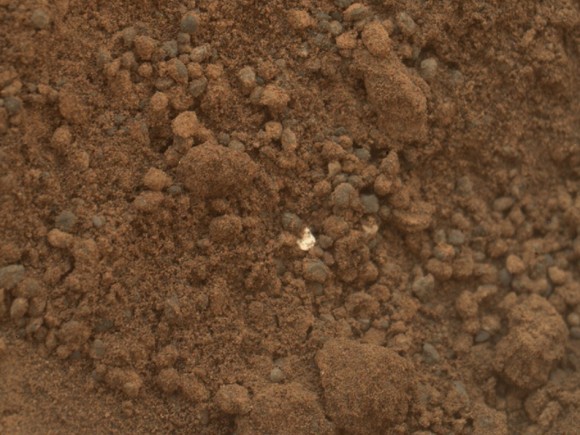
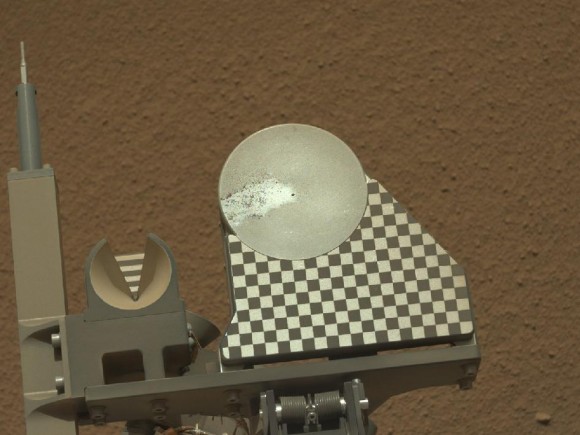
Last weekend, Curiosity began conducting the “scooping” portion of its mission; in essence, taking samples of Martian soil from the area known as the Rocknest, and examining them using it’s array of sensors. In the course of doing so, it came across another interesting find – a series of shiny objects, not unlike the small shard of plastic it had discovered ten days earlier.

However, NASA indicated after a preliminary examination that unlike that shard of plastic, these objects did not come from Curiosity itself. According to John Grotzinger, a project scientist with the Mars Science Laboratory, “As the science team thought about it more and more, the bright object is about the same size as the granules that it’s in and it is not uniformly bright. We went back and forth, and the majority of the science team thinks this is indigenous to Mars.”

One hypothesis is that the specks are natural geologic material that might have a broken-off from larger crystalline formations, known as a cleavage, and became dispersed through the soil. These crystalline minerals are more adept at reflecting sunlight than the soil that contains them, hence why they appeared after Curiosity’s scooping exposed them to Martian daylight.

According to Grotzinger, the next step is to examine them using the ChemCam, “a remote sensing tool that has spectacular spatial resolution, and aim it right on that fleck. Then we’ll aim it on another darker grain and try to decide if it is a different class of mineral.” And that’s just one of the fancy tools it will be employing. Another is the Chemistry and Mineralogy (CheMin) instrument, which analyzes samples of dirt to determine what minerals the sample contains. The team announced at a press conference the rover successfully placed a small sample of soil inside this sensor, and expects results in short order.

Stay tuned for more new from Mars!

Source: Universe Today

Space Shuttle Endeavour’s 2-Day Drive Through LA

Last week, amidst massive crowds and plenty of photo ops, the Space Shuttle Endeavour made a two day circuit of Los Angeles in order to mark its retirement. This was Endeavour’s 26th mission, the previous 25 having all taken place in orbit of the planet, a full 4671 orbits to be precise! During this time, Photographer/cinematographer Matthew Givot and his team followed the shuttle during the 2-day ‘endeavor’ – a drive that included photo-ops of the shuttle driving past several well-known L.A. landmarks – and compiled the footage into a nice 3-minute video (see below).

Showing the many twists and turns that were involved, not to mention stops for photo shoots and the crowds who showed up to pay their respects, the video concludes with Endeavour being brought into her new home, the California Science Center, where she will remain on display for years to come. Here, she joins such historic air and space craft as the A 12 Blackbird, the Apollo-Soyuz command module, Explorer 1, and the Viking Lander. Exhibitions for the Endeavour are reported to begin on October 30th, and are expected to draw some serious crowds!

On a side note, I have to admit that I feel bad for neglecting to mention Endeavour in any of my previous posts. For months now, news has been coming in about its final mission, but I was so caught up in my own story work and posts about cybernetics and other such stuff that I completely passed over it. I’m hoping this sets things to rights a little, as it would be a travesty if I didn’t acknowledge the retirement of this veteran spacecraft and all its accomplished over the years. Not to mention all the astronauts its delivered home, safe and sound. Good work, Endeavour! Enjoy the retirement, you’ve earned it!

Source: Universe Today, California Science Center

Also, if you want to see more of Endeavour’s cross-LA drive, Robert Pearlman has a gallery of over 150 images at collectSPACE.com, and NASA’s Flickr page has a huge collection, too.

The Case for Terraforming Venus

This weekend appears to be shaping up with a theme: news from space that isn’t about Mars. I swear that it’s entirely accidental. First there was the discovery of the diamond planet, 55 Cancri e, and now a story about the merits of terraforming another planetary neighbor. And wouldn’t you know it, it’s not Mars for a change.

Yes, it seems that there is a strong case for terraforming Venus instead of the Red Planet, and it comes from numerous scientists who claim that altering the climate on that planet could help us save our own. The reason being – and stop me if this sounds frightening – is because our planet could one day look just like our lifeless, acid ridden, cloud covered neighbor.

In short, Venus underwent a carbon-dioxide fueled cataclysm a long time ago, when it was still young and was believed to have oceans. In those early days, and as the sun got brighter, Venus’s oceans began to boil and evaporate into the atmosphere. As a result, carbon dioxide accumulated in the atmosphere, due in part to the lack of carbon recycling which depends on the presence of oceans and seaborne algae. This is essentially a magnified version of the Greenhouse Effect, which scientists identify as the reason for rising temperatures and melting polar ice caps here at home.

Because of this, Venus became the hot, deadly planet that we are familiar with today, with surface temperatures that average 467°C (872°F), hot enough to melt lead. What’s more, its atmosphere consists of 96% carbon dioxide, which appear as thick layers of clouds that float 50-70 km above the surface. Above that, clouds and mist of concentrated sulfuric acid and gaseous sulfur dioxide lead to acid rains that could literally melt the flesh off your bones and the metal off a landing craft. Combined with the amount of sunlight it gets (twice that of Earth) and the lack of a magnetosphere, Venus is a pretty damn awful place to visit!

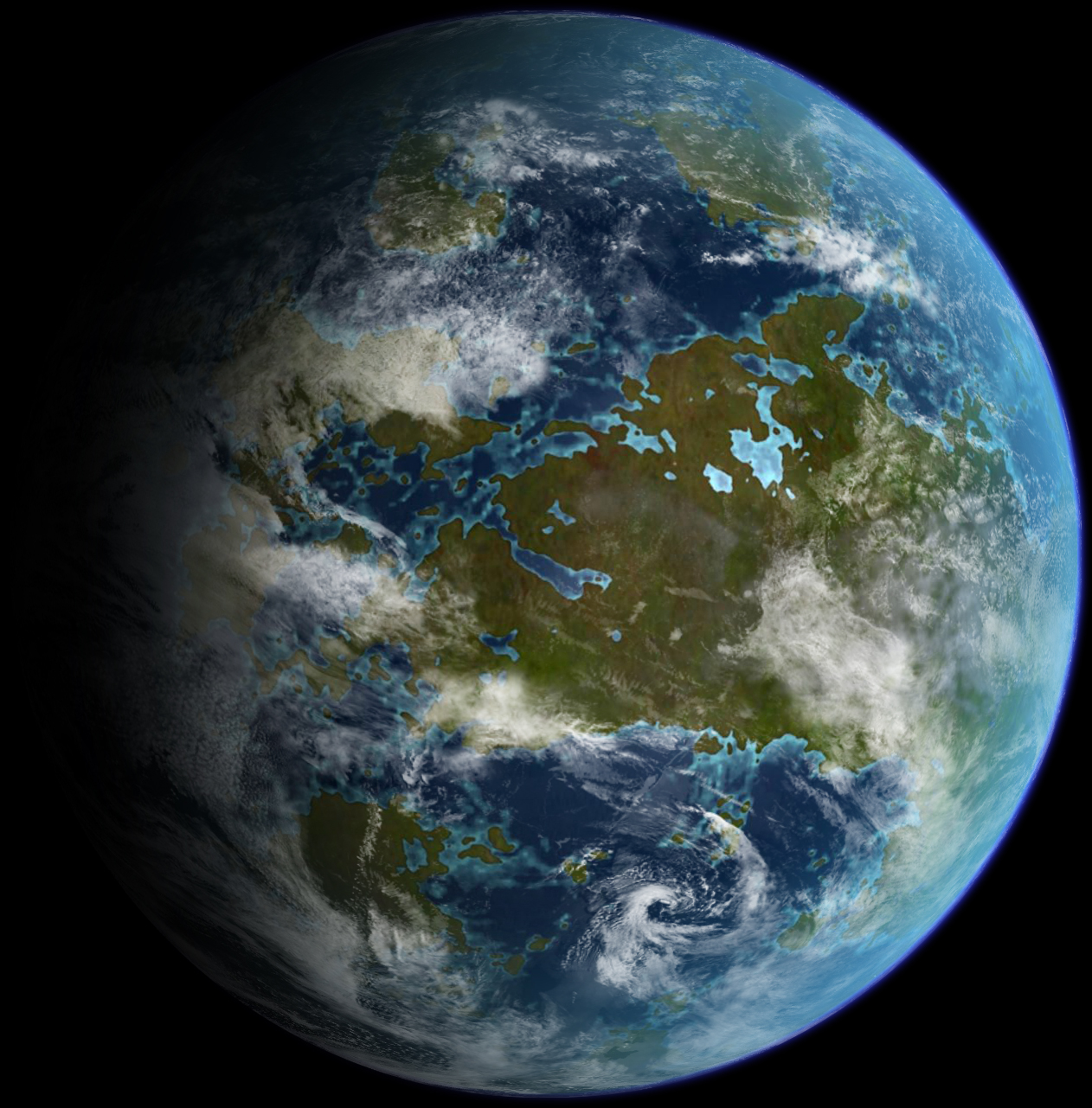
Of course, some would say that this makes terraforming the planet a pretty dangerous and poor prospect, at least compared to Mars. However, the benefits of terraforming Venus are far greater, certainly when we consider that the lessons gleamed from it could help us reverse the Greenhouse Effect here on Earth. In addition, it’s closer than Mars, making it easier and quicker to travel back and forth. And like the Earth, it resides within the solar system’s habitable zone and has its own atmosphere, not to mention it is nearly the same mass and size as Earth.
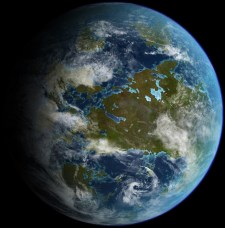
All of this, when taken together, would make Venus a far more suitable place to live once the terraforming process was complete. In short, its easier to convert an existing atmosphere than to create one from scratch. And, as noted, the process of converting the CO2 and sulfur-rich atmosphere into one that a breathable one that is rich with water and precipitation would go a long way to helping us device solutions to cleaning up our own atmosphere here at home.

This may sound like pure speculation, but in truth, many solutions have already been proposed. In fact, Carl Sagan began proposing that we introduce genetically-modified airborne algae into Venus atmosphere 50 years ago. Thought not 100 percent practical, it was a stepping stone to some more recent ideas which may prove doable. In 1981, NASA engineer James Oberg proposed that all the CO2 could be blown out into space. Again, not the most practical idea, but they were thinking and that’s what matters!

More recently, Paul Birch, a writer for the British Interplanetary Society, proposed flooding Venus with hydrogen. Once it interacting with the high concentrations of CO2 in the atmosphere, the end products would be graphite and plenty of water. Other plans involve carbon capture, nanotechnology, and other advanced forms of ecological engineering. These, alone or in combination, could prove to be the difference between thick glass clouds and sulfuric oceans and a lush green planet covered with water and vegetation.

A pretty interesting prospect; and if it all works out, humanity could end up with three habitable planets within the Solar System alone. Combined with pressure domes and sealed arcologies on the system’s various moons and larger asteroids, planet Earth could one day retire as the sole host of humanity and this thing we call “civilization”. In fact, I could foresee a time when our world goes on to become hallowed ground, hosting only a few hundred million people and free of heavy industry or urban sprawl. Hello idea for a story!

And, to mix up what I usually say at the end of every one of these posts, stay tuned for more news from Mars and other planets within our Solar System. There’s a lot of them out there, and someday, they might all places that our species calls “home”.

Source: IO9

A Diamond Bigger Than Earth

Some interesting news from space these days, and for once didn’t have to do with Mars. For many years, scientists at NASA and other space agencies have known about 55 Cancri e, an extrasolar planet that orbits the Sun-like star 55 Cancri A that is approximately 41 years from our system. Up until recently, it was believed that this planet was a “Super-Earth”, a planet many times the mass of Earth composed of granite.

Recently, however, scientists have announced that the planet may in fact be composed of carbon. That means, in essence, that the surface is composed of graphite and diamond. These findings come as part of a study that was released by the Institut de Recherche en Astrophysique et Planetologie in Toulouse, France. Nikku Madhusudhan, a Yale researcher who was part of the project, estimates that at least a third of the planet’s mass, the equivalent of about three Earth masses, could be diamond.

Imagine that, three entire Earth’s worth of diamonds! The mind reels at the staggering amount of wealth and opulence that this planet could produce, if only human mining teams were able to access it. However, surface conditions might complicate that a little. According to that same report, the planet is incredibly hot, with temperatures on its surface reaching 1,648 Celsius (3,900 degrees Fahrenheit). Not exactly cozy, by Earth standards.

Speaking of which, this is another aspect of the discovery which is proving exciting. According to Madhusudhan, “This is our first glimpse of a rocky world with a fundamentally different chemistry from Earth,” adding that the discovery of the carbon-rich planet meant distant rocky planets could no longer be assumed to have chemical constituents, interiors, atmospheres, or biologies similar to Earth. And he’s not alone is suspecting that discoveries like this are just the tip of the iceberg, as we work our way further out into the universe and discover more examples of strange and exotic exoplanets.

Source: Yahoo News.ca