Aerospace Travel: Los Angeles to Tokyo in One Hour

spaceshiptwo_flightGiven my busy schedule of late, some stories have been sitting in my stack for some time and I haven’t been able to write about them. But one’s like this are too cool to pass up, so here’s a belated acknowledgement. It seems that Virgin Galactic, having now demonstrated its ability to conduct aerospace tourism, has decided to enter into phase two of its plans for the future: aerospace travel!

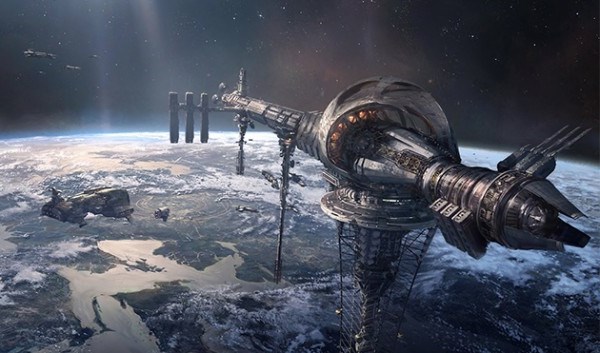
In the scenario they are proposing, their planes would fly customers from Los Angeles to Tokyo, and the transit would take one hour. The takeoff system would be similar to the midair launch the company uses now with the SpaceShipTwo. Basically, a large plane flies the spacecraft off the ground, drops it in midair, a hybrid rocket engine ignites, and the spacecraft ascends into lower orbit.

spaceshiptwo-2nd-flight-2A system like this would allow patrons to fly from the West Coast to Japan in an hour, or from the United Kingdom to Australia in two hours. This is according to statements made by Virgin Galactic’s CEO, George Whitesides, back in September at a company event at New York City’s Museum of Natural History:

You can imagine a SpaceShipThree or a SpaceShipFour going outside the atmosphere, then coming back down outside an urban area and landing. We don’t have to accept the status quo. We can imagine a vehicle using liquid oxygen or liquid hydrogen to get us across the Pacific in an hour. You could do that.

For those following Branson’s exploits, this announcement should come as no surprise. For years, he has been attempting to create a supersonic airline of his own. But when a paradigm-shifting idea like “point-to-point suborbital space transportation” becomes possible, he began to sets his sights a little higher (so to speak).

Spaceshiptwo-580x256Naturally, there are a few things that need to be worked out and tested before that’s possible, but it’s entirely within the realm of possibility. In fact, the European Space Agency has been researching the idea and claimed that SpaceShipOne and SpaceShipTwo are the most promising space launch mechanisms they’ve seen to date.

Naturally, there is the nagging question of cost. If aerospace travel does become feasible, who exactly will be able to afford it? So far, Virgin Galactic’s suborbital spaceflight have attracted hundreds of customers, but at a cost of $250,000 per head. It seems unlikely that these same people would pay a quarter of a million dollars just to travel halfway around the world. And some experts maintain that the industry will fail strictly because of the costs involved.

space-trip-klmDerek Webber, is one such person. As the executive director of Spaceport Associates, he wrote a paper in 2008 that explored the idea:

Credible market studies have not been done, or at least published. The optimum technical design has not been established. The ground infrastructure is not in place… Price levels are uncertain. It is not even clear whether such flights are best characterized as tourism or as transportation; whether the passengers would be primarily tourists or business persons on urgent trips.

Nevertheless, these doubts are doing nothing to stem the flow of investment and research being made by aerospace organizations and companies. For years, KLM Royal Dutch Airlines – the national air carrier of the Netherlands – has been developing a rocket-powered sub-orbital craft of its own. California-based XCOR Aerospace also has the Lynx – a hypersonic plane that could fly between New York and Tokyo in just 90 minutes.

XCORReaction Engines Limited is also developing the Skylon hypersonic engine for commercial spacecraft, much in the same way that Boeing and NASA are  developing the X-37B space plane. While these efforts are aimed at creating reusable spacecraft that could deploy satellites and deliver crew and supplies into orbit, they are also laying the groundwork for commercial transportation that takes people into orbit.

Meanwhile, DARPA and the US Marine Corps have been working on developing their own point-to-point rockets for delivering supplies and people for roughly a decade now and the Federal Aviation Administration’s 2010 report noted that:

[the] potential for the rapid global transport of passengers and the fast distribution of goods and services make point-to-point transportation an attractive space technology concept worth exploiting.

So while a price breakdown may be lacking, and the expected costs limiting, the technology is still in its infancy and it seems likely that the future of transportation lies in space. Beyond rapid transit and space tourism, it may very well be how airlines ferry people to and from their destinations in the not-too-distant future.

Source: motherboard.vice.com

Latest Articles Over At Universe Today!

center_universe2As the title would suggest, my third and fourth articles have just been published over at Universe Today. First off, let me assure people that I plan to post a link to UT in the near future so I don’t feel the need to do this every time a new article comes out. But since this is still a new experience to me, I naturally feel the need to share whenever a new one is published.

The first of the two, which was published on Monday, deals with a recent determination made about the source of the Moon’s water. This is based on research conducted by scientists over at the National Museum of Natural History in Paris. Back in 2009, India’s Chandrayaa-1 probe conducted a near-infrared survey of the Moon during a flyby that showed signs of surface water.

moon_waterAfter years of speculation that claimed that the surface water – which exists strictly in icy form – was deposited there by meteors and comets, the National Museum team concluded that its actually formed by solar wind interacting with oxygen in the Moon’s surface dust. Quite the odd little occurrence; but then again, even Mercury appears to have icy spots on it’s molten surface.

www.universetoday.com/115215/water-on-the-moon-was-blown-in-by-solar-wind/

The second is about a recent collaboration between NASA and SpaceX. While the latter was testing their Falcon 9 rockets, NASA filmed the performance using Infrared cameras. The information gleamed from this is helping SpaceX to develop their reusable rocket, but will also help NASA to figure out how they will land habitats and heavy equipment on the surface of Mars.

NASA_thermal1Sort of a win-win scenario, one that shows how the public and private sector are working together like never before to make the future of space exploration happen. And it’s another indication of just how serious NASA and its partners are in making a mission to Mars a reality.

www.universetoday.com/115408/how-nasa-and-spacex-are-working-together-to-land-on-mars/

Feel free to check them out, and stay tuned for the next subject of interest: Dark Matter Emanating From The Sun!

Bad New from Mars: First Colonists Doomed!

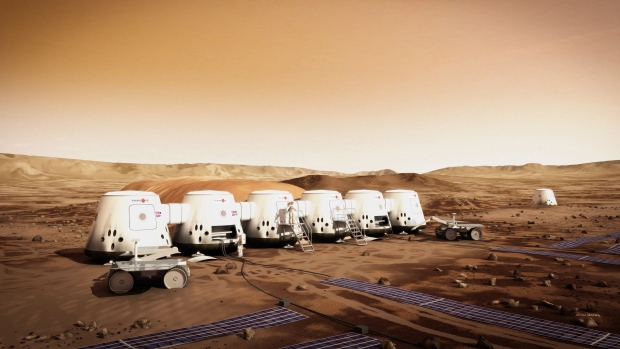
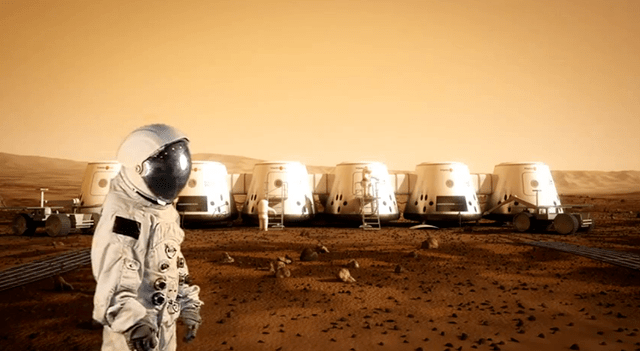
Mars_exploreWith the exploration of Mars continuing apace and a manned missions looming, there has been an explosion of interest in the idea of one day settling the planet. As the non-profit organization known as Mars One can attest, many people are  interested in becoming part of a mission to colonize the Red Planet. In fact, when they first went public, some 200,000 people signed on to become part of the experience.

The fact that the trip would be one-way and that the  plans for getting them there did not yet exist was not an deterrent. But if a recent study from MIT is to be believed, those who choose to go will and have the experience televised will be in for a rather harsh experience. According to a feasibility study produced by researchers at the Institute, the plan has potentially deadly and astronomically expensive flaws.

mars_revelationspaceAfter analyzing the Mars One mission plan, the MIT research group found that the first astronaut would suffocate after 68 days. The other astronauts would die from a combination of starvation, dehydration, or incineration in an oxygen-rich atmosphere. The analysis also concludes that 15 Falcon Heavy launches – costing around $4.5 billion – would be needed to support the first four Mars One crew.

The technology underpinning the mission is rather nebulous; and indeed, that’s where the aerospace researchers at MIT find a number of potentially catastrophic faults. While the technology to set up a colony on Mars does technically exist, most of it is at a very low technology readiness level (TRL) and untested in a Mars-like environment. And the prediction that things will be worked out with time and crowdfunding does not appear to be sufficient.

Mars_one2Mars One will rely heavily on life support and in-situ resource utilization (ISRU) – squeezing water from Martian soil and oxygen from the atmosphere. But these technologies are still a long way off large-scale, industrial use by a nascent human colony on Mars. NASA’s next Mars rover will have an ISRU unit that will make oxygen from the Red Planet’s atmosphere of CO2 – but that rover isn’t scheduled to launch until 2020, just two years before the planned launch of Mars One.

Originally, Mars One’s sign-up list included some 200,000 candidates. That number has now been whittled down to 705 – a fairly even mix of men and women from all over the world, but mostly the US. Several teams of four astronauts (two men, two women) will now be assembled, and training will begin. The current plan is to send a SpaceX Falcon Heavy rocket carrying the first team of four to Mars in 2022 – just eight years from now. 

spaceX-falcon9The whole thing will be televised as a reality TV show, an instrinsic part of the plan since much of the funding is expected to come from media sponsors and advertisers. In the interim, a number of precursor missions – supplies, life-support units, living units, and supply units – will be sent to Mars ahead of the human colonizers. More colonists will be sent fairly rapidly thereafter, with 20 settlers expected by 2033.

The new feasibility study was led by Sydney Do, a PhD candidate at the Massachusetts Institute of Technology who has done similar studies on other space missions. Do and his team ran a computer simulation based on publicly available information about the Mars One plan and the kinds of technologies it would rely on. The researchers entered data about the crew’s age, weight and activities to find out how much food, oxygen and water they would need.

Mars_GreenhouseThey took into account information from Mars One, such as its plan that “food from Earth will only serve as emergency rations” and the astronauts will mainly eat fresh food they grow themselves. The simulation monitored conditions in the Mars One habitat over 26 months – the amount of time between spaceships from Earth that would resupply them – or until the death of a crew member, whichever came first.

The results of their study were presented in a paper at the International Astronomic Union conference in Toronto last month. They suggest that serious changes would need to be made to the plan, which would either call for the astronauts to grow all their plants in a unit isolated from the astronauts’ living space to prevent pressure buildup in the habitats, or import all food from Earth instead of growing it on Mars.
mars_one2The researchers recommend the latter, as importing all the necessary food along with the first wave of colonists (not including the costs of development, operations, communications, and power systems) would cost $4.5 billion and require 15 Falcon 9 Heavy Rockets to transport it. Comparatively, flying all the equipment needed for the astronauts to grow their own food indefinitely which cost roughly $6.3 billion.

On top of all that, Do and his research staff have concluded that the project will not be sustainable financially. While Mars One says each subsequent manned mission will cost $4 billion, Do’s study found that each mission would cost more than the one before, due to the increasing number of spare parts and other supplies needed to support an increasing number of people.
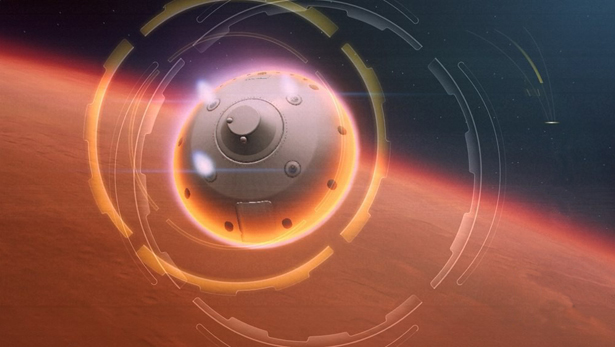
mars_roverNaturally, Mars One replied that they are not deterred by the study. CEO and co-founder Bas Landorp – who helped develop the mission design – said the plan was based on the company’s own studies and feedback from engineers at aerospace companies that make space systems, such as Paragon Space Development and Lockheed Martin. He added that he and his people are “very confident that our budgets, timelines and requirements are feasible”.

In any case, the study does not claim that the plan is bogus, just that it may be overreaching slightly. It’s not unreasonable to think that Mars One could get people to Mars, but the prospects for gradually building a self-sustaining colony is a bit farfetched right now. Clearly, more time is needed to further develop the requisite technologies and study the Martian environment before we start sending people to live there.
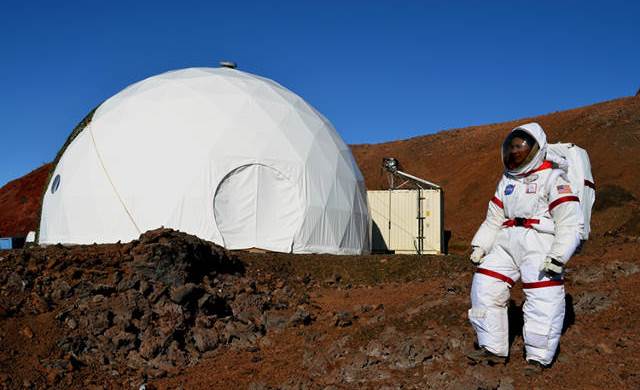
Mars_simulationOh well, people can dream can’t they? But the research and development are taking place. And at this point, it’s a foregone conclusion that a manned mission to Mars will be happening, along with additional robot missions. These will help lay the groundwork for eventual settlement. It’s only a question of when that could happen…

Sources: cbc.ca, extremetech.com, web.mit.edu

News from Space: We’re Going to Mars!

marsAs part of their desire to once again conduct launches into space from US soil, NASA recently awarded commercial space contracts worth $6.8 billion to Boeing and SpaceX. But beyond restoring indigenous spaceflight capability, NASA’s long-term aim is clearly getting a manned mission to Mars by 2030. And in assigning the necessary money to the companies and visionaries willing to help make it happen, they just might succeed.
As per the agreement, Boeing will receive $4.2 billion to finance the completion of the CST-100 spacecraft, and for up to six launches. Meanwhile, SpaceX is receiving $2.6 billion for its manned Dragon V2 capsule, and for up to six launches. NASA expressed excitement its collaboration with both companies, as it frees the agency up for bigger projects — such the development of its own Space Launch System (SLS).
elon-musk-on-mars-curiosity-self-640x353One person who is sure to be excited about all this is Elon Musk, SpaceX founder, CEO, and  private space visionary. With this big infusion of cash, he has apparently decided that it’s time to bring his plans for Mars forward. Ever since 2007, Musk has indicated a desire to see his company mount a manned mission to Mars, and now he may finally have the resources and clout to make it happen.

These plans include flying astronauts to Mars by 2026, almost a decade before NASA thinks it will. By late 2012, he even spoke about building a Mars Colony with a population in the tens of thousands, most likely established sometime during the 2020’s. As of this past year, he has also revealed details about a Mars Colonial Transporter (MCT), an interplanetary taxi that would be capable of ferrying 100 people at a time to the surface.

Fan art concept of the MCT
Fan concept art of the MCT

And then in February of this year, SpaceX began developing the MCT’s engines. Known as the Raptor, this new breed of large engine reportedly has six times the thrust of the Merlin engines that power the second stage of the Falcon 9 rocket. Now that the company has the financial resources to dream big, perhaps the MCT might move from the development stage to prototype creation.

And there is certainly no shortage of desire when it comes to sending people to the Red Planet. Together with Mars Society president Robert Zubrin, and Mars One co-founder Bas Lansdorp, crowdfunded organizations are also on board for a manned mission. The case for settling it, which Musk himself endorses, is a good one – namely, that planting the seed of humanity on other worlds is the best way to ensure its survival. 

Earth_Mars_ComparisonAnd as Musk has stated many times now, a manned mission Mars is the reason there is a SpaceX. Back in 2001, while perusing NASA’s website, he was perturbed to find that the space agency had nothing in the way of plans for a mission to Mars. And the best time to go is probably in about 15 or 20 years, since Mars will be at its closes to Earth by then – some 58 million kilometers (36 million miles).

During this window of opportunity, the travel time between Earth and Mars will be measured in terms of months rather than years. This makes it the opportune time to send the first wave of manned spacecraft, be they two-way missions involving research crews, or one-way missions involving permanent settlers. Surprisingly, there’s no shortage of people willing to volunteer for the latter.

Mars_one1When Mars One posted its signup list for their proposed mission (which is slated for 2025), they quickly drew over 200,000 applicants. And this was in spite of the fact that the most pertinent details, like how they are going to get them there, remained unresolved. Inspiration Mars, which seeks to send a couple on a round trip to Mars by 2021, is similarly receiving plenty of interest despite that they are still years away from figuring out all the angles.

In short, there is no shortage of people or companies eager to send a crewed spaceship to Mars, and federal agencies aren’t the only ones with the resources to dream big anymore. And it seems that the technology is keeping pace with interest and providing the means. With the necessary funding now secured, at least for the time being, it looks like the dream may finally be within our grasp.

Though it has yet to become a reality, it looks like the first Martians will actually come from Earth.

Sources: extremetech.com, (2)sploid.gizmodo.com, mars.nasa.gov

First Article Published at Universe Today!

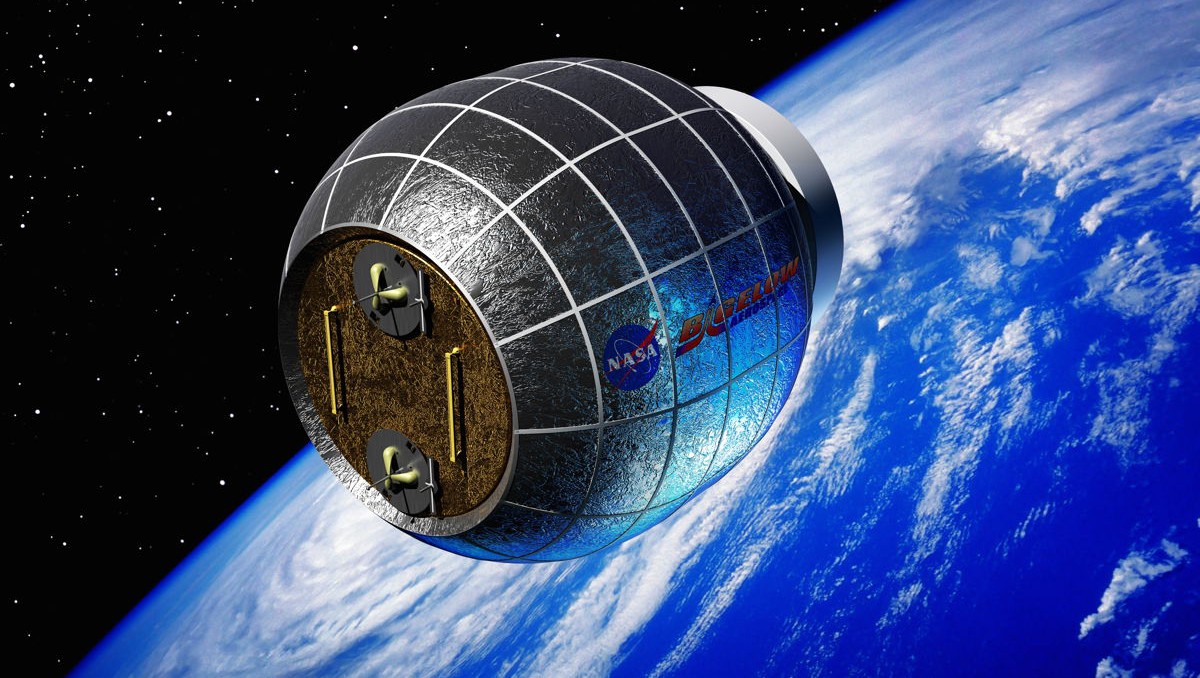
bigelow-expandable-activity-moduleHey all! Just wanted to let people know, my first article for Universe Today just went public. The subject of the article was the Bigelow Expandable Activity Module, a new type of space habitat that is being shipped to the ISS next year. Researching and writing the article itself was not unusual for me. It’s pretty much what I do here every single day. However, the real fun came in speaking to NASA and Bigelow Aerospace themselves via phone and email.

Interviewing the people behind big ideas and technological innovation is something a humble blogger like myself doesn’t get to do!  While I’ve really enjoyed talking to luminaries like Andraka and Makosinski in the past, this was a first for me. Looking forward to doing more of it in the near future!

In any case, follow the link below to check it out and don’t forget to comment and Like us on Facebook… no pressure 😉

www.universetoday.com

News from Space: “Life” Molecules Detected in Space!

SagitariusB2The secret to the creation to life in our universe appears to be seeding – the proper elements in the right mix in the right places to form the right kind of molecules. Only then can these molecules evolve chemically into more and more complex structures, thus following a general pathway toward biology. The pathway for life as we know it starts with carbon, but one which is specific organized and structured.

Recently, a team of astronomers  at the ALMA Observatory reported the discovery of this very element while probing distant galaxies. What they found was not just interstellar carbon, but a form of carbon with a branched structure. The discovery was made in the gaseous-star forming region known as Sagittarius B2 – a giant molecular cloud of gas and dust that is located about 390 light years from the center of the Milky Way.

radio-wave-dishesSimple carbon chains aren’t particularly unusual in the cosmos, but complex carbon is a different matter. It is what the researchers, based at Cornell University and the Max Planck Institute, describe as finding a molecular needle in a cosmic haystack. The actual molecule in question is isopropyl cyanide, and it was discerned thanks to the miracle known as radio astronomy.

Within clouds of interstellar dust and gas, elements find themselves shielded from the harsh radiation of open space and are, thus, free to form into more complex arrangements. These molecules don’t just sit there, but instead move around within their cloud-homes and bump into each other. The result of this activity are radio signals which can be detected light-years away – in this case, by radio telescopes here on Earth.

MaxPlanckIns_radiowavepulseEvery molecule has a different radio signal, so it’s possible to pick apart the contents of interstellar junk by examining a cloud’s frequency spectra. NASA, via the Ames Research Center, even maintains a radio-emission frequency database to aid in the tracking of polycyclic aromatic hydrocarbons, a form of molecule thought to contain much of the universe’s carbon stockpiles.

The branching carbon structure of isopropyle cyanide is of particular interest because it’s thought that this arrangement is a step on the way to the production of amino acids, the building blocks of proteins, and hence organic life. The discovery gives weight to the increasingly popular notion that life, or at least many of the key steps leading toward life, actually occurs off-planet.

alien-worldLife on Earth may have been well on its way while the planet was still just space dust waiting to come together into our rock-home. What’s more, the molecules discovered by the ALMA team probably aren’t alone.  As the authors, led by astronomer Arnaud Belloche, wrote:

[Isopropyle cyanide’s] detection therefore bodes well for the presence in the [interstellar medium] (ISM) of amino acids, for which such side-chain structure is a key characteristic… This detection suggests that branched carbon-chain molecules may be generally abundant in the [interstellar medium].

The discovery follows a general progression in recent years adding more and more life-ingredients to our picture of the ISM. A 2011 study revealed that complex organic matter should be created in large volumes from stars, while a 2012 report study found that conditions within the ISM are uniquely suited to the creation of increasingly complex molecules, “step[s] along the path toward amino acids and nucleotides, the raw materials of proteins and DNA, respectively.”

sugar-in-space-molecules_58724_990x742Also in 2012, astronomers working for ALMA found basic sugar molecules hanging out in the gas cloud around IRAS 16293-2422 – a young star located some 400 light-years from Earth. The particular form, glycoaldehyde, is thought to be a key component of the reaction behind the creation of DNA. Indeed, more and more, the universe is looking less and less like a harsh environment in which life must struggle to emerge, to a life factory.

Source: motherboard.vice.com

News from Mars: Mysterious Martian Ball Found!

Mars_ballThe rocky surface of Mars has turned up some rather interestingly-shaped objects in the past. First there was the Martian rat, followed shortly thereafter by the Martian donut; and very recently, the Martian thighbone. And in this latest case, the Curiosity rover has spotted what appears to be a perfectly-round ball. Even more interesting is the fact that this sphere may be yet another indication of Mars’ watery past.

The rock ball was photographed on Sept. 11 – on Sol 746 of the rover’s mission on Mars – while Curiosity was exploring the Gale Crater. One of Curiosity’s cameras captured several images of the centimeter-wide ball as part of the stream of photographs was taking. The scientists working at the Mars Science Laboratory based at NASA’s Jet Propulsion Laboratory (JPL), immediately began to examine it for indications of what it could be.

mars-selfie-01-140501As Ian O’Neill of Discovery News, who spoke with NASA after the discovery, wrote:

According to MSL scientists based at NASA’s Jet Propulsion Laboratory (JPL) in Pasadena, Calif., the ball isn’t as big as it looks — it’s approximately one centimeter wide. Their explanation is that it is most likely something known as a “concretion”… and they were created during sedimentary rock formation when Mars was abundant in liquid water many millions of years ago.

Curiosity has already found evidence of water at a dig site in Yellowknife Bay, which took place shortly after it landed in the Gale Crater two years ago. In addition, this is not the first time a Mars rover has found rocky spheres while examining the surface. In 2004, NASA’s Opportunity rover photographed a group of tiny balls made of a ferrous mineral called hematite. Opportunity photographed still more spheres, of a different composition, eight years later.

mars-blueberriesThe spheres likely formed through a process called “concretion”, where minerals precipitate within sedimentary rock, often into oval or spherical shapes. When the rock erodes due to wind or water, it leaves the balls of minerals behind and exposed. If in fact concretion caused the Mars spheres, then they would be evidence there was once water on the planet. However, some scientists believe the rock balls might be leftover from meteorites that broke up in the Martian atmosphere.

Curiosity is now at the base of Mount Sharp (Aeolis Mons) – The 5.6 km-high (3.5 mile) mountain in the center of Gale Crater – scientists are excited to commence the rover’s main science goal. This will consists of more drilling into layered rock and examining the powder so scientist can gain an idea about how habitable the Red Planet was throughout its ancient history, and whether or not it may have been able to support microbial life.

MarsCuriosityTrek_20140911_AMission managers will need to be careful as the rover has battered wheels from rougher terrain than expected. Because of this, the rover will slowly climb the slope of Mount Sharp driving backwards, so as to minimize the chance of any further damage. The Mars Reconnaissance Orbiter (MRO) will also be on hand to help, photographing the route from above to find the smoothest routes.

Despite the wear and tear that the little rover has experienced in its two years on the Martian surface, it has discovered some amazing things and NASA scientists anticipate that it will accomplish much more in the course of its operational history. And as it carried on with its mission to decode the secrets of Mars, we can expect it will find lots more interesting rocks – spherical, rat-shaped, ringed, femur-like, or otherwise.


Sources: cbc.ca, universetoday.com, news.discovery.com

The Future of Space: Smart, Stretchy, Skintight Spacesuits

biosuitSpacesuits have come a long way from their humble origins in the 1960s. But despite decades worth of innovation, the basic design remains the same – large, bulky, and limiting to the wearer’s range of movement. Hence why a number of researchers and scientists are looking to create suits that are snugger, more flexible, and more ergonomic. One such group hails from MIT, with a skin-tight design that’s sure to revolutionize the concept of spacesuits.

The team is led by Dava Newman, a professor of aeronautics and astronautics and engineering systems at MIT who previewed her Biosuit – playfully described by some as a “spidersuit” – at the TEDWomen event, held in San Fransisco in December of 2013. Referred to as a “second skin” suit, the design incorporates flexible, lightweight material that is lined with “tiny, muscle-like coils.”

mit-shrink-wrap-spacesuitSpeaking of the challenges of spacesuit design, and her team’s new concept for one, Dava Newman had the following to say in an interview with MIT news:

With conventional spacesuits, you’re essentially in a balloon of gas that’s providing you with the necessary one-third of an atmosphere [of pressure,] to keep you alive in the vacuum of space. We want to achieve that same pressurization, but through mechanical counterpressure — applying the pressure directly to the skin, thus avoiding the gas pressure altogether. We combine passive elastics with active materials.

Granted, Newman’s design is the first form-fitting spacesuit concept to see the light of day. Back in the 1960’s, NASA began experimenting with a suit that was modeled on human skin, the result of which was the Space Activity Suit (SAS). Instead of an air-filled envelope, the SAS used a skin-tight rubber leotard that clung to astronaut like spandex, pressing in to protect the wearer from the vacuum of space by means of counter pressure.

SAS_spacesuitFor breathing, the suit had an inflatable bladder on the chest and the astronaut wore a simple helmet with an airtight ring seal to keep in pressure. This setup made for a much lighter, more flexible suit that was mechanically far simpler because the breathing system and a porous skin that removed the need for complex cooling systems. The snag with the SAS was that materials in the days of Apollo were much too primitive to make the design practical.

Little progress was made until Dava Newman and her team from MIT combined modern fabrics, computer modelling, and engineering techniques to produce the Biosuit. Though a far more practical counter-pressure suit than its predecessor, it was still plagued by one major drawback – the skintight apparatus was very difficult to put on. Solutions were proposed, such as a machine that would weave a new suit about the wearer when needed, but these were deemed impractical.

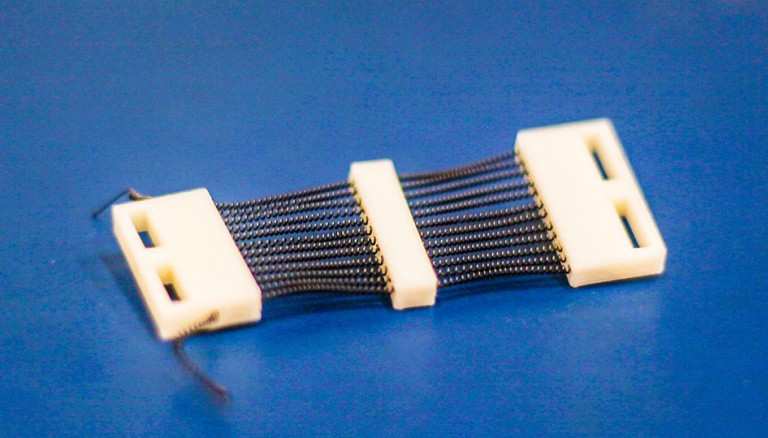
mit-shrink-wrap-spacesuit-0The new approach incorporates coils formed out of tightly packed, small-diameter springs made of a shape-memory alloy (SMA) into the suit fabric. Memory alloys are metals that can be bent or deformed, but when heated, return to their original shape. In this case, the nickel-titanium coils are formed into a tourniquet-like cuff that incorporates a length of heating wire. When a current is applied, the coil cinches up to provide the proper counter pressure needed for the Biosuit to work.

Bradley Holschuh, a post-doctorate in Newman’s lab, originally came up with the idea of a coil design. In the past, the big hurdle to second-skin spacesuits was how to get astronauts to squeeze in and out of the pressured, skintight suit. Holschuh’s breakthrough was to deploy shape-memory alloy as a technological end-around. To train the alloy, Holschuh wound raw SMA fiber into extremely tight coils and heated them to 450º C (842º F) to fashion an original or “trained” shape.

mit-shrink-wrap-spacesuit-3 When the coil cooled to room temperature, it could be stretched out, but when heated to 60º C (140º F), it shrank back into its original shape in what the MIT team compared to a self-closing buckle. As spokespersons from MIT explained:

The researchers rigged an array of coils to an elastic cuff, attaching each coil to a small thread linked to the cuff. They then attached leads to the coils’ opposite ends and applied a voltage, generating heat. Between 60 and 160 C, the coils contracted, pulling the attached threads, and tightening the cuff.

In order to maintain it without continually heating the coils, however, the team needs to come up with some sort of a catch that will lock the coils in place rather than relying on a continuous supply of electricity and needlessly heating up the suit – yet it will still have to be easy to unfasten. Once Newman and her team find a solution to this problem, their suit could find other applications here on Earth.

Image converted using ifftoanyAs Holschuh explained, the applications for this technology go beyond the spacesuit, with applications ranging from the militarized to the medical. But for the moment, the intended purpose is keeping astronauts safe and comfortable:

You could [also] use this as a tourniquet system if someone is bleeding out on the battlefield. If your suit happens to have sensors, it could tourniquet you in the event of injury without you even having to think about it… An integrated suit is exciting to think about to enhance human performance. We’re trying to keep our astronauts alive, safe, and mobile, but these designs are not just for use in space.

Considering the ambitious plans NASA and other government and private space agencies have for the near-future – exploring Mars, mining asteroids, building a settlement on the Moon, etc. – a next-generation spacesuit would certainly come in handy. With new launch systems and space capsules being introduced for just this purpose, it only makes sense that the most basic pieces of equipment get a refit as well.

And be sure to check out this video of Dava Newman showing her Biosuit at the TEDWomen conference last year:


Sources:
gizmag.com, motherboard.vice.com
, newsoffice.mit.edu

The Future of Space: Building A Space Elevator!

space_elevator2Regularly scheduled trips to the Moon are one of many things science fiction promised us by the 21st century that did not immediately materialize. However, ideas are on the drawing board for making it happen in the coming decades. They include regular rocket trips, like those suggested by Golden Spike, but others have more ambitious plans. For example, there’s LiftPort – a company that hopes to build a space elevator straight to the Moon.

When he was working with NASA’s Institute for Advanced Concepts in the early 2000s, LiftPort President Michael Laine began exploring the idea of a mechanism that could get people and cargo to space while remaining tethered to Earth. And he is certainly not alone in exploring the potential, considering the potential cost-cutting measures it offers. The concept is pretty straightforward and well-explored within the realm of science fiction, at least in theory.

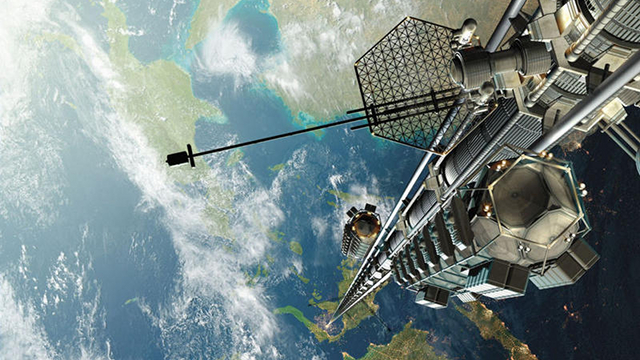
space_elevatorThe space elevator concept is similar to swinging a ball on a string, except it involves a tether anchored to the Earth that’s about 500 km long. The other end is in anchored in orbit, attached to a space station that keeps the tether taut. Anything that needs to be launched into space can simply be fired up the tether by a series of rocket-powered cars, which then dock with the station and then launched aboard a space-faring vessel.

Compared to using rockets to send everything into space, the cost using the elevator is far less (minus the one-time astronomical construction fee). And while the materials do not yet exist to construct 0ne, suggestions have been floated for a Lunar Elevator. Taking advantage of the Moon’s lower gravity, and using the Earth’s gravity well to stabilize the orbital anchor, this type of elevator could be built using existing materials.

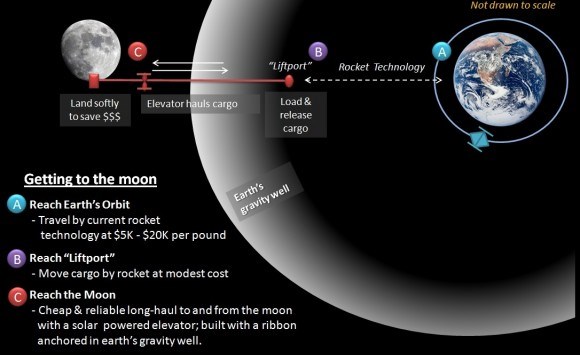
space_elevator_lunar1One such person is Laine, who believes the capability exists to build an elevator that would reach from to the Moon to a distance of 238,000 km towards the Earth. Hence why, started two and a half years ago, he struck out to try and bring this idea to reality. The concept behind the Moon Elevator is still consistent with the ball on the string analogy, but it is a little more complicated because of the Moon’s slow orbit around the Earth.

The solution lies in Lagrangian points, which are places of gravitational equilibrium between two bodies. It’s here that the gravitational pull of both bodies are equal, and so they cancel each other out. Lagrangian point L1 is about 55,000 kilometers from the Moon, and that’s the one Laine hopes to take advantage of. After anchoring one end of the “string” on the Moon’s surface, it will extend to L1, then from L1 towards Earth.

lunar_space_elevatorAt the end of the string will be a counterweight made up of all the spent pieces of rocket that launched the initial mission to get the spike into the Moon. The counterweight will be in the right place for the Earth to pull on it gravitationally, but it will be anchored, through the Lagrange point, to the Moon. The force on both halves of the “string” will keep it taut. And that taut string will be a space elevator to the Moon.

What’s more, Laine claims that the Moon elevator can be built off-the-shelf, with readily available technology. A prototype could be built and deployed within a decade for as little as $800 million, he claims. It would be a small version exerting just a few pounds of force on the anchor on the Moon, but it would lay the groundwork for larger follow-up systems that could transport more cargo and eventually astronauts.

liftportTo demonstrate their concept, LiftPort is working on a proof-of-concept demonstration that will see a robot climb the tallest free­standing human structure in existence. This will consist of three large helium balloons held together on a tripod and a giant spool of Vectran fiber that is just an eighth of an inch think, but will be able to support 635 kilograms (1,400 pounds) and withstand strong winds.

Vectran is the same material was used by NASA to create the airbags that allowed the Spirit and Opportunity’s rovers to land on Mars. Since it gets stronger as it gets colder, it is ideal for this high altitude test, which will be LiftPort’s 15th experiment and the 20th robot to attempt an ascent. Laine doesn’t have a prospective date for when this test will happen, but insists it will take place once the company is ready.

LiftPort1Regardless, when the test is conducted, it will be the subject of a new documentary by Ben Harrison. Having learned about Liftport back in 2012 when he stumbled across their Kickstarter campaign, Harrison donated to the project and did a brief film segment about it for Engadget. Since that time, he has been filming Liftport’s ongoing story as part of a proposed documentary.

Much like Laine, Harrison and his team are looking for public support via Kickstarter so they can finish the documentary, which is entitled “Shoot the Moon”. Check out their Kickstarter page if feel like contributing. As of the time of writing, they have managed to raise a total of $14,343 of their $37,000 goal. And be sure to check out the promotional videos for the Liftport Group and Harrison’s documentary below:

Lunar Space Elevator Infrastructure Overview:


Shoot the Moon – Teaser Trailer:


Sources:
 motherboard.vice.com
, lunarelevator.com

News from Aerospace: XS-1 Experimental Spaceplane

northrop-grumman-xs-1-spaceplaneThe race to produce a new era or reusable and cost-effective spacecraft has been turning out some rather creative and interesting designs. DARPA’s XS-1 Spaceplane is certainly no exception. Developed by Northrop Grumman, in partnership with Scaled Composites and Virgin Galactic, this vehicle is a major step towards producing launch systems that will dramatically reduce the costs of getting into orbit.

Key to DARPA’s vision is to develop a space-delivery system for the US military that will restore the ability of the US to deploy military satellites ingeniously. In a rather ambitious twist, they want a vehicle that can be launched 10 times over a 10-day period, fly in a suborbital trajectory at speeds in excess of Mach 10, release a satellite launch vehicle while in flight, and reduce the cost of putting a payload into orbit to US$5 million (a tenth of the current cost).

XS-1_1Under DARPA contracts, Boeing, Masten Space Systems, and Northrop Grumman are working on their own versions of the spaceplane. The Northrop plan is to employ a reusable spaceplane booster that, when coupled with an expendable upper stage, can send a 1360 kgs (3,000 pounds) spacecraft into low Earth orbit. By comping reusable boosters with aircraft-like operations on landing, a more cost-effective and resilient spacecraft results.

In flight, the Northrop version of the XS-1 will take advantage of the company’s experience in unmanned aircraft to use a highly autonomous flight system and will release an expendable upper stage, which takes the final payload into orbit. While this is happening, the XS-1 will fly back to base and land on a standard runway like a conventional aircraft, refuel, and reload for the next deployment.

Spaceshiptwo-580x256Northrop is working under a $3.9 million phase one contract with DARPA to produce a design and flight demonstration plan that will allow the XS-1 to not only act as a space launcher, but as a testbed for next-generation hypersonic aircraft. Meanwhile Scaled Composites, based in Mojave, will be in charge of fabrication and assembly while Virgin Galactic will handle commercial spaceplane operations and transition.

Doug Young, the vice president of missile defense and advanced missions at Northrop Grumman Aerospace Systems, had this to say about the collaboration:

Our team is uniquely qualified to meet DARPA’s XS-1 operational system goals, having built and transitioned many developmental systems to operational use, including our current work on the world’s only commercial spaceline, Virgin Galactic’s SpaceShipTwo. We plan to bundle proven technologies into our concept that we developed during related projects for DARPA, NASA and the U.S. Air Force Research Laboratory, giving the government maximum return on those investments.

space_elevator2Regardless of which contractor’s design bears fruit, the future of space exploration is clear. In addition to focusing on cutting costs and reusability, it will depend heavily upon public and private sector collaboration. As private space companies grab a larger share of the space tourism and shipping market, they will be called upon to help pick up the slack, and lend their expertise to more ambitious projects.

Examples abound, from putting satellites, supplies and astronauts into orbit, to landing settlers on Mars itself. And who knows? In the foreseeable future, NASA, Russia, China, the ESA and Japan may also be working hand-in-hand with transport and energy companies to make space-based solar power and a space elevator a reality!

Source: gizmag.com, globenewswire.com