Cool Cars

Just yesterday I was busy hearing about the new Zombie Car, an invention which is going to be unveiled at the next Comic Con. A collaboration between The Walking Dead’s Robert Kirkman and Hyundai, the car will essentially incorporate all the zombie-fighting features that a post-apocalyptic vehicle needs.

As it happens, one of my followers mentioned how this vehicle reminded her of the Batmobile and other cool cars. Between that and the allusions to Mad Max that the Zombie Car inevitably inspires, I got to thinking that this site is in need of a list of Cool Cars! And here it is, all the cool vehicles that have appeared in pop culture over the years, more often than not, as part of a science fiction franchise.

M577 APC:
Not so much a car as a tank, but she drives on four wheels and is VERY cool. So I don’t see why the M577 from the Aliens franchise shouldn’t be included on this list. Much like all APC’s, the purpose of this low-sitting but heavy hitting vehicle was to act as a battle taxi, deploying a squad of Marines to the field and then pulling them out in a hurry if things got harry. Designed to fit aboard a Cheyenne Dropship, it was part of the Colonial Marines quick deployment strategy.

As Hudson so righteously bragged in the movie, the M577 is decked out with some pretty impressive weaponry. For instance, the foldable turret mounted on the top carries a twin 20mW Boyars PARS-150 phased plasma cannon which is capable of making 1000 discharges. At the front end of the vehicle, a dual set of RE700 20mm Gatling cannons is built on a small swivel turret. In addition, it also carries plenty of small arms and munitions for its Marine compliments, consisting of pulse rifles, smart guns, flame units, grenades, rockets and even canisters of nerve gas.

Batmobile:
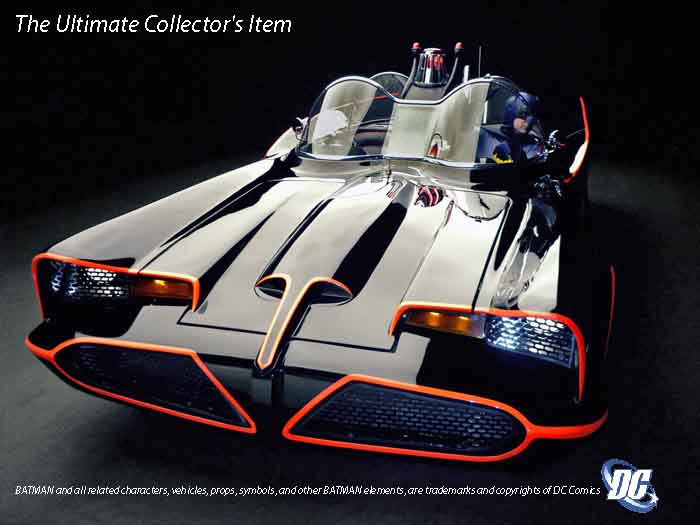
Now here’s a popular vehicle, so popular that’s gone through several variations over the years. From the campy 60’s version of the original Adam West series to the sculpted Burton remake to the Tumbler of the Nolan series, the Batmobile is a nostalgic icon which is constantly being reinvented. But all versions have two things in common. One, they’re crime-fighting specials, which means they have all kinds of gadgets and features. Two, they’re none to shabby to look at and probably a hell of a lot of fun to drive!

In the earliest Batman comics, the Batmobile was simply a sedan that served as Batman’s car. As time went on, it began to reflect Batman’s motif, including wing-shaped tailfins, dark colors, and even armor. Additional customizations, like crime-fighting gadgets also found their way into the design, and soon, a classic was born!

By the time of the original series, the Batmobile was based around the chassis of a Lincoln Futura and featured fully-functioning gadgets. These included a gas turbine, a Cable Cutter Blade, the Bat Ray Projector, a Batscope, Bat Eye Switch, Antenna Activator, Police Band Cut-In Switch, Automatic Tire Inflation Device, the Remote Batcomputer, the Batphone, Emergency Bat Turn Lever, Anti-Fire Activator, Bat Smoke, Bat Photoscope, and two rear-mounted ten-foot Deist parachutes.

Updated for the relaunch, Burton’s Batmobile built around the original concept but recieved a does of his characteristic grit and Gothic nature. As such, the new Batmobile’s aesthetics and gadgets were updated for the modern era and included a sleeker design, a more comprehensive turbine system, a sliding canopy, and of course retractable body armor! It also retained the idea of a 180 degree “Bat turn”, which this time around was made possible from lateral harpoons, and two .30 cal machineguns.

As the second movie demonstrated, the vehicle was also capable of shedding much of its body and collapsing into a narrow version of itself in case it needed to fit through tight spots. By the third movie, the design concept had changed considerably to feature bright sections beneath its segmented chassis. Over the top and impractical, this design was in keeping with Schumacher’s vision of a Batman where everything glittered and was campy, like the original series.

And last, the Nolan version. Here, the Batmobile was apparently inspired by Frank Miller’s The Dark Knight Returns, where it was depicted as a tank rather than a car, and the Spinners of the Blade Runner movie. In the first film, it is indicated that the design came from a military vehicle known as “The Tumbler”, which Bruce Wayne then modified for his personal use.

It’s features included a propane fueled jet engine, front-firing rockets, autocannons, caltrops, rear airbrakes, and a stealth mode. In the Dark Knight, it was also shown that in emergency situations, the front wheels can deploy to form the Batpod. Rumors also abound that the new version featured in The Dark Knight Rises will be capable of flight as well. Oooooh, five more days!

Delorean:
This time-traveling vehicle has placed this short-lived 80’s experiment permanently on people’s radar. Were it not for Back to the Future and it’s unapologetically 80’s feel, the Delorean would probably have faded into obscurity a long time ago. Much like the Futura, it was a short-lived concept that caught on because of its appearance on screen.

But of course, were it not for its unusual design features, such as the gull-wing doors, stainless steel paneling and fiberglass underbody, it would never have made its cinematic appearances in the first place. The set designers were looking for something futuristic-looking to fashion a time-machine out of, and this is what they found!

It’s futuristic features are quite straightforward: A flux capacitor which allows for time travel, a plutonium engine that fuels it, a series of internal controls to set and monitor the time computations, and some rear facing exhaust fans to give it that ultra-futuristic look! Only three remain in existence once filming of the three movies was finished. Two are the property of Universal Studios and are display items, the third is owned by a private collector who assembled and restored the original model.

Ecto-1:
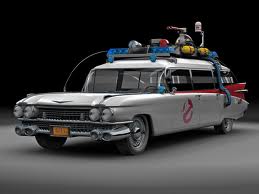
I shall not be making a “Who you gonna call?” reference here! Too obvious! Instead, let me just say that this car ought to be instantly familiar to anyone who grew up in the 80’s. If not, I’d be forced to wonder if you spent the entire decade in a cave or a cell somewhere, in which case, my sincere condolences!

Moving on, the Ecto-1 was the primary means of transport for the Ghostbusters. The car was built around the chassis of a 1959 Cadillac Miller-Meteor, which had been converted to act as an ambulance car. This is apparent from the realoader trunk and the car’s siren, which was retained by the Ghostbusters so they could make sure people stayed out of their way, and also to announce their arrival!

Additional features including a a special pull-out rack in the rear containing the staff’s proton packs, which facilitates a quick retrieval without the complication of having to reach into the vehicle’s rear. There are also various gadgets mounted on the top, whose function is never revealed in the movies. However, in the course of the cartoon adaptation, it is said that the vehicle carries a “proton cannon” on its roof, and has a vertical jump system built into the bottom. These allow the Ghostbusters to take on ghost with some heavy artillery, as well as clearing fences and other obstacles that lie between them and their deployment.

KITT:
Also known as Knight Industries Two Thousand, this talking car was featured in the popular 80’s show Knight Rider. In addition to being the “vehicle” (ha!) that launched Hasselhoff’s career, this car is one of the earliest instances where an AI was merged with a high-performance car.

Built around the chassis of a 1982 Pontiac Trans Am, the car was souped up with a number of features to give it that AI look and feel. These included the red-laser scanner bar at the front – which like the Cylons’, allowed KITT to “see” – a turbo boost that allowed him to make big jumps, an “alpha circuit” which allows KITT to drive himself, a Tri-Helical Plasteel 1000 MBS (molecular bonded shell) plating, a flame thrower, tear gas launcher, and even a laser.
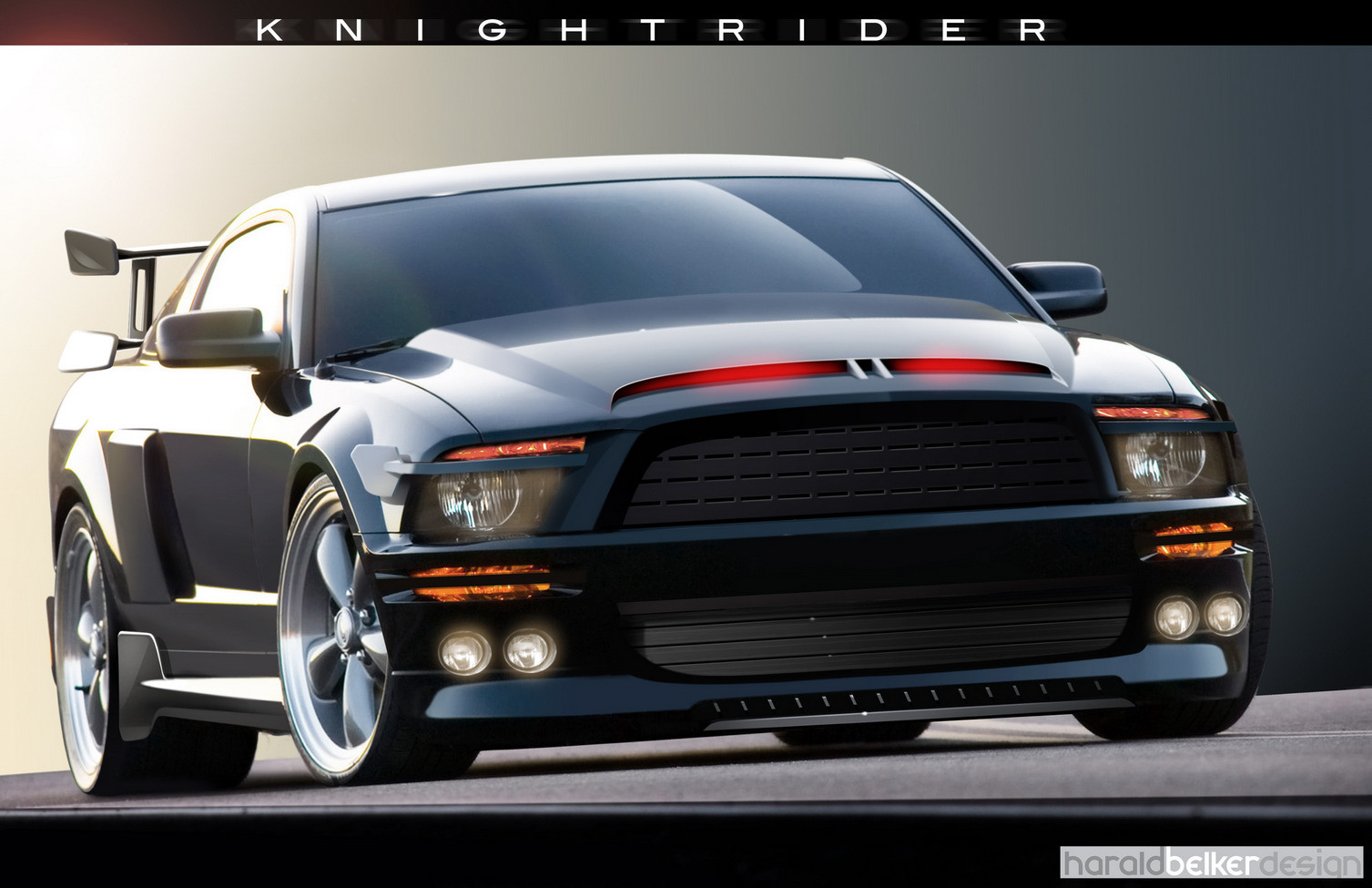
Inspiring several TV movies and a 2008 relaunch, the vehicle has gone through several redesigns and upgrades. In the updated series, the Trans Am chassis was traded in for a Mustang GT500KR and the molecular armor was traded in for nanotech polymer skin which is not only impregnable, but also capable of regeneration. Much of the other features, including the AI, scanners and defensive systems remained very much the same. However, the show only lasted single season, a possible indication that not all things 80’s are an instant success anymore.

Pursuit Special:
With all this talk about Mad Max, it was only a matter of time before this one crept into the list! Making multiple appearances in the franchise, the first car to hold this name was a modified Holden Monaro that was stolen and used by the “Night Rider” (not to be confused with Haffelhoff’s character). However, the more famous model was a modified 1973 Ford Falcon XB GT.

It was this car that Mad Max was offered as an incentive to stay with the force as their top pursuit man. Thought he initially refused it, he later used this same vehicle as his personal revenge weapon when evil men murdered his wife and child and had to be dealt with!

In terms of features, the main modifications on this car were the front nosecone, the eight individual exhaust side pipes, and a supercharger protruding through the bonnet. All of these alluded to the fact that the Pursuit Special was the fastest car in the force, capable of chasing down any road warriors that happened to be barreling down the highway.

In the sequel, the car was modified even further thanks to the success of the first film and a correspondingly larger budget. The new features included large petrol tanks fitted in the back to show that just how important a steady supply of petrol was to this car, not to mention within the context of the post-apocalyptic setting of Mad Max. The front end was also modified by removing the bottom section, which was in keeping with the design concept of making the car look more used and stressed.

Spinner:
So… it’s the 21st century, and yet there aren’t any flying cars. Screw hybrids and electrics, I was promised FLYING CARS! Well, according to the movie Blade Runner, we still have seven years before they are supposed to be a regular feature, at least as far as police cars go. And that’s the concept of a Spinner, in a nutshell –  a flying car used by the police of the future noire city of LA.

In addition to being able to drive as a ground car, the Spinner is also capable of vertical takeoff and landings and hovering at relatively high altitudes. Conceived by Syd Mead, the same man who designed concepts for Tron and Aliens, the vehicle was originally described as an “aerodyne” – a vehicle which directs air downward to create lift, though press kits for the film stated that the spinner was propelled by three engines: “conventional internal combustion, jet, and anti-gravity”.

I hope for their sake, they exaggerate! It’s going to be hard to come up with anti-gravity engines in just seven years time! In any case, the concept designs were built by Gene Winfield, the man who brought concepts to life for Batman, The Last Starfighter and Robocop as well as this. No indication was given as to what they used for a chassis, so I can only assume they built it up from spare parts and a classic was born!

So… seven years before these cars are supposed to be available, right? Ford, Toyota, GM, Hyundai, Subaru; all of you guys, get on it! Don’t make me come down there!

XXX GTO:
Last, but not least, we have the super-charge spy car on steroids from the movie XXX. As anyone who has seen this movie knows, Mr Vin Diesel, once undercover amongst a bunch of Russian mafia scumbags, decided he needed to have a classic muscle car. This he found in a 1967 Pontiac GTO hardtop. When circumstances demanded he start kicking some ass, he demanded that his spy buddies take all their precious gear and put it into the car.

Yes, that’s exactly how it happened. A table of guns, harpoons launchers, and assorted high tech gear lay in front of them. Behind the wheel, Diesel said “I want all of that… in here!” Within a few days, he got his wish. Featuring a folding seat which turns over to reveal a weapons rack, missiles mounted behind the lights, a flame thrower, and built-in machineguns.

And of course, all of this equipment had corresponding controls in the interior. These were to be found in a confusing array of millions of buttons and switches, along with an on-board GPS system built into the dashboard. Unfortunate that the car made only a brief appearance as part of the final chase scene.

Well that’s I got for this first installment in the series. I imagine people might have suggestions so please send them my way. Between ships, robots, guns, and now cars, I think we can just pay homage to just about every cool thing that’s ever come out of the realm of sci-fi and pop culture!

Cool Ships (volume XI)

Armageddon:
armageddonBack once more to the Eve universe, thank you Mr. Zidar for suggesting it in the first place! Here we have the Armageddon Battleship, the main heavy warship of the Amarr Empire. Packing a lot of firepower into its long, heavy frame, command of one of these is considered the greatest honor an Amarrian Captain can acheive within the Empire.

In terms of armaments, the Armageddon is studded with heavy turret batteries. Its forward section is also heavily reinforced, giving it the ability to ram into enemy ships while pulverizing them with weapon’s fire. It is also heavily shielded in addition to its armor, making it virtually impregnable to all but the most heavily armed cruisers.

Battle Galaxy Carrier:
battlegalaxy-carrierMuch like the SDF-1 from the Macross universe, the Galaxy Carrier is massive transforming ship that comes in two modes. In carrier mode, it is a massive ship that is capable of space flight and sea faring. In its battle mode, it takes the form of a massive mecha which is capable of kicking some very serious ass!

Build in the early-mid 21st century by the New United Nations government, its primary purpose was to act as a colonization vessel for the Macross fleet. And unlike previous colonization vessels, it boasted many new technologies – such as cybernetics and implants – which were meant to continually evolve as the ship traveled through space. On top of all that, it possesses cutting edge stealth technologies that make it capable of slipping past Zentraedi forces and blockades.

battlegalaxy-attackIn terms of armaments, the Battle Galaxy lives up to its name! In addition to an advanced Gunship Type Macross Cannon, which converts into its main firearm when in battle mode, it also has 12 heavy beam cannons (also available in battle mode), multiple phalanx beam cannons and missile launchers, and a compliment short range micro-missile batteries for point-defense.

Firstborn Monolith:
monolithIt would be an understatement to call this one a classic. Taken from the Arthur C. Clarke novel and the movie of the same name, the Monolith was the mysterious aliens means of transport in 2001: A Space Odyssey. Known as the Firstborn, this race was basically the first species to achieve sentience in the galaxy, making them many millions of years old. After eons of evolution and space exploration, these beings had basically evolved to the point where they were no longer flesh and blood.

So really, these monoliths were not so much ships as chariots to carry their uploaded consciousness to the stars. Composed of unknown material and impenetrable to everything from scanners to nuclear detonators, they were a mystery to humanity of the 21st century. It also didn’t help that the only man get within spitting distance of an operational one disappeared, his last words being “My God, it’s full of stars!”

GTF Ulysses:
gtf_UlyssesThis ship, taken once again from the Freespace gaming universe, was one of the fastest and most maneuverable ships in the known universe. A collaborative effort between Terran and Vasudan scientists, it possessed the best design features and technologies they could muster. The Ulysses was designed for service in the Great War, but because of its assets, it saw service with GTVA forces long after the Lucifer was destroyed and the last of the Shivans routed.

In terms of armaments, it was lightly armed compared to other fighters, with four gun mounts, but only two ordinance bays. In the end, its greatest assets were its speed and maneuverability which made it highly effective against faster Shivan ships. In a dog fight, few things could catch it, or get around fast enough to hit it!

Inhibitor Square:
black_cube_world-1024x768These are the mysterious, dark and malevolent machines from the Revelation Space universe. Also known as “The Wolves”, they are a semi-sentient race of machinery that is designed to locate sentient star-faring cultures and exterminate them. However, the Inhibitors didn’t do this using lasers or photon weapons.
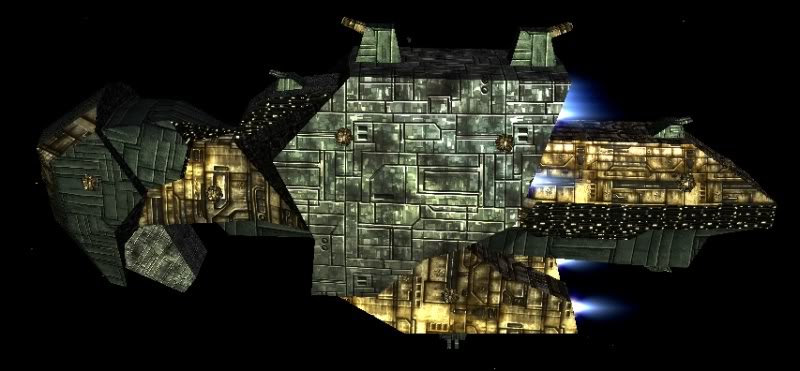
Much like the Firstborn from Clarke’s Space Odyssey series, they relied on a series of natural processes. The only real difference was they did it for destruction purposes. For example, when they became alerted to the presence of humanity on Resurgam, they chose to disassemble the planet’s gas giant bit by bit in order to create a massive trumpet like device in space. This was basically a gravitational weapon which they began using to shake the system’s sun to pieces.

Megathron:
megathronAnother Eve warship, the Megathron is the battleship of choice for the Gallente faction. It accelerates quickly, has a high armor capacity, and is very versatile due to its seven turret slots and two launcher hardpoints. This last feature is rare in Gallente ships, which tend to focus on energy weapons.

Because of its many weapons slots, the Megathron can be adapted to long range fire, known as the “Sniperthron”. This vessel is capable of engaging enemies at a distance of 150 km, but leaves it vulnerable to close range attacks and strips of the ability to heal. Another common build is the “Blasterthron” where the weapons of choice or short-range blasters, making it one of the toughest battleships around.

NTF Iceni:
ntf_iceniOnce more onto the Freespace franchise, dear friends. Here we have the one-of-kind prototype vessel known as the Iceni, the brainchild of the Neo-Terran Federation’s commander, Admiral Aken Bosch. Designed to be a command ship and mobile research platform, the Iceni was also a highly capable attack vessel, boasting mutiple turrets, beam mounts and missile batteries.

As part of project ETAK, the Iceni was the only vessel capable of communicating with the Shivans. After being mistaken for a command facility in an asteroid belt, Bosch was forced to deploy this ship prematurely. After shedding it’s housing asteroid, it set course for Gamma Draconis, where it used an Ancient jump gate to flee into unknown space. After making contact with the Shivans, the ship was boarded and most of the crew killed. Once the survivors were rescued, the ship engaged its self-destruct sequence and was lost.

In addition to being faster and more maneuverable than most ships its size, the Iceni also packed as much firepower as a Deimos-class frigate. These included 3 large beam emitters, 7 heavy turrets, 9 defenses turrets, 2 flak batteries, and 4 defensive missile batters. As such, it was capable of standing toe-to-toe with any comparable ship in the Terran or Vasudan armadas, and outrunning anything larger.

Prometheus:
prometheus_shipJust to be clear, I haven’t seen the movie… yet! I wanted to, but I dragged into seeing another film last night which also rocked (see below)! Luckily, I have seen enough trailers and promotional videos to know a few things about the eponymously named vessel. So here she is, just one day (finger crossed) before I see her on the silver screen! As an exploration vessel, the USCSS Prometheus was a designed for deep-space expeditions to alien worlds.

As a full-service space taxi, it was designed for both atmospheric and space flight and could therefore forgo the need for landing pods and shuttles. This was all made possible thanks to its reinforced hull, four multi-vector thrusters that allowed for verticle take off and landing, and an observation deck that allowed the crew a panoramic view of space and whatever landscapes they were surveying. During takeoff and atmospheric entry, these are enclosed by a series of protective shields.

Prometheus_ship_rearOn top of all that, it was packed with amenities for its crew. These included a large bay for heavy equipment and expedition vehicles, a full-service mess hall, a medical bay, recreational facilities, a built-in basketball court, long-range communications systems, crew quarters, cryogenic chambers, and holographic display windows. And of course, the ship’s own laboratory which served as its main research center. No doubt about it, ships like this, courtesy of the Weyland Corporation, ensured that crews could travel in style and comfort before being horribly killed by extra-terrestrials!

Special Mention: The Avenger Helicarrier!
Yes, I managed to get out last night to the movie theater. But instead of catching Prometheus as I originally hoped, I was coaxed into seeing the Avengers instead. It-was-awesome! Tons of cool action, a respectable, multi-layered plot, and lots and lots of cool shit! Kudos to Joss Whedon, I think he just became my hero!

And one of the things I liked best about this movie was S.H.I.E.L.D.’s own big-ass helicarrier! When they hinted that it was both a carrier and a sub, I was like “Whoaaaa! Like something out of Robotech!” But then, out came those massive turbofans and it took off! I just sat and stared for several, sustained minutes. My wife laughed at me. At that point, I said, “Okay, maybe you were right to want to see this.”

Anyhoo, much like something out of Robotech, this carrier was a massive machine that came in two modes. In its standard mode, it was your basic aircraft carrier similar in appearance to a Nimitz-class carrier. In its other mode, it is a freaking hovercraft, where four massive turbofans and two sets of jet engine clusters allow it to fly! It also has a comprehensive camouflage system where a series of reflector panels obscure it from sight, similar to adaptive camouflage.

And of course, as an aircraft carrier, it also has the usual amenities, which include several squadrons of F-22 and F-35 fighters and quinjets. And though armament didn’t come up in the movie, we can also assume that it has a full compliment of Phalanx point-defense cannons and Harpoon anti-ship missiles. But knowing S.H.I.E.L.D., I’m sure the list doesn’t end there. Most likely, they also got some cool stuff like an EMP, some rail guns, or laser devices in there too!

Sci-Fi Drugs

The other night, I had one of those moments. It was a moment where I found myself thinking about a cool concept and realized that it would make a damn fine post. It’s also one that interests me quite a bit and has even influenced my own writing. So as quickly as I could, I hopped on my laptop (even though it was 2am) and began making a list of all the sci-fi drugs I knew!

To me, the reasons for including drugs as part of a sci-fi franchise are obvious. For one, drugs and drug cultures are very much a part of our society, so it’s only natural that a sci-fi author should have something to say about it. As Gibson said, all sci-fi is really about the time in which it is written, ergo fictionalized drugs in future settings are really a reflection on the attitudes of today.

On the other hand, creating fictitious drugs and inventing subcultures that use them are a good way to give a story some realistic background. Wherever and whenever a story takes place, you have to assume that they will have narcotic substances there, and what form they take and how they go about dealing with them tells you much about that culture.

Either way, it’s a subject that has fascinated me for quite some time. So here are some highlights from the wold of sci-fi drugs!

Can-D:
Here we have a designer drug that was created by none other than sci-fi great Philip K. Dick. As fans may know, this guy was somewhat of an expert on drugs, having taken part in the Californian drug counter-culture during the 60s and 70s. As a result, he had a lot to say about drug use, their impact, and drug policy.

In this particular case, the drug comes to us from the story of The Three Stigmata of Palmer Eldritch. Taking place in the 21st century, where global warming has sent millions of people off Earth to the hostile environments of the Solar System, people have turned to a combination of the drug Can-D and what are known as “layouts.”

Layouts are physical props intended to simulate a sort of alternate reality where life is easier than either the grim existence of the off-world colonies or life on Earth. By taking the drug in conjunction with the layouts, people are able to experience a sort of shared hallucinogenic state. This in turn has given rise to pseudo-religious cults that have grown up around the use of layouts and the drug, consisting of people who dream of better worlds than the one they are forced to endure.

Dancer:
To complete the semi-dystopian setting of his Bridge Trilogy, Gibson was sure to add a designer drug that was all the rage amongst Californians in the near future. The drug was named Dancer, a powerful and addictive hallucinogen that apparently came in the form of a red dust. People would take it orally, rub it on their gums, smoke it or snort it.

In short, Dancer was like a red cocaine, except that it caused hallucinations rather than manic behavior. People who consumed it would typically become euphoric and mellow, causing them to get all rhythmic and break into dance (hence the name). However, it was was also known to make people violent from time to time, which made it more akin to the the effects of PCP.

Inspired by California’s drug culture and the emergence of designer drugs in the early 90s, Dancer was clearly meant to serve as an allegory for multiple drugs, or as a prediction of what the next big craze could be.

Dust:
Fans of Babylon 5 ought to remember this one. Basically, the drug was a hot item on the black market because it had the ability to give users temporary telepathic powers. It was violently addictive, and known for giving a very powerful and unique high. However, in the course of trying to stop the Dust trade to B5, Psi Cop Bester acknowledged that the drug was originally created by the Psi Corps as a way of creating telepaths.

When they realized it didn’t work, the drug was abandoned, but made its way to the black market because of its obvious appeal. As a longtime fan of B5, I can honestly say it was elements like this that made me like the show. Not only was the concept and the name cool, the fact that it began as a government-sanctioned drug was also believable and clearly inspired by the history of many real-world drugs.

Neuroin:
Inspired by Philip K Dick’s short story, Minority Report was a quasi-dystopian future where the use of precognitives promised to eliminate all violent crime from society. But of course, there’s a dark side to all this, and it just happens to be linked to the underworld drug known as Neuroin, a powerful and addictive psychoactive substance.

Though it is never explained in any real detail, the name suggests that it is of the opiate family and possibly combined with a neural stimulant. In addition to being the drug of choice of the protagonist, it is also the very thing that created the precognitives in the first place. All three psychics were once children who suffered brain damage in utero as a result of their mothers’ neuroin use. Though damaged neurologically, a side effect was the development of precognitive powers, which the state began to use in order to engineer the process known as “PreCrime.”

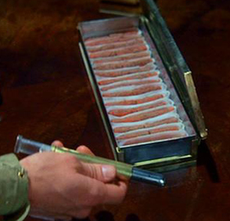
Based on the film adaptation, the principal means of taking neuroin appears to be through a specialized inhaler. This would allude to the fact that neuroin was taken in vaporized form. In the end, this drug served as both a commentary on the dangers of escapism as well as a plot device. While neuroin was the reason for the precognitives existence, it was also how the main character chose to numb himself over the loss of his son.

Nuke:
The designer drug from Robocop 2, and one man’s attempt at achieving his dream of becoming a Jesus-like figure! Designed by Cain, Nuke was an extremely pleasurable and addictive substance that began making the rounds in Old Detroit by the second movie. Coupled with a Police strike and financial ruin, Nuke seemed to be the thing that would finally break Detroit and allow the greedy bastards at OCP to finally take over.

There are several kinds of Nuke, but by far the most popular variety comes in the form of the red sludge. This is known as Red Ramrod, and was followed shortly thereafter by White Noise, Blue Velvet, and Black Thunder. The color scheme alluded to Cain’s “patriotic” sentiments, as he was known to say that his drug was making “Made in America” mean something again.

Nuke comes only in liquid form and is taken by means of small needles that inject the drug directly into the bloodstream. Because of its highly pleasurable nature and chemical properties, only a few doses are needed before a person becomes hooked and will experience intense withdrawal if they don’t get a regular dose. A commentary on the emergence of designer drugs, it was also served as a means for making some tough observations on drug use and its effect on society.

Snow Crash:
This drug is, admittedly a little off the beaten path. Featured in the Neal Stephenson novel of the same name, Snow Crash was essentially an allegory for a system crash, but in neurological form. Taking the form of both an inhalant and a digital virus, the “drug” had the effect of rendering users docile, passive and babbling an idioglossia similar to speaking in tongues.

But of course, there was more to it than all that. Basically, Snow Crash was designed by an information tycoon named L. Bob Rife who wanted control over people’s minds and daily habits. Using a Sumerian tablet, he basically encoded the ancient “Enki virus” – a virus that altered humanity’s neurology and spawned modern languages. So really, he was looking to reverse the Babel myth, making humanity neurologically simpler and thus programmable.

In addition to being a commentary on the drug culture, Snow Crash was also an observation about the proliferation of computer viruses in the early 90s and an allegory on the similarities between ancient myth and modern technology. It was also pretty cool and weird!

Soma:
When it comes to designer drugs, Soma pretty much takes the cake. Derived from Aldous Huxley’s classic tale of dystopia and social engineering, Brave New World, Soma was the kind of drug that came with the label “good for what ails ya” and meant it literally. Designed to cure any and all emotional problems, the pill was mass produced and a key feature of the World State’s apparatus of social control.

Use of Soma is prescribed at a very young age to citizens of the World State, as soon as children are old enough to begin sleep conditioning. Slogans such as “a gram is better than a damn” are programmed into their minds so that they respond to emotional stress by simply popping a pill. This is often referred to as “taking a vacation”.

To illustrate the effects of the drug, Huxley relied on his own experience using mescalin and other drugs. Apparently, subjects using Soma would enter a dream-like state where everything became pleasant and agreeable, all their worries and unpleasant emotions melting away. This dream-like state could be discerned by observing a person’s eyes, which would become noticeably glazed.

In addition, though the state freely distributed the drug and there were no shortages, Soma was still designed to be non-addictive and with no harmful side effects. This, added to its effectiveness, made it the ultimate designer drug and a very effective means of social control. A commentary on the pharmaceutical industry of his day and on the drug culture of the 1920s and 30s, Soma remains the most popular example of a fictional sci-fi drug!

Spice:
Then again, the spice melange is pretty damn popular too. However, as the only drug on this list that is not designed or synthesized, and is by definition an “awareness narcotic,” Spice is really in a category of its own. Taken from the Dune series, Spice was the most precious resource in the universe in more ways than one.

For starters, Spice could only be found on one planet, the desert world known as Arrakis. Mining Spice was also a highly hazardous duty, due to the inhospitable climate of Arrakis and the presence of Sandworms. And given its many benefits, which included prolonged life and expanded awareness, it’s little wonder why it was so damned expensive!

A clear allegory for oil, all life and commerce in the Imperium of Dune revolved around Spice in one way or another. The Guild Navigators used it to achieve their limited prescience and guide ships through foldspace. The Bene Gesserit used it to enhance their mental and physical acuity and make contact with their “Other Memory”. And every house used it to improve their health and longevity. In short, without Spice, all trade and commerce in the universe would end and countless people would die.

And of course, there never would have been a Paul Mua’dib or a Leto II, and humanity would have died as a result! That’s quite a drug them people got there!

Substance D:
Once again, we have a fictitious drug that comes to us straight from the mind of Philip K Dick. Featured in his 1977 book A Scanner Darkly about the drug subculture of California, Substance D was a powerful psychoactive drug that also went by the name “Slow Death.” The name proved apt, as the drug was not only violently addictive, but resulted in brain damage due to overuse.

According to the story, Substance-D was synthesized from the fictitious blue flower Mors ontologica, which is Latin for “death of being”. In the course of the story, the protagonist – an undercover narcotics agent – becomes addicted to the drug, suffers brain damage and is sent to one of the new recovery centers (“New Path”) to get clean.

In time, he is given the task of working on one of their many farms and learns that these places serve as grow ops for the flower. Hence, we see that “New Path” is the source of Substance-D, and is therefore benefiting from both the drug and the harmful effect it has on society. A commentary on strong-arm governments and the pharmaceutical industry perhaps?

Final Thoughts:
When it comes to fictionalized narcotics, a few basic features become evident. For one, fictional drugs can take one of two forms, being either of the organic or synthetic (i.e. designer) variety. Second, their use as part of a story’s background is meant to call attention to our current drug wars, warts and all. But above all, they seem to serve as a form of social commentary by pointing to the ongoing nature of temptation, escapism and repression. On the one hand, human beings will always be looking for escapes and ways to ease the burden of existence. On the other, we are always likely to feel the need to control the flow of narcotic substances and legislate what people can and can’t put in their bodies.

Finally, I found that just about all the authors here were taking a descriptive, rather than prescriptive, approach. Essentially, they were content to sit back and make observations on the whole issue of drug use and moral legislation, rather than making pronouncements. This would seem the preferable option considering that you can’t really offer a clear resolution without sounding either enabling or preachy. Some say that drug use destroys society, other say that people have the right to put whatever they want in their bodes. And then there are those who say that human weakness is a constant, and that criminalizing such a thing turns a flaw into a war. Complicated!

On a brighter note, all this talk puts me in mind of my own fictional creations. Years back, when I was coming up with the concept for my Legacies story, I spent a fair bit of time pondering what kind of drugs people would be using in the relatively distant future. I think I might just dedicate a page or a post to just that topic. In truth, I’d like to know what people think about my inventions. Look for it, it shall be coming soon!

Cool Guns (vol.3)

ARASKANA HLR-12x:
Finally, I’ve found it! After much searching and digging, I finally found my way to the lasergun from the Akira movie. And I got to say, between anime, live action, and the gaming world, this weapon is about the most realistic take on a lasergun I’ve yet to see. Used initially by military forces in Neo-Tokyo to stop Tetsuo (unsuccessfully, I might add), the protagonist Kaneda would later use one as his personal weapon.

Powered by a portable battery pack, this weapon would fire a lancing beam of focused energy at its targets. In addition to being able to cut through metal and concrete, it was also capable of hewing off limbs. And it did too! Seriously, that scene where the army opens fire on the mob, ick and whoa in equal parts!

EM-1 Railgun:
Even thought I didn’t think the movie was that hot, these guns did inspired to learn more about coilguns, gauss rifles and EM technology. Known as the EM-1, this weapon was a prototype railgun that was featured in the movie Eraser. Basically, it was this advanced technology that set up the plot, and provided Arny with an excuse to do some Terminator-style double firing!

Running on the concept of a coilgun, the EM-1 would use a super-charged magnetic tube to accelerate a caseless slug to hypersonic velocities. This gave it incredible punch as well as range, and could eviscerate man, machine and solid matter with ease. An x-ray scope was also attached to let the gunner see through solid objects, which was handy considering that this weapon was designed to punch through obstacles and kill whatever was on the other side.

Guitar Case Rocket Launcher:
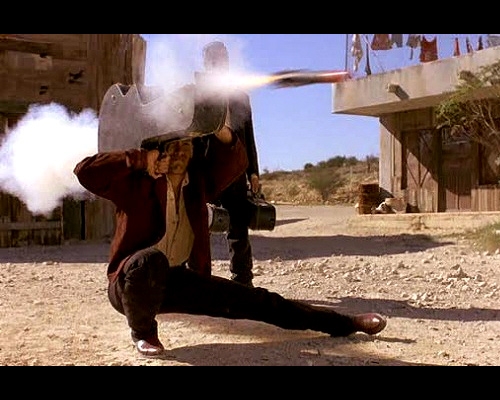
Here’s a movie I never expect to take anything from. Desperado, the Mexican western-style shoot-em-up directed by Robert Rodriquez, featured a lot of cool guns. But in the end, I’d have to say the coolest were the ones sported by his band members, which came embedded in their guitar cases. Where one man relied on cases that had built-in automatic weapons, the other fired rockets out the front!

I’ve looked it up and can’t find any info on how they rigged this case to do this. Probably just a launch tube and some fire crackers. But it was still pretty cool, and not entirely ludicrous either. Assuming you don’t mind ruining a few guitar cases, this weapon would probably make a great conversation piece and its owner a hit at parties!

Joshua:
Ah, my favorite of the bunch! Known as Joshua, this BFG is named in honor of the Hebrew warrior who led the Israelites to victory over the Caananites, in brutal, genocidal fashion! It’s essentially a massive long slide, chambered for the mighty .454 Casull round which is used primarily for hunting wild game. BIG wild game!

In Alucard’s case, the gun was also fitted with silver-tipped bullets for hunting vampires and demons. So in addition to packing a massive punch, it could also turn the undead into ash with a single blast. And of course, Alucard’s super-human strength gave him the ability to endure the weapon’s massive kickback!
Jackal:
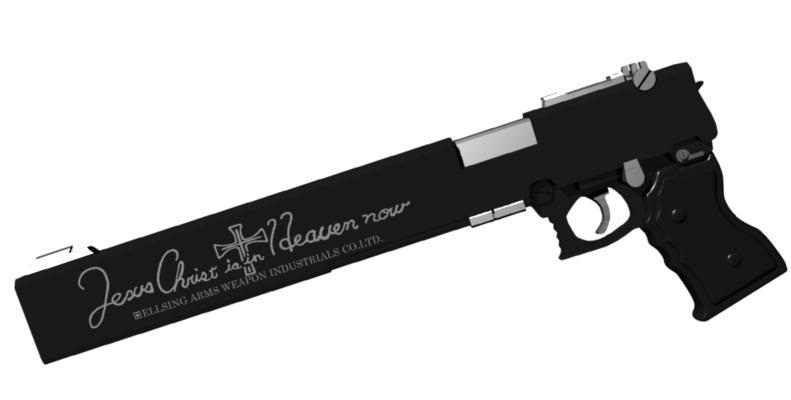
What do you know, it’s two for one day! Here we have Alucard’s second gun of choice, known as the Jackal. Officially, it’s known as the ARMS 13mm (.51 cal.) Anti-freak pistol, and in many ways represented a step-up from the earlier Joshua. Also produced by Walter, the Hellsing organization’s own gunsmith, this weapon was made in response to Alucard’s request for something “bigger”.

And that’s precisely what he got! In addition to having less kickback than its predecessor and firing spent casing to the left (so as not to obscure Alucard’s view of the target), this gun also fired 13mm (.51 cal) bullets and came in a sleek, black gunmetal design. In addition, it also had the words “Jesus Christ is in heaven” scrawled on the side, no doubt a comical reference to the man Alucard intended to use it on!

Leonhearts Gunblade:
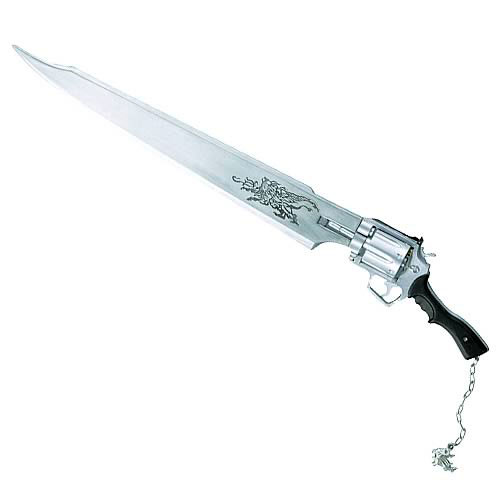
Is it a gun, it is a blade? Well… yes. The property of Squall Leonheart, from Final Fantasy VIII, this weapon is basically a stainless steel broadsword with an inset .44 magnum revolver. Firing this gun off in the midst of a sword fight not only has the potential to punch a big hole in the enemy, it also produces a wild vibration in the blade that makes it cut even better.

Much like Cloud’s Blade from FF VII, it is heavily oversize, though not as much. Though even the designer claimed that it had an “odd appearance” in hindsight, and the configuration makes it look a little unwieldy, you can’t deny that its pretty damn cool!

Prosthetic Leg Gun:
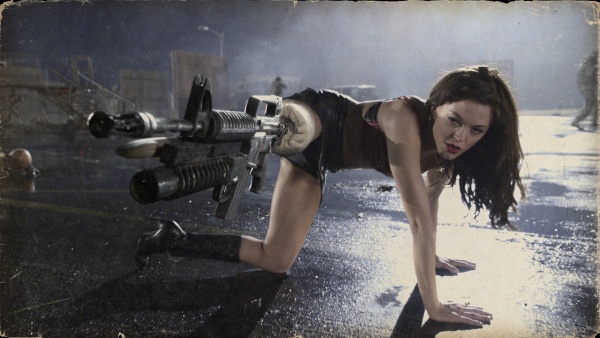
Now here’s a novel take on both movie guns and prosthetics! Taken from the movie Planet Terror, is essentially a Bushmaster Carbine with the addition of an M203A1 grenade launcher.

This gun made its appearance when the character Wray gives Cherry Darling (played by Rose McGowan) the assault rifle grenade launcher combination as a replacement for her prosthetic leg. She put it to good use, alternately kicking and blowing bad guys away with it!

Pauza P50:

The Robocop franchise was nothing if not good at popularizing cool guns! And this one was no exception. Known as the P50, this .50 cal semi-automatic sniper rifle was featured repeatedly throughout the film. Intended as a shout out to the “Cobra Assault Rifle” from the first movie, this weapon had the same things going for it, namely explosive, punchy firepower!

It’s first appearance was during the robbery of the gun store at the beginning. It later appeared in the hands of some of Cain’s thugs who used it to blow Robocop’s hand off during his initial confrontation with the crime boss. It was then used by those same thugs later on Robocain himself. Robocop then confiscated it and used it against Robocain during their final confrontation. With one clean hit, he managed to destroy Cain’s autocannon’s with this baby. Always great when accuracy and firepower come together!

The Samaritan:
Named in honor of the fact that it puts monsters out of their misery, Hellboy named this one “The Samaritan”. Although the caliber is not listed, the bullets appear to be at least one inch (25mm or 1.00 cal) in diameter, glass tipped, and filled with holy water.

In addition, the construction of the gun is heavily consistent with the name. The metal is forged from a combination of Irish church bells, cold iron from crucifixes, blessed silver, and other mystic metals. The handle wood of the grips is believed to be that of the cross of which Jesus Christ was crucified on. Holy religiosity Batman!

It weighs ten pounds, making it double effective as an impact hammer. And of course, the size of the gun also gives it a kickback which would be capable of breaking a regular man’s hand off. Hence, nobody but Hellboy even takes it out for an evening of monster killing!

Wow, a third installment! Did NOT see that one coming. And I’m really trying to get off this guns and robots kick, I swear! I’ll be back tomorrow with something else… maybe!

More Cool Guns!

This post is a follow-up to one I did awhile back, one which featured weapons from the sci-fi universe. At the time, I really wasn’t planning on doing a follow-up. However, since I began writing about existing weapons that just happen to look like something out of sci-fi, I happened to find some more that really were. So here they are, in alphabetical order!

Auto 9:
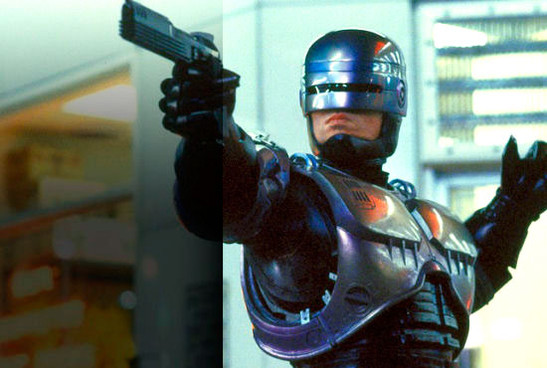
Robocop_gunOtherwise known as the Robocop gun, the Auto 9 was fashioned out of attaching a frontal assembly to a standard Berretta 93R. This variant of the 9mm pistol is famous for being the automatic version which can fire full auto or in three round bursts. Special vents at the front made for a cooler dispersal of the flames coming out of the barrel.

One look at the handle will also tell you that this model was fitted with an extra-long magazine to ensure that Peter Weller/Robocop had plenty of ammo to take down his enemies. Rarely, if ever, was he to be seen reloading this cannon in the course of his movies!

C-14 Impaler:
C14Hello Starcraft universe! Here we have the Terran rifle that comes standard with marines serving in the Confederate and Dominion forces. As a Gauss rifle, this weapon is not a gun in the traditional sense, but an electromagnetic gun that hurls 8mm projectiles (known as “spikes”) at hypersonic speeds.

Though it is capable of firing up to 30 rounds a minute, the Impaler comes with a built-in capacitor system which restricts fire to short bursts to conserve ammo and power. It also comes with a variety of ammo, giving the average marine the ability to kick all kinds of ass.

Lasgun (Warhammer 40k):
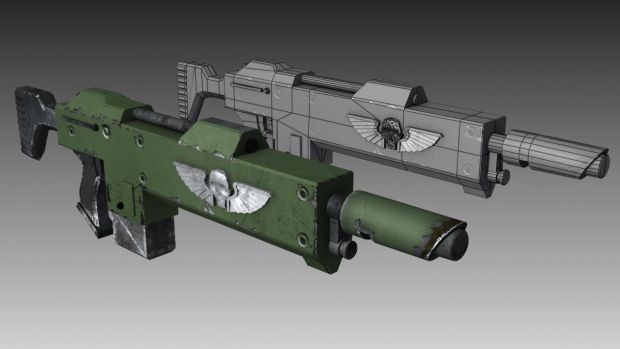
Warhammer_LasgunsNot to be confused with the Lasguns of the Dune universe, even though the principle is the same. A directed energy weapon, it is used by all the military forces within the Imperium of Man, making it the most common energy weapon in the galaxy.

Though comparatively simple next to many Warhammer weapons, this weapon is still extremely effective. In addition to being capable of severing limbs, it is even able to penetrate the Power Armour of a Space Marine.

M6 Nonlinear Rifle:
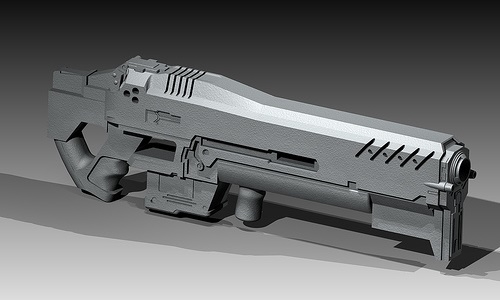
Halo_Reach_-_Model_8_SP_LaserAlso known as the Spartan Laser, this portable and vehicle-mounted rifle is the only directed energy weapon in service with the USNC. As part of Project GUNGNIR, a program designed to provide supplemental material to the Spartans, this weapon was designed to be part of the MJOLNIR powered assault armor.

Making its first appearance in Halo: Reach, this weapon is devastating to infantry and most vehicles at any range. Unfortunately, the expense of building and maintaining them makes them somewhat impractical compared to other UNSC weapons.

RBS-80 Pulse Gun
RBS-80This baby comes highly recommended by both sides of the Terminator franchise! Designed by General Dynamics in the 21st century, the RBS-20 is a phased plasma pulse gun used by both Skynet’s Terminators and the Resistance. In the former case, it was used as a portable weapon, usually by infiltration units to take out Resistance bases. However, given the weapon’s size and weight, the Resistance preferred to mount them on their vehicles.

Making its debut appearance in Terminator when a T-800 broke into a Resistance safe house and began using its RBS-80 to kill everyone in sight. These events were recounted by Kyle Reese, who narrowly survived the encounter. It was also mentioned by name when Arny, making a gaffe, asked for one at a gunstore. “Just what you see here, pal,” replied the owner. Little wonder then why Arny chose to blow him away afterwards…

Type 25 Directed Energy Rifle:
PlasmarifleBack to the Halo universe, but this time for a more widely known Covenant weapon. More commonly known as the Plasma Rifle, this directed energy weapon, is the weapon of choice for the Elites and the Brutes, though other member races have been seen using it as well. Like much of the Covenant’s weapons, it was reverse-engineered from Forerunner technology.

Powered by a high-capacity energy cell, the Plasma Rifle is capable of semi-automatic fire at a rate of 360~540 rounds per minute. In the hands of the Elites, both the casing and plasma are colored a light shade of blue, whereas the Brutes prefer their weapons look and fire at the red end of the spectrum.

Between Halo and Halo 2, the weapon evolved somewhat, losing power and range in favor of rate of fire and the ability to duel wield. Personally, I like combining this baby with a submachine gun or a magum pistol. Plasma and bullets baby! Whooooo!

Tesla Rifle:
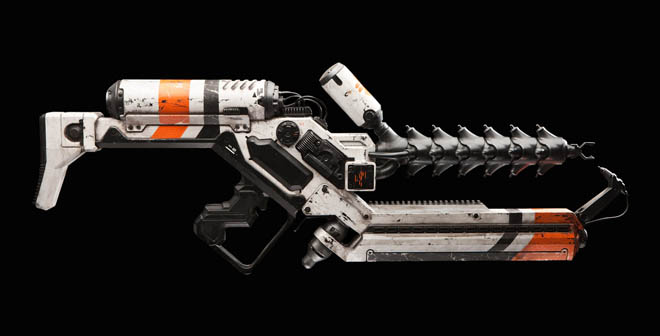
tesla_gunBy definition, a Tesla Rifle is a weapon that fires of electricity with a limited range and high spread. This particular version comes from District 9 and was a weapon of alien manufacture. Built by the race prejoratively known as the “Prawns”, it was confiscated by the South African government, and then fell into the hands of Wilkus (the film’s protoganist).

Since all “Prawn” weapons are attuned to their DNA, no human was able to use one. However, due to the transformation Wilkus was undergoing, he was able to use one, and did so! Surrounded by mercenaries who were in charge of clearing District 9 and taking him down, he had little choice but to blow them to gory pieces with this thing. And since the whole movie was shot in faux-documentary style, you could bet that chunks of bad guy got splattered on the camera!

The Sol:
Sol1Holy crap! I definitely saved the biggest and baddest for last today! Here is The Sol (yes THE Sol) an attack satellite which comes from the anime movie Akira. Featured towards the end of the film, The Sole was called in when Testuo Matsuo – the psychically altered teenager – began going on a rampage and threatened to destroy Neo-Tokyo.

Built around a central directed-energy weapon, The Sol gave new meaning to the term “Death from above!” Though not much is said about her, The Sol was clearly inspired by the Strategic Defense Initiative, aka. Star Wars Defense, and therefore designed to shoot down ICBM’s from orbit. Given that the story revolves around WWIII, this seems like a pretty safe assumption.

Sol2In the course of the story, she was called in by the Neo-Tokyo authorities and tried to blow the psychotic and psionic Tesuo up. It didn’t take, but the kid was psychic man! What can you do? If nothing else, it did demonstrate just how powerful it was by removing one of his arms. Tetsuo was obviously impressed too, because he commandeered the thing and began using it to wreak even more havoc. Seriously, we’re talking death from above man!

And that is all. Thanks for reading and stay tuned for more. Thinking I need to get off this whole guns and robots kick. Everything I write lately seems to revolve around one or the other…

Cool Cyborgs (updated)!

8 Man:
Always good to start with a classic, don’t you think? Especially one that really doesn’t get the attention it deserves. In addition to being Japan’s first cyborg superhero, this 60’s anime character was also the inspiration for Robocop. You heard me right!

Apparently, the main character was a Detective who was murdered by a group of ruthless criminals, but whose body was retrieved by a scientist who conducted an experimental procedure to transfer his “life force” into a machine body. Having failed the previous seven times, his eights and successful attempt is aptly named “8 Man”.

But unlike Robocop, this cyborg can do some pretty freaky stuff! In addition to being heavily armored, he can run at incredible speeds and shape-shift into other people. His true identity is kept a secret from everyone except his old police chief and the professor who conducted his experiment.

But like Robocop, 8 Man chooses to go beyond his crime-fighting mandate to find his old girlfriend, best friend and attempt to rebuild his old life. His attempts are often marred by the fact that he is no longer human, but as they say, it’s the journey that counts!

Bionic Woman:
Sure, Steve Austin was pretty cool, but did he look this good? Hell no! And in the case of the Bionic Woman, the hero story was far less crude. Though the original series was little more than a spinoff of The Six Million Dollar Man (featuring Oscar Goldman as the scientist again), the re-imagined series was far more original and endearing.

In this version, the main character (again named Jaime Sommers) is a surrogate mother and bartender struggling to make ends meet. After a near fatal car accident, she is saved by an experimental procedure involving advanced prosthetics and implants (no, not those kind!). Afterwards, she goes to work for the people who performed her operation – the Berkut Group, whom he boyfriend works for.

Through her work, she is responsible for thwarting crimes and evil machinations, while trying to explore her role and the changes she’s endured. As with the original series, Jaime’s modifications include bionic legs, a bionic right arm, a bionic right ear, and a bionic eye like that of Steve Austin. In the updated series, she also gets a dose of nanomachines called “anthrocytes” which are capable of healing her body at a highly accelerated rate.

The Borg:
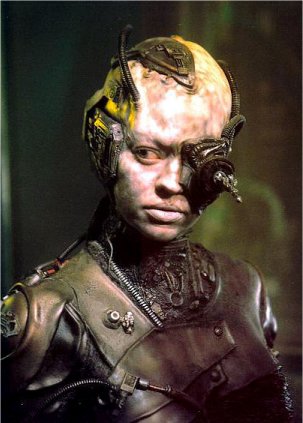
Now here is a race who’s name is the second half of Cyborg! No chance for misunderstandings here! And as all fans of Star Trek know, the Borg are extremely proud of what they are. A race of beings dedicated to the perfection of life by merging the organic with the synthetic. And of course, they are all networked to a hive mind known as “the collective.”

Native to the Delta Quadrant of the Star Trek universe, the Borg occupy thousands of systems and hundreds of races. No indication is ever given where they originated from or what their intentions are, beyond adding “the biological and technological distinctiveness of other species to [their] own” in pursuit of “perfection”.

Is there a more perfect metaphor for runaway progress and the deification of technology? It’s not exactly a subtle commentary on the issue, but it does encapsulate the kinds of fear many people have when faced with a rapidly changing world that seems to be growing more complicated all the time. I imagine the Singularitarians don’t like the analogy much, but then again, Star Trek has been known to send mixed messages 😉

Cylon:
In the original series, the Cylons were lumbering, chrome covered robots that kind of resembled toasters. It was for this reason that they frequently got a shout out in the re-imagined by being referred to as such. However, the re-imagined versions were quantum leaps ahead, the result of bioengineering rather than conventional robotics.

Unlike the “skin jobs” (a reference to Blade Runner), Centurions and Cylon Raiders were only partially organic, consisting of organic brains inside machine bodies. Much the same is true of the Cylon Hybrids, the minds that operated their Basestar’s jump systems. In their case, their bodies are largely organic, but their minds are enhanced with advanced machinery and networked into their ship.

Because of this combination of organic and synthetic, Centurions and Raiders are capable of being “lobotomized”, which took place in the third season when their handlers became suspicious of their behavior. Ultimately, these three begins represented a key step in the Cylon’s evolution from mechanical to biological, which achieved perfection with the creation of the seven purely biological models.

Cyberman:
A fictional race taken from Dr. Who, these cyborgs were another one of the good Doctor’s recurring enemies. But unlike their Dalek counterparts, they seemed to change with every appearance. A possible inspiration for the Borg, these being were as humans who chose to begin experiment more and more with artificial implants.

This eventually led them to become the cold, calculated and ruthlessly logical beings that are, with every emotion all but deleted from their minds. While they do maintain their human brains and some human organs, they possess little of their original humanity, which is why they don’t get along with us decent folk!

Another parallel they share with the Borg is their means of proliferation, which is to turn other organic beings into Cybermen (a process known as “cyber-conversion”). However, they remain few in number during the course of the series and therefore prefer to act covertly, conducting their schemes from hiding places and using human pawns or robots to act in their place until they need to appear. Quite unlike the Borg, who prefer to get right in there, blow shit up, and assimilate anything that’s left!

Darth Vader:
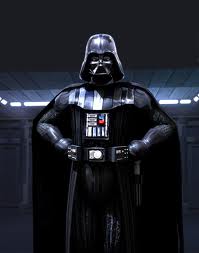
“He’s more machine than man… twisted and evil!” That’s not to say all people who are more machine than man are evil! But it is the working definition of “cyborg.” Having lost both arms and legs in lightsaber duels and much of his body severely burned, Darth Vader (nee Anakin Skywalker) had to be put in a protective suit that regulated his breathing and bodily functions… I don’t even want to think about that!

But there was an upside to all those enhancements. For one, he got James Earl Jones vocals and the most intimidating, badass exterior in the Galaxy! Hell, even his breathing sounded scary. And it didn’t encumber his use of the Force at all, as exemplified by his ability to crush throats and toss objects around at will. And the ghosts of many dead Jedi and Luke’s missing hand can attest to it not hampering his sword fighting skills either.

Ultimately, this suit proved to be his undoing when, in the course of betraying his evil master, most of its circuits were fried by the Emperor’s electrical bolts. He died shortly thereafter, redeemed and looking upon his son for the first time “with his own eyes.” Sniff… I hate this mushy stuff!

Motoko Kusanagi:
The star of Ghost in the Shell, the beautiful, deadly and artificially enhanced Motoko Kusanagi. Known by her fellow officers as “the Major”, Kusanagi is a member of Section 9, a counter-terrorism squad working for Japan’s National Public Safety Commission. As part of her commitment to her job, Kusanagi underwent cybernetic enhancements, marrying her human brain to the “shell” that is her new body.

Throughout the original manga, anime and cinematic versions, Kusanagi’s basic role is the same. She fights all kinds of criminal elements: kingpins, warlords, and cyber terrorists, but also uses these experiences to reflect on the larger issues and her fateful choice to become a cybernetic being. These issues include what it means to be human, what constitutes life, and the line between authentic and artificial.

In addition, she’s also a pretty vivacious and good-looking being! Though technically not flesh and blood, she still maintains a pretty active sex life, at least in some versions of the story. In others, her personal life is not dealt with, but there are still plenty of nude shots, provided exposed synthetic flesh can be counted as nudity 😉

Robocop/Murphy:
Here we have another case of tragedy yielding the perfect union between man and machine. Alex Murphy, dedicated cop and family man, gets ruthlessly gunned down by a bunch of criminal thugs, only to be resurrected by a bunch of corporate thugs as a cop cyborg. Heavily armed, armored, and programmed to serve and protect, he became the Detroit Police Departments signature weapon in the war on crime.

But of course, things begin to go awry when Murphy’s memories and personality began to re-emerge. For one, there was the question of his wife and son, both of whom had been led to believe he was dead. Second, there was the psychological and emotional strain of knowing you could never be fully human again.

Alas, Murphy resolves the sacrifice of his identity and humanity by doing what he did best, kicking criminal ass and taking criminal names! These of course included crime lords, drug bosses, and the thugs who murdered him, but also the corporate crooks who created him and were plotting to take over Detroit. So aside from the sci-fi elements and human interest angles, there was also some social commentary in this franchise. Lots going on here!

Nexus Six Replicant:
“If we gift them with a past, we create a cushion or a pillow for their emotions, and consequently, we can control them better.” What is a machine when it has feelings, thoughts, and even memories?  Is it, as the Tyrell Corporation motto goes, “More human than human”?

Sure, some purists would say that a Nexus 6 isn’t technically a cyborg. But as I recall, the working definition of Cyborg is a merger of the cybernetic and organic. And as any fan of Blade Runner knows, Nexus 6’s are not so much built as grown, the product of biomedics rather than mechanics. And if that’s not good enough to get this one past the censors, screw em! Moving on…

Designed for service on the off-world colonies, every Replicant was designed to fill a certain role, ranging from military, to worker, to pleasure. In short, they could do the work of any human while simultaneously being denied the basic rights humans take for granted. However, since it was understood that they could become unruly after too much time, each unit was built with a four-year lifespan.

Inevitably, the Replicants of the movie came to Earth seeking a reprieve from their inevitable deaths. Their leader, Roy Batty, was especially obsessed with buying more time, since he himself was near the end of his lifespan. When told that there was nothing that could be done, he went a little beserk, but also came to appreciate life all the more in his last few moments.

T-800 Terminator:
“The Terminator’s an infiltration unit, part man, part machine. Underneath, it’s a hyper-alloy combat chassis – micro processor-controlled, fully armored. Very tough. But outside, it’s living human tissue – flesh, skin, hair, blood, grown for the cyborgs..” That’s how Kyle Reese, the warrior from the future, describes them. Arny’s version was a bit less… loquacious. “I’m a cybernetic organism. Living tissue over a metal endoskeleton.” Take your pick, they’re both right!

Designed to impersonate human beings, mainly so he could get close to them and kill them, the two Arny models were quite at home in the past. If you looked like this, would anyone really complain if you chose to walk the streets of LA naked? It’s LA man, anything goes! What’s more, Arny’s cyber strength and tough skeleton make him deadly and very survivable.

This proved quite the headache when one was sent back to kill Sarah Conner, but was quite a plus when one was later providing protection for her and her son! In the end, it took a hail of bullets, some well placed plastic explosives and a machine press to kill the first one. And the second one managed to survive an impalement, the loss of a limb, about a million bullets, and still managed to lay the smack down on a T-1000. Perhaps they should amend the name… Endurinators!

Thank you all! Stay tuned for the follow-up, Sexy Female Robots! I guess I’m just in a robot kind of mood 😉

Futuristic Guns

Many of these will look familiar, and for good reason. In addition to being futuristic looking, they also happen to be real! For many years, science fiction movies and series have used weapons of legitimate manufacture in order to inspire a futuristic feel.

Calico M960:
Calico960aHere’s a gun that has been featured in several movies, games and television series, and its obvious why. Just look at the thing. A fully-automatic pistol, this baby provides a lot of firepower in a small and uniquely shaped package. As one of the first personal defense weapons to feature a top-mounted magazine, a revolutionary concept for its time which has since caught on bigtime.

Guns of this class were featured in the sci-fi movies Robocop 2, Robocop 3, Total Recall, Virtuosity, and Star Trek: First Contact.

Daewoo K11:
daewook11This gun not only looks futuristic, it is downright revolutionary in its design. Whereas most assault rifles have grenade launchers slug underneath the front barrel, this version carries an launcher mounted on top and fed by a bullpup magazine.

Designed by the Republic of South Korea in 2006, the weapon also comes with a state of the art scope which features the latest in a ballistics computer technology as well as thermal/night vision. I have yet to find a sci-fi franchise which has used it, but time will tell. These things aint cheap, after all!

FN F2000:
f2000As part of the new generation of bullpup assault rifles, the F2000 is of Belgian manufacture that’s been around for the better part of a decade. It’s futuristic features include the revolutionary new handle and trigger grip, bullpup magazine and updated sights.

Because of its aesthetic appeal, the F2000 has been featured in numerous places, including Terminator: Salvation, the Modern Warfare and Ghost Recon video game series, and the upcoming G.I. Joe: Rise of Cobra.

HK XM29:
Xm29Also known as an OICW (Objective Individual Combat Weapon), the XM29 is part of the new generation of hybrid assault rifles that features the a secondary bullpup magazine which houses its compliment of grenades.

Much like the K11, this weapon combines the benefits of a 5.56mm assault rifle, a 20mm grenade launcher and an ultra-modern scope that contains a ballistics computer, laser range finder, advanced optics and night vision. It was featured in the Ghost Recon series, Die Another Day, and Universal Soldier: The Return.

KRISS Vector:
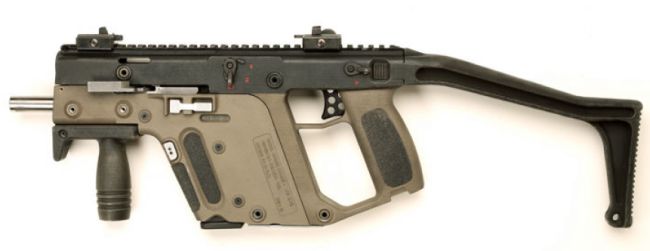
kriss1When I first saw this weapon, all I could say was “Wow, now there’s something that doesn’t qualify for home defense!” A .45 caliber weapon, fully automatic, and very compact, this weapon is futuristic, uniquely designed and deadly. A triple threat, quite literally!

And the list of features and featurettes include the upcoming Total Recall remake, Resident Evil: Retribution, the Nikita television series and the Modern Warfare and Ghost Recon game franchises.

Mossberg 500:
mossberg_500_bullpupHere we have a game changer! And interestingly enough, it’s been around for quite some time. Back in 1985, Mossberg decided to upgrade their long lineup of shotgun stocks by taking advantage of the concept of bullpup firearms. Essentially, this means that it is loaded from the rear and ejects spent cartridges from behind the trigger mechanism.

Given it’s futuristic look, it was featured in several sci-fi movies during the 80’s and 90’s, most notably The Running Man, Predator 2, and the film version of Stargate.

NTW-20:
ntw20_1Go big or go home! That seems to be the reasoning behind this 20mm (.78 cal) assault rifle, which comes direct from South Africa, famous purveyor of grisly firearms! As part of an international series of large-caliber rifles which emerged during the 1990’s, this weapon was meant to give snipers the ability to take down armored troops and vehicles. Well, it certainly does that!

In addition to appearing in the movie District 9, it was also featured in the Halo series as the USNC sniper’s rifle. And anyone’s who played that series knows just how powerful that baby is. Blamoo! They all fall down…

PP-2000:
pp_2000Next up, the Russian sidearm of choice for today’s military, police forces, and apparently even cilivians. At least that’s what the designation PDW (Personal Defense Weapon) means. Can’t imagine most houses have any real cause for stocking a 9mm submachine gun, but that’s a matter for the courts.

Because of it’s appearance and popularity with modern armed forces, it was features in the video game series’ Modern Warfare, Ghost Recon, Bad Company, SOCOM, and the Russian sci-fi thriller The Interceptor (Zapreshchyonnaya Realnost).

P90:
P90Here we have yet another PDW that really doesn’t seem to fit that criteria, not when its a compact submachinegun and packs as many as 50 bullets! And in addition to its ammo count, it also boasts two very high-tech advancements, including a top loading magazine and the same handle/trigger grip as the F2000. Not surprising since they have the same maker – Fabrique Nationale (FN) from Belgium.

For obvious reasons, this gun has a long history of making special appearances. Its credits include Equilibrium, I, Robot, Babylon A.D., District B13 and its sequel, and was specifically chosen to be the sidearm of choice on the shows Stargate and Stargate: Atlantis.

Steyr AUG:
Steyr_augAnother popular item, and one which I’m sure everyone out there is familiar with. Invented back in 1978 by the Austrian-based Steyr company, this weapon was the first assault rifle to introduce the bullpup loading design. On top of that, its appearance is downright futuristic!

It too has a long list of credits, including Robocop 1 and 2, Predator 2, District B13, as well as the television shows Red Dwarf, Space: Above and Beyond, and Firefly.

Okay! There’s more, of course, but ten examples is kind of my limit. And because I think something like this could go longer than I’m willing to type… at least in one sitting. Enjoy the gun show (no bad pun!) and see y’all next time.

More Giant Robots

Welcome back. I had a lot of fun with the last installment, so here’s another! Updated, expanded, and with plenty of additions. Ah, screw it! Let’s get to it.

Immortal:
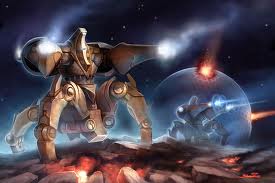
Back to the Starcraft universe for a sequel. Much like its predecessor, the Immortal was a vehicle for severely wounded Templars who still wanted to serve. Developed shortly after the Brood War, the Immortals replaced the aging Dragoon design and improved on it in many ways.

In terms of armaments, the Immortals boast two phased disruptor cannons which pretty much doubles their firepower. Their chassis are heavily armored and of course boast shields that can even withstand attacks from heavy artillery.

The Immortal’s one weakness is that their shields are only activated when they are hit by heavy munitions. In addition, their weapons are best for ranged attacks. This makes them somewhat vulnerable to close encounters with small arms fire and auto-cannons.

Mad Dog:
Another classic mech from the Battltech universe. Much like the Mad Cat from the last installment, the Mad Dog is another omnimech. It’s configuration, which appeared to Inner Sphere forces as a bird of prey, earned it the nickname “Vulture”.

Heavily armored with a n8 and a half ton ferro-fibrous shell, the Mad Dog is still fast and maneuverable, able to run at over 85 km/h. In its standard configuration, it carries two large pulse lasers in the arms, two medium ones (typically mounted underneath) and two shoulder mounted missile launchers.

Quick, powerful and versatile, the Mad Dog is well represented in the armies of every Outer Sphere Clan. In fact, the Mad Dog and Mad Cat are so close in design that they are often fashioned for the same mold. They often serve alongside each other for mutual support in the field of battle.

Madox-01:
When it comes to big, mechanized war machines, much like many cool inventions, the Japanese seem to have the market cornered. But what do you expect, they got their first and pioneered the whole concept. And this example is one of the many originals shows to popularize it.

Taken from Metal Skin Panic, the Madox-o1 was a prototype mech design built by the Japanese Self Defense Forces for use against tanks. Armed with a large caliber minigun, a chainsaw, a grappling claw, and can also carry an assortment of missiles. It is deployed by helicopters to a field of battle, but is also capable of running speedily to wherever it needs to go.

In the story, it becomes the property of a mechanic who climbs into the mech and “merges”, meaning that the machine comes to recognize him as its controller and won’t let him leave. As a result, Koji – the mechanic – is stuck with the machine and forced to defend himself when the authorities come looking for it. But in time, it is agreed that the best thing for all sides is if Koji works for the government and uses the machine for good. Everybody’s happy!

Metal Gear Ray:
Since these guys are so damn good at producing mech designs, I just had to return to the Metal Gear franchise! Picking up after the first game, this next example comes from its sequel: Sons of Liberty.

After the events in the first game, the world was apparently flooded with designs for the Metal Gear Rex. As a result, Ray began as a proposed countermeasure design, an amphibious design produced by the US Marine Corps. Because of this, Ray was the first Metal Gear that was both amphibious and not specifically designed for nuclear warfare.

Originally intended to be operated by a single pilot, the final Ray design was completely unmanned. Its primary armaments consisted of two machine guns, anti-tank and anti-ship missile banks, cluster bombs and a water jet cutter. Its smaller frame and lighter weight also meant it a lot speedier and more agile than its behemoth cousin, Rex.

MSZ-007 Gundam:
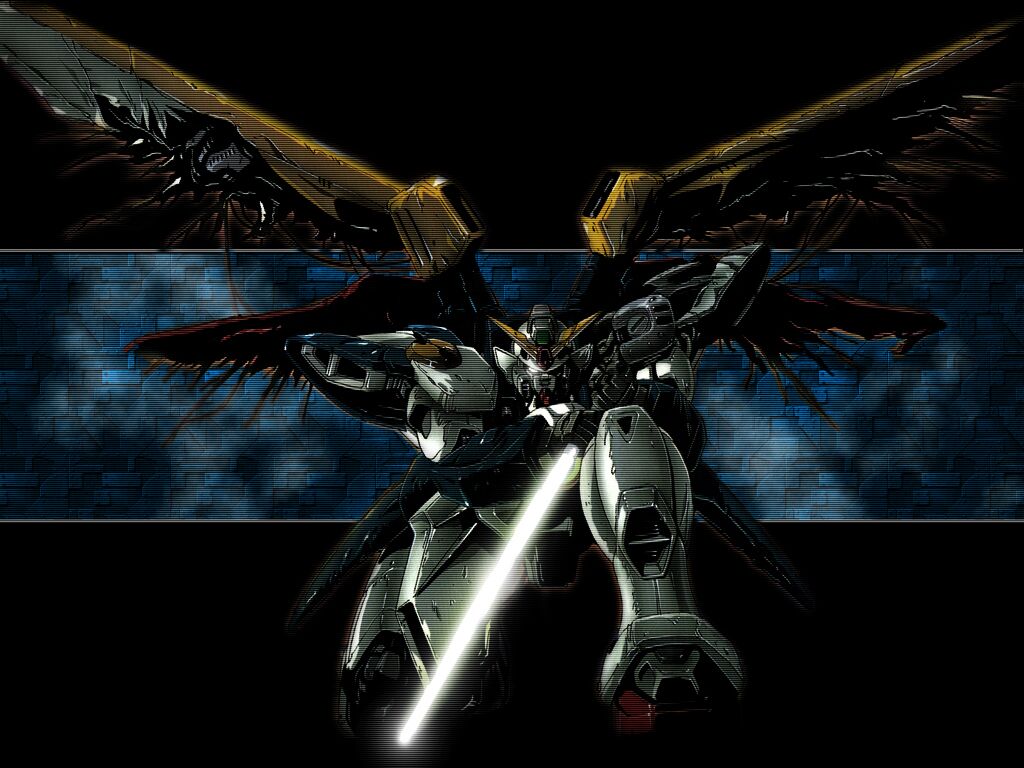
Speaking of anime and Japanese robots, the next examples comes from a similarly old-school show, Gundam! Known as the Mass Production type Z Gundam, this “Mobile Suit” is one of the more popular mechs from the series. And for good reason!

In addition to being able to fly on its own without having to transform into a fighter configuration, this mech also carries a beam rifle and can get into hand to hand combat with its pair of beam sabres. Just because you’re a futuristic robot suit doesn’t mean you can’t go samurai on your enemies asses!

In addition to being able to run at high speeds, its thruster packs provide a whopping 1.53 G (73900 kg) of thrust. This makes it capable of operating in air, space and on land. Its diverse weapons capabilities also mean it is able to perform ranged and hand to hand attacks. In short, its versatility makes it popular, and pretty damn cool to look at!

Robocop 2:
Also known as “Robocain”, this monster appeared in the sequel to Robocop and was intended as his successor. In the midst of the police strike in the second movie, OCP intended to fully replace the police force with cyborgs. All they needed was a human brain to make the prototype work… again.

Unfortunately, due to some tampering from a rather ambitious OCP exec, the brain came from former drug kingpin and Jesus wannabee Cain. Rather than protecting and serving, he saw this as an opportunity for quasi-godhood. Heavily armed, armored, and clearly nuclear powered by the symbol on the right side of the chest plate.

And who wouldn’t feel like a god with this kind of firepower? Though somewhat cumbersome and easy to trip up, the Robocain suit had all kinds of advantages. A rotary cannon was its main article, mounted on one arm, while a shoulder mounted autocannon added some punch. While its right hand was articulated, its left was little more than a hydraulic fist. Hard to describe, but if you’ve seen the movie, you’d understand.

At the end of the movie, Murphy and Cain get into it, with Murphy being heavily over-matched. In the end, he managed to defeat him by having his partner distract him with a vial of nuke (the designer drug he invented) and then jumped on his back and ripped his brain out of the head assembly. A grissly death, but a fitting one for a criminal madman with a god complex!

Tripod Walker:
I always say there is nothing like a classic, but when it comes to giant robots, this is the cat’s ass of classics! Taken from H.G. Well’s War of the Worlds, the tripod walker was the proposed design of what an alien attack machine would look like. Tall, tripedal, and using heat rays to annihilate everything in their paths, these robots served as an inspiration for countless other franchises and genres of sci-fi.

In the novel, Well’s describes his creation as follows: “Machine it was, with a ringing metallic pace, and long, flexible, glittering tentacles… Behind the main body was a huge mass of white metal like a gigantic fisherman’s basket, and puffs of green smoke squirted out from the joints of the limbs as the monster swept by me. And in an instant it was gone.”

From this basic description, movie makers and conceptual artists have through several renditions. The latest, which were featured in the Stephen Spielberg remake, were updated to look sleaker and more modern; in essence, less Steampunk-y. However, they retained the same basic design, consisting of a central “head”, three legs and a series of beam emitters mounted underneath.

Zentraedi Battlepod:
As artists concept, by VulnePro at deviantArta finale, it’s back to the Robotech universe with the Zentraedi Battlepod. Built by the alien race that are the main antagonists of the show, this battlepod is essentially a mass-produced infantry mech and the mainstay of the Zentraedi forces.

Known as the Regult within their own ranks, this mech is fast, maneuverable, and highly versatile, especially when compared to heavier mechs like the Tomahawk. It lightweight and chassis-mounted thrusters ensure that it can make high jumps and operate in zero gravity.

It’s weaponry is also more sophisticated than the average human design, which includes two quadruple-barreled medium beam cannons, two single barrel light cannons, and two light pulse beam cannons mounted on the back of the head.

However, the Battlepod has a discernible weakness, which is its light armor. Although this makes the pod faster and more maneuverable, especially in space, it is not capable of withstanding direct hits from autocannons, missiles or lasers. In the end, the Battlepod’s greatest quality is it’s quantity. Later generations would be upgraded to include heavier weapons and armor, but for the duration of the First Robotech War, Zentraedi forces were stuck with this one.

Well, that was fun, again! Bring on the suggestions, I still got a few to work through. See you next time!

Robocop Speaks to Detroit

robocopHilarious, yet somehow socially relevant. Recently, Peter Weller joined the people at funnyordie.com to make a public announcement. Apparently, several citizens of the Motor City announced that they want to erect a statue of Robocop to commemorate their city and how it was the setting for that franchise. However, Mayor Bing shot the idea down, referring to it as “silly”. In response, Weller went online to call the mayor out and lend his support to the idea.

Through a series of comical displays and a cheeky speech, he indicated how the themes of Robocop are in fact appropriate for a city which is suffering from rampant unemployment, a decimated manufacturing sector and corporate greed. After all, these were all central to the story of the movie, so it makes sense to Weller and others that his trademark character get a statue.

And it does, if you think about it. Robocop was all about a good cop who sacrificed his life, only to be turned into an icon for corporate control over a once fair and proud city. He turned the tables by becoming a popular hero, taking on the very corporate moguls who made him what he was.

Follow the link below to watch the full video. I would have embedded, but the damn folks at Youtube disabled it. Dorks!