Robots Meet the Fashion Industry

robot_fashionRobotics has come a long way in recent years. Why, just take a look at NASA’s X1 Robotic exoskeleton, the Robonaut, robotaxis and podcars, the mind-controlled EMT robot suit, Stompy the giant robot, Kenshiro and Roboy, and the 3D printed android. I suppose it was only a matter of time before the world of fashion looked at this burgeoning marketplace and said “me too!”

And here are just some of the first attempts to merge the two worlds: First up there’s the robot mannequin, a means of making window shopping more fun for consumers. Known as the MarionetteBot, this automaton has already made several appearances in shops in Japan and can expected to be making debut appearances across Asia, in North America and the EU soon enough!

Check out the video below to see the robot in action. Designed by the Japanese robotics company United Arrows, the mannequin uses a Kinect to capture and help analyze the movements of a person while a motor moves a total of 16 wires to match the person’s pose. Though it is not yet fast or limber enough to perfectly mimic the moves of a person, the technology shows promise, and has provided many a window-shopper with plenty of entertainment!


And next up, there’s the equally impressive FitBot, a shape-shifting mannequin that is capable of emulating thousands of body types. Designed by the British virtual shopping company Fits.Me, the FitBot is designed to help take some of the guesswork out of online shopping, where a good 25% of purchases are regularly returned because they were apparently the wrong size.

But with the FitBots, along with a virtual fitting room, customers will be able to see right away what the clothes will look like on them. The only downside is you will have to know your exact measurements, because that’s what the software will use to adjust the bot’s body. Click here to visit the company’s website and see how the virtual fitting room works, and be sure to check out there video below:


What does the future hold for the fashion industry and high-tech? Well, already customers are able to see what they look like using Augmented Reality technology displays, and can get pictures thanks to tablet and mobile phone apps that can present them with the image before making a purchase. Not only does it take a lot of the legwork out of the process, its much more sanitary as far as trying on clothes is concerned. And in a world where clothing can be printed on site, it would be downright necessary.
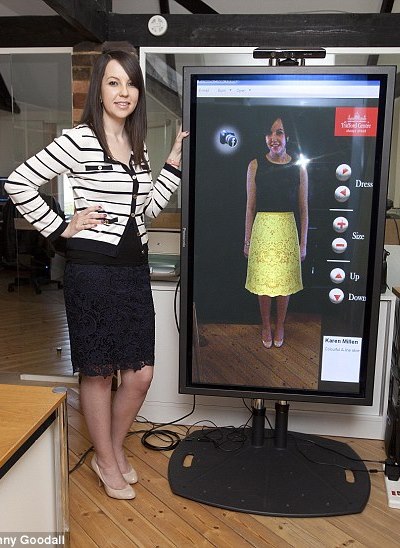
The "magic mirror"
The “magic mirror”

But in the case of online shopping, its likely to take the form of a Kinect device in your computer, which scans your body and lets you know what size to get. How cool/lazy would that be? Oh, and as for those AR displays that put you in the clothes you want? They should come with a disclaimer: Objects in mirror are less attractive than they appear!

Source: en.akihabaranews.com, technabob.com

DARPA’s New Sub-Hunting Robot

robot_sub-hunterWhen it comes to planning for the next possible conflict, military planners are often forced to take into account emerging trends in technology, and find both uses and countermeasures for them. And when it comes to future wars at sea, possibly fought in the Straight of Hormuz or the Sea of Japan, a number of startling developments are being taken into account, and solutions drawn up!

One such “solution” is the new robot sub-hunter being jointly created by the Science Applications International Corporation and DARPA – the Defense Advanced Research Projects Agency. That unmanned maritime robot, called the Anti-Submarine Warfare Continuous Trail Unmanned Vehicle, or ACTUV, doesn’t exist yet and won’t for years. But the SAIC’s plan does have the backing it needs, and presents an idea that is likely to inspire fear in submariners everywhere!

knifefish-drone-640x353For one, the unmanned vehicle will be capable of operating for periods ranging between 60 and 90 days, significantly longer than any aerial drone is capable of staying airborne. What’s more, SAIC is designing the ACTUV to be way more autonomous than contemporary drone aircraft. Once powered up, all a ship need do is release the drone and allow it to rely on its long-range acquisition sonar and other advanced sensors to scan for submarines, while at the same time steering clear of any nearby surface ships.

And then there is the advanced technology powering the drone’s sonar arrays. Unlike other ships, the ACTUV’s sensors create an acoustic image of its target to know it has the right one. Once the ACTUV thinks it’s got something, it pings nearby Navy ships through a satellite link, which they can either confirm or deny, either giving the ship the green light to hunt or instructions to search elsewhere.

And last, but not least, the ACTUV can operate alongside its surface fleet, remain in constant communication with a mothership as well as naval aircraft as they deploy sonar charges to help it hunt subs. This is a level of coordination that is rarely seen in aerial drones, which are either sent into action far from the front lines or controlled remotely by infantry in the field to offer fire support.

X-47BAh, but there’s one thing: the drone isn’t armed. Primarilyy developed to help Naval ships with hunting silent subs and/or cheap diesel-electric models, the ship may be capable of operating autonomously, but cannot take action to end lives. This feature may be the result of the Pentagon’s recent decision to limit the killing powers of UAV and autonomous drones, which amounted to ensuring that a human being will always be at the helm wherever the death of human beings is involved.

What’s more, the drone is designed with all kinds of futuristic and present-day scenarios in mind. While silent subs – ones that use advanced drive systems to generate little to no noise (a la The Hunt for Red October) – are one likely scenario, there is also the possibility of the US Navy running into the cheap diesel models which are technologically inferior, but can be much quieter and harder to track than anything nuclear. Russia is known to sell them and Iran claims to have them, so any military analyst worth his salt would advise being prepared to meet them wherever they present themselves.

And of course, the SAIC was sure to create a video showing the ACTUV in action:


Source:
Wired.com

The Future is Here: Roboy the Robotic Child!

roboy_splashThe field of robotics has been heated up in recent years. With autonomous killing machines being developed by the USAF, mind-controlled prosthesis for the disabled, juggling robots by Disney, a headless Kenshiro Robot and even 3D printable android, it seems like only a matter of time before Asimov’s Three Laws will need to be applied. Either that, or we might have a Robopocalypse on our hands.

But when you see this latest project in robotics, you might find it hard to imagine an apocalyptic scenario resulting. Forget Terminator, this seems more like something from the realm of Pinocchio or AI. That’s the feeling I get from Roboy, a concept that began back in May of 2012 when the University of Zurich’s Artificial Intelligence Lab committed to creating a fully humanoid robot by March of 2013.

For those doing the math, yes, that is roughly nine months. As if his size and proposed aesthetics weren’t enough, the creators even committed to a timeline that mirrored the time it takes to birth and actual child. And just to complete the illusion, they hope to cover the finished product in a soft, artificial skin. Talk about infanto-centric (assuming that’s even a word)!

But of course, the real breakthrough of Roboy is in the design itself, which borrows from the Kenshiro humanoid and the earlier Ecce model that both rely on artificial muscles to move. At this point, the robot is near completion and should be released next month during the Robots on Tour event in Zurich, Switzerland, providing everything arrives on schedule. At the moment, the long-term purpose of Roboy is to act as a prototype for service robots that will help elderly people remain independent for as long as possible.

I smell another movie reference there, one involving and old man and his friendly robot side-kick. Can you guess which one I am referring to here? Correct, it’s Robot and Frank! And with all the developments in robots happening right now, I’d say we need to do our homework and see all these movies, and reread Asimov’s Robot series while were at it!

And while you’re doing that, be sure to check out this video of the Roboy’s design in action:


Source: news.cnet.com, ailab.ifi.uzh.ch

The Future is Here: The Kenshiro Muscle-bot

kenshiroIt may seem like someone at Tokyo University drank their breakfast. I mean really, a robot without a head? How is supposed to mimic our facial expressions and creep us out with its glowing red eyes? But when you consider the purpose behind the Kenshiro muscle-bot, you begin to see the rather important method behind the design.

In recent years, various robotics companies have been able to create machines that mimic the animal kingdom – from hummingbirds, to turtles and even squirrels. However, few have managed to tackle the realm of human movement, and shown truly positive results. Hence the purpose of Kenshiro, human-like musculoskeletal robot that was revealed at the Humanoids conference back in December.

For years, the University has been toying with the design for a bio-inspired robot, adding more muscles and more motors with each new design. Standing at 158 centimeters and weighing in at 50 kilograms, Kenshiro basically mimics the body of the average Japanese 12-year-old male. And with 160 pulley-like “muscles” – 50 in the legs, 76 in the trunk, 12 in the shoulder, and 22 in the neck –  the robot mirrors almost all the major muscles in a human and has the most muscles of any other bio-inspired humanoid out there.

And with all the progress being made in developing a fully-functional autonomous machine mind (see Google Neural Net), not to mention a face that can mimic human expressions (see the FACE), it may just be a matter of time before we need to start thinking about applying Asimov’s Three Laws of Robotics. Don’t want a Robopocalypse on our hands!


Source:
spectrum.ieee.org

More Judgement Day Announcements…

terminator_judgement_dayNovember saw some rather interesting developments in the field of robotics. First, there was the unveiling of Disney’s charming juggling robot, an automaton capable of playing catch with a human being. This robot is intended for use in Disneyland parks as a form of entertainment for guests, but many people wonder if this is an eerie precursor to a machine that is capable of throwing other things as well…

While Disney was scant with the details of how the robot works, they did explain that a camera tracks the balls being thrown, while an algorithm works out exactly where the ball is going to land and positions the robot arm accordingly. Combining video tracking and software, the robot is able to anticipate where its catching hand needs to be, much like the human brain does. Check out the video of it playing catch with a human stand-in below:


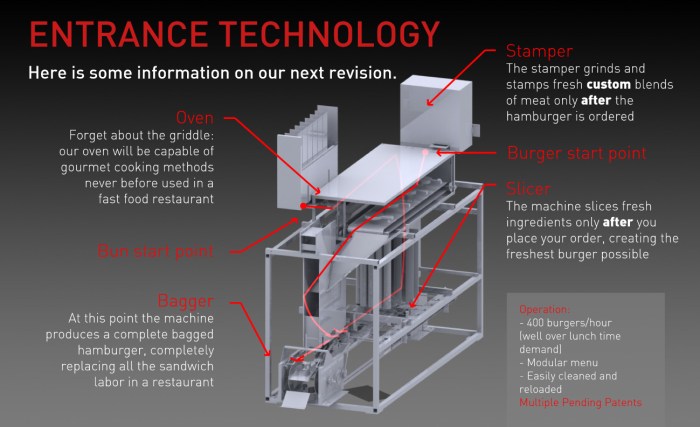
Also in the news, Momentum Machines unveiled a new automated burger robot chef last month. After being successfully tested on the line, the company announced its plans to introduce this robot to fast food chains everywhere, saving companies millions of dollars in staffing costs. According to projections, Momentum Machines says that its automated burger robot — which does everything from flipping burgers, to slicing tomatoes, to toasting the bun — could save the fast food industry $9 billion in wages.

Of as yet, no video is available of the burger robot doing a demonstration, but this helpful infographic does give a breakdown of the robots structure and basic functions (below). Granted, this might seem like a callous and insensitive move, especially to the over 2 million workers currently employed in fast food in the US alone. But with just about every other production line having been automated already, this seems to many like the next logical step. Good luck Momentum Machines; hope the angry mob outside your offices doesn’t scare you!

robot-burger-flipper-momentum-machinesGranted, this may all still seem like a far cry from Skynet and Cylons, but under the circumstances, is it any wonder that Cambridge University founded the Center for the Study of Existential Risk (CSER) to evaluate new technologies? Clearly, some people are worried robots are going to be doing more than just chucking balls and flipping our burgers.

Robonauts

A robot and an astronaut shake hands… That might sound like the set up for a really cheesy joke, but in fact, it was a moment in history. Back in February of this year, a first occurred when Daniel Burbank. the commander of the International Space Station, shook hands with the first ever Robonaut. Controlled by ground crews, and currently lacking in full-body motion – they aint got no legs! – this does represent a big step forward in robotics.

As things stand, it is not yet clear if this represents a plan to “unman” space, or just supplement astronauts with humanoid machines that are capable of performing rote tasks and the more labor intensive aspects of space travel. But given the fact that space travel still requires adaptation and flexibility as much as calculations and precision, and that no amount of remote control can equal the thrill of actually being there, I’m thinking human astronauts are going to be around for a long time.

Check out this video of the Robonaut and Burbank making their historic handshake!

Source: CNET.com

Robot and Frank Trailer

Check out the trailer for the new movie entitled Robot and Frank, a near future comedy/drama about an elderly man with Alzheimer’s whose family gets him a robot to help him out around the house. In time, Frank and the Robot begin to bond and form a relationship that even begins to supersede the one he has with his own children. Naturally, things get a bit awry when Frank decides to go back to his old ways and use the Robot to pull some heists!

Not only does this look like an interesting movie from a purely technological angle, I looks downright touching and deep. The existential issues it explores, like how one does not need emotions in order to form bonds, or how Frank is more willing to go on the lam (I assume) than erase his friend’s memory. Significant! Looking forward to it. Expect a review 🙂

“Our Favorite Cimenatic Robots”

Just came across this article in the Globe and Mail today and I have to say, I was pleasantly surprised. It’s funny when a respectable publication like this one chooses to release something that I myself would have done, or did do, in small increments. In fact, many of the contenders on this list call to mind my little listing on Robots, Cyborgs and AIs which I did awhile back.

But dammit, they left out HAL and Robocop. That’s just plain wrong! Sure, they were trying to keep it to top 10 and felt the need to exclude cyborgs and supercomputers, and did have the good nature to apologize in advance for this, but still…

Here is the list as it appears in the article:

  1. The Terminator
  2. Droids from Star Wars (R2D2 and C3P0)
  3. Wall-E
  4. Replicants from Blade Runner
  5. Maria (Metropolis)
  6. Ash (Alien)
  7. The Iron Giant
  8. Gigolo (AI)
  9. The Stepford Wives
  10. Robby the Robot

Check out the full article here, complete with a gallery and some explanations of why these constitute “our” favorites 😉


The Future is Here: The Google Neural Net!

I came across a recent story at BBC News, one which makes me both hopeful and fearful. It seems that a team of researchers, working for Google, have completed work on an artificial neural net that is capable of recognizing pictures of cats. Designed and built to mimic the human brain, this may very well be the first instance where a computer was capable of exercising the faculty of autonomous reasoning – the very thing that we humans are so proud (and jealous) of!

The revolutionary new system was a collaborative effort between Google’s X Labs division and Professor Andrew Ng of the AI Lab at Standford University, California. As opposed to image recognition software, which tells computers to look for specific features in a target picture before being presented with it, the Google machine knew nothing about the images in advance. Instead, it relied on its 16,000 processing cores to run software that simulated the workings of a biological neural network with about one billion connections.

Now, according to various estimates, the human cerebral cortex contains at least 1010 neurons linked by 1014 synaptic connections – or in lay terms, 10 trillions neurons with roughly 1 quadrillion connections. That means this artificial brain has one one thousandth the complexity of the organic, human one. Not quite as complex, but it’s a start… A BIG start really!

For decades – hell, even centuries and millennia – human beings have contemplated what it would take to make an autonomous automaton. Even with all the growth in computer’s processing speed and storage, the question of how to make the leap between a smart machine and a truly “intelligent” one has remained a tricky one. Judging from all the speculation and representations in fiction, everyone seemed to surmise that some sort of artificial neural net would be involved, something that could mimic the process of forming connections, encoding experiences into a physical (i.e. digital) form, and expanding based on ongoing learning.

Naturally, Google has plans for an application using this new system. Apparently, the company is hoping that it will help them with its indexing systems and with language translation.  Giving the new guy the boring jobs, huh? I wonder what’s going to happen when the newer, smarter models start coming out? Yeah, I can foresee new generations emerging over time, much as new generations of iPods with larger and larger storage capacities have been coming out every year for the past decade. Or, like faster and faster CPU’s from the past three decades. Yes, this could very well represent the next great technological race, as foreseen by such men as Eliezer Yudkowsky, Nick Bostrom, and Ray Kurzweil.

In short, Futurists will rejoice, Alarmists will be afraid, and science fiction writers will exploit it for all its worth! Until next time, keep your eyes peeled for any red-eyed robots. That seems to be the first warning sign of impending robocalypse!

The Future is Here: Transforming Humvee

I recently uncovered this video of the Humvee Bioloid, which is basically a transformer. The designers have indicated that this is their second attempt at creating real transformer technology, and swear up and down that no CGI was involved in the production of the video. Having watched it, I cannot attest to the authenticity for sure, but suffice it to say, the whole thing looks real enough to me.

Maybe some day soon they can produce one that can do more than “the robot”! Seriously, this thing can dance, but where the hell are the laser guns and the in-your-face interface? Guess we’ll have to wait for the upgraded model 😉