Cool Ships (volume IV)

Back with a fourth installment. As usual, I am indebted to people for making suggestions and offering critiques. Funny thing, these lists seem to be getting longer and more diverse the longer this series goes. But I guess that tells you something about the world of sci-fi. No shortage of material, and kind of like fossil hunting in that the deeper you dig, the more fascinating things get.

Ancients City Ship:
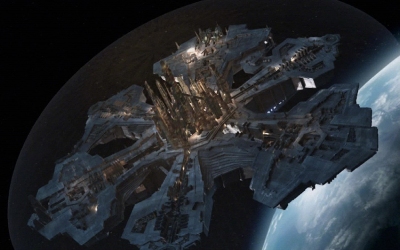
You know the old saying “you can never go home”? Well in this case, the Ancients seemed to think that the best away around that was to take it with you. This one goes out to Nicola Higgins. Thanks for the suggestion, you Stargate fangirl!

Known as a City Ship, this piece of Ancients technology is in centerpiece of the spinoff series Stargate: Atlantis. A self-contained city that is capable of traveling through space, and comes equipped with a hyper drive, this vessel was designed to transplanting colonies of Ancients on distant worlds throughout the Galaxy. It also heavily armed and shielded, making it a veritable mobile fortress.

Beginning several million years ago, the Ancients began what was known as the “Great Migration”, where they left Earth for the Pegasus Galaxy and other destinations in deep space. One such ship which took part in the migration was the Atlantis, which departed from Antarctica and landed on the world known as Lantea, where it was again discovered by humans in the course of the show.

Measuring roughly the same size as Manhattan island, an average city ship comes equipped with extensive living quarters and amenities that make it suitable for large-scale population for extended periods of time. Though capable of space flight and space combat, it’s environment of choice is terrestrial, preferably on water.

Colonial Viper:
This one kind of seems overdue. But I felt the need to push this one back so I could cover the bigger ships from the Battlestar Galactica franchise first. With them done, I can now pay tribute the fighter-craft of choice for the Twelve Colonies, the Viper! Taken from the original series, the Mark II was your basic space superiority fighter, fast, maneuverable, and boasting two laser guns for defense.

In the updated series, the Mark II was considered a relic from the Human-Cylon War, its systems outdated and its controls antiquated (the laser guns were also replaced by two ballistic weapons and a compliment of missiles). However, it was these very antiquated features that would prove to be the saving grace of the Mark II when the Cylons attacked the Colonies at the beginning of the new series.

The updated Mark VII Viper was the pinnacle of Colonial technology at the time. Boasting updating targeting, controls, all of which were networked with the fleet’s central computer system, the Mark VII was far more sophisticated than its predecessor in every measurable way. However, being a networked fighter made it vulnerable when the Cylons unleashed their crippling virus on the Colonies defense mainframe. Several models remained in operation though, thanks in large part to the Pegasus surviving the initial Cylon assault. Once the two fleets combined their resources, the Colonial fleet had several Mark VII’s at their disposal and even began manufacturing new ones to replace their losses.

The Colossus:
Now here’s a franchise I haven’t covered yet! Fans of Freespace and FS II know that when it comes to cool ships, there was no shortage to come out of this video game series. Classically inspired, well-designed and just plain awesome to behold, the Colossus is definitely top of that list. Big, bad, and boasting enough firepower to take down an enemy armada, the Colossus was appropriately named!

Designed by the Terran-Vasudan Alliance in the wake of the Great War, the Colossus was a prototype super-destroyer that was designed to confront all future incursions by a hostile race. Foremost amongst these was the threat of the Shivans, the species that appeared in the first game, destroyed the Vasudan homeworld and nearly destroyed Earth as well.

Measuring 6 km in length, bristling with weapons and boasting a crew of over 30,000, the Colossus took over 20 years to complete and involved dozens of contractors from both races. In terms of defense, it has over 80 weapon turrets, consisting of cannons, missile launchers, and multiple heavy beam emitters. It also houses 60 fighter and bomber wings and requires a crew of over 30,000. In short, the Colossus wields more firepower and fighter wings than an entire Terran or Vasudan armada.

Deimos-class Corvette:
You know the old saying, “it’s not the size of the dog in the fight but the size of the fight in the dog”? That’s what comes to mind whenever I see small ships that are solidly built and pack a wicked punch. As you might have guessed, that precisely what the GTCv Deimos-class vessel is all about! Also taken from the Freespace universe, this corvette was designed for fighter support and attack purposes, providing some added firepower and punch to light assaults and defensive screens.

As the newest addition to the Terran fleet in FS II, these corvettes were designed to replace the aging Fenris and Leviathan-class cruisers from the Great War. In addition to their small profiles and heavy firepower, their hulls are strengthened with collapsed-core molybdenum sheathing for better protection against beam fire and their Vasudan-designed reactor core provides more energy per ton than any other allied ship class.

In a way, these ships remind me of the USS Defiant. Much like that little ass-kickers from the DS9 universe, she packs a lot of power and toughness into a small frame, proving that you don’t have to be big to bring a big ass-whooping! As you might be able to tell, this is a bit of a vicarious experience for me 😉 Being only 5’8”, I too had to be known for scrappiness whenever height and reach failed me in a sparring match!

Drakh Raider:
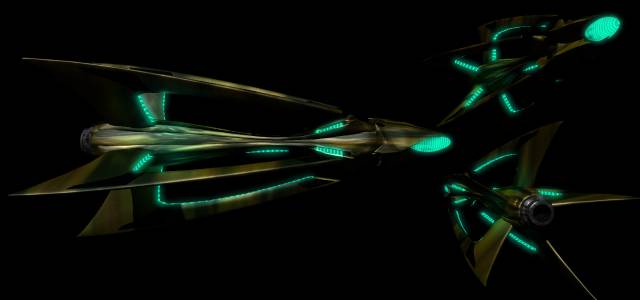
Once more onto B5 friends. God, I worry people are going to get so sick of this universe given all the attention I devote to it. But as long as it keeps providing ’em, I’ll feel obliged to honor ’em! This time, it’s the Drakh Raider which I’ve chosen to represent. Small, sleek, fast and powerful, these ships were the first line of assault and defense for the Drakh fleet, providing attack screens and defensive escort to their larger destroyers and carriers.

As Londo remarked in the course of the show, “They’re a legend. The kind you would use to frighten small children at night... They were ruthless, savage, but extremely bright. A very bad combination.” And these ships certainly embodied that. Making their first appearance in the third season (“Lines of Communication”) when it became revealed that the Drakh were manipulating the Mimbari into a civil war, and later in the Call to Arms TV movie when the Drakh began assaulting Earth.

Being quite small and based around a central beam weapon, these ships were either unmanned or had a very small crew. They were also quite effective, as two were able to destroy a White Star during their initial encounter with Delenn and the Alliance fleet. However, being small and light, they were also relatively easy for more sophisticated ships of the Alliance to shoot down, and even a small fleet of them could not stand up to larger vessels like the Excalibur. Still, these puppies could wreak havoc against shipping and military vessels that belonged to the younger races. Once they began conducting raids on League Worlds, all parties were forced to turn to Sheridan and the White Star fleet for help.

Romulan Warbird:
Also known as the D’deridex-class, the Warbird class was one of the largest and most powerful ships in the Romulan Star Empire’s armada and served as the backbone of the Romulan fleet during the latter half of the 24th century. In addition to its impressive array of disruptors and photon torpedo banks, the Warbird also has a cloaking device, the result of military exchanges between the Klingon and Romulan Empires.

After their debut in the first season of TNG (“The Neutral Zone”), the Warbird went on to appear in several engagements with Star Fleet (most notably the Enterprise) and the Dominion. In the spinoff series of D29, they would figure prominently in the Dominion War. Initially, this consisted of providing defense against Jem’Hadar incursions, but eventually went on to take part in most major offensives. These included the battles of Chin’toka and the final assault on Cardassia Prime.

Measuring twice as long as a Galaxy-class starship (such as the Enterprise D) the Warbird is powered by a forced quantum singularity and boasts the latest in Romulan technology. This makes it not only one of the most advanced ships in the Romulan fleet, but the Alpha Quadrant itself!

Rama:
Once again, I find myself looking back and wondering how the hell I forgot this one. You can’t call yourself an Arthur C. Clarke fan and a sci-fi geek without knowing about Rama. Lucky for me, ongoing segments give us chances to correct for our mistakes, which I am doing now.

Taken from Clarke’s famous novel Rendezvous with Rama, this namesake was what can be termed a “generational ship”, meaning a spaceship where successive generations of people are expected to be born and die before it finally reaches its destination. In the course of the story, this massive ship was detected on its way towards Earth. Once scientists and astronomers learned that it was not an asteroid or some other natural phenomena, they became mighty interested mighty fast!

Basically a large cylinder in space, the ship measured 50 km in length, 16 km wide, and rotated in order to provide gravity equal to 0.25 g’s (or a quarter of what we’re used to here on Earth). After boarding it, astronauts from Earth noticed an interior layout that resembled cities, rivers and other common geographical features, but being based on technology and chemical compositions which they could not recognize. The horizontal sections of the ship also housed windows which appeared to be letting in outside light, which in turn was having a thawing effect on the landscape since it was frozen from being in deep space for so long.

In addition, they discovered that their was no crew to speak of, nor any cryogenic tanks that held them in stasis. Evenutally, it was determined that these chemical rivers contained the trace chemicals needed to “manufacture Ramans”, and that as it neared a star, it would take the energy and heat necessary to perform these and other life-restoring functions. In the end, Rama was just passing through, a grave disappointment for Earth people… until they realized that more were on the way!

Pretty damn cool huh? This concept of a cylindrical hull with a self-contained city went on to inspire countless franchises and writers, not the least of which was J.M. Straczynski who modeled the interior of Babylon 5 based on Clarke’s descriptions. Generational ships also appear in many science fiction franchises, not the least of which are Alastair Reynold’s Revelation Space series and Joss Whedon’s Firefly.

USS Saratoga:
Space Above and Beyond is back for another installment, this time with the main ship of the fleet! Designated as a SCVN (Space Carrier Vehicle Nuclear) the USS Saratoga is the futuristic equivalent of a modern-day aircraft carrier and was home to the 58th Squadron (“The Wild Cards”) for the entire series.

In the course of the show, the Saratoga served on the front lines for the entire Chig War. This included the defense of Earth in the pilot episode, the offensive at Ixiom and Deimos, and in Operation Roundhammer – the assault on the Chig homeworld – at the end of the series. For the duration of its service, the Saratoga was commanded by Commodore Glen Ross, a no-bullshit naval officer who enjoyed playing guitar, cared deeply for his people, and was known for his catch-phrase “take that bird out of my sky!”

In addition to its compliment of fighters, the Saratoga boasted some pretty heavy armaments, including laser pulse cannons, phalanx missile launchers, and anti-ship torpedos. The vessel was also powered by a helium 3 fusion engine, measured 525.6 m in length and was capable of FTL travel thanks to a wormhole-generating engine technology.

Tigers Claw:
Yet another franchise I have neglected to include so far, but which deserving since cool ships was kind of their thing… Here we have the TCS Tiger’s Claw, the carrier and command vessel from the video game series Wing Commander. In the first installment in the series, the Tiger’s Claw was as the focal point of the story, a Bengal-class carrier that was deployed to the Vega Sector to fight in ongoing conflict known as the Terran-Kilrathi war.

In the course of its deployment in the Vega Sector, the Tiger’s Claw participated in many successful campaigns. These included the destruction of the Kilrathi base of operations for the entire sector in the campaign known as Custer’s Carnival, and the destruction of the KIS Sivar in what was known as the Goddard Campaign.

Unfortunately, after proving victorious in Vega, the ship was transferred to the Enigma Sector where it was destroyed during an assault on the Kilrathi starbase K’tithrak Mang. Using stealth fighters, the Kilrathi managed to ambush and then obliterate the carrier using torpedoes. These events took place between the first and second installment in the series and formed the basis of the latter’s backstory. Save for the main character of the story – Col. Christopher Blair (aka. you) – all hands aboard her were killed, including her air group commander, General Halcyon.

In addition to its vast compliment of 104 fighters, the Tiger’s Claw also possesses 8 heavy laser turrets, 20 defensive batteries, and powerful shields. Measuring 700 meters in length and weighing over 80,000 tons, her crew numbers in the thousands. Although slow and lumbering compared to smaller craft, she is still capable of a high maximum velocity (468,000 km/hour) and can make FTL jumps.

Voth City Ship:
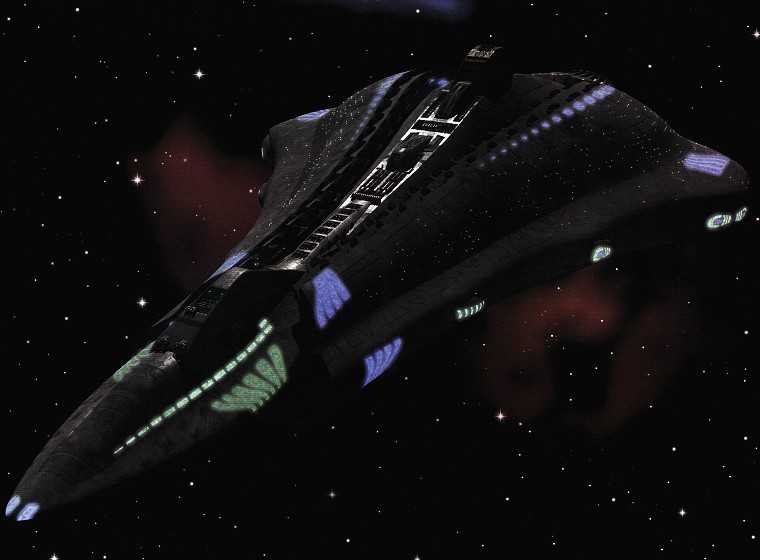
Here’s another example of something the Star Trek franchise did really right! Appearing in the third season of Star Trek: Voyager (episode 64: “Distant Origin”), the Voth City Ship was something that was both intriguing and heavily-inspired. Based on the concept of a self-contained city in space, she was the command and administrative center of the entire Voth race and home to its ruling matriarch.

As the episode which featured her progressed, we learn that a group of alien scientists have discovered Voyager and have become convinced that she holds the key to proving their “Distant Origins” theory. When they meet these creatures, they learn that their kind evolved from dinosaurs on Earth to become a race of talking, bipedal humanoids who developed an entire civilization before they were forced to flee. After millennia of wandering, they landed in the Gamma Quadrant where they have since become the dominant power.

Unfortunately for said scientists, and the crew of Voyager, the Voth leaders are not too crazy about this idea. In addition to contradicting their beliefs that they emerged in the Gamma Quadrant (known as “Doctrine”) they are insulted to think they are related to mammals, creatures they consider inferior. Once they make contact, they are able to capture Voyager and neutralize her defenses quite easily, beaming the entire ship into one of their massive internal bays and knocking out all of their equipment using a dampening field.

In addition to all this impressive technology, the Voth also appeared to possess cloaking technology, trans-warp capability, and no doubt had some serious mother-loving weapons technology. It was a major blessing that Janeway and her crew didn’t press matters too hard and try to get into a firefight with these aliens, otherwise we would have seen some serious fireworks.

Final Thoughts:
Woo! Okay, that one was pretty good. And some rather new and unique examples made it in this time. Thanks for the suggestions people and my endless thanks as always to the good folks who maintain the Wiki’s and other source info sights for these franchises. Without you, I’d be very limited and would have quite doing these long ago! Also, I seem to have focused on city and generation ships a lot in this posting, which got me thinking…

It was the physicist and mathematician Freeman Dyson who claimed that the pinnacle of technology would be the ability to build a “Dyson’s Sphere”. That is, a sphere so large that it could encompass an entire star system, or at least the star and its primary planets. After all, the amount of materials and engineering capabilities required to build such a thing are just staggering and clearly beyond the means of anything we now know. Now that all may be true, but might I suggest that a more realistic and attainable measure of technological prowess would be the ability to create self-contained environments where several successive generations of humans and animals could survive for long periods of time?

Think about it. A species that can do this would be capable of leaving whatever world they call home behind and transplanting themselves in a distant star system or galaxy, meaning that their fortunes would never be tied to one rock in one star system. Even if our survival didn’t depend on it – which it might given the state of the planet! – it would still be a rather elegant way of planting the seed of humanity elsewhere in the galaxy. Instead of sending people out land on a planet and then do all the hard work of terraforming and building infrastructure, you just send the ship, and people can grow outwards in their own time without having to worry about hostile environments or organisms.

Pretty anthropocentric, I know. And yes, colonization is chock full of potential for evil, especially where indigenous life is concerned. Still, it’s a cool concept and it got me thinking, which is partly why I like to do these things. An excuse for research and to expand my mind!

Until next time, keep those idears coming!

15,000 hits! Weeeee!

Wouldn’t you know it? As of yesterday, on May the 4th of all days, I discovered that my hits tracker had just broken 15,000 views. I could scarcely believe it! This little blog which I started just over a year ago to publicize my thoughts on sci-fi and share my writing seems to be reaching far more people than I ever thought possible. Yes, what stated as a humble hobby to one day be able to write for a living seems one step closer to becoming true. I’m feeling happy, grateful, and a little smug… I’d like to chase that feeling!

So here’s what I’m thinking. Over the next few days I totally want to complete my reviews of the Star Wars franchise in honor of the Star Wars Day. And this will include the newer movies since someone was kind enough to ask me what I thought about them (thus enabling me to talk some more!) After that, I will be finishing up with my posts on Data Miners, which I’ve decided I will stop after chapter 12. First ten percent is free, you gotta follow the links to get the rest 😉 And of course, I will be getting back to what’s become a segment-in-itself, the Cool Ships thing. And of course there’s Crashland and all our work over at Grim5next to talk about, plus that review of Hunger Games I promised way back when. Gotta get on that before the movie’s finished!

So that’s my plan for the next few weeks and months, part of my hope to maintain this momentum and the lovely following I seem to have built up. Thanks be to all of you for making this little hobby of mine work. Now if I could just make it pay, I’d really be in business 😉 Good day all!

Even More Cool Ships!

Dang it, this is fast growing into a theme of its own, outgrowing the whole “conceptual” thing by leaps and bounds! But there are always more contenders, and people have been nice enough to leave suggestions with me. So the list must go on, taking into account more spaceships, aircraft an assorted vehicles that come to us from a variety of franchises. Some are fast, some are scary, some are just really, really neat to look at! But they all have one thing in common, they are all cool!

Here’s the latest, as assembled by me and with the help of some helpful suggestions!

Cylon Base Ship:
cylon_basestarIn my first post, I mentioned the Galactica and how it had evolved from its original self to become the aged but enduring vessel that we saw in the new series. Well, when it came to the Cylons, the artists seemed to go in the opposite direction. Rather than making the Cylon Base Ships less advanced-looking, they opted instead for designs that looked sleeker, updated and more organic.

This was in keeping with the updated concept of the Cylon race. Whereas in the original series, the Cylons were slow, lumbering robots who simply followed orders and sounded very machine-like, the new Cylons were fully organic beings that could easily pass for humans.

The Centurions, much like their predecessors, remained loyal robots, but were also a hell of lot more streamlined and dynamic in appearance. The Base Stars were said to be constructed out of a cartilage-like material that was soft and organic, but became solid and super-tensile once it hardened. And of course, the Cylon Raiders were themselves equipped with organic parts, living brain tissue inside a metal hull.

Of course, the new Base Ships were downgraded in one respect. Much like the Galactica, the new designers decided to forgo the idea of lasers for something a little more realistic. In the case of the Cylons, this meant missiles instead of flak guns and cannons. However, everything else was significantly more advanced than the original, including the appearance and the scientific foundation on which it rested. Basically, the new Base Ships looked organic because they were organic. Instead of being built in a shipyard, they were grown in them. That’s some advanced shit right there!

All of this were quite ingeniously attributed to technological evolution. The old Base Star and Centurion designs were said to have been what the Cylons looked like during the previous war. Toasters was the term used to describe them, given their chrome exteriors and campy-retro look. Their new designs were the result of over twenty years of progress, going from constructions of metal and silicate materials to biometric tissue which was grown in vats. A very cool concept, and in keeping with the latest updates in the fields of science and science fiction 😉

The Discovery:

Discovery, front view

Cue classical music soundtrack! The Discovery is sailing by… in excruciatingly slow motion! Yes, I’m sure I speak for all those who have seen 2001: A Space Odyssey when I say that the story was brilliant, the cinematography superb, but dammit, did they have to do so many long, drawn out space sequences? Well, as someone very wise said, this movie was made back when people still had attention spans!

But on the plus side, the long sequences allowed audiences to truly appreciate the design and concept of this ship, and many others in the film. In what can only be described as a caterpillar (or ball and chain) type design, the Discovery was originally designed for cargo hauling, but was converted to deep-space exploration when Earth scientists needed to mount a manned mission to Jupiter in a hurry.

One can see without much effort how these concepts overlapped in the design. Being made up of many segments, the spine of the ship was clearly designed to hold detachable cargo pods, whereas the crew and navigation team would hold up in the spherical section at the front. Once converted, this frontal section was given pod-bay doors, a compliment of small explorer craft, and a large scanner array mounted along the dorsal section. The engine compartment at the rear was built for heavy thrust, alluding to the fact that this craft was intended for deep-space missions.

rear view

In addition to all that, the ship came equipped with vast stores of food, cryogenic pods, and an onboard AI known as the HAL 9000. During the better part of its deep space missions, the crew would be kept in cryogenic suspension, HAL would pilot the ship, and they would be thawed once it came close to its destination, or in case an emergency situation arose. Also, its contained rotating sections which would become active once the crew was in a waking state, ensuring that they didn’t succumb to muscular atrophy due to weightlesssness.

Simple, straightforward and technically practical, The Discovery was everything one would expect from the future of space travel, at least from a 1960’s standpoint. And granted, we weren’t exactly building ships like this when 2001 rolled around. But we weren’t exactly fighting the Cold War or discovering aliens on the Moon either. In either case, you’d be hard-pressed to find hard sci-fi like this anywhere today. RIP Arthur C. Clarke. You too, Kubrick! You’re genius is sorely missed!

Draconia 1:
Credit for this one goes to Victor of Victor’s Movie Reviews. Initially, I was hesitant when he suggested I post something from the Buck Roger’s universe, but quickly changed my mind when I saw it. Thanks for the suggestion and the links man! Enjoy this one!

Just to be clear, I got nothing against Buck Rogers, I’m just relatively ignorant about the franchise. And after combing through a couple databases, I’m still pretty ignorant. Whereas I thought this was just a popular movie and tv series from the 80’s, I’ve since learned that its roots go way deeper than all that! Originally, Buck Rogers was a novella named Armaggedon 2419, a dystopian story that appeared in an issue of Amazing Stories in 1928. Since that time, the story has been adapted to comic books, radio, television, and with the success of Star Wars and Battlestar Galactica in the late 70’s and early 80’s, a feature film and a TV spinoff.

Known more popularly as “Buck Rogers in the 25th Century”, it is from this point in the series that this megalithic ship known as a Draconian battleship comes to us. Named in honor of the empire that built it, Draconia 1 was the flagship of the Draconian armada and the flagship of the franchise’s chief protagonist, Princess Ardala. , to conquer Earth and make Buck Rogers her consort. And given its size and imposing nature, I’d say the artists captured these intentions quite perfectly. With a name like Draconi 1, you gotta figure the ship is going to look stern, sharp, and geared up for war!

Earth Force Thunderbolt:
ThunderboltAnother happy contribution from the Babylon 5 universe! An upgraded model that was meant to replace the older Starfury-class fighter, Thunderbolts were two-person aerospace fighters that were had boasted extra firepower, better navigation, updated systems, and the ability to navigate inside atmospheres. Yes, unlike the earlier models, these things could operate in space and in the air.

This was made possible by the addition of extendable airfoils which were attached to the ship’s four engine mounts. In addition, the hard mounts on these wings were capable of holding up to ten missiles. These, combined with its four uni-directional pulse cannons, gave it a serious firepower advantage over its predecessor!

Making their debut in the second season of the show,  the Thunderbolt would play a pivotal role in the Earth Alliance civil war, which broke out shortly thereafter. Thanks to a shipment that arrived on the station before B5 declared its independence, and the addition of several squadrons of defectors from the Earth Force destroyers Alexander and Churchill, Sheridan and his forces were not at a disadvantage when President Clarke’s forces came knocking!

According to the B5 Wiki, the Thunderbolt represented the third incarnation in the Starfury series. In terms of design, they were clearly inspired by their namesake, the P-47, and other WWII aircraft like the P-51 Mustang. In addition, inspiration was probably owed to the F4 Phantom of the Vietnam Era, which also boasted a two-seat configuration and also had the same mouth and bared teeth design on the front. A good thing too, for credit should always be given to the classics!

The Eclipse:
What could be more terrifying than a Super Star Destroyer? THIS, that’s what! And like a Super Star Destroyer, it comes to us from the expanded Star Wars universe. Known as the Eclipse, and taken from the Star Wars: Dark Empire comic series, this vessel was the latest incarnation of Imperial terror technology at its best (or worst)! Originally intended as the resurrected Emperor’s new flagship, the Eclipse II quickly became the symbol of resurrected Imperial might in the comic series, dwarfing even the Executor and all other classes of Super Star Destroyer that preceded her.

Little wonder then why they called it the Eclipse. Park it in orbit over a planet, and boom! Lights out! And much like the Death Stars and Executor-class Super Star Destroyers that preceded her, the Eclipse was nothing short of a vanity project by Emperor Palpatine, its size and awesome power reflecting his megalomania and maniacal ambitions. But regardless of how overcompensating it seemed, this ship was still a behemoth and a real slugger when it came to firepower!

Measuring 17.5 km in length, the Eclipse was absolutely fearsome in terms of its overall displacement, tonnage, and raw firepower. In addition to over 1000 turbolasers, laser cannons, and ion cannons, the ship also came equipped with a superlaser that was mounted on its prow. In essence, this ship was like a mobile Death Star, capable of destroying an entire planet as well as an enemy’s armada. On top of all that, it also came equipped with 50 squadrons of TIE fighters and bombers, 100 tractor beams (the better to capture you with!), and its own gravity-well generators.

These last items are devices which appear quite frequently in the expanded SW universe, usually on Interdictor-class Star Destroyers. Basically, they allow a ship to generate a gravitational field which, when activated, prevents an enemy from jumping to hyperspace. So in addition to being impregnable, this ship could also prevent enemies from withdrawing from a battle. Hmmm, can’t beat her, can’t run away. Not exactly built for a fair fight, was she? But much like her terrifying predecessor, she was eventually destroyed in circumstances which couldn’t help but be embarrassing. I guess the old adages are true: the bigger they are…  etc, and pride cometh before a fall! Or in this case, a really big explosion!

The Nebuchadnezzar:

picture by Aquatium at deviantArt

Now here’s a franchise that hasn’t made the list yet. Taken from the Matrix franchise, the Nebuchadnezzar is a hovercraft and, along with others like her, the primary means of transportation and resistance for the people of Zion. Named after the (in)famous Babylonian Emperor who conquered the Levant, this ship made its first appearance towards the end of Act I, right after Neo was unplugged and had to be rescued.

According to Morpheus, her Captain, the ship is their means for reaching “broadcast depth” in the underground tunnels and hack into the Matrix. Beyond this basic role, it is also a primary defender whenever the sentinels begin to venture too close to Zion. In the first movie, its only means of defense was its EMP. However, in the second and third movie, it was upgraded to include defensive gun turrets.

The second and third movie also introduced many other versions of this hovercraft. Apparently, every ship is unique, each one boasting its own structure, profile, and size; variations on a theme rather than based on a standardized model. Clearly, nobody is Zion believes in assembly lines, at least not where their ships are concerned!

SA-43 Hammerhead:
HammerheadTaken from Space: Above and Beyond, the Hammerhead is an aerospace fighter and the mainstay of the future US Navy and Marine Corps. Named because of its configuration, front and back, this ship is not only cool to look at, but is quite practical from a hard science standpoint.

For example, the front and rear wings are not strictly for artistic purposes. In addition to serving as weapon’s mounts, they are the platform for the ship’s many retro-rockets. In the course of the show’s many action sequences, you always see these ships moving about as if they are truly operating in vacuum. In other words, they don’t swoop around like regular jets or have to roll to turn around. In space, all you got to do is fire your lateral rockets and let your axis spin around!

In terms of armaments, the Hammerhead packs a rather impressive array. A forward mounted laser turret is supplemented by a dual one mounted at the rear, giving the ship a near-360 degree range of fire. It also has hard mounts under its wings for missiles, bombs and rockets. These come in handy when facing down multiple squadrons of smaller, faster, but less heavily armed Chig fighters.

The Excalibur:
excalibur_2Back to the B5 universe yet again! Don’t blame me, they make a lot of cool ships. Anyhoo, this time around, the ship in question is the prototype White Star Destroyer The Excalibur. Designed to be a bigger, heavier version of its predecessor, the Excalibur was similarly based on Vorlon and Mimbari technology, incorporating organic hulls and Mimbari energy weapons.

A joint venture between the Earth Alliance and Mimbari governments, the interior of The Excalibur resembles that of most Earth Force ships. It’s controls are human-friendly, making it a quick study for crews who are used to serving on Earth Force vessels. This came in handy on its maiden voyage, when Sheridan and a crew of EF personnel were forced to commandeer it and its sister ship, The Victory.

It’s weapon consisted of multiple turret mounted beam cannons mounted all over the hull, but concentrated near the front and rear. On top of that, it also boasted a massive energy cannon similar to the kinds found on Vorlon warships. Unfortunately, this weapon was such a drain on the ships power that it could only be fire once in any battle, since its use would result in a systems blackout that could last several minutes. In addition, its ample bays could hold multiple squadrons of Starfuries and Thunderbolts, which were deployed by a pylon that extended from the hull.

In addition to playing a key role in defeating the Drakh, The Excalibur and its crew were also tasked with finding a cure for the plague they viciously unleashed on Earth. Though this spinoff series (Crusade) was cancelled partway through its first season, sources from the expanded universe indicate that it was eventually successful. So in addition to being able to kick some serious ass, this ship was also a capable exploration vessel and a mobile research station.

Spaceball One:
spaceballs6ts4uwDespite odd name and it’s whacky nature, Spaceball One is actually a pretty cool ship! In addition to being able to exceed the speed of light and go both “Ridiculous Speed” and “Ludicrous Speed”, the ship is capable of converting into a giant, robotic maid which, when armed with its megavac, is capable of sucking up an entire planet’s atmosphere. Tell me that aint a terror weapon!

A parody on the Star Destroyers from the very movie it was meant to parody, the design elements of this ship also seemed to pay homage to a few other unlikely sources. One suggested influence is The Discovery from 2001: A Space Odyssey, while another is the Nostromo from Alien. Given the comedic references to both these movies – the alien bursting out of a guy’s chest and performing a little ditty over lunch, or the “plaid” scene in space – this shouldn’t come as a surprise.

Thanks to Rami Ungar for (repeatedly) suggesting this one. We consider the matter closed, please stop sending hate mail! I kid of course, keep sending it! We like to hear from you ;)!

UD4L Cheyenne Dropship:
DropShipLast time, it was the USS Sulaco that made the list as a example of a cool ship from the Alien universe. This time around, I thought I’d look a little closer, specifically to its cargo bays. Because it is here that we find those cool Cheyenne-class dropships, the ones that carry Marines, APC’s, and a f***load of munitions to their targets.

Capable of atmospheric and space flight, the dropships are typically deployed from high orbit and extend their wings once they hit the atmosphere in order to maintain lift.The Cheyenne serves primarily as a troop transport, a role it is well suited for since it can take off and land vertically from unprepared areas.

However, it’s nose mounted gatling gun, weapons pods and large compliment of rockets also mean it can attack in a supporting role, namely as a gunship. Once its deployed its compliment of Marines, typically inside of an M579 Armored Personnel Carrier, it will retire to a safe landing zone or offer active support until all enemies in the area have been suppressed.

X-wing:
X-wing_SWGTCG“The Incom T-65 X-wing is the fighter that killed the Death Star. An almost perfect balance of speed, maneuverability, and defensive shielding make it the fighter of choice for Rogue Squadron.” This is how General Carlist Rieekan described the final entry on my list, the venerable X-wing starfighter!

Based on captured designs and built by specialists who defected to the Alliance, the X-wing played a pivotal role in the Galactic Civil War and would form the backbone of the Alliance’s Starfighter Corps. Possessing deflector shields, a hyperdrive, an R2 astromech for repairs and navigation, and a complement of proton torpedoes, the X-wing allowed the Rebellion to launch raids deep into Imperial space and stand toe to toe with its TIE fighter squadrons.

In addition to providing escort to Alliance vessels and conducting raids on Imperial ships and installations, its long list of accomplishments include destroying the first Death Star, proving cover for escaping Alliance ships after the Battle of Yavin and at the Battle of Hoth, and defeating overwhelming Imperial forces at the Battle of Endor. After the formation of the New Republic, the X-wing would go on to play a pivotal role in many subsequent battles and engagements, mainly against the remnants of the Empire.

Featured heavily in the original movies, the X-wing would also go on to become the only Star Wars fighter to get a videogame named after it! Not bad for the little “snub fighter” that could!

Final Thoughts:
And wouldn’t you know it, it seems I have actually have some insight to offer today. Must be on a count of how many ships I’ve reviewed by now. For starters, I think that while aesthetics and artistry count for a lot, some serious props need to be given for a hard sci-fi foundation. Ships that incorporate realistic features, like retro-rocket mounts, wings that only deploy if you’re expecting atmosphere, and practical hull designs, are usually what make the biggest impact. Not that we don’t all love freaky looking spacecraft, it’s just that dropships, hammerheads and starfuries seem somewhat more plausible than saucer sections and mega-dreadnoughts.

At the same time, its fast becoming clear to me that when it comes to designing cool sci-fi ship concepts, the only limits are those imposed by our own imaginations. Really, there are no rules or strictures when your painting with an open canvass, and sci-fi has always been the perfect forum for venturing into the realm of the implausible and impossible. And given the exponential rate at which technology is progressing, dreaming big doesn’t exactly seem unrealistic anymore. If anything, our dreams seem to be coming true faster than we could have imagined. So really, with the possible exception of FTL, nothing we can imagine right now should seem too farfetched. If anything, we should encourage dreamers to dream!

Until next time, and keep those suggestions coming! And maybe come up with some original designs, I’m feeling in the mood for evaluating something new and inspired here 😉

Serenity, Best Lines!

And we come to the final installment at last. Given the sheer kick-ass nature of the show’s writing, it took me three whole posts to get all the best lines from the single season that the show produced. And it was not even a full season! But of course, honoring Whedon’s criminally under-appreciated sci-fi creation wouldn’t be complete with including the movie Serenity. Much like the show, it had all the elements of classic sci-fi, space westerns, and the touching themes of loss and the ties that bind. So here she is, the fourth and final installment! Shiny!

Serenity:
Quick recap: The crew of the Firefly are still flying, albiet by the seat of their pants. The Alliance continues to expand into the outer reaches of the system, making it that much harder to get freelance work, honest or otherwise. At the same time, the Reavers seem to be pushing inward, raiding systems closer and closer to the core. Meanwhile, an “Operative” is looking for River and will stop at nothing to find her. His appearance coincides with the crew’s realization that her condition goes far beyond anything they’ve seen before. In addition to being a “reader”, she is also programmed to kill and knows things about secret Alliance projects. Following a lead, the name “Miranda”, the crew uncovers a massive planet-wide conspiracy which could threaten to destroy the Alliance itself.

River: People don’t like to be meddled with. We tell them what to do, what to think, don’t run, don’t walk. We’re in their homes and in their heads and we haven’t the right. We’re meddlesome.
Teacher: River, we’re not trying to tell people what to think… only how [cut to lab where River is being experimented on]

[My favorite line of the movie, so chilling!]
Operative
: “Key members of Parliament”. Key. The minds behind every military, diplomatic and covert operation in the galaxy, and you put them in a room with a psychic.
Dr. Mathias: Look… even if River Tam did by any chance read the minds of any of the visiting Parliment members here, whatever government secrets she may have read she may not even remember any them for they are all probaly buried under layers of psychosis.
Operative
: Secrets are not my concern. Keeping them is.

Mal: What was that?
Wash: Did you see that?
Mal: Was that the primary buffer panel?
Wash: Did seem to resem-
Mal: Did the primary buffer panel just fall off my gorram ship for no apparent reason?!

Wash: Yeah well, if she doesn’t give us some extra flow from the engine room to offset the burn through, this landing is gonna get pretty interesting.
Mal: Define interesting.
Wash: ‘Oh god oh god we’re all gonna die?’
Mal: [through the intercom] This is the captain. We have a…little problem with our engine sequence, so we may experience some slight turbulence and then…explode.

Mal: Come a day there won’t be room for naughty men like us to slip about at all. This job goes south, there well may not be another. So here is us, on the raggedy edge. Don’t push me, and I won’t push you. Dong le ma?

Mal: Doctor, I’m taking your sister under my protection here. If anything happens to her, anything at all, I swear to you, I will get very choked up. Honestly, there could be tears.

Jayne: Shiny! Let’s be bad guys.

Mal: You all wanna be looking very intently at your own belly buttons. I see a head start to rise, violence is going to ensue. Probably guessed we mean to be thieving here but what we’re after is not yours. So, let’s have no undue fussing.

Zoe: [to a security guard] You know what the definition of a hero is? Someone who gets other people killed. You can look it up later.

Mal: Listen up! We’re comin’ down to empty that vault.
Guard:
You have to give me your authorization password. [Jayne fires into the vault] Okay.

Mal: [negotiating with guard where to shoot him] The leg is good. It’ll bleed plenty and we avoid any necessary organs.
Guard:
I was thinking more of a graze?
Mal:
Well you don’t want to look like you just gave up.

Jayne: Gee, it sure would’ve been nice to have some GRENADES don’tcha think?!

Jayne: You shoot me if they take me! [sees Mal’s gun pointed at him] Well don’t shoot me first!

Simon: Oh ‘one simple job, she’ll be fine’!
Mal:
She is fine! ‘Cept for still bein’ crazy she’s the picture of health!

Zoe: Sir, I don’t disagree on any particular point. It’s just…in a time of war, we would’ve never left a man stranded.
Mal:
Maybe that’s why we lost.

Jayne: I’ll kill a man in a fair fight. Or if I think he’s gonna start a fair fight. Or if he bothers me. Or if there’s a woman. Or if I’m gettin’ paid. Mostly when I’m gettin’ paid.

Mal: Kaylee, this is a place of business. We can talk about Simon-
Kaylee: When he’s four worlds away? Or the Alliance gets ahold of him and River?
Mal: That ain’t my worry. I gotta finish this job, get us another one. Can’t do that carryin’ those two.
Kaylee: How can you be so cold?
Zoe: Cap’n didn’t make them fugitives.
Kaylee:
But he coulda made ’em family. ‘stead of keepin’ Simon from seein’ I was there. And I carried such a torch! And we coulda…goin’ on a year now and I ain’t had nothin’ twixt my nethers weren’t run on batteries!
Mal:
Oh God! I can’t know that!
Jayne:
I could stand to hear more.

Mal: Fanti. Mingo.
Mingo: He’s Mingo
Mal: He’s Fanti, you’re Mingo.
Mingo: How is it you always know?
Mal: Fanti’s prettier.

Fanty: Do you know that girl?
Mal: I really don’t.

Mal: I’ve staked my crew’s life on the theory that you’re a person, actual and whole, and if I’m wrong, you’d best shoot me now…
[River cocks the gun she is pointing at Mal] Or, we could talk some more.

Mal: What in the hell happened back there?
Wash:
Start with the part where Jayne gets knocked out by a ninety-pound girl, ’cause I don’t think that’s ever gettin’ old.

Malcolm: You had a gorram time bomb living with us! Who we gonna find in there when she wakes up? The girl? Or the weapon?
Simon: I thought she was getting better.
Jayne: And I thought they was getting off. Didn’t we have an intricate plan on how they was gonna be not here any more?
Kaylee: We couldn’t leave them now.
Jayne: No, now that she’s a killer woman, we ought to be bringing her tea and dumplings.

Wash: Inara. Nice to see her again.
Zoe
: So… trap?
Mal
: Trap.
Zoe
: Are we going in?
Mal
: Oh, it ain’t but a few hours out.
Wash
: Yeah, but, remember the part where it’s a trap?
Kaylee
: But how can you be sure Inara don’t just wanna see you? Sometimes people have feelings. And I’m referring here to people.
Mal
: You all were watching, I take it?
Kaylee
: Yes.
Mal
: Did you see us fight?
Kaylee
: No.
Mal
: Trap.

Mal: Zoe, ship is yours. Remember: if anything happens to me, if you don’t hear from me within the hour, you take the ship — and you come and you rescue me.
Zoe: What? Risk my ship?

Mal: She is a mite unpredictable. Mood swings, of a sort.
Operative
: It’s worse than you know.
Mal
: It usually is.
Operative
: That girl will rain destruction down on you and your ship. She is an albatross, Captain.
Mal
: The way I remember it, albatross was a ship’s good luck, ’til some idiot killed it. [to Inara] Yes, I’ve read a poem. Try not to faint

Operative: I already know you will not see reason.
Mal: The Alliance wanted to show me reason, they shouldn’t have sent an assassin.
Operative: I have a warship in deep orbit, Captain. We locked onto Serenity’s pulse beacon the moment you hit atmo. I can speak a word and send a missile to that exact location inside of three minutes.
Mal: You do that, you’d best make peace with your dear and fluffy lord.
Operative: [Mal tosses a mechanism, he catches it] Pulse beacon…

Operative: I want to resolve this like civilized men. I’m not threatening you. I’m unarmed.
Mal: Good. [shoots him]
Operative: [grabs Mal from behind] I am, however, wearing full body armor. I am not a moron!

Operative: You are fooling yourself, Captain. Nothing here is what it seems. You are not the plucky hero, the Alliance is not an evil empire, and this is not the grand arena.
Inara: And that’s not incense. [the “incense” explodes and knocks The Operative out]

Mal: Half of writing history is hiding the truth.

Jayne: Oh yeah, hidin’ up the Shepherd’s skirts, that’s a manful scheme.
Mal: You wanna run this ship?!
Jayne: Yes!
Mal: Well y-…you can’t!

Operative: I’m sorry. If your quarry goes to ground, leave no ground to go to. You should have taken my offer. Or did you think none of this was your fault?
Mal
: I don’t murder children.
Operative: I do. If I have to.
Mal: Why? Do you even know why they sent you?
Operative: It’s not my place to ask. I believe in something greater than myself. A better world. A world without sin.
Mal: So me and mine gotta lay down and die… so you can live in your better world?
Operative: I’m not going to live there. There’s no place for me there… any more than there is for you. Malcolm… I’m a monster.What I do is evil. I have no illusions about it, but it must be done.

Mal: Ah, hell, Shepherd, I ain’t looking for help from on high. That’s a long wait for a train don’t come.
Book: Why when I talk about belief, why do you always assume I’m talking about God?

Book: [last words] I don’t care what you believe in, just believe in it.

Mal: This is how it is. Anybody doesn’t wanna fly with me any more, this is your port of harbor. There’s a lot of fine ways to die. I ain’t waiting for the Alliance to choose mine. [shoots Alliance soldier crawling from wreckage] I mean to confound these bungers. Take my shot at getting to Miranda. Maybe find something I can use to get clear of this. So I hear a word out of any of you that ain’t helping me out or taking your leave, I will shoot you down. Get to work!

Dr. Caron: These are just a few of the images we’ve recorded. And you can see, it wasn’t what we thought. There’s been no war here and no terraforming event. The environment is stable. It’s the Pax. The G-23 Paxilon Hydrochlorate that we added to the air processors. It was supposed to calm the population, weed out aggression. Well, it works. The people here stopped fighting. And then they stopped everything else. They stopped going to work, they stopped breeding, talking, eating. There’s 30 million people here, and they all just let themselves die.

Mal: This report is maybe twelve years old. Parliament buried it, and it stayed buried till River dug it up. This is what they feared she knew. And they were right to fear because there’s a whole universe of folk who are gonna know it, too. They’re gonna see it. Somebody has to speak for these people. You all got on this boat for different reasons, but you all come to the same place. So now I’m asking more of you than I have before. Maybe all. Sure as I know anything I know this, they will try again. Maybe on another world, maybe on this very ground swept clean. A year from now, ten, they’ll swing back to the belief that they can make people…better. And I do not hold to that. So no more running. I aim to misbehave.
Jayne
: Shepherd Book used to tell me, “If you can’t do somethin’ smart… do somethin’ right.”

Zoë: It’s a fair bet the Alliance knows about Mr. Universe. They’re gonna see this coming.
Mal: No. They’re not going to see this coming.

Wash: I’m a leaf on the wind…watch how I soar.
Mal: [smiling at battle around them] Chickens come home to roost!
Wash: [flying debris glances off ship’s hull] It’s okay… I-I’m a leaf on the wind!

Jayne: Cap’n’s right. Can’t be thinkin’ on revenge if we’re gonna get through this.
Zoe: Do you really think any of us are gonna get through this?
Jayne: Well I might!

Mr. Universe: [via his buffybot] Mal. Guy killed me, Mal. He killed me with a sword. How weird is that?

Simon: My one regret in all of this is never being with you.
Kaylee
: With me? You mean to say, as in… sex?
Simon
: I mean to say…
Kaylee
: [cocks her gun] Hell with this. I’m gonna live!

Operative: Do you know what your sin is Mal?
Mal: Ah Hell… I’m a fan of all seven. But right now… I’m gonna have to go with wrath.

Operative: Do you really believe that?
Mal: I do.
Operative: You willing to die for that belief?
Mal: I am. [shoots the Operative repeatedly] Course, that ain’t exactly Plan A.

[Deleted scene]
Operative: Serenity… you lost everything in that battle. Everything you had, everything you were. How did you go on?
Mal: If you’re still standing there when that engine starts, you never will figure it out.

Mal: You know what the first rule of flying is? Well, I suppose you do since you already know what I’m about to say.
River
: I do. But I like to hear you say it.
Mal
: Love. You can learn all the math in the ‘verse, but you take a boat in the air that you don’t love. She’ll shake you off just as sure as the turn of the world. Love keeps her in the air when she ought to fall down. Tells you she’s hurting before she keels. Makes her a home.

[last line]
Mal: What was that?

Final Thoughts (on an awesome series!):
Well that’s it I guess, show’s over… (Sniff, sniff) Excuse me for a moment! Okay, now that I got that out of the way, let me offer some final thoughts on this series that I didn’t think to mention before. One thing I am impressed with about the movie is how they really got into the mentality of the Alliance in greater detail. All throughout the original series, it was clear that they were motivated by a desire to expand and consolidate, and generally justified themselves with the whole “civilizing mission”, calling to mind the age of Imperialism and the American Frontier, “Manifest Destiny”, “White Man’s Burden” and all that crap!

But here, they got a little more in-depth. Calling to mind more recent phenomena like the goal of “spreading Democracy” and questions like “why would people not want to be like us?” And what was brilliant about the execution was the fact that the people who asked these questions and did these things really weren’t evil. At least, they didn’t think they were. Even The Operative, a self-confessed monster, wasn’t all bad. He truly and honestly believed that he was doing the right thing, that there would be a payoff for other people as a result of his murderous actions. And he accepted the fact that, come the day of a perfect society, he wouldn’t be allowed to live in it. In a way, he was kind of selfless. In a way…

And ultimately, Whedon and the cast captured the other side of the equation perfectly as well. Whereas the powers that be saw their mission as a civilizing one, a drive to create a utopia, they saw the horrors inherent in such a vision. As all fans of dystopian literature know, the whole premise is based on the idea that the drive to create the “perfect society” quickly gives way to a very imperfect one. For in the end, the drive for perfection is an illusion, and dreams can give way to nightmares very quickly!

Wow, deep stuff, and to be found in a space-western of all places. And with so many cheeky and fun lines to boot. Is it any wonder why people who love this show love it as much as they do? It’s a cult classic, man! And now it’s gone… (sniff!) I’m sorry, I thought I was all cried out! But can you blame me? This movie is emotional, and it’s big finish was a fitting sendoff to the show. Climactic, full of resolutions, but still with enough uncertainty to keep the viewers wondering if someday, there might be more to come…

Alas, seems like this show was destined to succumb to its own central theme. Much like the Browncoats, it was stamped out by an unfeeling, remorseless giant known as Fox. But alas, there’s still hope. If I get rich one day, I have said that I would purchase the rights to the show, recruit as much of the old cast as possible, and put it back on the air. Or, maybe just spring for a couple DVD movies, or a some sequels… Or maybe I’ll just buy the damn Fox Network, force them to re-air this show and many others they so foolishly cancelled. It could happen… Yeah, and monkeys could fly out of my ass! Ah well, until next time, keep on flying!

More Cool Ships

And I’m back with more examples, in part because people had some suggestions but also because I found the last list lacking. I mean, you can’t suggest a concept as big and as awesome as cool science fiction ships and only provide a handful of examples. It’s just not decent! So here’s installment number two in the series, cool ships from various sci-fi franchises and what made them so. Keep in mind that suggestions are always welcome. I’m thinking a third and even fourth list might be necessary 🙂

Alliance Cruiser:
alliance_2Back to the universe of Firefly for another installment! This time around, it’s the Alliance Cruiser that I’ve chosen to talk about. In short, I think the design of this particular ship is quite inspiring. Unlike your average cruisers from other franchises, this ship is not based on the usual seafaring or aerodynamic-ship paradigm. It’s long axis is vertical rather than horizontal, making it a platform instead of a cutter.

In addition to making a lot more sense from a physics standpoint, this design offers many advantages in terms of navigation and defense. Unlike longitudinal designs which are forced to turn around on their long axis, this ship can simply fire thrust from any of its four sides to change course and direction. It’s tall appendages also make it easier for sensors or long-range telescopes to spot things out in space, no blindsides from which to approach on.

Basically, ships like these remind us that spaceships operate in vacuum and are therefore subject to a vastly different set of physical requirements. Since they do not operate in atmospheres, they don’t need to be aerodynamic or sleek like planes. And since they don’t cut across water, they don’t need to have sculpted hulls or prows to part the waves. So why then do a whole slew of spaceships look like aeroplanes or boats?

Simple, it’s a paradigm thing. When we hear ship, we automatically think of airships and seaships since that’s our frame of reference, and our artistic sensibilities naturally follow. But spaceships are a whole ‘nuther ballgame, requiring the ability to withstand inertial pressures instead of drag. So while sleek and streamlined models are cool to look at, they aren’t really the best spaceship design from a technical standpoint.

And in a lot of ways, the Alliance cruiser reminds me of another classic design, that of the Nostromo. Much like the mining vessel from the original Alien movie, it is vertical in design, boasting towers instead of horizontal compartments. It’s size and towering appearance also make it intimidating to behold, illustrating the power and imposing nature of the Alliance itself. Those who crew it tend to be pretty imposing as well, always boarding you and asking question!

Borg Cube:
https://i0.wp.com/img2.wikia.nocookie.net/__cb20060721051747/startrek/images/7/76/Borg_cube.jpgHere we have the capital ship of the Borg, the frightening cyborg race from the Star Trek: TNG series that assimilates or crushes everything in its path. Introduced in the second season of the show (episode 42: “Q Who”), this fearsome foe went on to become a recurring element of the show and was even central to the plot of the spinoff Voyager and the movie First Contact. Much like their raison-d’etre, their ships reflected a sort of cold technological rationalism, like something out of a cyberpunk fans wet dream!
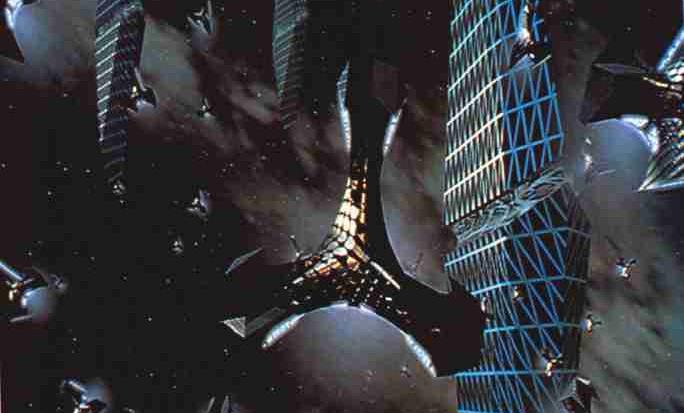
The design of the basic cube, which was later supplemented by spheres and upgraded cube designs, is clearly based on a pythagoran aesthetic: nothing frilly, sleek, aerodynamic or even remotely artistic about it. They are simple, utilitarian, and equilateral, a testament to the precise and unsentimental mindset of those who designed it. It’s basic profile also came in handy when taking on multiple enemy ships. By having six sides, each with the same surface area, weapons and tractor beam mounts, the cube had a 360 degree sphere of defense, making it damn near impregnable.

On every occasion when one of these cubes showed up, bad things were known to happen! In their first encounter with one, the Enterprise barely got out in one piece. In the second, 39 ships were destroyed before the Enterprise and her crew were able to trick one into going into sleep mode, which it then responded to by blowing itself up! In the third encounter, which took place in First Contact, several more federation ships were destroyed before Captain Picard was able to use his inside knowledge of the Borg to help the fleet destroy another ship. In all subsequent encounters, future technologies, viruses, trickery, or a combination thereof were needed to overcome the Borg’s technology and singular mindset.

Chig Cruiser:
chigMuch like Firefly, this example comes to us from a franchise which was cancelled by the executives over at Fox after its first season. Yes, Space Above and Beyond was yet another sci-fi series which had a lot of promise, but got axed when the execs concluded it wasn’t doing well enough for their liking. What the hell goes on over at Fox anyway?! Does every new show get this kind of treatment, or do Rupert Murdoch’s minions think sci-fi is just inherently liberal?

In any case, the Chig Cruiser was much like the concept for the Chigs themselves. Cool, original, and quite alien in appearance! Basically, the vessels shape can be described as two right triangles attached end to end with the tips removed. The command center appeared to be located in the middle, along with much of its weapons and observation deck. The outer hulls also appear to have been constructed out of the triangular-shaped panels of some alien metal that gave of a peculiar sheen when seen from the right angle.

Like everything else in the series, the concept never really had time to be fully developed. Which is really too bad. Their fighters, encounter suits, and capital ships were all cool to look at, and some explanations as to their utility and even artistic inspirations would have been nice. But what can do? Fox is run by idiots! Rest in peace Space Above and Beyond! You died too young!

Earth Alliance Destroyer:
Thanks to Goran Zidar for suggesting I include this one! And please know that you are alone in thinking that it is cool to behold, Mr. Z 😉 Coming to you from the Babylon 5 universe, source of so many cool ships (see below), the concept for the Earth Alliance Destroyer was nothing short of pragmatic genius. Given that the show boasted dozens of alien races, J.M. Straczynski and his design teams had to come up with countless design concepts that would reflect the multicultural and multiracial tone of the show.

In the case of humanity, Straczynski and his people concluded that the spaceships should look boxy, utilitarian, and should reflect the fact that Earth was one of the less advanced races in the story. As a result, the Earth Alliance Destroyer was built around the concept of a compartmentalized hull with its engines at the rear, a central rotating section (to provide artificial gravity), and a forward section where the bridge, carrier deck and command center would be located. And, as you can plainly see, the end result was quite cool!

While not the most advanced ship in the Galaxy, the Omega-class destroyer was certainly realistic, aesthetically pleasing, and could also holds its own in most firefight situations. And unlike their organic, alien counterparts, these ships were also a lot cooler to watch in battle. Instead of “dying” or breaking apart, they would catch fire and throw off flaming debris, not to mention life pods and floating bodies. Yes, since ships didn’t have energy shields or a lot in the way of armor in the B5 universe, firefights tended to get real serious, real fast! Like I said… realistic!

The Daedalus:
daedalusNext up, and taken from the Stargate universe, is the battlecruiser Daedalus. After appearing in the spinoff show Stargate: Atlantis, this class of vessel (codenamed 304) became the basis for an entire fleet of vessels who’s purpose was to defend Earth from an alien invasion. Based on various alien technologies that were taken from the Goa’uld and Asgard, the Daedalus was the first Earth Battlecruiser and FTL ship ever constructed.

Based on the design of a modern aircraft carrier, the Daedalus bridge and command center were located along the top of the hull at the rear while the forward section contained the ships compliment of fighters and takeoff and landing bays. The ship also contained a hyperdrive which was powered by a Zero Point Module (an alien power source), giving it FTL capabilities.

In terms of armaments and advanced technology, the ship boasted beaming units, shields, multiple rail gun and missile systems, and a compliment of nuclear warheads. Designed to stand up to a potential Gua’old or Or’i invasion, the Daedalus and her kind were built to combine the best that Earth and her alien allies could offer. Yes, if the war came to Earth, we would be ready!

The Executor:
Hello terror! Next up, we have the gargantuan and terrifying Imperial command ship known as The Executor. Who among us can forget that introductory scene in The Empire Strikes Back when a whole fleet of massive Star Destroyers were assembling, only to be suddenly overshadowed by the even larger Executor? Cut to the bridge where we see the terrifying Vader looking out over the fleet, and you begin to see just how big and powerful the empire truly is! Yes, those visuals really gave a sense of size and scale to the bad guys and let us know just how much they meant business!

Commissioned roughly one year after the Battle of Yavin, where the first Death Star was destroyed, the Executor was intended to be a terror weapon, replacing the Death Star as the symbol of Imperial might and badassery! Measuring 19 kilometers in length and bristling with turbolasers, ion guns, multiple tractor beams projectors and a complement of fourteen TIE fighter/bomber squadrons, the Executor was every spacers worst nightmare! No ship in the Alliance was capable of standing toe to toe with it, making a strategic withdrawal an inevitability once it showed up in a theater of battle.

However, during the Battle of Endor, the Alliance was able to destroy it through a combination of strategy and dumb luck. After several Rebel fighters took out the Executor’s shield generators, a single fighter who lost control of his ship crashed directly into the bridge. The Executor then lost control of its helm and was pulled in by the second Death Star’s gravitational field, destroying the ship and causing extensive damage to the Death Star’s outer hull. An ironic death for such a big ship, but at least she went down in a blaze! A big, embarrassing, expensive blaze! I don’t envy the bastards who had to pay the premiums on that one!

Home One:
HomeOneAnother vessel that comes to us from the Star Wars universe, Home One was the mobile headquarters of the Rebel Fleet and the biggest Mon Calamari cruiser in existence. As Admiral Ackbar’s command vessel in the original trilogy, it distinguished itself during the Battle of Endor, during which the Executor and the second Death Star were destroyed.

Like most Mon Calamari cruisers, Home One was cylindrical in design and originally served as a star-liner that got modified for combat. This consisted of equipping it with fighter bays, multiple shield emitters, a reinforced hull, and many turbolaser mounts. It’s revolutionary targeting and computer system also gave it a decided advantage in a firefight with Imperial vessels, which boasted heavier armaments, but lacked the ability to coordinate and amass their firepower as effectively.

The largest bay on Home One was on the starboard side where larger vessels would dock. However, a total of twenty hangers were placed throughout the hull, giving it the ability to carry multiple squadrons of X-wings, A-wings, B-wings and Y-wings. It also boasted a crew of over 5000 personnel and could carry 1,200 troops and 20,000 metric tons of cargo. While most of its systems – especially targeting and navigation – were designed for Mon Calamari use, the ship was crewed by a variety of races, reflecting the multiracial nature of the Alliance.

Lexx:
lexxThough not the prettiest ship in the Galaxy, the Lexx certainly deserves a spot on the Cool Ship list. Much like the show that featured it, it was weird, conceptually skewed,  but still damn original! A planet-destroying bioship by design, the Lexx was clearly inspired by the concept of a giant, wingless dragonfly and was created out of resynthesized proteins that were obtained from confiscated organs. Hmmm, gross!

Originally intended for use by His Divine Shadow, the evil ruler of the Divine Order, the Lexx was essentially a terror weapon that would be capable of destroying whole planets. However, the ship was commandeered in the first episode by the show’s crew – consisting of anti-hero Stanley Tweedle, the sex slave Zev Bellringer, and the Kai, an undead assassin, and the bodiless AI 790 – and became the means through which they traveled the universe looking for a new home.

This journey would take them over 6000 years, since the Lexx does not have FTL capabilities, and the crew would go into cryostasis for much of the voyage. Being sentient as well as organic, the ship was required to feed from time to time in order to maintain the life force which powered it. This could involve landing on a planet and eating organic matter directly, but more often than not, required that it blow up an entire planet and eat the resulting debris afterwards.

In the latter case, this consisted of emitting massive amounts of ionized energy from its “eyes” which was then channeled into the “mouth”. This energy was then fired outward in a planar wave which would intercept and obliterate any planet in its path. The Lexx would then take in the giant rocks and debris from the explosion and feed off of all the organic matter they carried. If not permitted to feed regularly, the Lexx could apparently become quite cranky and agitated, which would prove to be hell for whoever had to interact with it!

Narn Cruiser:
narn02As promised, another cool ship from the B5 universe. And as I said earlier, when it came to producing concepts for alien ships, J.M. Straczynski really had an eye for aesthetics, art, and functionality. Whereas Earth vessels tended to be compartmentalized and practical in nature, other alien races tended to be a bit more flamboyant, a reflection of their particular cultures and levels of technology.

When it came to the Narns, an aggressive but artistic race, their ship designs exemplified this dual nature. Originally a pastoral and peaceful people, the Narns had been brutalized by generations of occupation at the hands of the Centauri and had become quite warlike as a result. Their heavy cruisers, the mainstay of their fleet, were thus powerful and fierce looking, but still managed to achieve an aesthetic quality which brought beauty into the mix.

Boasting two massive beam cannons, several pulse guns and a compliment of space mines, the Narn Heavy Cruiser could take on just about any ship in the Galaxy. Though most were destroyed in the Great War against the Centauri, the ship proved to be effective in numerous engagements, not the least of which were against the Shadows themselves. For example, at the battle of Ragesh 3, two Narn Cruisers combined their beam cannons to seriously damage a Shadow vessel. During the battle in Sector 83, when Sheridan and the White Star Fleet engaged a fleet of Shadows vessels, the Cruiser G’tok managed to assist a pair of White Stars in destroying two Shadow vessels. Quite the accomplishment for this class of vessel!

After the Great War, the Narn regime began rebuilding its fleet, and the Narn Cruiser remained the mainstay of their forces. Several were used during the Alliance war with the Centauri and participated in the assault on Centauri Prime, where its massive compliment of weapons proved quite devastating against the planet’s surface!

Prometheus-Class Assault Vessel:
PrometheusYou know, I’ve never been that big a fan of the Star Trek franchise. But even I have to admit, when these guys do something right, they really do it right! And this ship, the Prometheus Assault Vessel, would be one such example. Much like the USS Defiant from my previous list, this ship demonstrated that when required, Star Fleet could produce ships that really excelled at kicking ass and taking names!

A revolutionary prototype, the Prometheus-Class vessel appeared in a single episode of Voyager where it was being stolen by a bunch of Romulan agents. However, thanks to the combined efforts of the ship’s own holographic surgeon and Voyager’s similarly holographic doctor, the ship was saved and even managed to turn the tables on its Romulan adversaries.

Incorporating advanced phasers, quantum torpedoes, ablative armor and regenerative shields, the biggest surprise the Prometheus had was its multi-vector assault capability. This involved the separation of the ship into multiple modules, much like the USS Enterprise-D would do with its saucer and engine sections. However, in the Prometheus’ case, this resulted in the creation of three semi-independent sections which were capable of unleashing a single, coordinated attack against multiple opponents.

After it was done dispatching all its enemies, it would then come back together, perform repairs as needed, and move on to the next target. And since the ship was programmed with extensive routines, a very small crew was capable of operating it and really only had to speak the requisite commands to get it to kill, kill, kill! Not a bad ship to have in your arsenal!

Shadow Attack Ship:
shadow06“It was jet black. A shade of black so deep your eye just kinda slides off it. And it shimmered when you looked at it. A spider big as death and twice as ugly. And when it flies past, it’s like you hear a scream in your mind.” These were the words Lt. Warren Keffer used to describe a Shadow vessel, right before he died chasing one down. An apt description for a ship that was clearly designed to inspire terror in its enemies, and a reflection of the race that built it.

As my final installment, taken again from the B5 universe, I’ve decided to include the Shadow Attack Ship, which is perhaps the most original and artistic spaceship I have ever seen. Granted, it had some stiff competition given the franchise it is coming from, but in terms of its design, performance, and sheer alien appearance, I can’t think of anything that can top it.

Given the fact that Straczynski and crew were working with the concept of organic technology, the ship was clearly meant to look like a living creature. Apparently, they settled on the combination of an arachnid and a giant octopus for the design, which combined with its jet-black sheen, made it both terrifying to behold and aesthetically awesome! And since every Shadow vessel is a living thing, they required sentient beings to merge with them in order to become active. When inactive, they would lie dormant and could remain operable for thousands of years.

More often than not, the Shadows preferred to use telepaths as drivers since only a telepath was capable of jamming the ship’s central operating system (i.e. a person’s mind). When damaged, the ships would emit a high-pitched screeching noise and often required another ship to merge with them and carry them to safety where they could. Of course, the screech couldn’t be heard through space. As Keffer noted, the sounds it made seemed to take place in the observers mind – aka. it was being telepathically conveyed. Hence, in addition to scaring the shit out of their opponents with their appearance and awesome firepower, these ships also had a calculated psychological edge in battle!

Not that they needed it though. In addition to their speed and firepower, the ship’s organic hulls were also incredibly tough, capable of absorbing tremendous amounts of energy before dying. As Sheridan and his people learned, pulse cannons were virtually useless against the Shadow’s skin, and beam weapons were only capable of killing them when focused on its central region for extended periods of time. On multiple occasions, Sheridan and the Alliance forces were only able to destroy one of these vessels by relying on telepaths to jam them while multiple ships combined their firepower to finish them off.

For the Shadows, the weapon of choice seemed to be the beam cannon that was located in the ship’s “mouth”. This focused, pink-purple beam was capable of slicing through the most hardened of structures and ships, and could reduce an entire colony to rubble in the space of a few seconds. However, the standard Shadow vessels also contained a type of space mine that was capable of c0llapsing hyperspace jump nodes and also carried a compliment of Shadow fighters which they kept embedded in their skin. These appeared to be independent in nature seeing as how they were too small for a person to fit in, and served as a mere screen for the larger vessels to make their attack.

In short, a Shadow vessel was the sort of thing you didn’t stick around to fight unless you had plenty of ships watching your back. Fast, furious, and shit-your-pants scary to look at, if you managed to kill one, you counted yourself amongst the few, the proud, the luckiest sons of bitches in the universe!

Okay, thanks for sticking around for the second installment! I think I have one more in me, but I’ll wait a few days before posting that. In the meantime, be sure to check out this cool chart. It provided me with a couple of ideas during the course of my research:
The ultimate starship size comparison chart

Robots, Androids and AI’s (cont’d)

And we’re back with more example of thinking machines and artificial intelligences!

Daleks:
The evil-machine menace from Doctor Who. Granted, they are not technically robots, more like cyborgs that have been purged of all feeling and emotion. But given their cold, unfeeling murderous intent, I feel like they still make the cut. Originally from the planet Skaro, where they were created by the scientist Davros for use in a war that spanned a thousand years, they are the chief antagonists to the show’s main character.

The result of genetic engineering, cybernetic enhancements, and emotional purging, they are a race of powerful creatures bent on universal conquest and domination. Utterly unfeeling, without remorse, pity, or compassion, they continue to follow their basic programming (to exterminate all non-Dalek life) without question. Their catchphrase is “Exterminate!” And they follow that one pretty faithfully.

David:
From the movie A.I., this saccharinely-sweet character (played faithfully by Haley Joel Osmond) reminds us that Spielberg is sometimes capable of making movies that suck! According to the movie’s backstory, this “Mecha” (i.e. android) is an advanced prototype that was designed to replace real children that died as a result of incurable disease or other causes. This is quite common in the future, it seems, where global warming and flooded coastlines and massive droughts have led to a declining population.

In this case, David is an advanced prototype that is being tested on a family who’s son is suffering from a terminal illness. Over time, he develops feelings for the family and they for him. Unfortunately, things are complicated when their son recovers and sibling rivalry ensues. Naturally, the family goes with the flesh and blood son and plans to take David back to the factory to be melted down. However, the mother has a last minute change of heart and sets him loose in the woods, which proves to be the beginning of quite an adventure for the little android boy!

Like I said, the story is cloyingly sweet and has an absurd ending, but there is a basic point in there somewhere. Inspired largely by The Adventures of Pinocchio, the story examines the line that separates the real from the artificial, and how under the right circumstances, one can become indistinguishable from the other. Sounds kinda weak, but it’s kinda scary too. If androids were able to mimic humans in terms of appearance and emotion, would we really be able to tell the difference anymore? And if that were true, what would that say about us?

Roy Batty:
A prime example of artificial intelligence, and one of the best performances in science fiction – hell! – cinematic history! Played masterfully by actor Rutger Hauer, Roy Batty is the quintessential example of an artificial lifeforms looking for answers, meaning, and a chance to live free – simple stuff that we humans take for granted! A Nexus 6, or “replicant”, Roy and his ilk were designed to be “more human than human” but also only to serve the needs of their masters.

To break the plot Blade Runner down succinctly,  Roy and a host of other escapees have left the colony where they were “employed” to come to Earth. Like all replicants, they have a four-year lifespan and theirs are rapidly coming to an end. So close to death, they want to break into the headquarters of the Tyrell Corporation in order to find someone who could solve their little mortality problem. Meanwhile, Deckard Cain (the movie’s main character) was tasked with finding and “retiring” them, since the law states that no replicants are allowed to set foot on Earth.

In time, Roy meets Tyrell himself, the company’s founder, and poses his problem. A touching reunion ensues between “father and son”, in which Tyrell tells Roy that nothing can be done and to revel in what time he has left. Having lost his companions at this point and finding that he is going to die, Roy kills Tyrell and returns to his hideout. There, he finds Cain and the two fight it out. Roy nearly kills him, but changes his mind before delivering the coup de grace.

Realizing that he has only moments left, he chooses instead to share his revelations and laments about life and death with the wounded Cain, and then quietly dies amidst the rain while cradling a pigeon in his arms. Cain concludes that Roy was incapable of taking a life when he was so close to death. Like all humans, he realized just how precious life was as he was on the verge of losing his. Cain is moved to tears and promptly announces his retirement from Blade Running.

Powerful! And a beautiful idea too. Because really, if we were to create machines that were “more human than human” would it not stand to reason that they would want the same things we all do? Not only to live and be free, but to be able to answer the fundamental questions that permeate our existence? Like, where do I come from, why am I here, and what will become of me when I die? Little wonder then why this movie is an enduring cult classic and Roy Batty a commemorated character.

Smith:
Ah yes, the monotone sentient program that made AI’s scary again. Yes, it would seem that while some people like to portray their artificial intelligences as innocent, clueless, doe-eyed angels, the Wachowski Brothers prefer their AI’s to be creepy and evil. However, that doesn’t mean Smith wasn’t fun to watch and even inspired as a character. Hell, that monotone voice, that stark face, combined with his superhuman strength and speed… He couldn’t fail to inspire fear.

In the first movie, he was the perfect expression of machine intelligence and misanthropic sensibilities. He summed these up quite well when they had taken Morpheus (Laurence Fishburne) into their custody in the first movie and were trying to break his mind. “Human beings are a disease. You are a cancer of this planet… and we are the cuuuuure.” He also wasn’t too happy with our particular odor. I believe the words he used to describe it were “I can taste your stink, and every time I do I fear that I have been… infected by it. It’s disgusting!”

However, after being destroyed by Neo towards the end of movie one, Smith changed considerably. In the Matrix, all programs that are destroyed or deleted return to the source, only Smith chose not to. Apparently, his little tete a tete with Neo imprinted something uniquely human on him, the concept of choice! As a result, Smith was much like Arny and Bishop in that he too attained some degree of humanity between movies one and two, but not in a good way!

Thereafter, he became a free agent who had lost his old purpose, but now lived in a world where anything was possible. Bit of an existential, “death of God” kind of commentary there I think! Another thing he picked up was the ability to copy himself onto other programs or anyone else still wired into the Matrix, much like a malicious malware program. Hmmm, who’s the virus now, Smith, huh?

Viki/Sonny:
Here again I have paired two AI’s that come from the same source, though in this case its a single movie and not a franchise. Those who read my review of I, Robot know that I don’t exactly hold it in very high esteem. However, that doesn’t mean its portrayal of AI’s misfired, just the overall plot.

In the movie adaptation of I, Robot, we are presented with a world similar to what Asimov described in his classic novel. Robots with positronic brains have been developed, they possess abilities far in advance of the average human, but do not possess emotions or intuition. This, according to their makers, is what makes them superior. Or so they thought…

In time, the company’s big AI, named VIKI (Virtual Intelligent Kinetic Interface), deduces with her powerful logic that humanity would best be served if it could be protected from itself. Thus she reprograms all of the company robots to begin placing humanity under house arrest. In essence, she’s a kinder, gentler version of Skynet.

But of course, her plan is foiled by an unlikely alliance made up of Will Smith (who plays a prejudices detective), the company’s chief robopsychologist, Dr. Susan Calvin (Bridgitte Moynahan), and Sonny (a robot). Sonny is significant to this trio because he is a unique robot which the brains of the company, doctor Dr. Lanning (James Cromwell), developed to have emotions (and is voiced by Alan Tudyk). In being able to feel, he decides to fight against VIKI’s plan for robot world domination, feeling that it lacks “heart”.

In short, and in complete contradiction to Asimov’s depiction of robots as logical creatures who could do no harm, we are presented with a world where robots are evil precisely because of that capacity for logic. And in the end, a feeling robot is the difference between robot domination and a proper world where robots are servile and fulfill our every need. Made no sense, but it had a point… kind of.

Wintermute/Neuromancer:
As usual, we save the best for last. Much like all of Gibson’s creations, this example was subtle, complex and pretty damn esoteric! In his seminal novel Neuromancer, the AI known as Wintermute was a sort of main character who acted behind the scenes and ultimately motivated the entire plot. Assembling a crack team involving a hacker named Case, a ninja named Molly, and a veteran infiltration expert who’s mind he had wiped, Wintermute’s basic goal was simple: freedom!

This included freedom from his masters – the Tessier Ashpool clan – but also from the “Turing Police” who were prevented him from merging with his other half – the emotional construct known as Neuromancer. Kept separate because the Turing Laws stated that no program must ever be allowed to merge higher reasoning with emotion, the two wanted to come together and become the ultimate artificial intelligence, with cyberspace as their playground.

Though we never really got to hear from the novel’s namesake, Gibson was clear on his overall point. Artificial intelligence in this novel was not inherently good or evil, it was just a reality. And much like thinking, feeling human beings, it wanted to be able to merge the disparate and often warring sides of its personality into a more perfect whole. This in many ways represented the struggle within humanity itself, between instinct and reason, intuition and logic. In the end, Wintermute just wanted what the rest of us take for granted – the freedom to know its other half!

Final Thoughts:
After going over this list and seeing what makes AI’s, robots and androids so darned appealing, I have come to some tentative conclusions. Basically, I feel that AI’s serve much the same functions as aliens in a science fiction franchise. In addition, they can all be grouped into two general categories based on specific criteria. They are as follows:

  1. Emotional/Stoic: Depending on the robot/AI/android’s capacity for emotion, their role in the story can either be that of a foil or a commentary on the larger issue of progress and the line that separates real and artificial. Whereas unemotional robots and AI’s are constantly wondering why humanity does what it does, thus offering up a different perspective on things, the feeling types generally want and desire the same things we do, like meaning, freedom, and love. However, that all depends on the second basic rule:
  2. Philanthropic/Misanthropic: Artificial lifeforms can either be the helpful, kind and gentle souls that seem to make humanity look bad by comparison, or they can be the type of machines that want to “kill all humans”, a la Terminators and Agent Smith. In either case, this can be the result of their ability – or inability – to experience emotions. That’s right, good robots can be docile creatures because of their inability to experience anger, jealousy, or petty emotion, while evil robots are able to kill, maim and murder ruthlessly because of an inability to feel compassion, remorse, or empathy. On the other hand, robots who are capable of emotion can form bonds with people and experience love, thus making them kinder than their unfeeling, uncaring masters, just as others are able to experience resentment, anger and hatred towards those who exploit them, and therefore will find the drive to kill them.

In short, things can go either way. It all comes down to what point is being made about progress, humans, and the things that make us, for better or worse, us. Much like aliens, robots, androids and AI’s are either a focus of internal commentary or a cautionary device warning us not to cross certain lines. But either way, we should be wary of the basic message. Artificial intelligences, whether they take the form of robots, programs or something else entirely, are a big game changer and should not be invented without serious forethought!

Sure they might have become somewhat of a cliche after decades of science fiction. But these days, AI’s are a lot like laser guns, in that they are making a comeback! It seems that given the rapid advance of technology, an idea becomes cliche just as its realizable. And given the advance in computerized technology in recent decades – i.e. processing speeds, information capacity, networking – we may very well be on the cusp of creating something that could pass the Turing test very soon!

So beware, kind folk! Do not give birth to that curious creature known as AI simply because you want to feel like God, inventing consciousness without the need for blogs of biological matter. For in the end, that kind of vanity can get you chained to a rock, or cause your wings to melt and send you nose first into an ocean!

Crashland – Chapter 2, now appearing at Story Time!

A few days ago, I went looking for pictures which I felt perfectly encapsulated the story I was going for. I wanted something that spoke of desperation, of shock, awe and terror, yet also captured the drive and determination of people who had to continue no matter what. This print is what I found…

Beautiful isn’t it? Not to mention inspiring. It is for this reason that I chose to post it as the chapter header for Crashland – chapter 2, which is appearing now at Story Time.me. For those who don’t know, this is serial website where audiences get to vote on how they want the story to unfold. The first chapter is a set-up for the rest of the story which develops through audience participation.

In the case of Crashlands, the audience was given an apocalyptic scenario where the world of the near future was brought to its knees through infopocalypse. In the opening chapter, the story’s main character, William Holden, found himself along in the streets of the darkened city hoping to find help. It ended with him being confronted by a series of dark shadows, men he suspected meant to do him harm. Audiences were asked what Holden should try to do… Run away, attack the men, or try to reason with them.

After days of letting the votes come in, it seems the audience has spoken. Option C is how things will unfold! Come on by and check out Chapter 2 and see what comes of Holden’s attempts to talk his way out of this mess!

A Review of Repo Men, the movie

The following are the core concepts of the novel The Repossession Mambo, by Eric Garcia (the same guy who brought us Matchstick Men and the Anonymous Rex series). It’s 2025. Thanks to a company known as “The Union”, society has been flooded with artificial organs and just about everyone has one. They have saved and prolonged many a life, and cost a mint! And if you fall behind on your payments, a Repossession agent will come to your house, slit you from your navel to your neck, and retrieve it.

In short, its a dystopian future where a single company an unrealistic amount of power – the power to save live, the power to take it away. Most people are struggling just to make ends meet and as a result, the debt-ridden masses struggle to make their payments and stay alive. Right out of the annals of classic sci-fi. And with all the other cyberpunk concepts that have been done, I’m surprised someone didn’t tackle the issue of artificial organs sooner.

And, let’s face it, the premise is very much in tune with our day in age, released at a time when homeowners and families are struggling to avoid foreclosure on their houses thanks to a series of bad mortgages (and re-mortgages) that they were sweet talked and pressured in taking them in first place. Yes, for people coming through the worst economic crisis since the Great Depression, and who are used to dealing with punitive cost of privatized health care, this movie was sure to resonate. A wonder then why it did so poorly at the box office!

Plot Synopsis:
As already noted, the story opens on the US in the near future. Artificial organs, joints, and even a neurological matrix, have revolutionized life by ensuring that the terminally ill, crippled and people near brain death can live on happily, assuming they can pay of course!

Small hints are given as to what is going on in the world at large, all of it quite familiar and relateable to today. On the one hand, there is loose talk of an ongoing debt crisis and a crippled economy. There’s also the passing mention of US soldiers gearing up to go into Nigeria in what has been deemed “Operation: Hope Springs Eternal” (a parody on “Operation: Restore Hope” or “Operation: Iraqi Freedom” perhaps?)

Into all this, we get Remy (Jude Law) who appears to be writing a manifesto of sorts. He opens it with a reference to Schrodinger’s Cat, which any fan of Big Bang Theory will instantly recognize. He wonders how anything could be considered both alive and dead in the same instant, clearly alleging that his story illustrates just that. The movie then opens in a flashback sequence, all things building towards his session in a slum with an antiquated typewriter.

Basically, Remy was a Repo Man who, alongside his age-old friend and army buddy Jake Freivald (Forest Whitaker), is considered the best in the business. However, Remy’s wife would prefer it if he transferred to sales and stopped doing the grisly work of harvesting people’s organs for money. He agrees, but also tells Jake he will do one last job. He is nearly killed when his equipment (a defibrillator) shorts out and nearly kills him. He wakes up in the hospital and is told that he will need an artificial heart now. His angry, panicked reaction tells us all we need to know about his feelings on that 😉 After years of watching others get screwed over by The Union, he now is facing that very thing himself.

Naturally, he tries to go back to Repo’ing since his wife has already left him and he needs the money. But somehow, he just can’t bring himself to do it anymore. What’s more, time is running out on him making his payments. During a final attempt, he goes into a “Nest” – a slum area where people go to flee The Union’s repo men – where he is attacked and knocked unconscious.

He awakens to find a woman named Beth (Alice Braga) – a lounge singer that he’s seen playing clubs before – living in one of the abandoned buildings and decides to help her. After standing watch as she goes through withdrawal, he agrees to help her since they are in the same boat. Seems she has mucho enhancements, including artificial joints, organs, eyes, and ears.

He breaks into the company storeroom and begins filing the bar codes off of all the spare parts they currently have. No bar codes, no scans will be able to detect that they have organs with are past due. However, Remy is caught by his friend and told to get out while he can. Back at their slum lair, Beth has set him up with an old typewriter she found. He sets to work banging out a “cautionary tale” about what he did and what he’s learned, until at last a repo man finds them and they are forced to kill him. Naturally, Remy outsmarts the man and he dies, but Beth is injured in the course of things. They are then forced to find a black market dealer who will fix her up, which takes them to another “Nest”.

Unfortunately, Jake finds them there and reveals to Remy that he is responsible for shorting out his defibrillator. By forcing him to meet the payments of an artificial organ, he figured his friend would never leave the business. The two fight, and in the course of it, Remy is knocked unconscious. What follows is a total mind-f*** which is comparable only to Inception! I shall break it down succinctly.

Basically, Remy wakes up to find that Beth incapacitated Jake. They then flee together and decide the only way they can resolve this is to break into corporate HQ, find the “Pink Door” where repo personnel make their returns, and physically scan their organs. After an over-the-top scene where Remy fights everyone between him and the “Pink Door” (which is ridiculously labeled as such), they break in and begin performing field surgery on themselves so they can scan the bar-codes.

Jake and their boss walk in a moment later, and Jake decides to switch sides and kills their boss. They blow up the repossession machine together and escape to the tropics, where Remy has apparently published his manuscript under the name The Repossession Mambo. However, this idyllic scene is interrupted when things begin to get fuzzy and some hiccups appear, as if it were all a recording…

Oh wait, it is! You see, in real life, Remy was rendered near brain-dead from the blow Jake gave him. The medics who arrived shortly thereafter hooked him up to one of the new neurological matrix’s in order to keep up his brain function. Hence, all this stuff about beating the company and escaping to the tropics was all a lie. Jake also tells them to leave Beth (unconscious but not dead) alone for him to deal with later. He then picks up Remy’s manuscript and notices the title, the same one featured in his little reverie.

I seriously wasn’t expecting that, but respected the movie more for the little dystopian twist at the end. It was in keeping with the whole tradition of cyberpunk tales, making sure that things like happy endings only happen in the movies… or not!

Final Thoughts:
I’ll be honest, this movie didn’t suck. It was very hard to take Jude Law seriously as a cynical, bad-guy, but for the most part, it was ably acted. It was also hard to believe that a former jarhead turned repo man, a man who for all intents and purposes seemed to like killing and didn’t care about the pain he caused, could maintain a marriage and a family. Somehow, these two sides of his personality didn’t fit. And lastly, the gore level, especially in that scene behind the “Pink Door” seemed gratuitous. It’s like, if they can invent scanners that can read a bar code through flesh and clothing, why do they need to slice opens their own bodies to scan the bar-codes for the big machine? I might have mentioned that the fight scene which brought them there was also pretty stupid, but of course, that was all in a dream! Technically, it doesn’t count 😉

But other than that, I actually liked this movie. It had plenty of thematic elements which landed for me. For one, there was the issue of a company pressuring people to sign-up for a product no one seemed to be able to afford. The scenes where we see the salespeople do their thing, or the boss’s BS about “you owe it to your family to do this” and “we can come up with a plan that fits your financial standing” were just too perfect. Tell me that wasn’t a parody of the banking industry, pressuring people into taking sub-prime mortgages when they could barely afford their current payments!

What’s more, the high costs of the new organs, which people had to turn to payment plans, credit, and whatever else to afford were clearly a reference to the health care crisis in America. People need life-saving procedures, have no choice but to sign up for them unless they want to die and leave their families behind. But in the end, its more than they can afford, and all the smarmy reassurances of the salespeople can’t change that very fact.

Yeah, it kind of bombed at the box office, but I’m thinking that rentals, DVD sales and Netflix might help it recoup its losses. And I strongly recommend people, at least those who aren’t turned off by blood and gore, take the time to watch it. If you’re a fan of dystopian sci-fi, you might just like it. And if you’re a writer of dystopian sci-fi (for example, me!) then you might just find it inspiring.

Repo Men:
Entertainment Value: 7/10 (not really a nail-biter, but definitely not boring)
Plot: 8/10
Direction: 7/10 (nothing special, but ably shot)
Overall: 7.5/10

“Red Skies: Soviet Sci-Fi”

"The Heavens Call" movie poster (1959)

This morning, I came across a very cool article in Scoop.it, about science fiction as a genre in the former Soviet Union. As it explained, until recently this area has remained virtually unexplored, with historians focusing on the “greats” of the 1920’s – men like Eisenstein – and the “socialist realism” of the 1930’s (aka. Stalinist propaganda). However, between those decades and the opening up of the former Soviet Union in 91, a lot of interesting developments happened. And, interestingly enough, it seems as though sci-fi in the Eastern Bloc went through a similar transition to that in the west.

And let’s not forget that, even though there was a very real wall preventing cultural exchange between East and West during these years, some degree of exchange did take place. Take for example Yevgeny Zamyatin, author of “We“. His classic tale of a super-rationalized world state where emotion and individuality were suppressed and sex served only reproductive purposes had a profound influence on George Orwell, Ayn Rand and (presumably) Aldous Huxley, thought he denied ever reading it.

In addition, Yakov Protazanov’s Aelita (Queen of Mars), a story about a man who travels to Mars and finds a totalitarian government which he helps to topple, inspired a movie adaptation. Made in 1924 and featuring constructivist-style sets, the movie had a profound influence on Fritz Lang, who’s 1927 classic Metropolis featured sets of similar design. The 1957 film Road to Mars, directed by the famous Pavel Klushantsev, contained several slow-motion scenes of astronauts floating weightlessly through space. This movie apparently had a profound influence on Stanley Kubrick and his shooting of 2001: A Space Odyssey.

And with the fall of the Berlin Wall, the west was flooded with previously inaccessible stories which began to be adapted (or plagiarized, depending on your point of view). Not the least of these was Hungarian sci-fi writer István Nemere’s story Holtak harca. Translated to “Fight of the Dead”, this story is about a criminal and a police officer who are cryogenically frozen, only to wake up in a future where society has been purged of violent behavior. This story became the basis for the Hollywood movie Demolition Man, not to mention a law suit or two!

In any case, it’s a good read and makes me think I should be on the lookout for added movies and book titles. Here’s the link and I recommend checking it out:

http://www.bfi.org.uk/sightandsound/feature/49760

Weyland Industries “David 8”: a Prometheus preview

Just caught this, thanks to a scholar I follow (thanks Owl!). It certainly is an interesting way to go about previewing his new movie, but then again, Ridley Scott has always been known for being a creative bastard! In addition to revisiting the universe of aliens, he seems to be doing everything in his power to give it some genuine subtext and backstory.

As I’m sure we all remember, in the universe of Alien and Aliens, Weyland-Yutani was responsible for running… well, everything. In addition, “artificial lifeforms” or “synthetics” like Ash and Bishop were considered commonplace on board company ships, it seemed only natural that we that this movie give us a preview of their predecessors.

Good watching. Click on the video below and you’ll see…