 Hey all. Have I said yet that it’s good to be back? Well, truth be told, it feels like I’ve only really got back into the swing of things in the past few days, and after a two week hiatus to boot. I also noticed that it’s been awhile since I’ve done a conceptual post, something dedicated to classic sci-fi and the concepts that make it so freakishly and enduringly cool!
And so I thought I’d tackle a very time (pun!) honored concept in science fiction today, that being the concept of time travel. Despite what many may think, the idea of going forwards or backwards in time is not a recent idea. It did not begin only after scientists theorized that time and space were expressions of the same phenomena – aka. relativity – nor with the development of quantum theory. However, these scientific discoveries did spur the concept on by introducing the idea of temporal paradoxesand the notion that there was such a thing as a space-time continuum resulting in multiple universes.
But I’m getting sidetracked here; and frankly, all this paradox and timelines stuff has been known to give me a headache! Instead, I’d rather look at some of the most renowned and celebrated instances of time travel in science fiction. Sidenote: As usual, I’ll be starting with literature and saving pop culture for another day. And of course, I won’t be covering everything, just the few examples that I think are the best.
Earliest Examples:
As already noted, the concept of being able to see into the past and future, with the purpose of changing the course of it, predates the idea of time travel as a scientific phenomena. In truth, it was often used in novels as a device to advance plot, character development, and offer moral instruction on the importance of choices and making the right ones.
A Christmas Carol:
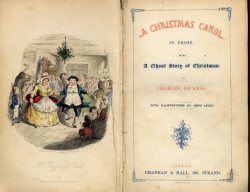 This was certainly the case in Charles Dickens’ classic tale of selfishness and redemption, where a miserly capitalist is shown both his past and future in order to help him mend his ways. Published in 1843, A Christmas Carol has gone through countless renditions and adaptations over the years, with names like Ebeneezer Scrooge, Bob Cratchit and Tiny Tim becoming household names that are synonymous with greed, pathos, and generosity of spirit.
Taking place on Christmas Eve, 1843, the story opens with a general description of Scrooge’s own life and success in the accounting trade, followed by an assessment of his character. Miserly, stingy, unsympathetic to the plight of the poor, his success is due in part to the fact that his business partner, a man much like him, has been dead for seven years, leaving everything to him.
After reluctantly letting his employee, Bob Cratchit, a poor but happy family man go home for the night, he is visited by the ghost of his former partner, Jacob Marley. Marley warns him that for his life of greed, he is suffering eternal punishment, and tells Scrooge that he will be visited by three ghosts who will show him the error of his ways and teach him the true meaning of Christmas. These ghosts, which are named the Ghost of Christmas Past, Present, and Future, all show Scrooge how his decisions to forsake love, family, and kinship for the sake of his money have left him lonely and heartbroken, which is the source of his cruelty. When he sees his future, which is a cold grave with no one to mourn or miss him, he realizes there is still time and vows to change his ways.
Encapsulating Dickens’ view of industrialization, class distinction, poverty and the exploitation of the English working class, Carol remains one of the best known examples of social commentary in English literature. It is also the first widely-known example where time travel was used as a plot device.
A Connecticut Yankee in King Arthur’s Court:
 Published in 1889 and written by the venerable humorist Mark Twain, Yankee employs a great deal of Twain’s characteristic wit in order to dispel the 19th century notion that the Middle Ages were a time of romance and chivalry, instead showing them to be a time by ignorance, superstition and brutality.
The story begins when an engineer named Hank Morgen from Hartford, Connecticut suffers a head wound and finds himself inexplicably transported back in time to the court of Camelot. After realizing that he is living in the 6th century and, for all intents and purposes, the most technically proficient man on Earth, he begins using his skills and knowledge of the future to convince the people that he is a powerful magician.
As a result, he replaces Merlin as the chief sorcerer of the court and begins growing in fame and power. He then embarks on an industrialization program for England, establishing trade schools to teach modern concepts and English, thus elevating them from the Dark Ages. At his prompting, Arthur begins to travel the land and is convinced to make several enlightened reforms, including abolishing slavery and improving the lot of the peasants.
In the end, Hank is lured to the continent by the Papal authorities who naturally fear him. While he is gone, the Church issues an Interdict on his followers and activities, and Arthur and Lancelot go to war over Guinevere. As foretold by legend, Arthur dies at the hands of Sir Mordred before Hank can save him. Upon his return to England, a Papal Army comes for Hank and his followers, who end up fortifying themselves in Merlin’s Cave behind an electric fence and minefield while employing Gatling guns.
However, disease begins to set in and Hank himself is wounded and falls prey to illness. While lying in bed, his assistant sees Merlin casting a spell over him, one which he claims will make him sleep for 1300 years (putting him back in his own time). The story ends with the narrator, a man who is writing the tale down in the present, saying that Hank is lying unconscious on the floor of his factory, leading the reader to question whether or not it was all a dream.
An endorsement of rationalization, industrialization and Americanization, Twain’s tail not only challenges the notion that the Middle Ages were a time of ignorance, brutality and persecution, but shows how attempts to remedy the past, however well-intentioned, were doomed to fail. In a way, this proved to an ironic commentary on those who were reinterpreting the Middle Ages to suit their current woes about industrial civilization. To them, Twain would insist that it’s easy to glory a past you don’t have to live in!
The Time Machine:
 As already mentioned, the concept of time travel was not new by the time that H.G. Wells wrote the book on the same subject. However, Wells was the first to approach it as a scientific phenomena and inspired just about all subsequent interpretations. Written in 1895, The Time Machine was one of several stories written by Wells that involved time travel. Much like his earlier story, The Chronic Argonauts, the story revolves around an inventor who builds a time machine for his own personal use.
Told from the point of the view of a man known only as “The Time Traveller”, the story consists of his account of his journeys into the distant future and what he encounters there. In his first journey, he travels to the year 802, 701 AD, where he discovers a world divided between two races of people – the Eloi and the Morlocks.
The former are a beautiful, elegant people, though they appear to have no real drive or curiosity, who live in Edenic communities. The latter are a race of brutish troglodytes who live underground and work the machinery that makes the Edenic world above possible. Every now and then, these people emerge to the surface at night to capture and eat one of the Eloi, an act of revenge against their oppressors.
After escaping from a near-death encounter with the Morlocks and retrieving his time machine, he travels ahead to roughly 30 million years from his own time. There he sees some of the last living things on a dying Earth, which appears to be covered by red lichens and populated only by crab-like creatures and butterflies. He jumps forward further by small increments and sees the Earth’s rotation gradually cease and the sun die, leaving the Earth a frozen heap where no life can live.
Clearly meant as a social commentary on class distinction in Britain of his day, The Time Machine was also a potential warning about the state of man. Taken to its extreme, the concept of industrialization and rationalization would lead to the production of two races of people – a leisure class with no discipline or survival skills and a class of brutalized, downtrodden workers who had gone backwards in terms of evolution. A fitting commentary on an age when the gap between the rich and poor was enormous, the former becoming rich of the work of the workers while they in turn lived in horrendous conditions.
The Modern Classics:
By the onset of the 20th century, time travel was becoming an increasingly popular concept for science fiction writers. Thanks to writer’s of the previous century, the purpose of using it for the sake of social commentary, allegory, or as a literary device for the sake of character development had become well established. Many of these were used effectively by authors to warn contemporary readers about the path human civilization was on. Another major development was the publication of Einstein’s “Theory of Relativity” in 1905 and the proposal of multiple universes (as an interpretation of Quantum Theory). These added a certain degree of scientific merit to the idea. As a result, books involving time travel also began to be used to describe such phenomena as temporal paradoxes and circular time.
By His Bootstraps:
 Written in 1941 by Robert A. Heinlein, this short story was amongst the first to introduce the concept of a time circular paradox, where the past and future becoming intertwined. This idea is something which Heinlein would return to several times over the years, where time travel creates a self-fulfilling scenario that the character must repeat, either in the past or in the future.
The story begins when a man (Bob) who is working on his doctoral thesis on time-travel is met by a time-traveling interloper named “Joe”. Joe looks familiar and shows him the small gateway that he used to travel back, and invites Bob to come with him 1000 years into the future. Suddenly, a man who looks just like Joe shows up and begins fighting with him, during which Bob is knocked through the gate.
He awakens in the future, and learns from an old man named Diktor that aliens were the one who built the time machine so they could fashion humanity into slaves. Joe realizes a 20th century man could become king in this world and that the man who invited him was his future self. As such, he travels back through the gate to meet himself in his apartment, this time using his own name to convince his past self to time travel. As before, another version of himself which shows up to fight him and his past self is knocked through.
This time around, his past self meets with Diktor, but this time goes back into the past to procure all the items a 20th century man will need to be a ruler. He procures these, then goes back for the third time, but sooner so he can arrive at a time before Diktor is around. When he gets there, he sets himself up as chief and begins tampering with the time travel device so he can see its makers. Once he does, he’s shocked by their appearance and his hair turns white. After years of waiting, he meets his past self which comes through the gate to meet him. The circular paradox is now complete, with Bob realizing that he IS Diktor (the future word for “chief”) at that he must send himself back to ensure his own future.
At once complicated and containing several overlapping elements, the story introduced audiences to the very cool and timeless concepts of time loops and paradoxes. On the one hand, we see a future which seems fated to come true, but could not possibly exist without the intervention of the main character. Hence the concept of the circular time paradox. After learning the truth, the main character must conspire to ensure that everything that has happened happens again… otherwise the future which he inhabits will no longer exist.
A Sound of Thunder:
 A short story which was first published by Ray Bradbury in 1952, A Sound of Thunder introduced readers to the concept of the “Butterfly Effect”. Beginning in 2055, the story opens on an era when time travel has been invented and is used for hunting safaris. The main characters are talking politics, remarking about how a fascist presidential candidate was defeated by a moderate.
The party then gets into their time machine and travels back in time several million years to hunt a Tyrannosaurus rex. Once they arrive, the travel guide (Travis) warns the hunters about the necessity of minimizing their effect on events, since any alterations to the distant past could snowball into catastrophic changes in the future. The hunters must also stay on a levitating path to avoid disrupting the environment and only kill animals which were going to die anyway.
When they find the T rex, one of the hunters (Eckels) loses his nerve and runs away. The two guides then kill the dinosaur seconds before a falling tree was meant to kill it, and go off in search for Eckels. After finding him and realizing that he ventured from the path, Travis orders him to remove the bullets from the T rex’s body (a necessary precaution) as penance. When they return to the present, they immediately notice subtle changes.
Words are spelt differently, people act differently, and the fascist candidate who had lost the election in their own time has been announced as the winner. Eckels removes his boot and discovers the culprit, a crushed butterfly that he stepped on while straying from the path. He begs the others to let him go back and make things right, but all that is heard in reply is the “sound of thunder” alluding to the fact the Travis shot Eckels.
In addition to being one of the most republished science fiction stories in history, this short story also introduced the concept of what would later be known as the Butterfly Effect, so named because of the butterfly featured in the story. As such, the story would go on to inspire countless similar science fiction tales over the course of the ensuing decades, serving as a cautionary tale about tampering with the laws of nature.
The End of Eternity:
 Written by Isaac Asimov and released in 1955, Eternity is considered one of his best works, due to the way it dealt with the subject of time paradoxes. Striking a starkly different tone from his Robot and Foundation novels, the story is a mystery/thriller that deals with the subjects of time travel and social engineering.
It begins with the introduction of an organization known as Eternity that exists outside of time. Staffed by people from various time periods (known as Eternals), this group enters the temporal world at different points in time to make small alterations (called Reality Changes) that are designed to minimize human suffering over the course of history. They are also made up of “Technicians”, the people who execute those changes.
As the story opens, the main character, a Technician named Andrew Harlan, is tasked with going back and ensuring Eternity’s creation. His mission involves taking a young Eternal (Cooper) back in time with the “kettle”, i.e. the time machine, where he is to meet the historic inventor of Eternity (Vikkor Mallansohn) and teach him the principles of time travel so he can make it happen.
However, Harlan, embittered by Eternity politics and the fact that he is being denied contact with his lover (a non-Eternal named Noÿs), scrambles the time settings and sends Cooper to the wrong time. After his superior reasons with him and tells him of his own love affair with a non-Eternal, Harlan realizes he’s made a mistake and begins trying to find Cooper, whom he thinks he sent to the 20th century. Working on the theory that Cooper would have left an SOS behind in the past, he begins going through old artifacts. He discovers a message in a magazine from 1932 showing a Mushroom Cloud with the acrostic A-T-O-M. Since this predates the development of nuclear weapons, he determines that it must be a message.
Harlan then agrees to travel back in time to find Cooper, provided he can take his lover Noÿs with him. When they get there though, she reveals that she herself is an agent of Reality Change, from the centuries where Eternals cannot enter. She reveals that her own people prefer to watch time and not get involved, and that Eternity is denying human creativity and the development of space travel through their tampering. As such, they want to deny the creation of Eternity.
She tells him that all he need do is give up on finding Cooper and let her perform her mission, which is to help stimulate the development of nuclear science. Due to his own experiences with the Eternals, Harlan agrees that his organization may not be the best thing for humanity. He agrees to help her and the kettle disappears, indicating that Eternity no longer exists.
Slaughterhouse Five:
 Written in 1969, Slaughterhouse Five is considered Kurt Vonnegut’s most influential work. Taking place during World War II, the story incorporates aspects of time travel and the larger questions of free will versus determinism. In addition, the themes of war and senseless slaughter run through the whole thing like a vein, with the setting, tone, and events aligning perfectly to convey a noire message to the reader.
The story opens with a disillusioned man named Billy Pilgrim, an American soldier who is taken prisoner during the Battle of the Bulge. He and other POW’s are taken to a slaughterhouse in Dresden which has fallen into disuse since the war began. During the subsequent fire-bombing of the city, in which the entire town is destroyed, both the POW’s and German soldiers take cover in the basement.
While in the basement, Billy becomes “unstuck in time”, moving forward and backward and experiencing events out of sequences. In one time jump, he is kidnapped by aliens and placed in a zoo with a B-movie actress who is meant to be his mate. He learns from the aliens, known as the Tralfamadorians, that they can see in four dimensions and see the full progress of their lives. As such, they cannot change the course of them, but can focus on individual moments.
As he continues to travel, he witnesses different moments from his own life and relives various fantasies. He sees himself in the snow before his capture, experiences moments from his post-war life in the US as a mundane family man during the 50s and 60s, and even witnesses his own death at the hands of a petty thief named Paul Lazzaro in the late 70’s.
He learns that his death is the result of a string of events which have already begun. The man who kills him turns out to be the friend of another POW named Weary, who died of gangrene as a result of his capture. This, he blamed on Pilgrim, who he hates for his anti-war attitudes and thinks was responsible for their capture. By the 70’s, when the US has become Balkanized and Billy joins a movement dedicated to warning people about the alien threat, Lazzaro shoots him in front of an audience. In this way, Billy realizes he has become just like the Tralfamadorians, in that he too can see his fate and now must decide how to go about changing it.
In many ways, Vonnegut was on the ground floor of the post-modern trend, thanks to his use of a non-liner narrative where things happen out of sequence and time seems jumbled and confused. The book was also hailed for its multi-layered nature, combining the ideas of fate, free will, cause and effect, with a fatalistic sense of human nature and war in the same narrative. The fact that it takes place inside a slaughterhouse when outside, fire bombs are consuming a city, also demonstrated a thematic consistency that did not go unnoticed.
Recent Examples:
With time and our evolving understanding of history has come many new and exciting examples of time-travel in sci-fi. For one, writers began to incorporate ideas from the growing field of alternate history, as well as refining their ideas of what time travel would involve from a scientific standpoint. From this point onwards, time-travel novelist would either maintain a sense of paradox with their writing, showing how tampering in the past led to the future, or would use the idea of altering the past to show just how easily can diverge from what we know today.
A Rebel in Time:
 Written in 1983 by Harry Harrison, the author of Make Room! Make Room! (which became the basis of the movie Soylent Green), Rebel is one of several science fiction novels that presents an alternate history of the American Civil War in which the Confederacy won. However,this novel was the first to combine this idea with the concept of time travel, where it was intervention from the future that led to the divergence.
The story opens with a racist Colonel named Wesley McCulloch who is being investigated by a special military committee for buying up large quantities of gold. Troy Hamon, the black soldier charged with looking into his activities, determines that McCulloch also murdered three people to cover his plans, which includes the theft of an antique Sten gun.
In time, he realizes that McCulloch’s plans involve the use of an experimental time machine, and that he hopes to deliver the Sten gun and the gold to Confederate forces in the past. With this easily-producible automatic weapon and plenty of gold to fund the war, the Confederacy will win. Hamon pursues McCulloch into the past and must fight his way through Civil War America, braving prejudice and the war in order to stop the plot from achieving fruition.
Because of the way it combined time travel and attempts to alter the past with alternate history, Rebel went on to inspire such renowned stories as The Guns as the South by Harry Turtledove, as well as the entire Southern Victory Series. Though not as popular as straightforward alternate histories, it was demonstrative of how easily some of history’s most pivotal events could have played out very differently.
Outlander:
 Written by Diana Gabaldon and Published in 1991, this novel is the first is a series of seven that are known as the Outlander Series. In addition to winning the RITA Award for “Best romance novel” of 1992, the series is renowned for merging historical fiction and romance with the concept of time travel, though in a way that is arguably more fantasy than sci-fi.
The story takes place shortly after WWII and centers on a British Army nurse named Claire Randall and her husband Frank, an Oxford history professor who briefly worked for MI6. Reuniting after the war, they decide to take a second honeymoon in Scotland, during which time they plan to research Frank’s family tree. While there, they hear of the local standing stones of Craigh na Dun and decide to attend an evening with some of the locals.
The next day, she returns to the stones and experiences a strange sense of disorientation. Upon waking, she hears a battle nearby and goes to investigate. She sees an English army fighting with the Scots and comes across the very ancestor Frank has been researching, Captain Randall. Convinced that this is a reenactment, Claire plays along and pretends to be a robbed Englishwoman.
Before she can go with him, a Scotsman knocks out Randall and takes Claire prisoner. They claim to be fugitives from the Red-Coats and ask for her help in tending to their wounded, and her skills as a nurse earn her their trust. Afterward, they begin running again, and Claire comes to the realization that she must be in the past given the brutality of the situation and the fact that the lights of Inverness do not appear where they should. This causes her much grief, and the man she helped heal, Jamie, begins to comfort her.
Confused and disoriented, she is brought to the seat of power of the Clan McKenzie and questioned by the laird. She in unable to convince them of her story, but is allowed to stay with them on the condition that she not try to leave. Having come to terms with her situation, she tries to find a way to return to Craigh na Dun where she hopes to be able to return to the present. Around the county, Claire comes to be known as an “Sassenach”, an “Outlander”, but earns some trust through her knowledge of medicine. In addition, it is becoming clear that she and Jamie are beginning to take a shine to each other.
She learns that the McKenzie’s are Jacobites who are resisting English rule, that Captain Randall is the one oppressing them, and that he is still looking for her. The laird’s brother, Dougal, proposes that Claire marry Jamie, as a means of making her a Scotswoman and ensuring her protection. She agrees, thinking this is the only way to ensure her safety for the time being, and also because she thinks Jaime is the most suitable man there. As a gesture of trust, he reveals to her that he has been using an alias since he’s a wanted man. Not a McKenzie by birth, his real name is James Fraser.
They marry and have sex for the first time, but Claire finds herself tormented by thoughts of Frank, who she knows must be worried sick over her. After a near-disastrous escape attempt in which Captain Randall nearly rapes her, she returns to life in Castle Leoch and grows closer to Jamie. However, due to local superstitions and the jealousy of others, she and a fellow healer named Geilis Duncan are accused of witchcraft and sentenced to public whipping. Naturally, Jamie comes to their rescue and they ride out into the wilderness. Claire realizes that Geilis is also from the future when she notices a vaccination scar.
Once safely away, Claire finally tells Jamie the truth and he decides to return her to Craigh na Dun. However, she cannot bring herself to leave and decides to stay with Jamie, realizing that her love of him is greater than her love of Frank. Jamie then returns with her to Lallybroch where he secretly reclaims his role as Laird. However, things turns bad when Jamie is betrayed by one of his own to Captain Randall who sentences him to hang for his Jacobite activities. Claire and her kinsmen organize a rescue, during which Captain Randall is killed. She and Jamie escape to a monastery in France to contemplate the future, and Claire learns that she is pregnant with their first child…
The novel remains a favorite amongst fantasy and historical fiction fans alike because of its interweaving of real history with fantasy and romance. As the series goes on, Gabaldon dabbled in further examples of crossing historical fiction with romance, with Claire going back and forth through time and completing the loop her travel has initiated. In this way, her travels are shown to be a paradoxical phenomena, creating the very future she comes from and necessitating that she go into the past again.
Pastwatch: The Redemption of Christopher Columbus:
 Orson Scott Card, the same writer who created the Ender’s Game series, released this complicated tale of time travel and historical tampering in 1996. As the first in the Pastwatch Series, this installment deals with the most controversial historical figure and subject in history: Christopher Columbus and European contact with the Americas in the late 15th/early 16th century.
The book contains two interwoven narratives which converge towards the end of the book. The first opens in the late 15th century where Christopher Columbus is preparing for his long voyage across the ocean, while the second takes place in the future where the planet is doomed and civilization is on the verge of collapse. Entering into this is a group of researchers who haves developed a machine called the “TruSite II” which gives them the ability to view and record events in the past.
In time, their work leads to the development of time travel and the group decides to send back agents to alter the past. Focusing on Columbus, who’s actions led to centuries of genocide and exploitation, the group concludes that if he did not arrive in the New World, history and technological development would have proceeded more slowly and evenly, leading to a better future.
However, the team soon realizes that they are not the first to tamper with history. In an alternate timeline, Columbus was never obsessed with going westward and instead led a final crusade to Constantinople. Meanwhile, the Aztec Empire fell and was replaced by an iron-wielding Tlaxcalans, who went on to establish a more modern, centralized state in central Mexico and pushed their influence far beyond the old Aztec borders.
When Portuguese traders finally did make contact with the New World, the Tlaxcalans kidnapped them and acquired the knowledge of firearms. Though exposure to smallpox did have a dire effect, the sparse amount of contact did not lead to full-scale pandemics and the Tlaxcalans were able to develop a natural immunity. By the 16th century, the Tlaxcalans used their knowledge of improved ship technology to sail to Europe and conquer it at a time when it was politically fragmented.
This timeline led to the development of its own Pastwatch, to whom the conquest of Europe by the Tlaxcalans was seen as the most dire event in history. As such, they traveled back in time and fed the ambitions of Columbus in order to act as a buffer against this conquest. However, their own tampering produced an equally dire, but opposite outcome: the conquest of the New World by Europe. With this in mind, the main characters begin to strive for a balance, a timeline in which neither hemisphere was conquered and both Europeans and Native Americans could acheive contact peacefully.
Ultimately, they succeed and Columbus’ wife, one of the agents, reveals to him near the end of his days what would have happened had they not intervened. After learning of the terrible events he would have had a hand in, Columbus weeps for days. His name and his title have thus been “redeemed”. By the end, Card gives readers a glimpse of a 20th century that resulted from this balance, a harmonious world where East and West came together for trade and mutual benefit, leading to the creation of an advanced utopia. In this future, scientist unearth the skulls and the time capsule of the three agents and hear their warnings about possible futures.
As a historian, this book appealed to me on many levels. Not only did it address one of the most contentious and controversial issues in all of recorded history, it also dealt a reality that is rarely ever addressed. For centuries, historians and social scientists have been trying to decipher why modernity turned out the way it did, with certain civilizations superseding others and colonizing the known world. Many modern scholars remain trapped in the past on this subject, with several still subscribing to outdated and even racist theories of “culture” and ideology being the cause.
However, it should be plain to anyone who looks closely enough that one pivotal event, aside from various geographical and environmental factors, was the real cause of this disparity. This was none other than the discovery” of the New World in the late 15th century by the Spanish. Thanks mainly to smallpox, Europeans managed to embark on a program of conquest, genocide and plunder and would meet minimal resistance in the process.
And thanks to the introduction of countless tons of gold, silver, pearls, cotton, coffee, tobacco, spices, tomatoes, potatoes, avocados, chocolate, vanilla, pumpkins, beans, rice, squash, and more to the European economy and diet, Europeans grew fat and rich and shot ahead of their previously more advanced neighbors (the Arabs, Indians and Chines). This fueled further expansion into Africa and Asia, and also led to the discovery of more resources that would fuel industrial growth – i.e. the Americas vast stores of coal, minerals, and oil.
By examining the what ifs of history, and positing that another outcome was possible and just as undesirable, Scott creates a narrative that is not only realistic and deals with extremely relevant subject matter, but also instructive in that it demonstrates the importance of cooperation over conquest, trade and understanding over genocide and assimilation. I often wonder what would have happened had Columbus died of a heart-attack before venturing, or his ships had been destroyed like Cortez’s. Better yet, if Cortez had been killed in battle and never made it back to Cuba. That man was a royal douche!
Timeline:
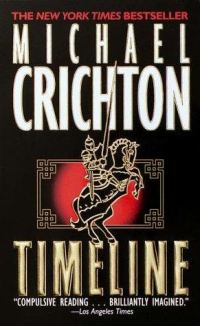 A tale of historians who travel back in time, Timeline, released in 1999, contains Michael Crichton’s usual combination of fact, action and adventure. In this case, he combines aspects of real history and questions about quantum and multiverse theory with scenes of medieval warfare, as told through the eyes of modern historians who travel back to the time which they are studying.
After a series of strange events in the Arizona desert and an archaeological site in France, the main characters – a group of medieval historians – are summoned to the headquarters of ITC (the company that is funding their research) and learn of a startling fact. After building a quantum time machine, one of their professors used it to travel back to the 14th century. Apparently, he went to the very site they have had under excavation, but then failed to return.
The researchers – Chris, Kate, and Marek – all agree to go back and search for him, dressing in period costume and taking a security detail with them. However, they are attacked as soon as they arrive in the past, which leads to an accident in which a grenade rolls through the space-time aperture and their time machine is destroyed on the other side. What’s more, the local lord takes Kate and Marek prisoner.
Alone and cut off from the future, Chris heads for Castelgard to confront the Lord Oliver and meets a boy along the way. Apparently, this “boy” is actually the Lady Claire in disguise, a woman who has escaped from Lord Oliver’s custody. Once they reach the castle, Chris is taken and he and Marek are challenged to a joust, which they prove victorious in. However, this leads Lord Oliver to order their deaths, and they are forced to plan their escape.
It is also revealed that Lord Oliver is holding Johnston in his fortress at La Roque, mainly because he believes Johnston knows of a secret passage that is its only weakness. With an army led by the infamous French mercenary Arnaut de Cervole approaching, he is desperately preparing for the siege. Johnston helps Oliver develops Greek Fire, even though he knows Oliver is meant to lose the siege, while Chris, Marek, Kate and Claire use clues from the future to search for the secret passage themselves.
Chris also realizes that someone else from the future is tracking them, a knight named Robert de Ker. Eventually he is revealed to be Rob Deckard, an ITC employee and former marine driven insane from too many time trips. This is apparently a consequence of traveling to different possible universes, which can result in the displacement and mismatching of different cells in the body. In Rob’s case, it is his neurons which have become mismatched, causing him to have psychotic episodes.
In the end, they all break into La Roque and do battle with hum and Deckard, killing them both. Back home, the ITC manage to finally repair the device and try to bring the team home. However, Marek chooses to stay behind with Claire, having realized that he always wanted to live in the past. When the others return and realize that the company head, Mr. Doniger, has no regard for human life and plans to use the time travel device commercially, they send him to 1348, the year of the first Black Death outbreak. In the end, Chris and Kate get married and find the graves of Marek and Claire in France marked with a familiar epitaph.
The Time Travellers Wife:
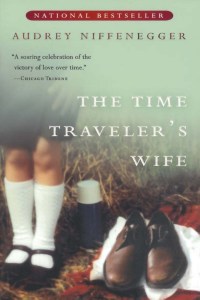 A slight twist on the classic story of time travel, this 2003 novel by Audrey Niffenegger explores the idea of time-travel as a genetic disorder. Inspired by Niffenegger’s own frustration with relationships, this novel is essentially a metaphor for the trials of true love. Classified as both science fiction and romance, the story is based on the themes of love, loss, free will, and communication, it also contains some rather interesting commentaries on existence and the nature of memory and experience.
As the title suggests, the story focuses on the life a man who suffers from Chrono-Displacement, a condition which causes him to involuntarily travel through time, and his wife, who is forced to endure stretches of time without him. The man, Henry, has been time-traveling for most of his life and apparently has no control over the process, though his destinations are largely places and times related to his own history. The trips are apparently tied to stress and other stimuli, making them unpredictable and undesirable.
His own timeline naturally converges with that of his wife, Clare, but at seemingly random points in her life. In each visit, their ages are mismatched, as are their memories of the other. Whereas Clare meets him in a natural chronological order, the visits are mismatched from Henry’s perspective. On one of his early visits (from her perspective), Henry gives her a list of the dates he will appear and she writes them in a diary. During another visit, he inadvertently reveals that they will be married in the future.
Once married, Clare has trouble bringing a pregnancy to term because of the genetic anomaly Henry may presumably be passing on to the fetus. After six miscarriages, Henry wishes to save Clare further pain and has a vasectomy. However a version of Henry from the past visits Clare one night and they make love, causing her to become pregnant with their daughter Alba. She too is diagnosed with Chrono-Displacement, but appears to have some control over it. Before she is born, Henry travels to the future and meets her when she is ten years old and learns that he died when she was five.
When he is 43, during what is to be his last year of life, Henry experiences a time slip which deposits him in a Chicago parking garage on a frigid winter night. Unable to find shelter and clothes (he always appears naked during a time slip) he suffers hypothermia and frostbite and has to have his feet amputated when he returns to the present. Henry and Clare both know that he will not survive many more time jumps. Then, on New Year’s Eve, 2006, Henry time travels into the middle of the Michigan woods in 1984 and is accidentally shot by Clare’s brother, a scene which was foreshadowed earlier in the novel. Henry returns to the present and dies in Clare’s arms.
Clare is devastated by Henry’s death and later finds a letter from Henry asking her to “stop waiting” for him, but which describes a moment in her future when she will see him again. The last scene in the book takes place when Clare is 82 years old and Henry is 43. She has been waiting for Henry, as she has done most of her life, and when he arrives they clasp each other for what may or may not be the last time. The story ends with it being implied that Clare dies in Henry’s arms, as he did in hers before.
Through the use of a non-linear narrative, Neffinenegger was able to effectively demonstrate the sense of yearning and loss that so often accompanies true love. In addition, her use as separate narratives was also an effective tool in that it demonstrated how different people can be in different places in a relationship at different times. Ultimately, every instance that Clare and Henry spend together is made sacred by the fact that neither of them knows how long they will have together, which illustrates beautifully the temporal nature of love itself. Or to put it another way, that story’s a sad, sad tale! Go hug the one you love right now! I’ll wait…
Summary:
And that’s all I got for now and my brain is fried from all this writing. Hence, I think I will leave the summaries and commentaries for another time (was that a pun? That sounded like a pun!) Besides, with this many examples, does anything really need to be said in the way of conclusions? Of course it does! The more examples you have, the more complex the patterns become. So expect some more on my time-travel series, coming real soon!














 Stories by Williams