Episode 75 of SfS – “The Grand Tour: The Legacy of the Voyager Probes” – is Now Live!

Episode 75 of SfS – “The Grand Tour: The Legacy of the Voyager Probes” – is Now Live!

This week’s episode was dedicated to the Voyager 1 and 2 probes, and it was a long time in the making! Launching in 1977, these two probes explored the outer Solar System and accomplished many firsts. This included obtaining the first evidence that Jupiter’s moon, Europa, could have an interior ocean. They also examined Saturn’s rings and got the first close-up look at Saturn’s moon, Titan, and its dense hydrocarbon atmosphere, which led to speculation that liquid methane lakes might exist on its surface.

The Voyager Golden Record. Credit: NASA

While Voyager 2 became the first mission to visit Uranus and Neptune, a feat which has not yet been repeated, Voyager 1 conducted the Pale Blue Dot campaign, obtaining the best-known image of Earth. And, of course, they both carry the Voyager Golden Records, which contain sounds and images of Earth and simple diagrams indicating the location of Earth and the Solar System. These records could be the first interstellar message sent by humanity to another civilization or a time capsule for future generations of humans.

The two probes are now in interstellar space, where they continue to operate and return data on the interstellar medium. Regardless of how much time has passed, the Voyager probes will forever remain iconic and their accomplishments legendary. Check out the episode below:

Where to Listen:

Episode 72 of SfS – The Gift of Gravitational Lensing (with Dr. Slava Turyshev) – is now Live!

Episode 72 of SfS – The Gift of Gravitational Lensing (with Dr. Slava Turyshev) – is now Live!

This week, my guest was Russian-American physicist Dr. Slava Turyshev, a Senior Research Scientist, Technologist, and Project Manager at NASA’s Jet Propulsion Laboratory. Dr. Turyshev has spent years studying the phenomenon known as gravitational lenses, a consequence of General Relativity, where massive objects amplify and alter the path of light from more distant objects. Astronomers have used this phenomenon to study objects that would otherwise be very difficult to see, including some of the farthest galaxies in the Universe.

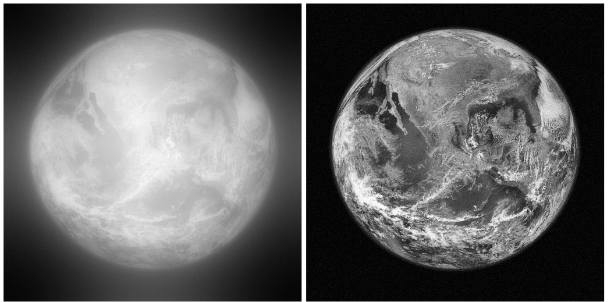
In recent years, Turyshev has published numerous studies advocating for a space telescope that would travel to the focal region of our Sun’s Gravitational Lens (SGL). Once there, it could conduct the most detailed astronomical studies ever, which includes taking extremely high-resolution images of exoplanets. In fact, astronomers predict that an SGL telescope could take pictures of exoplanets that would have the same resolution as images of Earth taken from high orbit (see below).

Toth H. & Turyshev, S.G.

Not only that, but Turyshev predicts that gravitational lenses could also be used for communications from one star system to another. These ideas could lead to an “interstellar internet,” which could be how advanced civilizations keep in touch in our galaxy. Perhaps this is why we haven’t found evidence of any extraterrestrial civilizations: they are routing all their calls through a gravitational lens network, and we aren’t hooked up to it yet!

Where to Listen:

Episode 70 of SfS – The Crisis in Cosmology: What is the Hubble Tension? – is now live!

Episode 70 of SfS – The Crisis in Cosmology: What is the Hubble Tension? – is now live!

This week’s episode deals with a rather pressing matter for astronomers and cosmologists. Shortly after Einstein revealed his Theory of General Relativity in 1916, scientists began pondering how it predicted that the Universe was either expanding or contracting. The debate was settled when Georges Lemaitre and Edwin Hubble confirmed that it was expanding (in 1927 and 1929, respectively). In honor of their accomplishments, the rate at which the cosmos is expanding was named the “Hubble-Lemaitre Constant” (or more commonly, the “Hubble Constant”).

As the field of astronomy expanded and telescopes improved, scientists were able to make distance measurements for objects located farther and farther away. However, these observations were restricted to objects within 4 billion light-years due to the way Earth’s atmosphere distorts light. Depending on the distances involved, astronomers relied on different methods, which came to be known as the “Cosmic Distance Ladder.” In addition to determining the age and size of the Universe, these measurements allowed astronomers to refine their estimates of the Constant.

The Hubble Space Telescope revolutionized astronomy by gradually pushing the boundaries of the “observable Universe” to less than 1 billion years after the Big Bang (13 billion light years!) That’s when scientists noticed some discrepancies. Not only did they learn that the rate of expansion had accelerated over time, but distance measurements to objects located 13 billion light-years away (the earliest galaxies) yielded different values than local measurements. This came to be known as the “Hubble Tension” or the “Crisis in Cosmology.”

While it was hoped that the James Webb Space Telescope would resolve this crisis, its observations have only confirmed that Hubble was right on the money! The crisis endures, and scientists are seeking answers. Is Einstein’s Theory of General Relativity, which is foundational to our cosmological models, wrong? Or are there additional physics/forces at work that we haven’t yet accounted for? Once we know that, we’ll know how just about everything in the Universe works!

Check out the episode below.

Where to Listen:

Episode 65 of SfS – Mars by 2040? Why Must We Wait? – is Now Live!

Episode 65 of SfS – Mars by 2040? Why Must We Wait? – is Now Live!

This week was a bit of a treat for me because it allowed me to talk about something that has been unfolding over at NASA for many years. As a science communicator, I have been privileged enough to watch it unfold and have had the opportunity to comment along the way. I am referring to NASA’s long-held plans for sending crewed missions to Mars in the next decade and the many decades’ worth of planning that went into it.

Since 2010, the plan has been to send missions back to the Moon in this decade, build habitats and other infrastructure there, and use it as a testing ground to prepare for Mars. The next step was to send the first crewed mission in 2033, followed by additional missions every 26 months (coinciding with Mars being at its closest to Earth). While there have been doubts for years that NASA could accomplish this goal in that timeline, it was announced this past summer that 2033 won’t happen.

While a flyby mission could occur that year, a crewed mission where astronauts land on the surface is not likely to happen until 2040 – and that would be an ambitious goal. Meanwhile, China is still hoping to make it there by 2033, and SpaceX wants to land there even sooner. But they aren’t in any position to promise that right now since they are dealing with similar challenges and delays. Check out the episode below to learn more about how we got here and what’s likely to follow:

Where to Listen:

Episode 61 of Stories from Space – A Mars Sample Return Mission – is Now Live!

Episode 61 of Stories from Space – A Mars Sample Return Mission – is Now Live!

This week’s episode is focused on the upcoming Mars Sample Return (MSR) mission, a joint NASA-ESA venture to send a robotic mission to Mars to collect the Perseverance samples. This will constitute the first sample-return mission from Mars, something that scientists have been planning for decades. In 2028, the mission will launch and is expected to return the samples to Earth no sooner than 2033. Unfortunately, due to recent budget cuts, the mission may be delayed or scaled back significantly.

Meanwhile, China is planning its own sample-return mission as part of the Tianwen-3 mission. This mission will launch in 2028 but is scheduled to return by July 2031. As we enter the new Space Race, it is clear that the brass ring is the Red Planet! But regardless of who secures samples from Mars and returns them to Earth first, the scientific returns will be immeasurable. Much like the Moon rocks returned by the Apollo astronauts, scientists will be able to study these samples for generations using the most cutting-edge instruments available.

These studies could finally answer questions that have remained unresolved since the days of the Viking missions. Was there ever life on Mars? Is there life there today (and where can it be found)? When did it go from being a warmer, wetter environment to the freezing, desiccated world we see today? Check out the episode to learn more:

Where to Listen:

Stories from Space is now Live!

Stories from Space is now Live!

It’s officially Launch Day! My podcast series, Stories from Space, just released its first episode. The topic, “We’re Going Back to the Moon!” talks about Artemis and related programs that will send astronauts back to the lunar surface with the long-term goal of establishing a sustained human presence on the Moon. Mostly, the episode addresses the question: why did it take us over fifty years to go back?

Answering a question like that takes about half an hour (or the length of a podcast episode). You can check it out at the Stories from Space homepage (https://www.itspmagazine.com/stories-from-space), or just click on the play button below. The episode is also available for streaming on Spotify and Apple

Writing for HeroX and Universe Today!

good_news_farnsworthGood news, everyone! My services as a freelance writer were recently enlisted by the good folks who run HeroX and Universe Today. Thanks to my old friend and mentor, Fraser Cain (who consequently got me started in the indie publishing bizz), I’m going to be bringing the experience I’ve garnered writing my own blog to a more professional format – writing about space exploration, innovation and technological development.

As you can imagine, this means I’ll be doing less in the way of writing for this here website. But I promise I’ll still be around! After all, I’ve got lost more work to do on my stories, and there are always articles and headlines that need to be written about that I won’t get a chance to cover at those other sites. So rest assured, storiesbywilliams will be in operation for a long time to come.

XPRIZE_GooglePlus_Cover_2120x1192For those unfamiliar, HeroX is a spinoff of the XPRIZE Foundation, the non-profit organization that runs public competitions intended to encourage technological development and innovation. It’s directors includes such luminaries as Google’s Elon Musk and Larry Page, director James Cameron, author and columnist Arianna Huffington, and businessman/ philanthropist Ratan Tata, and more. In short, they are kind of a big deal!

Fraser Cain, founder of Universe Today, began HeroX as a way of combining the best of the XPRIZE with a crowdfunding platform similar to Kickstarter. Basically, the site brings together people with ideas for new inventions, finds the people with the talent and resources to make them happen, and funnels contributions and donations to them to bankroll their research and development.

big_bangUniverse Today, on the other hand, is kind of an old stomping ground for me. Years back, I did articles for them that dealt with a range of topics, including geology, natural science, physics, environmentalism, and astronomy. In both cases, I’ll be doing write ups on news items that involve technological development and innovation, and doing interviews with some of the people in the business.

If possible, I’ll try to link articles done for these sources to this page so people can check them out. And stay tuned for more updates on the upcoming release of Flash Forward, Oscar Mike, and my various other projects. Peace out!

News From Space: Big Bang Vs. Black Hole

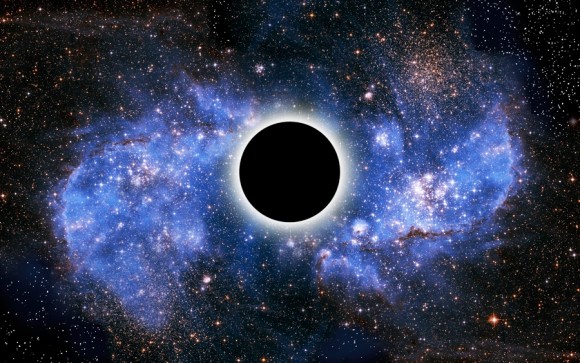
big bang_blackholeFor decades, the Big Bang Theory has remained the accepted theory of how the universe came to be, beating out challengers like the Steady State Theory. However, many unresolved issues remain with this theory, the most notable of which is the question of what could have existed prior to the big bang. Because of this, scientists have been looking for way to refine the theory.

Luckily, a group of theoretical physicists from the Perimeter Institute (PI) for Theoretical Physics in Waterloo, Ontario have announced a new interpretation on how the universe came to be. Essentially, they postulate that the birth of the universe could have happened after a four-dimensional star collapsed into a black hole and began ejecting debris.
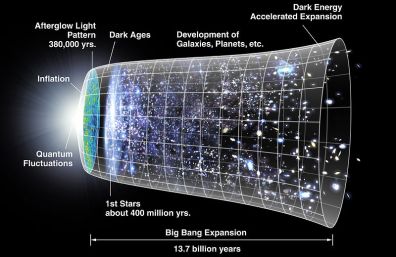
big_bangThis represents a big revision of the current theory, which is that universe grew from an infinitely dense point or singularity. But as to what was there before that remain unknown, and is one of a few limitations of the Big Bang. In addition, it’s hard to predict why it would have produced a universe that has an almost uniform temperature, because the age of our universe (about 13.8 billion years) does not give enough time to reach a temperature equilibrium.

Most cosmologists say the universe must have been expanding faster than the speed of light for this to happen. But according to Niayesh Afshordi, an astrophysicist with PI who co-authored the study, even that theory has problems:

For all physicists know, dragons could have come flying out of the singularity. The Big Bang was so chaotic, it’s not clear there would have been even a small homogenous patch for inflation to start working on.

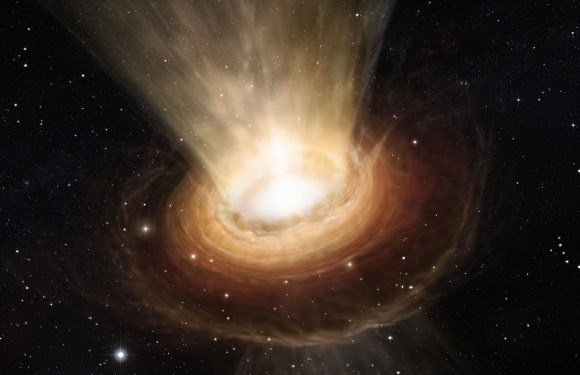
black_holeThe model Afshordi and her colleagues are proposing is basically a three-dimensional universe floating as a membrane (or brane) in a “bulk universe” that has four dimensions. If this “bulk universe” has four-dimensional stars, these stars could go through the same life cycles as the three-dimensional ones we are familiar with. The most massive ones would explode as supernovae, shed their skin and have the innermost parts collapse as a black hole.

The 4-D black hole would then have an “event horizon”, the boundary between the inside and the outside of a black hole. In a 3-D universe, an event horizon appears as a two-dimensional surface; but in a 4-D universe, the event horizon would be a 3-D object called a hypersphere. And when this 4-D star blows apart, the leftover material would create a 3-D brane surrounding a 3-D event horizon, and then expand.

planck-attnotated-580x372To simplify it a little, they are postulating that the expansion of the universe was triggered by the motion of the universe through a higher-dimensional reality. While it may sound complicated, the theory does explain how the universe continues to expand and is indeed accelerating. Whereas previous theories have credited a mysterious invisible force known as “dark energy” with this, this new theory claims it is the result of the 3-D brane’s growth.

However, there is one limitation to this theory which has to do with the nearly uniform temperature of the universe. While the model does explain how this could be, the ESA’s Planck telesceop recently mapped out the universe and discovered small temperature variations in the cosmic microwave background (CBM). These patches were believed to be leftovers of the universe’s beginnings, which were a further indication that the Big Bang model holds true.

big_bang1The PI team’s own CBM readings differ from this highly accurate survey by about four percent, so now they too are going back to the table and looking to refine their theory. How ironic! However, the IP team still feel the model has worth. While the Planck observations show that inflation is happening, they do not show why the inflation is happening.

Needless to say, we are nowhere near to resolving how the universe came to be, at least not in a way that resolves all the theoretical issues. But that’s the things about the Big Bang – it’s the scientific equivalent of a Hydra. No matter how many times people attempt to discredit it, it always comes back to reassert its dominance!

Source: universetoday.com, perimeterinstitute.ca

Epic Rap Battles of History – Science Edition

epic_rap_battlesIt occurs to me that I really haven’t given the ERB site its due over the years. They’ve provided me with endless hours of enjoyment and all I ever did was post about one of their videos. Granted, I have nowhere near the kind of following that would needed to actually give their traffic a shot in the arm, but it’s the thought that counts!

And so I thought I’d a little compilation here of some of their funniest, and educational, videos. Whether it was the match ups between Steve Jobs and Bill Gates (made shortly after Jobs death as a tribute to his life), Einstein and Stephen Hawking, or Thomas Edison and Nikola Tesla, these guys have shown a real commitment to their art and are clearly willing to do their homework!

Enjoy!

Steve Jobs vs. Bill Gates:


Einstein vs. Stephen Hawking:


Thomas Edison vs. Nikola Tesla:


Note: Though I am well aware of their existence, I have assiduously avoided posting the videos of Darth Vader vs. Adolph Hitler. Though I found them hilarious, such material is bound to offensive to some. Although, if people were willing to give me permission… 😉 😉

News From Space: Center of the Universe Closing!

center_universeYeah, that title might be a bit misleading. Technically, the news comes from Earth, but has everything to do with our study of the heavens. And this story comes to you from my own neck of the woods where – just a few kilometers from my house – the Dominion Astrophysical Observatory is about to shut down due to budget cuts.

Typically, it goes by the name of Center of the Universe, a national historic site and a hub for astronomy education in Victoria. And at the end of the summer, in what I can only say its a tragedy, it will be closed to the public for good. The National Research Council (NRC) put the official closing date at the end of August, right after the last of the student summer camps ends.

center_universe2In addition, the facility houses historical artifacts like the original 1.8 metre mirror from the Plaskett Telescope and runs historical tours, multimedia shows, and youth programs. Unfortunately, this all costs about $32,000 to operate and $245,000 in employee wages, and brings in only about $47,000 per year in revenue. This gives the NRC a deficit of about $230,000 a year for this facility alone.

Naturally, Charles Drouin, spokesman for the NRC in Ottawa, said that the decision did not come easy, but was necessary. He confirmed that the active astronomy facility and national historic site will have no public outreach come late August or early September, and locals and visitors will no longer be able to tour the Plastkett Telescope, in operation since May 6, 1918.

center_universe3On the bright side, the historical artifacts and displays in the Centre of the Universe building will remain in place after the facility is closed. The NRC will also be working with local community groups to find volunteers to use the space, so it will remain in operation, though in a limited capacity. This much is good news, since the loss of the site in its entirety would be an immeasurable loss for this community.

Interestingly enough, Drouin also claimed that the decision to close the facility was unrelated to the federal governments announcement in May to reorganize the NRC as an “industry-focused research and technology organization.” In short, the budget-driven decision is not being blamed on funding cuts or the desire to privatize. I wonder…

center_universe1Personally, I am sad and ashamed to hear this news. The wife and I have been saying for ages that we need to go to this place and take a tour. Granted, that is not the easiest thing in the world to arrange, what with all the booked tours and the way the place seems to have an odd schedule. But you’d think we could have arranged something by now. It’s a national observatory, and right in my backyard for God sakes! To think we might have missed our chance is just plain sad…

However, there is still time, and I strongly recommend that anybody in the Saanich, Victoria, or Vancouver and Island region get their butts out and do what they can to see the place in operation before it shuts down. No telling what kind of hours and limited services it will be offering once its got only volunteers manning it. We need to take a gander at this star-gazing facility now before we lose the opportunity!

And be sure to check out their website too!

Source: vicnews.com, nrc-cnrc.gc.ca