
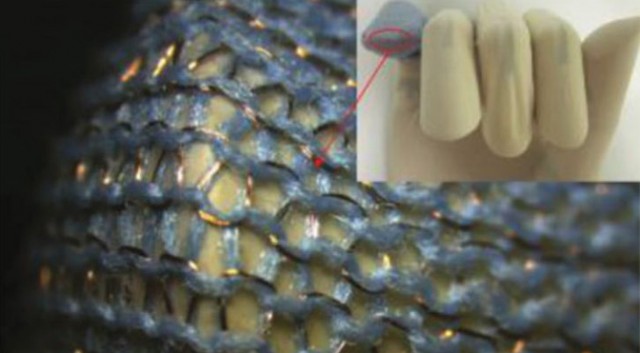
 Chances are that almost every piece of electronics handled by someone today is some sort of printed circuit board (PCB). PCBs are an essential part of modern technology, but as technology improves and moves into the realm of the wearable and the flexible, their rigid and flat design is being reconsidered. In addition to looking for more flexible materials, there’s also a desire to break the 2-dimensional mold.
That’s precisely what researchers at the Hong Kong Polytechnic University were thinking of. Using a revolutionary, never-before-seen concept known as computerized knitting technology, they developed a new line of fabric circuit boards (FCBs). To make them, lead scientists Qiao Li and Xiao Ming Tao at HKPU relied a combination of conductive fibrous metal materials and traditional fabric.
 Within the FCB, the wires are the equivalent of the circuits on a regular board, and the fabric acts as the mounting material that keeps everything in the right orientation and insulates different circuits. The finished FCBs can contain 3D circuits that are resistant to bending, stretching, and washing. To test this, Li and Ming subjected the boards to repeated stretching and folding, and found they were functional to about 1 million cycles.
The washing test was a little less successful with six of 30 samples experiencing mild damage after 30 washes, but that’s not bad when you consider a single wash cycle would probably kill your average PCB. Oddly enough, Li and Ming also wanted to test how the fabric stood up to bullets, and placed one inside a bulletproof vest. After several shots, the fabric boards continued to work without difficulty.
 Garments made of FCBs could also to connect devices that are mounted on different parts of the body, like small solar panels on your back or shoulders to charge your devices. The FBC garment could then route that power into a battery pack or directly to your pocket where your phone charges wirelessly. Another potential use case would be biometric sensors that are built into your clothing instead of a device like a smartwatch or fitness band.
According to the team, the basic FCB design is ready for use. The fabric samples made as part of the study are reportedly rather comfortable and the circuits should be sturdy enough to outlast the fabric component of the garment as well. However, the success of FCBs will likely come down to cost. Right now, the Samsung S Shirt costs $199 with purchase of a smartphone and requires a two-year AT&T contract. Not quite cost-effective just yet!
 Still, what this amounts to is the possibility a future where “wearable computing” is taken quite literally. Beyond smart watches, smart rings, smart glasses, and portable computers, there could also be the option for “smart clothes”. In short, people may very well be able to wear their computer on their person and carry it with them wherever they go. Smartphones, contacts or glasses could then be worn to sync up and act as displays.
I can’t help but feel that this is all starting to sound familiar. Yep, echoes of Vinge’s Rainbow’s End right there! And in the meantime, be sure to check out this video from New Scientist that gives a first-hand look at the fabric circuit board:
Sources: extremetech.com, ecouterre.com, newscientist.com
 Earlier this month, Computex 2014 wrapped up in Taipei. And while this trade show may not have all the glitz and glamor of its counterpart in Vegas (aka. the Consumer Electronics Show), it is still an important launch pad for new IT products slated for release during the second half of the year. Compared to other venues, the Taiwanese event is more formal, more business-oriented, and for those people who love to tinker with their PCs.
 For example, big name brands like Asus typically use the event to launch a wide range of products. This year, this included such items as the super-slim Asus Book Chi and the multi-mode Book V, which like their other products, have demonstrated that the company has a flair for innovation that easily rivals the big western and Korean names. In addition, Intel has been a long stalwart at Computex, premiered its fanless reference design tablet that runs on the Llama Mountain chipset.
 And then there was the Asus wireless storage, a gadget that looks like an air freshener, but is actually a wireless storage device that can be paired with a smartphone using near-field communication (NFC) technology – essentially being able to transfer info simply by bringing a device into near-proximity with it. And as always, there were plenty of cameras, display headsets, mobile devices, and wearables. This last aspect was particularly ever-present, in the form of look-alike big-name wearables.
 In his keynote speech, Microsoft’s Nick Parker talked about the age of ubiquitous computing, and the “devices we carry on us, as opposed to with us.” What this means is, we may very well be entering a PC-less age, where computing is embedded in devices of increasingly diminished size. Eventually, it could even be miniaturized to the point where it is stitched into our clothing as accessed through contacts, never mind glasses or headsets!
 Stories by Williams