Latest Articles Over At Universe Today!

center_universe2As the title would suggest, my third and fourth articles have just been published over at Universe Today. First off, let me assure people that I plan to post a link to UT in the near future so I don’t feel the need to do this every time a new article comes out. But since this is still a new experience to me, I naturally feel the need to share whenever a new one is published.

The first of the two, which was published on Monday, deals with a recent determination made about the source of the Moon’s water. This is based on research conducted by scientists over at the National Museum of Natural History in Paris. Back in 2009, India’s Chandrayaa-1 probe conducted a near-infrared survey of the Moon during a flyby that showed signs of surface water.

moon_waterAfter years of speculation that claimed that the surface water – which exists strictly in icy form – was deposited there by meteors and comets, the National Museum team concluded that its actually formed by solar wind interacting with oxygen in the Moon’s surface dust. Quite the odd little occurrence; but then again, even Mercury appears to have icy spots on it’s molten surface.

www.universetoday.com/115215/water-on-the-moon-was-blown-in-by-solar-wind/

The second is about a recent collaboration between NASA and SpaceX. While the latter was testing their Falcon 9 rockets, NASA filmed the performance using Infrared cameras. The information gleamed from this is helping SpaceX to develop their reusable rocket, but will also help NASA to figure out how they will land habitats and heavy equipment on the surface of Mars.

NASA_thermal1Sort of a win-win scenario, one that shows how the public and private sector are working together like never before to make the future of space exploration happen. And it’s another indication of just how serious NASA and its partners are in making a mission to Mars a reality.
www.universetoday.com/115408/how-nasa-and-spacex-are-working-together-to-land-on-mars/

Feel free to check them out, and stay tuned for the next subject of interest: Dark Matter Emanating From The Sun!

The Future of Space: A Space Elevator by 2050?

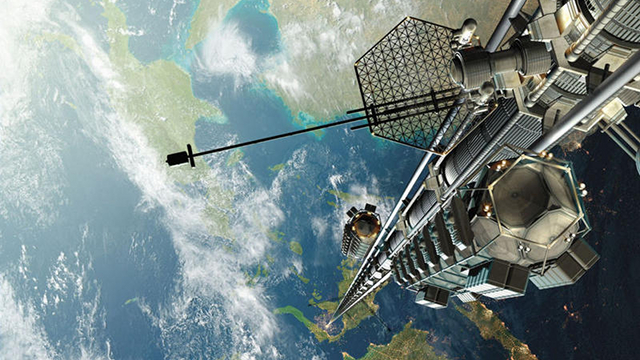
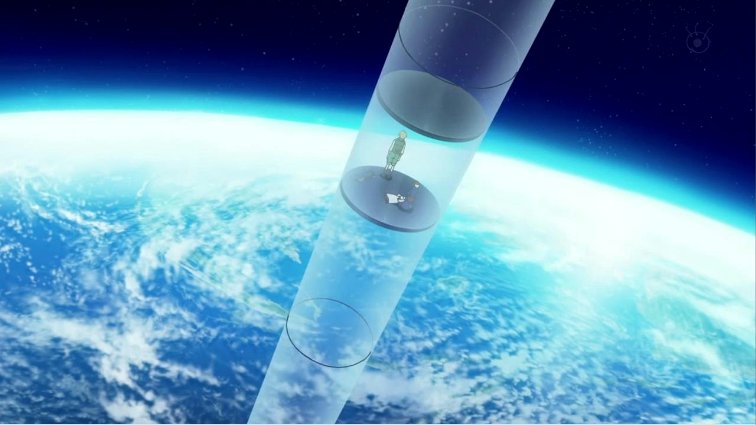
space_elevatorIn the ongoing effort to ensure humanity has a future offworld, it seems that another major company has thrown its hat into the ring. This time, its the Japanese construction giant Obayashi that’s declared its interest in building a Space Elevator, a feat which it plans to have it up and running by the year 2050. If successful, it would make space travel easier and more accessible, and revolutionize the world economy.

This is just the latest proposal to build an elevator in the coming decades, using both existing and emerging technology. Obayashi’s plan calls for a tether that will reach 96,000 kilometers into space, with robotic cars powered by magnetic linear motors that will carry people and cargo to a newly-built space station. The estimated travel time will take 7 days, and will cost a fraction of what it currently takes to bring people to the ISS using rockets.

space_elevator_liftThe company said the fantasy can now become a reality because of the development of carbon nanotechnology. As Yoji Ishikawa, a research and development manager at Obayashi, explained:

The tensile strength is almost a hundred times stronger than steel cable so it’s possible. Right now we can’t make the cable long enough. We can only make 3-centimetre-long nanotubes but we need much more… we think by 2030 we’ll be able to do it.

Once considered the realm of science fiction, the concept is fast becoming a possibility. A major international study in 2012 concluded the space elevator was feasible, but best achieved with international co-operation. Since that time, Universities all over Japan have been working on the engineering problems, and every year they hold competitions to share their suggestions and learn from each other.

space_elevator3Experts have claimed the space elevator could signal the end of Earth-based rockets which are hugely expensive and dangerous. Compared to space shuttles, which cost about $22,000 per kilogram to take cargo into space, the Space Elevator can do it for around $200. It’s also believed that having one operational could help solve the world’s power problems by delivering huge amounts of solar power. It would also be a boon for space tourism.

Constructing the Space Elevator would allow small rockets to be housed and launched from stations in space without the need for massive amounts of fuel required to break the Earth’s gravitational pull. Obayashi is working on cars that will carry 30 people up the elevator, so it may not be too long before the Moon is the next must-see tourist destination. They are joined by a team at Kanagawa University that have been working on robotic cars or climbers.

graphene_ribbonsAnd one of the greatest issues – the development of a tether that can withstand the weight and tension of stresses of reaching into orbit – may be closer to being solved than previously thought. While the development of carbon nanotubes has certainly been a shot in the arm for those contemplating the space elevator’s tether, this material is not quite strong enough to do the job itself.

Luckily, a team working out of Penn State University have created something that just might. Led by chemistry professor John Badding, the team has created a “diamond nanothread” – a thread composed of carbon atoms that measures one-twenty-thousands the diameter of a single strand of human hair, and which may prove to be the strongest man-made material in the universe.

diamond_nanothreadAt the heart of the thread is a never-before-seen structure resembling the hexagonal rings of bonded carbon atoms that make up diamonds, the hardest known mineral in existence. That makes these nanothreads potentially stronger and more resilient than the most advanced carbon nanotubes, which are similar super-durable and super-light structures composed of rolled up, one atom-thick sheets of carbon called graphene.

Graphene and carbon nanotubes are already ushering in stunning advancements in the fields of electronics, energy storage and even medicine. This new discovery of diamond nanothreads, if they prove to be stronger than existing materials, could accelerate this process even further and revolutionize the development of electronics vehicles, batteries, touchscreens, solar cells, and nanocomposities.

space_elevator2But by far the most ambitious possibility offered is that of a durable cable that could send humans to space without the need of rockets. As John Badding said in a statement:

One of our wildest dreams for the nanomaterials we are developing is that they could be used to make the super-strong, lightweight cables that would make possible the construction of a ‘space elevator’ which so far has existed only as a science-fiction idea,

At this juncture, and given the immense cost and international commitment required to built it, 2050 seems like a reasonable estimate for creating a Space Elevator. However, other groups hope to see this goal become a reality sooner. The  International Academy of Astronautics (IAA) for example, thinks one could be built by 2035 using existing technology. And several assessments indicate that a Lunar Elevator would be far more feasible in the meantime.

Come what may, it is clear that the future of space exploration will require us to think bigger and bolder if we’re going to secure our future as a “space-faring” race. And be sure to check out these videos from Penn State and the Obayashi Corp:

John Badding and the Nanodiamond Thread:


Obayashi and the 2050 Space Elevator:


Sources:
cnet.com
, abc.net.au, science.psu.edu

The Future of Space: Smart, Stretchy, Skintight Spacesuits

biosuitSpacesuits have come a long way from their humble origins in the 1960s. But despite decades worth of innovation, the basic design remains the same – large, bulky, and limiting to the wearer’s range of movement. Hence why a number of researchers and scientists are looking to create suits that are snugger, more flexible, and more ergonomic. One such group hails from MIT, with a skin-tight design that’s sure to revolutionize the concept of spacesuits.

The team is led by Dava Newman, a professor of aeronautics and astronautics and engineering systems at MIT who previewed her Biosuit – playfully described by some as a “spidersuit” – at the TEDWomen event, held in San Fransisco in December of 2013. Referred to as a “second skin” suit, the design incorporates flexible, lightweight material that is lined with “tiny, muscle-like coils.”

mit-shrink-wrap-spacesuitSpeaking of the challenges of spacesuit design, and her team’s new concept for one, Dava Newman had the following to say in an interview with MIT news:

With conventional spacesuits, you’re essentially in a balloon of gas that’s providing you with the necessary one-third of an atmosphere [of pressure,] to keep you alive in the vacuum of space. We want to achieve that same pressurization, but through mechanical counterpressure — applying the pressure directly to the skin, thus avoiding the gas pressure altogether. We combine passive elastics with active materials.

Granted, Newman’s design is the first form-fitting spacesuit concept to see the light of day. Back in the 1960’s, NASA began experimenting with a suit that was modeled on human skin, the result of which was the Space Activity Suit (SAS). Instead of an air-filled envelope, the SAS used a skin-tight rubber leotard that clung to astronaut like spandex, pressing in to protect the wearer from the vacuum of space by means of counter pressure.

SAS_spacesuitFor breathing, the suit had an inflatable bladder on the chest and the astronaut wore a simple helmet with an airtight ring seal to keep in pressure. This setup made for a much lighter, more flexible suit that was mechanically far simpler because the breathing system and a porous skin that removed the need for complex cooling systems. The snag with the SAS was that materials in the days of Apollo were much too primitive to make the design practical.

Little progress was made until Dava Newman and her team from MIT combined modern fabrics, computer modelling, and engineering techniques to produce the Biosuit. Though a far more practical counter-pressure suit than its predecessor, it was still plagued by one major drawback – the skintight apparatus was very difficult to put on. Solutions were proposed, such as a machine that would weave a new suit about the wearer when needed, but these were deemed impractical.

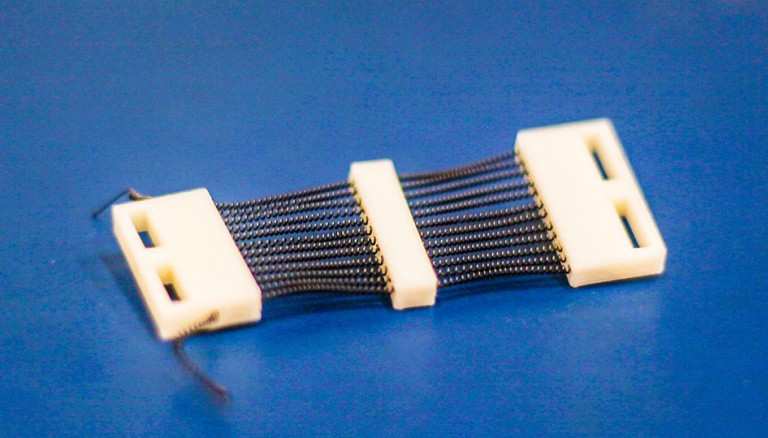
mit-shrink-wrap-spacesuit-0The new approach incorporates coils formed out of tightly packed, small-diameter springs made of a shape-memory alloy (SMA) into the suit fabric. Memory alloys are metals that can be bent or deformed, but when heated, return to their original shape. In this case, the nickel-titanium coils are formed into a tourniquet-like cuff that incorporates a length of heating wire. When a current is applied, the coil cinches up to provide the proper counter pressure needed for the Biosuit to work.

Bradley Holschuh, a post-doctorate in Newman’s lab, originally came up with the idea of a coil design. In the past, the big hurdle to second-skin spacesuits was how to get astronauts to squeeze in and out of the pressured, skintight suit. Holschuh’s breakthrough was to deploy shape-memory alloy as a technological end-around. To train the alloy, Holschuh wound raw SMA fiber into extremely tight coils and heated them to 450º C (842º F) to fashion an original or “trained” shape.

mit-shrink-wrap-spacesuit-3 When the coil cooled to room temperature, it could be stretched out, but when heated to 60º C (140º F), it shrank back into its original shape in what the MIT team compared to a self-closing buckle. As spokespersons from MIT explained:

The researchers rigged an array of coils to an elastic cuff, attaching each coil to a small thread linked to the cuff. They then attached leads to the coils’ opposite ends and applied a voltage, generating heat. Between 60 and 160 C, the coils contracted, pulling the attached threads, and tightening the cuff.

In order to maintain it without continually heating the coils, however, the team needs to come up with some sort of a catch that will lock the coils in place rather than relying on a continuous supply of electricity and needlessly heating up the suit – yet it will still have to be easy to unfasten. Once Newman and her team find a solution to this problem, their suit could find other applications here on Earth.

Image converted using ifftoanyAs Holschuh explained, the applications for this technology go beyond the spacesuit, with applications ranging from the militarized to the medical. But for the moment, the intended purpose is keeping astronauts safe and comfortable:

You could [also] use this as a tourniquet system if someone is bleeding out on the battlefield. If your suit happens to have sensors, it could tourniquet you in the event of injury without you even having to think about it… An integrated suit is exciting to think about to enhance human performance. We’re trying to keep our astronauts alive, safe, and mobile, but these designs are not just for use in space.

Considering the ambitious plans NASA and other government and private space agencies have for the near-future – exploring Mars, mining asteroids, building a settlement on the Moon, etc. – a next-generation spacesuit would certainly come in handy. With new launch systems and space capsules being introduced for just this purpose, it only makes sense that the most basic pieces of equipment get a refit as well.

And be sure to check out this video of Dava Newman showing her Biosuit at the TEDWomen conference last year:


Sources:
gizmag.com, motherboard.vice.com
, newsoffice.mit.edu

News from Aerospace: XS-1 Experimental Spaceplane

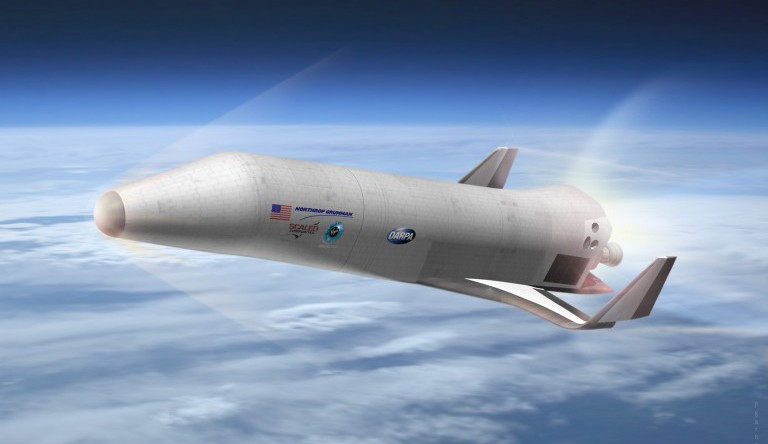
northrop-grumman-xs-1-spaceplaneThe race to produce a new era or reusable and cost-effective spacecraft has been turning out some rather creative and interesting designs. DARPA’s XS-1 Spaceplane is certainly no exception. Developed by Northrop Grumman, in partnership with Scaled Composites and Virgin Galactic, this vehicle is a major step towards producing launch systems that will dramatically reduce the costs of getting into orbit.

Key to DARPA’s vision is to develop a space-delivery system for the US military that will restore the ability of the US to deploy military satellites ingeniously. In a rather ambitious twist, they want a vehicle that can be launched 10 times over a 10-day period, fly in a suborbital trajectory at speeds in excess of Mach 10, release a satellite launch vehicle while in flight, and reduce the cost of putting a payload into orbit to US$5 million (a tenth of the current cost).

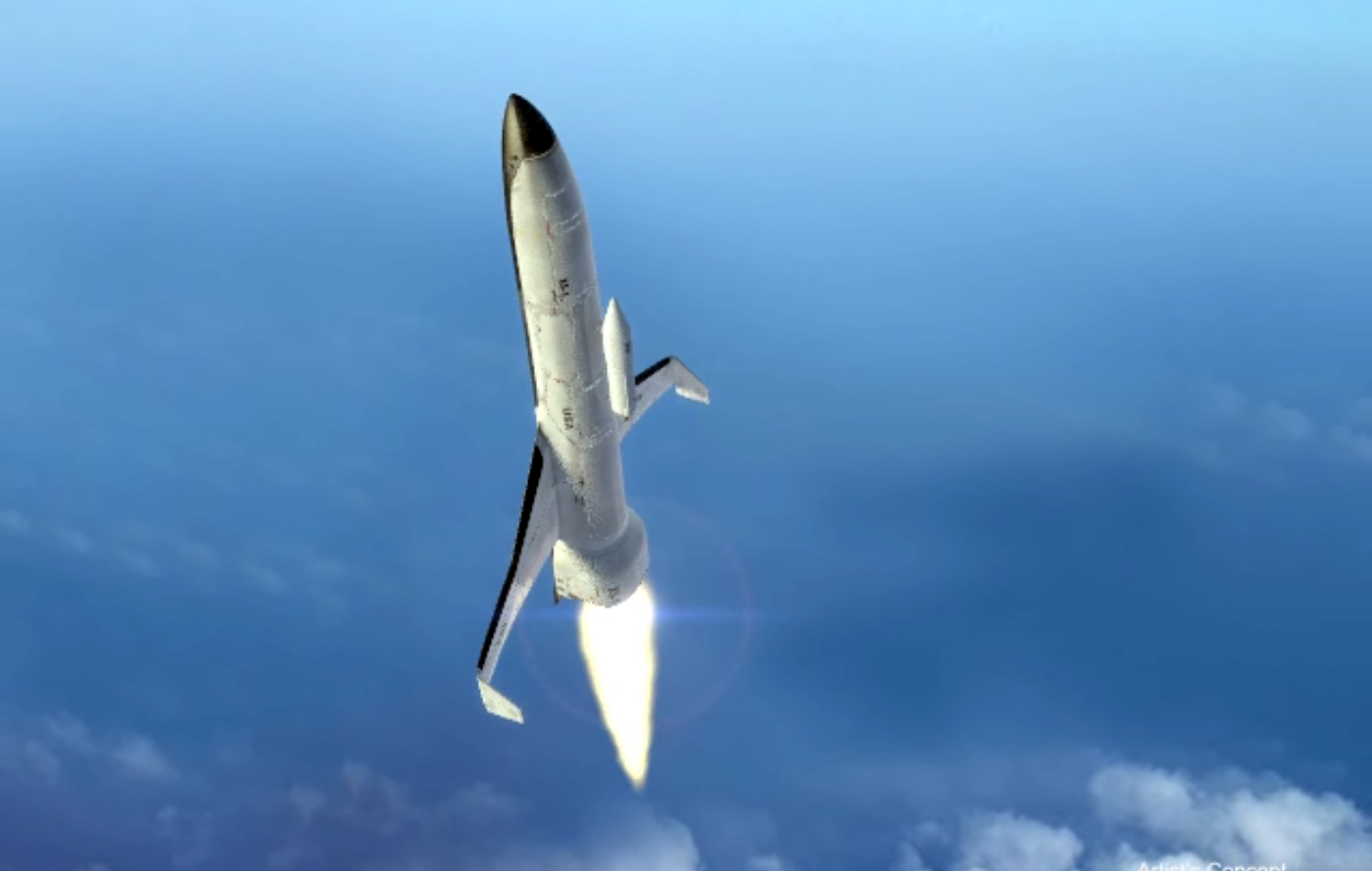
XS-1_1Under DARPA contracts, Boeing, Masten Space Systems, and Northrop Grumman are working on their own versions of the spaceplane. The Northrop plan is to employ a reusable spaceplane booster that, when coupled with an expendable upper stage, can send a 1360 kgs (3,000 pounds) spacecraft into low Earth orbit. By comping reusable boosters with aircraft-like operations on landing, a more cost-effective and resilient spacecraft results.

In flight, the Northrop version of the XS-1 will take advantage of the company’s experience in unmanned aircraft to use a highly autonomous flight system and will release an expendable upper stage, which takes the final payload into orbit. While this is happening, the XS-1 will fly back to base and land on a standard runway like a conventional aircraft, refuel, and reload for the next deployment.

Spaceshiptwo-580x256Northrop is working under a $3.9 million phase one contract with DARPA to produce a design and flight demonstration plan that will allow the XS-1 to not only act as a space launcher, but as a testbed for next-generation hypersonic aircraft. Meanwhile Scaled Composites, based in Mojave, will be in charge of fabrication and assembly while Virgin Galactic will handle commercial spaceplane operations and transition.

Doug Young, the vice president of missile defense and advanced missions at Northrop Grumman Aerospace Systems, had this to say about the collaboration:

Our team is uniquely qualified to meet DARPA’s XS-1 operational system goals, having built and transitioned many developmental systems to operational use, including our current work on the world’s only commercial spaceline, Virgin Galactic’s SpaceShipTwo. We plan to bundle proven technologies into our concept that we developed during related projects for DARPA, NASA and the U.S. Air Force Research Laboratory, giving the government maximum return on those investments.

space_elevator2Regardless of which contractor’s design bears fruit, the future of space exploration is clear. In addition to focusing on cutting costs and reusability, it will depend heavily upon public and private sector collaboration. As private space companies grab a larger share of the space tourism and shipping market, they will be called upon to help pick up the slack, and lend their expertise to more ambitious projects.

Examples abound, from putting satellites, supplies and astronauts into orbit, to landing settlers on Mars itself. And who knows? In the foreseeable future, NASA, Russia, China, the ESA and Japan may also be working hand-in-hand with transport and energy companies to make space-based solar power and a space elevator a reality!

Source: gizmag.com, globenewswire.com

News from Mars: MAVEN Orbiter Arrives!

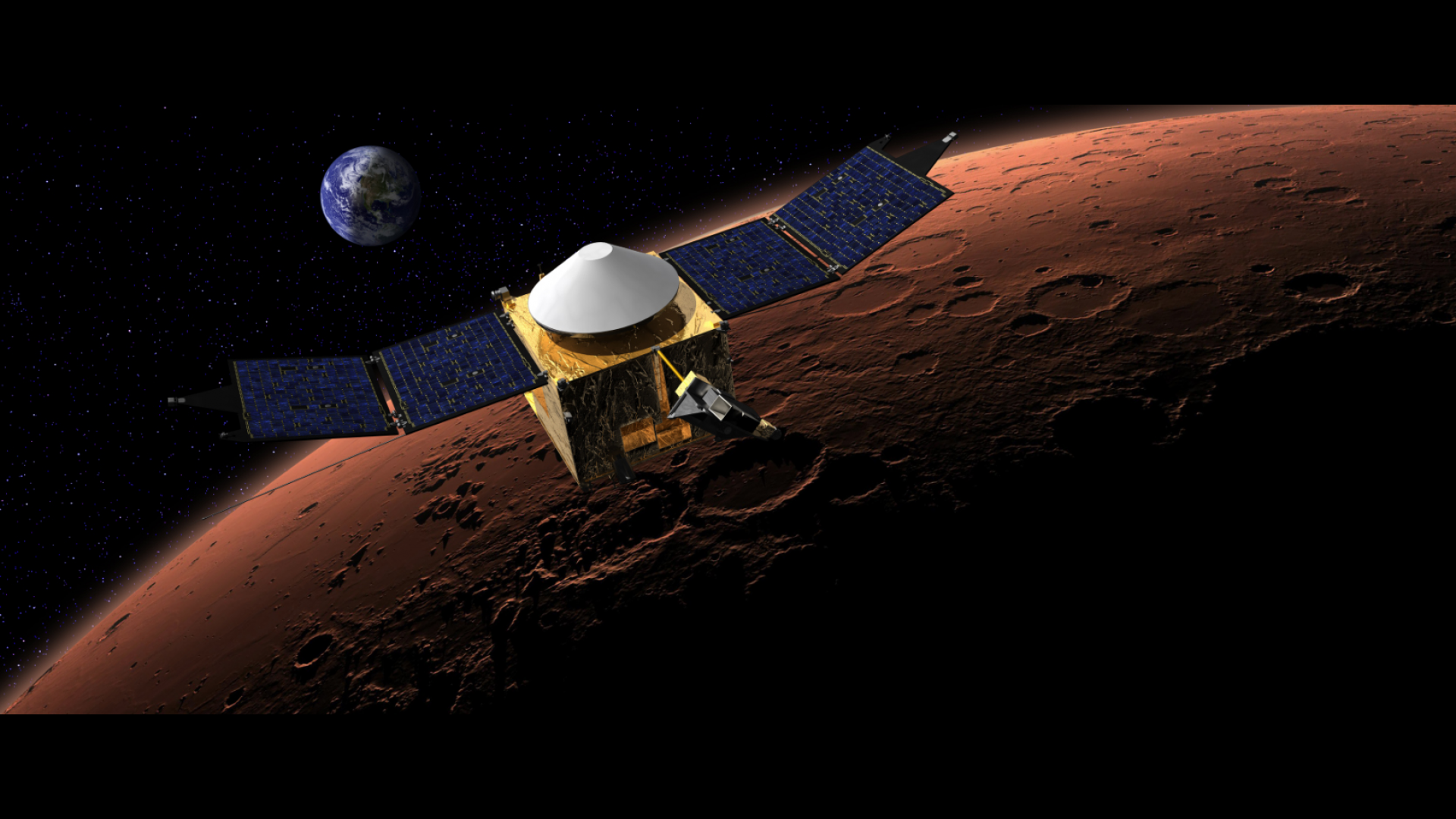
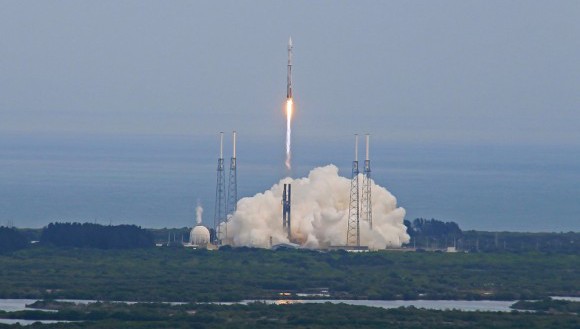
maven_tv_backdropIn November 2013, NASA launched the Mars Atmosphere and Volatile Evolution (MAVEN) space probe from Cape Canaveral. Described as a “time machine” for Mars, the orbiter would spend the next ten months traversing space, assuming an orbit around the Red Planet, and look for an answer as to how Mars went from being a planet with an atmosphere and water to the dried out husk that we know today.

And this evening, after trekking some 711 million kilometers (442 million-mile) across our Solar System, MAVEN will have arrived in orbit around Mars and will begin its year-long mission to study the planet’s upper atmosphere. The arrival will be broadcast live, courtesy of NASA TV and Space.com. The live webcast will run from 9:30 p.m. to 10:45 p.m. EDT (0130 to 0245 GMT), and if all goes well, MAVEN will enter orbit around Mars at 9:50 p.m. EDT (0250 GMT).

maven_launchAs David Mitchell, NASA’s MAVEN project manager at the Goddard Space Flight Center in Greenbelt, Maryland, said in a statement:

So far, so good with the performance of the spacecraft and payloads on the cruise to Mars. The team, the flight system, and all ground assets are ready for Mars orbit insertion.

Though plans to study Mars’ atmosphere in detail have been in the works for years, the MAVEN program received a big push from the ongoing efforts from the Curiosity rover. During its ongoing mission to study the surface of Mars, Curiosity was able to confirm that Mars had extensive surface water billions of years ago. This revelation came very early in the mission, and indicated some rather interesting things about Mars’ past.

Mars-snow-header-640x353For instance, although Mars is now too cold for flowing water today, it might have had a thicker atmosphere in the past that warmed its surface and allowed the liquid to remain stable on the surface. And while scientists have a pretty good idea how it was lost (i.e. too far our Sun, too low a gravity field), the rate of loss and when it disappeared are just some of the questions that MAVEN will attempt to answer.

Much of what scientists know about Mars’ upper atmosphere comes from just a few minutes’ worth of data from the two Viking landers that took measurements as they made their way to the Martian surface in the 1970s. This time around, NASA will be able to collect data for an entire year, gathering far more data than either the Viking landers or any other spacecraft has since had the opportunity to do.

maven_atmo1As Bruce Jakosky, the mission’s principal investigator at the University of Colorado, Boulder’s Laboratory for Atmospheric and Space Physics, explained it:

The MAVEN science mission focuses on answering questions about where did the water that was present on early Mars go, about where did the carbon dioxide go. These are important questions for understanding the history of Mars, its climate, and its potential to support at least microbial life.

NASA scientists understand that Mars’ upper atmosphere acts as an escape zone for molecules floating dozens of miles from the planet’s surface. They theorize that as the solar wind hits the atmosphere, the radiation strips away the lighter molecules and flings them into space forever. To test this hypothesis, MAVEN will be examining the state of Mars’ upper atmosphere, and ionosphere to determine its interactions with the solar wind.

maven_atmosphereIn so doing, NASA hopes to determine what the current rates of escape are for neutral gases and ions, and thus get a better picture of how long it took for the atmosphere to degrade and when it began degrading. The upper atmosphere of Mars likely changes as the sun’s activity increases and decreases, which is why MAVEN investigators hope to run the mission for longer than a year.

MAVEN will began making science measurements around Nov. 8, due to it taking a short break from its commissioning phase to watch Comet Siding Spring pass close by on Oct. 19. The $671 million MAVEN spacecraft is one of two missions that launched toward Mars last November and which are making their arrival this month. The other probe is India’s Mars Orbiter Mission, which launched just before MAVEN and will arrive at the Red Planet this Wednesday (Sept. 24).

It is an exciting time for space exploration, and the coming years are sure to be characterized by an escalating and accelerating rate of learning. Be sure to head on over to Space.com to watch the arrival broadcast live. And be sure to check out the following videos – the Mars Arrival trailer; NASA Goddard Center’s “Targeting Mars” video; and the NASA MAVEN PSA, hosted by LeVar Burton:

MAVEN Mars Arrival Trailer:


Targeting Mars:


LeVar Burton Shares MAVEN’s Story:


Sources:
space.com, (2), nasa.gov

News from Space: Orion Spacecraft Completed

orion_arrays1NASA’s return to manned spaceflight took a few steps forward this month with the completion of the Orion crew capsule. As the module that will hopefully bring astronauts back to the Moon and to Mars, the capsule rolled out of its assembly facility at the Kennedy Space Center (KSC) on Thursday, Sept. 11. This was the first step on its nearly two month journey to the launch pad and planned blastoff this coming December.

Orion’s assembly was just completed this past weekend by technicians and engineers from prime contractor Lockheed Martin inside the agency’s Neil Armstrong Operations and Checkout (O & C) Facility. And with the installation of the world’s largest heat shield and the inert service module, all that remains is fueling and the attachment of its launch abort system before it will installed atop a Delta IV Heavy rocket.
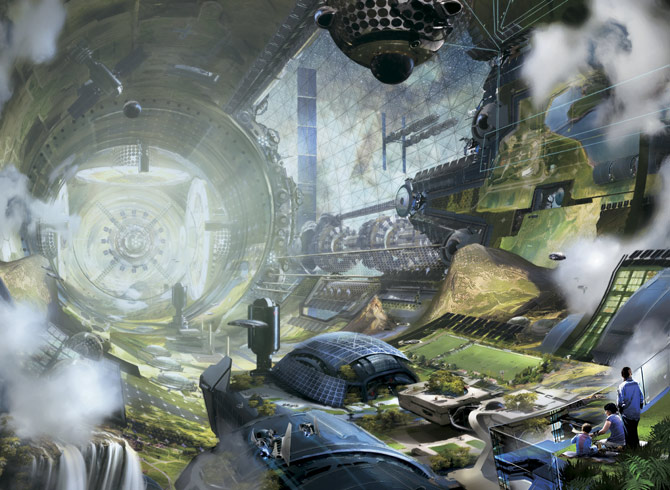
Orion-at-KSC_Ken-KremerThe unmanned test flight – Exploration Flight Test-1 (EFT-1) – is slated to blast off on December 2014, and will send the capsule into space for the first time. This will be NASA’s first chance to observe how well the Orion capsule works in space before it’s sent on its first mission on the Space Launch System (SLS), which is currently under development by NASA and is scheduled to fly no later than 2018.

The Orion is NASA’s first manned spacecraft project to reach test-flight status since the Space Shuttle first flew in the 1980s. It is designed to carry up to six astronauts on deep space missions to Mars and asteroids, either on its own or using a habitat module for missions longer than 21 days. The development process has been a long time in the making, and had more than its share of bumps along the way.

Orion-at-KSC_Ken-Kremer1As Mark Geyer, Orion Program manager, explained:

Nothing about building the first of a brand new space transportation system is easy. But the crew module is undoubtedly the most complex component that will fly in December. The pressure vessel, the heat shield, parachute system, avionics — piecing all of that together into a working spacecraft is an accomplishment. Seeing it fly in three months is going to be amazing.

In addition to going to the Moon and Mars, the Orion spacecraft will carry astronauts on voyages venturing father into deep space than ever before. This will include going to the Asteroid Belt, to Europa (to see if there’s any signs of life there), and even beyond – most likely to Enceladus, Titan, the larger moons of Uranus, and all the other wondrous places in the Solar System.

oriontestflightThe two-orbit, four and a half hour EFT-1 flight will lift the Orion spacecraft and its attached second stage to an orbital altitude of 5,800 km (3,600 miles), about 15 times higher than the International Space Station (ISS) – and farther than any human spacecraft has journeyed in 40 years. It will be an historic occasion, and constitute an important step in what is sure to be known as the Second Space Age.

And be sure to watch this time-lapse video of the Orion Capsule as it is released from the Kennedy Space Center to the Payload Hazardous Servicing Facility in preparation for its first flight:


Sources:
gizmag.com, universetoday.com

News from Mars: Beam Me to Mars

marsIn the latest ambitious plan to make space exploration accessible to the general public, Uwingu has unveiled a new campaign where people can send messages and pictures to the Red Planet. It’s called “Beam Me to Mars”, and the company is inviting people to contribute, for a fee, to a “digital shout-out” that will send messages from Earth to Mars on Nov. 28 — the 50th anniversary of Mars exploration.

The first successful Mars mission, NASA’s Mariner 4 – launched on Nov. 28, 1964 – performed the first flyby of the Red Planet and returned the first pictures of the Martian surface. This was the first time that images were captured of another planet and returned from deep space. and their depiction of a cratered, seemingly dead world largely changed the view of the scientific community on life on Mars.

beam-me-to-mars-uwinguAccording to representative from Uwingu, “Beam Me to Mars” celebrates that landmark effort in a new and original way by inspiring people to get on board with Martian exploration. Other goals include raising lots of money to fund space science, exploration and education (Uwingu’s stated chief purpose) and letting policymakers know how important space exploration is to their constituents.

As CEO Alan Sterm, a planetary scientist and former NASA science chief, said in an interview with Space.com:

We want it to inspire people. There has never been an opportunity before for people of Earth to shout out across the solar system their hopes and wishes for space exploration, for the future of mankind — for any of that… We want to make an impression on leaders. The more messages, the bigger impression it makes. If this thing goes viral, and it becomes the thing to do, then it’ll make a huge impression.

ESO2For $4.95, people can beam their name (or someone else’s) to Mars, whereas $9.95 gets people a chance to beam a name and a 100-character message. $19.95 gets a 1,000-character note instead of the shorter one, and for those willing to spend $99 will be able to send their name, a long message and an image of their choosing. All messages submitted for “Beam Me to Mars” will also be hand-delivered to Congress, NASA and the United Nations.

Submissions must be made via uwingu.com by Nov. 5. And the company – whose name means “sky” in Swahili – and its transmission partner, communications provider Universal Space Network, will use radio telescopes to beam the messages at Mars on Nov. 28 at the rate of 1 million bits per second. The transmission, traveling at the speed of light, will reach the Red Planet on that day in just 15 minutes.

mariner-4-poster-art.enFor comparison, it took Mariner 4 more than seven months to get to Mars a half-century ago. The probe didn’t touch down, but its historic flyby in July 1965 provided the first up-close look at the surface of another planet from deep space. Mariner 4’s observations revealed that Mars is a dry and mostly desolate world, dashing the hopes of those who had viewed it as a world crisscrossed by canals and populated by little green men.

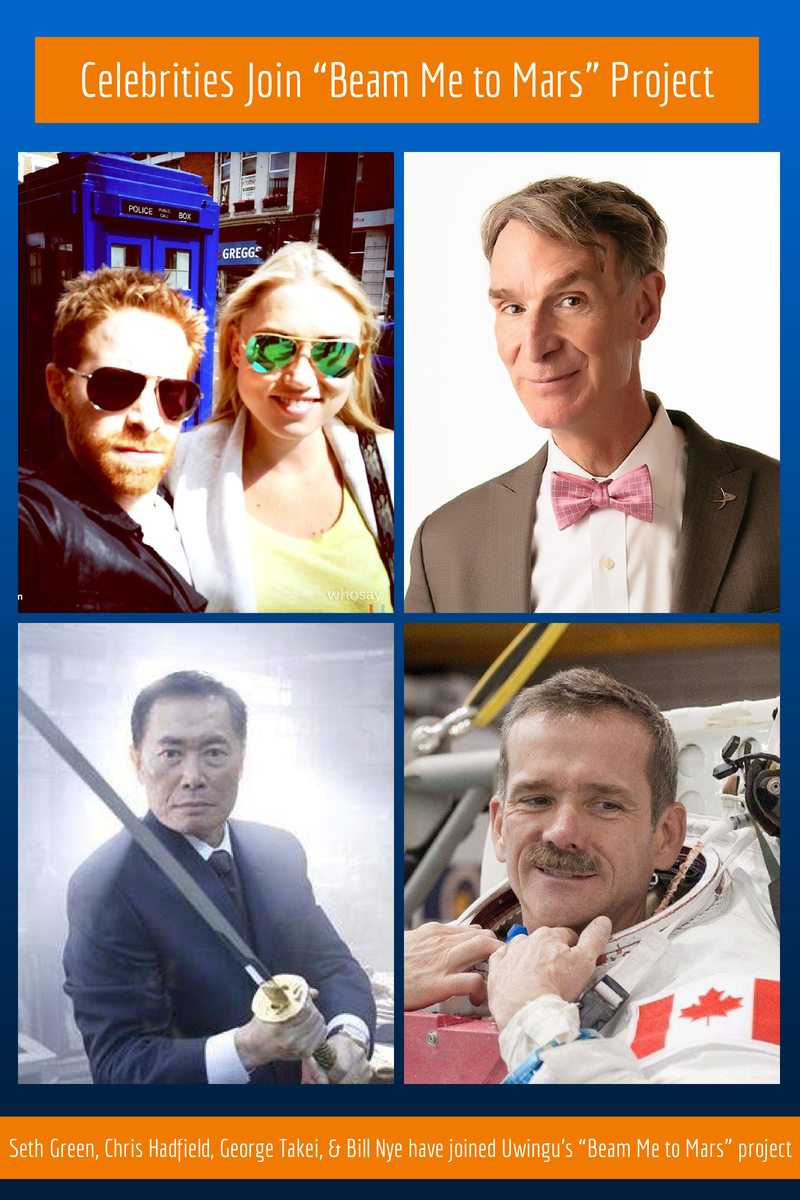
Already, several celebrities have signed on to the campaign, including actors Seth Green and wife Clare Grant, George (“Sulu”) Takei of Star Trek fame and his husband Brad, Bill Nye “The Science Guy”, astronaut and former ISS commander Chris Hadfield, commercial astronaut Richard Garriott, former NASA senior executive Lori Garver, Pulitzer winning author and playwright Dava Sobel, and Author and screenwriter Homer Hickam.

Uwingu-CelebritiesThis is not the first Mars effort for Uwingu, which was founded in 2012. In February, the company launched its “People’s Map of Mars,” asking the public to name Red Planet landmarks for a small fee. To date, people have named more than 12,000 Mars craters, and Uwingu has set aside more than $100,000 for grants. And when it comes to getting the general public involved with space science and travel, they are merely one amongst many. The age of public space exploration is near, people!

Sources: space.com, uwingu.com, (2)

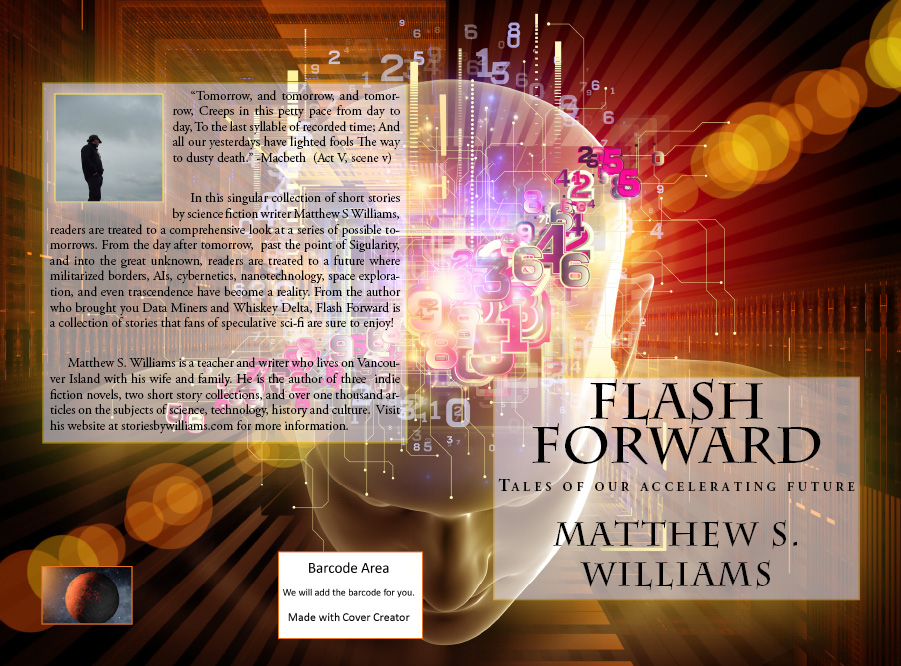
Flash Forward Is Done!

FlashForward_2After many months on the back burner, I finally took a big step while house-sitting for my family this weekend and completed Flash Forward. For those who don’t know, this book is an anthology of short sci-fi stories I did back in April of 2013, with a few additions from both before and after. All told, it works out to 19 short stories, 140 pages, and just over 51,000 words.

For some time, I had been wanting to do some fiction that explored the world of emerging technologies, artificial intelligence, autonomous machines, space exploration and the coming Technological Singularity. And a project involving a short story a day for 26 days was just the excuse I needed. After collecting the resulting stories together, I grouped them into three parts based on common time period and theme.

transhumanismPart I: Transitions deals with the near future, where climate change, militarized borders, and explosive growth in portables, social media, and synthetic foods will have a major effect on life. Part II: Convergence deals with the ensuing decades, where space exploration, artificial intelligence, digital sentience, and extropianism will become the norm and fundamentally alter what it is to live, work, and be human.

And Part III: Infinitum finishes things off, looking to the distant future where the seed of humanity is planted amongst the distant stars and our species passes the existential singularity. It was fun to write, but what I’ve been looking forward to for quite some time is the chance to hold a physical copy. Somehow, that’s always the best moment of the whole creative process for me. Seeing the book in print, as a real, physical thing you can touch and leaf through.

hyperspace4And now if you’ll excuse me, I have a book to edit, a million and one ideas for critical revision to consider, and a whole heap of what Aldous Huxley referred to as “Chronic Remorse” to deal with. Writing, huh? There’s a reason not everybody does it!

More Yuva Artwork!

gliese-581.jpgMore news on the collaborative writing front! A few weeks back, I found myself tinkering with some of the ideas for the upcoming anthology known as Yuva – the one that deals with space exploration and colonization in the not-too-distant future. As a result of this tinkering, I began to look at some of our concept art and began to ponder making some changes…

Basically, in the anthology me and my writer’s group are crafting, there would be multiple waves of settlers arriving at the planet known as Gliese 581 g (aka. Yuva). Whereas the First Wave would be arriving in ships that relied on relativistic engines (slower than the speed of light), subsequent “waves” would be using something a little more advanced.

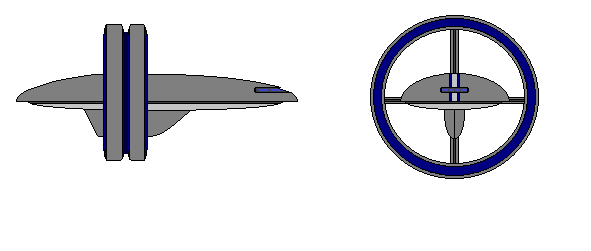
Second WaveHence the design you see above. Here, the ship is one of three that would be bringing the Second Wave to Yuva. Note the torus ring that encloses the ship. This indicates that the vessel comes equipped with an Alcubierre Drive, a proposed FTL system that is currently being investigated by NASA’s Engineering Directorate.

Based on the field equations of theoretical physicist Miquel Alcubierre, the drive does not  exceeding the speed of light within its local frame of reference, but allows a spacecraft to contract space in front of it and expand space behind it, resulting in effective faster-than-light travel.

ixs-enterpriseThe design was inspired in large part by the IXS Enterprise designs by Mark Rademaker, an artist who sought to visualize what a spaceship that relied on the Alcubierre Drive might look like. As you can see, he too pictured a ship that would have a ring-shaped torus, but is more suited to our near-future aspirations of exploration.

For the sake of Yuva, the Second Wave ships need to be especially exotic. Which would mean that the vessels have hulls composed of nanofabricated materials that are completely seamless. And whereas the First Wave ships would rely on antimatter engines that would spew energy out the back, the new ships would have no thruster nozzles to speak of.

space-colony-art-670It’s all in keeping with the idea of rapidly advancing technology, and how the effects of space travel exacerbate the gap between new and obsolete. Whereas the First Wave of colonists would take 100+ plus years to get to a star within our stellar neighborhood, subsequent waves would only need a few years.

This would mean that those who came next would be at least a century ahead in terms of development. And by the 22nd/23rd centuries, when the story is taking place, the leaps and bounds taking place in that amount of time would be immense. New waves of settlers would overwhelm the old with a sense of future shock…

space_elevator2But I’m venturing into spoiler territory here! Rest assured, when the anthology is complete, there’s going to be plenty of these kinds of technological, social and predictive issues being explored. And throughout all that, a sense of high adventure as well. After all, we started this project wanting to capture the awe and wonder that comes from space exploration.

Come hell or high water, that is what we intend to do! Stay tuned for more on this book as it develops…

New Anthology Sample: Arrivals!

http://timedotcom.files.wordpress.com/2014/04/beyond-earth-shuttle.jpg?w=1100Lately, I’ve been getting back to work on the space anthology known as Yuva – and for good reason. Not only has our group been blessed with the arrival of some new blood in recent months, but for many of us (me especially), the inspiration bug has bitten after a long hiatus.

Don’t ask me why, but writing for a different genres can be very temperamental. One minute, you find that all you can write about zombies and apocalyptic scenarios; next minute, its all space ships and futurism. Somebody really needs to put a label on inspiration, one that reads “non-transferable”!

In any case, here is the latest sample from my latest anthology story, “Arrivals”. In this scene, we find one of the main characters (Marcellin Strauss) aboard the ship that will take him and its crew to rendezvous with the Second Migration, a flotilla of ships that are rapidly making their way towards Yuva…

*                    *                    *

The tiny space inside his helmet felt terribly confining. And at the moment, the heads-up display, with all its colored light and constant barrage of information, was not helping. And top of all that, there was the launch clock that was slowly counting down in the lower left corner. At the moment, it was the largest thing in his display field, and impossible to ignore. It’s every tick kept pace with the automated voice coming in from Control, and with the frantic beating of his heart.

Strauss could only breathe and try to remember what he had been told during the past few weeks of crash-course training.

Breath steadily, sit tight, and trust in the instruments.

Not exactly the height of preparation; but at the moment, what else could one do? At this point, the ship pretty much flew itself and all they could do was trust the equipment not to kill them. And considering that Strauss wasn’t even flying the thing, he was left with little to do but wait and try not to panic.

Hartberg’s voice sounded in his ear. “Commencing engine ignition sequence…” He felt a low rumble as the ship’s engine began powering up and preparing to slam hydrogen and anti-hydrogen together in a controlled reaction. “Ignition sequence in five, four, three, two, one…”

They were hit by a hard jolt. Vibrations that were enough to make all the colored lights in his field of view turn into a blurred mess took over. Like everyone else in the cabin, he was thrust into his seat and felt the restraints grab him tighter. And within seconds, they began shooting down the runway.

Hartberg‘s voice spoke again within a few seconds, relaying their progress to Control in an unbelievably calm tone.

“Thrust capacity reaching optimal… acceleration normal… beginning ascent in ten seconds…”

Breath steadily, sit tight… he thought as he continued to be pushed back into the seat.

“Five seconds…”

The runway continued to recede behind them. In the distance, he could see the Great Expanse growing larger as they drew nearer to the coast. And then, he felt the slightest lift as the runway dropped beneath them.

Hartberg‘s reports became faster and closer together now.

“Ascent begun, engine function nominal, orbital velocity in sixty seconds…”
The vibrations subsided a little, so that the readouts in his vision seemed discernible. He could only ascertain so much from them, but the fact that all were in the green was reassuring.

Their acceleration mounted and they continued to climb, and Strauss felt himself being pushed harder back into the seat. It was a funny paradox, how breaking the hold of planet’s gravity meant having to endure additional gravitation stress. It was as if Yuva didn’t want them to leave and was trying to pull them back in.

Trust in the instruments, he told himself. Trust in the pilot.

Up ahead, all he could see now was the deep azure of the sky, the slowly receding clouds, and the faint dots of the distant stars. The engine continued to slam particles together in an ongoing effort to achieve maximum thrust, and his body could feel additional bit of acceleration they achieved.

Beneath the noise of the ship, the voices and the instruments, he could hear a dull moaning. It was coming from him, and growing in intensity. A voice soon sounded in his ear, one of the operators at Control demanding to know his status.

“Control to Eagle One. We’ve got Strauss showing very high levels of epinephrine. Advise on the need for a sedative, over.”

Strauss quickly keyed his comm and replied. “This is Strauss. I’m fine. I’m just fine, over. I’m good, don’t dose me.”

His hurried, panting reply was followed by that of the Captain’s, who was sure to use all the proper comm protocol.

“Control, this is Eagle One Actual. That’s a negative on a sedative, over.”

“Roger that, Eagle One.”

There was a slight pause, during which time Strauss stopped making noise and tried to catch his breath. The Captain came back on and tried to talk him down.

“That’s it, Strauss. Just keep breathing. We’re almost there.”

Strauss heard him and felt somewhat reassured. He kept breathing and kept his eyes ahead, focusing on the distant stars. These were much more calming than all the readouts that continued to frantically tick away, showing their speed, engine pressure, altitude, and anything else that was rapidly changing. In time, the sky began to change color. A flare of orange light flickered through the cabin as their sun’s light hit them for the first time without refraction. And very quickly, the distant stars began to burn much brighter.

That’s when Strauss noticed everything change…

The cabin ceased vibrating, the numbers in his field of view began to drop off, and he no longer felt himself being thrust back into his seat. In fact, he now felt the restraints tugging against him to keep him from floating away.

They had done it. They had broken atmo, and were now floating in high orbit above the planet. Hartberg’s voice came back on the line to announce this.

“Control, this is Eagle One. We have broken atmo. I repeat, we have broken atmo, over.”

There was a pause as Strauss was sure the people at Control were howling out in celebration. Just about everyone in the cabin was doing the same. Meanwhile, he licked his lips and tried to get his heart and breathing under control. He could feel his head beginning to spin as his blood pressure dropped and his adrenals took a break. He also became aware of an incredibly dry feeling in his mouth.

All of this made him painfully aware of how sober he was right now, and how much he wished it weren’t so.

Man I picked a bad time to stop drinking!