News From Space: The Antares Rocket Launch!

antares_launch1Commercial space flight got a shot in the arm just two days ago thanks to the flawless launch of the privately developed Antares rocket from the NASA Wallops Flight Facility in Virginia. On board was the first of many Cygnus craft, a commercial unmanned cargo resupply vehicle that is now making its way to the ISS in orbit. It was a day of firsts, and signaled the beginning of a new space race.

For starters, it was the first time the launchpad in Virginia was used, not to mention the maiden flight of a Cygnus craft. But perhaps most importantly, it was the first time in a long time that supplies and equipment were bound for the International Space Station from American soil. Since its cancellation in 2011, NASA’s space program has been forced to rely on the Russians and an aging fleet of Soyuz rockets to send astronauts and supplies into orbit.

spaceX_elonmuskAnd, as already noted, it was a big day for commercial space flight, since both the Antares and the Cygnus were produced by the Orbital Sciences Corporation. For some time now, SpaceX has been leading the charge to develop rockets and spacecraft for private commercial use. Now, with NASA awarding OSC contracts to restore America’s ability to mount resupply missions, it seems they might have some competition.

The “picture perfect” blastoff took place at 10:58 a.m. EDT on the morning  of Sept. 18 from Virginia and was witnessed by a large crowd of spectators. The launch was reported as being incredibly beautiful as the rockets two stage engines spewed intensely bright flames and send out reverberations that wowed the people watching and woke people who were still asleep in the nearby community of Chincoteague.

antares_deploymentAnother historic first that bears mentioning is the fact that this latest mission happens to be the heaviest cargo load ever delivered to the ISS by a commercial vehicle. And by awarding contracts for such missions to private companies, NASA hopes to be able to free more of its budget up for long-term missions. These include exploration beyond low earth orbit, getting people back to the Moon and beyond to deep space destinations including Asteroids and Mars.

NASA Administrator Charles Bolden spoke glowingly of the launch in a statement and praised OSC for their role in making it happen:

Today marks a milestone in our new era of exploration as we expand the capability for making cargo launches to the International Space Station from American shores.  Orbital’s extraordinary efforts are helping us fulfill the promise of American innovation to maintain our nation’s leadership in space.

According to ongoing mission updates, the Cygnus spacecraft successfully unfurled its solar panels starting 1.5 minutes after separation from the second stage, which took place about 10 minutes after launch. Currently, Cygnus is traveling at 28,000 km/h (17,500 mph) and will rendezvous with the space station on Sunday, Sept. 22.

antares_launch2Once there, the cargo vessel will deliver about 590 kilograms (1,300 pounds) of cargo, including food, clothing, water, science experiments, spare parts and gear to the Expedition 37 crew. The flight, known as Orb-D1 is a demonstration mission to prove that Cygnus can conduct a complex series of maneuvers in space safely bringing it to the vicinity of the ISS.

And once the mission is complete and the supplies delivered, we can expect to be hearing about more missions like this one! Between SpaceX’s Dragon module, the Cygnus, and both companies ongoing rocket tests, space will is likely to become the new frontier where private enterprises carry out their endless dance of competition.

And of course, there are some cool videos of the launch to behold. So behold!

Time-lapse video of Antares deployment:


Antares launch:


Sources:
universetoday.com, (2)
News From Space: IAU Revises Stance on Naming Planets

alien-worldGood news everyone! According to the International Astronomic Union, the public can now participate in the naming of new exoplanets. What’s more, they can be popular names like kinds found in science fiction, assuming they are appropriate and the public is behind it. This represents a big change in terms of IAU policy, which previously reserved the right to give names to newly discovered bodies outside of our Solar System.

As recently as late March, 2013, the IAU’s official word on naming exoplanets was, “the IAU sees no need and has no plan to assign names to these objects at the present stage of our knowledge.” Their rationale was since there is seemingly going to be so many exoplanets, it will be difficult to name them all.

IAU_exosBut then, on March 24th, the IAU added on their website:

…the IAU greatly appreciates and wishes to acknowledge the increasing interest from the general public in being more closely involved in the discovery and understanding of our Universe. As a result in 2013 the IAU Commission 53 Extrasolar Planets and other IAU members will be consulted on the topic of having popular names for exoplanets, and the results will be made public on the IAU website.

This new decision follows from an event earlier this year where the SETI Institute and the space company Uwingu organized their own campaigns for creating popular names of objects in space. Both events were wildly popular with the general public, but generated some controversy. For one, the IAU issued a statement regarding the contests saying that while they welcomed the public’s interest, the IAU has the last word.

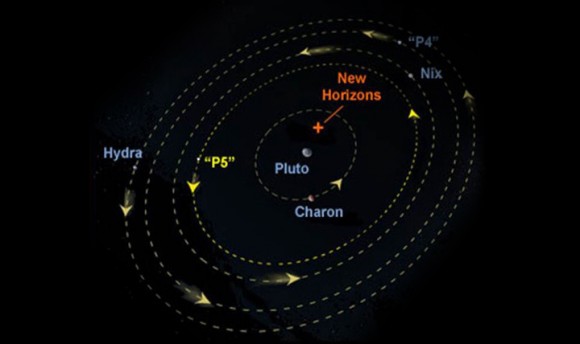
Pluto-System_720-580x344For example, the SETI institute’s contest, “Space Rocks”, was intended to name two newly discovered moons around Pluto. Though the name “Vulcan” was the top contender for one of them, and even got a nod from William Shatner, the IAU overruled their decision and went with the name “Styx” instead. Additionally, the IAU took issue with the “selling” of names, referring to the fact that Uwingu charged a fee to take part in their contest.

However, given public interest in the process and the fact that other bodies might begin privatizing the process, the IAU has altered its position on these matters and opened up the naming process to the public. The new rules, which were passed this summer, now allow individuals to suggest names of exoplanets and planetary satellites (moons) via email to the IAU.

gliese-581.jpgThose looking to make a contribution to naming newly discovered planets and moons are asked to abide by the following criteria:

  1. Prior to any public naming initiative the IAU should be contacted from the start by Letter of Intent sent to the IAU General Secretary
  2. The process should be submitted in the form of a proposal to the IAU by an organization
  3. The organization should list its legal or official representatives and its goals, and explain the reasons for initiating the process for naming a particular object or set of objects
  4. The process cannot request nor make reference to any revenues, for whatever purpose
  5. The process must guarantee a wide international participation
  6. The public names proposed (whether by individuals or in a naming campaign) should follow the naming rules and restrictions adopted for Minor Bodies of the Solar System, by the IAU and by the Minor Planet Center.

Among other rules cited in their new policy are that proposed names should be 16 characters or less in length, pronounceable in as many languages as possible, non-offensive in any language or culture, and that names of individuals, places or events principally known for political or military activities are unsuitable. Also, the names must have the formal agreement of the discoverers.

KeplerThis about face has its share of supporters and critics alike. Whereas people who support it generally see it as a sign that we are entering into an era of open and democratic space exploration. the critics tend to stress the contradictions and ambiguities in the new policy. Whereas the IAU previously claimed it had the final word on the naming process, their new stance appears to indicate that this is no longer the case.

In addition, companies like Uwingu are now free to participate in the naming of planetary bodies, which means that their contest to name Pluto’s moon “Vulcan” would now be legitimate under the new framework. Many people, such as astronomer and Uwingu CEO Alan Stern, are wondering if the new rules will apply retroactively since they were previously forbidden from having any input.

kepler22b.jpgAs for me, this puts me in mind of my own attempts to name real or fictitious exoplanets. Sadly, since it this was done for the sake of writing fiction, they would have no legal standing, but the process was still fun and got me thinking… If we are to begin exploring and colonizing planets outside of our Solar System, how will we go about naming them?

Now it seems there is a process in place for just such a thing, one which will assign actual names instead of bland designations. And it appears that this process will be a trade off between scientific organizations and public input, either through campaigns or contests. And I imagine once we start breaking ground on new worlds, settlers and shareholders will have a thing or two to say as well!

Planet Microsoft… Planet Starbucks… Planet Walmart… I shudder to think!

Sources: universetoday.com, uwingu.com. phl.upr.edu

Timeline of the Future…

hyperspace4I love to study this thing we call “the future”, and began to do so as a hobby the day I made the decision to become a sci-fi writer. And if there’s anything I’ve learned, its that the future is an intangible thing, a slippery beast we try to catch by the tail at any given moment that is constantly receding before us. And when predict it, we are saying more about the time in which we are living than anything that has yet to occur.

As William Gibson famously said: “…science fiction was always about the period in which it was written.” At every juncture in our history, what we perceive as being the future changes based on what’s going on at the time. And always, people love to bring up what has been predicted in the past and either fault or reward the authors for either “getting it right” or missing the mark.

BrightFutureThis would probably leave many people wondering what the point of it all is. Why not just wait and let the future tend to itself? Because it’s fun, that’s why! And as a science fiction writer, its an indispensable exercise. Hell, I’d argue its absolutely essential to society as a whole. As a friend of one once said, “science fiction is more of a vehicle than a genre.” The point is to make observations about society, life, history, and the rest.

And sometimes, just sometimes, predictive writers get it right. And lately, I’ve been inspired by sources like Future Timeline to take a look at the kinds of predictions I began making when I started writing and revising them. Not only have times changed and forced me to revise my own predictions, but my research into what makes humanity tick and what we’re up to has come a long way.

So here’s my own prediction tree, looking at the next few centuries and whats likely to happen…

21st Century:

2013-2050:

  • Ongoing recession in world economy, the United States ceases to be the greatest economic power
  • China, India, Russia and Brazil boast highest rates of growth despite continued rates of poverty
  • Oil prices spike due to disappearance of peak oil and costs of extracting tar sands
  • Solar power, wind, tidal power growing in use, slowly replacing fossil fuel and coal
  • First arcologies finished in China, Japan, Russia, India and the United States

arcology_lillypad

  • Humanity begins colonizing the Moon and mounts manned mission to Mars
  • Settlements constructed using native soil and 3D printing/sintering technology
  • NASA tows asteroid to near Earth and begins studies, leading to plans for asteroid mining
  • Population grows to 9 billion, with over 6 living in major cities across the all five continents
  • Climate Change leading to extensive drought and famine, as well as coastal storms, flooding and fires
  • Cybernetics, nanotech and biotech leading to the elimination of disabilities
  • 3D Construction and Computer-Assisted Design create inexpensive housing in developing world

europa_report

  • First exploratory mission to Europa mounted, discovers proof of basic life forms under the surface ice
  • Rome ordains first openly homosexual priests, an extremely controversial move that splits the church
  • First semi-sentient, Turing compatible AI’s are produced and put into service
  • Thin, transparent, flexible medical patches leading to age of “digital medicine”
  • Religious orders formed opposed to “augmentation”, “transhumanism” and androids
  • First true quantum computers roll off the assembly line

quantum-teleportation-star-trails-canary-islands-1-640x353

  • Creation of the worldwide quantum internet underway
  • Quantum cryptography leads to increased security, spamming and hacking begins to drop
  • Flexible, transparent smartphones, PDAs and tablets become the norm
  • Fully immersive VR environments now available for recreational, commercial and educational use
  • Carbon dioxide in the upper atmosphere passes 600 ppm, efforts to curb emissions are redoubled
  • ISS is retired, replaced by multiple space stations servicing space shuttles and commercial firms
  • World’s first orbital colony created with a population of 400 people

2050-2100:

  • Global economy enters “Second Renaissance” as AI, nanomachinery, quantum computing, and clean energy lead to explosion in construction and development
  • Commercial space travel become a major growth industry with regular trips to the Moon
  • Implant technology removes the need for digital devices, technology now embeddable
  • Medical implants leading to elimination of neurological disorders and injuries
  • Synthetic food becoming the rage, 3D printers offering balanced nutrition with sustainability

3dfood2

  • Canada, Russia, Argentina, and Brazil become leading exporters of foodstuffs, fresh water and natural gas
  • Colonies on the Moon and Mars expand, new settlement missions plotted to Ganymede, Europa, Oberon and Titan
  • Quantum internet expanding into space with quantum satellites, allowing off-world connectivity to worldwide web
  • Self-sufficient buildings with water recycling, carbon capture and clean energy becomes the norm in all major cities
  • Second and third generation “Martians” and “Loonies” are born, giving rise to colonial identity

asteroid_foundry

  • Asteroid Belt becomes greatest source of minerals, robotic foundries use sintering to create manufactured products
  • Europe experiences record number of cold winters due to disruption of the Gulf Stream
  • Missions mounted to extra-Solar systems using telexploration probes and space penetrators
  • Average life expectancy now exceeds 100, healthy children expected to live to 120 years of age
  • NASA, ESA, CNSA, RFSA, and ISRO begin mounting missions to exoplanets using robot ships and antimatter engines
  • Private missions to exoplanets with cryogenically frozen volunteers and crowdfunded spaceships

daedalus_starship_630px

  • Severe refugee crises take place in South America, Southern Europe and South-East Asia
  • Militarized borders and sea lanes trigger multiple humanitarian crises
  • India and Pakistan go to war over Indus River as food shortages mount
  • China clamps down on separatists in western provinces of Xinjian and Tibet to protect source of the Yangtze and Yellow River
  • Biotechnology begins to grow, firms using bacteria to assemble structural materials

geminoid

  • Fully sentient AIs created and integrated into all aspects of life
  • Traditionalist communities form, people seeking to disconnect from modern world and eschew enhancement
  • Digital constructs become available, making neurological downloads available
  • Nanotech research leading to machinery and materials assembled at the atomic level
  • Traditional classrooms giving way to “virtual classrooms”, on-demand education by AI instructors
  • Medical science, augmentation, pharmaceuticals and uploads lead to the first generation of human “Immortals”

space_debris

  • Orbital colonies gives way to Orbital Nexus, with hundreds of habitats being established
  • Global population surpasses 12 billion despite widespread famine and displacement
  • Solar, wind, tidal, and fusion power replace oil and coal as the dominant power source worldwide
  • Census data shows half of world residents now have implants or augmentation of some kind
  • Research into the Alcubierre Drive begins to bear experimental results

alcubierre-warp-drive-overview22nd Century:

2100-2150:

  • Climate Change and global population begin to level off
  • First “Neural Collective” created, volunteers upload their thought patterns into matrix with others
  • Transhumanism becomes established religion, espousing the concept of transcendence
  • Widespread use of implants and augmentation leads to creation of new underclass called “organics”
  • Solar power industry in the Middle East and North Africa leading to growth in local economies
  • Biotech leads to growth of “glucose economy”, South American and Sub-Saharan economies leading in manufacture of biomaterials
  • Population in Solar Colonies and Orbital Nexus reaches 100,000 and continues to grow

asteroid_belt1

  • Off-world industry continues to grow as Asteroid Belt and colonies provide the majority of Earth’s mineral needs
  • Famine now widespread on all five continents, internalized food production in urban spaces continues
  • UN gives way to UNE, United Nations of Earth, which has near-universal representation
  • First test of Alcubierre FTL Drive successful, missions to neighboring systems planned
  • Tensions begin to mount in Solar Colonies as pressure mounts to produce more agricultural goods
  • Extinction rate of wild animals begins to drop off, efforts at ecological restoration continue
  • First attempts to creating world religion are mounted, met with limited success

networked_minds

  • Governments in most developed countries transitioning to “democratic anarchy”
  • Political process and involvement becoming digitized as representation becomes obsolete
  • “Super-sentience” emerges as people merge their neural patterns with each other or AIs
  • Law reformed to recognize neural constructs and AIs as individuals, entitled to legal rights
  • Biotech research merges with AI and nanotech to create first organic buildings with integrated intelligence

2150-2200:

  • Majority of the world’s population live in arcologies and self-sufficient environments
  • Census reveals over three quarters of world lives with implants or augmentation of some kind
  • Population of Orbital Nexus, off-world settlements surpasses 1 million
  • First traditionalist mission goes into space, seeking world insulated from rapid change and development
  • Labor tensions and off-world riots lead to creation of Solar policing force with mandate to “keep the peace”

Vladivostok-class_Frigate

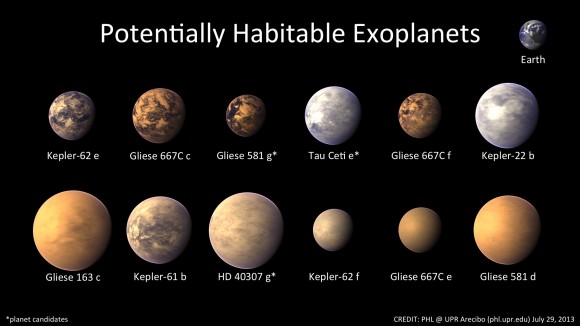
  • First mission to extra=Solar planets arrive, robots begin surveying surface of Gliese 581 g, Gliese 667C c, HD 85512 b, HD 40307 g, Gliese 163 c, Tau Ceti e, Tau Ceti f
  • Deep space missions planned and executed with Alcubierre Drive to distant worlds
  • 1st Wave using relativistic engines and 2nd Wave using Alcubierre Drives meet up and begin colonizing exoplanets
  • Neighboring star systems within 25 light years begin to be explored
  • Terraforming begins on Mars, Venus and Europa using programmed strains of bacteria, nanobots, robots and satellites
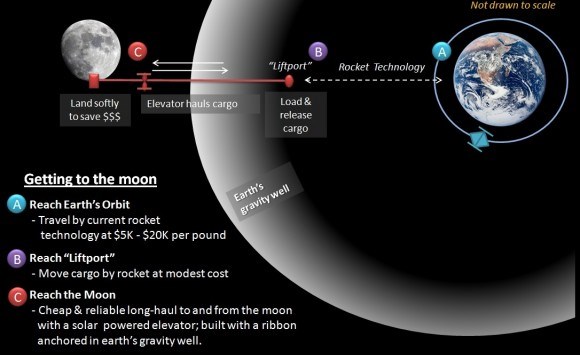
  • Space Elevator and Slingatron built on the Moon, used to transport people to space and send goods to the surface

space_elevator_lunar1

  • Earth’s ecology begins to recover
  • Natural species are reintroduced through cloning and habitat recovery
  • Last reported famine on record, food production begins to move beyond urban farms
  • Colonies within 50 light years are established on Gliese 163 c, Gliese 581 g, Gliese 667C c, HD 85512 b, HD 40307 g, Tau Ceti e, Tau Ceti f
  • Off-world population reaches 5 million and continues to grow
  • Tensions between Earth and Solar Colonies continue, lead to demands for interplanetary governing body
  • Living, breathing cities become the norm on all settled worlds, entire communities build of integrated organic materials run by AIs and maintained by programmed DNA and machinery

self-aware-colony

23rd Century and Beyond:

Who the hell knows?

*Note: Predictions and dates are subject to revision based on ongoing developments and the author’s imagination. Not to be taken literally, and definitely open to input and suggestions.

News From Space: Walk on Mars with VR

oculus-rift-omni-treadmill-mars-nasa-640x353Virtual Reality, which was once the stuff of a cyberpunk wet dream, has grown somewhat stagnant in recent years. Large, bulky headsets, heavy cables, and graphics which were low definition and two-dimensional just didn’t seem to capture the essence of the concept. However, thanks to the Oculus Rift, the technology known as Virtual Reality has been getting a new lease on life.

Though it is still in the development phase, the makers of the Oculus Rift has mounted some impressive demos. Though still somewhat limited – using it with a mouse is counter-intuitive, and using it with a keyboard prevents using your body to scan virtual environments –  the potential is certainly there and the only question at this point is how to expand on it and give users the ability to do more.

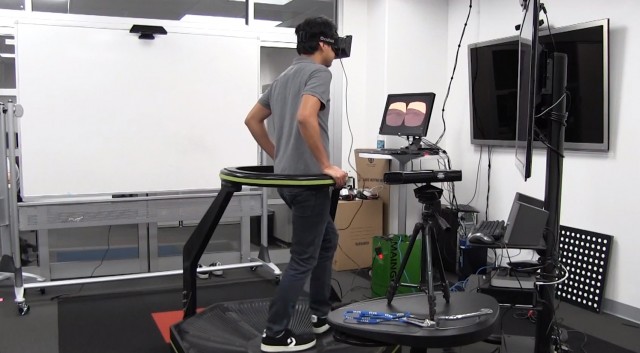
Oculus-RiftOne group that is determined to explore its uses is NASA, who used it in combination  with an Omni treadmill to simulate walking on Mars. Already, the combination of these two technologies has allowed gamers to do some pretty impressive things, like pretend they are in an immersive environment, move, and interact with it (mainly shooting and blowing things up), which is what VR is meant to allow.

NASA’s Jet Propulsion Laboratory, however, went a step beyond this by combining the Omni and a stereoscopic 360-degree panorama of Mars to create a walking-on-Mars simulator. The NASA JPL team was able to give depth to the image so users could walk around an image of the Martian landscape. This is perhaps the closest normal folks will ever get to walking around on a “real” alien planet.

omni_treadmillAlong with the Martian terrain, JPL created a demo wherein the user could wander around the International Space Station. The JPL team also found that for all the sophisticated imagery beamed back to Earth, it is no substitute for being immersed in an environment. Using a rig similar to the Rift and Omni could help researchers better orient themselves with alien terrain, thus being able to better plan missions and experiments.

Looking to the long run, this kind of technology could be a means for creating “telexploration” (or Immersive Space Exploration) – a process where astronauts would be able to explore alien environments by connecting to rover’s or satellites camera feed and controlling their movements. In a way that is similar to teleconferencing, people would be able to conduct true research on an alien environment while feeling like they were actually in there.

mars-180-degrees-panorama_croppedAlready, scientists at the Mars Science Laboratory have been doing just that with Curiosity and Opportunity, but the potential to bring this immersive experience to others is something many NASA and other space scientists want to see in the near future. What’s more, it is a cheap alternative to actually sending manned mission to other planets and star systems.

By simply beaming images back and allowing users to remotely control the robotic platform that is sending them, the best of both worlds can be had at a fraction of the cost. Whats more, it will allow people other than astronauts to witness and feel involved in the process of exploration, something that social media and live broadcasts from space is already allowing.

As usual, it seems that the age of open and democratic space travel is on its way, my friends. And as usual, there’s a video clip of the Oculus Rift and the Omni treadmill bringing a walk on Mars to life. Check it out:


Sources:
extremetech.com, engadget.com

New Movie Trailer: Europa Report

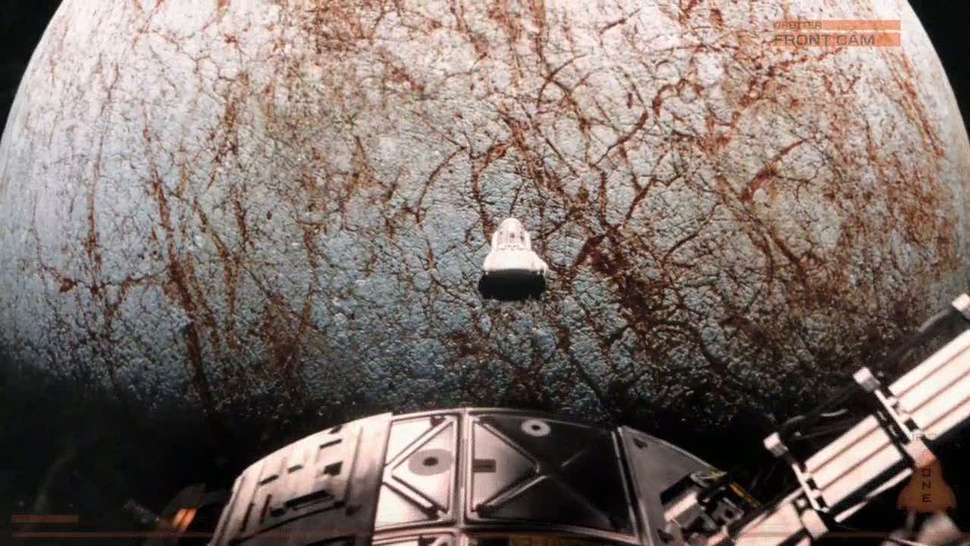
europa_reportOrdinarily, I like to show movie previews before the movie has been released. This time around, I’m a little behind the curve. But my thanks to Rami for bringing this movie to my attention, since it seems like just the thing for us sci-fi geeks and buffs. It’s called the Europa Report, a near-future speculative science fiction film that follows in the vein of the 2001: A Space Odyssey and the Blair Witch Project.

Taking place in 2061, the story follows a group of astronauts who are sent on a private venture to Jupiter’s moon of Europa to investigate it for signs of life. Naturally, things go wrong, lives are lost, and the footage of their mission becomes the basis of a “report” that people back at Earth pour over, hoping to find some answers to the mystery of what happened.

The film was officially released just under two weeks ago, on August 2nd, and has received some pretty kick-ass reviews. Over at space.com, they claimed the movie was “One of the most thrilling and realistic depictions of space exploration since Moon or 2001: A Space Odyssey”, while IO9’s Annalee Newitz wrote of the film:

The representations of Jupiter and Europa in this film come directly from real satellite imagery gathered by NASA, and the journey to Europa itself is both realistic and gorgeous. There’s a lesson here about how dramatic tension and brilliant concept design, even on an indie budget, can create a sense of wonder rivaling that of a VFX blockbuster. And the payoff at the end is electrifying.

Hot damn, that’s a good endorsement! As for me, and I imagine Rami, I plan to see it and offer a review of my own! A movie like this couldn’t be more timely. Already, long-term plans are being made to send a lander or a space penetrator to Europa to have a gander at what lies beneath its icy veil. And I look forward to the day when the reality of that planet and all the speculative fiction can get together and compare notes!

Source: IO9.com

News from SpaceX: More Tests and the Coming Launch

spaceX_elonmuskElon Musk just can’t get enough of the spotlight lately! But that’s the price you pay for being a billionaire, innovator, genius-type person! And barely a week after announcing his idea for the Hyperloop high-speed train, it now seems that SpaceX is once again making the news, thanks to its latest test of the Grasshopper reusable rocket system as well as their planned launch of the Falcon Heavy rocket.

For those unfamiliar with the Grasshopper, this is a proposed reusable rocket system that Musk and SpaceX created with the hopes of bringing the costs associated with space launches down considerably. Since September 2012, the rocket has been put through successive tests, reaching higher and higher altitudes and safely making it back to the ground.

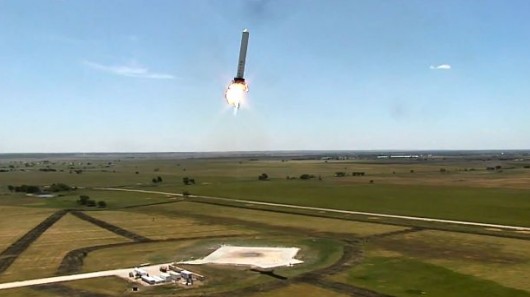
grasshopper_lateraldivertIn this latest test, the rocket successfully performed a “lateral divert test”. In all previous tests, the rocket lifted off vertically from a launch pad and then used its Merlin-1D engine to ease itself back down to the pad. However, in actual launch situations, the rocket wont simply be traveling up and down. When it comes time to land, a considerable amount of lateral steering will be necessary to line it back up with the launch site.

This is what the test, which took place on Tuesday, August 13th, amounted to. It began with the Grasshopper reaching its previously-achieved altitude of 250 meters, but then continued with the rocket moving an additional 100 m (328 ft) to one side. It was subsequently still able to land safely back at the center of the launch pad, compensating for its lateral diversion.

According to SpaceX: “The test demonstrated the vehicle’s ability to perform more aggressive steering maneuvers than have been attempted in previous flights.” What’s more, it places the company that much closer to the realization of a truly reusable rocket system, something which will drastically cut costs for future space missions.

And of course, they were sure to catch the entire test on video:


But equally important for this rising company that seeks to privatize space travel was the announcement that they have are moving ahead with plans to launch their Falcon Heavy rocket system by late 2013 or early 2014. At present, the Falcon is the most power rocket system in the world, overshadowed only by the now retired – but soon to be reserviced – Saturn V booster that put the Apollo astronauts into space and on the Moon.

spaceX-falcon9As Musk himself said of the rocket:

Falcon Heavy will carry more payload to orbit or escape velocity than any vehicle in history, apart from the Saturn V moon rocket, which was decommissioned after the Apollo program. This opens a new world of capability for both government and commercial space missions.

Fully loaded, the Falcon Heavy will be able to carry payloads of 53 metric tons (117,000 pounds or 53,070 kg) into orbit, and is made up of two engine stages. The first stage consists of a Falcon 9 rocket, with a nine-engine cores, followed by two additional nine-engine cores attached to either side. In addition, the Merlin engines have been upgraded to handle the additional weight, and are being tested at SpaceX’s facility in McGregor, Texas.

flacon-heavy-3At liftoff the 69.2m (227 ft) long Falcon Heavy will generate 3.8 million pounds of thrust, which is equivalent to the thrust of fifteen Boeing 747’s taking off at the same time. SpaceX claims that this gives the Falcon Heavy more than twice the performance of the next most powerful vehicle – the Delta IV Heavy operated by the Boeing-Lockheed Martin joint venture United Launch Alliance.

SpaceX also says that with more than twice the payload of the Delta IV but at one third the cost, the Falcon Heavy sets a new world record in terms of economy at approximately US$1,000 per pound to orbit. This is in keeping with Musk’s promise to bring the associated costs of space travel and exploration down, hopefully one day to his goal of $500 per pound.


spaceX_solararrayWith the ability to carry satellites or interplanetary spacecraft to orbit, SpaceX is offering the Falcon Heavy on the commercial market for US$80–$125 million, which compares to the $435 million per launch the U.S. Air Force has budgeted for four launches in 2012. So in effect, Musk’s company is offering a money-saving alternative to both the public and private sector.

For those fascinated by the long-term potential of space travel, this is certainly exciting news. By cutting the costs of placing satellites, supplies and people in orbit, many things are being made feasible that were previously impossible. This includes conducting more research in orbit, the ability to create space-based solar arrays (a very cool solution to our current power problems and the limitations of Earth-based solar power) and perhaps even begin work on a Moon settlement.

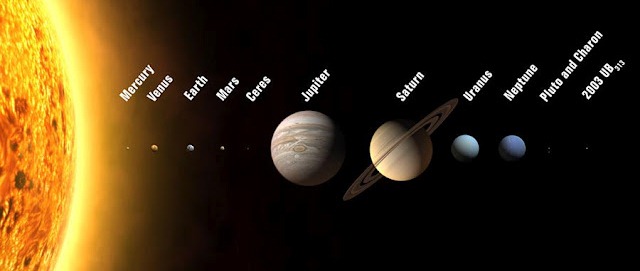
solar_system1Beyond that, there are the growing possibilities of commercial space travel, space tourism, and even setting our sights father afield with manned missions to the Moon, prospecting missions to the asteroid belt, and surveying probes to Jupiter’s Moons and to the very edge of the Solar System. Possibly even beyond…

Exciting times we live in, when the impossible is slowly becoming possible!

Sources: gizmag.com, (2), spacex.com


News from Space: The Slingatron

slingatronPlacing things into orbit is something humanity has been doing since the 1940’s, beginning with Germany’s V2 Rockets, then giving way to artificial satellites like Sputnik in the 1950’s. These efforts really came into their own during the 1960’s and since, when manned missions reached high orbit and even the Moon. But despite all these  milestones, little has been done to address the problems of cost.

Ever since space travel began in earnest, the only way to send satellites, supplies and shuttle craft into orbit has been with rockets. Even at its cheapest, a space launch can still cost an estimated $2000 per pound per mission, due to the fact that the rockets employed are either destroyed or rendered unusable once they’ve completed their mission.

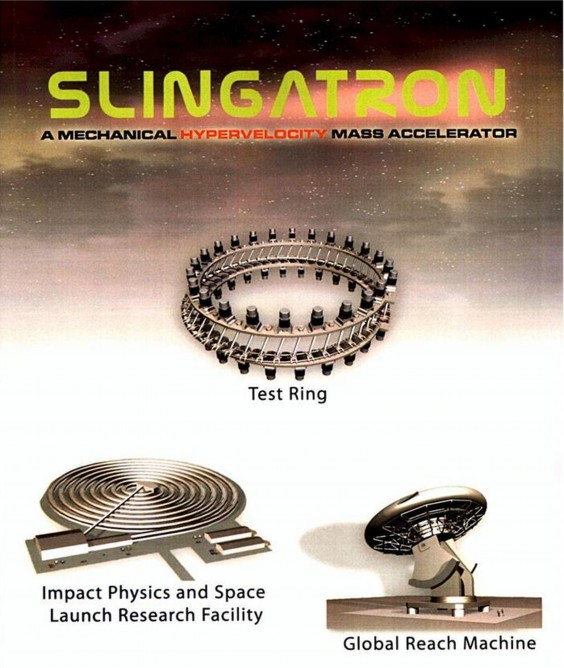
slingatron-20Attempts to create reusable launch systems, like the SpaceX Grasshopper, is one solution. But another involves “slinging” payloads into orbit, rather than launching them. That’s what HyperV Technologies Corp. of Chantilly, Virginia is hoping to achieve with their design for a “mechanical hypervelocity mass accelerator”, otherwise known as a “slingatron”.

Invented by Derek Tidman in the 1990s, the slingatron replaces rockets with a more sophisticated version of the sling. However, the principle differs somewhat in that the device uses something far more sophisticated than circumferential force. In the end, the name cyclotron might be more apt, which is a very simple particle accelerator.


slingatron-11Utilizing a vacuum tube and a series of magnetic/electostatic plates of opposing charges, an atomic particle (such as a proton) is introduced and sent back and forth as the polarity of the plates are flipped. As the frequency of the flipping is increased, the proton moved faster and faster in a series of spirals until it reaches the rim and shoots out a window at extremely high velocity.

The slingatron achieves the same result, but instead uses a spiral tube which gyrate on a series of flywheels along its length. As the slingatron gyrates, a projectile is introduced and the centripetal force pulls the projectile along. As the projectile slides through larger and larger turns of the spiral, the centripetal forces increase until the projectile shoots out the muzzle, traveling at several kilometers per second.

slingatron-13Ultimately, the goal here is to build a slingatron big enough to fire a projectile at velocities exceeding 7 km/s (25,000 km/h, 15,600 mph) to put it into orbit. With rapid turnarounds and thousands of launches per year while all of the launch system remains on Earth, the developers claim that the slingatron will offer lower costs for getting payloads into orbit.

However, there are weaknesses to this idea as well. For starters, any projectile going into space will also need to be fitted a small set of rockets for final orbit insertion and corrections. In addition, the G-forces involved in such launches would be tremendous – up to 60,000 times the force of gravity – which means it would be useless for sending up manned missions.

slingatron-15In the end, only the most solid state and hardened of satellites would have a chance of survival. The developers say that a larger slingatron would reduce the forces, but even with a reduction by a factor of 10,000, it would still be restricted to very robust cargoes. This makes it an attractive options for sending supplies into space, but not much else.

Still, given the costs associated with keeping the ISS supplied, and ensuring that future settlements in space have all the goods and equipment they need, a series of slingatrons may be a very viable solution in the not-to-distant future. Combined with concepts like the space penetrator, which fired bullet-like spaceships into space, the cost associated with space travel may be dropping substantially in coming decades.

All of this could add up to a great deal more space traffic coming to and from Earth in the not-too-distant future as well. I hope we have the foresight to construct some “space lanes” and keep them open! And in the meantime, enjoy this video interview of Dr. F. Douglas Witherspoon explaining the concept of the slingatron:

Source: gizmag.com

Apocalypse News: Sun’s Magnetive Field about to Flip

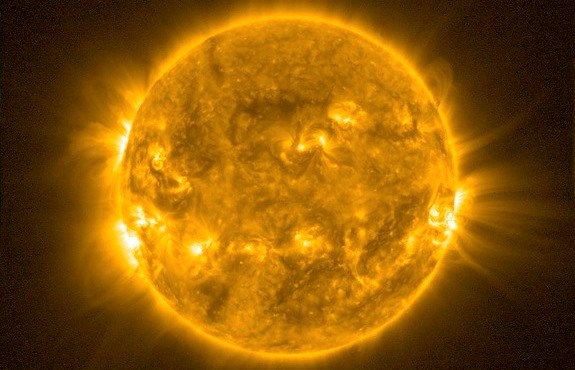
sun_magneticfieldThe sun is set to reverse its polarity in the next few months, something that occurs at the height of every Solar Cycle. The resulting ripple effect will be felt all across the Solar System and will even be detectable by the far-away Voyager probes. However, scientists are telling us not to fret, as this event will not lead to the end of the world.

In truth, the Sun’s reversal of polarity is something that occurs every 11 years. And the shift won’t spark an increase in powerful solar storms or other events that could have a damaging effect on Earth and its inhabitants, say the researchers. One such researcher is Phil Scherrer, a solar physicist at Stanford University, who insisted “The world will not end tomorrow.”

NASAsolar_radiationIn addition, from a human perspective, the effects of the field shift will likely be slight and even beneficial. For example, the polarity reversal will cause the “current sheet” – an enormous surface extending out from the solar equator on which the sun’s rotating magnetic field has induced an electric current – to become much wavier.

This crinkled current sheet, in turn, will provide a better barrier against galactic cosmic rays, high-energy particles that are accelerated to nearly the speed of light by faraway star explosions. Galactic cosmic rays can damage spacecraft and hurt orbiting astronauts who don’t get to enjoy the protection of Earth’s thick atmosphere. So for space exploration, at any rate, this is certainly good news.

Sun's Heliospheric-current-sheetAccording to Todd Hoeksema, director of Stanford’s Wilcox Observatory, a drop in galactic cosmic ray levels could also have a subtle impact on weather here on Earth.

One of the things that helps clouds form and lightning to flash is cosmic-ray ionization of things in the Earth’s atmosphere. So when the cosmic-ray intensity is lower, it means you have fewer places where lightning will occur, and so the storms will probably be a little less intense.

He added, however, that it’s pretty much a speculative endeavor at this point, as no conclusive link has ever been demonstrated between cosmic rays and the weather.

In any case, during a reversal, the sun’s polar magnetic fields weaken all the way down to zero, then bounce back with the opposite polarity. Researchers will keep a keen eye on just how strong this recovery is over the next two years or so. The sun has been quiet during its current 11-year activity cycle, which is known as Solar Cycle 24. So it would be particularly interesting to see a strong field emerge after the impending flip.

sun_magneticfield1Dean Pesnell, a project scientist for the space agency’s Solar Dynamics Observatory spacecraft at NASA’s Goddard Space Flight Center, the Sun’s latest field is likely to be a good indicator of what the next solar cycle is going to do. During its most recent cycle, known as Solar Cycle 24, the sun was rather quiet, so what happens next ought to be interesting:

If it quickly goes to a high value, then that tells us the next cycle will be high. We’ve had several of these solar minimums, and each time the polar field has been weaker. And each time, the next cycle has been a little bit weaker. So it would be nice to see one where the polar field strength was higher, and the next cycle was higher as well.

So rest easy, folks. No apocalyptic scenarios are likely to result from this latest, all-too-common solar phenomena. If anything, it will provide research benefits for scientists and aid in space exploration – especially for companies looking to mount missions to Mars in the next 11 years and trying to figure out a way around that tricky radiation problem.

As for the rest of us, we’re likely to maybe get a little break on the weather front. Maybe not. Kind of disappointing when you think about it…

But at least there’s a helpful video provided by Space.com. Enjoy!


Source:
space.com

News From Space: Penetrators to Explore Space

space_penetrator1As space exploration goes, we can do quite a bit within our own Solar System. We can land people on the Moon, rovers on Mars, and put satellites in orbit around the inner and outer planets. We even have the means of placing astronauts on Mars, presumably. But the cost are still prohibitively high, and when it comes to reaching distant celestial bodies, we remain pretty powerless.

Hence the new “space penetrator” program being contemplated by the European Space Agency. Basically, this amounts to a space missile that is fired in the direction of a celestial body, and which delivers a payload of sensors and equipment upon arrival on the surface. Classified as a “hard lander”, this program has been under development for ten years and offers many advantages over the standard soft lander.

space_penetratorFor starters, a soft lander not only has to slow down before landing (which requires rockets and a payload of fuel), but has to be built to land rather than just crash into the ground. And if a soft lander wants to collect subsurface samples or conduct readings, it requires additional equipment to drill and scoop. By contrast, a penetrator can simply smash through a planet’s surface layer, and requires no additional fuel or landing gears.

Of course, a space penetrator also comes with its share of issues, like ensuring that its payload survives the hard landing. This requires that a special spring mechanism be included in the outer shell that cushions the payload from impact. This “suspension system” is made out of Torlon polymer, which is able to provide a 2mm gap of insulation during a high deceleration. A retrorocket will be employed in order to soften the blow a bit as well.

space_penetrator2In order to rest the impact, the designers who built the steel penetrator fired it directly into a 10-ton block of ice. The missile traveled at 340m/s, just under the speed of sound, and turned the block into powder. But the penetrator’s casing and internal instruments remained intact and functional. Thanks to onboard sensors, the test impact will provide the developers of the missile, Rapid Space Technologies, with more information.

The space penetrator is intended to do more than just collect subsurface soil samples. Once in use, it will also help look for alien life by busting through icy surfaces, such as on Jupiter’s famous moon Europa. For years, scientists have suspected that the planet may support aquatic life beneath its icy surface. With the help of radio signals, the on-board sensors could send information up to an orbiting satellite, which could in turn relay that information back to Earth.

converted PNM fileThe European Space Agency has funded the project, but has not yet decided if it would ultimately use the space penetrator. Currently, the system isn’t designed to be launched from Earth, but rather a satellite or spaceship. There’s no telling if it will be used anytime soon, but it does present scientists and astronomers with an viable option for future interstellar exploration.

And there is huge potential as far as the exploration of Europa is concerned. Ever since it was postulated that subsurface oceans exist there – ones that are warm enough to support life – the Jovian moon has served as a source of inspiration for astronomers and science fiction writers alike. I for one am interested to see what resides underneath all that ice, provided we don’t disturb it too much!

And of course, there’s a video of the space penetrator test taking place. Check it out:


Sources:
extremetech.com, bbc.co.uk

News From Space: MAVEN’s “Time-Machine” for Mars

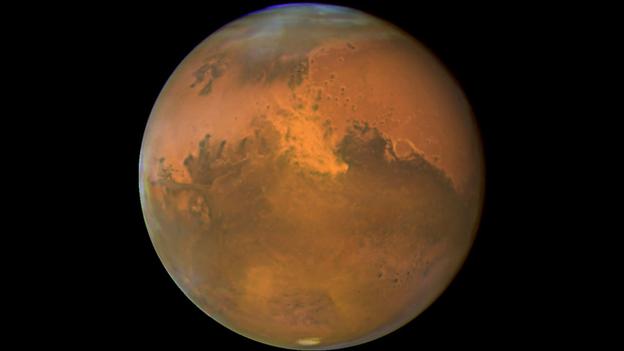
marsYes, the name is a bit of a attention-getter, but when you come to understand the purpose behind Lockheed Martin’s new spacecraft, the description does appear to be quite apt. It’s known as MAVEN, which stands for Mars Atmosphere and Volatile EvolutioN, and it is currently being produced in Lockheed Martin’s Martin Space Systems facility in Denver, Colorado.

People may recall how earlier this year, MAVEN was mentioned as part of the “Going to Mars” campaign. A project that is being organized by the University of Colorado at Boulder’s Laboratory for Atmospheric and Space Physics (CU/LASP), the Martian orbiter will be carrying a DVD featuring the names of everyone who applies, as well as three specially-selected haikus.

However, it is MAVEN’s larger mission which is now the focus of much interest. Later this year, NASA will be launching the orbiter to Mars for the sake of examine the atmosphere and answering some burning questions that remain about the planet. Thanks to evidence provided by Curiosity, Opportunity, and other missions, scientists now know that the Martian surface once boasted conditions suitable for life, including liquid water.

maven_orbitHence, Maven’s ultimate purpose, which will be will to orbit the planet and examine whether the atmosphere could also have provided life support. Scientists working on the Maven mission want to understand what this atmosphere was like, and the processes that led to its destruction. As Guy Beutelschies, Maven Programme Manager at Lockheed Martin, put it:

What we know from our missions looking at the surface of Mars is that there used to be water there. We can see the outlines of ancient rivers, the shorelines of ancient oceans. But water can’t exist there now – the atmosphere is too thin and too dry, any water would just evaporate or freeze. 

So the big question is what happened to Mars’ atmosphere? Short of being able to travel back in time into the Martian past, how would anyone go about tackling these questions with a mission today? Beutelshcies explained it as follows:

[The atmosphere] used to be thicker, warmer, wetter, now it’s thin and dry. How did we get there? In a sense we are building a little bit of a time machine. What we’re doing is understanding the processes.

maven_atmosphereJust last week, evidence provided by the Curiosity rover supports the theory that Mars may have lost most of its atmosphere billions of years ago. Still, scientists remain skeptical that Mars once had an atmosphere comparable to that of Earth. Today, that atmosphere is roughly one-hundredth the thickness of Earth’s, made up mostly of carbon dioxide and a tiny fraction of water vapor. What little remains is being stripped away by the solar wind.

And unlike Earth, Mars does not have a magnetosphere to protect its atmosphere from being blown away – at least not anymore. Such a fragile, thin band around is now unlikely to support any sort of life, as far as we know. But the atmosphere in the past must have been more substantial to allow the formation of rivers, lakes and oceans.

mars_sunsetBruce Jakosky, the Principal Investigator for Maven who is based at the University of Colorado’s CU/LASP lab in Boulder, claims:

We think that Mars used to have a magnetic field. We see places on the surface that retain some remnant magnetism, they were imprinted when they formed with whatever magnetism was there. We think that some four billion years ago, when the magnetic field turned off, that turn-off of the magnetic field allowed [for the] turn-on of the stripping by the solar wind.

To investigate the processes taking place today, Maven will dip into the Martian upper atmosphere with each orbit, measuring the particles, sampling gases, monitoring the magnetic field and solar wind. Whereas the rovers have looked at the atmosphere from the ground up, MAVEN will look at it from the top down. At this point, both are needed to put together a picture of what’s controlling the Mars environment.

maven_atmo1As well as filling in the blanks about Mars’ depleted atmosphere, Maven will also provide clues to the habitability of other planets beyond the solar system. As Jakosky said, the research conducted will have far-reaching implication for our understanding:

In trying to understand the distribution of life throughout the Universe, this is a really important indicator. Understanding the environmental conditions that allow [life] to exist, or don’t allow it to exist, is key to being able to extrapolate elsewhere.

What’s more, understanding what happened to Mars will provide some key insight into the history of our Solar System, and how it went from being a star with two planets that had oceans and atmospheres to just one. Knowing why things continued to operate on Earth, while on Mars they went horribly wrong, is likely to be quite the eye-opener, and make us all thankful we evolved here on Earth.

Source: bbc.com