News from Space: New Map of the Universe Confirms The Big Bang!

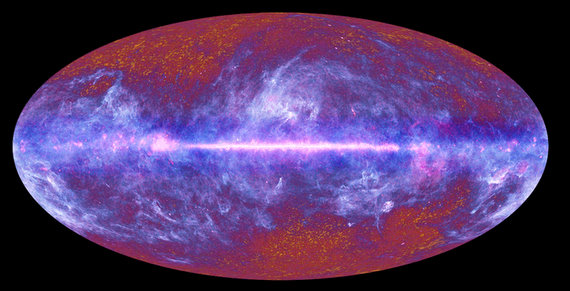
planckAfter 15 months of observing deep space, scientists with the European Space Agency Planck mission have generated a massive heat map of the entire universe.The “heat map”, as its called, looks at the oldest light in the universe and then uses the data to extrapolate the universe’s age, the amount of matter held within, and the rate of its expansion. And as usual, what they’ve found was simultaneously reassuring and startling.

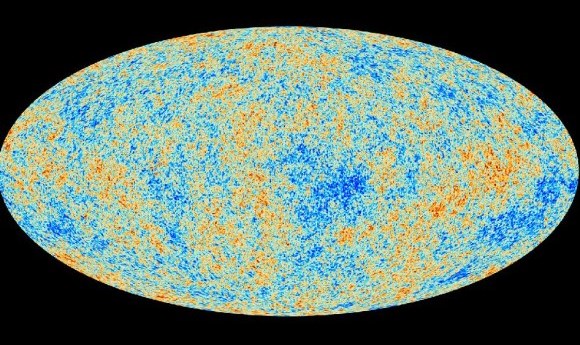
When we look at the universe through a thermal imaging system, what we see is a mottled light show caused by cosmic background radiation. This radiation is essentially the afterglow of the Universe’s birth, and is generally seen to be smooth and uniform. This new map, however, provides a glimpse of the tiny temperature fluctuations that were imprinted on the sky when the Universe was just 370,000 years old.

big_bangSince it takes light so long to travel from one end of the universe to the other, scientists can tell – using red shift and other methods – how old the light is, and hence get a glimpse at what the universe looked like when the light was first emitted. For example, if a galaxy several billion light years away appears to be dwarfish and misshapen by our standards, it’s an indication that this is what galaxies looked like several billion years ago, when they were in the process of formation.

Hence, like archaeologists sifting through sand to find fossil records of what happened in the past, scientists believe this map reveals a sort of fossil imprint left by the state of the universe just 10 nano-nano-nano-nano seconds after the Big Bang. The splotches in the Planck map represent the seeds from which the stars and galaxies formed. As is heat-map tradition, the reds and oranges signify warmer temperatures of the universe, while light and dark blues signify cooler temperatures.universe

The cooler temperatures came about because those were spots where matter was once concentrated, but with the help of gravity, collapsed to form galaxies and stars. Using the map, astronomers discovered that there is more matter clogging up the universe than we previously thought, at around 31.7%, while there’s less dark energy floating around, at around 68.3%. This shift in matter to energy ratio also indicates that the universe is expanding slower than previously though, which requires an update on its estimated age.

All told, the universe is now believed to be a healthy 13.82 billion years old. That wrinkles my brain! And also of interest is the fact that this would appear to confirm the Big Bang Theory. Though widely considered to be scientific canon, there are those who dispute this creation model of the universe and argue more complex ideas, such as the “Steady State Theory” (otherwise known as the “Theory of Continuous Creation”).

24499main_MM_Image_Feature_49_rs4In this scenario, the majority of matter in the universe was not created in a single event, but gradually by several smaller ones. What’s more, the universe will not inevitable contract back in on itself, leading to a “Big Crunch”, but will instead continue to expand until all the stars have either died out or become black holes. As Krzysztof Gorski, a member of the Planck team with JPL, put it:

This is a treasury of scientific data. We are very excited with the results. We find an early universe that is considerably less rigged and more random than other, more complex models. We think they’ll be facing a dead-end.

Martin White, a Planck project scientist with the University of California, Berkeley and the Lawrence Berkeley National Laboratory, explained further. According to White, the map shows how matter scattered throughout the universe with its associated gravity subtly bends and absorbs light, “making it wiggle to and fro.” As he went on to say:

The Planck map shows the impact of all matter back to the edge of the Universe. It’s not just a pretty picture. Our theories on how matter forms and how the Universe formed match spectacularly to this new data.

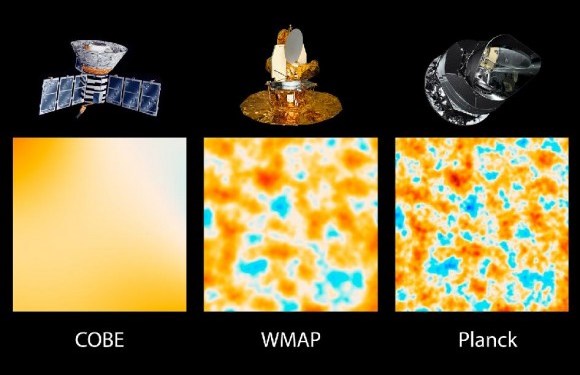
planck_satThe Planck space probe, which launched in 2009 from the Guiana Space Center in French Guiana, is a European Space Agency mission with significant contribution from NASA. The two-ton spacecraft gathers the ancient glow of the Universe’s beginning from a vantage more than a million and a half kilometers from Earth. This is not the first map produced by Planck; in 2010, it created an all-sky radiation map which scientists, using supercomputers, removed all interfering background light from to get a clear view at the deep background of the stars.

However, this is the first time any satellite has been able to picture the background radiation of the universe with such high resolution. The variation in light captured by Planck’s instruments was less than 1/100 millionth of a degree, requiring the most sensitive equipment and the contrast. So whereas cosmic radiation has appeared uniform or with only slight variations in the past, scientists are now able to see even the slightest changes, which is intrinsic to their work.planck-attnotated-580x372

So in summary, we have learned that the universe is a little older than previously expected, and that it most certainly was created in a single, chaotic event known as the Big Bang. Far from dispelling the greater mysteries, confirming these theories is really just the tip of the iceberg. There’s still the grandiose mystery of how all the fundamental laws such as gravity, nuclear forces and electromagnetism work together.

Ah, and let’s not forget the question of what transpires beneath the veil of an even horizon (aka. a Black Hole), and whether or not there is such a thing as a gateway in space and time. Finally, there’s the age old question of whether or not intelligent life exists somewhere out there, or life of any kind. But given the infinite number of stars, planets and possibilities that the universe provides, it almost surely does!

And I suppose there’s also that persistent nagging question we all wonder when we look up at the stars. Will we ever be able to get out there and take a closer look? I for one like to think so, and that it’s just a matter of time!

To boldly go!
To boldly go!

Sources: universetoday.com, (2), extremetech.com, bbc.co.uk

Asteriod Prospecting by 2015

asteroid_beltDeep Space Industries, a private aerospace company, has been making a big splash in the news lately. Alongside SpaceX, they have been pioneering a new age in space exploration, where costs are reduced and private companies are picking up the slack. And in their latest bid to claim a share of space, the company announced plans late in January to begin asteroid prospecting operations by 2015.

For some time, the concept of sending spaceships to mine asteroids and haul ore has been explored as a serious option. Within the asteroid belt that lies between Mars and Jupiter, countless tons of precious metals, carbon, silicates, and basaltic minerals. If humanity could tap a fraction of a fraction of that mineral wealth, it would be able to supply Earth’s manufacturing needs indefinitely, without all the harmful pollutants or run off caused by mining.

asteroid_miningSo to tap this potential goldmine (literally!) known as the Asteroid Belt, DSI plans to launch a fleet of mini spacecraft into solar orbit to identify potential targets near to Earth that would be suitable to mine. Lacking the resources of some of the bigger players in the space rush, DSI’s probes will ride-share on the launch of larger communications satellites and get a discounted delivery to space.

Initially, a group of 25kg (55 pounds) cubesats with the awesome designation “Firefly” will be launched on a journey lasting from two to six months in 2015. Then, in 2016, the 32 kilograms (70 pound) DragonFly spacecraft will begin their two-to-four-year expeditions and return with up to 68 kilograms (150 pounds) of bounty each. Beyond this, DSI has some truly ambitious plans to establish a foundry amongst the asteroids.

asteroid_foundryThat’s another thing about the Belt. Not only is it an incredibly rich source of minerals, its asteroids would make an ideal place for relocating much of Earth’s heavy industry. Automated facilities, anchored to the surface and processing metals and other materials on site would also reduce the burden on Earth’s environment. Not only would there be no air to befoul with emissions, but the processes used would generate no harmful pollutants.

In DSI’s plan, the foundry would use a patent-pending nickel gas process developed by one of DSI’s co-founders, Stephen Covey, known as “sintering”. This is the same process that is being considered by NASA to build a Moon Base in the Shackleton Crater near the Moon’s south pole. Relying on this same technology, automated foundries could turn ore into finished products with little more than microwave radiation and a 3D printer, which could then be shipped back to Earth.

deepspaceindustries-640x353Naturally, DSI will have plenty of competition down the road. The biggest comes from Google-backed Planetary Resources which staked it claim to an asteroid last April. Much like DSI, they hope to be able to mine everything from water to fuel as well as minerals and rare earths. And of course, SpaceX, which has the most impressive track record thus far, is likely to be looking to the Asteroid Belt before long.

And Golden Spike, the company that is promising commercial flight to the Moon by 2020 is sure to not be left behind. And as for Virgin Galactic, well… Richard Branson didn’t get crazy, stinking rich by letting opportunities pass him by. And given the size and scope of the Belt itself, there’s likely to be no shortage of companies trying to stake a claim, and more than enough for everyone.

So get on board ye capitalist prospectors! A new frontier awaits beyond the rim of Mars…

Source: Extremetech.com

NASA’s 3D Printed Moon Base

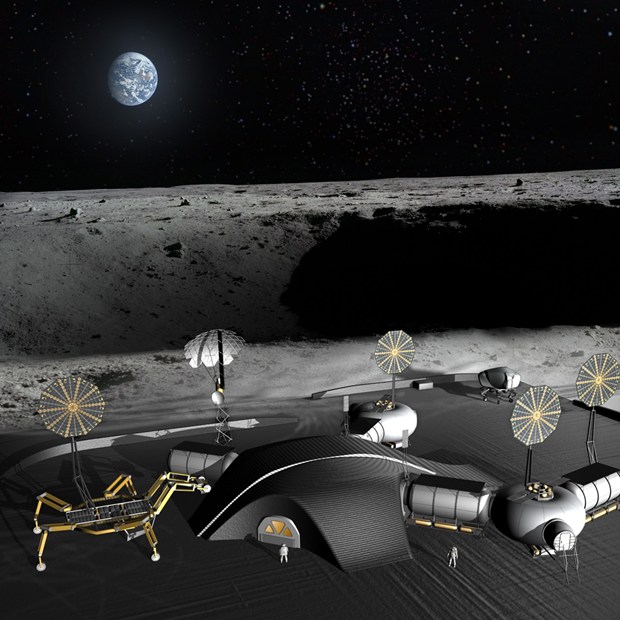
ESA_moonbaseSounds like the title of a funky children’s story, doesn’t it? But in fact, it’s actually part of NASA’s plan for building a Lunar base that could one day support inhabitants and make humanity a truly interplanetary species. My thanks to Raven Lunatick for once again beating me to the punch! While I don’t consider myself the jealous type, knowing that my friends and colleagues are in the know before I am on stuff like this always gets me!

In any case, people may recall that back in January of 2013, the European Space Agency announced that it could be possible to build a Lunar Base using 3D printing technology and moon dust. Teaming up with the architecture firm Foster + Partners, they were able to demonstrate that one could fashion entire structures cheaply and quite easily using only regolith, inflatable frames, and 3D printing technology.

sinterhab2_1And now, it seems that NASA is on board with the idea and is coming up with its own plans for a Lunar base. Much like the ESA’s planned habitat, NASA’s would be located in the Shackleton Crater near the Moon’s south pole, where sunlight (and thus solar energy) is nearly constant due to the Moon’s inclination on the crater’s rim. What’s more, NASA”s plan would also rely on the combination of lunar dust and 3D printing for the sake of construction.

However, the two plans differ in some key respects. For one, NASA’s plan – which goes by the name of SisterHab – is far more ambitious. As a joint research project between space architects Tomas Rousek, Katarina Eriksson and Ondrej Doule and scientists from Nasa’s Jet Propulsion Laboratory (JPL), SinterHab is so-named because it involves sintering lunar dust: heating it up with microwaves to the point where the dust fuses to become a solid, ceramic-like block.

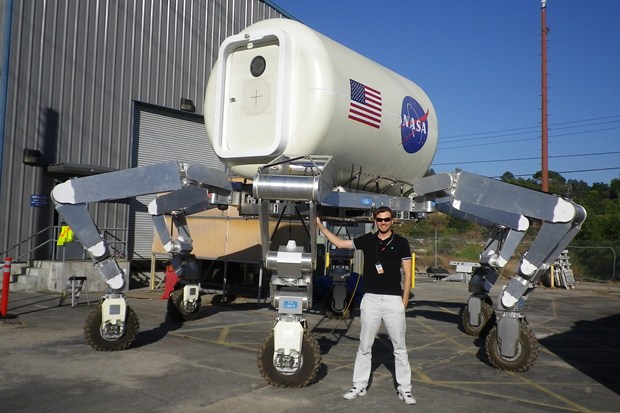
This would mean that bonding agents would not have to be flown to the Moon, which is called for in the ESA’s plan. What’s more, the NASA base would be constructed by a series of giant spider robots designed by JPL Robotics. The prototype version of this mechanical spider is known as the Athlete rover, which despite being a half-size variant of the real thing has already been successfully tested on Earth.

athlete_robotEach one of these robots is human-controlled, has six 8.2m legs with wheels at the end, and comes with a detachable habitable capsule mounted at the top. Each limb has a different function, depending on what the controller is looking to do. For example, it has tools for digging and scooping up soil samples, manipulators for poking around in the soil, and will have a microwave 3D printer mounted on one of the legs for the sake of building the base. It also has 48 3D cameras that stream video to its operator or a remote controlling station.

The immediate advantages to NASA’s plan are pretty clear. Sintering is quite cheap, in terms of power as well as materials, and current estimates claim that an Athlete rover should be able to construct a habitation “bubble” in only two weeks. Another benefit of the process is that astronauts could use it on the surface of the Moon surrounding their base, binding dust and stopping it from clogging their equipment. Moon dust is extremely abrasive, made up of tiny, jagged morcels rather than finely eroded spheres.

sinterhab3Since it was first proposed in 2010 at the International Aeronautical Congress, the concept of SinterHab has been continually refined and updated. In the end, a base built on its specifications will look like a rocky mass of bubbles connected together, with cladding added later. The equilibrium and symmetry afforded in this design not only ensures that grouping will be easy, but will also guarantee the structural integrity and longevity of the structures.

As engineers have known for quite some time, there’s just something about domes and bubble-like structures that were made to last. Ever been to St. Peter’s Basilica in Rome, or the Blue Mosque in Istanbul? Ever looked at a centuries old building with Onion Dome and felt awed by their natural beauty? Well, there’s a  reason they’re still standing! Knowing that we can expect similar beauty and engineering brilliance down the road gives me comfort.

In the meantime, have a gander at the gallery for the proposed SinterHab base, and be sure to check out this video of the Athlete rover in action:

Source: Wired.co.uk, robotics.jpl.nasa.gov

Powered by the Sun: The Future of Solar Energy

Magnificent CME Erupts on the Sun - August 31Researchers continue to work steadily to make the dream of abundant solar energy a reality. And in recent years, a number of ideas and projects have begun to bear fruit. Earlier this year, their was the announcement of a new kind of “peel and stick” solar panel which was quite impressive. Little did I know, this was just the tip of the iceberg.

Since that time, I have come across four very interesting stories that talk about the future of solar power, and I feel the need to share them all! But, not wanting to fill your page with a massive post, I’ve decided to break them down and do a week long segment dedicated to emerging solar technology and its wicked-cool applications. So welcome to the first installment of Powered By The Sun!

spaceX_solararrayThe first story comes to us by way of SpaceX, Deep Space Industries, and other commercial space agencies that are looking to make space-based solar power (SBSP) a reality. For those not familiar with the concept, this involves placing a solar farm in orbit that would then harvest energy from the sun and then beam the resulting electricity back to Earth using microwave- or laser-based wireless power transmission.

Originally described by Isaac Asimov in his short story “Reason”, the concept of an actual space-based solar array was first adopted by NASA in 1974. Since that time, they have been investigating the concept alongside the US Department of Energy as a solution to the problem of meeting Earth’s energy demands, and the cost of establishing a reliable network of arrays here on Earth.

Constructing large arrays on the surface is a prohibitively expensive and inefficient way of gathering power, due largely to weather patterns, seasons, and the day-night cycle which would interfere with reliable solar collection. What’s more, the sunniest parts of the world are quite far from the major centers of demand – i.e. Western Europe, North America, India and East Asia – and at the present time, transmitting energy over that long a distance is virtually impossible.

NASA "Suntower" concept
NASA “Suntower” concept

Compared to that, an orbiting installation like the SBSP would have numerous advantages. Orbiting outside of the Earth’s atmosphere, it would be able to receive about 30% more power from the Sun, would be operational for almost 24 hours per day, and if placed directly above the equator, it wouldn’t be affected by the seasons either. But the biggest benefit of all would be the ability to beam the power directly to whoever needed it.

But of course, cost remains an issue, which is the only reason why NASA hasn’t undertaken to do this already. Over the years, many concepts have been considered over at NASA and other space agencies. But due to the high cost of putting anything in orbit, moving up all the materials required to build a large scale installation was simply not cost effective.

spacex-dragon-capsule-grabbed-by-iss-canadarm-640x424However, that is all set to change. Companies like SpaceX, who have already taken part in commercial space flight (such as the first commercial resupply to the ISS in May of 2012, picture above) are working on finding ways to lower the cost of putting materials and supplies into orbit. Currently, it costs about $20,000 to place a kilogram (2.2lbs) into geostationary orbit (GSO), and about half that for low-Earth orbit (LEO). But SpaceX’s CEO, Elon Musk, has said that he wants to bring the price down to $500 per pound, at which point, things become much more feasible.

And when that happens, there will be no shortage of clients looking to put an SBSP array into orbit. In the wake of the Fukushima accident, the Japanese government announced plans to launch a two-kilometer-wide 1-gigawatt SBSP plant into space. The Russian Space Agency already has a a working 100-kilowatt SBSP prototype, but has not yet announced a launch date. And China, the Earth’s fastest-growing consumer of electricity, plans to put a 100kW SBSP into Low-Earth Orbit by 2025.

space-based-solarpowerMost notably, however, is John Mankins, the CTO of Deep Space Industries and a 25-year NASA vet, who has produced an updated report on the viability of SBSP. His conclusion, in short, is that it should be possible to build a small-scale, pilot solar farm dubbed SPS-ALPHA for $5 billion and a large-scale, multi-kilometer wide power plant for $20 billion. NASA’s funding for SPS-ALPHA dried up last year, but presumably Mankins’ work continues at Deep Space Industries.

Cost and the long-term hazards of having an array in space remain, but considering its long-term importance and the shot in the arm space exploration has received in recent years – i.e. the Curiosity Rover, the proposed L2 Moon outpost, manned missions to Mars by 2030 – we could be looking at the full-scale construction of orbital power plants sometime early in the next decade.

And it won’t be a moment too soon! Considering Earth’s growing population, its escalating impact on the surface, the limits of many proposed alternative fuels, and the fact that we are nowhere near to resolving the problem of Climate Change, space-based solar power may be just what the doctor ordered!

Thanks for reading and stay tuned for the next installment in the Powered By The Sun series!

Source: Extremetech.com

ISS Astronaut Chris Hadfield sings with the Barenaked Ladies!

ISS_Hadfield_BNLFans of The Big Bang Theory, or anyone who has lived in Canada for the last 20 years, ought to be instantly familiar with the Barenaked Ladies. However, what is not common knowledge is that Chris Hadfield, an astronaut aboard the International Space Station, is himself Canadian and apparently, quite the musician! Not only can he sing, he can play the guitar in zero-gravity and even execute some sweet moves. Quite the ensemble!

And in this rare treat, which took place back in February, Hadfield, the Barenaked Ladies, and the Wexford Gleeks children’s choir all collaborated to create the world’s first space-to-earth musical collaboration. The song they sang was an original creation, entitled “I.S.S. (Is Somebody Singing)”, which was commissioned by CBCMusic.ca and The Coalition for Music Education with the Canadian Space Agency to celebrate music education in schools across Canada.

So if you have a few minutes, I recommend you cue up this video, turn the volume up, and enjoy a truly heartwarming and breathtaking song that celebrates Canada, music, planet Earth, and the wonder of looking down at it all from space. It’ll give you goose bumps, I swear!

Origins of Russian Meteor Found!

meteorJust over a week after a meteor exploded across the sky above the Chelyabinsk region of Russia, a group of astronomers published a paper that reconstructs where the rock came from. The men in question were Jorge Zuluaga and Ignacio Ferrin at the University of Antioquia in Medellin, Colombia. And the method they used was quite unconventional, and is perhaps a testament to the age we live in.

Basically, Zuluaga and Ferrin used the many sources of dashboard and security cameras that captured the event on film. Using the trajectories shown in the videos posted on YouTube, the researchers were able to calculate the trajectory of the meteorite as it fell to Earth and use it to reconstruct the orbit of the meteoroid before its fell to Earth and cause the shockwave that damaged buildings and shattered windows.

From their calculations, they were able to determine the height, speed and position of the meteorite as it fell to Earth. According to the team’s paper:

“…the Chelyabinski meteor started to brighten up when it was between 32 and 47 km up in the atmosphere. The velocity of the body predicted by our analysis was between 13 and 19 km/s (relative to the Earth) which encloses the preferred figure of 18 km/s assumed by other researchers.”

They then used software developed by the US Naval Observatory (called NOVAS) and the Naval Observatory Vector Astrometry to calculate the likely orbit. From all this, they came to the preliminary conclusion that the meteorite came from the Apollo class of asteroids, a well-known class of rocks that cross Earth’s orbit.

This conclusion has some worried, since the Apollo group, which orbits the Sun in the vicinity of Venus and Earth, contains over 2000 asteroids that are larger than 1 km in diameter. And considering that this one meteor, which measured between 17 and 20 meters, caused 1491 injuries and damage to over 4000 buildings in the area.

Lucky for us, NASA and every other space agency on the planet has some defensive strategies in mind. And of course, early warning is always the most important aspect of disaster preparedness. In the near future, we can expect some of the proposed observation satellites that will be going up to ensure there will be a better degree of early warning.

Source: universetoday.com

NASA Loses Contact With ISS

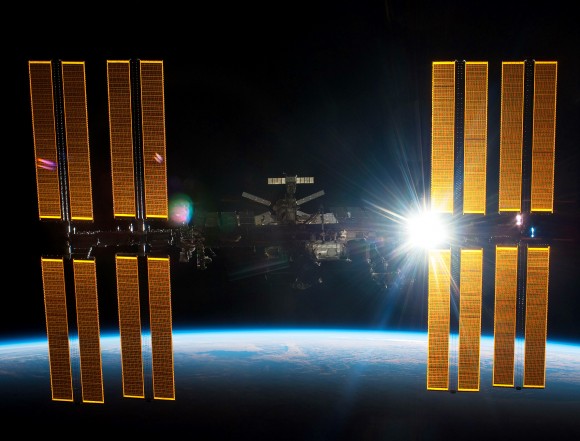
International-Space-Station-ISS-580x441It’s something no one hovering hundreds of kilometers over the Earth ever really wants to experience. Yes, when you floating in a tin can, you’re only connection to the surface being a communications relay, it can be pretty scary when it suddenly stops working. Can’t be much of a picnic for those working Mission Control either, or the families forced to sit idly by and wait for others to figure out what went wrong.

The communications blackout began on Tues, Feb. 19th at 9:45 am EST(15:45 UTC) , and lasted until 11:34 am yesterday (17:34 UTC). So for a good twenty-six hours straight, the ISS was unable to communicate with ground crews, which as anyone can guess caused a bit of a stir. Luckily, it turns out everyone on board the ISS was just fine the whole time, no injuries or space invaders to speak of!

According to a statement filed by NASA, communications were apparently lost when flight controllers in Houston were updating the software onboard the station’s flight computers and one of the station’s data relay systems malfunctioned. The primary computer that controls critical station functions defaulted to a backup computer, but was not allowing the station to communicate with NASA’s Tracking and Data Relay Satellites.

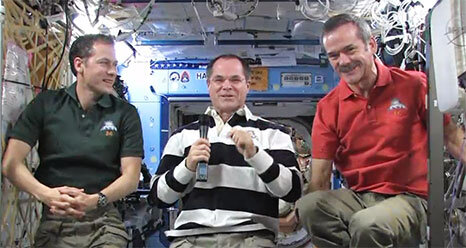
NASA_ISScrewThen, just before 11:00 a.m. EST, flight controllers were able to communicate with the crew once more as the space station flew over Russian ground stations. They then instructed the crew to connect a backup computer to begin the process of restoring communications. Once that was done, Expedition 34 Commander Kevin Ford reported the following:

“Hey, just FYI, the station is still flying straight, everybody is in good shape, or course, and nothing unexpected except lots of caution and warning [alarms]. All the systems look like they are doing just fine.”

According to the Johnson Space Center’s latest Twitter update, the crew is back at work and the crew is taking questions from fans. Click here to see what the crew had to say about the temporary communications blackout and what’s in store for them now.

In an ironic twist, sources have since indicated that Canadian astronaut Chris Hadfield Tweeted the following from the ISS shortly before the blackout took place: “Good Morning, Earth! Today we transition the Space Station’s main computers to a new software load. Nothing could possibly go wrong.” The moral here? Things can always go wrong! And don’t tempt fate, especially when you’re hurling through space, hundreds of kilometers above the Earth.

Source: universetoday.com
 

NASA Engine Will Take Us To The Moon (And Beyond)

NASA_Moon1For almost a year now, NASA has been discussing plans which will eventually culminate in a return to the Moon. Initially, such plans were kept under wraps just in case NASA found itself in a budget environment that did not favor renewed space exploration. But since the 2012 election, and the re-election of President Obama, NASA publicly announced its plans, confident that the budget voted on in 2010 (which included lucrative funding for them) would continue.

And now, NASA has been unveiling the tools that will take us there and beyond in the coming years. Far from simply shooting for the Moon for the first time in decades, NASA’s plans also include manned missions to Mars, and exploratory missions which will take it out to Jupiter and the outer Solar System. And since they are thinking big, its clear some budget-friendly and powerful tools will be needed for the job.

jx-2rocketAbove, we have the latest. It’s called the JX-2, a liquid-fuel cryogenic rocket engine is the modernized version of the J-2, the engine that NASA used in the late-’60s and early-’70s to thrust humans beyond low Earth orbit. With the conclusion of the Apollo program, these babies fell into disuse. But with the upgrades made to these new versions, NASA hopes to send people back to the Moon, and a few places beyond.

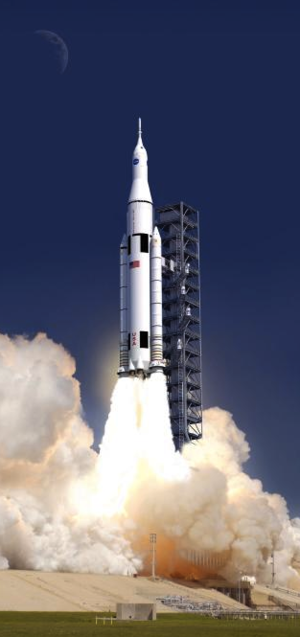
Of course, there are other noted improvements in NASA’s arsenal that will also come into play. For starters, the J-2 was part of the general assembly of the Saturn V rocket, the mainstay of the space agency’s fleet at the time. In the years to come, NASA will be deploying its new Space Launch System (SLS) and the Orion Multi-Purpose Crew Vehicle (MPCV).

NASA_marsThe SLS is NASA’s next-generation rocket, a larger, souped-up version of the Saturn V’s that took the Apollo teams into space and men like Neil Armstrong to the Moon. According to NASA spokesmen, the SLS rocket will “incorporate technological investments” and “proven hardware” from previous space exploration programs.” Essentially, this means that projects which have been shelved and retired have been updated and incorporated to create a rocket that can do the job of sending men into deep space again.

The Orion MPCV, on the other hand, is the module that will sit atop the SLS, carrying its crew compliment and delivering them to their destination once the rocket has put them into space and disassembled itself. Announced back in September of 2011, the SLS and MPCV constitute the largest and most powerful space rocket system ever built by a space agency.

No date has been given as to when the SLS and MPCV will be sent into space, courtesy of the new JX-2 rocket engine. But NASA claims there will be a launch sometime next year. As for the Moon, well, we’re waiting on that too, but it’s clear that with Mars slated for 2030, a manned mission to the Moon is sure to happen before this decade is out.

In the meantime, check out the infographic on the new rocket system below, and keep your eyes on the skies! We’re going back, and this time, we mean to stay!

nasa-spaceship-mpcv-orion-capsule-comparison-apollo-shuttle-infographic-110525b-02

Sources: IO9.com, (2), Space.com

Asteroid Misses Earth, Again!

asteroid_DA14Well it seems that Earth has survived yet another close shave with an asteroid. This time around, the object in question was a celestial body known as DA14, a rock measuring 45 meters (150 feet) in diameter and weighing in at 130,000 metric tons in mass. Discovered last year by astronomers working out of the La Sagra Sky Survey at the Astronomical Observatory of Mallorca, this asteroid performed the closest fly-by of Earth ever observed by astronomers.

Basically, the asteroids passage took it within Earth’s geosynchronous satellite ring, at a paltry distance of 27,000 kilometers (17,000 miles). That may sound like its still pretty far away, but to give you a sense of scale, consider that Earth’s geosynchronous satellite ring, which the asteroid passed within, is located about 35,800 km above the equator. So basically, this asteroid was closer to you than the satellite that feeds your TV set. Scared yet?

asteroid_DA14pathNaturally, NASA was quick to let people know that DA14’s trajectory and orbit about the Sun would bring it no closer to the Earth’s surface than 3.2 Earth radii on February 15, 2013. In a statement released in advance of the asteroid’s passage, they claimed:

“There is very little chance that asteroid 2012 DA14 will impact a satellite or spacecraft. Because the asteroid is approaching from below Earth, it will pass between the outer constellation of satellites located in geosynchronous orbit (22,245 miles/35,800 kilometers) and the large concentration of satellites orbiting much closer to Earth. (The International Space Station, for example, orbits at the close-in altitude of 240 miles/386 kilometers.). There are almost no satellites orbiting at the distance at which the asteroid will pass.”

However, they were sure to warn satellite operators about the passing, providing them with detailed information about the flyby so they could perform whatever corrections they needed to to protect their orbital property. All in all, we should be counting our lucky stars, given the asteroid’s mass and size. Were it to have landed on Earth, it would have been an extinction-level-event the likes of which has not been seen since the age of the dinosaurs.

In related news, NASA was quick to dispel notions that this asteroid was in any way related the recent arrival of the meteor above the Urals in Russia. In a statement issued earlier today, they said the following:

“According to NASA scientists, the trajectory of the Russia meteor was significantly different than the trajectory of the asteroid 2012 DA14, making it a completely unrelated object. Information is still being collected about the Russia meteor and analysis is preliminary at this point. In videos of the meteor, it is seen to pass from left to right in front of the rising sun, which means it was traveling from north to south. Asteroid DA14’s trajectory is in the opposite direction, from south to north.”

Good news! We’re not witnessing the End of Days just yet. Take that Apocalyptics! Don’t you people get tired of being wrong? (fingers crossed!)

Source: IO9.com, NASA.gov, (2)

The Kessel Run: The Fandom Obsession

hyperspaceIf you were to get into a discussion with a true Star Wars fan, it would only be a matter of time before the subject of the Kessel run came up. Long considered one of the biggest enigmas to come out of the franchise, Han’s boast in A New Hope about his ship’s capabilities – with the Kessel Run as a reference – still has some people scratching their noggins and scrambling for explanations today.

To refresh people’s memory, this is how the boast went down in the course of Han’s introduction to Luke and Obi-Wan at the Mos Eisley Cantina:

Han: “Fast ship? You’ve never heard of the Millennium Falcon?”
Obi-Wan: “Should I have?”
Han: “It’s the ship that made the Kessel Run in less than twelve parsecs!”

See what I mean? A parsec is a unit of distance, not time, so from an astronomical perspective, it made no sense. How could Han have used it to explain how quickly his ship could travel? Well, as it happens, there are some possible and even oddball explanations that have been drafted as the franchise has expanded over the years.

kessle_mapAnother important point to make here is about the Kessel Run itself. As a smuggler, Han was deeply involved in running “glimmerstim spice” during his pre-Rebel days (a clear rip off from Dune, but whatever). This took him to and from Kessel, a remote planet located in the Outer Rim that is surrounded by a black hole cluster known as the Maw. As an unnavigable mess, it provided a measure of protection for smugglers running the Imperial blockade that guarded the space lanes near the planet.

All of this comes up in the Jedi Academy Trilogy, a series of novels written by Kevin J. Anderson that are part of the expanded Star Wars universe, and is the first case of the Run being detailed. From these an other sources, we are told that the Run is an 18-parsec route that led away from Kessel, around the Maw, and into the far more navigable area of space known as The Pit. Here, smugglers had to contend with asteroids, but any smuggler worth his salt could find their way through without too much difficulty, and didn’t have to worry about Imperial patrols from this point onward.

MFalconTo cut down on the distance traveled, pilots could dangerously skirt the edges of the black holes, a maneuver dangerous because it involves getting pulled in by their gravitational forces. If a ship were fast enough, it could risk cutting it closer than most, thus shaving more distance of the route while still being able to break free after it all to complete the run.

Hence we have the first possible explanation to Han’s ambiguous statement. Han’s boast was not about the time taken for him to complete the Run, but the fact that Millennium Falcon was so fast that he was able to cut a full third of the Run off and still make it out. The Falcon would have to be a pretty sweet ship to do that! And it would also fit in with all his other boasts, about how the ship could  “make 0.5 past light speed”, and was the “fastest ship in the fleet”.

However, there are other explanations as well. For starters, this expanded universe explanation does not jive with what Lucas himself said, what was presented in the novelization of the original movie, and of course what astronomers and megafans have to say. In the first instance, Lucas claimed in the commentary of the Star Wars: Episode IV A New Hope DVD that the “parsecs” are due to the Millennium Falcon’s advanced navigational computer rather than its engines, so the navicomputer would calculate much faster routes than other ships could.

HanIn the A New Hope novelization, Han says “standard time units” in the course of his conversation with Luke and Ben, rather than “parsecs.” And in the revised fourth draft of A New Hope that was released in 1976, the description for “Kessel Run” is described as a bit of hapless misinformation that Obi-Wan doesn’t believe for a second. In short, Han erred when he said it and didn’t realize it.

And then there is the far more farfetched and mind-bending explanation as made by Kyle Hill in a recent article by Wired magazine. Here, he argues that the true intent of Han’s statement was that he was, in fact, a time traveler. By combining some basic laws of physics – namely that the speed of light (c) is unbreakable and 0.99 ad infinitum is as fast as anything can go – and the details of Han’s boast, a more clear picture of how this works emerges.

First, because the shortened Kessel Run spans 12 parsecs (39.6 light-years), a ship traveling nearly light-speed would take a little more than 39.6 years to get there. Factoring in time dilation, anyone watching the Kessel Run would see Solo speeding along for almost 40 years, but Solo himself would experience only a little more than half a day. So basically, in the time it takes Han to complete just one Kessel Run, the rest of the galaxy continues on its usual path for 40 years, which pushed the date of Han’s birth 40 years into the past.

time-slipConfused yet? Well, the idea is that Han would have been born long before events in A New Hope, and even The Phantom Menace took place. After completing his run, no doubt trying to avoid Republic authorities or some such equivalent, he came upon a universe that had gone through the ringer with a Sith coup d’etat, Imperial oppression, and a looming Civil War. What could he do but stick to smuggling and hope to make a living?

REALLY doesn’t make sense in terms of the storyline, does it? Ah, but what can you do? People like to find quirky explanations for things that don’t make sense. It can be fun! But of course, there’s a final and much, much simpler explanation that I haven’t even mentioned yet, and it’s one that’s far more believable given the so-called evidence.

george_lucas02Put simply, Lucas made a mistake. The parsecs line was a misfire, an oversight, and/or brain fart on his part. Nothing more, and all these attempts at explanation are just an obvious attempt to make something that doesn’t fit fit. It makes perfect sense when you think about it: since A New Hope was the first Star Wars movie, that meant Lucas was directing it all by himself. The assistance he sorely needed in terms of directing, writing, editing, etc. didn’t come until the movie was almost complete and he was looking bankruptcy and a nervous breakdown in the eye.

And remember, this is the same movie where a Storm Trooper walked head first into a door aboard the Death Star, Luke yells “Carrie” to Carrie Fisher while they are shooting, the cast and camera can be seen in numerous widescreen shots, and just about every technical problem that could go wrong did go wrong, some of which even made it into the final cut. As far as bloopers, outtakes and errors are concerned, the first Star Wars movie was a mess!


See? So really, is it hard to imagine a simple oversight like a typo could have made it on screen and no one caught it? Hell no! And frankly, I think fandom would be a lot happier if Lucas had remembered these early days of his career and not decided to make the prequels all by himself. Sure, there were plenty of people to catch these kinds of simple errors the second time around, but his many flaws as a movie maker found other ways to shine through – i.e. Jar Jar, lazy directing, too much special effects, wooden dialogue, confused storyline, continuity errors and plot holes galore!

star-wars-complete-cast-20042Ah, but that’s another topic entirely. Point is, Star Wars had simple beginnings and plenty of mistakes were made along the way. One can’t expect something so grand and significant in terms of popular culture to be consistent or error free. And Lucas was never really good at producing a seamless product. In the end, it was a fun ride until the new ones came out, and even then he was still making money hand over fist.

And with Disney at the helm now, chances are we’re in for a real treat with some high-budgets and high-production values. And I’m sure there will be plenty of things for the meganerds and uberfans to poke fun at and make compilation videos of. And I of course will be writing about all of it 😉