The Future is Here: Smart Tattoos!

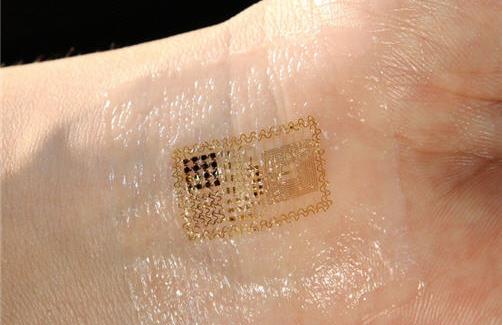
electronic_skin_patchIn recent years, scientists have been working towards electronics that come in flexible and ultra-thin packages. Back in 2011, this bore fruit as researchers from the University of Illinois unveiled the world’s first health monitoring patch, an ultra-thin device which looked like a temporary tattoo, but packed enough sensors in its flesh to monitor a person’s vitals. As a testament to the rate at which technological developments happen these days, improvements are already being made on the concept and design.

For example, a team of researchers from the University of Toronto and the University of California recently announced the creation of what they are calling the “smart tattoo”.  This device is a step up from the previous one, as it contains “ion-selective electrodes” which go beyond monitoring just your vitals. According to the collaborative team, this patch is made up of “sensors that detect the pH or salt levels of the skin, as well minerals like potassium, and even blood oxidation.”

In other words, this patch can monitor athletic performance at a granular level, but without any of the bulk or wiring of older sensors. It also means that for the first time, detailed athletic response testing would no longer be limited to the walls of a sports clinic, but could be done daily by the athlete herself. What’s more, the nature of the design and relative cost are in keeping with a mass production model and mass market appeal.

bloodstreamThis last aspect is an important indicator since one of the hallmarks of technological progress is the ability to create devices which go beyond matters of life and death and are able to address our daily concerns. In addition to proving that the technology is becoming more commonplace, it’s also a sign of growing affordability and availability. With this latest development, it seems that smart tattoos are doing just that.

Another example comes from Sano intelligence, a 2012 health startup that announced that they are in the testing phase of a smart tattoo that reads a wearer’s blood markers. This patch would be especially useful to diabetics, for whom blood monitoring is a constant hassle and often required invasive measures, such as needles. If the patch proves successful, diabetics everywhere would not only be able to forgo finger pricking and needles, but would also be freed of the burden of having to carry around bulky devices.

stretchable-electronicsFinally, there was the news from Cambridge Massachusetts, where another startup company named MC10 announced early in 2012 that they had created a “stretchable electronics” patch that was applicable not only to skin, but to human clothing and even organs. By mounting nanoscale electronics to a flexible, stretchable patch, the company hopes to be able to produce sensors that can monitor any number of health functions, from the more mundane things like heart-rate and hydration, to brain, heart, tissue, and organ function.

What is especially exciting about all of this is not so much the technology involved, but the fact that it is leading to an era where patients will have a far greater degree of control over their own health and monitoring. No longer will we be dependent on clinics and doctors for every single matter relating to our health, from checkups to surgery. Now we can take care of the former ourselves, making our information available to our doctor or specialist as needed, and going in for only serious or life-threatening procedures. This, in addition to leading to a more health-conscious public, could also bode well for medical costs.

Sources: takepart.com, technologreview.com, factcoexist.com
The Future is Here: The Magic Forest LED Wall

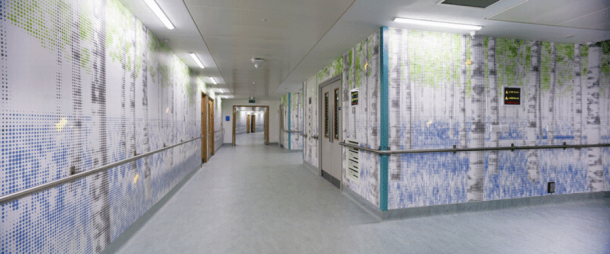
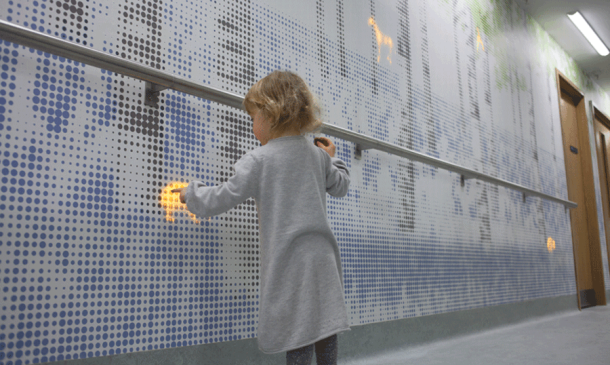
magic_forest1In an attempt to address the sterile feel of lobbies and waiting rooms in hospitals and clinics, a London design studio recently unveiled a very cool concept. Essentially, it’s an interactive wallpaper that turns clinical corridor walls into a magical forest which engages and distracts kids as they journey toward their procedure. Known as Nature Trail, the installation is a 50 meter (165 feet) long corridor that walls part of the Mittal Children’s Medical Centre at London’s Great Ormond Street Hospital.

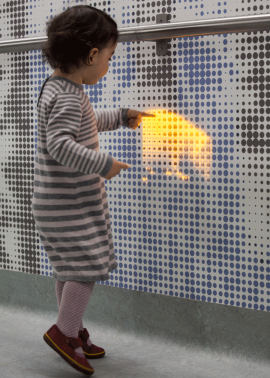
Jason Bruges, head of the Jason Bruges Studio and creator of the installation, claims that “the idea came from remembering walks in my childhood. I loved spotting and following things, those stolen glances and glimpses… I was trying to re-create this with the idea of digital lookout points along the corridor.” Relying on a series of 70 LED panels that house a total of 72,000 LEDs, the walls are triggered by motion sensors and reveal animated patterns in the shape of horses, deer, hedgehogs, birds, and frogs peeking through the foliage and trees.

magic_forestThe studio modeled the critters in 3D before translating them to low resolution to give the creatures an aesthetic similar to an old-fashioned video game character. The creators then placed the LED panels at various heights so kids of all ages, and to take into account being bedridden or in a wheelchair, can access the animals at eye level. The hospital says its young patients have been so entranced by the nature canvas that it will grow to fill more walls by 2017.

magic_forest2As it stands, doctor’s offices, dental clinics and medical centers rely on aesthetics to combat what can only be described as the “clinical feel”. But this concept just may offer them a high-tech option that will put patients at ease through the illusion of a natural setting that is dazzling the eyes. Some might accuse men like Bruges of using technology to anesthetize, but for anyone who has had sick children, its likely to be seen as a godsend!

Source: news.cnet.com

Should I Be Afraid of the Future?

should-i-be-afraid-of-the-futureNot that long ago, I discovered a site dedicated to taking speculations about the future, crunching data and trends, and producing visualizations about them. Already, they had me with their graph that shows when future technologies will emerge, and how they will be interrelated. But then came their future of education and health technology, both of which addressed the same issue – what can we can expect within the next few decades, leading up to the middle of this century?

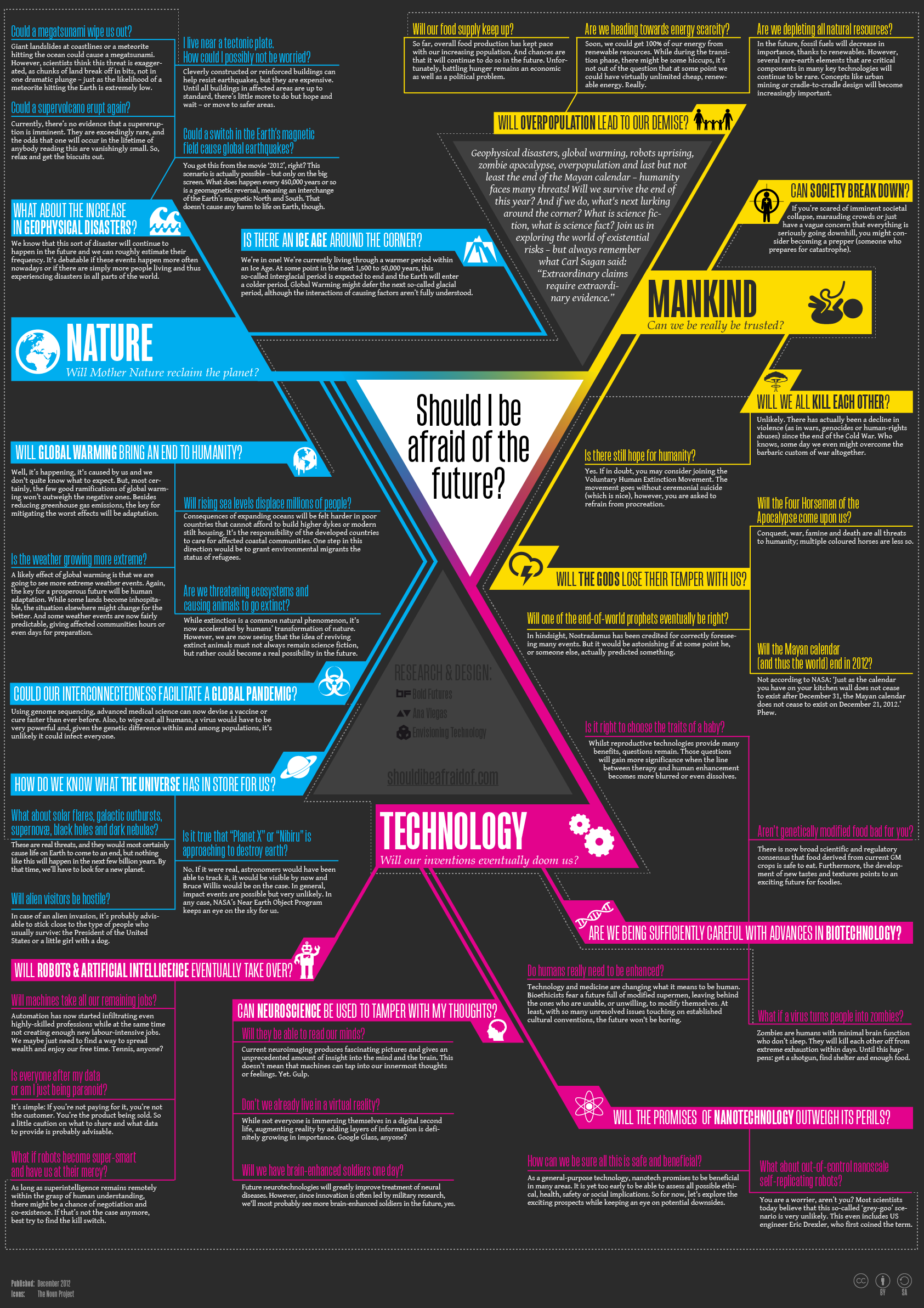
And now, the good folks at Envisioning Technology have created something truly informative and relevant. Entitled “Should I be afraid of the future?”, the infograph addresses all the big questions people might have when it comes to emerging technology, environmental perils, and the kind of technophobia that often result.

“Geophysical disasters, global warming, robot uprisings, zombie apocalypse, overpopulation, and last but not least the end of the Mayan calendar – humanity faces many threats! Will we survive the end of the year? And if we do, what’s next lurking around the corner? What is science fiction, what is science fact? Join in exploring the world of existential risks – but always remember what Carl Sagan said: ‘Extraordinary claims require extraordinary evidence.'”

The questions are broken down into three interrelating fields. First, there is Nature, covering such things as geological disasters, climate change, a possible ice age, and even astronomical events. Then comes Mankind, addressing possible factors such as war, apocalyptic scenarios, and overpopulation. And finally, there is technology, where questions about whether robots and AIs could turn hostile, and if advances in nanotech, biotech, and neuroscience could be potentially harmful.

And of course, each question is addressed in a rational, sensible fashion, even when the questions themselves are based on irrational, myth-peddling paranoia. The Mayan Calendar, bio-outbreaks, every possible technophobic impulse, and even a zombie apocalypse are covered. But then again, the infograph is all about addressing fears. Fear, by its very definition is irrational, and the only cure is information. A well-informed public is not only a safeguard against persecution and bigotry, but against a future full of existential risks.

Source: Envisioning Technology

Relaunching an Idea: Apocrypha!

future-city-1Recently, I began to seriously contemplate revisiting an old idea. Not just any old idea, mind you. This was an idea that went back to 2008, to the point where I first decided I wanted to move away from far-reaching, distant future speculative writing. It was also my first real stab at social commentary, predating Data Miners by several months, and which called for a lot of research.

The name I had in mind for it was Apocrypha. Basically, the two threads that came together to form this idea for me were the ideas of Demarchy and Apocalypticism. At the time, the idea that digital technology and wireless communication might one day lead to direct democracy, while religious fervor might actually spike within the current century due to climate change and the social impacts thereof.

singularity.specrepHowever, after a lot of tinkering and writing the story halfway, I found I couldn’t really make the idea work. It was my first attempt to write something contemporary and it really didn’t go so well. I’ve since tried to reboot it at least once and found I could only get a few chapters out of myself. But I couldn’t dispose of it entirely, not after all the work I put into it and all the bits of wheat I felt were buried in the chaff. And so, its lingered in my files for years.

And now, years later and after all the tech research I’ve done, I find myself coming back to the idea. This is due in part to to trends which I’ve been researching in the last few months. The way I see it, by the middle of this century, two trends will be coming together, and its anybody’s guess which will come to determine our future. The one is technological growth and change – culminating in a future of post-scarcity – and the other is Climate Change, which will lead to a future of nothing but!

Megalopolis'And that’s where this story opens up. The year is 2030, and the world is a fast-changing place. On the one hand, mega-cities have taken root in several places, such as the Nanjing Peninsula, the Gangetic Plain, Cascadia, the Northeast Megalopolis, the “Blue Banana”, and the west coast of Japan. Life in these megalopolis’ is increasingly characterized by violence, poverty, unemployment, bigotry, and an ever increasing fast-pace of life due to increasingly advanced technologies trickling down to the street.

Meanwhile, the wealthy and privileged continue to buy up property and move to higher altitudes and latitudes in order to avoid the coming difficulties. It is widely accepted that within the next few decades, waves of immigration and refugees will pour into the coastal and border regions of the developed parts of the world (those that exist outside the equatorial regions that is) and life is likely to get more difficult.

In the midst of all this, a new group is taking to the streets, a group of quasi-apocalyptics who claim that the End of Days is coming. Their message is code-named Apocrypha, since it is really a cover for their more deeply laid plans to usher about something far more sinister. As they say, some spend their lives waiting for the apocalypse, while others are determined to make it happen in their lifetime.

Crashland.ebookThis story was actually the basis for my short Hunluan, which is part of the proposed Grim5Next anthology known as World’s Undone. It’s also the basis for the serial novel Crashland that I began posting over Story Time.me back when 2012 first started. Funny thing, the year 0f 2012 was marked by a lot of dystopian and apocalyptic lit. Maybe that’s why I want to revisit it now, seeing as how we’re in the clear for the time being!

In any case, as soon as Yuva is complete, Pappa Zulu is all wrapped up, and I’m done editing and releasing Data Miners (one of these days I’ll get that damn book finished!), I plan to return to this concept and give it my full attention. There’s plenty of potential to make some predictions about the future and that’s something I can’t pass up! In addition, it was my first attempt at something truly speculative and relevant and I definitely want to pursue that again.

It is my dream, after all, to produce something that capture the spirit of this age, and since Climate Change, break-neck progress, and fears for the future seem to be the dominant trends as I see them, this might just be the book to do it with! Look for it soon, I hope it will please the discerning reader!

climatewars

Worlds First Medimachine!

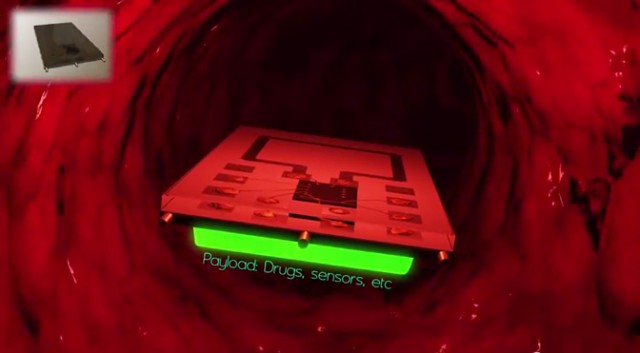
Medimachine: noun, a nanotechnological device used for medical applications. Granted, that’s not a working definition, but it does encompass what the technology is all about. And, as it happens, researchers at Standford created the world’s first device which is capable of traveling through the human bloodstream and which is controlled and powered wirelessly just this past year.

This development came in the midst of a similar significant development over at MIT. In January of this year, they announced that they had developed the world’s first implantable microchip that could deliver drugs directly into the bloodstream. This chip is also controlled wirelessly, and is the first step towards remote implants that could contain an entire pharmacy.

According to Ada Poon, the lead developer of the Standford team, the next step in the development of this device will be creating models that incorporate sensors and drug delivery systems for the ultimate in pin-point accurate medicine. If successful, Poon and her team could very well be responsible for creating the prototype device that will inspire entire generations of medical machines that are conducting exploratory exams, cleaning our arteries, removing tumors, destroying pathogens and viruses, and even repairing internal injuries.

And just think, if this development triggers further research and development, it could very well lead to nanomachines which are capable of making even tinier nanomachines. These devices could in turn manipulate matter on the mitochondrial level, correcting faults in our DNA and turning harmful or unwanted cells into something more useful for our bodies.

Just another step on the road to transhumanism and post-mortality!

Source: Extremtech.com

The Future…

A recent article from The Futurist concerning trends in the coming decade got me thinking… If we can expect major shifts in the technological and economic landscape, but at the same time be experiencing worries about climate change and resource shortages, what will the future look like? Two competing forces are warring for possession of our future; which one will win?

To hear Singularitarians and Futurists tell it, in the not-too-distant future we will be capable of downloading our consciousness and merging our brains with machine technology. At about the same time, we’re likely to perfect nanobots that will be capable of altering matter at the atomic level. We will be living in a post-mortal, post-scarcity future where just about anything is possible and we will be able to colonize the Solar System and beyond.

But to hear environmentalists and crisis planners tell it, we will be looking at a worldwide shortage of basic commodities and food due to climate change. The world’s breadbaskets, like the American Midwest, Canada’s Prairiers, and the Russian Steppe, will suffer from repeated droughts, putting a strain on food production and food prices. Places that are already hard pressed to feed their growing populations, like China and India, will be even harder pressed. Many countries in the mid-latitudes that are already suffering from instability due to lack of irrigation and hunger – Pakistan, North Africa, the Middle East, Saharan Africa – will become even more unstable.

Polar ice regions will continue to melt, wreaking havoc with the Gulf Stream and forcing Europe to experience freezing winters and their own crop failures. And to top if off, tropical regions will suffer from increased tropical storm activity and flooding. This will be create a massive refugee crisis, where up to 25% of the world’s population will try to shift north and south to occupy the cooler climes and more developed parts of the world. And this, of course, will lead to all kinds of political upheaval and incidents as armed forces are called out to keep them away.

Makes you wonder…

To hear the future characterized in such dystopian and utopian terms is nothing new. But at this juncture, it now seems like both of these visions are closer to coming true than ever before. With the unprecedented growth in computing, information technology, and biology, we could very well be making DNA based computers and AI’s in a few decades. But the climate crisis is already happening, with record heat, terrible wildfires, tropical storms and food shortages already gripping the world. Two tidal waves are rising and heading on a collision course, both threatening to sweep humanity up in their wake. Which will prove successful, or will one come first, rendering the other completely ineffective?

Hard to say, in the meantime, check out the article. It proves to be an interesting read!

The Futurist – Seven Themes For the Coming Decade

20,000 Hits!

Morning! Some good news, netter news, and bad on this rainy day here in Victoria BC. Good news first, I’m finally over my flu… well mostly. For days it’s been dogging me and keeping me grounded. Luckily, I turned this  time towards more articling and have topped 250! Good for me. As for the better news, I just learned that my hit ticker, the thing that monitors my overall traffic, has just passed 20,000. YAAAAAAY!

Okay, now for the bad news… I lied, there is no bad news! At least none that I can see right now, but I’m heavily biased by this good news. Perhaps I’m tempting fate… Who cares?! Point is, I’ve finally reached this milestone and there are plenty of people to thank!

For starters, I want to thank Worpdress.com for the FP back in March of this year. Were it not for them posting my article Dystopian Science Fiction, on their home page, I never would have made it this far. I know, the moderators give FP’s to like a dozen people a day, but thanks to that sliver of recognition, I got over 7000 hits in the space of 24 hours. That’s almost twice what I managed to get in the 12 months leading up to it. In the space of a day, my overall traffic went from just over 4000 to 11,000, just in the space of a day!

Wow. But more importantly, that day allowed me to pick up roughly 100 new followers. 100 new colleagues, peers, friends, and collaborators to spin ideas with, bounce my thoughts off of and help with ideas of their own. This meant that every day thereafter, whenever I published something, I had 100 people to share it with, rather than just speaking my thoughts to the void. That kind of interaction is invaluable and matters far more than overall traffic, let me tell you 😉

And things only got better from there. As March rolled in April and April to May, more and more people came by to comment on what I had to say and began following my blog. In those eight weeks, my total followers went from just over 100 to 200, on WordPress that is (think I got like 600 from twitter, but they rarely stop by!) So naturally, my endless gratitude goes to all the people who came by, liked what they saw, and decided to stay. Without you, this would really be impossible!

And of course there’s my family, my darling bride, the good folks at Grim5Next, and Story Time to thank. You’re encouragement, invitations to join in writer’s projects, proofreading and editing and helpful comments have always been a source of help and inspiration. I dream of someday writing professionally, which in addition to committing all my time to it means that I’ll also get paid. Hopefully, that dream isn’t too far from realization. I can’t tell you how annoying I’ll be when that happens, at least to those who sign my checks… Freaking PAY ME!

So once again, thank you all and I hope you’ll keep coming by in the future. I have plenty more to share, new ideas to formulate, and about a million more articles concerning science fiction, pop culture and the changing world we live in. And rest assured, if I EVER get famous, I’ll be taking all of you with me! Good luck and good day!

The Technological Singularity

This is a little off the beaten path right now, but lately, I’ve been spending a lot of time contemplating this big concept. In fact, it’s been informing the majority of my writing for the past year, and during my recent trip back to Ottawa, it was just about all my friend and I could talk about (dammit, we used to club!) And since I find myself explaining this concept to people quite often, and enjoying it, I thought I’d dedicate a post to it as well.

It’s called the Technological Singularity, and was coined in 1993 by sci-fi author Vernor Vinge. To put it concisely, Vinge predicted that at some point in the 21st century, human beings would be able to augment their intelligence using artificial means. This, he argued, would make the future completely unpredictable beyond that point, seeing as how the minds that contemplating the next leaps would be beyond anything we possess now.

The name itself is derived from the concept of the Quantum Singularity or Event Horizon, the region that resides at the center of a black hole beyond which, nothing is visible. In the case of a black hole, the reason you can’t see beyond this point is because the very laws of physics break down and become indistinguishable. The same is being postulated here, that beyond a certain point in our technological evolution, things will get so advanced and radical that we couldn’t possibly imagine what the future will look like.

how-nanotechnology-could-reengineer-us

Bad news for sci-fi writers huh? But strangely, it is this very concept which appears to fascinate them the most! Just because we not be able to accurately predict the future doesn’t stop people from trying, especially writers like Neal Stephenson, Greg Bear, and Charles Stross. Frankly, the concept was coined by a sci-fi writer so we’re gonna damn well continue to talk about it. And besides, when was the last time science fiction writers were bang on about anything? It’s called fiction for a reason.

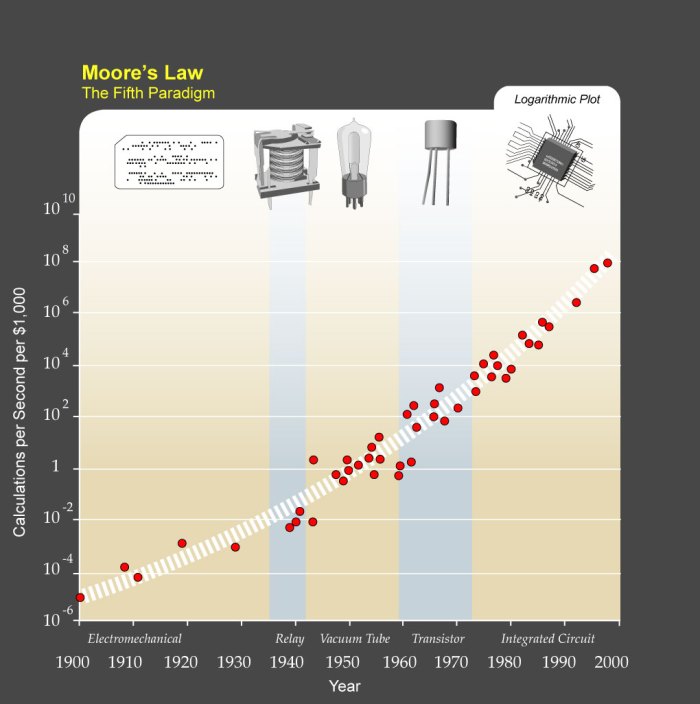
Men like Ray Kurzweil, a futurist who is all about achieving immortality, have popularized this idea greatly. Thanks to people like him, this idea has ventured beyond the realm of pure sci-fi and become a legitimate area of academic study. Relying on ongoing research into the many, many paradigm shifts that have taken place over time, he and others have concluded that technological progress is not a linear phenomena, but an exponential one.

Consider the past few decades. Has it not been a constant complaint that the pace of life and work have been increasing greatly from year to year? Of course, and the driving force has been constant technological change. Whereas people in our parents generation grew up learning to use slide rules and hand-cranked ammonia copiers, by the time they hit the workforce, everything was being done with calculators and Xerox printers.

PPTMooresLawai

In terms of documents, they used to learn typewriters and the filing system. Then, with the microprocessor revolution, everything was done on computer and electronically. Phones and secretaries gave way to voicemail and faxes, and then changed again with the advent of the internet, pager, cell phone and PDA. Now, all things were digital, people could be reached anywhere, and messages were all handled by central computers.

And that’s just within the last half-century. Expanding the time-frame further, let’s take a much longer view. As a historian, I am often fascinated with the full history of humanity, going back roughly 200,000 years.  Back then, higher order primates such as ourselves had emerged in one small pocket of the world (North-Eastern Africa) and began to circulate outwards.

By 50,000 years ago, we had reached full maturity as far as being homo sapiens is concerned, relying on complex tools, social interaction, sewing and hunting and gathering technigues to occupy every corner of the Old World and make it suitable for our purposes. From the far reaches of the North to the Tropics in the South, humanity showed that it could live anywhere in the world thanks to its ingenuity and ability to adapt. By 15,000 years ago, we had expanded to occupy the New World as well, had hunted countless species to extinction, and began the process of switching over to agriculture.

By 5000 years ago, civilization as we know it was emerging independently in three corners of the world. By this, I mean permanent settlements that were based in part or in full on the cultivation of crops and domestication of animals. Then, 500 years ago, the world’s collided when the Spanish landed in the New World and opened up the “Age of Imperialism”. Because of the discovery of the New World, Europe shot ahead of its peer civilizations in Africa, Asia and the Middle East, went on to colonize every corner of the world, and began to experience some major political shifts at home and abroad. The “Age of Imperialism” gradually gave way to the “Age of Revolutions”.

100 years ago, the total population of the Earth reached 1 billion, industrialization had taken full effect in every developed nation and urban populations were now exceeding that of rural. 50 years ago, we had reached 3 billion human beings, were splitting the atom, sending rockets into space, and watching the world decolonize itself. And only 10 years ago, we had reached a whopping 6 billion human beings, were in the throws of yet another technological revolution (the digital) and were contemplating nanotechnology, biomedicine and even AI.

In short, since our inception, the trend has been moving ever upwards, faster and faster. With every change, the pace seems to increase exponentially. The amount of time between paradigm shifts – that is, between revolutionary changes that alter the way we look at the world – has been getting smaller and smaller. Given this pattern, it seems like only a matter of time before the line on the graph rises infinitely and we have to rethink the whole concept of progress.

Is your nooble baked yet? Mine sure is! It’s get like that any time I start contemplating the distant past and the not too distant future. These are exciting times, and even if you think that the coming Singularity might spell doom, you gotta admit, this is an exciting time to be alive. If nothing else, its always a source of intrigue to know that you are on the cutting edge of history, that some day, people will be talking about what was and you will be able to say “I was there”.

Whoo… deep stuff man. And like I said, fun to write about. Ever since I was a senior in high school, I dreamed of being able to write a book that could capture the Zeitgeist. As soon as I learned about the Technological Singularity, I felt I had found my subject matter. If I could write just one book that captures the essence of history at this point in our technological (and possibly biological) evolution, I think I’ll die a happy man. Because for me, it’s not enough to just have been there. I want to have been there and said something worthwhile about it.

Alright, thanks for listening! Stay tuned for more lighter subject matter and some updates on the latest from Story Time and Data Miners. Plus more on Star Wars, coming soon!

Of Great Sci-Fi (and other non-affliated) Quotes:

alien-worldRecently, I’ve taken to posting quotes by the great science fiction authors on twitter. Most are from the authors I draw the most inspiration from, others are just from people I admire and who offered some wisdom along the way. Like a true nerd, I keep these things in a file on my computer, adding to it every time I find a new one or think up one myself. Might sound odd but I find it useful, it offers fresh inspiration and perspective whenever I’ve hit a wall or am not sure how a piece of writing is turning out. Today, I thought I’d share a few of the gems that have really inspired me over the years. To be fair, some of them are not science-fiction related, or even by authors; they’re just moments of brilliance captured in an utterance. Here are a few:

“We sit atop a sort of anthill of technologies. At the bottom there’s fire, and growing cereal grains, and learning to store cereal – all those things that people have to store edible energy and start building cities. Not that we’re the crown of creation; we are at the crown of technological creation at any given moment.”
-William Gibson during an interview after writing “Pattern Recognition”

“It’s impossible to move, to live, to operate at any level without leaving traces, bits, seemingly meaningless fragments of personal information.”

“The future has already arrived. It’s just not evenly distributed yet.”

“Cyberspace. A consensual hallucination experienced daily by billions of legitimate operators, in every nation, by children being taught mathematical concepts…”

“When I began to write fiction that I knew would be published as science fiction, [and] part of what I brought to it was the critical knowledge that science fiction was always about the period in which it was written.”

“. . . the street finds its own uses for things.”
-Other tidbits from Gibson, who’s nothing if not prolific in his observations!

“The difference between stupid and intelligent people—and this is true whether or not they are well-educated—is that intelligent people can handle subtlety. They are not baffled by ambiguous or even contradictory situations—in fact, they expect them and are apt to become suspicious when things seem overly straightforward.”
-Neal Stephenson, “The Diamond Age”

“Ronald Reagan has a stack of three-by-five cards in his lap. He skids up a new one: “What advice do you, as the youngest American fighting man ever to win both the Navy Cross and the Silver Star, have for any young marines on their way to Guadalcanal?”
Shaftoe doesn’t have to think very long. The memories are still as fresh as last night’s eleventh nightmare: ten plucky Nips in Suicide Charge!
“Just kill the one with the sword first.”
“Ah,” Reagan says, raising his waxed and penciled eyebrows, and cocking his pompadour in Shaftoe’s direction. “Smarrrt–you target them because they’re the officers, right?”
“No, fuckhead!” Shaftoe yells. “You kill ’em because they’ve got fucking swords! You ever had anyone running at you waving a fucking sword?”
-Stephenson, “Cryptonomicon”. One of the funniest written passages I’ve ever read, and fitting because it puts Reagan in his proper, historically accurate place!

“I just think talk of suffering should be left to those who’ve actually suffered.”
-Jack (a First Nations former student I knew. As soon as he said it, I knew that I had just heard one of the smartest things ever said by anybody, anywhere, ever!)