“Earthshaking” News From the Red Planet?

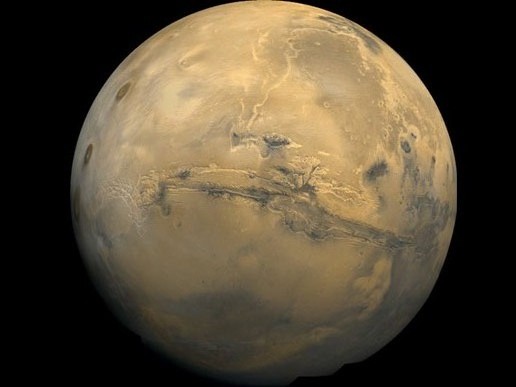
In an interview with NPR earlier today, John Grotzinger – the Principal Investigator for NASA’s Mars Science Labs – said a recent soil sample test with the SAM instrument (Sample Analysis at Mars) shows something”‘earthshaking.” Like any good scientist (or a terrible tease), Grotzinger and his team are awaiting confirmation before announcing just what it is they’ve found. Nevertheless, the announcement of a potential discovery which could be “one for the history books” has fueled speculation and put many on the edge of their seats.

Thus far, the smart money has been on the discovery of organic molecules in the Martian soil, which is precisely what Curiosity has been up to for the past few months. This is because the very purpose of the SAM instrument to examine the chemical and isotopic composition of the Martian atmosphere and soil, specifically to determine if anything organic is capable of living there. If so, it will end the age-old argument of whether or not life can exist on the surface Mars, even if it doesn’t currently.

It will also prove to be a boon for those who are seriously looking ahead, and plotting manned missions to the Red Planet with the intent of making it habitable for humans. As I’m sure all people are aware of by now, there are plenty of people who are monitoring Curiosity’s findings and hoping they will help determine whether or not terraforming can be carried on the the planet, with the long-term goal of creating a “Green Mars” where terrestrial species can live and thrive, crops can grow, and oceans and rivers can once again exist.

I think I speak for them and myself when I say, “Grotzinger, best of luck to you, and this better not be some kind of media stunt!” Oh, I can’t wait to hear what they find!

Source: Universe Today

Engineering Life for Mars

And we’re back with some more news of and about the Red Planet! Thanks to Curiosity’s ongoing efforts to discover potential life on Mars, scientists back at home have begun to seriously contemplate engineering life that will help in our own colonization efforts someday. The rational seems to be, “why search for life on Mars when you could create it?”

And the reasons for this seem pretty straightforward. Though Mars may have supported life at one time, it is not an especially hospitable environment right now. If in fact human beings settle there someday, survival won’t be easy. The average surface temperature of Mars is minus 60 degrees Celsius, and the almost-nonexistent atmosphere is 95 percent carbon dioxide.

And although water exists in Mars’ ice caps and there’s some evidence that oceans once existed, today it’s essentially a deep-frozen desert. If the would-be settlers ever want to live beyond sealed domes, and eat something other than hydroponically grown food and melted ice that is constantly being recycled, efforts to be got underway to ecologically engineer the surface.

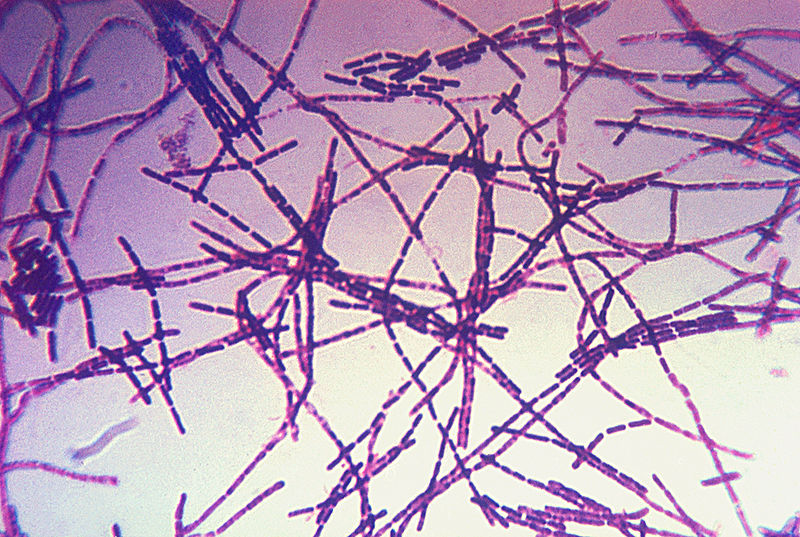
And one such group is a team of undergraduate students from Stanford and Brown Universities that are busy applying synthetic biology to space exploration, outfitting microbes to survive the extreme Martian conditions and produce resources needed to sustain a human colony. According to Ben Geilich, the team Captain, the benefits are obvious: “Obviously, bringing up heavy machinery or building materials is going to be really expensive. The benefit of having bacteria that can do this for you is they’re really small and very light. Once there, they could grow food, produce medicine, extract minerals, and build building material.”

The fruit of their labor is the Hell Cell, a genetically engineered assemblage that could enable a bacterium to withstand extreme cold, dryness and radiation. It includes genetic modules, or BioBricks, based on DNA from a variety of ultra-tough organisms, including a cold-resistant species of Siberian beetle that makes “antifreeze” proteins, a radiation-resistant bacterium that sequesters large amounts of the element manganese, and E. coli, which produces a nutrient that confers cold and drought resistance.

It’s part of a process that Andre Burnier, one of the team’s mentors and a lab technician at NASA’s Ames Research Center, described in the following way: “You go into nature and find genes, and then you can recombine them into circuits that you cannot find in nature.” After presenting their Hell Cell during the regional International Genetically Engineered Machines (iGEM) challenge this month, the team has since moved on to developing bacteria that could extract minerals from Martian sediment or recycle rare metals from spacecraft electronics. In addition, they are also investigating heat and acid-tolerance mechanisms that could be useful in other planetary environments, particulary Venus, which as you may recall, is also a candidate for terraforming.

Needless to say, Geilich is excited by all the doors theirs and the research of others is opening. “In the coming years,” he says, “I think we’re going to see a huge boom in stuff done with bacteria, only limited by our imagination and creativity.” But of course, not all agree. As Burner indicates, there are ethical implications that are likely to upset some, should the concept ever be made viable. After all, if there is no life on planet to begin with, then there are no ethical implications about transforming it. But send in the bacteria to change up a world that already boasts life, and you are essentially committing eco-genocide.

All of this puts me in mind of the Genesis Project from Star Trek II and III. There, scientists created a device which could alter the configuration of any planet within minutes. With a name like “Genesis”, the purpose was pretty self-explanatory – to create life from lifelessness. But this made it absolutely necessary to find a lifeless planet, otherwise whatever was already there would find itself permanently altered.

Funny how science fiction predicts real science, up to and including the ethical implications. They were pretty good movies too, go heck them out. And follow the link below for more reading on the subject!

Source: Wired.com

The Case for Terraforming Venus

This weekend appears to be shaping up with a theme: news from space that isn’t about Mars. I swear that it’s entirely accidental. First there was the discovery of the diamond planet, 55 Cancri e, and now a story about the merits of terraforming another planetary neighbor. And wouldn’t you know it, it’s not Mars for a change.

Yes, it seems that there is a strong case for terraforming Venus instead of the Red Planet, and it comes from numerous scientists who claim that altering the climate on that planet could help us save our own. The reason being – and stop me if this sounds frightening – is because our planet could one day look just like our lifeless, acid ridden, cloud covered neighbor.

In short, Venus underwent a carbon-dioxide fueled cataclysm a long time ago, when it was still young and was believed to have oceans. In those early days, and as the sun got brighter, Venus’s oceans began to boil and evaporate into the atmosphere. As a result, carbon dioxide accumulated in the atmosphere, due in part to the lack of carbon recycling which depends on the presence of oceans and seaborne algae. This is essentially a magnified version of the Greenhouse Effect, which scientists identify as the reason for rising temperatures and melting polar ice caps here at home.

Because of this, Venus became the hot, deadly planet that we are familiar with today, with surface temperatures that average 467°C (872°F), hot enough to melt lead. What’s more, its atmosphere consists of 96% carbon dioxide, which appear as thick layers of clouds that float 50-70 km above the surface. Above that, clouds and mist of concentrated sulfuric acid and gaseous sulfur dioxide lead to acid rains that could literally melt the flesh off your bones and the metal off a landing craft. Combined with the amount of sunlight it gets (twice that of Earth) and the lack of a magnetosphere, Venus is a pretty damn awful place to visit!

Of course, some would say that this makes terraforming the planet a pretty dangerous and poor prospect, at least compared to Mars. However, the benefits of terraforming Venus are far greater, certainly when we consider that the lessons gleamed from it could help us reverse the Greenhouse Effect here on Earth. In addition, it’s closer than Mars, making it easier and quicker to travel back and forth. And like the Earth, it resides within the solar system’s habitable zone and has its own atmosphere, not to mention it is nearly the same mass and size as Earth.

All of this, when taken together, would make Venus a far more suitable place to live once the terraforming process was complete. In short, its easier to convert an existing atmosphere than to create one from scratch. And, as noted, the process of converting the CO2 and sulfur-rich atmosphere into one that a breathable one that is rich with water and precipitation would go a long way to helping us device solutions to cleaning up our own atmosphere here at home.

This may sound like pure speculation, but in truth, many solutions have already been proposed. In fact, Carl Sagan began proposing that we introduce genetically-modified airborne algae into Venus atmosphere 50 years ago. Thought not 100 percent practical, it was a stepping stone to some more recent ideas which may prove doable. In 1981, NASA engineer James Oberg proposed that all the CO2 could be blown out into space. Again, not the most practical idea, but they were thinking and that’s what matters!

More recently, Paul Birch, a writer for the British Interplanetary Society, proposed flooding Venus with hydrogen. Once it interacting with the high concentrations of CO2 in the atmosphere, the end products would be graphite and plenty of water. Other plans involve carbon capture, nanotechnology, and other advanced forms of ecological engineering. These, alone or in combination, could prove to be the difference between thick glass clouds and sulfuric oceans and a lush green planet covered with water and vegetation.

A pretty interesting prospect; and if it all works out, humanity could end up with three habitable planets within the Solar System alone. Combined with pressure domes and sealed arcologies on the system’s various moons and larger asteroids, planet Earth could one day retire as the sole host of humanity and this thing we call “civilization”. In fact, I could foresee a time when our world goes on to become hallowed ground, hosting only a few hundred million people and free of heavy industry or urban sprawl. Hello idea for a story!

And, to mix up what I usually say at the end of every one of these posts, stay tuned for more news from Mars and other planets within our Solar System. There’s a lot of them out there, and someday, they might all places that our species calls “home”.

Source: IO9

New Anthology Sample: The Torch!

Hello all and welcome back for another Anthology Update. As I said a few days ago, there is still plenty of news to be had vis a vis my groups ongoing efforts to create our our Magnum Opus about colonization and space travel, aka. Yuva. And the latest is that I’ve finally begun writing the prologue for the entire series.

Entitled “The Torch”, this first installment in the anthology shows the origins of the story’s central character (Magid Muktari) and his lifelong mission to see humanity colonize a distant world. Thanks to Khaalidah Muhammed-Ali who coauthored this with me and once again provided the characters and impetus for it’s creation! Hope you all enjoy!

“A man of cold, hard science, most assume that Magid Muktari was not a man of faith. At the press conference following the acceptance of his final proposal for the creation and international funding of the Yuva Colonization Project, Muktari was questioned thus by one young reporter: “Sir, can you please explain to us why this project is so important?” Muktari said in cryptic form, “Our Earth is alive.” When asked to elaborate Muktari said: “Has not Allah promised us in that every soul shall taste of death?”

-Magid Muktari, 2108

Masdar City, UAE, 2048

Magid Muktari took a deep breath and tried to remain calm. Oh how he hated waiting! Even after all the years he had spent on the front lines of his industry, waiting for meetings, trips to end, and plans to reach fruition, he still couldn’t stand the time it took to wait for a presentation. But that was the way of it, he knew. Anticipation was the thousand little deaths that preceded the actual execution. One could only surmise from this that humans weren’t designed to wait on others. Either that or the Universe had a very poor sense of humor.

To pass the time, Muktari began to punch up his presentation info. Adjusting his compad to a convex shape and resting it on his knees, he placed his contacts to display mode and waited for the computer to warm up. A command prompt appeared in his field of vision and asked for his password. He typed it in promptly.

Meşale

His eyes filled with a cerulean blue sky, small clouds and a series of desktop icons dotted the projected heavens. Accessing the proper folder, he accessed the presentation and waited a moment. The opening display image, five planets arranged from left to right, appeared in his visual field shortly thereafter.

The Future of Off-World Settlement, ran the title. A title bar appeared beneath the five planets, their names scrolling out as the marble-sized pictures became animated.

Gliese 581 g, Gliese 667C c, Kepler 22 b, HD 85512 b, Gliese 581 d

Placing his hands above the compad again, Muktari brought up the first of the five. The brown marble moved to the center of his visual field, displacing the rest and growing exponentially in size. A soft contralto began to speak in the background.

“Planet Gliese 581 g, fourth planet of the Gliese 581 star system. Discovered in 2000 by Lick-Carnegie Exoplanet Survey, led by principal investigator Steven S. Vogt, who named the planet Zarmina after his wife – ”

Muktari terminated the audio and began interfacing with the image. Zooming in on the planetary mass, he began to assess the features that had been observed from the most recent astronomical surveys. Being a tidally-locked body, only so much was visible, and most of that was only clear when the space telescope and the exoplanet’s rotations were in perfect sync. He moved back and forth, noting the outlines of a large continent facing towards the sun.

No, not a lot happening there, he thought gravely.

Putting it back in its place, he called forth the second in the list. Here too, the disc look particularly brown and mottled. However, its size and relevant characteristics set it apart from the previous entry, and here too Muktari began to worry. Super-Earth’s were not exactly a popular destination for colonists, not when they could expect a serious and potentially punitive adjustment period.

Muktari shut the display down and took a deep breath. Moments away from the greatest presentation he would ever make, that perhaps anyone would ever make, and he was already beginning to write himself off. Not a good sign, not if he wanted to have any chance at convincing Zimmerman of his sincerity.

There were those who said that the great Magid Muktari could sell ice to the Eskimos. Other’s said he could sell sand to the Arabs. He never cared for either assessment; both seemed to be both inaccurate and quite bigoted in his estimation. But the sentiment he understood.

But then again, the sheer scope of what he was proposing might have had something to do with that. Were this just another pitch, a proposal for more allocations, more surveys or more satellite deployments, he probably wouldn’t be giving it a second thought. And after years of bending the ears of government and industry officials who did business with them, he had earned himself enough capital to make a few pitches of his own.

If he screwed this up, all that capital would burn up and be gone. What’s more, he would be humiliated in front of the man he had come to respect more than any other…

Across from him, seated at her desk, the assistant seemed to stir. In her eye piece, the image of a face appeared and she began conversing with it. Muktari was only privy to one half of the conversation, which was mainly her agreeing.

 “Yes… yes… yes, sir. I will pass that along.”

The image faded and she looked over to Muktari.

“Mr. Zimmerman’s plane has just landed. He will be here in five minutes.”

Muktari nodded. Another thing that hadn’t changed over the years. Regardless of how much time transit really took, it was an administrative habit to say that it would take five. And he knew from experience that a pod ride from the aerospace port to the office building would take at least ten. And then he would no doubt be mobbed by half a dozen assistants and corporate middle-men who needed to advise him and brief him on his way in. In truth, he would be lucky if he spoke to him before the hour was out.

He checked his chrono just to get a sense of the time. His watch was still set to orbital time. He shook his head when he realized that that was the last time he had slept, in a room near the tip of the axis looking out at the southern tip of Chile. Ever since, he had been running on a non-stop diet of aerospace lag, adrenaline and EBME.

At last, the woman at her desk looked up again and got that distant look in her eyes. She repeated the familiar string of secretary talk.

“Yes… Hello. Yes, sir, he is. Right away, sir.” Her call ended and her eyes focused on him. “Mr. Zimmerman will see you now.”

Muktari smiled and placed his compad back in the satchel. Getting to his feet, he ran a hand through his hair and straightened his blazer. His clothes were fresh, but his skin still felt like it was carrying a few days’ worth of residue. He discreetly checked for any telltale signs of body odor as well, and was reasonably confident the natural musk he was carrying wouldn’t kill his boss. After many minutes in the same room as him, the secretary seemed undisturbed.

Here we go, he thought, and set off for the door.

The door slid open, revealing Zimmerman in the middle of freshening up. This consisted of him shedding his blazer and replacing it with one of the many he kept hanging in his side closet. He looked up with mild amusement at Muktari’s entrance.

“Magid,” he said, throwing on a fresh top. “You’ve travelled some distant to and come see me.”

“Yes I have, but only a fraction of your own, from what I hear.”

“Yes,” he said with a sigh. “The Jovian tour was quite extensive. One has to wonder why we can’t just teleconference the entire process.”

 Muktari smiled. Though he tended to complain upon his returns, everyone knew that Zimmerman remained an engineer at heart. Whenever new facilities went in and processing began, he insisted on conducting spot checks in person. Somehow, the virtual variety did not inspire much in the way of confidence from people like him, men who openly bragged about being educated in a simpler time.

“So…” he said, taking his seat. “What’s so important you had to see me as soon as I got back?”

“Well sir, I wanted to see you while the trip was still fresh in your mind.”

“Oh?” Zimmerman said with a nod. “Then this ought to be good.”

Muktari chuckled and placed his satchel down beside the seat in front of him. He removed his compad again and placed it directly on top of Zimmerman’s desk. He keyed up the 3D display and sat back.

“As it stands, this company is responsible for almost half of the development taking place in the outer Solar System. Unlike many other firms that see little promise in anything beyond the Belt, we’re renowned for taking the long view. That’s what I’m hoping to tap into.”

Zimmerman grumbled. “Why do I have the sinking feeling you’re winding up for a very slow pitch?”

Muktari chuckled. “Shall I cut to the chase?”

“Please do. Formal presentations are for board rooms and junior execs.”

Muktari terminated the display on his compad and stood. He walked to the room’s window and looked outside. The glittering spires of Abu Dhabi shined in the distance, visible just beyond the cities limits. He took a deep breath and started from the beginning.

“How long have I been in your employ, sir?  Ten years, the last six of which I’ve spent as the head of our eco-engineering division. Much of the technology that was borne here and is now being adapted by other cities worldwide originated in our labs. And yet, everywhere I go, I hear the same basic reports, the same alarming assessments.”

Zimmerman looked on and pursed his lips. He was still waiting for the point to emerge. His recent travel had clearly taxed his patience to its very limit. He decided to expedite things.

“As it stands, eco-engineering accounts for over twenty percent of our government’s annual global spending.  Investment and development have been moving more and more to off world locations. And it’s estimated that by the end of this century, the majority of our planet’s heavy industry will be relocated to Luna, Mars, and the Asteroid Belt. All this points towards a singular trend.”

“Extra-terrestrial development,” Zimmerman said obviously. “What of it?”

“But what drives it?” Muktari asked, turning to look him in the eye. “What knowledge prompted us to create orbital facilities, off-world mining and agricultural settlements, and to spend so much, year after year, trying to keep global mean temperatures down?”

Zimmerman nodded. The inclusion of that last detail was indication enough of what he was getting at. Naturally, he let him continue.

“The Earth is still cycling towards death, its oceans are still rising, its coastal areas are still plagued by floods and storms, drought and famine are still causing untold damage and death in the most densely populated regions, and humanitarian crises abound. What’s more, off-world settlement was hoped to be a means of relieving population pressures here at home; but you are certainly aware, the Solar Colonies maintain some of the highest birth rates, compared to Earth. Soon enough, there won’t be enough room and expansion will just shift the burden, but not by enough to make a difference here at home. When it comes right down to it, the scientific consensus on Earth’s longevity is clear.”

Zimmerman nodded, quoting from the latest findings. “Barring some major technological developments, such as the development of full-spectrum nanotechnology and/or a full-spectrum development of the Earth’s equatorial regions, and we can expect that most of the planet will be only partially habitable by 2100.”

Muktari extended his hand, palm facing up. The point was laid bare. He went back to his seat and lowered himself into it, careful not to strain any of his tired muscles.

“We proceed on track as if our current measurements will be enough to stay the torrent, but the problem continues to grow unabated. And just about everywhere I go, I am asked how we will save the planet.”

Zimmerman allowed for a brief pause and then raised his hands. “I’m on the edge of my seat, Muktari. What are you proposing?”

Muktari sighed and held his hands in front of him. This was where things would truly be tested. It was do or die time, he could hesitate no longer.

“Not too long ago, a colleague of mine, Adamcik, you’ve met him.” Zimmerman hummed affirmatively. “He hit me with a rejoinder not too long ago which truly vexed me. I asked him how we would go about addressing this planet’s needs. He retorted by asking me, ‘what if this planet is the problem?’”

Zimmerman frowned. Muktari had done much the same when he first Serge say it.

“When it comes right down to it, our homeworld is plagued by three separate problems – overpopulation, environmental degradation, and economic underdevelopment.” He raised his fingers, counting them off. “All of these are interrelated and compounded by one another. What’s more, attempts to remedy any one of them inevitably meets with failure due to the presence of the other two. We address the planet at the expense of the economy, we promote economic development at the expense of the environment, and all attempts at addressing the population fails as long as the economic divide remains. And our Extra-Terrestrial colonies aren’t going to solve this problem any time soon, and simply are not big enough to host our civilization should Earth fall.” He paused for the last time and took a deep breath. “So what if we looked farther abroad?”

Zimmerman raised an eyebrow. He was intrigued, Muktari was thankful for that much.

“Within this arm of the Galaxy, we’ve already confirmed the existence of several dozen Earth-like planets. Of the top five contenders, four are within 35 light-years from us; which, given the current state of technology and a hefty investment, can be traversed in just over a century.”

“Wait a minute!” Zimmerman raised his hand. “You’re talking about actual exoplanet colonization?” Muktari nodded. Zimmer waited for a moment, seemingly waiting for the punch line, and then scoffed. “Magid, you know as well as I do that research and development for deep space travel is a mere fraction of what we dedicate to aerospace development. For anyone to even begin contemplating an interstellar expedition, billions in investment capital would have to be poured into research and development.”

“I know,” replied Muktari. “Which is precisely what I suggest we do. If we create an exoplanet division, right away, we could produce a worthy vessel within a quarter of a century. Of all the viable candidates, two exist within the same star system and happen to be closest. Give them one-hundred years to reach –”

“How much?” Zimmerman said intrusively.

“All told, roughly fifteen percent of our annual gross. However, we’d need to outsource some of concerns, which would mean partnering with other corporations worldwide. We might also be able to convince a number of NGO’s and government bodies to –”

“Magid!” Zimmerman raised his hand again and kept it raised. When a few seconds of silence passed, he lowered it and sighed before talking again. Not that he needed to, Muktari had known for some time that he had lost him. He sighed and resigned himself for what was coming.

“You’ve compiled all this into a presentation, yes?”

“Yes,” Muktari said with a  resigned nod.

“Good. Let me look over it and present it at the next board meeting. I’m sure they will find it all… very illuminating.”

Muktari fetched his compad and keyed up the transfer sequence. Within seconds, a copy of his full presentation was transferred to Zimmerman’s personal files and the system acknowledged the receipt. Standing, he extended his hand and shook Zimmerman’s. He didn’t bother to get up.

He turned to leave, knowing there was little more that could be said. Unfortunately, something was holding him back once he reached the door. Some small shred still needed to be shared, a final push before he abandoned the office and trusted in his boss’ judgment to make the right decision. He knew that if he left without saying it, his idea would fall on deaf ears. With that degree of certainty, what else did he have to lose?

“Sir, if I may say one final thing…?” He turned to face his boss again, received a nod of approval. “Since time immemorial, civilizations have used the symbol of the torch to symbolize the life of their civilizations. I think the reason for this is obvious. Flames banish the darkness of confusion, death and despair. They light the way to the future. But most importantly, they are temporal. A flame, like a culture, or any other living thing, is impermanent. It requires care and commitment to keep it alight. When the flame begins to falter, or the bearer of it loses their footing, they must pass it onward. They throw the torch, as it were, to keep it aflame. If we are facing the death of our civilization here at home, then we must contemplate passing it onward, and to a suitable place. Before it’s too late.”

Zimmerman took a few slow, heavy breaths. When he was finished, all he could do was shook his head and offer the same tired reassurances.

“I admire your passion, Magid. However, I think your sights are focused just a little too far. In time, what you’re proposing might be feasible, but as it stands, no one is going to jump on this, not when the payoff is so immensely distant and the risks so high. I’d set your sights closer, focus on the work and development which needs to be done here. Then we’ll talk about looking to the stars.”

He smiled, a warm little gesture to let Muktari know he still held him in esteem. Muktari smiled back, thankful for that much, and showed himself out.

Mars Lander Mission, 2016

With all the news coming back from Curiosity rover since its deployment, one would get the impression that Mars is a pretty happening place. Blue sunsets, wide open vistas, tall mountains and extensive plains. All the while, our collective fascination with the planet has been growing apace. And it seems that this trend is destined to continue…

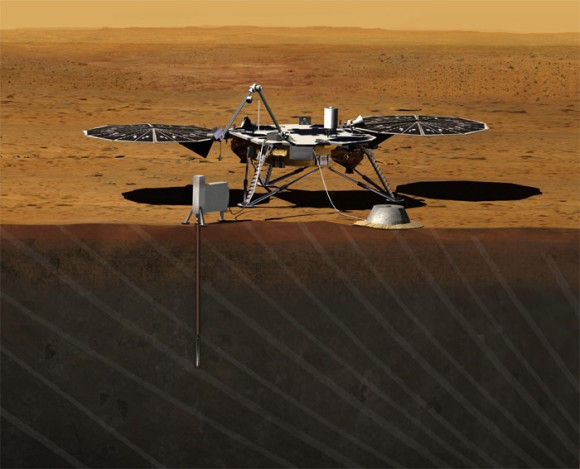
After looking at several low-cost options for their next major mission, NASA scientists decided to once again return to the Red Planet, this time to do some interior planet studies to determine whether Mars has a solid or liquid core, and determine the planet’s basic structure.

Known as the InSight lander, this mission won out over two equally enticing proposals. The first called the for the deployment of the Titan Mare Explorer (TiME), a floating high-tech buoy which would be sent to Saturn’s moon Titan. Once there, it would study the methane lakes of Titan, examining their composition and interaction with the atmosphere. Thanks to the Cassini probe, these lakes have attracted a great deal of interest of late, particularly since they may be able to support life. Understandably, many can’t wait to study them up close and see if this holds true.

The second potential mission called for the deployment of “Chopper”, a proposed Comet Hopper mission that would put a lander on comet 46P/Wirtanen where it would study the comet’s composition. This comet, which was originally discovered in 1948, belongs to the Jupiter family of comets and orbits the Solar System once every 5.4 years. Studying its make-up would go a long way to helping scientists understanding how Solar comets behave and provide clues as to the early formation of our Solar System.

But scratch those! With 2016 on the way, budget limited and Mars the happening place, InSight will be the one to go. What’s more, it’s research is likely to prove very useful in settling some ongoing arguments, not the least of which is whether Mars possesses liquid water beneath its surface. If this should prove true, it might mean terraforming could be a go sometime down the road…

People can dream! And speaking of which, check out the NASA simulation of what InSight will look like once deployed.


Source: Universe Today

The News From Saturn

Saturn has certainly been seen in the news a lot as of late. And you have the Cassini space probe, which was deployed from Earth back in 1997, to thank for all of that. Having completed the first leg of its mission back in 2008, its mission was extended to 2010, when most of the new photos and startling discoveries that are now being announced were made. Now, the healthy spacecraft is seeking to make exciting new discoveries in a second extended mission called the Cassini Solstice Mission.

But alas, the news! First, there was the announcement back in February that Saturn’s two largest moons – Titan and Rhea – were captured together in the same photo by the Cassini space probe. Considering that Saturn has 66 moons and Cassini was flying past at the time, this was no small accomplishment! What’s more, Titan’s atmosphere, which is fully developed (the only Saturnine moon to have this) was captured perfectly the shot.

But the news didn’t stop there. Shortly thereafter, in March to be specific, a report published in the Geophysical Research Letters announced that a thin layer of oxygen was discovered around Saturn’s moon of Dione. Once again, this discovery was made by the Cassini space probe as it passed by this other satellite of Saturn’s two years ago. This finding is proving to be quite the exciting one within the astronomical community.

Shortly after that, NASA announced that the moon of Enceladus did indeed have its own ocean. Named the Enceladan Ocean, this natural body of water has been known about for some time, but what is now known is the water contains carbon dioxide, carbon monoxide, potassium salts and other organic materials. On top of that, it is now understood that it is situated above some volcanic jets, which means the water is most likely warm. Warm water, combined with organic minerals, makes the Enceladan Ocean a good candidate for life!

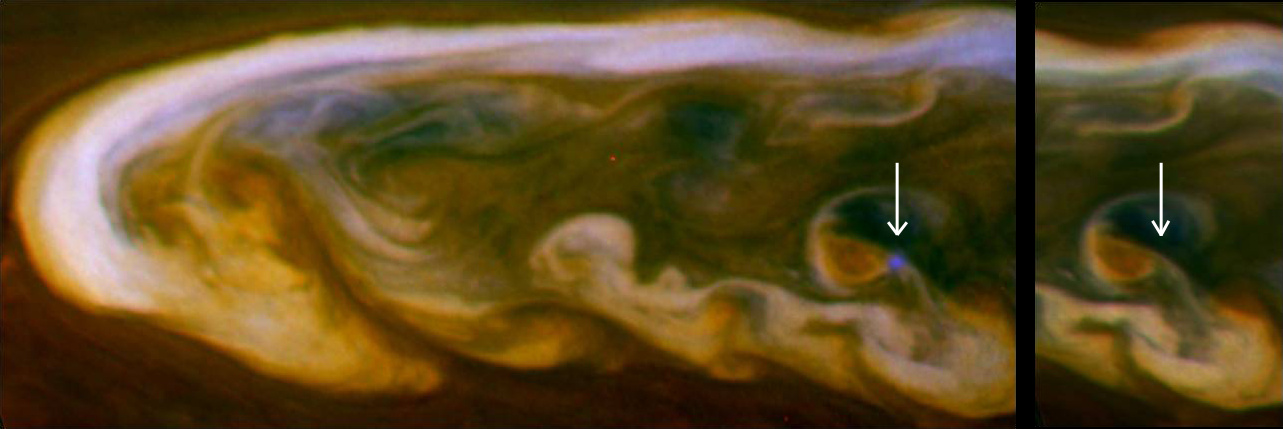
And then, in late July, images released by NASA showed that Cassini also caught a glimpse of a thunderstorm happening on Saturn’s surface. As all residents of Earth will surely agree, a thunderstorm is an impressive sight to behold. Especially when it’s seen happening on another planet! Apparently, what made this sighting most impressive was that it was visible on Saturn’s day side – aka. in broad daylight – from a range of 4.5 million km (2 million miles). That’s one humungous light show!

And less than a week ago, more information emerged as a result of the Cassini space probe, this time in relation to Saturn’s moon of Iapetus. After getting a good glimpse of the moon, scientists at NASA have determined that it is home to the largest ice avalanches in the Solar System, and is rivaled only by Mars. Take that Mount Everest! You too Olympus Mons!

Already, scientists had Iapetus pegged as the most intriguing moon in the Solar System. For starters, it has a Ying-Yang color pattern, looks like an inverted Death Star (check that image, no Photoshopping!), and has a long ridge running almost perfectly along Iapetus’ equator, a feature which earned it the nickname “the walnut moon”. I guess it wasn’t happy with just that, it also wanted to be the most dangerous place to downhill ski!

And you thought Jupiter did some badass things. Well, it does. But judging from all these findings, Saturn is going to be a pretty happening place someday. I can envision settlements on Titan, skiing on Iapetus, and terraforming on Dione. And for those who like to sight-see, there will be shuttle services that take you to the dark side of Saturn to witness the light show from space. Ooooh, I got goose bumps!

Via: BBC, IO9, Nature Geoscience, CICOPS, Time Science, and NASA

3D Model of the Yuva Ship

Hey all. Thanks go to William Joel, contributing author to the anthology project, for coming up with this artistic gem. Yes, in addition to being an accomplished writer, he also teaches computer animation and knows a thing or two about rendering things in 3D. This animated short is of the Terraforming ship, Mark I, doing a fly by in deep space. Hope you enjoy as much as I did!

Winston Agonistes, Part IV

Welcome back! You know, it feels like I’ve been a little wan in my output lately. Perhaps it’s because I’ve been hard at work on my stories… or not. Hard to say really, but I will say that the anthology me and my colleagues have been working on is coming along nicely! In an attempt to keep pace with my group, I’ve come up with another installment in the Winston Agonistes story.

And just for fun, much of this installment was inspired by real-life tales of Shàngdū, China. It is this ruined city that was once the summer capital of the Yuan Dynasty, as decreed by the Mongol ruler Khublai Khan. Often referred to as Xanadu or Sanadu (in Mongolian), this city is the same place that is mentioned in Marco Polo’s account of China, the one which inspired European dreams of traveling to the Orient and finding cities of gold. It also inspired the poem “Kubla Khan” by Samuel Taylor Coleridge and a musical which I will not get into, even to save my own life!

Anyway, here it is, fresh from the press. Behold!

As expected, a greeting party was waiting for them in the Transport Bay. Dressed in their ceremonial robes and wearing pressure masks, they stood on the platform overlooking the main deck. Winston eyed them through the cabin window as their ATV came to a complete stop, noting the individuals and their respective positions from the mantles they wore.

There were five in total, arranged by twos around the one in the middle who wore the most flamboyant garb of all. The ladies he denoted by the choice of red robes, while the males wore the traditional blue, consistent with Shiangdu’s code of customs. Aside from that, there was only a single distinction, which came in the form of the orange inlaying that the man in the center had on his robe. That could be none other Commissioner Yan Moon Kim, Wu’s second in command.

The seals disengaged and the door opened. The top segment rose above the ATV’s roof while the bottom one lowered to form their exit ramp. Winston allowed the Councilors on the other side to file out first and fitted his helmet, which at this point in their mission had remained unused, over his head. Though the Shangdu settlers were no strangers to synthetics, their reaction to seeing one in the capitol’s delegation could not be fully predicted.

As their team filed into the bay, the Shangdu representatives climbed down the steps to the deck to meet them. Handshakes were exchanged between Kim and Mutlu, Kim gesturing to the pressure doors immediately thereafter so that further pleasantries could be conducted without the need for helmets. Mutlu nodded and they marched together, mounting the steps and entering through the cycling doors that would lead them within.

Winton looked back upon the bay, noted the deck hands that began to pour over their ATV. As a courtesy, they refueled the vehicle, removed the excess traces of fungal deposits from its wheels, and packed them away in biohazard containers. Some of the tendrils looked rather large this trip.

The pressure doors opened, admitting them into a small vestibule located next to the main colony. Much like all decontamination bays, the walls were studded with sensors, vents and irradiation panels, all of which became active as soon as the doors closed behind them. Many in their crew drew a hand to their face to cover their visors, protection against the onset of the harsh lighting that began to fill the confines of the room. Winston needed no protection, as his eyes adjusted automatically to the onslaught of the harmful rays. In a few seconds, it was over. All airborne pathogens that had clung to their shells rendered completely inert.

The harsh lights disappeared and were replaced by a green glow. The interior doors began to slide open slowly. Beyond, the grey paneling of the entrance hallway appeared and the Shangdu welcoming committee stepped out and ushered the rest of them forward.

Winston could not help but think this was a momentous occasion. It would be the first time he had ever witnessed a colony outside of Zarmina. He had conducted all the research necessary to prepare himself for the trip. He knew the interior layout of the colony well and the significance of every detail contained within. And yet, to actually see it for himself seemed beyond compare.

We’re he able to describe the situation; the word exciting would certainly come to mind. If only he were capable of truly feeling that.

*          *          *

They came to it at last, the doors that led into the settlement proper, where the expectation of excitement would certainly be at apogee. Winston had learned from his many archival studies on emotions that it was in the last moments before the reveal that feelings of anticipation reached their highest, in what was described as a fever’s pitch. It was fortunate then that he did not feel such feverish emotions, otherwise he might not have noticed the fine details that were in front of him.

The colonies main doors, for example. Constructed of a crystalline-polymer composite, they were clearly meant to resemble a marble gateway that had been etched with classical motifs from the late Yuan Period. And in keeping with the design of the original city, the colony had been laid out in four-quadrants with mayoral palace towards the center-rear, though the layout was circular instead of square. Such a profile would never support the settlements enclosed nature, which invariably required some degree of revision to the original plan.

The doors slid open and Winston’s eyes shifted to long focus, every detail being absorbed as it became clear. He was immediately aware of lush greenery and emerald color schemes, of gilded columns and carved surfaces. A few meters from the doorway, a second party of three people who also ornately dressed, stood and waited for them. In the exact center, dressed to resemble a Manchu-dynasty tyrant, no doubt, was Wu himself. Their greeting party of five joined his, forming a perfect eight.

“Councilman, I am honored,” Wu said in a strained, lightly accented voice. Mutlu stepped forward and bowed gently towards him.

“Mayor Wu, the honor is mine.” Wu returned the gesture and they came together to exchange kisses on each other’s cheeks. The initial exchange was going well, respect being given for each leader’s particular cultural niceties. Winston began to wonder if his request for a seat at the meeting was more or less likely to succeed at this point.

More conversation followed as they walked down the length of the settlement’s main foyer, into what appeared to be a preserve featuring various Terrestrial plants. A path of what resembled cobbled stone stretched out before them, stretching to the far end of the enclosure where the city itself would be accessible. For all newcomers to the settlement, this was the first thing they would see as they made their way into the vast collection of marketplaces, tenements, facilities, and of course, the mayoral palace at the far end.

As they walked, Winston’s olfactory receptors noted the presence of cherry blossoms and plum trees, his eyes detecting the bright colors of birds of paradise plants and even animals prancing about. Most impressive amongst these was the Pelicans that were drinking by the small creak running through the enclosure.

Winston turned to Bhutto next to him. “Synthetics?” he asked. Bhutto looked in the direction he was pointing and shook her head.

“No Winston, those are real. The settlers arranged for ova and sperm to be stowed in their supplies well in advance.”

He looked back at the animals as they continued to graze and drink from the artificial creek. It seemed unlikely that organic creatures would have been transplanted here, given the cost to bread them and added upkeep. And yet, he was being told to believe this very thing. And for a moment, he considered the possibility that what he was experiencing the emotional state known as confusion. Another unlikelihood.

His attention returned to Bhutto when she playfully slapped his arm.

“Imagine that, a synthetic that can’t tell the different between organic and synthetics.”

Wilson smiled obligingly. “For that, you will have to blame the makers, madam. They do their work too well.”

She laughed again and placed both hands on his arm. He registered a gentle squeeze through the layers of his sleeve. His calculated jocularity appeared to be having an interesting effect. In addition to entertaining the Councilor, he was almost sure she was beginning to… like him.


Terraforming in Pop Culture

Welcome back to the wonderful world (pun!) of Terraforming. In my last post on the subject, I came to see that it emerged in fiction in the early 20th century as part of our growing awareness of the universe and humanity’s place within it. As western civilization grew and came to encompass the entire world through exploration, conquest and colonization, human scientists simultaneously discovered that our universe was much larger than previously thought, and began to postulate that life could exist on other planets.

In short, while our world grew smaller, the universe grew much, much larger. With no more nooks  or corners left to explore and conquer, we began to set our sights to the heavens for the next frontier. It’s such a fertile topic, but I shan’t get into it here. If I start waxing philosophical on all the thought that goes into exploring new worlds, we’ll be here forever.

Onto to the subject for today, which is terraforming in popular culture! As you can guess, there are quite a few instances of this taking place, and for good reason. Wherever science fiction and exoplanets have shown up in pop-culture, the concept terraforming was sure to follow. In some cases, this constituted a mere mention, but in others, detailed descriptions were given. Here is a list of just a few examples that I could find:

Aliens:
Central to the plot of Aliens was the fact that LV-426, the planet where the Nostromo and its crew encountered the Xenomorph in the first movie, had become a settler colony. As the executive at Weyland Yutani told Ripley, it was what they referred to as a “Shake and Bake Colony”, where terraformers were sent on ahead to run the atmospheric processors and make the planet suitable for human use. This was all in keeping with WY’s motto of “Building Better Worlds”. Pshaw!

Shortly after they arrive on LV-426, Ripley and the compliment of Colonial Marines determined that the colonists had been moved into the atmospheric processor, specifically to its lower levels where the air was hot and humid. Apparently, these conditions were favorable to the Xenomorph hatchlings, which began to use the colonists as hosts to breed”Chestbusters”.

After their disastrous confrontation in the hive, the atmospheric processor suffered a rupture to its coolant systems, which meant that the entire thing would go thermonuclear in just a few hours. After being all but eradicated in their first encounter with the Xenomorph and losing their only transport back to the ship, this served to add further urgency to the plot. And in the end, it was the destruction of the atmospheric processor which ensured that the Xenomorph colony was destroyed and all traces of them (with the exception of the Queen) wiped out.

Cowboy Bebop:
Set in the not-too-distant future, this anime from from the late nineties was set in a universe where humanity lived throughout the Solar System. This was made possible due to the discovery of hyperspace gates; however, due to the explosion of one near the Moon, Earth found itself being bombarded by meteorites which devastated large sections of the planet. As a result, much of the human race had to relocate to the Inner Planets, the Asteroid Belt, and the moons of Jupiter.

Many episodes of the show take place on the planets of Venus, Mars, Ganymede, Io, Callisto, and Titan, where terraforming has rendered them partially of fully habitable. Though the concept is treated as a sort of given, some degree of explanation is given as to how it took place and the varying degrees of success that resulted. In the case of Mars and Venus, the terraforming was so successful that Mars became the new hub of human civilization and Venus a major population center.

With this background firmly in place, the series plot arc – which involves a motley group of bounty hunters patrolling the system Space Western style – is then able to unfold. Though the show last only 26 episodes, it did achieve a cult following and a level of influence, similar to Joss Wedon’s Firefly (another Space Western that died prematurely).

Firefly:
Speak of the devil, or in this case, a show that made good use of the concept of terraforming. Intrinsic to the plot of this show, so much so that they opened every episode by referring to it, is the fact that in this future, the human race was forced to relocate to a new star system after Earth had been “used up”. Arriving at the “White Star”, they found dozens of planets and hundreds of moons around the system’s central sun and its many dwarf suns. These planets were then terraformed, a process which took generations, and began populated them soon after.

Another fact which is central to the story is the fact that while the central worlds were terraformed successfully and boasted large, advanced populations, the outer planets were poorly terraformed, leading to dry, desolate worlds that became havens for crime and backwards populations. Though life was show to be difficult in these colonies, they were also the only places where people can still enjoy a life free of the repressive Alliance regime.

But more importantly, this back story gave Joss Whedon an excuse for the look and feel of his acclaimed Space Western! It also played perfectly into the show’s historical narrative, where the expanding Alliance represented the closing of the American frontier and the death of a way of life. For not only were the First Nations and their culture being sacrificed in the name of “Manifest Destiny”, a great deal of the American Dream of an open frontier was as well.

Red Planet:
Set in 2056 AD, the plot of this film centers around ongoing terraforming efforts on Mars. Faced with the dual problems of overpopulation and pollution, NASA and other space agencies begin sending automated probes to Mars that contain atmosphere-producing algae. These probes have been seeding Mars for twenty years as the first stage in a terraforming effort that will make the planet suitable for human settlement. When the oxygen production is inexplicably reduced, a crew is sent to investigate so that the  terraforming efforts can be put back on track.

When the mission arrives, and endures numerous disasters,they eventually discover that the introduction of Earth algae has stirred up the native Martian life. This consists of nematodes that have come to the surface to feed on the algae, emitting oxygen in return. This, they realize, has changed the parameters of the original project, but leaving it otherwise intact.

Star Trek II and III:
What is generally hailed by fans as the best movie of the franchise (Wrath of Khan) opens up with a rather unusual take on terraforming. In fact, the plot of both the second and third movie revolve around a project known as Genesis, a means of instantaneously transforming a planet from a lifeless husk into a habitable M-class planet.

In Wrath of Khan, things begin when the starship Reliant, while searching for a lifeless planet in the Ceti Alpha system, is taken over by Khan Noonien Soong and his band of genetically-modified people. Having learned of their mission, Khan becomes obsessed with finding the Genesis device so that he can restore the desolate landscape of Ceti Alpha V, presumably with the intention of resurrecting his dead wife.

In the end, Kirk and the Enterprise disable his ship inside a nebula, prompting Khan to set the Genesis device to self-destruct in the hopes of taking Kirk with him. With their warp drive non-functional, the Enterprise could not escape, prompting Spock to sacrifice himself in order to bring the engines back online. Though he dies from radiation poisoning, the ENterprise escapes as the Genesis device detonates, which has the effect of turning the nebula itself into an M-Class planet.

At the very end of the movie, Spock’s body is placed inside a torpedo casing and fired into orbit around Genesis. After landing on the surface, the “Genesis wave” heals Spock’s body and he is reborn. This, as all fans of the franchise know, was the basis for the third movie where Kirk and the Enterprise come back to Genesis to retrieve him. In the course of doing so, the Genesis plant is examined in more detail and the effects of the project. Ultimately, though the device was capable of creating life out of lifeless, it proved unstable and resulted in the total collapse of the planet created.

Total Recall:
The film adaptation of Philip K Dick’s “We can Remember it for You Wholesale” differed from the source material in many key ways. For example, in addition to the central theme of memory and the dividing line between real and artificial, there was also an extensive backstory involving Mars. Ultimately, the character of Quad (played by Arnold Schwarzenegger) learns that he is drawn to Mars because that is where he is from, and his false identity implanted because of something he witnessed there.

In the end, it is revealed that this secret has to do with an ancient alien device that lies at the heart of the planet, a device which has the power to terraform Mars into a habitable world. Apparently, this involved some super-heated coils that, when activated, would plunge into the planet’s watery core, evaporating them and filling Mars’ atmosphere with water vapor. When Quad activated the device, it had the effect of creating breathable atmosphere within a matter of minutes.

Not the most realistic depiction of terraforming, but it did have it’s upsides. For one, it took advantage of contemporary scientific theories that stated that Mars might have underground sources of water and ice. Second, it incorporated speculation of how these could be used to eventually create oxygen-creating plants on the surface and hence, an atmosphere. Last, it worked into the plot in that the villain, Coohagen, knew that if Mars had a natural atmosphere, it would destroy the basis of his power (controlling the air supply).

Of Terraforming

Several scientific subjects have piqued my interest as of late, particularly the ones that relate to the colonization of other planets. And there are plenty of good reasons for this. First off, NASA has been talking at length about a possible Mars mission which will be begin in 2030. Second, the topic is central to the novel my group and I are writing. And third, because it’s what I do. I’m a geek, dammit! Do I really need any other reason?

So in honor of this fertile and increasingly relevant topic, I thought I’d dedicate a post to the science of terraforming and its depiction in popular culture. Like the majority of your more radical ideas, the concept first appeared around the turn of the 20th century. As part of the larger trend of exploring planetary colonization, several historical developments contributed to this phenomena.

Foremost amongst them was the closure of the American frontier by 1900 and the partitioning of Africa in 1905. With the “Age of Discovery” officially over, scientists and dreamers began to look farther abroad for the next place to move to. Refinements in the fields of metallurgy, chemistry, and astronomy also contributed to the idea that planets like the Moon, Mars, Venus, Europa, Ganymede, and even other star systems, could be colonized.

And thanks to the advent of the Space Race, the Apollo missions, and Eco-engineering in the latter half of the 20th century, scientists have begun to take a serious look at terraforming, particularly in regards to Mars. While the practicality, feasibility and affordability are all still being debated, the very fact that there is a serious scientific debate would seem to indicate that it may very well be done someday.

And so, here is a list of science fiction novels from the last century that have explored the idea of terraforming. Once again, I hope you enjoy reading about them as much as I enjoyed researching them, and incorporating some of what they taught me!

Last and First Men:
This future history by Olaf Stapledon, released in 1930, is the first time that the terraforming of Venus is made in fiction. This was only a fragment of the larger story, which focuses on human evolution over the course of two billions years. Nevertheless, the move to Venus is an intrinsic part of the story involving the “Fifth Men”, who are forced to relocate after Earth becoming uninhabitable.

This occurs only after humanity pushes the local inhabitants to extinction after a protracted war. Afterward, they begin the process of transforming Venus to meet their needs. Like all early accounts, the description was hampered by the fact that knowledge of Venus was highly inaccurate. For example, Stapledon’s account has Venus covered in oceans, rather than the pits of sulfuric acid which are now known to be there.

Farmer in the Sky:
Here we have Robert A. Heinlein’s 1950 story which focuses on a family which has moved to Ganymede, which is in the process of being terraformed. Earth is overcrowded in this day and age, and farming colonies are being established in Jupiter’s moon to help provide much needed food supplies.

The process of creating the new farms is explained in some detail. For example, the topsoil is created from scratch by pulverizing boulders and lava flows, and seeding the resulting dust with carefully formulated organic material. Pressurized housing is erected to ensure that new arrivals are able to adjust, since the atmosphere is not fully breathable. And Ganymede is shielded from Jupiter’s intense radiation by a massive heat shield.

Hints are even given that establish that Ganymede once boasted an indigenous civilization, or was at least visited by one in the past. This includes a working land vehicle that has many legs, essentially a large metal centipede.

The Sands of Mars:
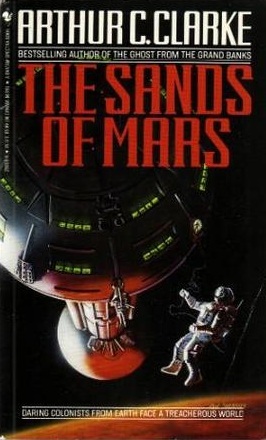
Next we have Arthur C. Clarke’s 1951 novel, which happened to be his first published work. And curiously enough, it is written from the point of view of a famous science fiction author. A case of art imitating life, or art as wish fulfillment? In any case, the setting is a research facility on Mars, which is in the process of terraforming so it will be able to become a self-sufficient colony.

Based on Clarke’s descriptions, this terraforming process (known as “Project Dawn”) involves some rather curious steps. The first is the ignition of the moon Phobos so that it will become a second “sun” for Mars. It will burn for at least one thousand years and the extra heat, combined with the mass production of the oxygen-generating plants, will eventually make the Martian atmosphere breathable for humans.

In many respects, this served as a preview for the plot of 2001: A Space Odyssey and it’s sequel 2010: Odyssey Two (see below).

The Martian Way:
In keeping with the tradition of sci-fi greats, this next novel was written by Isaac Asimov and first published in 1952. The story is told from the point of view of Scavengers, Mars-born humans who spend their time scouring space for the spent lower stages of spacecraft. This sort of lifestyle, making do with less and toughing things out, is known as the “Martian Way”.

At this point, Mars is still very much dependent on Earth for water shipments, which are used for fuel as well as consumption. Life takes a turn for a worse when an ambitious Earth politician decides to cut of the “Wasters”. In response, the protagonists come up with an ambitious plan, to fly to Saturn’s Rings and tow back an asteroid made of pure ice.

The trip is difficult and takes many months, but the Martian Scavengers manage to snag an asteroid that will supply two hundred years worth of water. This, they begin to use to transform the ecology of Mars, and turn the tables on the Earth government.

The Psychotechnic League:
Written by Poul Anderson over the course of two decades, the Psychotechnic League refers to a series of novels and short stories that are set in the same universe. Of all these stories, two in particular deal with the terraforming of Solar Planets. In “The Big Rain”, Venus is being terraformed, a process of planetary engineering that takes several centuries to complete.

In “The Snows of Ganymede”, the focus shifts to the Jovian moon where scientists are able convert the planet to the point where it experiences seasons similar to Earth. This, in addition to Mars, Venus and several other Solar Planets, all come together in time to form the Solar Union. Because of Anderson’s realistic description, the term “big rain” became associated with scientific terraforming models.

The Space Odyssey Series:
Arthur C. Clarke’s series, which began with the novelization of the classic film 2001: A Space Odyssey, revolves around the terraforming of Europa by a super advanced race. Known as the Firstborn, these aliens use the Monoliths to travel throughout the universe to foster the development of sentient life. Millions of years after fostering the development of high-order primates on Earth, they shifted their focus to Europa, Jupiter’s ice moon.

Much as in “Sands of Mars”, the process involved the creation of a “second sun”, this time involving Jupiter. In the first novel, the story ends with David Bowman, the only astronaut to survive an exploratory mission to Jupiter after their ships AI (the HAL 9000) malfunction and kills the crew.
When he arrives, he discovers a Monolith in orbit around Europa and disappears without a trace shortly thereafter.

In 2010: Odyssey Two, a second mission is mounted to determine the whereabouts of the first. When the joint US-Soviet mission arrives at Europa, they come to realize that the planet is showing signs of life. They also learn that the Monoliths are in the process of turning Jupiter into a sun so that Europa’s icy surface will evaporate and form an atmosphere, allowing all the life contained underneath to emerge and grow.

In the subsequent novels, Europa is revisited after its transformation is complete. Although sentient life does not appear to be possible, the planet does boast an atmosphere and vast oceans, which teem with sluggish sulfur-based lifeforms. In the end, after the Monoliths are convinced that humanity deserves a reprieve, and they land on Europe to commence building peaceful relations with the Europan life forms.

Mars Trilogy:
We finish with the most recent and profound example of all, the Mars Trilogy by Kim Stanley Robertason. The trilogy’s three works – Red Mars, Green Mars, Blue Mars – all focus on the ongoing efforts to transform Mars from an arid, hostile world with barely any atmosphere to a lush, hospitable planet capable of supporting human life.

The first novel deals with the initial colonization effort, which begins with the crew of the Ares, a ship carrying 100 scientists drawn predominantly from the US and the Soviet Union. Upon arriving, the crew builds the first settlement, known as Underhill, as well as colonies on the hollowed out asteroid-moon of Phobos.

After debating what is to be done with Mars, whether to turn it “Green” or leave it “Red”, the United Nations Organization Mars Authority (UNOMA) eventually opts for the “Green” option and terraforming begins. This process involves the drilling of “moholes” in the surface to release subsurface heat to thicken the atmosphere and the detonation of nuclear devices deep in the sub-surface permafrost to release water.

Green Mars, which begins 50 years after events in the first novel, during the dawn of the 22nd century. At this point in time, the Martian landscape is evolving thanks to the expansion of plant life, hence the name. The process is stimulated though the use of continent-sized orbital mirrors which focus sunlight to and away from various sectors of the planet, to melting the northern polar ice cap, and digging moholes deep enough to form volcanoes.

In the third and final installment, Blue Mars, long-term terraforming has created atmospheric pressure and temperature conditions that allow for the presence of liquid water on the planet’s surface, forming rivers and seas. This all takes place over the course of the following century, long after Earth has flooded and revolutions have displaced corporate control of the planet. Because of this, Mars has become the principle planet of the Solar System.

Summary:
Terraforming efforts have come a long way in fiction, and hopefully some day soon they will be realizable. Even though the concept remains highly speculative at this point, all proposed efforts are currently focused on Mars. In all ways that count, Mars has everything we would need to make it suitable for human habitation. This includes water, in the presence of the frozen ice caps and possibly underground rivers, and high concentrations of carbon and oxygen in the form of CO2, nitrogen, and gravity to keep the atmosphere anchored.

And most importantly of all, Mars’ atmosphere closely resembles that of Earth several billions of years ago. In time, due to the development of photosynthetic bacteria, enough oxygen was produced to allow for the development of animals. Though the careful introduction of similar bacteria and plants to Mars surface, humans could speed that process along and eventually create a breathable atmosphere. This, in turn, will allow for the creation of an ozone layer and weather patterns. Combined with the melting of the polar ice and underground aquifers, this will lead to surface water in the form of rivers, streams and oceans.