
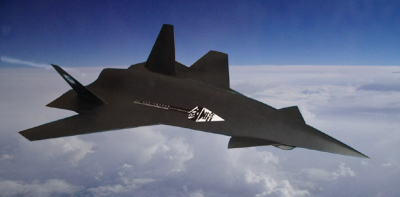
 Twice a year, China showcases the latest in military technology at a show held in Zhuhai city, in the Guangdong province. During the last show, held in November, a series of new unmanned aerial vehicle,s most of which bore a striking resemblance to the American drones that have been conducting attacks in Afghanistan and Pakistan for the past few years. Naturally, observers in the west were rather concerned with the wider implications.
Until recent years, the United States, Britain and Israel have maintained supremacy in the field of UAV’s. But much like stealth technology and naval aviation, the Red Dragon appears to be catching up by leaps and bounds. What’s more, it is likely China intends to take full advantage of using unmanned aerial vehicles to achieve its national interests, which includes their territorial disputes with Taiwan over the Senkaku Islands and South China Sea and Japan.
 In response, the Defense Science Board released an unclassified report in they claimed: “In a worrisome trend, China has ramped up research in recent years faster than any other country. It displayed its first unmanned system model at the Zhuhai air show five years ago, and now every major manufacturer for the Chinese military has a research center devoted to unmanned systems.”
The report went on to say that “the military significance of China’s move into unmanned systems is alarming [suggested that China could] easily match or outpace U.S. spending on unmanned systems, rapidly close the technology gaps and become a formidable global competitor in unmanned systems.”
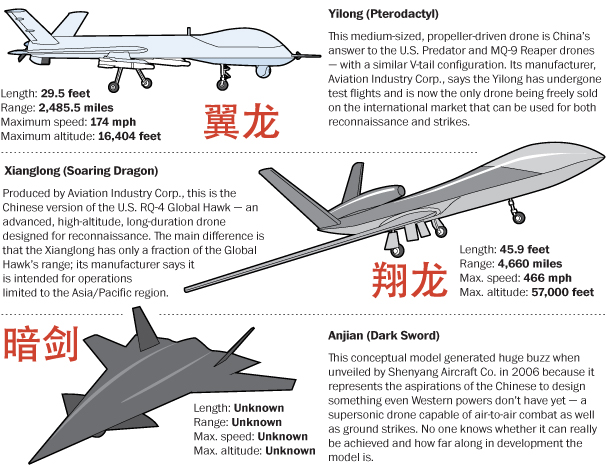 Two Chinese models on display at the Zhuhai show — the CH-4 and the Wing Loong, or Pterodactyl — appeared to be clones of the Reaper and Predator drones that are fixtures in the U.S. arsenal. A larger drone, the Xianglong, or Soaring Dragon, is a long-range, high-altitude model that would seem to be a cousin of the RQ-4 Global Hawk.
Huang Wei, the director of the CH-4 program at the China Aerospace Science and Technology Corporation, told the state-run newspaper Global Times that his lightweight drone can carry cameras, ground-searching radar, missiles and smart bombs. “As the Americans say,” he said, “the U.A.V. is fit for missions that are dirty, dangerous and dull.”
What will this mean for the future? Drone wars? Or a new arms race where increasingly complicated unmanned aerial vehicles and stealth fighters are involved? Difficult to say, but with the advances of such weapons systems in other countries, it was only a matter of time before China followed suit. One can only hope, as the saying goes “that cooler heads prevail” before they are used in an open conflict.
Source: policymic.com, nytimes.com
 Stories by Williams