News from Space: The Orion MPCV gets a Manned Mission

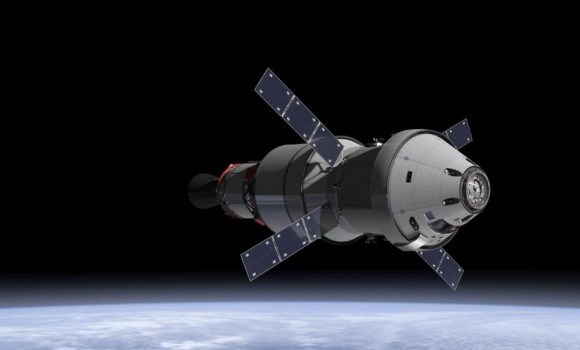
Orion_arraysIt’s known as the Orion Multi-Purpose Crew Vehicle (MPCV), and it represents NASA’s plans for a next-generation exploration craft. This plan calls for the Orion to be launched aboard the next-generation Space Launch System, a larger, souped-up version of the Saturn V’s that took the Apollo teams into space and men like Neil Armstrong to the Moon.

The first flight, called Exploration Mission 1 (EM-1), will be targeted to send an unpiloted Orion spacecraft to a point more than 70,000 km (40,000 miles) beyond the Moon. This mission will serve as a forerunner to NASA’s new Asteroid Redirect Initiative – a mission to capture an asteroid and tow it closer to Earth – which was recently approved by the Obama Administration.

orion_arrays1But in a recent decision to upgrade the future prospects of the Orion, the EM-1 flight will now serve as an elaborate harbinger to NASA’s likewise enhanced EM-2 mission. This flight would involve sending a crew of astronauts for up close investigation of the small Near Earth Asteroid that would be relocated to the Moon’s vicinity. Until recently, NASA’s plan had been to launch the first crewed Orion atop the 2nd SLS rocket to a high orbit around the moon on the EM-2 mission.

However, the enhanced EM-1 flight would involve launching an unmanned Orion, fully integrated with the SLS, to an orbit near the moon where an asteroid could be moved to as early as 2021. This upgrade would also allow for an exceptionally more vigorous test of all the flight systems for both the Orion and SLS before risking a flight with humans aboard.

orion_arrays2It would also be much more technically challenging, as a slew of additional thruster firings would be conducted to test the engines ability to change orbital parameters, and the Orion would also be outfitted with sensors to collect a wide variety of measurements to evaluate its operation in the harsh space environment. And lastly, the mission’s duration would also be extended from the original 10 to a full 25 days.

Brandi Dean, NASA Johnson Space Center spokeswoman, explained the mission package in a recent interview with Universe Today:

The EM-1 mission with include approximately nine days outbound, three to six days in deep retrograde orbit and nine days back. EM-1 will have a compliment of both operational flight instrumentation and development flight instrumentation. This instrumentation suite gives us the ability to measure many attributes of system functionality and performance, including thermal, stress, displacement, acceleration, pressure and radiation.

The EM-1 flight has many years of planning and development ahead and further revisions prior to the 2017 liftoff are likely. “Final flight test objectives and the exact set of instrumentation required to meet those objectives is currently under development,” explained Dean.

orion_spacecenterThe SLS launcher will be the most powerful and capable rocket ever built by humans – exceeding the liftoff thrust of even the Saturn V, the very rocket that sent the Apollo astronauts into space and put Neil Armstrong, Buzz Aldrin and Michael Collins on the Moon. Since NASA is in a hurry to reprise its role as a leader in space, both the Orion and the SLS are under active and accelerating development by NASA and its industrial partners.

As already stated by NASA spokespeople, the 1st Orion capsule is slated to blast off on the unpiloted EFT-1 test flight in September 2014 atop a Delta IV Heavy rocket. This mission will be what is known as a “two orbit” test flight that will take the unmanned Multi-Purpose Crew Vehicle to an altitude of 5800 km (3,600 miles) above the Earth’s surface.

After the 2021 missions to the Moon, NASA will be looking farther abroad, seeking to mount manned missions to Mars, and maybe beyond…

And in the meantime, enjoy this video of NASA testing out the parachutes on the Orion space vehicle. The event was captured live on Google+ on July 24th from the U.S. Army’s Yuma Proving Ground in Arizona, and the following is the highlight of the event – the Orion being dropped from a plane!:

Incredible Astrophoto: Yuga Kurita’s “Galactic Volcano”

mt-fuji

I came across this stunning photo lately and just had to share it. The man who took it is none other than inspired photographer Yuga Kurita, who snapped a shot of Mt. Fuji at night to create a truly stunning image that makes the iconic Mt. Fuji appear like a galactic volcano. This effect is due largely to the heavens obliging him on a clear night, but also thanks to thousands of people climbing the mountain’s slopes.

Apparently, this is something of a pilgrimage in Japan, where people take their flashlights and climb the mountain at night in order to get a clear look from the peak of the volcano at the sun rising on the following day. Over at his account on Google+, he explains his inspiration to get a snapshot of the mountain at night:

When I arrived at Fujiyoshida in Yamanashi Prefecture, I saw people climbing up Mt. Fuji with flash lights and I thought they looked like lava streams. Then I came up with this composition, since nowadays, the Milky Way appears vertically in the sky so probably I could liken Mt. Fuji to an imaginary galactic volcano, that is, people climbing up with torches are lava streams and the Milky Way is the volcano smoke.

After deciding to get a picture of the “stellar” site, Kurita checked out several maps and then spent an entire day driving and hiking around the base of the mountain in order to get the most pristine shot. And as you can see, it worked out quite well! Between the vertical arm of the Milky Way and the lights leading up the mountainside, it looks like stars are escaping out of the mountain’s mouth and stellar flames are trickling over the edge. Truly cosmic!

To see more of Kurita’s work, click on this link here, or head on over to Google+ and simply type in his name.

Sources: plus.google.com, universetoday.com

News from Space: Dream Chaser Begins Testing

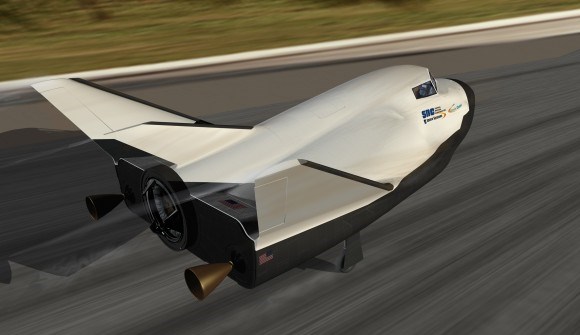
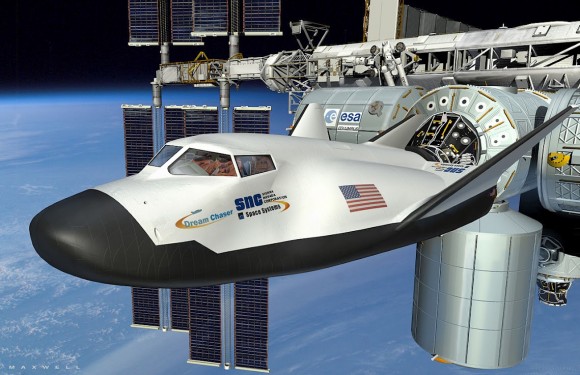
dream_chaserEver since their Space Shuttle program was forcibly shut down in 2011, NASA has been forced to look to the private sector to restore their ability to put human beings into orbit from American soil. This consists of providing the seed money needed for companies to develop a new race of “space taxis”.  One such program is the Dream Chaser, a reusable shuttle that will fly astronauts into low Earth orbit (LEO) and to the International Space Station (ISS).

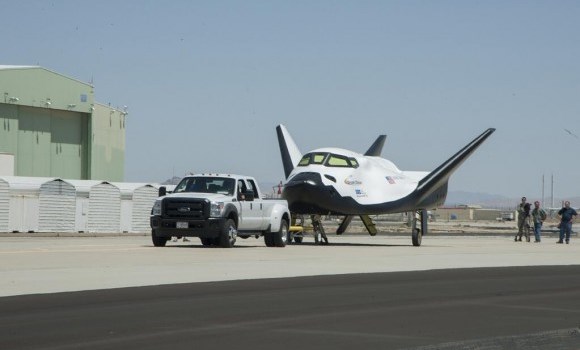
Much like a standard Space Shuttle, the Dream Chaser is designed to launch atop a United Launch Alliance Atlas V rocket and land on a shuttle landing facility. And after lengthy periods of research and development, the Dream Chaser is now moving forward with a series of ground tests at NASA’s Dryden Flight Research Center in California that will soon lead to dramatic aerial flight tests throughout 2013.

dream-chaser-testThis consisted of putting the shuttle together and then conducting a series of what’s known as “Pathfinding tow tests” on Dryden’s concrete runway. The purpose here is to validate the performance of the vehicles’ nose skid, brakes, tires and other systems to prove that it can safely land an astronaut crew after surviving the searing re-entry from Earth orbit. For the initial ground tests, the ship was pulled by a tow truck at 16 and 32 km/h (10 to 20 mph).

Later this month, the next leg of the test will consist of towing it up to speeds of 64 to 95 km and hour (40 to 60 mph). The next phases of testing will take place later this year in the form of airborne captive carry tests, where an Erickson Skycrane helicopter will fly the fuselage around to see how it holds up. Approach and Landing Tests (ALT) will follow to check the aerodynamic handling, which will consist of atmospheric drop tests in autonomous free flight mode.

dream-chaser-test1In an interview with Universe Today, Marc Sirangelo – Sierra Nevada Corp. vice president and SNC Space Systems chairman – spoke on record about the shuttle and where it is in terms of development:

It’s not outfitted for orbital flight. It is outfitted for atmospheric flight tests. The best analogy is it’s very similar to what NASA did in the shuttle program with the Enterprise, creating a vehicle that would allow it to do significant flights whose design then would filter into the final vehicle for orbital flight.

In short, the Dream Chaser has a long way to go, but the program shows great promise. And as already noted, they are not the only ones benefiting from this public-private agreement that seeks to develop commercial vehicles for the sake of kick starting space travel.

dream-chaser-dockedOther companies include Boeing and SpaceX, companies that were also awarded contracts under NASA’s Commercial Crew Integrated Capability Initiative, or CCiCap. All three have their own commercial vehicles under development, such as the Boeing CST-100, SpaceX’s Dragon, which are similarly designed to bring a crew of up to 7 astronauts to the ISS and docking with it for up to 6 months.

Dream_Chaser_launchBut of course, everything depends on NASA’s approved budget, which seems headed for steep cuts in excess of a billion dollars if a Republican dominated US House has its way.This is the third contract in NASA’s Phase 1 CCiCap contracts, who’s combined value is about $1.1 Billion and runs through March 2014. Phase 2 contract awards will eventually lead to actual flight units after a down selection to one or more of the companies. The first orbital flight test of the Dream Chaser is not expected before 2016 and could be further delayed if NASA’s commercial crew budget is again slashed by the Congress – as was done in the past few years.

But as William Gerstenmaier – NASA’s associate administrator for human exploration and operations in Washington – indicated in a statement, the larger goal here is one of repatriation. As it stands, US astronauts are totally dependent on Russia’s Soyuz capsule for rides to the ISS, which costs upwards of $70 million a trip. NASA hopes to change that by rekindling the “good old days” of space travel:

NASA centers around the country paved the way for 50 years of American human spaceflight, and they’re actively working with our partners to test innovative commercial space systems that will continue to ensure American leadership in exploration and discovery.

And I for one wish NASA luck. Lord knows thirty-years of post-Cold War budget cutbacks hasn’t been easy on them. And hitching rides into space above Cold War era rockets is not the best way of getting your astronauts into space either!

In the meantime, check out this concept video of the Dream Chaser in action, courtesy of the Sierra Nevada Corporation:


Source:
universetoday.com

News From Space: Arkyd Telescope and Shenzhou 10

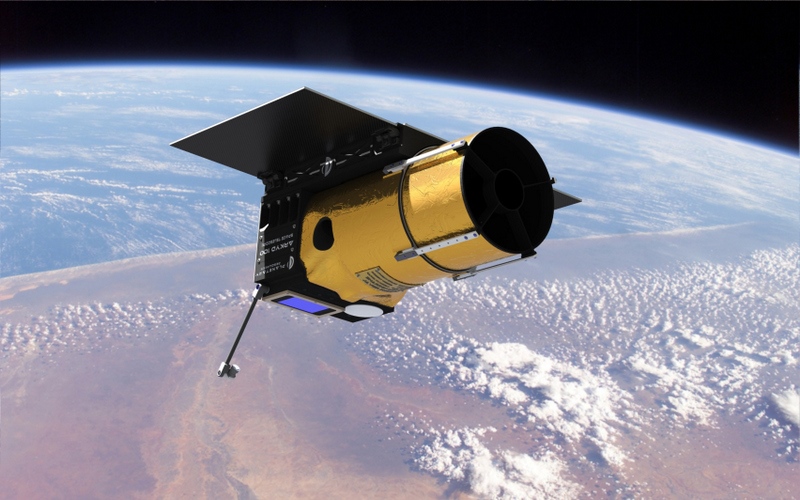
spacex-icarus-670It seems that every day, the frontiers of space exploration are being pushed. In recent months, two stories occurred close to home (relatively speaking) that have stuck out in my memory. The first had to do with Planetary Resources plan to commission the world’s first crowdfunded telescope. The second came from China, where the new Shenzou 10 space ship launched on its way to dock with the prototype Tiangong-1 space station.

These stories were both groundbreaking for a number of reasons. Arkyd’s plan for a publicly-owned and funded telescope is not only an historic first, its also a major step forward in the creation of a new era of space exploration, one which is far more open and democratic than before. The second story represents a major leap for China as a major power, and their plans to conduct research aboard the Tiangong-1 shows a commitment to opening their space program to the public.

ARKYD-in-SpaceAnd as it happens, there have been recent developments on both fronts. On June 20th, less than a week ago, the Arkyd space telescope passed their goal of $1 million with its Kickstarter campaign. But perhaps to keep the money flowing, the company announced an ambitious aim to add extrasolar planet searching  to the list they can double that goal to $2 million.

And they’ve set some other fundraising milestones just to keep things interesting:

  • $1.3 million: A ground station at an undisclosed “educational partner” that would double the download speed of data from the orbiting observatory.
  • $1.5 million: This goal, just released yesterday, is aimed at the more than 20,000 people who signed up for “space selfies” incentive where uploaded pictures are photographed on the telescope while it is in orbit. For this goal, “beta selfies” will be taken while the telescope is in the integration phase of the build.
  • $1.7 million: The milestone will be announced if Arkyd reaches 15,000 backers. (It has more than 12,000 as of this

With five days remaining and a total of $1,189,359 now raised, they are not likely to break that ceiling. Still, the company’s plan to begin prospecting asteroids for the sake of future mining efforts now seems well within reach. Best of luck to them!

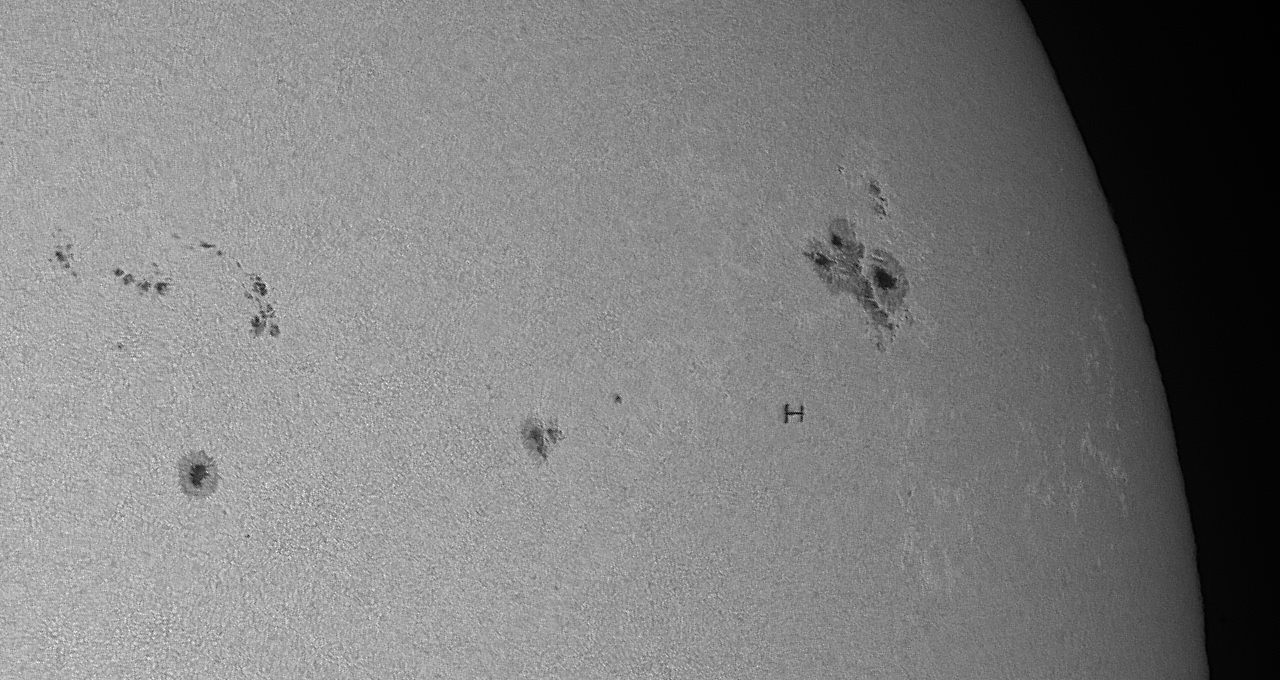
shenzhou10_tiangong1As for China’s Shenzhou 10, in an event that was captured on film, the space module is now docked with the Tiangong-1 space station and made a scenic transit in front of the sun. Astrophotographer Terry Legault had less than half a second to capture these incredible shots, but managed to get not one, but two shots in two consecutive days. Not an easy task to pull off, let alone twice!

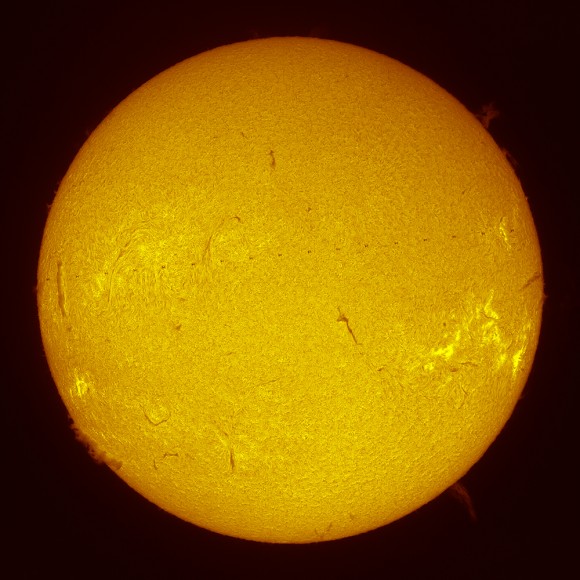
If you look closely at the picture above, you can just make out Tiangong-1 station to the right of the sun, located below and to the left of a large cluster of sun spots. This top image is a crop of a full-face view of the Sun, taken with white light filters by Thierry from southern France on June 16, just after noon UTC. The transit duration was just 0.46 seconds, the distance of the spacecraft to observer was 365 km away, and the spacecraft was traveling at 7.4km/s (26,500 km/h or 16,500 mph).

shenzhou10_tiangong3This second imagine was taken the next day, again from the south of France, at 12:34:24 UTC on June 17, 2013. This one, in Hydrogen-alpha shows the Shenzhou-10/Tiangong-1 complex in multiple shots over the 0.46 second transit. Click on the photo to get the full resolution, then zoom in to see multiple shots of station as it made its transit across the face of the sun.

In a previous interview with Universe Today, Thierry explained how he prepares to take images like these:

For transits I have to calculate the place, and considering the width of the visibility path is usually between 5-10 kilometers, but I have to be close to the center of this path, because if I am at the edge, it is just like a solar eclipse where the transit is shorter and shorter. And the edge of visibility line of the transit lasts very short. So the precision of where I have to be is within one kilometer.”

Legault studies maps, and has a radio synchronized watch to know very accurately when the transit event will happen.

My camera has a continuous shuttering for 4 seconds, so I begin the sequence 2 seconds before the calculated time. I don’t look through the camera – I never see the space station when it appears, I am just looking at my watch!

Kudos to the man for once again capturing images of the heavens and sharing them with the world. And exciting times these are, when space exploration is once again booming and the frontiers of tomorrow are increasingly within our reach.

Sources: universetoday.com, (2), legault.perso.sfr.fr

New Podcast Series: Space Stations!

star_trek_space_stationMy good buddy, Fraser Cain, a co-inventor and publisher over at Universe Today, has just unveiled a new podcast series which I strongly recommend to anyone who loves space, science, and fiction pertaining to them. Those who follow this site may recognize the name, as Universe Today just happens to be my go-to source for all things space related. From the Curiosity Rover and the Cassini Probe to the mysteries of life on Earth and the universe at large, these guys can be trusted to be in the know!

I even had the honor of writing articles to them for about a year and a half, and I credit this experience with honing my ability to take hard science, gain a basic understanding of it, and then convey it to a general audience in an understandable fashion. Yes, before I worked for these guys, I was truly a geek-in-waiting, someone who didn’t know their quasars from their quarks. Now… well, I’m a little better!

In any case, the podcast series is called Space Stations, and comprises four episodes that take a look at man-made structures in space, beginning with Salyut and Skylab – the earliest Soviet and American attempts to put a manned station into orbit – and then moving onto Russia’s Mir space station, the International Space Station (ISS), and then taking a look at what the future holds for humans living and working in space.

ISSYou can check out the series at their website here, or just head on over to Astronomy Cast, the site for Universe Today‘s podcasts, and start listening willy-nilly. Me, my favorite is the fourth and final episode which takes a look at the future of space stations, and anyone claiming to know the first thing about me will not wonder why! I mean, c’mon, future of space, what’s not to love about that???

And of course, you can check out their voluminous archives, which contain podcasts on subjects ranging from Aliens to Physics, Astronomy to Planetary Science, and the history of space flight to current missions and the future of space exploration. I can promise you that if you’re the kind of person who finds the science jokes in The Big Bang Theory hilarious, you will feel like a kid in a candy store!

Trivia Question: Where does the name Universe Today come from? If you answer this question (no Googling!) you will have my enduring respect forever!

Sources: universetoday.com, astronomycast.com

Apollo Rocket Engines Recovered from Seafloor

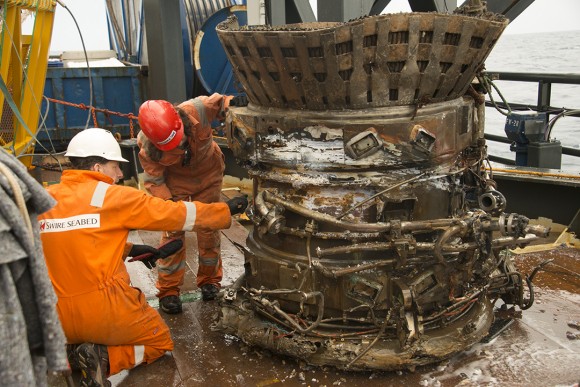
apollo_rocketThis past week, history was made when Jeff Bezos (founder of Amazon.com) and his privately funded company, Bezos Expeditions, announced that they had successfully retrieved pieces of the very engines that had once launched Apollo astronauts to the moon. Using remotely operated vehicles and a series of slings, the crew members recovered enough parts to reconstruct the majority of two F-1 rocket boosters.

Bezos Expeditions announced last year that using state-of-the-art deep sea sonar, that they had discovered the remains off the coast of Cape Canaveral off the coast of Florida. And this past Thursday, and with NASA’s help, Bezos located the fragments at a depth of almost 4.8 kilometers (3 miles) and began hauling them to the surface. Bezos claims they belonged to the historic Apollo 11 spaceflight, but further study and restoration will be needed before their identity can be confirmed.

apollo_rocket1Regardless, this is an exciting find, and the nature of the rocket boosters confirms that they were at least part of the Apollo program. Between 1968 and 1972, ten missions were conducted that flew out of the Kennedy Space Center, each one using the Saturn V rocket, that used five F-1 engines to boost them into orbit. Once the rockets had spent their fuel, they were detached and fell into the sea.

That means that approximately sixty five F-1 engines reside in the ocean off the coast of Florida. No telling which of those these ones could be, but it is hoped that serial numbers will be retrieved from the engines that can connect them to a specific Apollo mission. But regardless, this is an exciting find, and could not have come at a better time since NASA is looking to embark on a renewed era of exploration.

saturn-v-rocket-engines-recovered-ocean-installed_65442_600x450All told, Bezos and his team spent three weeks at sea, working almost 5 kilometers below the surface. During this time, Bezos claims that his team found so much:

We’ve seen an underwater wonderland – an incredible sculpture garden of twisted F-1 engines that tells the story of a fiery and violent end, one that serves testament to the Apollo program. We photographed many beautiful objects in situ and have now recovered many prime pieces. Each piece we bring on deck conjures for me the thousands of engineers who worked together back then to do what for all time had been thought surely impossible.

Naturally, NASA was pretty impressed with the find as well. After the find was announced, NASA Administrator Charlie Bolden made the following statement on behalf of the Agency:

This is a historic find and I congratulate the team for its determination and perseverance in the recovery of these important artifacts of our first efforts to send humans beyond Earth orbit. We look forward to the restoration of these engines by the Bezos team and applaud Jeff’s desire to make these historic artifacts available for public display.

Apollo_11Needless to say, this is an exciting find, regardless of whether or not these rockets were the same ones that sent Neil Armstrong, Buzz Aldrin and Michael Collins to the Moon. Naturally, I hope it is. I can think of no greater tribute to Armstrong’s memory so soon after his passing. I can imagine him looking down on this from the stars, where he now resides, with a big old smile!

And be sure to check out this video taken by the Bezos Expedition of the undersea find:

Source: nationalgeographic.com, universetoday.com

Curiosity Drills!

curiosity_drillsIn what is a first amongst cosmic first, the Curiosity Rover drilled into Martian rock and collected fresh samples from the resulting dust. The precision drilling took place this past Friday, Feb. 8, 2013 – during the 182nd day of the mission – after numerous tests and procedures were conducted. The images were beamed back to Earth on the following day (Saturday, Feb 9) amidst a great deal of fanfare and celebration.

Given the fact that it took them nearly a decade of painstaking work and effort to design, assemble, launch and land the Curiosity Mars Science Laboratory (MSL) rover, it’s obvious while the rover team is overjoyed with this latest development. What’s more, this was more than just a first in the history of space exploration, it also marked Curiosity’s 6 month anniversary on the Red Planet since touching down on Aug. 6, 2012 inside Gale Crater.

John Grunsfeld, NASA’s associate administrator for the agency’s Science Mission Directorate, had this to say about the drilling:

“The most advanced planetary robot ever designed now is a fully operating analytical laboratory on Mars. This is the biggest milestone accomplishment for the Curiosity team since the sky-crane landing last August, another proud day for America.”

curiosity_drilling_sightCuriosity drilled a circular hole about  16 mm (0.63 inch) wide and 64mm (2.5 inches) deep into the red slab at the “John Klein” rock site. The  fine-grained sedimentary rock, which is rich with hydrated mineral veins of calcium sulfate, parted to produce a slurry of grey trailings surrounding the hole. These dust samples were then collected for examination using the rover’s on board laboratory.

The team believes the area known as Yellowknife Bay, where the drilling took place, repeatedly experienced percolation of flowing liquid water eons ago when Mars was warmer and wetter, and potentially more hospitable to the possible evolution of life. These latest samples, they hope, will offer additional compelling evidence to this effect, and also some traces of organic molecules.

curiosity_drillbitWhile this may sound like an ordinary day around NASA, it represents a quantum leap in terms of what remote landed craft are capable of doing. At no time in the past have astronauts been able to place mobile research platforms on a distant planet, collect samples of said planet, and conduct research on them, all the while beaming the results and images back to labs at Earth for analysis.

What’s next for the rover? Well, once the analysis is complete, the 1 ton robot will continue to investigate Yellowknife Bay and the Glenelg area. After that, it will set off on a nearly year long trek to her main destination – the sedimentary layers of the lower reaches of the  5 km (3 mile) high mountain named Mount Sharp – some 10 km (6 miles) away from its current position.

Source: universetoday.com

Captain Kirk Hails the ISS

ISSIn a move that was sure to give Trekies a collective fangasm, William Shatner made contact with the International Space Station this week. This past Thursday, thanks to the marvels of 21st century communications technology, the man who portrayed Captain Kirk was able to speak to Chris Hadfield, an astronaut on board the International Space Station.

Captain-KirkThe conversation began when Shatner – ahem! – opened hailing frequencies and contacted the ISS. Hadfield replied and, using some Star Trek sound effects as background, the two had a live, streaming video conversation. The entire conversation was recorded and uploaded to Youtube for the benefit of fans and amateur astronomers everywhere.

Needless to say, when science fiction and reality collide like this, it is an epic day in nerdom! Check out the video below…


Source:
universetoday.com

Update on Asteroid Apophis: No Apocalypse by 2036

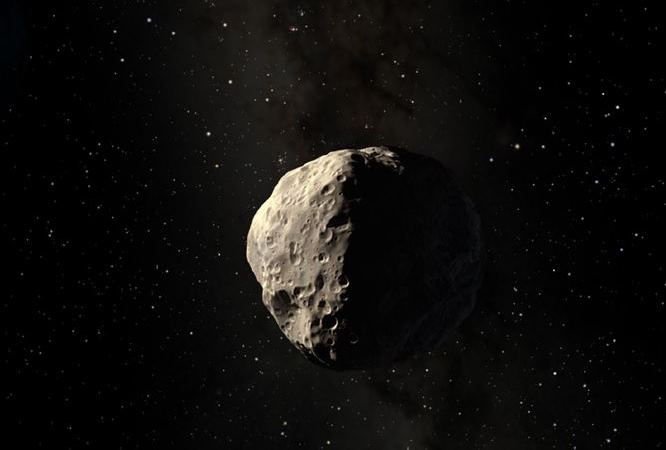
apophisDiscovered back in 2004, the Apophis asteroid garnered lots of attention when initial calculations of its orbit indicated that there was a 2.7 percent chance that it would hit Earth when it did a flyby in 2029. After running additional calculations based on the asteroids data, scientists were able to rule out a 2029 impact, but there was still a remote possibility that it might hit Earth during another flyby in 2036. However, that estimate has also been revised.

Thanks to the European Space Agency’s Herschel Space Observatory, a number of thermal infrared observations were captured of Apophis at different wavelengths. Taken together with optical measurements, Hershel was able to refine earlier estimates of the asteroid’s properties, which included its overall diameter. Initially, it was estimated to be 270 m on a side but now stands at a robust 325 m, an increased which translates into a 75% increase in its volume.

The thermal readings on the asteroid also provided a new estimate of the asteroid’s albedo, which is the a measure of its reflectivity. Knowing the thermal properties of an asteroid indicates how its orbit might be altered due to subtle heating by the Sun. Known as the Yarkovsky effect, the heating and cooling cycle of a small body as it rotates and as its distance from the Sun changes can instigate long-term changes to the asteroid’s orbit.

All of this taken together, has allowed NASA, the ESA and other space authorities to rule out the possibility of an impact by 2036 as well. Don Yeomans, manager of NASA’s Near-Earth Object Program Office at the Jet Propulsion Laboratory:

“We have effectively ruled out the possibility of an Earth impact by Apophis in 2036. The impact odds as they stand now are less than one in a million, which makes us comfortable saying we can effectively rule out an Earth impact in 2036. Our interest in asteroid Apophis will essentially be for its scientific interest for the foreseeable future.”

But the flyby on April 13, 2029 will be one for the record books, says NASA. On that date, Apophis will achieve the closest flyby of an asteroid of its size when it comes to within 31,300 kilometers (19,400 miles) of the Earth’s surface. And in the meantime, an smaller asteroid (40 meters in diameter) named 2012 DA14 will make an ever closer flyby as it passes Earth at a distance of 27,670 km (17,200 miles).

So people can rest, safe in the knowledge that no asteroids are likely to hit us anytime soon. But at the same time, apocalyptics can rest assured that there will be plenty of remote chances to exploit for the sake of their unusual brand of paranoia. As Yeomans said:

“With new telescopes coming online, the upgrade of existing telescopes and the continued refinement of our orbital determination process, there’s never a dull moment working on near-Earth objects.”

A Look at “Living Mars”

Living-Mars With the confirmation that Mars with once home to oceans and rivers, and with speculation that a terraformed Mars will once again, there are many who wonder what a “Blue Mars” would look like. As it happens, a software engineer named Kevin Gill took it upon himself to create a series of images showing what a “living Mars” might look like.

Relying on his own imagination and a series of combined source material, the Red Planet gets a makeover, with aesthetically pleasing results! In an interview via email, Gill said the following of his process:

“This was something that I did both out of curiosity of what it would look like and to improve the software I was rendering this in. I am a software engineer by trade and certainly no planetary scientist, so with the exception of any parts derived from actual data, most of it is assumptions I made based on simply comparing the Mars terrain to similar features here on Earth (e.g. elevation, proximity to bodies of water, physical features, geographical position, etc) and then using the corresponding textures from the Blue Marble images to paint the flat image layer in a graphics program.”

Living-Mars.2For example, the view above is of the western hemisphere of Mars, with Olympus Mons on the horizon beyond the Tharsis Montes volcanoes and the Valles Marineris canyons near the center. The placement of clouds and the atmosphere was mainly to achieve a sense of scale and grandeur, but the rest is in keeping with information obtained by NASA over the years.

And these are just some of the images Gill has made over the years. His Flickr is awash in visualizations, many of which are of Mars, the Moon, and of course Earth, all of which are rendered from orbit. He also makes 3D models of geographic features, which comes in handy when its time to construct large-scale models.