
 There are drones for aerial reconnaissance, drones for domestic surveillance, and drones for raining hell, death and destruction down on enemy combatants. But drones for making personal deliveries? That’s a relatively new one. But it is a not-too-surprising part of an age where unmanned aerial vehicles are becoming more frequent and used for just about every commercial applications imaginable.
After working on secret for quite some time, Google’s secretive projects lab (Google X) recently unveiled its drone-based delivery system called Project Wing. On the surface, the project doesn’t look much different from Amazon’s Prime Air aut0nomous quadcopter delivery service. However, on closer inspection, Project Wing appears to be much more ambitious, and with more far-reaching goals.
 The original concept behind Project Wing — which has been in development for more than two years — was to deliver defibrillators to heart attack sufferers within two minutes. But after running into issues trying to integrate its tech with the US’s existing 911 and emergency services systems, the focus shifted to the much more general problem of same-day deliveries, disaster relief, and delivering to places that same- and next-day couriers might not reach.
For their first test flights, the Google team traveled to Australia to conduct deliveries of dog food to a farmer in Queensland. All 31 of Project Wing’s full-scale test flights have been conducted in Australia, which has a more permissive “remotely piloted aircraft” (i.e. domestic drones) policy than the US. There’s no word on when Project Wing might be commercialized, but it is estimated that it will be at least a couple of years.
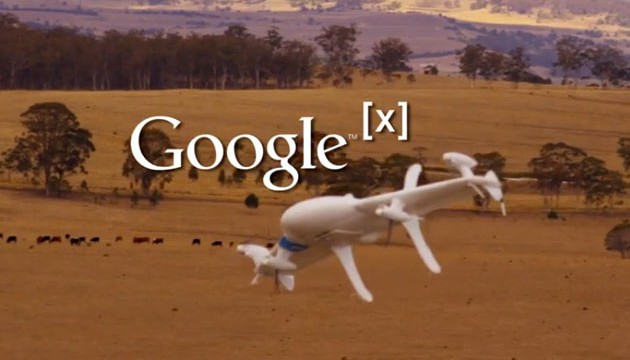 While most work in small-scale autonomous drones and remotely piloted aircraft generally revolves around quadcopters, Google X instead opted for a tail-sitter design. Basically, the Project Wing aircraft takes off and lands on its tail, but cruises horizontally like a normal plane. This method of vertical-takeoff-and-landing (VTOL) was trialed in some early aircraft designs, but thrust vectoring was ultimately deemed more practical for manned flight.
The Project Wing aircraft has four electric motors, a wingspan of around 1.5m (five feet), and weighs just under 8.6 kg (19 pounds). Fully loaded, the drones apparently weigh about 10 kg (22 pounds) and are outfitted with the usual set of radios and sensors to allow for autonomous flight. But there’s also a camera, which can be used by a remote pilot to ensure that the aircraft drops its package in a sensible location.
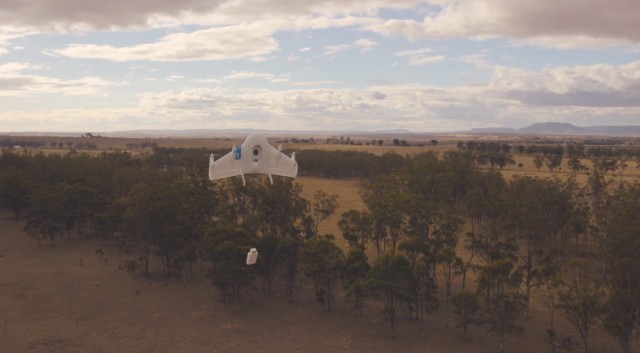 As you can see from the video below, the packages are dropped from altitude, using a winch and fishing line. Early in the project, Google found that people wanted to collect packages directly from the drone, which was impractical when the engines were running. The air-drop solution is much more graceful, and also allows the drone to stay away from a large variety of low-altitude obstacles (humans, dogs, cars, telephone lines, trees…)
This is another major different with Amazon Prime Air’s drones, which carry their package on the drone’s undercarriage and land in order to make the delivery. And while their octocopters do have slightly better range – 1.6 km (1 mile), compared to Project Wing’s 800 meters (half a mile) – Google is confident its delivery system is safer. And they may be right, since its not quite clear how small children and animals will react to a landing object with spinning rotors!
 For the moment, Google has no specific goal in mind, but the intent appears to be on the development for a full-scale same-day delivery service that can transport anything that meets the weight requirements. As Astro Teller, director of Google X labs, said in an interview with The Atlantic:
Throughout history there have been a series of innovations that have each taken a huge chunk out of the friction of moving things around. FedEx overnight delivery has absolutely changed the world again. We’re starting to see same-day service actually change the world. Why would we think that the next 10x — being able to get something in just a minute or two — wouldn’t change the world?
Nevertheless, both projects are still years away from realization, as both have to content with FAA regulations and all the red tape that come with it. Still, it would not be farfetched to assume that by the 2020’s, we could be living in a world where drones are a regular feature, performing everything from traffic monitoring and aerial reconnaissance to package delivery.
And be sure to check out these videos from CNET and Amazon, showing both Project Wing and Prime Air in action:
Sources: extremetech.com, zdnet.com, mashable.com

 The Optionally Piloted Black Hawk (OPBH) operates under Sikorsky’s Manned/Unmanned Resupply Aerial Lifter (MURAL) program, which couples the company’s advanced Matrix aviation software with its man-portable Ground Control Station (GCS) technology. Matrix, introduced a year ago, gives rotary and fixed-wing vertical take-off and landing (VTOL) aircraft a high level of system intelligence to complete missions with little human oversight.
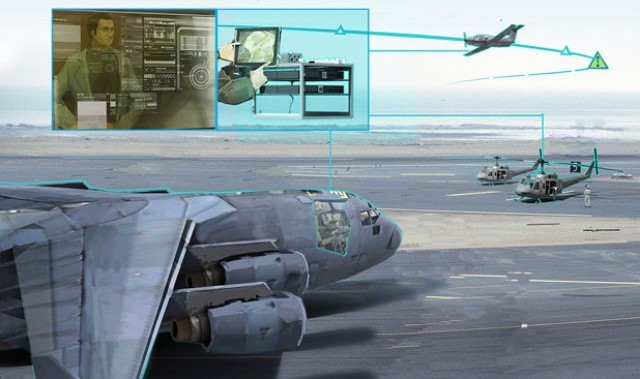 The Optionally Piloted Black Hawk fits into the larger trend of the military finding technological ways of reducing troop numbers. While it can be controlled from a ground control station, it can also make crucial flying decisions without any human input, relying solely on its ‘Matrix’ proprietary artificial intelligence technology. Under the guidance of these systems, it can fly a fully autonomous cargo mission and can operate both ways: unmanned or piloted by a human.
 Military aircraft have grown increasingly complex over the past few decades, and automated systems have also evolved to the point that some aircraft can’t be flown without them. However, the complex controls and interfaces require intensive training to master and can still overwhelm even experienced flight crews in emergency situations. In addition, many aircraft, especially older ones, require large crews to handle the workload.
 DARPA says that it wants ALIAS to not only be capable of executing a complete mission from takeoff to landing, but also handle emergencies. It would do this through the use of autonomous capabilities that can be programmed for particular missions, as well as constantly monitoring the aircraft’s systems. But according to DARPA, the development of the ALIAS system will require advances in three key areas.



 Stories by Williams