It all came flooding back in an instant. The time it took to assimilate it lasted a little while longer. Once Dube fully returned to his senses, the chronometer in his visual field told him that only a few seconds had passed. But of course, time was consistent that way, always so subjective. The effects of time dilation, which naturally came with travelling at relativistic speeds, were routine compared to the mind’s grasp on reality.
The other Engineers sighed lowly as the memories finished forming the necessary synaptic connections. All the specialized training Jonas kept as part of the C0S Package became memories as real as any other they carried in their minds. Except, of course, for combat training, which the Engineers had elected to hold onto for keeps.
When Dube closed his eyes, he could almost see the training becoming part of him again. The ship’s layout, which had previously been a careful interweaving of smart and dumb matter, suddenly became a strategic grid.
He could see sightlines, angles of approach, and what sections and compartments a stowaway would have from the cargo bay. He was also aware of all possible targets a stowaway might have in mind, the approach vector they would use, and the escape routes available to them. To Dube, it was like having a window into all possible avenues, outcomes, and options the intruder had.
Then again, that was the point. They knew before they set off that they had to be prepared for anything. When it came to the possibility of an unwanted guest on the ship, they were now. There remained only one thing to do…
“Shall we adjourn to the armory?”
“Forthwith.”
The room’s system sensed their approach. The door dissolved into a cascade of nanoparticles that retreated into the surrounding walls. Inside, the room illuminated itself, revealing an austere chamber with only a series of plinths evenly spaced across the walls. Like a coordinated ballet, each of the nine Engineers stepped onto one and stood at attention.
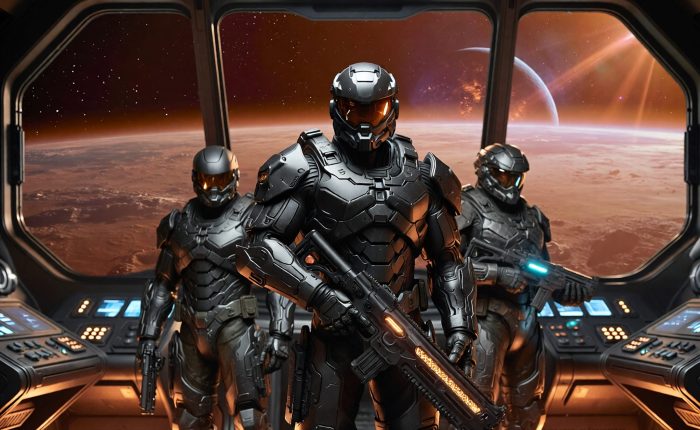
It wasn’t necessary to remain perfectly still; the nanoware would adapt. But every person in the room maintained an erect posture, arms at their sides, fingers spread. Within seconds, they were enveloped by a second skin that forged itself into an integrated suit of armor and weaponry.
Only one part of the transition felt awkward, the part where the nanoware reached up to his neck to cover his face. As always, Dube closed his eyes and held his breath for this part. It was only when he felt the nanoware form a pliable membrane over his entire head that he opened his eyes and resumed normal breathing.
He felt a slight touch of vertigo from all the data that was passing in front of his eyes. There was also a mild euphoria caused by the uploading of data into his neural loom. Both passed quickly once the suit had finished the integration process, shaking hands with his physiology, neurology, and assorted implants.
The sensation of something forming in his arms instinctively caused Due to look down. Where an empty space had previously been, a weapons package had formed that was deemed appropriate for the mission profile. A Cycling Stunner, something that would allow him to strike the target with varying electromagnetic pulses. While the weapon formed, Dube’s suit also linked to the Transverse’s internal systems to ensure that every surface in his vicinity was ready to adjust instantly to changes in the weapons’ EM frequency.
Dube turned to look at his colleagues once the suit and weaponry were fully formed. Every one of them was now covered in a second skin of self-configuring and self-replicating hardware. While each was different in terms of design and appearance, this was largely for aesthetic purposes. For the most part, each of them was as equipped as well as the next.
The armaments they selected were less diverse. Like Dube, some of the other Engineers were carrying sleek and ergonomic stunners. Others were carrying more traditional-looking plasma casters, and the rest had compact ballistic guns. Between these three selections, they had all the necessary weapons to disable their intruder’s defenses, deplete them piecemeal, and inflict significant physical trauma – should the need arise.
The goal was to subdue them, of course. Even though they were all far from the home they had left behind, it was paramount that they question the stowaway. As per the parameters of a C0S, they needed to know who they represented. The Transverse Project had many rivals, but no enemies that they knew of. Clearly, someone back home knew something they didn’t. And of course, they needed to know how the hell they managed to get aboard in the first place.
The dazzling array of weaponry they carried was just in case their intruder refused to come quietly. Dube voked to the other Engineers to check on their status. His suit linked with theirs, and all relevant data was shared between them.
[Everyone independently integrated? Excellent. Synchronize into fire teams, then we go.]
Dube felt the replies of all eight of his fellow Engineers. At the moment, they were following his lead, a privilege reserved for those who were on shift. As per his instructions, their group formed into three fire teams, each one synchronizing closely with its own members. These were connected to the two other groups, with Dube’s designated as fire team Alpha, and Beta and Charlie forming support teams.
The nine of them were now more connected to each other than ever before. That was as deliberate as it was necessary. Until they secured the ship, they needed to be as integrated with each other as they were with their own equipment. But of course, this needed to be tempered by group dynamics, where the whole was broken down into moving parts that could complement and assist one another.
The process was complete.
Everything was in the green.
It was time to go.
[Let’s move!] Dube ordered. His own words echoed in the shared sensorium of their minds. The replies he received echoed louder. Eight voices in his head were more powerful than one, after all.
From their departure point at the end of the habitation section, Dube and Alpha team picked up the path of their intruder – the one Jonas deemed the most probably. Beta and Charlie split off, the former following the next most probable one while the latter secured the location where the intruder had spent the past few years.
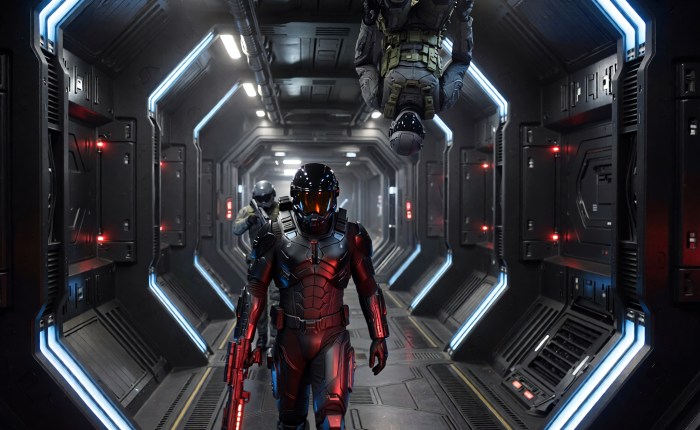
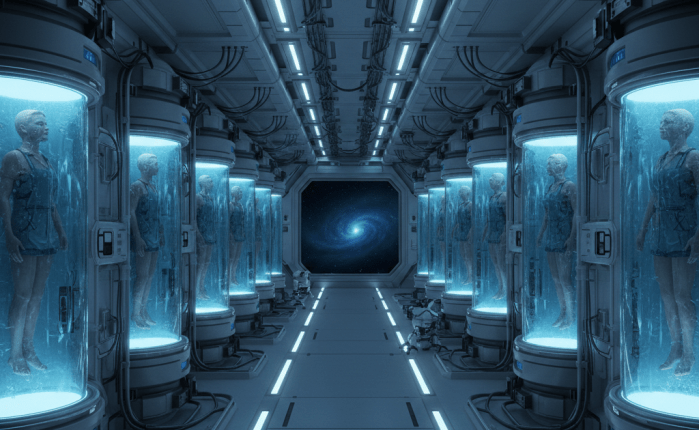
Their movements were fluid and fast, from the cargo bays to the storage bays, to the entrance to the cryobays. Not a moment was spared as they continued along the path of their quarry, even as they communicated with each other and Jonas. When the doors between sections opened, Dube and the other members of Alpha team were hit by a gust of cold air. Their second skins registered the sudden drop in temperature, and they could even see flecks of snow crystals floating on the wind.
[Pressure is equalized between sections, we’d better move,] said Vorhees.
[Confirmed.]
[The intruder has a 45% chance of sabotaging one or more cryogenic units. The purpose of which is to interfere with our settlement efforts.]
[Confirmed.] Dube impatiently replied. He really didn’t need to be reminded. Thanks to the download, he recalled everything he needed to know about how things could go sideways. Still, he and the team were sure to check all the cryopods they passed. There was no time to waste. A quick scan of their vitals and bio readings, all summarized in a small display window in each pod’s glass cover. Everyone they saw was in the green. As the three of them proceeded, they got word from Charlie team.
[Our guest was definitely in here while the rest of us were sleeping,] said Vorhees. [It looks like they sealed the pod and the wall back up after they got out.]
[How did they do that without setting off any alarms?]
In an instant, Dube was able to see through Vorhees’s eyes and those of his team. All the data they had accumulated from their scans was pressed into his mind. It was all clear. The intruder used a divider to create a seam in the wall from the inside. Once they were out, they simply removed it, and the opening sealed shut behind them.
As far as the ship’s systems were concerned (and by extension, Jonas), a section of the wall had voluntarily receded and returned to its previous configuration. An event like that would barely register if Jonas’ ToC had been set to one.
Worse than that was the timing. The stowaway had extricated themselves from their hiding place just in time to elude capture. This meant they were no longer eluding detection. Jonas’s inspection of the ship’s power systems must have triggered some kind of alarm in their pod, or perhaps the fact that the Engineers had issued an internal alert to the crew. If the stowaway were tapped into the system in ways that went beyond siphoning power, this might have alerted them as well.
Dube reached out to Jonas to share this new information. Jonas came back with updated projections.
[The intruder displays an impressive level of preparedness. We now estimate that he has a sixty-five percent chance of sabotaging one of the ship’s main power relays].
[To what end?] Dube asked.
[Depending on the intruder’s exact location, there are a number of possibilities]
[List them in order of probability, cross-referenced with severity] Dube ordered. Jonas took a second to run the two parameters against each other and began listing his results.
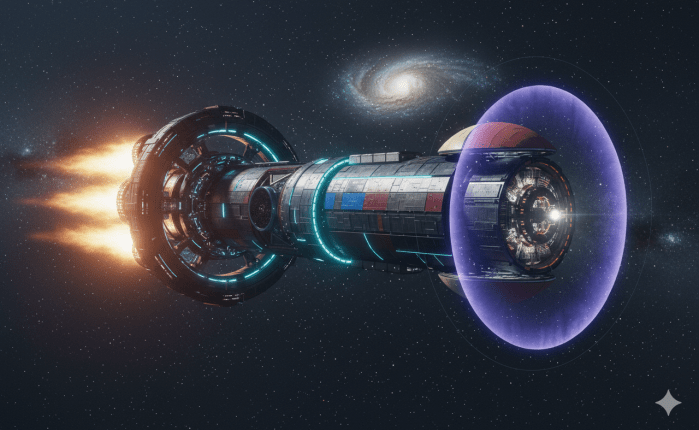
[We estimate that if the intruder is still localized in the Cryogenic Bay area, there is a seventy percent possibility that they intend to interrupt power to multiple cryounits. However, if the intruder is currently moving to the Engine Section, there’s a 100% chance they intend to interrupt power to an engine component. The most likely target would be one of the magnetic stasis chambers on one of the main thrusters.]
Dube didn’t need to know what the outcome of that would be. Each engine was an assemblage of parts that needed to run in perfect synchronicity; otherwise, the engine would cease to function. Jonas would need to shut down the entire engine section to ensure they did not veer dangerously off-course.
However, this seemed like a rather limited strategy. The net result would be that the mission was delayed. No, the plan had to be something bigger, something more ambitious. That’s what Dube’s sense of paranoid self-preservation was telling him, something that Jonas could only appreciate on an abstract level.
[Assume the intruder intends to do more harm. What then?]
Jonas recomputed and almost instantly offered an alternate scenario. [We anticipate another possibility whereby the intruder will attempt to access the Foundries. Based on specified criteria, and assuming they can obtain access to a Foundry unit, we anticipate an eighty-five percent probability that they will attempt to manufacture an explosive device that could cause a breach between the reaction mass and the stasis chambers.]
Dube froze for just a second. If their stowaway managed to get access to the Foundries and could convince the industrial fabricators in that section that he was part of the crew, they could easily assemble an explosive device powerful enough to do serious harm. Assuming such a device were placed in the right way, the stowaway could create a breach between the ship’s supply of matter and antimatter.
[The effect would trigger a cascade reaction large enough to destroy the Transverse.]
[I know!] Dube responded. It was a gamble either way. Assume the intruder meant to destroy the ship, and he would risk crippling a vital system or killing some of the crew. Assume they meant to commit either of these smaller acts of sabotage, and he risked losing the ship. Considering the consequences influenced the odds, but the odds were their best bet at finding their stowaway in time.
[Alpha and Beta teams, converge on the Foundries, immediately,] ordered Dube. [We need to assume their intent is to inflict the maximum amount of harm. Lethal force is authorized.]








 Stories by Williams