Foundation and Empire

FYI: this is my 400th post, people! Woohoo! I hope Asimov is flattered… Hey, a guy can dream, can’t he?

Welcome back to my ongoing review of Isaac Asimov’s Foundation series. Picking up where I left off last time, here we have book II in the series, known as Foundation and Empire. Much like Foundation, this book was originally published as separate novellas in 1952, and did not appear as a single volume until 1955.

As the second installment in the original trilogy, this book is where things invariably get dark. Though it begins with a sort of conclusion to the previous novel, showing the path of Seldon’s Plan and the decline of the Empire, things invariably go south with the introduction of a new and unforeseen threat. After detailing the nature of this new enemy and placing the existence of the Foundation in peril, things end with the mention of a Second Foundation, which sets the scene for the final installment in the series.

Plot Synopsis:
The book consists of two sections, the first of which picks up where the first book left off and acts as a sort of conclusion to everything contained within. Centuries after its establishment on Terminus, the Foundation seems well on its way to fulfilling its purpose, as foreseen by Seldon’s psychohistory. However, the Empire has not yet collapsed and the growing might of the Foundation is seen as a threat. Hence, a showdown between the two is in the works!

The second story is starkly different, throwing a curve ball into the storyline with the introduction of a new force that was unforeseen in Seldon’s Plan. This force, known as “The Mule” threatens to destroy the Foundation simply by being an aberration in the science known as “psychohistory”.

The General:
The first book, titled “The General” opens Bel Riose, a skilled and dedicated General of the Galactic Empire meeting with the old Siwennan noble, Ducem Barr, son of the man Hober Mallow visited in “The Merchant Princes from the first book.The reason for this meeting is that Barr is the closest thing the Empire has to a source on the Foundation, and his knowledge of their technology, assets and the science of psychohistory is sought.

In the course of their discussions, Barr warns that Riose that his plans are merely a symptom of the Empire’s impending collapse. Naturally, Riose rejects this and claims that the Empire is still healthy. He shares Emperor Cleon II’s feelings that the Foundation constitutes a threat which must be neutralized, though at the same time he to seize all traces of their knowledge and technology and incorporate it back into the Empire.

The focus then shifts Lathan Devers, an independent trader and agent of the Foundation who is sent to Riose’s armada to figure out how the Foundation can save itself. This, according to Ducem Barr, is a wholly unnecessary step, because the Seldon Plan has already foreseen this and everything will work out on its own. Nevertheless, he still feels something must be done and travels to Trantor in the hopes of convincing the Emperor that Riose has his own agenda. He fails, but still manages to escape and find his way back to Foundation space.

Once there, he discovers that things have worked out on their own. Apparently, Emperor Cleon II really was beginning to fear that Riose had his own agenda, and the closer he came to conquering the Foundation, the more fearful he became. Hence, Riose was recalled from service and arrested, thus saving the Foundation. As Bel Riose himself says in the story, it’s a dead hand versus a living will, and it turns out the living well never stood a chance.

The Mule:
The second story takes place roughly one hundred years later. The Empire has now fallen, Trantor has been sacked, and the Foundation has become the dominant power in the Galaxy. Meanwhile, the Foundation is experiencing decay and corruption, with several of its outer planets are planning a war of cessation.

In addition, a new threat has emerged which refers to itself as “The Mule”, an apparent mutant who possesses strange psychic powers. Already he has taken control of many star systems that border the Foundation and appears hell-bent on conquering it as well. Naturally, the Foundation leadership is not concerned, for they believe that this is just another “Seldon Crisis”, and that the Vault will open and tell them how to resolve it.

To their horror, during the scheduled speech by Seldon’s hologram, no mention is made of the Mule, which indicates that this threat is completely unforeseen. What’s worse, the Mule’s fleet shows up in orbit and begins attacking the planet. The main characters, Toran and Bayta Darell, flee to the border planets along with psychologist Ebling Mis and refugee clown named “Magnifico Giganticus”. There, they find temporary solace until the Mule’s forces show up again and conquer the sector with ease.

Faced with the fall of the Foundation, the group sets out to find the fables Second Foundation which they feel is their only hope at this point. In time, this journey takes them to Trantor, where the unearth the Great Library and begin searching for clues as to where the Second Foundation might be.Along the way, they are taken prisoner by agents of the Mule, but Magnifico manages to kill them using a trick involving his psychoactive music.

After days of tireless research on Trantor, which startles Toran and Bayta, Mis claims to have uncovered the location. However, Bayta has a revelation and kills Mis before he can tell them. She reveals this revelation to her husband: they’ve been in the presence of the Mule all along! She has noticed that wherever they’ve gone, people have been behaving mysteriously. The sense of defeat that was taking over the border worlds, the way their captor’s were killed, Ebling Mis’s extreme mental clarity… it was all for the sake of finding the Second Foundation! And the only person who was in their presence the entire time that they couldn’t account for was Magnifico .

When they confront him, he reveals that she is right. All along, he’s been infiltrating enemy worlds and using his psychic powers to bend people to his will. Initially, this served the purpose of making sure his forces met with minimal resistance, but when they began searching for the Second Foundation, his plans changed. He knows that this contingency group, which Seldon apparently kept a secret, still constitutes a threat to him. He declares that he will find it in time, and let’s them go as they are no threat to him or his plans.

Summary:
In many respects, this book built upon the strengths of the original. In the first story, it reestablished its roots in Gibbons seminal study The Decline and Fall of the Roman Empire. In keeping with the series’ Romanesque theme, he also adapted the tale of Emperor Justinian I and General Belisarius through the characters of Cleon II and Riose. In addition, it extended it’s commitment to the concept of psychohistory, how all things were essentially foreseen by Seldon and prepared for. The way Devers runs about hoping to fulfill said plan, only to find that it unfolded naturally, was quite apt at demonstrating this. Much like Frank Herbert’s portrayal of the prescient trap, the pre-deterministic nature of the story is interesting, even if it is at a times a little convenient and contrived.

And the story provides a pretty fitting diversion with the introduction of the Mule. After a book and a half of being told that the Foundation is pretty much sacrosanct and unassailable, Asimov throws a wrench into the works that demonstrates that the vaunted science of psychohistory is not in fact perfect. The explanation given for this is also quite interesting, in that it  that it circumvents whatever pretense Asimov made earlier about the infallibility of psychohistory.

Essentially, Seldon’s psychohistory was based in part on the notion that humanity’s biological nature would remain fixed for the period his Plan accounted for. What he did not plan for was any spontaneous mutations or sudden divergence in human evolution which would allow for the emergence of individuals which psychic powers. Hence, the arrival of the Mule threw his Plan into disarray by creating a second power which could very well threaten to take over the Galaxy.

But of course, there is a slimmer of hope presented with the existence of a Second Foundation. Whereas the first was something that was out in the open that would openly abide by Sheldon’s Plan, the second was something that was meant to operate behind the scenes; their purpose was to see to the maintenance of the Plan if the worst should happen and the Foundation fell.

But just to play Devil’s Advocate here, these characteristics do open the story up to accusations of inconsistency. In one book, we are basically told that the Plan accounted for everything, didn’t account for everything, but did account for everything after all. Three twists in one book is a bit much. In fact, it would have been better if the first story had been included as part of the original Foundation since it felt like the real closing chapter to Act I.

And, to venture beyond the second book for just a second, this happens yet again in book III. There, as with here, the story is broken into two parts, with the first concluding the Mule thread and the second capping off the story. In both cases, I couldn’t help but feel that the story was cut and pasted in a way which seemed unnatural. But fixing that would have required a rewrite, not a simple case of restructuring. So in the end, this book is something you have to swallow as a whole, structure, twists and all. It’s a good read, a fitting sequel to the first book, and like all of Asimov’s work, accessible and entertaining.

3D Model of the Yuva Ship

Hey all. Thanks go to William Joel, contributing author to the anthology project, for coming up with this artistic gem. Yes, in addition to being an accomplished writer, he also teaches computer animation and knows a thing or two about rendering things in 3D. This animated short is of the Terraforming ship, Mark I, doing a fly by in deep space. Hope you enjoy as much as I did!

Video Game Review: The Modern Warfare Series

Morning all, or afternoon or evening as the case may be. Lousy time zones! Today, I thought I’d get back to my promise of reviewing video games by tackling a series I’ve been wanting to get into for some time. Like most geeks, and just about all guys, I am a fan of first person shooters. Not the violence for violence’s sake type that emerged en masse after the release of Doom, mind you, but the kind’s that used the platform creatively and intelligently.

Which is one thing I always liked about Call of Duty and similar franchises. During the early millennium, it was one of many WWII-era FPS games that sought to reenact history’s greatest war by giving players a first-person perspective on the whole thing. Over time, the depictions became more and more realistic, and embraced more theaters and battles that aren’t usually addressed in popular culture.

And after three incarnations of WWII, the makers naturally decided it was time to make a game that dealt with combat in the modern era, that took advantage of the all the recent developments in firearms, aerial drones, night vision, thermal vision, and other assorted high-tech devices. In short, they thought it would be cool to have players running around with the latest toys and shooting things up in an up-to-date simulation.

However, in this case, the designers also were required to come up with a modern storyline that would reflect the attitudes of today’s military planners and the situation we know find ourselves in. Unlike the other games, whatever story they came up with would be fictitious and speculative for the first time ever. And, in my humble opinion, this is where they were just the slightest bit weak. Sure, Modern Warfare 1, 2 and 3 do have some rather kick-ass gameplay and an intense storyline to them, but they aren’t exactly realistic.

To demonstrate why, let me get to the first game in the series…

Call of Duty 4: Modern Warfare:
Released in 2007, Modern Warfare was one of the critically acclaimed and well received games of all time. Whereas the Campaign Mode of the game (i.e. single player) was lauded for its intensity and immersive quality, it was the Multiplayer that really wowed critics and gamers alike. Unlike previous COD games, the additional features, such as the ability to call in air strikes and helicopters, as well as unlocking new weapons and types of camouflage, was entirely new.

In fact, GamePro magazine even compared the multiplayer aspect favorably to Halo 3, a franchise that was yet to be rivaled by anyone! And personally, I think gamers enjoyed the ability to play a game that features weapons and tactics they know to be current and real, and not lasers, BFG’s or antiquated weapons. But of course, there was far more to this game than just the gameplay, which I shall get into now…

Plot Synopsis:
The story is a familiar one, one which has been told many times over since the end of the Cold War. And for the sake of the game, it comes in two separate strands which invariably come together towards the end. In the first, Russia has fallen into a state of civil war with the rise of an ultra-nationalists front who are led by a former communists named Imran Zakhaev. He who wants to return Russia to its Soviet past,

In the second strand, a militant Salafist regime led by a man named Khaled Al-Asad has seized power in an unnamed Middle Eastern nation and is apparently being backed by the ultra-nationalist Russians who is sending them nukes. This is apparently a move on behalf of Imran Zakhaev to divert attention from his civil war, and its works!

Yes, this too is a familiar tale, the kind of thing that Israeli and US policymakers have nightmares about. But like I said, the identity of this nation is never specified. One minute things are taking place near Mecca, Saudi Arabia; the next, in Basra, Iraq. Yeah, not doing much to dispel the notion that all Arab nations are the same, dude!

And so the two threads unfold, with you playing as both the British SAS (Special Air Services), who are busy trying to stop the exchange of nukes. After a failed attempt to stop the shipment of one, you are sent to Russia to team up with with Loyalist forces and rescue a contact named Nikolai, a recurring figure in the MW series.

Things then switch over to the US perspective, where you are a Marine Lieutenant Vasquez who is part of the US invasion of the unnamed Middle Eastern nation. In the initial invasion, your Marine unit searches for Al-Asad in the capitol’s tv station, but is too late to retrieve him. As operations progress in the capitol, the warning comes in that Al-Asad has a nuke and is preparing to set it off. All units begin to evacuate, but your unit doesn’t make it out before the blast!

Back in Russia, the SAS manage to finally track down Al-Asad who appears to be hiding out in a safehouse in Azerbaijan. After working him over, he recieves a call from Zakhaev, and the SAS team leader, Captain Price, shoots Asad and explains who Zakhaev is. Apparently, he performed a “wetwork” mission against Zakhaev back in the early 90’s, shortly after the fall of Communism when Zakhaev was just another revisionist trying to get his hands on nuclear material in the abandoned town of Pripyat, Ukraine (outside of Chernobyl). In the course of the mission, Price managed to take down Zakhaev, but instead of delivering the fatal bullet, merely cost him an arm.

Now, years later, it is time to finish the job. With Al-Asad dead, Zakhaev and his forces have managed to seize a major Russian missile silo and are threatening to launch the nukes. When his son, whom the SAS try to seize in order to gain some leverage over him, commits suicide to avoid capture, he goes over the edge and orders the launch. At this stage in the game, you are now part of a joint operation between the US Marines and the SAS and your job is to storm the silo and input the countermand codes before the nukes reach the Eastern Seaboard.

Once that is done, you and your team begin to beat a hasty retreat and are pursued by Zakhaev’s men. The mission then ends with a tense final showdown where you are required to take out Zakhaev with a handgun while he and his men have you cornered and try to finish you off. The good ol’ Russian Loyalists then arrive on scene to medevac you and your friends to safety.

Good Points and Bad:
Like I said already, the gaming experience of this installment in the COD series is pretty badass. Picking up where COD: World at War left off, you have the ability to call in air strikes by “painting” targets with a designator, something that wasn’t available in the first three installments. Second, the use of modern weapons, from M4’s, SAW’s, M203s, RPG’s, AK’s, Flashbangs, Claymores, Suppressors, SPAS-12’s – the list goes on! – is quite cool. Not to mention the scene where you are able to take control of an AC-130 gunship, watching a theater of engagement from above through thermal scopes and be able to bombard targets with either a minigun, a bofors cannon, or a 105mm howitzer.

This idea, incorporating the latest in weapon’s technology, is something which every MW installment adds to in it’s own way, combining the speculative with the current and cutting edge. In this installment, they kind of kept it to the current and tried and true, but it was still fun. As a geek and guy, I was familiar with many of these pieces of kit already, thanks to years of reading up on them and watching TV programs about war. Being able to use them in a gaming environment was pretty sweet!

As for the weak stuff, well I’ve mentioned that already… For one, the story is a kind of predictable and tired one, one which the makers clearly knew the audience would buy into. For almost two decades now, fiction writers and amateur analysts have been saying that it’s only a matter of time before some Middle Eastern regime gets its hand on a thermonuclear device and tries to use it on Israel or US forces. And in every version of this scenario, it’s always Russia that gives it to them, mainly because it’s been theorized that the Russians are not in control of their stockpile of nukes or would be willing to sell them for cheap.

I’m bothered by the reiteration of this story for the simple reason that it’s both stupid and terribly cliched. It’s a well known fact that after the fall of the former USSR, Russia took great pains to make sure it got all its nukes back from its former allies and that those nukes are all accounted for and have been under lock and key for the past twenty years. What’s more, Russia is not run by total freaking morons. They know that if they tried to sell any nukes to a Middle Eastern country, or any regime for that matter, that they would be inviting sanctions, embargoes and even open war on themselves. In the wake of the Cold War economic collapse Russia went through and the rise of a privatized, investor-based economy, this is not something they can afford.

Also, with every spy agency in the world – the CIA, MI6, the Massad, and the KGB – and countless bodies like the UN, NATO,  and the Atomic Energy Commission watching them, no Russian general who might have access to the nuclear stockpile would ever be dumb enough to try and negotiate a private sale. No matter how much money was in it for them, they would know that to steal a Russian-made nuke would put them in the cross hairs of every “wetboy” (i.e. assassin-spy) on the planet! There would literally be no place in the world where they would be safe. What’s more, the idea that any Middle Eastern regime would become an instant threat if it got a nuke is also ridiculous.

Since 1992, Israel and the US have maintained the position that if Iran, Syria or any other Middle Eastern nation that has not signed a peace treaty with Israel got a nuke, they would attempt to use it. Just how stupid do they think Arab nations are? Israel maintains a stockpile of over 200 nukes and the US has one that numbers in the thousands. Once said Arab regime used this one nuke and took out a single city, they would be nuked several hundred times over, their country completely obliterated in the process. Does anyone really believe that any nation would be willing to watch all of its citizens die just for the sake of some measured revenge? I certainly hope not! The only reason why this notion is taken seriously at all is the fact that decades of inaccurate portrayals, propaganda and bigotry have led many people to believe that Arabs and Muslims are viscous, crazy, hateful people who’ll stop at nothing to kill Christians, Americans and Jews.

And yet, the fiction of this idea persists, mainly because it’s the only way writer’s like Tom Clancy can keep outputting spy novels in the post-Cold War era. His book Op Center was based on this very idea, of a Russian general who sells a nuke to some Middle Eastern terrorist for a small fortune. The plot of The Peacemaker was also built around this very same concept, and in the movie Broken Arrow it is openly said that anyone wanting nukes could just got to Russia, where they would “give you a half dozen for the price of a BMW”. Bullshit, man! If it’s such a plausible scenario, then why hasn’t it happened already? For the same reason that WWIII has not happened, and that is, once again, that no one is willing to risk total annihilation for the sake of politics or ideology.

But I can understand why they took this approach. Again, in the post-Cold War era, there aren’t really a lot of stories that provide the same interest and intensity as the potential for nuclear war. But it does demonstrate just how tired and unrealistic this plot device has become. And the only reason I labor the point is because it only gets more like this the longer the franchise goes. It capitalizes on the fact that the American public really doesn’t know that much about the world or its people, and are willing to believe various doomsday scenerarios because they’ve been so inundated with them by movies and fiction for so many years.

But how else are you going to create a fun and accessible WWIII scenario?  An in the end, it doesn’t take away from the awesome gaming experience that Modern Warfare truly is. Stay tuned, up next, the sequel!

The Future is Here: The World’s First Cyborg!

TerminatorWell, that’s one way to look at this bio-engineered jellyfish. Sure, it’s a long way from Terminators, Replicants and Cylons, but it just might constitute a step in that direction. Known as a medusoid, this jellyfish was created by growing a thin layer of rat heart muscle cells on top of a layer of elastic silicone. The end result is a creature that is a merger of living and non-living components and swims like an actual jellyfish.

This feat of bioengineering is the result of a collaboration between Harvard biophysicist Kit Parker and Caltech biotechnology researcher Janna Nawroth, who used the bell-shaped configuration of a moon jelly as their blueprint. Like the moon jelly, the cyborg version moves by rapidly moving its appendages, then drifts by opening itself up again. This is accomplished by applying an electrical current to the heart muscle, which contracts to close the body, while the silicone part springs the body back into a flat shape.

medusoidThe point of this project, according to Nawroth, was to show that lifeforms, beginning with the most basic, could be reverse engineered and rebuild using biological and synthetic components. What’s more, they intended to demonstrate that mechanical components could be made to mimic biological functions. Though this may seem like a modest accomplishment to some, it effectively shows that biotech machines can exist and behave like normal creatures, at least basic ones.

Score one for the biotech team! Combined with AI research, nanotechnology and mind-machine interfacing, this is all grist to the Singularity mill. If we can create machines that can mimic complex biological functions, then there’s very little keeping us from creating artificial lifeforms… like synthetic humans! And if machinery can merge with biological tissue, then cybernetic enhancements capable of accelerating human thought might be possible too. Hence why this latest development should be seen as significant, and even a little bit scary!

Via IO9

Liebster Award, continued

Thank you again to Carly of Suburbia for the nod. I notice the rules stipulate that this is a particular award for people who have less than 200 followers with the purpose of getting to know that person better. Yeah, haven’t had that many followers in over a year… but I STILL accept. Yeah, that’s right, I see your two hundred and raise ya! And in the meantime, I am honored that anyone would like to get to know me better, so I shall do my best to answer the questions you’ve posed and honor the rules of this award.

They are:

  1. Each person must post 11 facts about themselves.
  2. Answer 11 questions the tagger has given you and give 11 questions for the people you’ve tagged.
  3. Choose 11 people and link them in your post. Tell them you’ve tagged them.
  4. Remember, no tag backs.

I think I can handle that. It’s been getting hard to come up with new facts about myself for each nomination, so I shall just speak from the heart and not worry about overlap. Let me see if I can come up with a full 11 and still sound interesting…

  1. I love animals – I grew up with cats, have learned to love dogs, and generally think animals are of a superior moral disposition than most humans. I can’t stand animal abuse and think people who engage in it should be receive the harshest penalties as meted out by the medieval justice system. I’ve always said they should bring the rack back 😉
  2. Aside from a core of oldest friends, my bff’s are seem to be women – Yep, my best friend is my wife, and most of the friends I’ve made since I moved were women. I guess I just like women better, and get along with them on a more mature level. Sure, there’s only so much girl stuff I can stand, and most of these friends were all tomboys in their day, but I just seem to like and respect them more.
  3. I love food – I love to cook, I love food that is exotic, and I especially love eating food that puts me in mind of another place and time. It’s a cultural experience, a sensual experience, and a rewarding experience.
  4. I love beer – Much like my predilection for food, I love any suds that are a testament to the culture and history of brewing. There’s something about a bottle of a living, breathing elixir that just speaks to me. This is why I love craft brewing, beer made according to ancient traditions or in ancient place, and can’t stand generic stuff that’s rolled out on a factory floor with no attention to detail.
  5. I love travel – Strangely, I haven’t seen that much of the world, which is odd because I’ve spent most of my adult life studying it to death. I’ve been all across Canada, been to the US on many occasions, and traveled to Spain, England, Germany, Mexico and Cuba. But that’s it and I want to see more! I want to go to Timbuktu, ancient trade capitol of West Africa. I want to see Shanghai, Beijing and Shangdu, the ancient historic centers of China. I want to visit Central Europe and the Balkans, Turkey and the Middle East. I want to travel through Northern France and the Low Counties in 2014 and share in the centennial that marks the 100 years since the end of the Great War. I want to see the ancient ruins of Babylon and immerse myself in the Cradle of Civilization! I’d like to walk the Amber Trade Route into Eastern Europe and Russia, and dine on perogies and pivo! I’d like to witness the ruins of Carthage and gaze on the civilization that could have beat Rome. I’d also like to visit the ruins of Maccu Picchu, Teotihuacan, and all the Mayan ones I missed last time! The itinerary is long and I need money to make it happen. Pay me!
  6. I’m convinced reincarnation is real – Well, not exactly convinced, but I do like to believe in it. How else am I to understand my obsession with history and places I’ve never seen? One explanation is that I really was there, just not in my current form. I like that idea very much, because it considers that history is cyclical for a reason. It’s not just that human beings are essentially the same across time, but that our very souls are constantly being recycled thought it all and bearing witness to it again and again.
  7. I feel like we’re at a crossroads in history – After years of reading about where we are going and what’s to come, I feel like things are coming together, and I’m both awestruck and a little frightened. It’s one thing to speculate about a future that’s still a long ways away, but another thing entirely to watch as that future takes shape around you. If what some say is true and we are on the verge of a Singularity, then life as we know it will be speeding up exponentially very soon, to the point where it will no longer resemble life as we know it.
  8. I love the West Coast – I consider where I live to be amongst the most beautiful land on this planet. Every land has significance and sentimental value to some people, but I feel truly blessed that I live in a place where oceans, mountains, rainforest and sky are so plentiful. And I feel that these must be protected and preserved at all costs.
  9. I still miss my friends – Six years back, I moved to the West Coast to be with my family and met the woman I would fall in love with shortly thereafter. Not a day goes by that I regret this life altering decision, but I still miss my friends from back East. Sure, there’s no ocean, mountains or ancient rainforests there, but I still see the last few years we spent together there as some of the best years of my life. If I had the means, I would see to it that we all lived within driving distance of each other. Either that or I’d just buy a plane and make the trip a few times a year.
  10. I’m vain, but not shallow – Yes, I got a bit of a double standard going on. Whenever my wife says she feels out of shape, I tell her not to worry about it. But it’s a complaint I make anytime I miss a few workouts. I can’t be completely happy unless I’m thin, my muscles feel firm, and my shoulders and calves are big and brawny. I feel like a man should look like a man, muscles, hair, six pack and all!
  11. Why I Write – I started writing in the hopes of creating the great novel, in the hopes of expressing my ideas and sharing them with the public. But I’ve learned along the way that in the end, what matters is the act itself. Expression for expression’s sake is what makes it sincere, and ironically, more worth reading. And if I found that I suddenly couldn’t’ do it anymore, I think I might go nuts!

And now we come to the QandA portion, which happens to be my favorite. So much easier than telling random tidbits about yourself. Which is I guess one other thing that about me that I don’t often admit to: I like structure!

  1. What’s your favourite book?
    That’s like asking to me say which of my illegitimate children I love the least! Since just about everyone says 1984, I’ll go with Guns, Germs and Steel. Much like the Orwellian classic, it changed the way I look at the world and human history.
  2. What’s your least favourite book?
    That is another toss up but I’ve have to go with Hunters of Dune. It was the single-most disappointing experience since Attack of the Clones and Batman and Robin. Daniel and Marty were NOT killer robots, dammit!
  3. Have you met any authors?
    Yes, but just one, but on two separate occasions. I’ve met Gwynne Dyer, my hero when it comes to cool reads about geo-political issues and world events. I was pretty much in awe of him, but still managed to ask some important questions on two occasions. Nice man, and very well informed!
  4. Do you own an e-reader? If not, will you make the switch to e-reading?
    I do, I have the Amazon Kindle program for iPad. I think it’s better than a Kindle itself, in that it has color and can approximate the experience of reading a book far more closely than a grey screen.
  5. What’s your favourite colour?
    Green! There’s nothing quite like a rainforest or emerald green, and I’m told it brings out the color in my eyes.
  6. What is your favourite childhood book?
    Not sure I had one. The literary bug didn’t bite me until I was in my teens, really. My other tried, bless her soul, but it took military fiction and pulp sci-fi to light my fire, and years later I’d be reading classics like The Iliad, A Tale of Two Cities, and Brave New World.
  7. Do you have a favourite genre you like to read?
    Science fiction generally, but anything satirical and historical is aces in my (ahem) book as well.
  8. Sunrise or Sunset?
    Sunset. It’s beautiful, relaxing, inspiring. Plus you can drink without worrying about ruining your health or getting fired.
  9. Favourite pass time, other than reading?
    Taekwon-Do. I’ve done martial arts since I was about ten and haven’t looked back. In fact, if I couldn’t punch, kick and generally wail on things, I’d probably go insane!
  10. What’s your favourite day of the week?
    Friday, without a doubt. Something about the energy, the promise of sleeping in, and having an open canvass before you. It just can’t be beat!
  11. Finally, two men walk into a bar.. ?
    Well that was stupid of them. Surely with two of them they’d be able to notice a metal beam in their way!

And now for my list of nominees. Gee, I can’t think of many people I know with less than 200 followers, so this might take some time… My apologies too for anyone who’s well over 200, sometimes it’s hard to tell. And remember you’re free to disregard this if you don’t want to participate.

  1. Clowie’s Corner – The adventures of Clowie, a Pyrenean mountain dog who’s perspective on life is nothing if not interesting and refreshing!
  2. Inside the Mind of a Fantasy Writer – The home of Heidi N. Sieverding, Fantasy writer extraordinaire! She;’s authored 27 fantasy books by my last count, and maintains this site to communicate her insights about the world of Fae, fantasy and the supernatural to her fans. An with a name like Heidi Sieverding, you gotta know she’s the real deal!
  3. advocatemmmohan aksharaalu – An interesting site, clearly that of a man who’s dedicated to the law and has plenty to say about life and the world around him, but curiously very little about himself! Hence, I call upon him to answer questions and be a little narcissistic for a moment.
  4. Better With A Pen – The site of the author who shall remain nameless, at least that’s the impression I got from his blog! Sure, there’s plenty of information on his likes, his process, and the book he’s been writing for the past eight years. But no photos or real bio info. This could be just the thing to shake some of that info loose!
  5. restaurantbastards – The unrelentingly and unrepentantly honest scribe of the service industry, telling it like it is to all you potential patrons out there. I have no idea if they have 200 or 200,000 followers, I’d just like to see what they have to say to some of these questions!
  6. I think about beer – The site of a certified beer server (yes, they do have certification for that). Like me, this person loves beer, beer culture, and is well-situated to talk about it being in the Pacific Northwest. Frankly, I can’t understand why tons more people aren’t following this person! Get off your asses people and listen to what this beer enthusiast has to say. It just might save your taste buds!
  7. 8 Bit Beer Blog – Another beer snob, like myself (that’s a compliment, don’t worry!), who’s also based right here in the beautiful Pacific Northwest. I’m so happy to find like minded people around here, especially in that it they provide reviews of beers which I may not have tried, but which are actually accessible to me since we are in the same geographic area. Rock on 8 Bit!
  8. The Millennium Conjectures – The site of author and journalist Mark Sackler, who is writes about the ridiculous and the sublime (his words) and is based in the eastern seaboard of the US. In short, he is a man who delights in observing things both trivial in nature and profound. Interesting… one could say he’s got life summed up right there!
  9. Better With a Pen – The site of sci-fi indie writer who shall remain nameless. At least, that’s my impression since I can’t seem to find a name, a picture or anything identifying about this site. But dangit if he doesn’t delve into his process and the book he’s been hard at work on for the last eight years. Maybe this award will shake something loose…
  10. The Wandering G0urmand – Here is someone I just started following recently. Now I love food, cooking and travel, but compared to some of heavy-hitters (like this guy), I’m a total novice. Hence why I turn to the professionals who know a thing or two about the world and the fine food, wine and culture to be experienced therein.
  11. Serenity Spell – The site of photographer and adventurer Feygirl, a woman who grew up on Three-Mile Island and now photographs the world, its animals and its habitats as a means of exploring it and expressing her creative side. I have a feeling she has a lot of worthwhile things to say, and so I bat this award to her in the hopes of hearing all about her journeys!

Done and done. Remind me to start a campaign to make sure these awards are finalized every year, and come with a cash prize! They seem to just bounce around endlessly otherwise. Of course, they do kind of serve the purpose of achieving cross-promotion between bloggers, and do help us get to know each other a little better. But dammit if I’m not just a little tired of their being endless nominations and no winners! I want something I can brag about to my peers, something I can rub the noses of my illegitimate kids in when I tell them how much of a disappointment they are! But most, I want the cash and the ass-kissing adulation of acolytes and fans. Is that such a bad thing?

Until next time, take everything I say with a dose of salt and keep doing what you love. The rest will surely follow… 😉

The Post-Apocalypse in Sci-Fi (Part III)

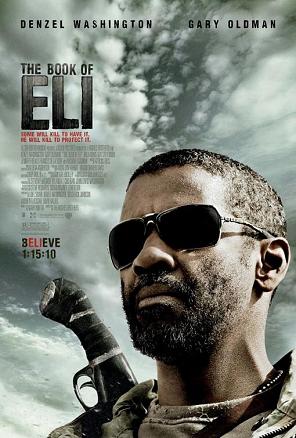
The Book of Eli:
This 2010 movie – starring Denzel Washington, Gary Oldman and directed by the Hughes Brothers – takes place in a post-apocalyptic United States thirty years after nuclear war has left it a scarred and desolate place. Enter into this a wandering nomad named Eli (Washington), a man who is wandering to the West Coast with a mysterious book that “a voice” commanded him to take there. As he travels, the importance of his task is made clear, as the history of the post-war world he is making his way through.

Along the way, he encounters a town run by Carnegie (Oldman), a  man who dreams of building more towns and controlling their residents through the power of a (again) a mysterious book he has heard about. His men are busy at work, searching the surrounding countryside for this book, but so far to no avail. When Eli arrived in town, Carnegie forces him to stay, as he is the only other literate person he has ever encountered.

Ultimately, it is learned that Eli has the book Carnegie is seeking, and that this book is none other than the Bible. He escapes from town and is pursued by Carnegie’s daughter, Solara (Mila Kunis). He explains to her that the Bible he carries is the last remaining copy since all others were destroyed after the nuclear holocaust. He was guided to it by a voice, he says, and has since been making his way across the country, guided by his newfound faith.

Eventually, Carnegie catches up to them, mortally wounds Eli and takes the Bible for himself. However, Solara manages to escape from his custody and begins transporting Eli to San Francisco so he can complete his mission. They come at last to Alcatraz where a group of survivors has been holding up under the watch of the curator named Lombardi (Malcolm McDowell). When Solara reveals they have a copy of the King James Bible, they let them in. Eli, who for the first time is revealed to be blind, begins reciting the Bible from memory.

Back in Carnegie’s town, he manages to unlock the Bible and is horrified to see it is in braille and that his wounds will soon kill him. Meanwhile, Eli dies in Alacatraz just as the printing press there begins printing copies of the Bible and the curator puts the original on a shelf next to the Torah, Tanakh and the Qur’an. Solara decides to leave and head back home, taking with her Eli’s possessions in the hopes of making a difference. She, like him, has become a wanderer guided by faith.

Granted, the message of this movie might seem a little over the top. I, for one, can’t imagine why post-apocalyptic people would destroy Bibles. If anything, I would think they would take their frustrations out on science and turn to religion for solace. Still, the point is made very clear through several key acts of symbolism. Eli, though blind, is guided by faith and it keeps him alive. And though he is robbed of the Book, the true source of it’s power, which Carnegie wants to abuse for the sake of power, lies in Eli’s own self. Really, the message couldn’t be more clear, and yet it is demonstrated with a degree of subtly that one would not ordinarily expect from a movie with a religious message. But it’s not so much about the Bible itself, it’s about maintaining hope and faith in a world where these things have been abandoned.

A Canticle for Leibowitz:

Published in 1960 and written by Walter M. Miller Jr., this novel is a considered a classic of post-apocalyptic sci-fi by genre fans and literary critics alike. Renowned for its themes of religion, recurrence, and church versus state, this book has generated a significant body of scholarly research, yet it was strangely the only novel Miller wrote in his lifetime.

Inspired by Miller’s own participation in the bombing of the monastery  at Monte Cassino in WWII, the story takes place in a Catholic Monastery in the South-Western US after a nuclear war – known as the “Flame Deluge” – takes place. Known as the Albertian order, the monks who inhabit this monastery are dedicated to preserving humanity’s scientific knowledge and rebuilding civilization over the course of thousands years.

The story opens roughly 600 years after the war takes place, in a time when science and technology, even the idea of literacy itself, has been almost wiped out by a campaign known as “Simplification”. At around the same time, a Jewish electrical engineer named Isaac Edward Leibowitz, who worked for the military, converted to Christianity and founded the Albertan order.

After generations of hiding and smuggling books to safety within the orders walls, Leibowitz was betrayed and sacrificed by “Simpletons”, at which time the Catholic Church had him sainted and ordered the monastery beatified. Centuries after his death, the abbey is still preserving “Memorabilia”, the collected writings that have survived the Flame Deluge and the Simplification, in the hope that they will help future generations reclaim forgotten science. The story is structured in three parts titled: “Fiat Homo”, “Fiat Lux”, and “Fiat Voluntas Tua” (Let There Be Man, Let There Be Light, Thy Will Be Done), with each part comprising six centuries each.

In Fiat Homo, which takes place in the 26th century, events revolve around a young novice who while on a Vigil, finds his way to a bomb shelter with the help of a mysterious Wanderer. The discovery triggers an uproar at the Monastery, as it seems that the shelter contains relics belonging to Leibowitz himself. Some fear the sensationalism triggered by the discovery will hurt Leibowiz’s canonization, which is still being debated. After many years, the canonization is given the green light and Francis is sent to New Rome to represent the order at the Mass. Unfortunately, he is murdered in the wilderness and is buried, by none other than the Wanderer himself!

Fiat Lux opens up  in the 32nd century, 6 centuries later, when the New Dark Age is coming to an end and a New Renaissance beginning. At this point in time, the Abbey is coming into conflict with the city-state of Texarkana, a metropolis’ who’s growth was hinted at in the last pages of Fiat Homo. The mayor, Hannegan, is essentially an upstart dictator who intends to become ruler of the entire region my manipulating alliances and gaining access to the Abbey’s own stores of knowledge. In the end, Hannegan’s intentions to occupy the abbey and make war on his neighbours leads to a schism whereby Hannegan is excommunicated by the Pope and he declares loyalty to the Pope to be a crime in his domain.

In the last part, which takes place towards the end of the 38th century, humanity has once again returned to a state of advanced technology, complete with nuclear power, weapons, and even starships and extra-solar colonies. As a state of cold war sets in between the Atlantic Confederacy and the Asian Coalition, the Order begins to enact a contingency plan known as “Quo Peregrinatur Grex Pastor Secum” (“Whither Wanders the Flock, the Shepherd is with Them”). As the nuclear bombs begin to fall, members of the Order board a starship and launch for deep space. With Earth about to succumb to nuclear war yet again, the Order is heading out to ensure that both humanity and its knowledge survives.

The stories central themes, which include the rivalries between church and state and the cyclical nature of history, are what make it such a memorable and enduring classic. Even though it is set in a fictitious future, it is loaded with allegories that connect it to the past. Nuclear war in the near future is the fall of Rome, the ensuing New Dark Ages a reiteration of the last, and the final nuclear holocaust between the Coalition and Confederacy represented contemporary fears of nuclear Armageddon.

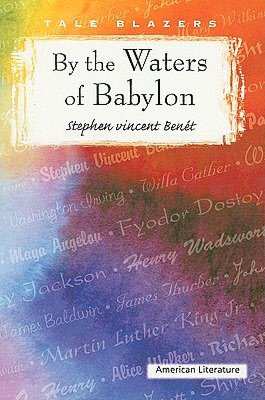
By the Waters of Babylon:
Also known as “The Place of the Gods”, this short story was originally published in 1937 by Stephen Vincent Benét. Taking place in a future where industrial civilization has been destroyed, the story is narrated by a young man named John, a son of a priest who’s people live in the hills. In his day and age, John’s people believe that past civilizations were in fact Gods. There homes are considered hallowed ground and only priests are permitted to handle metal artifacts taken from them.

Eventually, John decides that he will go to the Place of the Gods, an abandoned city that was once part of industrial civilization. In order to gain his father’s approval, he claims he is going on a spiritual quest, but keeps the intended location a secret. John then journeys through the forest for eight days and crosses the river Ou-dis-sun to make his way to the sacred place.

Once he gets to the Place of the Gods, he finds abandoned buildings, statues and countless indications that the “Gods” were in fact human. When he finally finds the remains of a dead person in an apartment, he comes to realize the truth. The Gods were in fact humans whose power overwhelmed their better judgement, hence they fell.

Upon returning to his tribe, John tells his father of the place called “New York”. It is at this point that it is made clear that the “hill people” live in the Appalachians, and the river he crossed was the Hudson. In the end, his father warns him that recounting the experience to the other tribe members will have destructive consequences. The truth, he claims, can be bad if not conveyed discretely and in small doses. The story ends with John promising that once he becomes the head priest, “We must build again.”

Farnham’s Freehold:
Based on his own experiences in building a fallout Shelter, this 1964 novel by Heinlein involves a family that is transported to the future after a nuclear explosion puts a dent in their reality. In addition to the thematic elements of nuclear war and time travel, the book also contains some rather interesting commentary on race relations and segregation in the United States at the time.

The story begins with the Farnham family holding a bridge game in their home, which is attended by Hugh, his alcoholic wife Grace, their son and daughter (Duke and Karen), her friend Barbara, and a black domestic servant named Joe. After they are alerted to the fact that nuclear war is commencing, the people rush to the bomb shelter and wait for it to pass. When it seems that the bombs have stopped falling and their oxygen is running low, they walk out and begin to investigate.

What they find is that they’ve been transported to Africa, where an advanced civilization now exists that uses white people as slaves. Initially, they suspected they had been sent into an alternate dimension, but quickly realize that they are in the future. They are spared because Joe, their black domestic servant, is able to communicate to their captors in French.

In time, Hugh and Barbara agree to take part in a time-travel experiment in exchange for their freedom. They are sent back to their own time, where they escape from the bomb shelter just as the bombs begin to fall. However, they soon realize that they are not in their own time, but an alternate dimension where things are just slightly different. They survive the war and agree to spend the rest of their lives trying to prevent the future they saw from coming to pass.

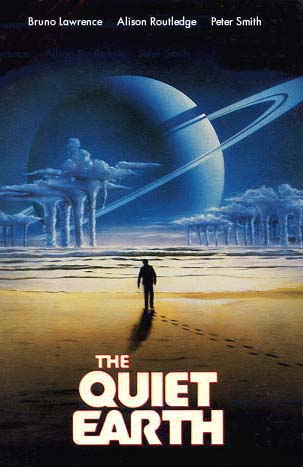
The Quiet Earth:
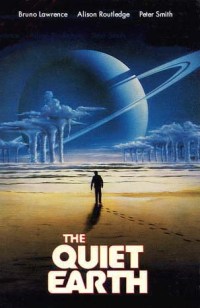
Originally a novel written by New Zealand author Craig Harrison in 1981, this story went on to inspire the loosely-adapted film of the same name which was released four years later. In both cases, the story revolves around a small group of survivors who awaken to find that the world is now devoid of humans and most other forms of life, and that time itself seems to have stopped.

The story begins with John Hobson, a geneticist who was experimenting with using radiation to activate dormant genes, which was meant to have an accelerating effect on human evolution. He wakes up in a hotel room from a nightmare where he was falling, only to find all clocks stopped at 6:12. Upon leaving the hotel, he finds that all clocks have stopped at 6:12 and that everyone appears to have simply vanished. He dubs this phenomena “The Effect” and begins looking for other survivors.

His journey takes him back to his research facility where he finds the corpse of his partner, Perrin, inside the radiation chamber. Retrieving Perrin’s locked box of papers and grabbing some weapons and supplies he sets out for Wellington. Eventually, he finds someone, a Māori lance-corporal named Apirana Maketuin, who agrees to accompany him. They eventually reach the capitol and settle in, hoping to find other survivors and run tests on “The Effect”.

Things deteriorate before long, as Hobson begins to worry that Api might be a psychopath due to his wartime experiences in Vietnam (he finds pictures of him posing with the mutilated corpses of Viet Cong). His plans to kill him with sleeping pills are interrupted when they accidentally run over a woman in the street while joyriding. They return to the hotel and make her comfortable but know she will inevitably die. This leads to a further breakdown between Hobson and Api and they fight. Api dies in the confrontation after apparently giving up.

Finally, Hobson breaks open Perrin’s box and realizes that his partner had him under surveillance because he considered him unstable. Hobson comes to the conclusion that the Effect was his doing since the the project cause the unraveling of animal DNA, and hence only those with the dormant gene pair would be spared. It is at this time that Hobson begins to have flashbacks from his last days at the facility, during which time he sabotaged the machine because of growing misgiving about the project and mistrust for his Perrin’s motivations. It was this sabotage that caused the Effect, and the reason Hobson slept through it was because he took what he thought was a fatal dose of sleeping pills.

Maddened with grief and guilt, Hobson jumps from the window and begins to fall to his death. But then, he wakes up in the same hotel room he found himself in at the beginning, recalling the same dream where he was falling. He checks his watch and it says it’s 6:12… Spooky! Though it bears a strong resemblance to such works as I Am Legend, The Quiet Earth went beyond in that it chose to focus on the themes of perception, culpability, and alternate states of consciousness. All throughout the book, it is not quite clear if Hobson is dreaming, in an alternate dimension, the last man on Earth who is responsible for the death of countless life forms, or just plain crazy.

Shadow on the Hearth:

This post-apocalyptic novel, which was the first novel to be released by Canadian sci-fi author Judith Merril (1950), takes place a week after nuclear bombs have devastated, but not destroyed, civilization as we know it. The plot revolves around a mother named Gladys Mitchell and her two daughters – Barbara and Ginny, who are fifteen and five years of age – as they struggle to deal with worsening conditions and a system that is quickly becoming an abusive dictatorship.

For starters, all civil authority has broken down in the wake of the war and been replaced by the Security Office, a form of emergency services that exercises all power. Gladys’ contact with the services is the local “emergency squadman”, Jim Turner, a neighbor who begins to display a rather creepy fascination with Gladys along with a desire to turn the emergency to his own advantage.

Similarly, the difficult situation breeds suspicion and intolerance on behalf of the authorities who begins see enemies everywhere. The Mitchell’s maid, a woman named Veda, comes under suspicion when it is learned that she was off sick during the time of the attack. Much the same is true of Gladys’ old science teacher, who predicted that nuclear war would be inevitable and now fears the paranoid Security Office might suspect him.

Meanwhile, Gladys tried to maintain a disposition of stoic calm, mainly because she believes its her role as a mother to act as though everything is fine. While her intentions are good, she’s slow to admit that Turner and the authorities are corrupt, that their situation is bleak, or that she might need to manipulate certain people to get her way. But in the end, she is willing to go to great lengths to protect her family, from both external threats and the threat of dissolution.

In several key aspects, this story demonstrates some of the overriding themes and feelings that were present during the early cold war. We have the specter of war and dictatorship, the focus on the single-parent family, the idea of domesticity and sexism, and the affirmation of the mother figure who will do whatever it takes, even if she seems naive and silly, to keep her family safe and secure. While it might seem dated by modern standards, it is nevertheless a fitting and accurate portrayal of life in the 1950’s and the likelihood of what would come of it if the bombs started to fall.

The Time Machine:
Last, but not least, we have the story that has made my lists in one form or another on numerous occasions. In addition to being an example of utopian and dystopian fiction, The Time Machine is also a fitting example of post-apocalyptic science fiction. This is part of what makes H.G. Wells novella a timeless classic, in that it transcends or jumps between genres and can therefore be read from a number of different perspectives.

In this respect, the Time Traveler’s trip to the distant future, where the world has degenerated into a two-tier structure between the monstrous Morlocks and the stagnant but beautiful Eloi, can be seen as an example of post-apocalyptic society. What’s more, their respective degeneration is seen as the result of humanity’s obsession with class distinction, the masters becoming lazy and ineffectual while the workers have become cannibalistic and brutish.

Another apocalyptic element in the story comes towards the end when the Time Travelers recovers his machine from the Morlocks and travels another 30 million years into the future. Once there, he sees some of the last living things on a dying Earth, a red landscape similar to that of Mars which is covered by lichenous vegetation and crab-like creatures wandering across blood-red beaches. As he jumps further, he sees the Earth’s rotation gradually cease and the sun die out, the world falling silent and freezing as the last organisms die off.

In a deleted section of text, which H.G. Wells apparently included in the original serial version at the behest of his editor, but cut from the novel once it was published. Here, Wells demonstrated “the ultimate degeneracy” of man by having the Time Traveler escape from the Morlocks and jump once more before traveling 300 millions years into the future. Here, he found an unrecognizable Earth populated by furry, hopping herbivores, which he interpreted to be the descendents of the Morlocks and Eloi. Thus, in addition to first losing the instincts that defined humanity at its greatest, the Morlocks and Eloi, themselves descended from humans, even reverted to an earlier state of evolution in the end.

Though not a post-apocalyptic tale in the strictest sense, this story does contain the necessary elements of such a story. You have humanity degenerating as a result of cataclysmic events or its own inherent weaknesses, civilization as we know it being destroyed or disappearing, and even the world itself coming to an end.

Final Word:
And that’s all I got for post-apocalyptic sci-if. Sure, there are countless more examples that could be included, but three lists is enough for me and I’m neck deep in other concepts that are vying for page time. In the coming weeks, expect more news on technology, space exploration, the upcoming anthology, Data Miners (set for release in August) and plenty of assorted tidbits on stuff that relates to the world of science and science fiction. Take care all and see you again soon!

Nominated for a Liebster!

I can remember, somewhat vaguely, when the Versatile Blogger Awards were making the rounds and I received a nomination. I felt so… confused. It’s like, so it’s an award… but it’s not an award? I get nominated but there’s no winner and no prize money? What gives? And then came the Kreative Blogger Awards, the Lucky Sevens, and a slew of others. And all the while, I aint got no stinking reward cash! So you can imagine how “honored” I was to find out that I’ve been nominated for a Liebster Blog Award, which also doesn’t come with cash!

Ah, I’m just kidding, Carly! I’m very honored that you chose to nominate me for this. But just for fun, I thought I’d give an acceptance speech loaded with sarcasm, self-pity and recrimination. People always talk about how happy they are, how unworthy they are, and who they want to thank. Me? I want to talk about who I BLAME! And all the while, I’ll be reminding everybody just how worthy I am of their praise and how crappy a job I think they’re doing of kissing my ass! Brace yourself, this is not going to be pretty…

First off, I blame my parents. I didn’t ask to be born! And what’s more, I blame them for providing me with the kind of stable, privileged, upper-middle class upbringing with just aint cool anymore. If I want to be a successful writer, I need a hook, an angle, a background I can exploit for cheap sympathy and street cred! Mom, Pop – why couldn’t we have been the kind of broken home that inspires it’s kids to be tough and responsible? Why couldn’t I have grown up in a neighborhood where kids were badass and throw downs involved more than just hurt feelings? I can’t help but think that if I had picked up a few flesh wounds in my time, I might also be hawking vitamin water and my own line of apparel.

Second, I blame my friends who made the unforgivable mistake of believing in me. Everybody knows that the best success stories come from overcoming the odds and flying in the face of all the naysayers. So may I say, you’ve all failed me terribly! Where was the “you’re never going to make it” or the “you just don’t have what it takes” speeches? How am I supposed to succeed with all you people telling me what I’m doing sounds “interesting” or that “you’re all pulling for me”? Didn’t you see Million Dollar Baby? Do you really think she would have become a great fighter if her momma said “Everybody in the trailer park is cheering for ya, honey”?

Third, I blame my peers and colleagues for not challenging me enough. Sure, you’ve been supportive, friendly, and generally a pleasure to be around, but did you ever once think of ME? It’s a well known fact that people need conflict in order to be creative, so why the hell didn’t any of you troll me or call me a hack? The best I could do was some kid who barely spoke passable English and didn’t even seem to understand what the article he was slamming was about. What kind of nemesis is that? If I’m going to nominate anybody for anything, it’s going to be for the Crappy Enemy Award. The nominees in that category are… all of you!

And last, I’d like to blame God. Of all the generations and countries I could have been born into, why did you stick me with Generation Echo here in Canada? Were you aware that I would grow up in a time and place where the standard of living was ranked highest in the world? Were you aware that I would grow up surrounded by a diverse array of people who would teach me so many interesting things, like how lucky I was and how rich and wonderful the world really is? Yeah, I know you’re busy running the universe and all that, but seriously, you could have done a way better job on me! Thanks to you, I got no complaints! Well, sure, I could complain about a few things, but the who the hell would want to listen? I’ve never seen a war, never known hunger, never known poverty or neglect. I’ve never seen a person die or been traumatized by the sheer brutality that some people have to face on a daily basis. In short, I’m not interesting! Sure, you stuck me with a real nice situation, but no one wants to hear about nice! If it’s true that a person is the sum total of their experiences, might I then say that I’m boring and it’s clearly your fault.

So thank you all for this honor and I hope you’re happy. I know I am 😉

Okay, sarcasm done. Hope you found it funny because I was kind of blowing my cover towards the end there. I really can’t be too sarcastic when it comes to the suffering of other people and how I’ve never had to deal with that. That’s just too plain stark and serious to ever really joke about. But I hope my point was clear. I am a lucky man and I want to pass that on to as many people as I possibly can before I die. I’ve felt for the longest time that that’s my Dharma, my purpose since I’ve been dealt a pretty good hand. What the universe gives ya, you should pay forward, or back, as the case may be.

Oh, and I will be sure to actually follow the rules and nominate people. Hang on, that’s coming up in my next post 🙂

Winston Agonistes, Part IV

Welcome back! You know, it feels like I’ve been a little wan in my output lately. Perhaps it’s because I’ve been hard at work on my stories… or not. Hard to say really, but I will say that the anthology me and my colleagues have been working on is coming along nicely! In an attempt to keep pace with my group, I’ve come up with another installment in the Winston Agonistes story.

And just for fun, much of this installment was inspired by real-life tales of Shàngdū, China. It is this ruined city that was once the summer capital of the Yuan Dynasty, as decreed by the Mongol ruler Khublai Khan. Often referred to as Xanadu or Sanadu (in Mongolian), this city is the same place that is mentioned in Marco Polo’s account of China, the one which inspired European dreams of traveling to the Orient and finding cities of gold. It also inspired the poem “Kubla Khan” by Samuel Taylor Coleridge and a musical which I will not get into, even to save my own life!

Anyway, here it is, fresh from the press. Behold!

As expected, a greeting party was waiting for them in the Transport Bay. Dressed in their ceremonial robes and wearing pressure masks, they stood on the platform overlooking the main deck. Winston eyed them through the cabin window as their ATV came to a complete stop, noting the individuals and their respective positions from the mantles they wore.

There were five in total, arranged by twos around the one in the middle who wore the most flamboyant garb of all. The ladies he denoted by the choice of red robes, while the males wore the traditional blue, consistent with Shiangdu’s code of customs. Aside from that, there was only a single distinction, which came in the form of the orange inlaying that the man in the center had on his robe. That could be none other Commissioner Yan Moon Kim, Wu’s second in command.

The seals disengaged and the door opened. The top segment rose above the ATV’s roof while the bottom one lowered to form their exit ramp. Winston allowed the Councilors on the other side to file out first and fitted his helmet, which at this point in their mission had remained unused, over his head. Though the Shangdu settlers were no strangers to synthetics, their reaction to seeing one in the capitol’s delegation could not be fully predicted.

As their team filed into the bay, the Shangdu representatives climbed down the steps to the deck to meet them. Handshakes were exchanged between Kim and Mutlu, Kim gesturing to the pressure doors immediately thereafter so that further pleasantries could be conducted without the need for helmets. Mutlu nodded and they marched together, mounting the steps and entering through the cycling doors that would lead them within.

Winton looked back upon the bay, noted the deck hands that began to pour over their ATV. As a courtesy, they refueled the vehicle, removed the excess traces of fungal deposits from its wheels, and packed them away in biohazard containers. Some of the tendrils looked rather large this trip.

The pressure doors opened, admitting them into a small vestibule located next to the main colony. Much like all decontamination bays, the walls were studded with sensors, vents and irradiation panels, all of which became active as soon as the doors closed behind them. Many in their crew drew a hand to their face to cover their visors, protection against the onset of the harsh lighting that began to fill the confines of the room. Winston needed no protection, as his eyes adjusted automatically to the onslaught of the harmful rays. In a few seconds, it was over. All airborne pathogens that had clung to their shells rendered completely inert.

The harsh lights disappeared and were replaced by a green glow. The interior doors began to slide open slowly. Beyond, the grey paneling of the entrance hallway appeared and the Shangdu welcoming committee stepped out and ushered the rest of them forward.

Winston could not help but think this was a momentous occasion. It would be the first time he had ever witnessed a colony outside of Zarmina. He had conducted all the research necessary to prepare himself for the trip. He knew the interior layout of the colony well and the significance of every detail contained within. And yet, to actually see it for himself seemed beyond compare.

We’re he able to describe the situation; the word exciting would certainly come to mind. If only he were capable of truly feeling that.

*          *          *

They came to it at last, the doors that led into the settlement proper, where the expectation of excitement would certainly be at apogee. Winston had learned from his many archival studies on emotions that it was in the last moments before the reveal that feelings of anticipation reached their highest, in what was described as a fever’s pitch. It was fortunate then that he did not feel such feverish emotions, otherwise he might not have noticed the fine details that were in front of him.

The colonies main doors, for example. Constructed of a crystalline-polymer composite, they were clearly meant to resemble a marble gateway that had been etched with classical motifs from the late Yuan Period. And in keeping with the design of the original city, the colony had been laid out in four-quadrants with mayoral palace towards the center-rear, though the layout was circular instead of square. Such a profile would never support the settlements enclosed nature, which invariably required some degree of revision to the original plan.

The doors slid open and Winston’s eyes shifted to long focus, every detail being absorbed as it became clear. He was immediately aware of lush greenery and emerald color schemes, of gilded columns and carved surfaces. A few meters from the doorway, a second party of three people who also ornately dressed, stood and waited for them. In the exact center, dressed to resemble a Manchu-dynasty tyrant, no doubt, was Wu himself. Their greeting party of five joined his, forming a perfect eight.

“Councilman, I am honored,” Wu said in a strained, lightly accented voice. Mutlu stepped forward and bowed gently towards him.

“Mayor Wu, the honor is mine.” Wu returned the gesture and they came together to exchange kisses on each other’s cheeks. The initial exchange was going well, respect being given for each leader’s particular cultural niceties. Winston began to wonder if his request for a seat at the meeting was more or less likely to succeed at this point.

More conversation followed as they walked down the length of the settlement’s main foyer, into what appeared to be a preserve featuring various Terrestrial plants. A path of what resembled cobbled stone stretched out before them, stretching to the far end of the enclosure where the city itself would be accessible. For all newcomers to the settlement, this was the first thing they would see as they made their way into the vast collection of marketplaces, tenements, facilities, and of course, the mayoral palace at the far end.

As they walked, Winston’s olfactory receptors noted the presence of cherry blossoms and plum trees, his eyes detecting the bright colors of birds of paradise plants and even animals prancing about. Most impressive amongst these was the Pelicans that were drinking by the small creak running through the enclosure.

Winston turned to Bhutto next to him. “Synthetics?” he asked. Bhutto looked in the direction he was pointing and shook her head.

“No Winston, those are real. The settlers arranged for ova and sperm to be stowed in their supplies well in advance.”

He looked back at the animals as they continued to graze and drink from the artificial creek. It seemed unlikely that organic creatures would have been transplanted here, given the cost to bread them and added upkeep. And yet, he was being told to believe this very thing. And for a moment, he considered the possibility that what he was experiencing the emotional state known as confusion. Another unlikelihood.

His attention returned to Bhutto when she playfully slapped his arm.

“Imagine that, a synthetic that can’t tell the different between organic and synthetics.”

Wilson smiled obligingly. “For that, you will have to blame the makers, madam. They do their work too well.”

She laughed again and placed both hands on his arm. He registered a gentle squeeze through the layers of his sleeve. His calculated jocularity appeared to be having an interesting effect. In addition to entertaining the Councilor, he was almost sure she was beginning to… like him.


Terraforming in Pop Culture

Welcome back to the wonderful world (pun!) of Terraforming. In my last post on the subject, I came to see that it emerged in fiction in the early 20th century as part of our growing awareness of the universe and humanity’s place within it. As western civilization grew and came to encompass the entire world through exploration, conquest and colonization, human scientists simultaneously discovered that our universe was much larger than previously thought, and began to postulate that life could exist on other planets.

In short, while our world grew smaller, the universe grew much, much larger. With no more nooks  or corners left to explore and conquer, we began to set our sights to the heavens for the next frontier. It’s such a fertile topic, but I shan’t get into it here. If I start waxing philosophical on all the thought that goes into exploring new worlds, we’ll be here forever.

Onto to the subject for today, which is terraforming in popular culture! As you can guess, there are quite a few instances of this taking place, and for good reason. Wherever science fiction and exoplanets have shown up in pop-culture, the concept terraforming was sure to follow. In some cases, this constituted a mere mention, but in others, detailed descriptions were given. Here is a list of just a few examples that I could find:

Aliens:
Central to the plot of Aliens was the fact that LV-426, the planet where the Nostromo and its crew encountered the Xenomorph in the first movie, had become a settler colony. As the executive at Weyland Yutani told Ripley, it was what they referred to as a “Shake and Bake Colony”, where terraformers were sent on ahead to run the atmospheric processors and make the planet suitable for human use. This was all in keeping with WY’s motto of “Building Better Worlds”. Pshaw!

Shortly after they arrive on LV-426, Ripley and the compliment of Colonial Marines determined that the colonists had been moved into the atmospheric processor, specifically to its lower levels where the air was hot and humid. Apparently, these conditions were favorable to the Xenomorph hatchlings, which began to use the colonists as hosts to breed”Chestbusters”.

After their disastrous confrontation in the hive, the atmospheric processor suffered a rupture to its coolant systems, which meant that the entire thing would go thermonuclear in just a few hours. After being all but eradicated in their first encounter with the Xenomorph and losing their only transport back to the ship, this served to add further urgency to the plot. And in the end, it was the destruction of the atmospheric processor which ensured that the Xenomorph colony was destroyed and all traces of them (with the exception of the Queen) wiped out.

Cowboy Bebop:
Set in the not-too-distant future, this anime from from the late nineties was set in a universe where humanity lived throughout the Solar System. This was made possible due to the discovery of hyperspace gates; however, due to the explosion of one near the Moon, Earth found itself being bombarded by meteorites which devastated large sections of the planet. As a result, much of the human race had to relocate to the Inner Planets, the Asteroid Belt, and the moons of Jupiter.

Many episodes of the show take place on the planets of Venus, Mars, Ganymede, Io, Callisto, and Titan, where terraforming has rendered them partially of fully habitable. Though the concept is treated as a sort of given, some degree of explanation is given as to how it took place and the varying degrees of success that resulted. In the case of Mars and Venus, the terraforming was so successful that Mars became the new hub of human civilization and Venus a major population center.

With this background firmly in place, the series plot arc – which involves a motley group of bounty hunters patrolling the system Space Western style – is then able to unfold. Though the show last only 26 episodes, it did achieve a cult following and a level of influence, similar to Joss Wedon’s Firefly (another Space Western that died prematurely).

Firefly:
Speak of the devil, or in this case, a show that made good use of the concept of terraforming. Intrinsic to the plot of this show, so much so that they opened every episode by referring to it, is the fact that in this future, the human race was forced to relocate to a new star system after Earth had been “used up”. Arriving at the “White Star”, they found dozens of planets and hundreds of moons around the system’s central sun and its many dwarf suns. These planets were then terraformed, a process which took generations, and began populated them soon after.

Another fact which is central to the story is the fact that while the central worlds were terraformed successfully and boasted large, advanced populations, the outer planets were poorly terraformed, leading to dry, desolate worlds that became havens for crime and backwards populations. Though life was show to be difficult in these colonies, they were also the only places where people can still enjoy a life free of the repressive Alliance regime.

But more importantly, this back story gave Joss Whedon an excuse for the look and feel of his acclaimed Space Western! It also played perfectly into the show’s historical narrative, where the expanding Alliance represented the closing of the American frontier and the death of a way of life. For not only were the First Nations and their culture being sacrificed in the name of “Manifest Destiny”, a great deal of the American Dream of an open frontier was as well.

Red Planet:
Set in 2056 AD, the plot of this film centers around ongoing terraforming efforts on Mars. Faced with the dual problems of overpopulation and pollution, NASA and other space agencies begin sending automated probes to Mars that contain atmosphere-producing algae. These probes have been seeding Mars for twenty years as the first stage in a terraforming effort that will make the planet suitable for human settlement. When the oxygen production is inexplicably reduced, a crew is sent to investigate so that the  terraforming efforts can be put back on track.

When the mission arrives, and endures numerous disasters,they eventually discover that the introduction of Earth algae has stirred up the native Martian life. This consists of nematodes that have come to the surface to feed on the algae, emitting oxygen in return. This, they realize, has changed the parameters of the original project, but leaving it otherwise intact.

Star Trek II and III:
What is generally hailed by fans as the best movie of the franchise (Wrath of Khan) opens up with a rather unusual take on terraforming. In fact, the plot of both the second and third movie revolve around a project known as Genesis, a means of instantaneously transforming a planet from a lifeless husk into a habitable M-class planet.

In Wrath of Khan, things begin when the starship Reliant, while searching for a lifeless planet in the Ceti Alpha system, is taken over by Khan Noonien Soong and his band of genetically-modified people. Having learned of their mission, Khan becomes obsessed with finding the Genesis device so that he can restore the desolate landscape of Ceti Alpha V, presumably with the intention of resurrecting his dead wife.

In the end, Kirk and the Enterprise disable his ship inside a nebula, prompting Khan to set the Genesis device to self-destruct in the hopes of taking Kirk with him. With their warp drive non-functional, the Enterprise could not escape, prompting Spock to sacrifice himself in order to bring the engines back online. Though he dies from radiation poisoning, the ENterprise escapes as the Genesis device detonates, which has the effect of turning the nebula itself into an M-Class planet.

At the very end of the movie, Spock’s body is placed inside a torpedo casing and fired into orbit around Genesis. After landing on the surface, the “Genesis wave” heals Spock’s body and he is reborn. This, as all fans of the franchise know, was the basis for the third movie where Kirk and the Enterprise come back to Genesis to retrieve him. In the course of doing so, the Genesis plant is examined in more detail and the effects of the project. Ultimately, though the device was capable of creating life out of lifeless, it proved unstable and resulted in the total collapse of the planet created.

Total Recall:
The film adaptation of Philip K Dick’s “We can Remember it for You Wholesale” differed from the source material in many key ways. For example, in addition to the central theme of memory and the dividing line between real and artificial, there was also an extensive backstory involving Mars. Ultimately, the character of Quad (played by Arnold Schwarzenegger) learns that he is drawn to Mars because that is where he is from, and his false identity implanted because of something he witnessed there.

In the end, it is revealed that this secret has to do with an ancient alien device that lies at the heart of the planet, a device which has the power to terraform Mars into a habitable world. Apparently, this involved some super-heated coils that, when activated, would plunge into the planet’s watery core, evaporating them and filling Mars’ atmosphere with water vapor. When Quad activated the device, it had the effect of creating breathable atmosphere within a matter of minutes.

Not the most realistic depiction of terraforming, but it did have it’s upsides. For one, it took advantage of contemporary scientific theories that stated that Mars might have underground sources of water and ice. Second, it incorporated speculation of how these could be used to eventually create oxygen-creating plants on the surface and hence, an atmosphere. Last, it worked into the plot in that the villain, Coohagen, knew that if Mars had a natural atmosphere, it would destroy the basis of his power (controlling the air supply).

Shatner’s “Get A Life” Explores Star Trek Fandom

In 1986, William Shatner hosted Saturday Night Live and performed the sketch where he told a convention of Trekkers to “Get a life!” A hilarious moment in television history, or an instance of carefully scripted sincerity? Who knows? Either way, anyone who has not checked seen the sketch should do so immediately. I’ll wait, don’t worry…

Wasn’t that hilarious?

Anyway, it just so happens that Shatner is back at it, trying to find out what it is that defines Trekkies and contributes to the phenomena known as Star Trek fandom. Appropriately, he has named this movie “Get A Life” in honor of the satirical remarks he made on SNL. Again, this may or may not be sincere advice. The point is, even after decades of being the big name is Star Trek, he still wonders why the hell grown men and some grown women have spent their entire lives dedicated to this franchise.

Following in the same vein as Trekkies, this documentary goes beyond taking a look at Star Trek conventions and fandom over the years and  delves into the deeper questions of what makes Star Trek so enduringly popular. Much like Star Wars, it’s a science fiction franchise that has become inextricably embedded in our collective consciousness, to the point that even Captain Kirk himself is astounded and left wondering what the hell is going on…

Snippets from the documentary suggest that it was Roddenberry’s optimism that won fans over. His positive view of a future where all our current ills are solved and the worst didn’t happen is certainly one of the a selling points of the franchise. With so many dystopian and misanthropic visions permeating the pop culture sphere, people enjoy hearing a more positive appraisal of humanity and its prospects.

More echoes of Star Wars there, another franchise which captured fans imagination with its upbeat message and tempo. One has to wonder if the timing of these two franchises wasn’t just the slightest coincidental…

Anyhoo, here is the documentary’s official trailer. Enjoy!