New Anthology Sample: Arrivals!

http://timedotcom.files.wordpress.com/2014/04/beyond-earth-shuttle.jpg?w=1100Lately, I’ve been getting back to work on the space anthology known as Yuva – and for good reason. Not only has our group been blessed with the arrival of some new blood in recent months, but for many of us (me especially), the inspiration bug has bitten after a long hiatus.

Don’t ask me why, but writing for a different genres can be very temperamental. One minute, you find that all you can write about zombies and apocalyptic scenarios; next minute, its all space ships and futurism. Somebody really needs to put a label on inspiration, one that reads “non-transferable”!

In any case, here is the latest sample from my latest anthology story, “Arrivals”. In this scene, we find one of the main characters (Marcellin Strauss) aboard the ship that will take him and its crew to rendezvous with the Second Migration, a flotilla of ships that are rapidly making their way towards Yuva…

*                    *                    *

The tiny space inside his helmet felt terribly confining. And at the moment, the heads-up display, with all its colored light and constant barrage of information, was not helping. And top of all that, there was the launch clock that was slowly counting down in the lower left corner. At the moment, it was the largest thing in his display field, and impossible to ignore. It’s every tick kept pace with the automated voice coming in from Control, and with the frantic beating of his heart.

Strauss could only breathe and try to remember what he had been told during the past few weeks of crash-course training.

Breath steadily, sit tight, and trust in the instruments.

Not exactly the height of preparation; but at the moment, what else could one do? At this point, the ship pretty much flew itself and all they could do was trust the equipment not to kill them. And considering that Strauss wasn’t even flying the thing, he was left with little to do but wait and try not to panic.

Hartberg’s voice sounded in his ear. “Commencing engine ignition sequence…” He felt a low rumble as the ship’s engine began powering up and preparing to slam hydrogen and anti-hydrogen together in a controlled reaction. “Ignition sequence in five, four, three, two, one…”

They were hit by a hard jolt. Vibrations that were enough to make all the colored lights in his field of view turn into a blurred mess took over. Like everyone else in the cabin, he was thrust into his seat and felt the restraints grab him tighter. And within seconds, they began shooting down the runway.

Hartberg‘s voice spoke again within a few seconds, relaying their progress to Control in an unbelievably calm tone.

“Thrust capacity reaching optimal… acceleration normal… beginning ascent in ten seconds…”

Breath steadily, sit tight… he thought as he continued to be pushed back into the seat.

“Five seconds…”

The runway continued to recede behind them. In the distance, he could see the Great Expanse growing larger as they drew nearer to the coast. And then, he felt the slightest lift as the runway dropped beneath them.

Hartberg‘s reports became faster and closer together now.

“Ascent begun, engine function nominal, orbital velocity in sixty seconds…”
The vibrations subsided a little, so that the readouts in his vision seemed discernible. He could only ascertain so much from them, but the fact that all were in the green was reassuring.

Their acceleration mounted and they continued to climb, and Strauss felt himself being pushed harder back into the seat. It was a funny paradox, how breaking the hold of planet’s gravity meant having to endure additional gravitation stress. It was as if Yuva didn’t want them to leave and was trying to pull them back in.

Trust in the instruments, he told himself. Trust in the pilot.

Up ahead, all he could see now was the deep azure of the sky, the slowly receding clouds, and the faint dots of the distant stars. The engine continued to slam particles together in an ongoing effort to achieve maximum thrust, and his body could feel additional bit of acceleration they achieved.

Beneath the noise of the ship, the voices and the instruments, he could hear a dull moaning. It was coming from him, and growing in intensity. A voice soon sounded in his ear, one of the operators at Control demanding to know his status.

“Control to Eagle One. We’ve got Strauss showing very high levels of epinephrine. Advise on the need for a sedative, over.”

Strauss quickly keyed his comm and replied. “This is Strauss. I’m fine. I’m just fine, over. I’m good, don’t dose me.”

His hurried, panting reply was followed by that of the Captain’s, who was sure to use all the proper comm protocol.

“Control, this is Eagle One Actual. That’s a negative on a sedative, over.”

“Roger that, Eagle One.”

There was a slight pause, during which time Strauss stopped making noise and tried to catch his breath. The Captain came back on and tried to talk him down.

“That’s it, Strauss. Just keep breathing. We’re almost there.”

Strauss heard him and felt somewhat reassured. He kept breathing and kept his eyes ahead, focusing on the distant stars. These were much more calming than all the readouts that continued to frantically tick away, showing their speed, engine pressure, altitude, and anything else that was rapidly changing. In time, the sky began to change color. A flare of orange light flickered through the cabin as their sun’s light hit them for the first time without refraction. And very quickly, the distant stars began to burn much brighter.

That’s when Strauss noticed everything change…

The cabin ceased vibrating, the numbers in his field of view began to drop off, and he no longer felt himself being thrust back into his seat. In fact, he now felt the restraints tugging against him to keep him from floating away.

They had done it. They had broken atmo, and were now floating in high orbit above the planet. Hartberg’s voice came back on the line to announce this.

“Control, this is Eagle One. We have broken atmo. I repeat, we have broken atmo, over.”

There was a pause as Strauss was sure the people at Control were howling out in celebration. Just about everyone in the cabin was doing the same. Meanwhile, he licked his lips and tried to get his heart and breathing under control. He could feel his head beginning to spin as his blood pressure dropped and his adrenals took a break. He also became aware of an incredibly dry feeling in his mouth.

All of this made him painfully aware of how sober he was right now, and how much he wished it weren’t so.

Man I picked a bad time to stop drinking!

Good Zombie-Related News Everyone!

shutterstock_107588285Good evening all! I hope this August weekend finds you all happy, safe and having fun in the sun. But never mind that right now, I got some good news to share! For several months now, I have been trying to get Whiskey Delta placed on Goodread’s Listopia – a place where people can list their favorite works by genre.

And with a little push from some of my Goodreads friends, it finally happened! As of the writing of this post, it is placed at #220 on a list of 1139 original works. This list expands all the time as people vote to have their favorite works included, and books move up with each added vote.

If you have time, access, and would like to help a zombie fiction-writing indie writer out, here’s the link:

https://www.goodreads.com/list/show/933.Zombies_?page=3

Just scan the page for #220 (I will post again if it moves up in the queue) and vote for this humble work of fiction which I am working so hard to pimp out!

New Milestone: 500 Follows!

fireworks1The good people that run WordPress have just informed me that this humble blog o’ mine has reached an important milestone. As of 3:00 AM this morning (Pacific Daylight Time) I received my 500th follow! Combined with followers from Facebook, Yahoo, and Twitter, that brings the grand total to 2,091!

I’m especially happy about this because for some time now, I’ve had trouble breaking the 2050 mark. It seemed that with every new follower, I would lose one, and that’s never nice. Sounds greedy, I know. But it seems that the more people you have willing to listen to you, the more concerned you are about keeping that following.

https://wordpress.com/wp-content/mu-plugins/achievements/followed-blog-500-1x.png?m=1391188133i

Naturally, I want to thank all those people who have signed on to follow Storiesbywilliams. This past March marked its third anniversary, and for those who have chosen to stick with me over the past few years, I am especially thankful. The support and encouragement I have received since deciding to go public with my writing have made quite the difference.

Not only has it helped me to bring my written work to publication by giving it the feedback and constructive criticism it needed, it has been the difference between toiling in anonymity and making meaningful connections with people. This is why I began writing in the first place, and knowing that there is a receptive public makes all the difference.

Here’s to three years more and (fingers crossed) another 500 followers! And to those I’ve been following myself, I hope I have managed to make a similar contribution to your work. None of us is alone on this journey and we all need to know that we are doing matters to others. May it lead us all to somewhere joyous, fruitful and (God willing) profitable as well!

Combatting Suicide: Blood Testing for Predisposition

rip-robin-williams-1951-2014The recent suicide of Robin Williams has left people all over the world in a state of shock. As is so often the case with suicides, the people who knew him best are left wondering how someone who seemed so full of life, so buoyant, and so happy could have become so hopeless and depressed that they felt compelled to take their own life. I myself, who looked up to the man and am so often asked if I’m related, was completely buffaloed by the news.

So when I came across this story, I decided to skip it past the queue and write about it straight away. As I’m sure many people are aware, mental illness has long been a question of nurture vs. nature. Whereas some believe that environmental factors are the chief cause, others have been looking for genetic indicators that could show that certain people are predisposed to mental illness.

https://i0.wp.com/images.gizmag.com/gallery_lrg/suicidebloodtest.jpgHowever, some recent findings from the John Hopkins School of Medicine may have settled the debate. Led by Dr. Zachary Kaminsky, a John Hopkins research team came to the conclusion that suicidal tendencies can largely be traced to a genetic mutation in those people who are more likely to commit suicide. What’s more, this mutation can be detected with a simple blood test.
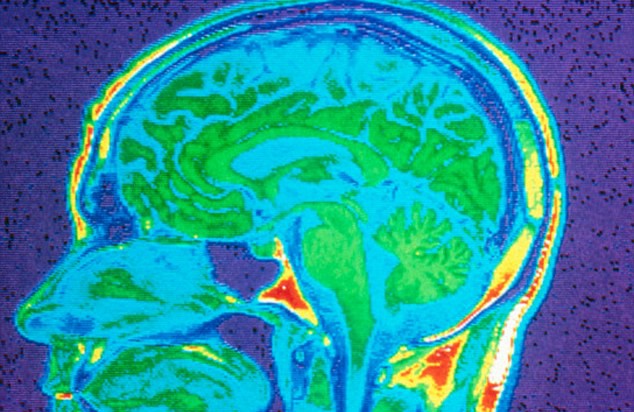
Based on the analysis of brain samples taken from the cadavers of both mentally ill and healthy people, they found that in  cases where the people had died by suicide, there was a lower-than-normal concentration of a gene known as SKA2. This gene is expressed in the prefrontal cortex of the brain – an area involved in inhibiting negative thoughts and controlling impulsive behavior.

depression_brainscanThis gene plays a part in the brain’s handling of stress hormones. If it isn’t functioning properly or lacking, stressful situations that would ordinarily be bearable can drive a person to contemplate or even attempt killing themselves. It was also found that the mutation not only reduced the levels of the gene, but also added chemicals called methyl groups to the SKA2 that was present.
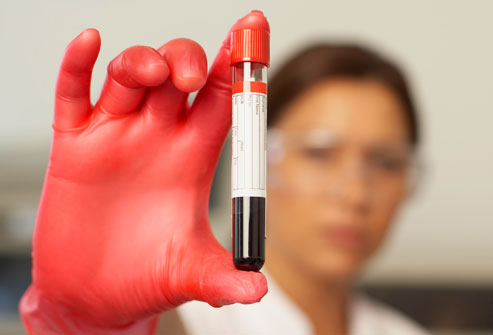
This finding was backed up by an analysis of blood samples taken from 325 living test subjects. Based on the levels of methyl groups in the SKA2 genes within those samples, the scientists could predict with 80 percent overall accuracy which of the participants had contemplated or attempted suicide. The accuracy went up to 90 percent for test subjects who posed a severe suicide risk, and 96 percent for the youngest group of participants.

blood_testIf the data is confirmed by larger studies, it is hoped that such testing could ultimately be used to predict how likely mentally-ill people are to commit suicide, and to then tailor their treatment accordingly. It could also be utilized to screen patients before administering medication that can cause suicidal thoughts, or as a reference for monitoring people who have recently returned from stressful military service.

This is good news for people who have a family history of mental illness, or know somebody who has begun struggling with it, or has been for their entire life. As mental health experts will attest, knowledge is the best means of prevention, so that the illness can be predicted and preempted, and its onset properly addressed. What’s more, knowing that a genetic mutation is involved will go a long way toward developing genetic treatments that can correct the mutation.

RIP-Robin-WilliamsIt is always a tragic thing when a person dies before their time, but it is especially so when they take their own life. In addition to the grief, there are also the terrible, burdensome questions of why they did it, and what could have been done to save them. One can only hope that developments like these will lead to an age where mental illness is no longer such a terrible, unpredictable thing.

Rest in peace, Robin Williams. Wish I could have been there for you, buddy. And know that you will be sorely missed!

Sources: gizmag.com, dailymail.co.uk

Towards a Cleaner Future: Denmark’s Wind Power

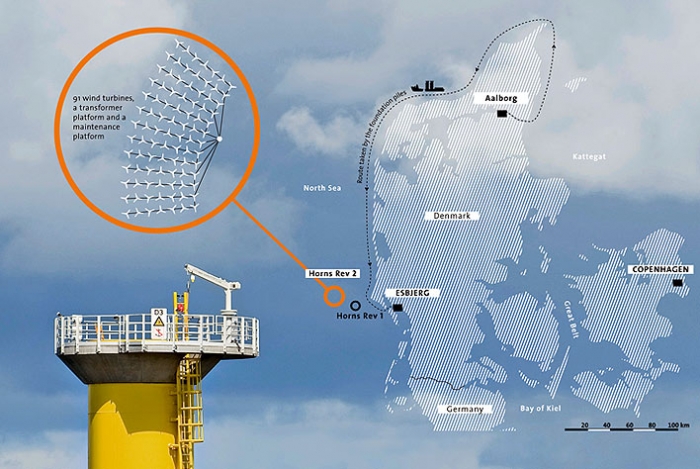
wind-power-660Denmark made a recent and very positive announcement. According to Denmark’s Energy Association, wind power is now the cheapest source of energy, beating coal, fossil fuels, and natural gas. What’s more, the government agency claims that by 2016, the electricity whipped up by its newest turbines will be half the price of conventional means. The announcement came in the last week of July, and is raising hopes for clean energy around the world.

For years, wind and solar have been achieving grid parity with fossil fuels in many places around the world, meaning they are just as cheap. But even without the tax breaks, declining manufacturing costs and growing scale have rendered wind power just as cheap as natural gas in many states in the gas-rich US. And as Deutsche Bank analyst Vishal Shah claims, this is the “beginning of the grid parity era” for solar, worldwide.

solar_array1As he explains it, demand is being driven by “sustainable” markets – meaning the US, China, and regions outside of Europe – with Japan leading the way with an estimated 7 GW annual demand:

Solar is currently competitive without subsidies in 10+ major markets globally, and has the potential to achieve competitiveness in 10-20 additional markets over the next 3 years.

China, which plans to add 10 GW of solar capacity this year alone, only added “in the 2-3 GW range” during the first half of 2013, which would suggest a vast expansion is coming in the second half of the year. Emerging markets are likely to adopt unsubsidized policy models to promote solar growth, especially if new low-cost capital becomes available in concert with policy support to reduce costs.

denmark_windBut Denmark is blowing past grid parity and towards a scenario in which clean energy is actually much, much cheaper. According to analysts, when its two massive offshore wind farms come online, they’ll be the nation’s most inexpensive energy source by a wide margin. As Yale 360, an environmental policy group centered at the Yale School of Forestry & Environmental Studies, explains:

Electricity from two new onshore wind power facilities set to begin operating in 2016 will cost around 5 euro cents per kilowatt-hour. Wind power would remain the cheapest energy option even if interest rates on wind power projects were to increase by 10 percent, the report found.

This is good news for a nation that’s hoping to get 50 percent of its power from wind turbines by 2050. Right now, the nation already boasts an impressive clean energy mix of 43 percent. And Rasmus Peterson, Denmark’s energy minister, said at a press conference:

Wind power today is cheaper than other forms of energy, not least because of a big commitment and professionalism in the field. This is true for researchers, companies and politicians. We need a long-term and stable energy policy to ensure that renewable energy, both today and in the future, is the obvious choice.

airpollution1Importantly, the DEA’s analysis did not factor in the health and environmental costs of burning fossil fuels—which are considerable—and instead looked directly at the market forces in the country. Natural gas and coal are much more expensive in Denmark than it is in the US, which helps make wind such an economic bargain, and the nation has explicitly pursued wind power for decades.

But improving technology, falling costs, and the strong, consistently blowing offshore winds that will turn the new turbines are making the case for wind power rock solid. At the end of July, it was revealed that Germany gets a full 28.5 percent of its energy needs with clean sources. Now Denmark is proving that running your nation on clean energy can be cheaper anyone thought possible, even ten years ago.

Sources: motherboard.vice.com, renewableenergyworld.com, e360.yale.edu


Oscar Mike – Chapter Five

humvee_gunner1

Insanity in individuals is something rare – but in groups, parties, nations and epochs, it is the rule.

-Friedrich Nietzsche

The vehicle began to rumble as Whitman slowed their speed to a cautious crawl. Dezba’s eyes were trained on his sector, spying the junction up ahead through his Starlight. The filter was down and all he could see at the moment was a small circle of morning haze with a target dot in the middle. Behind him, Morris was doing the same with his M16 while Batista monitored from their roof with the .50 cal.

On their nav screen, the junction was marked with a bet, red line. As the first turn on their selected route, it would take them to the gates of Sombrillo, and their First Objective. As the lead element of First Platoon, they were the first to have eyes on the target. Any Whiskeys that popped up would be theirs to kill first.

Behind them, the rest of Bravo Company followed, every platoon arranged two by two – an army of Humvees and fighting vehicles with the armored fist of the Brigade Combat Team holding up the rear. This made the going tense and the anticipation palatable, knowing that they were the spear point on a long, fighting column.

And yet, Dezba felt strangely at ease. He and his squad had done this enough times now to feel composed and natural about it. But given what he had been going through a little over an hour beforehand, it seemed odd. How was it that writing or talking about that night was impossible for him, but something like this came easily? In what world did that make sense?

This one, he reminded himself. Such crap was natural in this world. The only way to make sense of it was to accept that it didn’t make sense, and never would…

“Contact!” yelled Batista. Dezba’s snapped his attention back to the road and began scanning with his scope. He spotted what something about one-hundred meters from the intersection and roaming about. They were just visible in the morning haze, but through his scope, he could discern the telltale signs of rotted flesh and milky-white eyes.

“I got eyes on six – no, eight – Whiskeys at two o’clock,” he said.

“That’s them, Sarge! No other contacts from up here,” replied Batista.

Dezba scanned around the small mass of lurking bodies. Beyond them, the burned out building of the DreamCatcher loomed. To the far right, he could see the walls that encircled the town, apparently still intact and with the gates closed. There were no signs of anyone waving flags of flailing their arms from either. For all intents and purposes, their newfound friends were alone and standing in the clear.

Grabbing the handset from the radio, Dezba keyed the mike and called it in. “Viper One Actual,” he paused after saying it, fighting the influx of bad feelings the designation produced. He could tell the others in the vehicle noticed, and quickly tried to push past it. Now was simply not the time to be lamenting. “This is Viper One-One. We got eyes on eight Tangos outside the objective area.”

Rollins came back a second later. “Roger that, One-One. Do you have eyes on the town, over?”

“Affirmative, One Actual. No sign of civilians. Walls appear to be intact, front door shut and locked.”
Batista called from the roof. “I got a perfect shot, sir. Do I engage?”

Dezba waited for the reply. The Lieutenant was taking his time, no doubt afraid to give the all clear unless he was able to confirm the sighting for himself. A rookie tendency, he knew, and a pain in the ass to deal with. Dezba began to tap his finger against the side of the handset impatiently. Once again, he became aware of how the others might perceive this. Now was not the time to be displaying doubts about their new CO’s competence either.

“Roger that, One-One. Engage.”

Dezba hung up the handset and slapped the side of his door, yelling to Batista. “Light em up!”

He barely got the words out before Batista opened up with the vehicles .50 cal. The gun began popping off, sending empty casings against the roof and a loud thrum through the vehicle. In the distance, the hot, red tracers found purchase in the morning mist. On the receiving end, the roaming Whiskeys were turned into chunked meat, limbs flying, bodies ripped apart, and the haze turning to a maroon-colored mist.

Bastista quickly terminated his fire to conserve round, but it had been enough. What was left of the Whiskeys were spread out on the ground, and only one or two appeared to be moving at all. Dezba and Morris squeezed off a few precision shots when they got closer, taking out the heads of the one’s that remained active. Only single shots, but they made them count. When it came time to make the turn off the highway, none were left moving.

The junction was now upon them and the nav console showed them intersecting with the crooked red line. Dezba grabbed the handset and keyed the mike. “Viper One-One to Viper Actual. All targets are dispatched. Making the first turn now.”

“Roger that, One-One,” replied Rollins.

Whitman brought them about quickly and rolled onto the connecting road. The remains of the eight Whiskeys were now directly ahead of them, arranged in a wide pile of meat, bones and viscera. Whitman gave the vehicle a bit more gas and aimed their wheels directly at the mess. Dezba saw what he was doing and yelled out.

“Private, don’t – !” Too late. They hit the first bump and everyone in the cabin was tossed around. They hit a few more as they mashed the last of the remains that were still large enough to pass under the wheels and complaints followed. As soon as they were clear, Dezba yelled out at their driver. “PRIVATE! What the fuck?! They’re dead already!”

“Just making sure, boss,” he said happily.

“Fucking redneck…” Dezba breathed, though he couldn’t fault him too much for it. Over-zealousness was not a bad thing, not at the moment. Given the alternative, it was downright preferable.

Up ahead, the morning haze was beginning to dissipate and they could clearly see the closed gate standing before them. They were less than 100 meters away now, and still there were no sign of people waving or trying to get their attention. When they finally came to within a stone’s throw, Whitman slowed the vehicle down and brought them to a halting stop.

Dezba waved to Whitman to kill the engine, and something approaching total quiet followed. Carefully, he opened his door and popped his head out the side. Behind them, the vehicles of the 1st Platoon drove up behind them and came to a stop, forming up in a straight line. The near-silence continued, for several interminable long seconds…

“What gives, man? They must have heard the gunshots.”

It was Morris saying this from the backseat. Majorca quickly replied. “Wouldn’t matter. They were radioed, told to man the walls and signal for help. And even if they didn’t get the message, everyone knows the drill by now.”

“Only one explanation,” said Whitman, though he did not say it. There was really no need.

Dezba felt like he should say something, express some optimism. But the outward signs didn’t look so good. Stepping from the vehicle, he got out on onto the road and shut the door.

“Hold tight,” he said. “I’m heading back to talk to the LT.”

Slinging his weapon over his shoulder, he began walking back towards 4th squad’s vehicle. There was no sense radioing it in. At this point, everyone could see for themselves. All that remained was the order to get inside and confirm it.

He got to 4th’s vehicle just as Rollins and Grayson were emerging.

“No signs, huh, Sergeant?” said the former.

“Negative, sir. They’ve had every chance. Even if their wireless was broken, they should have heard us on approach. Not unless they’re all hiding and have got sound-proofed basements and panic rooms.”

Rollins let out a deep sigh and nodded. He looked over his shoulder to the highway, where the balance of Bravo Company and 2nd Battalion was now coming to a stop. The Abrams’ and Bradley’s of the Brigade Combat Team were there too, parking amongst them and looking like a bunch of hungry predators just waiting for the chance to pounce.

Once again, Dezba could sense Rollins’ indecision. He knew the signs of it, a new and untested officer, distressed about not being in control of all the particulars and worrying about making a mistake. He tried to remember that this was the man’s first op and kept his mouth shut. He was sure Grayson would nudge him in the right direction if and when the time came.

Luckily, that didn’t prove necessary.

“Alright, Sergeant,” he said finally. “Take your squad up and find a way over the wall. Once you’re inside, secure the entrance and open the doorway. We’ll move in and secure it for the BCT.”

“Yes, sir,” said Dezba and turned to head back to his vehicle. Behind him, Rollins jumped on his own radio and began calling it in. He could hear the strain in his voice. Not at all sure, but at least he was playing it by the book. On the balance sheet, he was doing okay… so far.

Dezba was back to his vehicle within seconds, his weapon in hand and his feet suddenly itchy. Whatever else might be happening, they had a mission now, and he was feeling eager to get to it. And everyone else was looking eager too, or perhaps they were just anxious to get moving. Either way, it would work in their favor.

“What’s the word, Sarge?” asked Majorca, his SAW raised and ready.

“Word is, get on your fucking feet. We got a wall to scale!”

“Ah crap,” said Batista, squirming within his ringmount and crawling out onto the roof. The others muttered various complaints too. Apparently, they weren’t sharing his adventurous spirit right now. Reaching to his side, Dezba touched his M9 in its sheath and felt another surge of excitement. The thought of piercing some Whiskey heads with his trusty face fucker had a way of doing that to him.

“And remember your bayonets,” he said. “We’ll probably be looking at some close quarters combat once we get inside!”

Robocop Then and Now

robocop-2014-wallpaper-robocop-movie-wallpapers1Recently, I took the plunge and watched some of the reboots I had been avoiding. These included the reboot of Robocop, an updated take on the 1987 Paul Verhoeven gorefest about a police officer who is brutally murdered and brought back as a cyborg. The movie was officially released in February of 2014 after being pushed back from its original August 2013 release, and received mixed reviews.

In any case, upon viewing the film, I totally saw what all the mixed reviews were all about. Whereas the new movie does score some points for updated special effects, technology, and has some decent casting, it lacked the social satire, edginess and macabre sensibilities of the first. So while it had some entertainment value, it really suffered from a sense of ambivalence, as if the makers themselves were wondering what the point of the remake was.

To put it in perspective, here’s a rundown on the original and what made it work…

Robocop (1987):
https://i0.wp.com/upload.wikimedia.org/wikipedia/en/5/50/Robocop_film.jpgSet in the near-future, the film opens on a Detroit that has become a cesspool of crime, corruption and corporate greed. Having gone bankrupt, the city has signed a deal with Omni Consumer Products (OCP) to run the underfunded police department in exchange for demolishing Old Detroit and building a new metropolis – Delta City – that will renew the city and provide employment.

To remedy the crime situation, OCP plans to deploy the ED-209 enforcement droid. But after a demonstration leads to the death of a junior exec, an alternate plan is considered from the cybernetics division. This involves placing a recently-deceased police officer inside a machine that is armored, has superior firepower, and runs on programming based on three simple directives:

1. Serve the public trust
2. Protect the innocent
3. Uphold the law

https://i0.wp.com/www.joblo.com/images_arrownews/robocop%204.jpgTo get a “volunteer”, OCP transfers officers to more crime-ridden districts, one of which is officer Alexander Murphy. A dedicated officer, he and his new partner run into criminal kingpin Clarence Boddicker and his gang during their first patrol. After pursuing them to an abandoned steel mill, Murphy is isolated and gunned down. Pronounced dead, his body is then used to create Robocop.

His deployment results in an immediate drop in crime, but problems quickly ensue. At OCP, the creation of Robocop leads to an internal power struggle between senior president Dick Jones and Bob Morton – the young exec behind the Robocop program. Boddicker, it is revealed, has been working with Jones for some time, using his crime connections to advance OCPs agenda of taking over Detroit. Jones orders Boddicker to kill Morton, and promises him exclusive control over all vice in Delta City.

https://i0.wp.com/normalguysnetwork.com/wp-content/uploads/2013/09/robocop.gifMeanwhile, Murphy begins to remember his old life and begins hunting for Boddicker and his gang. After capturing him, he learns of Boddicker’s relationship with Jones and attempts to arrest him, but is stopped by a secret Fourth Directive, which prevents him from arresting an executive of OCP. He narrowly escapes OCP headquarters with the help of Lewis, his old partner, and flees to an abandoned factory to recuperate.

Meanwhile, Boddicker is given advanced weaponry by Jones and a tracking device to go and kill Murphy. In a showdown at the abandoned plant, Murphy and Lewis kill all members of his gang, including Boddicker himself. He then goes to OCP headquarters and presents a video of Jones confessing to ordering Morton’s death. Jones attempts to take the head of OCP chairman, but he fires Jones, giving Robocop freedom to kill him.

http://nureviews.files.wordpress.com/2013/09/robocop-without-helmet.jpgThe movie ends with the chairman asking Robocop if he has a name, to which he replied: “Yes. Murphy”.

Summary:
For many reasons, the movie remains a cult classic and an iconic genre film. Though the franchise didn’t do so well after two sequels, the original remains popular with fans decades after the fact because of the way it pulled no punches and delivered on a message. Set in a future Detroit characterized by rampant crime and urban collapse, the movie showcased a very real problem that was apparent by the late 80s in America, and people certainly noticed.

Thought it was brutal and shocking at times, the over-the-top nature of the violence played into the social satire of the film. As he would demonstrate with later films – Total Recall, Starship Troopers – Verhoeven was known for using graphic violence to parody America’s preoccupation with violence in media. And in this context, it provided a sense or urgency to the plot – with police, politicians, and common folk feeling helpless in the face of it, and corporate execs being indifferent and using it to further their agendas.

In short, the hard-R rating of the movie worked in its favor. And the exploration of issues relating to identity and humanity in an age of man-machine interface were also well rendered. Now as for the reboot…

Robocop (2014):
https://i0.wp.com/upload.wikimedia.org/wikipedia/en/b/b1/Robocop_poster.jpgThe year is 2028, and robotics and automated military systems are now commonplace around the world, enforcing US military policy in places like Iran. Looking to expand, Omnicorp contemplates ways that they will be able to make robots palatable to the American masses, where the Dreyfus Act currently forbids their deployment. All they need is a critically injured policeman to put inside the machine.

Meanwhile, detective Alexander Murphy and his partner are trying to take down crime boss Antoine Vallon, who has contacts within the police department. A car bomb nearly kills Murphy, and Omnicorp roboticist Dr. Dennett Norton convinces his wife to let them use him in the program. What is left or Murphy is placed inside a full-body prosthetic, and he is awakened.

robocop-2014-1Initially, Murphy is shocked to see what has become of him and tries to escape. But Norton manages to convince him to stay and do his job, if for nothing else for the sake of his family. He begins undergoing testing to see how combat effective he will be, and proves to be inferior to a fully-automated robot. Pressured to make him work, Norton then alters Murphy’s brain so that behavioral software is control of his actions, even though he still thinks he is in control.

This leads to the confirmation of the Robocop program and the company prepares to unveil it to the public. But his first demonstration, Murphy experiences a seizure when they attempt to upload tons of information and video feeds to his brain. Norton and his team then alter his emotional responses again, leading him to coldly enact his protocols before the public and arrest a criminal in the crowd. The arrest is a PR success, and Robocop’s performance begins to reduce crime and convince the public to rescind the Dreyfus Act.

https://i0.wp.com/www.robocop.com/media/images/gallery-2.jpgMurphy’s wife confronts him in the street, which triggers Murphy’s memories and leads him to begin investigating his own death. He tracks down Vallon and destroys his gang in an intense shootout, and then confronts the members of the police department who were supplying him. Seeing this, Omnicorp shuts Murphy’s systems down before he can arrest the police chief and begin to rethink his existence.

They decide to circulate a news story that he died of complications, while plotting to shut him down permanently. With the help of Doctor Norton, Murphy escapes the Omnicorps facility where he is kept and goes to the headquarters to confront the CEO. With the help of his old partner, he is able to fight his way in and narrowly kill the CEO, who is holding his wife hostage.

Murphy is then rebuild in Norton’s lab, the President of the US vetoed the repeal of the Dreyfus Act based on the testimony of Norton, who confesses everything OmniCorp has done, and Murphy goes back to work and living with his family.

Summary:
Compared to the original, the reboot suffered from multiple problems. In addition to being toned down and less violent, as evidenced by its PG-13 rating, it was c0mparatively confused and muddled in terms of its message. Whereas the original was a hard-hitting movie about corporate greed, corruption, crime, and the fight to retain humanity in inhuman circumstances, the new movie was a rather bland commentary on the morality of robotics and autonomous machines in today’s world.

https://i0.wp.com/blogs-images.forbes.com/scottmendelson/files/2014/03/robo.jpgWhile these issues are certainly very relevant, the way the movie went about presented them seemed at once too subtle and heavy-handed. This is best illustrated by the character of news pundit Pat Novak (played by Samuel L. Jackson), a clear parody of Bill O’Reilly and a slew of other Fox News commentators. In addition to being loud, extremely biased and a corporate shill, he completely hands the message to the audience within the last few seconds of the movie:

Now I know some of you may think that this kind of thinking is dangerous and these machines violate your civil liberties. Some of you even believe that the use of these drones overseas makes us the same kind of bullying imperialists that our forefathers were trying to escape. To you, I say… Stop whining! America is now and always will be the greatest country on the face of the Earth! 

The way his scenes are shot, he’s even addressing the viewing audience. So he’s effectively breaking the Fourth Wall when he says this. It was honestly the most obvious scene and message I’ve watched in some time!

Another odd aspect of the movie was Murphy’s sense of self, which was a key aspect of the original. After having his remains dismembered and placed into a “full-body prosthetic”, Murphy’s memory was erased to prevent any semblance of his old personality from coming through. This was to ensure that Robocop would function perfectly and not experience complications due to things like anger, sadness, trauma, or an attachment to his old life.

https://i0.wp.com/cephuscorner.jadedragononline.com/wp-content/uploads/2014/06/Making-of-RoboCop-3.jpgBut in this movie, he wakes up inside the machine remembering everything that happened to him and has trouble performing on par with automated robots. To remedy this, they have to go through a convoluted process whereby he’s no longer in control, but thinks he is thanks to the magic of brain-altering software. All of this seemed unnecessary, clunky, and took away from the story. It also begged the question, why not simply erase his memory and avoid all this?

But above all, the decision to go this route also robbed the movie of its most central theme – i.e. the Jesus allegory of death and ressurection! Murphy does not rise from the dead at all in this movie, but is simply put in a body to keep him alive. So ultimately, his transformation – dying and coming back to life as something completely different – is something that’s very watered down and ineffective by comparison.

robocop_concept_art_walkerThis all seemed weak when they could have simply gone with what they did in the first movie and erased Murphy’s memory, which would have worked way better for the plot. That was one of the most important aspects of the old film and how it exposed OCPs corruption and delved into the whole issue of man vs. machine and what it is to be human. Not only was OCP looking for an automaton, Murphy’s recovery of his past self got the audience emotionally involved.

To boot, the bad guys were very underdeveloped in this film. Vallon was no match for Boddicker, having little screen time and no sense of motivation compared to Kurtwood Smith. His allies in the police department were also afterthoughts, who seemed to be nothing more than bride-taking cops who betrayed Murphy because he was too dedicated. And Michael Keaton is poorly cast as the crooked CEO of Omnicorps, which in this movie falls far short of the cold, indifferent corporate crooks of the first one.

Robocop_concept_art_UAVTo be fair, some casting choices weren’t bad. Joel Kinnaman wasn’t bad in the lead role, Gary Oldman played his role ably, and Samuel L. Jackson (though not very well scripted) certainly delivered on his portrayal of a loudmouthed, angry, horribly-slanted media pundit. But compared to Peter Weller, Ronny Cox, Kurtwood Smith and Miguel Ferrer, the guys were just eating crumbs off the table.

All of this leaves me wondering, what was the point of this remake? The idea was to relaunch the franchise for a new generation by focusing on modern issues, updated technologies, and a fresh take on the whole cybernetics thing. And in all of these respects, save for the technology aspect, they failed. Too bad, because their certainly was potential, given the range of issues that could have been explored better.

Between the highly contentious issue of UAVs, killer robots, and their effect on foreign and domestic policy, this movie could have really been something. Instead, it was a confused, half-hearted and obvious effort. And this is really too bad, because it’s likely to lead to yet another relaunch in a few years time. Don’t believe me, just look at Terminator: Salvation!

But regardless of what any reboots or relaunches attempt to do, Detroit still loves Robocop! As evidenced by their commissioning a massive statute of the guy. And Peter Weller and Kurtwood Smith… still the men!

robocop-statue-2

The Future is Here: Shipbuilder Robotic Exosuit

SK_exoskeletonWith numerous prototypes in development, it seems like just a matter of time before the industrial robotic exoskeleton becomes an everyday reality. Between NASA, the US armed forces, Panasonic, and now Daewoo, the range of powered robot suits seems virtually limitless. And Daewoo, the South-Korean manufacturing giant, now appears to be a step ahead of the competition, having already tested its prototype suits last year.

The test took place at a sprawling shipyard in Okpo-dong in South Korea, where workers dressed in wearable robotics were hefting large hunks of metal, pipes and other objects. It was all part of a test by Daewoo’s Shipbuilding and Marine Engineering facility, where workers strapped into 28kg (62 pound) aluminum alloy, steel and carbon fiber suits called the RoboShipbuilder that supported their own weight plus an additional 30kg (66 pounds).

Daewoo-exoskeletonAnyone between 160 and 185cm tall (5 feet 2 inches and 6 feet) fits the suit, and it has three hours of battery life. Straps across the legs, feet and chest secure the wearer, and the RoboShipbuilder runs on hydraulic joints and electric motors, with the power source tucked inside a backpack. And, because the suit bears most of the weight of the heavy objects, wearers have much finer control over what they are handling.

Gilwhoan Chu, the lead engineer for the firm’s research and development arm, says the pilot showed that the exoskeleton does help workers perform their tasks. Worker feedback was mostly positive, but their were comments that the suit could be faster and be bale to carry more weight. Chu and his team are working towards this, hoping to increase the robot’s lift capacity to 100 kilograms (220 pounds).

activelink-power-loader-concept-1The prototypes still have several important kinks to be worked out as well. In tests, workers had a hard time negotiating sloping or slippery surfaces. And the prototypes cannot yet cope with twisting motions, so workers making turns while carrying heavy objects could tire out easily. But South Korea’s vast shipbuilding market is committed to merging human oversight with automation, and Daewoo is hardly alone in working towards this goal.
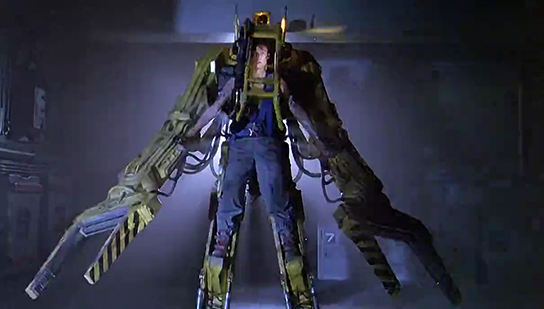
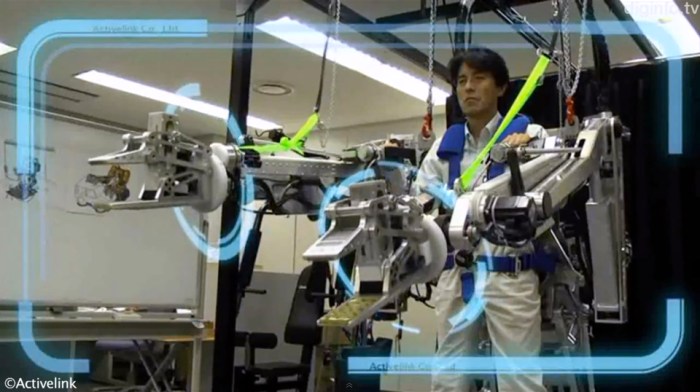
Earlier this year, the Panasonic subsidiary Activelink is developing an exosuit known as the Powered Loader – a deliberate homage to the Caterpillar P-5000 Powered Work Loader from Aliens fame. According to Activelink, the Power Loader will enable a human to lift up to 100 kilos (220 pounds) and run at speeds up to 8 kilometers (5 miles) per hour, and will be powered by lithium ion battery packs that will provide several hours worth of power.

exoskeleton-titan-armThe exoskeleton will initially be deployed in construction work, nuclear power plants, and emergency situations, but the company has big plans for the future. Activelink would like to develop an exosuit that can fit under a spacesuit or diving gear for underwater and space exploration purposes. The Power Loader appears to be a full-body version of creations like the battery-powered robotic Titan Arm, which won the 2013 James Dyson Award.

The Titan Arm augments arm strength by 18 kg (40 pounds), helping rehabilitate people with back injuries and assisting those lifting objects as part of their daily work. The price for Panasonic’s strength suit is currently projected to be 500,000 yen (around $4,940), and Panasonic says it wants to bring the suits to market by next year. It’s an exciting time to be alive, where a once-feverish dream of science fiction fanatics is fast becoming reality!

And who knows? By the 2020’s, we might even be seeing something along the lines of this in active service:

"Get away from her you bitch!"
“Get away from her you bitch!”

And be sure to watch this video of the Power Loader exoskeleton being tested:


Sources: newscientist.com, cnet.com, (2), jamesdysonfoundation.com

The Future is Here: Autonomos Mineroller Vehicles

terramax-inlineImprovised explosive devices (IEDs), landmines and other kinds of roadside bombs are a major threat to Coalition troops serving overseas. And even though combat operations in Afghanistan are coming to a close in the near future, military planners and developers are still looking for ways to address the kinds of threats that are all too common in these fields of engagement.

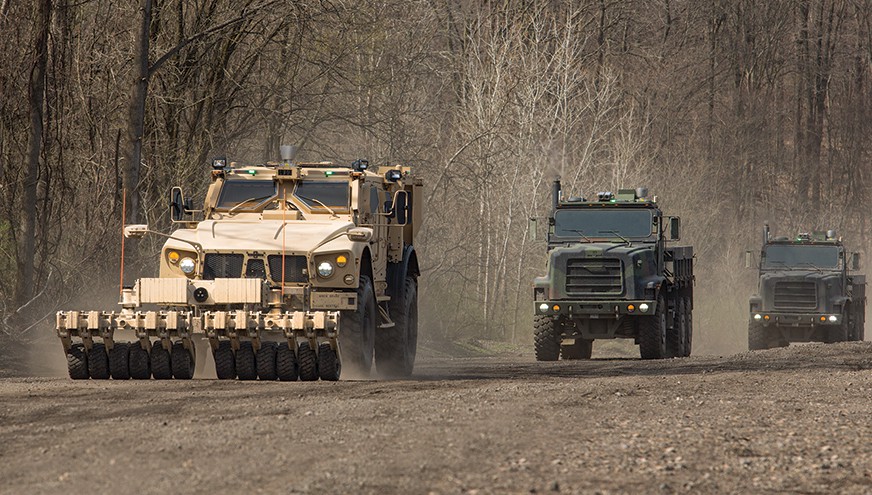
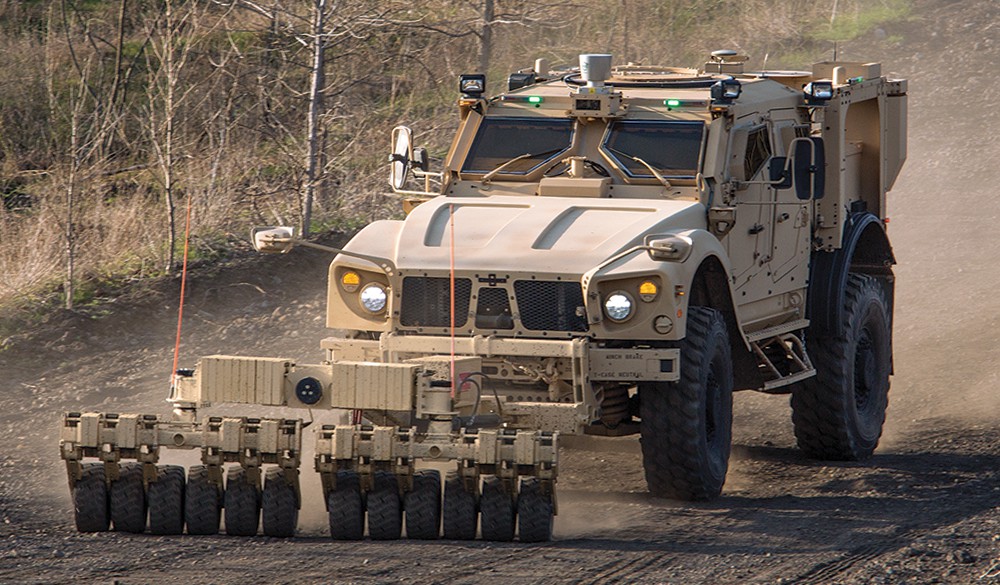
One such developer is U.S. defense contractor Oshkosh Defense, which recently unveiled its new M-ATV, an armored vehicle specially designed to resist blasts from IEDs and mines. This specialized, high-tech troop transport detects explosives using special ground penetrating radar and a 12-wheeled mineroller which attaches to the front. But now, the company is going a step further.

M-ATV_Light_P7A1130_rgb_720x300Oshkosh now claims it wants to move soldiers even further from the danger zone by putting them in another vehicle entirely and making the minesweeping truck drive itself. For the past decade, the company has been developing an autonomous driving technology called TerraMax. This self-driving system can be applied to vehicles already on the road, and was unveiled during the 2004 DARPA Grand Challenge.

It’s now equipped with radar and LIDAR, which uses lasers to detect nearby objects, along with a drive-by-wire system that electronically controls engine speed, transmission, braking, and steering. The system does more than steer and hit the throttle and brakes. It can intelligently control a central tire inflation system and driveline locks to navigate deep sand or mud, all without any input from the operator.

terramax-inline2Similar to the technology that powers Google’s self-driving cars, TerraMax is adapted for use in much tougher conditions. But whereas Google and big auto manufacturers can carefully map roads, lane markings, and speed limit signs before its vehicles are even on the road, Oshkosh doesn’t have those advantages. It’s vehicles must navigate hostile terrain in territories that have not been thoroughly mapped and imaged.

So it made TerraMax capable of combining overhead imagery from satellites and planes with standard military maps generated through geographic information systems. That lets soldiers define roads and other obstacles, much like with a commercial GPS system. Once given a defined course, the vehicles can navigate themselves while operators set things like vehicle speed and following distance.

M-ATV_withTerraMax_J4A1330_720x300-CO1Granted, these aren’t entirely autonomous vehicles. Whenever a convoy reaches an impasse  of some kind, the M-ATV will need to alert an operator and ask what to do. However, it is still an impressive system that achieves two key objectives. One, it allows the military to move more cargo with fewer personnel; and two, it makes a convoy look like it’s carrying more personnel than it really is, which is likely to deter attacks.

Oshkosh’s unmanned vehicle technology is still in testing, but the company has spent the last three years working with the Marine Corp Warfighting Lab and the Office of Naval Research to get it ready for the battlefield. And while the technology is currently being developed for combat vehicles, it could also be used in civilian settings – like autonomous snow clearing at airports or police bomb disposal units.

mfc-amas-photo-02-hThough Coaltion forces are drawing down their presence in Afghanistan, Oshkosh’s and other unmanned ground vehicle concepts will likely be used in conflicts around the world in the years to come. Company representatives gave demonstrations of the technology at Eurosatory 2014, a defense industry trade show, and say they received positive feedback from other nations as well.

And it is only one of several military-grade autonomous technology project currently in development. Lockheed Martin is also working on the Autonomous Mobility Appliqué System (AMAS), which also allows for autonomous or semi-autonomous driving. With the development of unmanned systems showing no signs of slowing down, autonomous-vehicle technology is likely to advance considerably in the coming years.

And be sure to check out this video of Oshkosh showcasing the M-ATV and TerraMax system at Eurosatory 2014:


Sources: wired.com, oshkoshdefense.com, humanisticrobotics.com

Walking Dead: “They’re f***ing with the wrong people”

WD4_finaleFew people who watch The Walking Dead can forget how Season Four ended. After finally finding their way to Terminus and regrouping, Rick and the others quickly learned that something wasn’t right. After attempting to escape, they found themselves being herded by bullets to a railcar, which they were then told to board. Inside, they found the rest of their companions and realized the community was nothing but a lie.

A series of hints were given as to what was going on there, like the room filled with candles, the names of people written on the floor, and the slogan: “Never Again. Never Trust. We First, Always” written on the walls. The smart money says this community is made up of cannibals, based on material taken from Volume 11: Fear the Hunters. This would make sense, given their efforts to lure people in and the fact that they didn’t kill Rick and the others right away.

wd4_16_3In any case, the season ended with their crew reunited in crisis and Rick uttering the chilling pronouncement: “They are gonna feel pretty stupid when they find out… They screwed with the wrong people.” As it turns out, AMC had a different ending in mind. Once again, mirroring what was written in Volume 11 of the original comics, the real conversation between Rick and Abraham was punctuated with some F-bombs.
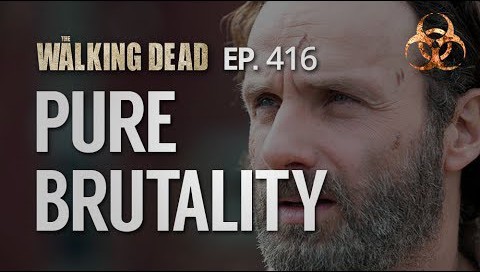
AMC filmed this ending first, but decided to tone it down for the sake of their viewing audience. To which I have to ask… really AMC? You have a series that showcases rotting corpses eating people alive; but swearing, that’s wrong? You’re season finale was especially bloody, featuring men attempting to rape Michonne and Carl, Rick biting a man’s jugular, an evisceration, and even strong hints of cannibalism.

AIn that same season, you had people bleeding out of their eye sockets, the Governor cutting off Hershel’s head, and a massive prison assault where multiple characters were violently gunned down. You even had one episode where a little girl murdered her sister and had to be executed, and where partially-cooked zombies had their heads explode once they were shot. And yet, you think the word “fuck” is a step too far? REALLY AMC???

Anyhoo, Season Five kicks off October 12th, by which time all questions regarding the true nature of Terminus, and why they choose to keep their captives alive, will be answered. And in the meantime, check out the clip of Rick delivering his final line as he was meant to, F-bomb and all: