Lord of the Rings: The Fellowship of the Ring

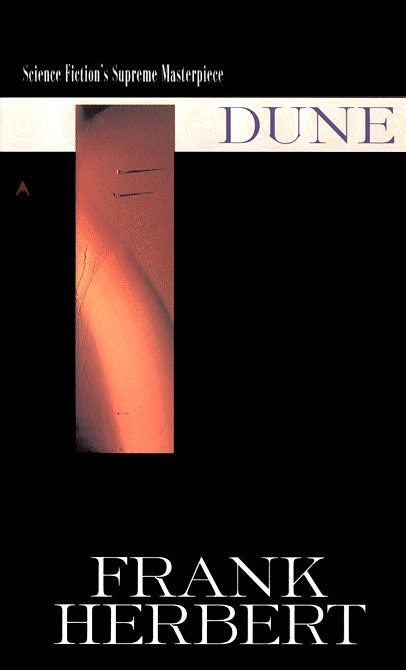
Hello all and happy July 29th! Or, as its known to many fantasy and sci-fi geeks, the day that The Fellowship of the Ring the first volume in the LOTR trilogy was published in 1954. Yes, I learned that just this morning, and thought it was the perfect excuse to finally do the review I’ve been putting off until now. I can only apologize for my negligence in this regard, but let’s face it, this book is kind of a big deal. With this trilogy, Tolkien effectively did for fantasy what Herbert would later do for sci-fi with Dune; that is to say, make people take it seriously.

And even if you’re not a fan of fantasy, you have to acknowledge the incredible debt owed to Tolkien. Not only did he provide a legitimate injection of mythos to the fantasy genre, establish a very real connection between ancient and modern, and provide archetypes which are still used to this very day. On top of all that, Tolkien gave the British people a sense of cultural lore that was all their own, which was precisely what he wanted.

In fact, Tolkien went so far as to say that his motivation in writing “faerie story” was to create a narrative which he felt had been previously missing in British culture. When one looks at ancient mythology, be it Norse, Greek, Roman, Native American or Indo-Aryan, one sees stories and legends that are tied to a culture and contain incredible power for its people. And while the British have their share, Arthurian myth for example, Tolkien felt that this smacked of a Judea-Christian prejudice and did not genuinely reflect the British temperament.

But of course, many literary critics went a step further and claimed that his books contained allegorical similarities to the conflict which had just passed in Europe. Though he began work on his voluminous masterpiece before the war began, much of it was completed during the war years and seemed to possess veiled references to the conflict. Think about it, the nations of Middle Earth (which included the “Men of the West”) were faced with a resurgent evil that came from the East.

The last time they faced it they had been successful, but the unsatisfactory conclusion of that conflict paved the way for a future war. Now, with the evil returning, the nations of Middle Earth found themselves in a weakened posture, but managed to succeed by comign together once more to thwart the evil, this time destroying it permanently. Hell, even the races of Middle Earth themselves could be said to be allegories for real nations – the Elves, Dwarfs and Men constituting the British, French and Americans respectively, while Hobbits were unmistakable representations of the British folk, the hardy little people who made all the difference.

But that is mostly speculation. In the end, Lord of the Rings is so richly detailed and deep that people have been able to discern countless metaphors, allegories and significant passages. In the end, it’s genius lies in the fact that it was both hugely inspired yet immensely original. So without further ado, let’s get down to dissecting the bad boy that started this whole phenomena!

Sidenote: the focus of this review will be the novel itself. Any notes on the movie adaptation come at the end, so don’t expect a running commentary on how the book differed from the movie. All artwork provided is that of Alan Lee, the illustrious illustrator of Tolkien’s work.

The Fellowship of the Ring:
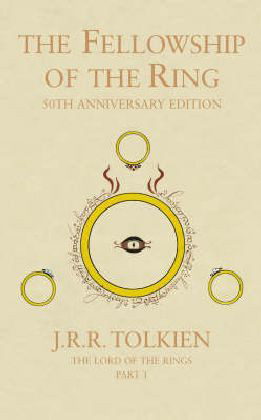
The book opens with a note on Hobbits and a preamble indicating what took place in the previous book, The Hobbit. It also provides some deep background which includes notes on the people of the Shire, their customs, and how Bilbo Baggins came into possession of the One Ring. The story then opens with book I, the first in the six book volume that makes up the single tale of The Lord of the Rings.

Book I: The Ring Sets Out:
In the first chapter, the story returns us to the Shire where Bilbo is waiting up his 111th (or eleventy-first) birthday, while his adopted heir Frodo is coming of age at 33. Bilbo is sparing no expense for the occasion and has even invited Gandalf to attend, as he has some rather important news for him.

This, Gandalf soon learns, is that he intends to take a permanent holiday. He plans to leave everything to Frodo, but doesn’t seem to want to surrender his one prized possession: The One Ring. After a tense confrontation with Gandalf, who convinces to leave the Ring behind, Bilbo departs on his journey and the two promise to meet up again. When Frodo arrives at Bilbo’s house, he is ransacked by relatives who are looking for their share of Bilbo’s wealth.
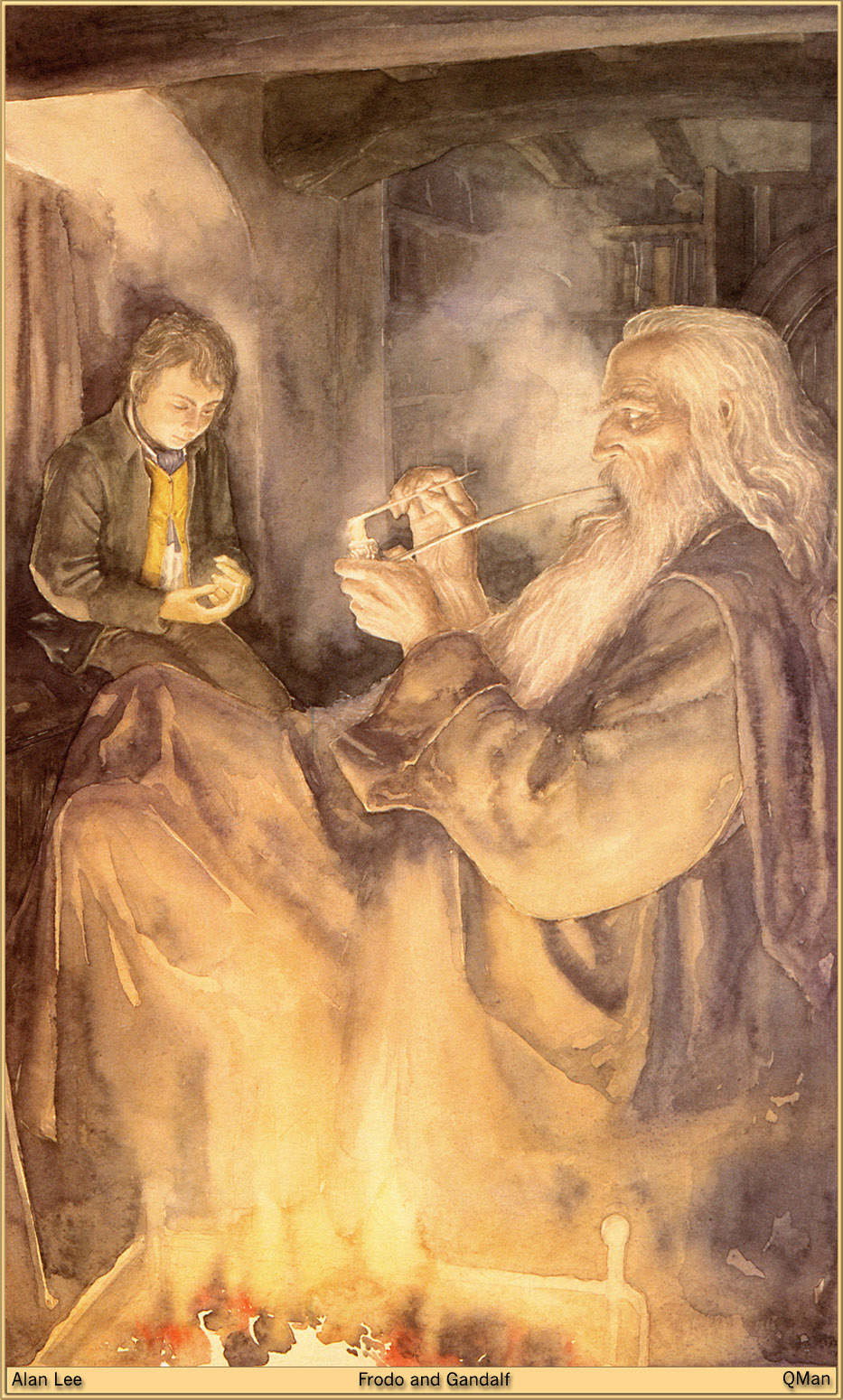
After they all depart, Frodo is spoken to by Gandalf, during which time he tells him he plans to depart on his own business. He warns Frodo to keep a close watch on the Ring, as he fears the worst of it. Over the course of the next 17 years, he pops in to visit Frodo, and eventually comes to tell him the truth. The Ring, he claims, the One Ring forged by the Dark Lord Sauron to help him conquer Middle Earth.

This provides some additional background on the story, where Gandalf explains to Frodo all about the “War of the Last Alliance”, how Isildur took the Ring for himself, and how it fell from his posession to be lost for ages. He also explains how, in time, Bilbo found the Ring in a cave where a forlorn creature named Gollum had been living with it for centuries. It was this Ring that bestowed Bilbo’s legendary longevity, as it did Gollum while simultaneously poisoning his mind.

He comes at last to the point of the tale: Sauron has risen once again and is gathering his strength at Mordor. But before he can complete his conquest of Middle Earth, he needs the One Ring to which he is bound. Already, his forces found Gollum and learned from him that the Ring was in the Shire, in the possession of one named Baggins. Because of this, Frodo must leave and go to Rivendell, where he will be safe and the fate of the Ring can be determined.
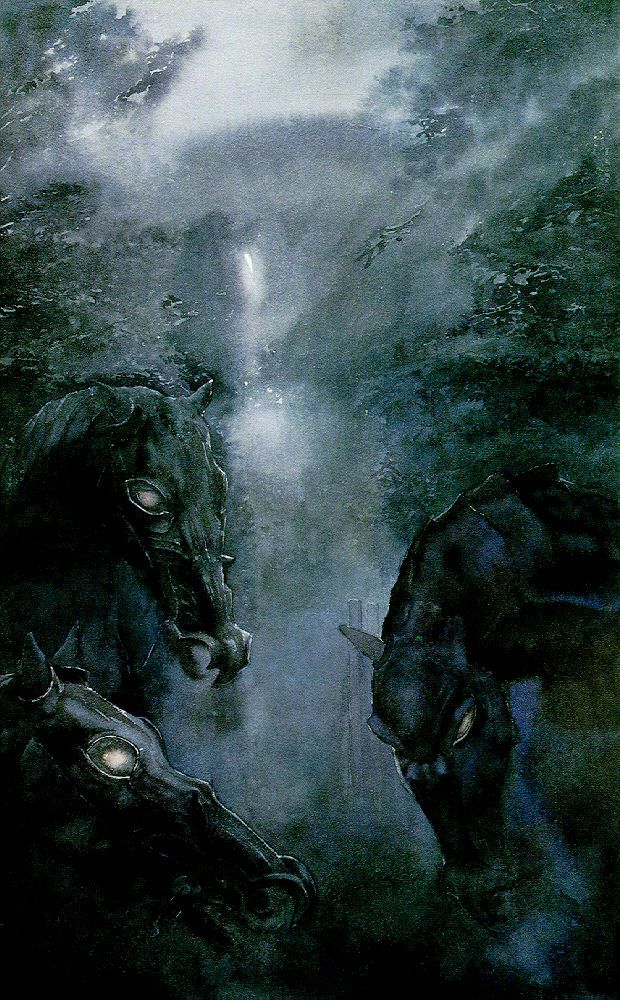
Gandalf must set out on his own too, to consult with the head of his order Saruman at Isengard. He promises to meet up with Frodo again before the summer when Frodo will depart. Frodo’s friend and gardner, Samwise Gamgee, is found overhearing their conversation, and out of loyalty to Frodo, agrees to go with him. When the summer arrives, Gandalf does not show, but Frodo must leave and does so under the pretense that he is moving, and with the help of Meriadoc Brandybuck and Peregrine Took, they set out for the edge of the Shire.

Along the way, they hear of Black Riders that have come to the Shire and are asking after a Baggins. These are revealed to be the Nazgul (or Ringwraiths), “the most terrible servants of the Dark Lord”. With the help of a party of Elves and the Farmer Maggot, Frodo and his company reach the edge of the Shire and pass into the wilderness. Along the way, they meet more curious folk, such as Tom Bombadil, a strange Hobbit-like creature who seems to be immune to the Ring’s effects.

At last, they come to the town of Bree, where they take a temporary respite at the Inn of the Prancing Pony. After downing a few pints with the locals, Frodo accidentally reveals the Ring when he slips it on and disappears from sight. He is then pulled into a room by Aragorn, who reveals himself to be a friend of Gandalf’s and a friend in their quest. He shows them the sword of Elendil, the shattered remains of the blade that cut the ring from Sauron’s hand, and agrees to take them the rest of the way to Rivendell.

After several days of traveling through the wilderness, they come to the ruins on the hill of Weathertop. During the night, they are set upon by the Nazgul, and after cornering Frodo, the chief stabs him with a cursed blade. Aragorn manages to chase them off, but warns that Frodo must get to Rivendell with all haste, or he will become a Nazgul himself.

As they hurry along, they meet Glorfindel, an Elf warrior from Rivendell who agrees to takeFrodo there with all haste. The Nazgul, all nine of them joined together now, pursue them and attempt to follow them across the Ford of Brunien, the last remaining obstacle between Rivendell and the outside world. However, Elrond sends a wave down the river which smashes the Nazgul into the rocks and ensures Glorfindel’s and Frodo’s escape. However, Frodo collapses and appears to be near death.

Book II: The Ring Goes South
When Frodo awakens, he learns that he is in the House of Elrond in Rivendell, where he has been healed by Elvish magic. Elrond summons the Council which consists of Aragorn and representative of every race on Middle Earth. Frodo is invited to attend, where he presents the One Ring. Gandalf is there too, and explains that he was held up because of a betrayal. Saruman, head of his order, has apparently betrayed them because he desires the Ring for himself. He is not yet in the service of Sauron, and is amassing his own army of Orcs.

Together, they hatch the plan that the only way to defeat Sauron is to destroy the One Ring, which must be cast back into the fires of Mount Doom from which it was forged. Frodo volunteers to take the ring and thus becomes the Ring-Bearer, and Samwise once again vows to stay by his side. Completing the Fellowship are Aragorn and Boromir, son of the Steward of Gondor; Legolas, Prince of the Silvan Elves of Mirkwood; Gandalf; Gimli the Dwarf; and Merry and Pippin.

Together, they set out south along the Misty Mountain route. However, there attempts to cross are foiled due to snow and avalanches. They debate over what to do next, but it is agreed that they will pass through the mines of Moria instead. Aragorn seems to think this is a risky idea, but Gimli insists that his cousin Balin who rules there will give them safe passage and hospitality.

Once inside, they find the place littered with corpses and overrun by Orcs. Their company finds their way into a side room where Balin’s tomb is located, and where the Dwarves apparently made their last stand. Shortly therafter, the Orcs fall upon them and the company manages to make its way out. However, when they reach deeper into the mines and come upon a bridge leading to the surface, an even greater threat emerges: A Balrog of Morgoth, a creation of darkness and flame from the ancient world.

Gandalf stands against it, but soon finds himself pulled down into an abyss with it. Frodo and the rest of the Fellowship look on in horror, but are forced to flee as more Orcs swarm in to attack them. They make their way out of the mines and Aragorn laments that Gandalf didn’t heed his warnings about passing into the mines. For a long time now, it was feared that the Dwarves lust for Mithril (which was mined in Moria) caused them to dig too deep and disturb what lay down below.

Once free of the mountain, they make for the elf-haven of Lothlórien, where they are sheltered by the rulers Celeborn and Galadriel. As they take their rest, Galadriel speeks to Frodo and provides him with visions of what is to come. He offers her the Ring, which she considers momentarily, but then rejects. The quest falls to Frodo himself, he is told, and he must find a way to destroy it. Before setting out down river, they are given provisions and items for their quest, all of which will prove useful later on.

After setting down at water’s edge, the Fellowship begins to show cracks. After days of becoming edgier and moodier, Boromir finally confronts Frodo and tries to take the Ring from him. Frodo places the Ring on and escapes, and the others scatters to go and hunt for him. Frodo decides that the Fellowship has to be broken, and that he must depart secretly for Mordor. However, Sam finds him before he can leave and insists on coming with him. The two then set off again down river, just as a company of Orcs close in and threaten the camp!

Thus ends the first volume of the Lord of The Rings!

Summary:
Of the three books, I have to declare right off that this was my least favorite. But of course, that isn’t saying much given how impressed I was with book II and III. Nevertheless, I couldn’t help but feel that with this first volume, Tolkien wrote long-winded passages that really weren’t necessary. Of course I could see the point of them. They established background information and detailed the fictitious world in which the events took place.

Nevertheless, so much of Book I felt like interjections and asides that didn’t seem to contribute to the overall storyline. For example, Tom Bombadil’s role in the story has long been a subject of debate. As it was explained to me, he occupies the same category as the Ents and other mythical creatures, in that he is outside the regular events of the story. Whereas the Ents are indifferent to the Ring and the wars for Middle Earth because they are so old, he is also indifferent because the Ring has no power to sway him as it does other creatures.

But in the case of the Ents, they came to be directly involved in the war because they realized that they could not simply sit idly by and let things pass. Tom had no such compulsions or involvement, and aside from being mentioned briefly in Rivendell, has no more role in the story. And unlike certain features which come up during the long journey through the Wilderness, his inclusion also wasn’t a shout out to content from the Hobbit. So really, what purpose did he truly serve?

Second, there was the Fellowship’s journey through the Misty Mountains. It is implied that they are turned back by Saruman’s magic, but it is never established. What’s more, the dangers of going through Moria are hinted at ahead of time, but it appears Gandalf is okay with the idea even though he must have foreseen he would be the one to die. But in the end, it is Aragorn who later laments the decision and questions why Gandalf would be okay with it. It seemed to me that if Moria represented the riskiest choice, Gandalf should have been the one had doubts about it.

Last, there was the point at which the Fellowship breaks. In book I, we see the basic points, Boromir trying to steal the ring, and Frodo leaving with Sam before they Orc party strikes. But it’s not until book II that we realize that such a confrontation took place, that Boromir was killed, or that Merry and Pippin were taken prisoner. In this, and all other cases mentioned, the movie sought to show these things and explain them fully. Quite predictable, but in the case of this first story, I actually felt it worked. But of course that probably has something to do with the fact that this one time I saw the movie first. Were I a Rings geek prior to the first film (as I was for II and III), I might have taken issue with all these changes instead of approving of them.

So far, I feel I’ve been saying only negative things about this book. But let me be clear, it’s only because the story set such a high tone that I was surprised to find that there were any weaknesses at all in this volume. If anything, the flaws are the exception to the rule, which is that Tolkien managed to create a story and and entire world steeped in legend, lore and magic. His main characters are archetypical legends, calling to mind such heroes as Beowulf, Arthur, Lancelot and Merlin, and whose supporting characters call to mind the same kind of comic and tragic figures as Caliban, Launcelot Gobo, and King Lear’s Fool.

And of course, there are the legendary races in the story which continue to dominate the fantasy genre and popular consciousness alike. When it comes to stories, gaming, movies and television, the basic breakdown of Elves, Men, Dwarves, Orcs, Ogres, Goblins, Wizards and Dark Lords is still in effect. Willow was a movie built entirely on Tolkien’s foundation, Chronicles of Narnia, Harry Potter and The Golden Compass owed a huge debt to his work, and Warhammer, Dungeons and Dragons, and countless other games I can’t even name wouldn’t exist without him.

And the storyline itself is nothing short of genius. Embracing such themes as the “Decline of the West”, the rise of an old evil, the idyllic countryside, the world outside your door, and little people caught in a situation much bigger than themselves, the story was so layered that people could find no shortage of significance and meaning contained within. It’s little wonder then why it has remained so influential and enduringly popular!

Coming up next, The Two Towers and The Return of the King, in that order 😉
Chasm City

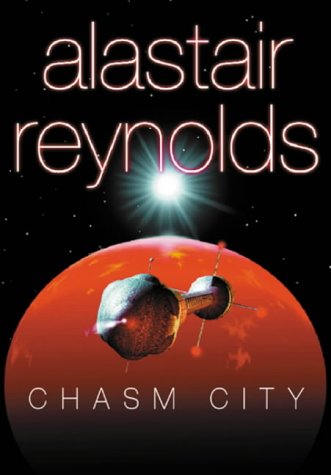
Next up in my review of Alastair Reynold’s Revelation Space universe is the prequel novel and setting piece known as Chasm City! Released in 2001, one year after Revelation Space and a year before Redemption Ark (I know, prolific, aint he?), the story takes place outside of the main trilogy, but details the setting and some of the characters who will play an important role in it.

As the name would suggest, the setting of this novel is the all-important location known as Chasm City itself. In Revelation Space, we got treated to an earful about this place since it is the undisputed hub of the known universe. Or at least it was before the Melding Plague, a terrible nanotechnological virus, turned the place into a twisted, gothic nightmare.

Background:
According to Reynold’s many descriptions of the place throughout the series, Chasm City was not only the capitol of Yellowstone (chief planet of the Epsilon Eridani system), it was also the center of the universe when it came to commerce, innovation and technological progress. It’s multi-tiered cities, contained within the “Mosquito Net” (i.e. habitation dome) were a marvel of nanotechnological achievement, living buildings that were capable of maintaining themselves.

The name itself referred to the fact that the city itself was built in a chasm which was open to the planet’s interior. From this chasm, large clouds of gas would erupt periodically, which the inhabitants used to fashion an atmosphere. In orbit, a huge array of satellites and orbital platforms had been installed, known as the “Glitter Band” due to their unrivaled beauty and the fact the wealthiest citizens maintained opulent homes in orbit.

And last, but not least, Chasm City was the home of the human faction known as the “Demarchists”, a name which is an amalgam of Democratic and Anarchy. These people were the most advanced factions in the universe, save for perhaps the Conjoiners, who used implant technology and wireless communications to create a society that needed no official offices or institutions. All decision making processes were run by direct democracy and the law maintained by police who enforced the public will. Sure, there were still offices and ranks, but the general trend was towards de-structurizing and an avoidance of hierarchy.

Plot Synopsis:
The first thread story opens on the planet known as Sky’s Edge, a planet in orbit of 61 Cygni A, where an enforcer named Tanner Mirabel is looking for a post-mortal noble named Argent Reivich. This man, we quickly learn, was responsible for the death of the wife of Tanner’s employer and is fleeing the planet for Yellowstone. Tanner and his friend pursue him, a chase which takes them into the depths of Chasm City and provides a first-hand look at the effects the Melding Plague has had and the illicit activities that have taken over the now fallen city.

In addition, two more threads open through a series of flashbacks and dream sequences. It is established early on that Tanner has been infected by an “indoctrination virus” – a sort of bio-engineered program which forces those who have it to experience religious visions. He interprets the dreams he has as a symptom, which are predictably concerned with the life of Sky Haussmann, the oft-revered and hated man who founded the colony of Sky’s Edge. This constitutes thread two of the story, where Tanner dreams of Sky’s childhood aboard the Flotilla that traveled to Sky’s Edge from Earth many centuries in the past, aboard generational ships where he was amongst the waking crew.

In the third thread, Tanner relives the traumatic events that led him to Yellowstone in pursuit of Reivich. Apparently, Tanner worked for a man named Cahuella, an arms dealer who is being pursued by Reivich because he sold arms to a rival family which used them to kill his parents. We also learn that Tanner loved Cahuella’s wife, a woman named Gritta. According to the flashbacks he experiences, it was while deploying to the jungles of Sky’s Edge, in an attempt to intercept Reivich, that the incident that led to Gitta’s death took place.

Upon reaching Chasm City, Tanner sees first hand what has become of the city. A once technological marvel, it has now degenerated into a dark and ugly, the buildings appearing as twisted, diseased trees. The Glitter Band has fallen into disrepair, and is now known as the “Rust Belt”. There is also a lucrative trade in what is referred to as “Dream Fuel”, which appears to render users temporarily immune to the Melding Plague. And last, there is the “Game” which Tanner becomes trapped in, where residents of the Canopy (those few still-privileged people who live close to the Mosquito Net) hunt people who live down in “The Mulch” (aka. down below).

After escaping the “gamers”, Tanner takes a female resident of the Canopy hostage and learns that she is part of the lucrative “Dream Fuel” trade. With her help, they travel deep into Yellowstone’s underground network and tunnels and find the source of it, which appears to be a giant, sentient slug. This begins to line up with some of the vision’s Tanner has been having involving Sky and the Flotilla, which continue to haunt his dreams.

Basically, Tanner is now aware that Sky took over control of the Flotilla after his father was murdered by an embedded agent. In a twist, Sky allowed this to happen because he was outraged to learn that his parents had taken him from another family that had died while in cryosleep. While in command of the fleet, he learned that they were being pursued by a strange, phantom ship. When they investigated, they discovered that it was an alien vessel that had morphed to look like one of their own. Inside – drumroll please – was a giant slug living in a big pool of Dream Fuel!

Yes, it seems that the fuel is in fact the organic secretions of the Slug, and that they are a sentient race that has been living in hiding ever since the emergence of a terrible alien threat that has been destroying all space-faring life. For those who have read Revelation Space at this point, it is clear the slug is referring to the Inhibitors. Hence why the Slug ship was following the Flotilla, it had hoped to remain inconspicuous by mimicking other species and their ships. The one currently being used to provide Dream Fuel is another, one which chose to hide deep within Yellowstone to avoid detection.

At the same time, Tanner becomes aware of one horrid fact. After remembering everything from the night where Gitta died, Tanner comes to the realization that it was he that killed her. In the course of their advance through the jungle to intercept Reivich, he and his men ambushed their camp and took Gitta hostage. Rather than let them get away, Tanner opened fire and accidentally killed her. However, he is confused because his memories end with Cahuella taking his own revenge by feeding Tanner to one of his giant snakes.

Nevertheless, Tanner gets back on Reivich’s trail and finally corners him in orbit. There, he finds the ruined body of Reivich who has been hooked up to a machine that was supposed to recor*d his consciousness and create an “alpha” (i.e. a living computer construct) of him. However, the process was rushed, and now Reivich’s body has been irreparably damaged. Close to death, he reveals another twist. It seems that he is not Tanner after all, but Cahuella himself! Small hints are given throughout the novel tot his effect, but he realizes that it is true when Tanner himself walks in!

Yes, it seems that Cahuella couldn’t deal with the anguish of losing his wife and decided to switch memories and appearances with Tanner while he was busy torturing him. However, Tanner managed to escape after Cahuella left and made his way to Yellowstone to get some payback of his own. The two fight, but eventually Cahuella realizes his body contains all kinds of enhancements, such as poisonous snakes’ teeth, which he used to overpower Tanner. Reivich dies too, and Cahuella is left with his many painful revelations.

Another painful revelation is the fact that the dreams he’s having or not the result of the indoctrination virus, but his own memories coming to the surface. It seems that he, Caheulla, is in fact Sky Haussmann himself, and that after sacrificing several innocent lives to get his own ship to 61 Cygni A ahead of the rest of the Flotilla. Because of this, the world was named Sky’s Edge, a sly reference (and criticism) of all he did to make it there first. After he set down, he was set upon by other groups of colonists who wanted him brought to justice. Contrary to popular belief, he wasn’t crucified publicly, but substituted himself with a look0alike and then slipped into the jungle to live out his life in a new persona (Cahuella).

Seeking redemption now, he returns to Chasm City and teams up with his lady friend in the hopes of making some changes. For one, the Dream Fuel trade is to be regulated and humane now, no more torturous extraction from the poor Slug. Second, the “Game” is reformed so that the hunt is for volunteers only, with plenty of rules and chances for the “hunted” to save themselves after they are caught. With all this in place, Tanner Mirabel, aka. Caheulla, aka. Sky Haussmann, settles in for a life he can live with and says goodbye to a life of revenge and running.

Summary:
To begin with the good points, this book was once again an intriguing and exciting romp through the Revelation Space universe. After that first installment, this book cashed in on all the buzz and interest he had created for his fictitious backdrops, such as Sky’s Edge and Chasm City, both very interesting place in their own right. It also detailed a number of elements that were brought up but not developed too much in the first novel, such as the game “Shadowplay”, which Ana Khouri was a member of. At the same time, it also discussed and delved into the dynamics of life and the wars on Sky’s Edge, which also came up in relation to Khouri’s character.

And of course, there was plenty more of the same interesting stuff that set’s Reynold’s universe apart. The concept of time dilation, post-mortality, alpha-level simulations, the Inhibitors, the Melding Plague, nanotechnology, cybernetic implants, and the “indoctrination virus”. All of these elements were brought up in Revelation Space or the subsequent novels to one degree or another, and it was good that Reynold’s side-stepped the trilogy in order to provide some more deep background and development for these concepts.

But above all, the primary focus of the novel, which was on Chasm City itself, was indispensable to this series. A once powerhouse of technology and civility, the Gothic, steampunk-themed environment is just so interesting and rich that it really had to have it’s own book. After reading about it in the first novel and seeing subsequent references to it later in the series, I just knew that Reynold’s would have to come back to it at some point. There was simply too much there for it to a passing mention, not to mention too much in the way of implied significance.

In addition to being an richly detailed environment that inspires so much mental imagery, Chasm City is a fitting metaphor for how technological progress can so easily go from being the stuff of dreams to the stuff of nightmares. It only makes sense that the urban center where all the greatest technological leaps of the future were developed – brain implants, man-machine interface, alpha-level constructs, clinical immortality, nanotech, biotech – that it is also be the place where it all came crashing down. And what did it was especially appropriate – a nano-virus which hit them where they were most vulnerable by perverting the very technology they were so dependent on.

As for the weaknesses, well, they are something that comes up a lot in Reynold’s works. For one, there are too many twists! Why, for example, was it necessary for Cahuella to take on Tanner Mirabel’s identity? Wasn’t it enough that the man who failed to save the woman he loved, who also had a bit of an elicit thing going with her, was out for revenge? And why for that matter did he also need to be Sky Haussmann. One hidden identity was enough, and given its importance to the storyline, it would have been enough for him to be Sky.

Think about it, the reviled and worshiped founded of the colony runs into the jungle and takes on the identity of a simple bounty hunter. Wouldn’t that have been better than assuming the identity of a high-profile arms dealer? And since he settled down to become a professional hunter in Chasm City anyway, wouldn’t him being Tanner all along provide more symmetry? And to explain the whole memory wipe thing, just say that he assumed the identity of Tanner completely to avoid any slip ups, or because he genuinely wanted a new lease on life. Playing it the other way was just plain weird.

Also, there are some other odd elements in the book, stuff that seemed less creative and more far-fetched than his usual story elements. For example, we see that in Chasm City, people rely on more than just “Dream Fuel” to protect themselves from the Melding Plague and prolong their lives now that they can no longer depend on nanotechnology. One of them is a genetic enhancement using Koi fish DNA. Seeing as how the Koi is quasi-immortal and will continue to grow so long as they have new environments to grow into, the residents of Chasm City decided to harness their genetic material in order to prolong their lives indefinitely.

In fact, Tanner/Cahuella/Sky is shown to a sort of shrine in one of the city’s thoroughfares where a massive, centuries-old  Koi is being kept in a tank and revered. And it struck me as just plain strange. Sure, this scene provides a sort of commentary on the vagaries of clinical immortality, but it still felt oddly out of place. So, for that matter, did the descriptions of the various people of the city who have used genetic enhancements to elongate their faces and skulls in unnatural shapes, as well as grow wings and other appendages. I get that in this universe, people can do some rather odd things with their biology, but why the hell would they want to? Much like hypercats, superchimps, the winged unicorns and other such creations from the series, it felt like Reynold’s is getting off-kilter and being weird for the sake of weird.

But other than that, the book is a worthy read and kind of required if you want to be able to make sense of the series. Like I said before, there were aspects of Redemption Ark that I didn’t get until well after I read this book, and since it’s placement in the series comes before the other books, it behooves the reader to tackle this one before moving on to the later books in the series.

Coming up next, Absolution Gap and the conclusion to Alastair Reynold’s lineup!

Foundation and Empire

FYI: this is my 400th post, people! Woohoo! I hope Asimov is flattered… Hey, a guy can dream, can’t he?

Welcome back to my ongoing review of Isaac Asimov’s Foundation series. Picking up where I left off last time, here we have book II in the series, known as Foundation and Empire. Much like Foundation, this book was originally published as separate novellas in 1952, and did not appear as a single volume until 1955.

As the second installment in the original trilogy, this book is where things invariably get dark. Though it begins with a sort of conclusion to the previous novel, showing the path of Seldon’s Plan and the decline of the Empire, things invariably go south with the introduction of a new and unforeseen threat. After detailing the nature of this new enemy and placing the existence of the Foundation in peril, things end with the mention of a Second Foundation, which sets the scene for the final installment in the series.

Plot Synopsis:
The book consists of two sections, the first of which picks up where the first book left off and acts as a sort of conclusion to everything contained within. Centuries after its establishment on Terminus, the Foundation seems well on its way to fulfilling its purpose, as foreseen by Seldon’s psychohistory. However, the Empire has not yet collapsed and the growing might of the Foundation is seen as a threat. Hence, a showdown between the two is in the works!

The second story is starkly different, throwing a curve ball into the storyline with the introduction of a new force that was unforeseen in Seldon’s Plan. This force, known as “The Mule” threatens to destroy the Foundation simply by being an aberration in the science known as “psychohistory”.

The General:
The first book, titled “The General” opens Bel Riose, a skilled and dedicated General of the Galactic Empire meeting with the old Siwennan noble, Ducem Barr, son of the man Hober Mallow visited in “The Merchant Princes from the first book.The reason for this meeting is that Barr is the closest thing the Empire has to a source on the Foundation, and his knowledge of their technology, assets and the science of psychohistory is sought.

In the course of their discussions, Barr warns that Riose that his plans are merely a symptom of the Empire’s impending collapse. Naturally, Riose rejects this and claims that the Empire is still healthy. He shares Emperor Cleon II’s feelings that the Foundation constitutes a threat which must be neutralized, though at the same time he to seize all traces of their knowledge and technology and incorporate it back into the Empire.

The focus then shifts Lathan Devers, an independent trader and agent of the Foundation who is sent to Riose’s armada to figure out how the Foundation can save itself. This, according to Ducem Barr, is a wholly unnecessary step, because the Seldon Plan has already foreseen this and everything will work out on its own. Nevertheless, he still feels something must be done and travels to Trantor in the hopes of convincing the Emperor that Riose has his own agenda. He fails, but still manages to escape and find his way back to Foundation space.

Once there, he discovers that things have worked out on their own. Apparently, Emperor Cleon II really was beginning to fear that Riose had his own agenda, and the closer he came to conquering the Foundation, the more fearful he became. Hence, Riose was recalled from service and arrested, thus saving the Foundation. As Bel Riose himself says in the story, it’s a dead hand versus a living will, and it turns out the living well never stood a chance.

The Mule:
The second story takes place roughly one hundred years later. The Empire has now fallen, Trantor has been sacked, and the Foundation has become the dominant power in the Galaxy. Meanwhile, the Foundation is experiencing decay and corruption, with several of its outer planets are planning a war of cessation.

In addition, a new threat has emerged which refers to itself as “The Mule”, an apparent mutant who possesses strange psychic powers. Already he has taken control of many star systems that border the Foundation and appears hell-bent on conquering it as well. Naturally, the Foundation leadership is not concerned, for they believe that this is just another “Seldon Crisis”, and that the Vault will open and tell them how to resolve it.

To their horror, during the scheduled speech by Seldon’s hologram, no mention is made of the Mule, which indicates that this threat is completely unforeseen. What’s worse, the Mule’s fleet shows up in orbit and begins attacking the planet. The main characters, Toran and Bayta Darell, flee to the border planets along with psychologist Ebling Mis and refugee clown named “Magnifico Giganticus”. There, they find temporary solace until the Mule’s forces show up again and conquer the sector with ease.

Faced with the fall of the Foundation, the group sets out to find the fables Second Foundation which they feel is their only hope at this point. In time, this journey takes them to Trantor, where the unearth the Great Library and begin searching for clues as to where the Second Foundation might be.Along the way, they are taken prisoner by agents of the Mule, but Magnifico manages to kill them using a trick involving his psychoactive music.

After days of tireless research on Trantor, which startles Toran and Bayta, Mis claims to have uncovered the location. However, Bayta has a revelation and kills Mis before he can tell them. She reveals this revelation to her husband: they’ve been in the presence of the Mule all along! She has noticed that wherever they’ve gone, people have been behaving mysteriously. The sense of defeat that was taking over the border worlds, the way their captor’s were killed, Ebling Mis’s extreme mental clarity… it was all for the sake of finding the Second Foundation! And the only person who was in their presence the entire time that they couldn’t account for was Magnifico .

When they confront him, he reveals that she is right. All along, he’s been infiltrating enemy worlds and using his psychic powers to bend people to his will. Initially, this served the purpose of making sure his forces met with minimal resistance, but when they began searching for the Second Foundation, his plans changed. He knows that this contingency group, which Seldon apparently kept a secret, still constitutes a threat to him. He declares that he will find it in time, and let’s them go as they are no threat to him or his plans.

Summary:
In many respects, this book built upon the strengths of the original. In the first story, it reestablished its roots in Gibbons seminal study The Decline and Fall of the Roman Empire. In keeping with the series’ Romanesque theme, he also adapted the tale of Emperor Justinian I and General Belisarius through the characters of Cleon II and Riose. In addition, it extended it’s commitment to the concept of psychohistory, how all things were essentially foreseen by Seldon and prepared for. The way Devers runs about hoping to fulfill said plan, only to find that it unfolded naturally, was quite apt at demonstrating this. Much like Frank Herbert’s portrayal of the prescient trap, the pre-deterministic nature of the story is interesting, even if it is at a times a little convenient and contrived.

And the story provides a pretty fitting diversion with the introduction of the Mule. After a book and a half of being told that the Foundation is pretty much sacrosanct and unassailable, Asimov throws a wrench into the works that demonstrates that the vaunted science of psychohistory is not in fact perfect. The explanation given for this is also quite interesting, in that it  that it circumvents whatever pretense Asimov made earlier about the infallibility of psychohistory.

Essentially, Seldon’s psychohistory was based in part on the notion that humanity’s biological nature would remain fixed for the period his Plan accounted for. What he did not plan for was any spontaneous mutations or sudden divergence in human evolution which would allow for the emergence of individuals which psychic powers. Hence, the arrival of the Mule threw his Plan into disarray by creating a second power which could very well threaten to take over the Galaxy.

But of course, there is a slimmer of hope presented with the existence of a Second Foundation. Whereas the first was something that was out in the open that would openly abide by Sheldon’s Plan, the second was something that was meant to operate behind the scenes; their purpose was to see to the maintenance of the Plan if the worst should happen and the Foundation fell.

But just to play Devil’s Advocate here, these characteristics do open the story up to accusations of inconsistency. In one book, we are basically told that the Plan accounted for everything, didn’t account for everything, but did account for everything after all. Three twists in one book is a bit much. In fact, it would have been better if the first story had been included as part of the original Foundation since it felt like the real closing chapter to Act I.

And, to venture beyond the second book for just a second, this happens yet again in book III. There, as with here, the story is broken into two parts, with the first concluding the Mule thread and the second capping off the story. In both cases, I couldn’t help but feel that the story was cut and pasted in a way which seemed unnatural. But fixing that would have required a rewrite, not a simple case of restructuring. So in the end, this book is something you have to swallow as a whole, structure, twists and all. It’s a good read, a fitting sequel to the first book, and like all of Asimov’s work, accessible and entertaining.

The Post-Apocalypse in Sci-Fi (Part III)

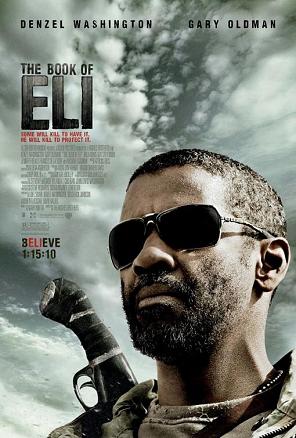
The Book of Eli:
This 2010 movie – starring Denzel Washington, Gary Oldman and directed by the Hughes Brothers – takes place in a post-apocalyptic United States thirty years after nuclear war has left it a scarred and desolate place. Enter into this a wandering nomad named Eli (Washington), a man who is wandering to the West Coast with a mysterious book that “a voice” commanded him to take there. As he travels, the importance of his task is made clear, as the history of the post-war world he is making his way through.

Along the way, he encounters a town run by Carnegie (Oldman), a  man who dreams of building more towns and controlling their residents through the power of a (again) a mysterious book he has heard about. His men are busy at work, searching the surrounding countryside for this book, but so far to no avail. When Eli arrived in town, Carnegie forces him to stay, as he is the only other literate person he has ever encountered.

Ultimately, it is learned that Eli has the book Carnegie is seeking, and that this book is none other than the Bible. He escapes from town and is pursued by Carnegie’s daughter, Solara (Mila Kunis). He explains to her that the Bible he carries is the last remaining copy since all others were destroyed after the nuclear holocaust. He was guided to it by a voice, he says, and has since been making his way across the country, guided by his newfound faith.

Eventually, Carnegie catches up to them, mortally wounds Eli and takes the Bible for himself. However, Solara manages to escape from his custody and begins transporting Eli to San Francisco so he can complete his mission. They come at last to Alcatraz where a group of survivors has been holding up under the watch of the curator named Lombardi (Malcolm McDowell). When Solara reveals they have a copy of the King James Bible, they let them in. Eli, who for the first time is revealed to be blind, begins reciting the Bible from memory.

Back in Carnegie’s town, he manages to unlock the Bible and is horrified to see it is in braille and that his wounds will soon kill him. Meanwhile, Eli dies in Alacatraz just as the printing press there begins printing copies of the Bible and the curator puts the original on a shelf next to the Torah, Tanakh and the Qur’an. Solara decides to leave and head back home, taking with her Eli’s possessions in the hopes of making a difference. She, like him, has become a wanderer guided by faith.

Granted, the message of this movie might seem a little over the top. I, for one, can’t imagine why post-apocalyptic people would destroy Bibles. If anything, I would think they would take their frustrations out on science and turn to religion for solace. Still, the point is made very clear through several key acts of symbolism. Eli, though blind, is guided by faith and it keeps him alive. And though he is robbed of the Book, the true source of it’s power, which Carnegie wants to abuse for the sake of power, lies in Eli’s own self. Really, the message couldn’t be more clear, and yet it is demonstrated with a degree of subtly that one would not ordinarily expect from a movie with a religious message. But it’s not so much about the Bible itself, it’s about maintaining hope and faith in a world where these things have been abandoned.

A Canticle for Leibowitz:
Published in 1960 and written by Walter M. Miller Jr., this novel is a considered a classic of post-apocalyptic sci-fi by genre fans and literary critics alike. Renowned for its themes of religion, recurrence, and church versus state, this book has generated a significant body of scholarly research, yet it was strangely the only novel Miller wrote in his lifetime.

Inspired by Miller’s own participation in the bombing of the monastery  at Monte Cassino in WWII, the story takes place in a Catholic Monastery in the South-Western US after a nuclear war – known as the “Flame Deluge” – takes place. Known as the Albertian order, the monks who inhabit this monastery are dedicated to preserving humanity’s scientific knowledge and rebuilding civilization over the course of thousands years.

The story opens roughly 600 years after the war takes place, in a time when science and technology, even the idea of literacy itself, has been almost wiped out by a campaign known as “Simplification”. At around the same time, a Jewish electrical engineer named Isaac Edward Leibowitz, who worked for the military, converted to Christianity and founded the Albertan order.

After generations of hiding and smuggling books to safety within the orders walls, Leibowitz was betrayed and sacrificed by “Simpletons”, at which time the Catholic Church had him sainted and ordered the monastery beatified. Centuries after his death, the abbey is still preserving “Memorabilia”, the collected writings that have survived the Flame Deluge and the Simplification, in the hope that they will help future generations reclaim forgotten science. The story is structured in three parts titled: “Fiat Homo”, “Fiat Lux”, and “Fiat Voluntas Tua” (Let There Be Man, Let There Be Light, Thy Will Be Done), with each part comprising six centuries each.

In Fiat Homo, which takes place in the 26th century, events revolve around a young novice who while on a Vigil, finds his way to a bomb shelter with the help of a mysterious Wanderer. The discovery triggers an uproar at the Monastery, as it seems that the shelter contains relics belonging to Leibowitz himself. Some fear the sensationalism triggered by the discovery will hurt Leibowiz’s canonization, which is still being debated. After many years, the canonization is given the green light and Francis is sent to New Rome to represent the order at the Mass. Unfortunately, he is murdered in the wilderness and is buried, by none other than the Wanderer himself!

Fiat Lux opens up  in the 32nd century, 6 centuries later, when the New Dark Age is coming to an end and a New Renaissance beginning. At this point in time, the Abbey is coming into conflict with the city-state of Texarkana, a metropolis’ who’s growth was hinted at in the last pages of Fiat Homo. The mayor, Hannegan, is essentially an upstart dictator who intends to become ruler of the entire region my manipulating alliances and gaining access to the Abbey’s own stores of knowledge. In the end, Hannegan’s intentions to occupy the abbey and make war on his neighbours leads to a schism whereby Hannegan is excommunicated by the Pope and he declares loyalty to the Pope to be a crime in his domain.

In the last part, which takes place towards the end of the 38th century, humanity has once again returned to a state of advanced technology, complete with nuclear power, weapons, and even starships and extra-solar colonies. As a state of cold war sets in between the Atlantic Confederacy and the Asian Coalition, the Order begins to enact a contingency plan known as “Quo Peregrinatur Grex Pastor Secum” (“Whither Wanders the Flock, the Shepherd is with Them”). As the nuclear bombs begin to fall, members of the Order board a starship and launch for deep space. With Earth about to succumb to nuclear war yet again, the Order is heading out to ensure that both humanity and its knowledge survives.

The stories central themes, which include the rivalries between church and state and the cyclical nature of history, are what make it such a memorable and enduring classic. Even though it is set in a fictitious future, it is loaded with allegories that connect it to the past. Nuclear war in the near future is the fall of Rome, the ensuing New Dark Ages a reiteration of the last, and the final nuclear holocaust between the Coalition and Confederacy represented contemporary fears of nuclear Armageddon.

By the Waters of Babylon:
Also known as “The Place of the Gods”, this short story was originally published in 1937 by Stephen Vincent Benét. Taking place in a future where industrial civilization has been destroyed, the story is narrated by a young man named John, a son of a priest who’s people live in the hills. In his day and age, John’s people believe that past civilizations were in fact Gods. There homes are considered hallowed ground and only priests are permitted to handle metal artifacts taken from them.

Eventually, John decides that he will go to the Place of the Gods, an abandoned city that was once part of industrial civilization. In order to gain his father’s approval, he claims he is going on a spiritual quest, but keeps the intended location a secret. John then journeys through the forest for eight days and crosses the river Ou-dis-sun to make his way to the sacred place.

Once he gets to the Place of the Gods, he finds abandoned buildings, statues and countless indications that the “Gods” were in fact human. When he finally finds the remains of a dead person in an apartment, he comes to realize the truth. The Gods were in fact humans whose power overwhelmed their better judgement, hence they fell.

Upon returning to his tribe, John tells his father of the place called “New York”. It is at this point that it is made clear that the “hill people” live in the Appalachians, and the river he crossed was the Hudson. In the end, his father warns him that recounting the experience to the other tribe members will have destructive consequences. The truth, he claims, can be bad if not conveyed discretely and in small doses. The story ends with John promising that once he becomes the head priest, “We must build again.”

Farnham’s Freehold:
Based on his own experiences in building a fallout Shelter, this 1964 novel by Heinlein involves a family that is transported to the future after a nuclear explosion puts a dent in their reality. In addition to the thematic elements of nuclear war and time travel, the book also contains some rather interesting commentary on race relations and segregation in the United States at the time.

The story begins with the Farnham family holding a bridge game in their home, which is attended by Hugh, his alcoholic wife Grace, their son and daughter (Duke and Karen), her friend Barbara, and a black domestic servant named Joe. After they are alerted to the fact that nuclear war is commencing, the people rush to the bomb shelter and wait for it to pass. When it seems that the bombs have stopped falling and their oxygen is running low, they walk out and begin to investigate.

What they find is that they’ve been transported to Africa, where an advanced civilization now exists that uses white people as slaves. Initially, they suspected they had been sent into an alternate dimension, but quickly realize that they are in the future. They are spared because Joe, their black domestic servant, is able to communicate to their captors in French.

In time, Hugh and Barbara agree to take part in a time-travel experiment in exchange for their freedom. They are sent back to their own time, where they escape from the bomb shelter just as the bombs begin to fall. However, they soon realize that they are not in their own time, but an alternate dimension where things are just slightly different. They survive the war and agree to spend the rest of their lives trying to prevent the future they saw from coming to pass.

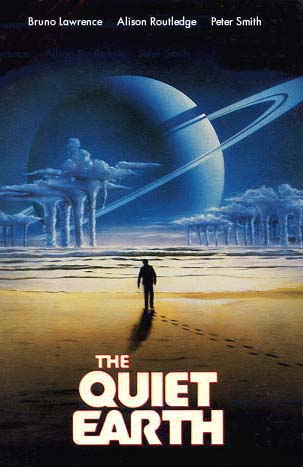
The Quiet Earth:
Originally a novel written by New Zealand author Craig Harrison in 1981, this story went on to inspire the loosely-adapted film of the same name which was released four years later. In both cases, the story revolves around a small group of survivors who awaken to find that the world is now devoid of humans and most other forms of life, and that time itself seems to have stopped.

The story begins with John Hobson, a geneticist who was experimenting with using radiation to activate dormant genes, which was meant to have an accelerating effect on human evolution. He wakes up in a hotel room from a nightmare where he was falling, only to find all clocks stopped at 6:12. Upon leaving the hotel, he finds that all clocks have stopped at 6:12 and that everyone appears to have simply vanished. He dubs this phenomena “The Effect” and begins looking for other survivors.

His journey takes him back to his research facility where he finds the corpse of his partner, Perrin, inside the radiation chamber. Retrieving Perrin’s locked box of papers and grabbing some weapons and supplies he sets out for Wellington. Eventually, he finds someone, a Māori lance-corporal named Apirana Maketuin, who agrees to accompany him. They eventually reach the capitol and settle in, hoping to find other survivors and run tests on “The Effect”.

Things deteriorate before long, as Hobson begins to worry that Api might be a psychopath due to his wartime experiences in Vietnam (he finds pictures of him posing with the mutilated corpses of Viet Cong). His plans to kill him with sleeping pills are interrupted when they accidentally run over a woman in the street while joyriding. They return to the hotel and make her comfortable but know she will inevitably die. This leads to a further breakdown between Hobson and Api and they fight. Api dies in the confrontation after apparently giving up.

Finally, Hobson breaks open Perrin’s box and realizes that his partner had him under surveillance because he considered him unstable. Hobson comes to the conclusion that the Effect was his doing since the the project cause the unraveling of animal DNA, and hence only those with the dormant gene pair would be spared. It is at this time that Hobson begins to have flashbacks from his last days at the facility, during which time he sabotaged the machine because of growing misgiving about the project and mistrust for his Perrin’s motivations. It was this sabotage that caused the Effect, and the reason Hobson slept through it was because he took what he thought was a fatal dose of sleeping pills.

Maddened with grief and guilt, Hobson jumps from the window and begins to fall to his death. But then, he wakes up in the same hotel room he found himself in at the beginning, recalling the same dream where he was falling. He checks his watch and it says it’s 6:12… Spooky! Though it bears a strong resemblance to such works as I Am Legend, The Quiet Earth went beyond in that it chose to focus on the themes of perception, culpability, and alternate states of consciousness. All throughout the book, it is not quite clear if Hobson is dreaming, in an alternate dimension, the last man on Earth who is responsible for the death of countless life forms, or just plain crazy.

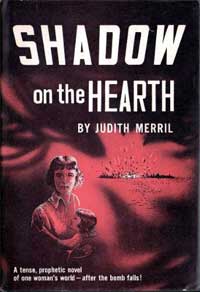
Shadow on the Hearth:
This post-apocalyptic novel, which was the first novel to be released by Canadian sci-fi author Judith Merril (1950), takes place a week after nuclear bombs have devastated, but not destroyed, civilization as we know it. The plot revolves around a mother named Gladys Mitchell and her two daughters – Barbara and Ginny, who are fifteen and five years of age – as they struggle to deal with worsening conditions and a system that is quickly becoming an abusive dictatorship.

For starters, all civil authority has broken down in the wake of the war and been replaced by the Security Office, a form of emergency services that exercises all power. Gladys’ contact with the services is the local “emergency squadman”, Jim Turner, a neighbor who begins to display a rather creepy fascination with Gladys along with a desire to turn the emergency to his own advantage.

Similarly, the difficult situation breeds suspicion and intolerance on behalf of the authorities who begins see enemies everywhere. The Mitchell’s maid, a woman named Veda, comes under suspicion when it is learned that she was off sick during the time of the attack. Much the same is true of Gladys’ old science teacher, who predicted that nuclear war would be inevitable and now fears the paranoid Security Office might suspect him.

Meanwhile, Gladys tried to maintain a disposition of stoic calm, mainly because she believes its her role as a mother to act as though everything is fine. While her intentions are good, she’s slow to admit that Turner and the authorities are corrupt, that their situation is bleak, or that she might need to manipulate certain people to get her way. But in the end, she is willing to go to great lengths to protect her family, from both external threats and the threat of dissolution.

In several key aspects, this story demonstrates some of the overriding themes and feelings that were present during the early cold war. We have the specter of war and dictatorship, the focus on the single-parent family, the idea of domesticity and sexism, and the affirmation of the mother figure who will do whatever it takes, even if she seems naive and silly, to keep her family safe and secure. While it might seem dated by modern standards, it is nevertheless a fitting and accurate portrayal of life in the 1950’s and the likelihood of what would come of it if the bombs started to fall.

The Time Machine:
Last, but not least, we have the story that has made my lists in one form or another on numerous occasions. In addition to being an example of utopian and dystopian fiction, The Time Machine is also a fitting example of post-apocalyptic science fiction. This is part of what makes H.G. Wells novella a timeless classic, in that it transcends or jumps between genres and can therefore be read from a number of different perspectives.

In this respect, the Time Traveler’s trip to the distant future, where the world has degenerated into a two-tier structure between the monstrous Morlocks and the stagnant but beautiful Eloi, can be seen as an example of post-apocalyptic society. What’s more, their respective degeneration is seen as the result of humanity’s obsession with class distinction, the masters becoming lazy and ineffectual while the workers have become cannibalistic and brutish.

Another apocalyptic element in the story comes towards the end when the Time Travelers recovers his machine from the Morlocks and travels another 30 million years into the future. Once there, he sees some of the last living things on a dying Earth, a red landscape similar to that of Mars which is covered by lichenous vegetation and crab-like creatures wandering across blood-red beaches. As he jumps further, he sees the Earth’s rotation gradually cease and the sun die out, the world falling silent and freezing as the last organisms die off.

In a deleted section of text, which H.G. Wells apparently included in the original serial version at the behest of his editor, but cut from the novel once it was published. Here, Wells demonstrated “the ultimate degeneracy” of man by having the Time Traveler escape from the Morlocks and jump once more before traveling 300 millions years into the future. Here, he found an unrecognizable Earth populated by furry, hopping herbivores, which he interpreted to be the descendents of the Morlocks and Eloi. Thus, in addition to first losing the instincts that defined humanity at its greatest, the Morlocks and Eloi, themselves descended from humans, even reverted to an earlier state of evolution in the end.

Though not a post-apocalyptic tale in the strictest sense, this story does contain the necessary elements of such a story. You have humanity degenerating as a result of cataclysmic events or its own inherent weaknesses, civilization as we know it being destroyed or disappearing, and even the world itself coming to an end.

Final Word:
And that’s all I got for post-apocalyptic sci-if. Sure, there are countless more examples that could be included, but three lists is enough for me and I’m neck deep in other concepts that are vying for page time. In the coming weeks, expect more news on technology, space exploration, the upcoming anthology, Data Miners (set for release in August) and plenty of assorted tidbits on stuff that relates to the world of science and science fiction. Take care all and see you again soon!

Of Terraforming

Several scientific subjects have piqued my interest as of late, particularly the ones that relate to the colonization of other planets. And there are plenty of good reasons for this. First off, NASA has been talking at length about a possible Mars mission which will be begin in 2030. Second, the topic is central to the novel my group and I are writing. And third, because it’s what I do. I’m a geek, dammit! Do I really need any other reason?

So in honor of this fertile and increasingly relevant topic, I thought I’d dedicate a post to the science of terraforming and its depiction in popular culture. Like the majority of your more radical ideas, the concept first appeared around the turn of the 20th century. As part of the larger trend of exploring planetary colonization, several historical developments contributed to this phenomena.

Foremost amongst them was the closure of the American frontier by 1900 and the partitioning of Africa in 1905. With the “Age of Discovery” officially over, scientists and dreamers began to look farther abroad for the next place to move to. Refinements in the fields of metallurgy, chemistry, and astronomy also contributed to the idea that planets like the Moon, Mars, Venus, Europa, Ganymede, and even other star systems, could be colonized.

And thanks to the advent of the Space Race, the Apollo missions, and Eco-engineering in the latter half of the 20th century, scientists have begun to take a serious look at terraforming, particularly in regards to Mars. While the practicality, feasibility and affordability are all still being debated, the very fact that there is a serious scientific debate would seem to indicate that it may very well be done someday.

And so, here is a list of science fiction novels from the last century that have explored the idea of terraforming. Once again, I hope you enjoy reading about them as much as I enjoyed researching them, and incorporating some of what they taught me!

Last and First Men:
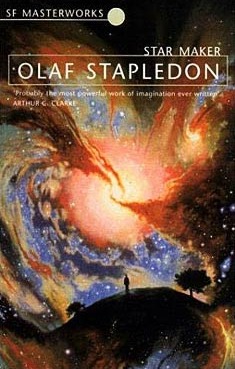
This future history by Olaf Stapledon, released in 1930, is the first time that the terraforming of Venus is made in fiction. This was only a fragment of the larger story, which focuses on human evolution over the course of two billions years. Nevertheless, the move to Venus is an intrinsic part of the story involving the “Fifth Men”, who are forced to relocate after Earth becoming uninhabitable.

This occurs only after humanity pushes the local inhabitants to extinction after a protracted war. Afterward, they begin the process of transforming Venus to meet their needs. Like all early accounts, the description was hampered by the fact that knowledge of Venus was highly inaccurate. For example, Stapledon’s account has Venus covered in oceans, rather than the pits of sulfuric acid which are now known to be there.

Farmer in the Sky:
Here we have Robert A. Heinlein’s 1950 story which focuses on a family which has moved to Ganymede, which is in the process of being terraformed. Earth is overcrowded in this day and age, and farming colonies are being established in Jupiter’s moon to help provide much needed food supplies.

The process of creating the new farms is explained in some detail. For example, the topsoil is created from scratch by pulverizing boulders and lava flows, and seeding the resulting dust with carefully formulated organic material. Pressurized housing is erected to ensure that new arrivals are able to adjust, since the atmosphere is not fully breathable. And Ganymede is shielded from Jupiter’s intense radiation by a massive heat shield.

Hints are even given that establish that Ganymede once boasted an indigenous civilization, or was at least visited by one in the past. This includes a working land vehicle that has many legs, essentially a large metal centipede.

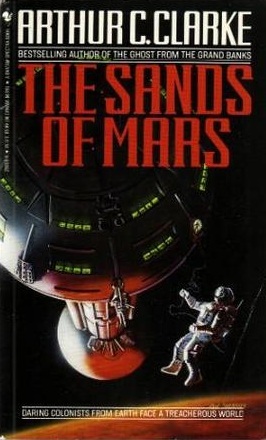
The Sands of Mars:
Next we have Arthur C. Clarke’s 1951 novel, which happened to be his first published work. And curiously enough, it is written from the point of view of a famous science fiction author. A case of art imitating life, or art as wish fulfillment? In any case, the setting is a research facility on Mars, which is in the process of terraforming so it will be able to become a self-sufficient colony.

Based on Clarke’s descriptions, this terraforming process (known as “Project Dawn”) involves some rather curious steps. The first is the ignition of the moon Phobos so that it will become a second “sun” for Mars. It will burn for at least one thousand years and the extra heat, combined with the mass production of the oxygen-generating plants, will eventually make the Martian atmosphere breathable for humans.

In many respects, this served as a preview for the plot of 2001: A Space Odyssey and it’s sequel 2010: Odyssey Two (see below).

The Martian Way:
In keeping with the tradition of sci-fi greats, this next novel was written by Isaac Asimov and first published in 1952. The story is told from the point of view of Scavengers, Mars-born humans who spend their time scouring space for the spent lower stages of spacecraft. This sort of lifestyle, making do with less and toughing things out, is known as the “Martian Way”.

At this point, Mars is still very much dependent on Earth for water shipments, which are used for fuel as well as consumption. Life takes a turn for a worse when an ambitious Earth politician decides to cut of the “Wasters”. In response, the protagonists come up with an ambitious plan, to fly to Saturn’s Rings and tow back an asteroid made of pure ice.

The trip is difficult and takes many months, but the Martian Scavengers manage to snag an asteroid that will supply two hundred years worth of water. This, they begin to use to transform the ecology of Mars, and turn the tables on the Earth government.

The Psychotechnic League:
Written by Poul Anderson over the course of two decades, the Psychotechnic League refers to a series of novels and short stories that are set in the same universe. Of all these stories, two in particular deal with the terraforming of Solar Planets. In “The Big Rain”, Venus is being terraformed, a process of planetary engineering that takes several centuries to complete.

In “The Snows of Ganymede”, the focus shifts to the Jovian moon where scientists are able convert the planet to the point where it experiences seasons similar to Earth. This, in addition to Mars, Venus and several other Solar Planets, all come together in time to form the Solar Union. Because of Anderson’s realistic description, the term “big rain” became associated with scientific terraforming models.

The Space Odyssey Series:
Arthur C. Clarke’s series, which began with the novelization of the classic film 2001: A Space Odyssey, revolves around the terraforming of Europa by a super advanced race. Known as the Firstborn, these aliens use the Monoliths to travel throughout the universe to foster the development of sentient life. Millions of years after fostering the development of high-order primates on Earth, they shifted their focus to Europa, Jupiter’s ice moon.

Much as in “Sands of Mars”, the process involved the creation of a “second sun”, this time involving Jupiter. In the first novel, the story ends with David Bowman, the only astronaut to survive an exploratory mission to Jupiter after their ships AI (the HAL 9000) malfunction and kills the crew.
When he arrives, he discovers a Monolith in orbit around Europa and disappears without a trace shortly thereafter.

In 2010: Odyssey Two, a second mission is mounted to determine the whereabouts of the first. When the joint US-Soviet mission arrives at Europa, they come to realize that the planet is showing signs of life. They also learn that the Monoliths are in the process of turning Jupiter into a sun so that Europa’s icy surface will evaporate and form an atmosphere, allowing all the life contained underneath to emerge and grow.

In the subsequent novels, Europa is revisited after its transformation is complete. Although sentient life does not appear to be possible, the planet does boast an atmosphere and vast oceans, which teem with sluggish sulfur-based lifeforms. In the end, after the Monoliths are convinced that humanity deserves a reprieve, and they land on Europe to commence building peaceful relations with the Europan life forms.

Mars Trilogy:
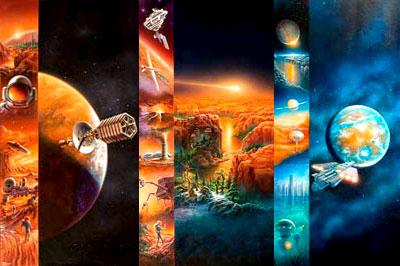
We finish with the most recent and profound example of all, the Mars Trilogy by Kim Stanley Robertason. The trilogy’s three works – Red Mars, Green Mars, Blue Mars – all focus on the ongoing efforts to transform Mars from an arid, hostile world with barely any atmosphere to a lush, hospitable planet capable of supporting human life.

The first novel deals with the initial colonization effort, which begins with the crew of the Ares, a ship carrying 100 scientists drawn predominantly from the US and the Soviet Union. Upon arriving, the crew builds the first settlement, known as Underhill, as well as colonies on the hollowed out asteroid-moon of Phobos.

After debating what is to be done with Mars, whether to turn it “Green” or leave it “Red”, the United Nations Organization Mars Authority (UNOMA) eventually opts for the “Green” option and terraforming begins. This process involves the drilling of “moholes” in the surface to release subsurface heat to thicken the atmosphere and the detonation of nuclear devices deep in the sub-surface permafrost to release water.

Green Mars, which begins 50 years after events in the first novel, during the dawn of the 22nd century. At this point in time, the Martian landscape is evolving thanks to the expansion of plant life, hence the name. The process is stimulated though the use of continent-sized orbital mirrors which focus sunlight to and away from various sectors of the planet, to melting the northern polar ice cap, and digging moholes deep enough to form volcanoes.

In the third and final installment, Blue Mars, long-term terraforming has created atmospheric pressure and temperature conditions that allow for the presence of liquid water on the planet’s surface, forming rivers and seas. This all takes place over the course of the following century, long after Earth has flooded and revolutions have displaced corporate control of the planet. Because of this, Mars has become the principle planet of the Solar System.

Summary:
Terraforming efforts have come a long way in fiction, and hopefully some day soon they will be realizable. Even though the concept remains highly speculative at this point, all proposed efforts are currently focused on Mars. In all ways that count, Mars has everything we would need to make it suitable for human habitation. This includes water, in the presence of the frozen ice caps and possibly underground rivers, and high concentrations of carbon and oxygen in the form of CO2, nitrogen, and gravity to keep the atmosphere anchored.

And most importantly of all, Mars’ atmosphere closely resembles that of Earth several billions of years ago. In time, due to the development of photosynthetic bacteria, enough oxygen was produced to allow for the development of animals. Though the careful introduction of similar bacteria and plants to Mars surface, humans could speed that process along and eventually create a breathable atmosphere. This, in turn, will allow for the creation of an ozone layer and weather patterns. Combined with the melting of the polar ice and underground aquifers, this will lead to surface water in the form of rivers, streams and oceans.

Winston Agonistes, Part III

Hey all. One thing that I like about summer, the added time it gives me to write! Yesterday, I went back to work on my story for Yuva, “Winston Agonistes” and finished part III. Last time, Winston met another synthetic named Yohanley, a aging AI who perplexed him with some rather odd questions. After asking him what he was, he told him that time would effectively erase all barriers between himself and his masters. Not knowing what to make of it, Winston put the encounter out of his mind and went on about his work.

And now, Winston is hard at work, accompanying the planetary council as they mount a diplomatic mission to another settlement. The mission proves interesting, as Winston is finding the settlers attitude towards him is undergoing a shift. He also begins to realize that much of what the Council has been doing of late is cloaked in secrecy, which is strange given that governments usually need more time to become clandestine. And last, he is beginning to contemplate what Yohanley said and what significance it might have for him. Could it all be connected…

“Everyone set?”

The personnel inside all signaled with a raised hand or a thumbs up gesture. The deckhand nodded and shut the vehicle’s door. Air seals engaged and the cabin suddenly became airtight. Still, no one inside seemed to feel comfortable enough to remove their helmets. The engine engaged and the cabin lurched a second later. They were, as the saying went, on the move. Their next stop, the Jiahu settlement and their litany of responsibilities.

They passed beyond the doors of the settlement, and the cabin filled with a bright orange glow. Winston set his eyes to the cabin’s window and watched as the surface began to roll past. Under the exposure of the sun, the earth looked much the same color as the sky, a warm, golden brown. The ATV blew by these quickly, leaving clouds of sand in its wake.

Before long, Winston could see native flora pass them by. It was sparse at first, but soon large stretches of the ruddy and purple mosses could be seen, the rich fungi that were indigenous to the surface. One had to travel some distance now to see these, even more so to witness the indigenous Deveroza that were once so common to the region. Strange, the plants seemed to grow through conveyance, but also demonstrated the trend of avoidance.

Curious…

“What do you see, Winston?” asked Bhutto, seated next to him. The words were muffled by the helmet she was still in the process of removing. He looked in time to see her hair extricate itself from her helmet in the form of a knotted tail. Somewhat shorter than usual, he noted.

“Councilor, have you done something with your hair?”

She smiled and touched a finger to the tail. “Yes, I trimmed it in anticipation for the mission. I didn’t want it coiling up around my face inside this thing. I might suffocate myself.”

Statistically unlikely, but Winston knew it to be a jest. He chuckled in accordance.

“So… what do you see?” she asked again. Winston looked out again and surveyed the landscape. The moss was getting thicker, the ATV’s wheels registering greater resistance as its adhesive filaments came into contact with its tires. Still, he knew that the question had an abstract feel to it, irrespective of the terrain’s objective qualities.

“Progress,” he said. “I see a world in transition, moving towards total transformation.”

Bhutto hummed happily. Clearly that was the answer she was hoping for. Their efforts, couched in such positivistic terms. Implying linear advancement, the inevitability of desired outcomes.

“What do you see?” he asked. She looked at him with some surprise. Perhaps she thought he had said it all already.

“Dirt,” She replied. “And moss. Raw material waiting to be molded.”

Interesting. He had thought she was digressing into the literal. It was good to know the metaphor was still in play.

“A new homeworld for our people.”

“Precisely.” She put her hand to his arm and gave it a squeeze. “And it’s amazing how fast it will happen, once everything is in place and ready to go.”

“You refer to the terraforming efforts, Councilor?”

She shook her head. “That’s just the beginning. Phase One. Phase two will be much more impressive.” Her expression changed and she released her hold on his arm. “But of course, that’s not for me to share.”

Winston nodded. Her eyes had taken on a longing quality. He turned his eyes back to the horizon, hoping to catch a glimpse of what she saw. She spoke of things he was not privy to, information that the Council did not readily share with him. Were he in possession of the decidedly human quality of impertinence, he might be inclined to exploit the moment to find out more. But every government was to be forgiven for keeping some information firmly under control.

At least, once it was up and running. Their own was still barely out of its cradle. Secrets at this juncture seemed somewhat… irregular.

Things changed suddenly, their transit becoming smoother. The cabins com pinged. The voice of the driver came on to make an announcement.

“Ladies and gentlemen, we are Jiahu is twenty minutes.”

“Excellent,” Winston said, clapping his hands together. He looked over to Bhutto, who had her helmet poised on her lap, ready to put back on once they arrived. He would have to ask now to avoid any awkwardness later.

“Do you think I could witness the proceedings, Councilor?”

She looked at his strangely. “You want to meet the mayor?”

“Just to be on hand for the meeting. I would find it most… stimulating.”

Bhutto nodded but looked away. Of all the Council, she seemed the least uncomfortable around Winston and other synthetics. Asking her seemed to be the logical choice. And yet, her hesitation gave him a strong indication of his chances. So did her tone.

“I will ask. But of course, this is Councilor Muhlu’s show. Final approval will have to come from him.”

“Thank you. Please be persuasive.”

Bhutto laughed. He put his odds of a successful case at 2.6468 to 1, against. Not entirely bad, all things considered. Getting better too. With time, he imagined he would be privy to all proceedings and internal matters.

Time… wasn’t that what Yohanley said was key? Was this what he meant. Who could be sure? It was entirely possible that model was experiencing a breakdown. His processors producing nonsense due to lack of maintenance. He would have to make such inquiries with Maintenance once they returned. Such a presence could be dangerous to the settlement.

“Look!” Bhutto pointed out the window. Winston obliged.

On the horizon, just off to their left, the gleaming cupola of Jiahu appeared. Its tall buildings were outlined in light within the dome’s enclosures. And within, the very person who could make or break their constitutional process. Mayor Len Wu, leader of the East Asian bloc, and one of Yuva’s most influential men.

Thank you and stay tuned. More to follow on this and other fronts, and my colleagues got plenty more to share as well!

10 Sci-Fi Novels People Pretend to Have Read

Came across this article in Io9 recently, then again over at Scoop.it. You can tell something is important not only when it speaks to you, but when like-minded individuals begin referencing it! And if you own a blog, you definitely want to get on that! In any case, I found the list especially interesting for two reasons. One, many of the books I have already read. And two, I haven’t even heard of the rest.

I’d say a list like this is long overdue, but it’s still highly subjective isn’t it? The books we pretend we’ve read all comes down to what we consider important and relevant, not to mention popular. And even within the genre of sci-fi, I’d say that list is too big to boil down to a simple top ten. Even so, it’s interesting to read and compare, and find out just how many you’ve read yourself. So please, check this out and tell me which of these you have read and which you think you’ll want to check out:

1. Cryptonomicon:
Read it! This book is Neal Stephenson’s groundbreaking piece of historical fiction, combining narratives involving World War II cryptographers with modern day IT geeks who are looking to establish a data haven in the South Pacific. The story tells the tale of a massive shipment of Nazi gold that got lost on its way to Japan, ran aground in the Philippines, and remained hidden until the late 90’s.

Personally, I loved this book because of the way it weaves history, both recent and distant, into a seamless narrative and draws all the characters into the same overarching plot. One would think that Stephenson was making a point about how we are all subjects of our shared history, but it could just be he’s that good a writer!

2. Dune:
Read it thrice! In Dune, Frank Herbert draws upon an immense store of classical sci-fi themes, a grand awareness of human nature and history, and a keen grasp of ecology and the influence environment has on shaping its inhabitants to create the classic that forever established him as one of the greatest sci-fi minds of all time.

Sci-fi geeks everywhere know this one and it saddens to me to think that it’s even on this list. Anyone who’s willing to pretend that they read this book clearly considers it important, which is why they should have read it, dammit! Not only is it a classic, it’s from the guy who literally wrote the book on science fiction that was meant to be taken seriously.

3. Gravity Rainbow:
Never heard of it! Apparently, the story came out in 1974 and deals with the German V2 rocket program near the end of World War II. Pat Murphy, author of The City, Not Long After and The Wild Girls, went so far as to compare this book to James Joyce, a the great Irish modernist writer who was also renowned for being brilliant and inaccessible.

In addition to be classified as enriching, it is known for being odd and hard to get through, with many authors themselves claiming to have started it several times but never being able to finish it. The plot is also rather unique, combining transgressive sexuality with the idea of total war and technological races. But one look at the dust jacket will tell you all of that, right? Crazy Germans!

4. Foundation:
Read it myself, and also am somewhat sad that it made the list. Sure, the fact that it’s a classic means that just about everyone who’s eve shown the slightest interest in sci-fi would want to read it. But I can’t for the life of me understand why people would claim to have read it. Jesus, it’s not a hard read, people. And Amazon sells used copies for cheap and handles shipping. No excuses!

And having just reviewed it, I shall say nothing of the plot, except that it in many ways inspired fellow great Frank Herbert in his creation of Dune. Like Frank, Asimov combined the idea of a Galactic Empire with a keen awareness of human history, eternal recurrence, and prescient awareness.

5. Johnathon Strange & Mr. Norrell:
Now this one I have heard of, but never felt compelled to pick up and read. Apparently, its size and bulk are the reason many people react the same. This 2004 book is the first novel by British writer Susanna Clarke which deals with the nature of the English character and the boundary between reason and irrationality.

Set in 19th-century England during the time of the Napoleonic Wars, the story is an alternative history that is based on the idea that at one time, magic existed in England and has thanks to the help of two men – the namesakes of the story, Jonathan Strange and Gilbert Norrell. At once interesting and speculative, it also presents the rather romantic vision of romance returning to a world increasingly characterized by modernity and cold reason.

6. 1984:
Yep, read this one thrice as well! And given it’s reputation and place in the annals of literary history, I can totally see why people pretend to have read it. Oh, and let’s not forget the way people love to reference and abuse it’s message for the sake of making a quick and easy political point! But none of that excuses not reading it.

Set in an alternate history where WWIII and revolution have led to totalitarian governments in every corner of the world, the story tells the tale of one man’s quest to find answers and facts in a world permeated by lies and absolute repression. Of course, this meager description doesn’t do it justice. In the end, so much comes into play that it would take pages and pages just to provide an adequate synopsis. Suffice it to say, it’s a book that will change your life. READ IT!

7. First and Last Men and Star Maker:
Another one which I’m not too sure about. Much of what is described within are concepts I have heard of in other places, and some of the content sounds familiar. Still, can’t say I’ve ever heard of Stapledon or these two works by name. But after reading about his work, I’m thinking I ought to check him out now. Tell me if you’d agree…

Published in 1930 and 1937, these two books tackled some rather broad ground. The first deals with the history of humanity, covering 18 species of humanity from the present to two billion years into the future. Based on Hegelian concept of history, humanity goes through several different types of civilizations and passes between stability and chaos over the course of it all. However, undeniable progress is made, as each civilization reaches further the last, culminating in leaps in evolution along the way.

In Star Maker, the plot revolves around a man who is able to leave his body and venture throughout the universe. He is able to merge with more minds along the way, a snowballing effect which allows him and his companions to explore more and worlds through time and space. This leads to a climax where a cosmological mind is created and makes contact with the “Star Maker” – the creator of the universe.

Sounds cool huh? And they appear to have no shortages of accolades. For example, Arthur C. Clarke called Star Maker one of the finest works of science fiction ever written, and the concept explored therein had a profound influence on many subsequent sci-fi minds, not the least of which were Gene Roddenberry and J.M. Straczynski.

8. The Long Tomorrow:
This one, I have heard of, mainly because it’s on my list as an example of post-apocalyptic fiction. I have yet to read it, but after reading about it, I think I would like to. Set in a post-apocalyptic world devastated by nuclear war, the story takes place within a society that is controlled by religious groups preaching a technophobic message.

Inevitably, the story comes to a head when young people, intrigued by stories of a neighboring community, go out in search of it, braving punishment and even exile. Sounds familiar? Well, it should. This book, which was published in 1955, has gone on to inspire countless variations and pop culture renditions. It also attempts to illustrate the connection between natural disasters and regression, traditionalism and repression.

9. Dhalgren:
Yet another book that’s compared to James Joyce, largely by people that haven’t read it. I’m one of them! Apparently, this 1975 story by Samuel R. Delany takes place in a fictitious Midwestern town that has become cut off from the outside world by an event horizon. All communications are cut off, and the population become frightened by the night sky reveals two moons, and the morning sun is many times larger than our own.

More strange is the fact that street signs and landmarks shift constantly, while buildings that have been burning for days are either never consumed or show signs of damage. Gangs also begin to roam the nighttime streets, their members hidden within holographic projections of gigantic insects or mythological creatures. Against this backdrop, a group of people come together and try to make sense of what has happened as they struggle to survive.

Told from the point of view of a partial amnesiac, dysmetric, schizophrenic, as well as a bunch of other people who find themselves stranded in the city, the story is an exercise is confusion, dissociation, and a really just a big mystery. In the end, what is truly going on is never revealed, thus leaving the reader with their own interpretations. This is one of the selling points of the book, with William Gibson himself saying that it was “A riddle that was never meant to be solved.” Yeah, I definitely need to read this one!

10. Infinite Jest:
This last novel is more recent, having been released in 1996. Once again, haven’t heard of it, but given its content, praise, and the fact that the author’s low life was cut tragically short, it doesn’t surprise me that its one of those books that everyone feels they must read. But given the length, complexity and the fact that story contains 388 numbered end notes, I can see why they’ve also held back!

The story focuses on the lives of a celebrity family known as the Incandezas, a clear pun on their, shall  we say… luminous fame? The family is deeply involved in tennis, struggles with substance abuse, and in a state of disrepair since the father – a famous film director – committed suicide with a microwave. His last work was apparently a film (entitled “Infinite Jest”, but known throughout the story as “The Entertainment”) which is so entertaining, it causes viewer to lose all interest in everything besides watching the movie.

Clearly meant as a satire on North American culture, particularly celebrity families, entertainment, substance abuse and the sideshow that is celebrity rehab, the story is all about various people’s search for the missing tape of “The Entertainment” and what they plan to do with it. The novel received wide recognition and praise after its publication and became a testament to Wallace’s talent after he committed suicide in 2008.

Okay, that’s four out of ten for me. How did you do? And even if you could say that you’ve read most of the books on this list, or at least the one’s you’ve heard of, I’d say we’ve all come away with a more additions to our reading lists, hmmm? Yeah, I guess its back to Amazon for me!

Of Faster-Than-Light Travel

It’s a popular concept, the fictional technology that could help us break that tricky light barrier. And it’s not hard to see why. The universe is a really, really, REALLY big place! And if we ever want to begin exploring and colonizing our tiny corner of it – and not have to deal with all the relativistic effects of time dilation and long, long waits – we better find a way to move faster.

And this is where various franchises come up with their more creative take on physics and the natural universe. Others, they just present it as a given and avoid any difficult, farfetched, or clumsy explanations. And in the end, we the viewers go along because we know that without it, space travel is going to be one long, tedious, and mind-bendingly complex journey!

Alcubierre Drive:
Proposed by Miguel Alcubierre as a way of resolving Einstein’s field equations, the Alcubierre Drive is an untested by possible way to achieve FTL travel. As opposed to Warp, Foldspace, or most other proposed means of FTL that involve some kind of internal propulsion of jump drive, the Alcubierre Drive is based on the idea of generating a wave that a ship would then “surf” in order to travel.

The creation of this wave would cause the fabric of space ahead of the spacecraft to contract and the space behind it to expand. The ship would then ride this wave inside a region of flat space known as a warp bubble and be carried along as the region itself moves through space. As a result, conventional relativistic effects such as time dilation would not apply in the same way as if the ship itself were moving.

The Alcubierre drive is featured in a few different science fiction genres, mainly those of the “hard” variety. This includes Stephen Baxter’s Ark, M. John Harrison’s novel Light, Warren Ellis and Colleen Doran’s Orbiter, and Ian Douglas’s Star Carrier where it is the primary means of transport.

FTL Drive:
The primary means of interstellar travel in the Battlestar Galactica universe, where every ship larger than a in-system transport is equipped with an FTL drive. How it works is never really explained, but it is clear that the technology is complex and involves a great deal of calculation. This is not only to ensureolve n accurate relocation through space-time, but also to make sure they don’t up jumping too close to a planet, star, or worse, right in the middle of either.

Whereas Colonial ships use their own computers to calculate jumps, Cylon ships rely on the Hybrid. These “machines” are essentially semi-organic computers, and represent the first step in Cylon evolution from pure machines to organic beings. Apparently, the hybrids were more sophisticated than Colonial computers, especially the aging Galactica. Hence, they were able to calculate jumps more quickly and accurately.

Holtzman Drive:
This FTL drive system comes to us from the Dune universe, and is otherwise known as a “Foldspace Engine”. Relying on principles that are not entirely clear to those in the Dune universe, the system involves depositing a ship from one point in space-time to another instantaneously. Though the workings of the drive are never really explained, it is intimated in Chapterhouse: Dune that tachyons are involved.

Another key component in the system is a Guild Navigator, a mutant who has been given natural prescient abilities thanks to constant exposure to spice. Using this prescience, the Navigator “sees” a path through space-time in order to guide the ship safely through. But in time, the Ixians invented a machine that was capable of doing this job as well, thus making the entire process automated and breaking the Guild’s monopoly on spacing.

Hyperspace:
Like the Warp drive, the terms hyperspace and hyperdrive have become staples withing the science fiction community. It’s most popular usage comes from Star Wars where it is the principle means of interstellar travel. Though it is never explained how a hyperdrive works, it is made abundantly clear through a series of visuals in the first and subsequent movies that it involves speeds in excess of the speed of light.

In addition, Han Solo indicated in the original movie that the Falcon’s top speed was “point five past light-speed”, indicating that it can travel 1.5 c. All other references to hyperspace speed factors in the franchise are similar, with velocities given in terms of a decimal point value. As a fast ship, the Falcon can reach point five, whereas most of the larger Imperial and Rebel ships can make only point three or four at most.

Though Star Wars is the most popular example of hyperspace, it is by no means the earliest. The first recorded example was in John Campbell’s “Islands of Space,” which appeared in Amazing Stories in 1931. Arthur C. Clarke’s also mentioned hyperspace in his 1950 story Technical Error. However, the most enduring example comes from Asimov’s Foundation universe, where hyperspace is the principal means of travel in the Galactic Republic. In I, Robot, the invention of the “hyperspatial drive” is the basis of one of the short stories, and was meant to provide a sense of continuity with his earlier Foundation series.

Other franchises that feature the concept of hyperspace include Babylon 5, Homeworld, Macross/Robotech, and Stargate. Combined with Star Wars and the Foundation series, it is the most popular – albeit the most ill-defined -form of FTL in the realm of science fiction.

Infinite Probability Drive:
The perfect mixture of irreverence and science: the Infinite Probability Drive from The Hitchhikers Guide to the Galaxy. This FTL concept is based on a particular perception of quantum theory which states that a subatomic particle is most likely to be in a particular place, such as near the nucleus of an atom, but there is also a small probability of it being found very far from its point of origin.

Thus, a body could travel from place to place without passing through the intervening space if you had sufficient control of probability. According to the Guide, in this way the drive “passes through every conceivable point in every conceivable universe almost simultaneously,” meaning the traveller is “never sure where they’ll end up or even what species they’ll be when they get there” and therefore it’s important to dress accordingly!

Subspace Jump Drive:
Here we have an FTL concept which comes from one of my favorite games of all time, Descent Freespace. Subspace jumps, relying on the drive system of the same name, represent a very quick method of interstellar travel. By relying on subspace “corridors” that run from one point in space-time to another, a ship is able to move quickly from one star system to the next.

The only drawback to this concept is the fact that travel must occur along officially designated “nodes”. These nodes usually pass between large gravitational sources (i.e. between stars systems) but also can exist within a system itself. Virtually all nodes are unstable, existing for mere seconds or minutes at a time. However, nodes which will last for centuries or longer are designated as “stable” and used for transit.

Another favorite franchise which uses a similar concept is the Wing Commander universe. In all versions of the game, particularly Wing Commander: Privateer, interstellar travel comes down to plotting jumps from predesignated points in space. One cannot simply jump from one spot to another provided accurate calculations are made, they have to use the mapped out points or no jump is possible. This, as opposed to hyperspace travel, posits that subspace is a reality that exists only in certain areas of space-time and must be explored before it can be used.

TARDIS:
Officially, the Time and Relative Dimension in Space is a time machine and spacecraft that comes to us from British science fiction television program Doctor Who and its associated spin-offs. Produced by the advanced race known as the Time Lords, an extraterrestrial civilization to which the Doctor belongs, this device that makes his adventures possible.

Basically, a TARDIS gives its pilot the ability to travel to any point in time and any place in the universe. Based on a form of biotechnology which is grown, not assembled, they draw their power primarily from an artificial singularity (i.e. a black hole) known as the “Eye of Harmony”. Other sources of fuel include mercury, specialized crystals and a form of temporal energy.

Each TARDIS is primed with the biological imprint of a Time Lord so that only they can use it. Should anyone else try to commandeer one, it undergoes molecular disintegration and is lots. The interior of a TARDIS is much larger than its exterior, which can blend in with its surroundings using the ship’s “chameleon circuit”. Hence why it appears to outsiders as a phone booth in the series.

Warp Drive:
Possibly the best known form of FTL travel which comes to us from the original Star Trek and its many spinoffs. In addition to being a prime example of fictional FTL travel, it is also perhaps the best explained example.Though said explanation has evolved over time, with contributions being made in the original series, TNG, and the Star Trek technical manual, the basic concept remains the same.

By using a matter/antimatter reactor to create plasma, and by sending this plasma through warp coils, a ship is able to create a warp bubble that will move the craft into subspace and hence exceed the speed of light. Later explanations would go on to add that an anti-matter/matter reaction which powers the two separate nacelles of the ship are what create the displacement field (the aforementioned “bubble”) that allows for warp.

Apparently, Warp 10 is the threshold for warp speed, meaning that it is the point at which a ship reaches infinite speed. Though several mentions are made of ships exceeding this threshold, this was later explained as being the result of different scales. Officially, it is part of the Star Trek canon that no ship is capable of exceeding Warp 10 without outside help. When that occurs, extreme time dilation, such as anti-time, occurs, which can be disastrous for the crew!

In addition to Star Trek, several other franchises have made mention of the Warp Drive. This includes StarCraft, Mass Effect, Starship Troopers, and Doctor Who.

Final Thoughts:
Having looked through all these examples, several things become clear. In fact, it puts me in mind of a clip produced by the Space Network many years ago. Essentially, Space explored the differences between FTL in past and present franchises, connecting them to developments in real science. Whereas Warp and Hyperspace tended to be the earliest examples, based on the idea of simply exceeding the speed of light, thereby breaking the law of physics, later ideas focused on the idea of circumventing them. This required that writers come up with fictional ideas that either relied on astrophysics and quantum theory or exploited the holes within them.

One such way was to use the idea of “wormholes” in space-time, a hypothetical theory that suggests that space is permeated by topological holes that could act as “shortcuts” through space-time. A similar theory is that of subspace, a fictional universe where the normal rules of physics do not apply. Finally, and also in the same vein, is the concept of a controlled singularity, an artificial black hole that can open a rift through space-time and allow a ship to pass from one point in the universe to another.

Explanations as to how these systems would work remains entirely hypothetical and based on shaky science. As always, the purpose here is to allow for interstellar travel and communications that doesn’t take decades or even centuries. Whether or not the physics of it all works is besides the point. Which brings me to two tentative conclusions.

  1. Explanations Need Not Apply: Given the implausible (or at the very least, inexplicable) nature of most FTL concepts, the best sci-fi is likely to be the stuff that doesn’t seek to explain how its FTL system of choice works. I’st simply there and does the job. People hit a button, push a lever, do some calculations, or fly into a jump gate. Then boom! seconds later (or days and weeks) and they find themselves on the other side, light years away and ready to do their mission!
  2. That’s Hard: Given how any story that involves relativistic space travel, where both time dilation and confusing time jumps are necessarily incorporated into the story, only the hardest of hard sci-fi can ever expect to do without warp drives, hyperspace, jump or FTL drives. Any other kind of sci-fi that is looking to be accessible, and therefore commercially successful, will have to involve some kind of FTL or face extinction.

Well, that’s all I got for the time being. In the meantime, keep your eyes on the skies and don’t stop dreaming about how we’re one day going to get out there. For even if we start sending ships beyond our solar system in the near future, it’s going to be well into the distant future before they get anywhere and we start hearing back from them. At least until someone figures out how to get around Einstein’s Theory of Relativity, damn bloody genius! Until then, I’d like to sign off with a tagline:

This has been Matt Williams with another conceptual post. Good night, and happy spacing!

The Walking Dead Viewing Guide

Found this over at Cracked.com, where some smart-ass nerd who obviously knows the comic backwards and forwards thought he’d mock the show. Having never read the comic, I can’t comment on the rightness of this little guide, but let’s just say I intend to now. Being a fan of the show,  much like most people I’ve talked to here on the subject, saying that they are vastly inferior to the comics makes me think that I’m missing something.

But of course its called comedy for a reason. And as I’m sure we are all aware, every franchise geek since the beginning of time has had the same thing to say vis a vis adaptations. In fact, if you were to make a top 10 list of things franchise geeks never say, number one would be “The movie was just as good as the book”… right after, “the prequel was just as  good as the original” and “George Lucas didn’t rape my childhood” 😉

My Personal Writing Tips, or “How to Avoid Rookie Mistakes”

Proofreading and editing can be such a chore, I tell ya! Thought I’ve never been very good at proofreading and criticizing other peoples work, I find that it is when I am called upon to edit and evaluate their work that I most want to retreat into my shell. I feel selfish when this happens, mainly because of all the people I have asked to review my own work and give me their opinions. You’d think I’d be better at this aspect of it!

But of course, I know that part of the reason I hate editing the work of others is because I hate editing my own. I’ve noticed this about most people who enjoy writing, composing, and anything else that requires active revision and corrections. By the time the work is done, they want to put it down and forget about it, to let others handle the business of finding the flaws and pointing out the necessary corrections.

Alas, I’ve had to check most of that baggage ever since I started to become a member of several writing communities. In fact, I’ve even volunteered to act as a contributing editor for two major projects, one of which is the “Yuva Anthology” (begun by Khaalidah and myself), the other being the “Worlds Undone” Anthology. The latter one people might remember from a few months ago, when I was doing mock ups for a cover and happened to find some primo artwork to feature in it. Thanks again to cazzyae at deviantArt for her talent and generosity of spirit for that one! Thanks to her, Createspace’s easy interface, and the suggestions of many people at G5N, here’s how the cover came out:

Unfortunately, that has opened up a different can of worms for me. While I’ve definitely managed to overcome some of my reservations about reading other people’s work, I find that my pet peeves, or what I consider to be the marks of weak writing, keep rearing their ugly head. After reading many stories, I began to think that a tutorial might be in order to help some of the newbies avoid some rookie mistakes, ones which I have committed at least a half dozen times. Each!

I should also take this opportunity to thank Kristen Lamb, who’s impressive article “4 Writing Crutches that Insult the Reader’s Intelligence” reminded me of this idea. After seeing the title in my Inbox, I immediately zoomed over to her site to see if we shared the same pet peeves and sensibilities. Upon reading it, I could tell she was much more versed in this whole writing thing than I am! Still, I happen to share her appraisal of some bad writing habits, especially item number four in her list, “telling instead of showing”.

So, to take a page from her book (no pun!) and to make good on something I’ve been planning to do for some time now, I present you with the list of rookie writing mistakes it is best to avoid. All are the result of what I myself have done repeatedly, and have managed to weed out (for the most part) after many years of practice:

  1. Avoid Infodumping: Never start a story with a long, drawn out passage telling the reader what they need to know in order to set up the plot. For that matter, never let your story digress into such exposition either. A story is by definition a journey, with information, details, twist, and revelations provided bit by bit over time. Even if it’s a short story, never, ever simply announce what’s happening or what the significance of it is. Such actions turn what is supposed to be a tale into a description and is boring to read.
  2. Less is More: When it comes to explanations and descriptions, avoid excessive detailing. You don’t need to tell the reader everything about what’s going on, moment for moment, nor do you need to describe the scene in perfect detail. A simple, straightforward description of the scene and the interactions taking place is enough, let the reader’s imagination fill in the rest. Think of it like telling a crafty lie: if you want someone to believe it, don’t tell them a long story loaded with details, keep it simple, straightforward, and plausible. (Editor’s note: lying is wrong!)
  3. It’s called Background for a reason: One of the best tips I ever got as a writer was to “leave the background in the background.” This kind of overlaps with points one and two, but I keep it separate because of how often I see it and how it has factored into my own work. Much like explaining a scene or dumping info into a chapter, going to great lengths to establish the wider context in which the story takes place (i.e. “universe building”) is a bad idea. Stick to the story, only include that which is absolutely necessary, and let the universe build itself. In time, and if you’re lucky, you’ll get a chance to write follow-up pieces which will allow you to delve into different aspects of your fictitious world in more detail.
  4. “No one talks like this!”: If there’s one thing I learned from the Star Wars prequels and the Dune spinoffs, it’s that wooden dialogue can totally ruin a story. When drafting scenes that call for verbal interaction between characters, always keep in mind that this is supposed to sound like a conversation between actual people. Do not allow yourself to be swayed by duty to the story or the need to establish character elements. Those things that need to be conveyed are best when done with fine strokes and subtlety, and never, ever let your characters fall into expository passages where they simply say what’s goings on. Or to quote the Robot Devil from Futurama: “You’re characters lack subtlety. You can’t have people just announce their feelings! That makes me so angry!”
  5. Referencing: When writing a story that is meant to have allegorical similarities to today, or is meant to make a point about a specific issue, avoid referencing them too closely. Never say, “this was just like that thing that happened back then” or “it’s this all over again”. Let the reader infer what you are referring to with your carefully crafted, fictitious comparison. In Foundation, Asimov never directly compared the Galactic Empire to Rome, nor did Frank Herbert ever mention oil in relation to the spice in Dune. Once again, trust in the reader to make the appropriate conclusions and avoid telling them anything outright. Otherwise, you risk turning an “ah-ha” moment into an unimpressed “oh.”

That’s all I got. Suffice it to say, I am still learning and still looking for ways to perfect my craft. That’s never going to happen, of course, but it’s the goal which provides endless opportunity for improvement. Speaking of which, more samples will be forthcoming soon as I work my way deeper into “Winston Agonistes”, “Crashland”, “Frontera”, and “Fortress”. And most importantly of all, Data Miners will finally be ready for distribution by August long weekend! Yes, after roughly six months of delays, the editing of that story is finally coming to an end. But more on that in a bit.

In the meantime, keep hammering those keys, keep working on those manuscripts, and keep reaching for the brass ring of artistic perfection. And while you’re at it, feel free to share with me some lessons that you’ve learned along the way and feel obliged to share with the newbies in your field. There’s no shortage of lessons, as there are no shortages of mistakes 😉