The Hunger Games, a review (finally!)

It finally happened, I read the Hunger Games. Not that this should come as much of a surprise, I did promise I would after all. But it took me quite a while! Months back when I was doing a review of Dystopian Science Fiction – which earned me most of my current followers, thank you! – one of the biggest questions I was asked was “what about the Hunger Games?”

Yes, person after person wanted to know how this recent piece of YA dystopian fiction fit into the historical record. At the time, I really had no intention of reading it or doing a review. Not because I had anything against Collins or this book, but because I had not heard of it prior to the movie’s release. And I have this thing where I become resistant towards anything that becomes a big commercial deal. Maybe its a desire not to follow the trends, I don’t know.

However, as I began to look into the concept of this book, the desire began to grow to check it out. And though I did my best to avoid spoilers, I couldn’t help but check out some reviews of the phenomena and what is said about our culture. Here is an excerpt from one such article, entitled “‘The Hunger Games’: your kids are angrier than you think”, by Brian Bethune (Maclean’s Magazine):

“Imagine a life where possibilities are opening at a speed that veers unpredictably between exhilarating and terrifying. The familiar, precisely because it’s familiar and safe, still tugs at you, but even so, you want out because your old life constricts as much as it comforts. Besides, your social milieu, which often feels like an endless struggle to achieve, or resist being slotted into some arbitrary niche—pretty, ugly, smart, dumb, athlete, klutz—is changing fast. You feel driven—by inner need and outside pressure—to make choices. Meanwhile, the manipulative, often harsh, powers that be, who created the larger world they’re busy shoving you into, have clearly not done a bang-up job of it, either in their personal lives or as part of society. And they want you to get out there and fix their mistakes—just at a moment when worry over the imminent demise of their entire socio-economic structure is never far from the surface. It can be cruel and scary out there. Dystopian, even.

Chances are, anyone not imagining this life, but actually living it, is a teenager. And living it in an era of economic uncertainty, conspiracy theories and fear of environmental collapse. Western civilization used to produce literary utopias, but in the past century of world wars, financial panics, murderous totalitarian regimes and nuclear threat, dystopias have outnumbered sunny projections by several orders of magnitude. Pessimistic depictions of the future are now everywhere in popular culture. Teens and teen books are not immune to larger trends in society.”

What a perfect synopsis really. Not only is this book a look at a future where apocalyptic events have led to the creation of an oppressive, abusive state that controls people through scarcity and force. Not only is it a commentary on mankind’s fascination with reality tv and endless appetite for distraction. No, this book has the added dimension of capturing the angst and confusion of being a teenager, thrust into the world of adults and forced to work hard and compete for their apparent amusement, all the while reflecting on how it’s basically the older generation that have made the world what it is.

Plot Synopsis:
Not that it’s necessary since so many people have now read the book or seen the movie, but I shall give a bare bones summary anyway just to recap the selling points. The story opens on the nation of Panem, which is a play on the name Pan-America, a post-apocalyptic nation set in the not too distant future. Though it is never specified exactly what happened, what is clear is that what is left of North America is now organized into 12 Districts ruled from a central city known only as “The Capitol”.

We then see the protagonist, Katniss Everdeen, a resident of District 12 located in the coal-rich areas of Appalachia. Her and her friend Gale are hunting, which is necessary to ensure their families eat well and supplement their meager incomes. We quickly learn that the Hunger Games are upon the 12 District for another year, that the names of two “tributes” are about to be drawn from each district, whereupon they will be sent to the Capitol to compete. When District 12’s names are drawn, Katniss is terrified to learn that her younger sister’s Priss, who is barely a tween, has been selected. She does the unthinkable and volunteers in her stead.

Her partner/competitor for the games is a baker’s boy named Peeta, a boy who apparently has always fancied her. The two of them are put aboard the special rail car for transport to and from the Capitol where they meet their “coach”, their design team, and the frumpy lady who acts as their PR and etiquette consultant. As they travel in style, these people take turns prepping them, which mainly consists of cleaning them up and making them look presentable since the lead up to the games involves all kinds of televised appearances and interviews.

Their coach, a man named Haymich Abernathy, who was the last person from D12 to win, is a horrendous drunk who doesn’t seem to care what happens to them. This changes when an altercation aboard the train makes him realize that Katniss and Peeta have some fight in them. From then on, he curbs his drinking so he can advise them properly. When they arrive, they witness even more style and opulence, being placed in a private hotel, treated to lavish meals, and made to take part in a presentation ceremony where all districts ride out in a public arena.

Quickly, and with Haymich’s help, Katniss and Peeta distinguish themselves as the team to beat. On many occasions, hints are given that there is a bubbling romance between the two, one which may very well be real. Katniss also impresses her judges when she demonstrates her archery skills, something she’s spent years honing from hunting. By the time the games roll around, she is considered the contestant to beat, and Peeta quietly shares with her that he wishes there was a way to strike back at the people who are forcing them to compete.

The games begin shortly thereafter and half the tribute die within the first day. Bonds form as the kids from the more privileged districts, known as the Career Tributes, come together to eliminate other contestants, which is typical of the games. As the best equipped, best sponsored and best trained contestants – who, as the name suggests, spend much of their time preparing for this at home – a tribute from one of their districts is usually the winner. Their leader is a large, temperamental boy named Cato, who to her dismay, Peeta seems to have joined in order to hunt her.

Luckily, Katniss forms a bond of her own with a young girl named Rue, a young girl from District 11 who reminds her of her sister. Small, fast, and adept at climbing and hiding, the two become fast friends and assist each other. They even manage to take out a few of the privileged kids and manage to destroy their supply cache, a move which evens the odds considerable. Peeta also risks his own life to save Katniss at one point, a move which confounds her since she was convinced he turned on her. However, the move saves her life and causes Peeta to be several injured by Cato himself.

Shortly thereafter, Rue is killed by one of the boys. Katniss manages to take this boy out with an arrow, and sings to Rue until she dies. This is something she promised she’d do, as Rue was a lovely singer who sang regularly during her long hours picking orchard fruit. Remembering what Peeta said about getting back at the Capitol, she also moves Rue’s body to a more dignified spot and covers it with flowers, knowing that everyone in the Capitol is watching. She is given heart when she realizes that Peeta’s has not been declared dead yet and goes off in search for him.

She finds him camouflaged in an embankment and digs him up. He is mortally wounded, and Katniss spends the next few days trying to heal him. Due to their growing popularity as “star-crossed lovers” the Capitol announces a rule change, couples from a district can win together! Once he’s healed enough, Katniss and Peeta begin to enact a final plan to draw the last of their enemies out and kill them. When Rue’s fellow tribute dies and the girl named “Foxface” is accidentally poisoned by some berries Peeta picks, Cato is now alone. However, when they find him, the Capitol throws in another game changer.

All the previous tributes, now dead and taken away, have been bred into muttations – bio-engineered dogs that can stand on their hind legs, and that are smarter and more aggressive than your average hound. These dogs pursue the three tributes to the Cornucopia, the starting point of the games, where they trap them on top of the structure. There, Cato tries to take Peeta hostage, but Katniss takes him down with an arrow to the hand. He falls and is set upon by the mutts, and Katniss mercifully fires and arrow into his head to end his suffering.

In the end, the Capitol declares that the two of them must kill each other again, but Katniss and Peeta pull a fast one. Grabbing their store of poisonous berries, they resolve to eat a lethal handful together and force the issue. Seeing this, the Capitol backs down and declares them both winners! A hovercraft arrives shortly thereafter and brings them back to the Capitol for medical treatment and rest. When Katniss wakes up, she learns that Peeta is alive and well despite his many injuries, and she appears to be completely made over.

However, all accounts are not settled. Haymich warns her before the final interviews take place that her stunt with Peeta embarrassed the rulers of Panem and they are planning on retribution against them. There only hope is to make it look as if they did it for love, playing up the popular lovers angle and thus ensuring that the Capitol can’t touch them. This, they do, but Peeta is heart-broken when he learns that to Katniss, this was just a ploy to help them win. However, she privately reflects that she doesn’t know if her feelings for Peeta are genuine or not, and fears what will happen when they are separated upon their return to D12.

Overall Impressions:
Let me start with the criticisms first, since that is by far a shorter list. To begin, I felt that things were conveyed a little quickly and easily vis a vis the whole power structure of Panem. It’s in the first chapter when the Games are being discussed that Katniss conveys all the relevant details about the 12 districts, how their used to be a 13th, and how the games are used to control them and prevent further rebellion. In fact, I felt that the tone of the book was being pitched at a bit of a basic level.

But then of course, I remembered that it’s YA fiction. Of course it’s going to say these things up front, the intended audience is not yet familiar with dystopian fiction and its many subtleties. Slapping myself on the forehead and saying “A-doi!” I continued reading with a more open and less snobbish mind. And the book only got better from there, weaving a young adults appraisal of the world quite seamlessly with dystopian themes.

Because in the end, the real genius of the book comes through amidst all the entertaining and well-paced format of the story. Between Katniss’ confusion, angst, anger and the ongoing struggle to stay alive, the dystopian flavor of the whole affair really shines through. We see that there are very clear and obvious distinctions between the Capitol and the outlying districts, that these become more evident and appalling the further one ventures out, and that disparities between districts are exploited for the sake of entertainment and control.

This is especially true when it comes to the Career Tributes, who have it better than the others and stick together as a way of guarding their shared sense of privilege. The way the outlying districts, as personified by Rue and Katniss, form similar bonds is held up as the flip-side to this, where a shared sense of deprivation and abuse push them together to resist their common enemies. And what I found brilliant about this was how it demonstrated that for the dispossessed, it’s not just the oppressors who they must fight against, but also those they have bought off with scraps from their own table.

But even more brilliant was the way this was so relatable to young adult readers. In their own way, teenagers experience dystopia every day by simply having to endure the unfair and privileged environment known as high school. With its cliques, ruthless sense of social judgment, bullying and constant pressure to perform, always at the behest of a system dominated by adults, it must seem like an arena in which their very lives are at stake. Many people speak of “teen-age” drama and how silly it seems to them, but I challenge those people to look back at what being a teenager was like and to tell me drama isn’t precisely what every moment of every day is charged with.

I can now see why this book resonates with young people and adults everywhere. Not only was it a good dystopian themed story, combining several classical elements in a way that hasn’t really be done before; it is also a perfect allegory for growing up and being forced to step into a world not of your own making; all the while feeling like everyone’s against you. Between those forcing you into the game and those of your own age trying to kill you, adolescence is very much like living in a totalitarian state and fighting your own for the entertainment of others.

I get it, people. I see why this book is a big deal now. However, I often wonder if others really see its for its inherent value. Sure it’s entertaining, relatable, and chock full of stuff that young people love – empathy, romance, pain and angst. But it’s allegorical depth is what I think makes it truly valuable as a science fiction and dystopian read, especially to the young. By describing a dark world from the point of view of teenagers, it basically captures what all teenagers know already. Life can be totally unfair, oppressive, aggravating, and just generally suck!

Personal Note:
Feel free to skip this part if you don’t feel like a heavy read. But I assure you, it’s relatable…

In my work, I’ve often been subjected to the drama of the young and find myself sympathizing one moment and wanting to pull my hair out the next. But always, I enjoy the moments when I’m able to talk to a young man or woman and feel like I’m getting through to them. There’s nothing more rewarding when you see that glimmer in their eyes that says “they get it!” It’s little wonder then why my worst job experience was in an environment where the words “f*ck off”, “you suck”, and “I hate you” were so common.

It made me angry, it made me sad. But more than anything, it made me feel powerless. How do you help when the disparity of your positions makes it impossible? But of course, after I left, I kept hearing how the new teacher was constantly being told “Mr. Williams was WAY better than you!” Funny, they kept comparing me to the last guy too 😉 But I think it made me appreciate how much life can suck for young people, especially kids growing up in poverty, broken homes, and living with the legacy of abuse, defeat and blatant racism. As if these kids don’t have enough problems without a dark legacy hanging over their heads.

Under the circumstances, it’s amazing any of us make it out of our teen years, let alone the majority of us. That was another thing that happened regularly in my old job posting, teen-age suicide. With all the problems and complications of life and their age, some kids truly feel like there’s no way out. In addition to thinking life sucks, they become convinced that it isn’t worth living. But what seems to do them in is the fact that they feel so alone, and can’t express their feelings and lighten their load. If more kids understood just how un-alone they are, far more would make it to adulthood. I think we should all take a moment for those who didn’t…

Game of Thrones Romantic Comedy Mash-up!

Think Game of Thrones meets a bad romantic comedy! That’s what some rather enterprising fans managed to pull off with this mock trailer for GOT Season 2. Following the logic that all the relationships in the story could be broken down and pitched as a series of cliched love triangles, these fans took a series of clips from the show, added some cheesy pop music, and voila! Delicious satire was born.

Yes, it seems to work too, doesn’t it? It’s all funny and patronizingly heart-warming, until you remember that most characters in this story wind up losing their heads, being gelded or getting a golden crown 😉 Ah who cares, its fun stuff!

Generation Ships

systems___cryogenics_1Ever since my writing group and I got on the subject of space and colonization, some recurring themes have come up. For starters, there’s the concept of interstellar space travel, the kind that doesn’t involve fictitious Faster-Than-Light drive systems and cannot exceed the speed of light. In those situations, which are far more likely to happen in this and the next century, the question of how to keep crews alive until your arrival keeps popping up.

One way is to utilize some kind of cryogenic procedure, where passengers are put into “reefersleep” for the duration of the journey and awakened upon arrival. Though it might sound a bit crude, it’s actually a very practical solution to the problems of how to keep a crew preserved and provided for during the incredibly long voyages that space travel entails. This procedure has come up repeatedly in the realm of science fiction, particularly H.P. Lovecraft’s Cool Air, Robert A Heinlein’s The Door into Summer, Clarke’s 2001: A Space Odyssey, PKD’s Ubik, the Alien franchise, and the Revelation Space universe, just to name a few.

RAMAThe other solution, which is the subject of this post, is to construct generational ships. These are basically “interstellar arks” where people and even entire biospheres are transported from one location to another. Crews are kept in waking conditions, experience subjective time, and entertain themselves in interactive, simulated, or virtual environments in order to stay sane until they complete their voyage. Though much more expensive to build, these ships are an equally elegant solution for what to do about non-FTL space travel and settlement.

These two have made many appearances in science fiction, and I’ve compiled a list of all the Generation Ships, Space Arks, and O’Neil Cylinders I could find.

Firefly:
At the beginning of each episode, it was explained how Earth was used up, prompting humanity to seek out a new home. This is what eventually led them to 34 Tauri in the 22nd century, where they began the process of terraforming and settling the many worlds and moons. Though it was never explained in detail, mainly because the show was canceled before they could (screw you, Fox!), indications are given in the movie Serenity and the expanded universe that this migration involved Generation Ships.

In the movie, this was done mainly through visuals, where a large flotilla dusts off from Earth and eventually finds its way to the system of the White Sun. It was also said that the process of terraforming took decades, which would require that the crews had somewhere to stay while the terraformers did their work. Also, speculative point here, but it would stand to reason that the fleet would have to have some pretty large ships to accommodate both settlers and the kind of equipment they would need.

Chasm City:
This novel, set in Alastair Reynold’s Revelation Space universe, involves a large thread that follows the settlement of the world known as Sky’s Edge. This took place early in the universe’s backstory, before the development of “lighthuggers,” and therefore required that the ships be able to support crews for long periods of time.

From Reynold’s descriptions, these ships were large, cylindrical vessels that boasted vast bays to hold their many cryogenically frozen passengers. At the same time, the waking crew needed vast facilities to provide for their needs. These included mess halls, sleeping quarters, medical bays, and recreational facilities. Sky Haussmann, one of the children amongst the crew, had a nursery with a robotic clown and virtual backgrounds.

This divide, between a waking crew and frozen settlers, represents a sort of compromise between the cryo-ship design and the generation ship. On the one hand, you’ve got the majority of your crew at near-frozen temperatures and perfectly preserved for the voyage. On the other, you’ve got a crew walking about and looking for food, rest, and entertainment. However, it still qualifies and even inspired my group in our quest to design the perfect story for settlement!

Orphans of the Sky:
One of the earliest known examples of the use of generation ships in sci-fi, this two-novella set was also one of Heinlein’s first works. Like Clarke’s Rendezvous with Rama, it features a massive cylindrical ship that is drifting through space. But unlike Rama, Heinlein’s ship, known as the Vanguard, has become a derelict that is permanently adrift in space.

As the story goes on, we learn that this was due to a mutiny that killed all the piloting officers many generations back. Since that time, the descendants of the surviving loyal crew have forgotten the purpose and nature of their ship and lapsed into a pre-technological culture marked by superstition. In fact, they now view their ship as the cosmos itself and interpret its “voyage” as a metaphor.

The crew is also ruled by an oligarchy of “Officers” and “Scientists”, the head of which is the descendent of the original captain. Much like pre-industrial times, most crew members are dedicated to a simple life where they tend to agriculture and are illiterate. Seldom does anyone ever venture to the “upper decks” where the “muties” (aka. “mutants” or “mutineers”) are kept. These individuals, it is learned, know the truth of the ship’s purpose, another reason why they are ostracized from the rest of the crew.

As you can plainly see, this book not only featured a generation ship and some rather hard science when it came to colonization, but it also raised some valid and interesting questions about how space travel and confining environments could affect subsequent generations of people. Those who were born into an enclosed environment would come to know it as their whole world. And in the absence of external, verifiable facts (such as messages from Earth or historical records), they could even be led to believe there was nothing beyond their walls.

Paradises Lost:
Similar in tone and setting to Heinlein’s Orphans, this story by Ursula K. LeGuin focuses instead on the psychological impact that generational travel would have on a human crew. Adapted into a musical, this story explores the basic question of what happens when you spend your whole life (and entire generations) traveling toward a goal, only to find that the endpoint has become otherworldly and unattainable?

The story takes place aboard a generation ship known as the Discovery, where people are born and die on a trip to colonize a distant planet. Much like the Orphans, the ship becomes their entire universe and begins to seem more tangible to them than Earth or their mission to colonize a new world. The reason for this is quite simple; as the journey goes on, those who once lived on Earth are slowly dying off, and subsequent generations know about these things only through tales and lore.

As a result, a new religion is born that teaches that the ship is “spaceship heaven” and that it is bound for eternity. This religion is known as Bliss, and the younger generation is embracing it against the wishes of the older. The story is told through the eyes of two elder characters – Hsing and Luis. They know their lives will end on board the ship and that their mission lies in the hands of future generations. Naturally, they worry since said generations are convinced that they should never leave the ship they call heaven.

Rendezvous with Rama:
One of the best examples of a generational ship that is extra-terrestrial in origin! Known as Rama, this massive space cylinder was basically a self-contained world that was carrying the Raman civilization from one corner of the galaxy to another. When a crew from Earth arrives and begins to survey the interior, they begin to notice several tell-tale features.

For one, the interior contains several structures that appear to be arranged in “cities” – odd blocky shapes that look like buildings and streets with shallow trenches in them, looking like trolley car tracks. In addition, there is a sea that stretches in a band around Rama, dubbed the Cylindrical Sea, and trenches cut into the sides that appear to be windows.

In time, all the machinery comes to light, thanks in part to the admission of light through the ship’s long windows. Small creatures that appear to be biological machines (aka. “biots”) also begin to come out to conduct routine maintenance. In time, they come to the conclusion that the buildings constitute factories and the cylindrical sea contains trace elements and bio-matter, which they will begin to convert into “Ramans” as soon they get within range of their destination.

In the end, it seemed that the Ramans determined that the best way to spread their species was to break them down into their component parts, place them aboard ships that would float for generations through space, and begin recompiling them once they got to where they wanted to go. Ultimately, Sol was just a stopover on their long journey, and more ships were coming in subsequent novels. Still, this first exposure to the alien generation ship was an educational experience!

Ringworld:
Written by Larry Niven, the Ringworld series is considered one of the greatest examples of exploratory sci-fi. Set in the Known Space universe of the distant future, the story revolves around the discovery and exploration of the Ringworlds, an artificial habitation ring built by an extinct civilization. With the makers of these rings long dead, the rings themselves are adrift and their engineered inhabitants degenerated into a primitive state.

These artificial rings are roughly one million kilometers wide and one thousand kilometers across, approximately the diameter of Earth’s orbit. Each one encircles a Sol-type star which provides both life-sustaining energy and light. And, of course, they rotate, thus providing artificial gravity that is 99.2% as strong as Earth’s through the action of centrifugal force. Nighttime is provided by an inner ring of shadow squares which are connected to each other by thin, ultra-strong shadow square wire.

The ringworld has a habitable flat inner surface that is equivalent in area to approximately three million Earth-sized planets. Hence, it is able to sustain extensive ecosystems and all forms of life. This appears to be the purpose of the rings, in the end, the creation of habitable areas in space that were removed from terrestrial environments. An added bonus was the ability to transport said life and ecosystems over vast distances through space without having to stick them in an enclosed environment.

So really, these things were like a gigantic version of a generation ship, capable of moving an entire species or civilization through space.

Stargate Atlantis:

The series Stargate Atlantis contained a few mentions of vessels that fit the profile of generation ships. For starters, there was the Ancients City Ship, a self-contained city that was also a spaceship. Though it was capable of FTL travel, the vessel was capable of sustaining a city-sized population for extended periods of time as it traveled through space.

In addition, in the third season episode entitled “The Ark”, Colonel Sheppard’s team discovers a facility inside a hollowed-out moon that turns out to be an ark created by the people of the planet around which the moon is in orbit. The ark was built to preserve the existence of the people from the planet so that they could reemerge and rebuild their civilization. Generations prior, these people had fought a disastrous war with the Wraith in which they were almost exterminated.

Though not a vessel per se, the moon base served the same purpose as a generation ship. Though the moon orbited their original homeworld and the people really weren’t traveling through space (except in orbit around their planet), the principle was essentially the same. People were kept in stasis until the day came when they could awaken to transplant themselves on the intended world, thus ensuring the survival and expansion of their civilization.

Yes, the examples abound! In fact, the concept of the generation ship and related ideas are so fertile that I’m kind of surprised that it took me so long to really appreciate it. But then again, I came to a lot of the classics a little late in life. Ah well, it doesn’t really matter when you get to the destination, provided that you get there and enjoy the journey – which is kind of the concept behind a generation ship, isn’t it? If you can’t just warp your way across the Universe – if you have to take your time and drift slowly – you might as well travel in style!

George W. Bush’s head appears on Game of Thrones

I came across this baby on Blastr recently. Yes, apparently the “Deciders” head was featured on GOT last season, and news of this has people tweeting, texting, facebooking, myspacing… you know, all that social media shit! In any case, after watching the video, I had to wonder how and where they came up with that. Was it something that the set cast noticed and sent out into the blogosphere? Probably. In any case, the story is simply that one of the head’s featured in season one of GOT, in the scene where Joffrey is showing Sansa her father’s head on a stake, looked a lot like the former president.

Lord knows the little Bush has never been one to not attract controversy, but I do wonder how he might react if he heard this. I can only assume there are plenty of pundits who would say this is some kind of liberal plot and that no one would dare do this with Obama’s head. Nevertheless, the set designers insisted that it was all a coincidence and that the heads were part of the props department. Can they faulted that one of them just happen to look somewhat simian? I mean have you ever really looked at W’s face? There’s a reason anthropologists believe we intermarried with Neanderthals, you know 😉

Follow the link below to the original article from I09 and see if you spot the head in the video:

george-w-bushs-decapitated-head-appeared-on-game-of-thrones

Dystopia and Deathmatches in Sci-Fi

Battle Royale:
This controversial story, also adapted into a film, takes place in an alternate universe where Japan is a member region of a totalitarian state named the Republic of Greater East Asia. Alluding to the Greater East Asia Co-Prosperity Sphere of WWII, it is clear that this a world in which Japan won the Second World War and continued on the path of fascist Imperialism.

In any case, the story revolves around what is called “The Program”. Under the guise of a “study trip”, a group of junior high school students from a fictional town are gassed on a bus. They awaken in the school of an isolated, evacuated island and learn that they have been placed in an event where they must battle each other to the death, or all will die.

Officially a military research project, it is a means of terrorizing the population, of creating such paranoia as to make organized insurgency impossible. Every year, fifty classes are selected to participate where students from a single class are isolated and are required to fight the other members. It ends when only one student remains, with that student being declared the winner.

Their movements are tracked by metal collars, which contain tracking and listening devices; if any student should attempt to escape the Program, or enter declared forbidden zones, a bomb will be detonated in the collar. If no one dies within any 24-hour period, all collars will be detonated simultaneously and there will be no winner.

Banned in many countries (the novel and the film) because of its controversial and graphic nature, Battle Royale has gone on to inspire such books as The Hunger Games.  Combining a Lord of the Flies-style appraisal of human psychology with a indictment of reality TV, this story remains one of the most effective pieces of modern dystopian literature featuring death matches.

Dune:
Fans of Dune will remember the lovely scene in the novel where Count Fenrig travels to Geidi Prime to speak with the Baron. Once he arrived, and in honor of Feyd Rathau’s birthday, he was treated to a gladiator match between Feyd and a slave gladiator. This is a common feature on Geidi Prime where death matches are considered public entertainment and every major city has its own arena.

And what better place for this kind of entertainment than Geidi Prime, a world run by ruthless overlords and characterized by harsh, perverse brutality? And that was the point after all. The Harkonnen’s were the bad guys in this tale and everything about them, their appearances, ethics, and homeworld was designed to match.

Robot Jox:
Taking place in a post-apocalyptic world where conventional warfare is forbidden between nations, Robot Jox tells the tale of a gladiator-style sport where giant mechs do battle in open arenas. This is how the two super-nations – the American-influenced Western Market and the Russian Confederation – work out their differences.

Of course, espionage and betrayal remain an integral part of the games, mirroring the Cold War. What’s more, the games often rigged to ensure that one bloc can get a leg up on the other. And in the end, the entertainment factor is also a driving force behind the games. In a post-apocalyptic world, the masses need some form of entertainment to distract them from the shock and horror of their daily lives.

The Hunger Games:
Following in the same vein as Battle Royale and Lord of the Flies, The Hunger Games tells the tale of a not-too-distant future where the United States has degenerated into a tyrannical government ruled from a political seat known only as “The Capitol”. Every year, the rulers of this city force all the outlying districts to send two young people – one boy and one girl – to compete in a free-for-all known as the Hunger Games.

The purpose of these games is simple, to keep all districts in a state of awe and fear so they won’t be able to contemplate another uprising. Years back, it is said that the 13 districts committed to one such uprising, the result being that District 13 was destroyed. The remaining twelve now send their competitors and try to exploit the incentives, which just happen to be rations.

Throughout the book, several things are made clear about the games which highlight its satirical nature. Satirizing reality TV shows, we learn that the games are televised, incentives are offered to keep the games going, and contestants draw sponsors based on their popularity. In addition, extra elements like romances and collaborations are encouraged to ensure that the games remain interesting and dramatic.

In the end, the games serve the purpose of keeping people down but also exploiting their destitute nature by offering them a shot at something better. When the games are over and only one person remains, they will receive enough rations to last them a lifetime. Many times over, it is also shown how life in the capitol is opulent and comfortable, whereas the outlying districts are malnourished and must do things like hunt illegally for food. And of course, the farther the district from the capitol, the more difficult life is, another aspect which the capitol exploits to ensure its continued survival.

The Running Man:
Written by Stephen King under the pen name Richard Bachman, The Running Man is also a near-future dystopian tale set in 2025 where the US has become a totalitarian state because of economic fallout and wide-scale starvation. For a population dogged by hunger and martial law, the only real source of enjoyment is a televised TV show where convicts are forced to engage in gladiator-style combat against seasoned “hunters”.

Aptly named “The Running Man”, the show begins when a series of “enemies of the state” – i.e. convicts – are released into a massive arena where they are pursued by a group of network-employed hitmen. For every hour they remain alive, they earns 100 dollars, plus a bonus for every Hunter they kill. If they survive 30 days, they earn a total of 1 billion “New Dollars” and a full pardon. Or so they say…

Though the novel and the movie differ in terms of plot and resolution, the basic elements are the same. In a future where the vast majority of the population is indigent and desperate, brutal spectator sports are seen as the only outlet. In both versions, much is made of how popular the games are and how important they are to both the network and the government, hence why every attempt is made to ensure that the Hitmen always win.

This serves to reinforce the notion that enemies of the state will always lose when faced with the governments brand of justice, which in this respect is similar to a show trial. It also ensures that the most profitable business in that day and age, since the show grosses billions of dollars in sponsorship and betting on convicts is also a big side-business, stays up and running. So in addition to serving as a source of social control, the games are also an example of corporatism, where the government has a lucrative arrangement with its biggest corporations.

Unreal Tournament:
Don’t laugh! Yes, this may have been a glorified (and gory) first-person shooter in it’s time, but that doesn’t mean it wasn’t also inspired. Though gamers cared little for the storyline, the fact remains that Unreal Tournament actually had a dystopian theme that drew from several classical sources. Set in a future where the Earth government creates a no-holds-barred arena deathmatch game to settle disputes between deep space miners.

However, when it became clear just how profitable and popular the games were, the games expanded to become an interstellar affair where anyone could fight and the prizes were astronomical. In turn, the corporate responsible for creating the games also became incredibly powerful and used every tool in its crooked arsenal to make sure that competitors were in good supply and things always worked in their favor.

Any player who survived long enough to make it to the end would square off against the companies own cyborg. If they were fortunate enough to kill him too, they received the grand prize and rank of Tournament Champion! All of this, though it took the form of a first-person shooter, calls to mind all the previously mentioned examples of dystopian science fiction and psychological realism. By pitting the desperate, the brutal and the avaricious against each other, a company was able to make an obscene amount of money and keep people blind to the true abuses of power in their universe.

Final Thoughts:
In the end, all of these examples have one thing in common. Whether the setting is a post-apocalyptic world or just a destitute nation dealing with economic downturn, the element of social control is always there. By throwing the powerless, hungry and greedy into an arena and ordering them to kill or be killed, a government ensures that it not eliminates potential threats but channels discontent into something truly atavistic and brutal. Though this is in many ways inspired by the Roman example, modern developments seem to be the true inspiration.

Like all dystopian literature, it seems that developments within the late 19th and early 20th century were the crucial factor. It was here that writers and social commentators truly came face to face with humanity’s abundant capacity for distraction, atavistic behavior, and indifference to suffering. That is another thing that all these pieces of literature have in common. Whether it is the brutal cynicism of those who profit from the games, or the uncaring nature of those who enjoy them, a disgusting lack of empathy runs through them all like a vein.

For what is worse than exploiting misery for the sake of entertainment? It’s one thing to persecute people directly, but making the oppressed and exploited fight each other for the scraps off your own table? That’s a real dick move!

Speaking of which, stay tuned for my review of The Hunger Games. I’ve finally gotten to the end of the book and will sharing my long-promised thoughts on them real soon! Thank you all, and remember: don’t let the bastards pit you against each other! FIGHT THE POWER!

Reality TV gets the Hunger Games treatment!

My wife forwarded me this gem, which was shared with her by one of her friends on Pinterest. Man, that thing is becoming the new Facebook! But that’s a separate satirical issue. Mainly I think this hilarious recommendation is perfect at combining reality TV with a satire thereof. The Hunger Games, true to the best traditions of dystopian sci-fi, depicted a future in which young people were pitted against each other for the entertainment of the privileged. Who says this is not an elegant solution to our current problem with reality TV stars? Wouldn’t it solve all our issues with them?

Think about it… they annoy the hell out of us. And yet, the more we talk about them, the more press they get. The more press they get, the more famous and rich they become. It’s a terrible, viscous cycle! Turn them loose in an arena with orders to kill each other, with the remaining person getting set for life, and we’d pretty much kill all those birds with one stone. Actually, its more like we’d be ordering the birds to kill each other, but the point remains. All but one reality star is gone, and the remainder never need bother us again.

Sounds kind of twisted, but what better way to introduce my next concept piece: gladiator-style death matches in sci-fi!

P.S. Wouldn’t you know it? This just happens to be my 300th post! Yaaaaay, another milestone!

Cool Ships (volume XI)

Armageddon:
armageddonBack once more to the Eve universe, thank you Mr. Zidar for suggesting it in the first place! Here we have the Armageddon Battleship, the main heavy warship of the Amarr Empire. Packing a lot of firepower into its long, heavy frame, command of one of these is considered the greatest honor an Amarrian Captain can acheive within the Empire.

In terms of armaments, the Armageddon is studded with heavy turret batteries. Its forward section is also heavily reinforced, giving it the ability to ram into enemy ships while pulverizing them with weapon’s fire. It is also heavily shielded in addition to its armor, making it virtually impregnable to all but the most heavily armed cruisers.

Battle Galaxy Carrier:
battlegalaxy-carrierMuch like the SDF-1 from the Macross universe, the Galaxy Carrier is massive transforming ship that comes in two modes. In carrier mode, it is a massive ship that is capable of space flight and sea faring. In its battle mode, it takes the form of a massive mecha which is capable of kicking some very serious ass!

Build in the early-mid 21st century by the New United Nations government, its primary purpose was to act as a colonization vessel for the Macross fleet. And unlike previous colonization vessels, it boasted many new technologies – such as cybernetics and implants – which were meant to continually evolve as the ship traveled through space. On top of all that, it possesses cutting edge stealth technologies that make it capable of slipping past Zentraedi forces and blockades.

battlegalaxy-attackIn terms of armaments, the Battle Galaxy lives up to its name! In addition to an advanced Gunship Type Macross Cannon, which converts into its main firearm when in battle mode, it also has 12 heavy beam cannons (also available in battle mode), multiple phalanx beam cannons and missile launchers, and a compliment short range micro-missile batteries for point-defense.

Firstborn Monolith:
monolithIt would be an understatement to call this one a classic. Taken from the Arthur C. Clarke novel and the movie of the same name, the Monolith was the mysterious aliens means of transport in 2001: A Space Odyssey. Known as the Firstborn, this race was basically the first species to achieve sentience in the galaxy, making them many millions of years old. After eons of evolution and space exploration, these beings had basically evolved to the point where they were no longer flesh and blood.

So really, these monoliths were not so much ships as chariots to carry their uploaded consciousness to the stars. Composed of unknown material and impenetrable to everything from scanners to nuclear detonators, they were a mystery to humanity of the 21st century. It also didn’t help that the only man get within spitting distance of an operational one disappeared, his last words being “My God, it’s full of stars!”

GTF Ulysses:
gtf_UlyssesThis ship, taken once again from the Freespace gaming universe, was one of the fastest and most maneuverable ships in the known universe. A collaborative effort between Terran and Vasudan scientists, it possessed the best design features and technologies they could muster. The Ulysses was designed for service in the Great War, but because of its assets, it saw service with GTVA forces long after the Lucifer was destroyed and the last of the Shivans routed.

In terms of armaments, it was lightly armed compared to other fighters, with four gun mounts, but only two ordinance bays. In the end, its greatest assets were its speed and maneuverability which made it highly effective against faster Shivan ships. In a dog fight, few things could catch it, or get around fast enough to hit it!

Inhibitor Square:
black_cube_world-1024x768These are the mysterious, dark and malevolent machines from the Revelation Space universe. Also known as “The Wolves”, they are a semi-sentient race of machinery that is designed to locate sentient star-faring cultures and exterminate them. However, the Inhibitors didn’t do this using lasers or photon weapons.
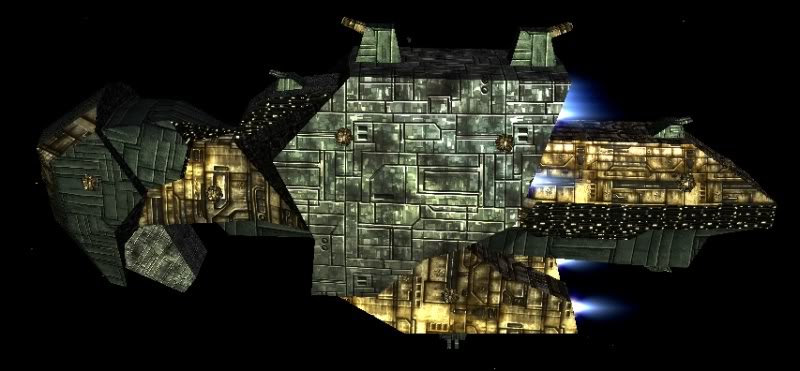
Much like the Firstborn from Clarke’s Space Odyssey series, they relied on a series of natural processes. The only real difference was they did it for destruction purposes. For example, when they became alerted to the presence of humanity on Resurgam, they chose to disassemble the planet’s gas giant bit by bit in order to create a massive trumpet like device in space. This was basically a gravitational weapon which they began using to shake the system’s sun to pieces.

Megathron:
megathronAnother Eve warship, the Megathron is the battleship of choice for the Gallente faction. It accelerates quickly, has a high armor capacity, and is very versatile due to its seven turret slots and two launcher hardpoints. This last feature is rare in Gallente ships, which tend to focus on energy weapons.

Because of its many weapons slots, the Megathron can be adapted to long range fire, known as the “Sniperthron”. This vessel is capable of engaging enemies at a distance of 150 km, but leaves it vulnerable to close range attacks and strips of the ability to heal. Another common build is the “Blasterthron” where the weapons of choice or short-range blasters, making it one of the toughest battleships around.

NTF Iceni:
ntf_iceniOnce more onto the Freespace franchise, dear friends. Here we have the one-of-kind prototype vessel known as the Iceni, the brainchild of the Neo-Terran Federation’s commander, Admiral Aken Bosch. Designed to be a command ship and mobile research platform, the Iceni was also a highly capable attack vessel, boasting mutiple turrets, beam mounts and missile batteries.

As part of project ETAK, the Iceni was the only vessel capable of communicating with the Shivans. After being mistaken for a command facility in an asteroid belt, Bosch was forced to deploy this ship prematurely. After shedding it’s housing asteroid, it set course for Gamma Draconis, where it used an Ancient jump gate to flee into unknown space. After making contact with the Shivans, the ship was boarded and most of the crew killed. Once the survivors were rescued, the ship engaged its self-destruct sequence and was lost.

In addition to being faster and more maneuverable than most ships its size, the Iceni also packed as much firepower as a Deimos-class frigate. These included 3 large beam emitters, 7 heavy turrets, 9 defenses turrets, 2 flak batteries, and 4 defensive missile batters. As such, it was capable of standing toe-to-toe with any comparable ship in the Terran or Vasudan armadas, and outrunning anything larger.

Prometheus:
prometheus_shipJust to be clear, I haven’t seen the movie… yet! I wanted to, but I dragged into seeing another film last night which also rocked (see below)! Luckily, I have seen enough trailers and promotional videos to know a few things about the eponymously named vessel. So here she is, just one day (finger crossed) before I see her on the silver screen! As an exploration vessel, the USCSS Prometheus was a designed for deep-space expeditions to alien worlds.

As a full-service space taxi, it was designed for both atmospheric and space flight and could therefore forgo the need for landing pods and shuttles. This was all made possible thanks to its reinforced hull, four multi-vector thrusters that allowed for verticle take off and landing, and an observation deck that allowed the crew a panoramic view of space and whatever landscapes they were surveying. During takeoff and atmospheric entry, these are enclosed by a series of protective shields.

Prometheus_ship_rearOn top of all that, it was packed with amenities for its crew. These included a large bay for heavy equipment and expedition vehicles, a full-service mess hall, a medical bay, recreational facilities, a built-in basketball court, long-range communications systems, crew quarters, cryogenic chambers, and holographic display windows. And of course, the ship’s own laboratory which served as its main research center. No doubt about it, ships like this, courtesy of the Weyland Corporation, ensured that crews could travel in style and comfort before being horribly killed by extra-terrestrials!

Special Mention: The Avenger Helicarrier!
Yes, I managed to get out last night to the movie theater. But instead of catching Prometheus as I originally hoped, I was coaxed into seeing the Avengers instead. It-was-awesome! Tons of cool action, a respectable, multi-layered plot, and lots and lots of cool shit! Kudos to Joss Whedon, I think he just became my hero!

And one of the things I liked best about this movie was S.H.I.E.L.D.’s own big-ass helicarrier! When they hinted that it was both a carrier and a sub, I was like “Whoaaaa! Like something out of Robotech!” But then, out came those massive turbofans and it took off! I just sat and stared for several, sustained minutes. My wife laughed at me. At that point, I said, “Okay, maybe you were right to want to see this.”

Anyhoo, much like something out of Robotech, this carrier was a massive machine that came in two modes. In its standard mode, it was your basic aircraft carrier similar in appearance to a Nimitz-class carrier. In its other mode, it is a freaking hovercraft, where four massive turbofans and two sets of jet engine clusters allow it to fly! It also has a comprehensive camouflage system where a series of reflector panels obscure it from sight, similar to adaptive camouflage.

And of course, as an aircraft carrier, it also has the usual amenities, which include several squadrons of F-22 and F-35 fighters and quinjets. And though armament didn’t come up in the movie, we can also assume that it has a full compliment of Phalanx point-defense cannons and Harpoon anti-ship missiles. But knowing S.H.I.E.L.D., I’m sure the list doesn’t end there. Most likely, they also got some cool stuff like an EMP, some rail guns, or laser devices in there too!

My First Troll!

Wow, this is what it feels like to experience hate mail! I gotta say, I’m kind of flattered. It was in reference to my article “Dune and Its Descendents”, one of many in which I praised the late Frank Herbert for his amazing work over the years and bashed the work that has followed in his wake. Like many fans of the original books, my love for them is matched only by my disappointment with how the series ended.

Plenty of times I have encountered fans of the new books, and we’ve been able to have some spirited debate. Hell, I even conversed with Kevin J Anderson himself and managed to keep a civil tongue, partly out of sympathy because this guy gets TONS of hate mail! But this person, who goes by the name of Carlos, he really took the cake. Here’s what he said:

“Of course your the big idiot ever, since the creation of the universe. And you don’t understand the work of frank Herbert, or the deep: spiritual, scientific, artistic and philosophic work of this avatar, also the reality of science fiction (reality). Frank Herbert is a genius, like Tolkien, and if you don´t understand it, its because you don´t have brains or the intelligence needed to see it. Au dare you to say something so idiot from others work, in what brainless basis of yours? It makes no sense or logic, i only see envy, some ow, and a very small brain, even smaller than a desert rat.

Carlos”

How nice, he even signed his name. It’s like F*@@$% you, you unbelievable bastard! Sincerely, Troller. Well,  I would be inclined to reply to this… um … comment here, except for two things. One, the man’s name doesn’t provide a link that goes anywhere. And two, I don’t have the slightest freaking idea what the hell he’s on about.

Correct if I’m wrong but it sounds like he thinks I’m bashing Frank Herbert, not the work of Kevin J Anderson and Brian Herbert. And what the hell is this “avatar”, does he even know what that means? That would imply a stand in, which makes me think he IS defending these two authors. But their names never come up, and rarely do their works ever inspire such heartfelt defense of the words “genius” or “deep”. Mainly people just say that they’re alright and entertaining and not hurting anyone.

Ah well, I’m clearly over thinking this. Mainly, I’m just intrigued because this is the first hate mail I’ve ever received here, which makes me think I’m coming up in the world! And second, the vociferous and confused nature of it kind of amuses me. It’s good to believe that attacks against you are the result of misunderstandings and confused emotion, and not the result of disapproval you can actually understand and get behind.

Ah well, kudos Carlos. You will always be my first hater! I just wish I knew what the hell you were talking about.

Zombie Guns, or How To Prepare for World War Z!

I blame myself in part, but what with all the talk of face-eating and Bath Salts in the news, there’s been a lot of speculation about whether or not there’s a Zombie Apocalypse on the way. Personally, I’m not one to go in for rumors and speculation, but I figure it’s better to be prepared! Hence why I’ve decided to do a post dedicated to Zombie Guns, or more specifically, firearms that will come in handy when the flesh-eating zombies start roaming your neighbourhoods!

Having done some posts of late involving futuristic guns, I’m already pretty well versed when it comes to recent developments in the firearms industry. However, I wanted to be thorough, so I also did a looking around and included some ideas from people who’ve already put some work in on the subject. And of course, I would be lost were it not for the common sense rules that come to us from all of movie, television and even literacy sources on the subject.

Whether it’s tv’s The Walking Dead, movies like Zombieland or 28 Days Later, or Max Brooks’ Zombie Survival Guide, the basic rules for surviving zombies are the same. Go for the head, don’t be stingy with ammo, and sever all emotional attachments! And when it comes to weaponry that will be most effective in this regard, portability, capacitiy, firepower and versatility are all important.

Relying on all these basic criteria and what I know about modern weaponry, I now present a list of the top handguns, SMG’s, shotguns, and rifles, each entry with its own selling points and drawbacks. Have a look through them and see if any of them tickles your fancy! In the end, I figure we all get one from each category. Have fun picking your arsenal!

Small Arms:
The weapon of last resort. When you’re cornered and all other weapons have failed or run dry, your last option is to draw your sidearm and knock as many heads off as possible, preferably while falling back. And when this happens, you need a steady firearm that won’t run out of bullets fast. And when it does, it needs to be quick to reload. That way you can keep on knocking heads off without worrying about being bitten!

Beretta 92:
Here’s one everyone should recognize. Also known as the M9 or Beretta 9mm, this gun is a favorite amongst police forces and militaries in many countries, especially the US. Combining a 9mm round, dual action and a 15 round magazine, it is one of the best all around sidearms in existence. In a firefight against zombies, its also a good last resort. The rounds are large enough to take out zombie brains, the pistol is accurate and doesn’t have significant recoil, and the shooter can go awhile without reloading.

The only real downside is the fact that this 9mm round doesn’t the same power as some its larger-caliber kin. If rounds are misplaced, like in zombie’s body, they won’t do much to slow it down. Basically, anyone using this will have to make their shots count by getting them right in the brain pan. But with 15 rounds (16 if they load the chamber), they will have plenty of opportunity.

Colt 45:
Don’t ask me why, but when it comes to old school designs, big bullets seemed to be the norm. That is certainly true of the Colt M1911, aka. the Colt 45. Originally designed for shooting gangsters and trench warfare, this weapon is more than capable of splattering zombie brains all over the sidewalk.

An immediate downside of this weapon is its ammo capacity, a mere seven rounds. In addition, as a single action pistol, it can be less accurate than its peers. However, it can overcome the former with an extended (12 round) mag, and its simplicity and old-world durability can make up for any inaccuracy. Unlike other models, this sidearm can up to 6000 rounds without a single misfire or jam up.

Desert Eagle:
What do you get when you cross a magnum with a semi-automatic pistol? The Desert Eagle, available in both the .357, .44 and .50 calibers. Each of these are capable of decorating a wall with zombie brains, but the bigger the bullet, the bigger the mess! As a hand gun, it packs a hell of a lot of firepower into a relatively small package. And at close range, nothing short of shot gun or an assault rifle can match its power.

However, its greatest strengths also prove to be its greatest weaknesses. Its powerful punch means powerful kickback, which can make accuracy a bit of a problem. What’s more, the large caliber make capacity problematic, even at the smallest caliber (9 bullets for .357, 8 for .44, 7 for .50). An extended 14 round clip helps this, but not the central problem of accuracy.

Glock 17:

This brand of handgun has been made famous by countless TV shows and movies, mainly because it sees so much use by police and military forces around the world. A variation on the Glock 9, the Glock 17 is also a compact 9mm pistol, but boasts a 17 round magazine. That kind of capacity is useful when facing off against a Zombie hoard!

In terms of drawbacks, the Glock has few. Much like the 9mm, its power is somewhat limited when used against zombie torsos. In the hands of an accurate shooter, this isn’t a problem. But for anyone else, that 17 mag will come in handy!

Submachineguns:
When zombies get close, its good to have something quick and small at the ready to take them down. Submachineguns, PDW’s and compact full-autos all fall into this category. In this case, rate of fire and ammo capacity count for something, but in the end, accuracy is important too, since head shots are the most effective.

Calico M960:
Because of its unique, sleek design, the Calico is a mysterious gun that’s made many cinematic appearances, usually in connection to sci-fi franchises. However, when it comes to combating zombies, its chief benefits are firepower and ammo capacity. A 9mm weapon with a top-mounted, helical magazine, the Calico can hold up to 100 rounds. And because of the compact shape of the magazine, many can be kept on the gunner’s person without fear of being overlaiden.

Drawbacks? Can’t think of many. Given its two handles, 9mm caliber, ambidextrous option and the choice between semi-auto and full-auto firing modes, the Calico is well suited to taking down individual and crowds of zombies. One possible flaw is that the range is slightly limited, compared to that of an assault rifle.

Chang Feng SMG:
Here we have another submachinegun that features a top-mounted helical magazine, a compact design and a relatively high ammo capacity. And like many other guns on this list, it is a 9mm design which makes it just right for splattering zombie brains! It’s ability to switch between semi-auto and full auto can also be useful when one needs to switch from accuracy to “kill em all” mode.

The drawbacks of this compact design are simple. Being so compact, it can be a bit unruly when fired in full auto mode. Though it has a forward handle as well as the trigger grip, the spacing makes recoil a bit of a problem.

MP5:
A favorite amongst law enforcement and military personnel everywhere, and for good reason. It’s compact size, firepower, weight and range are all very well suited to close combat firefights, which are common in urban environments. This makes it well suited to zombie killing as well. As usual, the 9mm round is prime brain-bashing ammo, and the third round clip ensures plenty of ammo.

At full auto, the gun fires 800 rounds a minute, but given its stability and accuracy, those rounds will be well placed. Compared to all that, its only real downside is its size. Compared to other SMG’s, this gun is more akin to an assault rifle than a compact machine pistol. Combined with other large weapons, this can create a problem.

P90:
Known as PDW (Personal Defense Weapon) this weapon is the living embodiment of compactness and automatic fire. Combining a 5.7mm round (the equivalent of .22 caliber) with a 50 bullet magazine, top-mounted, this weapon has enough punch to pulp zombie brains and can keep firing for some time. Its size and compact shape make it very portable as well.

However, there are some notable drawbacks. For starters, at full auto, its high rate of fire (900 rounds a minute) combined with its small size can produce some troublesome recoil. In addition, I hear tell that it has been known to jam up from time to time, which in a zombie fight can be truly fatal!

PP-2000:
Built in Russia and a popular item amongst its armed forces, this 9mm machine pistol has a number of useful features when facing zombies. For starters, it combines an assault rifles rate of fire with the size and caliber of a pistol. This makes it highly compact and portable and a good weapon to have when in close quarters with a small group of zombies.

Alas, its magazine capacity is only 20-30 rounds, which at a 600 rpm rate of fire can go very fast! Its retractable stock can combat recoil, but also adds volume which reduces compactness. As a result, it is best when used in single fire mode like a mega-pistol.

TDI Kriss:
Yet another example of portability meeting firepower, and then producing some weird looking offspring. Basically, a Kriss is an SMG that combines .45 caliber rounds with a rate of fire that lies between 800-1100 rounds per minute. Its handled design also makes it a steady shooter, which combined with its firepower, makes it good at chopping off zombie heads.

The downside you say? Well, its magazine is terrible small for a weapon that fires so quickly. As it stands, the weapon comes standard with a 13 round mag, which at 800 rounds per minute would go within a 1.33 seconds! Apparently, a 28 round mag is being developed, but that too would be gone in 2.1 seconds. This is fine if you’re happy shooting at semi-auto, but until they come up with a 50 round mag, this weapon is too quick for zombie fights.

“Close Encounters” – aka. Shotguns:
When it comes to zombie hunting, shotguns are mighty handy. Not only do they pack a lot of punch, a single shot can take a zombie’s head clean off. And even if you miss the head, a hewed arm or leg can also slow a zombie down considerably. Here, accuracy doesn’t count for a lot, but ammo capacity certainly does. When you’re blasting zombies, the last thing you want to hear is an empty click.

Franchi SPAS-12:
Originally designed for sport shooting, this automatic shotgun has become a mainstay amongst police and military forces everywhere. Able to shoot in either the pump action or semi-automatic firing modes, it is renowned for versatility, reliability, and firepower. It’s eight round capacity is also highly respectable as ammo capacities go.

The only drawbacks, compared to other weapons in this category, is its limited ammo supply. Though accurate and not prone to mechanical problems, which can happen in automatic designs, the SPAS 12 can deplete its ammo quicker and then takes time to reload.

Kel Tec KSG:
A cutting-edge design, boasting duel feed magazines and compact dimensions, this weapon is well suited for anti-zombie defense! In total, it holds 14 rounds, as is operated by pump action. It’s two handles also ensure a relative degree of accuracy, making head shots a real possibility.

Unfortunately, the weapon has two distinct drawbacks. Though it holds a highly respectable 14 shots between its two magazines, the pump action slows it down somewhat. In addition, it must be reloaded manually, and between its two tubes, that can take some time. This demands that the user find cover after exhausting their supply of ammo, or spend only part of it before taking time to reload.

Striker:
Manufactured in South Africa, the Striker Protecta was specifically designed to be a counter-insurgency, high capacity weapon with a hell of a lot of punch. It’s size and shape make it compact and portable, and its 12 round magazine give it enough capacity for a prolonged firefight.

In terms of drawbacks, the Strikers has a few. Though it has a good capacity, it has to be reloaded manually, which can take some time. In addition, even though its compact, the drum magazine can make it bulky and awkward to carry. However, it can make up for this since it doesn’t require additional magazines, just a simple ammo belt, in order to be reloaded.

USAS-12:
Here is a somewhat interesting design. Combining the familiar profile of an assault rifle with the concept of a shotgun, the USAS-12 also manages to combine a high capacity with a lot of firepower! The standard box magazine can hold 10 shots, but the drum magazine gives it a robust twenty. However, this is balanced by the fact that the ten can be reloaded by simply slamming a new box into place, whereas the twenty must be reloaded manually.

The only potential drawback of this weapon is its rate of fire. In addition to being semi-automatic, the gunner does not need to pull the trigger multiple times to get multiple shots off. This can cause have a saturation effect, but can also waist ammo. Remember, zombies hunt in packs, so saturation is only useful in real close quarters.

Rifles:
Last, but not least, is the category of rifles. Basically, these are the weapons that you want for long range encounters and sniping. In this case, what matters most are accuracy and ammo capacity. Even small caliber rifles have enough muzzle velocity to kill with a head shot, so in the end what matters is the ability to place that shot on target. Once you got that down, you want to make sure you can do it again, and again, and then again some more…

Barrett XM500:
This .50 cal sniper rifle design, which is the most recent to come out of the US, is lighter and more compact that its peers. And its sheer firepower and range would make it a real Zombie killer. Just imagine, .50 cal slugs that are capable of taking a zombie’s head off, literally! A hit to the torso will limb will all dismember and tear them apart too. Even if that’s not fatal, its sure to slow them down a ton!

However, the weapon does come with its share of drawbacks. Though good for long-range encounters, it would be of little use up close since it can only be fired while in a prone position. It’s ammo capacity is also lacking, at ten rounds a magazine, and despite its more compact and light design, she’s still tough to get around in a hurry.In short, good for support fire, not the best to have on its own.

Daewoo K11:
Here we have the Korean made dual caliber rifle that is part of the larger OICW (Objective Individual Combat Weapon) program. Combining a standard 5.56mm assault rifle with a built-in grenade launcher, this weapon is highly versatile, has good range and is very powerful. It’s regular ammo are more than capable of smashing zombie heads, and the grenades are good to disperse zombie crowds.

The drawbacks are clear. The K11 comes with a high-tech scope, but this is of little use when it comes to zombies. The added weight and bulkiness of it can also be a problem. In short, its delivers in all areas except portability, which in the end can mean the difference between life and death.

M16A2 Assault Rifle:
This version of the M16 rifle is an upgraded model of the weapon that seen service with US armed forces since Vietnam. In addition to better ammo and less blowback, the A2 has the ability to carry the M203 40mm grenade launcher, which is a fine addition for zombie killing. Combined with the standard 5.56mm round, a good muzzle velocity and a 30 round magazine, the M16 is accurate, has good range, and a respectable capacity.

Compared to bullpup rifles, its not very compact, but this problem is pretty minor since it can be carried for its stock or slung without difficulty. The only other thing is the grenade launcher, which while powerful addition can take some time to reload. As a single shot, slide-loader, the gunner is going to be up against it to get ammo in between shots. Best when used sparingly and at long range between shots from the rifle.

FN SCAR:
The name stands for Special Forces Combat Assault Rifle, which is precisely who this weapon was designed for. As a result, its accurate, powerful, compact, and very versatile. In addition to its 30 round 5.56mm rifle, it can be upgraded to carry a 40mm grenade launcher, red dot or holographic sites, tactical grips near the front, and probably some other things! All of this adds up to a very functional and versatile weapon.

Of course, all these modifications can be counterproductive. For instance, some modifications rules out others, such as tactical grips making a grenade launcher impossible. At the same time, too many attachments can make the gun bulky and cumbersome. The best configuration for fighting zombies would likely be a tactical grip for stability (ensuring better accuracy) or a 40mm grenade launcher for added punch. But as usual, that grenade launcher is a single shot weapon which takes time to load.

Steyr AUG:
I knew I couldn’t complete this list without including at least one bullpup assault rifle. And when it comes to bullpups, the AUG is arguably the best. Light-weight, compact, accurate and powerful, the Steyr AUG is ideal for zombie hunting. With its magazine loaded at the rear, this gun cuts down on bulk while at the same time adding muzzle velocity. Combined with a 42 round magazine, the AUG can kill zombies longer than most.

One downside is a potential lack of versatility. The standard AUG comes with a tactical grip that ensures more stability and accuracy while firing. This can be taken out to enable a grenade launcher, but only at the cost of accuracy. The scope can also be upgraded, but red sights and holographics are no more effective than its standard 1.5x scope. In the end, this gun is best as it is.

Suit Up!:
Well, that about does it, doesn’t it? Now it comes time to pick which weapons we want on our persons when the zombies come knocking. God, I feel like I’m making a role playing game, but if that were true, I’d have to give every player an upper weight limit or capacity based on their size. That’d really make things interesting! Alas, I can only do a four category thing right now with the available choices. So.. here’s what I’m taking

Sidearm: Beretta 92 (I love the way it looks)
SMG: Calico (it had me at 100 rounds!)
Shotgun: USAS-12, 10 round box magazine (I figure these will be easier to carry and quicker to change. I shall try to be sparing with my shots)
Rifle: Steyr AUG (its accuracy and 42 round clip ought to be ideal for zombie hunting. I was thinking the K11 because of its grenade launcher, but its size and clumsiness would get in my way)

Well, that’s me done. Anyone else want to take a run?

The Revelation Space Universe

Lighthuggers, Inhibitors, Ultras, Hyperpigs, Conjoiners Drives, Demarchists, Chasm City… Few science fiction authors have come up with as many weird and intriguing concepts as Alastair Reynolds. The author of the Revelation Space series, Pushing Ice, Blue Remembered Earth, Century Rain, House of Suns, Terminal World, and a slew of short stories and articles, Reynolds is not only a hard science fiction author but an actual scientist.

Yes, from 1991 to 2004, Reynolds worked as an astronomer for the European Space Research and Technology Center, which is part of the European Space Agency, in Noordwijk, Holland. So when it comes to matters of science and space – be it exploration, travel, or the physics thereof – this guy really knows what he’s talking about.

To start my review of his work off right, I’d like to cover his first full-length novel. Known as Revelation Space, this story became the basis for the universe of the same name and the setting of most of his books. It also advanced a lot of ideas and concepts which would inspire yours truly 😉

Revelation Space (2000):
The story opens with three separate but interrelated strands, though their connection is initially unclear. The first takes place on a planet known as Resurgam in 2551, where an archaeologist named Dr. Dan Sylveste is leading an expedition to uncover the remains of the Amarantin. This alien species, which were a winged-humanoid race, existed for over 900,000 years on the planet before some cataclysmic event wiped them out.

The most recent discovery of the excavation team proves that the Amarantin were far more technologically developed than previously thought. Retiring to his den, Dan begins to commune with the beta-level simulation of his deceased father, Calvin Sylveste. Often, he consults his father, who died on Yellowstone, for advice in scientific and political matters. However, Dan soon learns that a coup has taken place due to his obsession with uncovering the Amarantin, and a party shows up at the site to arrest him.

Cut to 2540 aboard the Nostalgia for Infinity, a “Lighthugger” vessel that is the mainstay of the universe in this time (the name refers to the fact that it can fly to within an inch of the speed of light.) Here, Triumvir Ilia Volyova is awake while the other crew members are in reefersleep (cryogenic suspension). They are en route to the Epsilon Eridani system and the planet of Yellowstone to find Dan Sylveste, not knowing that he departed for Resurgam some 15 years previously.

Its crew of Ultras (modified spacers) is desperate to find Sylveste since their Captain is a victim of the Melding Plague – a nanovirus that has infected all of Yellowstone. Basically, they are seeking his services yet again since his last treatment did not seem to take. Ilia also plans to pick up a new gunner since their last one apparently went insane and had to be spaced, the only clue he left behind was the name “Sun Stealer”, which he wrote on a wall in his own blood.

Last, the scene switches to 2524 and the surface of Yellowstone, where professional assassin Ana Khouri is hired by a wealthy recluse known as The Mademoiselle. Apparently, she wants Dan Sylveste found and killed, and she knows the Nostalgia for Infinity will go to the ends of the universe to find him. As such, she orders Khouri to go into stasis and meet up with the crew 20 years later when they arrive in orbit.

Meanwhile, we learn a few things of importance. For one, the Nostalgia appears to have been infected by virus other than the one that’s got their Captain in cryo-sleep. This virus appears to be what drove the last gunner insane and is threatening to kill Ilia now. During a training exercise where they test their landing suits, another glitch results in the death of another crewman, leaving only the Triumvirs – Ilia, Hegazi, Sajake – and the Captain.

We also learn that the cargo hold of the ship is holding a large supply of Cache Weapons, what are apparently referred to as Hell-class, all of which appear to be a bunch of Doomsday devices. Ilia secured these weapons from sources unknown, but in time it is suggested that they are of Conjoiner manufacture – the same advanced faction that built the Nostalgia’s engines (aka. Conjoiner Drives).

Artist concept of Ana Khouri

And finally, we learn why Sylveste is on Resurgam and why the Mademoiselle wants him dead. As it turns out, the Sylveste family maintained a research institute on Yellowstone dedicated to the study of alien civilizations. Many extinct cultures were discovered by humanity as it spread into space, no living ones aside from two exceptions. The first is the Pattern Jugglers, a planet-wide sentient species that comprised massive kelp nets that seemed to preserve the neural patterns of anyone who walked into them. The second is known as the Shrouders, aliens that were presumed to exist within a bunch of anomalous space-time bubbles.

Sylveste became interested in these when a colleague of his became the first to survive contact with a “Shroud” but was left insane. After years of doing nothing but scrawl images on the floor, he spoke and told Sylveste that he actually made contact with an alien intelligence inside the Shroud. This area of space-time, he said, was known as “Revelation Space”. He told him further that they held information about a great mystery that would explain the deaths of all alien civilizations in the quadrant and that he had to go to the Jugglers to get it. As preservers of memories, they held the secrets of many dead alien worlds in their massive neural nets.

Having completed all this, Sylveste finally flew into the Shroud and survived. However, his partner in the expedition, a female researcher, was lost and presumed dead. In truth, she survived, but just barely, and returned to Yellowstone where she became a recluse known as… wait for it… the Mademoiselle! Hence why she wants Sylveste dead, because she blames him for her accident and the fact that she is now forced to live in a containment apparatus.

Ah, but there’s more! After he made contact with “Revelation Space”, Sylveste was told to go to Resurgam, where he would find his answers. He did not know why, but it seemed the Amarantin were the final piece of the puzzle. Before that happened, though, he was brought aboard the Nostalgia to help the Captain for the first time. And years later, his work would be interrupted when the colony rose up against him.

Hints are also given as to what is going on vis a vis the extinction and the virus aboard the Nostalgia. Essentially, eons and eons ago, the first intelligent races of the Galaxy met up and began a prolonged conflict known as the Dawn War. After millions of years of fighting, the remaining civilizations, exhausted and cynical about sentient life, combined their intelligences with machinery to create a series of specialized weapons. Collectively, they came to be known as the Inhibitors, a race of machine-like intelligences that sought out sentient life and exterminated it once it achieved a high level of technical development.

Sun Stealer by bartolomeusz

Meanwhile, on Resurgam, Sylveste is given a reprieve from house arrest to see the latest results of the excavation, which has proceeded in his absence. It seems that the crews turned up a massive underground city containing many ruins and hints as to what happened. Featured over and over is an Amarantin idol which is reaching toward the sun. Hints are also given that Resurgam’s moon, Cerberus, was also particularly significant to the Amarantin people. After learning of all this, Sylveste proposes marriage to his new sweetheart, and they prepare to have their marriage in the city ruins.

By 2566, Khouri is brought aboard as the ship’s new gunner, and they arrive at Resurgam. However, before they make orbit, a nearly catastrophic situation occurs when one of the ship’s doomsday weapons suddenly becomes active and has to be released. It detonates off their bow and creates an artificial singularity that very nearly consumes their ship. Having just made it away, Ilia concludes that the virus is stepping up its game!

Once they make orbit, the crew establishes contact and demands Sylveste be turned over. To make their point, they stage a ruse where they pretend to level an outlying settlement, and the colony responds by handing Sylveste over. This they do by attacking him during his wedding and taking him and his wife prisoner. The crew fly down in their special suits to retrieve him and announce that they plan to bring him and his wife aboard. However, Sylveste turns the tables by saying his artificial eyes contain a pinhead antimatter device that will destroy their ship. He lists new terms, which include letting his wife go and taking him to Resurgam’s moon of Cerberus. In exchange, he promises to help their Captain any way he can.

As Sylveste and the crew of the Nostalgia for Infinity approach Cerberus, Sylveste realizes the massive celestial body isn’t a planet at all—but rather, a massive space station. They fly inside and begin to be set upon by the device’s defenses, but eventually make it down inside. Once in there, Sylveste realizes what it really is. Basically, the moon was built eons ago by the Inhibitors, which served as a beacon to alert them of the emergence of a star-faring intelligence. Once activated, it would signal the Inhibitors to launch their machines to the system so they could exterminate whichever species found them. Sylveste concludes that this is what happened to the Amarantin.

Aboard the Nostalgia, Ilia also is confronted by the truth when the virus threatens to finally take over the ship. Appearing on the ship’s main display, an Amarantin who identifies himself as “Sun Stealer” explains their purpose to her. Apparently, the Amarantin are the Shrouders! These bubbles in space-time have been their protection against the Inhibitors for hundreds of thousands of years and their means of drawing out new sentient races to find them and do their bidding. When Sylveste’s colleague passed into them, they realized their time had come, and as such, tried to manipulate him into discovering if the Inhibitors were still alive out there.

Unfortunately, this case of first contact went poorly. Not being able to recognize his neural patterns, the Amarantin nearly drove Sylveste’s friend completely mad with their message. Luckily for them, he was able to make sense of it in time and delivered it to Sylveste, who then came back to the Shroud, where they were able to imprint a series of clues in his mind as well as a virus that would monitor him. These, they hoped, would eventually lead him back to their homeworld and the moon of Cerberus.  Their intent all along was to have someone else make contact with the Inhibitor machine. Thus they could see if it was safe to emerge from hiding. If so, they planned to retake their homeworld. If not, it would be a different race who was exterminated, and they would wait until the next came along.

However, that plan changed when Sylveste came aboard the Nostalgia for the first time and unknowingly planted the virus in the ship’s hardware. Hence why the gunner went mad and why its been threatening to take over the ship. Cut off from Sylveste, it was beginning to go mad. However, once he was aboard, it saw an opportunity to complete its mission. Having taken the helm, Sun Stealer now kept the ship in orbit around the moon and began reporting everything it saw back to the Amarantin Shroud.

Down on the station, Sylveste realizes that the beacon has become active and that he has been played. Rather than allow the Inhibitors to emerge, he detonates the bombs in his eyes to destroy the facility. Back on the ship, Ilia decides to unleash the Melding Plague that’s been consuming their Captain and let Sun Stealer do battle with it. Sun Stealer loses, and the ship begins transforming into a gothic nightmarish version of itself. But at least they’ve restored control of it to themselves. The story ends with the crew reuniting and setting course for Resurgam again.

Good Points and Bad:
Well, I don’t know if you could tell from my description, but the plot of this book was pretty damn complicated and mighty layered. And personally, I thought that was a good thing! It is not unusual for an author to have distinct points of view in a story that seem unrelated but inevitably come together, but Reynolds was really working overtime with this one. How and where the plots overlapped could produce headaches due to the sheer effort of keeping track of it all, but I, for one, felt it worked pretty well.

In addition, the inventions and futuristic concepts were a real mind-blower for me at the time. In fact, I specifically picked up this book in order to research modern sci-fi and get a dose of the latest hard science, and that’s exactly what I got. Beta-level simulations, Alpha constructs, nanotechnology, servitors, Lighthuggers, inertia, controlled singularities, and the like. It all called to mind numerous other classic sci-fi franchises, many of which Reynolds himself acknowledged a debt to.

For example, his Inhibitors sounded very much like the Firstborn of the Space Odyssey series. Here and there, you had aliens who were so advanced that they could download their consciousness into machinery that would preserve them for eternity, making for effective space travel in a universe that didn’t permit FTL. Reefersleep also called to mind cryogenic pods from Alien and other franchises. Cybernetic implants, augmentation, and nanobots are all concepts one can find elsewhere too. Still, the way Reynolds combined these things together was quite masterful and very much in keeping with the tradition of space opera.

And finally, I found the story downright intriguing. The concept of an ancient race that prevents the rise of space-faring sentient life because it knows from experience that such life will likely engage in a prolonged war with other sentients seemed quite believable. One need only look at the process of human history to know that conflict is a defining feature and that peace on a grand scale only seems to follow in the wake of terrible, exhausting wars. Consider Europe after two world wars, Japan after the Shogunate wars, or China after its Warring States period (and even after that!) Like it or not, peace and consensus are very often the result of war, war, and more war.

Okay, now for the weak stuff. As I said already, the plot can be convoluted. For the most part, this works in the story’s favor. However, something which comes up in other Reynold’s works as well is his tendency to throw in too many plot twists, especially toward the end. Already we have a very complicated and layered story that really didn’t need any more curve balls, but some are thrown even as the other plot threads are culminating. In this story, the unnecessary twists involve last-minute revelations.

In Sylveste’s case, this happens just before he is captured by his own people, and he takes the opportunity to unburden himself to his wife. He tells her that his father once had an alpha-level simulation of himself, as opposed to the beta that he frequently talks to. He gave this alpha to the Pattern Jugglers in exchange for the info they gave him. It is also revealed that Dan Sylveste is actually a clone of his father. Hence his vanity and obsessive nature, which were inherited from a father who wanted a duplicate of himself.

Last, there’s the revelation that the Captain of Nostalgia – John Brannigan – went into the Jugglers sea himself and used them to imprint his mind on Sajaki, one of the Triumvirs. His reasons had to do with the fact that he knew he needed to go into reefersleep until they found a cure for the Melding Plague. Unable to stand the idea of being out of it for so long, he decided to get the Jugglers to erase Sajaki’s mind and replace it with a copy of his own. That way, he could be aware of everything that was going on while he was under. This twist also seemed quite unnecessary, as it really didn’t advance the plot any, just added another complication.

But overall, I was very pleased with this book and was sure to pick up its sequel. In fact, Revelation Space was the second Reynold’s book I had read at this point (the first was Century Rain), and I consider his writing to be a highly educational experience. In fact, much of his ideas and hard scientific basis served to inspire my own writing, particularly when it came to Source. So when it comes to authors I owe a debt to, he’s right up there! Stay tuned for more reviews of Reynolds and the Revelation Space Universe!