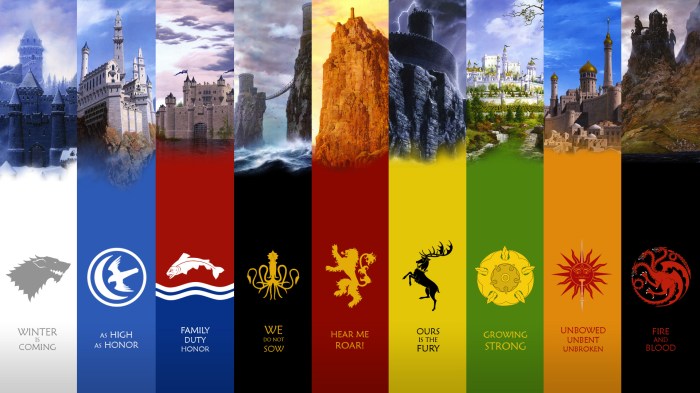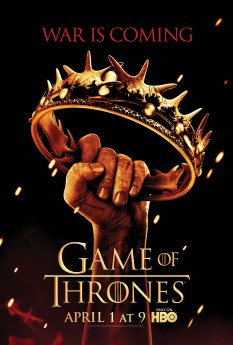
Game of Thrones – Season 3 Trailer!

GOT_Season3_teaserIt’s here at last, a GOT Season 3 trailer that isn’t just a despicable tease with no real footage to offer! But that’s to be expected, studios always love to treat their fans like a bunch of crack addicts. Get them hooked on a season, then tell them it’s going to be a year or more until the next one comes along. Feed them tiny crumbs along the way, and just before the next batch is ready, give them a taste!

Now that March has rolled around, we are just slightly less than a month away from the premiere. And from this trailer, some hints are given as to what’s in store for the characters of Robb, Daenerys, Tyrion, John Snow, Jaime, Cersei, and all those that fall somewhere in between this season. Naturally, fans of Martin would advise you not to get too attached! People have a way of dying off in his universe…

Enjoy!

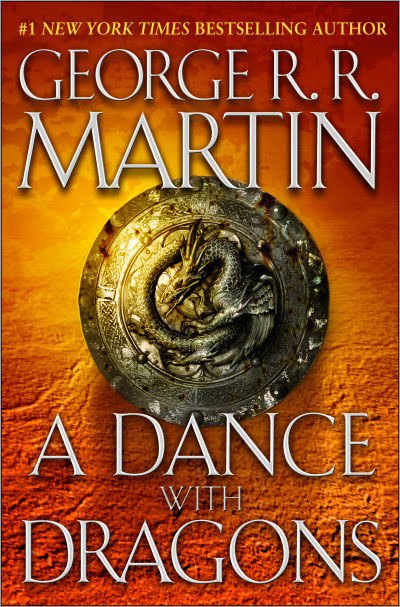
A Dance With Dragons: A Review

House-a-song-of-ice-and-fire-29965891-1920-1080Done at last! It seems like its taken me forever to finish this novel. And yet, now that it’s done, I find myself missing it already. After weeks on end of being immersed in Martin’s epic fantasy universe, it’s hard going without! What’s more, given how long – loooooong! – it took him to produce this last novel, who knows how long it could be before the next one comes out?

But I digress… I bought this book looking for some closure to the previous four, especially in the last one. With events in A Feast of Crows seeming to drag a bit, and the sudden twist and promise of resolution that came at the end, I was eager to see how things turned out. And, true to form, Martin managed to  provide some degree of resolution while still managing to drag things out further.

And of course, there were even more cliffhanger endings this time around. Damn you Martin, five books in and you still have me baited like a worm on a hook. You better produce the next book in a year’s time like you promised to do last time but didn’t or KAPOW! Oh, and there really better be only two more books. After all you’ve put us through, you owe us a final resolution, dammit!

Okay, that’s enough threats for now. Onto the story…

Plot Synopsis:
a-dance-with-dragons-coverAs promised in the epilogue for Crows, A Dance With Dragons completes the narrative that took place in the previous book, covering all the stories that didn’t make it in there and offering a balance to the other perspectives. This includes stories involving Tyrion, Daenerys, Davos, Brandon Stark and John Snow, while also offering more on the threads involving the Martells, Cersei and the Ironborn.

Initially, the story parallels events in the previous book, the first few chapters taking place before Crows ends. But by the end, things once again pick up and continue, bringing the entire story to an end where everything is poised for several more major developments. Essentially, it all comes down to four perspectives, with events taking place in the North and South of Westeros as well as the Free Cities and Slavers Bay in Essos.

The Wall:
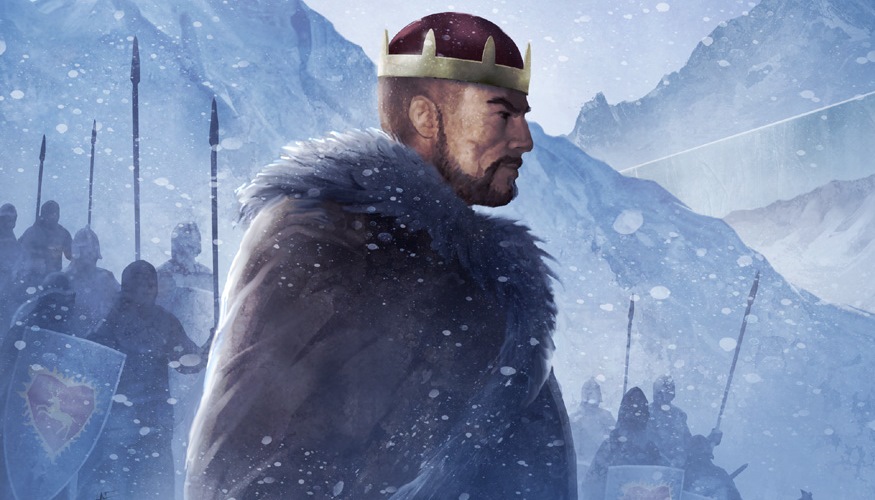
a-song-of-ice-and-fire-the-wallIn the north, where Jon Snow has taken up his role as the Lord Commander and is seeing to preparations for the Others and dealing with the aftermath of Mance Rayder’s assault. After saying goodbye to Samwell Tarly, Gilly, and Maester Aemon, who are being dispatched to Oldtown, he continues in his negotiations with Stannis Baratheon. After burning the captive Wildlings, which include Mance Rayder, who will not swear feality and embrace the Red God R’hllor, he prepares to march South.

As usual, Jon Snow tells him the Watch will not take part in his war. Stannis’ appeal to the Northmen is also complicated by the fact that the Lannisters have installed Roose Bolton as ruler of the North and the Freys are allied with them. However, the Karstarks are willing to fight alongside him and John tells him that he will find an army in the Northman hill clans who owe loyalty to no lord.

a-song-of-ice-and-fire-melisandreMarching south, Stannis leaves Melisandre and his queen, Sylese, in John’s care. Against the queen’s advice, and that of his Brothers, Jon arranges for a peace treaty with Wildlings, promising them food and safety south of the Wall in exchange for their service in manning it against the Others. Thousands of Wildlings are admitted, with the promise of many more thousands to come.

Melisandre also begins sharing her visions with Jon Snow. In addition to telling him that there is a murder plot against him, she also reveals that Mance Rayder is alive and the man burned was Rattleshirt, who’s identities were switched using sorcery. He dispatches Mance south to rescue Arya from Ramsay Bolton, unaware that the girl he is set to marry is actually Jeyne Poole. Eventually, her warnings come true as his brothers turn on him and stab him in the yard.

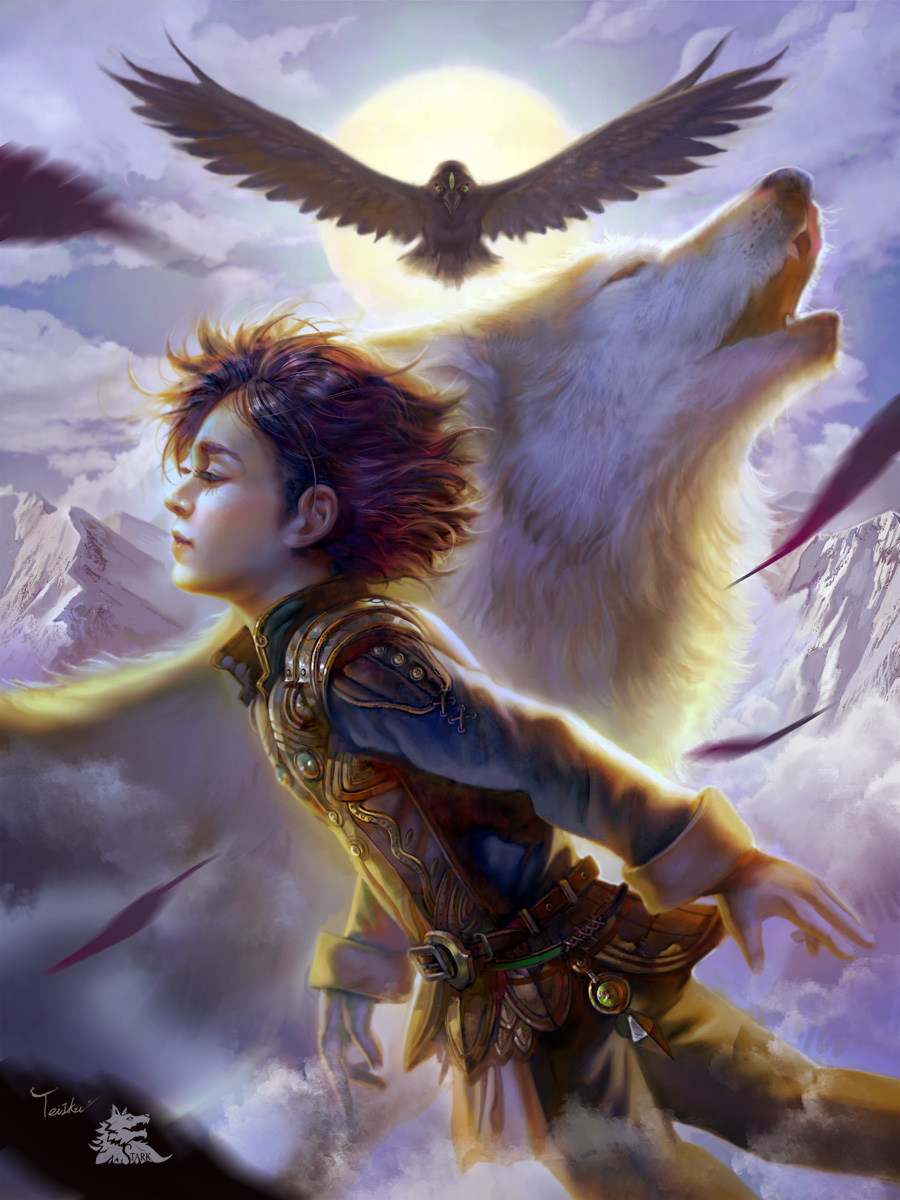
a-dance-with-dragons-bran-starkNorth of the Wall, Bran search for the Three-eyed Crow leads him, Hodor and the Reeds to a secret cave where the last surviving Children of the Forest dwell. As they take shelter in the cave, they meet the “Three-eyed Crow”, whom they call the “Last Greenseer”. He is a former human member of the Night’s Watch, who has been sitting on an underground weirwood throne for so long that its roots have fused into his body. He explains to Bran that he has been appearing to him as the Three-eyed Crow in his dreams so that he could lead him here, and train him in greensight.

Bran learns that there is truth to the belief that the sacred weirwoods are the eyes and ears of the Old Gods: the trees are capable of seeing and hearing all around them, and recording it in their memory for centuries. They also allow a greenseer at one weirwood to see and hear events going on at another in the present, and communicate through them. Using his increasing powers of greensight Bran sees memories of his father Ned Stark at Winterfell’s godswood in the past, and communicates with Theon Greyjoy at the godswood in the present.

Free Cities:
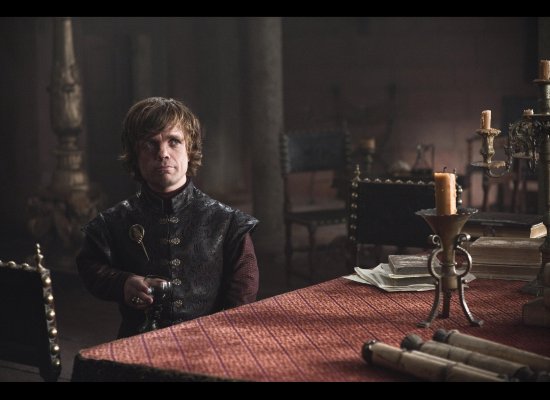
a-song-of-ice-and-fire-tyrionHaving fled King’s Landing with the help of Varys, Tyrion arrives in Pentos where is taken in by Magister Illyrio. Tyrion is then sent south, and learns along the way that Varys’ plot involves the son of the late Prince Rhaegar, Aegon Targaryen, who was thought to be dead. He was raised by John Connington, the former Hand of the King under King Aerys, who now commands the Golden Company – the largest and most skilled mercenary army in the Free Cities.

After traveling with Aegon halfway across Essos, Tyrion is kidnapped by Jorah Mormont in Volantis. After being banished by Daenerys, he hopes to deliver Tyrion to her in the hopes that she will take him back. However, Tyrion and Jorah are shipwrecked and sold by slavers to a Yunkish merchant, who then travels to Meereen to take part in the siege. After reaching the city, a plague begins ravaging the Yunkai’i army, and Tyrion and the others escape in the midst of the confusion. They then signs on with the Second Sons mercenary group and plan to switch their support to Daenerys.

a-song-of-ice-and-fire-arya-starkMeanwhile, in Braavos, the girl once known as Arya Stark continues in her training as one of the “Faceless Men”. This includes taking away her sight and forcing her to find her away about the House of Black and White using only her other senses. She is then tasked with killing her first target, a corrupt merchant, using poison. After succeeding, she is admitted to the guild to complete her training.

Slaver’s Bay:
Daenerys continues to rule Mereen as queen, but is beset by murders carried out by the Sons of the Harpy, a resistance group committed to restoring the old ways. In addition, she learns that Astapor was sieged by the Yunkai’i and the people she freed there massacred. Refugees come to the walls of her city seeking help, as a plague known as the “Pale Mare” or “Bloody Flux” is decimating their people. Temporary shelter is placed outside for them, but it is clear little can be done.

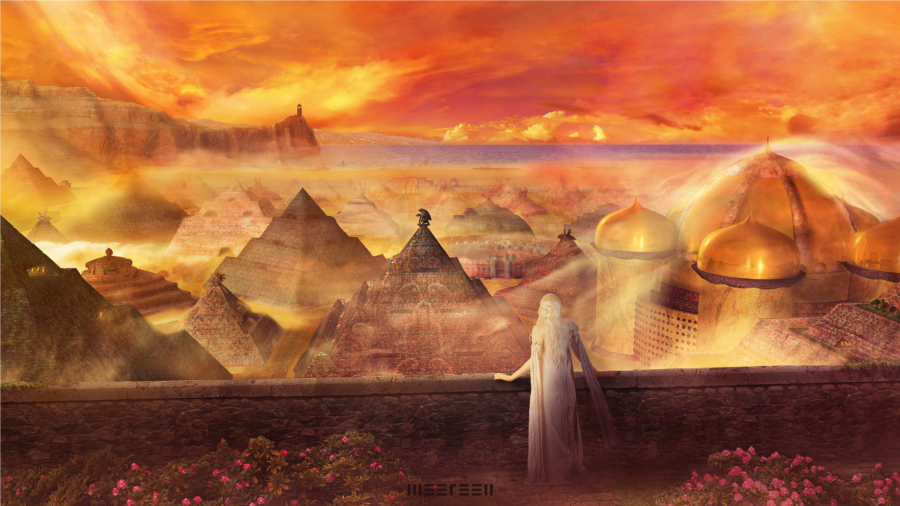
a-dance-with-dragons-Meereen_cityIn order to end the resistance and cement peace with the Yunkai’i, Daenerys agrees to marry Hizdahr zo Loraq, a Mereenese nobleman. Her mercenary captain, Daario Naharis, whom she has taken as a lover, is not pleased, but goes along with it out of loyalty to her. In addition, to prevent her dragons from killing people and livestock, she has them chained inside the pyramid, except for Drogon, who escapes capture and flies away.

Shortly thereafter, the Yunkai’i and Volantene armies arrives at her doorstep and a tentative peace is arranged, with hostages exchanged. Daenerys also agrees to open up the fighting pits, as a compromise with her new husband, and attends the first spectacle with him. During the fights, Tyrion and Penny joust, Strong Belwas is poisoned (but survives) and Drogon arrives and begins attacking the fighters and guards. After reaching him, Daenerys climbs on his back and is ferried away.

a-song-of-ice-and-fire-dany_drogonBarristan Selmy takes over with a provisional council and is made to believe Hizdahr attempted to poison Daenerys and is leading the Sons of the Harpy. He then arrests Hizdahr and begins planning with those loyal to Daenerys to attack the Yunkai’i camp before they can launch their own attack. However, these plans are stalled when Quentyn Martell, Prince of Dorne, and his Dornishmen try to steal one of her dragons and fails.

Having failed in his attempt to court Daenerys, he and his men hoped to return to Dorne with a dragon in tow. Instead, the dragons break free, Quentyn is killed, and his men are arrested and taken into custody. Meanwhile, Drogon flies Daenerys to the Dothraki Sea where Dany, starved and ill from being stranded in the wilderness, eventually encounters the khalasar of Khal Jhaqo, a former Bloodrider to Khal Drogo who betrayed her after Drogo’s death.

The North:
Having secured his army, Stannis and his forces march on Deepwood Motte and take it from the Ironborn, capturing Asha Greyjoy in the process. This swells Stannis’ ranks further as House Glover and House Mormont join Stannis’ army and decide to march with him on Winterfell. To cement his control over the north, Ramsay Bolton orders his bastard son and their supports to march to Winterfell to hold the mock wedding with Arya (Jeyne Poole), and Stannis plans to attack him there. However, Stannis’ host becomes bogged down in the terrible snows that begin falling, forcing them to stop and slowly starve.

a-song-of-ice-and-fire-stannisDavos Seaworth is taken prisoner in White Harbor after going ashore and trying to enlist House Manderly’s support. However, Lord Manderly secretly frees Davos and tells him that he is only feigning allegiance to the Boltons since the Lannisters are holding his son Wylis as captive. He is also planning revenge against the Freys since they murdered Ser Wendel Manderly at the Red Wedding. He enlists Davos help to find Rickon, who is apparently at Skagos with Osha, so the northmen will rally around a living Stark heir and rebel against the Boltons.

Meanwhile, Theon Greyjoy is revealed not to be dead, but is languishing in the Dreadfort prison and brutally tortured by Ramsay Bolton. He is freed to serve him as “Reek”, and travels with him to Winterfell where he waits upon Jeyne Poole. With the wedding complete and the snows hemming them in, Roose Bolton and his bannermen wait for Stannis to attack and slowly begin to turn on each other.

a-song-of-ice-and-fire-ashaEventually, and with the help of some serving maids, Theon arranges to free her and escapes the city just as the Manderlys and Freys begin open fighting. They travel together into the wilderness, where they are intercepted by Mance Rayder, and ride to Stannis’ camp. Theon is then reunited with his sister Asha.

The South:
Cersei Lannister, imprisoned by the Faith of the Seven, confesses to several of the less grave charges against her to alleviate her suffering. These include adultery and sleeping with her cousin Lancel Lannister, but stops short of admitting that she murdered King Robert, or that her children are actually the product of incest. The Faith is willing to release her, but she must still stand trial and make the penance walk naked back to the Red Keep.

a-song-of-ice-and-fire-great-septHumiliated, Cersei places her hope in a trial by combat, hoping that a new knight named Ser Robert Strong will champion her. Some mystery surrounds Ser Robert, as he is as huge as Gregor Clegane, and is never seen sleeping, eating, or using the privy. Ser Kevan, who now serves as the Hand, suspects that it is Ser Gregor and that some kind of sorcery has been used by ex-maester Qyburn to resurrect him.

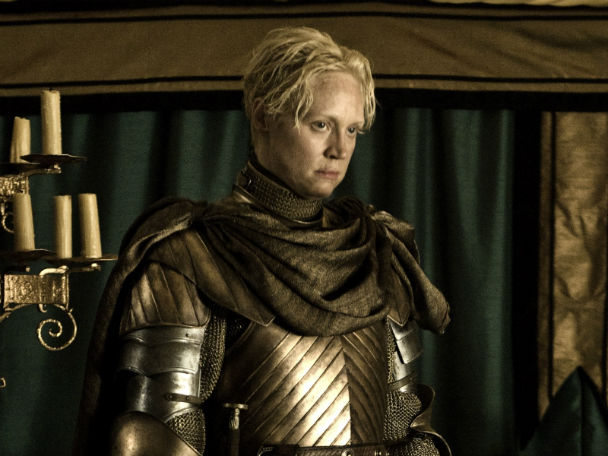
In the Riverlands, Jaime Lannister arrives with his army at the siege of Raventree Hall where he manages to negotiate the surrender quite painlessly. The last stronghold of Robb Stark’s kindgom in the Riverlands bends the knee, and Jaime relocates his camp when he gets word that Brienne of Tarth was seen in a nearby village. After arriving, Brienne of Tarth comes to his camp tent and tells him that she has found Sansa Stark and she is in danger from Sandor Clegane.

a-song-of-ice-and-fire_storms-endIn the Stormlands, Aegon Targaryen and Jon Connington arrive with the Golden Company in order to recover the Iron Throne. Taking Tyrion’s advice that their arrival would be met with jubilation, Connington prepares to march forward and take Storms End, believing that Dorne will raise their banners and march to their aid. When word reaches King’s Landing, Ser Kevan advises marching, but Lord Tyrells wants to hold off until after Maergerys trial.

In his solar, Varys sneaks in and murders Kevan Lannister and Grand Maester Pycelle with a crossbow. Before Kevin dies, Varys reveals to him that he supports Aegon, and that he is trying to prevent him from fixing the damage Cersei had caused in her attempts to build Tommen’s power base. Varys declares that with Tommen back in Cersei’s control, the kingdoms of Westeros will spend their strength fighting each other while Aegon prepares to conquer the Seven Kingdoms.

Summary:
And there we have it. After five books, the story stands poised, once again, on the edge of knife. After first learning in Crows that all roads were leading to the East, that virtually every faction was placing their hopes in Daenerys and conspiring to bring her home, it also became clear that there was another Targaryen heir that had plans of his own to restore the Dragonborn to the Iron Throne.

What’s more, many threads are proceeding towards culmination. Though Cersei seems to have freed herself from captivity in the Great Sept, her plans to get back in charge seem all but thwarted. At this point, its obvious that the Tyrells are in control, that Tommen’s power is temporary, and with Varys’ assassination of Ser Kevan, that the way is paved for Connington and Aegon Targaryen to assume the throne.

But of course, there were plenty of uncomfortable cliffhangers too! For one, Jon Snow’s betrayal by his brothers puts him in a bit of a bind. I am wondering how he will come out of all this, whether he will be saved by Val, Melisandre, some of his brothers, or some of his Wildling allies. On the other hand, its entirely possible that Martin is finished with him and plans to kill him off, a la Ned, Robb, or the many other main characters he’s killed so far.

Then there’s Daenerys’ thread, where she has gone from being the frying pan into the flame, having been whisked away from the siege of Meereen to captivity with Khal Jhaqo. Once more, I am hoping this doesn’t drag out because lord knows Martin has a real knack for putting his characters through endless trials and diversions before they finally get to where they are going. Or he kills them! In any case, the war of Five Kings will not officially be over until she resolves all her problems in Slaver’s Bay and makes it back to Westeros.

And again, after many books and all the hints he’s dropped about “skin-changing” and “Greenseers”, Bran finally seems to have found his way home and realized his true purpose. And personally, I found this to be quite interesting, in that it delved deeper into the mysteries surrounding the Children of the Forest and the history of Westeros before the First Men came. It will be interesting to see how this is woven into the larger story, which I assume will have to do with the legend of Azor Ahai reborn (in Daenerys) being fulfilled.

Overall, I really enjoyed the way this installment in the series took us deeper into the culture of the Free Cities, especially Volantis with its Tetrarchs, elephants, cuisine and drink, and its abundant use of tattoos. I also enjoyed the chapters that moved between Meereen, the Yunkishmen, and the culture portrayed throughout. And of course, the way the plot against the Lannisters is coming along was very pleasing to see. I hate that house and any kind of misfortune which could result in their destruction appeals to me! Now if he can just see his way to restoring House Stark, or just letting some of them know that the others still live, I would be even happier!

Only two books to go, presumably! No telling when the next installment, The Winds of Winter, will be released. But if I could be so bold, might I implore Mr. Martin to please get it done! After waiting five years for book five, we fans are kind of hungry for a finale. What’s more, HBO is going to needs those book if they are going to keep turning out new seasons! You don’t want to get on their bad side, sir. They’re ruthless!

Speaking of which, only thirty-nine more days to go til season three kicks off! Woohoo!

How The Hobbit Should Have Ended

It’s been awhile since I checked HISHE, and it seems they tackled a few gems while I was out doing other things. The latest in their lineup is this, a parody on Peter Jackson’s latest adaptation from the Tolkien universe. While I have yet to see the movie, I read the book and am familiar with just about everything the movie did by reputation alone. And I think these guys stuck it pretty good, as usual!

In fact, I would recommend checking out the site when you’re done watching this video and seeing what they did for Lord of The Rings as well. Not only do they tie together, but are a pretty example of how a more sensible ending can cut down on some serious screen time!

Here in the link to the site. Enjoy the video!

Upcoming Movie: Knights of Badassdom!

Larping_hobbiesI’m not sure why, but I’ve been inundated with movie previews lately, ones which I feel I must pass on to others. And this is just the latest and most awesome! Seriously, it was like this thing was created with me and my fellow nerds in mind! Some might think it an overly-appropriate commentary, others might sense some irony, but I look at it and just see fandom, nerdom, geekdom goodness!

As would be expected, this low-budget indie film was written and directed by relative newcomers, but happens to star some real heavyweights of the sci-fi, fantasy and horror genres. They include Peter Dinklage (Tyrion Lannister from HBO’s A Game of Thrones), Summer Glau (River Tam on Firefly and Serenity) and Ryan Kwanten (Jason Stackhouse from True Blood).

And of course, the plot is something that will appeal to the nerd in all of us. It begins when a group of friends travel into the woods to do some LARPing (Live Action Role Playing for those not nerdy enough to know). After the wizard of the group accidentally casts a real magic spell, the group must contend with a real-life succubus and an army of dark forces that are suddenly summoned to Earth. In short, a group of people who specialize in make-believe are called upon to become real life heroes and save the world from the forces of hell.

See? I told you it was an awesome concept! Between some genuine talent, a hilarious premise, and a metaphor that couldn’t be more frank, this movie has a lot of promise. The film previewed during ComicCon 2011, but is yet to be released to theaters. And did I mention it stars Peter Dinklage and Summer Glau? Their presence alone in this flick alone are worth the price of admission! Check out the trailer below…

Timeline of Game of Thrones

Game-of-Thrones-WallpaperNot too long ago, I realized just how immersed I was in the universe of A Song of Ice and Fire. It’s a funny experience, getting into a series, realizing you’ve finally got some understanding of the universe contained within, and you find that you really like it! As I’m sure I’ve mentioned before, I really haven’t experienced this since reading Lord of the Rings or possibly Dune.

And in the course of my latest bit of research into the ASOIAF universe, I came across a helpful timeline. This, much like the geography of J R.R. Martin’s world, was something I had been pondering by the time I got to the fifth book. As anyone’s who read the series knows, there’s plenty of references to historical events which can be a bit confusing, at least if you’re the kind of person who likes to know how everything fits together.

And much like Tolkien, Martin’s timeline is very inspired, dense, detailed, and draws on a great deal of real history. And knowing it is quite helpful in establishing the deep background of the series and understanding the interplay of characters and events. So here is what I found, condensed and abridged for your reading pleasure! Enjoy!

The Dawn Age:
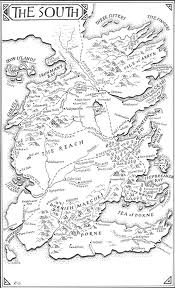
south_GOT
This is the prehistoric age of A Song of Ice and Fire, where the important factions know as the “Children of the Forest” and the “First Men” are introduced. The former are a race of magical creatures who feature quite prominently in the later volumes of the story, where Greenseers and prescient dreams start to come up more and more. They inhabited Westeros in the prehistoric period along with giants and other magical creatures that only live in the North anymore. The Children of the Forest are also credited with forging the religion of the “Old Gods” which the Northmen still worship in the story.

ca. 12,000: The First Men invade Westeros across a land-bridge from the east, using bronze weapons to conquer and colonize Westeros. The Children of the Forest fight back and cast a spell to break the land-bridge, giving rise to the island formation known as the Stepstones (Echoes of the Bering Land Bridge here!) However, the First Men rely on ships and complete their conquest after generations.

ca. 10,000: The First Men and Children sign the pact of Isle of Faces, agreeing to coexistence after generations of warfare. This pact gives the First Men dominion over the open lands and lets the Children keep control over the forested areas. In time, the First Men adopt the worship of the Old Gods of the Forest.

Children_of_the_Forest_greenseers
The Age of Heroes
Much like the age of same name in Greek mythology, this age is so named because it encompasses a number of great figures who accomplished noteworthy deeds. These include the founding of many of the Great Houses, who trace their lineage in the story to this period. The include Brandon the Builder, founder of House Stark; Lann the Clever who formed House Lannister; and Garth Greenhand who founded House Gardener of the Reach. Also, this was the time of the Storm Kings who arise in the Stormlands, and the Grey King of the Iron Islands.

ca. 10,000-8,000: The peace between the Children of the Forest and the First Men endures for thousands of years. The houses of Stark, Lannister, Gardener and the Storm Kings are established in the North, Casterly Rock, the Reach and the Stormlands respectively.

Azor-Ahai-a-song-of-ice-and-fire-3437825-905-521ca. 8,000-6,000: Period known as the Long Night in Westeros, a time of the coldest, darkest winter where a single night seems to last a generation. Ice spreads from the North, leading to the advance of the Others. It comes to an end following the Battle of the Dawn, where the First Men united under Azor Ahai (referenced in the text by Melissandre and the Red Priests) to repel the Others back to the north dragonglass weapons. Ahai also wields of a sword of fire known as Lightbringer.

After the defeat of the Others, Bran the Builder leads the raising of the Wall, a massive fortification of ice and ancient magic to shelter realms of Men. The Night’s Watch is formed to man and guard it against Others, Wights and Wildlings who live to the north. Bran then goes on to build Winterfell and becomes first King In The North. Not long after, a Black Brother betrays his oath and tries to install himself as king. The Starks of Winterfell and King Beyond the Wall Joramun join forces to destroy him. Joramun uses the Horn of Winter to summon giants from the earth to help him fight (the horn is buried, not to be found again until Mance Rayder uncovers it in A Storm of Swords)

The Andal Invasion:
The second of three major invasions of Westeros happens in this time period, leading to the Faith of the Seven and the tradition of chivalry being adopted. The divide between North and South is also rooted thanks to the failure of the Andals to conquer north of Moat Cailin.The Children of the Forest also begin their slow withdraw further from the lands of men in this period, retreating deeper into their forests and North of the Wall.

Andal_Invasionca.6,000-5,000: In the Hills of Andalos on the eastern continent of Essos, a new religion called the Faith of the Seven emerges. Supposedly, the supreme deity of the Andals appears to them and instructs them to cross the Narrow Sea and invade Westeros. They come under the banner of the Faith of the Seven, with seven-pointed stars carved into their chests, wielding weapons of steel.

The war endures for centuries and leads to the fall of the six southron kingdoms fall and the destruction of their weirwoods. The kingdoms of the North remain under First Men rule, thanks to the strategically placed fortification of Moat Cailin which resists multiple attacks, thereafter serving as the door between North and South.

Age of Valyria:
GOT_DanyThis period is characterized by the rise of the Valyrians as the dominant power in Essos and the many wars of expansion in Essos. These wars lead to the fall of the Ghiscari Empire, the Rhoynish cities, and the conquest of the Free Cities and the cities of Slaver’s Bay. Other Noble Houses are created during this time, most notably, House Martell of Dorne. It ends with the third and final invasion of Westeros, this time by House Targaryan, and the establishment of the Iron Throne.

ca. 5,000 – 700: On the eastern continent, the sheep-herding folk of the Valyrian peninsula find dragons lairing in the volcanoes that extend across the neck of the peninsula. The Valyrians tame the dragons with magic and gain influence over the area. The Valyrian Freehold is established and Valyrian steel, a magical metal renowned for its sharpness, light-weight and flaming properties, is forged. The Freehold goes to war with the Ghiscari Empire, the greatest power on the eastern peninsula. Valyria wins with the help of its dragons, destroys Old Ghis, and exerts influence over the cities of Slaver’s Bay.

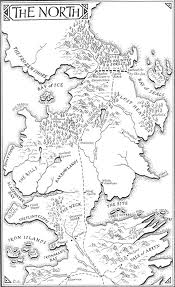
north_GOTca. 3000: The Wildlings Invasion takes place as the northern men unite under the brother Kings-beyond-the-Wall Gendel and Gorne, manage to evade the Night’s Watch and bypass the Wall in great numbers using a network of tunnels that extend under the Wall. However, they are met by the Stark King on the other side and are eventually thrown back.

ca. 700: In the North, House Stark finally subdues House Bolton, their primary antagonists for dominance in the North. Karlon Stark defeats sea raiders from the east and founds the cadet branch of House Karstark. In the West, the Ironborn of the Iron Islands rise to power. At their peak, they control most of the western coast from Oldtown and the Arbor in the south to Bear Island in the North.

ca. 700-500: Valyria’s expansion beyond Old Ghis brings it into conflict with the great cities along the Rhoyne and manages to subdue them, again because of their dragons. Nymeria, a Rhoynish queen, evacuates the survivors and takes them to Dorne where she forms an alliance with Lord Mars Martell and form the ruling house of Dorne.

House-Targaryen-game-of-thrones-20596041-1600-1200ca. 500-200: Valyria expands once again and conquers much of the southern Free Cities. A religous sect known as the Moonsingers leads refugees to a remote lagoon concealed by mountains and mist to found the secret city of Braavos. They build the Titan of Braavos to serve as a defensive fortification. The Valyrian Freehold, under the Targaryens, annex a small island at the mouth of Blackwater Bay, and build a castle whose tower is shaped to look like Dragons, giving its name: Dragonstone.

ca. 350: The Storm Kings expand their control of the Westerlands north to include the territory of the Riverlands up to the Neck. Over time the Ironborn lose many of their possessions but, some three generations before Aegon’s Landing, conquer the territory of the Riverlands from the Stormlands. The Ironborn king, Harren Hoare builds Harrenhal.

a-song-of-ice-and-fire-harrenhalca. 100: The Doom of Valryria begins. The volcanoes known as the Fourteen Fires erupt and shatter the Valyrian Peninsula and laying waste to the city of Valyria. The dragons of Valyria are virtually wiped out and the Valyrian Freehold crumbled apart, its various cities becoming independent city states. Braavos reveals itself to the other Free Cities and eventually becomes the most powerful due to its vast fleet and economic power.

The cities of Slaver’s Bay become independent again and Ghiscari power begins building again in the south. The warrior-nomads of the vast eastern plains arise thanks to the fall of Valyria and their dominant tribe, the Dothraki, begins raiding the surrounding lands. The Targaryens remain safe on Dragonstone, the guardians of possibly the last three dragons in the western world.

Targaryen Dynasty and Roberts Rebellion:
Events of this period direclty precede events in A Song of Ice and Fire. These include the Targaryan conquest of the Seven Kindgoms by Aeon the Conqueror and his three dragons, the death of the last of the worlds dragons, the unification of the Seven Kingdoms under the Iron Throne, and the fall of the Targaryen dynasty during Robert’s Rebellion.

The_iron_throne

 ca. 1 AL*: Aegon the Conqueror invades Westeros, conquers and unites six of the seven kingdoms of Westeros under his banner and constructs a new capital city at King’s Landing. He is unable to conquer Dorne and allows it to remain sovereign. Control of Highgarden passes to House Tyrell, House Tully of Riverrun takes control of the Riverlands and House Greyjoy become the rulers of the Iron Islands. Later Targaryans add Dorne and the Seven Kingdoms are united under the Iron Throne.

282-283 AL: Rhaegar Targaryen abducts Lyanna Stark. Lyanna’s brother and father (Ned Starks uncle and father) demand that Aerys discipline his son, but instead the Mad King kills them both. Aerys demands the heads of Robert Baratheon and Eddard Stark from their ward, Jon Arryn. Instead, Houses Arryn, Stark, and Baratheon raise the standard of rebellion. Robert’s Rebellion, also called the War of the Usurper, begins.

The Hand of the King, Jon Connington, is defeated in the Battle of the Bells and is sent into exile in the Free Cities. The rebel army defeats the royalists at the Battle of the Trident where Prince Rhaegar is killed. The Lannisters apparently march to the aid of King Aerys, but instead turn against him and sack the city. King Aerys is killed by Jaime Lannister.

A-Song-of-Ice-and-Fire-RobertPrincess Elia Martell and her children, Aegon and Rhaenys Targaryen, are brutally murdered by Lannister bannermen, causing a rift between Eddard Stark and Robert Baratheon. Robert becomes King of the Seven Kingdoms and marries Cersei Lannister. Ned returns home to Winterfell with his bastard son, Jon Snow. Loyal Targaryen retainers carry Aerys’ two youngest children, Prince Viserys and Princess Daenerys, to safety in the Free Cities.

*After Landing: The year that follows after Aegon lands in Westeros, establishing the “common era” of the Iron Throne.

Yes, its long, detailed and dense, and that’s just the stuff I chose to include. But you gotta admit, it does fill in the blanks and answer a whole lot of nagging questions! And of course, there are all those allegories I mentioned earlier. First there’s the invasion of the First Men across the land bridge calling to mind the migration of human beings across the Bering Land Bridge, giving rise to the First Nations and the establishment of American civilizations.

You also have the successive invasions of Westeros calling to mind the invasion of Britain by the Angles, Saxons, Jutes, and Normans. The Children of the Forest also call to mind the systematic destruction of native populations the world over, and the division between the Old Gods and New is very similar to the conquest of Roman pantheism over the “pagan” religions of the Old World.

And of course, the Red Priests and their dualistic vision of a world divided between the forces of Light and Darkness is not at all dissimilar to Judea-Christian theology, or more likely Zoroastrianism. The fact that the faith comes from the East and is so focused on a war between good and evil that is expected to achieve culmination soon is more in keeping with the Zoroastrian tradition, though the monotheistic aspects of it, forced conversions and burning of “idols” do call to mind Christianity’s conquest of European and the New World.

And on top of that, there’s a very rich history taking place in the East, where Valyria resembles ancient Rome, who’s power base (in this case Dragons) allows them to conquer the Free Cities (similar to the Greek city-states), the Empire of Old Ghis (Persia and other Empires of the East), and whose fall creates a power vacuum that leads to the rise of “Barbarian Hordes” – aka. the Dothraki.

I tell ya, the historical metaphors are thick. THICK!

Source: awoiaf.westeros.org

The World of “A Song of Ice and Fire”

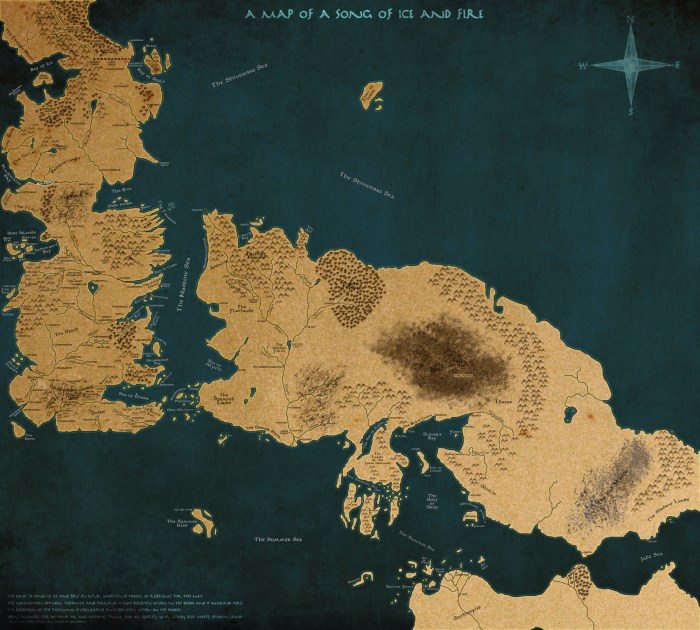
a_song_of_ice_and_fire_version_2_by_scrollsofaryavart-d4rabm1After reading four of the five of the books in the ongoing Song of Ice and Fire series, I’ve come to realize something. I really like the world George RR Martin has created! In fact, you might say I haven’t found myself becoming so engrossed with a fictional universe since Dune or Lord of the Rings. In those fictional universes, as with this one, one gets an incredible sense of depth, detail and characterization.

And in honor of this realization, or perhaps because I couldn’t keep track of the names, places and events alluded to in the texts, I began doing some serious research. For one, I found several lovely maps (like the one above) that speculate as to the complete geography of Martin’s world – the continents of Westeros, Essos, and Sothoryos.

And when I say complete geography, I mean just that, not the snippets that are given in the book that leave out the all important sections of Qarth, Slaver’s Bay, and the Free Cities. While these places are described in relation to the rest of the world, keeping track of them can be tricky, especially if you’re a visual learner like myself! And seeing as how much of the story involves a great deal of travel, it helps to know where characters were going, how far, and which direction they were headed.

House-a-song-of-ice-and-fire-29965891-1920-1080Even before I began reading the books, I could tell that Westeros was very much inspired by the British Isles, with its tough and grizzled Northerners resembling the Scots, Picts, and Celts of old while the Southerners were more akin to the aristocratic Normans. “The Wall” was also a clear allegory for Hadrian’s Wall, with the people on the other side being portrayed much as the Roman’s would have viewed the “Northern Tribes” that threatened their domain.

King’s Landing also seemed very much inspired by London, with its pomp, opulence, and extensive moral decay. Yes, just like London of the Middle Ages, it was a fine patchwork of royal finery, castles, fortifications, religious ceremony, brothels and public executions! And it even lies upon a large river, the Blackwater, which seems every bit like the Thames.

Essos also seemed very much inspired by Asia of ancient lore. Here we had the Dothraki Sea where the Dothraki horsemen roamed free and pillaged in all directions, exacting tribute and taking slaves. Can you say Mongols and/or Huns? In addition, their capital – Vaes Dothrak – seemed in every respect to be an adaptation of Karakorum, Ghengis Khan’s one time capitol that was little more than a collection of temporary houses and tents. And Master Ilyrio, as if his name wasn’t enough, seemed to be every bit a Mediterranean at heart, living in a lavish sea-side estate and growing fat of off trade in cheese, olives and wine.

Upon cracking the books, I found that the metaphors only went deeper. In fact, they were so thick, you could cut them with a knife! In terms of Westerosi geography and character, the different regions of the continent called to mind all kind’s of archetypes and real-world examples. The Reach sounds very much like Cornwall, fertile, populous, and in the south-east relative to the capitol. Casterly Rock and the domain of the Lannister’s, though it resides in the west away from the capitol, seems every bit like Kent, the wealthiest region of old where the most lucrative trade and shipping comes in. And their colors, gold and red, are nothing if not symbolic of the House of Lancaster – of which Henry V and the VIII were descended.

And last, but certainly not least, there were the all-important cities of Qarth, Mereen, Astapor, and Yunkai. All eastern cities that inspire images of ancient Babylon, Cairo, Istanbul, Jerusalem and Antioch. With their stepped pyramids, ancient history, flamboyant sense of fashion, and lucrative slave trade, they all sounded like perfect examples of the ancient and “decadent” eastern civilizations that were described by Plato, Aristotle, and medieval scholars. The conquest of Westeros by the First Men, the Children of the Forest, the Andal and Valyrian Conquest; these too call to mind real history and how waves of conquerors and settlers from the east came to populate the Old World and the New, with genocide and assimilation following in their wake and giving rise to the world that we know today.

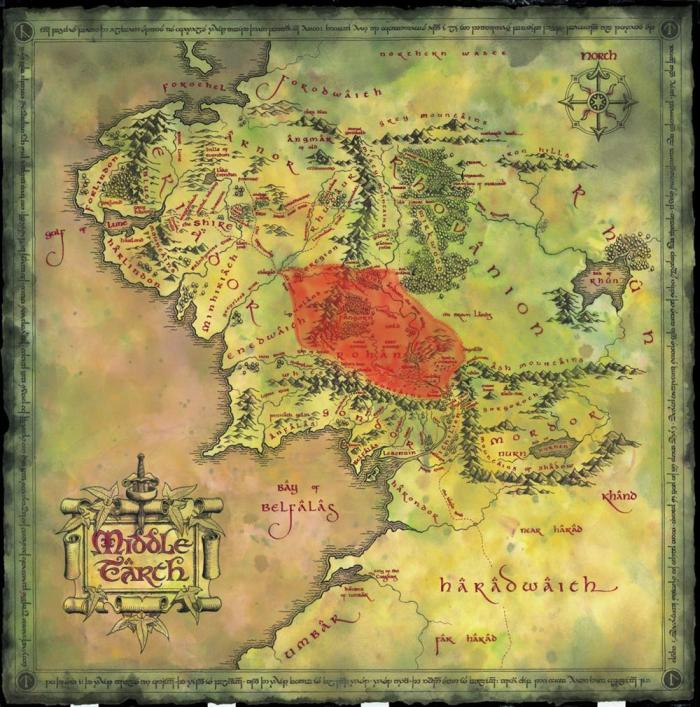
Middle-earthFans of Tolkien will no doubt be reminded of the map of Middle Earth, and for good reason. Martin’s knack for writing about space and place and how it plays a central role in the character of its inhabitants was comparable to that of Tolkien’s. And what’s more, the places have a very strong allegorical relationship to real places in real history.

In Tokien’s world, the Shire of the Hobbits seemed very much the metaphor for pre-industrial rural England. The inhabitants are these small, quirky people who are proud of their ways, lavish in their customs, and don’t care much for the affairs of the outside world. However, when challenged, they are capable of great things and can move heaven and earth.

In that respect, Gondor to the south could be seen as London in the early 20th century – the seat of a once proud empire that is now in decline. Given it’s aesthetics and location relative to the dark, hostile forces coming from the East and South, it’s also comparable to Athens and Rome of Antiquity.

And it was no mistake that the battle to decide the fate of Middle Earth happened here. In many ways it resembles the Barbarian Invasions of the late Roman Empire, the Persian Wars of Classical Greece, the Mongol Invasions or the Byzatine Empire’s war with the Turks in the High Middle Ages. In all cases, classical powers and the home of Western civilization are being threatened from Eastern Empires that are strange and exotic to them.

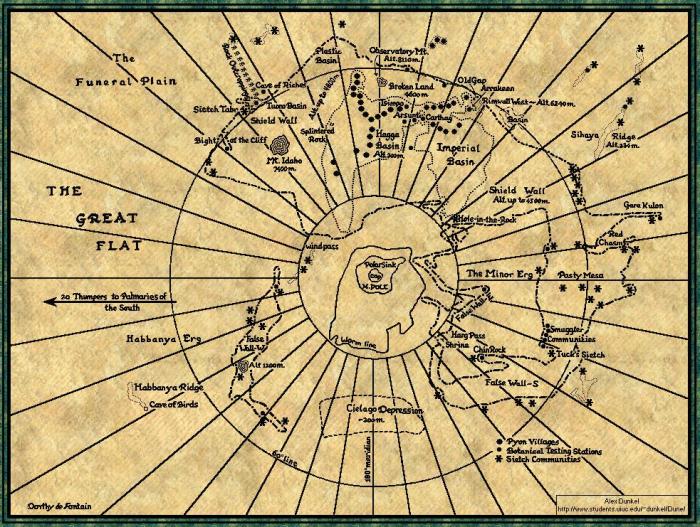
Dune_MapAnd let’s not forget Arrakis (aka. Dune) by Frank Herbert. Here too, we have a case where space and place are determining factors on their residents. And whereas several planets are described and even mapped out in the series, none were as detailed or as central as Arrakis itself. From its Deep Desert to its Shield Walls, from Arrakeen and Seitch Tabr; the planet was a highly detailed place, and the divide between Imperials and Fremen were played out in the ways both sides lived.

Whereas the Fremen were hardy folk who lived in the deep desert, took nothing for granted, and were a harsh folk sustained by prophecies and long-term goals, the Imperials were lavish people, pompous and arrogant, and used to doing things in accordance with the Great Convention. But far from being preachy or one-sided, Herbert showed the balance in this equation when it became clear that whereas the Imperials were governed by convention and thereby complacent, the Fremen were extremely dangerous and capable of terrible brutality when unleashed.

But as I said, other planets are also detailed and the influence their environments have on their people are made clear. Caladan was the ancestral home of the Atreides, covered in oceans, fertile continents, and a mild climate that many consider to be a paradise. As a result, according to Paul,  the Atreides grew soft, and it was for this reason that they fell prey to the Emperor’s betrayal and the machinations of their Harkonnen enemies.

And speaking of the Harkonnens, the world of Geidi Prime is described on a few occasions in the series as being an industrial wasteland, a world plundered for its resources and its people reduced to a status of punitive serfdom. What better metaphor is there for a people guided by sick pleasures, exploitation, and exceptional greed? Whereas the Atreides grew soft from their pleasures, the Harkonnens grew fat, and were therefore easily slaughtered by Paul and his Fremen once their rebellion was underway.

And of course, there is Selusa Secundus, a radioactive wasteland where the Emperor’s elite Sardukar armies are trained. On this prison planet, life is hard, bleak, and those who survive do so by being ruthless, cunning and without remorse. As a result, they are perfect recruits for the Emperor’s dreaded army, which keeps the peace through shear force of terror.

*                       *                        *

There’s something to be said for imaginative people creating dense, richly detailed worlds isn’t there? Not only can it be engrossing and entertaining; but sooner or later, you find yourself looking back at all that you’ve surveyed, you do a little added research to get a greater sense of all that’s there, and you realize just how freaking expansive the world really is. And of course, you begin to see the inspiration at the heart of it all.

Yes, this is the definitely the third time I’ve experienced this feeling in relation to a series. I count myself as lucky, and really hope to do the same someday. I thought I had with the whole Legacies concept, but I’m still tinkering with that one and I consider my research into what makes for a great sci-fi universe to be incomplete. Soon enough though, I shall make my greatest and final attempt, and there will be no prisoners on that day! A universe shall be borne of my pen, or not… Either way, I plan to blab endlessly about it 😉

GOT Theme On Eight Floppy Drives

Just came across this recently. I know, it’s kind of old news at this point, but any fan of Game Of Thrones, or anyone who remembers using a computer with a floppy drive, cannot afford to miss out on this!

Lord of the Rings: The Fellowship of the Ring

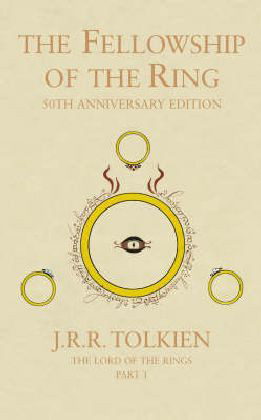
Hello all and happy July 29th! Or, as its known to many fantasy and sci-fi geeks, the day that The Fellowship of the Ring the first volume in the LOTR trilogy was published in 1954. Yes, I learned that just this morning, and thought it was the perfect excuse to finally do the review I’ve been putting off until now. I can only apologize for my negligence in this regard, but let’s face it, this book is kind of a big deal. With this trilogy, Tolkien effectively did for fantasy what Herbert would later do for sci-fi with Dune; that is to say, make people take it seriously.

And even if you’re not a fan of fantasy, you have to acknowledge the incredible debt owed to Tolkien. Not only did he provide a legitimate injection of mythos to the fantasy genre, establish a very real connection between ancient and modern, and provide archetypes which are still used to this very day. On top of all that, Tolkien gave the British people a sense of cultural lore that was all their own, which was precisely what he wanted.

In fact, Tolkien went so far as to say that his motivation in writing “faerie story” was to create a narrative which he felt had been previously missing in British culture. When one looks at ancient mythology, be it Norse, Greek, Roman, Native American or Indo-Aryan, one sees stories and legends that are tied to a culture and contain incredible power for its people. And while the British have their share, Arthurian myth for example, Tolkien felt that this smacked of a Judea-Christian prejudice and did not genuinely reflect the British temperament.

But of course, many literary critics went a step further and claimed that his books contained allegorical similarities to the conflict which had just passed in Europe. Though he began work on his voluminous masterpiece before the war began, much of it was completed during the war years and seemed to possess veiled references to the conflict. Think about it, the nations of Middle Earth (which included the “Men of the West”) were faced with a resurgent evil that came from the East.

The last time they faced it they had been successful, but the unsatisfactory conclusion of that conflict paved the way for a future war. Now, with the evil returning, the nations of Middle Earth found themselves in a weakened posture, but managed to succeed by comign together once more to thwart the evil, this time destroying it permanently. Hell, even the races of Middle Earth themselves could be said to be allegories for real nations – the Elves, Dwarfs and Men constituting the British, French and Americans respectively, while Hobbits were unmistakable representations of the British folk, the hardy little people who made all the difference.

But that is mostly speculation. In the end, Lord of the Rings is so richly detailed and deep that people have been able to discern countless metaphors, allegories and significant passages. In the end, it’s genius lies in the fact that it was both hugely inspired yet immensely original. So without further ado, let’s get down to dissecting the bad boy that started this whole phenomena!

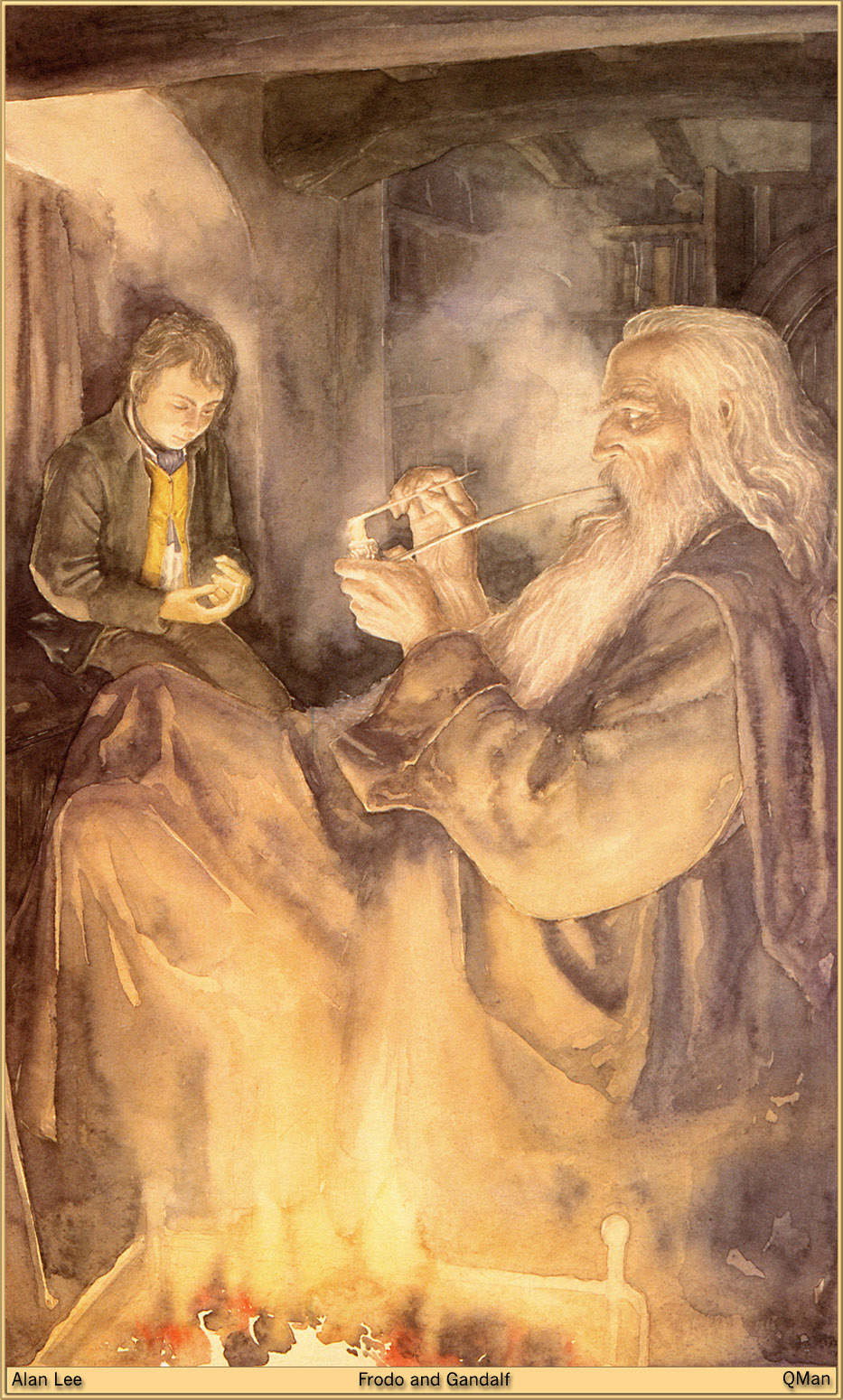
Sidenote: the focus of this review will be the novel itself. Any notes on the movie adaptation come at the end, so don’t expect a running commentary on how the book differed from the movie. All artwork provided is that of Alan Lee, the illustrious illustrator of Tolkien’s work.

The Fellowship of the Ring:
The book opens with a note on Hobbits and a preamble indicating what took place in the previous book, The Hobbit. It also provides some deep background which includes notes on the people of the Shire, their customs, and how Bilbo Baggins came into possession of the One Ring. The story then opens with book I, the first in the six book volume that makes up the single tale of The Lord of the Rings.

Book I: The Ring Sets Out:
In the first chapter, the story returns us to the Shire where Bilbo is waiting up his 111th (or eleventy-first) birthday, while his adopted heir Frodo is coming of age at 33. Bilbo is sparing no expense for the occasion and has even invited Gandalf to attend, as he has some rather important news for him.

This, Gandalf soon learns, is that he intends to take a permanent holiday. He plans to leave everything to Frodo, but doesn’t seem to want to surrender his one prized possession: The One Ring. After a tense confrontation with Gandalf, who convinces to leave the Ring behind, Bilbo departs on his journey and the two promise to meet up again. When Frodo arrives at Bilbo’s house, he is ransacked by relatives who are looking for their share of Bilbo’s wealth.

After they all depart, Frodo is spoken to by Gandalf, during which time he tells him he plans to depart on his own business. He warns Frodo to keep a close watch on the Ring, as he fears the worst of it. Over the course of the next 17 years, he pops in to visit Frodo, and eventually comes to tell him the truth. The Ring, he claims, the One Ring forged by the Dark Lord Sauron to help him conquer Middle Earth.

This provides some additional background on the story, where Gandalf explains to Frodo all about the “War of the Last Alliance”, how Isildur took the Ring for himself, and how it fell from his posession to be lost for ages. He also explains how, in time, Bilbo found the Ring in a cave where a forlorn creature named Gollum had been living with it for centuries. It was this Ring that bestowed Bilbo’s legendary longevity, as it did Gollum while simultaneously poisoning his mind.

He comes at last to the point of the tale: Sauron has risen once again and is gathering his strength at Mordor. But before he can complete his conquest of Middle Earth, he needs the One Ring to which he is bound. Already, his forces found Gollum and learned from him that the Ring was in the Shire, in the possession of one named Baggins. Because of this, Frodo must leave and go to Rivendell, where he will be safe and the fate of the Ring can be determined.

Gandalf must set out on his own too, to consult with the head of his order Saruman at Isengard. He promises to meet up with Frodo again before the summer when Frodo will depart. Frodo’s friend and gardner, Samwise Gamgee, is found overhearing their conversation, and out of loyalty to Frodo, agrees to go with him. When the summer arrives, Gandalf does not show, but Frodo must leave and does so under the pretense that he is moving, and with the help of Meriadoc Brandybuck and Peregrine Took, they set out for the edge of the Shire.

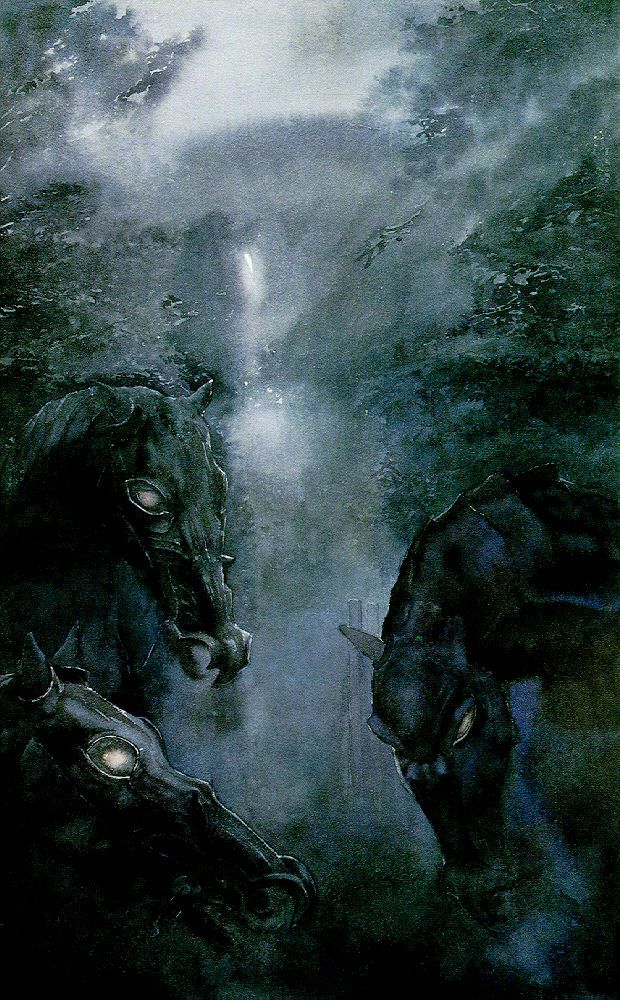
Along the way, they hear of Black Riders that have come to the Shire and are asking after a Baggins. These are revealed to be the Nazgul (or Ringwraiths), “the most terrible servants of the Dark Lord”. With the help of a party of Elves and the Farmer Maggot, Frodo and his company reach the edge of the Shire and pass into the wilderness. Along the way, they meet more curious folk, such as Tom Bombadil, a strange Hobbit-like creature who seems to be immune to the Ring’s effects.

At last, they come to the town of Bree, where they take a temporary respite at the Inn of the Prancing Pony. After downing a few pints with the locals, Frodo accidentally reveals the Ring when he slips it on and disappears from sight. He is then pulled into a room by Aragorn, who reveals himself to be a friend of Gandalf’s and a friend in their quest. He shows them the sword of Elendil, the shattered remains of the blade that cut the ring from Sauron’s hand, and agrees to take them the rest of the way to Rivendell.

After several days of traveling through the wilderness, they come to the ruins on the hill of Weathertop. During the night, they are set upon by the Nazgul, and after cornering Frodo, the chief stabs him with a cursed blade. Aragorn manages to chase them off, but warns that Frodo must get to Rivendell with all haste, or he will become a Nazgul himself.

As they hurry along, they meet Glorfindel, an Elf warrior from Rivendell who agrees to takeFrodo there with all haste. The Nazgul, all nine of them joined together now, pursue them and attempt to follow them across the Ford of Brunien, the last remaining obstacle between Rivendell and the outside world. However, Elrond sends a wave down the river which smashes the Nazgul into the rocks and ensures Glorfindel’s and Frodo’s escape. However, Frodo collapses and appears to be near death.

Book II: The Ring Goes South
When Frodo awakens, he learns that he is in the House of Elrond in Rivendell, where he has been healed by Elvish magic. Elrond summons the Council which consists of Aragorn and representative of every race on Middle Earth. Frodo is invited to attend, where he presents the One Ring. Gandalf is there too, and explains that he was held up because of a betrayal. Saruman, head of his order, has apparently betrayed them because he desires the Ring for himself. He is not yet in the service of Sauron, and is amassing his own army of Orcs.

Together, they hatch the plan that the only way to defeat Sauron is to destroy the One Ring, which must be cast back into the fires of Mount Doom from which it was forged. Frodo volunteers to take the ring and thus becomes the Ring-Bearer, and Samwise once again vows to stay by his side. Completing the Fellowship are Aragorn and Boromir, son of the Steward of Gondor; Legolas, Prince of the Silvan Elves of Mirkwood; Gandalf; Gimli the Dwarf; and Merry and Pippin.

Together, they set out south along the Misty Mountain route. However, there attempts to cross are foiled due to snow and avalanches. They debate over what to do next, but it is agreed that they will pass through the mines of Moria instead. Aragorn seems to think this is a risky idea, but Gimli insists that his cousin Balin who rules there will give them safe passage and hospitality.

Once inside, they find the place littered with corpses and overrun by Orcs. Their company finds their way into a side room where Balin’s tomb is located, and where the Dwarves apparently made their last stand. Shortly therafter, the Orcs fall upon them and the company manages to make its way out. However, when they reach deeper into the mines and come upon a bridge leading to the surface, an even greater threat emerges: A Balrog of Morgoth, a creation of darkness and flame from the ancient world.

Gandalf stands against it, but soon finds himself pulled down into an abyss with it. Frodo and the rest of the Fellowship look on in horror, but are forced to flee as more Orcs swarm in to attack them. They make their way out of the mines and Aragorn laments that Gandalf didn’t heed his warnings about passing into the mines. For a long time now, it was feared that the Dwarves lust for Mithril (which was mined in Moria) caused them to dig too deep and disturb what lay down below.

Once free of the mountain, they make for the elf-haven of Lothlórien, where they are sheltered by the rulers Celeborn and Galadriel. As they take their rest, Galadriel speeks to Frodo and provides him with visions of what is to come. He offers her the Ring, which she considers momentarily, but then rejects. The quest falls to Frodo himself, he is told, and he must find a way to destroy it. Before setting out down river, they are given provisions and items for their quest, all of which will prove useful later on.

After setting down at water’s edge, the Fellowship begins to show cracks. After days of becoming edgier and moodier, Boromir finally confronts Frodo and tries to take the Ring from him. Frodo places the Ring on and escapes, and the others scatters to go and hunt for him. Frodo decides that the Fellowship has to be broken, and that he must depart secretly for Mordor. However, Sam finds him before he can leave and insists on coming with him. The two then set off again down river, just as a company of Orcs close in and threaten the camp!

Thus ends the first volume of the Lord of The Rings!

Summary:
Of the three books, I have to declare right off that this was my least favorite. But of course, that isn’t saying much given how impressed I was with book II and III. Nevertheless, I couldn’t help but feel that with this first volume, Tolkien wrote long-winded passages that really weren’t necessary. Of course I could see the point of them. They established background information and detailed the fictitious world in which the events took place.

Nevertheless, so much of Book I felt like interjections and asides that didn’t seem to contribute to the overall storyline. For example, Tom Bombadil’s role in the story has long been a subject of debate. As it was explained to me, he occupies the same category as the Ents and other mythical creatures, in that he is outside the regular events of the story. Whereas the Ents are indifferent to the Ring and the wars for Middle Earth because they are so old, he is also indifferent because the Ring has no power to sway him as it does other creatures.

But in the case of the Ents, they came to be directly involved in the war because they realized that they could not simply sit idly by and let things pass. Tom had no such compulsions or involvement, and aside from being mentioned briefly in Rivendell, has no more role in the story. And unlike certain features which come up during the long journey through the Wilderness, his inclusion also wasn’t a shout out to content from the Hobbit. So really, what purpose did he truly serve?

Second, there was the Fellowship’s journey through the Misty Mountains. It is implied that they are turned back by Saruman’s magic, but it is never established. What’s more, the dangers of going through Moria are hinted at ahead of time, but it appears Gandalf is okay with the idea even though he must have foreseen he would be the one to die. But in the end, it is Aragorn who later laments the decision and questions why Gandalf would be okay with it. It seemed to me that if Moria represented the riskiest choice, Gandalf should have been the one had doubts about it.

Last, there was the point at which the Fellowship breaks. In book I, we see the basic points, Boromir trying to steal the ring, and Frodo leaving with Sam before they Orc party strikes. But it’s not until book II that we realize that such a confrontation took place, that Boromir was killed, or that Merry and Pippin were taken prisoner. In this, and all other cases mentioned, the movie sought to show these things and explain them fully. Quite predictable, but in the case of this first story, I actually felt it worked. But of course that probably has something to do with the fact that this one time I saw the movie first. Were I a Rings geek prior to the first film (as I was for II and III), I might have taken issue with all these changes instead of approving of them.

So far, I feel I’ve been saying only negative things about this book. But let me be clear, it’s only because the story set such a high tone that I was surprised to find that there were any weaknesses at all in this volume. If anything, the flaws are the exception to the rule, which is that Tolkien managed to create a story and and entire world steeped in legend, lore and magic. His main characters are archetypical legends, calling to mind such heroes as Beowulf, Arthur, Lancelot and Merlin, and whose supporting characters call to mind the same kind of comic and tragic figures as Caliban, Launcelot Gobo, and King Lear’s Fool.

And of course, there are the legendary races in the story which continue to dominate the fantasy genre and popular consciousness alike. When it comes to stories, gaming, movies and television, the basic breakdown of Elves, Men, Dwarves, Orcs, Ogres, Goblins, Wizards and Dark Lords is still in effect. Willow was a movie built entirely on Tolkien’s foundation, Chronicles of Narnia, Harry Potter and The Golden Compass owed a huge debt to his work, and Warhammer, Dungeons and Dragons, and countless other games I can’t even name wouldn’t exist without him.

And the storyline itself is nothing short of genius. Embracing such themes as the “Decline of the West”, the rise of an old evil, the idyllic countryside, the world outside your door, and little people caught in a situation much bigger than themselves, the story was so layered that people could find no shortage of significance and meaning contained within. It’s little wonder then why it has remained so influential and enduringly popular!

Coming up next, The Two Towers and The Return of the King, in that order 😉

A Storm of Swords (Song of Fire and Ice, book III)

Back with the third installment in the Song of Fire and Ice series! By the end of book II, A Clash of Kings, a number of interesting developments took place. Stannis Baratheon’s attack on King’s Landing ended in failure, Robb Stark’s campaign south began to suffer some setbacks, and John Snow had taken up with the Wildlings. In addition, Theon Greyjoy was killed, Winterfell was burned to the ground, Arya escaped and began heading north once again, and young Bran began to head for the Wall with his companions, pursuing a prescient dream.

A Storm of Swords:
The third novel picks up where all these strands left off, with the War of the Five Kings, the war beyond the Wall, and with Daenerys Targaryen’s ongoing efforts to secure an army and return to Westeros. Much like book II, Storm contained a sort of climax where a major battle takes place, this time at the Wall. John’s time spent amongst the Wildlings also gives the reader insight into the lives of the Wildlings and what is driving them south.

At the same time, there is a great deal of detail given to the world of the East, where Daenerys is travelling to the ancient slaver cities of Astapor, Yunkai and Mereen. Much like Qarth in book II, these eastern cities are clearly inspired by the ancient cities of Asia Minor and the Middle East (aka. Babylon, Antioch, Jerusalem, etc). However, there were also some rather dire developments as well. Like I said in my previous post, George RR Martin is never one to shy away from killing off main characters or devastating his readers. Whereas he kind of shied away from that in Clash, this book got right into it! But more on that in a bit. First, I’d like to get into the overall plot of the novel…

Plot Synopsis:
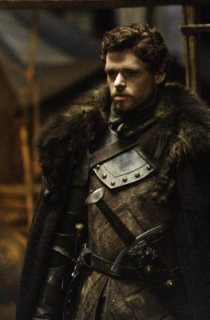
Starting at the Riverlands, where Robb Stark and his armies are gathered, we learn that the Wolf has suffered from some serious errors in judgement. For starters, his uncle, contrary to Robb’s orders, threw off his long-term strategy by engaging Tywin Lannister’s armies at the river crossings. Though they were victorious in thwarting them, this move upset Robb’s plans to lure Tywin closer to his home town of Casterly Rock, where Robb hoped to outflank him and end the Lannister’s involvement in the war.

However, Tywin instead deployed the bulk of his forces to attack Riverrun once Bolton began beating him. Tywin failed to take Riverrun, but deploying his forces here instead of further east meant that he was in a better position to redeploy south once he learned that King’s Landing was threatened. Their victory over Stannis also led to an alliance between House Tyrell and the Lannisters, which meant they would be doubly hard to beat.

In addition, while he was campaigning in Lannister country, Robb fell in love with a young woman from a smaller House and married her. This decision was an insult to the honor of House Frey, the Lord that controls the Twins (the river crossing to the north) and one of Robb’s most powerful allies. Now it was necessary for him to travel to the Twins and make amends, promising his uncle’s hand to one of Frey’s oldest daughters in order to salvage their relationship.

And last, but not least, he also has the defiance of his mother to deal with. It seems that while he was away campaigning, she set Jaime Lannister free and told Brienne to escort him to King’s Landing. On his honor, she made Jaime swear that he would return her daughters to her as soon as he arrived at the capitol. A desperate hope, but given what happened to her boys (she believes them both to have perished at Winterfell at his point) she was both desperate and distraught.
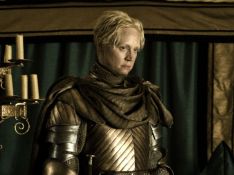
Naturally, Jaime has plans of his own and attempts to escape at the first opportunity. Unfortunately for him and Brienne, his escape attempt alerts some marauders to their presence. As soon as he obtains a sword, he attacks Brienne, the two fight for some time and the noise alerts a band of Bloody Mummers. These men are now in the employ of Lord Roose Bolton of Harrenhal, and they are taken captive. To ensure Jaime’s cooperation, Vargo Hoat, the leader of the pack, slices off Jaime’s hand. Without his sword hand, Jaime becomes a depressed shell of his former self, and begins to contemplate his choices and allegiances.

When Robb and his host arrive at the Twins, they are pleasantly surprised. Despite Lord Walder Frey’s reputation for being a bitter and vengeful man, he seems committed to making this new marriage happen. And his uncle is even pleasantly surprised when he sets eyes on the Frey girl, who doesn’t appear to be as hideous as his other offspring! Everything goes well on the wedding night as well. Though the food is not so good, the wine is plentiful and people begin to get soused. However, once the bride and groom are hauled off, Frey has another surprise in store. Crossbowmen emerge from the gallery and begin firing on them! Robb and his banner men are quickly surrounded, and Robb and his mother are killed!
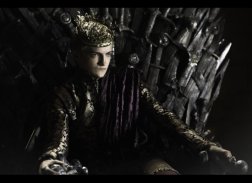
Back at King’s Landing, celebrations are being held! With their victory over Stannis’ forces, the people are jubilant and welcoming House Tyrell as liberators. In addition, Lord Tywin has taken the role as Hand of the King since Tyrion has been bed-ridden with injuries and is suspected of trying to harm Joffrey. Also, it seems that the new hand has made some changes to Joffrey’s wedding arrangements. Instead of marrying Sansa, as was arranged under King Robert, he now wishes to cement the Lannister’s new alliance with the Tyrell’s by marrying Joffrey to Lady Margaery Tyrell. Sansa is relieved, until she is informed that she will be wedding Tyrion instead, who isn’t particularly happy about it either.

Now two weddings must be held. The first, of Sansa and Tyrion, is a sham affair that is rushed through with minimal pomp and ceremony. For the second wedding though, much time and effort are spent and no expense is being spared. In addition, Sansa finds herself being taken into the confidences of the matriarch of House Tyrell. As Joffrey’s previous betrothal, she would like to know just what kind of man her granddaughter is marrying. After learning that the old lady is an honest and gentle person, Sansa tells her the truth: Joffrey is a monster, she says, and her granddaughter should be afraid. The old lady thanks her for her honesty, and begins plotting…
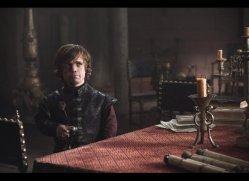
The wedding festivities are lavish and Joffrey appears to be taking well to his new wife, which leaves Sansa fearing for her life. Tyrion is similarly worried, knowing that Joffrey hates him and Cersei and their father both suspect him of treachery. He worries that the boy will try to kill him and his new wife, but they are both saved when something unexpected occurs. In the midst of eating from a massive pigeon pie that was prepared for the event, Joffrey chokes and dies horribly. More to the point, the girl Sansa disappears in the midst of his death. All eyes go to Tyrion, who is promptly arrested for the boy’s death.

After suffering in the dungeons of King’s Landing for a time, Tyrion is brought forth and put on trial. He is forsaken by everyone, including his mistress Shae, who appears to have been threatened into giving him up. All hope appears to be lost for Tyrion, but he then receives an offer from an unlikely source: Lord Oberyn Martell, the Prince of Dorne. It seems that the people of Sunspear still hold the Lannister’s accountable for the deaths of two Martell children who were murdered during Robert’s revolt. The one responsible was Sir Gregor Clegane (“The Mountain”), but they suspect Lord Tywin was the one who gave the order. He agrees to fight for Tyrion if he requests a trial by combat as part of a plot to kill Gregor and eventually put a Martell on the throne.
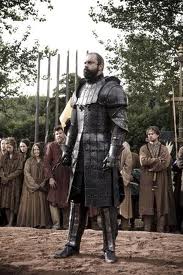
Without options, Tywin agrees, and as expected, Cersei chooses Gregor as her champion. The fight goes well for Oberyn, who employs cunning and speed to defeat Gregor with a poisoned spear. However, before he can deliver the final blow, Gregor takes Oberyn by the throat and kills him with his bare hands. Tyrion is once again doomed, and Gregor is destined to die a slow and terrible death. However, Tyrion finds help from an unlikely source once again, this time from his brother who has returned.

After hearing of Robb Stark’s death, Harrenhal once again changed hands and Jaime was set free. Having undergone a change of heart, he decided to bring Brienne back with her. Upon his arrival, he and Cersei have a falling out over his brother’s supposed guilt, and he decides to set Tyrion free. This consists of showing him a secret stairway that will take him to the coast, but Tyrion decides to head up instead. Having served as the Hand, he knows the secret stairs lead to the Tower of the Hand, where his father currently resides…

When he enters, he finds Shae warming his bed. She pleads and offers him the usual denials, telling him she was threatened and had no choice. Tyrion, sick of betrayal, decides to strangle her with her own jewelry and then sets out to find his father. After grabbing a crossbow from the bedroom wall, he finds his father in the privy and corners him there. After some harsh words are exchanged, he fires a bolt into Tywin’s stomach and leaves him there for dead.

With both Joffrey and Tywin dead, Cersei takes up the role of Hand and crowns her youngest son, Tommen, as king. In addition, she charges her newly-estranged brother with finding and killing Tyrion. As the new Lord Commander of the Kingsgaurd, it is his duty to track down the assassin, but he is obviously conflicted given the fact that he played a rolein his father’s death. Once the funeral is over, he decides to sets Brienne free and gives her a new sword named Oathkeeper. This was apparently Joffrey’s wedding gift from Tywin, which was reforged from the Valyrian steel of Ned Stark’s old sword. He then tells her to go forth and keep her oath to Catelyn to find Arya and Sansa.

Also, it should be noted, Cersei begins to go nuts as a result of recent events. In addition to losing her son and her father, it is also clear that her incest has become common knowledge. The Tyrells also appear to be positioning themselves to take the throne down the line. It is even intimated that the Tyrell matriarch was the one who poisoned Joffrey because of what Stansa told her about him. Now that Tommen is king, it is he who must marry Lady Margaery Tyrell, but since he’s so young, she believes she must be the power behind the throne.

Sansa is meanwhile ferried away with the help of Lord Donton, a disgraced ex-knight who Joffrey was in the habit of abusing, but whom Sansa was kind to. For some time, they were planning her escape, and when she learned that she would be wed to Tyrion instead of a Tyrell, she agreed to his plans. After helping her escape on the night of the big wedding, she is transferred to a ship waiting for them down by the water. Her rescuer, it seems, is Lord Petyr Baelish, who plans to take her to The Eyrie where he is about to wed her aunt (Catelyn’s sister). After delivering her aboard, Donton is killed to cover their tracks.

She is then brought to the coast of the Vale of Arryn where she meets Petyr and her aunt. While it is clear that Lady Lysa loves Petyr, it is also clear that he doesn’t love her, but instead is carrying a torch for Sansa. After arriving at the Eyrie, he kisses Sansa in the courtyard, sending Lysa into a jealous rage. Later on, she invites Sansa up to the throne room and threatens to throw her out the Moon Door, but Petyr intervenes. After talking Lysa down, he confesses to her that he only ever loved her sister, and then tosses her out the door! He then moves quickly to blame the minstrel and bribes Lysa’s bannermen to ensure their loyalty to his rule.

Meanwhile, Arya’s trip north brings her and her companions into some strange company. Having escaped Harrenhal, she now comes into contact with a group of men known as the Brotherhood without Banners. These were the men whom Ned Stark had sent out to deal with the raids in the Riverlands, but who now are protecting the countryfolk from raiders and Lannisters. Leading them is Lord Beric Dondarrion who has picked up an usual companion, the red priest Thoros of Myr. Here too is another worshiper of R’hllor, who has apparently used his magic to resurrect Beric, a couple of times!

Having been taken in by the company, they soon find Sandore Clegane, who fled King’s Landing during the siege, and put him on trial for his many crimes. Sandore request a trial by combat and narrowly wins when Beric’s sword breaks and he dies. However, Thoros is able to resurrect him yet again, and Sandore is free to go. But before he leaves, he is sure to take a hostage – Arya Stark! The two then travel north together since Sandore is hoping to ransom her to her brother. This journey takes them to the Twins, just in time for Lord Bolton’s supposed wedding. When the pandemonium strikes, Arya is forced to flee and is only saved by the intervention of Sandor himself.

In time, Sandor is critically wounded and Arya leaves him behind. She makes for the Vale of Arryn where she decides to board a ship and head for Braavos. She does this because Jaqen H’ghar, the killer she helped free, gave her a coin before departing which he claimed was from Braavos. The coin contained the inscription “Valar Morghulis”. When she arrives at the port, she speaks these words to a Braavosi Captain, who replies “Valar Dohaeris” and agrees to take her aboard. They set sail for the free city of Braavos and Arya bids farewell to her past life.

To the East, Daenerys and her companions are still busy trying to recruit an army. On the recommendations of Lord Mormont, they set course for Slaver’s Bay believing that they will be able to recruit an army from the Unsullied. These are apparently warrior-slaves who have been raised from birth to fight, feel no pain, and obey any and all orders from their commander. With her new-found friends, Arstan and Strong Belwas, they arrive at Astapor where she agrees to surrender one of her dragons in exchange for a large host. However, she then tricks the slavers by ordering the Unsullied, once they are transferred to her ownership, to kill all the city’s slave masters.

With her new army and a host of freed slaves, Daenerys sets course for the city of Yunkai next. Here, she finds another slave stronghold that is protected by a host of mercenaries. After meeting the enemy’s mercenary brigades, she is aided by the defection of one of their Captains. With his help, they attack the mercenary encampents at night and this city falls shortly thereafter. Finally, she and her host move on to Mereen, the last of the slave cities, but find it walled and heavily defended. They set camp and begin the long process of besieging it.

But first, some revelations are made. On the one hand, she discovers that Arstan is in fact Ser Barristan Selmy, the former Lord Commander of the Kingsguard who Joffrey dismissed. His true purpose, it seems, was to find the heir of the Targaryen line and bring her home. At the same time, she learns that Jorah Mormont was originally sent to spy on her for Robert. However, when the order came that she was to be assassinated, he changed his mind and enlisted with her. Daenerys is outraged. It seems that the prophecy told to her by the Undying of Qarth is coming true. She has been betrayed twice now, which means she will betrayed once more before the end.

To have them make amends, she orders Barristan and Mormont to sneak into the city  through its sewers with a host of Unsullied at night and open the gates. They succeed, and the city is taken shortly thereafter. She forgives Selmy and makes him the Lord Commander of her Queensguard, but decides to banish Lord Mormont. In the meantime, she decides to set up camp at Mereen and contemplate how she will become the ruler that Westeros needs.

Finally, things to the north are also proceeding apace. Having been captured by the Wildlings, John Snow is brought before Mance Rayder. He is asked to explain why he would defect, and wanting to be convincing, John tells him something approximating the truth. He says he defected because he is sick and tired of being “the bastard son” and wants to be free. Rayder believes him, and John is soon reunited with the young Wildling woman he met earlier and spared.

Her name is Ygritte, and she is clearly taken with John. As time goes on, they become close and claim each other, Wildling-style! As a result of all this, John’s feelings of betrayal deepen, but he made an oath to Qorin to learn all he could, so he continues. In time, this bears fruit when he learns that the Others are what is driving the Wildlings south. Hence why they are determined to take the Wall and claim the northern lands of Westeros for themselves.

He also learns that Rayder had been desperately searching for the Horn of Winter which the Wildlings believe is magic. By sounding this horn, he believes he can melt the Wall and take out the Night’s Watch easily. However, in the meantime, he must commit his forces to attacking the Wall conventionally and sends John and Ygritte with an advance party to scale it and do reconnaissance on the other side. Once over, John escapes from the Wildlings once more and rejoins his brothers at Castle Black.
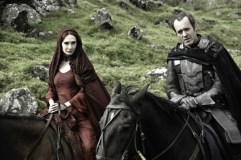
His loyalties are heavily suspect and few believe his story about Qorin orders, but his loyalty is proven when Ygritte and the advance party attack Castle Black. They manage to defeat the Wildling party, and Ygritte is killed by a stray arrow. John is torn by the loss, but there is little time to mourn. On the other side of the Wall, Rayder has over forty-thousand Wildlings, giants, mammoths and seige engines prepared, and begins his assault. John is given leave to command the defense of the Wall against this first assault, and things go relatively well.

Outnumbered but not outclassed, John and his brothers manage to thwart the first wave. John is then invited to parlay with Rayder, who reveals that he has found the horn after all. He tells John that he cold destroy the Wall with a single blast of the instrument, but he would rather capture it intact since it is the only thing that will keep the Others at bay. John considers his offer of a negotiated truce, but their parlay is cut short when Stannis’ surviving armies take to the field and destroy the Wildling encampment.

For months, the Night’s Watch had been pleading for aid and soldiers to be sent north to the Wall, and now it seems that only Stannis has chosen to answer. He tells John what the priestess Melissandre believes, how the return of the Others is just a prelude to the return of her god’s sworn enemy – the dark one. Stannis asks for John’s support and promises him Winterfell in exchange, but John is chosen by the Night’s Watch as their new commander and must refuse.

In the epilogue, we see how the Brothers Without Banners have taken one of the Frey men prisoner. After interrogating him about the massacre that happened at the wedding, the reanimated body of Catelyn Stark arrives and orders his death. It seems that the priest Thoros has used his magic to resurrect her as well, and now she is intent on revenge!

Strengths/Weaknesses:
Book III was, in my opinion, a step down from books I and II. On the one hand, there was plenty of action and plot developments to keep the reader interested, and plenty of surprises besides. However, not all of them were welcome to this humble reader. For starters, when Robb Stark is murdered at the court of Walder Frey, I was incensed! I very nearly put the book and the series down for good! Was it not enough that Martin had to kill off Ned Stark? No, he had to kill his son and Catelyn too? The Starks are supposed to be the heroes of this series, dammit! You can’t just keep killing them off! Yes, I was mad…

But it was not just the fact that sympathetic characters kept getting murdered. It was the confusion it caused. Basically, every story has a set of main characters, people that help drive the story forward. When a character dies off, it naturally falls to another to keep the story going. Now we all know that Martin uses many characters and perspectives in his novels, but most of these are secondary and rarely heard from. It’s the main perspectives that tell things of the greatest importance, and usually there are only a few of them. When these people die, it has the effect of making the reader think that they weren’t so important after all. And if it keeps happening, the reader can become cynical and will not form the usual emotional attachments to characters. When that happens, a story dies, at least from the point of view of the person reading it. It’s all about emotional attachments Martin, you can’t keep traumatizing us!

More than that, I was beginning to feel tedious and depressed by the way Arya and Sansa’s sad stories kept going on and on. For two books now, Arya has been trying to get home, only to be waylayed, taken prisoner, get free, taken prisoner again, get free once again, then only to find out that her family is dead. Thus she decides to go to Braavos because she thinks she’s the only Stark left. And she’s just a kid! How depressing! Sansa, on the other hand, has to endure Joffrey’s constant abuse, the prospect of sex with Tyrion, and then is set free only to find herself a prisoner again, just under different circumstances. As if the rapacious and cruel Lannisters weren’t enough, now she has to deal with the murderous and creepy Lord Baelish!

And even before Robb was murdered, the setbacks he was been forced to endure were beginning to get tedious. In spite of all his early successes, its becoming abundantly clear that he’s going to lose the war. First his strategic plans get interrupted, the Lannisters succeed in the south and make a new alliance, Theon stabs him in the back by seizing Winterfell, his attempts to liberate it fail, Winterfell is then burned to the ground and his brothers killed (presumably). Then, on top of all that, he learns that his alliance is likely to fall apart because he chose to follow his heart. And just when it seems like things are going to be okay on that front, he’s and his mother are betrayed and murdered! It’s like, we get it! War is hell, especially this war, and the bad guys are winning! But can’t you give us some happy news for a change?

But like I said, the book had plenty of things to keep the prospective reader interested. After picking it back up (after about a week or so of stewing), I found plenty of good things to keep me interested in the series. For starters, Joffrey finally got what was coming to him, Lord Tywin also bought it while sitting on the privy, and Catelyn was revealed to be alive (albeit in a somewhat hideous form). This was all nice to read, mainly because I was getting so sick of Joffrey that I was just waiting for someone to give him a “golden crown” as well! His and Tywin’s death also brightened Tyrion’s storyline a lot, seeing as how his constant struggle with his cruel family was also beginning to get Kafka-esque. Given that he is one of the few sympathetic characters from that thread, it was nice to see him get a little payback! Now if someone would just whack Cersei we’d be in business!

And of course there were all the plot developments that kept satisfying my curiosity. Much like in book II, there were plenty of things that I was just waiting to hear about that finally got revealed. For instance, I was dying to know what would become of the Others invasion, of the civil war, of Daenerys’ plans to return to Westeros, and of Bran’s visions. After so much build-up, set-backs and plot twists, I was dying for some resolutions! And as usual, George RR Martin gives it out sparingly, providing clues, some answers, and a few interesting tidbits, all the while ensuring that things keeps rolling into the next book.

All in all, I liked this book. It was a very decent follow-up to A Clash of Kings and maintained the commitment to realism, detail and world-building that the series is famous for. My problems really only stem from the fact that at times, the books are too realistic, too detailed, and contain far too many plot twists. However, it would be unfair to say that any one book fails in this regard when its really a cumulative effect. Anything bad that I can say about this particular novel always begins with “at this point in the series…” Mainly, I was just hoping that things would be close to some kind of resolution. That’s another thing that’s important when writing. When audiences wait too long for a resolution, they’ll also lose interest. I hope Mr. Martin is writing this down 😉

Speaking of which, I am currently nose-deep in A Feast For Crows. See you soon with the review for that one!

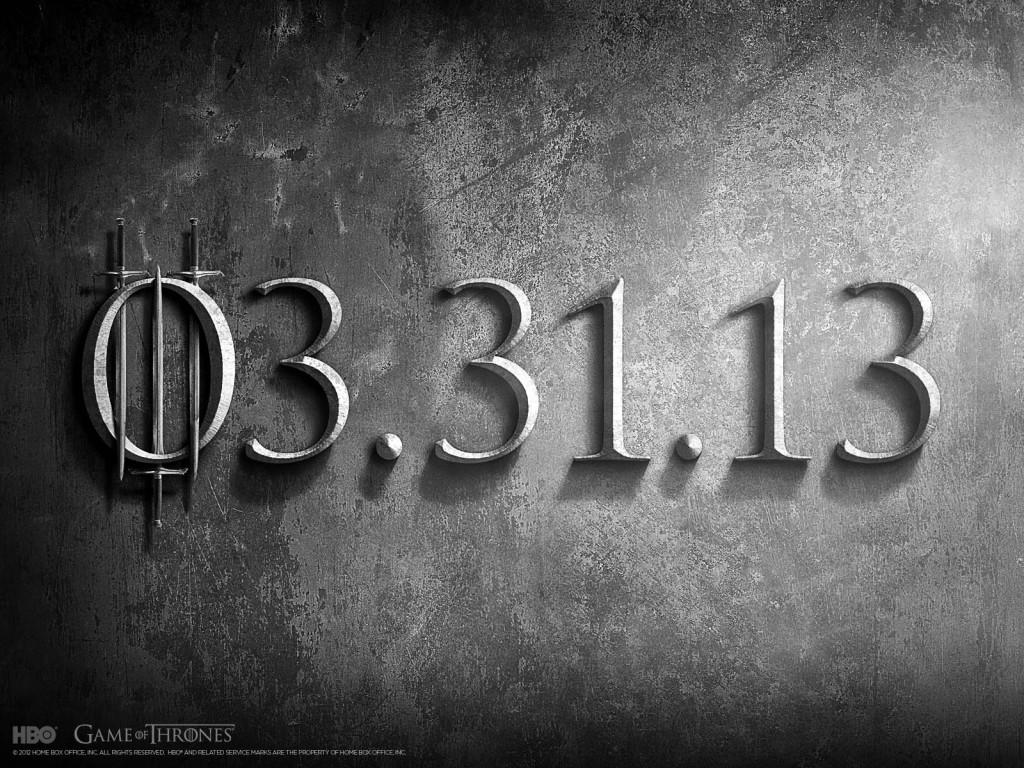
A Clash of Kings (A Song of Fire and Ice, book II)

As I’m sure I said in my last post, George R.R. Martin is known to his contemporaries as the “American Tolkien”. This is a fitting comparison for me seeing as how Game of Thrones was something I had no real interest in until after I saw it adapted to screen. It was only after I saw the whole first season, which is book I in the series, that I decided to start reading it and get informed! I’m now on book four in the series and like all GOT geeks, am eagerly awaiting season two which premiers April 1st (This better not be some kind of prank!) But anyway, here is book II in the Song of Fire and Ice series, which is appropriately named:

A Clash of Kings:
As with Lord of the Rings series, I decided to read the second book first, mainly so I could get a head start on all the material that was to come. However, since the series is ongoing, I did not dare wait til I read to the end before going back to cover the original. And I can honestly say that book II improves upon the first, bringing more action, more intrigue, and more fantasy-fiction to the fore. I tell ya, its a rare thing when a sequel actually surpasses the first in a series, but that was to be expected here. Whereas Game Of Thrones set the scene, introducing the major plot threads and building up the action, Clash of Kings incites it all and brings it all to an explosive semi-climax. The most important element of which is the battle at Kings Landing, which I cannot wait to see adapted to the screen!

Plot Synopsis:
The book opens with a celestial event. A red comet, which goes by various names, has entered the heavens and seems to mean different things to different people. To some, its a portent of evil, but to others, its a sign of impending victory. Picking up where the first book left off, the realm of Westeros finds itself divided between five powers who are now in a state of civil war. In the south, power is divided between Kings Landing, where the Lannisters rule through Joffrey, and Robert Baratheons two brothers – Renly and Stannis. The former now controls the southern area of Highgarden while the latter controls the island Dragonstone. While a Baratheon alliance would surely defeat the Lannisters, the brothers are divided because both are determined to sit the Iron Throne.

While Stannis, the elder, has the better claim to the throne, Renly is the more charismatic of the two. He is just as determined and has a much larger army, but Stannis has a secret weapon which he has yet to unveil: a sorceress named Melisandre, a priestess of Asshai who worships the fire god R’hllor. The cult of R’hllor, which is monotheistic in focus, is quite popular in the East but relatively unheard of in Westeros. To many, her backing of Stannis, whom she sees as the Azor Ahai (prophet of R’hllor) reborn, is merely a power play, a means to introduce her religion to the Seven Kingdom should be triumph in the war. But according to Melisandre, the civil war is merely a prelude to a much greater war against a dark force that has been coming for some time…

Meanwhile, to the north Robb Stark has been crowned King of the North by his bannermen and continues in his long campaign south. Though they are outnumbered by the Lannisters, they win victory after victory, and soon even Tywin Lannister is forced to move the bulk of his forces south when they hear that King’s Landing is threatened. For the wolf, victory seems possible, but a there are a few complications to his plans. For one, King Joffrey and the Lannisters are still holding Sansa Stark hostage and Arya Stark is still missing (in truth, she and the Night’s Watch recruiter who saved her are moving north with a band of convicts and recruits). The only thing keeping Sansa safe is the fact that Jaime Lannister is in their custody, but he’s proving to be a tricky hostage…

What’s more, the Iron Isles, where Theon Greyjoy hails from, are up in arms. With the wolf marching south and civil war dividing the realm, his father seems intent on carving out his own kingdom in north as well. His daughter is chief amongst his Captains, a fact which annoys Theon to no end. Determined to upstage her, he leads an attack on Winterfell and takes it. In time, Bran Stark and his newfound friends from the Riverlands, who’ve convinced him he’s having prescient dreams, decide to escape to The Wall. Something is up there, it seems, that is calling to Bran. When he flees, Theon decides to stage their murder to avoid the inevitable embarrassment of having lost them.

To the far north, Jon Snow has taken up with the Nights Watch and is with them as they begin a large-scale reconnaissance north of The Wall. Apparently, the Wildlings have been abandoning their villages in droves, moving to a large encampment where a man named Mance Rayder. Apparently, he has declared himself “King-beyond-the-Wall” and plans to lead a united army of Wildlings south to take the lands they have been historically cut off from. In time, it becomes clear that he himself is fleeing something, they very thing that Jon Snow and the Watch have been worrying about. It seems the White Walkers have been getting around, and just about everyone in their path is looking to flee…

To the east, Dany and her host travel across the desert to the great city of Qarth. Once there, Dany becomes the focus of much attention and fascination, given that she travels with three dragons. Despite this, she is unable to raise an army because the only coin she has to barter with is her dragons, which she refuses to give up. When she goes into the House of the Undying, where the warlocks of Qarth reside, she is told that her life is threatened and that she will be betrayed three times. When the warlocks try to attack her, her dragon burns the House down, sparking emnity between her and the Qartheen. An attempt is made on her life at the city harbor, but she is saved by two men – an old warrior named Arstan Whitebeard and a mercenary named Strong Belwas. They were sent by Illyrio, the man who sheltered her and her brother, and join her host. Together, they begin to plot where to travel to next to find her an army.

After a failed meeting between Renly and Stannis, which Catelyn Stark travelled south to host, Renly was killed by a “shadow”. It becomes clear that Stannis’ priestess was involved, because all those who oppose Stannis have a way of winding up dead. As a result, Renly’s former bannermen declare fealty to Stannis and add to his power, and Catelyn is forced to flee north with one of Renly’s staunchest supporters. A woman named Brienne of Tarth, a formidable fighter whom Renly made a knight. They return to Riverrun, the domain of her brother, where Robb is rallying his forces and her father lies dying. Upon her return, she learns of what happened to Winterfell and her two youngest sons and is heartbroken. Between Ned, her ailing father, and now her two boys, it seems everyone she loves is dying.

Back to King’s Landing, Tyrion has taken up the role as Hand of the King. Before him is the challenge of defending the capitol from Stannish Baratheon, who is quickly approaching by land and sea with his combined armies and navy. At the same time, he must cover his ass seeing as how his sister will stop at nothing to do him in. A game of chess ensues, with both sides employing bribes and whatever blackmail and threats they can to gain leverage over the other. For a time, Tyrion seems to have the upper hand, but soon, battle comes to their doorstep, and he must forgo all that to lead the defense of the city.

Meanwhile, Arya is captured while traveling north by men loyal to the Lannisters. The survivors are taken to Harrenhal, a major castle that is currently in Lannister hands, where she is forced to serve as a peasant girl. Her identity remains a secret, but she is forced to endure all kinds of abuse as a serving girl. However, one of the captives who was part of their caravan comes to her and tells her that he owes her three lives for saving him and the lives of his companions. Instead, she uses him to help free a bunch of Stark men who then seize the castle. However, her fortunes do not change much, as she is then forced to act as cup bearer to Roose Bolton who comes to occupy the castle. She escapes shortly thereafter with her old companions and continues north.

Tyrion’s preparations pay off in the end. At sea, the large chain link he had constructed is used to close off the river once Stannis’ fleet enters it. In addition, their forces use a their vast stores of Wildfire he had prepared to set them ablaze once they are trapped. On land, things go a little more poorly, but Tyrion manages to lead a successful defense of the gates and is eventually saved by his father, Tywin. It seems that he travelled to Highgarden before the conflict and enlisted the help of many of Renly’s former bannermen. At just the right time, they perform a flanking maneuver which routs Stannis’ forces and saves King’s Landing. Sensing that he will not die in battle, one of Cersei’s assassins attacks and nearly kills Tyrion. When he wakes up in bed, he finds that Cersei has gained the upper hand on him by preying on their father’s good graces.

North of the Wall, the Black Brothers find a base amongst a ruined tower and begin sending recon forces further north. Jon is part of a force dispatched to the Skirling Pass, where they find the bulk of Rayner’s army massing. In addition to thousands of Wildlings, they see giants, mammoths, and wargs complimenting their force. In time, the Wildlings fall upon them and they are forced to flee. Before they are captured, Qorin asks Jon to betray him when the time comes so that he may infiltrate the Wildling camp and learn their secrets. Jon reluctantly agrees, and when they are cornered, Qorin fights him and lets him win. Jon is now a prisoner of the Wildlings and is reunited with a young Wildling woman that he met and set free earlier. She convinces Rayner to take Jon in, as he himself was once a Black Brother who defected.

Back in Winterfell, Theon finds himself with his back to the wall when Robb dispatches one of his bannermen and an army to remove the Iron Men from Winterfell. All hope seems lost to him, when a new force enters the field and saves his butt. It seems that one of the sellswords who joined him earlier was in fact the Bastard of Bolton, a usurper who fell into disfavor with Robb’s men and was imprisoned in Winterfell. When Theon set him free, he returned to his home, took up the cities army, and returned to save him. However, he quickly betrays Theon, kills him, and orders Winterfell razed…

Strengths/Weaknesses:
As I said before, this book packs some serious action into its binding! After much build-up in the first, the climactic battle of King’s Landing takes place, and it was quite unclear how things were going to go… In fact, much of the book is unpredictable. One gets the impression that the Lannisters are bound to lose well up until the battle finally takes place. In addition, the fate of House Stark is something which is tenuous at best. As always, one can’t get too emotionally attached where the characters of George R.R. Martin is concerned. They tend to die suddenly and haphazardly. However, unlike in book I, none of the major characters die off, just the supporting cast. This I would consider a strength considering that I tend to get sour when people I like get killed!

That being said, there were a number of inexplicable plot twists in this book, so many that it began to feel a little contrived after awhile. For starters, the battle of King’s Landing suddenly turns when all hope seems lost. In itself, that was a pretty good twist, but there were many like it. When it came to the rivalry between Renly and Stannis, it seemed apparent that Renly was destined to win, but then he’s suddenly killed by Melisandre’s shadow, thus completely turning the tide. And then there’s the part where Theon Greyjoy is defending Winterfell. Everything seems said and done when at the last moment, he is saved by the intervention of the Bastard of Bolton, only to then be killed! That’s three major plot twists in one book, and the last one was like a… a compound twist! Kind of grows thin after awhile.

In addition, like all the books in the series, the story can become drawn out and emotionally taxing. It seems that despite whatever hopes the reader might have for a satisfactory resolution, the plot threads just seem destined to go on and on. Whether its Tyrion, Arya, Sansa, Robb, Catelyn, or John, it seems that they are just destined to suffer and endure more and more in the way of bad news. Unless of course the character dies suddenly, but that too is emotionally taxing for the reader! Just once, I would have liked for a character who I sympathize with to be able to put their feet up and say, “Whew! That was tough, but we got through it! Time to relax…”

However, this makes for a more respectable and realistic read all around. More than anything, the book conveys a genuine sense of desperation and discomfort, which is fitting since its about a civil war. These things are not comfortable, especially in a medieval setting! They are dirty, painful, bloody and festering, and the innocent constantly suffer. In all fairness, my feelings on this last note could be the result of the fact that I’m still reading the series, and after four books, all the war and death can get exhausting. However, this does not take away from this particular novel. It’s still awesome, and a very good follow-up to the first. My advice, check it out and then catch the miniseries. That way, you’ll have a frame of reference!
Check out the trailer:
GOT Season 2 Teaser Trailer (Youtube)