Hey all! Just wanted to do a late trip update and let everybody know I’m still kicking, and to share some of the many experiences that were had so far on this trip. It’s been almost two weeks now since the family and I departed from Vancouver Island and landed on the Continent, and try as I might, I’ve been unable to resist my internet fix! So as long as I was surfing, checking messages and doing a little messaging myself, I figured I could at least post an update or two.
Currently, we are in Paris, where we arrived on Sunday after dropping off our rental car at Charles de Gaulle Airport. After finding our hotel in the Latin Quarter, we began taking in the local sites and sounds, which included the Tour Eiffel, the Arc de Troimphe, the Notre Dame Cathedral, the Louvre, and la Maison de Verlaine, a restaurant that is famous for having been frequented by countless literary, political and showbiz personalities (Hemingway, Marilyn Monroe and the Kennedy’s, to name a few).
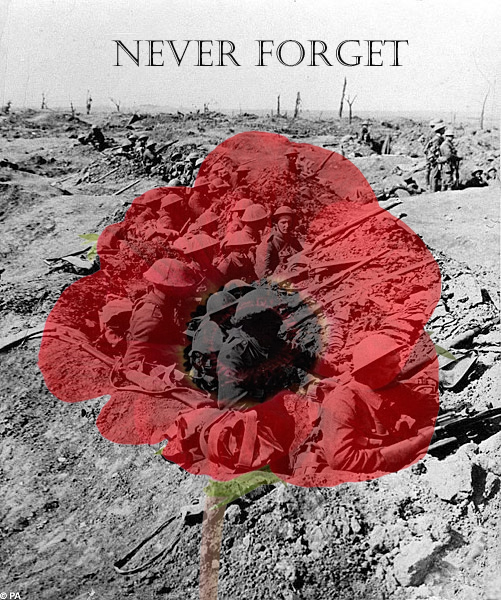
But before that, we were in the Flanders region of Belgium and the Normandy region of France. We began with Ypres, a small city in Belgium that was the site of three major battles during the Great War. This began in 1914 when the Allies retook the town from the Germans after their great sweep into northern France failed. The second took place five months later when the Germans, hoping to break the stalemate in Belgium, used chlorine gas for the first time. It was during this gas attack that the Canadian 1st Division distinguished itself by holding its ground and repelling the attack, despite the fact that they had no gas masks. The third and final battle took place east of the city and is also known as the Battle of Passchendaele, one of the bloodiest of the war.
These and other terrible sacrifices which were endured during the war are all commemorated on a daily basis in the town. Every night, wreaths are laid at the Mennin Gate at one side of the old city where the names of the dead are inscribed and people gather to hear The Last post played. Having attended it on both a Saturday and the following Sunday, I can tell you that It is a very beautiful and moving event.
We were also sure to visit the cemeteries, battlefields and memorials at Beaumont-Hamel, Concrete Farm, Langemarck, St. Julien, and Tyne Cot. This last cemetery, which is the largest World War I cemetery ever, has a small museum where the names of every soldier who died in the Battle of Arras is named. The recording plays on a loop, and takes FIFTEEN YEARS to finish!
I should also note that within this landscape, visitors and farmers are routinely still finding small pieces of the battles that took place over a century ago. These include unexplored munitions – which have to be carefully removed and disposed of – and shrapnel, which my father and I found quite miraculously. I say this because the field we were going to search was being tilled by a large machine, forcing us to search at the very edge. But even with this small space to work with, we still managed to find a large chunk of a shell and some small pieces of shrapnel.
After that, we visited the Vimy Memorial in France, one of the greatest to come out of the war. This site, and the many preserved trenches, tunnels and craters that mark the landscape are preserved and attended to by Canadian students who hope to keep the memory of this historical battle alive. Not only was it a major victory for the allies – the first decisive offensive of the war – it also defined Canada as a nation. While being guided through the trenches and tunnel, my father and I once again paused to pick up some keepsakes. This time around, it was a piece of chalk and flint (which the ridge is made of) and a small bit of ceramic, possibly from an old teacup.
We then travelled to Dieppe in Normandy and began visiting the World War II sites and memorials. This included the beach of Dieppe where the ill-faired raid performed by the Canadian 2nd Division, British, French and Polish Commandos, and American Rangers. We then drove to the French countryside to the town of Grangues to see where my Grandmothers cousin (an RAF pilot who died on D-Day) was shot down.
This was perhaps the most interesting part of our journey since it involved retracing the path of an actual family member. His name was Wilmot Pettit, and on June 6th, 1944, he was shot down while towing a glider full of British Commandos into the Normandy countryside. The mayor of Grangues was extremely helpful, and drove us to where the crash took place, told of how the survivors had been captured and executed by the SS, offered to send us some photos of the downed plane, and told us where Wilmott had been buried. We then drove to the cemetery at Ranville to pay our respects, before heading on to Bayeux.
From here, we visited Juno Beach, Gold Beach, and saw the museums set up at both that commemorated the D-Day landings of the Canadian, British and Commonwealth troops. We wanted to get around to seeing Omaha, but unfortunately there just wasn’t enough time. We also visited the war cemetery at Beny-sur-Mer, where the many Commonwealth troops who died during the Battle of Normandy were laid to rest. We also managed to walk inside the still-intact coastal batteries at Longues-sur-Mer, and took in the Bayeux Tapestry before leaving for Chartres.
Which brings us by commodious vicus back to the present. We still have a few more nights here in Paris and we intend to see as much as we can before leaving on Friday. And when I get home, I hope to write about my experiences here in more depth. Trust me when I say that this is the explicated version. The full-length one comes with way more background info, and pictures! Until then, take care, and take care to remember…
Hey all! Sad to say, I will be away for the next two weeks as the wife and I, and my mother and father, tour the battlefields of Normandy and Flanders. This trip has been a long time in coming, and is a pretty big deal for obvious reasons. Not only is it an opportunity to see some major historic sites – ones which I have been hoping to see for some time – we are also getting the chance to do this tour during the Centenary of World War I.
As my father informed us after returning from doing the battlefields tour back in 2009, commemorating the Great War and World War II is a pretty big deal for the people who live in Northern France and Belgium. Here, the people live with the reminders of these terrible wars every single day, with farmers and villagers finding pieces of shrapnel, bullets, and even unexploded munitions on a regular basis. And in some areas, the evidence of the trenches is still visible, even where they haven’t been preserved.
The sites we will be visiting include Ypres, Beaumont-Hamel, Vimy Ridge, Dieppe, Bayeux, Juno Beach, Caen, Omaha Beach, Chartres, and of course, Paris – which we will be flying in and out of. I will be back on the 25th of April, no doubt with plenty of stories and pictures! Take care, and never forget the sacrifice made by so many for so many more!
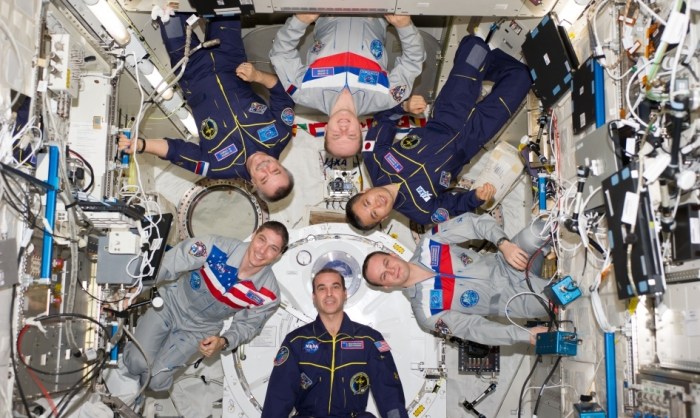
Yesterday, NASA officially announced that it intends to cease most work with the Russian Federal Space Agency amid growing tensions concerning the Ukrainian crisis. The statement came from Bob Jacobs, NASA’s deputy associate administrator of communications, who formalized the space agency’s position with a message sent to Universe Today, a copy of which was then posted on it’s Google+ message board on Wednesday, April 2nd.
In the statement, they indicate that while the International Space Station will still see work to “maintain safe and continuous operation”, most work with Roscosmos (Russia’s federal space agency) will cease. In addition, they were sure to include a reminder to Congress, saying that they now face a choice between fully funding human U.S. launches again in 2017, or facing years more of sending money to the Russians for Soyuz launches from Kazakhstan.
The full text of the statement appears as follows:
Given Russia’s ongoing violation of Ukraine’s sovereignty and territorial integrity, NASA is suspending the majority of its ongoing engagements with the Russian Federation. NASA and Roscosmos will, however, continue to work together to maintain safe and continuous operation of the International Space Station.
NASA is laser focused on a plan to return human spaceflight launches to American soil, and end our reliance on Russia to get into space. This has been a top priority of the Obama Administration’s for the past five years, and had our plan been fully funded, we would have returned American human spaceflight launches – and the jobs they support – back to the United States next year.
With the reduced level of funding approved by Congress, we’re now looking at launching from U.S. soil in 2017. The choice here is between fully funding the plan to bring space launches back to America or continuing to send millions of dollars to the Russians. It’s that simple. The Obama Administration chooses to invest in America – and we are hopeful that Congress will do the same.
So far, it’s not exactly clear what activities would constitute “safe and continuous operation” of the station. So, for example, whether or not NASA will continue to send photographers to cover launches and landing in Russia, or to what extent NASA TV broadcasts of Russian spacewalks would be affected, remains to be seen. And in the meantime, missions already scheduled for launch – such as Expedition 40, which will launch aboard a Soyuz spacecraft in May – are still expected to go ahead.
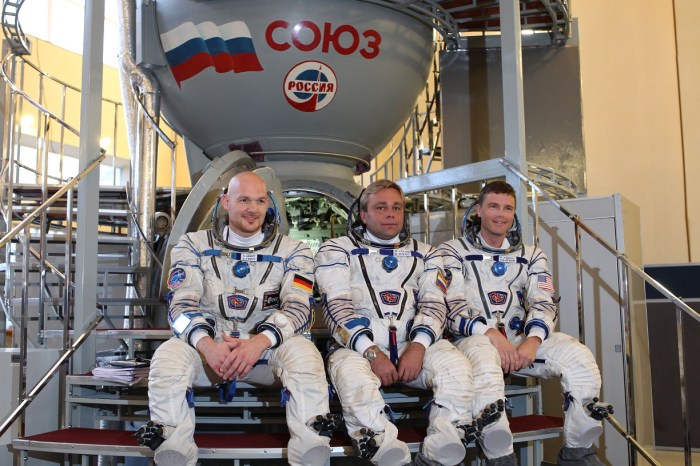
Since the Space Shuttle Program was retired in 2011, NASA and other space agencies such as the European Space Agency have relied on Russian Soyuz spacecraft to bring astronauts to the International Space Station. Crews are generally made up of large proportions of Russian cosmonauts and American astronauts, as well as a few astronauts from other agencies. The current Expedition 39 crew has has three Russians, two Americans and a Japanese commander, Koichi Wakata.
The relationship between NASA and Russia stretches back to the 1970s when Russia was still the Soviet Union, with their first joint mission (the Apollo-Soyuz Test Project) taking place in 1975. The relationship expanded when several NASA shuttles visited the Russian space station Mir in the 1990s, laying the groundwork for the International Space Station agreement today. And 2011, that relationship expanded considerably, with Russian rockets not only transporting ISS crews, but also US and European satellites into orbit.
NASA is working on a commercial crew program that right now is slated to bring U.S. astronauts back into space from American soil by 2017. There are several proposals being considered: a human-rated version of SpaceX’s Dragon, Blue Origin’s New Shepard, Sierra Nevada’s Dream Chaser and the Boeing CST-100. However, these depend upon continued funding and it is currently unclear how much money the CCP program will receive in the upcoming fiscal 2015 budget request before Congress.
Historically, NASA has repeatedly received less funding than what it has requested, which has resulted in missions being delayed – sometimes by years. But the new tensions with Russia may alter that situation somewhat, and judging from their statement, NASA is counting on this very thing. In the meantime, International Space Station operations were extended to at least 2024, and NASA officials have pointed out that it and similar agreements have weathered other world crises.
Today marks the 28th anniversary of the Shuttle Challenger Disaster, an incident which has lived on in the memories of people around the world and to many, signaled the end of an era. The shuttle’s explosion, which took place at 11:39:13 am EST on January 28th, 1986, occurred just 73 seconds into flight after it took off from Cape Canaveral on the Florida coast.
According to investigators, the accident occurred when the O-ring seal in the shuttle’s solid rocket booster failed during liftoff, which allowed pressurized hot gas from within the solid rocket motor to reach the outside. This malfunction led to the separation of the right-hand solid rocket booster’s aft attachment and the structural failure of the external tank.
The fallen crew members included NASA astronauts Greg Jarvis, Ronald McNair, Ellison Onizuka, Judith Resnik, Michael J. Smith and Dick Scobee, as well as school teacher Christa McAuliffe. It was because of McAuliffe’s presence on the shuttle – as the first member of the Teacher in Space Project – that roughly 17 percent of Americans were tuned to their TVs during the time of the accident and witnessed the tragedy.
The disaster resulted in a 32-month hiatus in the shuttle program and the formation of the Rogers Commission, a presidential commission charged with investigating the accident. It revealed, amongst other things, that NASA’s organizational culture was in part responsible for the disaster. In short, NASA managers had known that the O-Rings in the Solid Rocket Booster (SRB) design contained a fatal flaw, one which was overlooked.
The investigation also revealed that engineers at Morton Thiokol, the manufacturer of the rocket boosters, had warned them prior to the launch of the flaw. One such engineer was Roger Boisjoly, who realized that a shuttle launch in the cold weather that Florida was experiencing would pose a grave danger. As he had indicated, the rockets weren’t designed to launch safely in weather below 40 degrees Fahrenheit.
NASA officials at the time rejected Boisjoly’s warning, saying that he was acting on a gut feeling rather than science. Boisjoly told The Times in an interview in 2003 that NASA tried to blacklist him from the industry, and went so far as to argue that some NASA officials should be indicted for manslaughter charges, and the agency should be abolished.
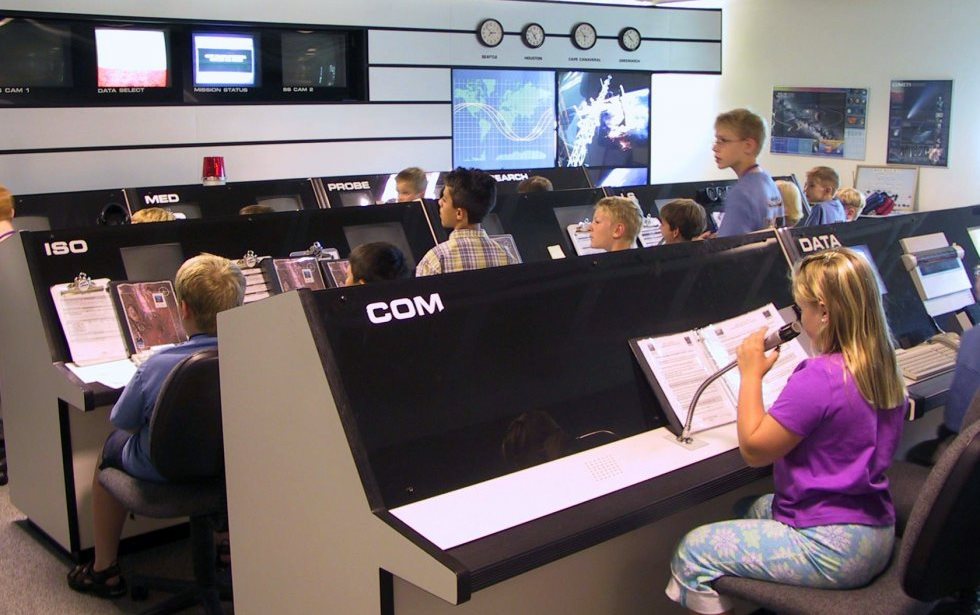
There are many memorials to the fallen crew, but one of the most cited in education is the 40 Challenger Learning Centers that are located in the United States, Canada, United Kingdom and South Korea. The network was founded by June Scobee Rogers (the widow of commander Scobee) and includes participation from other Challenger family members.
According to their website, their goal is to:
[G]ive students the chance to become astronauts and engineers and solve real-world problems as they share the thrill of discovery on missions through the Solar System.
As a result of the disaster, the Air Force decided to cancel its plans to use the Shuttle for classified military satellite launches from Vandenberg Air Force Base in California, deciding to use the Titan IV instead. Media coverage of the accident was also extensive, with one study indicating that 85 percent of Americans had heard the news within an hour of the accident.
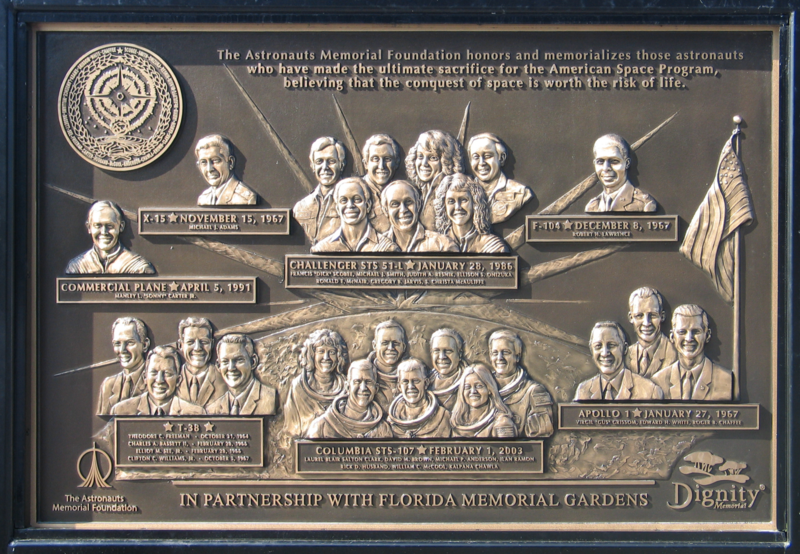
Challenger’s anniversary comes in a week that includes other tragic anniversaries, including the Apollo 1 pad fire that occurred on Jan. 27th, 1967 and claimed the lives of three astronauts’ lives; the Columbia shuttle breakup that happened on Feb. 1st, 2003 and killed seven. Many other astronauts have died in training accidents, and their names are listed at the Astronaut Memorial Foundation.
The disaster has also been used as a case study in many discussions of engineering safety and workplace ethics. And it serves as a constant reminder of the bravery of those who choose to go into space for the sake of advancing science and our understanding of the cosmos. It’s also a reminder that the only safeguard against tragic accidents is eternal vigilance!
Let us all hope and pray no such incidents happen as we embark on a renewed age of space exploration and discovery!
With all of the world’s current problems, poverty, underdevelopment, terrorism, civil war, and environmental degradation, it’s easy to overlook how things are getting better around the world. Not only do we no longer live in a world where superpowers are no longer aiming nuclear missiles at each other and two-thirds of the human race live beneath totalitarian regimes; in terms of health, mortality, and income, life is getting better too.
So, in honor of the New Year and all our hopes for a better world, here’s a gander at how life is improving and is likely to continue…
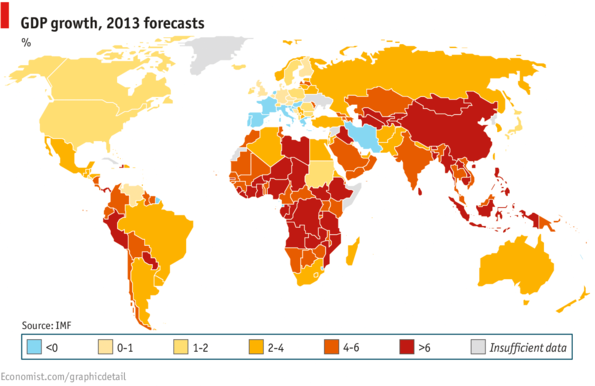
1. Poverty is decreasing: The population currently whose income or consumption is below the poverty line – subsisting on less than $1.25 a day – is steadily dropping. In fact, the overall economic growth of the past 50 years has been proportionately greater than that experienced in the previous 500. Much of this is due not only to the growth taking place in China and India, but also Brazil, Russia, and Sub-Saharan Africa. In fact, while developing nations complain about debt crises and ongoing recession, the world’s poorest areas continue to grow.
2. Health is improving:
The overall caloric consumption of people around the world is increasing, meaning that world hunger is on the wane. Infant mortality, a major issue arising from poverty, and underdevelopment, and closely related to overpopulation, is also dropping. And while rates of cancer continue to rise, the rate of cancer mortality continue to decrease. And perhaps biggest of all, the world will be entering into 2014 with several working vaccines and even cures for HIV (of which I’ve made many posts).
3. Education is on the rise:
More children worldwide (especially girls) have educational opportunities, with enrollment increasing in both primary and secondary schools. Literacy is also on the rise, with the global rate reaching as high as 84% by 2012. At its current rate of growth, global rates of literacy have more than doubled since 1970, and the connections between literacy, economic development, and life expectancy are all well established.
4. The Internet and computing are getting faster:
Ever since the internet revolution began, connection speeds and bandwidth have been increasing significantly year after year. In fact, the global average connection speed for the first quarter of 2012 hit 2.6 Mbps, which is a 25 percent year-over-year gain, and a 14 percent gain over the fourth quarter of 2011. And by the second quarter of 2013, the overall global average peak connection speed reached 18.9 Mbps, which represented a 17 percent gan over 2012.
And while computing appears to be reaching a bottleneck, the overall increase in speed has increased by a factor of 260,000 in the past forty years, and storage capacity by a factor of 10,000 in the last twenty. And in terms of breaking the current limitations imposed by chip size and materials, developments in graphene, carbon nanotubes, and biochips are promising solutions.
5. Unintended pregnancies are down:
While it still remains high in the developing regions of the world, the global rate of unintended pregnancies has fallen dramatically in recent years. In fact, between 1995 and 2008, of 208 billion pregnancies surveyed in a total of 80 nations, 41 percent of the pregnancies were unintended. However, this represents a drop of 29 percent in the developed regions surveyed and a 20 percent drop in developing regions.
The consequences of unintended pregnancies for women and their families is well established, and any drop presents opportunities for greater health, safety, and freedom for women. What’s more, a drop in the rate of unwanted pregnancies is surefire sign of socioeconomic development and increasing opportunities for women and girls worldwide.
6. Population growth is slowing: On this blog of mine, I’m always ranting about how overpopulation is bad and going to get to get worse in the near future. But in truth, that is only part of the story. The upside is while the numbers keep going up, the rate of increase is going down. While global population is expected to rise to 9.3 billion by 2050 and 10.1 billion by 2100, this represents a serious slowing of growth.
If one were to compare these growth projections to what happened in the 20th century, where population rose from 1 billion to just over 6, they would see that the rate of growth has halved. What’s more, rates of population growth are expecting to begin falling in Asia by 2060 (one of the biggest contributors to world population in the 20th century), in Europe by 2055, and the Caribbean by 2065.
In fact, the only region where exponential population growth is expected to happen is Africa, where the population of over 1 billion is expected to reach 4 billion by the end of the 21st century. And given the current rate of economic growth, this could represent a positive development for the continent, which could see itself becoming the next powerhouse economy by the 2050s.
7. Clean energy is getting cheaper:
While the price of fossil fuels are going up around the world, forcing companies to turn to dirty means of oil and natural gas extraction, the price of solar energy has been dropping exponentially. In fact, the per capita cost of this renewable source of energy ($ per watt) has dropped from a high of $80 in 1977 to 0.74 this past year. This represents a 108 fold decrease in the space of 36 years.
And while solar currently comprises only a quarter of a percent of the planet’s electricity supply, its total share grew by 86% last year. In addition, wind farms already provide 2% of the world’s electricity, and their capacity is doubling every three years. At this rate of increase, solar, wind and other renewables are likely to completely offset coal, oil and gas in the near future.
Summary:
In short, things are looking up, even if they do have a long way to go. And a lot of what is expected to make the world a better place is likely to happen this year. Who knows which diseases we will find cures for? Who knows what inspirational leaders will come forward? And who knows what new and exciting inventions will be created, ones which offer creative and innovative solutions to our current problems?
Who knows? All I can say is that I am eager to find out!
The new year is literally right around the corner, folks. And I thought what better way to celebrate 2013 than by acknowledging its many scientific breakthroughs. And there were so many to be had – ranging in fields from bioresearch and medicine, space and extra-terrestrial exploration, computing and robotics, and biology and anthropology – that I couldn’t possibly do them all justice.
Luckily, I have found a lovely, condensed list which managed to capture what are arguably the biggest hits of the year. Many of these were ones I managed to write about as they were happening, and many were not. But that’s what’s good about retrospectives, they make us take account of things we missed and what we might like to catch up on. And of course, I threw in a few stories that weren’t included, but which I felt belonged.
So without further ado, here are the top 12 biggest breakthroughs of 2013:
1. Voyager 1 Leaves the Solar System:
For 36 years, NASA’s Voyager 1 spacecraft has travelling father and farther away from Earth, often at speeds approaching 18 km (11 miles) per second. At a pace like that, scientists knew Voyager would sooner or later breach the fringe of the heliosphere that surrounds and defines our solar neighborhood and enter the bosom of our Milky Way Galaxy. But when it would finally break that threshold was a question no one could answer. And after months of uncertainty, NASA finally announced in September that the space probe had done it. As Don Gurnett, lead author of the paper announcing Voyager’s departure put it: “Voyager 1 is the first human-made object to make it into interstellar space… we’re actually out there.”
2. The Milky Way is Filled with Habitable Exoplanets:
After years of planet hunting, scientists were able to determine from all the data gathered by the Kepler space probe that there could be as many as 2 billion potentially habitable exoplanets in our galaxy. This is the equivalent of roughly 22% of the Milky Way Galaxy, with the nearest being just 12 light years away (Tau Ceti). The astronomers’ results, which were published in October of 2013, showed that roughly one in five sunlike stars harbor Earth-size planets orbiting in their habitable zones, much higher than previously thought.
3. First Brain to Brain Interface:
In February of 2013, scientists announced that they had successfully established an electronic link between the brains of two rats. Even when the animals were separated by thousands of kms distance, signals from the mind of one could help the second solve basic puzzles in real time. By July, a connection was made between the minds of a human and a rat. And by August, two researchers at the Washington University in St. Louis were able to demonstrate that signals could be transmitted between two human brains, effectively making brain-to-brain interfacing (BBI), and not just brain computer interfacing (BCI) truly possible.
4.Long-Lost Continent Discovered:
In February of this year, geologists from the University of Oslo reported that a small precambrian continent known as Mauritia had been found. At one time, this continent resided between Madagascar and India, but was then pushed beneath the ocean by a multi-million-year breakup spurred by tectonic rifts and a yawning sea-floor. But now, volcanic activity has driven the remnants of the long-lost continent right through to the Earth’s surface.
Not only is this an incredibly rare find, the arrival of this continent to the surface has given geologists a chance to study lava sands and minerals which are millions and even billions of years old. In addition to the volcanic lava sands, the majority of which are around 9 million years old, the Oslo team also found deposits of zircon xenocryst that were anywhere from 660 million to 1.97 billion years old. Studies of these and the land mass will help us learn more about Earth’s deep past.
5. Cure for HIV Found!:
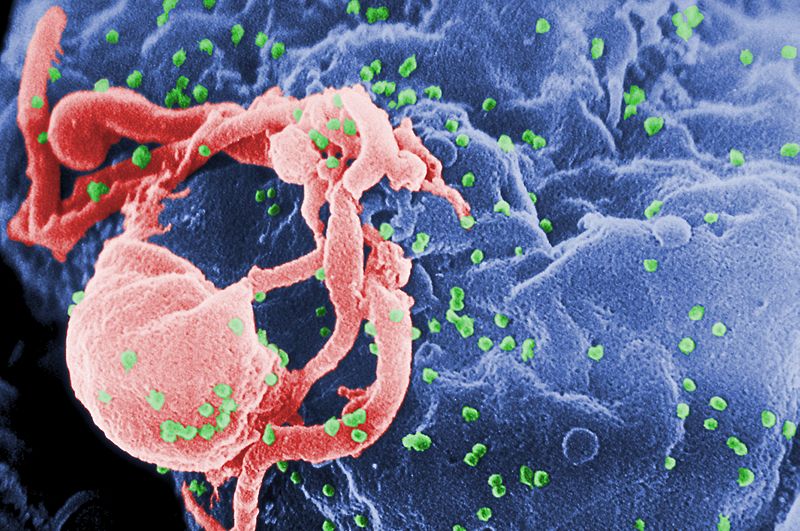
For decades, medical researchers and scientists have been looking to create a vaccine that could prevent one from being infected with HIV. But in 2013, they not developed several vaccines that demonstrated this ability, but went a step further and found several potential cures. The first bit of news came in March, when researchers at Caltech demonstrated using HIV antibodies and an approach known as Vectored ImmunoProphylaxis (VIP) that it was possible to block the virus.
Then came the SAV001 vaccine from the Schulich School of Medicine & Dentistry at Western University in London, Ontario, which aced clinical trials. This was punctuated by researchers at the University of Illinois’, who in May used the “Blue Waters” supercomputer to developed a new series of computer models to get at the heart of the virus.
But even more impressive was the range of potential cures that were developed. The first came in March, where researchers at the Washington University School of Medicine in St. Louis that a solution of bee venom and nanoparticles was capable of killing off the virus, but leaving surrounding tissue unharmed. The second came in the same month, when doctors from Johns Hopkins University Medical School were able to cure a child of HIV thanks to the very early use of antiretroviral therapy (ART).
And in September, two major developments occurred. The first came from Rutgers New Jersey Medical School, where researchers showed that an antiviral foot cream called Ciclopirox was capable of eradicating infectious HIV when applied to cell cultures of the virus. The second came from the Vaccine and Gene Therapy Institute at the Oregon Health and Science University (OHSU), where researchers developed a vaccine that was also able to cure HIV in about 50% of test subjects. Taken together, these developments may signal the beginning of the end of the HIV pandemic.
6. Newly Discovered Skulls Alter Thoughts on Human Evolution:
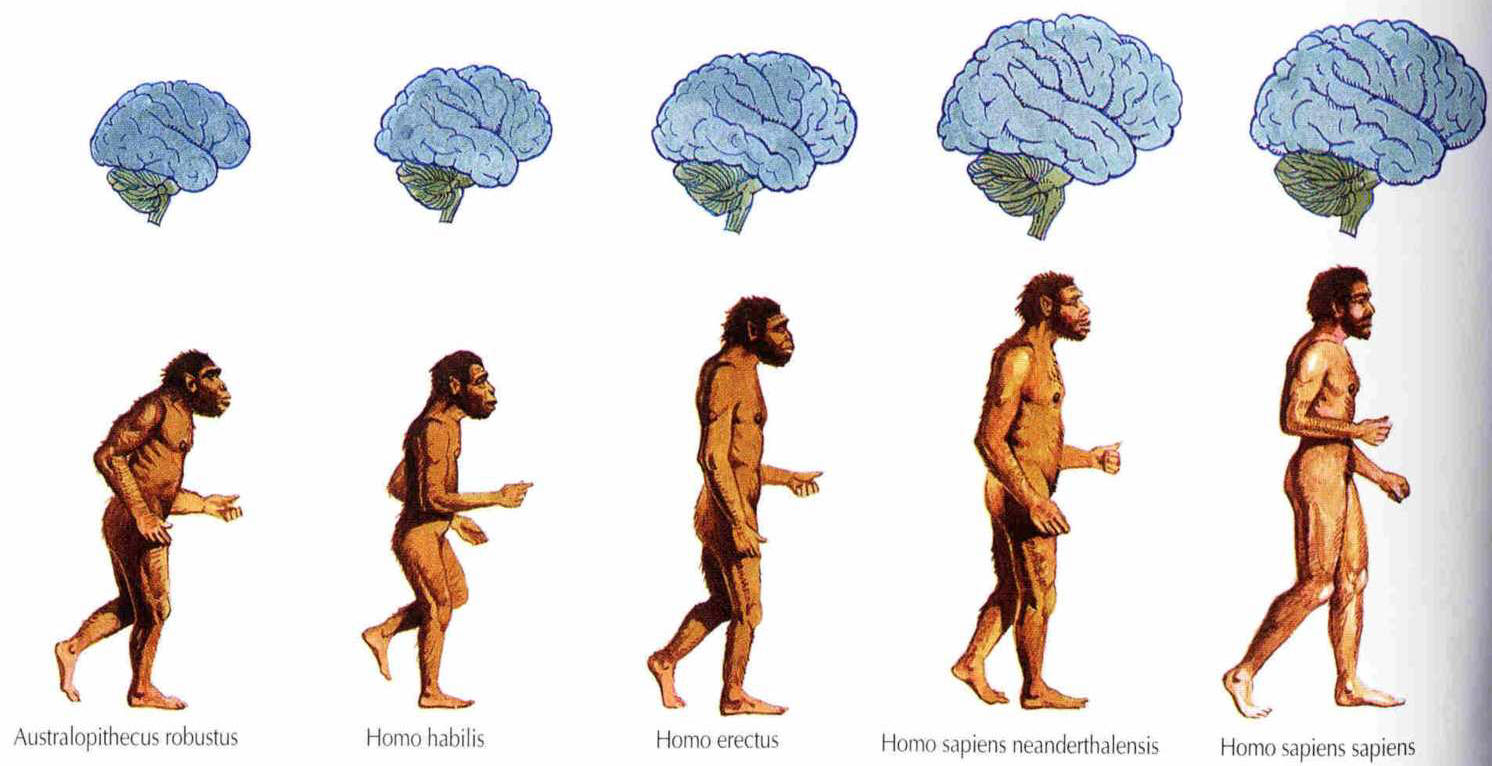
The discovery of an incredibly well-preserved skull from Dmanisi, Georgia has made anthropologists rethink human evolution. This 1.8 million-year old skull has basically suggested that our evolutionary tree may have fewer branches than previously thought. Compared with other skulls discovered nearby, it suggests that the earliest known members of the Homo genus (H. habilis, H.rudolfensis and H. erectus) may not have been distinct, coexisting species, but instead were part of a single, evolving lineage that eventually gave rise to modern humans.
7. Curiosity Confirms Signs of Life on Mars:
Over the past two years, the Curiosity and Opportunity rovers have provided a seemingly endless stream of scientific revelations. But in March of 2013, NASA scientists released perhaps the most compelling evidence to date that the Red Planet was once capable of harboring life. This consisted of drilling samples out of the sedimentary rock in a river bed in the area known as Yellowknife Bay.
Using its battery of onboard instruments, NASA scientists were able to detect some of the critical elements required for life – including sulfur, nitrogen, hydrogen, oxygen, phosphorus, and carbon. The rover is currently on a trek to its primary scientific target – a three-mile-high peak at the center of Gale Crater named Mount Sharp – where it will attempt to further reinforce its findings.
8. Scientists Turn Brain Matter Invisible:
Since its inception as a science, neuroanatomy – the study of the brain’s functions and makeup – has been hampered by the fact that the brain is composed of “grey matter”. For one, microscopes cannot look beyond a millimeter into biological matter before images in the viewfinder get blurry. And the common technique of “sectioning” – where a brain is frozen in liquid nitrogen and then sliced into thin sheets for analysis – results in tissue being deformed, connections being severed, and information being lost.
But a new technique, known as CLARITY, works by stripping away all of a tissue’s light-scattering lipids, while leaving all of its significant structures – i.e. neurons, synapses, proteins and DNA – intact and in place. Given that this solution will allow researchers to study samples of the brains without having to cut them up, it is already being hailed as one of the most important advances for neuroanatomy in decades.
9. Scientists Detect Neutrinos from Another Galaxy:
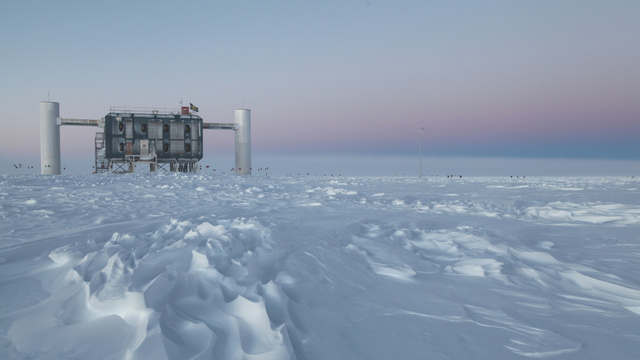
In April of this year, physicists working at the IceCube South Pole Observatory took part in an expedition which drilled a hole some 2.4 km (1.5 mile) hole deep into an Antarctic glacier. At the bottom of this hole, they managed to capture 28 neutrinos, a mysterious and extremely powerful subatomic particle that can pass straight through solid matter. But the real kicker was the fact that these particles likely originated from beyond our solar system – and possibly even our galaxy.
That was impressive in and off itself, but was made even more so when it was learned that these particular neutrinos are over a billion times more powerful than the ones originating from our sun. So whatever created them would have had to have been cataclysmicly powerful – such as a supernova explosion. This find, combined with the detection technique used to find them, has ushered in a new age of astronomy.
10. Human Cloning Becomes a Reality:
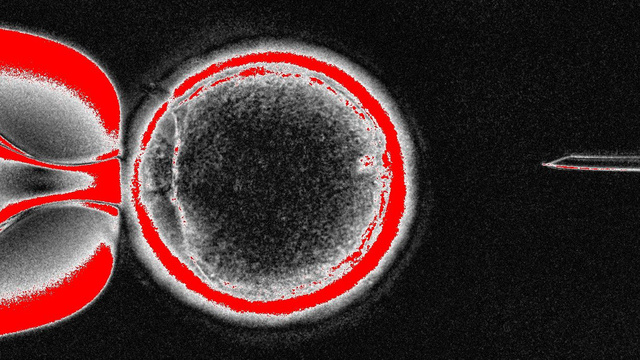
Ever since Dolly the sheep was cloned via somatic cell nuclear transfer, scientists have wondered if a similar technique could be used to produce human embryonic stem cells. And as of May, researchers at Oregon Health and Science University managed to do just that. This development is not only a step toward developing replacement tissue to treat diseases, but one that might also hasten the day when it will be possible to create cloned, human babies.
11. World’s First Lab Grown Meat:
In May of this year, after years of research and hundred of thousands of dollars invested, researchers at the University of Maastricht in the Netherlands created the world’s first in vitro burgers. The burgers were fashioned from stem cells taken from a cow’s neck which were placed in growth medium, grown into strips of muscle tissue, and then assembled into a burger. This development may prove to be a viable solution to world hunger, especially in the coming decades as the world’s population increases by several billion.
12. The Amplituhedron Discovered:
If 2012 will be remembered as the year that the Higgs Boson was finally discovered, 2013 will forever be remembered as the year of the Amplituhedron. After many decades of trying to reformulate quantum field theory to account for gravity, scientists at Harvard University discovered of a jewel-like geometric object that they believe will not only simplify quantum science, but forever alters our understanding of the universe.
This geometric shape, which is a representation of the coherent mathematical structure behind quantum field theory, has simplified scientists’ notions of the universe by postulating that space and time are not fundamental components of reality, but merely consequences of the”jewel’s” geometry. By removing locality and unitarity, this discovery may finally lead to an explanation as to how all the fundamental forces of the universe coexist.
These forces are weak nuclear forces, strong nuclear forces, electromagnetism and gravity. For decades, scientists have been forced to treat them according to separate principles – using Quantum Field Theory to explain the first three, and General Relativity to explain gravity. But now, a Grand Unifying Theory or Theory of Everything may actually be possible.
13. Bioprinting Explodes:
The year of 2013 was also a boon year for bioprinting – namely, using the technology of additive manufacturing to create samples of living tissue. This began in earnest in February, where a team of researchers at Heriot-Watt University in Scotland used a new printing technique to deposit live embryonic stem cells onto a surface in a specific pattern. Using this process, they were able to create entire cultures of tissue which could be morphed into specific types of tissue.
Later that month, researchers at Cornell University used a technique known as “high-fidelity tissue engineering” – which involved using artificial living cells deposited by a 3-D printer over shaped cow cartilage – to create a replacement human ear. This was followed some months later in April when a San Diego-based firm named Organova announced that they were able to create samples of liver cells using 3D printing technology.
And then in August, researchers at Huazhong University of Science and Technology were able to use the same technique create the world first, living kidneys. All of this is pointing the way towards a future where human body parts can be created simply by culturing cells from a donor’s DNA, and replacement organs can be synthetically created, revolutionizing medicine forever.
14. Bionic Machinery Expands:
If you’re a science buff, or someone who has had to go through life with a physical disability, 2013 was also a very big year for the field of bionic machinery. This consisted not only of machinery that could meld with the human body in order to perform fully-human tasks – thus restoring ambulatory ability to people dealing with disabling injuries or diseases – but also biomimetic machinery.
The first took place in February, where researchers from the University of of Tübingen unveiled the world’s first high-resolution, user-configurable bionic eye. Known officially as the “Alpha IMS retinal prosthesis”, the device helps to restore vision by converted light into electrical signals your retina and then transmitted to the brain via the optic nerve. This was followed in August by the Argus II “retinal prosthetic system” being approved by the FDA, after 20 years of research, for distribution in the US.
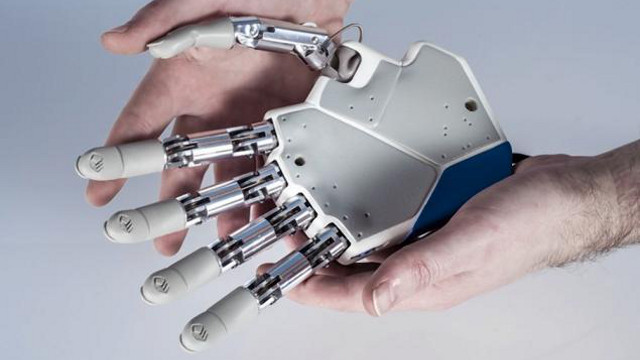
Later that same month, the Ecole Polytechnique Federale de Lausanne in Switzerland unveiled the world’s first sensory prosthetic hand. Whereas existing mind-controlled prosthetic devices used nerve signals from the user to control the movements of the limb, this new device sends electrostimulus to the user’s nerves to simulate the sensation of touch.
Then in April, the University of Georgia announced that it had created a brand of “smart skin” – a transparent, flexible film that uses 8000 touch-sensitive transistors – that is just as sensitive as the real thing. In July, researchers in Israel took this a step further, showing how a gold-polyester nanomaterial would be ideal as a material for artificial skin, since it experiences changes in conductivity as it is bent.
15. 400,000 Year-Old DNA Confuses Humanity’s Origin Story:
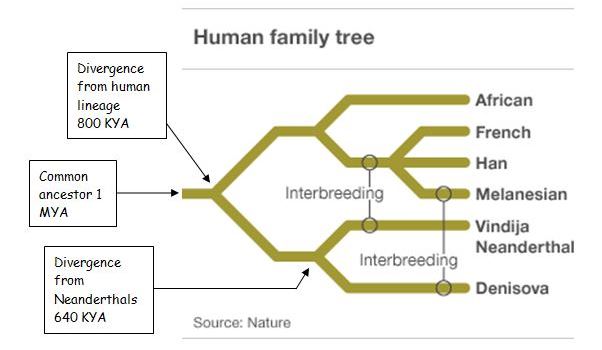
Another discovery made this year has forced anthropologist to rethink human evolution. This occurred in Spain early in December, where a team from the Max Planck Institute for Evolutionary Anthropology in Leipzig, Germany recovered a 400,000 year-old thigh bone. Initially thought to be a forerunner of the Neanderthal branch of hominids, it was later learned that it belonged to the little-understood branch of hominins known as Denisovans.
The discordant findings are leading anthropologists to reconsider the last several hundred thousand years of human evolution. In short, it indicates that there may yet be many extinct human populations that scientists have yet to discover. What’s more, there DNA may prove to be part of modern humans genetic makeup, as interbreeding is a possibility.
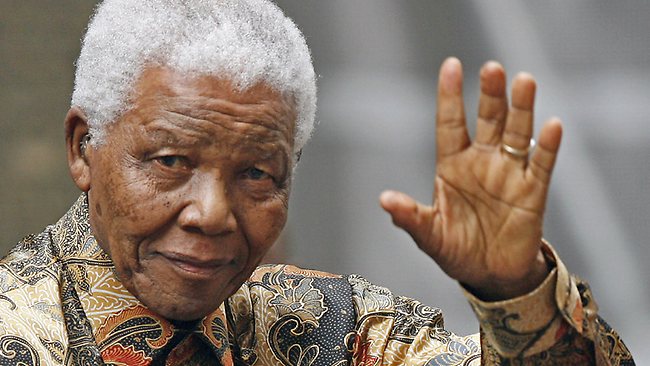
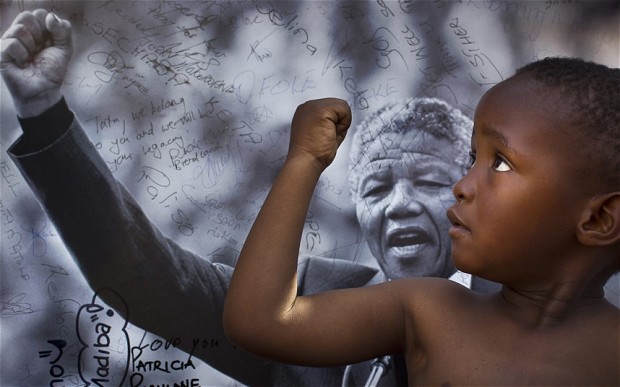
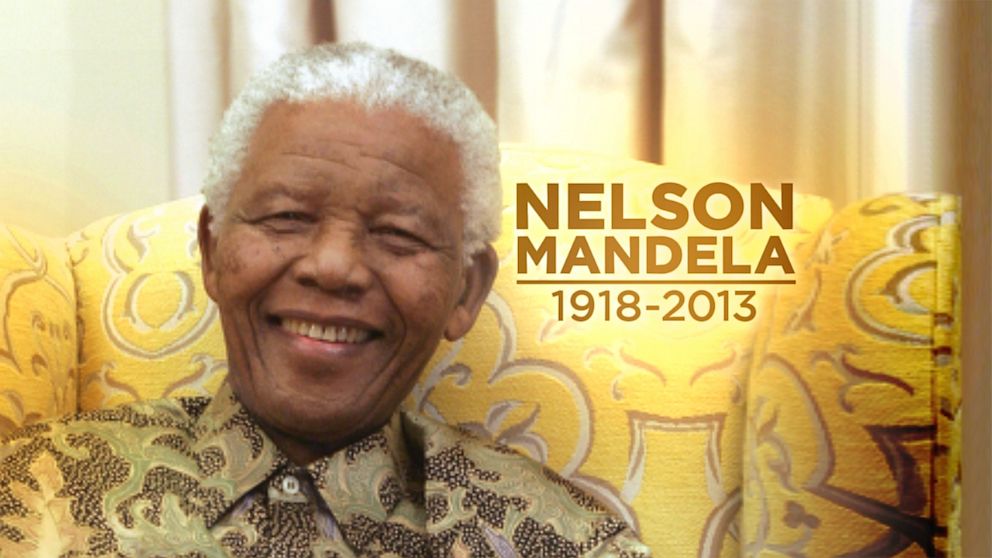
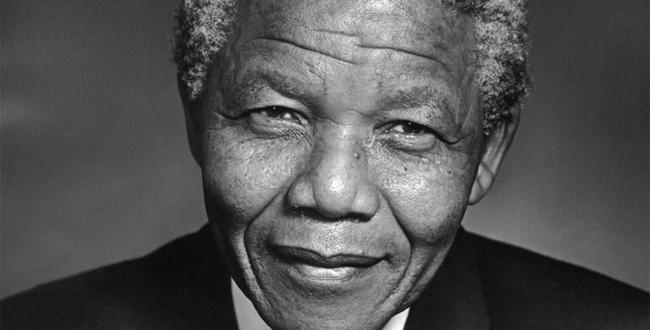
This week, former president, activist, and “father of the nation” Nelson Mandela died in his home in Houghton, Johannesburg. Having spent the last few years battling with failing health, he finally succumbed to a lung infection and passed away, surrounded by his family. He was 95 years of age, and his life and accomplishments reach far beyond the nation that considered him its mentor, leader, and father figure.
Today, in response to the news of his passing, President Zuma has announced a national mourning period of ten days, with the main event being an official memorial service to be held at the FNB Stadium in Johannesburg on December 10th, 2013. Mandela’s body will lie in state from the December 11th to 13th at the Union Buildings in Pretoria and a state funeral will be held on December 15th.
As current President Jacob Zuma said today of South Africa’s founding President, he was an:
international icon who was a symbol of reconciliation … love, human rights and justice in our country and to the world. The outpouring of love … illustrates the caliber of leader that Madiba was …, The week of mourning will also celebrate a life well lived.
Mandela’s grandson, Mandla Mandela, said he was strengthened by the knowledge that his grandfather was finally resting. He also said that the late statesman was the embodiment of strength, struggle and survival. As a grandfather, Mandela would always be remembered as kind-hearted, generous and wise. Mandla also expressed gratitude for the national and international support his family had received during Mandela’s long health problems.
In a statement, the grandson of the elder statesman said the following:
All that I can do is thank God that I had a grandfather who loved and guided all of us in the family. The best lesson that he taught all of us was the need for us to be prepared to be of service to our people… We in the family recognize that Madiba belongs not only to us but to the entire world. The messages we have received since last night have heartened and overwhelmed us.
Zelda la Grange, Mandela’s personal assistant for almost two decades, said the elder statesman inspired people to forgive, reconcile, care, be selfless, tolerant and to maintain dignity no matter what the circumstances. She said in a statement:
His legacy will not only live on in everything that has been named after him, the books, the images, the movies. It will live on in how we feel when we hear his name, the respect and love, the unity he inspired in us as a country, but particularly how we relate to one another.
In a church service in Cape Town, retired archbishop Desmond Tutu – another major South African activist and humanitarian who embodies the spirit of reconciliation and tolerance – said the anti-apartheid leader who became South Africa’s first black president would want South Africans themselves to be his “memorial” by adhering to the values of unity and democracy that he embodied.
Recalling how Mandela helped unite South Africa as it dismantled apartheid, and prepared for all-race elections in 1994, Tutu said that: “All of us here in many ways amazed the world, a world that was expecting us to be devastated by a racial conflagration.” In closing his prayer, Tutu said: “God, thank-you for the gift of Madiba.” Mourners also gathered outside Mandela’s former home on Vilakazi Street in the city’s black township of Soweto.
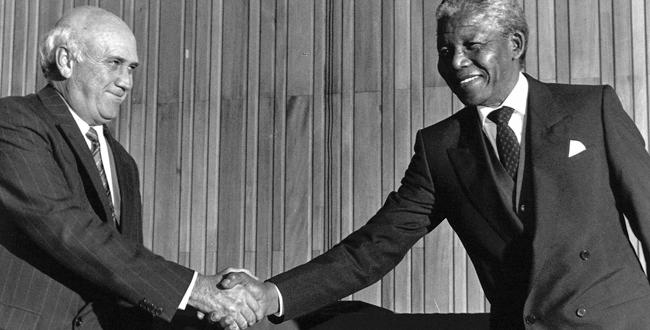
Also speaking of Mandela’s legacy was F.W. de Klerk, South Africa’s last apartheid-era president who negotiated an end to apartheid with Mandela. By finding common cause in often tense circumstances, the two men shared the Nobel Peace Prize in 1993. In summarizing Mandela’s legacy, de Klerk told eNCA television: “Never and never again should there be in South Africa the suppression of anyone by another.”
Helen Zille, leader of the country’s official opposition party, the Democratic Alliance, and premier of the Western Cape, the only province not controlled by the ANC, commented:
We all belong to the South African family — and we owe that sense of belonging to Madiba. That is his legacy. It is why there is an unparalleled outpouring of national grief at his passing. It is commensurate with the contribution he made to our country.
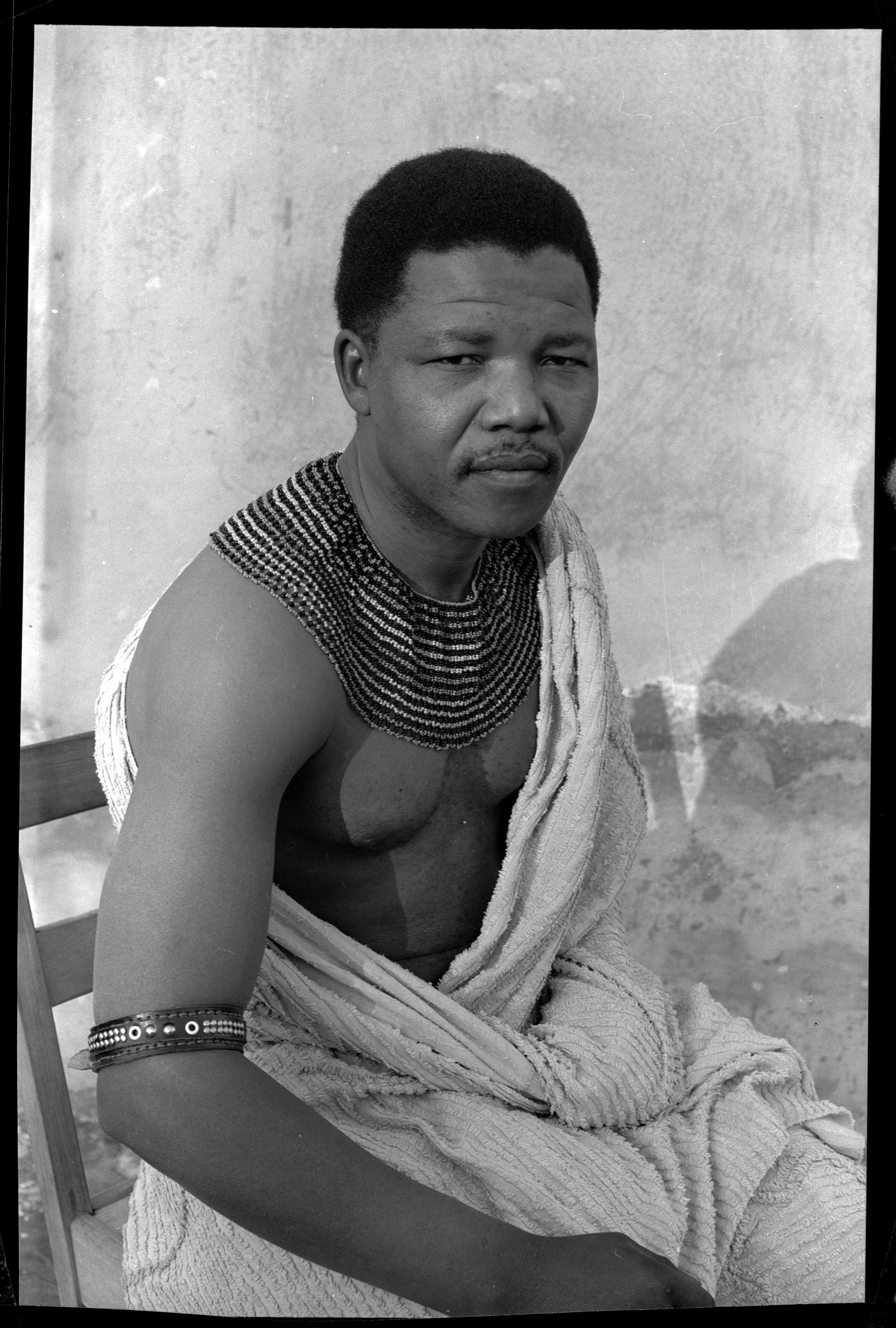
Mandela leaves behind a legacy that is virtually unparalleled in modern history, comparable only to Martin Luther King Jr. and Mohandas Gandhi. Also known as “Madiba” – a clan name that is considered of greater importance than a surname in Mandela’s ancestral Xhosa culture – Mandela was not South Africa’s first black President, but the first man to be elected in a fully representative election.
Having spent his life fighting against Apartheid, Mandela’s also spent his time as President – from 1994 to 1999 – focusing on dismantling the legacy of apartheid through tackling institutionalized racism, poverty and inequality, and fostering racial reconciliation. From 1991 to 1997, he also served as President of the African National Congress (ANC) and was the Secretary General of the Non-Aligned Movement – a group of states not aligned to any specific power bloc – from 1998 to 1999.
But what is especially poignant and significant about Mandela’s life is the fact that from 1964 to 1990 (a period of 27 years) he conducted his campaign for reform and racial inclusion from a prison cell. After being arrested for high treason against the government. This was the culmination of many years of agitation and resistance against a government that was becoming increasingly racist and authoritarian, and opposed to the winds of change that had been blowing through the country for years.
Due to his involvement with the ANC and the organization’s adoption of increasingly militant tactics in order to fight against the Nationalist pro-apartheid government, and its institution of martial law, Mandela was convicted of sabotage and conspiracy to overthrow the government and made one of his famous “I am prepared to die” speech (inspired by Castro’s “History will absolve me” speech):
During my lifetime I have dedicated myself to this struggle of the African people. I have fought against white domination, and I have fought against black domination. I have cherished the ideal of a democratic and free society in which all persons live together in harmony and with equal opportunities. It is an ideal which I hope to live for and to achieve. But if needs be, it is an ideal for which I am prepared to die.
Despite official censorship, this speech and the trial proceedings were broadcast around the world and numerous organizations – including the United Nations and the Word Peace Council – petitioned the South African government for clemency. These were ignored, and Mandela spent the next 27 years in a series of prisons before finally being released in 1990.
Upon his release, Mandela went back to advocating against apartheid and found a willing partner in President F.W. de Klerk. Together, and over the course of three years from 1990 to 1993, they dismantled the racialist apparatus of power installed by the Nationalist Party and opened up the franchise to all South Africans. In the 1994 General Election, the first free and open election in South Africa’s history, Mandela ran and won, becoming the first black president in the country’s history.
And despite what many observers and angry Afrikaners believed, that the election of a black president would signal a race war, Mandela presided over a period of peace and reconciliation between all of the nation’s people. Though the transition was not easy and there were bumps along the way, the next five years were marked overwhelmingly by progress and optimism as the country moved towards a truly free and open state.
From all this, Nelson Rolihlahla “Madiba” Mandela has forever been known as a man who defied the odds and remained stalwart in his commitment to improve the lives of his people, regardless of their race, creed, ethnicity, or background. In response to his passing, the Nelson Mandela Foundation – a charity devoted to social justice, peace, human rights and democracy – posted the following message on its website:
It is with the deepest regret that we have learned of the passing of our founder, Nelson Rolihlahla Mandela – Madiba. The Presidency of the Republic of South Africa will shortly make further official announcements.
We want to express our sadness at this time. No words can adequately describe this enormous loss to our nation and to the world.
We give thanks for his life, his leadership, his devotion to humanity and humanitarian causes. We salute our friend, colleague and comrade and thank him for his sacrifices for our freedom. The three charitable organisations that he created dedicate ourselves to continue promoting his extraordinary legacy.
Many world leaders are expected to converge on South Africa to witness the funeral of this elder statesman and advocate for peace and human rights, amongst them President Barack Obama and Canadian Prime Minister Stephen Harper. They will be joined by people from all over the world who will bear witness to the passing of a man who is sure to be remembered as one of history’s greatest.
Rest in peace Madiba. The world was made better because of your time within it. And we could sure use more people like you as we step into the future!
It goes by many names the world over. In Canada, Britain and Australia, we call it Remembrance Day. In the United States, it’s called by Veteran’s Day. In New Zealand, France, Belgium and Serbia, it’s known as Armistice Day. And to the Polish, it’s Independence Day since the end of World War I was also the occasion when their country achieved statehood.
Interestingly enough, the war that it originally commemorates also goes by many names. To those who fought in it, it was the Great War, but also the “War to end all wars”, as no one who lived through it could fathom that any nation would ever go to war again. And to those who have went to war again just 27 years later, it would come to be known as World War I or the First World War.
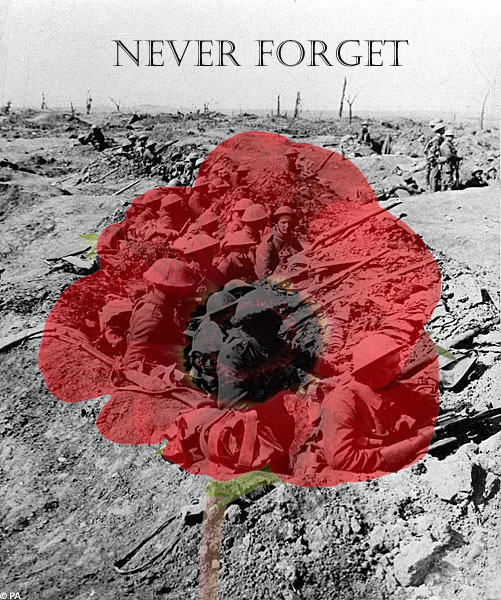
Regardless of the name, November 11 is a day when people the world over come together to mark one of the worst periods in our history, celebrate those who made the ultimate sacrifice, and reflect upon the terrible lessons that were learned. And while it is easy to look upon the world and imagine that we’ve learned nothing, I choose to believe otherwise.
When the world went to war in August of 1914, the news was greeted with general elation for those involved. In Berlin, Paris and London, crowds emerged to celebrate the fact that their nations were mobilizing against their enemies. In Canada, people readily volunteered to serve overseas and “fight the Hun”. The propaganda mills of every nation were running overtime, stoking the fervor of war, claiming rightness, and that God was on their side.
Four years later, few retained these romantic notions of war. Those who survived the carnage were known as “The Lost Generation”, and those born after the war entered into a world struggling to leave the memory behind and get back to normal. When war was once again declared in 1939, few were enthused, and the general attitude was one o fear.
In fact, part of the reason “Appeasement” – the strategy of giving in to Hitler’s demands, or accommodating Japanese and Italian expansion in Africa and East Asia – was permitted was because no one wanted a repeat of the last war. Even in the Axis nations of Germany, Japan, and Italy, the general public entered the war only reluctantly, convinced they had no choice and fearful for how it might turn out.
Six years, 70 million lives, 1600 cities, and several attempted genocides later, the victorious nations of the world once again came together with the common goal of lasting world peace, human rights and economic development. This was embodied in the Universal Declaration of Human Rights, the International Court of Justice, the International Monetary Fund and World Bank Group.
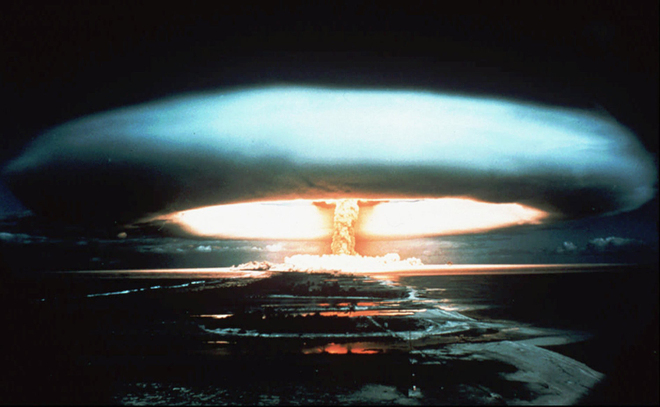
Despite the prevailing mood that a new “Cold War” was already brewing between east and west, the word’s “Never Again” were spoken by people on all sides. After two World Wars and the near total-destruction of many nations, it was understood that the world would not be able to endure a third. Somehow, and despite the arms race of the latter of the half of the 20th century, peace would endure.
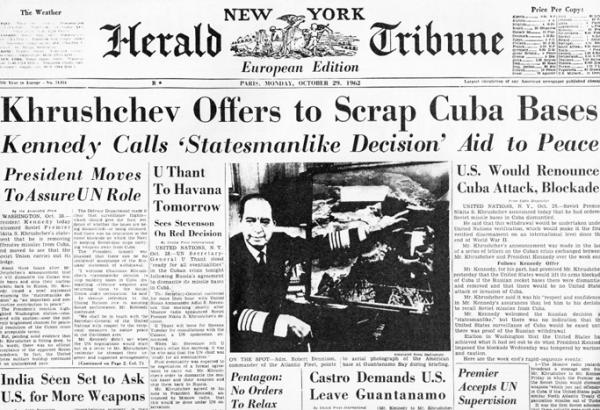
Lucky for all of us, the Cold War ended some two decades ago and the specter of World War III with it. While many wars took place during the intervening period and there were a few close calls (The Cuban Missile Crisis being foremost), a nuclear crisis was continually avoided because all sides understood that no one would emerge the victor.
Today, wars still rage in the underdeveloped regions of the world and even amongst the so-called “developed” nations – the rational ranging from fighting extremism to trying to foster nation building. Nevertheless, I can’t help but look back today and think that those who died and sacrificed so much taught us something invaluable and enduring.
Sure, the Great War did not end all wars, nor did those that followed it. But with every mistake, with every new sacrifice, with every new conflict, surely we have learned something. Were it not for the UN and the spirit multilateralism the prevailed after the Second World War, World War III may have been unavoidable, and might still be a possibility.
And while there were still wars between proxy nations during the Cold War, Korea and Vietnam taught us the futility of political conflicts, a lesson which helped end the Iraq War sooner and with less loss of life than would have otherwise been possible. These sentiments have since been applied to the war in Afghanistan and the drone wars, two more unpopular campaigns that are sure to end in the near future as well.
What’s more, the genocide of the Jewish, Roma and Slavic peoples all across Europe taught us the evils of ethnic cleansing and man’s capacity for hate, lessons which have helped us confront and combat genocide in former Yugoslavia, Rwanda, Darfur, East Timor and elsewhere. They have also forced us to contemplate genocides which have taken place on our soil, in Australia, Canada, the US and Latin America.
To look at the state of the world today, it is easy to grow cynical and say that we’ve learned nothing. But when you consider that fact that we no longer live in a world where total war is seen as glorious, where two superpowers are aiming nuclear-tipped missiles at each other, and where aggression and genocide are actively ignored or accommodated, you begin to appreciate what we have and who made it possible.
But most importantly of all, to say we’ve learned nothing is to disrespect those who made the ultimate sacrifice, not to mention those who came home forever changed and scarred. For these veterans, servicemen and women, and people who risked life and limb to ensure that war would bring peace, that people would remain free, and that greater evils would not be allowed to prevail, saying “it was all in vain” renders what they did for the rest of us meaningless.
With that in mind, I’m very happy to announce that next year, in April of 2014, my family and I will be visiting Europe to witness the Centennial of World War I. While we’re there, we will be visiting the grave sites of those who died overseas, several battlefield from the First and Second World War, and will bear witness to one of the greatest historic events in our lifetimes.
My father made the trip once before and remarked with awe how to people over there, the wars are not something that are commemorated once a year, but on a regular basis. But next year, it is expected to be especially poignant as people from all over the globe converge on Flanders to pay their respects. I expect it to be very eye-opening, and you can expect to be hearing about it the moment I get back!
A sober and reflective Remembrance Day to you all. Peace.
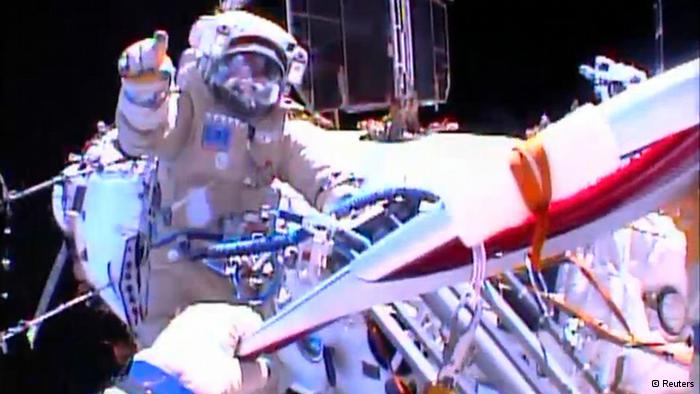
Yesterday, for the first time ever, the Olympic torch was taken into space as two Russian cosmonauts took it on a spacewalk outside of the International Space Station. NASA streamed video of the event as two cosmonauts, Oleg Kotov and Sergei Ryazanskiy, conducted their walk while the torch bobbed weightlessly from the end of a tether.
The two cosmonauts took several photos with the torch hovering with planet Earth in the background, the orb’s edge capturing the sunrise and emitting a bright glow. After two hours, they returned it to the space station and got to other tasks on their itinerary, which included attaching a footrest and a camera platform to the exterior of the orbiting laboratory.
The walk was just latest leg in the torch’s journey, which began on October 7th when the torch was delivered from Greece to Moscow. After touring the country, a journey which took it from Moscow, to St. Petersburg, and even to the North Pole (another first) aboard an atomic-powered icebreaker, the torch was launched last Thursday aboard a Soyuz rocket from the Baikonur Cosmodrome.
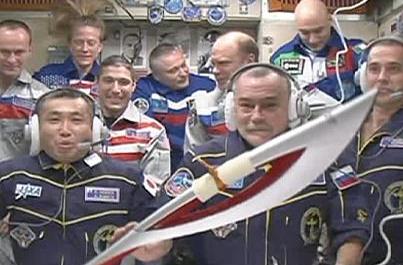
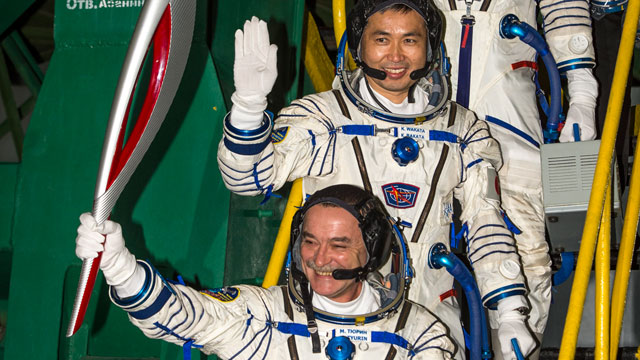
Inspired by the Firebird of Russian folklore, a magical glowing birdt hat can be both a blessing and a curse to its owner, the metre-long torch – which weighs roughly 2 kg (4.4 lbs) on Earth – accompanied a three-man crew into space. This consisted of a Russian cosmonaut and an American and Japanese astronaut, bringing the total number of crew aboard the station to nine.
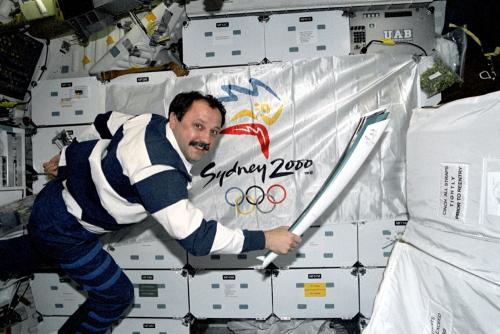
Granted, this is not the first time an Olympic torch has been taken into space. In 1996 and again in 2000, the Atlanta and Sydney Olympic torches were flown into space aboard the U.S. Space Shuttle Atlantis, in preparation for the Atlanta Summer Olympics. However, in that case, the torch was not taken outside of the spacecraft, which makes this a true first.
Much like on that occasion, the torch remained unlit while it was in space, as lighting it would have consumed precious oxygen. Still, the ISS crew managed to carry the unlit torch with them on a tour through several of the station’s modules and snapped pictures of it all. This took place over the course of several days before it stepped into space on Saturday.
The torch is set to return to Earth tomorrow along with Russian cosmonaut Fyodor Yurchikhin, U.S. astronaut Karen Nyberg and Italian Luca Parmitano of the European Space Agency. Once home, it will be handed off to Sochi 2014 officials and continue on its 65,000 kilometer (44,000 mile) journey, which just happens to be the longest Olympic torch relay in history.
The torch is also planned to reach such destinations as Mount Elbrus (Europe’s highest peak) in the Caucasus mountain range before arriving in Sochi on February 7th, where it will kick of the 22nd Winter Games. In another interesting first, this will be the first time that an Olympic Games has been held by the Russian Federation, whereas the 1980 Summer Olympics that were held in Moscow took place during the era of the Soviet Union.
According to Deputy Prime Minister Dmitry Kozak, who has been in charge of planning the Olympics, transporting the Olympic torch to the ISS and bringing it into space is seen as “[A] way to show the world what Russia is made of.” He said it would display Russia’s “might” and its economic achievements, not unlike China did with the Tiangong space station.
Though the upcoming games are still a source of controversy to many – due to the recent passage of several laws that criminalize what officials call “gay propaganda” – this latest part of the Sochi Olympic torch relay showcases what is truly great about the Olympics. Not only was it an historic first, it also reminds us what the Olympics are all about.
Originally conceived as a way of fostering goodwill between Greece’s city-states, and resurrected in 1894 to foster goodwill between nation-states, bringing the torch on board the ISS amidst a crew of international scientists helps to celebrate the spirit of diversity and tolerance which can and must define our modern world.
One can only hope that the symbolic value of this has not been lost on Russian lawmakers. Take it from us, Putin and the State Duma of Russia. It’s not too late to rethink your country’s political stances. If you really want to show how far your country has come, why not do some incredibly rational, like back away from an incredibly antiquated legal stance? I know for a fact it would make the Olympics go more smoothly this coming February…
And of course, be sure enjoy this video that NASA captured during the spacewalk:
Given the sensation created by the recent release of Google Glass – a timely invention that calls to mind everything from 80’s cyberpunk to speculations about our cybernetic, transhuman future – a lot of attention has been focused lately on personalities like Steve Mann, Mark Spritzer, and the history of wearable computers.
For decades now, visionaries and futurists have been working towards a day when all personal computers are portable and blend seamlessly into our daily lives. And with countless imitators coming forward to develop their own variants and hate crimes being committed against users, it seems like portable/integrated machinery is destined to become an issue no one will be able to ignore.
And so I thought it was high time for a little retrospective, a look back at the history of eyewear computers and digital devices and see how far it has come. From its humble beginnings with bulky backpacks and large, head-mounted displays, to the current age of small fixtures that can be worn as easily as glasses, things certainly have changed. And the future is likely to get even more fascinating, weird, and a little bit scary!
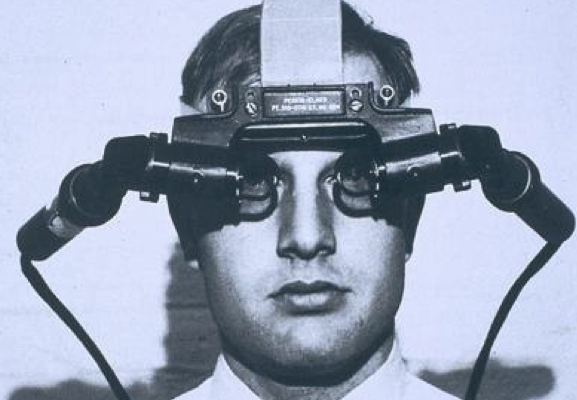
Sword of Damocles (1968): Developed by Ivan Sutherland and his student Bob Sprouli at the University of Utah in 1968, the Sword of Damocles was the world’s first heads-up mounted display. It consisted of a headband with a pair of small cathode-ray tubes attached to the end of a large instrumented mechanical arm through which head position and orientation were determined.
Hand positions were sensed via a hand-held grip suspended at the end of three fishing lines whose lengths were determined by the number of rotations sensed on each of the reels. Though crude by modern standards, this breakthrough technology would become the basis for all future innovation in the field of mobile computing, virtual reality, and digital eyewear applications.
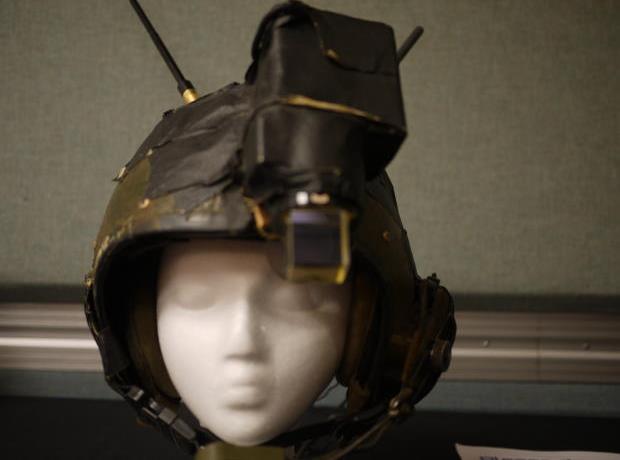
WearComp Models (1980-84): Built by Steve Mann (inventor of the EyeTap and considered to be the father of wearable computers) in 1980, the WearComp1 cobbled together many devices to create visual experiences. It included an antenna to communicate wirelessly and share video. In 1981, he designed and built a backpack-mounted wearable multimedia computer with text, graphics, and multimedia capability, as well as video capability.
By 1984, the same year that Apple’s Macintosh was first shipped and the publication of William Gibson’s science fiction novel, “Neuromancer”, he released the WearComp4 model. This latest version employed clothing-based signal processing, a personal imaging system with left eye display, and separate antennas for simultaneous voice, video, and data communication.
Private Eye (1989): In 1989 Reflection Technology marketed the Private Eye head-mounted display, which scanned a vertical array of LEDs across the visual field using a vibrating mirror. The monochrome screen was 1.25-inches on the diagonal, but images appear to be a 15-inch display at 18-inches distance.
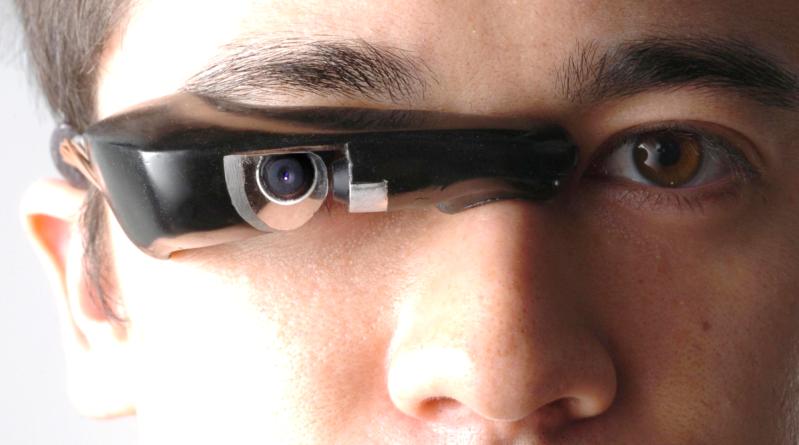
EyeTap Digital Eye (1998): Steve Mann is considered the father of digital eyewear and what he calls “mediated” reality. He is a professor in the department of electrical and computer engineering at the University of Toronto and an IEEE senior member, and also serves as chief scientist for the augmented reality startup, Meta. The first version of the EyeTap was produced in the 1970’s and was incredibly bulky by modern standards.
By 1998, he developed the one that is commonly seen today, mounted over one ear and in front of one side of the face. This version is worn in front of the eye, recording what is immediately in front of the viewer and superimposing the view as digital imagery. It uses a beam splitter to send the same scene to both the eye and a camera, and is tethered to a computer worn to his body in a small pack.
MicroOptical TASK-9 (2000): Founded in 1995 by Mark Spitzer, who is now a director at the Google X lab. the company produced several patented designs which were bought up by Google after the company closed in 2010. One such design was the TASK-9, a wearable computer that is attachable to a set of glasses. Years later, MicroOptical’s line of viewers remain the lightest head-up displays available on the market.
Vuzix (1997-2013): Founded in 1997, Vuzix created the first video eyewear to support stereoscopic 3D for the PlayStation 3 and Xbox 360. Since then, Vuzix went on to create the first commercially produced pass-through augmented reality headset, the Wrap 920AR (seen at bottom). The Wrap 920AR has two VGA video displays and two cameras that work together to provide the user a view of the world which blends real world inputs and computer generated data.
Other products of note include the Wrap 1200VR, a virtual reality headset that has numerous applications – everything from gaming and recreation to medical research – and the Smart Glasses M100, a hands free display for smartphones. And since the Consumer Electronics Show of 2011, they have announced and released several heads-up AR displays that are attachable to glasses.
MyVu (2008-2012): Founded in 1995, also by Mark Spitzer, MyVu developed several different types of wearable video display glasses before closing in 2012. The most famous was their Myvu Personal Media Viewer (pictured below), a set of display glasses that was released in 2008. These became instantly popular with the wearable computer community because they provided a cost effective and relatively easy path to a DIY, small, single eye, head-mounted display.In 2010, the company followed up with the release of the Viscom digital eyewear (seen below), a device that was developed in collaboration with Spitzer’s other company, MicroOptical. This smaller, head mounted display device comes with earphones and is worn over one eye like a pair of glasses, similar to the EyeTap.
Meta Prototype (2013): Developed by Meta, a Silicon Valley startup that is being funded with the help of a Kickstarter campaign and supported by Steve Mann, this wearable computing eyewear ultizes the latest in VR and projection technology. Unlike other display glasses, Meta’s eyewear enters 3D space and uses your hands to interact with the virtual world, combining the benefits of the Oculus Rift and those being offered by “Sixth Sense” technology.
The Meta system includes stereoscopic 3D glasses and a 3D camera to track hand movements, similar to the portrayals of gestural control in movies like “Iron Man” and “Avatar.” In addition to display modules embedded in the lenses, the glasses include a portable projector mounted on top. This way, the user is able to both project and interact with computer simulations.
Google Glass (2013): Developed by Google X as part of their Project Glass, the Google Glass device is a wearable computer with an optical head-mounted display (OHMD) that incorporates all the major advances made in the field of wearable computing for the past forty years. These include a smartphone-like hands-free format, wireless internet connection, voice commands and a full-color augmented-reality display.
Development began in 2011 and the first prototypes were previewed to the public at the Google I/O annual conference in San Francisco in June of 2012. Though they currently do not come with fixed lenses, Google has announced its intention to partner with sunglass retailers to equip them with regular and prescription lenses. There is also talk of developing contact lenses that come with embedded display devices.
Summary:
Well, that’s the history of digital eyewear in a nutshell. And as you can see, since the late 60’s, the field has progressed by leaps and bounds. What was once a speculative and visionary pursuit has now blossomed to become a fully-fledged commercial field, with many different devices being produced for public consumption.
At this rate, who knows what the future holds? In all likelihood, the quest to make computers more portable and ergonomic will keep pace with the development of more sophisticated electronics and computer chips, miniaturization, biotechnology, nanofabrication and brain-computer interfacing.
The result will no doubt be tiny CPUs that can be implanted in the human body and integrated into our brains via neural chips and tiny electrodes. In all likelihood, we won’t even need voice commands at that point, because neuroscience will have developed a means to communicate directly to our devices via brainwaves. The age of cybernetics will have officially dawned!
Like I said… fascinating, weird, and a little bit scary!

 Hey all! Just wanted to do a late trip update and let everybody know I’m still kicking, and to share some of the many experiences that were had so far on this trip. It’s been almost two weeks now since the family and I departed from Vancouver Island and landed on the Continent, and try as I might, I’ve been unable to resist my internet fix! So as long as I was surfing, checking messages and doing a little messaging myself, I figured I could at least post an update or two.
 But before that, we were in the Flanders region of Belgium and the Normandy region of France. We began with Ypres, a small city in Belgium that was the site of three major battles during the Great War. This began in 1914 when the Allies retook the town from the Germans after their great sweep into northern France failed. The second took place five months later when the Germans, hoping to break the stalemate in Belgium, used chlorine gas for the first time. It was during this gas attack that the Canadian 1st Division distinguished itself by holding its ground and repelling the attack, despite the fact that they had no gas masks. The third and final battle took place east of the city and is also known as the Battle of Passchendaele, one of the bloodiest of the war.
 We were also sure to visit the cemeteries, battlefields and memorials at Beaumont-Hamel, Concrete Farm, Langemarck, St. Julien, and Tyne Cot. This last cemetery, which is the largest World War I cemetery ever, has a small museum where the names of every soldier who died in the Battle of Arras is named. The recording plays on a loop, and takes FIFTEEN YEARS to finish!
 After that, we visited the Vimy Memorial in France, one of the greatest to come out of the war. This site, and the many preserved trenches, tunnels and craters that mark the landscape are preserved and attended to by Canadian students who hope to keep the memory of this historical battle alive. Not only was it a major victory for the allies – the first decisive offensive of the war – it also defined Canada as a nation. While being guided through the trenches and tunnel, my father and I once again paused to pick up some keepsakes. This time around, it was a piece of chalk and flint (which the ridge is made of) and a small bit of ceramic, possibly from an old teacup.
 This was perhaps the most interesting part of our journey since it involved retracing the path of an actual family member. His name was Wilmot Pettit, and on June 6th, 1944, he was shot down while towing a glider full of British Commandos into the Normandy countryside. The mayor of Grangues was extremely helpful, and drove us to where the crash took place, told of how the survivors had been captured and executed by the SS, offered to send us some photos of the downed plane, and told us where Wilmott had been buried. We then drove to the cemetery at Ranville to pay our respects, before heading on to Bayeux.
 Yesterday, NASA officially announced that it intends to cease most work with the Russian Federal Space Agency amid growing tensions concerning the Ukrainian crisis. The statement came from Bob Jacobs, NASA’s deputy associate administrator of communications, who formalized the space agency’s position with a message sent to Universe Today, a copy of which was then posted on it’s Google+ message board on Wednesday, April 2nd.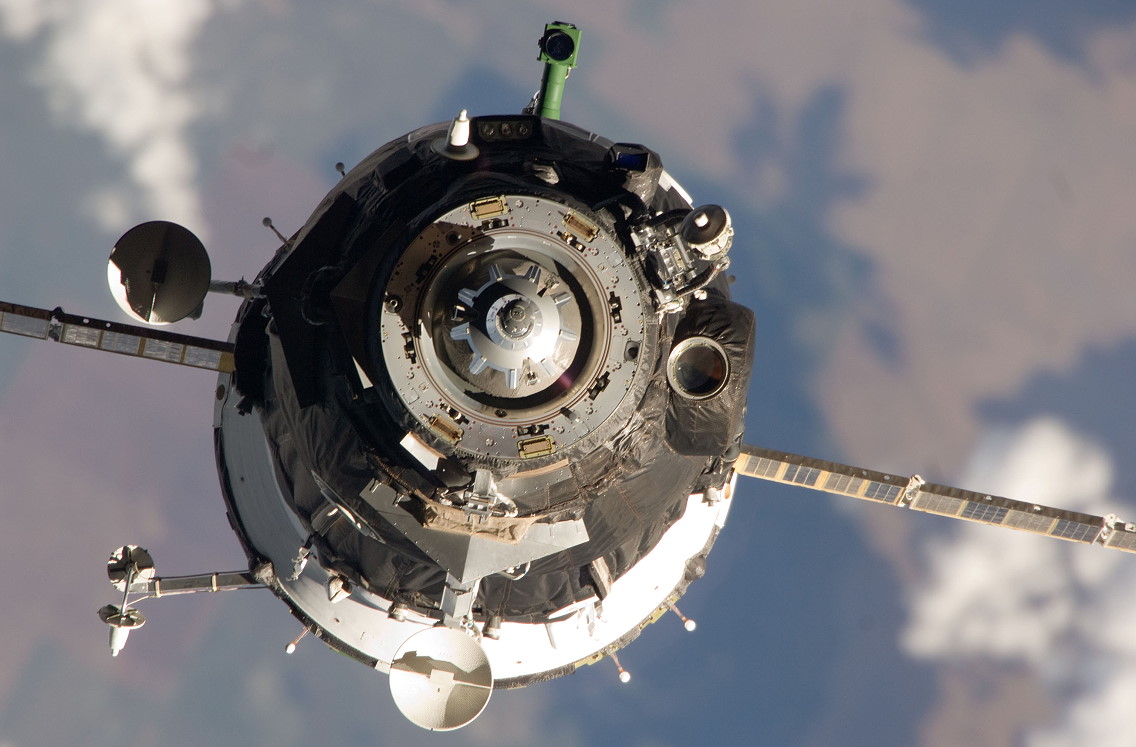
 Since the Space Shuttle Program was retired in 2011, NASA and other space agencies such as the European Space Agency have relied on Russian Soyuz spacecraft to bring astronauts to the International Space Station. Crews are generally made up of large proportions of Russian cosmonauts and American astronauts, as well as a few astronauts from other agencies. The current Expedition 39 crew has has three Russians, two Americans and a Japanese commander, Koichi Wakata.
 NASA is working on a commercial crew program that right now is slated to bring U.S. astronauts back into space from American soil by 2017. There are several proposals being considered: a human-rated version of SpaceX’s Dragon, Blue Origin’s New Shepard, Sierra Nevada’s Dream Chaser and the Boeing CST-100. However, these depend upon continued funding and it is currently unclear how much money the CCP program will receive in the upcoming fiscal 2015 budget request before Congress.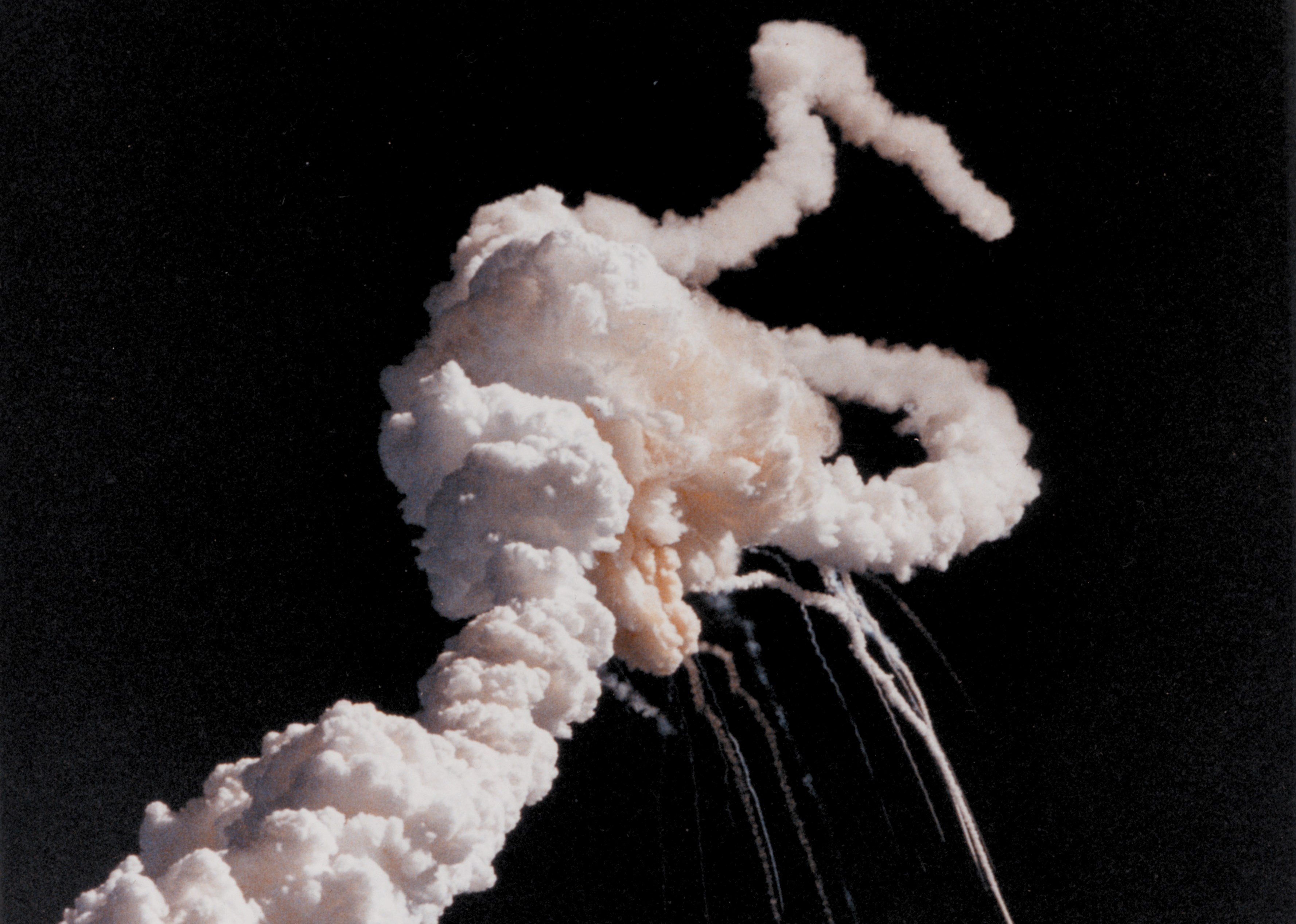

































 Stories by Williams