Neil Armstrong’s EKG Available for Auction

apollo17

The video of Neil Armstrong taking man’s first step onto the Moon is perhaps the most iconic pieces of footage humanity has ever produced. To Armstrong, seeing the Earth shining back at him must have been the most gorgeous, awe-inspiring sight ever. But to the crews manning Mission Control, Armstrong’s electrocardiogram reading was what they were looking at the moment he set his foot down.

And though we will never be able to see things from Armstrong’s perspective, you can see what Mission Control saw during those seminal moments. The six-inch strip of readout is going up for auction at the RR Auction site, and for the starting price of $200 you can own this piece of history. The strip comes in a presentation frame along with an Armstrong autopen signature and various mission patches.

apollo_ekg

RR Auction has a tremendous stash of space-related memorabilia going up for bid. Many of the pieces are autographs from luminaries of the space program, but the Armstrong EKG isn’t the only unusual piece on offer. There is also a Constant Wear Garment from 1968 that was issued to Buzz Aldrin. This garment is kind of like a space onesie designed to be worn under the in-flight coveralls.

Other interesting lots include a set of Challenger Spacelab screws, a Space Shuttle commemorative Pepsi can, a flown heat shield fragment from Apollo 8, and a chunk of seat fabric from Apollo 13. Bidding starts on May 16 for the EKG reading along with the other space items. The opening bid for the EKG is $200, but the last time an Armstrong EKG went up for action back in 2004, bidding ended at $12,500.

Apollo_11

As the description on the EKG reads:

After the landing, this EKG report was saved by the Manager of Medical Administration for the Space Center. It was cut up into five pieces; four were presented to the attending physicians on the medical team.

And interestingly enough, the EKG indicates that Armstrong was very calm as he gazed at Earth from the Moon. But then again, how could such a sight not inspire feelings of deep serenity? And it only seems fitting that even in death, Armstrong continues to impress, amaze and exert a strong influence.

Apollo_11_bootprint

Source: news.cnet.com

Vimy

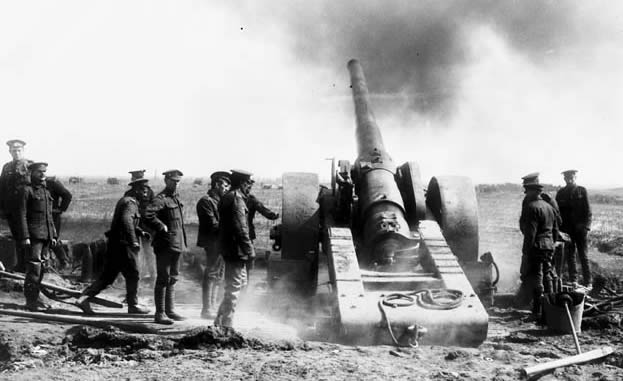
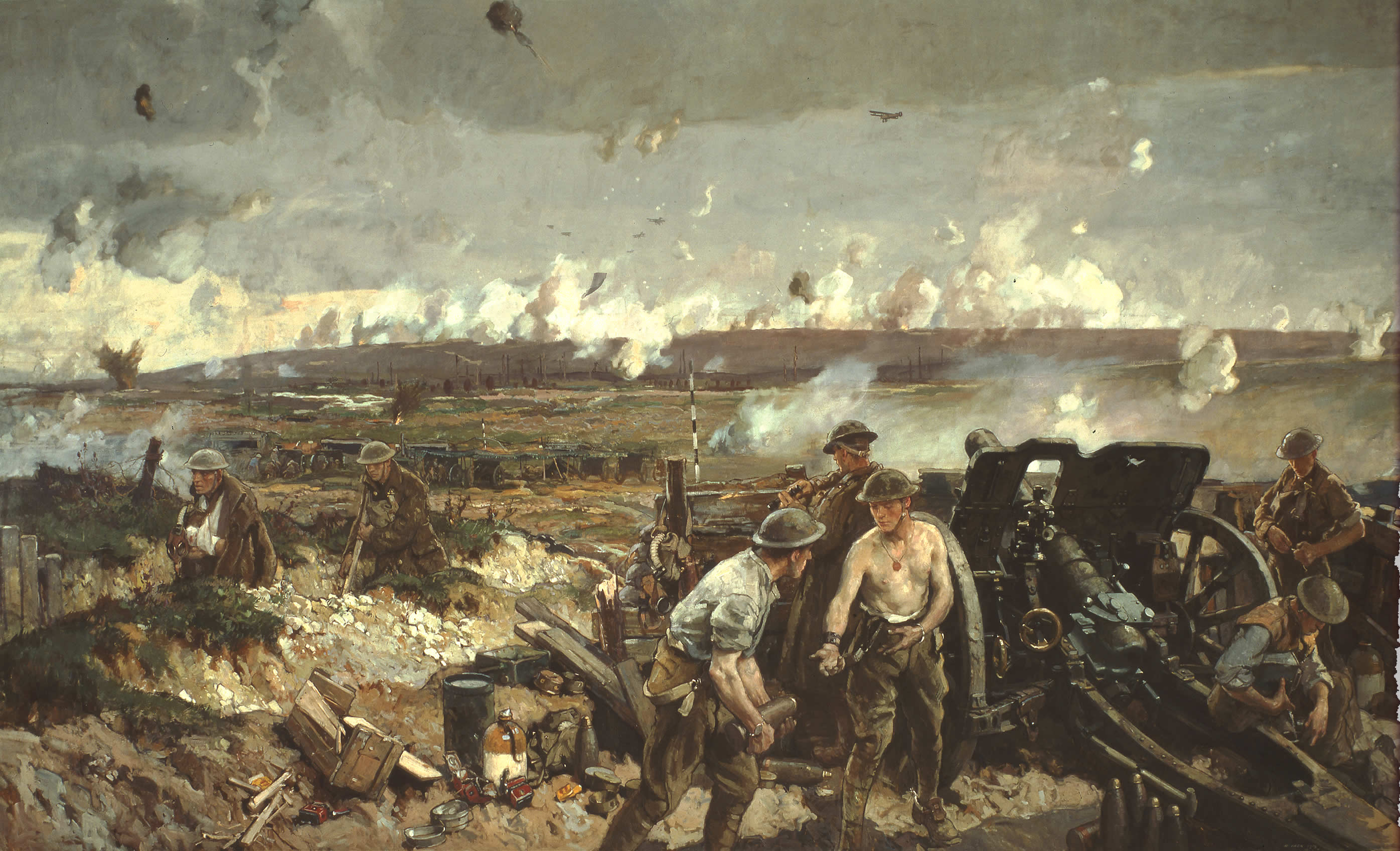
battle_of_vimy_ridge_field_gun_firingThey were all looking to the far horizon, to the ridge line that extended above and far into the distance. Without the benefit of trees and foliage, they could see the slope of the earth in gruesome detail. Nothing but mud, rocks, and stunted trees. And the final resting place of half a million men…

They were all watching it as the arty turned the field into a morass of craters and muddy holes. A fine mist had been on the field that morning, an icy rain that portended a long, hard day. But the screaming shells were doing their best to change that. With every burst, smoke and flame broke out along the high ground, the rain winking it out almost instantaneously, only to be followed up by another. It was like watching a macabre light show, or a wicked lightning storm. Except this one raged within the earth, kicking up soil and vaporizing bodies.

Yes, they all looked and watched the display. But Lieutenant Vincent Ross, he was looking at his men. The many fresh faces that made up 1st platoon, washed and ready for their big adventure.  He watched them wince when a big one hit, and rock from side to side and the shock made the earth rumble beneath their feet.

“No one had done what we are about to do today…” he said between bursts. “Many have tried already and failed, but we have something they do not… We are prepared… We are well equipped and ready… But most importantly of all, we have something to prove! Men of the Dominion… we are about to show the Hun over there what we’re made of, and those Brits across the Channel how its done!”

The soldiers let out a general hoot of approval. He basked in it for a second, knowing that he had only so much time before the preparatory bombardment ended and they would be moving up. That’s when the fun would begin, and the only moment of silence he could expect before the day ended. Hence, it would be the only chance he would get to remind his men of their duties, which were numerous.

And just like that, the pounding stopped. He looked to his men again and saw them looking at him. It was time. This was what it all came down to. A handful of men in a trench, their weapons at the ready and their mission on their minds. When the day ended, they would either be digging in, or someone else would be digging their graves.

“Alright men, this is it! We are the first wave in this assault. We move as soon as the creeping barrage starts, and we don’t stop until that ridge is in our hands. First Platoon leads the way, followed by Second, Third, and the balance of First Battalion. Be sure not to bunch up or get ahead of yourselves; otherwise, you will be stepping into the arty lines line of fire! And remember, once we secure the ridge, the battle will be just beginning. The Hun will try to take it from us, so once we have it, we will have to fight like hell to hold it!”

The men conducted their last minute rituals as they listened. Some kissed the crucifixes they had hung around their necks, others lit up a last cigarette, and others took the chance to do one last check of their weapons and ammo.

“I don’t need to remind you, people are counting on you. The Corps is counting on you, the General is counting on you. But most importantly, your nation is counting on you! Remember, your NCOs are your ticket to staying alive. Each and every one of them knows the lay of this land like the back of their hand.” He reaching into his uniform, he pulled out his field map and began pointing to the designated spots. “Squad leaders, remember your objectives, remember the timetable. Stick to these, keep your men in mind, and we will all make it home!”

Another roaring hoot went up from the men. Their voices slowly began to die down just as the first wave from the creeping barrage began to land a few hundred feet away.

“There it is!” He said over the roar of the incoming shells. “Wait for the first wave to clear, then we advance!”

New Drones Art Campaign

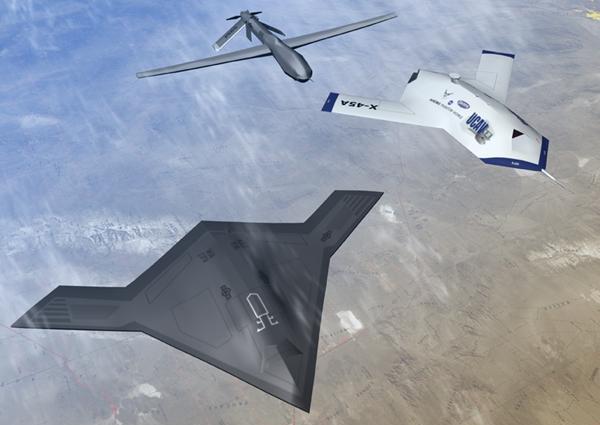
UAVsOver at deviantART, a constant source of inspired art for me, there’s an interest new campaign designed to raise awareness and stimulate debate on a rather controversial issue. I am referring, as the topic line would suggest, to the use of drones and UAV’s and all that it entails.

As one of the greatest concerns facing developed nations today, not to mention the developing world where they are being increasingly used, this campaign is not only timely and relevant, but an intriguing display of artwork motivated by social conscience. In short, it asks the question: how is this debate reflected in art and what will future generations think of it?

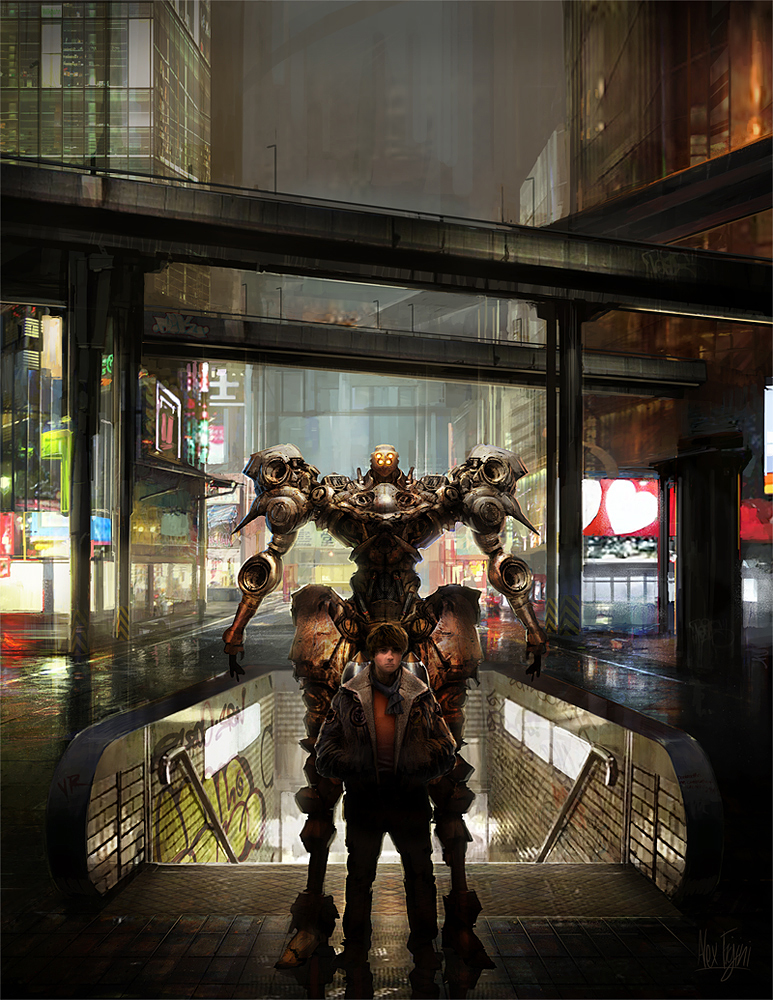
looking for a hole, by arcas art

Inspired by similar projects which are taking place around the world, the purpose of the campaign is to draw attention to the fact that were are living in a world increasingly characterized by surveillance and killing machines. Or as technognotic puts it:

Drones have become the white hot center of debate for a multitude of deeply consequential concerns for the entire Earth Sphere. No matter the digital end point or theatre of conversation, whether it be politics, war, privacy, pop culture, or the rise of machines – Drones or UAV’s (unmanned aerial vehicles) are the current catalyst du jour in any number of flashpoint discussions…

Even more interesting is the tone of inevitability of outcome. Core discussion seems to focus on a coming drone-filled sky and how we might govern our selves accordingly as this fact becomes a reality… Is this the dark side of human creativity and inquisitiveness that will ultimately one day spell our doom or the first signs of a coming technological Utopia.

galaxy saga - white gryphon, by ukitakumuki
galaxy saga – white gryphon, by ukitakumuki

In addition, the campaign features the thoughtful essay of the same name by Jason Boog (deviantART handle istickboy), who takes a look at how killing machines and drones have been explored through art and popular culture. Beginning with a short romp through history, identifying the first “drone” to ever be used, he goes on to examine how several generations of artists chose to portray them and their use.

Things culminate in the modern age, where spending on drone development and humanitarian concerns have culminated to make this a truly global and auspicious concern. With remote-controlled drones giving way to autonomous models and UAV’s being used for domestic surveillance, there’s no telling where things could go.

mysterious journals, by sundragon83

On the one hand, a concerned and mobilized public could place limits and controls on them, or counter using their own form of “sousveillance” (public counter-surveillance). On the other hand, we could be headed for a police state here privacy is non-existent and robots decide who lives and who dies – maybe entirely on their own!

As you can certainly imagine, when I first learned of this campaign I could tell that it was right up my alley. Being such an obsessive geek for all things technological and how innovation and progress affect us, I knew I had to post about it. And as you can certainly tell from the samples posted here, the artwork is pretty damn badass!

I would recommend checking it out for the aesthetic appeal alone. Knowing you’re taking part in a campaign dedicated to public awareness is just a big bonus!

For more information, and to take a gander at some galleries, visit the campaign at techgnotic.deviantart.com.

Messages of Hope for Boston

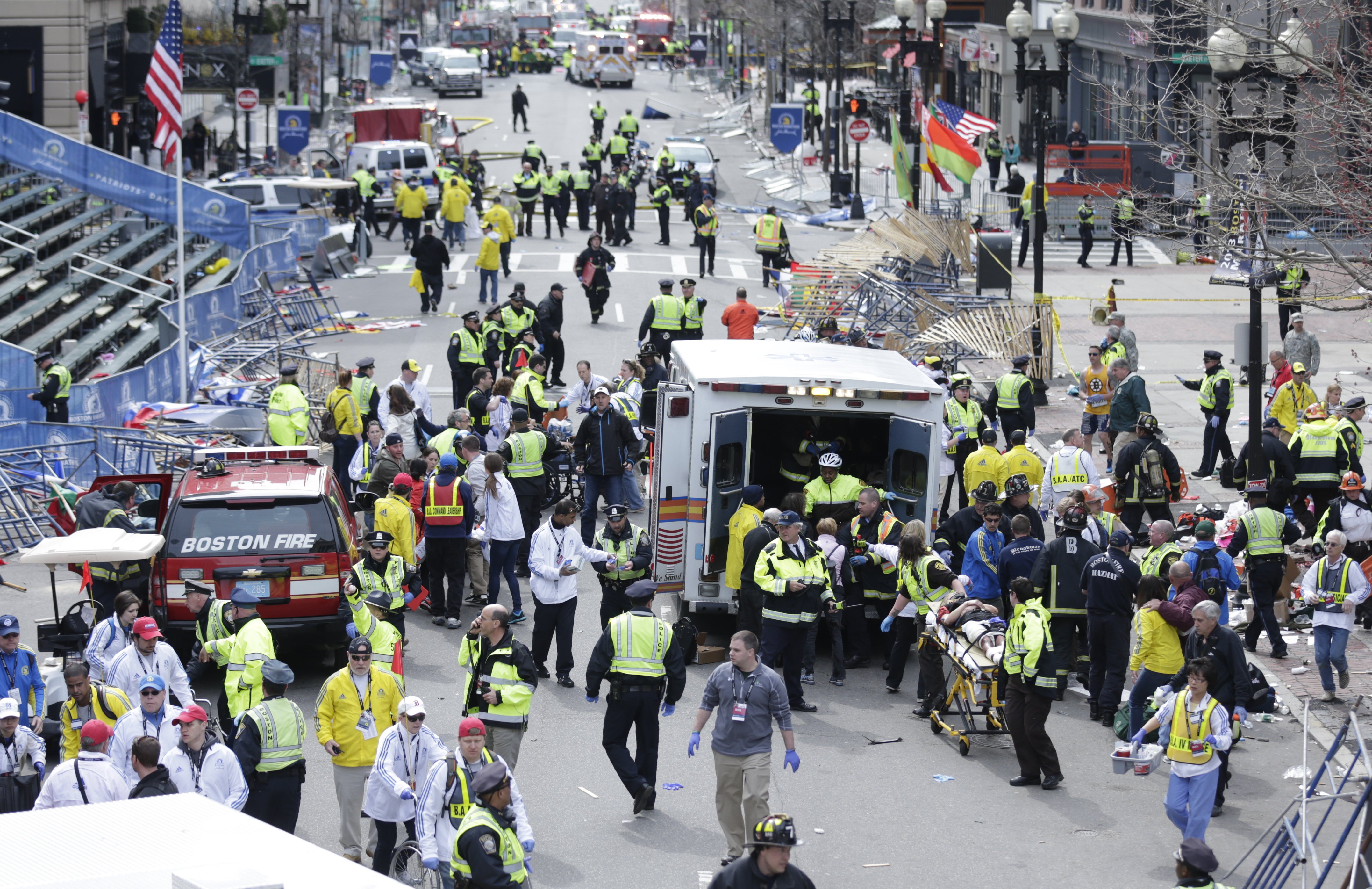
boston-marathon-explosion-1I think it’s fair to say that the weekend bombing attack in Boston was a shock to us all. Worse yet was the horror faced by those who were at ground zero when it happened, men, women and children taking part in a public sporting event that was hurting no one and served no political purpose. The deaths and injuries sustained to these people who were simply out for a run with hundreds of their fellow Bostonians is an outrage to say the least.

And of course, there has been plenty of speculation and attempts at recrimination, the kind of thing that always follows in the wake of a terrorist bombing. Though no guilty parties have been identified and no one has come forward to claim responsibility, there are those who want to point fingers and start beating the war drums, demanding blood and vengeance for the terrible crime. At a time so soon after the tragedy struck, this kind of attitude can only add to the hurt and difficulty.

Boston_projectorAnd yet, in the midst of this tragedy, there are thing that remind us that there’s always reason for hope, like in how people overcome their differences in times of strife to show mutual love and support. A perfect example is how last night in Brooklyn, a glowing message of hope appeared on the face of the Brooklyn Academy of Music. Here, New Yorkers were treated to a series of messages offering their support for the city of Boston in the wake of the Marathon bombings, such as “Brooklyn Loves Boston” and the Martin Luther King quote “Darkness cannot drive out darkness, only light can do that.”

But here’s where it gets especially inspiring! The lights were the work of a van that was outfitted with special projection technology that was originally designed for the Occupy Wall Street protests. As a mobile offshoot of the “We Are The 99%” projections that were placed on the sides of skyscrapers some years back, this vehicle was planned for upcoming Tax Day, projecting the message “Tax Evader”. However, it quickly retooled the moment news of the bombings broke. Hence, what was originally intended as a message of protest promptly switched to one of support, peace and love.

boston-marathon-bombingAnd then there was another news story to come out of the carnage, something which reminds us that human beings are capable of exceptional good when the chips are down. With all the news about how social media has been used for evil (i.e. to document cases or rape or bully people into committing suicide), the Boston Marathon presented a side of social media that shows how effective it can be in a crisis.

Within seconds of the first bomb blast, pictures, video and news of the horrific event were pulsing over social networks. For many, this was how news of the attack first came to light, and first responders and police even used Twitter, Facebook, and Tumblr and other networks to get valuable information out, like warning people to stay away from the crisis area. In times of mass panic, when conventional means of communication can be overwhelmed, this kind of response can be invaluable.

Boston Marathon ExplosionThe memes that quickly emerged from the event involved the sharing of photos and questions about how to reach loved ones when cell coverage was down in large parts of the Boston Area. Google immediately set up a “person finder” system for posting and finding information about specific people. And while major news outlets covered the casualties and law enforcement’s efforts to locate more bombs, citizens reached out to each other with the best factual information they could find.

Granted, there were some offensive memes, but by and large, the efforts of bloggers had the effect of providing real-time information on the bombing and allaying fears. Some even went as far as to correct misinformation and rumors spreading about the attack, about the bombers, and to place the events in a global context. One blogger reminded people of the recent bombings in Iraq which killed 37 people and left 140 injured. It says something about people when, even in the face of fear and sadness, they are able to remind people that there are some that have it worse.

Whereas many people think that social media is little more than a means of spreading rumors, gossip, or the hurtful trifecta known as FUD (Fear, Uncertainty and Doubt), thus making a crisis situation that much worse, the speedy response and responsible use of social media sites in the midst of this crisis was actually very helpful and may have averted further problems. I for one hope this is a sign of things to come, how technology can and will be used responsibly to deal with challenges and extend help to those in need.

At this point, I hope this spirit of support, love and mutual assistance continues on into the foreseeable future. As 9/11 reminded us, terrorist attacks and tragedies can so easily become the fodder of extreme intolerance and questionable agendas. Thought it’s not clear yet who did this or why, I am hopeful that what President Obama said about finding the people responsible and holding them accountable proves true, and soon.

Sources: IO9, fastcoexist.com

Remembering Vimy Ridge

The_Battle_of_Vimy_RidgeHello all! Today has been rather a busy one, and show’s no signs of slowing down just yet! In spite of that, I would be remiss if I did not take the time to acknowledge the rather special anniversary which falls on this day, of which some people may not be aware. You see, today is the 96th anniversary of the Battle of Vimy Ridge, a major event in my nation’s history and a defining moment for all Canadians.

Though many people outside of Canada may not know much about it, the Battle of Vimy Ridge was one of the most significant battles of World War I and a key moment in Canada’s history. Taking place between April 9th and 14th of 1917, it was not only a Canadian-led offensive, it was also the only Allied offensive victory in the war to date. And just as importantly, we in Canada consider it a defining moment in our history, when our country ceased being a colony and became a nation.

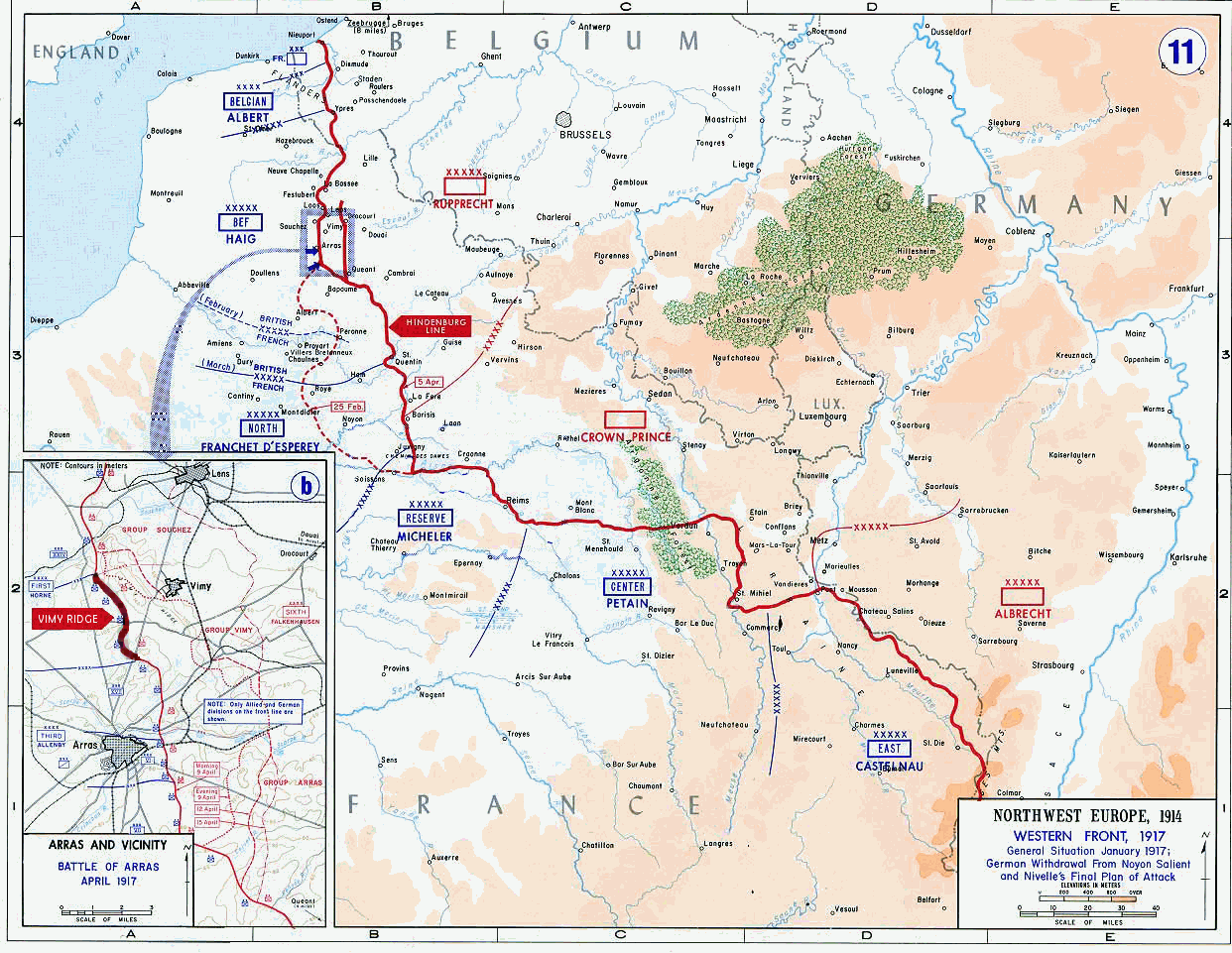
Battle_of_Arras_-_Vimy_Ridge_mapSurprising then that it is often considered a footnote to the larger campaign known as the Battle of Arras or the Nivelle Offensive, one of many disastrous offensives fought by the Allied armies during the war. Like all offensives of its kind, the purpose of the assault in the north-eastern region of France was to break the stalemate that had existened between the Allied and German lines since 1915.

It was believed that if this could be achieved, the numerically inferior German forces would finally be beaten and the war ended. And after so many bloody battles and worsening situations on home front – with shortages setting in and morale running short – the allies were desperate for their big breakthrough. Relying on armies fielded by the French, British, and all her dominions – Newfoundland, New Zealand, and Canada – the attack would take place in several key sectors along the Western Front.

vimy-ridge-875While the French struck at German positions along the Chemin des Dames ridge, and the British and most of the Dominion armies struck at positions around the town of Arras, the Canadian Corps – led by General Arthur Currie – was to take the highground known as Vimy Ridge. Despite promises of a speedy battle after a massive bombardment, the French made little gains against the dug-in defenders and lost almost 200,000 men. The British fared slightly better, achieving some gains but at the high cost of 158,000 men.

Only the Canadians achieved their objectives completely and promptly, taking the Ridge in just three days and with acceptable losses. Of the five divisions totaling nearly 170,000 men, only 3,598 were killed with another 7000 wounded. On the other side, the Germans – who were well dug-in and defending an elevated position – suffered at least as many killed and wounded, plus an additional four thousand captured. This was made ever more impressive considering that the French and British, during a previous attempt to take the Ridge, had lost a good 150,000 men.

vimy2

This was unprecedented for a World War I battle, and earned the Canadian Corps the status of elite “Shock Troops”. For the remainder of the war, Arthur Currie and the soldiers under his command would be the ones who were seen as being able to “get things done”. During the battle of Passchendale, a brutal, bloody, muddy offensive, the Canadians were called in to accomplish the offensive after the British efforts faltered. During the final 100 days of the war, when the German lines were collapsing, the Canadians led the way for every single push.

And yet, all of this was made possible due to one simple thing: sound planning. As the first offensive action that Canadian commanders were able to plan on their own, they took advantage of some rather novel ideas and technologies to overcome the problems of trench warfare. These included the rather revolutionary concept of using triangulation and wind measurements to determine the position of enemy artillery, and destroy them ahead of time.

battle_of_vimy_ridge_field_gun_firingCreeping barrages were also planned to give the advancing troops continuous fire support, rather than simply laying down a barrage and then stopping it before the infantry began to march. This tactic had already been proven ineffective, as the Germans simply dug in deeper to avoid preemptive barrages and also had time to emerge from their dugouts once the shells stopped falling to shoot at the advancing troops. By timing the artillery with the advance, any Germans brave enough to fire on the Canadian Corp risked being blown to pieces.

But most importantly, the planned offensive had been meticulously planned for month. Spotters mapped out 80 percent of the Ridge in advance, full-scale replicas of the terrain were built to rehearse unit tactics, and individual officers were assigned maps and time tables. All of this was a break from conventional philosophy, which held that troops did not need to be familiar with the grand strategy and should march as one.

Model_reproduction_of_German_linesThough many a military “expert” of the time found much of this suspect, they admitted dubiously that the Canadians’ plan couldn’t be any worse than the British tactics at the Somme, which cost the lives of 623,907 troops, 24,000 of which were Canadian. As such, the Canadian Corps got the go ahead. For weeks, Canadian and British artillery began pounding the German positions in preparation for the assault. Then on April 9th, an Easter Monday morning amidst rain and freezing cold, the Canadian Corps struck.

By the end of the first day, they had accomplished most of their objectives, but fighting and consolidation would continue for another four days and Canadians mopped up the German positions and took prisoners. When the dust had settled, the valour of the troops, the originality of the plan, and the success where larger, more established armies had failed all contributed to a new nation’s pride. The battle was hailed as the first allied success of the long war, achieved mostly due to the innovation of using a creeping, continuous massive artillery barrage to protect squads of advancing troops. Both sides used the tactic in future battles.

Vimy RidgeToday, the Canadian National Vimy Memorial stands as a proud reminder of what Canadians accomplished at Vimy and throughout the war. As a young nation, nominally independent but still very much tied to the British Crown, we had done what others could not and earned a reputation as stalwart soldiers and faithful allies that is still acknowledged to this day. The monument, as well as many of the wartime features of the Ridge, are maintained by an army of committed volunteers and government assistance.

And I for one very much look forward to visiting it in the spring of 2014, when the centennial of World War I is being marked all over Europe, and legions of Canadians and other nationals descend on Flanders and Northern France in order to pay their respects. In addition to the many monuments which mark the landscape, it is a testament to the futility of war, but also a symbol of a nation born in fire.

Today, it is especially important that we remember what happened not only at Vimy, but all over Europe and the world at large during those fateful years. Since the last living veteran of World War I, a British man named Florence Green, died on February 4th 2012 at the aged of 110, there is no one left who experienced that terrible war directly. And as we near the 100 year marker of the Great War and the battle that defined Canada as a nation, I hope and pray the lessons will not be forgotten! They simply cannot afford to be repeated…

The Singularity: The End of Sci-Fi?

singularity.specrepThe coming Singularity… the threshold where we will essentially surpass all our current restrictions and embark on an uncertain future. For many, its something to be feared, while for others, its something regularly fantasized about. On the one hand, it could mean a future where things like shortages, scarcity, disease, hunger and even death are obsolete. But on the other, it could also mean the end of humanity as we know it.

As a friend of mine recently said, in reference to some of the recent technological breakthroughs: “Cell phones, prosthetics, artificial tissue…you sci-fi writers are going to run out of things to write about soon.” I had to admit he had a point. If and when he reach an age where all scientific breakthroughs that were once the province of speculative writing exist, what will be left to speculate about?

Singularity4To break it down, simply because I love to do so whenever possible, the concept borrows from the field of quantum physics, where the edge of black hole is described as a “quantum singularity”. It is at this point that all known physical laws, including time and space themselves, coalesce and become a state of oneness, turning all matter and energy into some kind of quantum soup. Nothing beyond this veil (also known as an Event Horizon) can be seen, for no means exist to detect anything.

The same principle holds true in this case, at least that’s the theory. Originally coined by mathematician John von Neumann in the mid-1950’s, the term served as a description for a phenomenon of technological acceleration causing an eventual unpredictable outcome in society. In describing it, he spoke of the “ever accelerating progress of technology and changes in the mode of human life, which gives the appearance of approaching some essential singularity in the history of the race beyond which human affairs, as we know them, could not continue.”

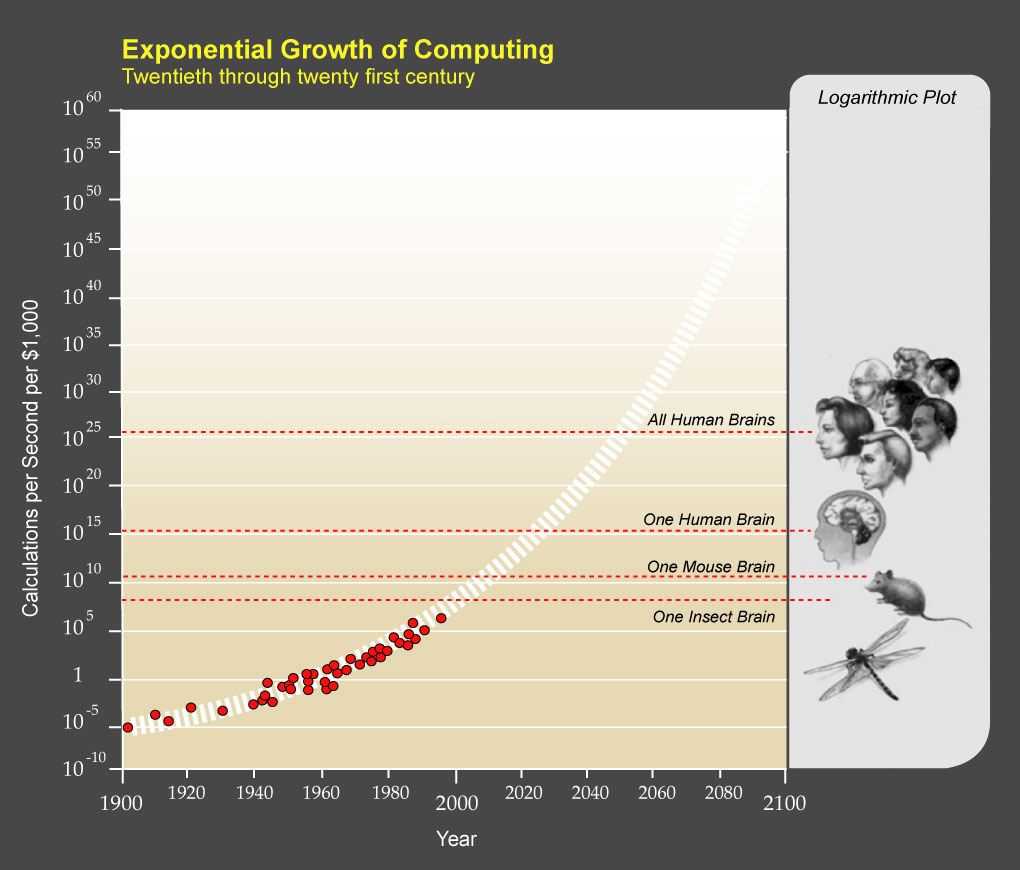
exponential_growth_largeThe term was then popularized by science fiction writer Vernor Vinge (A Fire Upon the Deep, A Deepness in the Sky, Rainbows End) who argued that artificial intelligence, human biological enhancement, or brain-computer interfaces could be possible causes of the singularity. In more recent times, the same theme has been picked up by futurist Ray Kurzweil, the man who points to the accelerating rate of change throughout history, with special emphasis on the latter half of the 20th century.

In what Kurzweil described as the “Law of Accelerating Returns”, every major technological breakthrough was preceded by a period of exponential growth. In his writings, he claimed that whenever technology approaches a barrier, new technologies come along to surmount it. He also predicted paradigm shifts will become increasingly common, leading to “technological change so rapid and profound it represents a rupture in the fabric of human history”.
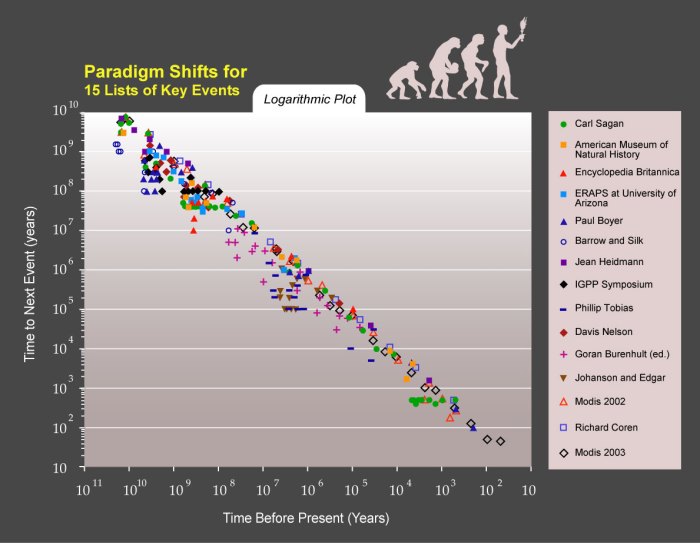
kurzweil-loglog-bigLooking into the deep past, one can see indications of what Kurzweil and others mean. Beginning in the Paleolithic Era, some 70,000 years ago, humanity began to spread out a small pocket in Africa and adopt the conventions we now associate with modern Homo sapiens – including language, music, tools, myths and rituals.

By the time of the “Paleolithic Revolution” – circa 50,000 – 40,000 years ago – we had spread to all corners of the Old World world and left evidence of continuous habitation through tools, cave paintings and burials. In addition, all other existing forms of hominids – such as Homo neanderthalensis and Denisovans – became extinct around the same time, leading many anthropologists to wonder if the presence of homo sapiens wasn’t the deciding factor in their disappearance.

Map-of-human-migrationsAnd then came another revolution, this one known as the “Neolithic” which occurred roughly 12,000 years ago. By this time, humanity had hunted countless species to extinction, had spread to the New World, and began turning to agriculture to maintain their current population levels. Thanks to the cultivation of grains and the domestication of animals, civilization emerged in three parts of the world – the Fertile Crescent, China and the Andes – independently and simultaneously.

All of this gave rise to more habits we take for granted in our modern world, namely written language, metal working, philosophy, astronomy, fine art, architecture, science, mining, slavery, conquest and warfare. Empires that spanned entire continents rose, epics were written, inventions and ideas forged that have stood the test of time. Henceforth, humanity would continue to grow, albeit with some minor setbacks along the way.

The_Meeting_of_Cortés_and_MontezumaAnd then by the 1500s, something truly immense happened. The hemispheres collided as Europeans, first in small droves, but then en masse, began to cross the ocean and made it home to tell others what they found. What followed was an unprecedented period of expansion, conquest, genocide and slavery. But out of that, a global age was also born, with empires and trade networks spanning the entire planet.

Hold onto your hats, because this is where things really start to pick up. Thanks to the collision of hemispheres, all the corn, tomatoes, avocados, beans, potatoes, gold, silver, chocolate, and vanilla led to a period of unprecedented growth in Europe, leading to the Renaissance, Scientific Revolution, and the Enlightenment. And of course, these revolutions in thought and culture were followed by political revolutions shortly thereafter.

IndustrialRevolutionBy the 1700’s, another revolution began, this one involving industry and creation of a capitalist economy. Much like the two that preceded it, it was to have a profound and permanent effect on human history. Coal and steam technology gave rise to modern transportation, cities grew, international travel became as extensive as international trade, and every aspect of society became “rationalized”.

By the 20th century, the size and shape of the future really began to take shape, and many were scared. Humanity, that once tiny speck of organic matter in Africa, now covered the entire Earth and numbered over one and a half billion. And as the century rolled on, the unprecedented growth continued to accelerate. Within 100 years, humanity went from coal and diesel fuel to electrical power and nuclear reactors. We went from crossing the sea in steam ships to going to the moon in rockets.

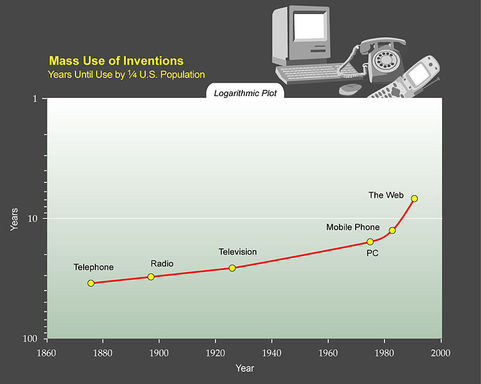
massuseofinventionsAnd then, by the end of the 20th century, humanity once again experienced a revolution in the form of digital technology. By the time the “Information Revolution” had arrived, humanity had reached 6 billion people, was building hand held devices that were faster than computers that once occupied entire rooms, and exchanging more information in a single day than most peoples did in an entire century.

And now, we’ve reached an age where all the things we once fantasized about – colonizing the Solar System and beyond, telepathy, implants, nanomachines, quantum computing, cybernetics, artificial intelligence, and bionics – seem to be becoming more true every day. As such, futurists predictions, like how humans will one day merge their intelligence with machines or live forever in bionic bodies, don’t seem so farfetched. If anything, they seem kind of scary!
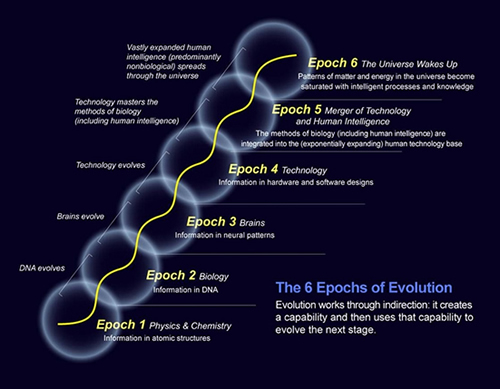
singularity-epocksThere’s no telling where it will go, and it seems like even the near future has become completely unpredictable. The Singularity looms! So really, if the future has become so opaque that accurate predictions are pretty much impossible to make, why bother? What’s more, will predictions become true as the writer is writing about them? Won’t that remove all incentive to write about it?

And really, if the future is to become so unbelievably weird and/or awesome that fact will take the place of fiction, will fantasy become effectively obsolete? Perhaps. So again, why bother? Well, I can think one reason. Because its fun! And because as long as I can, I will continue to! I can’t predict what course the future will take, but knowing that its uncertain and impending makes it extremely cool to think about. And since I’m never happy keeping my thoughts to myself, I shall try to write about it!

So here’s to the future! It’s always there, like the horizon. No one can tell what it will bring, but we do know that it will always be there. So let’s embrace it and enter into it together! We knew what we in for the moment we first woke up and embraced this thing known as humanity.

And for a lovely and detailed breakdown of the Singularity, as well as when and how it will come in the future, go to futuretimeline.net. And be prepared for a little light reading 😉

Happy Birthday Copernicus!

heliocentricAs I learned not long ago, today is the 540th birthday of the late great man who definitely proved that the Earth revolved around the sun. And so I thought I’d take some time out of my busy (not so much today!) schedule to honor this great man and the massive contribution he made to astronomy, science and our understanding of the universe.

Given the importance of these contributions, I shall do my best to be pay homage to him while at the same time being as brief and succinct as I possibly can. Ready? Here goes…

Background:
copernicusBorn in Toruń (Thorn), Poland on 19 February 1473, Mikolaj Kopernik was the youngest of four children to be born into his wealthy merchant family. Given his background, Copernicus’ family was able to provide an extensive education for their son, which took him from Thorn to Włocławek to Krakow, where he attended university. In this time, he learned to speak many languages – including Polish, Greek, Italian, German and Latin (the language of academia in his day) – and also showed himself to be adept at mathematics and science.

During this time, he also received a great deal of exposure to astronomy, since it was during his years in Krakow (1491-1495) that the Krakow astronomical-mathematical school was experiencing its heyday. He was also exposed to the writings of Aristotle and Averroes, and became very self-guided in his learning, collecting numerous books on the subject of astronomy for his personal library.

Leaving Krakow without taking a degree, Copernicus moved to Warmia (northern Poland) where he turned to the study of canon law, perhaps in part because of his family’s strong Roman Catholic background. However, his love for the humanities and astronomy never left him, and he seemed to devote himself to these subjects even as he worked to obtain his doctorate in law. It was also during his time in Warmia that he met the famous astronomer Domenico Maria Novara da Ferrara and became his disciple and assistant.

geocentricUnder Ferrara, Copernicus traveled to Bologna, Italy and began critiquing the logical contradictions in the two most popular systems of astronomy – Aristotle’s theory of homocentric spheres, and Ptolemy’s mechanism of eccentrics and epicycles – that would eventually lead him to doubt both models. In the early 1500’s, while studying medicine at the University of Padua in Italy, he used the opportunity to pour over the libraries many ancient Greek and Latin texts to find historic information about ancient astronomical, cosmological and calendar systems.

In 1503, having finally earned his doctorate in canon law, Copernicus returned to Warmia where he would spend the remaining 40 years of his life. It was here that all of his observations about the movement of the planets, and the contradictions in the current astronomic models, would crystallize into his model for the heliocentric universe. However, due to fears that the publication of his theories would lead to official sanction from the church, he withheld his research until a year before he died.

It was only in 1542, after he had been seized with apoplexy and paralysis, that he sent his treaties, De revolutionibus orbium coelestium (On the Revolutions of the Heavenly Spheres) to Nuremberg to be published. It is said that on the day of his death, May 24th 1543 at the age of 70, he was presented with an advance copy of his book.

Impact and Legacy:
The immediate reaction of the church to the publication of Copernicus’ theories was quite limited. In time, Dominican scholars would seek to refute based on logical arguments and Aquinism, ranging from the positions of planets in the sky to very idea that Earth could be in motion. However, in attempting to disprove Copernicus’ theory, his detractors merely fostered a debate which would provide the impetus for reevaluating the field of physics and proving the heliocentric model correct.

galileo_telescopeAnd in time, with the help of such astronomers and mathematicians as Galileo, the debate would come to a head. Using the telescope, a technology he helped pioneer, he was able to demonstrate that the size of the planets during various times in the year did indeed conform to the heliocentric model, and that it was only through distortions caused by observing with the naked eye that made them seem larger (hence, closer to Earth) than they really were.

And although Galileo would eventually be forced to recant and placed under house arrest for his last few years on this Earth, the Copernican system became the defacto model of astronomy henceforth, and would help to launch the Scientific Revolution whereby several long-established theories would come to be challenged. These included the age of the Earth, the existence of other moons in our Solar System, Universal Gravitation, and the belief in the universe as a giant, rationalized clockwork mechanism.

Final Thoughts:
Naturally, there are those purists who would point out that he was not the first to propose a heliocentric planet system. In fact, the concept of a universe with the sun at the epicenter dates back Ancient Greece. However, Copernicus would be the first astronomer to propose a comprehensive model, which would later be refined by Galileo Galilee.

HeliocentricOther purists would point out that his system, when he developed it, had numerous observation and/or mathematical flaws, and that it was only after Galileo’s observations of the heavens with his telescope that his theories were made to work. But it is precisely because he was able to realize the truth of our corner of the universe, sans a reliable telescope, that makes this accomplishment so meaningful.

In Copernicus’ time, the rigors of the Aristotelian and Ptolemaic models were still seem by the majority of astronomers to be the correct one, regardless of church doctrine or religious bias. In purely mathematical terms, there was little reason to make an intuitive leap and suppose that the great minds on which Scholastic science was based had got it all wrong.

So when it comes right down to it, Copernicus was an intuitive genius the likes of which is seen only once in a lifetime. What’s more, his discoveries and the publication thereof helped bring humanity out of the Dark Ages – a time where learning and the hearts and minds of men were still under the iron grip of the Church – and helped usher in the modern age of science.

Copernicus_conversation_with_GodAnd if I could get a bit polemic for a second, I would like to say that it is unfortunate then that much of what Copernicus helped to overcome is once prevalent in society today. In recent years, long-established scientific truths like Evolution, Global Warming, and Homosexuality have being challenged by individuals who claim they are lies or merely “theories” that have yet to be proven. In all cases, it is clear what the agenda is, and once again faith and God are being used as a justification.

In fact, despite the monumental growth in learning and the explosion in information sharing that has come with the digital age, it seems that misinformation is being spread like never before. Whereas previous generations could always blame ignorance or lack of education, we few who are privileged enough to live in a modern, secular, democratic and industrialized nation have no such excuses.

And yet, it seems that some decidedly medieval trends are determined to persist. Despite living in a time when the vast and infinite nature of the universe is plain to see, there are still those who would insist on making it smaller just so they can sleep soundly in their beds. As if that’s not enough, they feel the need to villify that which they don’t understand, or openly threaten to kill those who preach it.

Sorry, like I said, polemic! And on this day of days, we can’t help but remember the lessons of history and how so often they are ignored. So if I might offer a suggestion to all people on this day, it would be to choose a subject they feel uninformed about and learn what they can about it. And do not trust just any source, consider the built-in biases and political slants of whatever it is you are reading. And if possible, go out and hug a scientist! Tell them you accept them, do not fear what they have to say, and will not be sending them death threats for doing what they do.

Happy 540th birthday Mikolaj Kopernik!

In Remembrance of Columbia

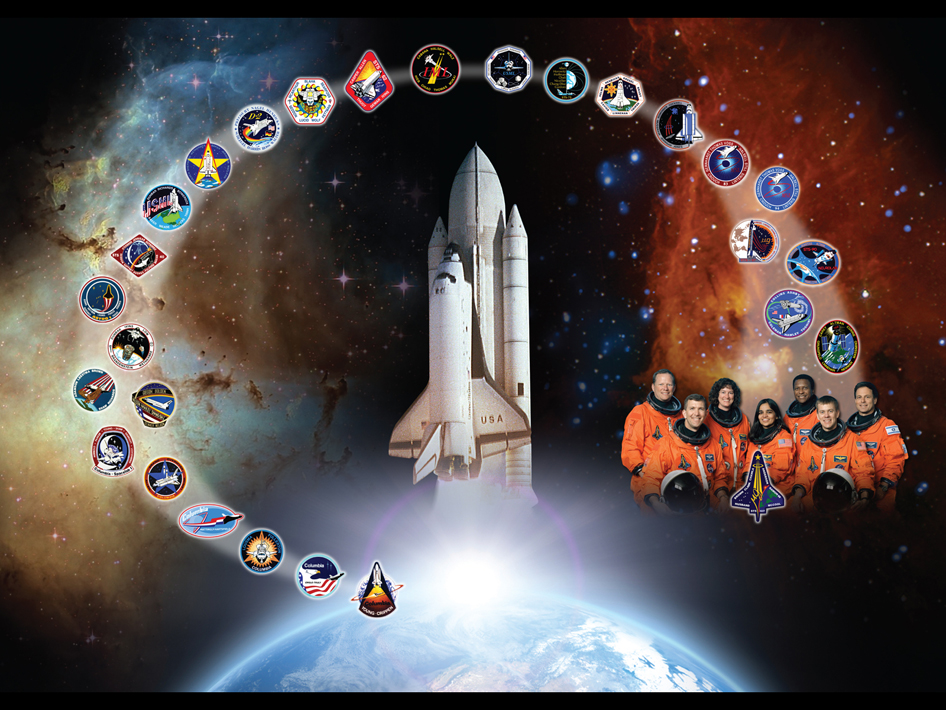
The STS-107 crew includes, from the left, Mission Specialist David Brown, Commander Rick Husband, Mission Specialists Laurel Clark, Kalpana Chawla and Michael Anderson, Pilot William McCool and Payload Specialist Ilan Ramon. (NASA photo)

Just two days ago, the tenth anniversary of the shuttle Columbia disaster came to pass. On that day, the pilots who lost their lives, as well as those who died on the Challenger and Apollo 1 missions, were commemorated at a special wreath-laying ceremony at the Arlington National Cemetery in Virginia. It is a somber day, when people all over the world come together to commemorate those brave souls who died in the name of advancing exploration.

The disaster took place on Feb. 1st 2003, roughly sixteen days after the shuttle departed from Earth to conduct microgravity experiments. During re-entry, contact was lost with the shuttle as the orbiter suffered a catastrophic failure due to a breach that had opened in one of the shuttle’s wings. This had occurred during launch when a piece of foam fell from the external tank during launch.

columbia_arlingtonThe seven person crew of the STS-107 Columbia, which included Rick D. Husband, William C. McCool, David Brown, Laurel Blair Salton Clark, Michael P. Anderson, Ilan Ramon, and Kalpana Chawla, died just 15 minutes before they were meant to touch down at Kennedy Space Center. Addressing the nation, then-President Bush said, “mankind is led into the darkness beyond our world by the inspiration of discovery and the longing to understand. Our journey into space will go on.”

On Feb. 1st, President Obama and Charles Bolden, Administrator for NASA, also marked the occasion with somber words of remembrance. The former emphasized the ongoing important of space exploration and its inherent risks:

“The exploration of space represents one of the most challenging endeavors we undertake as a Nation. Whether it’s landing a 1-ton rover on Mars, building a space telescope 100 times more powerful than the Hubble, or preparing to send humans beyond the Moon, it’s imperative America continues to lead the world in reaching for the stars while giving us a better understanding of our home planet.”

Bolden expressed similar sentiments, calling to mind other tragedies and drawing attention to the lessons learned from the disaster:

“After the tragedy of Columbia, we not only returned to flight, we established policies and procedures to make our human spaceflight program safer than ever. Exploration will never be without risk, but we continue to work to ensure that when humans travel to space, nothing has been left undone to make them as safe as possible.”

Naturally, I hope he’s right about that. As we embark on an era of renewed exploration – to the Moon, to Mars, and even beyond – there will plenty of risk incurred and only a few people bold and intrepid enough to risk their lives to see it done. Much like veterans who died in the name of peace, we should never forget those explorers who died in the name of advancing humanity’s knowledge, awareness, and understanding of the universe.

Rest In Peace you brave souls!

columbia_memorial

Sources: Universetoday.com, history.nasa.gov, nasa.gov

Idle No More: A Mobilization of People and Information

we_are_idle_no_moreFor years, I have been pondering how the information age has affected society, particularly with regards to politics and social change. Many would argue that it has simply amplified the tendencies Neil Postman spoke of in Amusing Ourselves to Death, where the truth would drowned in a sea of irrelevance and mindless entertainment would keep us pacified and inert. However, others, including myself, have been the type to notice how access to information and the ability to connect the world over has helped activists and reform movements mobilize and overcome, in ways that might have been impossible in previous ages.

And Idle No More, a new reform movement here in Canada that seeks to address injustice the status of Canada’s First Nations, is a perfect example. Initially, it was a small but committed protest movements that had emerged in response to our current government and the Omnibus Bill C-45 that was passed back in 2011. But in just a few short months, thanks largely to social media, it has become a nation-wide phenomena joining countless groups and encompassing many outstanding issues, not the least of which are matters of Native sovereignty and the enduring and outdated government document known as the “Indian Act”.

idle_no_more_saskThe movement officially began in November of 2012 as a series of teach-ins by activists Nina Wilson, Sheelah Mclean, Sylvia McAdam and Jessica Gordon in Saskatoon. This led to a series of teach-ins, rallies and protests that were planned by the founders in a National Day Of Action on Dec. 10th, which coincided with Amnesty Internationals Human Rights Day and similar protests already underway in British Columbia over the Northern Gateway and Pacific Trails pipelines – two other issues effecting First Nations, but which are being pushed ahead by the Conservative Government.

At about the same time, Chief Theresa Spence, leader of the Attawapiskat Nation, announced that she was going on a hunger strike (limiting herself to water and broth) until Prime Minister Stephen Harper agreed to a meeting to discuss these and other issues relating to First Nations. Idle No More timed its protests with her announcement and declared their support for her cause. And of course, Facebook became the principal means of coordinating and connecting people all over the country.

In addition to the many changes to the Indian Act that Bill C-45 contained, specifically with regards to land held by First Nations People, Idle No More’s grievances extend to the following government bills. These and other acts initiated by the Conservatives and other governments weaken environmental protection laws, effect Canada’s waterways (many of which pass through First Nations territory and are intrinsic to the health and well being of the communities), and are believed to have a negative impact on native people and native sovereignty:

  • Bill C-38 (Budget Omnibus Bill #1)
  • Bill C-45 (Budget Omnibus Bill #2)
  • Bill C-27 First Nations Financial Transparency Act
  • Bill S-2 Family Homes on Reserve and Matrimonial Interests or Right Act
  • Bill S-6 First Nations Elections Act
  • Bill S-8 Safe Drinking Water for First Nations
  • Bill C-428 Indian Act Amendment and Replacement Act
  • Bill S-207 An Act to amend the Interpretation Act
  • Bill S-212 First Nations Self-Government Recognition Bill
  • “First Nations” Private Ownership Act

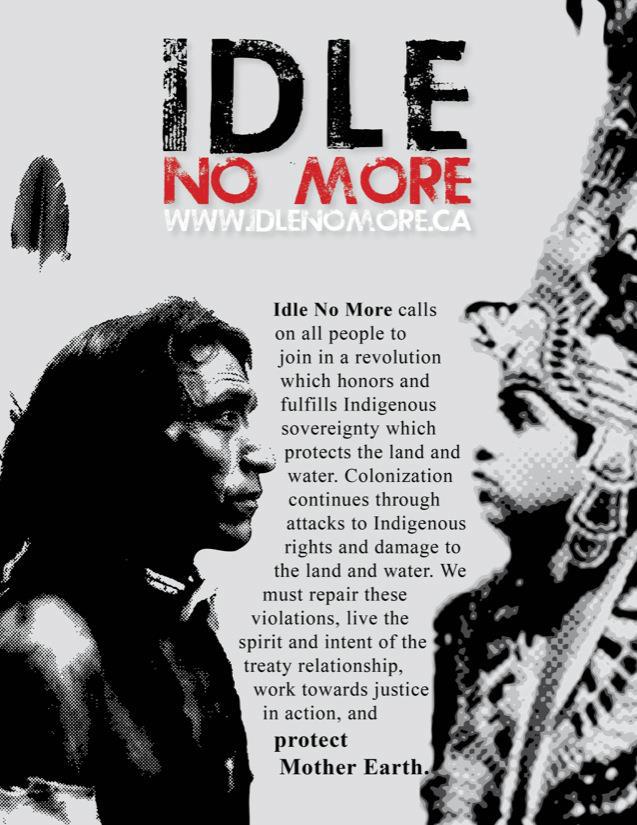
idle_no_more_posterTaken together, they are seen as part of a larger agenda on behalf of the Harper government to run rough-shod over environmental and First Nation interests, to ignore the harm caused by the implementation of one or many economic projects, and to streamline the legal process to make it easier for them to push their projects through. On top of that, they seek to redress hundreds of years of abuse, neglect and genocide that remain a stumbling block to a healthy relationship between the Canadian government and its First Nation people, and an embarrassment to the world.

Naturally, the Harper government was intransigent about having a meeting, but finally agreed when it became clear that Spence meant business and the Assembly of First Nations, Canada’s many Aboriginal peoples, and a hell of a lot of its non-Aboriginal citizens (myself included) stood in solidarity with Spence. As of January 2013, his government and the Govern General of Canada both agreed to hold a meeting to discuss all outstanding issues.

THERESA-SPENCE-HARPER-MEETINGTo many, this is a hard-won victory, even though the greatest battles may be yet to come. And as far as I am concerned, it is demonstration of what social media and the internet can do when used for positive political change. Much like the Arab Spring, the Wisconsin Protests, and the 2008 and 2012 elections, having the means to connect with people far and wide and share in a common goal, all the while circumventing traditional media and official procedures, may mean the difference between victory and defeat.

As we all know, sometimes it’s necessary to “wag the dog” when the system fails. More and more, we see this happening today and it gives me hope. If people the world over can rise up and bring an end to ongoing abuse and oppression, then it demonstrates that we might actually be moving towards this thing called a global community after all, and one that is united in its commitment to human rights and social justice, not just a globalized economy and cheap electronics!

You go Spence! Give Harper and his cronies hell, and don’t let them give you any crap either! Chances are, they won’t be in office much longer. Oh, how I hope and pray…

Idle_No_MoreSource: CBC.ca, Huffington Post.ca, Facebook, idlenomore.ca

The Anniversary of Pearl Harbor

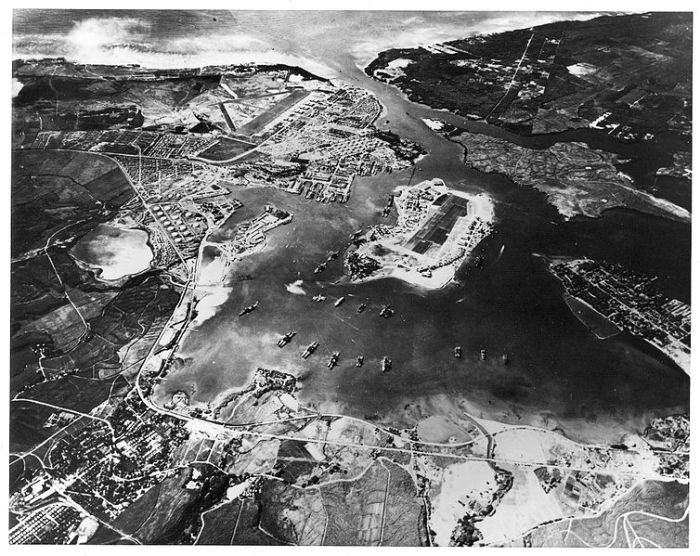
Aerial photo of Pearl Harbor, Oct. 1941

Hello fellow bloggers and blogger-followers! As you know, there are times I like to break with my usual subject matter to mark an important anniversary. Not always are these dates which accord with major scientific breakthrough or accomplishments. Sometimes, they are just about the anniversary’s of major historic events that are important to us for any number of reason. And today people all over the world, including several friends and family members of mine, stop to remember the events of Dec. 7th, 1941 – the day of the attack on Pearl Harbor.

Given the importance of this anniversary for so many people, not to mention the sheer historical importance of it, I couldn’t possibly let the day go by without saying something. And though I managed to acknowledge the 70th anniversary of Dieppe and the 100th anniversary of the War of 1812 this year, I neglected to say anything on the subject of the 68th anniversary of D-Day and never got over it! So in an attempt to not let another chance to pay my respects and acknowledge a major turning point in history pass me by, here are my thoughts on this somber anniversary. Please feel free to share your own…

_____

“Yesterday, December 7th, 1941, a date which live in infamy, the United States was suddenly and deliberately by naval and air forces by the Empire of Japan.”

These historic words by President Franklin D. Roosevelt, which were part of his famous “Day of Infamy” speech, came just one day after Japanese forces struck at Pearl Harbor, signalling the entrance of the US into the Second World War and a major turning point in history. In addition to 2,402 souls that died and the 1,282 that were wounded, the attack forever altered American’s perceptions of themselves.

USS Arizona, burning after the attack

Until the end of 1941, most US citizens lived with the notion that their nation could remain uninvolved in the global conflict which was happening overseas. As Hitler overran Europe and the Japanese occupied much of China, Southeast Asia, and the Pacific Ocean, the majority of citizens remained committed to non-involvement, citing the state of their economy or the fact that America wasn’t “prepared for another war” as reasons to stay out of the fighting.

B-29 assembly line
B-29 assembly line

All of that changed on Dec. 7th. For the first time, all people in the US, not just FDR and a hand full of analysts, came to understand that neutrality was not, and perhaps never was, an option. Some seven million men volunteered for military service within days, and American industry was fired up to produce all the tanks, aircraft, ships and munitions that would be needed to take on the Japanese Empire and the Axis Powers. Within three and a half years, total victory was won, though not without incredible sacrifice.

Little wonder then why this day is considered so important to historians and common people alike. Not only was it a tragic day, characterized by shock, loss and fear, it also was a day which led to one of the greatest national efforts ever seen, which in turn led to a victory that remains unparalleled in the annals of history. As just about every historian would say, Pearl Harbor “galvanized” the US and turned it from a semi-isolationist country that was still recovering from the Great Depression to a superpower which helped destroy Hitler, Fascism, and win the greatest and worst war in the history of civilization.

FDR delivering "Infamy" speech before Congress, Dec. 8th, 1941
FDR delivering “Infamy” speech before Congress, Dec. 8th, 1941

However, while the history books claim that it was Pearl Harbor which galvanized the US and erased its isolationist tendencies, FDR’s historic speech had a great deal of influence as well. When news of the attack first reached the public, the mood was one of shock, fear, and uncertainty. For years now, Americans had been fearing the specter of war and now that it was upon them, no one knew how to react or what would happen next.

But when people tuned in to listen to their President speak on the following day, they heard a stalwart man praising the efforts of US personnel and calling the citizenry to stand together against an evil power that was threatening not only them, but the entire world. Knowing that a man like FDR was at the helm, the same man who had seen them  through the worst of the Depression and was famous for uttering the words “You have nothing to fear but fear itself” was as much responsible for this turnaround as the attack itself.

USS Arizona Memorial, Peal Harbor
USS Arizona Memorial, Pearl Harbor

Years later, the significance and the true nature of this event are still the subject for debate. Since the initial days after the attack itself, there were some who speculated that the attack had been allowed to take place in order to achieve US involvement in the war. In fact, nine inquiries were conducted between the years of 1941 and 1946. However, due to secrecy and clearance concerns, especially where the issue of cryptography was concerned, the full details of the attack were not made clear to the public until 1992.

Reaction to the report was mixed. The findings seemed to emphasize that a combination of secrecy, a lack of inter-departmental communication, and an underestimating the Japanese forces capabilities and intentions prevented US forces from stopping the attack. However, some have claimed that these findings did not go far enough to probe the possibility that an attack was known of in advance and was allowed to take place, mainly for political reasons.

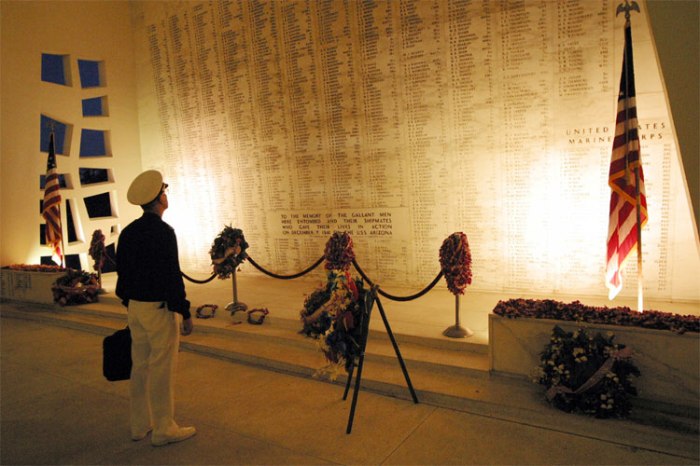
USS Arizona Memorial, interior

Much like with 9/11, it seemed that there were many questions and grey areas that were likely to give rise to speculation. When all is said and done though, hindsight is always capable of making it seem that their is intent and continuity to events, when in fact all things happen on an ad hoc basis and no one can see the outcome. In the end – and in this historians opinion – those who died on Dec 7th were victims of human error and the capacity for senseless violence.

To all those who perished at Pearl Harbor on that fateful day, to all those who died as a result of World War II and all wars previous and since; I think I speak for everyone when I say rest to peace on this day.