Towards a Safer Future: The Roofie-Detecting Glass

drinksavvy_glassAttention date rapers and sex offenders: you’re free ride is over! Thanks to a product known as DrinkSavvy, a new line of glassware, plastic cups, straws, and stirrers, the previously undetectable drug known as flunitrazepam (aka. rufies), has finally met its match! Basically, when a drink is spiked, a series of stop sign-red stripes show up on the cup’s sides, and the clear straw or stirrer turn red too, and the user knows not to drink.

That such a product is necessary is truly a sign of the times. Every year, over a million people find themselves becoming the victim of date rape drugs. And in 2010, DrinkSavvy founder Mike Abramson was one of them. As he recounted the incident:

I ordered my first drink of the night at a birthday party at a Boston club. But halfway through that first drink, it started to feel more like my 15th. One of the few things I remember after that is waking up with a massive headache and substantial nausea, feeling confused, and wondering, ‘What happened to me that I don’t remember?’”

drinksavvy_strawLuckily for Abramson, he was not injured or assaulted after consuming the drink. Without any explanations, he could only assume that he was either the intended victim or a robbery and the perpetrator backed out as the last minute. Or worse, that the drink was intended for someone else (a intended rape victim) and he just happened to consume it.

Because of this experience, Abramson made it his mission to avoid another hellish blackout and make sure similar experiences stopped happening to others. At first, this consisted of buying drug-testing strips and periodically pouring some of his drinks on one for analysis. However, he quickly realized that this was impractical and there needed to be a better way.

drinksavvySo he took his idea of merging the software with the hardware to Dr. John MacDonald, a chemistry professor at Worcester Polytechnic Institute, who integrated a color-changing, drug-testing material into plastic and glassware. This was followed by a crowdfunding campaign on IndieGoGo, where Abramson was able to raise $52,089 as seed capital to begin mass production.

Thanks to all this, the first batch of straws and 16-oz. plastic cups will be shipping out next month. By 2014, the company expects products to be widely commercially available. Abramson hopes the products will someday become the new norm in bars, clubs, and on college campuses, and bottles and cans with similar detection functions are in the works.

drinksavvy_cupIt is a sad time indeed when people need to get this creative in order to prevent sexually-based crimes. But inventions such as these remind us of the existence of socially-conscious individuals, and how much more powerful we are than cowardly predators who sulk in dark corners, slipping their dangerous wares to us when they think we’re not paying attention.

One can only hope that future versions of the Drinksavvy or similar products will also have some kind of detection system. Perhaps a finger printer or DNA sampler than can tell us who touched the glass, thus giving police and security an immediate list of suspects. Wouldn’t that be both cool and immensely affirming?!

And be sure to check out Abramson’s IndiGoGo promotional video, which includes some nauseating footage about drug-related sexual assaults:

Source: fastcodesign.com

NYC’s Futuristic Pool: Cleans Water Before You Swim

exorcisepool-perspective-poolWater pollution is one of the most serious environmental concerns facing the planet, and as with most things environmental, the culprit is urban sprawl. Take Newtown Creek in the Brooklyn neighborhood of East Williamsburg, which is one of the smelliest and dirtiest watersheds in the world. In addition to oil and industrial contaminants, the watershed is heavily burdened by the worst byproduct of urban living there is: sewage.

At present, storm water combines with the local sewage in a pipe-overloading combination that sends over a billion gallons of wastewater into the creek each year. Unlike industrial chemicals, which can be captured and treated to render it harmless, urban sewage is created in volumes that are extremely difficult to manage. And for most cities, the option of simply dumping it in the ocean is too attractive to pass up.

exorcisepool-treatmentHowever, architect Rahul Shah has a bold solution for dealing with this problem: Build a swimming pool. The Exorcise Pool – which Shah proposed for his master’s thesis at Parsons The New School For Design – wouldn’t use water directly from the Newtown Creek, its water supply would be the same, and its purpose would be both to mitigate and reveal the woeful state of local water pollution.

Instead, Shah’s project would divert an estimated 76,000 cubic feet per year of run-off into “bioswales”: ravines full of cattails, bulrush, and algae that would both absorb and carry water downhill. These bioswales would replace sidewalks on eight blocks of East Williamsburg, covered by grates where there are garages or doors to warehouse apartments.

exorcisepool-exteriorWater not absorbed by the plants would be carried to a series of water treatment technologies, using everything from algae to UV light to a bed full of reeds that will help trap solids. Ultimately, the water would not be clean to the point of drinkability, but would be safe as anything found in a pond. And in addition to drawing attention to the state of the river, the purpose, according to Shah, would also be to “showcase of different methods of water treatment.”

But of course, the main attraction, once all this water is treated, would be a series of patio misters and a public pool. The misters, according to Shah, will act as a sort of “test of faith”, where people decide to take a leap by letting treated water touch their skin. After that tentative step, they will have the option of swimming in it.

exorcisepool-showerAnd though the project is not being realized just yet, it stands as a suggestion of how to repurpose and redesign urban structures that were once sources of pollution into something healthier and more natural. In many ways, it calls to mind the work of the design firm Terreform ONE – which is seeking to convert Brooklyn’s Naval Yard into a vast greenspace through living architecture – or New York’s real estate firm Macro Sea, which began converting old dumpsters into mobile swimming pools back in 2011.

In the end, its all about converting the problem into a solution. Repurposing and redesigning the older, dirtier habitats of the past and turning them into something that actively cleans up the despoiled environment is much cheaper and easier than bulldozing and redeveloping them, after all.

And it also serves to remind us of how large urban environments are a part of the solution as well. With many people crammed close together amidst such sprawling infrastructure, the challenge of meeting future demands for space and clean living is visible and direct. As such, it has a hand in leading to innovative solutions and bright ideas.

Sources: fastcoexist.com, terreform.org, macro-sea.com

Five Technologies for the Developing World

Developed-and-developing-countriesWhen it comes to providing energy in the “developed world”, the challenge is in finding ways to generate electricity, heat, and cooling in a way that will not burden our environment. Whereas providing these things in the past has never been much of a challenge, finding ways to meet future demand in a way that is sustainable and renewable often is. Lucky for us, we have the means to meet this challenge head on.

But in the “developing world”, where the infrastructure does not readily exist, populations continue to grow exponentially, and the concerns about the natural environment are quite grave already, the challenge of providing for people’s basic needs presents a significant challenge. At the same time however, it presents an opportunity for creative solutions.

What follows is just a few examples of what engineers and designers have come up with in recent years. These devices are especially innovative because they are capable of increasing the supply of safe, cheap energy on a user-by-user basis, bypassing the years it takes to extend a power grid to remote places, the resources needed to increase a country’s energy production capacity, or the environmental damage involved.

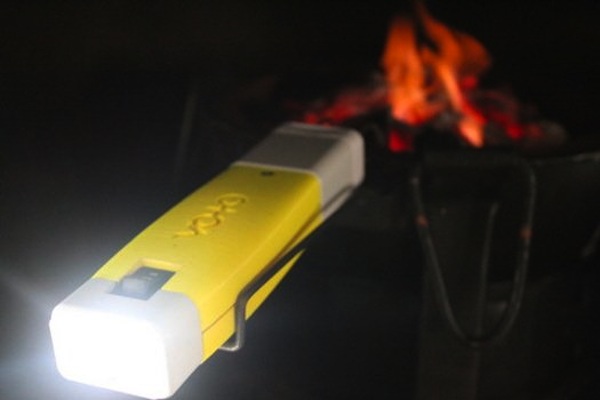
Voto-Stove1. The Voto: Millions of people around the world use coal or wood-fired stoves to provide for their cooking and heating needs. Developed by the company Point Source Power, the VOTO converts the energy these fires release as heat into electricity, which can power a handheld light, charge a phone or even charge a spare battery. Initially designed for backpackers and campers, the company is also trying to find a way to make it accessible to residents of the developing world, where it will be much more useful.

2. Window Socket: Here we have what is perhaps the simplest solar charger in existence. Simply attach the suction cup to a window or any sun-exposed surface, let sit for 5 to 8 hours, and the solar panels will store enough electricity to power a device for up to ten hours. Created by Kyuho Song and Boa Oh of Yanko Design to resemble a normal wall outlet as closely as possible, the charger can be taken and used anywhere, making it truly versatile.

window_socket33. The Berkeley-Darfur Stove: In recent years, health researchers have come to the conclusion that open-fire stoves lead to millions of deaths in the developing world. Hence this design by Potential Energy, a nonprofit dedicated to adapting and scaling technologies to help improve lives in the developing world. Featuring a tapered wind collar, a small fire box opening, nonaligned air vents that reduce the amount of wind allowed to stoke or snuff the fire, and ridges that ensure the optimal distance between the fire and pot, this stove is safe, fuel-efficient, and requires less wood to power. Over 25,000 units have been distributed to the Darfur region and Ethiopia so far.


gravitylight4. Gravity Light: Along with wood-burning stoves, kerosene-burning lamps are also a major health concern because of the fumes they create. Hence the simple and elegant solution known as the Gravity Light. Developed by the research initiative deciwatt.org, the device is powered by attaching a 20 lbs bag or rocks or dirt to a cord and then lifting it into place. The potential energy stored in that lifting motion is then gradually converted to electricity as the the bag descends over the course of about 30 minutes, powering a light or other electrical device in that time.

5. SOCCKET: Soccer is easily the most popular sport in the world, with millions of people playing daily. And in an attempt to turn this daily activity into an efficient form of energy that would replace kerosene lamps, Uncharted Play, a for-profit social enterprise, has created a ball that uses a kinetically-powered pendulum to generate and store electricity. After about 30 minutes of play, the ball stores enough energy to power an attachable LED lamp for 3 hours. Development of the product was funded via Kickstarter, and the first ones will ship in the next few weeks. A percentage of all retail sales will go to providing SOCCKETs to schools in the developing world.

two_SOCCKETsWhen it comes right down to it, these devices are especially innovative because of the way they marry  new technology to basic utility. In the end, what people get are things that are simple to use, effective, clean, and safe. And if history and sociological research have taught us anything, it’s that little things that make life healthier and easier have a profound impact on the lives of people.

Combined with large-scale concept (like 3D-printed structures) simple solutions like these are likely to make a big difference in the lives of millions of people. By ensuring that people have access to lighting and heating that does not compromise their health, is better for their environment, and less-labor intensive and expensive, the daily grind that characterizes far too many people’s existence is sure to get easier and allow for new opportunities.

Though they might seem like minor improvements, incremental changes have a way of adding up and can lead to serious and positive social change. And I for one am eager to see it happen!

Source: blogs.smithsonianmag.com

Climate Change, In Song!

daniel_crawford_4858Climate Change is a daunting phenomena, a severe problem that is threatening our planet but which remains inaccessible and invisible for many people. Part of the problem is condensing all the facts, figures and studies into a coherent, easy-to-understand form that people can see and understand. Not the easiest thing to do, and even the famous hockey-stick shaped graphs appear to be falling short.

Luckily, artists like cellist Daniel Crawford are stepping in to fill the role of scientific interpreter. Committing the most alarming portion of that hockey stick to music, he shows just how alarming this trend is. He calls it “A Song of Our Warming Planet”, where notes are matched to temperatures, one for each year since 1880.

keeling_curveAs the average global temperature increases by 0.8 Celsius (1.4 Fahrenheit) and atmospheric carbon dioxide levels increase by more than 40%, the song climbs from the low, open C to the high end of its register, sounding, in one commenter’s estimation, “like a woman screaming.” And the video ends with the chilling text:

Scientists predict the planet will warm by another 1.8 degrees Celsius (3.2 degrees Fahrenheit) by the end of this century. This additional warming would produce a series of notes beyond the range of human hearing.

Scary stuff. Check out the video below, and then be sure to look around this site for some of the more positive news on the issue. I don’t like sending people away gloomy!


Sources:
fastcoexist.com, vimeo.com

George Takei’s Proposal for the 2014 Winter Olympics

Sochi-2014-Olympic-StadiumThe build-up towards the Sochi Winter Games has been fraught with controversy, thanks to Russia’s recent passage of numerous laws which amount to persecution of its resident gay population. As a result of this, numerous pro-GLBT groups from around the world have proposed various boycotts. Like most issues involving human rights and sanctions, it is a sticky one without much in the way of clear solutions.

But first, some background on the issue seems needed. Though homosexuality was decriminalized after the fall of the Soviet Union in1991, more recent laws passed by numerous states, and now being advocated federally by Vladimir Putin, have led to concerns and criticisms that the country is slouching towards extreme social conservatism again.

russia-gay-law-olympics.siThese include the recent ban on “homosexual propaganda” that has been passed in numerous regions and is being proposed by Putin’s allies in the country’s federal Parliament. This law would effectively make it illegal for gay people to express themselves publicly, which would include admitting to being gay, or demanding equality or reform for same-sex couples at home or abroad. In effect, it would criminalize the act of being openly gay.

To make matters worse, this legislative ban has been linked to an upsurge in homophobia that led to a dozen murders and an unspecified number of assaults last year. Though obtaining accurate numbers is difficult, since victims are afraid to come forward, next of kin are reluctant to admit homophobia was a cause, and enforcement of hate crime laws remains tentative.

russia-gay-law-crackdownThis has led many people worldwide to propose boycotts against Russia, ranging from Russian vodka, to the Sochi Olympics themselves. However, there are those who are quick to point out that such a boycott would only punish the athletes who have worked very hard to get to the Olympics, and really won’t help the Russian gay community at all.

What’s more, if human rights issues are a reason to boycott the Olympics, what are we to think of Beijing hosting the 2008 Summer Games? In addition to its ongoing occupation of Tibet, China maintains a human rights record that is deplorable by most standards, and actively deprives its citizens of numerous human rights on a daily basis. But no boycotts were mounted there, leading some to conclude that one here would be unfair.

Luckily, George Takei has offered a possible way out of this dilemma: let Vancouver host the 2014 Winter Games. At the website for Allegiance: A New American Musical, which stars the openly gay actor and activist, he posted an appeal to people all over the world to not boycott the games, but instead to demand that they be moved to another venue.

George TakeiTitled “It’s Time to Move the Olympics”, Takei cites Russia’s Sports Minister recent confirmation that the country intends to enforce these new laws against visiting LGBT athletes, trainers and fans. This means that anyone attending the Olympics could be arrested, fined and deported for the simple act of waving a rainbow flag. Because of this, he says that it’s time for the IOC to reconsider Sochi as a location.

Instead, Takei and others believe that the games should be moved to Vancouver since “all of the facilities are still in good condition, so this would likely be the easiest of possible alternatives.” In addition to sending a clear message about human rights, the games could proceed and the athletes would not be penalized. People who are interested in signing the petition can do so by clicking here.

And as someone who witnessed the 2010 games firsthand, thought they were awesome, and saw how we came away from it all with plenty of debt, I can certainly see the value in this. We already have the structures, and would love another infusion of tourist dollars and international attention. Despite whatever logistical and financial considerations that will need to be ironed out in the meantime, I’d say it’s a win-win situation.

sochi-2014-takeiSidenote: According to Reuters, Russia has since denied that the “homosexual propaganda laws” will be enforced during the games. In a statement made by Igor Ananskikh, the head of the Russian Duma Committee on physical training, sports and youth, he claimed that:

The Olympics is a major international event. Our task is to be as politically correct and tolerant as we can be. That’s why we made the decision not to raise this issue during the Games.

This contradicts a statement made by Russian Sports Minister Vitaly Mutko, who said previously that no concessions would be made to foreign athletes and visitors to the Sochi Olympics:

No one is forbidding an athlete with non-traditional sexual orientation from coming to Sochi, but if he goes onto the street and starts propagandizing it, then of course he will be held accountable.

So the official story at this point is that Russia will NOT be enforcing its anti-GLBT laws to visiting athetes. No doubt, this overruling was the result of political pressure, as the Duma does not want to see Russia deprived of hosting a major international event for any reason. As years of languishing in obscurity Russia, much like China, can be counted on to jealously guard its newfound sense of status and grab any opportunity it can to advance it.

vancouver-2010-olympics-opening-ceremonyNo telling how this will work out. But in the meantime, I’m hoping Vancouver gets to host the Winter Games twice in a row! That would be some kind of record, and considering all the golds Canada took home last time, I imagine we’d be in good spirits!

Sources: allegiancemusical.com, rt.com, amnesty.org

Drone Wars: New Leaks Reveal Human Cost of Drone Strikes

drone-strikeIt would be an understatement to say that drones and UAVs are hot button issue right now. As an ongoing part of the “war on terror”, the use of remotely piloted vehicles to target terrorism suspects remain a popular one within the US, with 56% of respondents indicating that they supported it (as of Feb. 2013). However, when the matter of civilian casualties and collateral damage is introduced, the issue becomes a much stickier one.

What’s more, it is becoming increasingly evident that how the drone program is being presented is subject to spin and skewing. Much like the NSA’s domestic surveillance programs, it is in the Obama administration’s and the Pentagon’s best interest to present the issue in terms of “hunting terrorists” while categorically avoiding any mention of the real costs involved. And thanks to recent revelations, these efforts may prove to be more difficult in the future.

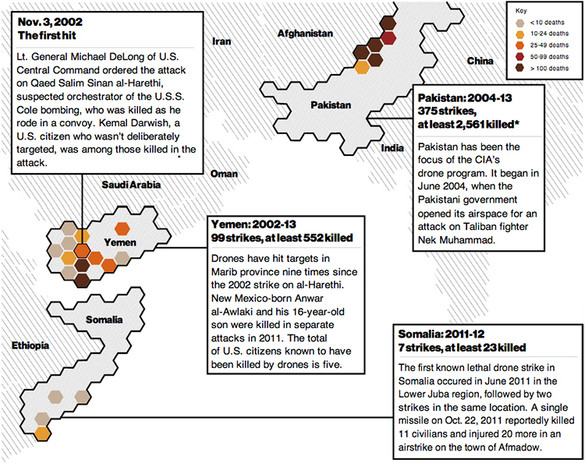
drone_mapIt was just over weeks ago, on July 22nd, that London’s Bureau of Investigative Journalism released a leaked Pakistani report that detailed numerous civilian casualties by drone strikes in the country’s Federally Administered Tribal Areas (FATA). For years now, obtaining information about civilian casualties caused by US and NATO strikes in this region has been incredibly difficult – information which these documents have now provided.

The 12-page dossier was compiled for the the authorities in the tribal areas, the Bureau notes, and investigates 75 CIA drone strikes and five attacks by NATO in the region conducted between 2006 and 2009. According to the document, 746 people were killed in the strategic attacks. At least 147 of the victims were civilians, and 94 were children.

on April 3, 2009 in Now Zad in Helmand province, Afghanistan.This directly contradicts inquired made by the United Nations, which began investigating the legality of the drone program and strikes last year. According to the U.N.’s special rapporteur on counterterrorism and human rights (Ben Emmerson) Pakistan then claimed at least 400 civilians had been killed in U.S. strikes in the country since 2006. Quite the discrepancy.

And while a majority of other tallies relied on media reports of drone strikes, the FATA list was compiled by government officials who were sent out to investigate damage firsthand in the wake of attacks. According to the Bureau, on several occasions officials registered different casualty rates than the media outlets reported.

Drone-strike-damageThe Bureau went on record to say that there were gaps in the information provided, like why none of the names of the casualties were provided, or why civilian casualties were not provided for 2009, the last year covered in the report. It is possible that logistical factors played a role, such as the lack of accurate census data in the FATA region, and that casualty figures for the year 2009 were difficult to obtain due to the acceleration of drone strikes during that year.

It is this last aspect which is likely to give many pause, since it was the decision of the outgoing Bush administration to intensify drone strikes during the last few months of his presidency, a decision which the Obama administration adopted and maintained. And the list provided only shows a gap between the official numbers and those obtained on the ground during the years of 2006 and 2009, when the strikes began.

drone_loadoutWhat are we to make then of the years running from 2009 to 2013, where drone strikes in the western region of Pakistan became a much more common occurrence and the body count – civilian or otherwise – can only be expected to have escalated? This could another reason that figures were omitted from 2009, which is that the Pakistani government was concerned that they might spark outrage if they were to ever be made public.

However, that is all speculation at this point, and more time and investigation are certainly needed to determine what the cost in human terms has been. One thing is for sure though, the use of drones in Pakistan, Yemen and Somalia are likely to become increasingly controversial as more information emerges and an accurate picture of the death toll is presented.

drone_map1For years now, the US government has denied that large civilian casualty counts exist, but it continues to withhold the numbers. But some claim those numbers will not shed any real light even if they are released, since it is still not clear how the US forces distinguish between civilians and “militants” or “combatants”.

In a major speech on national security in May 2013, Obama strongly defended the drone program but said the administration would codify the process it goes through before ordering attacks and would work with Congress to create more oversight. However, no promises were made about the number of deaths leading up to this declaration, whether or not those facts and figured would be made public, and strikes continue to take place which violate this new mandate.

obama_dronesAs the saying goes, “the first casualty of war is the truth”. And without much effort, one can easily draw parallels between this latest phase in the “war on terror” to the vagaries of Iraq, Abu Ghraib and Guantanamo Bay, where information was withheld, numbers debated and legalities issued in order to justify highly questionable acts.

And for those old enough to remember, the specter of Vietnam is also apparent here. Then, as now, the public is forced to rely on leaked information and confidential informants simply because the official stories being issued by their government are full of discrepancies, denials, and apparent fabrications. One would think we had learned something in the last five decades, but apparently not!

Sources: huffingtonpost.com, thebureauinvestigates.com

Cyberwars: U.S. Lawmakers Credit NSA for Uncovering Al-Qaeda Threat

bahrain-embassy-04818864In a statement made this past Sunday, the US State Department indicated that it will be extending its embassy and consulate closures until the end of the week. Offices were reopened in Iraq, Afghanistan and Algeria just yesterday, but another 19 will remain closed until Aug. 10 – including locations in Egypt, Yemen, Libya, Saudi Arabia and Kuwait.

These closures were made in response to an unspecified Al-Qaeda threat that indicated that an attack might be coming sometime in August, particularly in the Middle East and North Africa. According to the State Department, the decision to keep the embassies and consulates closed was “not an indication of a new threat,” but simply out of concern for the lives and safety of staff.

embassy-closure-mapAnd according to another State Department source, the credit for uncovering this supposed threat goes to the NSA and the PRISM program – i.e. the extensive new data mining operation that has garnered a great deal of controversy of late. Specifically, it was the agency’s ability to monitor communications on cellphones and emails that was is credited with making the difference.

Senator Saxby Chambliss, he top Republican on the Senate Intelligence Committee, claimed in an interview that “There is an awful lot of chatter out there”. This “chatter” apparently took the form of communications among terrorism suspects about the planning of a possible attack, which he claimed was “very reminiscent of what we saw pre-9/11.”

US embassy in Tel AvivNo indication was given as to the nature of the threat or whether or not an actual attack might take place. But Chambliss was very quick to draw the connection between the NSA’s ability to gather information and the warnings his department received.

[Those programs] allow us to have the ability to gather this chatter. If we did not have these programs then we simply wouldn’t be able to listen in on the bad guys. This is the most serious threat that I’ve seen in the last several years.

This information-gathering program was one of many aspects of the NSA’s broad surveillance identified by former spy agency contractor Edward Snowden in his testimony to major media outlets. So it comes as no surprise that the State Department would be coming to its defense at a time like this.

US-embassy-closures_010And Chambliss and the State Department are hardly the only ones singing the NSA’s praises right now. This past Sunday, several prominent Republicans and Democrats expressed their support for the NSA surveillance program. One such individual was Dutch Ruppersberger, the senior Democrat on the House Intelligence Committee, who told ABC’s This Week:

The good news is that we picked up intelligence. And that’s what we do. That’s what NSA does. We’ve received information that high-level people from al Qaeda in the Arabian Peninsula are talking about a major attack.

U.S. Representative Adam Schiff, another Democrat on the House Intelligence Committee, characterized the security threat as being based on specific intelligence rather than generalized anti-U.S. threats. While on CNN’s State of the Union program, he said:

This is not the usual type of chatter. It had to be corroborated or come from very reliable sources to take this kind of action.

Mideast Bahrain US Embassy ClosingsNaturally, there are those critics who would claim that the unspecified nature of the threat and the lack of oversight where PRISM is involved means that there is no way to tell if the “chatter” story is in fact real. Citing such examples as the “Orange Alert” controversy of 2004 – when Homeland Security Secretary Tom Ridge was pressured to raise the alert status leading up to the election – such critics would remind people that the US government has a history of issuing alerts based on factors other than hard data.

At the same time, it is important to note that the threat information also came ahead of the Eid celebration at the end of the Muslim holy month of Ramadan, which will be occurring later this week and just over a month before the anniversary of Al-Qaeda’s Sept. 11, 2001, attacks on a US ambassador and the American Embassy in Benghazi, Libya. In this sense, the alert may have been motivated by legitimate concern, even if hard data was lacking,

us_embassy_closings_yemenAnd the US is hardly the only nation responding to the warning seriously. The threat also has prompted some European countries to close their embassies in Yemen, where one of the most dangerous al-Qaeda affiliates is based. Interpol, the France-based international police agency, also issued a global security alert advising member states to increase vigilance against attacks after a series of prison breaks in Iraq, Libya and Pakistan.

The advisory prompted Canada’s Foreign Affairs Department to release its own warning this past Saturday for travelers and diplomats in the Middle East and North Africa region. In addition, the Canadian high commission office in Bangladesh was closed on Sunday, since Pakistan was one of several nations outside of the Middle East and North Africa to be named in the advisory.

A few things are certain at this point though: neither the threat of terrorism nor all that’s done in response to it are even close to being resolved. In addition, the controversy surrounding the response and whether or not it constitutes an overreaction or a calculated curtailment of people’s civil rights and liberties, is not over either. Not by a long shot.

Sources: cbc.ca, (2), washingtonpost.com, theguardian.com


Climate Crisis: Coming Trends in CO2

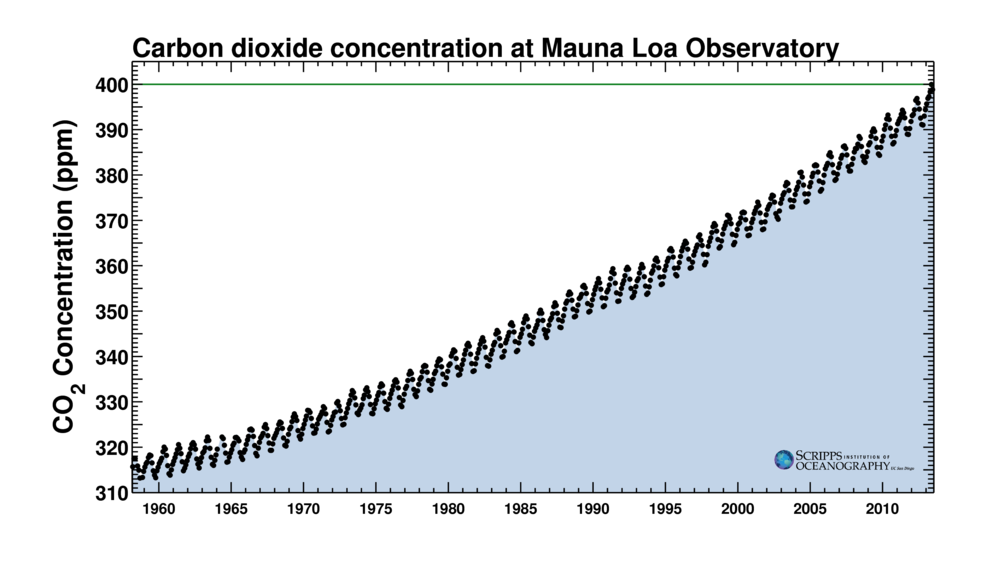
Pollution over Mexico CityGood news everybody! Okay, not exactly good, but it is news, and on a rather important subject. Recently, the National Oceanic and Atmospheric Administration (NOAA) announced that the Manua Loa observatory in Hawaii had recorded atmospheric levels of carbon dioxide which exceeded 400 parts per million. This represented a major milestone, one which climatological researchers and scientists have feared for some time.

However, they have since amended that statement, saying that the readings were a fraction of a point lower at 399.89 ppm. Not exactly a reason to celebrate, and not that surprising either, since individual readings at any of NOAA’s observation stations are subject to revision on a regular basis. And regardless of whether or not the 400 ppm milestone has been passed, scientists are still adamant that this reading is cause for concern.

keeling_curveAs has been stated repeatedly, when it comes to the buildup of human created greenhouse gases, it is the rate of increase which is most important. That rate, which is measured by the Keeling Curve, shows that atmospheric CO2 levels are rising at unprecedented rates, driven largely by the burning of fossil fuels over the past two centuries.

Originally pioneered by scientist Charles D. Keeling in 1958 , this curve is the longest-running tally of carbon dioxide levels in the atmosphere and is maintained by the Scripps Institution of Oceanography in San Diego. The saw-tooth pattern of the incline reflects small seasonal variations within the long-term upward trend, which peak annually around the month of May.

Combining this studies conducted on glacial melting patterns, pollination patterns, geological and oceanographic surveys, a long-term picture emerges. For the past 800,000 years, CO2 levels have never exceeded 300 ppm, and there is no known geologic period in which rates increased as sharply as they are now. That level was at about 280 ppm at the advent of the Industrial Revolution in the 18th century, the period when the burning of fossil fuels began to soar.

trafficScripps geochemist Ralph Keeling, who has taken over the Keeling curve measurement from his late father, had this to say about the news:

I wish it weren’t true, but it looks like the world is going to blow through the 400-ppm level without losing a beat. At this pace we’ll hit 450 ppm within a few decades.

Tim Lueker, an oceanographer and carbon cycle researcher who is a longtime member of the Scripps CO2 Group, also weighed in on the significance of these latest readings:

The 400-ppm threshold is a sobering milestone and should serve as a wake-up call for all of us to support clean-energy technology and reduce emissions of greenhouse gases before it’s too late for our children and grandchildren.

What’s especially frightening about a rating of 400 ppm is the fact that planet Earth has not experienced that kind of CO2 concentration for over 3 million years, during the Pliocene Era. At that time, sea levels were between 60 and 80 feet higher than their current levels. If sea levels rise by this much in the coming decades, roughly 1 billion of the Earths inhabitants will be left homeless.

climate_changetideAdd to this the widespread droughts, wildfires and flooding taking place in inland communities, where unpredictable weather will cause rivers to overflow erode river banks and turn millions more into refugees. And as crops fail due to increased heat and depleted topsoil, the ability to feed the world’s population will also begin to plummet.

Of course, these are the most dire predictions and are often used to remind us just how important it is to clean up our act before its too late. Researching and developing cleaner methods is one approach, as is finding ways to capture the carbon emissions we are generating on a daily basis. But in the end, the greatest weapon in our arsenal is and always will be public awareness.

Consider yourselves informed. Now go spread the word!

In the meantime, enjoy this animated “Carbon Tracker” graph that shows us the time history of atmospheric carbon dioxide – courtesy of the National Oceanic & Atmospheric Administration.


Source:
articles.latimes.com
, esrl.noaa.gov, keelingcurve.ucsd.edu

Drone Wars: X-47B Makes First Carrier Landing!

X47B_arrested_landing_610x407In any developmental milestone, the X-47B made its first arrested landing aboard an aircraft carrier yesterday. This latest test, which comes after a successful arrested landing on an airstrip and a successful deployment from an aircraft carrier, may help signal a new era for the use of unmanned aircraft in military operations.

For months now, the US Navy has been testing the Unmanned Aerial Combat Air System – the first drone aircraft that requires only minimal human intervention – pushing the boundaries in the hopes of determining how far the new autonomous air system can go. And with this latest landing, they just proved that the X-47B is capable of being deployed and landing at sea.

nimitz-class-carrier-640x424Aircraft landings on a carrier are a tricky endeavor even for experienced pilots, as the ship’s flight deck is hardly spacious, and rises, falls, and sways with the ocean waves. To stop their forward momentum in the shortest distance possible, carrier aircraft have a hook on the underside of the fuselage that latches onto cables stretched across the flight deck. This means that pilots need to land precisely to grab the hook and come to a complete stop in time.

The test flight began when the drone took off from the Naval Air Station at Patuxent River, Md. and then flew to meet the USS George H.W. Bush at sea, a flight which took 35 minutes. Upon reaching the carrier, the same which it took off from this past May, it touched down and caught the 3 wire with its tailhook at a speed of 145 knots, coming to a dead stop in less than 350 feet. After the first landing, it was launched from the Bush’s catapult and then made a second arrested landing.

X-47BThe Navy tweeted about the success shortly after it happened, and Ray Mabus – Secretary of the Navy – followed that up with a press statement:

The operational unmanned aircraft soon to be developed have the opportunity to radically change the way presence and combat power are delivered from our aircraft carriers.

Naturally, there is still plenty of testing likely to be done before such drones can be considered ready to go into combat zones. For example, perhaps, automated drone-to-drone refueling is scheduled for some time in 2014, another aspect of the UCAS the Navy is determined to try before deploying them in actual operations. Still, for fans and critics alike, this was a major step.

Which brings us to the darker side of this latest news. For many, a fleet of semi or fully-automated drones is a specter that induces serious terror. Earlier this year, the Obama administration sought to allay fears about the development of the X-47 and the ongoing use of UAVs in combat operations by claiming that steps would be taken to ensure that when it came to life and death decisions, a human would always be at the helm.

drone_mapBut of course, promises have been broken when it comes to the use of drones, which doesn’t inspire confidence here. Just eight days after the Obama Administration promised to cease clandestine operations where drones were used by the CIA to conduct operations in Pakistan, Yemen, and Somalia, one such drone was used to kill Wali ur-Rehman – the second in command of the Pakistani Taliban. This was a direct violation of Obama’s promise that UAVs would be used solely against Al-Qaeda and other known anti-US terrorist groups outside of Afghanistan.

What’s more, the development of unmanned drones that are able to function with even less in the way of human oversight has only added to many people’s fear about how, where, and against whom these drones will be used. Much has gone on that the public is now aware of thanks to the fact that only a handful of people are needed to control them from remote locations. If human agency is further removed, what will this mean for oversight, transparency, and ensuring they are not turned on their own citizens?

UAVsBut of course, it is important to point out that the X-47B is but an experimental precursor to actual production models of a design that’s yet to be determined. At this point, it is not farfetched to assume that preventative measures will be taken to ensure that no autonomous drone will ever be capable of firing its weapons without permission from someone in the chain of command, or that human control will still be needed during combat phases of an operation. Considering the potential for harm and the controversy involved, it simply makes sense.

But of course, when it comes to issues like these the words “trust us” and “don’t worry” are too often applied by those spearheading the development. Much like domestic surveillance and national security matters, concerned citizens are simply unwilling to accept the explanation that “this will never be used for evil” anymore. At this juncture, the public must stay involved and apprised, and measures instituted from the very beginning.

And be sure to check out this video of the X-47B making its first arrested landing. Regardless of the implications of this latest flight, you have to admit that it was pretty impressive:


Source:
news.cnet.com