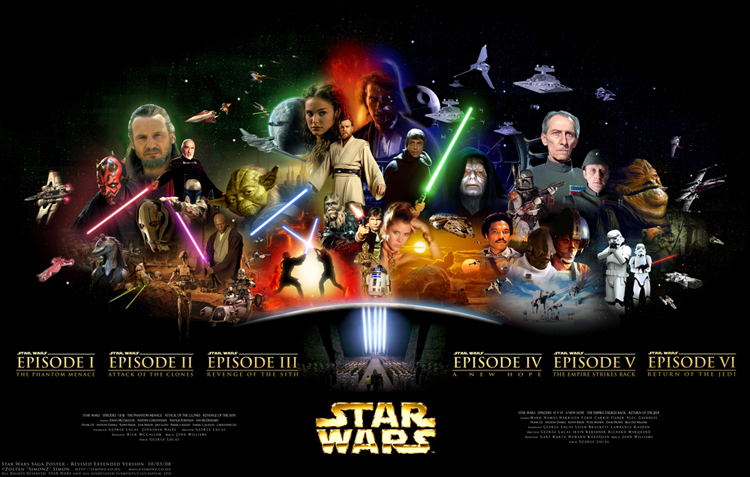
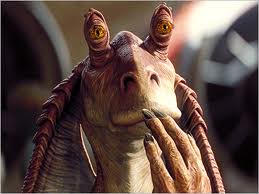
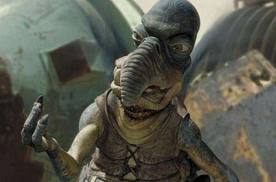
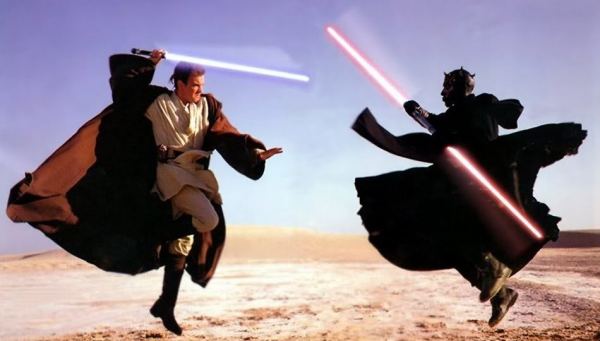
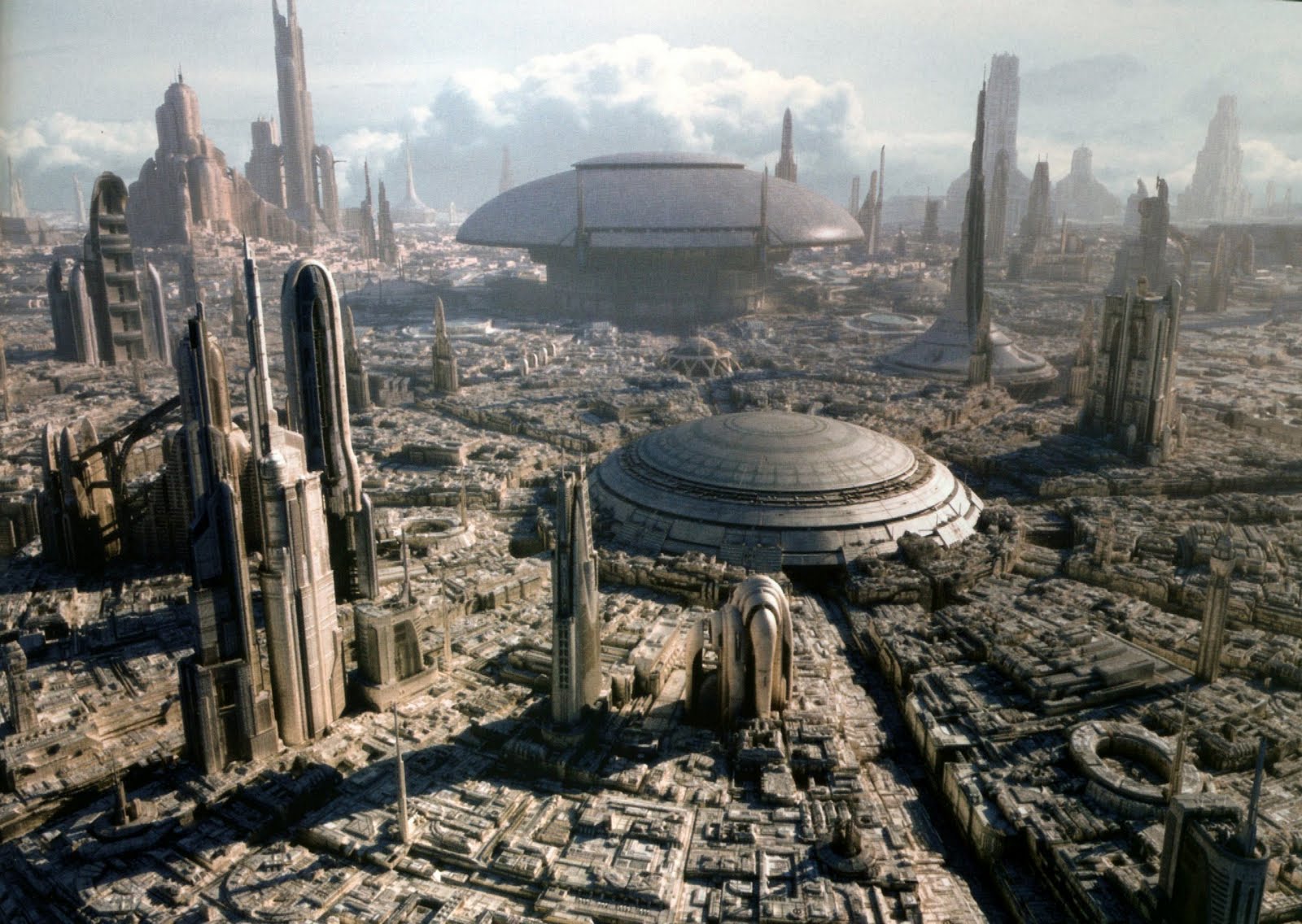
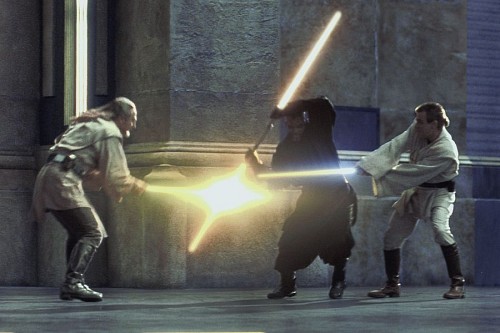
Revenge of the Sith. The Last Hope!

I come to it at last, the third and final installment in the prequel series, and sixth in the overall Star Wars franchise! Hard to imagine I started this whole thing three weeks ago. Seems like a lifetime has passed, but that’s the way time works!

And what can I say about this last installment? Well, I can tell you that between movies two and three, Lucas seemed to be taking mounting criticisms of his movies seriously. I can also say without exaggeration that after two generally panned movies, we were all pulling for him! Many reviewers openly wondered if the third and final movie could save the franchise, cuz Lord knew the fans weren’t likely to endure a third disappointment.

Luckily, Lucas seemed to pull if off with this third and final one. After the release, critics and fans seemed united in hailing it as the best of the three. Of course, the competition wasn’t exactly fierce, and there were still loads of problems that would become more apparent as time went on. The initial gentleness and praise with which this movie was met seemed to be the result of wishful thinking, really. No one wanted to see Star Wars fail.

Plot Synopsis:
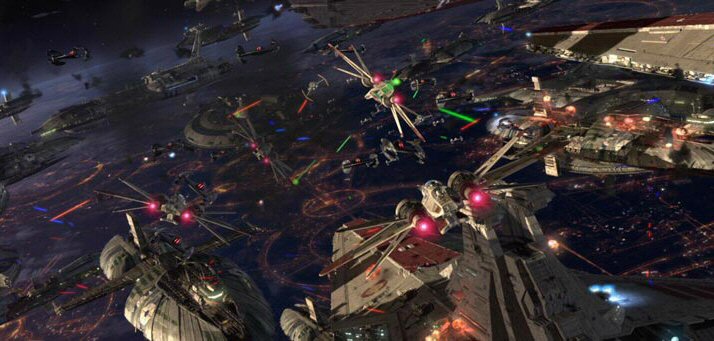
The movie opens, as always, with the crawl. WAR! It says. It then goes on to explain… See, there’s the thing known as the Clone Wars. They’re bad. Lots of people dying, lots of systems being overrun. And now, the fight seems to have come to Coruscant.

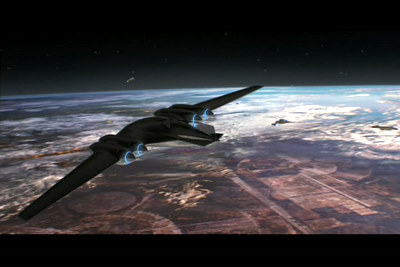
We cut, as usual, to ships in space. And after a brief, silent flyby, we see that its in fact some mad space combat! Ships everywhere are engaged in close quarters combat, destroyers, cruisers, and tons of fighters between them. And it’s all happening over the capitol. And to top it off, Skywalker and Kenobi are there too, leading the assault in their fighters.

There mission is to reach General Grievous’ command vessel, where Palpatine, a hostage, is being kept. They fight there way through several droid fighters, pull some cool moves, board the ship, take out tons of droids – all rendered with state of the art CGI of course – and begin working their way to the room where he’s being kept. Once there, a room that is made to resemble the Emperor’s own throne room, they do the deed of fighting Dooku for the second time.
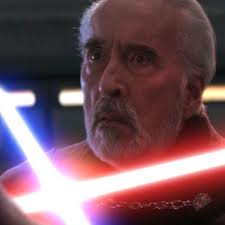
And this time, things go much the same. Obi-Wan is taken out early, and dismemberment ensues. But this time, it’s Anakin hewing off Dooku’s limbs. Defeated, Palpatine tells Anakin to kill him, and after a minimum of discussion, Anakin slices his head off.

He expresses some regret, but Palpatine tells him not to worry about it. Second time Anakin has committed cold blooded murder and the whole thing’s brushed off without a second thought. They even raise the issue of the last time he did this, appropriately…

He also tries to get him to leave Obi-Wan behind, but this Anakin proves immune to. Together, they begin the process of fleeing, only to get caught and brought to meet Grievous himself. Now this guy, though he’s hasn’t been introduced yet, is apparently important. He’s killed Jedi too, judging from his collection. However, Anakin and Obi-Wan have no trouble escaping and take control of the ship.

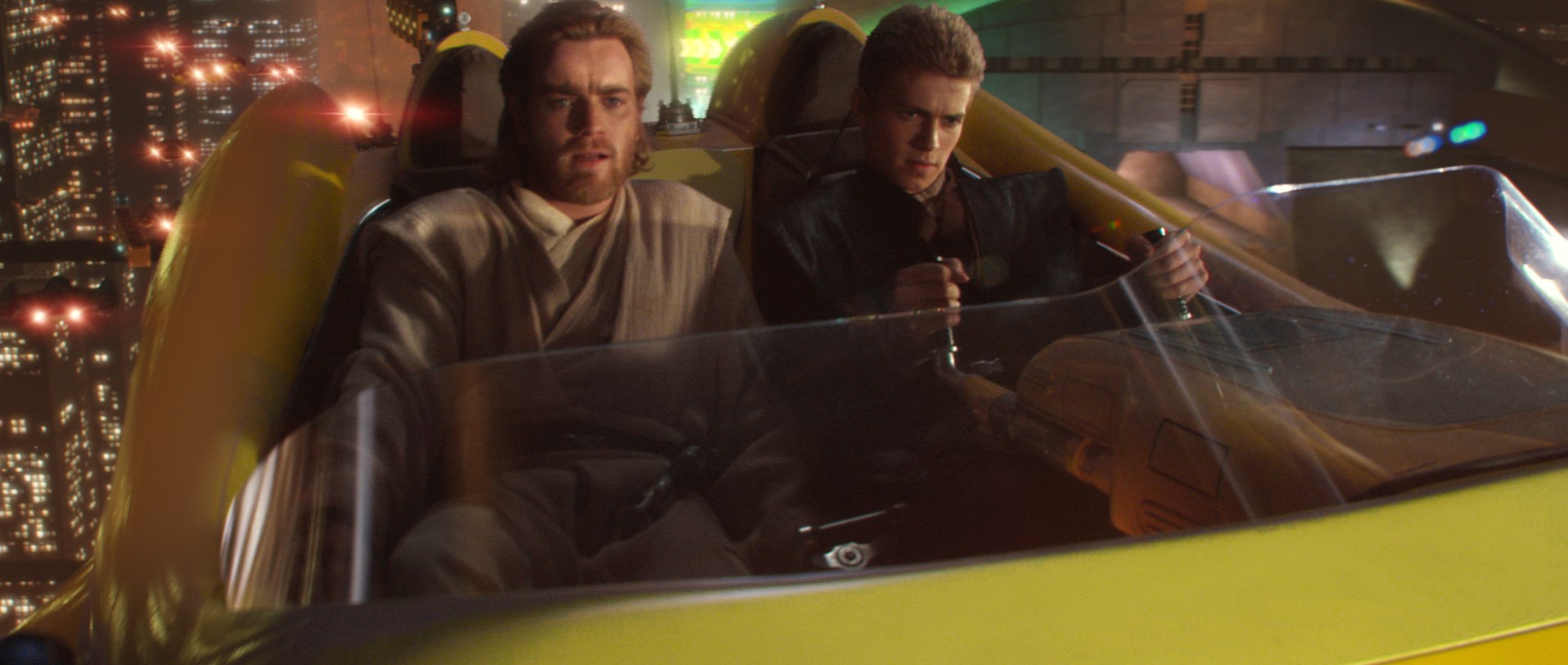
Anakin, in demonstrating his alleged flying skills, begins trying to land the ship on Coruscant itself. A spectacular crash ensues, in which we see a surprisingly callous attitude towards the potential loss of life. But then again, they never confirm that anyone was hurt, despite all the damage they do.

Anyhoo, a tender reunion soon follows. Anakin is reunited with Padme, admits he’s missed he, and learns she’s pregnant. This is a bad thing, for as we soon learn, Anakin’s been having bad dreams again. This time about Padme dying. He remembers what happened with his mother and doesn’t want a repeat.

Meanwhile, Obi-Wan and the Jedi are getting nervous about Palpatine. He’s had his emergency powers for some time and even expanded on them. Now that the war is nearing its end, they fear he won’t give up his powers. After years of benefiting from all the chaos and confusion, it seems they are finally sensing that he’s not on the level. They propose to devise a test. Once they’ve hunted down Grievous, they’ll confront him. If he doesn’t relinquish his powers, they’ll know he’s up to no good.

At the same time, Palpatine continues to use Anakin to further his own aims. He appoints Anakin as his personal representative to the Council, who do not trust him so they don’t promote him to Master. Anakin is incensed.

However, the Council still asks that Anakin spy on Palpatine for them. They also begin to express doubts about Anakin and the prophecy, whether or not it might be misread. Seems late to be bringing this up, but the die is kind of cast at this point…

Palpatine also seems to know more about Anakin than he’d prefer to know. That much is clear when he begins to address the possibility of how the Dark Side can save people from dying. Anakin is obviously intrigued, and begins to promise Padme in the most cryptic of ways that everything will be fine.
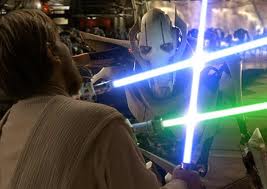
Once more, the Council decide to divide Anakin and Obi-Wan and send them on separate missions. While Anakin spies on Palpatine, Obi-Wan is dispatched to deal with Grievous. He flies to Atapau, where the Separatists base used to be, and engages Grievous in single combat. The Clones troops arrive shortly thereafter, and a big CGI fight ensues.

After a big chase involving a giant lizard, a ZOOM, and a cliffside fight, Anakin blows Grievous away with a blaster. In a shout out to remarks made in the first movie, he then mocks the weapon that saved his life. Seems kind of callous…
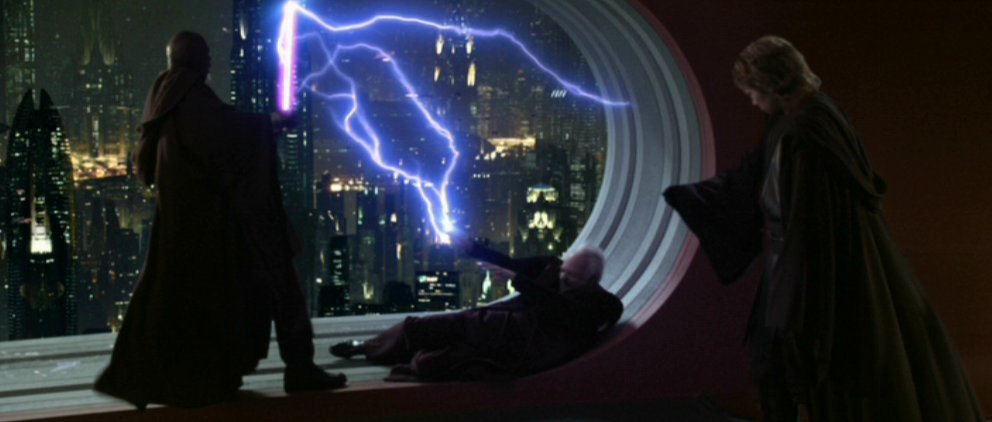
Back on Coruscant, Anakin gets wise to Palpatine after he practically spells it out for him. He draws his blade, but hesitates to take him down when Palpatine reminds him that he will never save Padme without his help. Instead, Anakin runs to Master Windu and tells him what he’s learned. Windu takes some backup and goes to arrest the Chancellor and another fight ensues. Palpatine quickly dispatches his backup, but Windu manages to subdue him before long.

Of course, Anakin shows up and pleads for Palpatine’s life. Windu seems set on killing him, which seems odd considering that he’s a Jedi Master and killing prisoners is not something they do. But this forces Anakin to intervene and Windu dies. Anakin is crippled by guilt, but out of a desire to save Padme declares his loyalty to Palpatine.
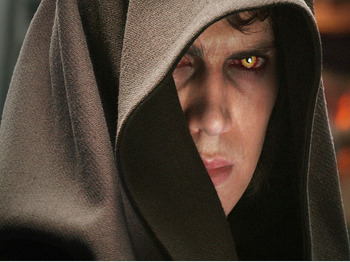
His first task, it seems, is to kill everyone in the Jedi Temple, which Anakin does, including all the kids. Once he’s done that, he’s sent to Mustafar to wipe out the Seperatist leadership, a move which will end the war and eliminate the last of Palpatine’s liabilities. He kills them too, and seems to enjoy it just a little too much!

Obi-Wan returns to learn what Anakin has done. He and Yoda arrive at the Temple to find the corpses of all the “Younglings” (guess they couldn’t say kids, might have sounded too… murdery). Obi-Wan then tells Padme, who for some reason seems surprised that Anakin has done this… again.

Once more, the Jedi choose to divide their forces. Yoda will go and take on Palpatine while Obi-Wan will fly all the way to Mustafar to deal with Anakin. Palpatine then declares the formation of the Galactic Republic, and outside of Padme and Bail Organa, no one seems to mind! She issues a line meant to capture the absurdity: “So this is how liberty ends… in thunderous applause.”

And so we get two fight-scenes, almost interspersed. Yoda fights with Palpatine in the Senate and gets several floating pods thrown at him. He loses, is picked up by Senator Organa (Leia’ adoptive father), and declares he’s failed and must go into hiding.

Padme and Obi-Wan confront Anakin, who seems to have gone a little Batty McPsycho now. After all he’s done to save her from death, he then turns on Padme with a choke move. And then of course Obi-Wan and him go at it like a bunch of Highlanders on crank!

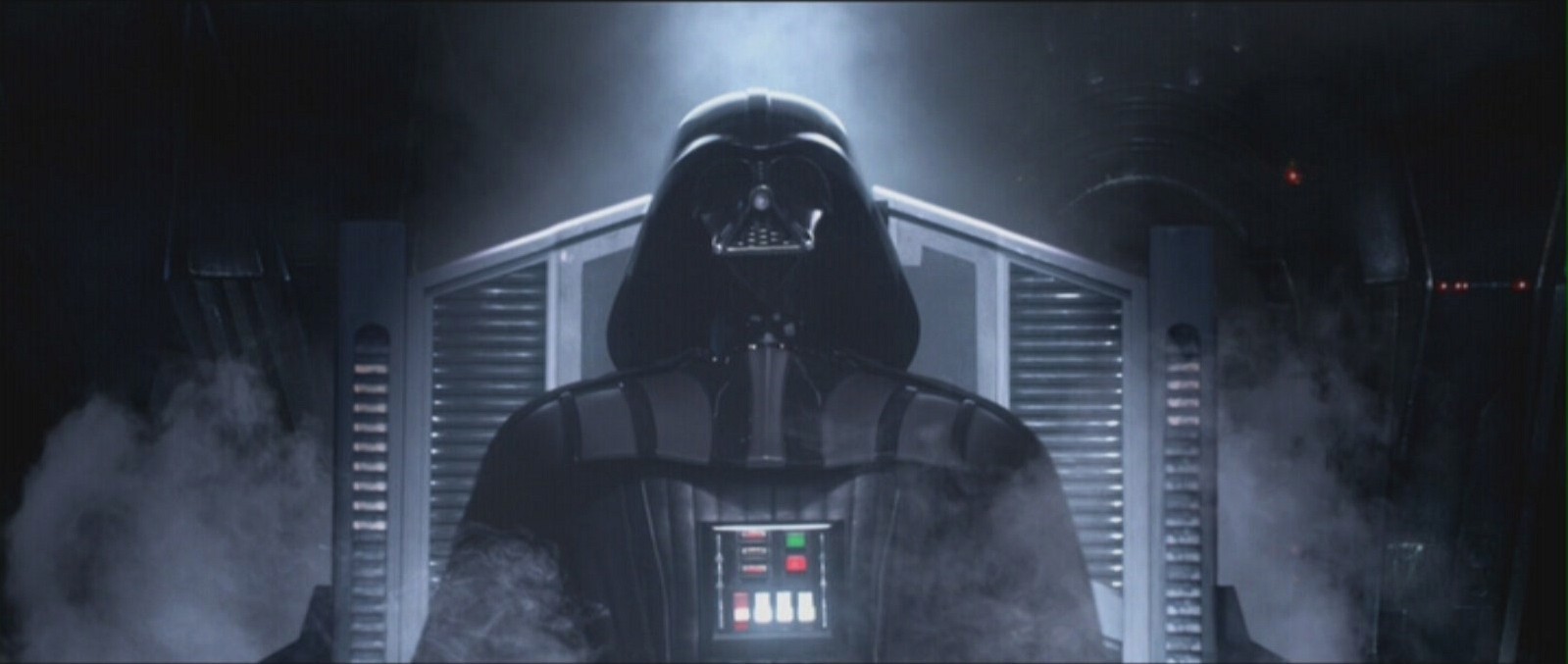
After a VERY long, drawn out fight scene, Obi-Wan takes off Anakin’s legs and remaining arm. Anakin burns on the slopes above molten magma, and Obi-Wan just leaves him there. Palpatine picks him up and takes him a medical facility where they begin the process of turning him into Vader. Simultaneously, Amidala delivers her babies and dies in childbirth. No medical reason is given, it just seems that she’s lost hope… okay.

All remaining threads are tied up nicely. It is agreed that Luke will go to Tatooine, Leia will go to Alderaan, and Obi-Wan will also go to Tatooine to hide and commune with his old master. And then, the newly-created Vader has a ham moment by wailing when Palpatine tells him that he killed Padme accidentally. “Nooooo!” is his reply. And it seems that they are no in total cahoots. The movie ends with them witnessing the construction of the Death Star.
Last Word:
Well, like I said, this movie did better than the previous two. However, there were problems that few were prepared to admit so long as the Star Wars legacy seemed on the line. Most had to do with the plot, so I’ll save those for last. First, the movie shared some problems from the previous two which really became apparent by now.

They include the shooting, how Lucas shot all his scenes from the comfort of his chair using two cameras and simply had his actors walk slowly across the screen or sitting to deliver the lines. And then there was the bad dialogue. The romance factor was diminished in this movie, but there were still those painfully awkward scenes where Anakin and Padme are forced to say how much they love each other and it all comes out tasting of ham and wood!

And it wasn’t just the romance, it was every dramatic line in the movie. Padme’s line about “how liberty ends” was one. Mace Windu’s angry declaration, “The oppression of the Sith must not be allowed to return!” was another. Why didn’t anyone ever tell Lucas, “this is NOT how people talk!” Where is Harrison Ford when you need him? And of course, the way he kept showing characters from the first as if it were necessary to cram them all in. This time it was Chewbacca, Leia, Luke, and bit more of Bail Organa, which pretty much completes the original cast. In fact, the only person he didn’t preview was Han Solo! Wonder why…

And of course there was more of the same on the recycling front. Here too, the examples were many and close together. At the beginning, we’re meant to remember Jedi where we see Palpatine in that chair in front of that window. The battle at the end was meant to call to mind the final duel between Luke and Vader. The attack on the Wookie compound on Kashyyk also seemed like a not-too-subtle attempt to resurrect the Battle of Endor (which originally called for Wookies). And the scene at the end where they are all stowed aboard a Corellian blockade runner is supposed to remind us of the first movie when Leia’s ship (same make and model) was boarded.

But none of that compared to the fact that the majority of the war, the most important aspect of the prequel movies, all happens off screen. It begins at the tail end of the movie II, then ends at the beginning of movie III, with the vast bulk of events taking place between them. Like most fanboys, I went to theaters back in 1999 expecting the prequels to be ABOUT this, but instead the war served as a backdrop to the duty of showing how Anakin fell and all the rest.

In fact, beyond a few action shots and some talk of it, the war seems to have no real consequences whatsoever to the Republic. No shortages, no recruitment drives, no resistance to the war. Even Coruscant itself seems completely unmarred by the fact that it was attacked in the beginning. A few scenes after an invasion, people are going to the opera and acting like nothing’s happened. There’s not even a single indication of damage done to the city.

Okay, plot holes time! I’ve chosen to list them in sequential order to save time and prevent overlap. Here goes!

  1. Opening Battle: Much like in Clones, the fight between Anakin, Obi-Wan and Dooku suffered from an obvious contrivance. Once again, Obi-Wan had to go down and stay down so Anakin and Dooku could fight one on one. But this time around, there was the added necessity of making sure he unconscious while Anakin executed Dooku. Which brings me to point 2!
  2. Murder? No Biggie: Once more, Anakin has committed a severe violation of the Jedi Code and basic morality by killing a man in cold blood, and no one seems to notice or care. Palpatine tells him to do it, he issues mild protests, but then does so without much regret. What little guilt he expresses is assuaged when Palpatine brings up how he’s done it before. That seemed appropriate, since there were no consequences then either.
  3. The Jedi Council, Assholes!: In the first movie, the Jedi Council tell Anakin that he has to severe all ties with his mother in order to be one of them. Why? Because his fear of losing her is bad and a path to evil. Okay, seems pretty callous, but I guess they needed something to hint at his descent into evil. Now, in movie three, Anakin is told by Yoda that his fear of losing Padme is wrong. Basically, he tells her that these fears are selfish and he should be happy this person, whoever they are, is going to die. He uses better sounding words, but the reasoning is basically the same. What kind of gurus are these? Why do they insist on being so harsh in their rules? It’s like their begging people to rebel against them by making their code impossible to follow. No love, no attachment, no sadness over loss. If anything, it’s their fault Anakin turned bad. They made him leave his mother behind, she dies and he goes on a rampage. His wife is near death, once again they tell him to let her go, and he goes on rampage to save her. There’s a lesson here I’m thinking…
  4. The Jedi Council, Idiots!: It is astounding how many stupid calls the Jedi Council make by this time in the series. First up, they’ve been saying for all three now that there’s something not quite right, some dark force, some hidden danger, but they never act on it. In this movie, they finally seem to be catching on. Mace Windu says he senses the Dark Side around Palpatine, Yoda expresses doubt about the so-called prophecy, and Mace and Yoda both fear putting Anakin in his presence. And yet, they do! Not only that, they continually fail to act to stop Palpatine even thought it’s obvious that he’s at the center of all things. Really, where is the mystery? Granted, Lucas tried to explain this away by saying the Jedi’s were being blinded by the Dark Side. But you don’t need ESP to see what’s going on here! The simple question, que bono, would have solved their entire dilemma. Who’s been benefiting from the all crises, again and again? Palpatine! And if you can sense dark energy coming from him, I’d say mystery solved!
  5. Anakin’s Descent: Now to be fair, Anakin had already turned to the Dark Side long before this movie. The moment he murdered women and children, he was bad. That wasn’t no preview of how it happened, that was it happening! But still, the way he chooses evil in this movie seems just so stupid. He saved Palpatine, that I get. But immediately after, Palpatine tells him he doesn’t know how to save Padme. That should have been the end of it. Anakin should have gone into a rage and killed him for lying through his teeth. Instead, he agrees to join him based on the promise of helping him, and that’s enough to convince him to murder children. On top of that, did he also not realize after Palpatine said go to Mustafar and kill all the Separatists that Palpatine was the one leading them? He had ample clues, like how did he know they were there? Why were they expecting him when he arrived? Why did they keep pleading that they were all friends? Did he not know, or did he not care?
  6. “No, not Anakin!”: I’ve harped on about how Anakin killed kids and no one, particularly Padme seemed to care. But what really makes no sense was how Padme reacts when Obi-Wan tells her he’s murdered the “younglings”. “No, not Anakin! He couldn’t!” Whaaaaat? You know he could, because he told you he’s done it before! The real answer should have been “Oh, no! Not again!”.
  7. Constant Separations: Why was it necessary to send Obi-Wan alone to get Grievous? On the one hand, they said they wanted an experienced Jedi to go deal with him. Okay, but why does he have to go alone? They say it’s also because it might just be a wild goose chase. Still not making sense. If Anakin’s the one who’s constantly saving Obi-Wan’s bacon, then it only makes sense to keep them together. No, the real reason is so they can be apart while Anakin does all that evil shit. Second, Yoda and Obi-Wan break up to deal with Palpatine and Anakin seperately. Again… why? Why not kill Palpatine first since he’s on Coruscant, then fly to Mustafar to deal with Anakin together. In every other movie, even at the beginning of this one, they always worked in pairs. Now they suddenly they are deliberately isolating themselves to have one-on-one showdowns. Again, the only reason is plot necessity, making sure that Yoda fails while Obi-Wan has his big fight with Anakin.
  8. The Senate, Morons!: As if the Jedi’s missing the obviousness of Palpatine’s rise to power wasn’t enough, there’s the added idiocy of the Senate. For years, these guys, have been surrendering more and more power willingly to Palpatine. And then when he announces that the Jedi attacked him, they buy it. Really? They believed that the Jedi, the servants of peace and justice for 1000 generations, are trying to take power? Not the hideously scarred man who took power in the name of security, wiped out the Jedi, and is now declaring the government a military dictatorship? They don’t see this as the slightest bit suspicious? What’s more, the entire reason they gave Palpatine “Emergency Powers” was because of the war. Now that it’s over and all the threats eliminated, he claims that arrangements is to be made permanent. And how does the Senate respond? According to Padme, “with thunderous applause”! How stupid are these people?
  9. “Noooooo!”: Another perfect opportunity for Anakin to turn on Palpatine would have been when he told him Padme was dead. Saving her was the whole reason he turned to the Dark Side, betrayed the Jedi, killed the “younglings”, and murdered the Separatists leaders. Now he’s told she isn’t even alive, and what does he do? Cries and still agrees to be the Emperor’s lap dog. Again, I would have been like “Well then f*** you, pal! I got no reason to follow you, so I’m taking it all!” He already said how he could defeat Palpatine and run things with Padme. Why not do it now and run the whole thing himself? What kind of Sith is he, turning down obvious opportunities for personal power?
  10. Contradictions: As a last point, I’d like to highlight how there were even contradictions here between this last movie and the originals. Didn’t Leia say that she knew her mother, and that she died when she was very young? That she was beautiful, kind, but… sad? She sure did, and this hinted at the fact that her mother was lamenting the loss of her husband, Anakin. So Padme dying in child birth kind of contradicts that. And it was just plain silly! Are we to believe that in this day and age, women die in child birth because they’ve got broken hearts? Even if she were feeling dejected and in the mood to give up, they got defibrillators and adrenaline, don’t they? They can restart a heart! And why was it necessary to have the Death Star being built at the end? Was it so important to preview it as well? As I recall, the first one was built to combat the threat of the Rebellion. Since that’s a good twenty years away at this point, the Empire has no justification to build it yet. And the second one only take a few years to build and it was bigger and badder than the first. Why then would it take them twenty years to build the first one?

Wow, that’s a lot of complaints. But like I said, time has a way of making these things more apparent. And listening to geeks way bigger than myself grip about the prequels flaws has kind of helped. And in truth, I didn’t mind this movie too much. It was just that by this point, the flaws of all the others seemed to snowball into one. So it really didn’t matter that this one was “the best of the three” because in the end, the whole production suffered from the same immutable flaws.

One thing I remember Lucas saying before the movie premiered was that he had to force himself to sit down and bang out this script. Not a good admission to make, but that seemed true of the first and second as well. It seemed like, beginning in the mid nineties, he sat down with the intent of writing a prequel, and focused entirely on how he was going to bring it to life through visuals and special effects. The plot was only important in so far as it explained everything from the original movies.

And with no one willing to question Lucas and help him with his writing, the plots for all three movies felt like they were first drafts that didn’t make much sense and were really just forced explanations and connections. Sure they explained where everyone came from. Sure, the fight scenes and CGI were pretty damn cool. But there was no tension, no suspense. We knew where everything was going since we already saw the originals. So any attempt at recapturing the feel of the originals was lost.

Really, what was the point of these movies? We all wanted them back so badly, but why couldn’t they have been about the Clone Wars and the stuff we didn’t know about? The best prequels are the ones that explore the things you don’t know, not the things you’ve already been told but haven’t yet seen. And that was where these movies were the weakest. It’s easy to criticize, I know. Especially with the benefit of hindsight. But even I could think of better plot lines and outcomes when I was watching the movies for the first time!

Well, that about does it for these movies. My apologies for not being more positive, but that’s the effect these movies tend to have. As the documentary The People Versus George Lucas contended, it’s only because people loved the original Star Wars so much that they expressed such disappointment and feelings of betrayal over these ones. I can think of one other franchise that has this sort of polarizing effect on people, except for maybe Dune!

Personally, I would be wishing Lucas well, were it not for the fact that he seems to have learned nothing from this experience. After the third and final movie was released, he completely took over the Clone Wars animated series which he didn’t seem to care about until he realized it was profitable. Then, he decided to re-release all six movies in 3D. Once again, he seems to be re-releasing his movies for no other reason than because he wants to take advantage of the latest technology. That makes three releases for the origins and two for the prequels.

On top of that, he has stalwartly refused for years to release the original movies on DVD. This was in response to fans saying they would like them available alongside the Gold Editions that feature all the added CGI and new ending where Hayden Christensen’s ghost shows up at the end. Lucasarts claimed that it was because they no longer existed, but he also went on the offensive saying it was his movie so he had the right to choose which version history would remember and which would be forgotten.

This, more than anything, would seem to indicate that Lucas has surrendered to the lure of the Dark Side of the industry, where money and power rule. All this from the man who used to resent studio control and industry greed. How bitterly ironic! Sad that he can’t see it, but what can you do? Well, some fans are taking it upon themselves to make their own versions. Topher Grace is one. As already noted, his movie, Star Wars 3.5, is slated for release one of these days. All he needs is for Lucas to give him the green light. It could happen…
Robocop Speaks to Detroit

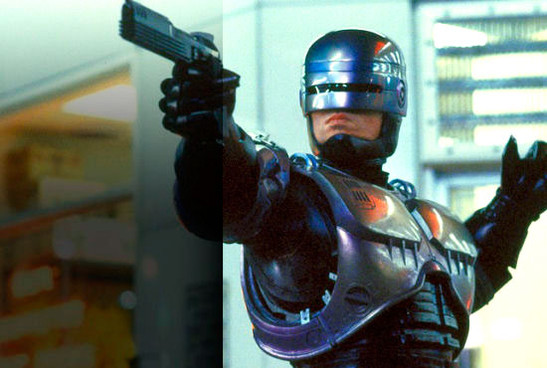
robocopHilarious, yet somehow socially relevant. Recently, Peter Weller joined the people at funnyordie.com to make a public announcement. Apparently, several citizens of the Motor City announced that they want to erect a statue of Robocop to commemorate their city and how it was the setting for that franchise. However, Mayor Bing shot the idea down, referring to it as “silly”. In response, Weller went online to call the mayor out and lend his support to the idea.

Through a series of comical displays and a cheeky speech, he indicated how the themes of Robocop are in fact appropriate for a city which is suffering from rampant unemployment, a decimated manufacturing sector and corporate greed. After all, these were all central to the story of the movie, so it makes sense to Weller and others that his trademark character get a statue.

And it does, if you think about it. Robocop was all about a good cop who sacrificed his life, only to be turned into an icon for corporate control over a once fair and proud city. He turned the tables by becoming a popular hero, taking on the very corporate moguls who made him what he was.

Follow the link below to watch the full video. I would have embedded, but the damn folks at Youtube disabled it. Dorks!

GIANT ROBOTS!

Forgive the all caps, but with a name like this, you gotta go big! Thanks to a helpful suggestion from a respected colleague (thanks Rami!), I’ve finally found the latest for my series on conceptual post. And I think my reasons for going with it are clear. Whether we are talking about mechs, mechas, walkers or sentient machines, giant robots are just plain cool! And here’s a list of some memorable ones from various franchises that have come down to us over the years:

AT-AT Walker:
It’s only right to start the list with a classic example from the classic franchise. Though I’m sure this giant needs no intro, I’ve recently come to learn that there are some people who really haven’t seen the original trilogy. Yeah, I can’t believe it either!

Known officially as the All Terrain Armored Transport, this beast was the Empire’s weapon of choice for digging Rebel troops out of fortified emplacements. It’s size alone made it an intimidating sight to behold, which was kind of the point! But in case that wasn’t enough to make people run, it also packed quite a punch.

AT-AT cross-section

Although they were invented by the Republic during the time of the Clone Wars, the AT-AT didn’t emerge as a weapon of terror until the time of the Empire when it was resurrected by General Veers. During the Battle of Hoth, her personally led a force against the Rebel Echo Base and overwhelmed its defenders. Its armor proved too strong for conventional blasters, and its weapons were devastating once they were in range.

Under Luke Skywalker’s command, Rogue Squadron was able to destroy one using their tow cables while Skywalker destroyed another using his lightsaber and a concussion grenade. However, this did not stop Veers from destroying the shield generator and reaching Echo Base in the end. On Endor, an AT-AT would make an appearance guarding the Imperial shield generator.

Broadside Battlesuit:
Finally, I’ve found an excuse to use something from Warhammer 40k! It’s a little hard to incorporate ships when the focus is really on cool battlefield stuff. But hey, the sign says Giant Robots, so we’re all good!

The Broadside Battlesuit is the Tau Army’s heavy hitter, marrying the concept of a tank with that of an infantryman. Armed with two arm-mounted missile launchers and two rail guns on its back, the Broadside is more like a mobile artillery piece than a mechanized suit of armor.

But of course, it also has a thick hide, which is a necessity given the mighty kickback of its weapons. Though they are comparatively slow and have no jetpacks, like other Warhammer mechs, they are able to entrench and kill their enemies from a distance.

Destroid Tomahawk:
Speaking of walking tanks, this next example comes from the Robotech universe and is the mainstay of Earth’s mecha forces. Big, bad, heavily armed and armored, the Tomahawk is essentially a walking version of the main battle tank.

In terms of armaments, the Tomahawk carries just about every weapon under the sun. It’s two heavy beam cannons constitute its arms while two missile launchers make up the shoulders. It also carries two head-mounted machine guns, two gun clusters in the lower chest consisting of an auto-cannon, flame thrower, laser and direct-fire mortar. On top of all that, it also has an outboard missile launcher over its right shoulder.

Measuring almost 13 meters in height and weighing a whopping 31 tons fully loaded, this beast is still capable of running at 88 km/h. It also came equipped with vernier thrusters, making it capable of limited space operations. Unfortunately, its size and weight made it somewhat cumbersome when engaged with Zentraedi Battlepods (see below), which is why the design was eventually abandoned in favor of lighter designs.

Dragoon:
You know, I think this is the first time I’ve mentioned Starcraft in the context of one of these posts. Bout time really! And as a primary example of something cool from this universe, here’s the Dragoon! Much like other examples on this list, this machine requires an organic operator, or at least parts of them…

A quadrupedal attack walker employed by the Protoss, the Dragoon was considered a second chance for templars who had been seriously wounded in the line of duty. These pilots would generally be submerged in a fluid-filled tank in the Dragoon’s interior and operate it through an “essence translator”.

The Dragoon’s main weapon was of a centrally-mounted cannon which fired phases antimatter at targets. Combined with the units speed and maneuverability over unstable terrain, the Dragoon was a highly effective fighting vehicle and played a crucial role in the Brood War. It was due to this success that other factions, such as the Dark Templars and the Confederates, attempted to copy or adapt the designs for their own armies.

Fuchikoma:
Also known as “Tachikoma”, these walker/rollers are essentially tanks that are used by police in the manga series “Ghost In The Shell”. Heavily armored, packing serious weapons and run by a simple artificial-intelligence, these robots can act independently but are generally used for fire support.

Every unit is based on the same quadrupedal configuration with two three-fingered hands which double as machine guns. They carry their sensor equipment in their “heads”, which consists of a large main lens and two sensors mounted on the “mouth” below. Heavier weapons can also be mounted on the underside, which can either be a heavy machine gun or a grenade launcher.

In addition to their firepower, the Fuchikoma is also highly versatile. They can handle many different types of terrain, are able to walk up walls, rappel, walk, extend wheels from their feet and drive, and are also even submersible. After missions, the AI’s also share their experiences with all other units so that they can learn and anticipate different scenarios.

Goliath:
Back to Starcraft for another prime example of supreme robotry. And fans of the Marine campaign will certainly recognize this one. Officially, it is known as a Terran all-terrain combat walker. But to those who fight alongside it, it’s known simply as a Goliath.

Designed to provide support for troops in urban settings, the role of the Goliath expanded to providing infantry assault in all terrains and conditions. Employed by just about all sides during the Guild Wars, the Goliath became the backbone of Confederate forces against the Zerg and Protoss.

Composed of neosteel alloy, the Goliath’s exterior is highly resistance to small arms fire and most munitions. It’s weapons consist of two arm-mounted autocannons, two shoulder-mounted missile launchers. With the arrival of the UED during the Brood War, the Goliath’s design was upgraded with a belly-mounted machinegun and improved missile range. By the time of the Second Great War, the design was retired in favor of updated designs.

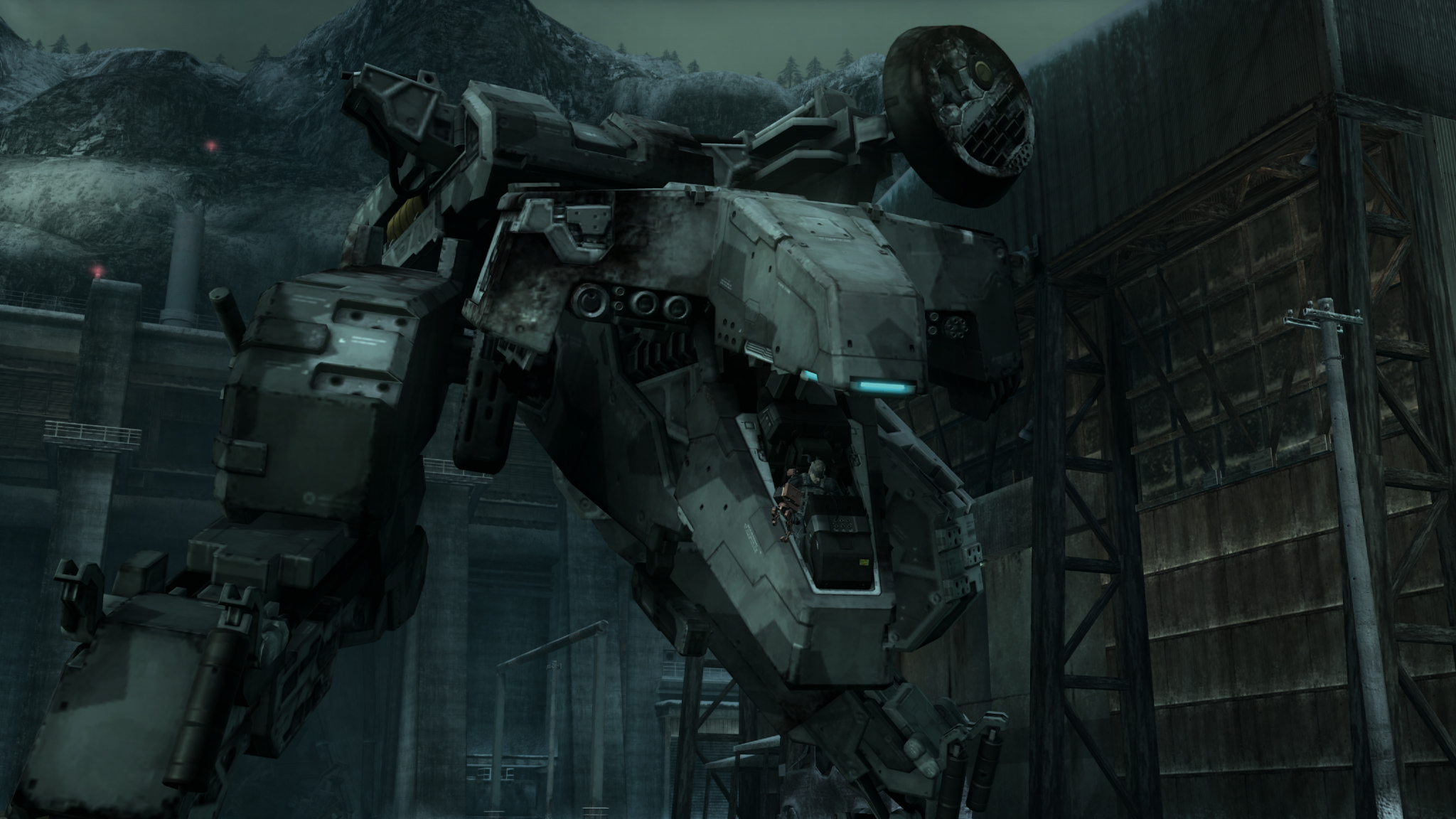
Metal Gear Rex:
Seems like a fitting name when you look at that gaping maw doesn’t it? And given its size, shape and terrifying power, the comparison seems even more apt. The focal point of the Metal Gear game series, this behemoth was a prototype weapon developed by DARPA and Arms Tech for the US Armed Forces.

Based on stolen designs from the former Soviet Union, Metal Gear was a revolutionary concept for a “bipedal tank” which would be capable of carrying nuclear weapons. After decades of toying and production, the end result was Rex.

In terms of armaments, the Rex has two 30 mm rotary cannon, a compliment of anti-tank missiles and 100 megawatt free-electron laser. However, its biggest surprise comes in the form of a massive shoulder-mounted rail gun which is capable of deploying stealth nuclear warheads. So in addition to being able to gallop into the field of battle and level everything in its wake, it was also capable of nuking an enemy city from several kilometers away.

Scary! I want one! Several version of Metal Gear would appear in the subsequent games with various modifications. But that’s something for another post (or more) 😉

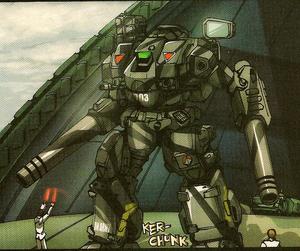
Timberwolf:
No list of giant robots would be complete without at least one example from the Battletech universe. And here it is! The Timberwolf, otherwise known as the Mad Cat. Fast, heavy and quite formidable, this vehicle puts the “mech” in omnimech!

According to the series, this vehicle was the first omnimech to be encountered by the Inner Sphere Clans invaded. It was here that it earned the name “Mad Cat”, being similar in design to both the Marauder (MAD) and Catapult (CAT). It’s rare combination of speed, heavy armor and armaments also led to this designation. Apparently, this combination is quite rare!

In its primary configuration, the Timberwolf packs a good balance of energy and projectile weapons. It’s main armaments consist of arm lasers and two shoulder-mounted missile pods, both of which are effective at long range. It also carries two medium lasers and a medium pulse laser for close range combat, and a set of cockpit mounted machine guns for point defense against infantry.

Though it has no jump jets, the Timberwolf is capable of running at over 80 km an hour and is capable of some nimble maneuvering. It’s composite ferro-fibrous armor also mean it can withstand several directs hits from enemy fire.

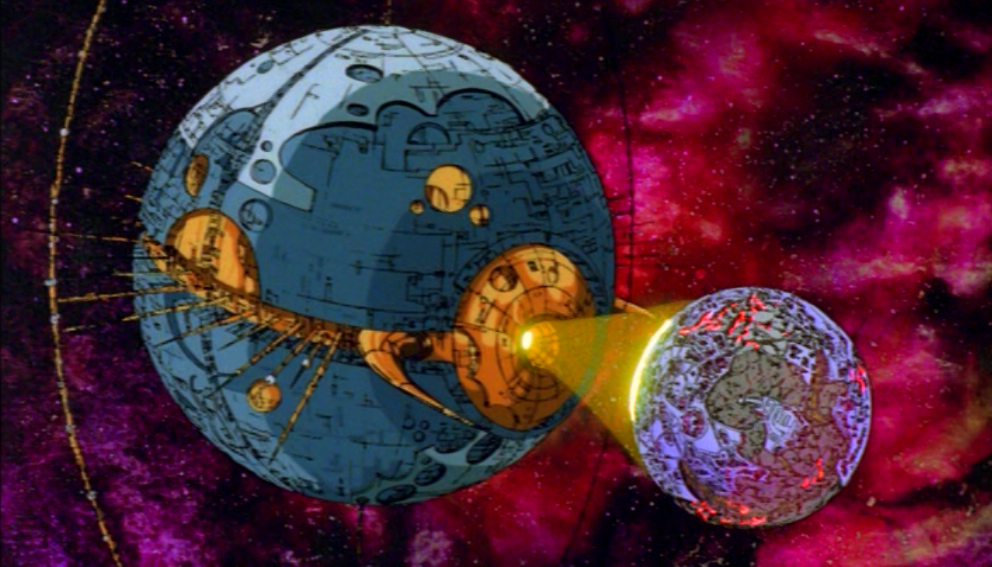
Unicron:
You know, I’m loathe to use the same example twice. But hey, the name says Giant Robots, and Unicron is nothing if not both of these things! Taken from the Transformers movie (circa. 1986), this big bot is the biggest bot in the universe, and an appropriate one to end this first installment on.

Also known as the “Lord of Chaos” and “Planet Eater”, Unicron is essentially a planet-sized transformer who goes about the universe consuming stellar objects. These can include planets, asteroids and even stars.

Powered by an array of massive quantum computers, Unicron is dedicated to being a force of uncreation, traveling across universes and consuming all he can to bring about an end to all existence. In addition, he is apparently able to confer powers on lesser beings, using the impressive technology which powers him to upgrade other machines.

In the end, the only thing that could stop him was the Matrix of Leadership, which contained the essence of his equal and opposite – a being known as Primus. Being a creature of destruction, such a creative power could only be seen as a threat. And it certainly was! In the end, the Matrix was opened inside his hull and unleashed a force which completely consumed him.

Well that’s all I got for now. Hope people enjoyed this little display of oversized automatons, mechanized vehicles and massive war machines. And like the song says:

“You dig giant robots
I dig giant robots
We dig giant robots
Chicks dig giant robots
Nice.”
-theme song from Megas XLR

And it’s true aint it? Except for the part about chicks, I can’t say with any authority that they actually dig giant robots. But I know I do! See ya next time.

Cool Ships (volume IX)

Borg Sphere:
BThis first example shows us that thought they were obsessed with simple geometric shapes, the Borg were capable of thinking outside of the cube. If anything, the sphere is a more perfect shape and aesthetically way more pleasing, so its a wonder why they didn’t do it sooner.

Making its first appearance in Star Trek: First Contact, the sphere appeared to be an auxiliary craft which was housed inside a Borg Cube. But in truth, these vessels were actually much more versatile, acting as scout ships and tactical vessels, doing deep-space reconnaissance or performing light assault missions.

In the spinoff series Voyager, Borg Spheres make several appearances. The most notable of which was the series finale (episode 168: “Endgame”), where Voyager was pursued and overtaken by one and had to destroy it from the inside to escape. This, in addition to scenes from other episodes, indicated that every sphere has an internal compartment capable of housing a sizable starship.

Measuring 600 meters in diameter, a standard Borg Sphere carries a crew of 11,000 drones, is protected by regenerative shields, ablative armor, and has the usual array of Borg weapons (which include tractor beams and disruptors). It is capable of warp speed, transwarp speed, and in some cases, can even generate a temporal vortex to achieve time travel (as was demonstrated in First Contact).

Jem’Hadar Battleship:
dominion_dread2You know, I was never was much of a Trekkie. Compared to other franchises, I never really did get into the shows that much. That is, until DS9 introduced the whole Dominion plot line, then I got into it with both feet! Space battles, explosions, ships blowing each other up… what’s not to like? And to make these battles happen, the show’s conceptual artist had to come up with some new designs.

One such design was the Jem’Hadar Battleship, which made its debut in season 6 (episode 144, “Valiant”). Introduced midway through the war, this new breed of warship was designed for the sole purpose of breaking the stalemate between the Dominion and the Allies. That and inspiring fear!

At twice the size of a Galaxy-class vessel (USS Enterprise D) and boasting over 40 torpedo launchers, this ship was clearly meant to be so large and so powerful that no Federation or allied ship would have a hope of stopping it. However, its size and speed also made it a relatively easy target for multiple enemy ships, which would have no trouble hitting it and could outmaneuver it in battle.

After it’s initial deployment, where it destroyed the USS Valiant, several battleships were rolled off the line and took part in the war, especially during the latter engagements of the war like the Battle of Cardassia. Many ships were needed to break the lines which they reinforced, and it was only by the timely defection of Cardassian forces that the Dominion was overwhelmed in these battles.

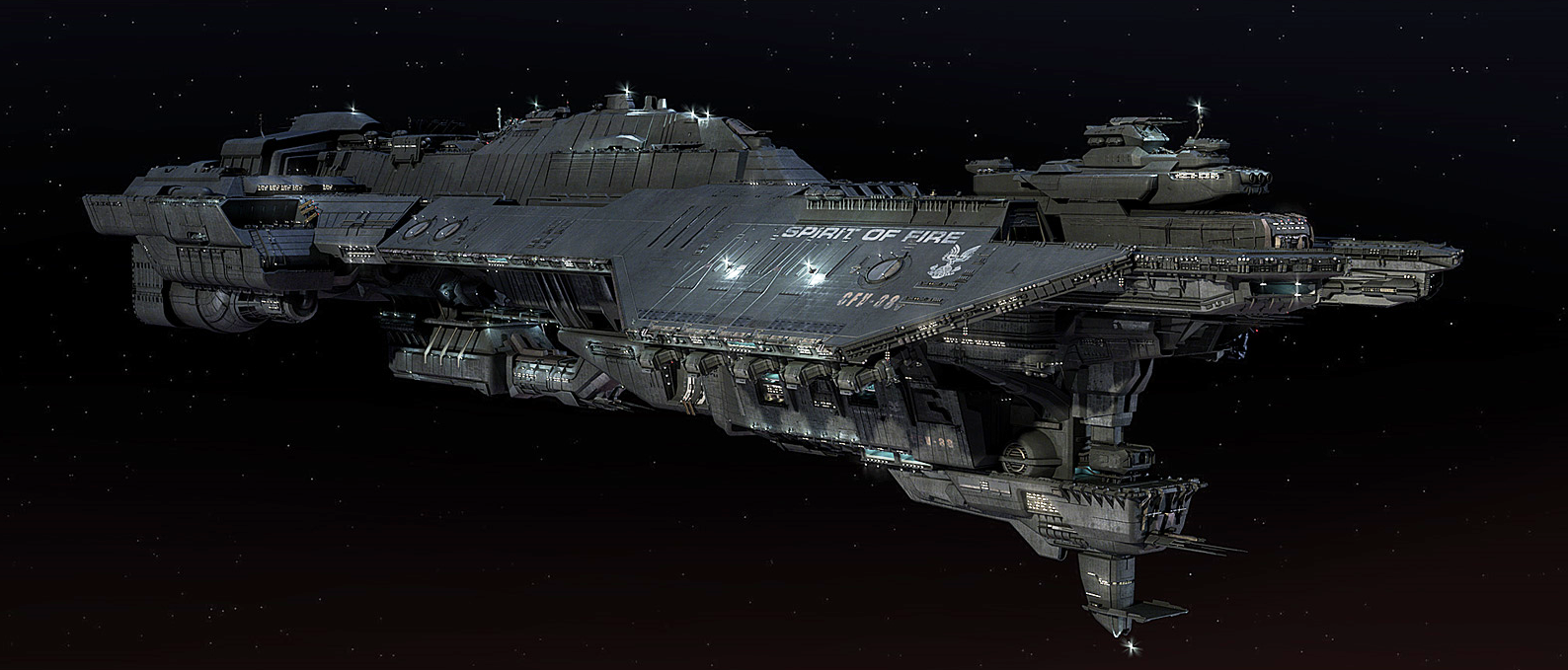
USNC Spirit of Fire:
To the Halo universe once more, this time for a look at a modified colony ship known as the Spirit of Fire! Making its appearance in Halo Wars, this ship was the largest in the UNSC navy and served with distinction during the Covenant War.

As already noted, the Spirit of Fire was originally a Pheonix-class colony ship, a vessel that was designed to carry colonists and supplies to new worlds as part of the UNSC’s prewar expansion efforts. However, this changed with the appearance of the Covenant and their apparent need to knock over human settlements.

Recommissioned for military service by the UNSC, the Fire was outfitted with a magnetic accelerator cannon, point defense guns and missile turrets, hull armor, and a major engine overhaul. Its internal bays were also converted to carry Scorpion tanks, Warthogs, Pelicans, fighters, bombers, and anything else it would need to put a small army onto a planet. As a former colony ship, the Fire retained the ability to enter atmosphere and land planetside, making it all the more effective at troop deployment.

During the course of the war, the ship was declared missing and all hands were presumed dead after it failed to return from a mission. However, the ship was actually traveling back at sublight speed from an engagement after it lost its fusion core. The crew had used this to destroy a Forerunner “Shield Planet” which happened to be housing a large Covenant attack fleet. In sacrificing its engine core, it prevented a major strike by Covenant forces on human territories, and therefore saved countless lives. Not bad for a civilian ship, eh?

SDF-1 Macross:
SDF-1 MacrossWhen you hear the words, Super Dimension Fortress, what comes to mind? Definitely not a piddly little spaceship! Which is probably why the Macross’ full name contains them! Apparently, this ship was rebuilt from the remains of an alien craft that crash-landed on Earth, and was intended for use should said aliens ever come knocking again.

Although intended to travel to distant solar systems and promote peace with alien species, the Macross became the first line of defense once war with the Zentradi species began. Much like all the “mechas” from this franchise, this ship is capable of changing from its ship designation into a towering mech (known as “Storm Attacker” mode), a process which takes about 15 minutes.

The massive ship also carries the two carriers – the CVS-101 Prometheus and SLV-111 Daedalus – within it’s fuselage. When in cruiser mode, these are housed along the sides, but while in “Storm Attacker” mode, they constitute the robots “arms”. In terms of weapons, this baby comes equipped with 8 guided converging beam cannons, four 178cm rail cannons, automatic missile launchers, and a main super-dimension-energy cannon. Aliens beware!

Strident-class Star Defender:
StridentIt’s funny how the Rebels only seemed to get into mega-ships after the Empire was thoroughly licked. And yet, here we have another Star Defender ship which comes from the expanded Star Wars universe and only showed up for duty after the Empire lost all its big behemoths.

Produced by the Corellian Engineering Corporation (natch!), the Strident-class was the first breed of Super Star Destroyer to serve on the side of the Alliance (which now called itself the New Republic). But of course the Alliance didn’t like the term “destroyer” when applied to their mega ships, hence the name change. But the particulars are pretty much the same.

Much like the Viscount-class produced by the Mon Calamari, the Strident comes equipped with thousands of turbolasters, laser cannons, and ion guns, and its massive hold houses dozens of squadrons of starfighters as well as hundreds of shuttles and support ships. It took awhile but I’m guessing the Rebels finally decided to go big or go home!

The Spacejockey ship:
I can’t wait to learn more about THIS one! As the focal point for the first Act of Alien, the “Spacejockey” ship is also central to the plot of its soon-to-be-released prequel, Prometheus. Known also as “The Derelict”, very little is known about this ship other than the fact that it was of unknown origin and appeared to be transporting xenomorphs.

The Derelict was first discovered by the crew of the Nostromo when their ship was rerouted to LV-426 to investigate a distress beacon. When they approached the ship, its alien configuration was immediately clear. Shaped in the configuration of a horseshoe, the ship apparently had two prongs, one longer than the other, and an engine array located at the rear.

SpaceJockeyWhen investigating the inside of the ship, its alien nature became even more apparent. Whoever the Space Jockeys were, they clearly shared H.P. Lovecraft’s sense of aesthetics! Literally everything aboard looked organic and gothic, right down to the funky patterns on the walls! When discovering what appeared to be a control chair, the crew stumbled onto the remains of a long “Space Jockey” as well. Having an anthropomorphic shape and a trunked face, they are assumed to look like a cross between a human and an elephant.

Closer examination of the remains revealed that it died from a “chestbuster” breaking through its ribcage. With the discovery of the ship’s compliment of eggs, and the observable symbiosis between the “facehuggers” and “chestbusters”, it was unclear why the Spacejockeys were transporting them. Perhaps they came aboard by accident, perhaps they were intended for another use somewhere. These are all questions I look forward to being answered… say June-ish!

Vor’cha-class Cruiser:
Vor'chaSeems the Klingons are getting a lot of attention from me as of late. But I’ve come to acknowledge just how many cool ships they really do have. Clearly, these blood-drinking, Valhalla worshipping guys excel when it comes to bringing beauty to their instruments of death. But then again, one would have to assume that it’s one of the few artistic outlets they get to have!

Taken from the TNG universe, the Vor’cha was the mainstay of the Klingon armada and the replacement for the aging K’t’inga-class. The first of its design served as the flagship for the Empire, but became fully integrated into the armada once it was mass-produced and replaced by the larger Negh’var-class.

Making its first appearance in season 4 of Star Trek: TNG (episode 80: “Reunion”) where it served as the Chancellor’s flagship, this vessel would go on to make several subsequent appearances in the expanded franchise. It’s most notable appearances were during the Klingon-Cardassian War where several participated in the assault on DS9 itself. Later, during the Dominion War, many more would serve on the front lines against the Jem’Hadar and their allies.

Naturally, this Klingon ship boasted multiple disruptor arrays, the main one located at the front end of the ship with two more mounted on the wings beside the nacelles. These were capable of firing in either the solid mode (like a phaser) or intermittently. Maneuverable for a ship of its size, it also came equipped with a cloaking device which was available in all flight modes.

Vorchan-class warship:
centauri_2This ship gets seen a lot around the B5 universe. And since I can’t stop hitting them up for cool ships, it only makes sense to mention this baby here. The Vorchan-class cruiser, a medium warship, was the mainstay of the Centauri fleet and weapon of choice when it came to raids, reconnaissance and even large-scale offensive operations.

Though designed predominantly to escort heavier cruisers, such as the Primus-class warship, Vorchans were still highly effective in small squadrons and were often called upon to mount attack missions by themselves. During the Narn-Centauri War, Vorchan warships carried out many assaults on Narn colonies and installations and even participated in skirmishes with the heavier Narn warships.

Its armaments consist of two plasma accelerators, missile banks and guided mines. These armaments, paired with its size, speed and relative maneuverability allow it to stand toe-to-toe with just about anything the Narns, Earth or League of Non-Aligned Worlds could throw at it. And unlike the heavier Primus ships, it is capable of maneuvering inside atmospheres. And it’s cool, raptor-winged like design makes it pretty easy on the eyes too. Were it not for the fact that Roddenberry beat them to it, you can bet the B5 designers would have named this ship a Bird of Prey!

Nine down, who the hell knows how many more to go!

Cool Ships (volume VIII)

Battleship Yamato:
A couple times now I’ve given praise to ship designs that went beyond the usual airplane/ seafaring paradigm. But what can you say about a spaceship which is a carbon copy of a old sea battleship? I don’t know, gutsy maybe? That its paying homage to the original? That’s all I can really say on this one, since it is identical to its namesake from the Imperial Japanese Navy.

Taken from the anime series of the same name, the Yamato was a prototype ship which was built in secret by Earth forces in the ruins of the original. Using alien technology, it was the first Earth ship to boast FTL and a “wave-motion-gun”. These devices were meant to give it an edge in the ongoing war with a race known as the “Gamilons”.

Early in this war, the Gamilons had bombarded Earth with radioactive meteorites. The result was that all human settlements had to be moved underground. However, the radiation was slowly working its way down to the inhabitants, and the only hope for survival came in the form of a message from a distant star. After completion, the Yamato was meant to fly to this world and retrieve the device which apparently could cleanse Earth of its poisonous radiation.

Thus, the Yamato was created to perform a mission that meant the very survival of the human race. It’s drive system was to make sure it could make the trip, while its weapons were meant to ensure it could defend itself.

Cylon Heavy Raider:
Another installment from the BSG universe, here we have the heavy hitter of the Cylon fleet, the dual purpose attack and transport craft, otherwise known as “the turkey”. Capable of atmospheric entry, space flight and FTL travel, the Heavy Raider is capable of attacking, transporting troops and conducting boarding operations.

Unlike the standard Raider, the heavy can either fly itself on autopilot or be piloted by actual an Centurion. However, its automated functions do not appear to be the result of a sentient nervous system. In terms of armaments and capacity, the heavy has six cannons mounted under its cockpit and its bay is capable of holding up to ten Centurions.

The Heavy Raider made its first appearance in season one (“Scattered”) when one crashed into the starboard flight pod. On Caprica, Sharon Valerii (Boomer) commandeers one to provide fire support to the resistance and save Starbuck as she escaped from a Cylon medical facility (“The Farm”). The Heavy Raider would go on to make several more appearances in the series, particularly whenever assault missions or heavy raids were concerned.

Quasar Fire-class Cruiser:
Once more onto the Star Wars universe, my friends! But this time, its into the expanded universe with a ship that is somewhat obscure by most standards. Known as the Quasar Fire-class cruiser, or Alliance Escort Carrier, this ship made its first appearance in the Thrawn Trilogy during the Battle of Bilbringi then again in the novel The Truce At Bakura.

Designed by the Sullustans as a cargo transport, many of these vessels were given to the Alliance and converted for combat. This consisted of stripping down the cargo bays and turning into hangars, and mounting defensive turrets at the front and rear.

Thought lightly armored, armed, and shielded, the Quasar’s small size and versatility make it a ship of choice for small fleets and minor attack forces. It’s six squadrons of fighters also give it an effective defensive screen, making it all the more suitable as a small fleet command ship.

The Leviathan:
Did I say once more, I meant twice… maybe more! And this one goes way back, to roughly 4000 years before events in the original movies. Officially known as an Interdictor-class cruiser, this vessel was the mainstay of the Republican navy during the time of the Mandalarion Wars and was featured heavily in Star Wars: Knights of the Old Republic.

During the outbreak of the Sith War which immediately followed, the Leviathan served as Darth Revan’s flagship. After he was captured by the Jedi Order, ownership of this vessel changed to Darth Malak. The ship was responsible for obliterating the surface of Taris and was later the site where Darth Revan, now working for the Jedi Order, confronted Darth Malak for the first time since his defection.

Measuring 600 meters in length, the ship carries an arsenal of 20 quad laser cannons, 4 turbolasers, 2 ion cannons, and four squadrons of fighters. Although somewhat mild by modern Star Wars standards, she was designed to be a forerunner to the modern Star Destroyer design.

Negh’var-class Cruiser:
Despite their brawling, yelling and terrible table manners, you gotta admit; the Klingons make a fine looking ship! And this is especially true of the Negh’var-class warship, the heaviest of the heavies in the Klingon armada, serving as the command ship on many different occasions (and in multiple universes).

Ships of this kind made their first appearance in the series finale of Star Trek: TNG when two attacked the USS Pasteur. Another appeared in DS9 when a changling posing as General Martok led the Klingon fleet against the Cardassian Union, and again against Deep Space 9 when the Federation chose to oppose the invasion. They also went on to play an important role in the Dominion War alongside Federation and Romulan warships.

In addition to the standard cloaking device, the Negh’var carries an impressive array of armaments, including two massive disruptor pods mounted underneath the ship’s wings. It also carries multiple photon torpedo launchers, and several smaller emitters mounted across the ship. She is also capable of standing toe to toe with most other ships in the Alpha Quadrant in terms of velocity, making it up to speeds of Warp 9.

Ornithopter:
Not long ago, I was lamented the fact that I kept forgetting to mention anything from the Dune universe. Now I can’t seem to do a single post without including a Dune ship! This time, its the ornithopter, the curious cool ship that’s perplexed readers and conceptual artists for some time.

The most common vessel in the Imperium, the ornithopter (or ‘thopter for short) was an extremely versatile vessel that served primarily as a cargo vessel and transport. In addition, they often served in a military capacity, being fitted with lasguns, bombs and missiles. This was particulalry the case during Paul Muad’ib’s uprising, when House Atreides ‘thopters were fitted for the assault on Arrakeen and the Imperial Palace.

According to numerous descriptions taken from the expanded Dune universe, the thopter was primarily powered by jet propulsion, but relied on a set of beating wings to maintain altitude and maneuver. The concept has gone through several renditions over the years, due to the many attempts to adapt Dune to the screen. In David Lynch’s 1984 movie adaptation, ‘thopters appeared as small, box-like crat with swept wings that retracted and deployed from the fuselage.

In the 2000 miniseries, they were pictured as vertical take off and landing craft with fans mounted in pivoting wings. The featured picture (shown above left) is taken from The Road to Dune and is an artists concept of what a ‘thopter would look like. Here, we see beating wings which deploy for takeoff and retract upon landing.

USNC In Amber Clad:
Feels like its been awhile since I included anything from the Halo universe. And so here’s the Reunion, a Vladivostok-class guided missile frigate. Though somewhat old and outclassed by modern Covenant standards, several frigates played a crucial role in the Great War against Covenant forces. One such vessel was the In Amber Clad.

Armed with 12 Point Defense Guns, 40 missile pods, 5 twin rail gun turrets, a magnetic accelerator cannon, a compliment of Shiva nuclear missiles and a full compliment of Marines, dropships and escort fighters, the In Amber Clad was considered the mainstay of the old Earth fleet. Capable of atmospheric entry and landing, this ship did not need to rely on drop pods or shuttles, and could land an entire Marine force by itself.

During the Covenant War, these frigates were replaced by the larger and more heavily armed Halcyon-class cruisers. However, the In Amber Clad managed to score a significant victory over the Covenant during the Battle of Installation 05. During the course of the battle, it served as the flagship and won the day when it crashed into the Covenant ship High Charity.

VF-1 Veritech:
As requested, I’ve finally found an example from the Robotech universe! And to be honest, I wondered how long it would take. Though I’m not too familiar with this franchise, the RPG is something I remember fondly from my childhood, and some of the designs still percolate in my consciousness.

One of which is this, the VF-1 Vertiech, also known as the “Valkyrie”. This battleoid, which was adapted from alien technology (known as Protoculture),was originally designed for hand-to-hand combat with aliens which were up to 15 meters in height, the Veritech and subsequent breeds of mechas became the new face of warfare.

Mechas can function in both the fighter and mech role. Capable of flying through space, atmospheres and fighting on land, the Veritech was one of the most versatile and maneuverable mechas in the known universe. With a flight speed of Mach 3 (in atmosphere), and a top speed of 100 km/h running, she is as fast as any land vehicle or aerospace vessel. In addition, the standard Veritech carries two high-powered lasers, head mounted laser cannons, guided missiles, a rotary cannon, and is even capable of engaging in hand to hand combat.

YT-2400 Corellian Freighter:
To finish, I’m in the mood for something Corellian! And so it’s back to the Star Wars universe for this one. Much like its predecessor, the YT-1300 (a.k.a. the Millennium Falcon), the 2400 was a class of light freighter that was fast, tough and endlessly modifiable. So like the Falcon, it was a favorite amongst smugglers, merchants and privateers.

Smaller and lighter than the 1300 series, the 2400 boasted only one servo-turret for defense in addition to its shield array and armor plating. However, this could easily be remedied with the addition of extra guns and missile launchers. And its ample hull space and engine power, the 2400’s could easily accommodate additional mounts and the added weight.

One such ship which acheived notoriety during the Galactic Civil War was the Outrider, the ship of famed smuggler Dash Rendar. This ship, like most other 2400’s, was heavily modified to accommodate additional systems and weapons. Clearly, when the Corellian shipyard designated this vessel as freight transport, it was a nod and a wink!

Thank you all and good hunting! See you in next time in volume 9!

Attack of the Clones. Here we go again…
Hello again! Here we are picking things up again with the Star Wars saga. Today, it’s the second installment in the prequel series, the ridiculously named Attack of the Clones. As I’m sure we all remember, Clones was the stuff of mixed reviews, some critics hailing its special effects and visual style, while others emphasized its flat dialogue and wooden romance.

But even more interesting was the fact that critics were torn over whether it was better or worse than the Phantom Menace. Not a good sign, and the butt of a LOT of jokes and debate. Hard to imagine that fanboys who were united in bashing the PM would find themselves fighting each other over which they thought sucked more!

But to be fair, there were some good points in this movie. So without further preamble, let’s get into it:

Plot Synopsis:
The movie opens with the crawl once again saying that there is a crisis. This time around, it’s the threat of Separatists – led by former Jedi Count Dooku – that’s making things problematic. And once again there is deadlock in the Senate over it. In any case, now-Senator Amidala comes to Coruscant to speak her peace on behalf of those who oppose taking strong measures, and an assassination plot gets underway.

This prompts the Jedi order to send two old friends, Obi-Wan and Anakin, to provide her with added protection. Their introduction is rather painful to behold, as the hormonally raging Anakin begins relating how he hasn’t stopped dreaming of her and tries to make awkward conversation with her. He also picks a fight with his mentor, Obi-Wan, over what their mandate truly is. In the midst of all this, Jar Jar breaks the fourth wall by looking into the camera and smiling at the audience – a sort of, “I’m still here, bitches” for all the fanboys to see!

In another bit of “things to come”, we also learn that Anakin has been having dreams of another woman – his mother. He dreams that something terrible is going to happen, but in the meantime, they must focus on Padme, who’s assassin is still out there. For some reason, they decide to “use her as bait”, which consists of letting her sleep in a window-filled room with nothing but R2 as protection. Didn’t Obi-Wan say they weren’t supposed to be investigating, just protecting? Oh well…

In any case, her would-be assassin sends a probe with some poisonous slugs to attack her. Obi-Wan and Anakin kill said slugs, and Obi-Wan jumps through the window to grab the probe and ride it. Wait, didn’t he say they weren’t supposed to be investigating? Why’s he so determined to follow this probe then? Anakin grabs a speeder, they fly like mad, and chase the attacker through the city. Anakin reveals that this woman is a shape-shifter, a fact which seems superfluous, but whatever. They also performs some stunts that defy the laws of physics, but that’s also unimportant.

After reaching a bar, Obi-Wan and Anakin chase her inside and begin combing the crowd. After a quick re-enactment of the scene from A New Hope (where Obi-Wan sliced off another thugs hand), they drag the shape-shifter outside and learn she’s subcontracting. But of course, her contractor kills her before she can say her name. Obi-Wan, who for some reason was willing to chase the shapeshifter across the planet, just lets him go…

The Jedi Council decides its time to send Padme home, and that Anakin is to go with her. Meanwhile, Obi-Wan is to track down the assassin by himself, a quest which takes him to the world of Kamino. This decision to split them, far from making logical sense, seems more like an excuse to get Anakin and Padme alone. Why send a Padawan off on his own, especially when his master has such misgivings about his attitude and powers?

But anyhoo, things get kind of cool when Obi-Wan arrives on Kamino and learns that former Master Sifo Dyas ordered the creation of a clone army. This, combined with the fact that the location of the planet was removed from the Republic archives memory would seem to indicate that there is a conspiracy afoot. Obi-Wan then meets with the clone template, a bounty hunter named Jango Fett, and is convinced he’s found Padme’s would-be assassin. They fight, Jango escapes, and Obi-Wan pursues him to Geonosis.

Meanwhile, we get a string of scenes that are meant to elicit a romantic response. After following Padme around, complaining bitterly about Obi-Wan and professing his love in a series of ever creepier and wooden dialogue, Padme tells Anakin there’s no way. Why? She’s a Senator… Uh, what? Are Senators not allowed to date? Of course, Anakin can’t because he’s a Jedi, but the very fact that they’re talking about this would seem to indicate the feeling is now mutual. Seems sudden, but neither here nor there…

Arriving at Geonosis, where there’s a massive a droid-building colony, Obi-Wan gets into it with Jango and the Slave I. After thinking he’s killed him (Obi-Wan eludes death by copying Han’s hiding move from Empire), Jango proceeds to planet and Obi-Wan follows shortly behind. After wintessing a meeting between Dooku and the Separatists in which they plan their attack (using their droid and clone armies), Obi-Wan broadcasts his position and is then captured. He meets Dooku, who proceeds to tell him the truth, after a fashion…

He tells Obi-Wan there is a Sith in charge of the Senate, and that his plans are motivated to bring him down. He asks for Obi-Wan’s help, who in a move taken from Empire and Jedi, tells him he “will never join you”. Back on Naboo, Anakin continues to have bad dreams about his mom and decides he must go to Tatooine. He retraces her path, only to discover that she was taken in by some people from the movie – the Lars family, which includes the future Uncle Owen and Aunt Beru.

He learns she was taken by Sandpeople, and catches up with them just in time to watch his mother die, at which point, he and loses it! And I mean REALLY LOSES IT! In a scene we don’t get to see, Anakin takes out his lightsaber and kills the entire community of Sandpeople who kidnapped and tortured his mom, including the women and children. He returns to the Lars family dwelling and tells Padme of his mass murder, to which she replies that it’s no big deal.

I’m sorry, NO BIG DEAL?! Are you freaking kidding me? Seriously, this man just confessed to murdering women and children and all Padme can say is that “to be angry is to be human”? What kind of sociopathic, enabling bullshit is that? Is she so into bad boys that she’s willing to overlook this first-time offense? Or are they in such a hurry to get to the next scene that she’s just got to forgive and move on? And why the hell didn’t the Jedi Order even mention this on his return? We all saw Yoda sensing it? C’mon people!

Alright, moving on… Back on Coruscant, the news of a Separatist army explodes like a bombshell, with Palpatine once again exploiting it for personal gain. Thinking he’s doing the smart and noble thing, Jar Jar moves that Palpatine get emergency powers – a la Octavian – and his first act is to create an army for the Republic. Why they don’t have one already is beyond me, but who cares? Point is, Palpatine has got his way, and Yoda and Mace Windu decide its time to get involved.

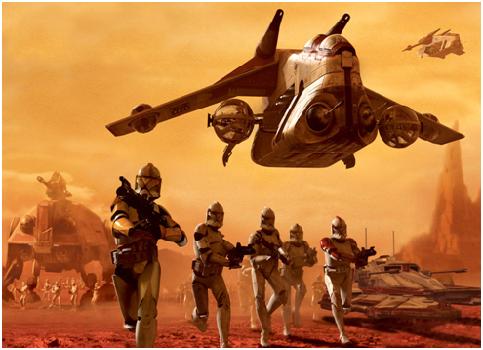
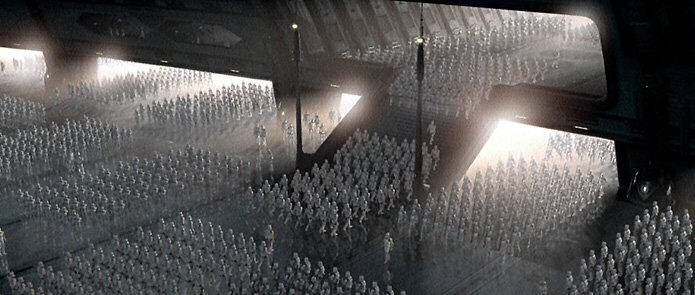
Anakin and Padme also get the distress signal from Obi-Wan and decide they will go save him. They arrive on Geonosis too and after a needless scene where they are almost killed in a robot factory, they too are captured. A scene ripped off from Gladiator follows, as they are reunited in a massive Colosseum-type arena to die in a public display. They escape and begin to wreak havoc, and are rescued just in time by the arrival of Mace and the Jedi Order. They fight to a standstill and are surrounded, when Yoda arrives with the Clone army and begins kicking some ass.

A big fight scene ensues on the open plains of Geonosis between droids and Clones, while Obi-Wan and Anakin chase Dooku down. He beats them both in a rather implausible scenario, first managing to cripple Obi-Wan without actually killing him or severing any of his limbs, and then cutting off Anakin’s arm (an obvious preview of the scene from Jedi). Yoda once again shows up to save the day, and in another scene from Jedi, Dooku does his lightning trick.

The fight ends with a stalemate, Dooku runs with Padme shooting at his ship. Once more, a scene from the originals is at work here, this time from Empire when Leia was shooting at the Slave I. But Dooku escapes, makes it back to Coruscant and tells Sideous (Palpatine) that the war is happening, as anticipated. He meanwhile sends the first batch of clones on their new Star Destroyer look-alikes, and Yoda laments that the Dark Side has fallen and “The Clones Wars” have begun.

The movie ends with Padme and Anakin back on Naboo, where they’ve decided to get married after all. But since it’s a secret wedding, the droids are the only parties in attendance. THE END!

What didn’t work:
Well, where to begin? I shan’t dwell on the wooden dialogue or the horrid lack of romantic tension, since those are the popular whipping posts of most critics when it comes to this movie. Instead, I’d like to stick to some of the more obvious weaknesses, those that become more clear with hindsight.

  1. The Set-Up: Things get rolling when we learn that an assassin is trying to kill Padme, presumably because she’s the voice of moderation between the Republic and the Separatists. However, things get really implausible, really fast. For one, why the hell did Jango Fett subcontract anyway. Why not simply kill her himself? And why did this lady use poisonous bugs when a simple bomb would have killed Padme instantly? We saw how easily that probe flew to her window, so why the slow, stupid and easily thwarted approach? Then came how Jango’s involvement led Obi-Wan on his wild goose chase. The only reason he knew to find him on Kamino was because he used a dart which was manufactured there. The only reason he know to fly to Geonosis was because Jango mentioned it to him. And why was Jango pulling double duty with the whole assassination thing anyway? If the Kaminos are such good cloners, anybody’s DNA would do and they could just enhance it. Having him do that and eliminate Padme was just a way to tie the two plots together really and make sure Obi-Wan could find out all that was going on.
  2. Love-Story Contrivances: I know, I said I wouldn’t mock the terrible dialogue, which I won’t. To me, the real weakness here was just how contrived and unnatural the whole love story seemed. Aside from a brief, age-inappropriate meeting ten years before, Anakin and Padme are practically strangers. Having Anakin say that he’s loved her ever since they met was completely forced. On top of that, the way they are sent to Naboo together and all the scenes of them doing lovers things: boating, playing in open fields, eating and retiring to the hearth – are all obvious attempts to try and force a sense of romance. That’s the key word here: force (no pun intended). Between Anakin constantly announcing his feeling for her and all the idyllic scenery they take in, it’s like Lucas was behind us constantly saying “Look, they’re in love!” In the original movie, Lucas took his time to build up the romance between Han and Leia. In the beginning, they couldn’t stand each other, but this concealed some genuine tension. In time, this flourished as they got to know each other and began to start acknowledging each others strengths. In the end, it was clear that their different backgrounds and personalities is what led to their attraction. Throw in some genuine crisis, and they realized they were in love. See? That’s a love story, not this!
  3. Unsubtle Dialogue: Again, said I would avoid talking about the wooden dialogue. Which I am, sort of! My gripe here is just how unsubtle and (again) forced it all was, which is something the critics really didn’t get into. Examples: in the beginning, Anakin announces that he loves Padme when talking with Obi-Wan and Jar Jar. When talking to Padme, Anakin announces that Obi-Wan is an unfair master who’s too hard on him. When sitting around the fire, Anakin announces how much he loves her. Finally, she announces her feelings back. And in this, they are hardly alone. All throughout the movie, actors announce what’s going on as a means to convey what’s happening and to make the audience feel the requisite emotions. Never is time taken to convey feelings, mood, or establish tension the old fashioned way. And this just makes for a bad movie! As Robot Satan said in Futurama: “You can’t have characters just announce their feelings! That makes me SO ANGRY!”
  4. Way Too Much: In the documentary of the making of Phantom Menace, there is a lovely scene where Lucas and his people are watching the screening and there’s this moment of “uh-oh” at the end. They then discuss how Lucas did too much and how that brought down the ending. You’d think between movie one and two, he would have learned from this, but no! In this movie, he tried to do way more. On top of showing how romance developed between Padme and Anakin, he’s also shoved in a big ol’ preview of Anakin’s descent to the Dark Side, how the Clones Wars started, and Palpatine’s evil rise to power. A lot of critics jumped on this, saying that the movie was too long and suffered from a sense of duty. And in that, they were profoundly right! Duty is another key word when describing this movie. Having spent movie one showing where Anakin came from, they now had to preview his fall, where the twins came from, and how the Clone Wars started all at once. And it made for a sloppy feel, with too much happening and things bouncing around from one thing to the next without any of it getting enough development.
  5. Recycling: But alas, all of these faults could have been mediated had it not been for the fact that there really didn’t seem anything new about these movies. All throughout, there is material which seems to serve no purpose than to satisfy origin stories or recapture elements of the first three movies. In Clones, Boba Fett, Luke’s surrogate parents, the Death Star and Vader’s robotic arm are all previewed, and that’s on top of the Clone Wars and the romance plot. Once more it’s like Lucas is behind us saying “Look! That’s how it happened!” But like everything else, it just feels forced. Why not let new characters have their time in the spotlight? Why is it necessary to use every character from the first three movies? And another thing, this movie, more than in the first, uses scenes from the originals like never before. I mean, its one thing to rip off other movies, like the arena scene from Gladiator, but Lucas was even ripping off himself! The scene in the bar where Obi-Wan cuts off the hunters arm, the scene where Obi-Wan hides his ship on the back of an asteroid, the scene where he tells Dooku he won’t turn, the scene with the lighting bolts, the scene at the end where Padma is shooting at Dooku’s ship. All of these are clearly meant to recapture the feeling of the original Star Wars, but they fell short for the simple reason that audiences wasn’t nearly as emotionally involved. There’s paying homage to an original, and then there’s recycling, and this was the latter!
  6. Lazy Shooting: Something else which became apparent by this movie was the lazy way in which it was shot. After Phantom, It was already obvious that Lucas loved to cram as much CGI into every frame as possible. Hell, that much was obvious with the Star Wars Gold Editions! But if you watch the movies again, pay close attention to how EVERY SINGLE scene is shot. In these, you have the actors either walking slowly across the stage or sitting down. Always. Two cameras capture all of their dialogue and exchanges, Camera one, camera two. Always. If they are walking and talking, they will always stop, turn, and go back and forth between camera one and two. Meanwhile, all visual effects and background are provided by a green screen and all CGI characters are represented by colored lights. There are virtually no props, no stand ins, and a minimum of real actors. This, I have learned, reflects Lucas’ preferred way of directing. He sits in his chair at the edge of the green screen and drinks his coffee while the actors interact with each other or lights which tell them where to look. They walk through, stop, turn, or stay seated, do their lines, and his two cameras capture everything. Action shots are handled in much the same way, with only the occasional close-up or distance shot. Unless of course the entire sequence is animated by CGI, which they usually are!
  7. Strengths? Not so much: The strong points about this movie, the ones that critics hailed, mainly had to do with vision and special effects. But here’s the thing: Lucas’ vision in this movie consisted of CGI environments that all seemed to be taken from other movies or real locations. That doesn’t seem very bold or original. And what’s more, even the special effects weren’t so innovative. Clones was launched during the summer of 2002, right about the time that Spider Man, Minority Report and Men in Black 2 were released, all of which made impressive use of CGI. So really, what was so stunning and unique about this movie’s visual effects? And if action was something else about this movie that people liked, consider that it came out at the same time as The Bourne Identity and XXX as well.  So really, this movie was not a stand-out, smash-hit, summer blockbuster. If anything, it was one hit in a summer full of them.

Well, that about covers the weaknesses of this movie. I did my best to avoid the cliched, beaten-to-death talking points, and yet I still feel I hit on them quite a bit. And I really went long there too didn’t I? And yet, I haven’t even mentioned what bothered me personally about this movie. But to do so means ditching all the civilized critique stuff and going all the way back to summer of 2000.

In was back then, between the first two movies movies, that Lucas seemed to be pulling an about face. A year after the Phantom Menace debuted, reassuring rumors began to circulate that Lucas claimed its sequel would be more dark, more realistic and more gritty, kind of like the way Empire was to the first movie. However, these hopes were shot when Lucas announced that the second movie would be a romance story at that Jar Jar would remain in the picture.

When asked about the fans hopes for something more adult and dark, he casually dismissed these and other criticisms by saying that Star Wars had always been a “Saturday morning serial for kids”. This above all else seemed to annoy me, and countless other fans, since it now seemed apparent that Lucas really didn’t care what his age old fans and was going to continue to do the things that was making the new movies incompatible with the old.

However, after movie two he seemed to sit up and take notice of just how annoyed the fans and critics were getting. With one movie left in the franchise, he seemed determined to give these objections some due before the sun set on the prequel trilogy. Of that, more next time. Stay tuned!


‘Prometheus’ writer Jon Spaihts on science fiction worldbuilding

Recently, iO9 – the online technology magazine – caught up with Jon Spaihts, one of the writers for the upcoming Prometheus movie. In the course of their interview, they discussed what it takes to build sci-fi worlds and the challenges facing sci-fi writers. Of particular interest was Spaihts inclusion of hard science in his sci-fi scripts, the nature of the movie, the Alien universe, and what it was like to work with Ridley Scott. Interesting reading, follow the link below to read about the whole interview:

Prometheus Writer Jon Spaihts Interview

Cool Ships (volume VI)

Back yet again with a sixth installment in the Cool Ships series. Like last time, I took this opportunity to tackle some overlooked examples, and some new ones as well. In addition… You know what? Screw the introductions and final thoughts, let’s just get into this!

Bird of Prey:
There’s nothing like a classic, and when it comes to the Star Trek franchise, few ships are more classic than the Klingon Bird of Prey. The perfect balance of form, speed, versatility, and firepower, the Bird of Prey is a ship with a very long history of service in the Klingon Empire.

This ship made its first appearance in Star Trek III: The Search for Spock when a renegade Klingon captain, seeking the secrets of the Genesis Planet, used one to attack the Enterprise. Kirk and his crew would later commandeer this ship and use it in the following movie to travel back in time and bring two whales to the future (The Voyage Home).

Bird of Preys would also appear in the fifth and six movie installments, in the latter case as a prototype raider that could fire while cloaked (something previously unheard of). Remaining in service well into the 24th century, Bird of Preys appeared repeatedly in Stark Trek TNG, and DS9,  most notably as part of the Klingon war effort against the Dominion.

Boasting two multi-directional disruptors and single photon torpedo launcher located in the nose. It is also one of the first Klingon vessels to boast a cloaking device, something unavailable on heavier cruisers. Because of their stealthy abilities and versatility, they have played a variety of roles, including reconnaissance, escort, raids and as support for larger vessels.

Cylon Raider:
Boy, they’ve come along way baby! During the original series, Cylon raiders were saucer-shaped, had energy weapons and were crewed by up to three Centurions. In the re-imagined series, this changed significantly, though the Raider still retained its basic roll as a light assault craft.

In addition to getting a facelift, the newer generation of raiders relied on kinetic weapons, missiles and even tactical nukes. Its crew was replaced by an organic brain which was merged with the ship’s machinery, and which relied on an “eye” located in the fore of the central module to communicate and conduct navigation. Much like Raptors, Raiders are capable of making short-range FTL jumps, and therefore do not need to be deployed from a Basestar in the field.

Much of what is known about the modern raider came from Starbuck’s own experiences with a downed vessel. After making her way into the interior, she discovered a system of organs which were apparently fed by an internal supply of nitrogen and oxygen. After removing the brain, she was able to fly the ship using the system of organic levers and controls and rendezvous with the Galactica. Starbuck was meant to use this same vessel as a Trojan horse, but instead used it to fly back to Caprica (“You Can’t Go Home Again”)

Though self-aware, the average Cylon ship is not as intelligent or independent as a humanoid Cylon. However, like the humanoids, they are capable of resurrection and have their consciousness and memories recycled into a new body whenever they are shot down. In time, their accumulated knowledge and experience can make them even more formidable as opponents, as was demonstrated by the vessel known as “Scar” in the season two episode of the same name.

The Ebon Hawk:
Looking beyond the original movies, there are plenty of cool ships to be found in the expanded Star Wars universe. One example is the Ebon Hawk, a Corellian freighter which comes from the Knights Of The Old Republic game.

Much like its modern cousin, the Millennium Falcon, the Ebon Hawk is every smugglers wet dream. The perfect marriage of speed, maneuverability, and survivability, it is perfect for running blockades, evading capture, and saving the galaxy! It also played a central role in the Sith War and the events immediately following it.

Originally belonging to Davik, a ruthless criminal warlord belonging to the Exchange, the ship became the property of the Jedi Order after it was confiscated by Revan. Using this vessel to escape the Sith blockade of Taris, Revan and his comrades used this vessel to travel the Galaxy, investigating the Sith’s plans for domination and systematically unraveling them.

After the end of the Sith War, Revan took this ship to the Rim to further invesigate the true source of the Sith threat. The ship returned to the universe a few years later, carrying an former Jedi master named Kreia who had since become a Sith master, and was exiled by her peers. Once again, the ship would become the property of a Jedi warrior – Meetra Surik – and several fellow-travellers who would used it to retrace the path of Revan and eliminate the Sith Triumvirate, the last of the Sith Lords.

The Event Horizon:
A bit of a break for the usual lineup of cool ships here, the Event Horizon was a  prototype vessel that was featured in the movie of the same name. Built in the near future by Earth scientists to be the first that would be capable of making FTL jumps. In the course of making the jump from the edge of the Solar System to Proxima Centauri, the ship disappeared. Seven years, it rematerialized, sending out a general distress signal.

Upon investigating the derelict, the crew of the rescue ship Lewis and Clarke found a ship of horrors. In addition to having a long spine that was inlaid with jagged metal spikes, the experimental gravity drive looked like some kind of medieval torture device. Seriously, the thing was basically a studded metal ball with spiky rotating appendages.

Oh, and did I mention the ship was haunted? Yeah, apparently generating a quantum singularity and passing through it leads directly to Hell. So in essence, the ship brought a whole lot of Hell back with it when it came back to our universe, and these dark forces began making the rescue teams go made just as it had the original crew. Kinda stupid really…

But ultimately, the design and concept of the ship were pretty cool. And even if you forget about the obviously macabre nature of the engine room, it was pretty neat to behold.

Mothership (Homeworld):
The flagship of the Kushan fleet, the Mothership was the centerpiece of every mission in the Homeworld universe. Originally intended as a colony vessel, its role expanded during the Homeworld War to include that of a command ship and mobile shipyard. This was due to the many hostile races encountered after the Kushan fleet left Kharak to find Earth.

Although not an effective combat platform, the Mothership’s hyperdrive make it FTL capable and therefore capable of deep-space travel. In addition to its internal factories, it also has the capacity to hold 600,000 cryogenically frozen colonists as well as its regular crew of 50,000.

Although not heavily armed, the Mothership contained the means to construct many different classes of support vessels. These included scouts, resource harvesters, fighter craft, destroyers and even cruisers. As such, it had a solid defense screen during the time of the Exodus. Periodically stopping to replenish its resources from asteroid belts, the Mothership was also able to replenish its losses.

USNC Pillar of Autumn:
And here we have another franchise making its first appearance in this series! Coming from the Halo universe, the Pillar of Autumn was featured in the original Halo. A Halcyon-class light cruiser, this class of ship is one of the older ships in service with the UNSC Navy.

During the Covenant assault on Reach, the Autumn fled to the Soell system where it discovered and then crash landed on the Halo ring known as Installation 04. There, after engaging both Covenant and Flood forces, Master Chief John 117 detonating it in order to destroy the installation before it could fire.

Measuring 1.17 km in length and armed with a combination of kinetic guns, nuclear missiles and a magnetic accelerator cannon, the Autumn is powered by a fusion core and able to make FTL (aka. slipspace) jumps through space. In addition, it also carries a squadron of fighters, 15 Pelican dropships, 8 Scorpion tanks, 40 Warthogs, and a full compliment of Marines and Orbital Drop Shock Troops. The ship is run by a central AI – in the case of the Autumn, Cortana – and has a crew of between 300 and 400 personnel.

The Scimitar:
Though I didn’t care much for the movie that featured it, The Scimitar was still a pretty freaking cool ship! Huge, powerful, scary-looking and packing a doomsday device and a truly impenetrable cloak, this baby pretty much had it all. So it begs the question… how the hell did a bunch of slaves built this thing anyway?

Of Reman origin, this dreadnought was built under the supervision of the Picard clone Shinzon and figured prominently in his designs to take over the Romulan Empire and destroy the Federation. This he planned to do by attacking Earth, a plot which was narrowly averted by the crew of USS Enterprise E.

Built for total war, the Scimitar was given every technological advantage the Romulan Empire had at its disposal. This included 52 disruptor banks, 27 torpedo launchers, several squadrons of Scorpion attack fighters, and of course, its thalaron radiation weapon of mass destruction. Requiring several minutes to power up, this weapon was capable of sterilizing an entire planet. Deployment of the weapon involved unfolding its wings, a move which only made it look scarier!

The Scimitar was also protected by two shield arrays, which combined with its weaponry gave it the edge in every combat situation. And as already noted, its cloak was perfect, emitting no tachyons or anti-protons as other cloaking devices were notorious for. As a result, the Scimitar was truly impossible to track while under cloak.

Slave I:
Anyone familiar with the Star Wars universe knows who Boba Fett is. And chances are, all of those people are familiar with his ship, the Slave I. A modified Firespray-31-class attack and patrol craft, the Slave I was originally the property of famed bounty hunter Jango Fett. After his death at the hands of Mace Windu, it passed to his son, Boba Fett.

Small, sleek and stealthy, the ship was also augmented with several advanced weapons systems. These included two rapid fire blaster cannons, two missile launchers, and a rear-mounted minelayer compartment which was capable of deploying seismic charges. The ship also carried a compliment of dummy torpedoes which could tag ships with tracking beacons.

During the events of Empire, Fett used this ship to track Han and the Falcon back to Bespin and then take his carbonite-frozen body back to Jabba’s Palace. After escaping from the Rancour Pit on Tatooine, Fett upgraded to a new ship, which he named Slave II in honor of his father’s ship.

Reaver Ship:
As a fitting final entry, I am returning to the Firefly universe once more. And this time, it’s the Reaver ship that I’ve decided to cover. Though every Reaver ship is of unique design, the one which was featured in the pilot episode (featured at right) is my personal favorite.

Like all Reaver ships, this vessel is adorned with red paint and what I can only assume is the blood of innocent victims. It’s hull and engine compartments have also been modified to look claw-like and threatening, it’s front section has been mangled from ramming into other ships, and its engine functions without radiation containment.

Above all, its weapons have been modified to incorporate the unique Reaver combination of medieval weaponry and snares. These can consist of EMP’s, grappling lines, nets, and launchers that fire shurikens, buzz saw blades, spears and some kinetic weapons. Ultimately, the purpose of Reaver weapons are to disable and capture enemy ships rather than destroy them. This gives the Reaver crews the pleasure of meeting their victims face to face and killing them with sharpened implements.

Yes, much like the Reavers themselves, their ships are scary and look like they got a facelift from a belt sander. But such appearances, as well as their lack of containment, let merchant ships and smugglers know they are coming. When that happens, crews can either power down and hope they’ll go unnoticed or run like all hell. Otherwise, they’re only option is to make peace with whatever deity they pray to and eat a bullet, cuz’ the alternative aint pretty!

Thank you all, this has been volume six! Stay tuned for volume seven, coming soon!

Cool Ships (volume V)

Back again! More ships, more designs, more franchises too. Like I said last time, there’s just no limit when you get right down to it. And in the course of doing my homework on cool sci-fi concepts, I’ve found that there are hundreds of franchises out there that I’ve never even heard of before. Of those I have heard of, I always seem to miss a few obvious candidates. That’s the beauty of ongoing segments though. Here are the latest, with some suggestions thrown in too 😉

Colonial Raptor:
Another late entry from the Battlestar Galactica universe, the updated version. Designed for reconnaissance, transport, atmospheric and space flight, and capable of making short range FTL jumps, the Raptor is the workhorse of the Colonial fleet and one of its most versatile vessels. Ordinarily, the Raptor is operated by a crew of two, one pilot and one Electronic Countermeasures Officer. Given it’s size and shape, it cannot launch from a launch tube and must take off and land from a Battlestar’s forward launch bay.

Having served with the Colonial fleet for over 40 years, making its debut in the first Cylon War, the versatility and reliability of this craft have prevented it from being phased out by newer generations of Colonial ships. During the second Cylon War, Raptors were used regularly in order to dust off survivors from Caprica and other colonies. Relying on a fly-by-wire system, rather than the new defense network systems, it also proved invulnerable to the virus the Cylon’s used to cripple the fleet.

Cygnus:
Now here’s one that people probably won’t remember. In fact, I didn’t recall it either until I did some reading and realized I had seen the movie which featured it – The Black Hole – as a child and quite enjoyed it. Though a little Buck Rogers-y by modern standards, the concept and the movie and this ship still stand the test of time.

Released in 1979 by Walt Disney Pictures, The Black Hole was one of many movies that sought to take advantage of the sci-fi craze that Star Wars had unleashed. The plot centers on a derelict ship, known as the Cygnus, which is run by an android crew and a brilliant (albeit mad) scientist named Doctor Hans Reinhardt.

In addition to looking pretty cool, with its glowing transparent sections and old-school design, the Cygnus is apparently able to withstand the gravitational pull of black hole due to its ability to generate its own gravity well. In addition, its commander, Dr. Reinhardt, theorized that he would be able to fly it through a black hole and see once and for all what lay on the other side… It didn’t take, but still a cool idea!

Guild Heighliner:

Artist’s concept for a Guild Heighliner

Here’s one I couldn’t believe I had forgotten. In fact, I will accept any and all chastisements for my failure to include Dune craft in this series thus far. This can include physical beatings, just stay away from the nads… not quite done with those yet!

Anyhoo, when it comes to Dune ships, the Heighliner definitely takes the cake! Massive as all hell, this ship was the backbone of all commerce, diplomacy, travel and tourism in the Dune universe. Like all shipping, it was the exclusive property of the Spacing Guild and subject to their many controls, laws and whims.

Boasting Holtzman engines – a FTL drive system that was capable of “folding space” – the ship still required the services of a Guild Navigator. This person, a semi-prescient mutant due to years of living in a spice tank, would see a path through time and space and thus navigate the ship safely to its destination.

According to the original Dune, a single Heighliner was capable of lifting an entire planet’s worth of personnel, goods and supplies from one point in space to the next. As Duke Leto tells Paul in Part I of the story: “A Heighliner is truly big. Its hold will tuck all our frigates and transports into a little corner — we’ll be just a small part of the ship’s manifest.” Later in that same installment, House Harkonnen used a single Heighliner in order to lift an entire army to Arrakis for a surprise assault on the Atreides, and the cost was nothing short of punitive!

Given that the Heighliners are the sole means of commerce in a Empire as massive as that of the Dune universe, its little wonder why Heighliners are so freakishly big. Chartering one aint cheap, and if you do stowe aboard, you are expected to mind your business and wait until you arrive at your destination. Due to their high level of secrecy and sensitivity, no one is even allowed to venture beyond their own boarding craft when on a Heighlinger, and virtually no one outside of the Guild has ever seen a Guild navigator. Considered to be neutral territory by Imperial law, any and all acts of violence aboard Guild Heighliners carry stiff penalties.

Gunstar:
Ah, another childhood classic! Taken from the film The Last Starfighter, the Gunstar was the first line of defense of the Star League against the evil Xur and the Ko-Dan Armada. Sounds pretty cheesy, huh? Well, it was the eighties! And this was yet another Disney franchise that seemed to be riding in the Star Wars wake. Still, this movie was one the first to make extensive use of CGI (Tron being the only other) and had a none-too-bad storyline too boot!

Boasting multiple guns, missiles and a “Death Blossom” trick that is nothing short of devastating, the gun star is a rather unique and innovative design. Apparently, it was meant to be a class of ship that would never go out of style, merging functionality with lethality and being able to take on any class of enemy ship.

Every Gunstar is a two seater, with the starfighter (gunner) in front, and the navigator in the rear. While the navigator flies the ship, the gunner directs fire from a swivel chair, which gives them control over the ships moveable weapons batteries. Although it has no shielding to speak of, the hull is protected by armor plating which can withstand multiple direct hits. When cornered, it is also capable of unleashing the “Death Blossom” where it will begin to rotate at a furious speed and unleash gun and missile fire in all directions. This however, is considered a weapon of last resort, since it will drain the ship’s power supply completely.

Heart of Gold:
Now here’s an interesting, and highly improbably, entry! Coming to us straight out of The Hitchhikers Guide To The Galaxy, the SS Heart of Gold is rather unique in that it merged scientific theory with Douglas Adam’s notoriously quirky sense of humor.

Being a prototype vessel, it was the first ship ever in the universe to boast the “Infinite Probability Drive”. This drive system is essentially a Faster-Than-Light engine which is actually based in quantum theory. Essentially, the theory states that a subatomic particle is most likely to be in a particular place at a particular time, but that there is also a small probability of it being found very far from its point of origin. Thus, a body could travel from place to place without passing through the intervening space as long as it had sufficient control of probability.

Pretty cool huh? In the original radio series, the shape of the vessel was not specified. In the novelization of the series, it was described as a “sleek white running shoe”. For the sake of the movie, artists went with a tea-cup design, and added some brake lights for good measure. Originally built as part of a secret government project on the planet of Damogran, the ship was stolen by President Zaphod Beeblebrox during its launching ceremony and became the means through which the main characters began exploring the universe.

Minbari Cruiser:
Back once more to the B5 universe for another fine example of kick-ass shippery! Known officially as the Sharlin-class Warcruiser, this Minbari vessel is the mainstay of the Minbari fleet in the original series. Big, bold, stealthy, and packing a sh*tload of firepower, this vessel is veritable nightmare for all but the most powerful of races. Even Shadow vessels mind their business when some of these are in the field.

Making its appearance in season one of the show (episode 17: “Legacies”) and went on to become a regular feature. When Sheridan assumed command of the station in season two, the renegade cruiser Trigati was destroyed in the course of a standoff. After B5 broke away from Earth in season 3, a force of Sharlin cruisers arrived just in time to prevent the station from being captured by forces loyal to Clarke. Many went on to serve alongside Sherian and Delenn in the Shadow War and even went on to help liberate Earth from Clarke’s forces.

According to Delenn, Minbari ships do not rely on conventional engines like other ships. Instead, a system of gravitational and electromagnetic fields for propulsion, which have the added benefit of supplying artificial gravity. This frees up their ships from the needs of rotating sections and makes for a more effective combat platform. Sharlin cruisers also boast a significant amount of weaponry, which consists mainly of heavy beam cannons, but also includes missile launchers, neutron guns, and electro-pulse cannons.

During the Earth-Mimbari War, Earth Forces were completely outmatched by this class of Cruiser. In addition to being highly resistant to Earth force weapons, the Sharlin cruiser also boasted a stealth field which prevented Earth ships from being able to lock onto it. In the course of the war, only one human Captain ever survived combat with one, Captain John Sheridan. Relying on a phony distress signal and several well placed tactical nukes, Sheridan was able to lure the Black Star, the Minbari flagship, into a trap and destroy it. Though the Minbari considered it a cheap victory, Sheridan’s fame and renown quickly spread throughout the fleet.

During the battle of Sector 83, the Sharlin-class Cruiser proved an effective weapon against the Shadows. Although somewhat slow and providing a large target for Shadows, their powerful beam weapons were capable of destroying a Shadow ship unassisted. When protected by smaller, faster craft like the White Star, it proves to be a very effective combat platform.

Nebula-B Escort Frigate:
More Star Wars! God, I think I’m OD’ing on this franchise. But the sign says “Cool Ships” and this one is no exception. Known as the Nebula-class frigate, this ship is probably best remembered as the “Medical Frigate” which appeared in Empire and Jedi. 

Measuring some 300 meters long and designed to defend Imperial convoys from Rebel attacks, this ship was more famously used by the Rebellion as a hospital ship. During heavy fighting, Nebula-B’s would be on hand to pick up pilots that had ejected and provide them with life-saving assistance, ensuring that Rebel pilots could live to fight another day.

The most famous appearance of a Medical Frigate was during the Battle of Endor, when several medical frigates were on hand to service Rebel pilots who had been shot down by superior Imperial forces. It was also on board the Medical Frigate Redemption that Luke Skywalker received his prosthetic hand after losing it in a lightsaber duel to Vader.

In addition to providing escort and as a hospital ship, the Nebula-B was proved useful as a deep space scout and reconnaissance ship, due to its sophisticated sensors. During raiding missions or less intense combat operations, many also served as command ships given their speed and defensive capabilities. One weakness of the Nebula-B however was its thin fusilage. Though this made the ship an inexpensive vessel by most standards, it also made it a poor choice for heavy combat. Hence why it was relegated to support, scouting and medical roles.

The Nostromo:
You know, I really thought I covered this one already. I already mentioned how the Alliance Cruisers from Firefly appeared to be inspired by this baby. And it just makes sense that if you’re going to cover ships from the sequel, (the USS Sulaco and the Cheyenne Dropship) that you cover the original first. But alas, the Nostromo was somehow passed over by me, another act of wanton insensitivity! Beating shall continue until my attitude improves!

Okay, now that we got my punishment out of the way, allow me to pay this ship it’s due homage. The main set for the movie Alien, the USCSS Nostromo was a deep space commercial vessel which belonged to the Weyland-Yutani corp (much like everything else in this universe!).

Overall, the Nostromo was a curious design which made perfect sense from a space-faring point of view. Doing away with such things as streamlining and aerodynamic sleekness, the ship was well suited to deep-space travel and hailing. In addition, it was also taller than it was long, another common aspect to spaceships which are confined to the whole sea ship/airplane paradigm.

It’s massive refinery, which it towed behind, would process its manifest of mined ore while it made its way back to Earth from wherever it had been deployed. Thus, in addition to providing transport and amenities for a crew of miners and spacers, it was also a mobile refining platform that could deliver processed materials to factories rather than just unrefined ore.

While on return from the distant planet of Thedus, the Nostromo was rerouted to LV-426 where it picked up the alien organism known as a xenomorph. After all but one of the crew were killed the by creature, Ellen Ripley, the ship’s Warrant Officer, set the ship’s to self-destruct and escaped aboard the ship’s life craft with the crew cat, Jones. According to Weyland-Yutani execs, who were some pissed when she returned without her ship, the destruction of this vessel cost them 24 million in adjusted dollars. Damn penny-pinchers!

The Sathanas:
What do you call the most fearsome, intimidating and powerful ship in the universe, without being too obvious, that is? The Sathanas, that’s what! Being the Latin name for Satan, this title is very apt when applied to a massive juggernaut built by a race known as the the Shivans (i.e. Shiva, Hindu god of destruction).

This last entry, much like The Colossus and Deimos from my last list, comes to us from the game Freespace 2. Making its appearance midway through the game, this terrifying vessel was the most powerful space-faring ship ever encountered by the human race or its allies.

Boasting four massive beam cannons which are situated at the end of its claw like appendages, this ship best exemplifies the offensive fighting spirit. Jumping into a field of battle, it is capable of dealing devastating blows on a target head on, keeping its flanks and rear hidden from the enemy.

Above all, it is clear that the Shivan built the Sathanas to act as a terror weapon in addition to a capital ship. One look at its design confirms this, given its clawing appendages and thorny skin. Defeating this ship outright is quite difficult given its reinforced plating and terrible array of weapons. Disabling this ship, through EMP missiles and guns, is not much easier given the incredibly density of its hull and many redundant systems. In the end, the only way to beat it seems to be for lighter craft to take out its “claws” while heavier vessels strike at it from a distance. However, this still proves to be a suicidal mission given the Sathanas’ many missile and defensive batteries.

Ultimately, taking down this ship in the game is much like the real-life campaign to sink the Bismark. This dreadnought, which was the pride and joy of the German navy in WWII, also boasted massive weapons, a heavily armored hull and superior systems. In the end, the Royal Navy brought it down through a combination of luck, persistence, and careful engagements, taking their time to disable it and then closing in to pound it relentlessly! Hmmm. I guess good history makes for good gaming 🙂

Final Thoughts:/strong>
The suggestion box, as always, is still open. Thanks to Goran Zidar for suggesting the Gunstar, I knew I’d have to include it sooner or later and I’m glad someone asked. Anything else? I got another installment on the way, and probably a few more after that. No? Sigh, alright, bring on the beatings! No nads!

The Star Wars Prequels, Duty Strikes!

Hello, welcome to my last installment on the Star Wars franchise in honor of May the 4th. Only took six days, and I still got the final three movies to cover. Not my best work. But as they say, we all have lives. Well, some of us do. For those who have nothing better to do than read what I write I can only say… you poor things!

In any case, I promised when reviewing the originals that I would dedicate at least one post to the Star Wars the prequel trilogy. But one can scarcely do that without getting into the whole Star Wars legacy and addressing questions about Lucas himself and the directions he’s taken. Love them or hate them, the prequels remain a bone of contention for original fanboys and the new generation of acolytes.

To start, I’d like to give a very quick recap of the three movies before saying what was good and bad about them.

The Phantom Menace:
This movie was without a doubt one of the most anticipated releases in the history of cinema. After years of waiting and hearing that Lucas intended to revisit his universe with some prequel pictures, fans finally got their big break in the summer of 1999. If you’ve seen some of the footage of opening night, where people were lining up around the block, in costume, kissing the floor upon entry, and waving around multicolored lightsabers inside the theater when the movie came on, then you’ve got idea of just how raw and powerful the atmosphere was.

And yet, the Phantom Menace would also go down in history as one of the biggest disappointments of all time. One could easily say that all the build-up made that inevitable. But there were clearly some other factors as well, and people would spend years speculating on them. Of that, more later. First, let’s recap the plot.

The movie opens with the declaration that there is a taxation dispute going on and that the “greedy Trade Federation” has decided to blockade a remote world named Naboo in protest. Sounds a little dry and implausible but okay. We see two Jedis, Obi-Wan and Qui Gonn, being sent to reach a settlement with said Federation.

But once they get aboard, things get hairy. The Feds destroy their ship, on the orders of some “Phantom” dude who’s clearly manipulating things back home. He orders them to begin an invasion of the planet while he covers their asses in the Galactic Senate. Meanwhile, they try to kill them using poisonous gas and some rather inept robots.

Obi-Wan and Qui Gonn manage to escape, relaying on some sweet combat moves and Jedi springing, stow away on one of the troop transports, and are taken down to the surface. Somehow, they are landed on the other side of planet and must find a way to reach the capitol to “warn the Naboo”. Uh, what good does it do to warn people in the midst of an invasion? And why are they on the other side of the planet if the robots are invading the capitol anyway? Bad navigation console?

They come across a glaring stereotype named Jar Jar, a bumbling Gungan idiot who tells them his people can help. They swim underwater to the Gungan city where the Boss Nass, through a little force persuation, gives them a pod and lets them take Jar Jar with them, mainly because he owes his life to Qui Gonn (echoes of the Wookie life-debt there). They make it to the capitol and manage to the save the princess, a monotone teenage Geisha named Amidala. Turns out, royalty is elected on this world, and she agrees to go with them to Coruscant to plead their case before the Senate.

After a daring escape, which is facilitated by R2, they make it to space. However, there hyperdrive is damaged and they must land on nearby Tatooine. Qui Gonn goes off to find a parts dealer and meets another stereotype, an alien named Watto (who might as well be called Shylock given his caricatured appearance and character). He won’t take their credits, and since they don’t have anything to barter with, Qui Gonn concocts a needlessly convoluted scheme.

Yes, instead of simply going to another dealer or hiring a ship (a la Star Wars I), he decides to back Watto’s slave (a boy named Anakin) in a pod race using his ship as collateral. If the boy wins, Watto keeps the money and Qui Gonn gets his parts. But after determining that the boy is force sensitive – via a midichlorian count, one of the biggest let downs ever! – and (according to his mother) the result of immaculate conception, he decides to up the ante. If the boy wins, he gets to take him and the parts with him. For some reason, he seems completely remorseless about seperating the boy from his mother, but whatever.

Oh, and did I mention he built 3P0 – a factory model protocol droid – from spare parts to help his mom around the house? Weird, I thought these things were designed for, you know, protocol, as opposed to doing dishes! But whatever… He meets R2 and the they have immediate chemistry 😉

After the big ass pod race, clearly inspired by Ben Hur, Anakin wins using his Force abilities and Qui Gonn has his bounty. Their departure is momentarily interrupted when a Sith named Darth Maul shows up, seeking the princess, and Qui Gonn must fight him. They make it out and head to Coruscant, which is introduced for the first time in the franchise, and begin to attend to all the dry political crap that is waiting for them.

There, Senator Palpatine, representative of Naboo (and the man posing as the “Phantom”) tells them they’re in the thick of it. The Chancellor could force the issue but can’t since he’s been marred by accusations of corruption. Palpatine recommends calling a vote of non-confidence to unseat him so that someone less weak-kneed will take over. After finding nothing but gridlock in the Senate, Amidala concedes and makes the motion. Palpatine is happy, since he (surprise, surprise!) gets nominated!

Meanwhile, the Jedi Council has a look at Anakin, and is worried. It seems his fear of losing his mother is a bad thing, at least according to Yoda. Fear, through commodius viccus, leads to the Dark Side. Seems harsh, but this combined with his age, leads to their decision not to train him. Qui Gonn goes to bat for the little kid, but they are stubborn.

However, things change when Amidala decides she must go back home and the two Jedi are ordered to go with her. For some reason, they take Anakin and his two droids too, and Jar Jar is coming too to provide more slapstick. When they arrive, they begin plotting how their going to overthrow Federation occaption. The Gungans are recruited to help, and agree to lure the droid army into a battle as a feint to leave the capitol open. They decide to make Jar Jar, the idiot they exiled for being clumsy, a General and charge him with leading their attack. …Really?

Meanwhile, Amidala, the Jedi and a handful of her security people infiltrate the capitol. After Amidala and her people take the throne room though a little decoy and switch, Qui Gonn and Obi-Wan come face to face with Maul. A brilliant duel ensues, Qui Gonn dies, and Obi-Wan defeats him by pulling a flip and slice routine that frankly, Maul should have been able to prevent. Hell, its the same thing Anakin tries in the third movie and Obi-Wan lopped both legs and one of his arms off! And Maul’s way more badass!

But the really objectionable part comes when Anakin, through sheer dumb luck, ends up commandeering a fighter and flies into orbit with the Naboo fighters to engage the Fed command ship. Those watching couldn’t help but notice that the other ships have all left for some reason, but again, WHATEVER! Anakin, despite the Feds claim that nothing can get through their shields, manages to do just that when he accidentally flies his fighter into their bay and fires some torpedoes into their main reactor. The ship blows up just as Anakin flies out.

Down below, the Gungans are having a hard time tackling the droid army, and Jar Jar’s constant slapstick and bumbling aren’t helping things much. But somehow, he manages to stay alive, and eventually the destruction of the command ship renders all the droids inoperative. The day is won and the capitol celebrates. The Jedi have a memorial and speculate on how Maul must have had an accomplice, since Sith always work in twos. The camera then pans to Palpatine to let us know, as if we hadn’t figured it out already, that he’s baaaad!

And that’s how the movie ends. With lots of fanfare that calls to mind the medal ceremony of the first movie, we see Gungans, the Princess, Obi-Wan and Anakin all standing on ceremony as people cheer and blow horns. The credits rolled, and audiences everywhere were left speechless…

The Reception:
After the movie finished on opening night, it was like the fans everywhere were going “uh, what just happened?” Seriously, if you watch the documentary footage, you can’t help but notice how underwhelming the mood was once the movie was over, nothing close to the electricity that there was going in. It was as if they’d come to witness the second coming and were forced to watch cheep parlor tricks instead. The critics weren’t too kind either, most giving it mixed reviews based on its weak scripting, the inclusion of Jar Jar, the dry political content, and the saccharine character of Anakin.

However, there were good things about this movie too which did not go unnoticed. Just about everyone acknowledged that the pod race and lightsaber duel were worth the price of admission. But overall, this movie fell far short of expectations. And with the benefit of hindsight, the weaknesses became all the more apparent.

  1. The plot stunk of duty: This is something that would become more apparent as the trilogy went on. For all three movies, the entire plot seemed like a set-up for a bunch of explanations. This is a weak basis for a story and makes the audience feel like the movie is plodding along out of a sense of duty rather than a desire to tell a story. In the Phantom Menace, the focus was overwhelmingly on explaining how Palpatine got into power, even if that was only a small part of the story. Aside from that and the introduction of Anakin, there was nothing of importance happening elsewhere. I mean seriously, a taxation dispute? A blockade of a remote world? THESE things put the Galactic Republic in turmoil? I know this was all meant to show how inefficient and corrupt the Republic had become in its dying days, but c’mon! Give us something of consequence!
  2. The plot just plain stunk!: Throughout the first half of the movie, so much happens for which there is no decent explanation. Mainly, audiences just followed it along, waiting to see where it went and only realizing with hindsight that it didn’t make any sense. For starters, why did the Trade Federation agree to this risky scheme when they didn’t even know who they were dealing with? Were they that desperate to getting out of paying their taxes? Second, why was it necessary to fly to the surface to warn the Naboo if they were already being invaded? Third, why did Qui Gonn go through all that trouble just to get some parts? Why not go to another dealer, find a smuggler, agree to pay them ten times what they wanted once they got to Coruscant? Why sponsor a pod race, plot to free a boy, use his force power to manipulate the situation, and ultimately leave the boy’s mother behind in the end? It all seemed so reckless and silly, not what you’d expect from a Jedi Master. What’s more, everybody and their brother was warning him against taking on Anakin, saying they foresaw danger in his training. So why then was he so obsessed with training him, because of that vague prophecy? If this is such an important factor, why weren’t audiences made aware of what that prophecy was? Maybe then we might understand why he was so intent on seeing Anakin become a Jedi and the Council was not. But this was never done, not in this movie or its sequels. And Qui Gonn’s death-bed request that the boy be trained was a pretty weak excuse for the Jedi Council accepting him after all.
  3. One-dimensional characters: There’s this hilarious clip over at Red Letter Media where a guy asks a bunch of people to describe characters from the Star Wars universe. The rules are, say stuff about them without mentioning what they look like or what their job is. In the case of the originals, the people selected could say volumes about Han, Luke, Leia, et al. But with the prequels, they couldn’t say jack! There’s a reason for this. Beyond their basic roles, every character in this movie had no real substance or character. Hell, it wasn’t even clear who the main character was. So many people are the focus of the film and doing things to advance the plot that it doesn’t feel like their is a protagonist at all. Ah, which brings me to point 3!
  4. Who’s the focus here? All good stories have a protagonist. A person’s who’s journey is the focal point of the story and helps the audience to identify with them and become emotionally involved. In the originals, that person was Luke Skywalker. By no means was he the only character, but he was clearly the focus of the story. His own journey of self-discovery was the main driving force of the plot, and his battle with his own demons and his past provided the resolution. In the Phantom Menace, all we get is snap shots of different people doing things to advance the plot towards a resolution, which feels too tidy in the end.
  5. Too much reliance on CGI: It’s an easy thing to criticize a director for relying on CGI, but when you consider the fact that Lucas managed to capture lightning in a bottle using nothing but stop-motion, animatronics and puppets, you have to wonder why he was so obsessed with using the latest technology. Granted, it allowed him to do things he couldn’t before, but it also limited his shoots and made the movie feel incredibly sterile. In just about every shot in this movie, you don’t have real sets and actors on location. You have actors walking in front of a green screen and looking at hanging lights instead of physically real stand-ins. And no matter how advanced the technology, people will always know what they are seeing isn’t real. And when all the backgrounds look so perfectly glossy, clean and packed to the hilt with digital effects, it all just feel fake.

Some Possible Explanations:
As all fans of the Star Wars franchise are aware of by now, Lucas was never that good at scripting or directing. In fact, it was well known that in the first movie, help needed to be brought in to complete the film. In the second movie, that help was on hand from the beginning and it showed. But by the third, Lucas was clearly back at the helm and making the big decisions. With this in mind, it’s little surprise why the Phantom Menace was the way it was. With the success of the original franchise, Lucas had grown richer and more powerful than anyone thought possible, and with companies like Lucas Arts and Industrial Light and Magic behind him, who the hell is going to question him? He’s George freaking Lucas!

Surely, the man must have thought himself immortal by the late nineties when he began writing the script. All those people who used to tell him what to do or challenge him were now gone, replaced by sycophants and suck ups who grew up idolizing him. And can you blame them? It’s George freaking Lucas! How could the creator of Star Wars be wrong?

Sure, there were plenty of cool action scenes and the new technology was pretty damn effective at letting Lucas do all the things he couldn’t do before. But this was Star Wars, dammit! Where were the classic characters, the epic storytelling, the stuff that went beyond special effects and eye-popping visuals? Part of what made the originals so damn good was the depth that went far beyond the ships, guns, and lightsaber duels.

When you look at the originals, at all the things Lucas wanted to do but got called on, you begin to understand. According to rumor, Luke Skywalker was supposed to be a half-cyborg, Han was supposed to be a green alien, and the dialogue was supposed to be a lot more wooden and cheesy than it turned out to be. But thanks to dedicated professionals who knew how to rely on Lucas’ strengths and help him with his weaknesses, something truly awesome and classic was made.

But, as with most things, this success proved to be the downfall. Like Lucas, we all seemed to think he was solely responsible for the creation of Star Wars. Granted he was, in his own words, “the creator as well as the decider” (a cheesy reference to that awful Bushism), but he was never the sole voice of the project. Literally everybody, from the co-directors, co-writers, and even the actors themselves had a role in helping him to make his movies. Without them, we are left with Lucas as he is, warts and all. And after years of success and a growing obsession with the latest special effects, that’s not a very pretty sight!

Well, that’s what I thought of Phantom Menace. Stay tuned for Attack of the Clones… This aint gonna be pretty! But in the meantime, here’s some funny news. It turns out Topher Grace, who played Eric on That 70’s Show, has made an 85 minute editors cut of the three movies. Follow this link to read more on this interesting and funny story:

http://www.bestweekever.tv/2012-03-07/topher-grace-edits-star-wars-prequels