News From Space: Cosmic Inflation and Dark Matter

big bang_blackholeHello again! In another attempt to cover events that built up while I was away, here are some stories that took place back in March and early April of this year, and which may prove to be some of the greatest scientific finds of the year. In fact, they may prove to be some of the greatest scientific finds in recent history, as they may help to answer the most fundamental questions of all – namely, what is the universe made of, and how did it come to exist?

First up, in a development that can only be described as cosmic in nature (pun intended), back in March, astrophysicists at the Harvard-Smithsonian Center announced the first-ever observation of gravitational waves. This discovery, which is the first direct evidence of the Big Bang, is comparable to significance to CERN’s confirmation of the Higgs boson in 2012. And there is already talk about a Nobel Prize for the Harvard crew because of their discovery.

big_bangThis theory, which states that the entire universe sprung into existence from a tiny spot in the universe some 13.8 billion years ago, has remained the scientific consensus for almost a century. But until now, scientists have had little beyond theory and observations to back it up. As the name would suggest, gravitational waves are basically ripples in spacetime that have been propagating outward from the center of the universe ever since the Big Bang took place.

Originally predicted as part of Einstein’s General Theory of Relativity in 1916, these waves are believed to have existed since a trillionth of a trillionth of a trillionth of a second after the Big Bang took place, and have been propagating outward for roughly 14 billion years. The theory also predicts that, if we can detect some gravitational waves, it’s proof of the initial expansion during the Big Bang and the continued inflation that has been taking place ever since.

bicep2-640x425Between 2010 and 2012, the BICEP2 – a radio telescope situated at the Amundsen–Scott South Pole Station (pictured above) – the research team listened to the Cosmic Microwave Background (CMB). They were looking for hints of B-mode polarization, a twist in the CMB that could only have been caused by the ripples of gravitational waves. Following a lot of data analysis, the leaders announced that they found that B-mode polarization.

The work will now be scrutinized by the rest of the scientific community, of course, but the general consensus seems confident that it will stand up. In terms of scientific significance, the confirmation of gravitational waves would be the first direct evidence that the universe started out as nothing, erupted into existence 13.8 billion years ago, and has continued to expand ever since. This would confirm that cosmic inflation really exists and that the entire structure of the universe was decided in the beginning by the tiniest flux of gravitational waves.

planck-attnotated-580x372And that’s not only discovery of cosmic significance that was made in recent months. In this case, the news comes from NASA’s Fermi Gamma-ray Space Telescope, which has been analyzing high-energy gamma rays emanating from the galaxy’s center since 2008. After pouring over the results, an independent group of scientists claimed that they had found an unexplained source of emissions that they say is “consistent with some forms of dark matter.”

These scientists found that by removing all known sources of gamma rays, they were left with gamma-ray emissions that so far they cannot explain. And while they were cautious that more observations will be needed to characterize these emissions, this is the first time that potential evidence has been found that may confirm that this mysterious, invisible mass that accounts for roughly 26.8% of the universe actually exists.

darkmatter1To be fair, scientists aren’t even sure what dark matter is made of. In fact, it’s very existence is inferred from gravitational effects on visible matter and gravitational lensing of background radiation. Originally, it was hypothesized to account for the discrepancies that were observed between the calculations of the mass of galaxies, clusters and entire universe made through dynamical and general relativistic means, and  the mass of the visible “luminous” matter.

The most widely accepted explanation for these phenomena is that dark matter exists and that it is most probably composed of Weakly Interacting Massive Particles (WIMPs) that interact only through gravity and the weak force. If this is true, then dark matter could produce gamma rays in ranges that Fermi could detect. Also, the location of the radiation at the galaxy’s center is an interesting spot, since scientists believe that’s where dark matter would lurk since the insofar invisible substance would be the base of normal structures like galaxies.
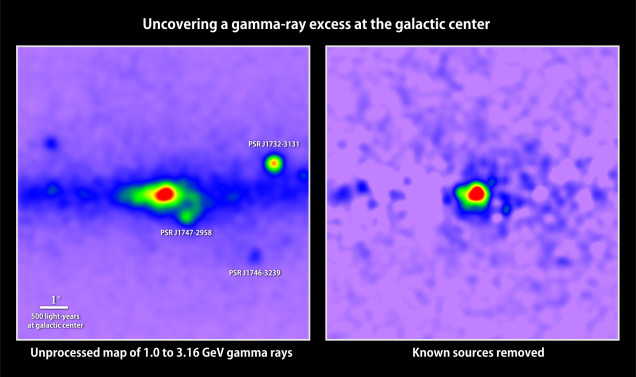
fermi_gamma-raysThe galactic center teems with gamma-ray sources, from interacting binary systems and isolated pulsars to supernova remnants and particles colliding with interstellar gas. It’s also where astronomers expect to find the galaxy’s highest density of dark matter, which only affects normal matter and radiation through its gravity. Large amounts of dark matter attract normal matter, forming a foundation upon which visible structures, like galaxies, are built.

Dan Hooper, an astrophysicist at Fermilab and lead author of the study, had this to say on the subject:

The new maps allow us to analyze the excess and test whether more conventional explanations, such as the presence of undiscovered pulsars or cosmic-ray collisions on gas clouds, can account for it. The signal we find cannot be explained by currently proposed alternatives and is in close agreement with the predictions of very simple dark matter models.

Hooper and his colleagues suggest that if WIMPs were destroying each other, this would be “a remarkable fit” for a dark matter signal. They again caution, though, that there could be other explanations for the phenomenon. Writing in a paper submitted to the journal Physical Review D, the researchers say that these features are difficult to reconcile with other explanations proposed so far, although they note that plausible alternatives not requiring dark matter may yet materialize.

CERN_LHCAnd while a great deal more work is required before Dark Matter can be safely said to exist, much of that work can be done right here on Earth using CERN’s own equipment. Tracy Slatyer, a theoretical physicist at the Massachusetts Institute of Technology and co-author of the report, explains:

Dark matter in this mass range can be probed by direct detection and by the Large Hadron Collider (LHC), so if this is dark matter, we’re already learning about its interactions from the lack of detection so far.This is a very exciting signal, and while the case is not yet closed, in the future we might well look back and say this was where we saw dark matter annihilation for the first time.

Still, they caution that it will take multiple sightings – in other astronomical objects, the LHC, or direct-detection experiments being conducted around the world – to validate their dark matter interpretation. Even so, this is the first time that scientists have had anything, even tentative, to base the existence of Dark Matter’s on. Much like until very recently with the Big Bang Theory, it has remained a process of elimination – getting rid of explanations that do not work rather than proving one that does.

So for those hoping that 2014 will be the year that the existence of Dark Matter is finally proven – similar to how 2012 was the year the Higgs Boson was discovered or 2013 was the year the Amplituhedron was found – there are plenty of reasons to hope. And in the meantime, check out this video of a gamma-ray map of the galactic center, courtesy of NASA’s Goddard Space Center.


Sources:
extremetech.com, IO9.com, nasa.gov, cfa.harvard.edu, news.nationalgeographic.com
Back from Europe!

remembrance_day___poppy_day_by_daliscarHello all! It’s good to be home, and though I am nursing the worst case of jet lag I’ve experienced since… well, two weeks ago, I felt the time was right to let people know how my trip went. As I was sure to have said in my last post, things were mighty eventful and we saw some truly amazing things. In addition to the preserved battlefields, war memorials, war cemeteries and museums, there was also the staggering amount of preserved history to be found in every corner of the places we visited.

We also got a chance to sample some interesting food, delight in the customs and practices of the Belgian, Norman and Parisian people, and drink some very good beer (more on this last aspect of things over my beer blog). Point being, it was a life-changing experience and one which we agreed as a family we needed to do again someday. Only this time, we would pace ourselves a little better so we wouldn’t be spending the first day driving on no sleep! 😉

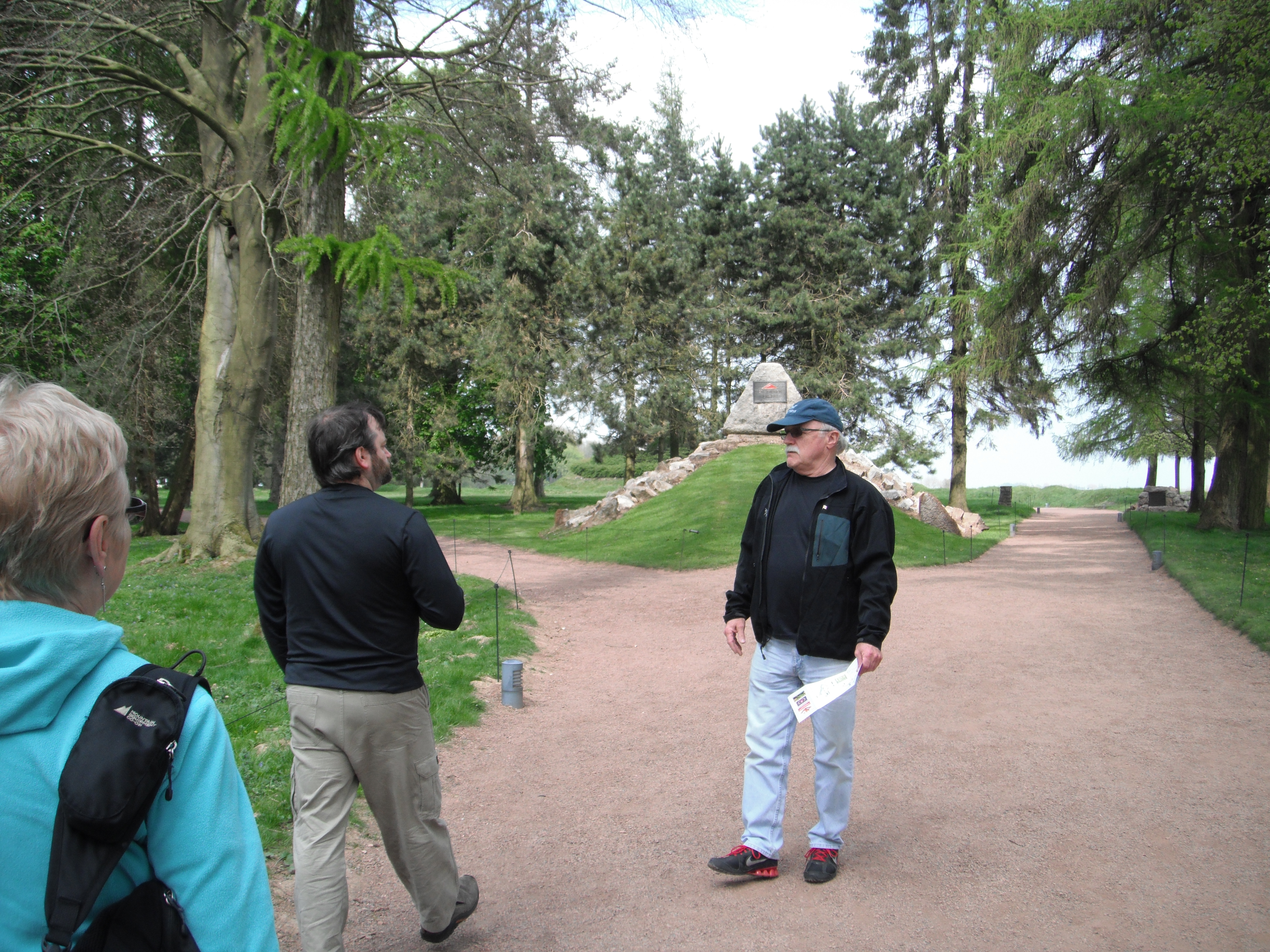
Us at Beaumont-Hamel
My mother, father and I at Beaumont-Hamel. All photos, unless otherwise indicated, by Carla Jack

To break it all down, we started by visiting cemeteries, memorials and museums in the Belgian countryside that commemorated the Great War and marked the centennial of its outbreak. We also managed to track down the last resting place of a relative of my mother’s, a young man named Wilmot Pettit who was shot down on D-Day over the Normandy countryside. And last, we visited two of the Normandy Beach landings and saw several museums and memorials that honored those who died during the Battle of Normandy in World War II.

This was the precise order of how we did things, which took us from Ypres to Dieppe, Bayeux to Chartres, and ended with us staying in Paris for several nights to take in the culture and history of the French capitol. Really, we couldn’t have packed more in, and now that this precis is over, let me get into the nitty gritty of this trip, with full background info and pictures. And since it’s too much to talk about in one posting, I’ve decided to break it down into a couple posts. Hopefully, I can cover more than a single day at a time, but no promises!

Wednesday, April. 9th – Friday, April 11th
(Nanaimo, BC to Ypres, Belgium):
Before the adventure could begin, there was the little matter of me and my wife meeting up with my folks and then flying to Paris. Now, this is not as easy as it sounds. First off, if you’re flying internationally from Vancouver Island, you either need to get to one of two cities (Comox or Victoria) or take the plane or ferry to Vancouver International Airport. And even then, there are likely to be one or more connecting flights along the way before flying the 8 or 9 hours to make it to Paris.

And once you get there, you’re nine hours ahead, which means you are stepping off the plane in midday when it feels in your head like its the wee hours of the morning. And chances are, you haven’t slept much the night before or on the plane, so you got a big ol’ sleep deficit to start with! Needless to say, that’s what happened to us. After meeting up with my folks the day before, we slept light the evening before the flight, and then set out on Thursday to the local airport before the sun was even up. After a quick trip over to Vancouver, we boarded our first flight, transferred in Montreal, and rode another plane into the sun for another nine hours.

French windmills, by Carla Jack
A few of the many wind turbines we saw

Upon our arrival, we were tired, greasy, and running on fumes. Nevertheless, we managed to grab a rental car and GPS at Charles de Gaulle International and started driving for the Belgium border.This took us through vast stretches of grassy green land, countless fields of golden canola, and many, many wind turbines. This was something that I noticed multiple times while touring the French and Belgian countryside, the large turbine operations that hovered above the flatlands like skyscrapers. I’m thinking we should get in on this in BC, and soon!

After driving northeast for several hours, we arrived in Belgium and began searching for our first set of sites. Having learned of some really cool stops during their previous visits, my folks wanted us to Avril Williams Guesthouse and Tea Room (no relation), a small BandB run by a British lady in the small town of Auchonvillers in the Somme region. In addition to providing food and accommodations, her business is also a de facto war museum due to its very interesting history.

town cellar used during the Great War
An Auchonvillers town cellar used during the Great War. Courtesy of http://www.avrilwilliams.eu

Having been built in the 17th century, graffiti found on the cellars walls and artifacts found on the floor indicated that the building served an important role during the Great War. Apparently, the cellar was one of 140 in the town that was used alternately by the French and British for ammo storage, signalling or for stretcher bearers. After the Armistice in 1923, the villagers returned and the house was rebuilt over the original cellar. It was the only one to have survived intact in Auchonvillers.

The cellar was rediscovered in 1992 when Avril Williams bought the property and some renovations were made. Artifacts found in the floor of the cellar – which included helmets, shell casings, swords, bags, insignia, and a slew of other items – have since been placed on display in the Tea Room itself behind plate glass. What’s more, out the back, a number of old trenches were dug up, restored, and incorporated into the place as part of its historical tour.

After lunch, we toured these and tried to imagine what it was like to have this kind of history in your own backyard! I should also note that Avril had some sheep grazing out the back, as well as several chickens and some very friendly cats. It was a strange and delightful pleasure to be seeing it all and talking to British and other tourists as we walked around and experienced all the reminders of such terrible events, all of which happened roughly 100 years ago but are a permanent part of the landscape. This is something we could to experience a lot on this trip.

Beaumont-Hamel Memorial

Then, it was off to Beaumont-Hamel, one of the many preserved battlefield parks within driving distance from Avril’s. For those who don’t know, it was here that the Royal Newfoundland Regiment (“The Blue Puttees”) fell during the Battle of the Somme. It was during this battle, which took place between July 1st and November 18th, 1916, that this small group of volunteers from the Dominion of Newfoundland (not yet part of Canada) stepped into No Man’s Land and was all but wiped out.

Several factors were to blame for this debacle. In the first place, the French and British plan of attack against the German lines was meant to take place in late June, but was postponed due to bad weather. Combined with the heavy bombardment which preceded the assault, the field between the German and British trenches was turned into mud. What’s more, the German troops on the other side had been occupying their position for 20 months, and used that time to fortify their positions against bombardment.

The Hawthorn Ride Mine exploding. Photo by Ernest Brooks
The Hawthorn Ridge Mine exploding. Photo by Ernest Brooks

The British attack began with the detonation of a large mine under a heavily fortified positing known as the Hawthorn Ridge Redoubt, which was caught on film and remains one of the most iconic bits of footage from the war. The explosion destroyed a major German strong point, but also alerted the German troops of the coming attack and led to their deployment. Moments later, when the British 29th Infantry Division advanced into No Man’s Land, they foundered due to German barbed wire, machine gun fire and artillery.

Back at the Divisional HQ, the British received confused reports, some of which stated that the German lines had been broken. To exploit this, General Beauvoir De Lisle ordered the Newfoundland Regiment and other units that were in reserve into the fray. Moving up from St. John’s Road, a support trench 230 meters (250 yards) behind the British forward line, the Newfoundlanders soon found that movement forward through the communication trenches was not possible because they were congested with the dead and wounded, and under shell fire.

The trenchlines and shell holes that still mark the lanscape
Note how the trench lines and craters still mark the landscape. Photo by Theitalinpen

Lieutenant Colonel Arthur Lovell Hadow, the battalion commander, decided to move immediately into attack formation and advance across the surface. As they moved out in the open, they were effectively the only troops moving on the battlefield and clearly visible to the German defenders. As a result, most of the Newfoundland Regiment who had started forward were dead, dying or wounded within 15 to 20 minutes of leaving St. John’s Road trench.

Most reached no further than the Danger Tree, a skeleton of a tree that lay in No Man’s Land that was being utilized as a landmark. As part of one of the most disastrous offensives during the war, the destruction of this regiment serves as a stark and sobering reminder of just how destructive the Great War was. Of the 780 men who went forward only about 110 survived unscathed, of whom only 68 were available for roll call the following day.

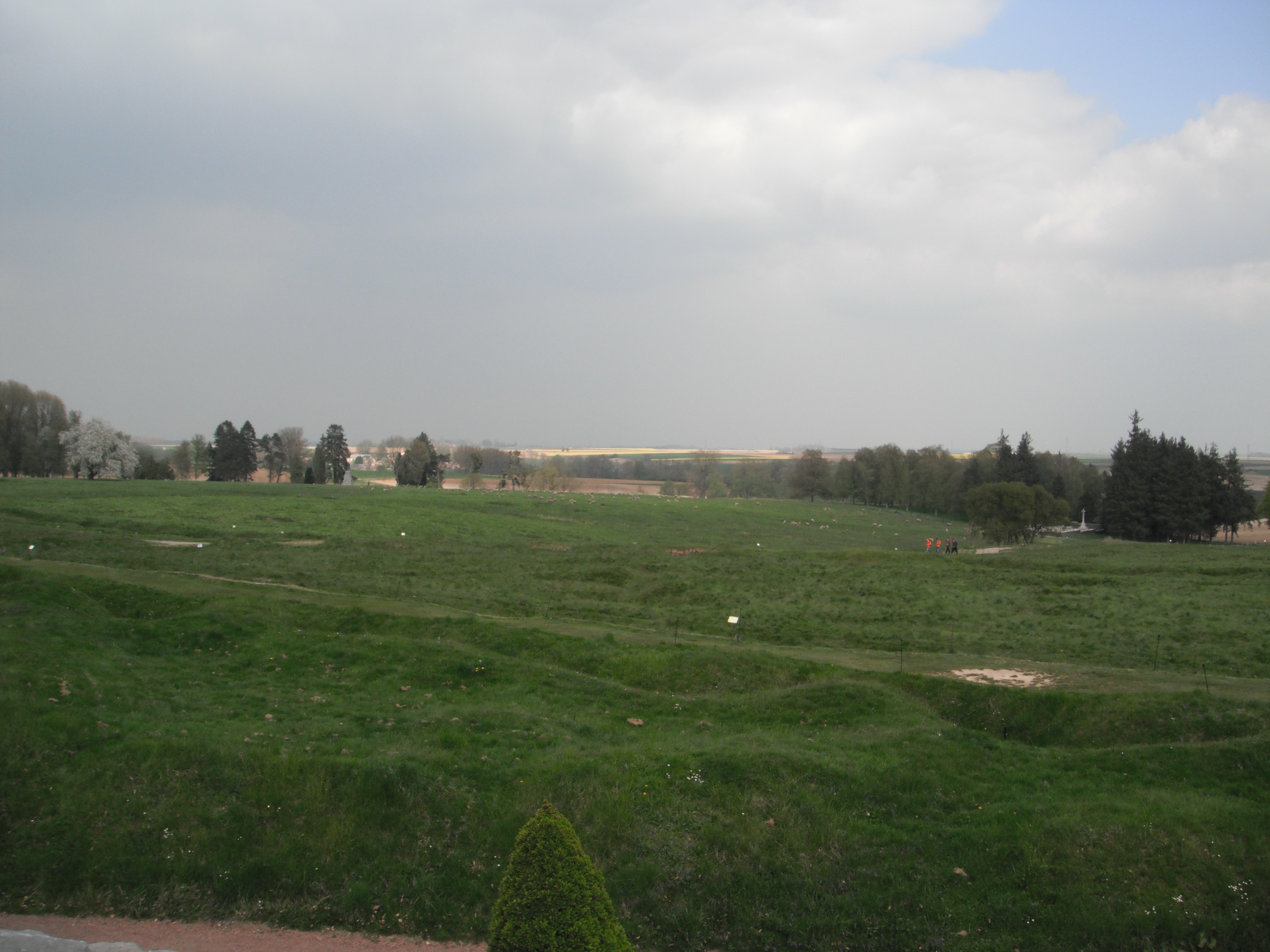
View of the battlefield, with the Danger Tree in the right hand
View of the battlefield from the memorial. The Danger Tree is visible on the right near the small group of visitors

As you can probably tell from the photographs, the area in which this battle took place is really not that big. Having seen it close up, I can tell you that it is astounding to know that so much death and destruction happened within such a small area. But such was the nature of battles like the Somme. So many men died brutally and senselessly for the sake of a few meters, and every position taken on the field was paid for with thousands of lives.

The Beaumont-Hamel Newfoundland Memorial is a testament to one of the greatest wastes of life of the war and in human history. Officially opened by the British in 1925, the memorial site is one of only two National Historic Sites of Canada located outside of Canada. The other is the Canadian National Vimy Memorial, which we visited a few days later. This symbol of sacrifice is staffed by Canadian students and civil servants, and remains a symbol of Newfoundland’s identity.

After taking this all in, we went back to our car and set off for the town of Ypres where we would be staying for the next three days. For most of us, this consisted of sleeping in the car while my father had to slap himself to stay awake. But in the end, we made it to the Hotel Albion located in the city’s old quarter and quickly climbed into our beds. Carla and I slept while my folks chose to nap and head on out for some proper dinner.

_____

And that is what we did for the first two days of the trip. If it sounds like a lot, then I’ve conveyed the experience properly! Needless to say, it was all quite overwhelming and we were all emotionally and physically exhausted afterwards. Just telling it again now makes me feel like I’m trying to cook an elephant! Basically, the only way I’m going to be able to do it is a bit at a time. So stay tuned, because there is plenty more to follow.

Up next, our adventures in and around the historic town of Ypres, Belgium! And in the meantime, please listen to this lovely song – “Recruiting Sergeant”, by the Newfoundland band Great Big Sea. It is a lovely song that commemorates the sacrifice of these brave young men, an entire generation of young Newfoundlanders. The video consists of images compiled by Dr. Death1020, who used RNR pictures of Beaumont-Hamel and of the Battle of the Somme to set the tone. Enjoy, and may we never forget!

Lest We Forget

lest-we-forgetHey all! Just wanted to do a late trip update and let everybody know I’m still kicking, and to share some of the many experiences that were had so far on this trip. It’s been almost two weeks now since the family and I departed from Vancouver Island and landed on the Continent, and try as I might, I’ve been unable to resist my internet fix! So as long as I was surfing, checking messages and doing a little messaging myself, I figured I could at least post an update or two.

Currently, we are in Paris, where we arrived on Sunday after dropping off our rental car at Charles de Gaulle Airport. After finding our hotel in the Latin Quarter, we began taking in the local sites and sounds, which included the Tour Eiffel, the Arc de Troimphe, the Notre Dame Cathedral, the Louvre, and la Maison de Verlaine, a restaurant that is famous for having been frequented by countless literary, political and showbiz personalities (Hemingway, Marilyn Monroe and the Kennedy’s, to name a few).

battle_of_vimy_ridge_field_gun_firingBut before that, we were in the Flanders region of Belgium and the Normandy region of France. We began with Ypres, a small city in Belgium that was the site of three major battles during the Great War. This began in 1914 when the Allies retook the town from the Germans after their great sweep into northern France failed. The second took place five months later when the Germans, hoping to break the stalemate in Belgium, used chlorine gas for the first time. It was during this gas attack that the Canadian 1st Division distinguished itself by holding its ground and repelling the attack, despite the fact that they had no gas masks. The third and final battle took place east of the city and is also known as the Battle of Passchendaele, one of the bloodiest of the war.

These and other terrible sacrifices which were endured during the war are all commemorated on a daily basis in the town. Every night, wreaths are laid at the Mennin Gate at one side of the old city where the names of the dead are inscribed and people gather to hear The Last post played. Having attended it on both a Saturday and the following Sunday, I can tell you that It is a very beautiful and moving event.

remembrance_day___poppy_day_by_daliscarWe were also sure to visit the cemeteries, battlefields and memorials at Beaumont-Hamel, Concrete Farm, Langemarck, St. Julien, and Tyne Cot. This last cemetery, which is the largest World War I cemetery ever, has a small museum where the names of every soldier who died in the Battle of Arras is named. The recording plays on a loop, and takes FIFTEEN YEARS to finish!

I should also note that within this landscape, visitors and farmers are routinely still finding small pieces of the battles that took place over a century ago. These include unexplored munitions – which have to be carefully removed and disposed of – and shrapnel, which my father and I found quite miraculously. I say this because the field we were going to search was being tilled by a large machine, forcing us to search at the very edge. But even with this small space to work with, we still managed to find a large chunk of a shell and some small pieces of shrapnel.

Vimy RidgeAfter that, we visited the Vimy Memorial in France, one of the greatest to come out of the war. This site, and the many preserved trenches, tunnels and craters that mark the landscape are preserved and attended to by Canadian students who hope to keep the memory of this historical battle alive. Not only was it a major victory for the allies – the first decisive offensive of the war – it also defined Canada as a nation. While being guided through the trenches and tunnel, my father and I once again paused to pick up some keepsakes. This time around, it was a piece of chalk and flint (which the ridge is made of) and a small bit of ceramic, possibly from an old teacup.

We then travelled to Dieppe in Normandy and began visiting the World War II sites and memorials. This included the beach of Dieppe where the ill-faired raid performed by the Canadian 2nd Division, British, French and Polish Commandos, and American Rangers. We then drove to the French countryside to the town of Grangues to see where my Grandmothers cousin (an RAF pilot who died on D-Day) was shot down.

dieppe-dsThis was perhaps the most interesting part of our journey since it involved retracing the path of an actual family member. His name was Wilmot Pettit, and on June 6th, 1944, he was shot down while towing a glider full of British Commandos into the Normandy countryside.  The mayor of Grangues was extremely helpful, and drove us to where the crash took place, told of how the survivors had been captured and executed by the SS, offered to send us some photos of the downed plane, and told us where Wilmott had been buried. We then drove to the cemetery at Ranville to pay our respects, before heading on to Bayeux.

From here, we visited Juno Beach, Gold Beach, and saw the museums set up at both that commemorated the D-Day landings of the Canadian, British and Commonwealth troops. We wanted to get around to seeing Omaha, but unfortunately there just wasn’t enough time. We also visited the war cemetery at Beny-sur-Mer, where the many Commonwealth troops who died during the Battle of Normandy were laid to rest. We also managed to walk inside the still-intact coastal batteries at Longues-sur-Mer, and took in the Bayeux Tapestry before leaving for Chartres.

Which brings us by commodious vicus back to the present. We still have a few more nights here in Paris and we intend to see as much as we can before leaving on Friday.  And when I get home, I hope to write about my experiences here in more depth. Trust me when I say that this is the explicated version. The full-length one comes with way more background info, and pictures! Until then, take care, and take care to remember…

BookofRemembrance_pg.479

Off to Europe!

remembrance_day___poppy_day_by_daliscarHey all! Sad to say, I will be away for the next two weeks as the wife and I, and my mother and father, tour the battlefields of Normandy and Flanders. This trip has been a long time in coming, and is a pretty big deal for obvious reasons. Not only is it an opportunity to see some major historic sites – ones which I have been hoping to see for some time – we are also getting the chance to do this tour during the Centenary of World War I.

As my father informed us after returning from doing the battlefields tour back in 2009, commemorating the Great War and World War II is a pretty big deal for the people who live in Northern France and Belgium. Here, the people live with the reminders of these terrible wars every single day, with farmers and villagers finding pieces of shrapnel, bullets, and even unexploded munitions on a regular basis. And in some areas, the evidence of the trenches is still visible, even where they haven’t been preserved.

The sites we will be visiting include Ypres, Beaumont-Hamel, Vimy Ridge, Dieppe, Bayeux, Juno Beach, Caen, Omaha Beach, Chartres, and of course, Paris – which we will be flying in and out of. I will be back on the 25th of April, no doubt with plenty of stories and pictures! Take care, and never forget the sacrifice made by so many for so many more!

The Future of Medicine: Replacement Ears and “Mini Hearts”

biomedicineBiomedicine is doing some amazing things these days, so much so that I can hardly keep up with the rate of developments. Just last month, two amazing ones were made, offering new solutions for replacing human tissue and treating chronic conditions. The first has to do with a new method of growing human using a patients own DNA, while the second involves using a patient’s own heart tissue to create “mini hearts” to aid in circulation.

The first comes from London’s Great Ormond Street Hospital, where researchers are working on a process that will grow human ears using genetic material taken from a patient’s own fat tissue. Building upon recent strides made in the field of bioprinting, this process will revolution reconstructive surgery as we know it. It also seeks to bring change to an area of medicine which, despite being essential for accident victims, has been sadly lacking in development.

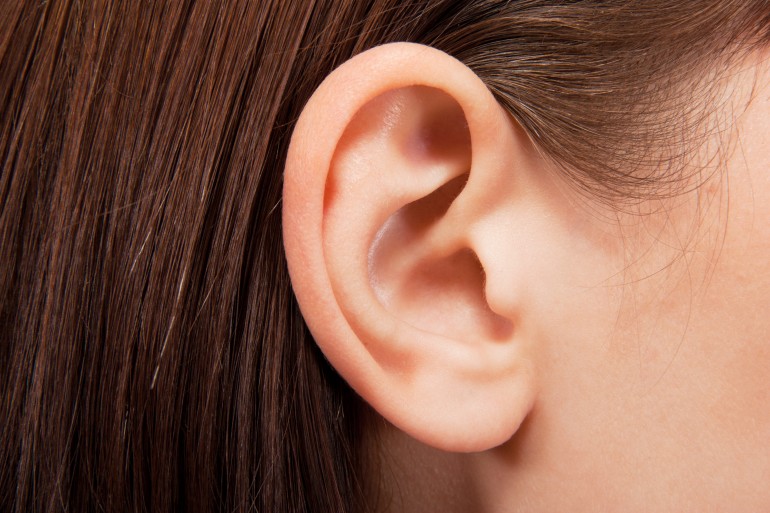
replacement_earCurrently, the procedure to repair damaged or non-existent cartilage in the ear involves an operation that is usually carried out when the patient is a child. For the sake of this procedure, cartilage is extracted from the patient’s ribs and painstakingly crafted into the form of an ear before being grafted back onto the individual. Whilst this method of reconstruction achieves good results, it also comes with its share of unpleasant side effects.

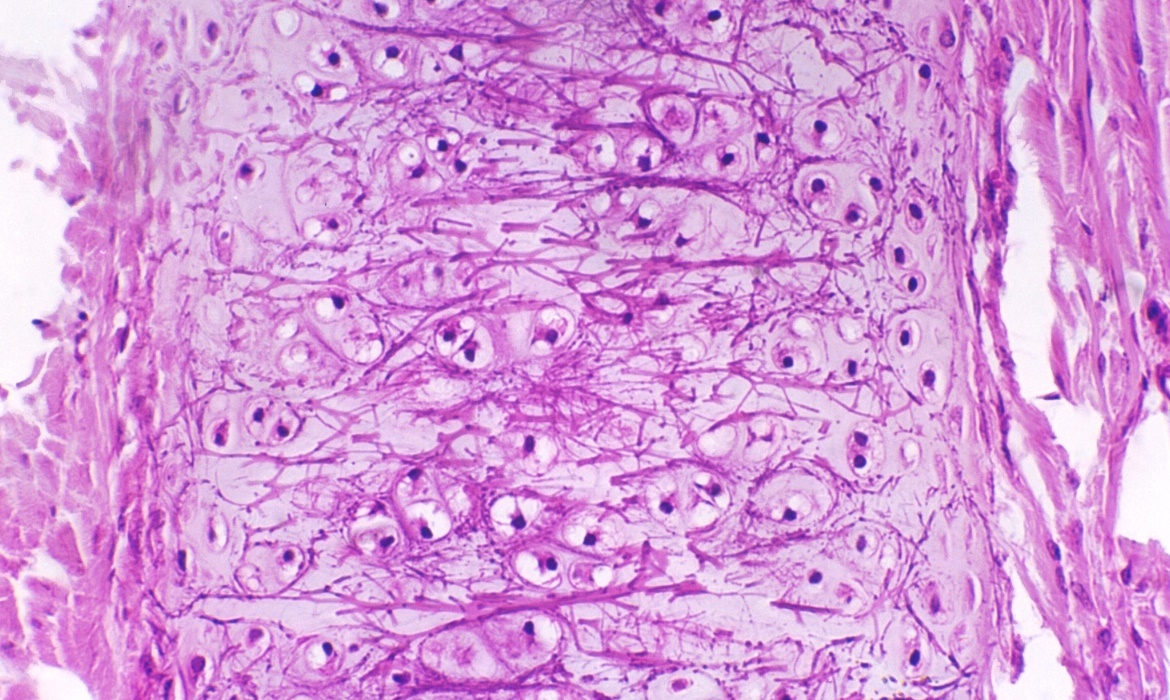
Basically, the patient is left with a permanent defect around the area from where the cells were harvested, as the cartilage between the ribs does not regenerate. In this new technique, the cartilage cells are engineered from mesenchymal stem cells, extracted from the child’s abdominal adipose (fat) tissue. The benefit of this new system is that unlike the cartilage in the ribs, the adipose tissue regenerates, therefore leaving no long-term defect to the host.

stem_cells1There is also the potential to begin reconstructive treatment with stem cells derived from adipose tissue earlier than previously possible, as it takes time for the ribs to grow enough cartilage to undergo the procedure. As Dr. Patrizia Ferretti, a researcher working on the project, said in a recent interview:
One of the main benefits in using the patient’s own stem cells is that there is no need for immune suppression which would not be desirable for a sick child, and would reduce the number of severe procedures a child needs to undergo.

To create the form of the ear, a porous polymer nano-scaffold is placed in with the stem cells. The cells are then chemically induced to become chondrocytes (aka. cartilage cells) while growing into the holes in the scaffold to create the shape of the ear. According to Dr. Ferretti, cellularized scaffolds – themselves a recent medical breakthrough – are much better at integrating than fully-synthetic implants, which are more prone to extrusion and infection.

cartilage2Dr. Ferretti continued that:

While we are developing this approach with children with ear defects in mind, it could ultimately be utilized in other types of reconstructive surgery both in children and adults.

Basically, this new, and potentially more advantageous technique would replace the current set of procedures in the treatment of defects in cartilage in children such as microtia, a condition which prevents the ear from forming correctly. At the same time, the reconstructive technology also has the potential to be invaluable in improving the quality of life of those who have been involved in a disfiguring accident or even those injured in the line of service.

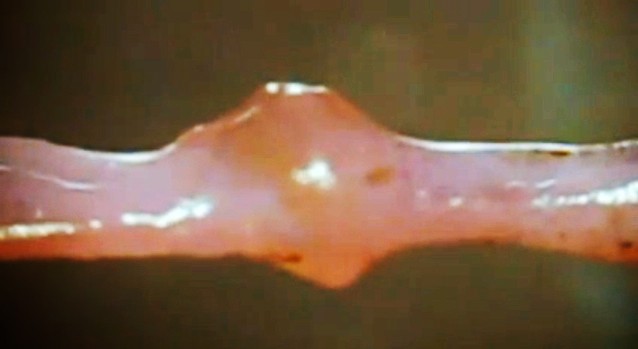
mini_hearts`Next up, there is the “mini heart” created by Dr. Narine Sarvazyan of George Washington University in Washington D.C.. Designed to be wrapped around individual veins, these cuffs of rhythmically-contracting heart tissue are a proposed solution to the problem of chronic venous insufficiency – a condition where leg veins suffer from faulty valves, which prevents oxygen-poor blood from being pumped back to the heart.

Much like process for creating replacement ears, the mini hearts are grown  by coaxing a patient’s own adult stem cells into becoming cardiac cells. When one of those cuffs is placed around a vein, its contractions aid in the unidirectional flow of blood, plus it helps keep the vein from becoming distended. Additionally, because it’s grown from the patient’s own cells, there’s little chance of rejection. So far, the cuffs have been grown in the lab, where they’ve also been tested. But soon, Sarvazyan hopes to conduct animal trials.

mini_hearts2As Sarvazyan explained, the applications here far beyond treating venous insufficiency. In addition, there are the long-range possibilities for organ replacement:

We are suggesting, for the first time, to use stem cells to create, rather than just repair damaged organs. We can make a new heart outside of one’s own heart, and by placing it in the lower extremities, significantly improve venous blood flow.

One of the greatest advantages of the coming age of biomedicine is the ability to replace human limbs, organs and tissue using organic substitutions. And the ability to grow these from the patient’s own tissue is a major plus, in that it cuts down on the development process and ensures a minimal risk of rejection. On top of all that, the ability to create replacement organs would also significantly cut down on the costs of replacement tissue, as well as the long waiting periods associated with donor lists.

Imagine that, if you will. A future where a patient suffering from liver, kidney, circulatory, or heart problems is able to simply visit their local hospital or clinic, donate a meager supply of tissue, and receive a healthy, fully-compatible replacement after an intervening period (days or maybe even hours). The words “healthy living” will achieve new meaning!


Sources: gizmag.com, (2), nanomedjournal.com

The Future of Medicine: Fake Muscles and 3D Printed Implants

3d-printed-jawWhen it comes to the future of medicine, its becoming increasingly clear that biomimetics and 3D printing will play an important role. Basically, this amounts to machines that are designed to mimic biology for the sake of making our bodies run better. In addition, it means that both medical machines and organic parts could be created on site, allowing for speedier, accessible and more cost-effective interventions and augmentations.

For example, research being conducted at Harvard’s Wyss Institute for Biologically Inspired Engineering and the Harvard School of Engineering and Applied Sciences has led to the creation of artificial muscle that can imitate the beating motion of the heart – also known as the “Left Ventricle Twist”. This development, which is a big break in the field of biomimetics, could also be a game-changer when it comes to producing artificial hearts.

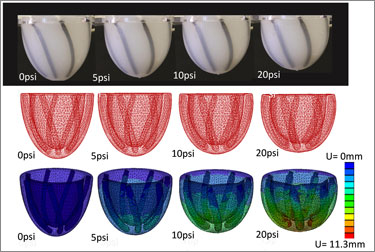
Artificial-Muscles-pic-1-400x267Their research started with what is known as a pneumatic artificial muscle (PAM), one which was modeled after the striated muscle fibers found in the heart. Made from silicone elastomer and embedded with braided mesh, this artificial heart was then hooked up to an air tube to see how it would handle being inflated. When air was pumped into the PAM, it responded by twisting and thus becoming shorter. This is similar to what the natural fibers of the heart do, which contract by twisting and shortening.

Several of the PAMs were then embedded within a matrix of the same elastomer from which they were made. Through a process of manipulating their orientation to one another, along with selectively applying different amounts of pressure, the researchers were able to get some of the PAMs twisting in one direction, at the same time that others twisted in the opposite direction. As a result, the silicone matrix exhibited the same three-dimensional twisting motion as the heart.

ArtificialMusclespic2-375x252The immediate applications for this are obvious; in short, creating a range of artificial hearts for patients who suffer from severe disorders or heart damage. Unlike conventional artificial hearts, these ones would be able to provide pumping action similar to the real thing. In addition, the PAMs were able to mimic the change in motion that is caused by various heart disorders, and these could be used to help in the research of such conditions, not to mention the development of treatments for them.

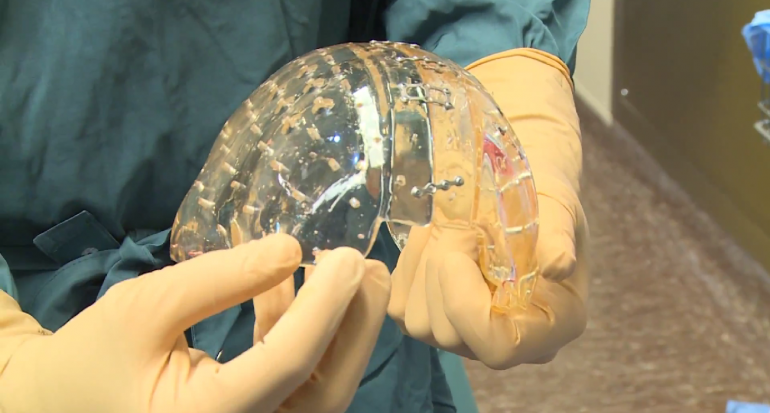
Equally exciting are the possibilities being offered by 3D printing which now offers a range of artificial replacements. The latest example comes from the Netherlands, where a 22-year old woman has had the top of her skull replaced with a 3D printed implant. Due to a severe condition that causes a thickening of the skull, the patient was suffering from severe and worsening symptoms. And in a first of its kind procedure, she was given a tailor-made synthetic replacement.

3d-printed-skullAs Dr. Bon Verwei of the University Medical Center (UMC) Utrecht explained, the surgery was not only a first, it was absolutely essential:

The thickening of the skull puts the brain under increasing pressure. Ultimately, she slowly lost her vision and started to suffer from motor coordination impairment. It was only a matter of time before other essential brain functions would have been impaired and she would have died. So intensive surgery was inevitable, but until now there was no effective treatment for such patients.

So far, 3D printing has been used to produce lower jaw implants, prosthetic arms, legs, and cells (kidney, liver, and skin cells). In this instance, the skull was 3D-modeled and then printed as a single full piece that was able to be slotted and secured into place. Prior to the procedure, Verwej and his team had to familiarize themselves with reconstructions and 3D printing, in particular that which pertained to partial skull implants.

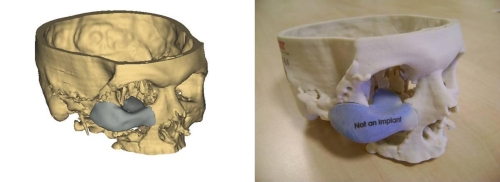
3d-printed-cheekImplants have often been used when part of a skull has been removed to reduce pressure on an patient’s brain. However, Verweij claimed that cement implants are not always a good fit, and that 3D printing allows for exact specifications. As he explained it:

This has major advantages, not only cosmetically but also because patients often have better brain function compared with the old method.

Verweij worked with an Australian company called Anatomics – which uses 3D printing to produce custom-made implants and surgical models for medical practitioners – to produce the replacement skull. The surgery, only just announced, was carried out three months ago and was a success. According to Verweij, the patient has fully regained her vision and has returned to her normal life. The work undertaken on the procedure means that UMC Utrecht is now is a position to carry out other similar work.

3d-printed-skull-0The ability to tailor-make synthetic bones, which are exact duplicates to the original, offers exciting possibilities for reconstructive and replacement surgery. It also does away with some rather invasive and unsatisfactory procedures that involve putting shattered bones back together and joining them with pins, bars and screws. And considering that such procedures often require multiple operations, the combination of 3D scanning and 3D printed replacements is also far more cost effective.
And be sure to check out the video below that shows the Utrecht procedure. Be warned, the video contains actual footage of the surgery, and is therefore not recommended for the squeamish! English subtitles are also available via the video controls.


Sources:
gizmag.com, (2), wyss.harvard.edu

News From Space: NASA Severs Ties to Russia

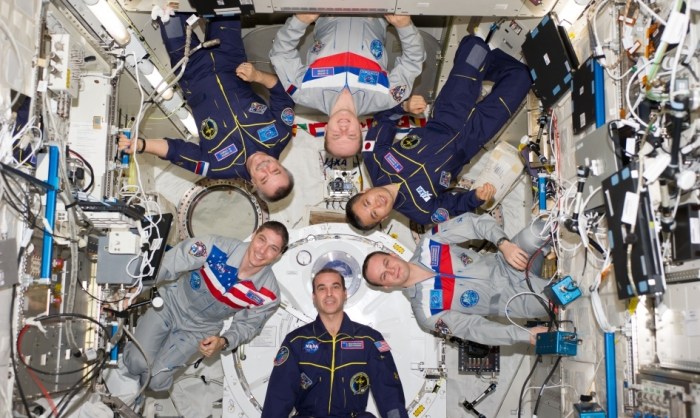
ISS_crewYesterday, NASA officially announced that it intends to cease most work with the Russian Federal Space Agency amid growing tensions concerning the Ukrainian crisis. The statement came from Bob Jacobs, NASA’s deputy associate administrator of communications, who formalized the space agency’s position with a message sent to Universe Today, a copy of which was then posted on it’s Google+ message board on Wednesday, April 2nd.
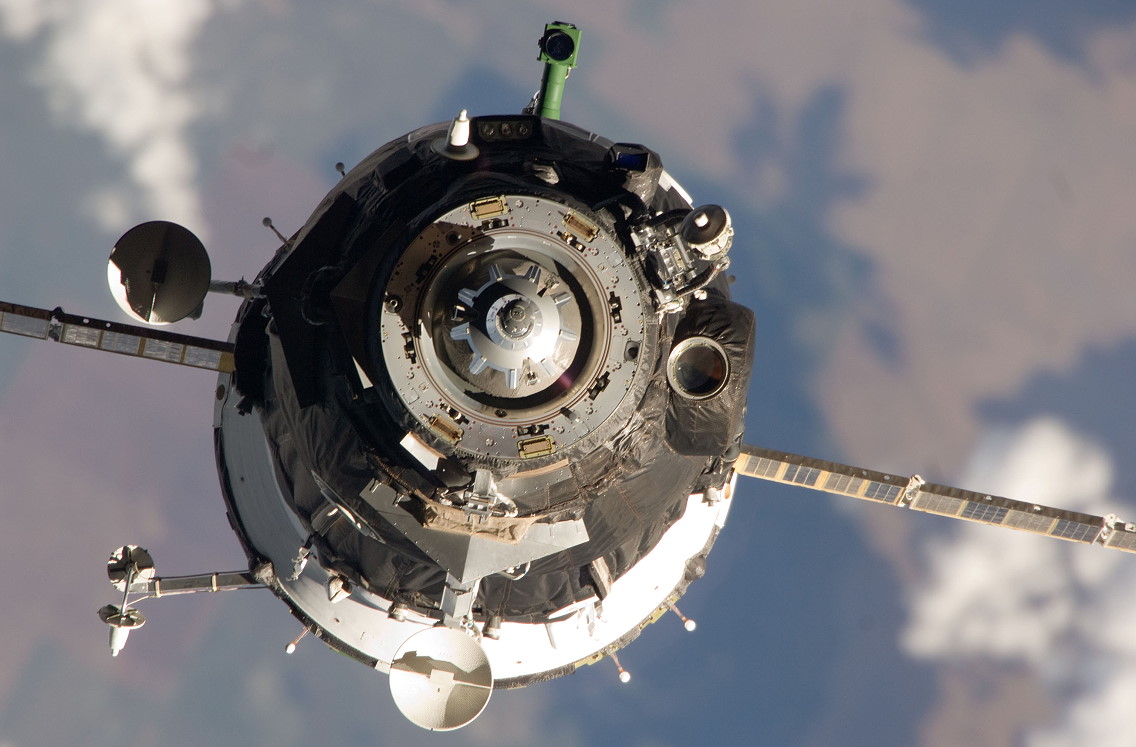
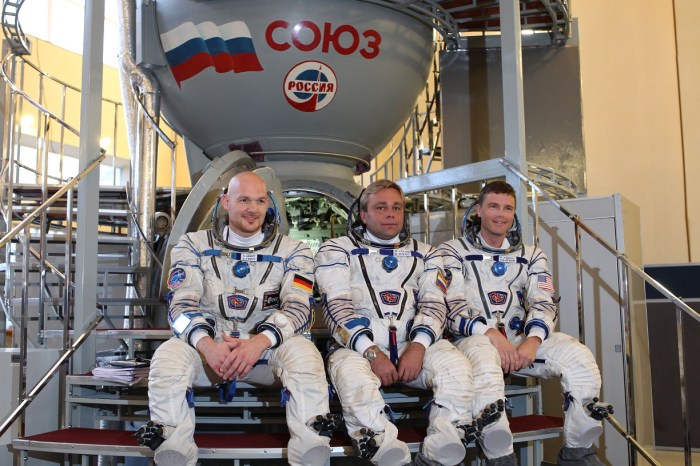
In the statement, they indicate that while the International Space Station will still see work to “maintain safe and continuous operation”, most work with Roscosmos (Russia’s federal space agency) will cease. In addition, they were sure to include a reminder to Congress, saying that they now face a choice between fully funding human U.S. launches again in 2017, or facing years more of sending money to the Russians for Soyuz launches from Kazakhstan.

Soyuz_capsuleThe full text of the statement appears as follows:

Given Russia’s ongoing violation of Ukraine’s sovereignty and territorial integrity, NASA is suspending the majority of its ongoing engagements with the Russian Federation.  NASA and Roscosmos will, however, continue to work together to maintain safe and continuous operation of the International Space Station.

NASA is laser focused on a plan to return human spaceflight launches to American soil, and end our reliance on Russia to get into space.  This has been a top priority of the Obama Administration’s for the past five years, and had our plan been fully funded, we would have returned American human spaceflight launches – and the jobs they support – back to the United States next year.  

With the reduced level of funding approved by Congress, we’re now looking at launching from U.S. soil in 2017.  The choice here is between fully funding the plan to bring space launches back to America or continuing to send millions of dollars to the Russians.  It’s that simple.  The Obama Administration chooses to invest in America – and we are hopeful that Congress will do the same.

So far, it’s not exactly clear what activities would constitute “safe and continuous operation” of the station. So, for example, whether or not NASA will continue to send photographers to cover launches and landing in Russia, or to what extent NASA TV broadcasts of Russian spacewalks would be affected, remains to be seen. And in the meantime, missions already scheduled for launch – such as Expedition 40, which will launch aboard a Soyuz spacecraft in May – are still expected to go ahead.

ISS_exp40Since the Space Shuttle Program was retired in 2011, NASA and other space agencies such as the European Space Agency have relied on Russian Soyuz spacecraft to bring astronauts to the International Space Station. Crews are generally made up of large proportions of Russian cosmonauts and American astronauts, as well as a few astronauts from other agencies. The current Expedition 39 crew has has three Russians, two Americans and a Japanese commander, Koichi Wakata.

The relationship between NASA and Russia stretches back to the 1970s when Russia was still the Soviet Union, with their first joint mission (the Apollo-Soyuz Test Project) taking place in 1975. The relationship expanded when several NASA shuttles visited the Russian space station Mir in the 1990s, laying the groundwork for the International Space Station agreement today. And 2011, that relationship expanded considerably, with Russian rockets not only transporting ISS crews, but also US and European satellites into orbit.

Earth_&_Mir_(STS-71)NASA is working on a commercial crew program that right now is slated to bring U.S. astronauts back into space from American soil by 2017. There are several proposals being considered: a human-rated version of SpaceX’s Dragon, Blue Origin’s New Shepard, Sierra Nevada’s Dream Chaser and the Boeing CST-100. However, these depend upon continued funding and it is currently unclear how much money the CCP program will receive in the upcoming fiscal 2015 budget request before Congress.
Historically, NASA has repeatedly received less funding than what it has requested, which has resulted in missions being delayed – sometimes by years. But the new tensions with Russia may alter that situation somewhat, and judging from their statement, NASA is counting on this very thing. In the meantime, International Space Station operations were extended to at least 2024, and NASA officials have pointed out that it and similar agreements have weathered other world crises.

Source: universetoday.com

News From Space: “Rosetta Stone” Meteorite Lands in Ontario

meteorite_st.thomasA search is underway in the small community St. Thomas, Ontario for a rare meteorite that may prove to be a major scientific find. That’s what the Canadian and NASA researchers believe, and they are urging local residents to comb their fields and neighborhoods for one or more of the rock’s fragments. It all began on Tuesday, March 18th at 10:45 p.m., when a fireball streaked across the sky some 75 kilometres above Port Dover, Ont.

The fireball then headed in a westerly direction before vanishing at an altitude of 32 kilometres between Aylmer and St. Thomas. It was widely seen in Toronto, Hamilton, London and other parts of southern Ontario, where skies were clear. Peter Brown, the director of Western University’s Center for Planetary Science and Exploration, estimated the space rock was originally the size of a basketball, which then broke up upon entry.

????????????????????????????????????????????????????????????????????????????????????????????????????????????????????????????????????????????????????????????????????????????????????????????????????????????????????????????????????????????????????His colleague, Western University meteorite curator Phil McCausland, said one or more fragments “about the size of a golf ball or baseball” likely landed about five kilometers north or northwest of St. Thomas. The meteorite from this event is particularly rare and valuable because the fireball was captured by seven all-sky cameras of Western University’s Southern Ontario Meteor Network, allowing researchers to calculate its orbit.

Not only were they able to obtain solid data on the space rock’s orbit, but that orbit itself was special. Before entering Earth’s atmosphere, the object spent most of time circling closer to the sun than the Earth, having left its original orbit in the asteroid belt between Mars and Jupiter long ago. Bill Cooke, head of NASA’s meteoroid environment office, said only one other meteorite known to have come from that kind of orbit has ever been recorded.

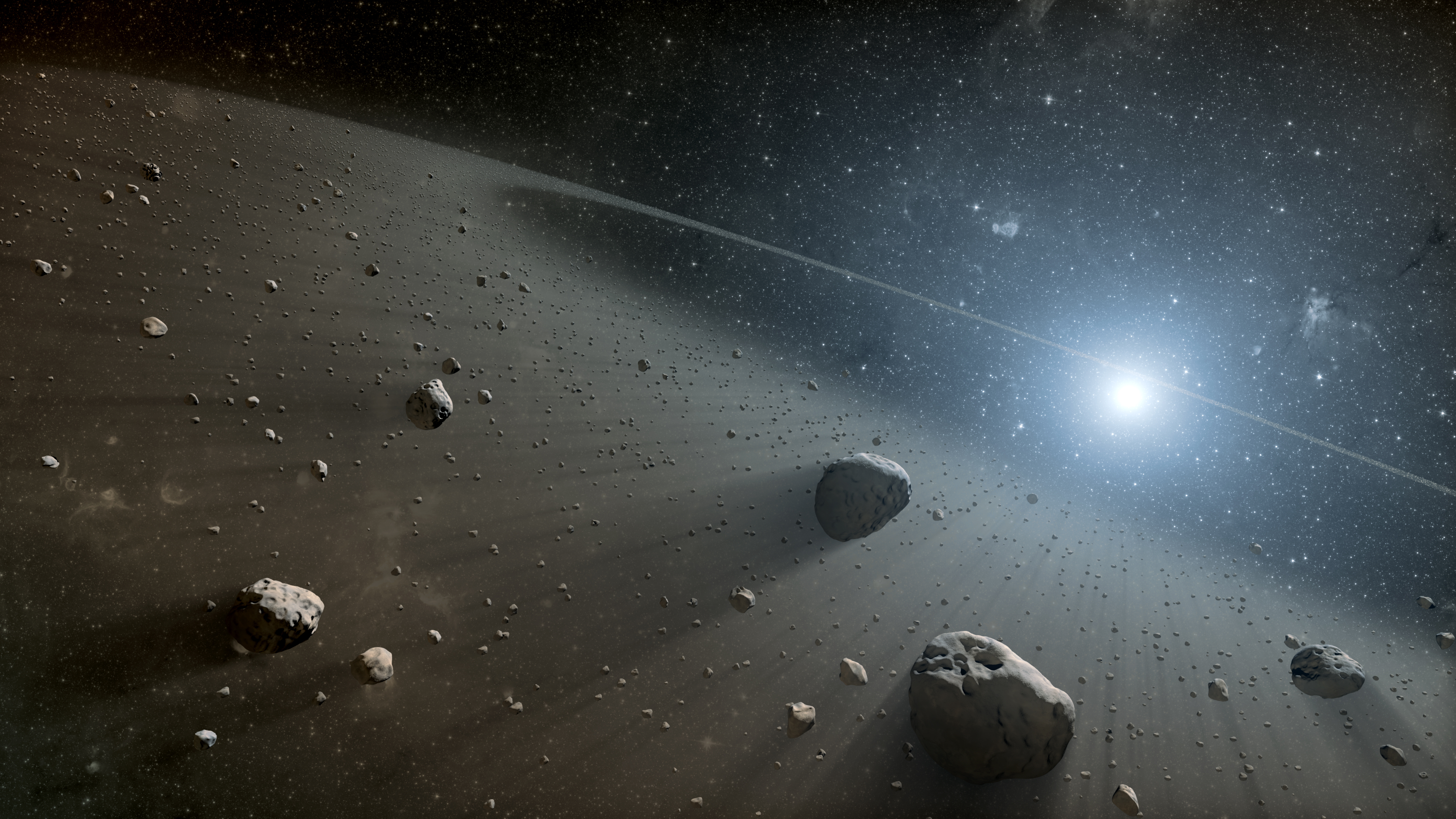
asteroids1As Cooke said during a recent press conference:

This is not your run-of-the-mill meteor fall. This is a very unusual orbit. We’re really interested in knowing what type of object was in this … We won’t know that until we find a piece of it.

According to Brown, this makes each of the meteorite’s fragments something of a “Rosetta Stone”, referring to the famous Egyptian artifact that was the key to translating ancient hieroglyphics. The comparison is not an exaggeration, as the meteor is likely to tell scientists quite a bit about the history of the early Solar System. As he described it:

This is like a poor man’s space probe. It comes to us. It’s going to tell us … what made the Earth, what made the other planets.

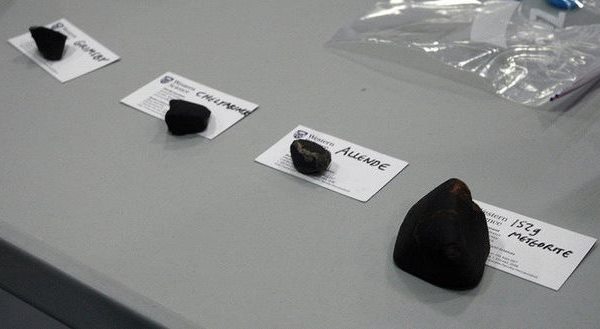
st.thomas_meteor1Hence why Brown is asking for the public to help look for the meteorite, which has been described as a rock that looks like it was painted black, and contact the researchers if they find it. The researchers are also interested in hearing accounts from anyone who may have heard a whistling sound “like artillery coming in” or a thud after witnessing the fireball, indicating that it may have landed within a few hundred metres. That may help narrow down the area for the search.

Brown noted that it’s the first time in five years that such a meteor fall has taken place in southern Ontario. The last time researchers issued a callout like this, the meteorite was recovered days later by a member of the public near Grimsby, Ont., where it had crashed through the windshield of an SUV. The fact that this meteorite did not cause injuries or property damage, unlike the one that exploded in the sky over Russia, is also a plus!

Source: cbc.ca

New Promotional Deal for Whiskey Delta!

shutterstock_107588285Hey all! In honor of Papa Zulu‘s recent publication, and the fact that there are still many people who haven’t read the first book in the series (I know, it’s crazy right?), I have started a special promotion. It began just yesterday, with the price for Whiskey Delta being marked down to $0.99. This will continue until March 31st, at which point the price will go up to a (still discounted) $1.99. The promotion ends on April 4th, at which time it will go back to its full price of $2.99.

So if you haven’t read the book, get it while you can! But of course, the real goal here is to get more people prepped and ready to buy Papa Zulu, which I intend to launch a special promotion for as soon as this one ends. As always, it’s all about getting people interested in the series, which they simply can’t do of they don’t start from the beginning! If interested, follow the link below to WD‘s Amazon page and select it for Kindle:

http://www.amazon.com/Whiskey-Delta

And don’t forget to review! 🙂

The 3D Printing Revolution: Furniture and Prosthetics Eyes

bigrep_1As always, it seems that additive manufacturing (aka. 3D printing) is on the grow. On an almost daily basis now, the range of applications grows with the addition of yet another product or necessity. With each and every addition, the accessibility, affordability, and convenience factor associated with these objects grows accordingly. And with these latest stories, it now seems that things like household furniture and prosthetic eyes are now printable!

Consider the BigRep One, a new design of 3D printer that allows users to manufacture full-scale objects. This has been a problem with previous models of printers, where the print beds have been too small to accommodate anything bigger than utensils, toys, models and small parts. Anything larger requires multiple components, which would then be assembled once they are fully printed. However, the BigRep One allows for a build volume of 1.14 by 1 by 1.2 meters (45 x 39 x 47 inches) – large enough to print full-scale objects.

bigrep_2Developed by Berlin-based artist Lukas Oehmigen and Marcel Tasler, the printer is has an aluminum frame, a print resolution of 100 microns (0.1 millimetres), and can print in a variety of materials. These include the usual plastics and nylons as well as Laywood – a mix of wood fibres and polymers for a wood finish – and Laybrick, a sandstone-like filament. It is even capable of being upgraded with Computer Numerical Control (CNC) so that it can carry out milling tasks.

One of the most obvious is the production of furniture and building materials, as the picture above demonstrates. This finely detailed sideboard was created as part of the printers debut at the 3D PrintShow in New York. The printer itself and will start shipping to customers in March/April, with the suggested price is US $39,000 per unit. However, prospective buyers are encouraged to contact BigRep through its website in order to get an accurate quote.

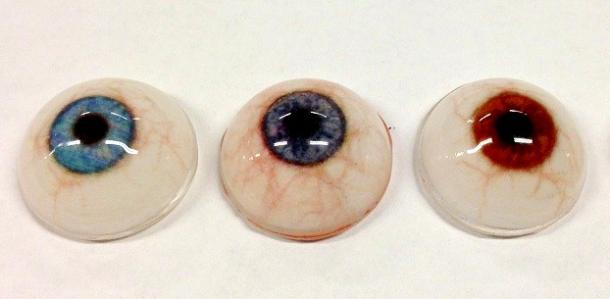
3D_eyesNext up, there’s the exciting news that 3D printing may be able to fabricate another type of prosthetic that has been missing from its catalog so far – prosthetic replacement eyes. Traditionally, glass eyes are time consuming to produce and can cost a person who has lost one (due to accident or illness) a pretty penny. However, UK-based Fripp Design, in collaboration with Manchester Metropolitan University, has developed a new process that offers greater affordability and production.

Compared to the hand-crafted and meticulously painted eyes, which are made to order, this version of replacement eyes are much cheaper and far less time-consuming to produce. And unlike traditional versions that are made from special glass or acrylic, these ones are printed in full color on a Spectrum Z-Corp 510 (a professional industrial printer) and then encased in resin. Each has a slightly different hue, allowing for matching with existing eyes, as well as a network of veins.

3D_nose_earWhile prosthetic eyes can cost as much as much as 3000 pounds ($4,880) and take up to 10 weeks to make and receive after ordering, Fripp Design’s method can print 150 units in a single hour. However, finishing them is much slower because iris customization remains a time-consuming job. As Fripp Design founder Tom Fripp said in a recent interview with Dezeen:

The 3D-printed prosthetic eyes may be ready for market within a year and could be especially popular in developing countries. In addition to eyes, Fripp Design is known for its 3D printed replacement noses, ears, and skin patches; all of the replacement parts that are in high-demand  but have previously been expensive and difficult to produce. But thanks to 3D printing, the coming years will see people who have been forced to live with disfigurements or disabilities living far more happy, healthy lives.

Click on the following links to see more of BigRep‘s design catalog, as well as Fripp Design‘s applications for skin and soft tissue replacements. And be sure to check out this video of the BigRep One demonstration at the 3D PrintShow in New York:


Sources:
cnet.com, cnet.com.au, bigrep.com, frippdesign.co.uk