Tech News: Google Seeking “Conscious Homes”

nest_therm1In Google’s drive for world supremacy, a good number of start-ups and developers have been bought up. Between their acquisition of eight robotics companies in the space of sixth months back in 2013 to their ongoing  buyout of anyone in the business of aerospace, voice and facial recognition, and artificial intelligence, Google seems determined to have a controlling interest in all fields of innovation.

And in what is their second-largest acquisition to date, Google announced earlier this month that they intend get in on the business of smart homes. The company in question is known as Nest Labs, a home automation company that was founded by former Apple engineers Tony Fadell and Matt Rogers in 2010 and is behind the creation of The Learning Thermostat and the Protect smoke and carbon monoxide detector.

nest-thermostatThe Learning Thermostat, the company’s flagship product, works by learning a home’s heating and cooling preferences over time, removing the need for manual adjustments or programming. Wi-Fi networking and a series of apps also let users control and monitor the unit Nest from afar, consistent with one of the biggest tenets of smart home technology, which is connectivity.

Similarly, the Nest Protect, a combination smoke and carbon monoxide detector, works by differentiating between burnt toast and real fires. Whenever it detects smoke, one alarm goes off, which can be quieted by simply waving your hand in front of it. But in a real fire, or where deadly carbon monoxide is detected, a much louder alarm sounds to alert its owners.

nest_smoke_detector_(1_of_9)_1_610x407In addition, the device sends a daily battery status report to the Nest mobile app, which is the same one that controls the thermostats, and is capable of connecting with other units in the home. And, since Nest is building a platform for all its devices, if a Nest thermostat is installed in the same home, the Protect and automatically shut it down in the event that carbon monoxide is detected.

According to a statement released by co-f0under Tony Fadell, Nest will continue to be run in-house, but will be partnered with Google in their drive to create a conscious home. On his blog, Fadell explained his company’s decision to join forces with the tech giant:

Google will help us fully realize our vision of the conscious home and allow us to change the world faster than we ever could if we continued to go it alone. We’ve had great momentum, but this is a rocket ship. Google has the business resources, global scale, and platform reach to accelerate Nest growth across hardware, software, and services for the home globally.

smarthomeYes, and I’m guessing that the $3.2 billion price tag added a little push as well! Needless to say, some wondered why Apple didn’t try to snatch up this burgeoning company, seeing as how its being run by two of its former employees. But according to Fadell, Google founder Sergey Brin “instantly got what we were doing and so did the rest of the Google team” when they got a Nest demo at the 2011 TED conference.

In a press release, Google CEO Larry Page had this to say about bringing Nest into their fold:

They’re already delivering amazing products you can buy right now – thermostats that save energy and smoke/[carbon monoxide] alarms that can help keep your family safe. We are excited to bring great experiences to more homes in more countries and fulfill their dreams!

machine_learningBut according to some, this latest act by Google goes way beyond wanting to develop devices. Sara Watson at Harvard University’s Berkman Center for Internet and Society is one such person, who believes Google is now a company obsessed with viewing everyday activities as “information problems” to be solved by machine learning and algorithms.

Consider Google’s fleet of self-driving vehicles as an example, not to mention their many forays into smartphone and deep learning technology. The home is no different, and a Google-enabled smart home of the future, using a platform such as the Google Now app – which already gathers data on users’ travel habits – could adapt energy usage to your life in even more sophisticated ways.

Larry_PageSeen in these terms, Google’s long terms plans of being at the forefront of the new technological paradigm  – where smart technology knows and anticipates and everything is at our fingertips – certainly becomes more clear. I imagine that their next goal will be to facilitate the creation of household AIs, machine minds that monitor everything within our household, provide maintenance, and ensure energy efficiency.

However, another theory has it that this is in keeping with Google’s push into robotics, led by the former head of Android, Andy Rubin. According to Alexis C. Madrigal of the Atlantic, Nest always thought of itself as a robotics company, as evidence by the fact that their VP of technology is none other than Yoky Matsuoka – a roboticist and artificial intelligence expert from the University of Washington.

yokymatsuoka1During an interview with Madrigal back in 2012, she explained why this was. Apparently, Matsuoka saw Nest as being positioned right in a place where it could help machine and human intelligence work together:

The intersection of neuroscience and robotics is about how the human brain learns to do things and how machine learning comes in to augment that.

In short, Nest is a cryptorobotics company that deals in sensing, automation, and control. It may not make a personable, humanoid robot, but it is producing machine intelligences that can do things in the physical world. Seen in this respect, the acquisition was not so much part of Google’s drive to possess all our personal information, but a mere step along the way towards the creation of a working artificial intelligence.

It’s a Brave New World, and it seems that people like Musk, Page, and a slew of futurists that are determined to make it happen, are at the center of it.

Sources: cnet.news.com, (2), newscientist.com, nest.com, theatlantic.com
The Future is Here: 3-D Printed Eye Cells

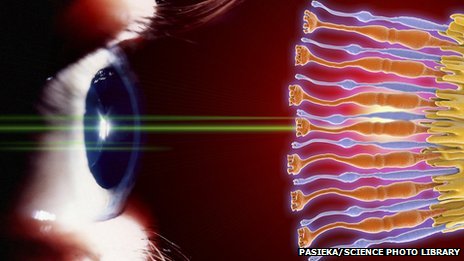
printed_eyecells3In the past few years, medical researchers have been able to replicate real, living tissues samples using 3-D printing technology – ranging from replacement ears and printed cartilage to miniature kidneys and even liver cells. Well now, thanks to a team of researchers from the University of Cambridge, eye cells have been added to that list.

Using a standard ink-jet printer to form layers of two types of cells,  the research team managed to print two types of central nervous system cells from the retinas of adult rats – ganglion cells (which transmit information from the eye to the brain), and glial cells (which provide protection and support for neurons). The resulting cells were able to grow normally and remain healthy in culture.

printed_eyecells2Ink-jet printing has been used to deposit cells before, but this is the first time cells from an adult animal’s central nervous system have been printed. The research team published its research in the IOP Publishing’s open-access journal Biofabrication and plans to extend this study to print other cells of the retina and light-sensitive photoreceptors.

In the report, Keith Martin and Barbara Lorber – the co-authors of the paper who work at the John van Geest Centre for Brain Repair at the University of Cambridge – explained the experiment in detail:

Our study has shown, for the first time, that cells derived from the mature central nervous system, the eye, can be printed using a piezoelectric inkjet printer. Although our results are preliminary and much more work is still required, the aim is to develop this technology for use in retinal repair in the future.

printed_eyecellsThis is especially good news for people with impaired visual acuity, or those who fear losing their sight, as it could lead to new therapies for retinal disorders such as blindness and macular degeneration. Naturally, more tests are needed before human trials can begin. But the research and its conclusions are quite reassuring that eye cells can not only be produced synthetically, but will remain healthy after they are produced.

Clara Eaglen, a spokesperson for the Royal National Institute of Blind People (RNIB), had this to say about the breakthrough:

The key to this research, once the technology has moved on, will be how much useful vision is restored. Even a small bit of sight can make a real difference, for some people it could be the difference between leaving the house on their own or not. It could help boost people’s confidence and in turn their independence.

printed_eyecells1Combined with bionic eyes that are now approved for distribution in the US, and stem cell treatments that have restores sight in mice, this could be the beginning of the end of blindness. And with all the strides being made in bioprinting and biofabrication, it could also be another step on the long road to replacement organs and print-on-demand body parts.

Sources: news.cnet.com, singularityhub.com, cam.ca.uk, bbc.co.uk

The Future is Weird: Cyborg Sperm!

cyborg_sperm1Finding ways to merge the biological and the technological, thus creating the best of both worlds, is one of the hallmarks of our new age. Already, we have seen how bionic appendages that connect and calibrate to people’s nerve signals can restore mobility and sensation to injured patients. And EEG devices that can read and interpret brainwaves are allowing man-machine interface like never before.

But cyborg sperm? That is something that might require an explanation. You see, sperm cells have an awesome swimming ability. And wanting to take advantage of this, Oliver Schmidt and a team researchers at the Institute for Integrative Nanosciences in Dresden, Germany, combined individual sperm cells with tiny magnetic metal tubes to create the first sperm-based biobots.

Cyborg_Sperm3This means we now have a way to control a cell’s direction inside the body, a breakthrough that could lead to efficient microscopic robots – one which are not entirely mechanical. To make the “biohybrid micro-robot,” Schmidt and his colleagues captured and trapped bull sperm inside magnetic microtubes, leaving the tail outside.

To create the spermbots, the team made microtubes 50 microns long, by 5 to 8 microns in diameter from iron and titanium nanoparticles. They added the tubes to a fluid containing thawed bull sperm. Because one end of each tube was slightly narrower than the other, sperm that swam into the wider end become trapped, headfirst, with their flagella still free.

cyborg_sperm2With mobility taken care of, the team moved on to the matter of how to control and direct the microtubes. For this, they chose to rely on a system of external magnetic fields which work the same way as a compass needle does, by aligning with the Earth’s magnetic field. This enabled the team to control the direction in which the sperm swam, adjusting their speed through the application of heat.

According to the researchers, the option of using sperm as the basis for a biohybrid micro-robot is attractive because they are harmless to the human body, they provide their own power, and they can swim through viscous liquids – such as blood and other bodily fluids. As the researchers said in their paper:

The combination of a biological power source and a microdevice is a compelling approach to the development of new microrobotic devices with fascinating future application.

cyborg_spermGranted, the idea of cybernetic sperm swimming through our systems might not seem too appealing. But think of the benefits for fertility treatments and inter-uteran health. In the future, tiny biohybrid robots like these could be used to shepherd individual sperm to eggs, making for more effective artificial insemination. They could also  deliver targeted doses of drugs to uteran tissue that is either infected or cancerous.

And if nothing else, it helps to demonstrate the leaps and bounds that are being made in the field of  biotechnology and nanotechnology of late. At its current rate of development, we could be seeing advanced medimachines and DNA-based nanobots becoming a part of regular medical procedures in just a few years time.

And while we’re waiting, check out this video of the “cyborg sperm” in action, courtesy of New Scientist:


Sources:
IO9, newscientist.com

The Future of Currency: Bitcoin Hitting the Streets

bitcoinFor those familiar with digital currencies, the name Bitcoin ought to ring a bell. Developed back in 2009, this “cryptocurrency” – i.e. it uses cryptography to control the creation and transfer of money – was created as a form of online payment for products and services. Since that time, it has become the subject of scrutiny, legislative bans, volatile pricing, and a hailed as a hardinger of the coming age of “distributed currency”.

Unlike precious metals or more traditional forms of currency, which hold value because they are backed by a country or are used to manufacture goods, Bitcoin is only buoyed by market demand. There are only 12.3 million virtual Bitcoins in circulation and those “coins” are traded through a Peer-to-Peer computer network, much as people used to share music files.

bitcoin1What’s especially interesting is the fact that the creator of this new form of currency remains unknown. It is assumed that it originated with a programer from Japan, due to the fact that its first mention came in a 2008 paper published under the pseudonym “Satoshi Nakamoto”. It became operational roughly a year later with the release of the first open source Bitcoin client and the issuance of the first physical bitcoin.

And in an interesting and personally-relevant development, it now seems that a Bitcoin ATM is coming to my old hometown of Ottawa. In this respect, the nation’s capitol is joining other major cities around the globe as municipalities that dispense the crypto currency, in spite of the fact that it is still not recognized by any national banking institutions, or financial regulating bodies.

future_money_bitcoinWhat’s more, the publicly-traded cryptocurrency has seen its stock go through repeated highs and lows over the past few years, being subject to both bubbles and price drops as countries like India and China prohibited its use. But with these machines hitting the streets, a trend which began back in November with the distribution of Robocoin ATMs, there is speculation that the digital currency might just be here to stay.

Part of the appeal of cryptocurrencies is that they allow for anonymity, hence why bitcoin has been linked to a number of illegal activities, such as on the shuttered drug marketplace Silk Road. And because its value is strictly tied to speculators, and not backed by any tangible measure or authority, speculators are able to ratchet up demand and push the stock value higher.

future_money2But Bitcoin is also starting to be accepted as a mainstream form of payment for U.S.-centric sites like OkCupid and WordPress. And back in October of 2013, China’s web giant Baidu accounced that it would start accepting Bitcoin payments for a firewall security service it sells. And though the Chinese government put the brakes on Bitcoin exchanges by December, the number of mainstream institutions opening up its coffers to it is growing.

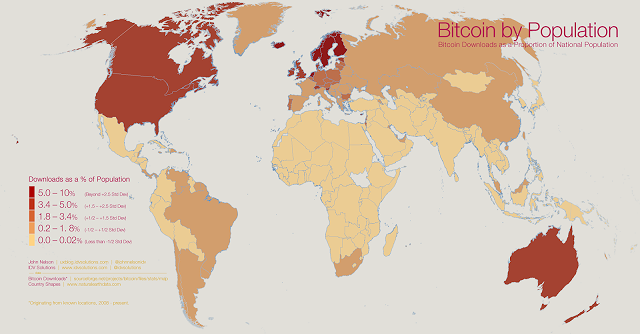
These include Richard Branson’s private space tourism company Virgin Galactic, the Sacramento Kings, the e-commerce giant Paypal, and Overstock.com, a major online retailer. And popular use is also growing, as evidenced by the visualization below which shows downloads of bitcoin client software since 2008, broken down by different operating systems.

bitcoin_globalWhat the graphic shows is quite indicative. All over the world, particularly in developed countries and areas of economic growth – the Eastern US, Europe, Brazil, Argentina, Russia, Sub-Saharan Africa, India, China, Australia and Southeast Asia – the Bitcoin software is being downloaded and used to oversee online exchanges in good and services.

And ultimately, those who believe in the service and choose to invest in it are doing so based on the promise that it will someday streamline monetary transactions and free the world from the financial manipulation of big government and big banks, breakdown the financial walls between nations, and remake the worldwide economy. In short, it will breakdown centralized economies and allow a “distributed economy” to takes its place.

bitcoin_popmapAdmittedly, the service is still flawed in a number of respects. For example, people who chose to collect bitcoins in the past were dissuaded from spending them since their value kept going up. The problem is, if economic incentives encourage people to hoard their bitcoins rather than spend them, the currency will never fulfill its role as the future of money.

Another problem is the one arising from the currency’s “deflationary nature”. Because the system was designed to allow the creation of only a finite number of bitcoins, there will come a point where, as demand rises, the value of the currency will only go up (making the price of goods and services fall, hence the term deflation). And that could lead to hoarding on an even larger scale.

bitcoin-atm-flagshipBut according to many economists who have closely followed the progress of the digital money, Bitcoin’s recent ups and downs are to be expected from a currency so young, and one that is just now attracting major attention from the mainstream population. The bottom could fall out of the market, but the currency could just as easily stabilize and reach a point where its value is consistent enough that people no longer hoard the stuff.

So at this point, its difficult to say what the future will hold for the new miracle money known as Bitcoin. But when it comes to cryptocurrencies in general, time seems to be on their side. Ever since the Internet Revolution took off, the possibilities for creating a new, de-centralized world order – research, development, politics and business are open and inclusive in ways like never before – has been emerging.

Sources: ottawacitizen.com, wired.com, fastcoexist.com, bbc.co.uk, uxblog.idvsolutions.com
News From Space: Luna Rings and Spidersuits!

space_cameraSpace is becoming a very interesting place, thanks to numerous innovations that are looking ahead to the next great leap in exploration. With the Moon and Mars firmly fixed as the intended targets for future manned missions, everything from proposed settlements and construction projects are being plotted, and the requisite tools are being fashioned.

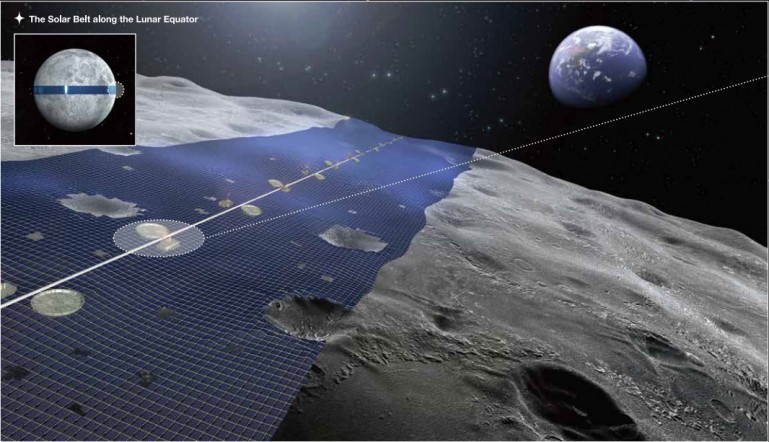
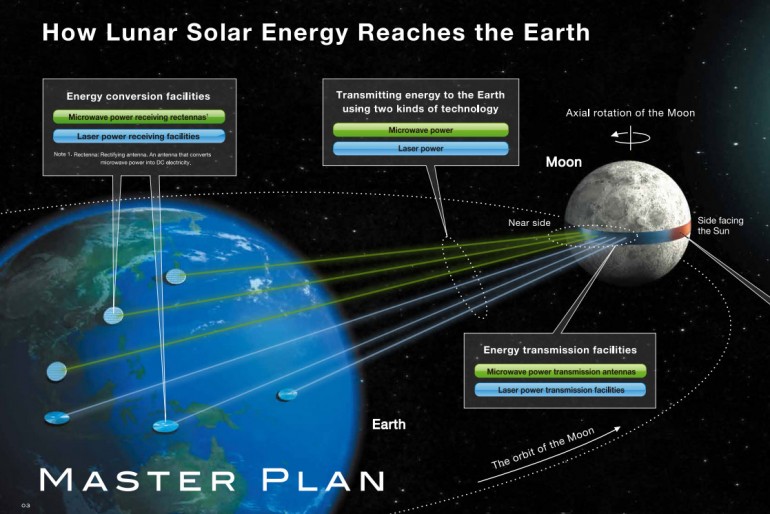
For instance, the Shimizu Corporation (the designers of the Shimizu Mega-City Pyramid), a Japanese construction firm, has proposed a radical idea for bringing solar energy to the world. Taking the concept of space-based solar power a step further, Shimizu has proposed the creation of a “Luna Ring” – an array of solar cells around the Moon’s 11000 km (6800 mile) equator to harvest solar energy and beam it back to Earth.

lunaringThe plan involves using materials derived from lunar soil itself, and then using them to build an array that will measure some 400 km (250 miles) thick. Since the Moon’s equator receives a steady amount of exposure to the Sun, the photovoltaic ring would be able to generate a continuous amount of electricity, which it would then beam down to Earth from the near side of the Moon.

It’s an ambitious idea that calls for assembling machinery transported from Earth and using tele-operated robots to do the actual construction on the Moon’s surface, once it all arrives. The project would involve multiple phases, to be spread out over a period of about thirty years, and which relies on multiple strategies to make it happen.

lunaring-1For example, the firm claims that water – a necessary prerequisite for construction – could be produced by reducing lunar soil with hydrogen imported from Earth. The company also proposes extracting local regolith to fashion “lunar concrete”, and utilizing solar-heat treatment processes to fashion it into bricks, ceramics, and glass fibers.

The remotely-controlled robots would also be responsible for other construction tasks, such as excavating the surrounding landscape, leveling the ground, laying out solar panel-studded concrete, and laying embedded cables that would run from the ring to a series of transmission stations located on the Earth-facing side of the Moon.

space-based-solarpowerPower could be beamed to the Earth through microwave power transmission antennas, about 20 m (65 ft) in diameter, and a series of high density lasers, both of which would be guided by radio beacons. Microwave power receiving antennas on Earth, located offshore or in areas with little cloud cover, could convert the received microwave power into DC electricity and send it to where it was needed.

The company claims that it’s system could beam up to 13,000 terawatts of power around-the-clock, which is roughly two-thirds of what is used by the world on average per year. With such an array looming in space, and a few satellites circling the planet to pick up the slack, Earth’s energy needs could be met for the foreseable future, and all without a single drop of oil or brick of coal.

The proposed timeline has actual construction beginning as soon as 2035.

biosuitAnd naturally, when manned missions are again mounted into space, the crews will need the proper equipment to live, thrive and survive. And since much of the space suit technology is several decades old, space agencies and private companies are partnering to find new and innovative gear with which to equip the men and women who will brave the dangers of space and planetary exploration.

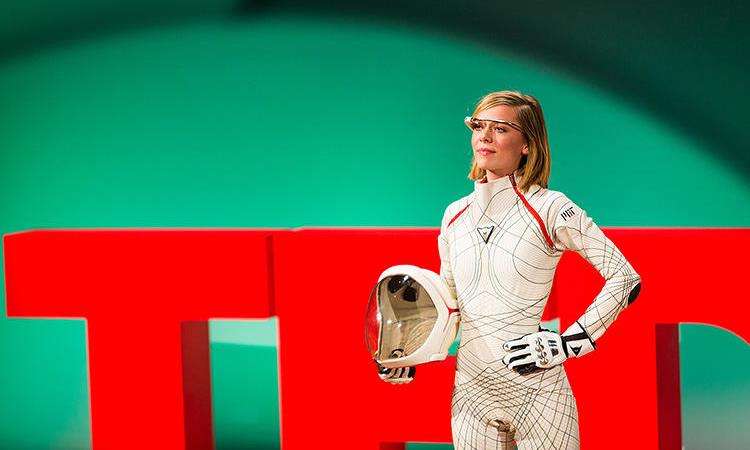
Consider the Biosuit, which is a prime example of a next-generation technology designed to tackle the challenges of manned missions to Mars. Created by Dava Newman, an MIT aerospace engineering professor, this Spiderman-like suit is a sleeker, lighter alternative to the standard EVA suits that weigh approximately 135 kilograms (300 pounds).

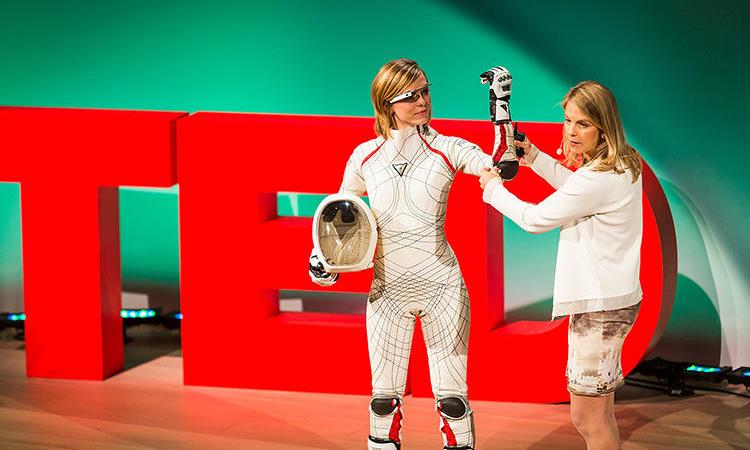
biosuit_dava_newmanFor over a decade now, Newman has been working on a suit that is specifically designed for Mars exploration. At this year’s TEDWomen event in San Francisco, she showcased her concept and demonstrated how its ergonomic design will allow astronauts to explore the difficult terrain of the Red Planet without tripping over the bulk they carry with the current EVA suits.

The reason the suit is sleek is because it’s pressurized close to the skin, which is possible thanks to tension lines in the suit. These are coincidentally what give it it’s Spiderman-like appearance, contributing to its aesthetic appeal as well. These lines are specifically designed to flex as the astronauts ends their arms or knees, thus replacing hard panels with soft, tensile fabric.

biosuit1Active materials, such as nickel-titanium shape-memory alloys, allow the nylon and spandex suit to be shrink-wrapped around the skin even tighter. This is especially important, in that it gets closer Newman to her goal of designing a suit that can contain 30% of the atmosphere’s pressure – the level necessary to keep someone alive in space.

Another benefit of the BioSuit is its resiliency. If it gets punctured, an astronaut can fix it with a new type of space-grade Ace Bandage. And perhaps most importantly, traditional suits can only be fitted to people 5′ 5″ and taller, essentially eliminating short women and men from the astronaut program. The BioSuit, on the other hand, can be built for smaller people, making things more inclusive in the future.

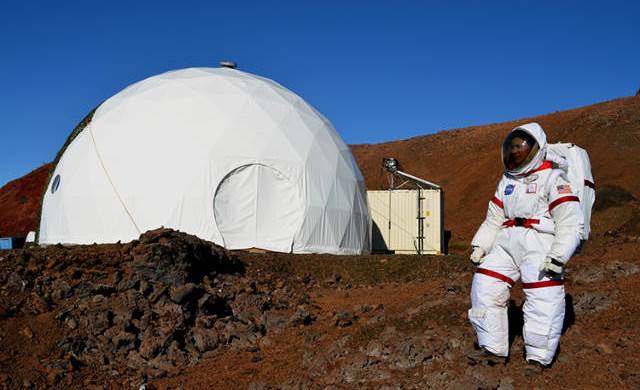
Mars_simulationNewman is designing the suit for space, but she also has some Earth-bound uses in mind . Thanks to evidence that showcases the benefits of compression to the muscles and cardiovascular system, the technology behind the Biosuit could be used to increase athletic performance or even help boost mobility for people with cerebral palsy. As Newman herself put it:

We’ll probably send a dozen or so people to Mars in my lifetime. I hope I see it. But imagine if we could help kids with CP just move around a little bit better.

With proper funding, Newman believes she could complete the suit design in two to three years. It would be a boon to NASA, as it appears to be significantly cheaper to make than traditional spacesuits. Funding isn’t in place yet, but Newman still hopeful that the BioSuit will be ready for the first human mission to Mars, which are slated for sometime in 2030.

In the meantime, enjoy this video of the TEDWomen talk featuring Newman and her Biosuit demonstration:

Sources: gizmag, fastcoexist, blog.ted

The Future of Smart Living: Smart Homes

Future-Home-Design-Dupli-CasaAt this year’s Consumer Electronics Show, one of the tech trends to watch was the concept of the Smart Home. Yes, in addition to 4K televisions, curved OLEDs, smart car technology and wearables, a new breed of in-home technology that extends far beyond the living room made some serious waves. And after numerous displays and presentations, it seems that future homes will involve connectivity and seamless automation.

To be fair, some smart home devices – such as connected light bulbs and thinking thermostats – have made their way into homes already. But by the end of 2014, a dizzying array of home devices are expected to appear, communicating across the Internet and your home network from every room in the house. It’s like the internet of things meets modern living, creating solutions that are right at your fingertips (via your smartphone)

smarthomeBut in many ways, the companies on the vanguard of this movement are still working on drawing the map and several questions still loom. For example, how will your connected refrigerator and your connected light bulbs talk to each other? Should the interface for the connected home always be the cell phone, or some other wirelessly connect device.

Such was the topic of debate at this year’s CES Smart Home Panel. The panel featured GE Home & Business Solutions Manager John Ouseph; Nest co-founder and VP of Engineering Matt Rogers; Revolv co-founder and Head of Marketing Mike Soucie; Philips’ Head of Technology, Connected Lighting George Yianni; Belkin Director of Product Management Ohad Zeira, and CNET Executive Editor Rich Brown.

samsunglumenSpecific technologies that were showcased this year that combined connectivity and smart living included the Samsung Lumen Smart Home Control Panel. This device is basically a way to control all the devices in your home, including the lighting, climate control, and sound and entertainment systems. It also networks with all your wireless devices (especially if their made by Samsung!) to run your home even when your not inside it.

Ultimately, Samsung hopes to release a souped-up version of this technology that can be integrated to any device in the home. Basically, it would be connected to everything from the washer and dryer to the refrigerator and even household robots, letting you know when the dishes are done, the clothes need to be flipped, the best before dates are about to expire, and the last time you house was vacuumed.


As already noted, intrinsic to the Smart Home concept is the idea of integration to smartphones and other devices. Hence, Samsung was sure to develop a Smart Home app that would allow people to connect to all the smart devices via WiFi, even when out of the home. For example, people who forget to turn off the lights and the appliances can do so even from the road or the office.

These features can be activated by voice, and several systems can be controlled at once through specific commands (i.e. “going to bed” turns the lights off and the temperature down). Cameras also monitor the home and give the user the ability to survey other rooms in the house, keeping a remote eye on things while away or in another room. And users can even answer the phone when in another room.

Check out the video of the Smart Home demonstration below:


Other companies made presentations as well. For instance, LG previewed their own software that would allow people to connect and communicate with their home. It’s known as HomeChat, an app based on Natural Language Processing (NLP) that lets users send texts to their compatible LG appliances. It works on Android, BlackBerry, iOS, Nokia Asha, and Windows Phone devices as well as OS X and Windows computers.

This represents a big improvement over last year’s Smart ThinQ, a set of similar application that were debuted at CES 2013. According to many tech reviewers, the biggest problem with these particular apps was the fact that each one was developed for a specific appliance. Not so with the HomeChat, which allows for wireless control over every integrated device in the home.

LGHomeChatAura, a re-imagined alarm clock that monitors your sleep patterns to promote rest and well-being. Unlike previous sleep monitoring devices, which monitor sleep but do not intervene to improve it, the Aura is fitted a mattress sensor that monitors your movements in the night, as well as a series of multi-colored LED light that “hack” your circadian rhythms.

In the morning, its light glows blue like daytime light, signaling you to wake up when it’s optimal, based upon your stirrings. At night, the LED glows orange and red like a sunset and turn itself off when you fall asleep. The designers hopes that this mix of cool and warm light can fill in where the seasons fall short, and coax your body into restful homeostasis.

aura_nightlightMeanwhile, the Aura will send your nightly sleep report to the cloud via Wi-Fi, and you can check in on your own rest via the accompanying smartphone app. The entire body is also touch-sensitive, its core LED – which are generally bright and piercing – is cleverly projected into an open air orb, diffusing the light while evoking the shape of the sun. And to deactivate the alarm, people need only trigger the sensor by getting out of bed.

Then there was Mother, a robotic wellness monitor produced by French inventor Rafi Haladjian. This small, Russian-doll shaped device is basically an internet base station with four sensors packs that track 15 different parts of your life. It is small enough to fit in your pocket to track your steps, affix to your door to act as a security alarm, and stick to your coffee maker to track how much you’re drinking and when you need more beans.

mother_robotAnd though the name may sound silly or tongue-in-cheek, it is central to Haladjian’s vision of what the “Internet of things” holds for us. More and more, smart and sensor-laden devices are manifesting as wellness accessories, ranging from fitness bands to wireless BP and heart rate monitors. But the problem is, all of these devices require their own app to operate. And the proliferation of devices is leading to a whole lot of digital clutter.

As Haladjian said in a recent interview with Co.Design:

Lots of things that were manageable when the number of smart devices was scarce, become unbearable when you push the limit past 10. You won’t be willing to change 50 batteries every couple of weeks. You won’t be willing to push the sync button every day. And you can’t bear to have 50 devices sending you notifications when something happens to them!

keekerAnd last, but not least, there was the Keecker – a robotic video projector that may just be the future of video entertainment. Not only is this robot able to wheel around the house like a Roomba, it can also sync with smartphones and display anything on your smart devices – from email, to photos, to videos. And it got a battery charge that lasts a week, so no cords are needed.

Designed by Pierre Lebeau, a former product manager at Google, the robot is programmed to follow its human owner from room to room like a little butler (via the smartphone app). It’s purpose is to create an immersive media environment by freeing the screen from its fixed spots and projecting them wherever their is enough surface space.


In this respect, its not unlike the Omnitouch or other projection smartscreens, which utilizes projectors and motion capture technology to allow people to turn any surface into a screen. The design even includes features found in other smart home devices – like the Nest smoke detector or the Spotter – which allow for the measuring of a home’s CO2 levels and temperature, or alerting users to unusual activity when they aren’t home.

Lebeau and his company will soon launching a Kickstarter campaign in order to finance bringing the technology to the open market. And though it has yet to launch, the cost of the robot is expected to be between $4000 and $5000.

Sources: cnet.com, (2), (3), (4), fastcodesign, (2), (3), (4)

News from Space: Full Model of Exoplanet Created

gliese_581gEver since the Kepler space probe began finding hard evidence of the existence of exoplanets – i.e. planets orbiting suns outside of our Solar System – scientists have been working hard to determine what conditions on these worlds must be like. For instance, it is known that planets that orbit closely to their red dwarf parent suns are tidally locked – meaning they do not rotate on their axis.

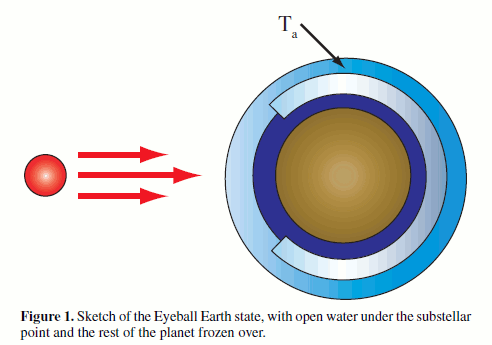
This, in turn, has led to the proposal that any watery worlds in the vicinity could form what’s called an “Eyeball Earth.” Being directly under the local star, with one side perpetually facing towards it, the light would be intense enough to melt a circular patch of water, while the rest of the planet would remain locked in a deep freeze. In short, not an ideal situation for supporting life.

eyeball_earthHowever, a new three-dimensional model has been created, thanks to the efforts of two researchers at Peking University. In their research paper, they suggest that ice and oceans on these planets would be dynamic, which is both good and bad. Basically, it means an Eyeball Earth has a narrower habitable zone, but that more of the surface has the potential to support life. It also means that the “eyeball” looks more like a lobster!

This paper represents the next step in scientific analysis of exoplanets. Initially, estimates of habitability – i.e. temperatures that could allow liquid water on the planet surface – were based on a single analysis of the planet’s atmosphere to see how much light reaches the surface. But, in the real world, atmospheres form clouds, distribute heat through winds and convection, and exhibit other sorts of complex behavior.

eyeball_earthThese are the sorts of things that are handled in the full, three-dimensional climate models built to study the Earth. Hence, the Peking research team adapted these same models to handle exoplanets that differed significantly from Earth. But these models didn’t capture a critical part of the distribution of heat on the Earth: the ocean circulation. Instead, it treated the entire ocean as a two-dimensional slab.

The new study corrects for that by using a coupled ocean-atmosphere climate model, the Community Climate System Model version 3. For their study, they used Gliese 581 g, a potentially Earth-like planet orbiting in the habitable zone of an red dwarf star 20 light years away. This planet, coincidentally, is ranked by NASA as being the most Earth-like exoplanet yet seen in the known universe.

Gliese_581_-_2010Critically for the model, it’s close enough to its host star to receive 866 Watts/square meter at the top of its atmosphere (whereas the Earth receives 1,366). Since it is not yet known what Gliese 581 g’s atmosphere looks like, the authors assumed an Earth-like composition, but varied the amount of CO2 to change the intensity of the greenhouse effect. From all this, the planet was assumed to be covered in a deep ocean.

After giving the model 1,100 years to come to equilibrium, the authors sampled a century of its climate. With carbon dioxide concentrations similar to the Earth’s (330 parts per million in the model), the “eyeball” vanished. That’s because ocean currents formed along the equator and brought in ice from the west that split the eyeball into two lobes that flanked the equator – which resemble the claws of the lobster.

eyeball_earth1The currents then transferred heat to the eastern portion of the planet, which melted the ice to form the lobster’s tail. In addition to the ocean current that altered ice distribution, an underwater circulation (similar to the one on Earth) formed, which sent warmer water toward the poles. In the atmosphere, a jet stream also formed over the equator, which also distributed some heat to the unlit side of the planet.

Ultimately, the new model suggests the habitable zone of watery planets near red dwarfs is a bit more narrow than previous studies had suggested. The good news is that, in this model, the ice never got more than 3m thick on the dayside of the planet. That’s thin enough to allow light to reach the water underneath, meaning photosynthesis is a possibility over the entire dayside of the planet.

OceanPlanetAlthough this model is a major improvement, it still lacks a key feature that’s likely to exist on planets – namely continents, or at least features on the seafloor that differ greatly in height. These will radically alter the currents on the planet, and thus radically alter the distribution of heat within the ocean. Unfortunately, this information is even harder to come by at present than atmospheric conditions.

So for the time being, all we really know about Gliese 581 g and other similar exoplanets is that their surfaces are icy, but habitable – not unlike the Jovian moon Europa. However, that is not to say that we won’t have more information in the near future. With Kepler still in operation and the Gaia space observatory now in space, we might be able to construct more detailed models of nearby exoplanets in the near future.

Also a coincidence, Gliese 581 g just happens to be the setting of my writers group’s upcoming anthology, known as Yuva. And with this latest bit of info under our belts (basically, that the entire planet is a big, watery ball), I imagine we’ll have to adjust our stories somewhat!

Source: arstechnica.com

The Future is Here: 3-D Printed Brain Scanner

openbciWhen it comes to cutting-edge technology in recent years, two areas of development have been taking the world by storm. On the one hand, there’s 3-D printing (aka. Additive Manufacturing) that is revolutionizing the way we fabricate things. On the other, there’s brain-computer interfaces (BCI), which are giving people the power to control machines with their minds and even transfer their thoughts.

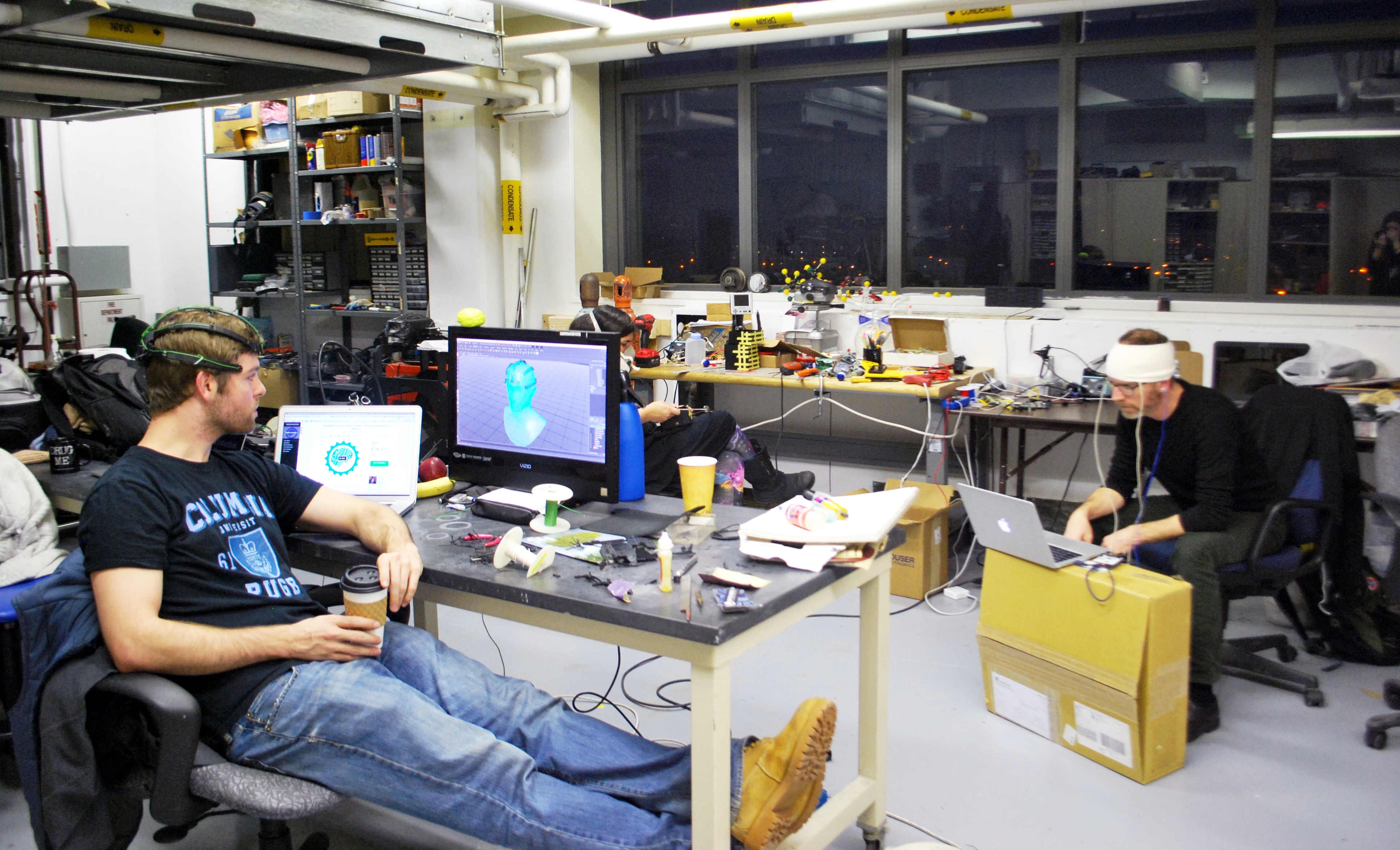
And now, two inventors – Conor Russomanno and Joel Murphy – are looking to marry the two worlds in order to create the first, open-source brain scanner that people can print off at home. Thanks to funding from DARPA, the two men printed off their first prototype headset this past week. It’s known as the OpenBCI, and it’s likely to make brain scanning a hell of a lot more affordable in the near future.

openbci1It includes a mini-computer that plugs into sensors on a black, skull-grabbing piece of plastic called the “Spider Claw 3000,” which can be created with a 3-D printer. Assembled, it operates as a low-cost electroencephalography (EEG) brainwave scanner that connects to a PC, compared to  high-grade EEG machines used by laboratories and researchers that cost thousands of dollars.

But over the past few years, cheaper models have been made by companies like Emotiv, which have in turn allowed a new era of DIY brain hackers to conduct brainwaves experiments. Since that time, everything from games, computer interfaces, personal tracking tools, and self-directed mind enhancement have been available to regular people.

openbci2But Russomanno and Murphy felt the community needed a completely open-source platform if it was truly going to take off – hence the OpenBCI. The hardware to build the headset can be ordered from the company, while the software to run it is available through GitHub, a popular code sharing site. Once procured, people will have the ability to print off, program, and adjust their own personal brain scanning device.

According to Russomanno, the greatest asset of the headset (aside from the price) is the freedom it gives to brain hackers to put their EEG probes anywhere they like:

You don’t want to limit yourself to looking to just a few places on the scalp. You can target up to 64 locations on the scalp with a maximum of 16 electrodes at a time.

As it stands, Russomanno and Murphy have built the prototype headset, but still need to raise money to build the mini-computer that it plugs into. To accomplish this, the two inventors launched a Kickstarter project to fund the development of the Arduino-compatible hardware. Last week, they reached their goal of $100,000, and expect to ship their first systems in March.

openbci3The current design of the hardware, which looks more like a hexagonly-shaped circuit board than a computer, is their third incarnation. In addition to being smaller and Adruino-compatible, the third version is also programmable via Bluetooth and has a port for an SD card. When the hardware starts shipping, Russomanno expects it to kick off a new round of experimentation:

We’ve got about 300 people that have already donated to receive the board. If you’re willing to spend $300 for a piece of technology, you’re definitely going to build something with it.

One of the hallmarks of technological revolutions is the ability to make the technology scalable and more affordable. In this way, its benefits (aka. returns) are able to multiply and expand. And with the help of open-source devices like these that people can create on 3-D printers (which are also dropping in prices) the returns on mind-controlled devices are likely to grow exponentially in the coming years.

In short, the age of mind-controlled machinery may be just around the corner. Good to know they will be obeying us and not the other way around!


Sources:
wired.com, kickstarter.com

New GOT Trailer – Season Four, Part II

GOT_4posterAt long last, after many months of waiting, fans of HBO’s Game of Thrones have finally been treated to the first teaser trailer for the second half of season four! And as you can see, the series producers decided to give the fans just enough to whet their appetites, while not giving too much away. But of course, us A Song of Ice and Fire geeks could tell what’s in store, not that it helps much!

As the preview opens, we see King’s Landing with a dragon’s shadow passing over it (purely symbolic, don’t worry!). We also get Joffrey speaking to the newly returned Jaime about the progress of the war, which – after the events of last season’s Red Wedding – he is claiming victory in. And of course, we hear from Daenerys, who continues in her campaign to overthrow the slave cities of Essos and build an army to retake the Iron Throne.

And between all that, we get hints and previews of other threads and plots, all punctuated with plenty of voiceovers. These include the trial of Tyrion (won’t say for what); the arrival of Prince Oberyn (Pedro Pascal) and his duel with Ser Gregor Clegane (now played by Hafþór Júlíus Björnsson); and of course, Jon Snow rallying the Night’s Watch for the Wildlings’ much anticipated attack on the Wall.

The show premiers on April 6th, and if their previous records are any indication, this one is sure to be one of the highest rated premiers of all time! Enjoy the trailer…

Top Stories from CES 2014

CES2014_GooglePlus_BoxThe Consumer Electronics Show has been in full swing for two days now, and already the top spots for most impressive technology of the year has been selected. Granted, opinion is divided, and there are many top contenders, but between displays, gaming, smartphones, and personal devices, there’s been no shortage of technologies to choose from.

And having sifted through some news stories from the front lines, I have decided to compile a list of what I think the most impressive gadgets, displays and devices of this year’s show were. And as usual, they range from the innovative and creative, to the cool and futuristic, with some quirky and fun things holding up the middle. And here they are, in alphabetical order:

celestron_cosmosAs an astronomy enthusiast, and someone who enjoys hearing about new and innovative technologies, Celestron’s Cosmos 90GT WiFi Telescope was quite the story. Hoping to make astronomy more accessible to the masses, this new telescope is the first that can be controlled by an app over WiFi. Once paired, the system guides stargazers through the cosmos as directions flow from the app to the motorized scope base.

In terms of comuting, Lenovo chose to breathe some new life into the oft-declared dying industry of desktop PCs this year, thanks to the unveiling of their Horizon 2. Its 27-inch touchscreen can go fully horizontal, becoming both a gaming and media table. The large touch display has a novel pairing technique that lets you drop multiple smartphones directly onto the screen, as well as group, share, and edit photos from them.

Lenovo Horizon 2 Aura scanNext up is the latest set of display glasses to the world by storm, courtesy of the Epson Smart Glass project. Ever since Google Glass was unveiled in 2012, other electronics and IT companies have been racing to produce a similar product, one that can make heads-up display tech, WiFi connectivity, internet browsing, and augmented reality portable and wearable.

Epson was already moving in that direction back in 2011 when they released their BT100 augmented reality glasses. And now, with their Moverio BT200, they’ve clearly stepped up their game. In addition to being 60 percent lighter than the previous generation, the system has two parts – consisting of a pair of glasses and a control unit.

moverio-bt200-1The glasses feature a tiny LCD-based projection lens system and optical light guide which project digital content onto a transparent virtual display (960 x 540 resolution) and has a camera for video and stills capture, or AR marker detection. With the incorporation of third-party software, and taking advantage of the internal gyroscope and compass, a user can even create 360 degree panoramic environments.

At the other end, the handheld controller runs on Android 4.0, has a textured touchpad control surface, built-in Wi-Fi connectivity for video content streaming, and up to six hours of battery life.


The BT-200 smart glasses are currently being demonstrated at Epson’s CES booth, where visitors can experience a table-top virtual fighting game with AR characters, a medical imaging system that allows wearers to see through a person’s skin, and an AR assistance app to help perform unfamiliar tasks .

This year’s CES also featured a ridiculous amount of curved screens. Samsung seemed particularly proud of its garish, curved LCD TV’s, and even booked headliners like Mark Cuban and Michael Bay to promote them. In the latter case, this didn’t go so well. However, one curved screen device actually seemed appropriate – the LG G Flex 6-inch smartphone.

LG_G_GlexWhen it comes to massive curved screens, only one person can benefit from the sweet spot of the display – that focal point in the center where they feel enveloped. But in the case of the LG G Flex-6, the subtle bend in the screen allows for less light intrusion from the sides, and it distorts your own reflection just enough to obscure any distracting glare. Granted, its not exactly the flexible tech I was hoping to see, but its something!

In the world of gaming, two contributions made a rather big splash this year. These included the Playstation Now, a game streaming service just unveiled by Sony that lets gamers instantly play their games from a PS3, PS4, or PS Vita without downloading and always in the most updated version. Plus, it gives users the ability to rent titles they’re interested in, rather than buying the full copy.

maingear_sparkThen there was the Maingear Spark, a gaming desktop designed to run Valve’s gaming-centric SteamOS (and Windows) that measures just five inches square and weighs less than a pound. This is a big boon for gamers who usually have to deal gaming desktops that are bulky, heavy, and don’t fit well on an entertainment stand next to other gaming devices, an HD box, and anything else you might have there.

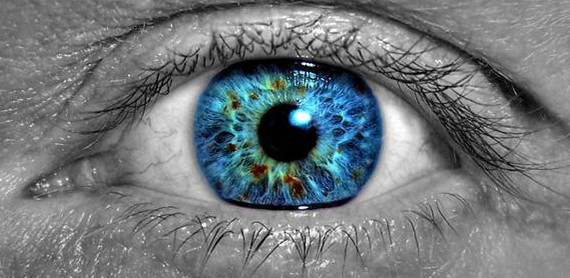
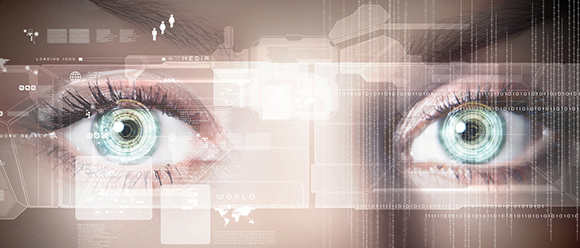
Next up, there is a device that helps consumers navigate the complex world of iris identification that is becoming all the rage. It’s known as the Myris Eyelock, a simple, straightforward gadget that takes a quick video of your eyeball, has you log in to your various accounts, and then automatically signs you in, without you ever having to type in your password.

myris_eyelockSo basically, you can utilize this new biometric ID system by having your retinal scan on your person wherever you go. And then, rather than go through the process of remembering multiple (and no doubt, complicated passwords, as identity theft is becoming increasingly problematic), you can upload a marker that leaves no doubt as to your identity. And at less than $300, it’s an affordable option, too.

And what would an electronics show be without showcasing a little drone technology? And the Parrot MiniDrone was this year’s crowd pleaser: a palm-sized, camera-equipped, remotely-piloted quad-rotor. However, this model has the added feature of two six-inch wheels, which affords it the ability to zip across floors, climb walls, and even move across ceilings! A truly versatile personal drone.


scanaduAnother very interesting display this year was the Scanadu Scout, the world’s first real-life tricorder. First unveiled back in May of 2013, the Scout represents the culmination of years of work by the NASA Ames Research Center to produce the world’s first, non-invasive medical scanner. And this year, they chose to showcase it at CES and let people test it out on themselves and each other.

All told, the Scanadu Scout can measure a person’s vital signs – including their heart rate, blood pressure, temperature – without ever touching them. All that’s needed is to place the scanner above your skin, wait a moment, and voila! Instant vitals. The sensor will begin a pilot program with 10,000 users this spring, the first key step toward FDA approval.

wowwee_mip_sg_4And of course, no CES would be complete without a toy robot or two. This year, it was the WowWee MiP (Mobile Inverted Pendulum) that put on a big show. Basically, it is an eight-inch bot that balances itself on dual wheels (like a Segway), is controllable by hand gestures, a Bluetooth-conncted phone, or can autonomously roll around.

Its sensitivity to commands and its ability to balance while zooming across the floor are super impressive. While on display, many were shown carrying a tray around (sometimes with another MiP on a tray). And, a real crowd pleaser, the MiP can even dance. Always got to throw in something for the retro 80’s crowd, the people who grew up with the SICO robot, Jinx, and other friendly automatons!

iOptikBut perhaps most impressive of all, at least in my humble opinion, is the display of the prototype for the iOptik AR Contact Lens. While most of the focus on high-tech eyewear has been focused on wearables like Google Glass of late, other developers have been steadily working towards display devices that are small enough to worse over your pupil.

Developed by the Washington-based company Innovega with support from DARPA, the iOptik is a heads-up display built into a set of contact lenses. And this year, the first fully-functioning prototypes are being showcased at CES. Acting as a micro-display, the glasses project a picture onto the contact lens, which works as a filter to separate the real-world from the digital environment and then interlaces them into the one image.

ioptik_contact_lenses-7Embedded in the contact lenses are micro-components that enable the user to focus on near-eye images. Light projected by the display (built into a set of glasses) passes through the center of the pupil and then works with the eye’s regular optics to focus the display on the retina, while light from the real-life environment reaches the retina via an outer filter.

This creates two separate images on the retina which are then superimposed to create one integrated image, or augmented reality. It also offers an alternative solution to traditional near-eye displays which create the illusion of an object in the distance so as not to hinder regular vision. At present, still requires clearance from the FDA before it becomes commercially available, which may come in late 2014 or early 2015.


Well, its certainly been an interesting year, once again, in the world of electronics, robotics, personal devices, and wearable technology. And it manages to capture the pace of change that is increasingly coming to characterize our lives. And according to the tech site Mashable, this year’s show was characterized by televisions with 4K pixel resolution, wearables, biometrics, the internet of personalized and data-driven things, and of course, 3-D printing and imaging.

And as always, there were plenty of videos showcasing tons of interesting concepts and devices that were featured this year. Here are a few that I managed to find and thought were worthy of passing on:

Internet of Things Highlights:


Motion Tech Highlights:


Wearable Tech Highlights:


Sources: popsci.com, (2), cesweb, mashable, (2), gizmag, (2), news.cnet