Editing is such a slow moving process, which is why I hate it so! As it’s not enough that you go through your initial draft and make all those pesky corrections, then you have to go over the whole thing and implement them. Then, assuming you haven’t made additional mistakes, you got to wait on beta readers to pick out anything you missed. Only then can you finally submit your work and wait for the kudos and criticisms from the reading public to come in.
At least, that’s the process when you’re working from a paper manuscript and doing most of it yourself. Were it not for the fact that this way is actually faster for me than scanning line after line of a doc file, I would have abandoned it a long time ago! And of course, its become a necessity since I can’t afford most editors rates. Oh, the slings and arrows of being an indie writer/teacher!
But alas, this post was supposed to be about good news. After finishing the edits on Papa Zulu‘s first draft – the sequel to my Whiskey Delta zombie-apocalypse novel – I am now half done implementing all the edits and rewrites I made there. The process has felt arduous, but I’m actually surprised by the progress. I seem to be able to get four to five chapters a day done, far better than my initial prediction of say, one!
And in case its not patently obvious, I am very anxious and impatient to get this done! I was so hoping to have this novel finished by the end of this past summer. Despite its initial success, Whiskey Delta has been accumulating dust over at Amazon and the reviews have ceased since the last few (which were all really good). So I am determined to get the ball rolling and figured the sequel would be the best way of doing that.
And of course, part of why this editing process is taking so long is that I am determined to get it right this time. Whiskey Delta still only has a rating of 3.5 stars thanks to all the people who penalized it for having editing mistakes. In my haste to get it out there after Max Brooks mentioned it by name (thanks again, Rami!), I took some serious flak for that. This time around, I want there to be no mistakes, or at least as few as possible.
I’m also hoping that getting the sequel out will help me get the ball rolling on the third one – Oscar Mike. I tell ya, that book has been through two starts and stops now, but I just can’t seem to capture the essence of what the third book should be about. Somehow, I feel that some sales and some feedback on the second installment might help me get my priorities straight for the latest.
Such is the life we’ve chosen isn’t it, my fellow indies? I sincerely hope you’re all doing well with your own pursuits and your works are garnering praise or at least some constructive criticism. And may we all find our way to that lovely person, known as an editor, who can take some of this arduous process of our hands and help us to do better!
Fans of the cable show Weeds ought to instantly recognize this invention. It was featured as a product invented by one of the characters while living (predictably) in Copenhagen. In addition, it was the subject of news stories, articles, design awards, and a whole lot of public interest. People wanted to get their hands on it, and for obvious reasons.
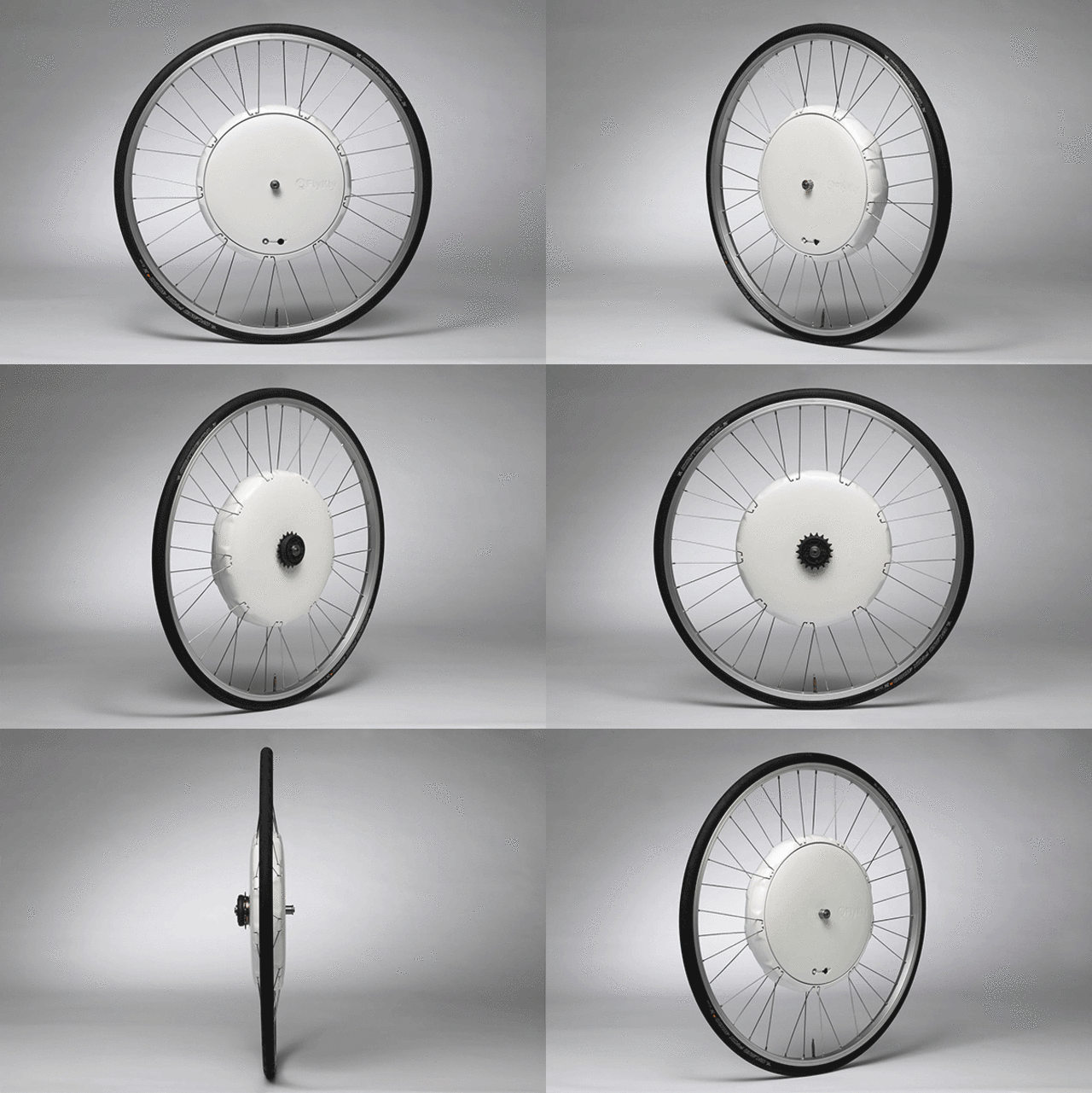
It’s known as the Copenhagen Wheel, a device invented by MIT SENSEable City Lab back in 2009 to electrify the bicycle. Since that time, engineers at MIT have been working to refine it in preparation for the day when it would be commercially available. And that time has come, as a new company called Superpedestrian announced that it has invested $2.1 million in venture capital to make the device available to the public.
Superpedestrian founder Assaf Biderman, who is also the SENSEable City lab associate director and one of the creators of the wheel, along with lab director Carlo Ratti, had this to say:
The project touched an exposed nerve somehow. Aside from news coverage and design awards, people were wanting it. Over 14,000 people emailed saying ‘I want to buy it, sell it, make it for you.
Three years after inventing it, Biderman finally decided that it was time to spin off a company to make it happen. MIT filed all the relevant patents, and Superpedestrian acquired exclusive licenses to the Copenhagen Wheel technology. And by late November, they plan to launch the wheel to the public for the very first time.
And though the much of the facts are being carefully guarded in preparation for the release, some details are already known. For example, the wheel can be fitted to almost any bike, is controlled by sensors in the peddles, and has a power assist feature that doesn’t require any work on the part of the rider. And according to Biderman, its range “will cover the average suburban commute, about 15 miles to and from work and back home.”
On top of that, a regenerative braking system stores energy for later use in a lithium battery. The wheel also comes with an app that allows users to control special features from their smartphone. These include being able to lock and unlock the bike, select motor assistance, and get real-time data about road conditions. An open-source platform called The Superpedestrian SDK also exists to allow developers to make on their own apps.
Interestingly enough,the Copenhagen Wheel also has a rival, who’s appearance on the market seems nothing short of conspiratorial. Its competitor, the FlyKly Smart Wheel, a device which has raised over $150,000 on Kickstarter so far. It is extremely similar to the Copenhagen Wheel in most respects, from its electrical assistance to the fact that it can be integrated via smartphone.
According to Biderman, the appearance of the Smart Wheel is just a coincidence, though it is similar to their product. And her company really doesn’t have to worry about competition, since the Copenhagen Wheel has years of brand recognition and MIT name behind it. In terms of the the target audience, Biderman says that they are looking at targeting city dwellers as well as cyclists:
If you’re an urbanite, you can use it to move all around, and go as far as the edges of most cities with this quite easily. You overcome topographical challenges like hills. The point is to attract more people to cycling.
Though no indication has been given how much an individual unit will cost, it is expected to have a price point that’s competitive with today’s e-bikes.
The FlyKly Smart Wheel, by comparison, can be pre-ordered for $550 apiece. In total, that campaign has raised $301,867 (their original goal was $100,000) since opening on Oct. 16th. As a result, they have been able to reach their first “stretch goal” of producing a 20″ wheel. If they can reach $500,000 before the campaign closes on Nov. 25th, they will be able to deliver on their other goals: a motor brake and a glow in the dark casing.
For some time, designers and engineers have been trying to find ways to make alternative transportation both effective and attractive. Between these designs and a slew of others that will undoubtedly follow, it looks like e-bicycling may be set to fill that void. Combined with electric cars, self-driving cars, hydrogen cars, robotaxis, podcars, and high speed trains, we could be looking at the revolution in transit that we’ve been waiting for.
Call me fussy, but since I decided to create a video trailer for Whiskey Delta, I’ve begun to think extra hard about promotion and marketing. What’s more, creating that trailer required me to open an account at Shutterstock so I would have images that I alone have the rights to and can use without worry of copyright infringement or rights.
And so, what you see above is how the new cover will look like now. Rather than the small arsenal that was featured on the original, this one has some real, bonafide zombie content to show the world! It’s something I’ve been thinking about for some time now, and even approached some friends and family who I know are skilled in visual arts. I mean, a zombie novel should have one on the cover right?
Addendum: All this experimenting with the first cover has made me want to redo the cover for the sequel. Now that I got images which I feel more accurately express the content, I feel I must tweak some more! And as usual, I produced a few different versions because I can’t seem to decide on which one is best. What do you think?
Product marketing has always been a high stakes game, where companies rely on psychology, competitive strategies, and well-honed ad campaigns to appeal to consumer’s instincts. This has never been an exact science, but it may soon be possible for advertisers to simply read your brainwaves to determine what you’re thinking and how much you’re willing to pay.
This past October, the German news site Spiegel Online profiled the provocative work of a Swiss neuroscientist and former sales consultant who is working on a method of measuring brain waves to determine how much a person would be willing to pay for a good or service. Known as “feel-good pricing” to marketing critics, the idea is already inspiring horror and intrigue.
The neuroscientist in question is Kai-Markus Müller, the head of Neuromarketing Labs who has over 10 years of experience in neuroscience research. According to his test, Starbucks is not actually charging enough for its expensive coffee. In fact, it’s probably leaving profits on the table because people would probably still buy it if they charged more.
To conduct this test, Müller targeting an area in the brain that lights up when things don’t really make sense. When test subjects were presented with the idea of paying 10 cents for coffee, their brain reacted unconsciously because the price seemed too cheap. A coffee for $8, on other hand, produced a similar reaction since the price seemed too high.
One would think that this method would help to determine optimum pricing. However, Müller then set up a coffee vending machine where people were allowed to set their own price. The two methods then matched up and revealed that people were willing to pay a higher price than what Starbucks actually charges. Somehow, paying less made people think they were selecting an inferior grade of product.
Naturally, there are those who would be horrified by this idea, feeling that it represents the worst combination of Big Brother surveillance and invasive marketing. This is to be expecting when any talk of “reading brainwaves” is concerned, dredging up images of a rampant-consumer society where absolutely no privacy exists, even within the space of your own head.
On the other hand, Müller himself takes issue with the notion of the “transparent consumer”, claiming that “Everyone wins with this method”. As proof, he cited the numerous flops in the consumer economy in the Spiegel Online article. Apparently, roughly 80 percent of all new products disappear from shelves after a short time,mainly because the producers have misjudged the markets desire for them or what they are willing to pay.
It’s all part of a nascent concept known as Neuromarketing, and it is set to take to the market in the coming years. One can expect that consumers will have things to say about it, and no doubt those feelings will come through whenever and wherever producers try to sell you something. Personally, I am reminded of what Orwell wrote in 1984:
“Always the eyes watching you and the voice enveloping you. Asleep or awake, working or eating, indoors or out of doors, in the bath or in bed — no escape. Nothing was your own except the few cubic centimetres inside your skull.”
And perhaps more appropriately, I’m also reminded of what Fry said about advertising in the Season 1 episode of Futurama entitled “A Fistfull of Dollars”:
“Leela: Didn’t you have ads in the 21st century?
Fry: Well sure, but not in our dreams. Only on TV and radio, and in magazines, and movies, and at ball games… and on buses and milk cartons and t-shirts, and bananas and written on the sky. But not in dreams, no siree.”
Woohoo! It feels like forever since I reached a milestone and felt the need to celebrate. But that’s to be expected after a few years. At first, they come fast and often due to the fact that everything’s new and exciting. After awhile, they naturally become fewer and further between. But it’s always important to mark these occasions and take the time to give thanks.
So my thanks to the many people who have chosen to come by over the years. Especially those 2038 of you who have chosen to stick around by subscribing and/or following. And thanks be to the people who have offered constructive criticism, comments, and ongoing support. I would name names, but I don’t want to leave anybody out. Besides, you know who you are!
And of course, a big shout out to people who’ve offered beta reading, editing and constructive criticism to my own works, and have allowed me to do the same for their own. This coming March will mark storiesbywilliams third anniversary, and I hope to have a number of things done by then. So stay tuned, and expect me to come by and camp out in your blogs as well!
Google has always been famous for investing in speculative ventures and future trends. Between their robot cars, Google Glass, the development of AI (the Google Brain), high-speed travel (the Hyperloop), and alternative energy, their seems to be no limit to what Musk and Page’s company will take on. And now, with Calico, Google has made the burgeoning industry of life-extension its business.
The newly formed company has set itself to “focus on health and well-being, in particular the challenge of aging and associated diseases.” Those were the words of Google co-founder Larry Page, who issued a two-part press release back in September. From this, it is known that Calico will focus on life extension and improvement. But in what way and with what business model, the company has yet to explain.
What does seem clear at this point is that Art Levinson, the chairman of Apple and former CEO of Genentech (a pioneer in biotech) will be the one to head up this new venture. His history working his way from a research scientist on up to CEO of Genentech makes him the natural choice, since he will bring medical connections and credibility to a company that’s currently low on both.
Google Health, the company’s last foray into the health industry, was a failure for the company. This site, which began in 2008 and shut down in 2011, was a personal health information centralization service that allowed Google users to volunteer their health records. Once entered, the site would provide them with a merged health record, information on conditions, and possible interactions between drugs, conditions, and allergies.
In addition, the reasons for the company’s venture into the realm of health and aging may have something to do with Larry Page’s own recent health concerns. For years, Page has struggled with vocal nerve strain, which led him to make a significant donation to research into the problem. But clearly, Calico aims to go beyond simple health problems and cures for known diseases.
In a comment to Time Magazine, Page stated that a cure for cancer would only extent the average human lifespan by 3 years. They want to think bigger than that, which could mean addressing the actual causes of aging, the molecular processes that break down cells. Given that Google Ventures included life extension technology as part of their recent bid to attract engineering students, Google’s top brass might have a slightly different idea.
And while this might all sound a bit farfetched, the concept of life-extension and even clinical immortality have been serious pursuits for some time. We tend to think of aging as a fact of life, something that is as inevitable as it is irreversible. However, a number of plausible scenarios have already been discussed that could slow or even end this process, ranging from genetic manipulation, nanotechnology, implant technology, and cellular therapy.
Whether or not Calico will get into any of these fields remains to be seen. But keeping in mind that this is the company that has proposed setting aside land for no-hold barred experimentation and even talked about building a Space Elevator with a straight face. I wouldn’t be surprised if they started building cryogentic tanks and jars for preserving disembodies brains before long!
Drone warfare is one of the most controversial issues facing the world today. In addition to ongoing concerns about lack of transparency and who’s making the life-and-death decisions, there has also been serious and ongoing concerns about the cost in civilian lives, and the efforts of both the Pentagon and the US government to keep this information from the public.
This past October, the testimonial of a Pakistani family to Congress helped to put a human face on the issue. Rafiq ur Rehman, a Pakistani primary school teacher, described how his mother, Momina Bibi, had been killed by a drone strike. His two children – Zubair and Nabila, aged 13 and 9 – were also injured in the attack that took place on October 24th of this year.
This testimony occurred shortly after the publication of an Amnesty International report, which listed Bibi among 900 other civilians they say have been killed by drone strikes since 2001. Not only is this number far higher than previously reported, the report claims that the US may have committed war crimes and should stand trial for its actions.
Already, efforts have been mounted to put limitations on drone use and development within the US. Last year, Human Rights Watch and Harvard University released a joint report calling for the preemptive ban of “killer robots”. Shortly thereafter, Deputy Defense Secretary Ashton Carter signed a series of instructions to “minimize the probability and consequences of failures that could lead to unintended engagements.”
However, these efforts officially became international in scope when, on Monday October 21st, a growing number of humans rights activists, ethicists, and technologists converged on the United Nations Headquarters in New York City to call for an international agreement that would ban the development and use of fully autonomous weapons technology.
Known as the “Campaign To Stop Killer Robots,” an international coalition formed this past April, this group has demanded that autonomous killing machines should be treated like other tactics and tools of war that have been banned under the Geneva Convention – such as chemical weapons or anti-personnel landmines.
As Jody Williams. a Nobel Peace Prize winner and, a founding member of the group said:
If these weapons move forward, it will transform the face of war forever. At some point in time, today’s drones may be like the ‘Model T’ of autonomous weaponry.
According to Noel Sharkey, an Irish computer scientist who is chair of the International Committee for Robot Arms Control, the list of challenges in developing autonomous robots is enormous. They range from the purely technological, such as the ability to properly identify a target using grainy computer vision, to ones that involve fundamental ethical, legal, and humanitarian questions.
As the current drone campaign has shown repeatedly, a teenage insurgent is often hard to distinguish from a child playing with a toy. What’s more, in all engagements in war, there is what is called the “proportionality test” – whether the civilian risks outweigh the military advantage of an attack. At present, no machine exists that would be capable of making these distinctions and judgement calls.
Despite these challenges, militaries around the world – including China, Israel, Russia, and especially the U.S. – are enthusiastic about developing and adopting technologies that will take humans entirely out of the equation, often citing the potential to save soldiers’ lives as a justification. According to Williams, without preventative action, the writing is on the wall.
Consider the U.S. military’s X-47 aircraft, which can take off, land, and refuel on its own and has weapons bays, as evidence of the trend towards greater levels of autonomy in weapons systems. Similarly, the U.K. military is collaborating with B.A.E. Systems to develop a drone called the Taranis, or “God of Thunder,” which can fly faster than the speed of sound and select its own targets.
The Campaign to Stop Killer Robots, a coalition of international and national NGOs, may have only launched recently, but individual groups have been to raise awareness for the last few years. Earlier this month, 272 engineers, computer scientists and roboticists signed onto the coalition’s letter calling for a ban. In addition, the U.N. is already expressed concern about the issue.
For example, the U.N. Special Rapporteur issued a report to the General Assembly back in April that recommended states establish national moratorium on the development of such weapons. The coalition is hoping to follow up on this by asking that other nations will join those already seeking to start early talks on the issue at the U.N. General Assembly First Committee on Disarmament and International Security meeting in New York later this month.
On the plus side, there is a precedent for a “preventative ban”: blinding lasers were never used in war, because they were preemptively included in a treaty. On the downside, autonomous weapons technology is not an easily-defined system, which makes it more difficult to legislate. If a ban is to be applied, knowing where it begins and ends, and what loopholes exist, is something that will have to be ironed out in advance.
What’s more, there are alternatives to a ban, such as regulation and limitations. By allowing states to develop machinery that is capable of handling itself in non-combat situations, but which require a human operator to green light the use of weapons, is something the US military has already claimed it is committed to. As far as international law is concerned, this represents a viable alternative to putting a stop to all research.
Overall, it is estimated that we are at least a decade away from a truly autonomous machine of war, so there is time for the law to evolve and prepare a proper response. In the meantime, there is also plenty of time to address the current use of drones and all its consequences. I’m sure I speak for more than myself when I say that I hope its get better before it gets worse.
And in the meantime, be sure to enjoy this video produced by Human Rights Watch:
At long last, and months after I was hoping to have it done, I’ve finally managed to give Papa Zulu a full first-round edit. Now, I just need to make all the corrections, maybe get an edited proof, and let my beta readers look over it for additional mistakes. Alas, after all that reading and correcting, this is only the first of many read-throughs.
See, this is why I hate editing! It’s slow, tedious, repetitive, and I hate having to read my own writing because it’s like listening to your own voice droning on and on and on. But lucky for me, I’ve got people lined up to handle things from here. Good thing I decided not to do NaNoWriMo and instead dedicate myself to this. Otherwise it would be 2014 before anyone saw this sequel! Not to toot my own horn, but those who liked Whiskey Delta did ask for a sequel. People don’t like to be kept waiting…
Oh, and when it is finished, this is what the cover will look like. I chose to split the difference and incorporate the best of both covers, which gave me this. Look for it on Amazon and Kindle in the coming weeks. Onto round two!
No one likes the idea of having to clean their homes or living spaces. Its time consuming, repetitive, and never seems to end. But thanks to some new concepts, which were featured this year at the Electrolux Design Labs competition, a day may be coming when all such maintenance can be handled by machines, and not the large, bulky kinds that are often featured in sci-fi shows and novels.
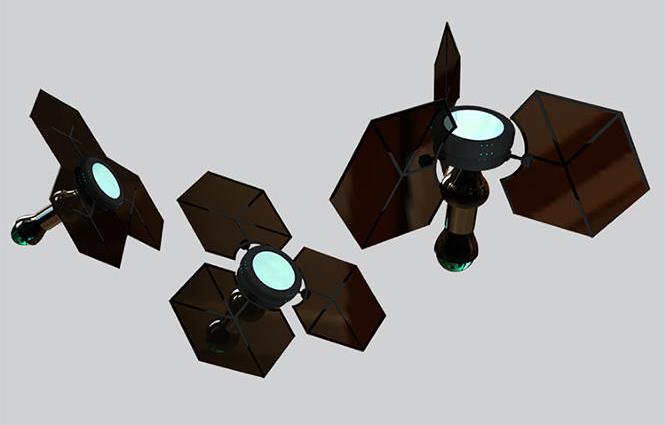
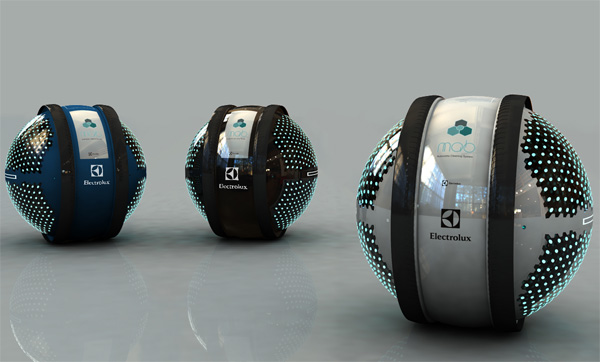
Instead, the new concept for household cleaning robots focuses on the growing field of swarm robotics. That was the concept behind Mab, a series to tiny robots that fly around the house and determine what needs cleaning. Designed by Adrian Perez Zapata, a 23-year old student from Bolivia, the Mab concept utilizes swarm programming to allow all 908 of its insect-like robots to carry out group functions.
Each of the tiny robots lives within a spherical core (picture above), and once they are released, they venture out and depositing tiny amounts of water and cleaning solution onto surfaces that have been identified as dirty. Then, having sucked up the dirty liquid, the swarm returns to their core where they unload and await further instructions or the next schedules cleaning cycle.
The robots fly around by means of several tiny, spinning propellers, and their energy comes from built-in solar panels and a battery unit that is recharged whenever they are in the core unit. Zapata claimed that he derived much of his inspiration for the design from the “robo-bee” research being conducted at Harvard, but initially got the idea from watching actual insects at work one day:
I was in my university gardens when I observed the controlled flight of bees pollinating a flower, and how magical it is to see swarms of bees working together. My concept Mab only requires a short initial configuration to function autonomously, so you could arrive home and see a swarm of mini-robots roaming around cleaning independently. This means you could sit back and relax, as you observe with great astonishment the little Mab fairies working their magic.
Zapata’s design won first place in the 2013 Electrolux Design Labs competition, an annual contest created to encourage designer students from all over the world to come up with ideas and solutions for future living. This year’s theme was Inspired Urban Living, featuring three focus areas to choose from: Social Cooking, Natural Air and Effortless Cleaning, and drew some rather impressive ideas!
For example, second place went to Luiza Silva of Brazil for her design concept known as Atomium, a home 3-D printer for food that uses molecular ingredients to construct food layer by layer. You simply draw the shape of the food you would like to eat and show it to the Atomium, which then scans the image and prints the specified food in the desired shape.
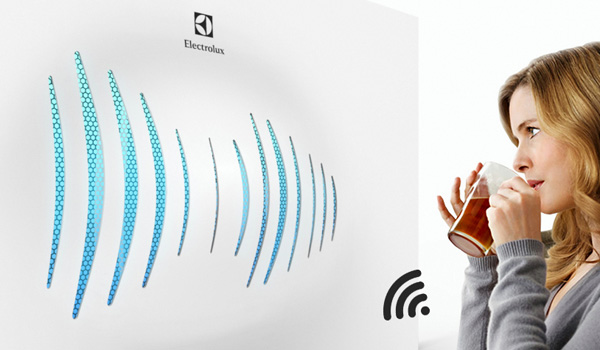
Third place went to Jeabyun Yeon from South Korea for the Breathing Wall, an “air cleaning concept which pulsates and changes shape as it cleans the air.” Inspired by fish gills, It can also be customized to suit individual needs as it scents the air you breathe and changes color according to your choice.
After that, the finalists included: Nutrima, a device for instantly assessing food’s nutritional value and possible toxicity; Kitchen Hub, an app to keep track of food in the fridge, encourage healthy eating, and reduce waste; OZ-1, an air purifier worn as a necklace; 3F, a shape-shifting autonomous vacuum cleaner; and Global Chef, a hologramatic device for bringing virtual guests to the dinner-table.
Taken together, these small bits of innovation are indicative of a much larger trend, where touchscreens, 3-D printing, scanners, swarm robots, and smart environments address our needs in ways that are intuitive, automated, efficient, and very user friendly. The only downside… they are likely to make us ever lazier than we already are!
In the meantime, check out these videos of the Mab, Atomium, Breathing Wall, and other cool inventions that were featured at the 2013 Electrolux Design Labs competition:
The basic law of computer evolution, known as Moore’s Law, teaches that within every two years, the number of transistors on a computer chip will double. What this means is that every couple of years, computer speeds will double, effectively making the previous technology obsolete. Recently, analysts have refined this period to about 18 months or less, as the rate of increase itself seems to be increasing.
This explosion in computing power is due to ongoing improvements in the field of miniaturization. As the component pieces get smaller and smaller, engineers are able to cram more and more of them onto chips of the same size. However, it does make one wonder just how far it will all go. Certainly there is a limit to how small things can get before they cease working.
According to the International Technology Roadmap for Semiconductors (ITRS), a standard which has been established by the industry’s top experts, that limit will be reached in 2015. By then, engineers will have reached the threshold of 22 nanometers, the limit of thickness before the copper wiring that currently connect the billions of transistors in a modern CPU or GPU will be made unworkable due to resistance and other mechanical issues.
However, recent revelations about the material known as graphene show that it is not hampered by the same mechanical restrictions. As such, it could theoretically be scaled down to the point where it is just a few nanometers, allowing for the creation of computer chips that are orders of magnitude more dense and powerful, while consuming less energy.
Back in 2011, IBM built what it called the first graphene integrated circuit, but in truth, only some of the transistors and inductors were made of graphene while other standard components (like copper wiring) was still employed. But now, a team at the University of California Santa Barbara (UCSB) have proposed the first all-graphene chip, where the transistors and interconnects are monolithically patterned on a single sheet of graphene.
In their research paper, “Proposal for all-graphene monolithic logic circuits,” the UCSB researchers say that:
[D]evices and interconnects can be built using the ‘same starting material’ — graphene… all-graphene circuits can surpass the static performances of the 22nm complementary metal-oxide-semiconductor devices.
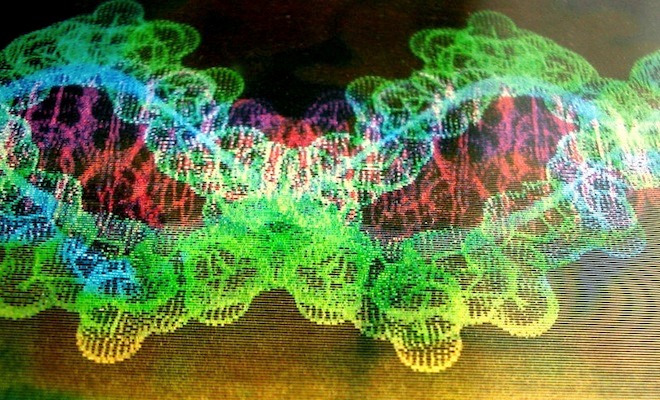
To build an all-graphene IC (pictured here), the researchers propose using one of graphene’s interesting qualities, that depending on its thickness it behaves in different ways. Narrow ribbons of graphene are semiconducting, ideal for making transistors while wider ribbons are metallic, ideal for gates and interconnects.
For now, the UCSB team’s design is simply a computer model that should technically work, but which hasn’t been built yet. In theory, though, with the worldwide efforts to improve high-quality graphene production and patterning, it should only be a few years before an all-graphene integrated circuit is built. As for full-scale commercial production, that is likely to take a decade or so.
When that happens though, another explosive period of growth in computing speed, coupled with lower power consumption is to be expected. From there, subsequent leaps are likely to involve carbon nanotubes components, true quantum computing, and perhaps even biotechnological circuits. Oh the places it will all go!

 Editing is such a slow moving process, which is why I hate it so! As it’s not enough that you go through your initial draft and make all those pesky corrections, then you have to go over the whole thing and implement them. Then, assuming you haven’t made additional mistakes, you got to wait on beta readers to pick out anything you missed. Only then can you finally submit your work and wait for the kudos and criticisms from the reading public to come in.
 But alas, this post was supposed to be about good news. After finishing the edits on Papa Zulu‘s first draft – the sequel to my Whiskey Delta zombie-apocalypse novel – I am now half done implementing all the edits and rewrites I made there. The process has felt arduous, but I’m actually surprised by the progress. I seem to be able to get four to five chapters a day done, far better than my initial prediction of say, one!
 And of course, part of why this editing process is taking so long is that I am determined to get it right this time. Whiskey Delta still only has a rating of 3.5 stars thanks to all the people who penalized it for having editing mistakes. In my haste to get it out there after Max Brooks mentioned it by name (thanks again, Rami!), I took some serious flak for that. This time around, I want there to be no mistakes, or at least as few as possible.