Towards a Safer Future: The Roofie-Detecting Glass

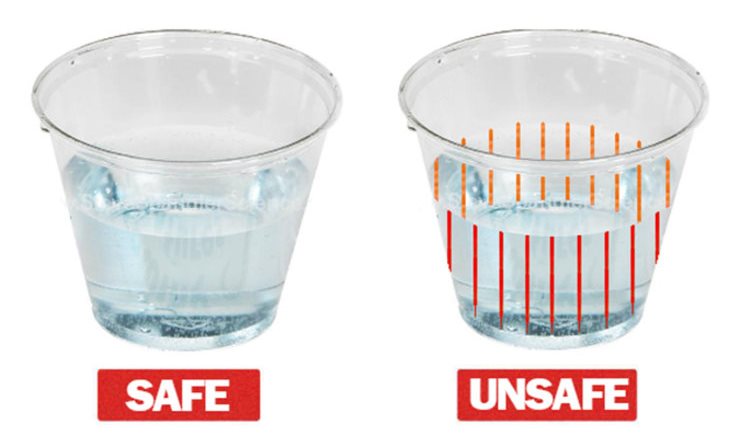
drinksavvy_glassAttention date rapers and sex offenders: you’re free ride is over! Thanks to a product known as DrinkSavvy, a new line of glassware, plastic cups, straws, and stirrers, the previously undetectable drug known as flunitrazepam (aka. rufies), has finally met its match! Basically, when a drink is spiked, a series of stop sign-red stripes show up on the cup’s sides, and the clear straw or stirrer turn red too, and the user knows not to drink.

That such a product is necessary is truly a sign of the times. Every year, over a million people find themselves becoming the victim of date rape drugs. And in 2010, DrinkSavvy founder Mike Abramson was one of them. As he recounted the incident:

I ordered my first drink of the night at a birthday party at a Boston club. But halfway through that first drink, it started to feel more like my 15th. One of the few things I remember after that is waking up with a massive headache and substantial nausea, feeling confused, and wondering, ‘What happened to me that I don’t remember?’”

drinksavvy_strawLuckily for Abramson, he was not injured or assaulted after consuming the drink. Without any explanations, he could only assume that he was either the intended victim or a robbery and the perpetrator backed out as the last minute. Or worse, that the drink was intended for someone else (a intended rape victim) and he just happened to consume it.

Because of this experience, Abramson made it his mission to avoid another hellish blackout and make sure similar experiences stopped happening to others. At first, this consisted of buying drug-testing strips and periodically pouring some of his drinks on one for analysis. However, he quickly realized that this was impractical and there needed to be a better way.

drinksavvySo he took his idea of merging the software with the hardware to Dr. John MacDonald, a chemistry professor at Worcester Polytechnic Institute, who integrated a color-changing, drug-testing material into plastic and glassware. This was followed by a crowdfunding campaign on IndieGoGo, where Abramson was able to raise $52,089 as seed capital to begin mass production.

Thanks to all this, the first batch of straws and 16-oz. plastic cups will be shipping out next month. By 2014, the company expects products to be widely commercially available. Abramson hopes the products will someday become the new norm in bars, clubs, and on college campuses, and bottles and cans with similar detection functions are in the works.
drinksavvy_cupIt is a sad time indeed when people need to get this creative in order to prevent sexually-based crimes. But inventions such as these remind us of the existence of socially-conscious individuals, and how much more powerful we are than cowardly predators who sulk in dark corners, slipping their dangerous wares to us when they think we’re not paying attention.

One can only hope that future versions of the Drinksavvy or similar products will also have some kind of detection system. Perhaps a finger printer or DNA sampler than can tell us who touched the glass, thus giving police and security an immediate list of suspects. Wouldn’t that be both cool and immensely affirming?!

And be sure to check out Abramson’s IndiGoGo promotional video, which includes some nauseating footage about drug-related sexual assaults:

Source: fastcodesign.com

News From Space: Volcanic Eruption on Io!

Io.1Io, the innermost of Jupiter’s four largest moons, has always been a source of wonder for astronomers and scientists. In addition to its pockmarked and ashen surface, it is the most volcanically active object in the Solar System, with about 240 active regions. This is due to the immense tidal forces that Jupiter provides, which create oceans of lava beneath the surface and huge volcanoes blasting it hundreds of kilometers into space.

Naturally, these eruptions are not visible directly from Earth unless one is using infrared cameras. But recently, a new series of eruptions were observed by Dr. Imke de Pater, Professor of Astronomy and of Earth and Planetary Science at the University of California in Berkeley. She was using the Keck II telescope on Mauna Kea in Hawaii on August 15, 2013 when it immediately became apparent something big was happening at Io.

Io_eruptionIn a telephone interview with Universe Today, de Pater claims this eruption is one of the top 10 most powerful eruptions that have been seen on Io, and she just happened to have the best seat in the house to observe it.

When you are right at the telescope and see the data, this is something you can see immediately, especially with a big eruption like that. It is a very energetic eruption that covers over a 30 square kilometer area. For Earth, that is big, and for Io it is very big too. It really is one of the biggest eruptions we have seen.

However, the fact that it occurred in the Rarog Patera region of Io, aptly named for a Czech fire deity, is somewhat unusual. While many regions of Io are volcanically active, de Pater said she’s not been able to find any other previous activity that has been reported in the Rarog Patera area, which the team finds very interesting.

Galileo_IoAccording to Ashley Davies of NASA’s Jet Propulsion Laboratory in Pasedena, California, Rarog Patera was identified as a small, relatively innocuous hot spot by the Galileo spacecraft during its encounter with the Jovian moon during the late 90’s. However, the observations made indicated that the volcanic activity was at a level way, way below what was seen on Aug 15.

Though we cannot see the eruptions directly, observation using the Keck telescope in the past have ascertained there are likely fountains of lava gushing from volcanically active fissures. But unlike volcanic eruptions here on Earth, which are already awesome and frightening to behold, eruptions on Io would be roughly 1000 times as powerful.

And since Io has no atmosphere to speak of, and the planet’s mass is significantly less than that of Earth’s (0.015 that of Earth’s to exact), the lava shoots off into space. Thus, for anyone standing on the moon’s surface, the result would look very much like a space launch at night, with plumes of flames reaching from the ground and extending indefinitely into the sky.

Io_Earth_Moon_ComparisonAs de Pater further indicated in the course of her interview, volcanic activity remains quite unpredictable on the Jovian moon:

We never know about eruptions – they can last hours, days months or years, so we have no idea how long it will stay active. but we are very excited about it.

No data or imagery has been released on the new eruption yet since the team is still making their observations and will be writing a paper on this topic. One thing is clear at this point, though. Despite its mysterious nature, Io still has a few surprises left for Earth scientists.

And for more information on the mysterious planet of Io, check out this Astronomycast podcast, featuring an interview with Dr. Pamela Gay of Southern Illinois University:

http://www.astronomycast.com/2011/12/ep-244-io/

Source: universetoday.com, astronomycast.com
The Future is Here: Holovision and PointGrab!

holovisionNothing spells future quite like a life-size hologram in your living room, does it? And much like flying cars and personal jetpacks (though these too are in development), holographics has been one promise that appears to be slow in materializing. However, thanks to the work of California-based company known as Provision, this promise is approaching reality.

Their invention is known as the  Holovision, a life-size holographic projector that uses what is called aerial or volumetric imaging – a way of producing 3D images without special glasses, lenses or slits. It uses a digital LCD screen and a concave mirror to produce the illusion of a 3D image floating outside the projector, and can produce clearer images without generating multiple views or causing dizziness or nausea.

holovision-0For some time now, Provision has been making 3D projectors as marketing tools, but is now running a Kickstarter campaign aimed at raising US$950,000 to fund the development of new technology for the projector, with hopes of unveiling it next year. Currently, the company’s largest projector can only produce an 18-in (45.7-cm) image, but the goal is to create one 6 feet (1.8 m) tall that projects 7 ft (2.1 m) from the screen and is visible within a 100-degree arc.

This will require developing new optics and a new light source. But once this is achieved, Provision plans to miniaturize the system to the size of a toaster for the game console market before expanding to applications in education, medicine, video conferencing and other fields. Just imagine, phone conversations or Skyping where you get to talk to a life-size representation of the person! I know one person who would be thrilled about this, though I imagine he’d want a bigger projector for himself…

ESB_emperorThe Kickstarter campaign runs through August 14 and the public debut of the system is scheduled for March, 2014. So far, the project has collected $13,112, a mere 1% of its total goal. However, they are just getting started, and have seven months to go. So if you’ve got money and want holographics to become a permanent part of gaming, teleconferencing and social media, invest now!

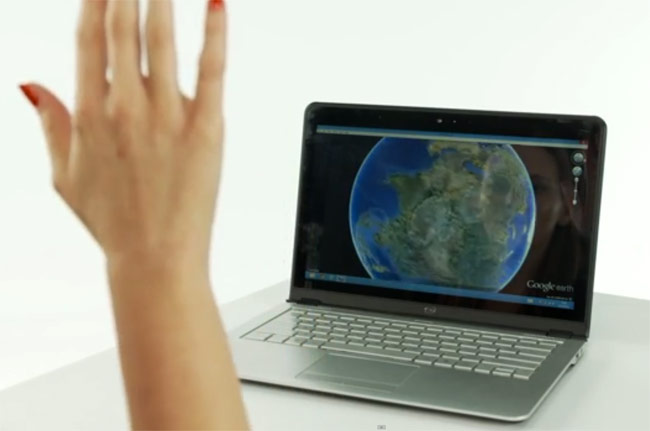
In a similar vein, gesture control, something that has also been explored heavily in science fiction, appears to be getting a boost as well. For those who do not own an Xbox Kinect or are unfamiliar with the technology (or just haven’t seen Minority Report), gesture control is essentially a motion capture technology that monitors a person’s movements and gestures as an interface.

minority-reportAnd it is companies like PointGrab that are looking to make this type of interface the norm for computing, relying on a technology known as Hybrid Action Recognition (HAR). Unlike previous gesture recognitions software, the company claims that the updated version that they recently launched is 98% accurate and takes advantage of numerous advances that will make the technology mainstream.

The biggest advance comes in the form of being able to tell the difference between intentional movement, such as putting your fingers to your lips to mute a TV or computer, and unintentional gestures, such as scratching your lip. In addition, PointGrab has updated its machine learning algorithms to accommodate more environmental factors, such as different lighting conditions and hand sizes, to improve accuracy.

gesture-controlAccording to Assaf Gad, vice president of marketing and product for PointGrab, its all about accommodation. And this is really just the beginning:

We don’t want to teach people how to interact with devices. The devices have to be smart enough to analyze the body language of user and act accordingly.

Based in Israel, PointGrab has been working on gesture recognition interfaces since 2008. Two other Israeli companies, Eyesight and Extreme Reality, are also developing gesture and body movement recognition software platforms that work with a variety of devices equipped with standard 2D cameras. In addition, Leap Motion just introduced a hardware controller for enabling gesture control, and Microsoft’s Xbox One will enable control of more than games with its updated Kinect technology.

eyeSight-3D-Gesture-ControlAnd according to Gad, this is really just the beginning. Soon gesture control will be integrated with other emerging technologies to create much more intelligent interfaces:

I see it as good sign that we are in the right place to change way people interact. In the near future, we’ll see more solutions that combine voice and gesture, as well as 3D.

An exciting prospect, and very futuristic! Now if only someone would get on those damn flying cars already. It’s the 21st century, we were promised flying cars! And be sure to enjoy this video of the PointGrab software in action:


Sources: dvice.com, news.cnet, kickstarter.com

Superman vs. Batman Anyone?

superman-vs-batmanWord around the comic book community of late is that the sequel to The Man of Steel will involve a bit of a crossover. Apparently, an aged Batman will be making an appearance in this movie, and the story may very well focus on a rivalry between the two. The news came earlier this month at Comic Con when director Zack Snyder announced that he had something of this nature in mind, taking many by surprise.

One such person was Frank Miller, the man who brought us The Dark Knight Returns, the classic graphic novel where Batman and Superman have a climactic showdown. with uber-freaking awesome results! For fans who were thinking this means that Snyder is looking to create a live-action version of TDKR, this is certainly good news indeed.

Sure, the animated version was certainly good, and the graphic novel itself is a wonderful standalone piece that really needs no adaptation. But I’m thinking few fans of either franchise would pass up an opportunity to see the big showdown between the two superheroes in Crime Alley on the big screen!

tdkr_batman_superman1And as if wanting to throw some gasoline on those flames ahead of time, Snyder even had actor Harry Lennix, who played General Swanwick in The Man of Steel, read a passage from TDKR. The line comes from the very climax of the fight scene between the two, where a victorious Batman is standing over a weakened Superman and is ready to deliver the coup de grace:
I want you to remember, Clark, in all the years to come… In your most private moments, I want you to remember my hand at your throat. I want you to remember the one man who beat you.

After the reading, Superman’s big S appeared on the screen behind the interview panel while the Batman symbol quietly superimposed itself. Fans were naturally excited and expressed themselves accordingly!

superman-vs-batman1Well, according to the latest industry gossip, a live-action version of TDKR is not quite had Snyder and the studio had in mind. David S Goyer, who co-wrote The Dark Knight trilogy with Christopher Nolan and Jonathan Nolan, recently revealed the Superman and Batman film may use a ‘versus’ in the title. But he was explicit about the fact that the film will not be adapted from Miller’s work.

At the same time, however, sources close to Miller confirmed that Snyder asked for a sit down to discuss what this crossover movie would involve. The source made a statement of this impending meeting, claiming that:

Frank had no idea the announcement in San Diego was going to happen so it did come as a surprise. He’s going to be meeting up with Zach in the next few days to go over the plans for the Superman film so things should be clearer after that.

batman_baleSet to be released in 2015, the Superman vs. Batman movie is likely to be a loose adaptation, from the sounds of things. And the very latest in industry gossip says that Christian Bale may be coming back to reprise the role of Batman, to the tune of $60 million! No indication has been given if he has chomped at the bit yet, but Bale did indicate that he might not be finished with the role.

As Bale said in a recent interview, when referring to the price tag, “Let’s not get greedy”. But at the same time, he didn’t rule out the possibility, claiming that “it all comes down to Chris [Nolan].”

Personally, I think this “loose adaptation” talk should be ditched in favor of a full-on TDKR adaptation. There’s plenty of potential to update the story, which was written in the late 80’s and featured a very Reagan-era Cold War-esque story, but with a few tweeks, it could easily be adapted to fit in the current era.

the-dark-knight-returnsAnd it might even tie the two franchises together nicely, with a supposedly dead Batman coming out of retirement, and a Superman who has been enlisted to serve the government finding themselves at odds. And since the storyline involves the Joker, it could be a fitting tribute to Heath to have him brought back for one final dance with the Batman.

It’s a tall order, I know, and like I said, it was already done. But if you’re gonna go big, Snyder, go REALLY BIG. Or just go the hell the home! You’re making some tall promises, and fans are expecting better from you after that bit of a letdown known as The Man of Steel. You got Batman and Superman in your hands now. Don’t screw it up!

Sources: indepedent.co.uk, badassdigest.com

News From Space: Eyes on Europa

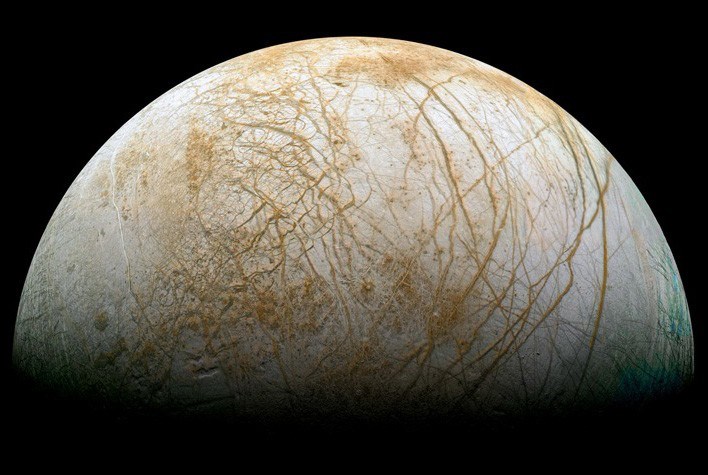
europa-landerIt’s one of Jupiter’s four largest moons, named the Jovians by the famed astronomer – Galileo Galilee – who first discovered them. And from all outward appearances, the moon is an icy, inhospitable place, with surface temperatures never reaching above -160º C (-256º F). Yet, beneath that frozen outer shell is believed to be a liquid, saltwater ocean, one that draws warmth from its orbit around Jupiter.

If this should indeed be the case, then Europa would be about the best candidate for extraterrestrial life in the Solar System, albeit in microbial form. For decades now, NASA has been working under that assumption and preparing for the day that it might be able to send an expedition or probe to confirm it. And it now seems that that day may be on the horizon.

europa-lander-2According to NASA, this would likely take the form of a robot lander. Much like Curiosity, Opportunity, and other robotic research vehicles, it would packed with a variety of sensors and analytical equipment. But of course, the nature of that equipment would be specifically tailored to answer a series of unknowns pertaining to Europa itself.

Overall, the lander would have three priorities: discover the makeup of minerals and organic matter present on the moon; examine the geophysics of the ice and the ocean underneath; and determine how the geology looks (and therefore how it might have evolved) at a human scale on the surface. Basically, it would all boil down to looking at chemistry, water and energy – in other words, the conditions necessary for life.

And though NASA has not announced any official dates, it has begun to speak of the idea an indication of intent. A new article by NASA scientists published in the peer-reviewed journal Astrobiology entitled Science Potential from a Europa Lander set out their research goals in more detail, and speculated how they might be practically achieved.

europa-lander-4One area of focus would be Europa’s distinctive linear surface cracks which are believed to be the result of tidal forces. Europa’s eccentric orbit about Jupiter causes very high tides when the moon passes closest to the gas giant, so it is thought that this process would generate the heat necessary for simple life to survive. NASA thinks the cracks could contain biological makers, molecules indicating the presence of organic life, which have come from the ocean.

But of course, plotting a mission is not as simple as simply launching a robot into space. To ensure that such a mission would maximize returns requires that a “scientifically optimized” landing site be identified, and to do that, Europa’s surface must be thoroughly surveilled. Thus far, the little we know and think about Europa is based on a handful of flybys by Voyager 2 in the 70s and the Galileo probe in the 90s.

europa-lander-3Lead author Robert Pappalardo of NASA’s Jet Propulsion Laboratory summed up the situation as follows:

There is still a lot of preparation that is needed before we could land on Europa, but studies like these will help us focus on the technologies required to get us there, and on the data needed to help us scout out possible landing locations. Europa is the most likely place in our solar system beyond Earth to have life today, and a landed mission would be the best way to search for signs of life.

At the present time, NASA’s exploratory itinerary is quite packed. In addition to wanting to tow an asteroid closer to Earth to study it, launching two more rovers to Mars, constructing a settlement on the far side of the Moon, and conducting a manned mission to Mars, it’s safe to say that a robot lander on Europa won’t be happening for some time.

converted PNM fileBut of course, the plans are in place and moving forward with every passing year. NASA is certainly not going to pass up a chance to examine one of the Solar Systems best candidates for extra-terrestrial life, and we can certainly expect more deep-space probes to be launched once Cassini is finished shooting pictures of Saturn.

I am willing to bet good money that any future probe sent into the outer reaches of the Solar System will be tasked with taking high-resolution photos of Europa as part of its mission. And from that, we can certainly expect NASA, the ESA, and even the Chinese, Russians and Indians to start talking turkey within our lifetimes.

What do you think? 2035 seem like a safe bet for a Europa lander mission?

Source: gizmag.com

Judgement Day Update: Robot Versatility

AI_robotWhat is it about robots that manages to inspire us even as they creep us out? Somehow, we just can’t stop pushing the envelope to make them smarter, faster, and more versatile; even as we entertain fears that they might someday replace us. And at the forefront of this expanding research is the desire to create robots that can not only think for themselves, but also maintain and/or repair themselves.

Case in point, the new hexapod robot that was developed by researchers from Pierre-and-Marie-Curie University, in Paris. Built with survivability in mind, this robot is the first of its kind to be able to address structural damage, adapt, and carry on. In a world where robots can be very expensive, the ability to keep working despite the loss of a component is invaluable.

clever-hexapodTo do this, the hexapod uses what the team refers to as a T-resilience (the T standing for Transferability-based) algorithm. With six legs, the hexapod moves along quite at a steady 26 cm/s. But once it loses one its front legs, it manages only 8 cm/s. But after running 20 minutes’ worth of simulations and tests, the robot works out a new way of walking, and is able to more than double its speed and cover 18 cm/s.

Essential to this approach is that the robot is programmed with what amounts to an understanding of its ideal undamaged anatomy. Previously, roboticists believed that it was necessary for a robot to analyze its new gait to diagnose the damage and compensate accordingly. But the team argues that a robot can arrive at an answer more quickly by generating a number of possible alternatives based on an undamaged state, and then testing them.

clever-hexapod-4The robot spends 20 minutes testing 25 alternatives, during which a ranging camera feeds data to a separate algorithm which works out the distance traveled. In this way the robot is able to compare its actual performance with its theoretical performance, finally settling for the closest match: a gait which recovers much of the lost speed.

This resilience could one day be a godsend for crew that rely on robots to survey disaster zones, conduct rescue operations, or deal with explosive devices. The ability to carry on without the need for repair not only ensures a better history of service, but makes sure that a task can be completed with subjecting repair crews to danger.

The team’s findings were released in a self-published paper entitled “Fast Damage Recovery in Robotics with the T-Resilience Algorithm”. And of course, the hexapod’s test run was caught on video:


And then there’s the RHex robot, a machine designed with versatility and performance in mind. Much like many robots in production today, it utilizes a six-foot (hexapod) configuration. But it is in how the RHex uses its appendages that set it apart, allowing for such athletic feats as long jumps, pull-ups, climbing stairs and even scaling walls.

This is all made possible by RHex’s six spinning appendages, which act as a sort of wheel-leg combination rather than traditional feet. These legs provide for a form of motion that exceeds standard locomotion, and allow the robot to go places others could not. The robot was created through the collaborative efforts of Aaron Johnson, an engineering graduate student at the University of Pennsylvania, and professor Daniel Koditschek at Penn State’s Kod*Lab.

RhexSaid Johnson of their robotic creation:

What we want is a robot that can go anywhere, even over terrain that might be broken and uneven. These latest jumps greatly expand the range of what this machine is capable of, as it can now jump onto or across obstacles that are bigger than it is.

Here too, the potential comes in the form of being able to mount rescue missions in rugged and hostile terrain. Thanks to its versatile range of motions, the RHex could easily be scaled into a larger robot that would be able to navigate rocky areas, collapsed buildings, and disaster zones with relative ease, and would have no trouble getting up inclined surfaces of hopping over gaps and holes.

And be sure to check out the video of the RHex in action. It’s like watching robot Parkour! Check it out:


Granted, we’re still a long way from the Nexus 6 or NS-5, but real advances are far more impressive than fictional representations. And with parallel developments taking place in the field of AI, it is clear that robots are going to be an integral part of our future. One can only hope its a happy, docile part. When it comes time for science fiction to give way to science fact, we could all do without certain cliches!

bender_killallhumans

Sources: gizmag.com, fastcoexist.com

NYC’s Futuristic Pool: Cleans Water Before You Swim

exorcisepool-perspective-poolWater pollution is one of the most serious environmental concerns facing the planet, and as with most things environmental, the culprit is urban sprawl. Take Newtown Creek in the Brooklyn neighborhood of East Williamsburg, which is one of the smelliest and dirtiest watersheds in the world. In addition to oil and industrial contaminants, the watershed is heavily burdened by the worst byproduct of urban living there is: sewage.

At present, storm water combines with the local sewage in a pipe-overloading combination that sends over a billion gallons of wastewater into the creek each year. Unlike industrial chemicals, which can be captured and treated to render it harmless, urban sewage is created in volumes that are extremely difficult to manage. And for most cities, the option of simply dumping it in the ocean is too attractive to pass up.

exorcisepool-treatmentHowever, architect Rahul Shah has a bold solution for dealing with this problem: Build a swimming pool. The Exorcise Pool – which Shah proposed for his master’s thesis at Parsons The New School For Design – wouldn’t use water directly from the Newtown Creek, its water supply would be the same, and its purpose would be both to mitigate and reveal the woeful state of local water pollution.

Instead, Shah’s project would divert an estimated 76,000 cubic feet per year of run-off into “bioswales”: ravines full of cattails, bulrush, and algae that would both absorb and carry water downhill. These bioswales would replace sidewalks on eight blocks of East Williamsburg, covered by grates where there are garages or doors to warehouse apartments.

exorcisepool-exteriorWater not absorbed by the plants would be carried to a series of water treatment technologies, using everything from algae to UV light to a bed full of reeds that will help trap solids. Ultimately, the water would not be clean to the point of drinkability, but would be safe as anything found in a pond. And in addition to drawing attention to the state of the river, the purpose, according to Shah, would also be to “showcase of different methods of water treatment.”

But of course, the main attraction, once all this water is treated, would be a series of patio misters and a public pool. The misters, according to Shah, will act as a sort of “test of faith”, where people decide to take a leap by letting treated water touch their skin. After that tentative step, they will have the option of swimming in it.

exorcisepool-showerAnd though the project is not being realized just yet, it stands as a suggestion of how to repurpose and redesign urban structures that were once sources of pollution into something healthier and more natural. In many ways, it calls to mind the work of the design firm Terreform ONE – which is seeking to convert Brooklyn’s Naval Yard into a vast greenspace through living architecture – or New York’s real estate firm Macro Sea, which began converting old dumpsters into mobile swimming pools back in 2011.

In the end, its all about converting the problem into a solution. Repurposing and redesigning the older, dirtier habitats of the past and turning them into something that actively cleans up the despoiled environment is much cheaper and easier than bulldozing and redeveloping them, after all.

And it also serves to remind us of how large urban environments are a part of the solution as well. With many people crammed close together amidst such sprawling infrastructure, the challenge of meeting future demands for space and clean living is visible and direct. As such, it has a hand in leading to innovative solutions and bright ideas.

Sources: fastcoexist.com, terreform.org, macro-sea.com

News from SpaceX: More Tests and the Coming Launch

spaceX_elonmuskElon Musk just can’t get enough of the spotlight lately! But that’s the price you pay for being a billionaire, innovator, genius-type person! And barely a week after announcing his idea for the Hyperloop high-speed train, it now seems that SpaceX is once again making the news, thanks to its latest test of the Grasshopper reusable rocket system as well as their planned launch of the Falcon Heavy rocket.

For those unfamiliar with the Grasshopper, this is a proposed reusable rocket system that Musk and SpaceX created with the hopes of bringing the costs associated with space launches down considerably. Since September 2012, the rocket has been put through successive tests, reaching higher and higher altitudes and safely making it back to the ground.

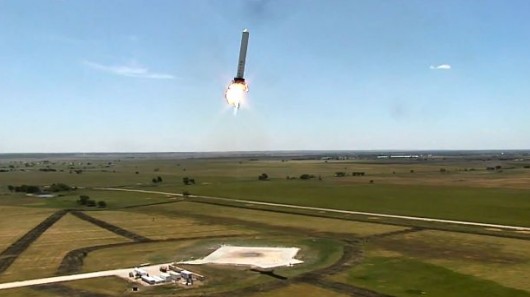
grasshopper_lateraldivertIn this latest test, the rocket successfully performed a “lateral divert test”. In all previous tests, the rocket lifted off vertically from a launch pad and then used its Merlin-1D engine to ease itself back down to the pad. However, in actual launch situations, the rocket wont simply be traveling up and down. When it comes time to land, a considerable amount of lateral steering will be necessary to line it back up with the launch site.

This is what the test, which took place on Tuesday, August 13th, amounted to. It began with the Grasshopper reaching its previously-achieved altitude of 250 meters, but then continued with the rocket moving an additional 100 m (328 ft) to one side. It was subsequently still able to land safely back at the center of the launch pad, compensating for its lateral diversion.

According to SpaceX: “The test demonstrated the vehicle’s ability to perform more aggressive steering maneuvers than have been attempted in previous flights.” What’s more, it places the company that much closer to the realization of a truly reusable rocket system, something which will drastically cut costs for future space missions.

And of course, they were sure to catch the entire test on video:


But equally important for this rising company that seeks to privatize space travel was the announcement that they have are moving ahead with plans to launch their Falcon Heavy rocket system by late 2013 or early 2014. At present, the Falcon is the most power rocket system in the world, overshadowed only by the now retired – but soon to be reserviced – Saturn V booster that put the Apollo astronauts into space and on the Moon.

spaceX-falcon9As Musk himself said of the rocket:

Falcon Heavy will carry more payload to orbit or escape velocity than any vehicle in history, apart from the Saturn V moon rocket, which was decommissioned after the Apollo program. This opens a new world of capability for both government and commercial space missions.

Fully loaded, the Falcon Heavy will be able to carry payloads of 53 metric tons (117,000 pounds or 53,070 kg) into orbit, and is made up of two engine stages. The first stage consists of a Falcon 9 rocket, with a nine-engine cores, followed by two additional nine-engine cores attached to either side. In addition, the Merlin engines have been upgraded to handle the additional weight, and are being tested at SpaceX’s facility in McGregor, Texas.

flacon-heavy-3At liftoff the 69.2m (227 ft) long Falcon Heavy will generate 3.8 million pounds of thrust, which is equivalent to the thrust of fifteen Boeing 747’s taking off at the same time. SpaceX claims that this gives the Falcon Heavy more than twice the performance of the next most powerful vehicle – the Delta IV Heavy operated by the Boeing-Lockheed Martin joint venture United Launch Alliance.

SpaceX also says that with more than twice the payload of the Delta IV but at one third the cost, the Falcon Heavy sets a new world record in terms of economy at approximately US$1,000 per pound to orbit. This is in keeping with Musk’s promise to bring the associated costs of space travel and exploration down, hopefully one day to his goal of $500 per pound.


spaceX_solararrayWith the ability to carry satellites or interplanetary spacecraft to orbit, SpaceX is offering the Falcon Heavy on the commercial market for US$80–$125 million, which compares to the $435 million per launch the U.S. Air Force has budgeted for four launches in 2012. So in effect, Musk’s company is offering a money-saving alternative to both the public and private sector.

For those fascinated by the long-term potential of space travel, this is certainly exciting news. By cutting the costs of placing satellites, supplies and people in orbit, many things are being made feasible that were previously impossible. This includes conducting more research in orbit, the ability to create space-based solar arrays (a very cool solution to our current power problems and the limitations of Earth-based solar power) and perhaps even begin work on a Moon settlement.

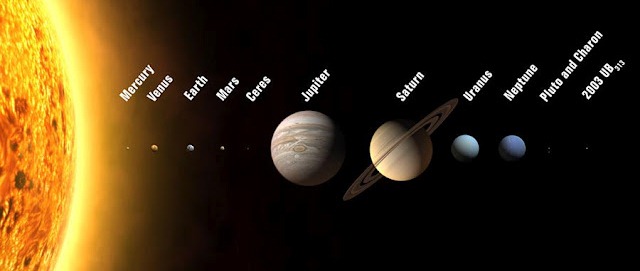
solar_system1Beyond that, there are the growing possibilities of commercial space travel, space tourism, and even setting our sights father afield with manned missions to the Moon, prospecting missions to the asteroid belt, and surveying probes to Jupiter’s Moons and to the very edge of the Solar System. Possibly even beyond…

Exciting times we live in, when the impossible is slowly becoming possible!

Sources: gizmag.com, (2), spacex.com


Powered by the Sun: Sun-Made Hydrogen Fuel

solar2It’s been known for some time that our future may hinge on the successful development of solar power. Despite it being a clean, renewable alternative to traditional, dirtier methods, the costs associated with it have remained prohibitive.  Which is why, in recent years, researchers and developers have been working to make it more efficient and bring down the costs of producing and installing panels.

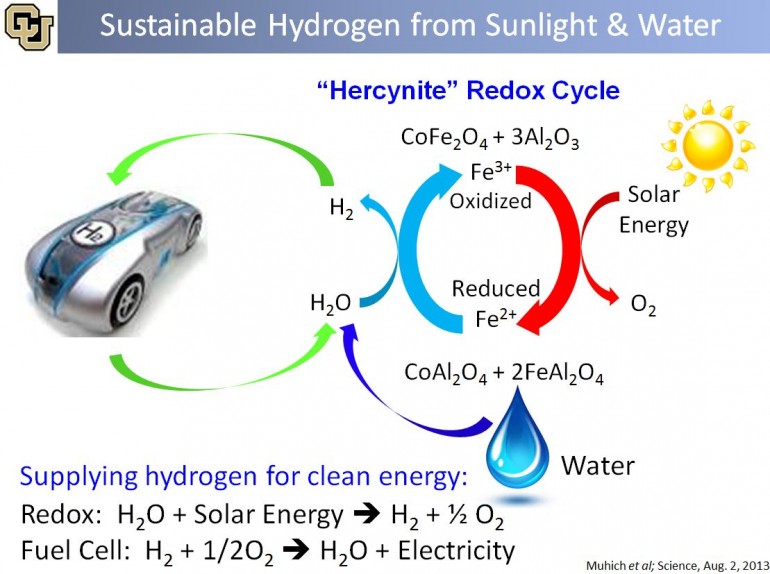
But a new technique developed by the University of Colorado Boulder may have just upped the ante on solar-powered clean energy. Using concentrated sunlight in a solar tower to achieve temperatures high enough to drive chemical reactions that split water into its constituent oxygen and hydrogen molecules, the team claims that solar energy may now be used to cheaply produce massive amounts of hydrogen fuel.

hydrogenfuelThe team’s solar thermal system concentrates sunlight off a vast array of mirrors into a single point at the top of a tall tower to produce very high temperatures. When this heat is delivered into a reactor full of metal oxides, the oxides heat up and release oxygen. This leaves the reduced metal oxides in a different state and ready to bind with new oxygen atoms.

Steam is then introduced into the reactor, which can also be produced by heating water with sunlight. This vaporized water then interacts with oxides, which draw oxygen atoms out of the water molecules leaving behind hydrogen molecules. These molecules can then be collected and harvested as hydrogen gas, and placed in storage containers for export.

solar_beadsGranted, the concept of using solar energy and heat to create hydrogen fuel is not new. Earlier this year, teams from the University of Delaware and Harvard already proposed using solar arrays and small panels (artificial leaves) to separate hydrogen from water. And solar thermal tower power plants have been in use in some parts of the world for years now.

But there are several key difference that set the University team’s concept apart. In a standard solar power tower, sunlight is concentrated about 500 to 800 times to reach temperatures around 500º C (932 º F) to produce steam that drives a turbine to generate electricity. However, splitting water requires temperatures of around 1,350º C (2,500º F), which is hot enough to melt steel.

hydrogenfuel-2To get those kinds of temperatures, the team added additional mirrors within the tower to further concentrate the sunlight onto the reactor and the active material. But the big breakthrough came about when the team discovered certain active materials that allowed both these chemical reactions (reducing the metal oxide and re-oxidizing it with steam) to occur at the same temperature.

As Charles Musgrave, Professor of Chemical and Biological engineering at CU-Boulder, explains it:

You need this high temperature both to give you the driving force to drive the chemical reactions and also the kinetics to make the reactions go fast enough to make the process practical. We determined that both reactions could be driven at the same temperature of about 2,500° F (1,371° C). Even though we run at a constant and lower temperature we still generate more hydrogen than competing processes.

Though they have yet to produce a working model, the concept has a big advantage over other methods. By eliminating the time and energy required for temperature swings, more hydrogen fuel can be created in any given amount of time. Another advantage it has over other renewable technologies, such as wind and photovoltaics, is that it uses sunlight directly to produce fuel rather first converting sunlight into electricity, which reduces overall efficiency.

solar_array1The team believes that a site with five 223 m (732 ft) tall towers and about two million sq m (21.5 million sq ft) of heliostats on 485 ha (1,200 acres) of land could generate 100,000 kg (222,460 lb) of hydrogen per day, which is enough to run over 5,000 hydrogen-fuel cell buses daily. Or as Alan Weimer, the research group leader, put it:

Our objective is to produce hydrogen (H2) at $2/kg H2. This is equivalent to about US$2/gallon (3.7 L) of gasoline based on mileage in a fuel cell car versus a combustion engine today.

Not a bad substitute for gasoline then, is it? And considering that the production process relies on only the sun – once the multi-million dollar infrastructure has been built of course – it will be much more cost effective for power companies than offshore drilling, frakking and pipelines currently are. Add to that the fact that its far more environmentally friendly, and you’ve an all around winning alternative to modern day fuels.

Source: gizmag.com

News from Space: The Slingatron

slingatronPlacing things into orbit is something humanity has been doing since the 1940’s, beginning with Germany’s V2 Rockets, then giving way to artificial satellites like Sputnik in the 1950’s. These efforts really came into their own during the 1960’s and since, when manned missions reached high orbit and even the Moon. But despite all these  milestones, little has been done to address the problems of cost.

Ever since space travel began in earnest, the only way to send satellites, supplies and shuttle craft into orbit has been with rockets. Even at its cheapest, a space launch can still cost an estimated $2000 per pound per mission, due to the fact that the rockets employed are either destroyed or rendered unusable once they’ve completed their mission.

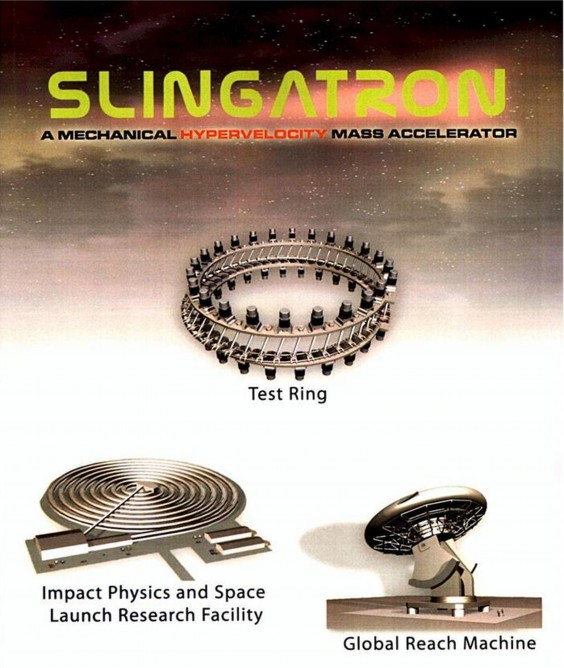
slingatron-20Attempts to create reusable launch systems, like the SpaceX Grasshopper, is one solution. But another involves “slinging” payloads into orbit, rather than launching them. That’s what HyperV Technologies Corp. of Chantilly, Virginia is hoping to achieve with their design for a “mechanical hypervelocity mass accelerator”, otherwise known as a “slingatron”.

Invented by Derek Tidman in the 1990s, the slingatron replaces rockets with a more sophisticated version of the sling. However, the principle differs somewhat in that the device uses something far more sophisticated than circumferential force. In the end, the name cyclotron might be more apt, which is a very simple particle accelerator.


slingatron-11Utilizing a vacuum tube and a series of magnetic/electostatic plates of opposing charges, an atomic particle (such as a proton) is introduced and sent back and forth as the polarity of the plates are flipped. As the frequency of the flipping is increased, the proton moved faster and faster in a series of spirals until it reaches the rim and shoots out a window at extremely high velocity.

The slingatron achieves the same result, but instead uses a spiral tube which gyrate on a series of flywheels along its length. As the slingatron gyrates, a projectile is introduced and the centripetal force pulls the projectile along. As the projectile slides through larger and larger turns of the spiral, the centripetal forces increase until the projectile shoots out the muzzle, traveling at several kilometers per second.

slingatron-13Ultimately, the goal here is to build a slingatron big enough to fire a projectile at velocities exceeding 7 km/s (25,000 km/h, 15,600 mph) to put it into orbit. With rapid turnarounds and thousands of launches per year while all of the launch system remains on Earth, the developers claim that the slingatron will offer lower costs for getting payloads into orbit.

However, there are weaknesses to this idea as well. For starters, any projectile going into space will also need to be fitted a small set of rockets for final orbit insertion and corrections. In addition, the G-forces involved in such launches would be tremendous – up to 60,000 times the force of gravity – which means it would be useless for sending up manned missions.

slingatron-15In the end, only the most solid state and hardened of satellites would have a chance of survival. The developers say that a larger slingatron would reduce the forces, but even with a reduction by a factor of 10,000, it would still be restricted to very robust cargoes. This makes it an attractive options for sending supplies into space, but not much else.

Still, given the costs associated with keeping the ISS supplied, and ensuring that future settlements in space have all the goods and equipment they need, a series of slingatrons may be a very viable solution in the not-to-distant future. Combined with concepts like the space penetrator, which fired bullet-like spaceships into space, the cost associated with space travel may be dropping substantially in coming decades.

All of this could add up to a great deal more space traffic coming to and from Earth in the not-too-distant future as well. I hope we have the foresight to construct some “space lanes” and keep them open! And in the meantime, enjoy this video interview of Dr. F. Douglas Witherspoon explaining the concept of the slingatron:

Source: gizmag.com