The Future is Here: The Telescopic Contact Lense

telescopic_contact_lensWhen it comes to enhancement technology, DARPA has its hands in many programs designed to augment a soldier’s senses. Their latest invention, the telescopic contact lens, is just one of many, but it may be the most impressive to date. Not only is it capable of giving soldiers the ability to spot and focus in on faraway objects, it may also have numerous civilian applications as well.

The lens is the result of collaboration between researchers from the University of California San Diego, Ecole Polytechnique Federale de Lausanne in Switzerland, and the Pacific Science & Engineering Group, with the financial assistance of DARPA. Led by Joseph Ford of UCSD and Eric Tremblay of EPFL, the development of the lens was announced in a recent article entitled “Switchable telescopic contact lens” that appeared in the Optics Express journal.
telescopic-contact-lens-2

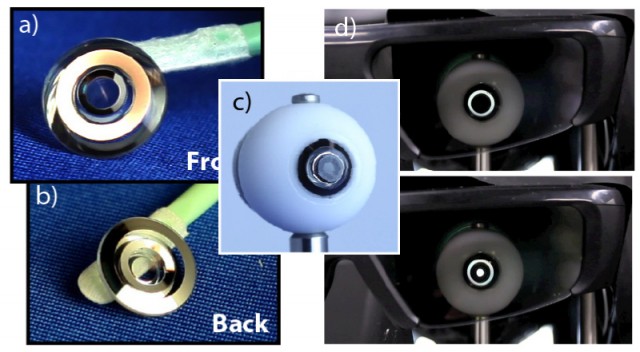
In addition to being just over a millimeter thick, the lens works by using a series of tiny mirrors to magnify light, and can be switched between normal and telescopic vision, which is due to the lens having two distinct regions. The first The center of the lens allows light to pass straight through, providing normal vision. The outside edge, however, acts as a telescope capable of magnifying your sight by close to a factor of three.

Above all, the main breakthrough here is that this telescopic contact lens is just 1.17mm thick, allowing it to be comfortably worn. Other attempts at granting telescopic vision have included a 4.4mm-thick contact lens (too thick for real-world use), telescopic spectacles (cumbersome and ugly), and most recently a telescopic lens implanted into the eye itself. The latter is currently the best option currently available, but it requires surgery and the image quality isn’t excellent.

Telescopic-Contact-Lens-3To accomplish this feet of micro-engineering, the researchers had to be rather creative. The light that will be magnified enters the edge of the contact lens, is bounced around four times inside the lens using patterned aluminum mirrors, and then beamed to the edge of the retina at the back of your eyeball. Or as the research team put it in their article:

The magnified optical path incorporates a telescopic arrangement of positive and negative annular concentric reflectors to achieve 2.8x magnification on the eye, while light passing through a central clear aperture provides unmagnified vision.

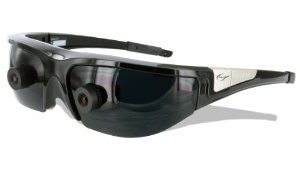
To switch between normal and telescopic vision, the central, unmagnified region of the contact lens has a polarizing filter in front of it — which works in tandem with a pair of 3D TV spectacles. By switching the polarizing state of the spectacles – a pair of active, liquid crystal Samsung 3D specs in this case – the user can choose between normal and magnified vision.
AR_glassesThough the project is being funded by DARPA for military use, the research team also indicated that the real long-term benefits of a device like this one come in the form of civilian and commercial applications. For those people suffering from age-related macular degeneration (AMD) – a leading cause of blindness for older adults – this lens could be used to correct for vision loss.

As always, enhancement technology is a two-edged sword. Devices and systems that are created to address disabilities and limitations have the added benefit of augmenting people who are otherwise healthy and ambulatory. The reverse is also true, with specialized machines that can make a person stronger, faster, and more aware providing amputees and physically challenged people the ability to overcome these imposed limitations.
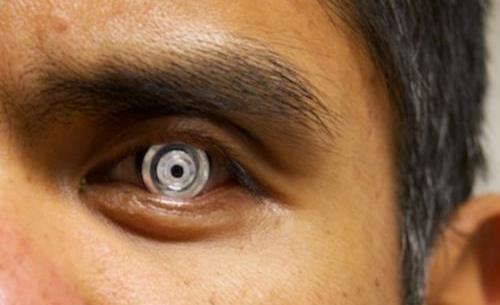
telescopic-contact-lens-5However, before anyone starts thinking that all they need to slip on a pair of these to get superhero-like vision, there are certain limitations. As already stated, the lens doesn’t work on its own but needs to be paired with a modified set of 3D television glasses for it to work. Simply placing it on the pupil and expecting magnified vision is yet not an option.

Also, though the device has been tested using computer modeling and by attaching a prototype lens to a optomechanical model eye, it has not been tested on a set of human eyes just yet. As always, there is still a lot of work to do with refining the technology and improving the image quality, but it’s clear at this early juncture that the work holds a lot of promise.

It’s the age of bionic enhancements people, are we find ourselves at the forefront of it. As time goes on, we can expect such devices to become a regular feature of our society.

Sources: news.cnet.com, extremetech.com

The Ender’s Game Controversy…

endersgame3If you’re the kind of person for whom science fiction is irrelevant, or if you’ve just been living under a rock for the past few months, it might come as a surprise that there are people who are looking to boycott the release of Ender’s Games. Granted, Card has been an opponent of gay marriage for some time, but its really only been with the release of the movie adapted from his 1984 novel that this has become an issue.

In response to the upcoming release, groups like Geeks OUT! have started the campaign called “Skip Ender’s Game”. Citing Card’s views, and his involvement with the National Organization for Marriage (NOM) – which supported the Defense Of Marriage Act – Geeks OUT and others like them are hoping to prevent Card from benefiting financially from the movie’s release.

enders_game_1Of particular concern is a statement made by Card in 1990 in an essay entitled “The Hypocrites of Homosexuality”:

Laws against homosexual behavior should remain on the books, not to be indiscriminately enforced against anyone who happens to be caught violating them, but to be used when necessary to send a clear message that those who flagrantly violate society’s regulation of sexual behavior cannot be permitted to remain as acceptable, equal citizens within that society.

In 2009, he stated that homosexual individuals “suffer from tragic genetic mixups,” and that the term “homophobe” is used in order to imply that opponents of the “homosexual activist agenda” are mentally ill. Card stated in 2008 that “[t]here is no branch of government with the authority to redefine marriage.” On July 8, 2013, Card wrote in Entertainment Weekly that the gay marriage issue is “moot” due to the Supreme Court decision on DOMA, and that eventually, gay marriage would be legal in all fifty states

enders_game_2All of this has generated its fair share of controversy and has led to some degree of distancing and disavowal. For starters, Lionsgate Films – the studio responsible for the movie – announced that Card would not be taking part in the Ender’s Game film panel at San Diego Comic Con in July 2013 with the other principal cast and crewmembers of the film.

In addition, hoping to dampen the flames of controversy, Lionsgate released the following statement:

As proud longtime supporters of the LGBT community, champions of films ranging from GODS AND MONSTERS to THE PERKS OF BEING A WALLFLOWER and a Company that is proud to have recognized same-sex unions and domestic partnerships within its employee benefits policies for many years, we obviously do not agree with the personal views of Orson Scott Card and those of the National Organization for Marriage.  However, they are completely irrelevant to a discussion of ENDER’S GAME.  The simple fact is that neither the underlying book nor the film itself reflect these views in any way, shape or form.  On the contrary, the film not only transports viewers to an entertaining and action-filled world, but it does so with positive and inspiring characters who ultimately deliver an ennobling and life-affirming message. Lionsgate will continue its longstanding commitment to the LGBT community by exploring new ways we can support LGBT causes and, as part of this ongoing process, will host a benefit premiere for ENDER’S GAME.

This is an argument that many have made, that since Card’s views on homosexuality don’t appear in the book itself, that it is not relevant to either it or the movie.

EndersGameAnd Card himself even made a statement in response to the proposed boycott, claiming the his story and his stances on gay marriage are two entirely separate issues:

Ender’s Game is set more than a century in the future and has nothing to do with political issues that did not exist when the book was written in 1984. With the recent Supreme Court ruling, the gay marriage issue becomes moot.  The Full Faith and Credit clause of the Constitution will, sooner or later, give legal force in every state to any marriage contract recognized by any other state. Now it will be interesting to see whether the victorious proponents of gay marriage will show tolerance toward those who disagreed with them when the issue was still in dispute.

Once again, Card has declared the issue open and shut and has asked for tolerance for his past stances. Personally, I can’t help but feel that the studio has missed the point entirely, and the Card himself is taking a rather hypocritical stance. Asking for tolerance for your opinions and beliefs are one thing, but he and his colleagues actively campaigned to deny equal rights to others.

enders_game5And though plenty of people have questioned whether or not a boycott is even likely to be effective, the issue seems to be snowballing. Not only is the studio taking notice, but Card’s own statements have only seemed to add fuel to the fire. And of course, a studio needs to reach beyond fans of the franchise and genre when doing adaptations, but given the way the controversy is growing, it’s not unreasonable to suspect they will have a hard time drawing people in.

And I admit to being heavily conflicted. While Card’s views were known to me before the movie was announced, his involvement with NOM and the many statements he’s made, not to mention his perception of the issue as being “moot” and over with, have led me to seriously reevaluate my opinion of the man. Like many sci-fi readers, I read and enjoyed Ender’s Game thoroughly. Had I know where the man stood at the time, would I have still bought it or enjoyed it nearly as much?

orson_scott_cardNot an easy question to answer, and it raises the uncomfortable specter of multiple, overlapping issues. Amongst them are censorship, free speech, hate speech, endorsing intolerance, and precedent. Personally, I think I’m going to skip the movie now. Too bad too, I was interested in seeing what they did with it. And as you can see, I can’t resist posting some of those stunning visuals! But on certain matters, I am just not flexible where intolerance is involved.

And given the way Card espoused tolerance and humanity in his classic book, even towards one’s enemy, I think it would be reasonable for him to reconsider his past involvements. After all, tolerance is about accepting the things you don’t approve of. If you expect people to extend that acceptance to you, you better be willing to show some yourself.

Sources: blastr.com, (2), IO9.c0m, skipendersgame.com

News from Space: Smile for the Space Probes!

cassini_spaceprobeFor those who love to stargaze, or people who just can’t resist having their picture taken, this weekend will present a number of cool opportunities. For many, the news that the Cassini space probe will be taking pictures of planet Earth this Friday is already known. But as it turns out, the MESSENGER space probe, currently in orbit around Mercury, has decided to get in on the action.

This is a rare opportunity indeed, and is associated with the Saturn Mosaic Project, something that Astronomers Without Borders is helping out with. The entire point is to give Earthlings a better view of the planet they call home, as well as to stimulate interest in Saturn, its rings, and many orbiting satellites. The SMP is also accepting images taken of Saturn, and has extended its deadline for submissions to July 29th.

wave_at_saturnThere are also other competitions associated with the event – one is to submit photos that best represents Earth (the image must be taken on July 19th, 2013) and another is to write an original song about this event. The digital versions of the winning entries will be beamed to space at a later date.

Also, at the exact time the Cassini spacecraft is snapping pics of Earth, the Slooh Space Camera will be snapping images of Saturn with a live broadcast team. Their feed starts at 2:30 PM PDT / 5:30 PM EDT / 21:30 UTC and will be providing live views of Saturn from the Canary Islands.

If you’re looking to get in on the fun, this is the time when you should be looking at the heavens: First up, Cassini’s photo op will be taking place between 21:27 and 21:47 UTC (2:27 and 2:42 PDT, 5:27 and 5:42 p.m. EDT) on Friday, July 19th. MESSENGER, meanwhile, will be taking images at 11:49, 12:38, and 13:41 UTC (4:49 a.m., 5:38 a.m. and 6:41 a.m. PDT or 7:49 a.m., 8:38 a.m. and 9:41 a.m. EDT) on July 19th and 20th.

Sorry for the late notice. Just look up at the sky and wave. As long as you keep doing it for the next thirty-six to forty-eight hours, I’m sure you can’t miss. Man, times zones are tricky!

Sources: universetoday.com, astronomerswithoutborders.org, saturn.jpl.nasa.gov

News from Space: The Canadarm2!

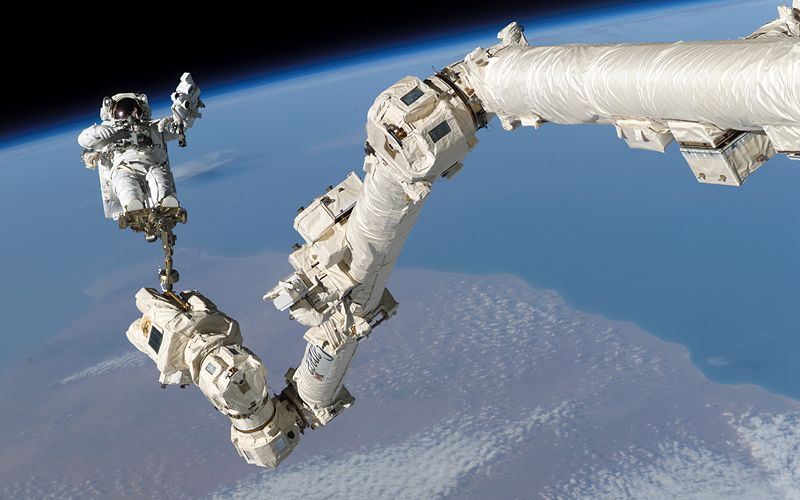
Astronaut Steve K. Robertson during STS-114

For decades, the Canadian Space Agency has been building the Shuttle Remote Manipulator System (SRMS) – also known as the Canadarm. Since 1981, aboard the shuttle STS-2 Columbia, this model of robotic arm has come standard on all NASA shuttles and was used as its main grasper. However, due to the progress made in the field of robotics over the past thirty years and the need for equipment to evolve to meet new challenges, the Canadarm was retired in 2011.

Luckily, the CSA is busy at work producing its successor, the Mobile Service System – aka. Canadarm2. The latest versions are in testing right now, and their main purpose, once deployed, will be to save satellites. Currently, an earlier version of this arm serves as the main grasper aboard the ISS, where it is used to move payloads around and guide objects to the docking port.

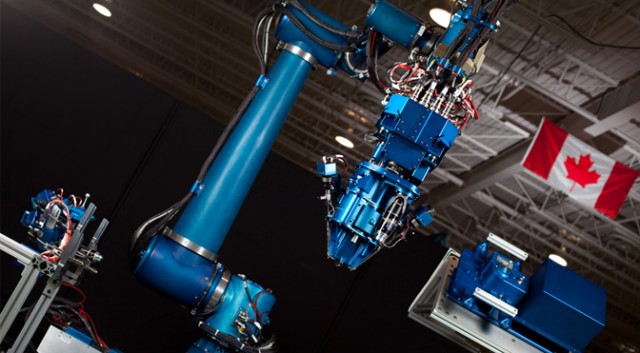
canadarm2However, the newest models – dubbed Next Generation Canadarm (NGC) – are somewhat different and come in two parts. First, there is the 15 meter arm that has six degrees of freedom, extreme flexibility, and handles grappling and heavy lifting. The second is a 2.58 meter arm that comes attached to the larger arm, is similarly free and flexible, and handles more intricate repair and replacement work.

This new model improves upon the old in several respects. In addition to being more intricate, mobile, and handle a wider array of tasks, it is also considerably lighter than than its predecessor. When not in use, it is also capable of telescoping down to 5 meters of cubic space, which is a huge upshot for transporting it aboard a shuttle craft. All of this is expected to come in handy once they start the lucrative business of protecting our many satellites.

canadarm2_missioncontrolIt’s no secret that there is abundance of space junk clogging the Earth’s upper atmosphere. This moving debris is a serious danger to both manned and unmanned missions and is only expected to get worse. Because of this, the ability to repair and retool satellites to keep them in operation longer is of prime importance to space agencies.

Naturally, every piece of equipment needs to undergo rigorous testing before its deployed into space. And the Canadarm2 is no exception, which is currently being put through countless simulations. This battery of tests allows operators to guide dummy satellites together for docking using the arms in both full manual and semi-autonomous mode.

canadarm2_chrishadfieldNo indication on when they will be ready for service, but it seems like a safe bet that any manned missions to Mars will likely feature a Canadarm2 or two. And as you can see, Chris Hadfield – another major Canadian contribution to space – is on hand to help out. Maybe he and the new arm can perform a duet together, provided it can handle a guitar!

And be sure to check out this video of the NGC Canadarm2 in action, courtesy of the Canadian Space Agency:


Source:
Wired.com

The Future is Here: Bionic Eye Approved by FDA!

Argus-IIAfter more than 20 years in the making, the Argus II bionic eye was finally approved this past February by the Food and Drug Administration for commercial sale in the US. For people suffering from the rare genetic condition known as retinitis pigmentosa – an inherited, degenerative eye disease that causes severe vision impairment and often blindness – this is certainly good news indeed.

Developed by Second Sight, the Argus II is what is known as a “Retinal Prosthesis System” (RPS) that corrects the main effect of retinitis pigmentosa, which is the diminished ability to distinguish light from dark. While it doesn’t actually restore vision to people who suffer from this condition, it can improve their perceptions of light and dark, and thus identify the movement or location of objects.

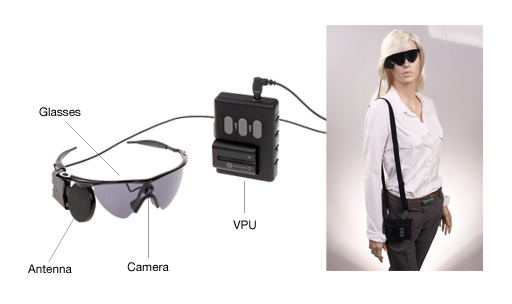
argusII_1The Argus II works by using a series of electrodes implanted onto the retina that are wirelessly connected to a video camera mounted on the eyeglasses. The eye-electrodes use electrical impulses transmitted from the camera to stimulate the part of the retina that allows for image perception. By circumventing the parts of the eye effected by the disease, the bionic device is a prosthetic in every sense of the word.

According to Suber S. Huang, director of the University Hospital Eye Institute’s Center for Retina and Macular Disease, the breakthrough treatment is:

 [R]emarkable. The system offers a profound benefit for people who are blind from RP and who currently have no therapy available to them. Argus II allows patients to reclaim their independence and improve their lives.

ArgusIIArgus II boasts 20-plus years of research, three clinical trials, and more than $200 million in private and public investment behind it. Still, the system has been categorized by the FDA as a humanitarian use device, meaning there is a “reasonable assurance” that the device is safe and its “probable benefit outweighs the risk of illness or injury.”

Good news for people with vision impairment, and a big step in the direction of restoring sight. And of course, a possible step on the road to human enhancement and augmentation. As always, every development that is made in the direction of correcting human impairment offers the future possibility of augmenting otherwise unimpaired human beings.

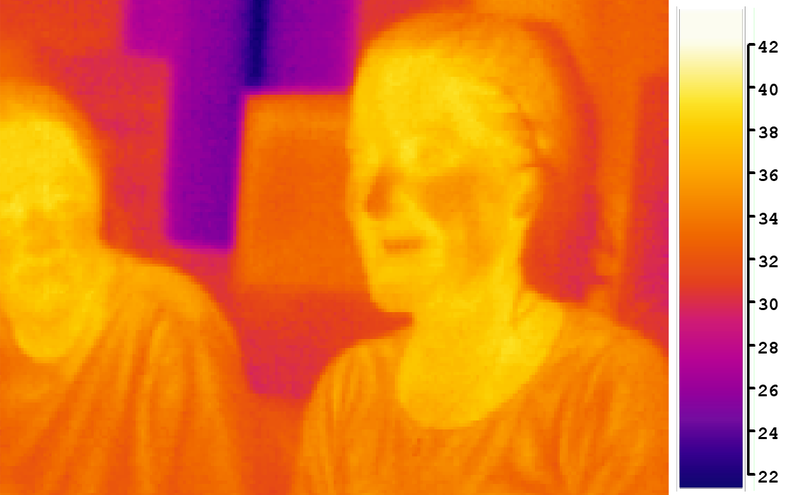
infraredAs such, it might not be long before there are devices that can give the average human the ability to see in the invisible spectrum, such as IR and ultra-violet frequencies. Perhaps also something that can detect x-rays, gamma ray radiation, and other harmful particles. Given that the very definition of cyborg is “a being with both organic and cybernetic parts”, the integration of this device means the birth of the cybernetic age.

And be sure to check out this promotional video by Second Sight showing how the device works:

Source: news.cnet.com

Judgement Day Update: e-David the Painting Robot

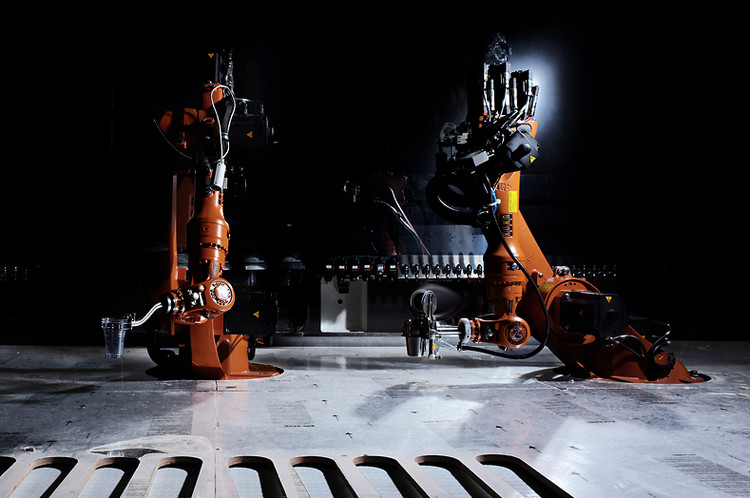
robot_bartenderRobots have been making quite the stir in the news lately. And no, that’s not a delicious pun on the robotic bartender – aka. the Makr Shakr, it’s just a frank appraisal of the leap and bounds by which robots and their integration to society is proceeding. Between developing machines that can imitate human movements, human facial expressions, and carry out specialized tasks, it appears that we may actually be on the verge on a world where robots are a common feature.

Just a few days ago, DARPA and Boston Dynamics unveiled their most anthropomorphic robot to date – the Atlas Robot. And this came less than a month after the Global Future 2045 conference took place in Moscow, where Geminoid robot clones – so realistic that they were virtually indistinguishable from their human counterparts – were put on display. And yet, it seems that the Singularitarians and roboticists of the world were not yet finished for the season.

e-DavidNow it appears that there is a robotic arm that is capable of performing another highly-specialized task: painting. Created by a team at the University of Konstanz in Germany, the E-David is capable of performing the artistic variety of painting, not the kind which involves spraying enamel onto car frames – something robots have been doing for decades, much to the chagrin of auto workers.

Granted, it is not capable of “artistic inspiration”, but instead takes a picture of what it wants to copy and takes it from there. What’s more, it e-David doesn’t require programming directions that tell it how to paint, relying instead on a concept known as “visual optimization” to make its own decisions. After each brush stroke, e-David takes a picture, and its software calculates where the next stroke needs to fall, what colors are needed, and whether it needs to be lighter or darker, etc.

e_David1In short, e-David can do the time-consuming and often monotonous task of reproducing original works of art, or cleaning them up, but cannot create someone all on its own. Now lets all join the artists of the world in breathing a collective sigh of relief. The team of university researchers described the e-David’s “process” in a release in which they stated:

We equipped a standard robot with all necessary means for painting. Five different brushes can be used, color can be selected from a repository with 24 colors, brushes can be cleaned, and colors can be distributed precisely on the canvas. The machine watches itself while painting and decides independently where to add new strokes. This way, paintings are created that are not completely defined by the programmer, but are the result of a visual optimization process.

While E-David isn’t the first robot capable of painting, it is in a class by itself when it comes to the quality of the images it creates. Much like the supercomputer Iamus that composed classical music which was performed by the London Symphony Orchestra and recorded on an album, it is impossible to tell when looking at the finished product if the paintings were crafted by hand or machine. An interesting twist on the Turing Test, I think!

What’s next? A robot that can compose pop songs? I don’t think I can stand another version of “Friday”! And be sure to enjoy this video of e-David at work:


Sources: news.cnet.com, (2), fastcoexist.com

Climate Crisis: Coming Trends in CO2

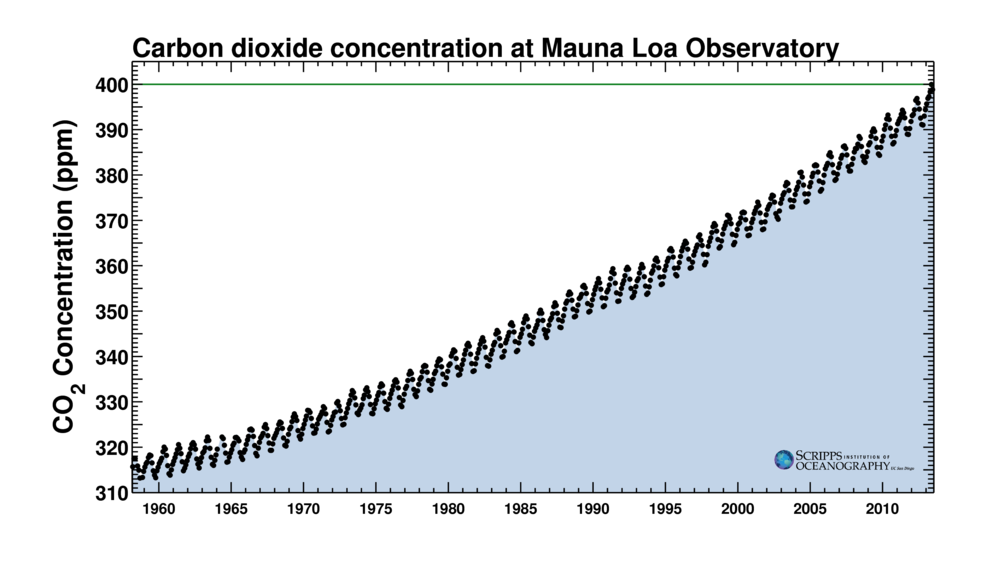
Pollution over Mexico CityGood news everybody! Okay, not exactly good, but it is news, and on a rather important subject. Recently, the National Oceanic and Atmospheric Administration (NOAA) announced that the Manua Loa observatory in Hawaii had recorded atmospheric levels of carbon dioxide which exceeded 400 parts per million. This represented a major milestone, one which climatological researchers and scientists have feared for some time.

However, they have since amended that statement, saying that the readings were a fraction of a point lower at 399.89 ppm. Not exactly a reason to celebrate, and not that surprising either, since individual readings at any of NOAA’s observation stations are subject to revision on a regular basis. And regardless of whether or not the 400 ppm milestone has been passed, scientists are still adamant that this reading is cause for concern.

keeling_curveAs has been stated repeatedly, when it comes to the buildup of human created greenhouse gases, it is the rate of increase which is most important. That rate, which is measured by the Keeling Curve, shows that atmospheric CO2 levels are rising at unprecedented rates, driven largely by the burning of fossil fuels over the past two centuries.

Originally pioneered by scientist Charles D. Keeling in 1958 , this curve is the longest-running tally of carbon dioxide levels in the atmosphere and is maintained by the Scripps Institution of Oceanography in San Diego. The saw-tooth pattern of the incline reflects small seasonal variations within the long-term upward trend, which peak annually around the month of May.

Combining this studies conducted on glacial melting patterns, pollination patterns, geological and oceanographic surveys, a long-term picture emerges. For the past 800,000 years, CO2 levels have never exceeded 300 ppm, and there is no known geologic period in which rates increased as sharply as they are now. That level was at about 280 ppm at the advent of the Industrial Revolution in the 18th century, the period when the burning of fossil fuels began to soar.

trafficScripps geochemist Ralph Keeling, who has taken over the Keeling curve measurement from his late father, had this to say about the news:

I wish it weren’t true, but it looks like the world is going to blow through the 400-ppm level without losing a beat. At this pace we’ll hit 450 ppm within a few decades.

Tim Lueker, an oceanographer and carbon cycle researcher who is a longtime member of the Scripps CO2 Group, also weighed in on the significance of these latest readings:

The 400-ppm threshold is a sobering milestone and should serve as a wake-up call for all of us to support clean-energy technology and reduce emissions of greenhouse gases before it’s too late for our children and grandchildren.

What’s especially frightening about a rating of 400 ppm is the fact that planet Earth has not experienced that kind of CO2 concentration for over 3 million years, during the Pliocene Era. At that time, sea levels were between 60 and 80 feet higher than their current levels. If sea levels rise by this much in the coming decades, roughly 1 billion of the Earths inhabitants will be left homeless.

climate_changetideAdd to this the widespread droughts, wildfires and flooding taking place in inland communities, where unpredictable weather will cause rivers to overflow erode river banks and turn millions more into refugees. And as crops fail due to increased heat and depleted topsoil, the ability to feed the world’s population will also begin to plummet.

Of course, these are the most dire predictions and are often used to remind us just how important it is to clean up our act before its too late. Researching and developing cleaner methods is one approach, as is finding ways to capture the carbon emissions we are generating on a daily basis. But in the end, the greatest weapon in our arsenal is and always will be public awareness.

Consider yourselves informed. Now go spread the word!

In the meantime, enjoy this animated “Carbon Tracker” graph that shows us the time history of atmospheric carbon dioxide – courtesy of the National Oceanic & Atmospheric Administration.


Source:
articles.latimes.com
, esrl.noaa.gov, keelingcurve.ucsd.edu

Judgement Day Update: The DARPA Atlas Robot

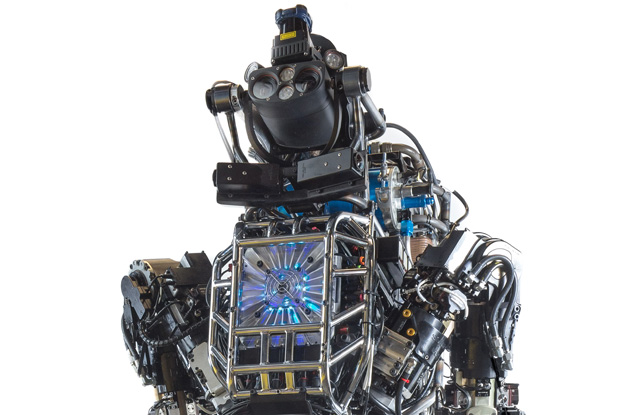
Atlas_robotJudgement Day has come early this year! At least that’s the impression I got when I took a look at this new DARPA prototype for a future robotic infantryman. With its anthropomorphic frame, servomotors and cables, sensor-clustered face, and the shining lights on its chest, this machine just screams Terminator! Yet surprisingly, it is being developed to help humans beings. Yeah, that’s what they said about Skynet, right before it nuked us!

Yes, this 6-foot, 330-pound robot, which was unveiled this past Thursday, was in fact designed as a testbed humanoid for disaster response. Designed to carry tools and tackle rough terrain, this robot – and those like it – are intended to operate in hazardous or disaster-stricken areas, assisting in rescue efforts and performing tasks that would ordinarily endanger the lives of human workers.

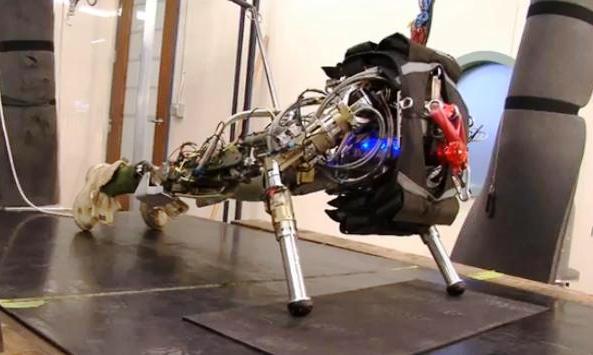
LS3-AlphaDog6reducedFunded by DARPA as part of their Robotics Challenge, the robot was developed by Boston Dynamics, the same people who brought you the AlphaDog – aka the Legged Squad Support System (LS3, pictured above) – and the Petman soldier robot. The former was developed as an all-terrain quadruped robot that could as an infantry-support vehicle by carrying a squad’s heavy ordinance over rough terrain.

The latter, like Atlas, was developed as testbed to see just how anthropomorphic a robot can be – i.e. whether or not it could move, run and jump with fluidity rather than awkward “robot” movements, and handle different surfaces. Some of you may recall seeing a video or two of it doing pushups and running on a treadmill back in 2011.

PetmanAlas, Atlas represents something vastly different and more complex than these other two machines. It was designed to not only walk and carry things, but can travel over rough terrain and climb using its hands and feet. Its head includes stereo cameras and a laser range finder to help it navigate its environment.

And, as Boston Dynamics claimed in a press release, the bot also possesses “sensate hands” that are capable of using human tools, and “28 hydraulically actuated degrees of freedom”. Its only weakness, at present, is the electrical power supply it is tethered to. But other than that, it is the most “human” robot – purely in terms physical capabilities – to date. Not only that, but it also looks pretty badass when seen in this full-profile pic, doesn’t it?

Atlas_4437_shrunk-1373567699341_610x903The DARPA Robotics Challenge is designed to help evolve machines that can cope with disasters and hazardous environments like nuclear power plant accidents. The seven teams currently in the challenge will get their own Atlas bot and then program it until December, when trials will be held at the Homestead Miami Speedway in Florida – where they will be presented with a series of challenges.

In the meantime, check out the video below of the Atlas robot as it demonstrates it full range of motion while busting a move! Then tell me if the robot is any less frightening to you. Can’t help but look at the full-length picture and imagine a plasma cannon in its hands, can you?


Source: news.cnet.com


Judgement Day Update: Geminoid Robotic Clones

geminoidWe all know it’s coming: the day when machines would be indistinguishable from human beings. And with a robot that is capable of imitating human body language and facial expressions, it seems we are that much closer to realizing it. It’s known as the Geminoid HI-2, a robotic clone of its maker, famed Japanese roboticist Hiroshi Ishiguro.

Ishiguro unveiled his latest creation at this year’s Global Future 2045 conference, an annual get-together for all sorts of cybernetics enthusiasts, life extension researchers, and singularity proponents. As one of the world’s top experts on human-mimicking robots, Ishiguro wants his creations to be as close to human as possible.

avatar_imageAlas, this has been difficult, since human beings tend to fidget and experience involuntary tics and movements. But that’s precisely what his latest bot excels at. Though it still requires a remote controller, the Ishiguro clone has all his idiosyncrasies hard-wired into his frame, and can even give you dirty looks.

geminoidfThis is not the first robot Ishiguro has built, as his female androids Repliee Q1Expo and Geminoid F will attest. But above all, Ishiguro loves to make robotic versions of himself, since one of his chief aims with robotics is to make human proxies. As he said during his talk, “Thanks to my android, when I have two meetings I can be in two places simultaneously.” I honestly think he was only half-joking!

During the presentation, Ishiguro’s robotic clone was on stage with him, where it realistically fidgeted as he pontificated and joked with the audience. The Geminoid was controlled from off-stage, where an unseen technician guided it, and fidgeted, yawned, and made annoyed facial expressions. At the end of the talk, Ishiguro’s clone suddenly jumped to life and told a joke that startled the crowd.

geminoid_uncanny_valleyIn Ishiguro’s eyes, robotic clones can outperform humans at basic human behaviors thanks to modern engineering. And though they are not yet to the point where the term “android” can be applied, he believes it is only a matter of time before they can rival and surpass the real thing. Roboticists and futurists refer to this as the “uncanny valley” – that strange, off-putting feeling people get when robots begin to increasingly resemble humans. If said valley was a physical place, I think we can all agree that Ishiguro would be its damn mayor!

And judging by these latest creations, the time when robots are indistinguishable from humans may be coming sooner than we think. As you can see from the photos, there seems to be very little difference in appearance between his robots and their human counterparts. And those who viewed them live have attested to them being surprisingly life-like. And once they are able to control themselves and have an artificial neural net that can rival a human one in terms of complexity, we can expect them to mimic many of our other idiosyncrasies as well.

As usual, there are those who will respond to this news with anticipation and those who respond with trepidation. Where do you fall? Maybe these videos from the conference of Ishiguro’s inventions in action will help you make up your mind:

Ishiguro Clone:


Geminoid F:

Sources: fastcoexist.com, geminoid.jp

News From Space: First Blue Exoplanet Discovered!

HD_189733_b_deep_blue_dotEver since our astronomers have gained the ability to see into deep space and discern what lies in distant solar systems, a total of 910 extra-solar planets have been discovered. Of those, only a handful have been confirmed as potentially habitable by Earth scientists. Despite these discovered, it was not until recently that a “blue planet” outside of the Solar System, thanks to NASAs Hubble telescope.

But here’s the kicker: as it turns out, the planet is not blue due to the presence of liquid water. The blue color likely comes from clouds in the atmosphere made of molten glass. The planet is known as HD 189733 b, located roughly 63 light years away from Earth in the constellation of Vulpecula (aka. the Fox). Initially discovered in 2005 by French astronomers who observed it passing in front of its star, HD 189733 b is one of the best-studied exoplanets.

Hd189733b_blue_planet_artPrior to this new finding, it was already known that the planet was a hot Jupiter — a massive gas giant that orbits very close to its parent star — and that, using polarimetry, it was most likely blue. Since that time, the blue color has been confirmed by a spectrograph aboard Hubble which scanned the planet during an eclipse. As it passed behind its parent star and out of our vision, Hubble recorded less blue light coming from the star, while the other colors remained the same.

This strongly indicates that the light reflected by HD 189733 b’s atmosphere is blue and thus, if we were close enough to directly observe the planet, it would appear blue. This is an apparent first for astrophysicists and astronomers, who wouldn’t normally be able to observe such a fluctuation from 63 light years away. But the size of the planet, plus the amount of light reflecting off it from its very-close-by star, mean that Hubble can do its thing.

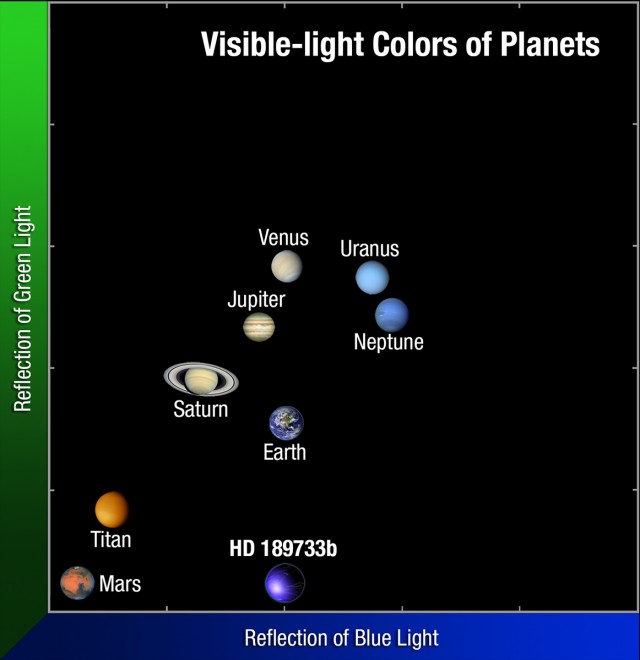
blue_planet_image2-640x660As for the cause of the color itself, the current theory is that the planets atmosphere is full of clouds that contain tiny silicate particles, which absorb some light frequencies but reflect and scatter blue light. In the words of NASA, because the surface of the planet is around  815 Celsius (1,500 Fahrenheit), these particles are likely in a molten, liquid state that periodically turn into rain. Yes, you read that right, the planet experiences periods of molten glass rain!

In addition to that, it is also known that its orbital period (length of a year) is only 2.2 days. The planet is also tidally locked, meaning that one side is always facing towards the sun while the other experiences perpetual night. So basically, outside of its blue color, HD 189733 b is about as uninhabitable as it gets.

Ah well, the search for a truly Earth-like exoplanet continues I guess! And in the meantime, enjoy this short video from Hubble ESA – a computer graphic representation of the universe’s other “blue planet”:

Source: Extremetech.com