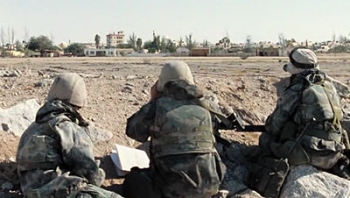
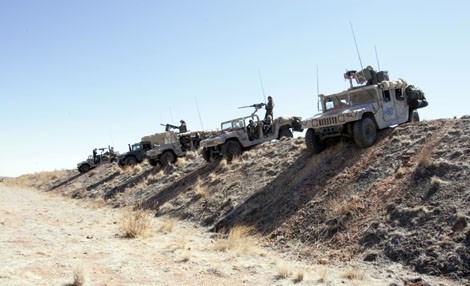
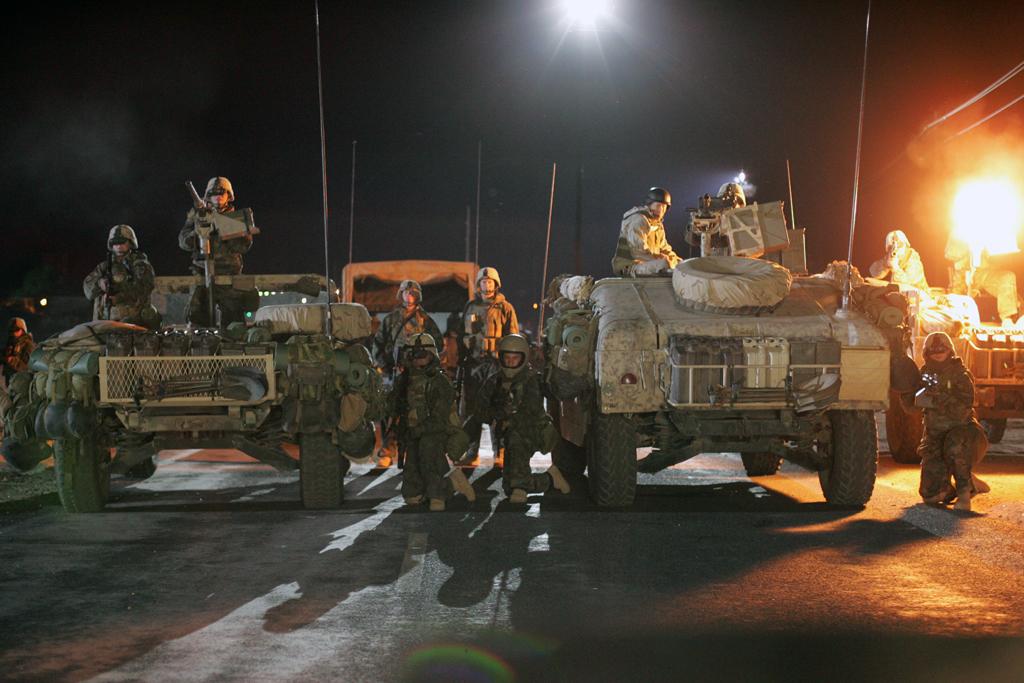
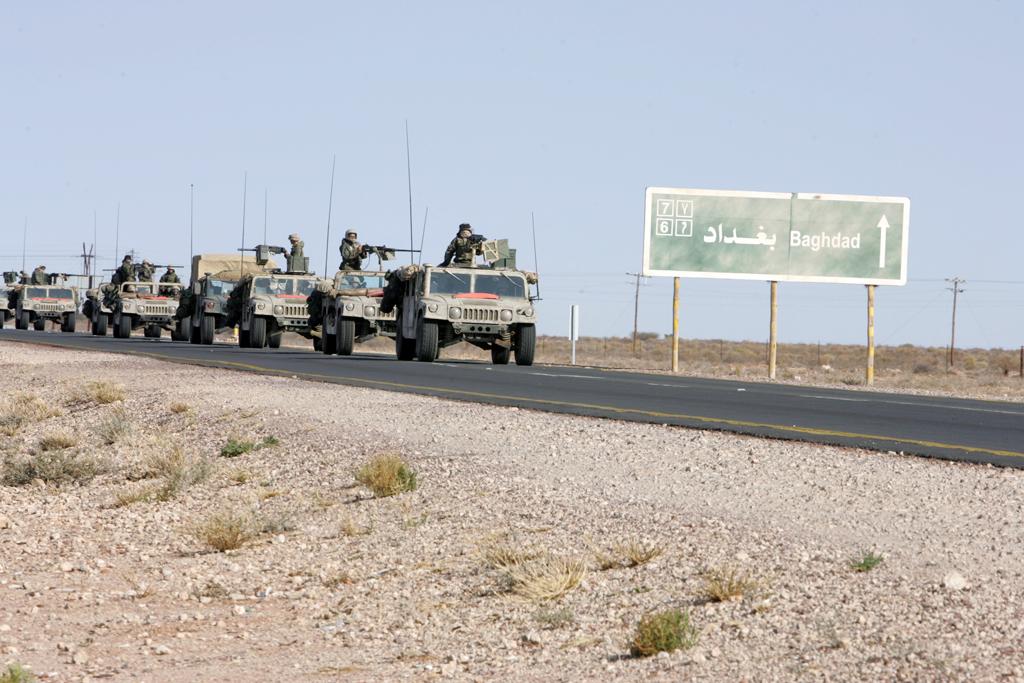
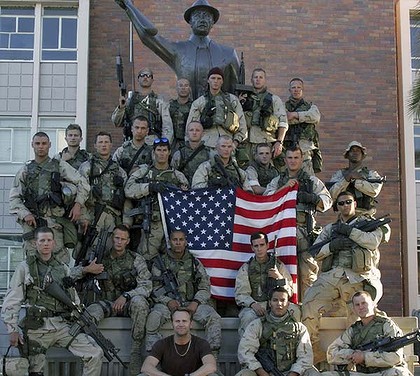
Video Game Review: The Modern Warfare Series

Morning all, or afternoon or evening as the case may be. Lousy time zones! Today, I thought I’d get back to my promise of reviewing video games by tackling a series I’ve been wanting to get into for some time. Like most geeks, and just about all guys, I am a fan of first person shooters. Not the violence for violence’s sake type that emerged en masse after the release of Doom, mind you, but the kind’s that used the platform creatively and intelligently.

Which is one thing I always liked about Call of Duty and similar franchises. During the early millennium, it was one of many WWII-era FPS games that sought to reenact history’s greatest war by giving players a first-person perspective on the whole thing. Over time, the depictions became more and more realistic, and embraced more theaters and battles that aren’t usually addressed in popular culture.

And after three incarnations of WWII, the makers naturally decided it was time to make a game that dealt with combat in the modern era, that took advantage of the all the recent developments in firearms, aerial drones, night vision, thermal vision, and other assorted high-tech devices. In short, they thought it would be cool to have players running around with the latest toys and shooting things up in an up-to-date simulation.

However, in this case, the designers also were required to come up with a modern storyline that would reflect the attitudes of today’s military planners and the situation we know find ourselves in. Unlike the other games, whatever story they came up with would be fictitious and speculative for the first time ever. And, in my humble opinion, this is where they were just the slightest bit weak. Sure, Modern Warfare 1, 2 and 3 do have some rather kick-ass gameplay and an intense storyline to them, but they aren’t exactly realistic.

To demonstrate why, let me get to the first game in the series…

Call of Duty 4: Modern Warfare:
Released in 2007, Modern Warfare was one of the critically acclaimed and well received games of all time. Whereas the Campaign Mode of the game (i.e. single player) was lauded for its intensity and immersive quality, it was the Multiplayer that really wowed critics and gamers alike. Unlike previous COD games, the additional features, such as the ability to call in air strikes and helicopters, as well as unlocking new weapons and types of camouflage, was entirely new.

In fact, GamePro magazine even compared the multiplayer aspect favorably to Halo 3, a franchise that was yet to be rivaled by anyone! And personally, I think gamers enjoyed the ability to play a game that features weapons and tactics they know to be current and real, and not lasers, BFG’s or antiquated weapons. But of course, there was far more to this game than just the gameplay, which I shall get into now…

Plot Synopsis:
The story is a familiar one, one which has been told many times over since the end of the Cold War. And for the sake of the game, it comes in two separate strands which invariably come together towards the end. In the first, Russia has fallen into a state of civil war with the rise of an ultra-nationalists front who are led by a former communists named Imran Zakhaev. He who wants to return Russia to its Soviet past,

In the second strand, a militant Salafist regime led by a man named Khaled Al-Asad has seized power in an unnamed Middle Eastern nation and is apparently being backed by the ultra-nationalist Russians who is sending them nukes. This is apparently a move on behalf of Imran Zakhaev to divert attention from his civil war, and its works!

Yes, this too is a familiar tale, the kind of thing that Israeli and US policymakers have nightmares about. But like I said, the identity of this nation is never specified. One minute things are taking place near Mecca, Saudi Arabia; the next, in Basra, Iraq. Yeah, not doing much to dispel the notion that all Arab nations are the same, dude!

And so the two threads unfold, with you playing as both the British SAS (Special Air Services), who are busy trying to stop the exchange of nukes. After a failed attempt to stop the shipment of one, you are sent to Russia to team up with with Loyalist forces and rescue a contact named Nikolai, a recurring figure in the MW series.

Things then switch over to the US perspective, where you are a Marine Lieutenant Vasquez who is part of the US invasion of the unnamed Middle Eastern nation. In the initial invasion, your Marine unit searches for Al-Asad in the capitol’s tv station, but is too late to retrieve him. As operations progress in the capitol, the warning comes in that Al-Asad has a nuke and is preparing to set it off. All units begin to evacuate, but your unit doesn’t make it out before the blast!

Back in Russia, the SAS manage to finally track down Al-Asad who appears to be hiding out in a safehouse in Azerbaijan. After working him over, he recieves a call from Zakhaev, and the SAS team leader, Captain Price, shoots Asad and explains who Zakhaev is. Apparently, he performed a “wetwork” mission against Zakhaev back in the early 90’s, shortly after the fall of Communism when Zakhaev was just another revisionist trying to get his hands on nuclear material in the abandoned town of Pripyat, Ukraine (outside of Chernobyl). In the course of the mission, Price managed to take down Zakhaev, but instead of delivering the fatal bullet, merely cost him an arm.

Now, years later, it is time to finish the job. With Al-Asad dead, Zakhaev and his forces have managed to seize a major Russian missile silo and are threatening to launch the nukes. When his son, whom the SAS try to seize in order to gain some leverage over him, commits suicide to avoid capture, he goes over the edge and orders the launch. At this stage in the game, you are now part of a joint operation between the US Marines and the SAS and your job is to storm the silo and input the countermand codes before the nukes reach the Eastern Seaboard.

Once that is done, you and your team begin to beat a hasty retreat and are pursued by Zakhaev’s men. The mission then ends with a tense final showdown where you are required to take out Zakhaev with a handgun while he and his men have you cornered and try to finish you off. The good ol’ Russian Loyalists then arrive on scene to medevac you and your friends to safety.

Good Points and Bad:
Like I said already, the gaming experience of this installment in the COD series is pretty badass. Picking up where COD: World at War left off, you have the ability to call in air strikes by “painting” targets with a designator, something that wasn’t available in the first three installments. Second, the use of modern weapons, from M4’s, SAW’s, M203s, RPG’s, AK’s, Flashbangs, Claymores, Suppressors, SPAS-12’s – the list goes on! – is quite cool. Not to mention the scene where you are able to take control of an AC-130 gunship, watching a theater of engagement from above through thermal scopes and be able to bombard targets with either a minigun, a bofors cannon, or a 105mm howitzer.

This idea, incorporating the latest in weapon’s technology, is something which every MW installment adds to in it’s own way, combining the speculative with the current and cutting edge. In this installment, they kind of kept it to the current and tried and true, but it was still fun. As a geek and guy, I was familiar with many of these pieces of kit already, thanks to years of reading up on them and watching TV programs about war. Being able to use them in a gaming environment was pretty sweet!

As for the weak stuff, well I’ve mentioned that already… For one, the story is a kind of predictable and tired one, one which the makers clearly knew the audience would buy into. For almost two decades now, fiction writers and amateur analysts have been saying that it’s only a matter of time before some Middle Eastern regime gets its hand on a thermonuclear device and tries to use it on Israel or US forces. And in every version of this scenario, it’s always Russia that gives it to them, mainly because it’s been theorized that the Russians are not in control of their stockpile of nukes or would be willing to sell them for cheap.

I’m bothered by the reiteration of this story for the simple reason that it’s both stupid and terribly cliched. It’s a well known fact that after the fall of the former USSR, Russia took great pains to make sure it got all its nukes back from its former allies and that those nukes are all accounted for and have been under lock and key for the past twenty years. What’s more, Russia is not run by total freaking morons. They know that if they tried to sell any nukes to a Middle Eastern country, or any regime for that matter, that they would be inviting sanctions, embargoes and even open war on themselves. In the wake of the Cold War economic collapse Russia went through and the rise of a privatized, investor-based economy, this is not something they can afford.

Also, with every spy agency in the world – the CIA, MI6, the Massad, and the KGB – and countless bodies like the UN, NATO,  and the Atomic Energy Commission watching them, no Russian general who might have access to the nuclear stockpile would ever be dumb enough to try and negotiate a private sale. No matter how much money was in it for them, they would know that to steal a Russian-made nuke would put them in the cross hairs of every “wetboy” (i.e. assassin-spy) on the planet! There would literally be no place in the world where they would be safe. What’s more, the idea that any Middle Eastern regime would become an instant threat if it got a nuke is also ridiculous.

Since 1992, Israel and the US have maintained the position that if Iran, Syria or any other Middle Eastern nation that has not signed a peace treaty with Israel got a nuke, they would attempt to use it. Just how stupid do they think Arab nations are? Israel maintains a stockpile of over 200 nukes and the US has one that numbers in the thousands. Once said Arab regime used this one nuke and took out a single city, they would be nuked several hundred times over, their country completely obliterated in the process. Does anyone really believe that any nation would be willing to watch all of its citizens die just for the sake of some measured revenge? I certainly hope not! The only reason why this notion is taken seriously at all is the fact that decades of inaccurate portrayals, propaganda and bigotry have led many people to believe that Arabs and Muslims are viscous, crazy, hateful people who’ll stop at nothing to kill Christians, Americans and Jews.

And yet, the fiction of this idea persists, mainly because it’s the only way writer’s like Tom Clancy can keep outputting spy novels in the post-Cold War era. His book Op Center was based on this very idea, of a Russian general who sells a nuke to some Middle Eastern terrorist for a small fortune. The plot of The Peacemaker was also built around this very same concept, and in the movie Broken Arrow it is openly said that anyone wanting nukes could just got to Russia, where they would “give you a half dozen for the price of a BMW”. Bullshit, man! If it’s such a plausible scenario, then why hasn’t it happened already? For the same reason that WWIII has not happened, and that is, once again, that no one is willing to risk total annihilation for the sake of politics or ideology.

But I can understand why they took this approach. Again, in the post-Cold War era, there aren’t really a lot of stories that provide the same interest and intensity as the potential for nuclear war. But it does demonstrate just how tired and unrealistic this plot device has become. And the only reason I labor the point is because it only gets more like this the longer the franchise goes. It capitalizes on the fact that the American public really doesn’t know that much about the world or its people, and are willing to believe various doomsday scenerarios because they’ve been so inundated with them by movies and fiction for so many years.

But how else are you going to create a fun and accessible WWIII scenario?  An in the end, it doesn’t take away from the awesome gaming experience that Modern Warfare truly is. Stay tuned, up next, the sequel!
The Post-Apocalypse in Sci-Fi (Part III)

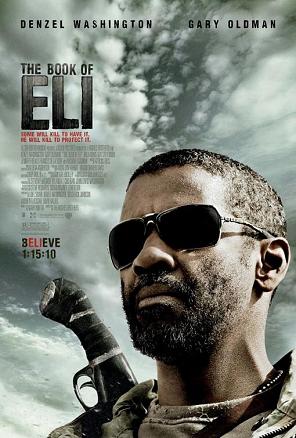
The Book of Eli:
This 2010 movie – starring Denzel Washington, Gary Oldman and directed by the Hughes Brothers – takes place in a post-apocalyptic United States thirty years after nuclear war has left it a scarred and desolate place. Enter into this a wandering nomad named Eli (Washington), a man who is wandering to the West Coast with a mysterious book that “a voice” commanded him to take there. As he travels, the importance of his task is made clear, as the history of the post-war world he is making his way through.

Along the way, he encounters a town run by Carnegie (Oldman), a  man who dreams of building more towns and controlling their residents through the power of a (again) a mysterious book he has heard about. His men are busy at work, searching the surrounding countryside for this book, but so far to no avail. When Eli arrived in town, Carnegie forces him to stay, as he is the only other literate person he has ever encountered.

Ultimately, it is learned that Eli has the book Carnegie is seeking, and that this book is none other than the Bible. He escapes from town and is pursued by Carnegie’s daughter, Solara (Mila Kunis). He explains to her that the Bible he carries is the last remaining copy since all others were destroyed after the nuclear holocaust. He was guided to it by a voice, he says, and has since been making his way across the country, guided by his newfound faith.

Eventually, Carnegie catches up to them, mortally wounds Eli and takes the Bible for himself. However, Solara manages to escape from his custody and begins transporting Eli to San Francisco so he can complete his mission. They come at last to Alcatraz where a group of survivors has been holding up under the watch of the curator named Lombardi (Malcolm McDowell). When Solara reveals they have a copy of the King James Bible, they let them in. Eli, who for the first time is revealed to be blind, begins reciting the Bible from memory.

Back in Carnegie’s town, he manages to unlock the Bible and is horrified to see it is in braille and that his wounds will soon kill him. Meanwhile, Eli dies in Alacatraz just as the printing press there begins printing copies of the Bible and the curator puts the original on a shelf next to the Torah, Tanakh and the Qur’an. Solara decides to leave and head back home, taking with her Eli’s possessions in the hopes of making a difference. She, like him, has become a wanderer guided by faith.

Granted, the message of this movie might seem a little over the top. I, for one, can’t imagine why post-apocalyptic people would destroy Bibles. If anything, I would think they would take their frustrations out on science and turn to religion for solace. Still, the point is made very clear through several key acts of symbolism. Eli, though blind, is guided by faith and it keeps him alive. And though he is robbed of the Book, the true source of it’s power, which Carnegie wants to abuse for the sake of power, lies in Eli’s own self. Really, the message couldn’t be more clear, and yet it is demonstrated with a degree of subtly that one would not ordinarily expect from a movie with a religious message. But it’s not so much about the Bible itself, it’s about maintaining hope and faith in a world where these things have been abandoned.

A Canticle for Leibowitz:
Published in 1960 and written by Walter M. Miller Jr., this novel is a considered a classic of post-apocalyptic sci-fi by genre fans and literary critics alike. Renowned for its themes of religion, recurrence, and church versus state, this book has generated a significant body of scholarly research, yet it was strangely the only novel Miller wrote in his lifetime.

Inspired by Miller’s own participation in the bombing of the monastery  at Monte Cassino in WWII, the story takes place in a Catholic Monastery in the South-Western US after a nuclear war – known as the “Flame Deluge” – takes place. Known as the Albertian order, the monks who inhabit this monastery are dedicated to preserving humanity’s scientific knowledge and rebuilding civilization over the course of thousands years.

The story opens roughly 600 years after the war takes place, in a time when science and technology, even the idea of literacy itself, has been almost wiped out by a campaign known as “Simplification”. At around the same time, a Jewish electrical engineer named Isaac Edward Leibowitz, who worked for the military, converted to Christianity and founded the Albertan order.

After generations of hiding and smuggling books to safety within the orders walls, Leibowitz was betrayed and sacrificed by “Simpletons”, at which time the Catholic Church had him sainted and ordered the monastery beatified. Centuries after his death, the abbey is still preserving “Memorabilia”, the collected writings that have survived the Flame Deluge and the Simplification, in the hope that they will help future generations reclaim forgotten science. The story is structured in three parts titled: “Fiat Homo”, “Fiat Lux”, and “Fiat Voluntas Tua” (Let There Be Man, Let There Be Light, Thy Will Be Done), with each part comprising six centuries each.

In Fiat Homo, which takes place in the 26th century, events revolve around a young novice who while on a Vigil, finds his way to a bomb shelter with the help of a mysterious Wanderer. The discovery triggers an uproar at the Monastery, as it seems that the shelter contains relics belonging to Leibowitz himself. Some fear the sensationalism triggered by the discovery will hurt Leibowiz’s canonization, which is still being debated. After many years, the canonization is given the green light and Francis is sent to New Rome to represent the order at the Mass. Unfortunately, he is murdered in the wilderness and is buried, by none other than the Wanderer himself!

Fiat Lux opens up  in the 32nd century, 6 centuries later, when the New Dark Age is coming to an end and a New Renaissance beginning. At this point in time, the Abbey is coming into conflict with the city-state of Texarkana, a metropolis’ who’s growth was hinted at in the last pages of Fiat Homo. The mayor, Hannegan, is essentially an upstart dictator who intends to become ruler of the entire region my manipulating alliances and gaining access to the Abbey’s own stores of knowledge. In the end, Hannegan’s intentions to occupy the abbey and make war on his neighbours leads to a schism whereby Hannegan is excommunicated by the Pope and he declares loyalty to the Pope to be a crime in his domain.

In the last part, which takes place towards the end of the 38th century, humanity has once again returned to a state of advanced technology, complete with nuclear power, weapons, and even starships and extra-solar colonies. As a state of cold war sets in between the Atlantic Confederacy and the Asian Coalition, the Order begins to enact a contingency plan known as “Quo Peregrinatur Grex Pastor Secum” (“Whither Wanders the Flock, the Shepherd is with Them”). As the nuclear bombs begin to fall, members of the Order board a starship and launch for deep space. With Earth about to succumb to nuclear war yet again, the Order is heading out to ensure that both humanity and its knowledge survives.

The stories central themes, which include the rivalries between church and state and the cyclical nature of history, are what make it such a memorable and enduring classic. Even though it is set in a fictitious future, it is loaded with allegories that connect it to the past. Nuclear war in the near future is the fall of Rome, the ensuing New Dark Ages a reiteration of the last, and the final nuclear holocaust between the Coalition and Confederacy represented contemporary fears of nuclear Armageddon.

By the Waters of Babylon:
Also known as “The Place of the Gods”, this short story was originally published in 1937 by Stephen Vincent Benét. Taking place in a future where industrial civilization has been destroyed, the story is narrated by a young man named John, a son of a priest who’s people live in the hills. In his day and age, John’s people believe that past civilizations were in fact Gods. There homes are considered hallowed ground and only priests are permitted to handle metal artifacts taken from them.

Eventually, John decides that he will go to the Place of the Gods, an abandoned city that was once part of industrial civilization. In order to gain his father’s approval, he claims he is going on a spiritual quest, but keeps the intended location a secret. John then journeys through the forest for eight days and crosses the river Ou-dis-sun to make his way to the sacred place.

Once he gets to the Place of the Gods, he finds abandoned buildings, statues and countless indications that the “Gods” were in fact human. When he finally finds the remains of a dead person in an apartment, he comes to realize the truth. The Gods were in fact humans whose power overwhelmed their better judgement, hence they fell.

Upon returning to his tribe, John tells his father of the place called “New York”. It is at this point that it is made clear that the “hill people” live in the Appalachians, and the river he crossed was the Hudson. In the end, his father warns him that recounting the experience to the other tribe members will have destructive consequences. The truth, he claims, can be bad if not conveyed discretely and in small doses. The story ends with John promising that once he becomes the head priest, “We must build again.”

Farnham’s Freehold:
Based on his own experiences in building a fallout Shelter, this 1964 novel by Heinlein involves a family that is transported to the future after a nuclear explosion puts a dent in their reality. In addition to the thematic elements of nuclear war and time travel, the book also contains some rather interesting commentary on race relations and segregation in the United States at the time.

The story begins with the Farnham family holding a bridge game in their home, which is attended by Hugh, his alcoholic wife Grace, their son and daughter (Duke and Karen), her friend Barbara, and a black domestic servant named Joe. After they are alerted to the fact that nuclear war is commencing, the people rush to the bomb shelter and wait for it to pass. When it seems that the bombs have stopped falling and their oxygen is running low, they walk out and begin to investigate.

What they find is that they’ve been transported to Africa, where an advanced civilization now exists that uses white people as slaves. Initially, they suspected they had been sent into an alternate dimension, but quickly realize that they are in the future. They are spared because Joe, their black domestic servant, is able to communicate to their captors in French.

In time, Hugh and Barbara agree to take part in a time-travel experiment in exchange for their freedom. They are sent back to their own time, where they escape from the bomb shelter just as the bombs begin to fall. However, they soon realize that they are not in their own time, but an alternate dimension where things are just slightly different. They survive the war and agree to spend the rest of their lives trying to prevent the future they saw from coming to pass.

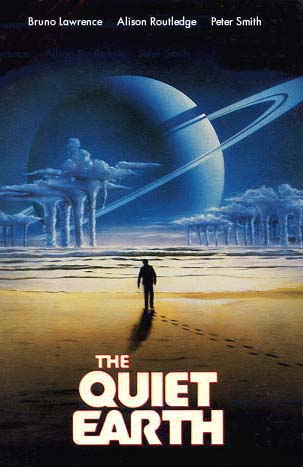
The Quiet Earth:
Originally a novel written by New Zealand author Craig Harrison in 1981, this story went on to inspire the loosely-adapted film of the same name which was released four years later. In both cases, the story revolves around a small group of survivors who awaken to find that the world is now devoid of humans and most other forms of life, and that time itself seems to have stopped.

The story begins with John Hobson, a geneticist who was experimenting with using radiation to activate dormant genes, which was meant to have an accelerating effect on human evolution. He wakes up in a hotel room from a nightmare where he was falling, only to find all clocks stopped at 6:12. Upon leaving the hotel, he finds that all clocks have stopped at 6:12 and that everyone appears to have simply vanished. He dubs this phenomena “The Effect” and begins looking for other survivors.

His journey takes him back to his research facility where he finds the corpse of his partner, Perrin, inside the radiation chamber. Retrieving Perrin’s locked box of papers and grabbing some weapons and supplies he sets out for Wellington. Eventually, he finds someone, a Māori lance-corporal named Apirana Maketuin, who agrees to accompany him. They eventually reach the capitol and settle in, hoping to find other survivors and run tests on “The Effect”.

Things deteriorate before long, as Hobson begins to worry that Api might be a psychopath due to his wartime experiences in Vietnam (he finds pictures of him posing with the mutilated corpses of Viet Cong). His plans to kill him with sleeping pills are interrupted when they accidentally run over a woman in the street while joyriding. They return to the hotel and make her comfortable but know she will inevitably die. This leads to a further breakdown between Hobson and Api and they fight. Api dies in the confrontation after apparently giving up.

Finally, Hobson breaks open Perrin’s box and realizes that his partner had him under surveillance because he considered him unstable. Hobson comes to the conclusion that the Effect was his doing since the the project cause the unraveling of animal DNA, and hence only those with the dormant gene pair would be spared. It is at this time that Hobson begins to have flashbacks from his last days at the facility, during which time he sabotaged the machine because of growing misgiving about the project and mistrust for his Perrin’s motivations. It was this sabotage that caused the Effect, and the reason Hobson slept through it was because he took what he thought was a fatal dose of sleeping pills.

Maddened with grief and guilt, Hobson jumps from the window and begins to fall to his death. But then, he wakes up in the same hotel room he found himself in at the beginning, recalling the same dream where he was falling. He checks his watch and it says it’s 6:12… Spooky! Though it bears a strong resemblance to such works as I Am Legend, The Quiet Earth went beyond in that it chose to focus on the themes of perception, culpability, and alternate states of consciousness. All throughout the book, it is not quite clear if Hobson is dreaming, in an alternate dimension, the last man on Earth who is responsible for the death of countless life forms, or just plain crazy.

Shadow on the Hearth:
This post-apocalyptic novel, which was the first novel to be released by Canadian sci-fi author Judith Merril (1950), takes place a week after nuclear bombs have devastated, but not destroyed, civilization as we know it. The plot revolves around a mother named Gladys Mitchell and her two daughters – Barbara and Ginny, who are fifteen and five years of age – as they struggle to deal with worsening conditions and a system that is quickly becoming an abusive dictatorship.

For starters, all civil authority has broken down in the wake of the war and been replaced by the Security Office, a form of emergency services that exercises all power. Gladys’ contact with the services is the local “emergency squadman”, Jim Turner, a neighbor who begins to display a rather creepy fascination with Gladys along with a desire to turn the emergency to his own advantage.

Similarly, the difficult situation breeds suspicion and intolerance on behalf of the authorities who begins see enemies everywhere. The Mitchell’s maid, a woman named Veda, comes under suspicion when it is learned that she was off sick during the time of the attack. Much the same is true of Gladys’ old science teacher, who predicted that nuclear war would be inevitable and now fears the paranoid Security Office might suspect him.

Meanwhile, Gladys tried to maintain a disposition of stoic calm, mainly because she believes its her role as a mother to act as though everything is fine. While her intentions are good, she’s slow to admit that Turner and the authorities are corrupt, that their situation is bleak, or that she might need to manipulate certain people to get her way. But in the end, she is willing to go to great lengths to protect her family, from both external threats and the threat of dissolution.

In several key aspects, this story demonstrates some of the overriding themes and feelings that were present during the early cold war. We have the specter of war and dictatorship, the focus on the single-parent family, the idea of domesticity and sexism, and the affirmation of the mother figure who will do whatever it takes, even if she seems naive and silly, to keep her family safe and secure. While it might seem dated by modern standards, it is nevertheless a fitting and accurate portrayal of life in the 1950’s and the likelihood of what would come of it if the bombs started to fall.

The Time Machine:
Last, but not least, we have the story that has made my lists in one form or another on numerous occasions. In addition to being an example of utopian and dystopian fiction, The Time Machine is also a fitting example of post-apocalyptic science fiction. This is part of what makes H.G. Wells novella a timeless classic, in that it transcends or jumps between genres and can therefore be read from a number of different perspectives.

In this respect, the Time Traveler’s trip to the distant future, where the world has degenerated into a two-tier structure between the monstrous Morlocks and the stagnant but beautiful Eloi, can be seen as an example of post-apocalyptic society. What’s more, their respective degeneration is seen as the result of humanity’s obsession with class distinction, the masters becoming lazy and ineffectual while the workers have become cannibalistic and brutish.

Another apocalyptic element in the story comes towards the end when the Time Travelers recovers his machine from the Morlocks and travels another 30 million years into the future. Once there, he sees some of the last living things on a dying Earth, a red landscape similar to that of Mars which is covered by lichenous vegetation and crab-like creatures wandering across blood-red beaches. As he jumps further, he sees the Earth’s rotation gradually cease and the sun die out, the world falling silent and freezing as the last organisms die off.

In a deleted section of text, which H.G. Wells apparently included in the original serial version at the behest of his editor, but cut from the novel once it was published. Here, Wells demonstrated “the ultimate degeneracy” of man by having the Time Traveler escape from the Morlocks and jump once more before traveling 300 millions years into the future. Here, he found an unrecognizable Earth populated by furry, hopping herbivores, which he interpreted to be the descendents of the Morlocks and Eloi. Thus, in addition to first losing the instincts that defined humanity at its greatest, the Morlocks and Eloi, themselves descended from humans, even reverted to an earlier state of evolution in the end.

Though not a post-apocalyptic tale in the strictest sense, this story does contain the necessary elements of such a story. You have humanity degenerating as a result of cataclysmic events or its own inherent weaknesses, civilization as we know it being destroyed or disappearing, and even the world itself coming to an end.

Final Word:
And that’s all I got for post-apocalyptic sci-if. Sure, there are countless more examples that could be included, but three lists is enough for me and I’m neck deep in other concepts that are vying for page time. In the coming weeks, expect more news on technology, space exploration, the upcoming anthology, Data Miners (set for release in August) and plenty of assorted tidbits on stuff that relates to the world of science and science fiction. Take care all and see you again soon!

Of Terraforming

Several scientific subjects have piqued my interest as of late, particularly the ones that relate to the colonization of other planets. And there are plenty of good reasons for this. First off, NASA has been talking at length about a possible Mars mission which will be begin in 2030. Second, the topic is central to the novel my group and I are writing. And third, because it’s what I do. I’m a geek, dammit! Do I really need any other reason?

So in honor of this fertile and increasingly relevant topic, I thought I’d dedicate a post to the science of terraforming and its depiction in popular culture. Like the majority of your more radical ideas, the concept first appeared around the turn of the 20th century. As part of the larger trend of exploring planetary colonization, several historical developments contributed to this phenomena.

Foremost amongst them was the closure of the American frontier by 1900 and the partitioning of Africa in 1905. With the “Age of Discovery” officially over, scientists and dreamers began to look farther abroad for the next place to move to. Refinements in the fields of metallurgy, chemistry, and astronomy also contributed to the idea that planets like the Moon, Mars, Venus, Europa, Ganymede, and even other star systems, could be colonized.

And thanks to the advent of the Space Race, the Apollo missions, and Eco-engineering in the latter half of the 20th century, scientists have begun to take a serious look at terraforming, particularly in regards to Mars. While the practicality, feasibility and affordability are all still being debated, the very fact that there is a serious scientific debate would seem to indicate that it may very well be done someday.

And so, here is a list of science fiction novels from the last century that have explored the idea of terraforming. Once again, I hope you enjoy reading about them as much as I enjoyed researching them, and incorporating some of what they taught me!

Last and First Men:
This future history by Olaf Stapledon, released in 1930, is the first time that the terraforming of Venus is made in fiction. This was only a fragment of the larger story, which focuses on human evolution over the course of two billions years. Nevertheless, the move to Venus is an intrinsic part of the story involving the “Fifth Men”, who are forced to relocate after Earth becoming uninhabitable.

This occurs only after humanity pushes the local inhabitants to extinction after a protracted war. Afterward, they begin the process of transforming Venus to meet their needs. Like all early accounts, the description was hampered by the fact that knowledge of Venus was highly inaccurate. For example, Stapledon’s account has Venus covered in oceans, rather than the pits of sulfuric acid which are now known to be there.

Farmer in the Sky:
Here we have Robert A. Heinlein’s 1950 story which focuses on a family which has moved to Ganymede, which is in the process of being terraformed. Earth is overcrowded in this day and age, and farming colonies are being established in Jupiter’s moon to help provide much needed food supplies.

The process of creating the new farms is explained in some detail. For example, the topsoil is created from scratch by pulverizing boulders and lava flows, and seeding the resulting dust with carefully formulated organic material. Pressurized housing is erected to ensure that new arrivals are able to adjust, since the atmosphere is not fully breathable. And Ganymede is shielded from Jupiter’s intense radiation by a massive heat shield.

Hints are even given that establish that Ganymede once boasted an indigenous civilization, or was at least visited by one in the past. This includes a working land vehicle that has many legs, essentially a large metal centipede.

The Sands of Mars:
Next we have Arthur C. Clarke’s 1951 novel, which happened to be his first published work. And curiously enough, it is written from the point of view of a famous science fiction author. A case of art imitating life, or art as wish fulfillment? In any case, the setting is a research facility on Mars, which is in the process of terraforming so it will be able to become a self-sufficient colony.

Based on Clarke’s descriptions, this terraforming process (known as “Project Dawn”) involves some rather curious steps. The first is the ignition of the moon Phobos so that it will become a second “sun” for Mars. It will burn for at least one thousand years and the extra heat, combined with the mass production of the oxygen-generating plants, will eventually make the Martian atmosphere breathable for humans.

In many respects, this served as a preview for the plot of 2001: A Space Odyssey and it’s sequel 2010: Odyssey Two (see below).

The Martian Way:
In keeping with the tradition of sci-fi greats, this next novel was written by Isaac Asimov and first published in 1952. The story is told from the point of view of Scavengers, Mars-born humans who spend their time scouring space for the spent lower stages of spacecraft. This sort of lifestyle, making do with less and toughing things out, is known as the “Martian Way”.

At this point, Mars is still very much dependent on Earth for water shipments, which are used for fuel as well as consumption. Life takes a turn for a worse when an ambitious Earth politician decides to cut of the “Wasters”. In response, the protagonists come up with an ambitious plan, to fly to Saturn’s Rings and tow back an asteroid made of pure ice.

The trip is difficult and takes many months, but the Martian Scavengers manage to snag an asteroid that will supply two hundred years worth of water. This, they begin to use to transform the ecology of Mars, and turn the tables on the Earth government.

The Psychotechnic League:
Written by Poul Anderson over the course of two decades, the Psychotechnic League refers to a series of novels and short stories that are set in the same universe. Of all these stories, two in particular deal with the terraforming of Solar Planets. In “The Big Rain”, Venus is being terraformed, a process of planetary engineering that takes several centuries to complete.

In “The Snows of Ganymede”, the focus shifts to the Jovian moon where scientists are able convert the planet to the point where it experiences seasons similar to Earth. This, in addition to Mars, Venus and several other Solar Planets, all come together in time to form the Solar Union. Because of Anderson’s realistic description, the term “big rain” became associated with scientific terraforming models.

The Space Odyssey Series:
Arthur C. Clarke’s series, which began with the novelization of the classic film 2001: A Space Odyssey, revolves around the terraforming of Europa by a super advanced race. Known as the Firstborn, these aliens use the Monoliths to travel throughout the universe to foster the development of sentient life. Millions of years after fostering the development of high-order primates on Earth, they shifted their focus to Europa, Jupiter’s ice moon.

Much as in “Sands of Mars”, the process involved the creation of a “second sun”, this time involving Jupiter. In the first novel, the story ends with David Bowman, the only astronaut to survive an exploratory mission to Jupiter after their ships AI (the HAL 9000) malfunction and kills the crew.
When he arrives, he discovers a Monolith in orbit around Europa and disappears without a trace shortly thereafter.

In 2010: Odyssey Two, a second mission is mounted to determine the whereabouts of the first. When the joint US-Soviet mission arrives at Europa, they come to realize that the planet is showing signs of life. They also learn that the Monoliths are in the process of turning Jupiter into a sun so that Europa’s icy surface will evaporate and form an atmosphere, allowing all the life contained underneath to emerge and grow.

In the subsequent novels, Europa is revisited after its transformation is complete. Although sentient life does not appear to be possible, the planet does boast an atmosphere and vast oceans, which teem with sluggish sulfur-based lifeforms. In the end, after the Monoliths are convinced that humanity deserves a reprieve, and they land on Europe to commence building peaceful relations with the Europan life forms.

Mars Trilogy:
We finish with the most recent and profound example of all, the Mars Trilogy by Kim Stanley Robertason. The trilogy’s three works – Red Mars, Green Mars, Blue Mars – all focus on the ongoing efforts to transform Mars from an arid, hostile world with barely any atmosphere to a lush, hospitable planet capable of supporting human life.

The first novel deals with the initial colonization effort, which begins with the crew of the Ares, a ship carrying 100 scientists drawn predominantly from the US and the Soviet Union. Upon arriving, the crew builds the first settlement, known as Underhill, as well as colonies on the hollowed out asteroid-moon of Phobos.

After debating what is to be done with Mars, whether to turn it “Green” or leave it “Red”, the United Nations Organization Mars Authority (UNOMA) eventually opts for the “Green” option and terraforming begins. This process involves the drilling of “moholes” in the surface to release subsurface heat to thicken the atmosphere and the detonation of nuclear devices deep in the sub-surface permafrost to release water.

Green Mars, which begins 50 years after events in the first novel, during the dawn of the 22nd century. At this point in time, the Martian landscape is evolving thanks to the expansion of plant life, hence the name. The process is stimulated though the use of continent-sized orbital mirrors which focus sunlight to and away from various sectors of the planet, to melting the northern polar ice cap, and digging moholes deep enough to form volcanoes.

In the third and final installment, Blue Mars, long-term terraforming has created atmospheric pressure and temperature conditions that allow for the presence of liquid water on the planet’s surface, forming rivers and seas. This all takes place over the course of the following century, long after Earth has flooded and revolutions have displaced corporate control of the planet. Because of this, Mars has become the principle planet of the Solar System.

Summary:
Terraforming efforts have come a long way in fiction, and hopefully some day soon they will be realizable. Even though the concept remains highly speculative at this point, all proposed efforts are currently focused on Mars. In all ways that count, Mars has everything we would need to make it suitable for human habitation. This includes water, in the presence of the frozen ice caps and possibly underground rivers, and high concentrations of carbon and oxygen in the form of CO2, nitrogen, and gravity to keep the atmosphere anchored.

And most importantly of all, Mars’ atmosphere closely resembles that of Earth several billions of years ago. In time, due to the development of photosynthetic bacteria, enough oxygen was produced to allow for the development of animals. Though the careful introduction of similar bacteria and plants to Mars surface, humans could speed that process along and eventually create a breathable atmosphere. This, in turn, will allow for the creation of an ozone layer and weather patterns. Combined with the melting of the polar ice and underground aquifers, this will lead to surface water in the form of rivers, streams and oceans.

Generation Kill

Hey all. Today I’m stepping outside the box to cover a review in honor of a friend of mine. Master Seaman Chris Jenkins, who recently moved across the country and won’t be in our neck of the woods for the next three years. Ah, that’s going to be rough. Luckily, there’s still this thing known as the internet and the communications it allows for.

And like I earlier, I still owe him this review and I hope it finds him in good spirits when he gets to the other side of the country. And since I loved this series myself, I’m willing to step outside the confines of sci-fi to honor it. It was downright awesome, and historically relevant. So here goes…

Background:
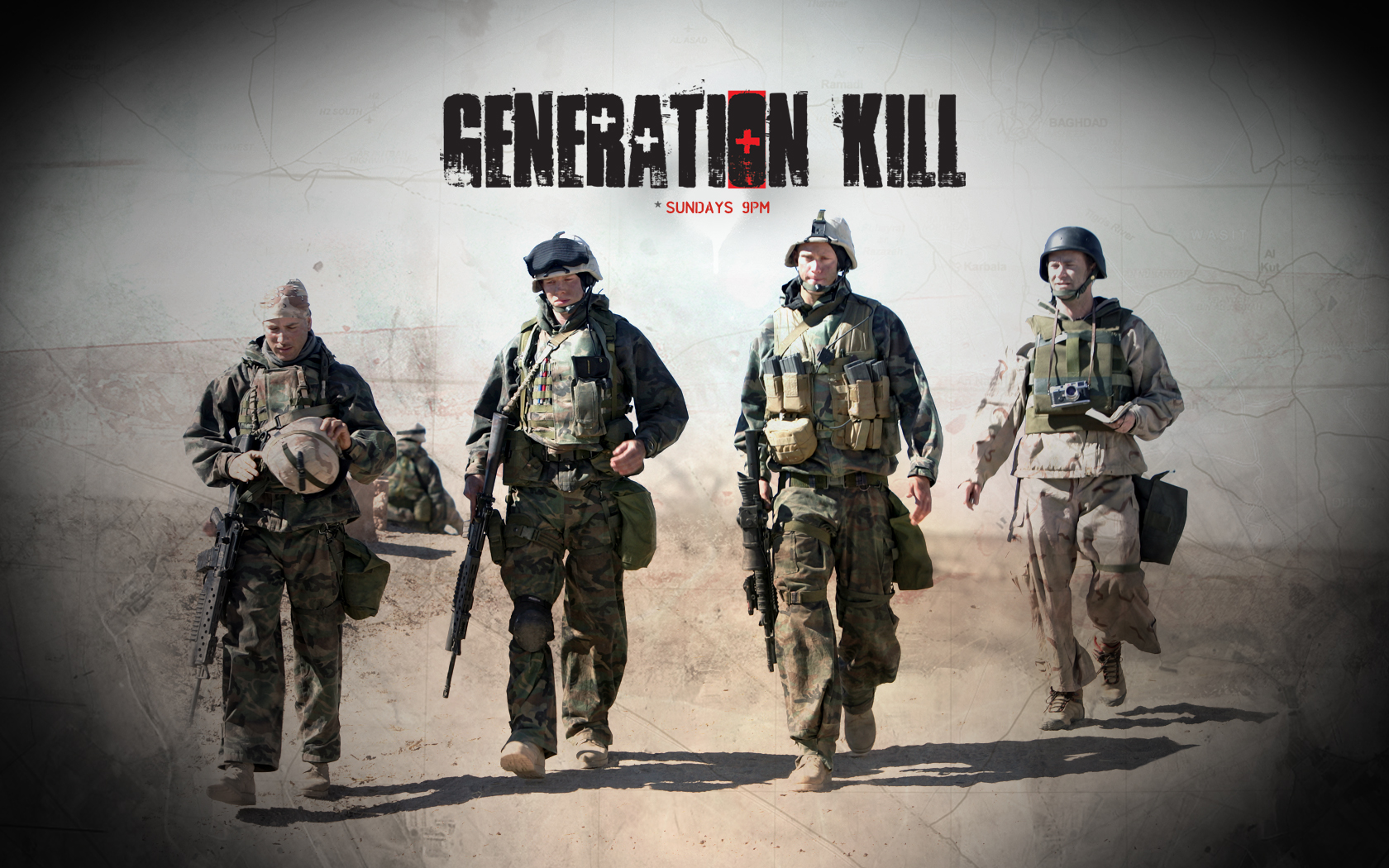
For those who don’t know, Generation Kill was an HBO miniseries adapted from the book of the same name. Said book was the result of reporter Evan Wright’s own experiences as an embedded reporter with the 1st Marine Reconnaissance Battalion during the 2003 Invasion of Iraq. In the course of his time with them, he had a first hand view of the invasion and all the problems that resulted.

And therein lies the real value of this miniseries. Whereas many people who witnessed the invasion, particularly in the US, seemed to think that the initial phase of the war was a success, that problems didn’t arise until after the occupation began, this series and the book that inspired it shows that the problems that would come to consume Iraq were there from day one. These included lawlessness, incompetence on behalf of the civilian planners, civilian deaths, insurgency, and the glaring gap between the reality of the situation on the ground and how it was being portrayed by politicians and media.

Plot Synopsis:
The story, which begins with the invasion and culminates in the arrival and settlement of 1st Recon around Baghdad, is told through seven episodes. Each one catalogs a different phase in the war effort, showing events from multiple points of view of those who fought with Bravo Company, the Company which led the way during the invasion.

Episode 1: “Get Some”
The episode opens with the 1st Recon Battalion, Bravo Company, conducting training drills inside Kuwait outside of Camp Mathilda. The embedded reporter from Rolling Stone magazine, Evan Wright (Lee Tergesen), arrives at camp and is given to 2nd Platoon where he receives a frosty welcome. Considering him a member of the “left-wing liberal media” they don’t have much love for him, until they learn he used to write for Hustler magazine!

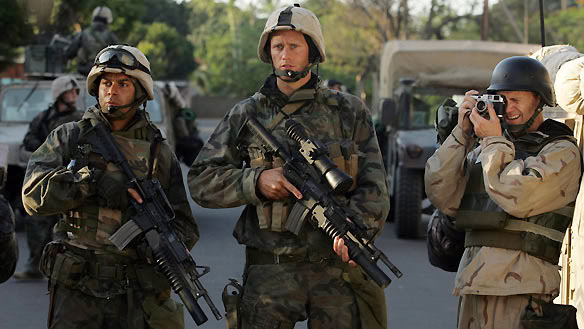
He quickly makes the acquaintance of the men of Bravo company whom he will be riding with in the lead Humvee. This includes Sgt. Brad “Iceman” Colbert (Alexander Skarsgard, Erik on True Blood), Cpl. Josh Ray Person (James Ransone), and relative FNG Lance Cpl. Harold James Trombley (Billy Lush). Throughout the first episode, we also get to meet many other “characters” of interest.

These includes Lt. Col. Stephen Ferrando (Chance Kelly), who was given the nickname ‘Godfather’ because throat surgery has left him with a harsh, whispery voice. Then there’s Lt. Nathaniel Fick (Stark Sands), the levelheaded commander of 2nd Platoon; Cpt. Craig ‘Encino Man’ Schwetje (Brian Patrick Wade), the well-meaning but incompetent commander of Bravo Company; Dave ‘Captain America’ McGraw (Eric Nenninger), the edgy and unstable commander of 3rd platoon; and Sgt. Rodolfo ‘Rudy’ Reyes, aka. “Fruity-Rudy” (played by himself), the metrosexual Marine who acts as the glue of Bravo Company.

Significance: This episode familiarizes the viewer with several realities that Marines in the 1st Recon had to deal with. The first and most obvious is shortages, which the Marines are constantly told to make do with. The second is the fact that much of Bravo Company’s own officers are inept, enforcing pointless rules instead of focusing on troop morale or making sure they have the right kinds of equipment.

Episode 2: “The Cradle of Civilization”
The invasion is now underway and 1st Recon is sent to An Nasiriyah where the invasion has stalled. Bravo Company begins to lead the way through the town and is given orders to fire on anyone they deem a threat. They encounter minimal gunfire until Cpt. McGraw, using a captured AK, opens fire on civilian cars for no apparent reason. They continue to press forward north into Mesopotamia, “The Cradle of Civilization”.

After taking a wrong turn, Bravo company rushes onward to reach to its next objective outside the town of Al Gharraf by nightfall. In the dark, Bravo company comes under fire by a group of armed Iraqis and takes them down without difficulty. They score their first kills and survive their baptism by fire, and Bravo company celebrates before moving on.

Significance: This episode is the first time that 1st Recon experiences combat and the first time that Cpt. McGraw commits a stupid act in the line of duty. His confiscating of an AK and firing randomly is a constant source of irritation as time goes on, but nothing is ever done about it. In addition, this episode, specifically the layout of the town, the bridge and the operation into the town, was the inspiration for COD: Modern Warfare 2, much like how scenes from Enemy at the Gates inspired Call of Duty 1 and 2 and COD: World at War.

Episode 3: “Screwby”
After surviving their first engagement, Bravo presses forward. When they reach a roadside hamlet, the company look on in disbelief as a regimental combat team arrives and obliterates the hamlet and its inhabitants, none of whom appeared to be armed. Shortly thereafter, Bravo heads north to the town of Ar Rifa, where Captain Schwetje orders a “danger close” artillery barrage on the settlement. Lt. Fick intervenes to try to prevent the unwarranted barrage, but to no avail. Once again, civilians are killed due to incompetence of senior officers.

Eager once more to press ahead, “Godfather” orders 1st Recon to push ahead another 40 km and capture an airstrip being controlled by Iraqi Republican Guard unit that is apparently equipped with tanks. Once again, Cpt. MgCraw begins to undermine morale by making all kinds of panicky statements, namely that they are going to die if they go up against the tanks. Also, in order to reach the airfield, they are forced to leave behind their supply trucks behind.

Once again, Bravo Company is given permission to open fire on anything that moves. In the lead Humvee, Cpl. Tromblay opens fire on people running along the roadside and severely injures a small boy. The Company secures the airfield, which appears to be abandoned, and then insists that command medevac the boy to a nearby base. Command is hesitant, but eventually agrees, and both Sgt. Colbert and Cpl. Tromblay are to told to expect consequences for the incident.

Significance: In this episode, we get a solid glimpse of how civilian deaths in Iraq are being swept under the rug and written off as justifiable. The soldiers are beginning to feel the weight of this and cracks begin to show in their morale and resolve. After both engagements, in the hamlet and Ar Rifa, they tell each other to put it out of their minds and move on, knowing that there isn’t much they can do about it.

Episode 4: “Combat Jack”
1st Recon reaches the airfield and encounters minimal resistance, the Republican Guard unit having already evacuated and left their tanks behind. This puts 1st Recon ahead of the rest of the American invasion, which is seen as something favorable to command. However, they soon learn that by leaving their supply trucks behind, that Iraqis have captured and looted them. Amongst the supplies was most of Bravo Company’s rations and an American flag, which means they are now down to one meal a day.

Alpha Company is then tasked with a different mission: to recover the body of a captured Marine who was murdered in Ah Shatra. The mission takes a turn when when CIA agents show up and declare that a special army of Iraqi Freedom Fighters will take the town for the sake of their propaganda campaign. However, the army deserts the next day after an artillery barrage fails to clear the town of the enemy. Meanwhile, Bravo company continues clearing hamlets along the northern route and sets up a roadblock outside of Al Hayy. The rules of engagement here are unclear, and Bravo ends up destroying a large truck and killing all passengers, uncertain if it even posed a threat.

Significance: Three major developments happen in this episode, all of which demonstrate a considerable amount about the unfolding war. First, it becomes clear to the Marines that their officers are making all the wrong calls, but as long as they continue to be successful, command will keep making them. The operation outside of Al Hayy shows just how important propaganda efforts are to the war effort, namely maintaining the illusion that the Iraqis welcome the invasion as liberation. And last, we get a first glimpse of how the Marines will have problems acting as police in the streets, mainly because they are not trained for the role.

Episode 5: “A Burning Dog”
1st Recon finally gets some solid intel from the locals, which says that there is an ambush waiting for them up ahead. The ambush is attacked by some LAV’s, and Bravo is ordered to cross the bridge at night. However, they hit a snag along the way and the convoy gets stuck, just as a group of fresh ambushees show up to attack them. Schwetje once again shows his incompetence by being unable to resolve the situation, and Cpt. McGraw once again panics and begins screaming over the open radio. Things are only resolved when Rudy intervenes and inspires Cpt Schwetje to think outside the box.

By morning, Bravo company learns that they are not soldiers, but militiamen, many of whom came from Syria and farther abroad. On passports recovered from the bodies, it says that their reason for coming to Iraq was “Jihad”. Bravo continues north to Al Muwafaqiyah, where they are tasked with setting up another roadblock and with destroying the Republican Guard outpost, which, unfortunately, is in the town’s only school. Despite Colbert’s orders to hold their fire unless its absolutely necessary, Bravo has another incident at the road block and a small child is killed.

Significance: This episode is especially significant because it shows how the roots of the insurgency began long before the war ended. Whereas Captain Schwetje thinks this is proof of what Bush said about their being terrorists in Iraq, the others see from their passports that the “Jihadis” didn’t enter Iraq until the day after the US declared war. Already, the invasion is beginning to have consequences that no one seemed to plan for, particularly in how it is involving people from outside Iraq. What’s more, the mounting civilian deaths is forcing the Marines to question the war and what their role in it really is.

Episode 6: “Stay Frosty”
Outside of Al Kut, Cpt. McGraw nearly kills a prisoner with his bayonet after his Company defeats a small group of armed Iraqis. His men are becoming more disillusioned in his command, and Sgt. Eric Kocher (Owain Yeoman) of 3rd platoon learns that he is being held accountable for the incident. Afterward, McGraw’s men refuse to allow him to anywhere near prisoners, for fear that he will attempt to stab them again. In addition, 1st Recon learns that Godfather’s counterpart in the Regimental Combat Team is being relieved of command despite his success. Apparently, command is reigning people in due to problems with deaths and insubordination.

Problems also begin to arise between Captain Schwetje and Lt. Fick because of their earlier disagreements after he hearsof this. Schwetje’s NCO, Gunnery Sgt. Ray Griego (David Barrera), suggest to him that command is alluding to Fick’s own insubordination when they spoke of insubordination, and begins spreading rumors about Fick behind his back. While Fick is told not to question Schwetje orders again, Fick demands that Schwetje also reign in Greigo for his unprofessional and insubordinate behavior towards himself.

Shortly thereafter, 1st Recon is tasked with escorting Iraqi civilians fleeing from Baghdad down the highway, a mission which makes them feel humane amidst all the slaughter. Colbert is confronted by an Iraqi woman who speaks perfect English and challenges him on the nature of the war, which he appears to take to heart. Unfortunately, while attempting to peacefully force cars coming the opposite direction turn back, another Iraqi is killed, this time an old man.

Significance: The immediate value in this episode is in how it shows how the wrong people are being blamed for failures while those who continue to screw up remain in positions of authority. We also get to see how the war is being perceived by the Iraqis, which is put into words by the female student who challenges Colbert on the road from Baghdad. And last, the incident involving the old man shows once again how civilians are being killed because combat soldiers are being assigned police duties, again as the result of bad planning. And last, but not least, it is indicated that the troops are now within reach of Baghdad, which they hope will end the war and all the stupidity and craziness they have been forced to endure.

Episode 7: “Bomb in the Garden”
1st Recon finally reaches Baghdad and is treated to some rest and reprieve in an abandoned cigarette factory. However, the rest doesn’t last long as they are called upon to mount patrols into the city and deal with shortages, looting and sporadic sniper fire.

Having only one translator, they are limited in what they can do and realize the problems the residents are face are entirely beyond their abilities. This is complicated further by constantly changing orders, a lack of necessary supplies, unruly locals and cultural misunderstandings. The situation only gets worse and the city continues to descend into anarchy.

1st Recon is soon relocated to a soccer stadium away from the action. At their new digs, the tensions that have been simmering for weeks finally boil over during a friendly football game. Wright conducts his last interview with Godfather where he learns that McGraw is not going to be punished for two near-stabbings.

He then says goodbye to the men of 2nd Platoon being carried off by helicopter, an event which seems tearful after all they’ve seen together. One of the Marines begins to show the movie he’s put together from the footage he’s shot over the course of the war. While the men initially enjoy watching it, they slowly begin to lose interest and drift away, thanks to all the bad memories it evokes.

Significance: This episode is the most significant of all because of how it showcases the reality of life in Baghdad during and immediately after the war. Contrary to public perceptions, the chaos and violence were almost immediate, and it was abundantly clear that the military hierarchy had no idea what to do about it. this, above all else in the show, highlights the lack of planning on behalf of the Bush administration and the Pentagon before the war began. Faced with victory, the soldiers were completely unprepared for the situation they faced as soon as the shooting was over.

Of equal significance are the scenes at the soccer stadium, where everyone seems burnt out and angry despite the fact that the war is now over. No one is in the mood to celebrate; in fact, everyone seems itching for a fight for someone specific. During the pick-up game, Schwetje is punched in the face by one of his men, and Cpl. Person attacks Rudy for no apparent reason. During his final interview with Lt. Col. “Godfather” Ferrando, Wright learns that there will be no consequences for any of the officers who screwed up along the way, highlighting the lack of accountability that runs like a vein through the show.

And finally, the scene where the Marines watch the video – this is the only scene in the miniseries that is accompanied by background music. Not a word is said, and yet the mood and the point are conveyed so clearly. The war is done, they have won, and yet everyone feels terribly bitter and angry. All that we need to know about the Iraq War is said in this one scene, with the men who fought in it preferring not to see the replay because it reminds them of everything they want to forget.

Summary:
As if it wasn’t clear already, I LOVED THIS MINISERIES! The tone, the pacing, the subtle way things are conveyed, the gritty and realistic nature of it all. It captured the essence of war, and was so much better because you watch it knowing that it all happened. Some might say that since it is being told from one man’s point of view, it would reflect his own particular biases and perspective. However, the series is shot from multiple points of view and reflects the very in-depth interview process which Wright conducted before releasing the book.

This comes through immediately in the show, where Wright appears to be little more than a background figure until the very last few minutes of the last episodes. And even then, the focus shifts back to the troops, where it always was during the course of the series. This diversity of perspectives gives the show a very broad and varied feel and let’s the viewer become acquainted with all that is going on, which is essential given the nature of the show.

Even people who don’t like war movies will find something to enjoy here. It is historic, it is personal, it is human and it is real. The characters are very rich, and the series has absolutely no shortage of keen dialogue. Cpl. Josh Ray Person has to be the funniest man in the series, and the antics of the men in the first Humvee, where Wright was embedded, were priceless. Several discussions which still stick out in my mind include when the grunts learn that Wright once worked for Hustler, the many times “Iceman” Colbert calls Person a “Whiskey Tango” (phonetic alphabet for White Trash), and the discussion concerning the nature of “November Juliet” (you’ll have to watch the series to learn the meaning of that one!)

Above all, what makes this story so effective is that it is a first-hand account of the events that took place in 2003, told by a member of the same media that helped to sell the war to the American public. Defying the conventional view that the war was an act of liberation that was embraced by the Iraqis, and only went bad long after major combat operations ended, the series shows that this was an operation doomed from the get-go. All the problems that would later come to haunt the “rebuilding phase” – basic shortages, cultural misunderstandings, insurgents, civilian deaths, failure to plan, shifting orders, and negligence in dealing with rioters and insurgents – were all there from day one.

For many years after the invasion, the American people were left in constant state of confusion and controversy as an intransigent administration and hand-picked military spokespeople tried to spin the situation, refused to accept responsibility for the failures, and insisted the situation was salvageable. It was only with time that they came to realize that the truth was always there, happening on the front lines, and that it was kept from them for political reasons. The situation had not changed, only their perception of it.

Well, that’s all I got to say about Generation Kill. I hope you enjoyed reading this review as much as I enjoyed watching the miniseries. And if you’re reading this Chris, I hope you especially enjoyed reading it. It got a little wordy there, I know. I’m known for that but this time, I really tried to keep it to 50, 000 words or less 😉

The Walking Dead, Season 3 Preview

Another lovely preview to make the rounds at this year’s Comic Con was the hit show The Walking Dead. Take a look at the latest preview for Season Three, the most lengthy and detailed look at the inside what’s coming yet! This includes “the prison”, the town of Woodbury, and Michonne, the sword-wielding badass heroine!

Thanks to Khaalidah for sending it to me, I was ignorant of it til now. Take a gander and, like me, get very impatient for October!

10 Sci-Fi Novels People Pretend to Have Read

Came across this article in Io9 recently, then again over at Scoop.it. You can tell something is important not only when it speaks to you, but when like-minded individuals begin referencing it! And if you own a blog, you definitely want to get on that! In any case, I found the list especially interesting for two reasons. One, many of the books I have already read. And two, I haven’t even heard of the rest.

I’d say a list like this is long overdue, but it’s still highly subjective isn’t it? The books we pretend we’ve read all comes down to what we consider important and relevant, not to mention popular. And even within the genre of sci-fi, I’d say that list is too big to boil down to a simple top ten. Even so, it’s interesting to read and compare, and find out just how many you’ve read yourself. So please, check this out and tell me which of these you have read and which you think you’ll want to check out:

1. Cryptonomicon:
Read it! This book is Neal Stephenson’s groundbreaking piece of historical fiction, combining narratives involving World War II cryptographers with modern day IT geeks who are looking to establish a data haven in the South Pacific. The story tells the tale of a massive shipment of Nazi gold that got lost on its way to Japan, ran aground in the Philippines, and remained hidden until the late 90’s.

Personally, I loved this book because of the way it weaves history, both recent and distant, into a seamless narrative and draws all the characters into the same overarching plot. One would think that Stephenson was making a point about how we are all subjects of our shared history, but it could just be he’s that good a writer!

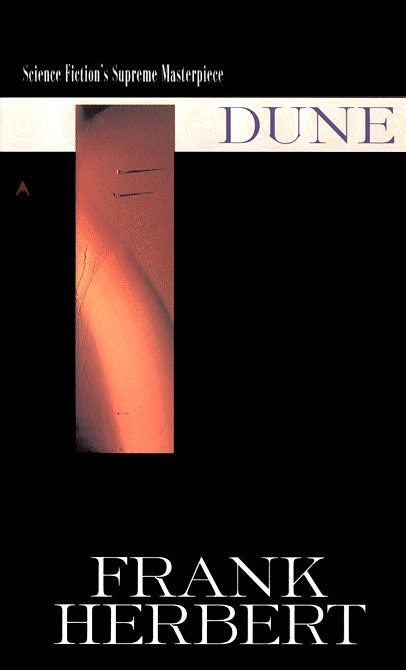
2. Dune:
Read it thrice! In Dune, Frank Herbert draws upon an immense store of classical sci-fi themes, a grand awareness of human nature and history, and a keen grasp of ecology and the influence environment has on shaping its inhabitants to create the classic that forever established him as one of the greatest sci-fi minds of all time.

Sci-fi geeks everywhere know this one and it saddens to me to think that it’s even on this list. Anyone who’s willing to pretend that they read this book clearly considers it important, which is why they should have read it, dammit! Not only is it a classic, it’s from the guy who literally wrote the book on science fiction that was meant to be taken seriously.

3. Gravity Rainbow:
Never heard of it! Apparently, the story came out in 1974 and deals with the German V2 rocket program near the end of World War II. Pat Murphy, author of The City, Not Long After and The Wild Girls, went so far as to compare this book to James Joyce, a the great Irish modernist writer who was also renowned for being brilliant and inaccessible.

In addition to be classified as enriching, it is known for being odd and hard to get through, with many authors themselves claiming to have started it several times but never being able to finish it. The plot is also rather unique, combining transgressive sexuality with the idea of total war and technological races. But one look at the dust jacket will tell you all of that, right? Crazy Germans!

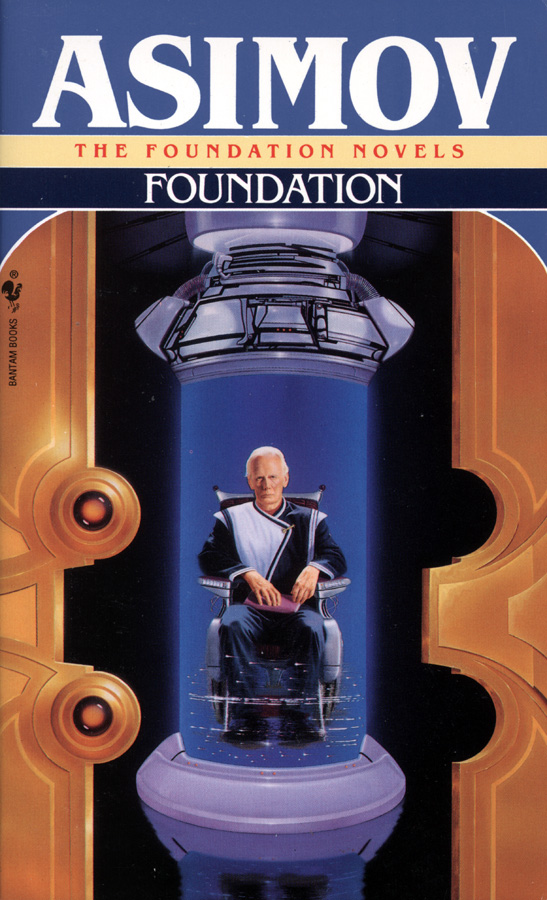
4. Foundation:
Read it myself, and also am somewhat sad that it made the list. Sure, the fact that it’s a classic means that just about everyone who’s eve shown the slightest interest in sci-fi would want to read it. But I can’t for the life of me understand why people would claim to have read it. Jesus, it’s not a hard read, people. And Amazon sells used copies for cheap and handles shipping. No excuses!

And having just reviewed it, I shall say nothing of the plot, except that it in many ways inspired fellow great Frank Herbert in his creation of Dune. Like Frank, Asimov combined the idea of a Galactic Empire with a keen awareness of human history, eternal recurrence, and prescient awareness.

5. Johnathon Strange & Mr. Norrell:
Now this one I have heard of, but never felt compelled to pick up and read. Apparently, its size and bulk are the reason many people react the same. This 2004 book is the first novel by British writer Susanna Clarke which deals with the nature of the English character and the boundary between reason and irrationality.

Set in 19th-century England during the time of the Napoleonic Wars, the story is an alternative history that is based on the idea that at one time, magic existed in England and has thanks to the help of two men – the namesakes of the story, Jonathan Strange and Gilbert Norrell. At once interesting and speculative, it also presents the rather romantic vision of romance returning to a world increasingly characterized by modernity and cold reason.

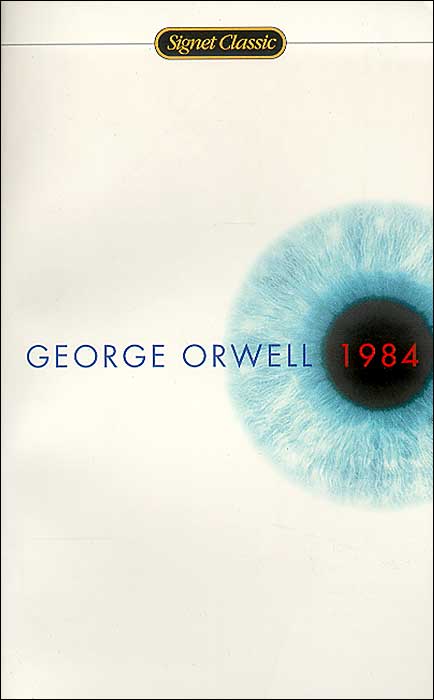
6. 1984:
Yep, read this one thrice as well! And given it’s reputation and place in the annals of literary history, I can totally see why people pretend to have read it. Oh, and let’s not forget the way people love to reference and abuse it’s message for the sake of making a quick and easy political point! But none of that excuses not reading it.
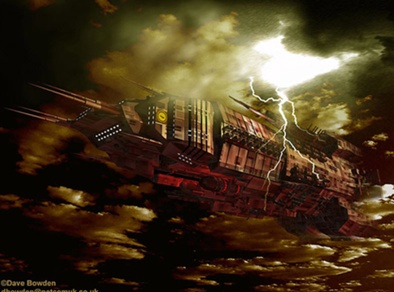
Set in an alternate history where WWIII and revolution have led to totalitarian governments in every corner of the world, the story tells the tale of one man’s quest to find answers and facts in a world permeated by lies and absolute repression. Of course, this meager description doesn’t do it justice. In the end, so much comes into play that it would take pages and pages just to provide an adequate synopsis. Suffice it to say, it’s a book that will change your life. READ IT!

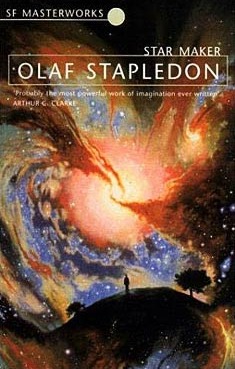
7. First and Last Men and Star Maker:
Another one which I’m not too sure about. Much of what is described within are concepts I have heard of in other places, and some of the content sounds familiar. Still, can’t say I’ve ever heard of Stapledon or these two works by name. But after reading about his work, I’m thinking I ought to check him out now. Tell me if you’d agree…

Published in 1930 and 1937, these two books tackled some rather broad ground. The first deals with the history of humanity, covering 18 species of humanity from the present to two billion years into the future. Based on Hegelian concept of history, humanity goes through several different types of civilizations and passes between stability and chaos over the course of it all. However, undeniable progress is made, as each civilization reaches further the last, culminating in leaps in evolution along the way.

In Star Maker, the plot revolves around a man who is able to leave his body and venture throughout the universe. He is able to merge with more minds along the way, a snowballing effect which allows him and his companions to explore more and worlds through time and space. This leads to a climax where a cosmological mind is created and makes contact with the “Star Maker” – the creator of the universe.

Sounds cool huh? And they appear to have no shortages of accolades. For example, Arthur C. Clarke called Star Maker one of the finest works of science fiction ever written, and the concept explored therein had a profound influence on many subsequent sci-fi minds, not the least of which were Gene Roddenberry and J.M. Straczynski.

8. The Long Tomorrow:
This one, I have heard of, mainly because it’s on my list as an example of post-apocalyptic fiction. I have yet to read it, but after reading about it, I think I would like to. Set in a post-apocalyptic world devastated by nuclear war, the story takes place within a society that is controlled by religious groups preaching a technophobic message.

Inevitably, the story comes to a head when young people, intrigued by stories of a neighboring community, go out in search of it, braving punishment and even exile. Sounds familiar? Well, it should. This book, which was published in 1955, has gone on to inspire countless variations and pop culture renditions. It also attempts to illustrate the connection between natural disasters and regression, traditionalism and repression.

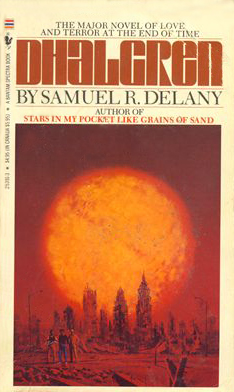
9. Dhalgren:
Yet another book that’s compared to James Joyce, largely by people that haven’t read it. I’m one of them! Apparently, this 1975 story by Samuel R. Delany takes place in a fictitious Midwestern town that has become cut off from the outside world by an event horizon. All communications are cut off, and the population become frightened by the night sky reveals two moons, and the morning sun is many times larger than our own.

More strange is the fact that street signs and landmarks shift constantly, while buildings that have been burning for days are either never consumed or show signs of damage. Gangs also begin to roam the nighttime streets, their members hidden within holographic projections of gigantic insects or mythological creatures. Against this backdrop, a group of people come together and try to make sense of what has happened as they struggle to survive.

Told from the point of view of a partial amnesiac, dysmetric, schizophrenic, as well as a bunch of other people who find themselves stranded in the city, the story is an exercise is confusion, dissociation, and a really just a big mystery. In the end, what is truly going on is never revealed, thus leaving the reader with their own interpretations. This is one of the selling points of the book, with William Gibson himself saying that it was “A riddle that was never meant to be solved.” Yeah, I definitely need to read this one!

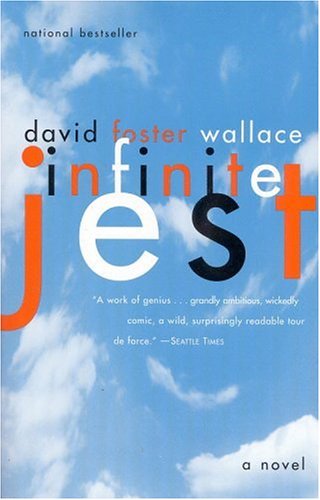
10. Infinite Jest:
This last novel is more recent, having been released in 1996. Once again, haven’t heard of it, but given its content, praise, and the fact that the author’s low life was cut tragically short, it doesn’t surprise me that its one of those books that everyone feels they must read. But given the length, complexity and the fact that story contains 388 numbered end notes, I can see why they’ve also held back!

The story focuses on the lives of a celebrity family known as the Incandezas, a clear pun on their, shall  we say… luminous fame? The family is deeply involved in tennis, struggles with substance abuse, and in a state of disrepair since the father – a famous film director – committed suicide with a microwave. His last work was apparently a film (entitled “Infinite Jest”, but known throughout the story as “The Entertainment”) which is so entertaining, it causes viewer to lose all interest in everything besides watching the movie.

Clearly meant as a satire on North American culture, particularly celebrity families, entertainment, substance abuse and the sideshow that is celebrity rehab, the story is all about various people’s search for the missing tape of “The Entertainment” and what they plan to do with it. The novel received wide recognition and praise after its publication and became a testament to Wallace’s talent after he committed suicide in 2008.

Okay, that’s four out of ten for me. How did you do? And even if you could say that you’ve read most of the books on this list, or at least the one’s you’ve heard of, I’d say we’ve all come away with a more additions to our reading lists, hmmm? Yeah, I guess its back to Amazon for me!

What more can I say? Just read the freaking article. It’s free…

Molly Wetta's avatarwrapped up in books

If I had a nickel for every time I have been asked to recommend a book that is “like The Hunger Games,” I could double my paycheck. It’s great that kids are excited about reading, but I hate that even though we have multiple copies of the most popular read-alikes, they are often checked out. Our dystopian/post-apocalyptic reading list hadn’t been updated in over a year, so at first I started to add to that, but I realized that it wasn’t capturing everything that attracted readers to The Hunger Games.

It was also difficult to organize. I’ve seen a few infographics on dystopian fiction, like this one from Goodreads that has lots of fun facts about the history of dystopian fiction and this one from E M Bowman that outlines the elements of dystopian fiction, they were highlighting ones that were already popular. There was a list compiled…

View original post 150 more words

Dystopan Literature Over Time

Came across this list on Goodreads, thanks largely to Molly Spring’s post (which I will reblog next since it’s pretty dawn awesome!). Basically, the table gives graphic representation to historical trends and the popularity of dystopian lit over the past few decades. Though it does preclude Yevengy Zamyatin’s We and Jack London’s The Iron Heel by a few years, it manages to pick up in the early 30′ with the creation of Brave New World.

Cataloging what led to the creation of that and all many subsequent dystopian classics, the creator of this infographic shows how our perceptions and tastes – as expressed through popular dystopian visions – have changed over time. In the end, the point seems to be that we’ve evolved from thinking simply that the state is the primary threat to human freedom in our world. Things like body image, reproductive rights, environmental issues, nuclear weapons, epidemics (both man-made and natural) and agism.

You might think that it’s making the point that people have more to worry about today than they did before. But personally, I just think it’s pointing out how the literature is evolving to focus on our own evolving sense of self and understanding of ourselves. You know the old saying, “the world isn’t any worse, you just understand it better?” Well, it’s a little like that. The literature isn’t any darker, just more complex. Quite the little romp too, if you ask me. 

The Foundation Series

When it comes to science fiction, few authors have achieved the kind of notoriety and prolific ouput of Isaac Asimov. Amongst the greats of classic sci-fi, he considered one of the “Big Three”, along with arry Niven and Arthur C. Clarke. And when it comes to his many novels, short stories, articles and thoughtful essays, two series stand out above all else. The Robot series and, more importantly, the Foundation novels.

Not only did they get the ball rolling on many major sci-fi themes that would come up again and again over the years (such as the concept of a Galactic Empire), they once again brought commercial science fiction into the limelight by showing how hard science could be merged with real history to produce genuinely thought-provoking literature. This is a trend which seems to be necessary once every generation years or so, with Frank Herbert doing it again roughly a decade later. And in his case, much of the inspiration came from Asimov himself.

So in honor of that accomplishment, and to mark the occasion that I finally finished reading the original trilogy, I thought it was high time that I start reviewing the Foundation series, beginning with the book that started it all. So without further ado, here’s Foundation!

Plot Synopsis:
The story opens many thousands of years in the future, where humanity has spread to occupy the entire Galaxy and is governed by the Galactic Empire. For over 12,000 the Empire has stood, and appears to still be stable and powerful. However, a trend of decay has set in and some suspect that it’s only a matter of time before the Empire falls

One such man is Hari Seldon, a scientist who has perfected a form of psychology and mathematics known as psychohistory. Having calculated the exact date and sequence of events which will lead to the collapse of the Empire, he has also created an organization that will be dedicated to ensuring that the dark ages that naturally follow will be as brief as possible – one thousands years instead of the alternate 30,000.

Divided into five parts – each of which was published throughout the 1940’s and together in a single volume in 1951 – the story jumps forward in time from the starting point, 0 F.E. (Foundation Era), to several hundred years in the future. Several protagonists are employed, people who find themselves at the center of events in any given period. Each period involves the emergence of a “Seldon Crisis”, a calamity that was predicted by Seldon’s psychohistory in advance, and the requisite response by the Foundation to resolve it. The first story, which sets up the subsequent stories and crises, is aptly named:

The Psychohistorians: Told from the point of view of Gaal Dornick, a young mathematician who has travelled to the capitol world of Trantor to meet Seldon, the story moves from their introduction to Seldon’s arrest by the Committee of Public Safety. Named after the Revolutionary body that send countless French citizens to their death after the 1789 Revolution, this committee is made up of Imperial aristocrats who are angered by Seldon’s philosophy and want to see him silenced. However, not wanting to martyr him, they instead tell him and his Foundation to pack up and move to Terminus, a world on the edge of the Empire.

The story then concludes with Seldon telling Dornick that he knew this was coming, and that it was actually all part of the plan. By being able to set up the Foundation at the edge of the Empire, it will be in a perfect position to begin enacting its policies once the Empire begins its inevitable slide into decline and loses control of first the periphery, and then the core systems. Thus, the most important lesson about psychohistory is presented for the first time: like a prescient science, it predicts all things and all things happen in accordance with its laws.

The Encyclopedists: Fifty years later on Terminus, the Foundation scholars have begun work on the Encyclopedia Galactica, the complete compendium of scientific knowledge for when the Empire falls. Unfortunately, the Empire is surrounded by four independent kingdoms that are in danger of threatening Terminus. The mayor of the planet, Salvor Hardin, is the protagonist of this story, and believes that the only way to keep their neighbors at bay is to pit them against each other. He perceives an opportunity when the Kingdom of Anacreon, which hopes to place military bases on Terminus, reveals that the four kingdoms no longer have nuclear technology.

Later, Hardin’s own rivalry with the Board of Trustees (the people responsible for the Encyclopedia) come to a head when Seldon’s Vault – a mysterious chamber which opens whenever a “Seldon Crisis” is imminent – opens to deliver a message. According to Seldon’s hologram, the creation of the Encyclopedia was a ruse to hide Terminus’ real importance. The true goal of the Foundation is to further science in a galaxy as it becomes consumed by interplanetary strife. Realizing that they are no longer in control, the Board hands its political power to the Terminus City mayor who graciously accepts.

The Mayors: Beginning in 80 F.E., this story revolves around the Foundation’s efforts to bring technology to the Four Kindgoms. This has the effect of creating a priesthood of sorts in these states, reminiscent of early medieval Europe where Roman priests were dispatched to western European kingdoms to establish centers of learning. Salvor Hardin has been re-elected many times over the course of the decades but faces an impending problem as an “Action Party” threatens to overthrow him. Fearing that Anacreon is slowly overtaking them, they want power so the Foundation will fight back.

On Anacreon, it is also becoming clear that the young King Lepold I faces an internal threat from his uncle, Prince Regent Wienis. Before he can come of age, Wienis plans on seizing power for himself. Central to this plan is using a battleship the Foundation restored for Anacreon to attack and conquer the planet. On the night that Lepold is to be ordained, Wienis invited Hardin into his quarters and shares his plan with him. Hardin reveals that he too has a plan, a counter stroke which will neutralize the battleship and Wienis’ power.

After decades of seeing Foundation scientists as “holy men”, the public is incensed when they learn that Wienis is planning an attack on them. What’s more, all their technology, including the attacking battleship, becomes useless as the only people who know how to run them (the Foundation scientists) begin shutting them down. Wienis loses it and tries to kill Hardin, but his weapons cease working, and he takes his own life.

Upon his return to Terminus, Hardin is vindicated when Seldon’s vault opens to reveal that his plan was right. With this crisis behind them, the Action Party defers to the mayors and their authority is once again validated. In addition, the Four Kingdoms are now free to continue the advance of “Scientism”, which will extend their influence throughout the region and ensure the fulfillment of Seldon’s plan.

The Traders: Events in this section take place 135 F.E., at a time when the Foundation has begun sending out Trade representatives to distant worlds to share their technology with all neighboring planets in the quadrant. Master Trader Eskel Gorov, also an agent of the Foundation government, has traveled to the worlds of Askone to trade in nucleics. Gorov, however, is met with resistance by Askone’s governing Elders who abide by the taboo that certain technologies are morally proscribed.

Enter the protagonist, Trader and Foundation agent Linmar Ponyets, who is sent to Askone’s central planet to negotiate the release of Gorov, who has been arrested. After learning that the Elder’s Grand Master plans to have Gorov executed, Ponyets agrees to offer them a payoff in the form of a transmuter than can turn lead into gold. At the same time, Ponyets finds a willing ally in a young protegee named Councilor Pherl. While initially wary of Ponyets, he is convinced that the transmuter could help him to attain power and eventually become Grand Master himself.

Because of this, Gorov is released and travels back to Foundation space with Ponyets. Gorov is critical of Ponyets dealings, saying that it was unethical, but Ponyets counters with a quote by Hardin, wherein he said “Never let your sense of morals prevent you from doing what is right!”

The Merchant Princes: This last story, which takes place in 155 F.E., occurs against the backdrop of a powerful Foundation, which has subjugated the neighboring Four Kingdoms and expanded its commercial and technological empire throughout numerous stellar systems. However, it still faces challenges, this time around from a planet named Korell where three Foundation ships have disappeared. Fearing that a “Seldon Crisis” in coming, the Foundation assigns Master Trader Hober Mallow to investigate and determine the Korellian’s level of technology.

At the same time, the people who assign Mallow, Foreign Secretary Publius Manlio and the Mayor’s secretary, Jorane Sutt, foresee an opportunity to weaken the traders by creating an embarrassing diplomatic incident. To oversee their plan, they plant an agent aboard Mallow’s ship to spy on him. When they arrive on Korell, he invites a Foundation missionary on board their ship, a move which causes a mob to surround the ship. Since Foundation agents and technology are not allowed on Korell, this arouses Mallow’s suspicions.

Mallow hands the missionary over to the mob, in spite of the agents intervention, and the missionary dies. Surprisingly, he doesn’t seem too disturbed by this and even earns the chance to meet with Korell’s authoritarian ruler, Commdor Asper Argo, because of it. He appears friendly and welcomes Foundation technological gifts, though he refuses to allow Scientism on Korell. In accordance, Mallow agrees to continue trading with them but agrees to abstain from encouraging missionary work within the Republic of Korell.

Later, Mallow is also given a tour of the planet’s facilities, during which time he notices the presence of atomic technology bearing the emblem of the Empire. He concludes that the Empire is expanding into the periphery again and journeys alone to the planet Siwenna, which he believes may be the capital of an Imperial province. There he finds nothing but a desolate world and an impoverished patrician named Onum Barr, a former provincial senator who tells him how an a local rebellion led the Empire to devastate the planet and kill all but one of his sons.

Convinced there is nothing there to see, Mallow returns to Terminus where he faces trial for murder because of how he turned the missionary over to the Korellian mob. However, he is able to convince the court that the “missionary” was in fact a Korellian secret policeman who played a part in the conspiracy against the Traders manufactured by Sutt and Manlio. Acquitted, Mallow is received with delight by the population of Terminus, which will almost undoubtedly select him as Mayor in the elections scheduled to take place in the following year.

To prepare for the election, Mallow engineers the arrest of Sutt and Manlio, and eventually takes office. However, he is soon faced with tensions between the Foundation and Korell, which declares war on the Foundation, using its powerful Imperial flotilla to attack Foundation ships. Instead of counterattacking, Mallow takes no action, knowing that Korell has become accustomed to trade with the Foundation and the lack of said trade will cause deprivation and anger towards the government. In time, this will cause Korell’s war efforts to grind to a halt and the end of hostilities.

Thus ends book I of the foundation series, with the Foundation ascendent in a Galaxy that is becoming increasingly permeated by chaos and Seldon’s plan in effect on well underway.

Good Points:
As I said, this novel (if you’ll excuse the pun) really wrote the book on Galactic Empires and historically/socially relevant sci-fi. Inspired largely by Gibbon’s The History of the Decline and Fall of the Roman Empire, it advances the notion that all civilizations are basically organism, subject to the same laws as all living things. And like all organisms, they enjoy a period of growth, maturation, and then decline, culminating in their death. When that happens, their absence leaves a natural power vacuum characterized by chaos, strife, and a marked decline in all things “civilized” – aka. the arts, the sciences, learning, etc.

By taking a page from history, namely the attempts to preserve classical knowledge throughout the Middle Ages (which culminated in a rebirth of learning in the Renaissance) Asimov creates a fictional repeat of history in the distant future whereby the efforts of the preservers were enhanced with the help of foresight and a coordinated plan. Had such factors existed in the wake of Rome’s fall, it is entirely possible that the Dark Ages would have lasted for a significantly shorter amount of time.

On top of that, this book was is also very accessible and readable, in spite of the fact that it throws some rather deep scientific and intellectual content at the reader. And the way the stories are succinct, concise, and tie together so effectively makes for a read which is easy on top of it all. For an accomplished reader, it can be read in one sitting. I am hardly a speed reader, but even I found it a quick study.

Bad Points:
Conversely, some of the books selling points are also potential weaknesses. For one, its accessibility can be seen as a mark of simplicity. For example, the book is all about a science that deals with the masses, of how historical events are determined by the actions of billions, trillions and even quadrillions of people. And yet, in every story, everything seems to hinge on the actions of one person, the protagonist, and a few others.This seems a little contradictory, and intentional since it provides quick resolution to the plot.

Herein lies another weakness, which is that of contrivance. Many times throughout the novel, the way the characters tend to figure things out seems awfully convenient. In every story, you see the mayors, merchants and Foundationists pulling resolutions seemingly out of nowhere, knowing everything they need to in advance or just providing a perfect solution on the spot. Granted, it seems to make sense, but how they know to do this and how it always seems to work out does not seem wholly realistic.

And of course, the explanation is always there in the background, Hari Seldon predicted it using psychohistory and these people know that science so they are therefore prepared where others are not. This sort of advances a notion that the science itself is infallible, that human minds really can be reduced to mathematical formulae which is water-tight. If anything, I would say that predicting the behavior of billions gets more unpredictable the farther afield one looks, and that no science can ever be capable of predicting it with certainty. And we all know what became of those philosophies that tried – aka. Marxism, Hegelianism, and many other isms besides!

But of course, the concept of psychohistory is entirely fictitious and was really just a tentative argument that Asimov advanced, and for the sake of a fictional story no less. In order to make the story work, he had to create a universe in which a form of prescient foresight, made possible through the application of rigorous mathematics and psychology, was possible and accurate. In short, its just food for thought, not something to be taken seriously. And of course, Asimov did show that he was willing to break from this notion with the second book in the series, Foundation and Empire, where the “Plan” began to falter due to external, unaccounted factors.

So in the end, I have to recommend Foundation as required reading, not just for science fiction fans but for all people curious as to how many trends we’ve come to associate with speculative and satirical literature (including dystopian lit) got started. Granted, there were those who came before Asimov who made use of such themes and classical inspirations, but he was the one who brought such things into the public eye like few before him. And as a result, he would go on to have an immeasurable influence on those who followed in his wake.

Up next, Foundation and Empire, part two of the original trilogy, before fans and publishers practically forced him to write many, many more books in the series. Stay tuned!

Redemption Ark

Continuing with the Alastair Reynold’s series is the second book in the Revelation Space universe, otherwise known as Redemption Ark. Released in 2002, just two years after the debut novel in the series, this book picked up where the previous story left off, continuing the story of the known universe, the Inhibitors, and the coming crisis where they would attempt to wipe out humanity.

While this alone was certainly a basis for an exciting novel, this second installment also included a lot of additional elements, such as a protracted war between the Demarchists and the Conjoiners, the inner workings of these and other factions, what life is like in the “Rust Belt” – the ring of satellites and orbital stations around Yellowstone – and some added secrets and twists that make it all more interesting.

Out of the three books that make up this trilogy – Revelation Space, Redemption Ark, and Absolution Gap – this one is definitely my favorite. While it was certainly no less interesting and detailed than the first, it was far less convoluted in terms of plot and expanded on some key elements. And ultimately, I found it more entertaining in terms of its pacing and action, and its characters were indeed more relatable than in the first.

Plot Synopsis:
The story opens in 2605 with a major discovery being made. After generations of being unheard from, Galiana (the woman who founded the Conjoiners) returns from deep space. Her vessel was apparently set upon by a mysterious force, square-sized segments of the ship are missing, and all aboard appear to be dead. All save for Galiana herself who is in cryosleep and appears to be suffering from the intrusion of an alien mind. After investigating the ship, Skade, a special operative for the Conjoiner faction, contact is made with Galiana herself.

It is then revealed that the alien force which attacked their ship, and now controls Galiana herself, was none other than the Inhibitors. They now are able to speak through her, and Galiana asks to be killed. Skade however puts her in suspended animation in the hopes that she can he helped, and so they can get more information out of the Inhibitor influence later… Skade herself appears to be communing with hidden voices, which belong to the Night Council, a super secret organization within the Conjoiner leadership that runs spec ops.

Fast forward to ten years later around Yellowstone, where a war is taking place between the Conjoiner faction and the Demarchists. After many generations of cooperation to restore Chasm City from the terrible effects of the Melding Plague, tensions have reached a crisis point and a constant state of war has been in effect ever since. Here we see Neville Clavain, a high-ranking military officer who defected to the Conjoiners centuries back.

In the course of a battle, Clavain comes into contact with a Yellowstone cosmonaut named Antoinette Bax, who nearly loses her ship while attempting to bury her father in the system’s gas giant, Tangerine Dream. After saving her ship, Clavain lets her know that if he sees her again, she’s dead, thus establishing that they most surely will! After taking down the Demarchist ship, he also finds a Hyperpig (a race of human-pig hybrids) who was apparently their prisoner. He also meets with Felka, Galiana’s gifted daughter whom he believes might be his as well.

Clavain is then brought to the Mother’s Nest, the Conjoiner hive, where he is asked to join the Conjoiners leadership, a decision he has been resisting until now. Skade informs him about the Inhibitors, and how there presence necessitates that they undertake a mission to reclaim the lost Conjoiner doomsday weapons. These weapons just happen to be the ones that appeared in the first novel, which are the current property of Volyova and the Nostalgia for Infinity.

The first step in the mission involves taking Clavain to see the fleet of advanced starships that the Conjoiners have been building in secret. Skade claims that the weapons and ships will be used to defend humanity against the Inhibitors, but Clavain is convinced that they will actually be used simply to evacuate the Conjoiners and abandon the rest of humanity. She confirms this when he begins a daring escape, saying only that “It’s a Darwinian universe, Clavain.” Clavain then travels to Yellowstone to defects to the Demarchists and spread the news of the Inhibitors, enlisting Antoinette Bax’s help to escape the pursuing Conjoiners under Skade. Told ya they’d see each other again!

Remontoire, a member of the Conjoiner leadership and old friend of Clavain’s pursues him to Yellowstone with Scorpio. However, once they reach Yellowstone, they are captured, along with Clavain and Antoinette, by a mysterious figure known as “H”. He takes them into his compound, which happens to the be the Mademoiselle old hangout, and tells them the truth of their situation. H reveals that many years previous, Skade participated in a raid into Chasm City to capture secrets that would lead to the development of inertia suppression technology.

He believes that at that time, she was subverted by the Mademoiselle herself, who happens to be the voice that’s inside her head. Clavain reveals Skade’s plans for the Conjoiner fleet and the cache weapons, and H agrees to help him beat Skade to them. H supplies ships and his own version of the inertial suppression technology, while Scorpio supplies an army of hyper-pigs for the pursuit. They name the ship the Zodiacal Light, in honor of a ship that holds significance to Scorpio.

Meanwhile, on Resurgam in 2665, Ilya Volyova and Ana Khouri have adopted aliases and are working on the planet. They have learned the Inhibitors have arrived and are busy dismantling several rocky moons and are moving the components towards the system’s gas giant, Roc. They begin collaborating with the local resistance leader, Thorn, who has been attempting to evacuate the planet by communicating with the Nostalgia, which is now under Captain Brannigan’s direct control. Thanks to the Melding Plague, he has now merged with the ship.

They begin the evacuation while the Inhibitors continue building their mysterious weapon, which appears to be a large gravitational device which they use to sheer the system’s sun to pieces. Unfortunately, their limited resources are only moving a few thousand people at a time. Volyova decides to deploy the Nostalgia’s cache weapons against the Inhibitor’s weapon to buy more time.

However, her efforts are upset a little when the Captain, in control of the ship and the weapons, attempts to use one to “commit suicide” by blowing the Nostalgia apart. Overwrought by guilt over everything he’s done to survive, he tries to end it all, but Volyova’s quick intervention stops him. By positioning her shuttle between the Nostalgia and the cache weapon, her shuttle is sliced in half and she is nearly killed. However, she is successful in getting the Captain to stop and he agrees to abide by her decisions.

Skade and Clavain then race to the Resurgam system employing various creative long-distance strategies against each other and pushing their vessels to higher and higher speeds. Eventually, Skade’s vessel is damaged in an attempt to exceed the speed of light. Clavain and crew arrive in the Zodiacal Light ready to recover the cache weapons. They begin communicating with the Nostalgia via a beta-level simulation of Clavain, but the efforts prove futile. Volyova refuses to hand them over and Clavain and friends are not willing to leave without them.

A shooting fight begins between the two sides when both ships come together. Clavain’s superior forces capture Nostalgia for Infinity, although Volyova is able to damage Zodiacal Light with one of the cache weapons. At a bit of a stalemate, Negotiations resume and the two sides come to terms. The evacuation is completed with the help of Clavain’s forces and the Nostalgia while Volyova, who is dying of her injuries, takes half of the cache weapons and attacks the Inhibitors in the Storm Bird, to no effect. Remontoire and Khouri remain in the system in the Zodiacal Light to try and contact Dan Sylveste in the Hades Matrix in hope that he will be able to supply information that can be used to fight the Inhibitors.

The Nostalgia then crosses paths with Skade’s ship again, which they rig to explode. But before this happens, Skade reveals the true plan and how they knew about the Inhibitors in advance. It seems that the Conjoiners began a project many centuries back known as Exordium, which involved the use of quantum computers to communicate across time and universes. This led them to the creation of the Conjoiner drives, but also to the Inhibitors impending attack. As a result, they began developing the cache weapons for the day when they showed up, but knew that even these wouldn’t be enough. This prompted them to develop the special fleet to escape to deep space.

In the end, Clavain and his team are unable to convince Skade that she’s being manipulated and learn that Galiana’s body is on Skade’s ship. But since she wants to die, he decides to detonate it once they are at a safe distance. Clavain mourns her death, since they were lovers, and the ship finds its way to a Pattern Juggler planet where they set down and begin building a tentative colony. Things seem bleak, until Felka reveals that she’s seen the planet before. Before dying, her mother showed her things, which included a vision of this place. She knows then that they are exactly where they need to be and takes heart from that. From this planet, they await the arrival of Khouri, Remontoire and the Zodiacal Light to catch up so they can continue the fight against the Inhibitors.

Good Points:
Like I said before, this book had a lot going for it that was new and interesting. One of the most important was the asides made by the Inhibitors themselves, which revealed their deeper intentions. Not only are they trying to inhibit the growth of space faring intelligence to prevent another Dawn War, but the inevitability of Andromeda’s Galactic Collision with the Milky Way is another reason. When this happens, the disturbance will cause untold destruction, especially to any civilizations inhabiting either galaxy. The only way to prevent trillions of deaths is to ensure that either no space-faring species are around at the time, or that one super-advanced one was in place to control the entire galaxy. Since the latter is so unlikely, they chose to opt for the former.

Also, the war between the Conjoiners and the Demarchists was an interesting touch. It provided some added excitement to the early chapters and some intrigue to the evolving story. Not that much was needed, given the plot involving the Inhibitors and the mounting crisis with them. Still, it was a nice addition. The glimpse inside Conjoiner society and the way they brought back characters from the earlier short stories, crossing them with this main plot line, also provided a lot of meat and consistency to the larger universe.

And last, there is the consistent theme of this novel. Whereas the first focused on revelation, this one was all about redemption. It was a fitting theme for the second book after everything that had taken place in the first. The misdeeds of Sylveste in his long search for answers, the crimes of Captain Brannigan in his quest for immortality, and even of Volyova in her drive to see his plans through. In the end, all things come together in this story with a drive to do something right in the midst of all the fear and chaos being wrought.

Which brings me to a part of the story which I am now kind of mixed on, meaning it was something I didn’t like about the story until after I realized the significance. The character of H, who appears on Yellowstone and provides some serious motivation to the plot. Initially, I had no idea who he was and saw his introduction as a total contrivance to the story. Not only did he know too much and have all the answers, he seemed to come out of nowhere. As plot twists go, this seemed like just another unnecessary one.

However, it was in reading Chasm City, a prequel to which was released between books one and two, that I realized who he was. Sky Haussmann, who is an important background character, was detailed in that novel and wound up on Yellowstone becoming an influential figure. It was he who killed the Mademoiselle and ended up inheriting her secrets and her empire, thereafter becoming known only as “H” to hide his identity. And it was fitting, since he too wanted redemption and found it by helping Clavain and his friends, and even attempted to commit suicide himself when it was all done.

Ah, which brings me to the weakness of this book, which bear some resemblance to all of Reynold’s other works.

Bad Points:
Once again, there are the excessive plot twists that just seem to keep coming and seem unnecessary. After all that is revealed in the early chapters, the book seemed perfectly packed with enough plot twists and revelations to keep the reader interested. However, in the later chapters, there are more which just seem to convolute things. For instance, Bax learns that her ship, Storm Bird, contains the AI of a man who was her father’s friend, and also a infamous because of an accident which apparently claimed his life. Facing death, and hoping to find a dignified end for his friend, he programmed the ship with his beta-level simulation to look after her. A nice story, a touching one even, but including it at that point in the story seemed too much and happened too late in the story.

Another is Exordium. While it was a very interesting concept and did provide some synthesis and some added background to the story, it was yet another 11th hour revelation that felt unnecessary. It was enough to know that Galiana had come back from deep space with a warning ten years previous, they really didn’t need to know about this generations back. That discovery alone would have been enough to motivate the creation of the secret fleet, the cache weapons and all the rest. And if time frames were an issue, Reynolds could have just made it happen sooner.

Last, but certainly not least, was the twist where it is revealed that the Night Council is in fact the Mademoiselle. What purpose did this twist serve, other than to involve the Mademoiselle from the first story? In that book, her agenda was clear. She was a Demarchist of great wealth and power who wanted Sylveste dead because of what he did to her. But now, what motivation did she have for infiltrating the Conjoiners or possessing the inertia suppressing technology? And, more importantly, what’s her agenda vis a vis the Inhibitors? Learning about them is understandable, but the agenda involving escaping into deep space and all, how’s that serve her interests? If anything, she would be trying to get her to help protect Yellowstone, where she presumably still is, not abandon it.

Really, it would have been much more plausible to actually have had a Night Council and have them being the motivating force behind Skade’s actions regarding the Inhibitors. It would have been a plausible angle involving covert conspiracies versus democratic considerations, like how the tiny executive council wants to save the Conjoiners and is keeping it a secret because they know the Council will object to such a selfish, Darwinian plan. These same people could become a problem later after Clavain and his friends defected, even coming after them later.

But like I said, this book was a worthy read, even more so than the first. It’s hard sci-fi and classic elements, and consistent themes of ancient aliens and worthy deeds in the face of impending doom – these all added up to a good story. And of course, Reynold’s usual stylistic touch, involving lots of cool technology, rich worlds, and his gothic, cyberpunk feel. It’s just cool! In keeping with why I picked it up in the first place, I highly recommend this book for those looking to learn more about current science fiction trends and what makes them popular.