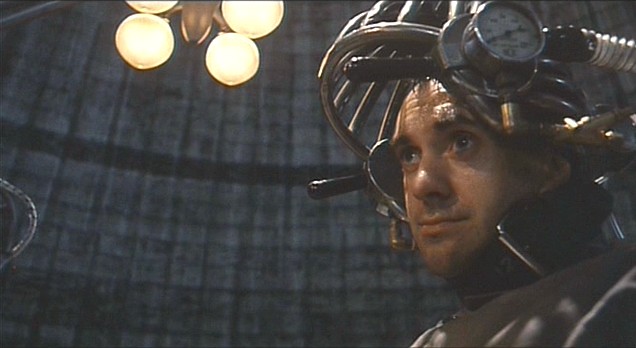
The following are the core concepts of the novel The Repossession Mambo, by Eric Garcia (the same guy who brought us Matchstick Men and the Anonymous Rex series). It’s 2025. Thanks to a company known as “The Union”, society has been flooded with artificial organs and just about everyone has one. They have saved and prolonged many a life, and cost a mint! And if you fall behind on your payments, a Repossession agent will come to your house, slit you from your navel to your neck, and retrieve it.
In short, its a dystopian future where a single company an unrealistic amount of power – the power to save live, the power to take it away. Most people are struggling just to make ends meet and as a result, the debt-ridden masses struggle to make their payments and stay alive. Right out of the annals of classic sci-fi. And with all the other cyberpunk concepts that have been done, I’m surprised someone didn’t tackle the issue of artificial organs sooner.
And, let’s face it, the premise is very much in tune with our day in age, released at a time when homeowners and families are struggling to avoid foreclosure on their houses thanks to a series of bad mortgages (and re-mortgages) that they were sweet talked and pressured in taking them in first place. Yes, for people coming through the worst economic crisis since the Great Depression, and who are used to dealing with punitive cost of privatized health care, this movie was sure to resonate. A wonder then why it did so poorly at the box office!
PlotSynopsis: As already noted, the story opens on the US in the near future. Artificial organs, joints, and even a neurological matrix, have revolutionized life by ensuring that the terminally ill, crippled and people near brain death can live on happily, assuming they can pay of course!
Small hints are given as to what is going on in the world at large, all of it quite familiar and relateable to today. On the one hand, there is loose talk of an ongoing debt crisis and a crippled economy. There’s also the passing mention of US soldiers gearing up to go into Nigeria in what has been deemed “Operation: Hope Springs Eternal” (a parody on “Operation: Restore Hope” or “Operation: Iraqi Freedom” perhaps?)
Into all this, we get Remy (Jude Law) who appears to be writing a manifesto of sorts. He opens it with a reference to Schrodinger’s Cat, which any fan of Big Bang Theory will instantly recognize. He wonders how anything could be considered both alive and dead in the same instant, clearly alleging that his story illustrates just that. The movie then opens in a flashback sequence, all things building towards his session in a slum with an antiquated typewriter.
Basically, Remy was a Repo Man who, alongside his age-old friend and army buddy Jake Freivald (Forest Whitaker), is considered the best in the business. However, Remy’s wife would prefer it if he transferred to sales and stopped doing the grisly work of harvesting people’s organs for money. He agrees, but also tells Jake he will do one last job. He is nearly killed when his equipment (a defibrillator) shorts out and nearly kills him. He wakes up in the hospital and is told that he will need an artificial heart now. His angry, panicked reaction tells us all we need to know about his feelings on that 😉 After years of watching others get screwed over by The Union, he now is facing that very thing himself.
Naturally, he tries to go back to Repo’ing since his wife has already left him and he needs the money. But somehow, he just can’t bring himself to do it anymore. What’s more, time is running out on him making his payments. During a final attempt, he goes into a “Nest” – a slum area where people go to flee The Union’s repo men – where he is attacked and knocked unconscious.
He awakens to find a woman named Beth (Alice Braga) – a lounge singer that he’s seen playing clubs before – living in one of the abandoned buildings and decides to help her. After standing watch as she goes through withdrawal, he agrees to help her since they are in the same boat. Seems she has mucho enhancements, including artificial joints, organs, eyes, and ears.
He breaks into the company storeroom and begins filing the bar codes off of all the spare parts they currently have. No bar codes, no scans will be able to detect that they have organs with are past due. However, Remy is caught by his friend and told to get out while he can. Back at their slum lair, Beth has set him up with an old typewriter she found. He sets to work banging out a “cautionary tale” about what he did and what he’s learned, until at last a repo man finds them and they are forced to kill him. Naturally, Remy outsmarts the man and he dies, but Beth is injured in the course of things. They are then forced to find a black market dealer who will fix her up, which takes them to another “Nest”.
Unfortunately, Jake finds them there and reveals to Remy that he is responsible for shorting out his defibrillator. By forcing him to meet the payments of an artificial organ, he figured his friend would never leave the business. The two fight, and in the course of it, Remy is knocked unconscious. What follows is a total mind-f*** which is comparable only to Inception! I shall break it down succinctly.
Basically, Remy wakes up to find that Beth incapacitated Jake. They then flee together and decide the only way they can resolve this is to break into corporate HQ, find the “Pink Door” where repo personnel make their returns, and physically scan their organs. After an over-the-top scene where Remy fights everyone between him and the “Pink Door” (which is ridiculously labeled as such), they break in and begin performing field surgery on themselves so they can scan the bar-codes.
Jake and their boss walk in a moment later, and Jake decides to switch sides and kills their boss. They blow up the repossession machine together and escape to the tropics, where Remy has apparently published his manuscript under the name The Repossession Mambo. However, this idyllic scene is interrupted when things begin to get fuzzy and some hiccups appear, as if it were all a recording…
Oh wait, it is! You see, in real life, Remy was rendered near brain-dead from the blow Jake gave him. The medics who arrived shortly thereafter hooked him up to one of the new neurological matrix’s in order to keep up his brain function. Hence, all this stuff about beating the company and escaping to the tropics was all a lie. Jake also tells them to leave Beth (unconscious but not dead) alone for him to deal with later. He then picks up Remy’s manuscript and notices the title, the same one featured in his little reverie.
I seriously wasn’t expecting that, but respected the movie more for the little dystopian twist at the end. It was in keeping with the whole tradition of cyberpunk tales, making sure that things like happy endings only happen in the movies… or not!
Final Thoughts:
I’ll be honest, this movie didn’t suck. It was very hard to take Jude Law seriously as a cynical, bad-guy, but for the most part, it was ably acted. It was also hard to believe that a former jarhead turned repo man, a man who for all intents and purposes seemed to like killing and didn’t care about the pain he caused, could maintain a marriage and a family. Somehow, these two sides of his personality didn’t fit. And lastly, the gore level, especially in that scene behind the “Pink Door” seemed gratuitous. It’s like, if they can invent scanners that can read a bar code through flesh and clothing, why do they need to slice opens their own bodies to scan the bar-codes for the big machine? I might have mentioned that the fight scene which brought them there was also pretty stupid, but of course, that was all in a dream! Technically, it doesn’t count 😉
But other than that, I actually liked this movie. It had plenty of thematic elements which landed for me. For one, there was the issue of a company pressuring people to sign-up for a product no one seemed to be able to afford. The scenes where we see the salespeople do their thing, or the boss’s BS about “you owe it to your family to do this” and “we can come up with a plan that fits your financial standing” were just too perfect. Tell me that wasn’t a parody of the banking industry, pressuring people into taking sub-prime mortgages when they could barely afford their current payments!
What’s more, the high costs of the new organs, which people had to turn to payment plans, credit, and whatever else to afford were clearly a reference to the health care crisis in America. People need life-saving procedures, have no choice but to sign up for them unless they want to die and leave their families behind. But in the end, its more than they can afford, and all the smarmy reassurances of the salespeople can’t change that very fact.
Yeah, it kind of bombed at the box office, but I’m thinking that rentals, DVD sales and Netflix might help it recoup its losses. And I strongly recommend people, at least those who aren’t turned off by blood and gore, take the time to watch it. If you’re a fan of dystopian sci-fi, you might just like it. And if you’re a writer of dystopian sci-fi (for example, me!) then you might just find it inspiring.
Repo Men: Entertainment Value: 7/10 (not really a nail-biter, but definitely not boring)
Plot: 8/10
Direction: 7/10 (nothing special, but ably shot)
Overall: 7.5/10
Yeah, I know I’m hardly alone in loving the cult-hit Firefly, nor am I alone in censuring Fox for its inept and inexplicable decision to cancel it after its first season. But then again, that seems to be their thing. What is more lamentable is the fact that after years of maintaining a following worldwide, producing a movie, an RPG, novelizations, comic books, and countless fan sites, Firefly still hasn’t been renewed or picked up by another network! What gives??? C’mon Wedon! Futurama did it, why can’t you?
Well, comeback or not, Firefly and its movie adaptation Serenity were still kick-ass. In addition to its memorable characters, smart writing, and classic sci-fi elements, there was also the heartfelt themes of conquest, resistance, and “manifest destiny”. That above all else made the show a hit, in my humble opinion. In adapting the history of the closing of the frontier, Wedon tapped into a very familiar American narrative and showed just how timeless history and human nature are.
Premise: To break the show’s background down succinctly, the story takes place roughly 500 years in the future, when humanity left Earth and began to explore the cosmos for a new place to call home. They eventually landed in the Blue Star system, a star with “dozens of planets and hundreds of moons” and began terraforming as many of them as possible. The inner worlds boasted the highest degree of technology and development and formed the Alliance, whereas the outer planets were sparsely populated and underdeveloped by comparison.
In time, the Alliance chose to expand and incorporate the outer worlds, prompting a coalition of Independents (or “Browncoats” because of the uniforms they sported) to resist. After a crushing defeat at the battle of Serenity Valley, the Independents were essentially finished. Thereafter, those “browncoats” who wanted to retain their independence took to a life of piracy, smuggling and spacing to make ends meet, pulling jobs in the outer-outer regions of space and staying clear of Alliance ships and “Reavers”, cannibalistic raiders who raid along the outer rim.
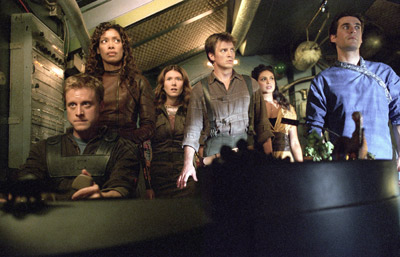
The Cast: One such group is the crew of the Serenity, a Firefly-class ship captained by former “Browncoat” Malcolm “Mal” Reynolds (played by Nathan Fillion). His second in command, Zoe Washburne (Gina Torres), was with him in the war and served in his platoon. As a result, they have a relationship that goes deeper than most, which has been known to make her husband and ships pilot Hoban “Wash” Washburne (Alan Tudyk) a little jealous.
There’s also Kaywinnet Lee “Kaylee” Frye (Jewel Staite), the spunky and ever-cheery ship’s mechanic who seems to be talk to machines and make them work. Then there’s Jayne Cobb (Adam Baldwin), a mercenary who they poached from another gang and who serves as hired muscle on the ship. And last, there’s Inara Serra (Morena Baccarin), a travelling “Companion”, or professional courtesan, who acts as a sort of ambassador for the ship.
As the show opens, the crew of the Serenity pick up some new passengers. The first is Derrial Brook (Ron Glass), a Shepherd (pastor) who is seeking passage away from the inner worlds to preach aboard. He quickly becomes part of the crew and acts as Mal conscience, though it becomes abundantly clear that he is more than what he appears. In addition, there is the strange duo of Dr. Simon Tam (Sean Maher) and his sister River Tam (Summer Glau). Summer is apparently a gifted young psychic who was experimented on by Alliance doctors, and her brother risked everything in order to free her. Now fugitives from the law, they remain aboard the Firefly as part of the crew, hoping to avoid capture.
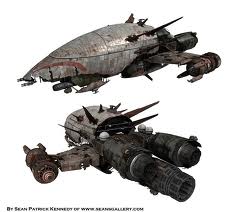
The Ship: The namesake of the show and the movie, the crew’s vessel of choice is the Firefly-class transport. A n older model, this vessel is apparently favored by privateers and smugglers because of its complex design and the presence of secret compartments. Although it boasts no armaments and is outdated by most inner-world standards, those who use it tend to get pretty attached to it and remain very monogamous. Echoes of the Millenium Falcon there…
Season One:
an Alliance Cruiser
The story opens with the extended crew coming together and getting to know each other. Mal, having realized that Simon and his sister were fugitives, decided to take them in after he shot and killed an alliance agent who had infiltrated their ship. Thereafter, the crew set out to continue on their ongoing adventure, taking whatever jobs they could find and staying one step ahead of the authorities.
Reaver Ship
The constant threat of the Reavers is also a recurring element in the first season. Existing on the fringes of known space and coming from parts unknown, the Reavers appear to be expanding inward towards the core, becoming more brash and brazen with their assaults on shipping and colony worlds. Aside from their obvious brutality and insanity, not much is known about this menace, other than the fact that they look like orcs and their ships like spiky sharks!
In addition, River’s condition, the result of endless experimentation, becomes the source of growing concern by her brother. Though she was always gifted, it’s becoming apparent to him and the other members of the crew that she might indeed be a psychic. Given that his resources are limited, they eventually have to break into a medical city on his old homeworld of Persephone so he can do a more thorough examination. His conclusions are that they physically tampered with her brain in order to enhance her abilities. Fractured and suffering from bouts of schizophrenia, she is eventually accepted by the other crew members and begins to feel whole again.
This, more than anything, is a guiding theme of the show, which is the growth of the Serenity family. Already, there is a strong sense of comradery between Mal and Zoe, which grows to include Wash when he and Mal confront and ultimately resolve the issue of his jealousy. There is also the growing bond between Mal and Inara. Initially, the two appear to be mutually hostile, but it soon becomes clear that this merely conceals their mutual attraction. Kaylee, as always, is the cheery epicenter of things, making her role as the ship’s engineer seem like a double-entendre. In addition to making sure the machinery keeps running, she’s also responsible for ensuring that everyone gets along.
Accepting Jayne proves more difficult, given his questionable loyalties; but in time, the crew comes to realize they can trust him since he values his friends more than money. And even though there are aspects of his past that are still unclear, Book proves that he too can be trusted and will endanger himself to keep the others safe. Hence, he too comes to be accepted as a permanent fixture aboard the ship. As the season ends, it becomes clear that even though the crew still faces a number of threats – the Alliance, Reavers, mercenaries and ruthless criminal lords – that they will be facing them together.
The Movie: The film adaptation opens with themes that were well-established in the show. We have the crew of the Serenity still trying to make ends meet, still having to take jobs out of desperation, and still fearing for their safety as hostile elements close in. However, the movie version chose to what was slowly developing with the show and tweak them to bring some serious tension and resolution to the storyline.
These include the ongoing search for River Tam, and the revelation of where the Reavers come from. In an intriguing twist, Wedon melds the two story lines together, showing how River’s condition and her exposure to members of the Alliance government put in her in possession of certain secrets which they would prefer to keep a secret! It is for this reason that an elite agent named only the Operative (Chiwetel Ejiofor) is sent out to find her, and is given blanket authority to do whatever it takes to achieve this goal.
The theme of family also gets kicked up a notch, with Inara having left the crew because of her incurably difficult relationship with Mal. Book has also left the crew in order to become the preacher to a community of settlers in the outer rim as well. Simon and River also seemed poised to leave when the job at the beginning of the movie comes dangerously close to going wrong and he decides that they would be better off on their own. However, this is cut short when during a payout, River is “triggered” by some sort of hidden transmission and begins kicking the ass of everyone in a seedy establishment. This, for obvious reasons, leads Mal to realize that there’s more going on with her than previously thought.
(Spoiler alert!) Eventually, the crew realizes that the key secret which River gleamed from the minds of the Alliance bureaucrats was the existence of a place known as “Miranda”. The secret is also important enough that they’ve sent the Operative to find them, a man who’s talents and methods far outstrip those of the agents and mercenaries they usually send! After an incident where Inara is used as bait, Mal and the rest are determined to know what’s so important that they are willing to kill for.
With the help of their friend, Mr. Universe, they eventually discover that Miranda is a colony located in the outermost ring of the system. This world was apparently settled generations ago by over 30 million people, but things went terribly wrong after an experiment failed and killed almost everyone there. After braving the Reavers to find the planet, the crew stumbles onto the answer in a form of a recording from a scientist’s journal.
It seems that the planet was subjected to a drug known as Pax, which was a chemical agent designed to make people docile and non-violent. However, the drug worked too well, and most people became so passive and withdrawn that they eventually ceased all activity and died of starvation. The remainder, however, became extremely violent and uncontrollable and killed off all remaining survivors, including the scientists. They then took what ships they could find and began preying on shipping in the outer rim. The Reavers were born!
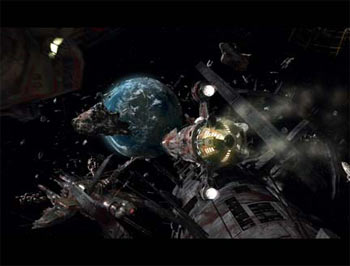
Having learned that the Operative has overrun every last known hideout of theirs and even killed Brooks, Mal decides that its time to fight! With the information of what happened on Miranda firmly in their hands, they make their way back to the reclusive moon where their hacker friend Mr. Universe lives. The Operative has it blockaded, but the Serenity managed to break past them by luring the Reavers into following them.
A huge firefight in space ensues and is followed by an equally tense firefight on the planet between the Serenity crew and the Reavers. In the course of the fight, Wash is killed and Kaylee and Simon are wounded, but River risks her life to save them all and give Mal the time he needs to reach Mr.Universe’s central hub. There, he confronts the Operative one last time, overcomes him, and sends out the broadcast.
Having seen the truth, the Operative orders his men to stand down. Mal and his crew are allowed to leave, mainly because he now knows he no longer has the grounds to hunt them. The Alliance has been dealt a blow from which it may not recover, and for the first time in years, the future seems uncertain. But at least there is hope. There is also much regret since the crew has lost two of its own, Wash and Book. But in the end, they set course for their next destination, carrying on in the only way they know how.
Final Thoughts:
I’ll just say it, this show rocked! It was loaded with great lines, great acting, great characters and lots of relateable material. And, like its theme song, it was pretty touching and emotionally involved. The show began with a pervasive sense of sadness, where people who were fighting for their freedom are overrun, beaten and forced into lives of running and criminality. But also, there is the redeeming sense of family and closeness that develops between the main characters. Though they are kind of a motley bunch, coming from vastly different backgrounds and having their own personal secrets, they eventually come together and realize they share a similar fate.
That is another thing that this show captured so well, which was the pervasive sense of alienation that takes place in a universe which is fast changing. Much like the frontier that inspired it, that process was very painful. Those who did not fit in with the dream of “manifest destiny”, i.e. Native Americans and settlers who preferred the freedom of the frontier, the question of what to do remained a terribly difficult one. The option of fighting seemed hopeless, but the alternative of surrendering seemed just as hopeless: a slow death replacing a swift one.
As Mal expressed in Serenity, “So me and mine gotta lay down and die… so you can live in your better world?” Another key line he said was “Half of writing history is hiding the truth”. Many a time I felt that Wedon was making a point about our own, how we often miss the fact that changes we’ve come to think of as natural and inevitable were in fact the result of decisions, and that they came with a lot of pain and suffering as well. Part of what makes this show emotionally appealing is that fact that we get to see good guys fighting against terrible odds, and eventually achieving a victory of sorts.
And of course there was the cool mix of cultures that gave the show a truly international feel. Whereas the planets appear to boast names taken predominantly from western mythology and culture, there is a hefty smattering of Mandarin Chinese in the spoken dialogue and written signs. Aspects of Southern, Arabic and other Asian cultures make appearances as well, both in the series and the expanded universe. Basically, Wedon seemed to be going with the plausible sci-fi premise that cultures would mix in the era of colonization to produce new and interesting cultural mosaics.
I for one would like to see where it goes from here. Would the Alliance fall? Would it become even more tyrannical in its pursuit of a “better world” and a unified system? And how would they get around the fact that Watt ggand Book exited stage left (Apparently due to money and the desire to not get typecast. Actors! Pfft!) But, we’ll never know unless someone gets off their duff and starts making new episodes now will we? So Mr. Wedon and/or the Fox Network, get off your duffs and bring back this show gorram it! We’ve waited ten bloody years and we’re growing in strength! Don’t make us come after you!
Oh, and to Mr. Nathan Phillion, whom I hear is trying to ressurect the show himself, tell us what its going to take to get this done and we’ll do our best to help. Please tell us it involves taking the Fox Network down, or at least the crop of execs who keep cancelling shows that are in their prime. Is it not enough that you give TV spots to the most pig-ignorant excuse for journalists and right-wing ideologues, you gotta kill anything with a soul before it grows too? Why don’t you just call yourself the Evil Empire Network and be done with it? I tell ya, the metaphor is too perfect here!
In the meantime, check out this kick-ass trailer from the Serenity movie. I plan to watch it again and would like to think others are too. Rock on Firefly!
“On receiving an interrupt, decrement the counter to zero.” -Programming The Z80 by Rodnay Zaks (1982).
The other night, I finally finished book II in the Sprawl series by William Gibson. Kindle for iPad, not paperback, which in itself was kind of a bummer. Somehow, I still haven’t made the transition for hard copies to ebooks. Probably never will. In any case, it was a rewarding experience which reminded me why I like Gibson in the first place. After getting through the Bigend Trilogy and the Bridge Trilogy and having somewhat mixed feelings, I got back to the trilogy that started it all, and was interested by what I found…
Count Zero is number two in the series that picks up after Neuromancer, the book which started it all for Gibson and which I read first. Set in the Sprawl – a.k.a. the Boston-Atlanta Metropolitan Axis (or BAMA) – this cyberpunk story deals with themes familiar to classic Gibson fans. Cyberpsace jockeys, freelance mercenaries, corporate monopolies, the street, and people so wealthy that they are able to cheat death and transcend humanity. In between, there’s all the familiar lexicon which Gibson invented himself: microsofts, biosofts, decks, trodes, jacking, jockying, ice, black ice, icebreaker, the matrix, Turing Police, cores, and all that good stuff.
However, there were also a few elements which put me in mind of his later work. Really, I could dedicate an entire post to the parallels between this book and his Bigend Trilogy. Again, there was the notion of the transformative power of wealth, how it means so much more than just having money and the freedom to use it. Given how much importance is placed on this in the book, how it serves as a sort of motivation in itself, one would get the impression that this is a serious preoccupation of Gibson’s. But then again, it was serious preoccupations of Fitzgerald’s, and for good reason! As he and Hemingway are rumored to have said to each other:
F: “The rich are different than you and me.” H: “Yes, they have more money.”
Plot Synopsis:
The story takes place seven years after the events of Neuromancer and centers on the lives of three people: First, a mercenary named Turner who has just recovered from a near-death experience and is beginning to question what he does. However, while attempting to flee his life, he is picked up and told he must do one final job. A scientist named Mitchell, working the company of Maas, wants to defect from his job and join the rival company of Hosaka. It’s up to Turner to pick him up and transport him back to Japan where, presumably, he will be safe to pursue his work in biosofts – a revolutionary biological form of technology. However, the run goes terribly awry when they find that the evacuee is in fact his daughter, and the company destroys its own fortress and kills Mitchell rather than let him fall into their rivals hands.
Second, we have a disgraced Parisian art dealer named Marly Krushkova who has been hired by a fabulously wealthy man named Virek to track down the maker of some mysterious art boxes. One of these boxes, which are based on Joseph Cornell’s artwork, apparently contain indication of biosoft construction. Virek, who is currently alive in a vat somewhere in Scandinavia, wants the technology so he can ressurrect his body and live forever. Using his dime and his contacts, Marly begins to follow the clues which will lead her to the abandoned station of Freeside, the once proud holding of the Tessier-Ashpool clan, where she will learn the shocking truth of the boxes.
Third, a young New Jersey boy named Bobby Newmark, hacker alias “Count Zero”, who is new to the jockeying game and comes across some “black ice” that nearly kills him. He discovers that the friend who gave it to him, “Two-A-Day”, received it from a questionable source and pawned it off on him to test it. When looking into this, he finds that Two-A-Day’s backers are a group of Haitain hackers who are interested in investigating a bunch of apparitions in cyberspace that appear as Voodoo gods. One of these “gods”, it seems, was responsible for saving Bobby’s life when he jacked and encountered the black ice, which was apparently of Maas construction. Their group must now move quickly, because it becomes clear that anyone who knows about the ice is being murdered.
Sound familiar? Well it should. This is classic Sprawl Gibson at his best! In time, all three threads, supposedly unrelated, weave together to the point where it becomes clear that Josef Virek, the wealthy mogul is pulling all their strings. For starters, we learn that Mitchell is not the genius he was rumored to be. Apparently, he was being fed all the information he needed to produce the biosoft technology. The person feeding him this info was apparently working from Freeside, and turns out to be one of the “apparitions” that is haunting cyberspace.
In addition, this same apparition instructed Mitchell to place biosoft technology in his daughter (Angie’s) head. Turner learns of these enhancements shortly after rescuing Angie and performing a routine scan on her. As a result, she is able to access the matrix anytime she wants without the need for a deck. Often, when she’s asleep, she is heard muttering things in Creole and having odd dreams which appear to coincide with events in cyberspace. For one, she remembers helping a boy named Bobby when he was being attacked by a malicious program. In short, she is the one who saved Bobby when he got into the black ice.
Last, Marly’s adventure to discover the box maker is related to the whole Maas/apparitions thing because Virek’s true agenda is to find the maker of the biosoft technology so he can use it to repair his dying body. As is made clear early on, he is alive only in the strictest sense, his remains being vet in a vat that keeps his vitals steady, and his brain wired to a Sim-Stim link that allows him to communicate with the outside world. It is also revealed that he intervened in Mitchell’s defection by paying off some of the mercenaries. However, his plans were upset somewhat when Mitchell chose to free his daughter instead of himself. So for the remainder of the novel, it becomes a race to capture her.
In time, she asks to be brought to the Sprawl where Bobby and his Voodoo friends are holding up inside a club. When they see Angie, Bobby recognizes her as the girl who saved his life. The Voodoo hackers also recognize her as one of the chief deities they have been observing in cyberspace. With some outside help, they make a stand against Virek and the mercenary Captain that was helping him and take them down. This they do by locating them both in cyberspace and arranging for their hiding places to be destroyed.
In the course of all this, it is revealed that these “apparitions” or Voodoo deities are in fact the splintered personality of the AI’s from book I that went by the names of Wintermute and Neuromancer. After coming together at the end of the story to form the first, fully-functional AI, the combined personality split itself up into several smaller constructs so that it would not be alone in the matrix. They adopted the form of Voodoo deities because they felt these suited them best, which is what attracted the interest of the Haitain hackers in the first place.
In addition, it was they who sent the Maas icebreak down from Freeside, as part of their wider plan to smoke out Virek. Knowing that he was trying to cheat death, they decided to intervene so that he wouldn’t be able to achieve the immortality and godlike power he had been seeking. A sort of “Tower of Babel” or Icarus-type scenario there, where a god or gods punish mortals for overreaching and trying to taste divinity.
Strength/Weaknesses:
As I said before, this book reminded me of why I turned to Gibson in the first place. His abilities at world-building, at submerging the reader in a world of megacities, megacorporations and cool and potentially frightening technologies is what established him as a master of cyberpunk in the first place. I was also happy to return to his world of familiar gadgets and tools, a la simstims, microsofts, decks, jockeys and mercenaries; not to mentions shadowy agendas and double-crosses. After having read through the Bigend Trilogy where the agendas were pretty benign and unclear, and the Bridge Trilogy where the settings were kind of inconsistent and really not that dark, it was a real treat to get back to the dirty, dystopian world of the Sprawl!
However, there were some bumps along the way as well. For one, Gibson’s penchant for portraying wealthy moguls as people who have ridiculous amounts of control and influence was something I was overly-familiar with at this point. In fact, substitute a desire to cheat death with immense curiosity and Virek easily becomes Bigend. However, I could see how this was the result of reading his later works first. Had I read the Sprawl Trilogy in its entirety before tackling the more recent Bigends, I might have seen this a bit less critically.
Ah, but there was another signature Gibson trait in this book. The anti-climactic ending! After quite a bit of action in getting Turner, Angie, Bobby and the Voodoo priests all in the same place, after all the growing tension as we are told that the club is surrounded by goons, not much happens. Bobby contacts another jockier who lost her boyfriend in the raid on Maas, because of the Mercenary Captain’s betrayal, she kills both him and Virek, and the goons dissipate as they realize the people they are working for are gone. The word “abortive” seems appropriate here, for that’s what you call an ending that is building towards and explosive climax, then fizzles out!
Still, I loved the setting, the themes, and the feel of the story. It reminds me of why I love cyberpunk and was the perfect addition to a month that has been characterized by dark, dystopian and technologically-driven literature! Much of what I had to say about Gibson’s Sprawl in my Dystopian Literature post was taken from this very book. After Neuromancer, it helped to complete the picture of what Gibson was all about in his early writing career. In building the world of tomorrow, where corporate monopolies rule, people live in dirty, overcrowded environments, where the rich are barely human and the poor struggle just to live and retain some essence of their humanity, Gibson epitomized the cyberpunk ideal of “high tech and low life”!
This past April 1st, fans of the Game of Thrones miniseries were treated to a real delight! For months, we had been told that season two was coming. And, praying that this was no April Fool’s joke, fans everywhere kept their fingers crossed and their feet tapping while they anxiously waited for it to come true. Seriously, I don’t think there was a fan among us who wasn’t sitting on one butt cheek the whole month of March!
Finally, the rumors were confirmed and it was no prank. After witnessing the big set-up, the death of Ned Stark, the build-up to war, and the cliffhanger ending (complimented by dragons and a nude lady!), we were finally going to see A Clash of Kings on our screens!
So, now that we’re two episodes in, I thought I’d offer some thoughts on season two. I would have offered up a review of the first episode the second it broke, but I wanted to wait until at least two episodes aired so I could see where they would be going. Now that I think I have a feel for it, here it is…
Ep.1. The North Remembers: Well, episode one was a bit of a letdown. After months and months of waiting, and knowing what to expect, I found it both topical and rushed. Naturally, any season opener needs to introduce everything and this can weight it down a little. And knowing what to expect can also lead to the inevitable sense of “they changed this, they changed that”. But I’m quite certain my impressions were not informed by either.
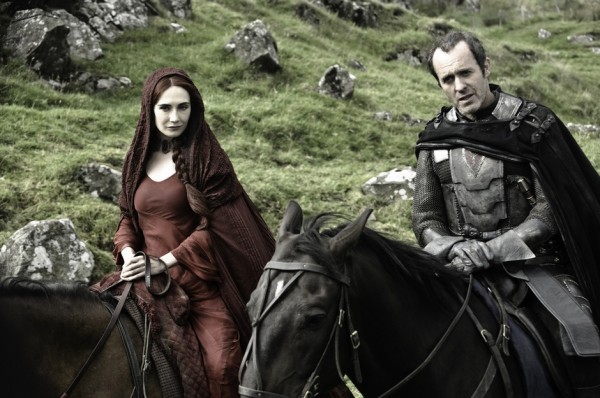
For starters, the book opens with a chapter from the point of view of Stannis’ priest. His perspective informs us of the comet that has appeared in the heavens (something that got barely any dialogue in the episode) and how Stannis has taken up with Melisandre. It also introduces Sir Davos Seaworth, the “Onion Knight” who will become a central character as the story progresses. Sure, these things get some coverage in the first episode, but the real development is left to episode two.
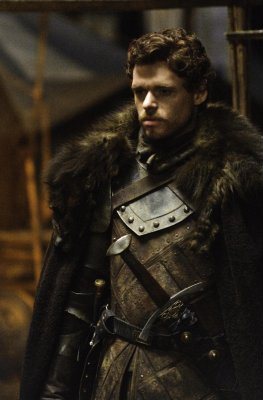
And then there was the scene between Cersei and Lord Petyr Baelish. Correct me if I’m wrong, but I don’t recall this ever happening in the novel. Granted, in the wake of Ned Stark’s execution and Joffre’s ascension, there was plenty of plotting and suspicion in the royal court. But none of it that took place between Baelish and Cersei. So really, this scene was just superfluous. The same is true of the scene where Robb confronts Jaime in his cage. Again, not in the book! Aside from recapping how they have him prisoner, I didn’t see the point in it.
But they did get two things right. First, we got to see and hear plenty from Tyrion and Cersei upon his return to court. And the scene between Sansa and Joffrey during his name-day tournament, that was quite faithful! And then there was the scene where the Night’s Watch reach Craster’s Keep and get an eyefull of his twisted little commune. All bang on, from what I recall. But as for the rest, it felt rushed and topical. Sure, they picked up where the last season let off and managed to tackle the salient points. But other that, didn’t seem like there was much development.
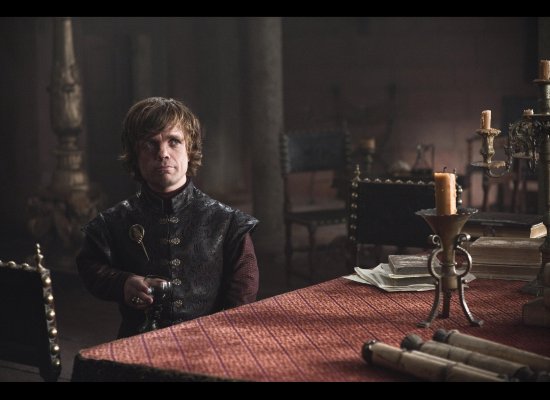
Ep.2. The Night Lands: And then episode two aired, and things began to pick up. For one, they finally got into Arya’s story and provided some details on her situation. This included her companion Gendry and the fact that the Kinsgaurd were looking for him; not to mention Hot Pie, Lommy, Joaquin H’ghar and the other two criminals. There was also the faithful scene where Tyrion begins exercising his powers as the new Hand, removing Janos Slynt as Lord of the City Watch and replacing him with Bronn. The subsequent scene where he has it out with Cersei was also pretty awesome! And last, there was the highly accurate scenes depicting Theon’s return to Pyke, and the little misunderstanding between him and his sister.
As for things that didn’t quite fit or misfired… Well, there was the scene in the brothel where Baelish threatens one of his ladies, a woman who never appeared in the book but is a recurring character in the show. She is apparently mourning the loss of one of their fellow ladies, who was cut down with her child when the Kingsguard went around slaughtering Robert’s bastards. Didn’t happen in the book, so I really got the feeling that it was just jammed in for some added nudity and evil character development. You know, just in case we didn’t already know Baelish was an asshole!
And then there was the final scene where Jon witnesses what Craster does with his sons. In short, he sees him bring one out to the forest where the Others take him away. Granted, it was established in the novel that this is what Craster does with all the boys his daughters/wives bear him, but it was never shown. Neither was the part where Craster knocks Jon out after he realizes he’s seen the whole thing. This I can’t imagine will be easy to explain in episode three. Craster is a man who threatens to kill anyone who so much as touches one of his daughters/wives. How is he going to let Jon go now that he’s seen how he’s offering up sacrifices to the White Walkers?
What’s more, there’s the added issue of White Walkers now being spotted near their camp. In the novels, they themselves aren’t spotted even in Book III, preferring to let their Wights do their fighting for them. This totally throws things off, especially where the Night’s Watch and Craster’s working relationship is concerned. What is Lord Mormont going to do when he finds out, say “shame on you” to Craster, pick up and then leave? Having read well into book IV, I know for a fact that they come back his way later and stay with him again. They can’t do that if they know he’s welcoming Others into his property! This just doesn’t jive!
Good episode, inexplicable ending. Ah well, I’m sure episode three will have something in the way of explanations…
Overall, so far, so good. I can’t wait until they get into the big burly battle at King’s Landing! That is sure to be awesome, as are the various other action scenes involving (edited for spoilers). See you next time!
First up, some news for those who asked. Back when I started this dystopian thread, a lot of people asked about The Hunger Games. This was understandable, given that its a modern take on dystopian sci-fi, and currently very popular since it’s being adapted into a movie. In fact, I got so many questions about it that I had to add an addendum to one of my posts, warning readers that it wouldn’t come up, so not to ask. However, somewhere along the line I also promised that I would tackle and review it at some point.
Well guess what? I just bought a copy! Yep, just as soon as I’m done my most recent reviews and posting chapters of my own upcoming novel (Data Miners), I will get around to reading this modern take on the classic dystopian novel. And, as a preamble, I thought I might include an article that I recently read in MacLeans. There, the author sought to shed some light on the issue of YA dystopian fiction, with particular attention being given to The Hunger Games. It raised some very interesting points before getting into the story, and so I thought I’d share them here.
Excerpt from ‘The Hunger Games’: your kids are angrier than you think by Brian Bethune:
“Imagine a life where possibilities are opening at a speed that veers unpredictably between exhilarating and terrifying. The familiar, precisely because it’s familiar and safe, still tugs at you, but even so, you want out because your old life constricts as much as it comforts. Besides, your social milieu, which often feels like an endless struggle to achieve, or resist being slotted into some arbitrary niche—pretty, ugly, smart, dumb, athlete, klutz—is changing fast. You feel driven—by inner need and outside pressure—to make choices. Meanwhile, the manipulative, often harsh, powers that be, who created the larger world they’re busy shoving you into, have clearly not done a bang-up job of it, either in their personal lives or as part of society. And they want you to get out there and fix their mistakes—just at a moment when worry over the imminent demise of their entire socio-economic structure is never far from the surface. It can be cruel and scary out there. Dystopian, even.
Chances are, anyone not imagining this life, but actually living it, is a teenager. And living it in an era of economic uncertainty, conspiracy theories and fear of environmental collapse. Western civilization used to produce literary utopias, but in the past century of world wars, financial panics, murderous totalitarian regimes and nuclear threat, dystopias have outnumbered sunny projections by several orders of magnitude. Pessimistic depictions of the future are now everywhere in popular culture. Teens and teen books are not immune to larger trends in society.”
Wow. Quite the preamble. What I liked best about it was the way it summed up the origins of dystopia. In my own posts on the subject, I noted that dystopian literature was recent compared to utopian. But I failed to note that the truest examples of the genre only really emerged around the turn of the century. And the particulars of what inspired it seemed to have everything to do with the trends of industrialization, rationalization, class conflict and the increasing pace of change. These things have only become more pronounced as time has gone on, and with the addition of such issues as environmental destruction, gender equality, and racial bigotry.
Or, as the case appears to be with The Hunger Games, issues of age. Here we have a story where the young fight for the entertainment of the old. Or at least, that’s one angle to the story. The issue of authoritarianism, reality TV, violence as entertainment and environmental catastrophe breading totalitarianism – these all appear to be present throughout, either as part of the background or as running themes.
Lately, I’ve been feeling kind of dystopian! Perhaps it’s the fact that I’m working on an anthology of dark science fiction with some fellow writer’s over at Goodreads (called Writer’s Worth). Or it might just be that this seemed like the next logical step in the whole “conceptual science fiction” thing. Regardless, when it comes to the future, sci-fi writers love to speculate, and it usually takes one of two forms. Either humanity lives in a utopian society, where technology, time, and evolution have ferreted out our various weaknesses. Or, we live in a dystopian world, where humanity has either brought itself to the brink of annihilation or is living in dark, polluted, and overpopulated environments, the result of excess and environmental degradation.
As with all things science fiction, the aim here is to use speculative worlds of the future to offer commentary on today. As William Gibson, himself a dark future writer, once said: “Science fiction [is] always about the period in which it was written.” So today, I thought I would acknowledge some truly classic examples of dystopian literature and the books that started it all. Here they are:
Earliest Examples
Dystopian literature, contrary to popular conception, did not begin in the 20th century with Brave New World. In fact, one can find examples going as far back as the Enlightenment when philosophers and scholars used fictional contexts to illustrate the weaknesses of society and how they might be reformed. And, in many ways, this form of social critique borrowed from Utopian literature, a genre that takes its name from Thomas More’s seminal book that describes a perfect fictional society.
But where More and earlier writers (such as Plato and St. Augustine) used perfect civilizations to parody contemporary society, this newer breed of authors used dark ones to do the same. In short, Utopian literature showed society how it could be, dystopian literature as it was.
Candide: A true classic, though it is sometimes difficult to classify this work as a true dystopian work of fiction. For one, it is set in the contemporary world, not in a fictionalized society, and revolves around the life of a fictional character who travels from one region to the next, seeking to answer the fundamental question of whether or not this is “the best of all possible worlds”. However, this book remains one of the principal sources of inspiration for science fiction writers when constructing fictional worlds for the sake of satirizing their own.
Published in 1755 by the critic and philosopher Voltaire, the story was inspired by the 1755 Lisbon Earthquake and the church’s and Leibnizian’s attempts to rationalize it. At the beginning, Candide – the main character whose name means “optimism” – lives a sheltered existence where he is busy studying and living with his friends and companions. However, this existence is quickly interrupted by the arrival of war, and Candide and his companions are forced to travel from place to place, witnessing all the problems of the world.
These include war, slavery, rape, imperialism, abuse of power, and exploitation, which they observe as the story takes them from Europe to the Middle East to the Americas. Eventually, they return home and reflect on all they have seen and whether or not this is “the best of all possible worlds”. They conclude that it is not, but offer a resolution by saying that “we must cultivate our garden”.
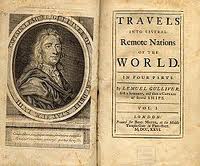
Gulliver’s Travels: Another classic example that is often considered a combination of utopian and dystopian novels. This is because the plot involves the travels of one man – Gulliver, whose name is a play on the world gullible – whose journey takes him through many fictional worlds where life is either perfect or tragically flawed in various ways. However, since the purpose of these worlds is to parody English society in his day, it is often included as an early example of satiric literature that falls into the utopian, dystopian, and science fiction camps.
The story involves four journeys where Gulliver travels to several fictional societies and records what he sees for posterity. The first voyage takes him to the land of the Lilliputians, a race of tiny people whose morals match their physical size. After some rather brief descriptions of how these people select their leaders (limbo tournaments and other stupid games), we learn that they are a parody of the British system of parliament.
His second voyage takes him to a place that is the polar opposite of the first. Here, in the land of the Brobdingnagians, he is presented with giants whose physical size mirrors their moral outlook. They consider Gulliver to be a curious specimen, whose descriptions of his country disgust them. In the end, they consider him a cute sideshow attraction and refuse his offer of technological advances (like gunpowder). Gulliver then leaves, thinking the people are out of their minds, but ironically states that he withheld the worse about England out of a desire to save face.
His next voyage involves a little “island-hopping”, first to the flying city of Laputa, an island nation where technological pursuits are followed without a single regard for the consequences. He then detours to another island, Glubbdubdrib, where he visits a magician’s dwelling and discusses history with the ghosts of historical figures.
Then onto Luggnagg, where he encounters the struldbrugs – an unfortunate race of people who are immortal but frozen in old age, with all the infirmities that come with it. Gulliver then reaches Japan, which is in the grips of the post-war Shogunate period, where he is narrowly excused from taking part in an anti-Christian display that all foreigners were forced to perform at the time (stepping on the symbol of the Cross).
His final voyage before going home takes him country of the Houyhnhnms, a race of horse-people who see themselves as “the perfection of nature” and who rule over the race of Yahoos – deformed humans who exist in their basest form. Gulliver joins them and comes to adopt their view of humanity – that of base creatures that use reason only to advance their own appetites. However, they soon come to see him as a Yahoo and expel him from their civilization. In the end, Gulliver returns home to regal his family of his adventures but finds that he cannot relate to them anymore. His journeys have filled him with a sense of misanthropy that he cannot ignore.
Throughout the narrative, Swift’s point seems abundantly clear. Each voyage to a fictitious world serves as a means to parody a different element of British society and civilization in general. And ultimately, Gulliver serves as the perfect narrator, in that his ignorance and naivety allow him to absorb the lessons of the journey in a way that is both ironic and sufficiently detached. Can’t just hand the reader the moral, after all! Gotta make them work for it!
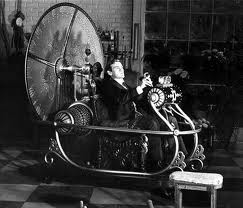
The Time Machine: Published in 1895, this science fiction novella inspired countless adaptations and popularized the very idea of time travel. In addition to introducing readers to the concept of time as the fourth dimension and temporal paradoxes, H.G. Wells also had some interesting social commentary to share. In this story, the narrator – known only as The Traveller – recounts to a bunch of dinner guests how he used a time machine to travel to the year 802, 701 A.D. where he witnessed a strange culture made up of two distinct peoples.
On the one hand, there were the Eloi, a society of elegant, beautiful people who live in futuristic (but deteriorating) buildings and do no work. Attempts to communicate with them prove difficult since they seem to possess no innate curiosity or discipline. He assumes that they are a communistic society who have used technology to conquer nature and evolved (or devolved) to a point where strength and intellect are no longer necessary to survive.
However, this changes when he comes face to face with a separate race of ape-like troglodytes who live in underground enclaves and surface only at night. Within their dwellings, he discovers the machinery and industry that makes the above-ground paradise possible. He then realizes that the human race has evolved into two species: the leisured class of the ineffectual Eloi, and the downtrodden working classes that have devolved into the brutish Morlocks. In the course of searching the Morlock enclave, he learns that they also feed on the Eloi from time to time. His revised analysis is that their relationship is not a benign one, but one characterized by animosity and the occasional act of kidnapping and cannibalism.
Is there not a more perfect vision of industrial society or class conflict? Written within the context of turn of the century England, where discrepancies in wealth, class conflict, and demands for reform were commonplace, this book was clearly intended to explore social models in addition to scientific ideas. And the commentary was quite effective if you ask me…
The Iron Heel: This dystopian work was written by Jack London, the same man who wrote the classic Call of the Wild, and was released in 1908. A clear expression of London’s own socialist beliefs, the novel is set in the distant future when a socialist utopia – known as the Brotherhood of Man – has finally been created. Overall, the plot revolves around the “Everhard Manuscript”, a testament that details the lives of the story’s two main protagonists and which takes place between 1912 to 1932 in the US. The work is known for its big “spoiler”, letting readers know outright that the protagonists die in the course of their pursuits, but that their efforts are rewarded by providing inspiration to later generations who succeed where they fail.
In the course of this speculative story, we learn that an oligarchy – the Oligarchs or “Iron Heel” – has seized power in the US by bankrupting the middle class and reducing farmers to a state of serfdom. Once in power, they maintained order through a combination of preferential treatment and control over the military. After a failed revolt (the First Revolt) takes place, preparations are underway for a second which is expected to succeed in restoring the Republic. Unfortunately, it too fails and the protagonists are killed. However, centuries later, when their Manuscript is discovered, the Oligarchy has been unseated and a debt is being acknowledged to these characters and their actions.
Thus, London speculates that a socialist society would someday emerge in the US, but only after centuries of dominance by oligarchs who would come to power by decimating the middle class, controlling trade unions, and transforming the military into a mercenary front. His main characters, though condemned to death in the present, will be vindicated in the distant future when humanity will, at last, overcome its greedy tendencies and usher in a state based on equality and fraternity. Apparently, this novel inspired such greats as George Orwell, but not in the way you think. Whereas London chose to offer his readers a sense of consolation by showing them everything turned out okay in the distant future, Orwell chose to take the hopeless route to make his point!
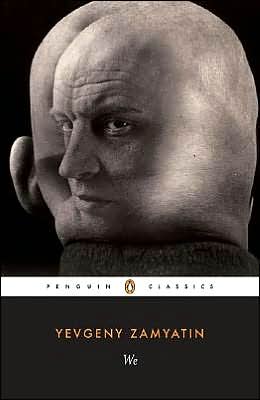
We: The story takes place in the distant future, roughly one thousand years after the One State conquered the entire world. After years of living in a perfectly synchronized, rational, and orderly world, the people of the One State are busy constructing a ship (the Integral) that will export their way of life to extra-terrestrial worlds. Published in 1921, and written by Yevgeny Zamyatin, the story was clearly inspired by life in post-revolutionary Russia, with its commitment to “scientific Marxism, but was also a commentary on the deification of reason at the expense of feeling and emotion.
The story is told from the point of view of D-503, chief engineer of the Integral who is keeping a journal which he intends to be taken on the voyage. As we learn in the course of the novel, everyone in the One State lives in glass apartments that are monitored by secret police known as the Bureau of Guardians. All sex is conducted strictly for reproductive purposes and cannot be done without state sanction. However, the main character soon comes into contact with a woman named I-330, a liberated woman who flirts with him, smokes, and drinks alcohol without regard for the law.
In time, he learns that I-330 is a member of a revolutionary order known as MEPHI which is committed to bringing down the One State. While accompanying her to the Ancient House, a building notable for being the only opaque structure in the One State where objects of historic and aesthetic importance are preserved, he is escorted through a series of tunnels to the world outside the Green Wall which surrounds the city-state. There, D-503 meets the inhabitants of the outside world – humans whose bodies are covered with animal fur. The aim of the MEPHI is to destroy the Green Wall and reunite the citizens of the One State with the outside world.
In his last entry, D-503 relates that he has undergone an operation that is mandated for all citizens of the One State. Similar to a lobotomy, this operation involved targeted x-rays that eliminate all emotion and imagination from the human brain. Afterward, D-503 informs on I-330 and MEPHI but is surprised how she refuses to inform on her compatriots once she is captured. People beyond the wall even succeed toward the story’s end in breaching a part of the Green Wall, thus ending the story on an uncertain note.
The Classics
And now we move on to the dystopian classics that are most widely known, that have inspired the most adaptations and sub-genres of noir fiction. Although updated many times over for the 20th century, these dystopian novels share many characteristics with their predecessors. In addition to timeless social commentary, they also asked the difficult question of what it would take to set humanity free.
Whereas some chose to confront this question directly and offer resolutions, other authors chose to leave the question open or chose to offer nothing in the way of consolation. Perhaps they thought their stories more educational this way, or perhaps they could merely think of none. Who’s to say? All I know is their works were inspired!
In addition to parodying the worst aspects of scientific rationalism, imperialism and the notion of progress, the story also went on to inspire some of the greatest satires ever known. In addition, many of its more esoteric elements have appeared in countless novels and films over the years, most notably the concepts of encapsulating walls, secret museums, government-sanctioned breeding, and machine-based programming.
Brave New World: There’s scarcely a high school student who hasn’t read this famous work of dystopian fiction! And although Aldous Huxley denied ever reading We, his novel nevertheless shared several elements with it. For instance, his story was set in the World State where all reproduction is carried out through a system of eugenics. In addition, several “Savage Reservations” exist beyond the veil of civilization, where people live a dirty, natural existence. But ultimately, Huxley’s aim was to comment on American and Western civilization of the early 20th century, a civilization where leisure and enjoyment were becoming the dominant means of social control.
This last aspect was the overwhelming focus of the novel. In the World State, all people are bred for specific roles. Alphas are the intellectuals and leaders of society, Betas handle high-level bureaucratic tasks, Deltas handle skilled labor, Gammas unskilled labor, and Epsilons menial tasks. Therefore, all vestiges of class conflict and generational conflict have been eliminated from society.
But to further ensure social control, all citizens are sleep-conditioned from a young age to obey the World State and follow its rules. These include the use of Soma, a perfectly legal and safe designer drug that cures all emotional ales, promiscuous sex habits, and “feelies” (movies that simulate sensation).
In the end, the story comes to a climax as two of the main characters, Bernard Marx and Lina Crowe, go to a savage reservation and find a lost child named John. His mother was apparently a citizen of the World State who became lost in the reservation and was forced to stay after she learned she was pregnant. Having experienced nothing but alienation and abuse as a “savage”, John agrees to go with Bernard and Lina back to “civilization.
However, he quickly realizes he doesn’t fit into their world either and expresses disdain for its excesses and controls. Eventually, the people who sympathize with him are sent into exile and he is forced to flee himself. But in the end, he finds that he cannot escape the people of the World State and commits suicide, a tragic act that symbolizes the inability of the individual to find a resolution between insanity and barbarity.
Overall, Huxley’s BNW was a commentary on a number of scientific developments which, under the right circumstances, could be used to deprive humanity of their freedom. In many ways, this was a commentary on how the expanding fields of psychology and the social sciences were being used to find ways to ensure the cooperation of citizens and ensure good work habits.
Nowhere was this more apparent than in factories and in the creation of “assembly-line discipline”, which was exemplified by how the people of the World State revered Henry Ford. In addition to performing eugenics on an assembly-line apparatus, the people worship Ford and cross themselves with a T (a reference to his model T car).
But above all, Huxley seemed to be asking the larger question of what is to be done about the process we know as civilization. If it was inimical to freedom, with all its rational, sterile, and domesticated luggage, and the alternative – a dirty, superstitious, and painful existence – was not preferable either, then what was the solution?
In the end, he offered no solution, allowing the reader to ponder this themselves. In his follow-up essay, Brave New World Revisited, he expressed some remorse over this fact and claimed that he wished he had offered a third option in the form of the exile communities – people who had found their own way through enlightened moderation.
1984: Ah yes, the book that did it all! It warned us of the future, taught us the terminology of tyranny, and educated us on the use of “newspeak”, “doublethink” and “thoughtcrime”. Where would dystopian literature be today were it not for George Orwell and his massively influential satire on totalitarianism? True, Orwell’s work was entirely original; in fact, he thoroughly acknowledged a debt to authors like H.G. Wells and Yevgeny Zamyatin. But it was how he synthesized the various elements of dystopia, combining them with his own original thoughts and observations, and crystallized it all so coherently that led to his popularity.
But I digress. Set in the not-too-distant future of 1984 (Orwell completed the book in 48 and supposedly just flipped the digits), the story takes place from the point of view of an Outer Party member named Winston Smith. Winston lives in London, in a time when England has been renamed Airstrip One and is part of a major state known as Oceania. As the book opens, Oceania finds itself at war with the rival state of Eurasia, though not long ago it was at war with Eastasia and will be so again. As a member of the Ministry of Truth, Winston’s job is that of a censor. Whenever the enemy changes, whenever the Party alters its policies, whenever a person disappears, or the Party just feels the need to rewrite something about the past, men like Winston are charged with destroying and altering documentation to make it fit.
Ultimately, the story involves Winston’s own quest for truth. Living in the constant, shifting lie that is life in the totalitarian state of Oceania, he seeks knowledge of how life was before the revolution; before the Party took control before objective reality become meaningless. He also meets a woman named Julia with whom he begins an affair and rediscovers love.
However, in time the two are captured and taken to the Ministry of Love, where they are tortured, brainwashed, and made to turn on each other. In the end, Winston accepts the Party’s version of reality, simply because he discovers he has no choice. His tragic end is made all the more tragic by the implicit knowledge that he will soon be killed as well.
For discerning fans of science fiction and dystopian literature, the brilliance of 1984 was not so much in how the totalitarian state of the future is run but how it came to be. According to the Goldstein Manifesto, which is the centerpiece of the novel, World War III took place sometime in the 1950s and ended in a stalemate, all sides having become convinced of the futility of nuclear war.
Shortly thereafter, totalitarian revolutionaries with similar ideologies took power all over the planet. In time, they became the three major states of Oceania, Eurasia, and Eastasia, whose boundaries were a natural extension of the post-war spheres of influence.
Also interesting is Orwell’s speculation on how these totalitarian ideologies came to be in the first place. In short, he speculates that dominance by a small group of elites has been an unbroken pattern in human history. In the past, this arrangement seemed natural, even somewhat desirable due to poverty, scarcity, and a general lack of education.
However, it was within the context of the 20th century, at a time when industrial technology and availability of resources had virtually eliminated the need for social distinction, that the most vehement totalitarians had emerged. Unlike the elites of the past, these ones had no illusions about their aims or their methods. As the antagonist, O’Brien, says “The Party seeks power entirely for its own sake… Power is not a means; it is an end. One does not establish a dictatorship in order to safeguard a revolution; one makes the revolution in order to establish the dictatorship.”
This message still resonates with us today. Even though western civilization did technically dodge the bullet of WWIII and does not resemble the world of 1984 in the strictest sense, the cautionary nature of Orwell’s critique remains. Even if the particulars of how 1984 came to be didn’t happen, the message remains the same: human freedom – meaning the freedom to live, love, and think freely – is the most precious thing we have. Beware those who would deprive you of it for your own safety or in exchange for some earthly utopia, for surely they will themselves to be your master! There is also an ongoing debate about which came true, 1984 or BNW, with the consensus being that it was Huxley’s dystopian vision that seemed more accurate. However, the jury is still out, and the debate is ongoing…
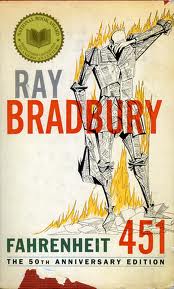
Fahrenheit451: Here is yet another dystopian novel that has become somewhat of a staple in the industry. In Bradbury’s vision of the future, society is permeated by mindless leisure and decadence. Virtually all forms of literature have been banned, and local “firemen” are responsible for enforcing the ban. Wherever illegal literature is found, firemen are responsible for arriving on the scene and putting them to the flame. Yes, in a world where all houses are fireproof, firemen are no longer responsible for putting fires out, but for starting them!
In the course of the story, the main character – a fireman named Guy Montag – begins to become intrigued with literature and discovers a sort of magic within it that is missing from his world. In addition, Guy is told by his boss that society became this way willingly. Perhaps out of fear, perhaps out of sloth, they chose convenience, ease, and gratuity over subtly, thought and reflection. In time, Guy’s choices make him a fugitive and he is forced to flee and seek refuge with other people who insist on keeping and reading books. It is also made clear that nuclear war is looming, which may provide some explanation as to how society came to be the way it is.
In this way, the book has a lot in common with both 1984 and Brave New World. On the one hand, there is active censorship and repression through the destruction of books and the criminalization of reading. On the other hand, it seems as though the people in Bradbury’s world surrendered these freedoms willingly. It is a fitting commentary on American society of the latter half of the 20th century, where entertainment and convenience seemed like the greatest threats to independent thought and learning. This, in turn, could easily form the basis of dictatorship. As we all know, a docile, narcotized society is an easily controlled one!
The Handmaid’s Tale: Here is another novel that few people get through high school without being forced to read, especially in Canada. But there’s a reason for that. Much like 1984, BNW, and F451, The Handmaid’s Tale is a classical dystopian narrative that has remained relevant despite the passage of time. In this story, the US has been dissolved and replaced by a theocracy known as the Republic of Gilead. In this state, women have been stripped of all rights in accordance with Old Testament and Christian theocracy. The head of this state is known as the Commander, the chief religious-military officer of the state.
The story is told from the point of view of a handmaid, a woman whose sole purpose is to breed with the ruling class. Her name is Offred, which is a patronym of “Of Fred”, in honor of the man she serves. Like all handmaidens, her worth is determined by her ability to procreate. And on this, her third assignment, she must get pregnant if she doesn’t want to be discarded. This time around, her assignment is to the Commander himself, a man who quickly becomes infatuated with her.
Over time, the infatuation leads to sex that is done as much for pleasure as procreation, and he begins to expose her to aspects of culture that have long been outlawed (like fashion magazines, cosmetics, and reading). She even learns of a Mayday resistance that is concerned with overthrowing Gilead, and that the Commander’s driver is apparently a member.
In the end, Offred is denounced by the Commander’s wife when she learns of their “affair”. Nick orders men from “The Eyes” (i.e. secret police) to come and take her away. However, he privately intimates that these are actually men from the resistance who are going to take her to freedom. The story ends with Offred stepping into the van, unsure of what her fate will be. In an epilogue, we learn that the story we have been told is a collection of tapes that were discovered many generations later after Gilead fell and a new, more equal society re-emerged. This collection is being presented by academics at a lecture, and is known as “The Handmaid’s Tale”.
In addition to touching on the key issues of reproductive rights, feminism, and totalitarianism, The Handmaid’s Tale presents readers with the age-old scenario of the rise of a dictatorship in the US. Apparently, the military-theological forces who run Gilead in the future seized power shortly after a staged terrorist attack that was blamed on Islamic terrorists. In the name of restoring order and ending the decline of their country, the “Sons of Jacob” seized power and disbanded the constitution. Under the twin guises of nationalism and religious orthodoxy, the new rulers rebuilt society along the lines of Old Testament-inspired social and religious orthodoxy.
This angle is not only plausible but historically relevant. For as Sinclair Lewis said back in 1936 “When fascism comes to America, it will be wrapped in the flag and carrying a cross.” This is paraphrased from his actual, more lengthy comments. But his essential point is the same. If a tyranny emerged in the US, he reasoned, it would do so by insisting that it was religiously right and that it was intent on protecting people’s freedoms, not revoking them.
In addition, the angle where an Islamic terrorist attack spawned the takeover? Tell me that’s not relevant to Americans today! Though written in 1985, Margaret Atwood’s dystopian scenario received a shot of credibility thanks to eight years of the Bush administration, a government that claimed religious orthodoxy and used security as justification for questionable wars and many repressive policies.
Final Thoughts: After years of reading dystopian literature, I have begun to notice certain things. For starters, it is clear why they are grouped with science fiction. In all cases, they are set in alternate universes or distant future scenarios, but the point is to offer commentary on the world of today. And in the end, utopian and dystopian satires are inextricably linked, even if the former predates the latter by several centuries.
Whereas Utopian literature was clearly meant to offer a better world as a foil for the world the writers were living, dystopian literature offers up a dark future as a warning. And in each case, these worlds very much resemble our own, the only real difference being a matter of degree or a catalyzing event. This is why there is a focus in dystopian literature on explanations of how things came to be the way they are. In many cases, this would involve a series of predictable events: WWIII, a terrorist attack, more overpopulation and pollution, an economic crisis, or a natural disaster.
And in the end, the message is clear: whether it is by fear, poverty, or the manipulation of critical circumstances, power is handed over to people who will deliberately abuse it. Their mandate is clear and their outlook is the exact same as any tyrant who has ever existed. But the important thing to note is that it is given. Never in dystopian literature do tyrants simply take power. Much like in real life, true totalitarianism in these novels depends upon the willingness of people to exchange their freedom for food, safety, or stability. And in all cases, they inevitably experience buyer’s remorse!
Quicknote: Since getting “freshly pressed”, a lot of people have written in and asked me about my thoughts on “The Hunger Games”. Sorry to say, haven’t read it so I can’t offer any commentary. I will however be commenting on a number of more modern dystopian franchises, specifically examples found in film and other media, in my next post. Stay tuned, hopefully, something you like will pop there!
Back with the third installment in the Song of Fire and Ice series! By the end of book II, A Clash of Kings, a number of interesting developments took place. Stannis Baratheon’s attack on King’s Landing ended in failure, Robb Stark’s campaign south began to suffer some setbacks, and John Snow had taken up with the Wildlings. In addition, Theon Greyjoy was killed, Winterfell was burned to the ground, Arya escaped and began heading north once again, and young Bran began to head for the Wall with his companions, pursuing a prescient dream.
A Storm of Swords:
The third novel picks up where all these strands left off, with the War of the Five Kings, the war beyond the Wall, and with Daenerys Targaryen’s ongoing efforts to secure an army and return to Westeros. Much like book II, Storm contained a sort of climax where a major battle takes place, this time at the Wall. John’s time spent amongst the Wildlings also gives the reader insight into the lives of the Wildlings and what is driving them south.
At the same time, there is a great deal of detail given to the world of the East, where Daenerys is travelling to the ancient slaver cities of Astapor, Yunkai and Mereen. Much like Qarth in book II, these eastern cities are clearly inspired by the ancient cities of Asia Minor and the Middle East (aka. Babylon, Antioch, Jerusalem, etc). However, there were also some rather dire developments as well. Like I said in my previous post, George RR Martin is never one to shy away from killing off main characters or devastating his readers. Whereas he kind of shied away from that in Clash, this book got right into it! But more on that in a bit. First, I’d like to get into the overall plot of the novel…
Plot Synopsis: Starting at the Riverlands, where Robb Stark and his armies are gathered, we learn that the Wolf has suffered from some serious errors in judgement. For starters, his uncle, contrary to Robb’s orders, threw off his long-term strategy by engaging Tywin Lannister’s armies at the river crossings. Though they were victorious in thwarting them, this move upset Robb’s plans to lure Tywin closer to his home town of Casterly Rock, where Robb hoped to outflank him and end the Lannister’s involvement in the war.
However, Tywin instead deployed the bulk of his forces to attack Riverrun once Bolton began beating him. Tywin failed to take Riverrun, but deploying his forces here instead of further east meant that he was in a better position to redeploy south once he learned that King’s Landing was threatened. Their victory over Stannis also led to an alliance between House Tyrell and the Lannisters, which meant they would be doubly hard to beat.
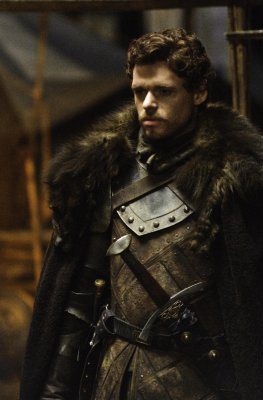
In addition, while he was campaigning in Lannister country, Robb fell in love with a young woman from a smaller House and married her. This decision was an insult to the honor of House Frey, the Lord that controls the Twins (the river crossing to the north) and one of Robb’s most powerful allies. Now it was necessary for him to travel to the Twins and make amends, promising his uncle’s hand to one of Frey’s oldest daughters in order to salvage their relationship.
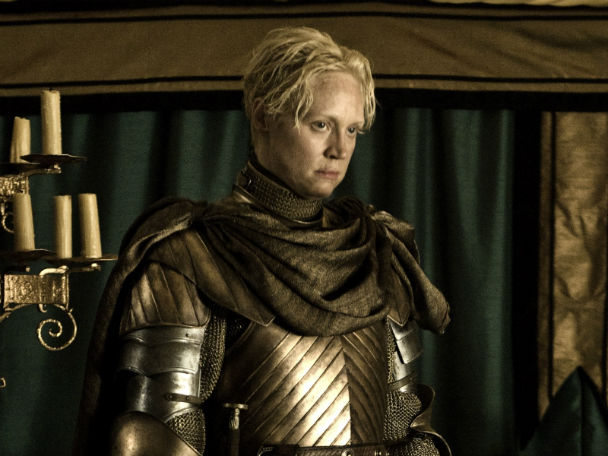
And last, but not least, he also has the defiance of his mother to deal with. It seems that while he was away campaigning, she set Jaime Lannister free and told Brienne to escort him to King’s Landing. On his honor, she made Jaime swear that he would return her daughters to her as soon as he arrived at the capitol. A desperate hope, but given what happened to her boys (she believes them both to have perished at Winterfell at his point) she was both desperate and distraught.
Naturally, Jaime has plans of his own and attempts to escape at the first opportunity. Unfortunately for him and Brienne, his escape attempt alerts some marauders to their presence. As soon as he obtains a sword, he attacks Brienne, the two fight for some time and the noise alerts a band of Bloody Mummers. These men are now in the employ of Lord Roose Bolton of Harrenhal, and they are taken captive. To ensure Jaime’s cooperation, Vargo Hoat, the leader of the pack, slices off Jaime’s hand. Without his sword hand, Jaime becomes a depressed shell of his former self, and begins to contemplate his choices and allegiances.
When Robb and his host arrive at the Twins, they are pleasantly surprised. Despite Lord Walder Frey’s reputation for being a bitter and vengeful man, he seems committed to making this new marriage happen. And his uncle is even pleasantly surprised when he sets eyes on the Frey girl, who doesn’t appear to be as hideous as his other offspring! Everything goes well on the wedding night as well. Though the food is not so good, the wine is plentiful and people begin to get soused. However, once the bride and groom are hauled off, Frey has another surprise in store. Crossbowmen emerge from the gallery and begin firing on them! Robb and his banner men are quickly surrounded, and Robb and his mother are killed!
Back at King’s Landing, celebrations are being held! With their victory over Stannis’ forces, the people are jubilant and welcoming House Tyrell as liberators. In addition, Lord Tywin has taken the role as Hand of the King since Tyrion has been bed-ridden with injuries and is suspected of trying to harm Joffrey. Also, it seems that the new hand has made some changes to Joffrey’s wedding arrangements. Instead of marrying Sansa, as was arranged under King Robert, he now wishes to cement the Lannister’s new alliance with the Tyrell’s by marrying Joffrey to Lady Margaery Tyrell. Sansa is relieved, until she is informed that she will be wedding Tyrion instead, who isn’t particularly happy about it either.
Now two weddings must be held. The first, of Sansa and Tyrion, is a sham affair that is rushed through with minimal pomp and ceremony. For the second wedding though, much time and effort are spent and no expense is being spared. In addition, Sansa finds herself being taken into the confidences of the matriarch of House Tyrell. As Joffrey’s previous betrothal, she would like to know just what kind of man her granddaughter is marrying. After learning that the old lady is an honest and gentle person, Sansa tells her the truth: Joffrey is a monster, she says, and her granddaughter should be afraid. The old lady thanks her for her honesty, and begins plotting…
The wedding festivities are lavish and Joffrey appears to be taking well to his new wife, which leaves Sansa fearing for her life. Tyrion is similarly worried, knowing that Joffrey hates him and Cersei and their father both suspect him of treachery. He worries that the boy will try to kill him and his new wife, but they are both saved when something unexpected occurs. In the midst of eating from a massive pigeon pie that was prepared for the event, Joffrey chokes and dies horribly. More to the point, the girl Sansa disappears in the midst of his death. All eyes go to Tyrion, who is promptly arrested for the boy’s death.
After suffering in the dungeons of King’s Landing for a time, Tyrion is brought forth and put on trial. He is forsaken by everyone, including his mistress Shae, who appears to have been threatened into giving him up. All hope appears to be lost for Tyrion, but he then receives an offer from an unlikely source: Lord Oberyn Martell, the Prince of Dorne. It seems that the people of Sunspear still hold the Lannister’s accountable for the deaths of two Martell children who were murdered during Robert’s revolt. The one responsible was Sir Gregor Clegane (“The Mountain”), but they suspect Lord Tywin was the one who gave the order. He agrees to fight for Tyrion if he requests a trial by combat as part of a plot to kill Gregor and eventually put a Martell on the throne.
Without options, Tywin agrees, and as expected, Cersei chooses Gregor as her champion. The fight goes well for Oberyn, who employs cunning and speed to defeat Gregor with a poisoned spear. However, before he can deliver the final blow, Gregor takes Oberyn by the throat and kills him with his bare hands. Tyrion is once again doomed, and Gregor is destined to die a slow and terrible death. However, Tyrion finds help from an unlikely source once again, this time from his brother who has returned.
After hearing of Robb Stark’s death, Harrenhal once again changed hands and Jaime was set free. Having undergone a change of heart, he decided to bring Brienne back with her. Upon his arrival, he and Cersei have a falling out over his brother’s supposed guilt, and he decides to set Tyrion free. This consists of showing him a secret stairway that will take him to the coast, but Tyrion decides to head up instead. Having served as the Hand, he knows the secret stairs lead to the Tower of the Hand, where his father currently resides…
When he enters, he finds Shae warming his bed. She pleads and offers him the usual denials, telling him she was threatened and had no choice. Tyrion, sick of betrayal, decides to strangle her with her own jewelry and then sets out to find his father. After grabbing a crossbow from the bedroom wall, he finds his father in the privy and corners him there. After some harsh words are exchanged, he fires a bolt into Tywin’s stomach and leaves him there for dead.
With both Joffrey and Tywin dead, Cersei takes up the role of Hand and crowns her youngest son, Tommen, as king. In addition, she charges her newly-estranged brother with finding and killing Tyrion. As the new Lord Commander of the Kingsgaurd, it is his duty to track down the assassin, but he is obviously conflicted given the fact that he played a rolein his father’s death. Once the funeral is over, he decides to sets Brienne free and gives her a new sword named Oathkeeper. This was apparently Joffrey’s wedding gift from Tywin, which was reforged from the Valyrian steel of Ned Stark’s old sword. He then tells her to go forth and keep her oath to Catelyn to find Arya and Sansa.
Also, it should be noted, Cersei begins to go nuts as a result of recent events. In addition to losing her son and her father, it is also clear that her incest has become common knowledge. The Tyrells also appear to be positioning themselves to take the throne down the line. It is even intimated that the Tyrell matriarch was the one who poisoned Joffrey because of what Stansa told her about him. Now that Tommen is king, it is he who must marry Lady Margaery Tyrell, but since he’s so young, she believes she must be the power behind the throne.
Sansa is meanwhile ferried away with the help of Lord Donton, a disgraced ex-knight who Joffrey was in the habit of abusing, but whom Sansa was kind to. For some time, they were planning her escape, and when she learned that she would be wed to Tyrion instead of a Tyrell, she agreed to his plans. After helping her escape on the night of the big wedding, she is transferred to a ship waiting for them down by the water. Her rescuer, it seems, is Lord Petyr Baelish, who plans to take her to The Eyrie where he is about to wed her aunt (Catelyn’s sister). After delivering her aboard, Donton is killed to cover their tracks.
She is then brought to the coast of the Vale of Arryn where she meets Petyr and her aunt. While it is clear that Lady Lysa loves Petyr, it is also clear that he doesn’t love her, but instead is carrying a torch for Sansa. After arriving at the Eyrie, he kisses Sansa in the courtyard, sending Lysa into a jealous rage. Later on, she invites Sansa up to the throne room and threatens to throw her out the Moon Door, but Petyr intervenes. After talking Lysa down, he confesses to her that he only ever loved her sister, and then tosses her out the door! He then moves quickly to blame the minstrel and bribes Lysa’s bannermen to ensure their loyalty to his rule.
Meanwhile, Arya’s trip north brings her and her companions into some strange company. Having escaped Harrenhal, she now comes into contact with a group of men known as the Brotherhood without Banners. These were the men whom Ned Stark had sent out to deal with the raids in the Riverlands, but who now are protecting the countryfolk from raiders and Lannisters. Leading them is Lord Beric Dondarrion who has picked up an usual companion, the red priest Thoros of Myr. Here too is another worshiper of R’hllor, who has apparently used his magic to resurrect Beric, a couple of times!
Having been taken in by the company, they soon find Sandore Clegane, who fled King’s Landing during the siege, and put him on trial for his many crimes. Sandore request a trial by combat and narrowly wins when Beric’s sword breaks and he dies. However, Thoros is able to resurrect him yet again, and Sandore is free to go. But before he leaves, he is sure to take a hostage – Arya Stark! The two then travel north together since Sandore is hoping to ransom her to her brother. This journey takes them to the Twins, just in time for Lord Bolton’s supposed wedding. When the pandemonium strikes, Arya is forced to flee and is only saved by the intervention of Sandor himself.
In time, Sandor is critically wounded and Arya leaves him behind. She makes for the Vale of Arryn where she decides to board a ship and head for Braavos. She does this because Jaqen H’ghar, the killer she helped free, gave her a coin before departing which he claimed was from Braavos. The coin contained the inscription “Valar Morghulis”. When she arrives at the port, she speaks these words to a Braavosi Captain, who replies “Valar Dohaeris” and agrees to take her aboard. They set sail for the free city of Braavos and Arya bids farewell to her past life.
To the East, Daenerys and her companions are still busy trying to recruit an army. On the recommendations of Lord Mormont, they set course for Slaver’s Bay believing that they will be able to recruit an army from the Unsullied. These are apparently warrior-slaves who have been raised from birth to fight, feel no pain, and obey any and all orders from their commander. With her new-found friends, Arstan and Strong Belwas, they arrive at Astapor where she agrees to surrender one of her dragons in exchange for a large host. However, she then tricks the slavers by ordering the Unsullied, once they are transferred to her ownership, to kill all the city’s slave masters.
With her new army and a host of freed slaves, Daenerys sets course for the city of Yunkai next. Here, she finds another slave stronghold that is protected by a host of mercenaries. After meeting the enemy’s mercenary brigades, she is aided by the defection of one of their Captains. With his help, they attack the mercenary encampents at night and this city falls shortly thereafter. Finally, she and her host move on to Mereen, the last of the slave cities, but find it walled and heavily defended. They set camp and begin the long process of besieging it.
But first, some revelations are made. On the one hand, she discovers that Arstan is in fact Ser Barristan Selmy, the former Lord Commander of the Kingsguard who Joffrey dismissed. His true purpose, it seems, was to find the heir of the Targaryen line and bring her home. At the same time, she learns that Jorah Mormont was originally sent to spy on her for Robert. However, when the order came that she was to be assassinated, he changed his mind and enlisted with her. Daenerys is outraged. It seems that the prophecy told to her by the Undying of Qarth is coming true. She has been betrayed twice now, which means she will betrayed once more before the end.
To have them make amends, she orders Barristan and Mormont to sneak into the city through its sewers with a host of Unsullied at night and open the gates. They succeed, and the city is taken shortly thereafter. She forgives Selmy and makes him the Lord Commander of her Queensguard, but decides to banish Lord Mormont. In the meantime, she decides to set up camp at Mereen and contemplate how she will become the ruler that Westeros needs.
Finally, things to the north are also proceeding apace. Having been captured by the Wildlings, John Snow is brought before Mance Rayder. He is asked to explain why he would defect, and wanting to be convincing, John tells him something approximating the truth. He says he defected because he is sick and tired of being “the bastard son” and wants to be free. Rayder believes him, and John is soon reunited with the young Wildling woman he met earlier and spared.
Her name is Ygritte, and she is clearly taken with John. As time goes on, they become close and claim each other, Wildling-style! As a result of all this, John’s feelings of betrayal deepen, but he made an oath to Qorin to learn all he could, so he continues. In time, this bears fruit when he learns that the Others are what is driving the Wildlings south. Hence why they are determined to take the Wall and claim the northern lands of Westeros for themselves.
He also learns that Rayder had been desperately searching for the Horn of Winter which the Wildlings believe is magic. By sounding this horn, he believes he can melt the Wall and take out the Night’s Watch easily. However, in the meantime, he must commit his forces to attacking the Wall conventionally and sends John and Ygritte with an advance party to scale it and do reconnaissance on the other side. Once over, John escapes from the Wildlings once more and rejoins his brothers at Castle Black.
His loyalties are heavily suspect and few believe his story about Qorin orders, but his loyalty is proven when Ygritte and the advance party attack Castle Black. They manage to defeat the Wildling party, and Ygritte is killed by a stray arrow. John is torn by the loss, but there is little time to mourn. On the other side of the Wall, Rayder has over forty-thousand Wildlings, giants, mammoths and seige engines prepared, and begins his assault. John is given leave to command the defense of the Wall against this first assault, and things go relatively well.
Outnumbered but not outclassed, John and his brothers manage to thwart the first wave. John is then invited to parlay with Rayder, who reveals that he has found the horn after all. He tells John that he cold destroy the Wall with a single blast of the instrument, but he would rather capture it intact since it is the only thing that will keep the Others at bay. John considers his offer of a negotiated truce, but their parlay is cut short when Stannis’ surviving armies take to the field and destroy the Wildling encampment.
For months, the Night’s Watch had been pleading for aid and soldiers to be sent north to the Wall, and now it seems that only Stannis has chosen to answer. He tells John what the priestess Melissandre believes, how the return of the Others is just a prelude to the return of her god’s sworn enemy – the dark one. Stannis asks for John’s support and promises him Winterfell in exchange, but John is chosen by the Night’s Watch as their new commander and must refuse.
In the epilogue, we see how the Brothers Without Banners have taken one of the Frey men prisoner. After interrogating him about the massacre that happened at the wedding, the reanimated body of Catelyn Stark arrives and orders his death. It seems that the priest Thoros has used his magic to resurrect her as well, and now she is intent on revenge!
Strengths/Weaknesses:
Book III was, in my opinion, a step down from books I and II. On the one hand, there was plenty of action and plot developments to keep the reader interested, and plenty of surprises besides. However, not all of them were welcome to this humble reader. For starters, when Robb Stark is murdered at the court of Walder Frey, I was incensed! I very nearly put the book and the series down for good! Was it not enough that Martin had to kill off Ned Stark? No, he had to kill his son and Catelyn too? The Starks are supposed to be the heroes of this series, dammit! You can’t just keep killing them off! Yes, I was mad…
But it was not just the fact that sympathetic characters kept getting murdered. It was the confusion it caused. Basically, every story has a set of main characters, people that help drive the story forward. When a character dies off, it naturally falls to another to keep the story going. Now we all know that Martin uses many characters and perspectives in his novels, but most of these are secondary and rarely heard from. It’s the main perspectives that tell things of the greatest importance, and usually there are only a few of them. When these people die, it has the effect of making the reader think that they weren’t so important after all. And if it keeps happening, the reader can become cynical and will not form the usual emotional attachments to characters. When that happens, a story dies, at least from the point of view of the person reading it. It’s all about emotional attachments Martin, you can’t keep traumatizing us!
More than that, I was beginning to feel tedious and depressed by the way Arya and Sansa’s sad stories kept going on and on. For two books now, Arya has been trying to get home, only to be waylayed, taken prisoner, get free, taken prisoner again, get free once again, then only to find out that her family is dead. Thus she decides to go to Braavos because she thinks she’s the only Stark left. And she’s just a kid! How depressing! Sansa, on the other hand, has to endure Joffrey’s constant abuse, the prospect of sex with Tyrion, and then is set free only to find herself a prisoner again, just under different circumstances. As if the rapacious and cruel Lannisters weren’t enough, now she has to deal with the murderous and creepy Lord Baelish!
And even before Robb was murdered, the setbacks he was been forced to endure were beginning to get tedious. In spite of all his early successes, its becoming abundantly clear that he’s going to lose the war. First his strategic plans get interrupted, the Lannisters succeed in the south and make a new alliance, Theon stabs him in the back by seizing Winterfell, his attempts to liberate it fail, Winterfell is then burned to the ground and his brothers killed (presumably). Then, on top of all that, he learns that his alliance is likely to fall apart because he chose to follow his heart. And just when it seems like things are going to be okay on that front, he’s and his mother are betrayed and murdered! It’s like, we get it! War is hell, especially this war, and the bad guys are winning! But can’t you give us some happy news for a change?
But like I said, the book had plenty of things to keep the prospective reader interested. After picking it back up (after about a week or so of stewing), I found plenty of good things to keep me interested in the series. For starters, Joffrey finally got what was coming to him, Lord Tywin also bought it while sitting on the privy, and Catelyn was revealed to be alive (albeit in a somewhat hideous form). This was all nice to read, mainly because I was getting so sick of Joffrey that I was just waiting for someone to give him a “golden crown” as well! His and Tywin’s death also brightened Tyrion’s storyline a lot, seeing as how his constant struggle with his cruel family was also beginning to get Kafka-esque. Given that he is one of the few sympathetic characters from that thread, it was nice to see him get a little payback! Now if someone would just whack Cersei we’d be in business!
And of course there were all the plot developments that kept satisfying my curiosity. Much like in book II, there were plenty of things that I was just waiting to hear about that finally got revealed. For instance, I was dying to know what would become of the Others invasion, of the civil war, of Daenerys’ plans to return to Westeros, and of Bran’s visions. After so much build-up, set-backs and plot twists, I was dying for some resolutions! And as usual, George RR Martin gives it out sparingly, providing clues, some answers, and a few interesting tidbits, all the while ensuring that things keeps rolling into the next book.
All in all, I liked this book. It was a very decent follow-up to A Clash of Kings and maintained the commitment to realism, detail and world-building that the series is famous for. My problems really only stem from the fact that at times, the books are too realistic, too detailed, and contain far too many plot twists. However, it would be unfair to say that any one book fails in this regard when its really a cumulative effect. Anything bad that I can say about this particular novel always begins with “at this point in the series…” Mainly, I was just hoping that things would be close to some kind of resolution. That’s another thing that’s important when writing. When audiences wait too long for a resolution, they’ll also lose interest. I hope Mr. Martin is writing this down 😉
Speaking of which, I am currently nose-deep in A Feast For Crows. See you soon with the review for that one!
Hey all! I am happy to announce that Source has just received another positive review. This one comes from Bibliotasitc.com from a user named george g (I’ll protect your anonymity!) who generously awarded it 4/5 stars!
“A story about water, or the lack thereof. Not exactly the makings of a great story, but the author pulled it off. When I first read this, I thought it was going to be a sermon about the environment, but it wasn’t. These actually a decent story in here. Check it out.”
Thanks man! I’ll have to post more stories to Bibliotastic. As it stands, Source is my only story that made it onto that site.
Meanwhile, over at free-ebooks.net, my latest entry there (Domicile 4.5) picked up the following comment:
“Very interesting! Such good technology–made inert by the greed and slackness of man. We are still not ready, and may never be–for such good things to be reality, since with great wisdom comes great sorrow. Good reading, only a few errors!”
And check out the cover I made for the ebook! Thanks for the feedback, folks! Looking forward to adding new material and seeing what people have to say about it.
As I’m sure I said in my last post, George R.R. Martin is known to his contemporaries as the “American Tolkien”. This is a fitting comparison for me seeing as how Game of Thrones was something I had no real interest in until after I saw it adapted to screen. It was only after I saw the whole first season, which is book I in the series, that I decided to start reading it and get informed! I’m now on book four in the series and like all GOT geeks, am eagerly awaiting season two which premiers April 1st (This better not be some kind of prank!) But anyway, here is book II in the Song of Fire and Ice series, which is appropriately named:
A Clash of Kings:
As with Lord of the Rings series, I decided to read the second book first, mainly so I could get a head start on all the material that was to come. However, since the series is ongoing, I did not dare wait til I read to the end before going back to cover the original. And I can honestly say that book II improves upon the first, bringing more action, more intrigue, and more fantasy-fiction to the fore. I tell ya, its a rare thing when a sequel actually surpasses the first in a series, but that was to be expected here. Whereas Game Of Thrones set the scene, introducing the major plot threads and building up the action, Clash of Kings incites it all and brings it all to an explosive semi-climax. The most important element of which is the battle at Kings Landing, which I cannot wait to see adapted to the screen!
Plot Synopsis: The book opens with a celestial event. A red comet, which goes by various names, has entered the heavens and seems to mean different things to different people. To some, its a portent of evil, but to others, its a sign of impending victory. Picking up where the first book left off, the realm of Westeros finds itself divided between five powers who are now in a state of civil war. In the south, power is divided between Kings Landing, where the Lannisters rule through Joffrey, and Robert Baratheons two brothers – Renly and Stannis. The former now controls the southern area of Highgarden while the latter controls the island Dragonstone. While a Baratheon alliance would surely defeat the Lannisters, the brothers are divided because both are determined to sit the Iron Throne.
While Stannis, the elder, has the better claim to the throne, Renly is the more charismatic of the two. He is just as determined and has a much larger army, but Stannis has a secret weapon which he has yet to unveil: a sorceress named Melisandre, a priestess of Asshai who worships the fire god R’hllor. The cult of R’hllor, which is monotheistic in focus, is quite popular in the East but relatively unheard of in Westeros. To many, her backing of Stannis, whom she sees as the Azor Ahai (prophet of R’hllor) reborn, is merely a power play, a means to introduce her religion to the Seven Kingdom should be triumph in the war. But according to Melisandre, the civil war is merely a prelude to a much greater war against a dark force that has been coming for some time…
Meanwhile, to the north Robb Stark has been crowned King of the North by his bannermen and continues in his long campaign south. Though they are outnumbered by the Lannisters, they win victory after victory, and soon even Tywin Lannister is forced to move the bulk of his forces south when they hear that King’s Landing is threatened. For the wolf, victory seems possible, but a there are a few complications to his plans. For one, King Joffrey and the Lannisters are still holding Sansa Stark hostage and Arya Stark is still missing (in truth, she and the Night’s Watch recruiter who saved her are moving north with a band of convicts and recruits). The only thing keeping Sansa safe is the fact that Jaime Lannister is in their custody, but he’s proving to be a tricky hostage…
What’s more, the Iron Isles, where Theon Greyjoy hails from, are up in arms. With the wolf marching south and civil war dividing the realm, his father seems intent on carving out his own kingdom in north as well. His daughter is chief amongst his Captains, a fact which annoys Theon to no end. Determined to upstage her, he leads an attack on Winterfell and takes it. In time, Bran Stark and his newfound friends from the Riverlands, who’ve convinced him he’s having prescient dreams, decide to escape to The Wall. Something is up there, it seems, that is calling to Bran. When he flees, Theon decides to stage their murder to avoid the inevitable embarrassment of having lost them.
To the far north, Jon Snow has taken up with the Nights Watch and is with them as they begin a large-scale reconnaissance north of The Wall. Apparently, the Wildlings have been abandoning their villages in droves, moving to a large encampment where a man named Mance Rayder. Apparently, he has declared himself “King-beyond-the-Wall” and plans to lead a united army of Wildlings south to take the lands they have been historically cut off from. In time, it becomes clear that he himself is fleeing something, they very thing that Jon Snow and the Watch have been worrying about. It seems the White Walkers have been getting around, and just about everyone in their path is looking to flee…
To the east, Dany and her host travel across the desert to the great city of Qarth. Once there, Dany becomes the focus of much attention and fascination, given that she travels with three dragons. Despite this, she is unable to raise an army because the only coin she has to barter with is her dragons, which she refuses to give up. When she goes into the House of the Undying, where the warlocks of Qarth reside, she is told that her life is threatened and that she will be betrayed three times. When the warlocks try to attack her, her dragon burns the House down, sparking emnity between her and the Qartheen. An attempt is made on her life at the city harbor, but she is saved by two men – an old warrior named Arstan Whitebeard and a mercenary named Strong Belwas. They were sent by Illyrio, the man who sheltered her and her brother, and join her host. Together, they begin to plot where to travel to next to find her an army.
After a failed meeting between Renly and Stannis, which Catelyn Stark travelled south to host, Renly was killed by a “shadow”. It becomes clear that Stannis’ priestess was involved, because all those who oppose Stannis have a way of winding up dead. As a result, Renly’s former bannermen declare fealty to Stannis and add to his power, and Catelyn is forced to flee north with one of Renly’s staunchest supporters. A woman named Brienne of Tarth, a formidable fighter whom Renly made a knight. They return to Riverrun, the domain of her brother, where Robb is rallying his forces and her father lies dying. Upon her return, she learns of what happened to Winterfell and her two youngest sons and is heartbroken. Between Ned, her ailing father, and now her two boys, it seems everyone she loves is dying.
Back to King’s Landing, Tyrion has taken up the role as Hand of the King. Before him is the challenge of defending the capitol from Stannish Baratheon, who is quickly approaching by land and sea with his combined armies and navy. At the same time, he must cover his ass seeing as how his sister will stop at nothing to do him in. A game of chess ensues, with both sides employing bribes and whatever blackmail and threats they can to gain leverage over the other. For a time, Tyrion seems to have the upper hand, but soon, battle comes to their doorstep, and he must forgo all that to lead the defense of the city.
Meanwhile, Arya is captured while traveling north by men loyal to the Lannisters. The survivors are taken to Harrenhal, a major castle that is currently in Lannister hands, where she is forced to serve as a peasant girl. Her identity remains a secret, but she is forced to endure all kinds of abuse as a serving girl. However, one of the captives who was part of their caravan comes to her and tells her that he owes her three lives for saving him and the lives of his companions. Instead, she uses him to help free a bunch of Stark men who then seize the castle. However, her fortunes do not change much, as she is then forced to act as cup bearer to Roose Bolton who comes to occupy the castle. She escapes shortly thereafter with her old companions and continues north.
Tyrion’s preparations pay off in the end. At sea, the large chain link he had constructed is used to close off the river once Stannis’ fleet enters it. In addition, their forces use a their vast stores of Wildfire he had prepared to set them ablaze once they are trapped. On land, things go a little more poorly, but Tyrion manages to lead a successful defense of the gates and is eventually saved by his father, Tywin. It seems that he travelled to Highgarden before the conflict and enlisted the help of many of Renly’s former bannermen. At just the right time, they perform a flanking maneuver which routs Stannis’ forces and saves King’s Landing. Sensing that he will not die in battle, one of Cersei’s assassins attacks and nearly kills Tyrion. When he wakes up in bed, he finds that Cersei has gained the upper hand on him by preying on their father’s good graces.
North of the Wall, the Black Brothers find a base amongst a ruined tower and begin sending recon forces further north. Jon is part of a force dispatched to the Skirling Pass, where they find the bulk of Rayner’s army massing. In addition to thousands of Wildlings, they see giants, mammoths, and wargs complimenting their force. In time, the Wildlings fall upon them and they are forced to flee. Before they are captured, Qorin asks Jon to betray him when the time comes so that he may infiltrate the Wildling camp and learn their secrets. Jon reluctantly agrees, and when they are cornered, Qorin fights him and lets him win. Jon is now a prisoner of the Wildlings and is reunited with a young Wildling woman that he met and set free earlier. She convinces Rayner to take Jon in, as he himself was once a Black Brother who defected.
Back in Winterfell, Theon finds himself with his back to the wall when Robb dispatches one of his bannermen and an army to remove the Iron Men from Winterfell. All hope seems lost to him, when a new force enters the field and saves his butt. It seems that one of the sellswords who joined him earlier was in fact the Bastard of Bolton, a usurper who fell into disfavor with Robb’s men and was imprisoned in Winterfell. When Theon set him free, he returned to his home, took up the cities army, and returned to save him. However, he quickly betrays Theon, kills him, and orders Winterfell razed…
Strengths/Weaknesses:
As I said before, this book packs some serious action into its binding! After much build-up in the first, the climactic battle of King’s Landing takes place, and it was quite unclear how things were going to go… In fact, much of the book is unpredictable. One gets the impression that the Lannisters are bound to lose well up until the battle finally takes place. In addition, the fate of House Stark is something which is tenuous at best. As always, one can’t get too emotionally attached where the characters of George R.R. Martin is concerned. They tend to die suddenly and haphazardly. However, unlike in book I, none of the major characters die off, just the supporting cast. This I would consider a strength considering that I tend to get sour when people I like get killed!
That being said, there were a number of inexplicable plot twists in this book, so many that it began to feel a little contrived after awhile. For starters, the battle of King’s Landing suddenly turns when all hope seems lost. In itself, that was a pretty good twist, but there were many like it. When it came to the rivalry between Renly and Stannis, it seemed apparent that Renly was destined to win, but then he’s suddenly killed by Melisandre’s shadow, thus completely turning the tide. And then there’s the part where Theon Greyjoy is defending Winterfell. Everything seems said and done when at the last moment, he is saved by the intervention of the Bastard of Bolton, only to then be killed! That’s three major plot twists in one book, and the last one was like a… a compound twist! Kind of grows thin after awhile.
In addition, like all the books in the series, the story can become drawn out and emotionally taxing. It seems that despite whatever hopes the reader might have for a satisfactory resolution, the plot threads just seem destined to go on and on. Whether its Tyrion, Arya, Sansa, Robb, Catelyn, or John, it seems that they are just destined to suffer and endure more and more in the way of bad news. Unless of course the character dies suddenly, but that too is emotionally taxing for the reader! Just once, I would have liked for a character who I sympathize with to be able to put their feet up and say, “Whew! That was tough, but we got through it! Time to relax…”
However, this makes for a more respectable and realistic read all around. More than anything, the book conveys a genuine sense of desperation and discomfort, which is fitting since its about a civil war. These things are not comfortable, especially in a medieval setting! They are dirty, painful, bloody and festering, and the innocent constantly suffer. In all fairness, my feelings on this last note could be the result of the fact that I’m still reading the series, and after four books, all the war and death can get exhausting. However, this does not take away from this particular novel. It’s still awesome, and a very good follow-up to the first. My advice, check it out and then catch the miniseries. That way, you’ll have a frame of reference!
Having covered Snow Crash and Diamond Age awhile back, I thought it was time to move on to the third installment in my Neal Stephenson series. Today, for consideration, the historic techno-thriller Cryptonomicon! This story took me close to a year to read, in part due to interruptions, but also because the book is pretty freaking dense! However, the read was not only enjoyable and informative, it was also pretty poignant. As a historian and a sci-fi buff, there was plenty there for me to enjoy and learn from. And for those who enjoy techno-thrillers and dissertations on mathematics, this book is also a page turner! Little wonder then why this novel was dubbed the “ultimate geek novel”.
The name is derived from H.P. Lovecraft’s Necronomicon, a fictitious book that has been referenced numerous times in western literature and pop culture. The name is indicative of the book’s main theme, cryptology, as well as the unofficial manual used by cryptologists during and after World War II. In addition to featuring fictionalized versions of real events, it is also chock-full of fictionalized personalities drawn from history. They include Alan Turing, Albert Einstein, Douglas MacArthur, Winston Churchill, Isoroku Yamamoto, Karl Dönitz, and Ronald Reagan, as well as some highly technical and detailed descriptions of modern cryptography and information security, with discussions of prime numbers, modular arithmetic, and Van Eck phreaking.
Unlike his other novels, Cryptonomicon was much more akin to historical fiction and techno-thriller than actual sci-fi, mainly because its narratives take place in the past and present day. However, this is a bit of an arbitrary designation. As most fans of science fiction know, a story need not take place in the future in order to explore the kinds of themes common to the genre. And really, all science fiction is actually about the time period in which it is written, and actively draws on the past to create a picture of the future. So putting aside the question of where it falls in the literary spectrum for now, allow me to delve into this bad boy and what was good about it!
Synopsis:
The story contains four intertwining plotlines, three of which are set in the Second World War, and a fourth which takes in the late 90’s. The first follows the exploits of a man named Bobby Shaftoe, a decorated Marine who has just survived the battle of Gaudacanal and is being transferred to the OSS’s counterintelligence division. The second follows Lawrence Pritchard Waterhouse, a mathematician and cryptologist working for the joint American and British cryptology unit 2702. This work involves breaking German codes and leads him to several interesting encounters with famous people. including Albert Einstein and Alan Turing. The third involves a Japanese man named Goto Dengo, an Imperial Army officer and a mining engineer who becomes involved in a a secret Axis project to bury looted gold in the Philippines. The fourth and final perspective which takes place in the 90’s centers on Randy Lawrence Waterhouse, an expert programmer working for an IT company (Epiphyte) that is been doing business in the Philippines.
As the story develops, we see Shaftoe become marooned in Finland where he meets up with some unlikely compatriots. The first is a Catholic priest and physician named Enoch Root, who is attached to 2702, while the second is a Kriegsmarine Captain named Günter Bischoff, who is the commanding officer of an experimental rocket-propelled U-Boat. We learn that an alliance has formed between these individuals, mainly because Bischoff, who became marooned in Finland with the rest of them, has learned that the Kriegsmarine has been given the task of smuggling gold to Japan in order to buy their continued cooperation in the war. He and the others decide to work together to get their hands on some, and soon find themselves back in the Philippines. Before the war, Shaftoe had a sweetheart there named Glory, who he has not seen since the Japanese invaded, and whom he is eager to get back to.
Meanwhile, Waterhouse is bounced around the globe in his efforts to break the Axis’ codes. First, he is sent to a fictional island in the English Channel known as Qwghlm (pronounced ???). On this island, the people wear incredibly thick wool sweaters and speak a language that is loosely related to Gaelic, and incredibly hard to understand. He is then sent off to Brisbane, Australia, to work on breaking the Japanese’s codes. While there, he finds a community of Qwghlmians, who he learns are serving as operators for the British. Whereas the US had their “Wind Talkers”, Navaho signal officers who used their native languages to confuse Japanese listeners, the British had Qwghlmians. Here, he falls in love with, and eventually marries, a young woman named Mary cCmndhd.
At the same time, Goto Dengo is nearly drowned when his troop ship is sunk in the South Pacific. He narrowly survives and drifts to an island where he is forced to survive amidst squalor, decay, and a group of Japanese soldiers who are pillaging and raping amongst the natives. In time, he is found by his fellow officers and is sent to the Philippines where he is put to work on the construction of a series of underground caverns. The purpose of these caves is to store the vast amounts of looted gold which is being shipped from Germany since the Germans are now losing the war and fear being overrun. After many years, the caves are completed and the Americans invade, during which time Dengo is reunited with Shaftoe. Having reenlisted with the Marines, Bobby was sent ahead to organize the resistance, and has learned that he has a son. After convincing Dengo to surrender and defect, he heads off for what turns out to be his final mission. Meanwhile, the sub carrying Gunter Bischoff and a hoarded supply of gold runs aground in the Philippines and the crew drown.
Fast forward to 1997, we come to meet Lawrence Waterhouse as he begins his work in the Philippines. Ostensibly, this involves selling Pinoy-grams to migrant Filipinos, a sort of fiber-optic communication system that allows migrants to speak with family instantaneously. However, he soon learns that his friend and CEO of Epiphyte, Avi Halaby, is interested in using this stream of capital to fund the building of a data haven in the nearby (and fictional) island of Kinakuta. At this point, his job description changes to surveying the laying of the underwater fiber optic cables that will run from the Philippines to Kinakuta, a job which leads him to enlists the help of a Vietnam veteran and mariner named Douglas MacArthur Shaftoe and his daughter, America “Amy” Shaftoe. These people, we quickly learn, are the son and granddaughter of Bobby Shaftoe. In addition, on the island of Kinakuta, the company that is contracted to build the underground facility that will house the haven is run by a Japanese man named Goto Furudenendu, who just happens to be the son of Goto Dengo.
Over time, there plans to create a haven free of repression and scrutiny comes under fire from various quarters. At this point, Amy and Doug begin to help Lawrence and his company find an alternative source of revenue – a hidden cache of gold rumored to be at the bottom of a Philippine harbor. They find the gold and have the money they need, but in the course of it, they also uncover the plot involving detachment 2702, the Japanese, the Nazis, and an unbreakable code named Arethusa. This discovery makes them more enemies, people who want the gold for themselves, or just revenge, and things start to get dicey! However, through this they also get to meet an aged Goto Dengo, CEO of the construction company and man who buried the gold. He agrees to show them where the cache is hidden so that it can be repatriated; and with his help, they find it, Randy and Amy get together, the haven is built, and just about everyone lives happily ever after!
Strengths: From the description alone, I’m thinking people will assume that this story was dense, well-conceived and came together quite nicely. And they would be right! One thing that is immediately clear about it is how well Stephenson weaves past and present together to create a grand narrative that is chock-full of suspense, intrigue and history. This last element is especially prevalent. I can’t tell you how many historical cameos made it into the novel. Through the character of Randy Waterhouse, Albert Einstein and Alan Turing make an appearance. Through his German counterpart, Rudy von Hacklheber, Hermann Goering makes several. Gunter Bischoff, though he never meets Karl Doenitz in the story, repeatedly references him since it he whom he is blackmailing and gets all his orders from! And through Bobby Shaftoe and Goto Dengo, Douglas MacArthur and Isoroku Yamamoto are also woven into the story.
In addition, the way he brings past and present together is done masterfully through his main characters, all of whom are apparently related. Lawrence Waterhouse is the son of Randy Waterhouse and Mary cCmndhd, Doug and Amy are the and granddaughter of Bobby Shaftoe respectively, and Furudenendu is the son of Goto. Hell, even Lawrence ex-girlfriend ends up shacking up with the son of a character in the story! In this way, the sense of connection between past and present is made more clear, as is the sense that destiny or some kind of long-term plan is being fulfilled. The evolution between cryptology and modern computing, how one grew out of the other, is also made abundantly clear.
Weaknesses:
As more than one critic observed, this book tends to appeal to the techno geeks in the crowd. In fact, that aspect of the novel can be quite oppressive at times. In several parts, the descriptions of mathematical concepts as they apply to various things (even the everyday), can go on and on and on. Two examples come to mind: the equation Randy comes up with to describe the rotation of a bicycle wheel, and the section where Lawrence and his peers are conducting some Van-Eck phreaking email surveillance. I mean really, page after page after page of inane detail! I got that the intent was to be comical in the sheer geekiness of it all, but for the non-geeky, the only way to survive these sections was to skip ahead or just keep reading and pray there was a point in there somewhere. Other than that, the sheer length of the book can feel somewhat stifling, which is why it took me a few months to finish it.
However, this book goes far beyond the mere technical. History buffs, fans of sci-fi and people who just plain like a good, complex and interwoven story will find something to enjoy here. Not only was it a good read, it previewed Stephenson’s ability to combine historical fiction and sci-fi, something he would reprise with the Baroque Cycle trilogy and the more recent Mongoliad, all of which I have yet to read! However, one thing at a time. I have yet to finish Anathem, and I’ve been eyeing Readme with keen interest lately…

 The following are the core concepts of the novel The Repossession Mambo, by Eric Garcia (the same guy who brought us Matchstick Men and the Anonymous Rex series). It’s 2025. Thanks to a company known as “The Union”, society has been flooded with artificial organs and just about everyone has one. They have saved and prolonged many a life, and cost a mint! And if you fall behind on your payments, a Repossession agent will come to your house, slit you from your navel to your neck, and retrieve it.
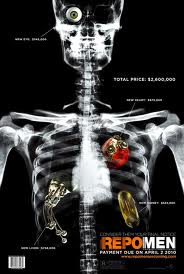 As already noted, the story opens on the US in the near future. Artificial organs, joints, and even a neurological matrix, have revolutionized life by ensuring that the terminally ill, crippled and people near brain death can live on happily, assuming they can pay of course!
 Naturally, he tries to go back to Repo’ing since his wife has already left him and he needs the money. But somehow, he just can’t bring himself to do it anymore. What’s more, time is running out on him making his payments. During a final attempt, he goes into a “Nest” – a slum area where people go to flee The Union’s repo men – where he is attacked and knocked unconscious.
 Unfortunately, Jake finds them there and reveals to Remy that he is responsible for shorting out his defibrillator. By forcing him to meet the payments of an artificial organ, he figured his friend would never leave the business. The two fight, and in the course of it, Remy is knocked unconscious. What follows is a total mind-f*** which is comparable only to Inception! I shall break it down succinctly.