You’re not going to believe this. But just 15 minutes ago, on his Facebook feed, George Takei announced that he will be starring in the upcoming Star Wars remake. Not only that, but he had a few newsworthy items to share about the upcoming sequel that the studio has not been sharing just yet. These include the name of the new film and when filming will begin.
Friends, I am thrilled to announce that I’ll be starring in the Star Wars reboot directed by JJ Abrams. I’ll be playing Master Ceti Maru, a member of the Jedi High Council. The new film, entitled “Star Wars: Galactic Empire,” is greenlit and will begin filming sometime early next year. It is truly a moment for The Star Alliance. Thanks to all my fans for their decades of support.
You may not think it, but even a little hint like the name of the film can tell you volumes. In this case, it would seem to confirm what Hamil has been saying, that the movie would be set in a time when the children of Han and Leia were growing up, a time where the Republic had been resurrected and was fighting the remnants of the Empire to take control of the Galaxy.
In addition, since he will be playing a Jedi Master, its clear that in this time period, the Jedi Order has been restored. So Luke won’t be the only one anymore. Perhaps he’ll just be the head honcho, which is a bit of a change-up ever since Yoda passed away. What’s more, Takei was sure to provided a little mockup photo to get fans in mind of what he would like sporting a Jedi robe and a lightsaber (I see he went with the Windu model). Excited yet? I know I am.
Addendum: It’s officially midnight, so Happy April Fool’s Day! George, you’re one mean SOB!
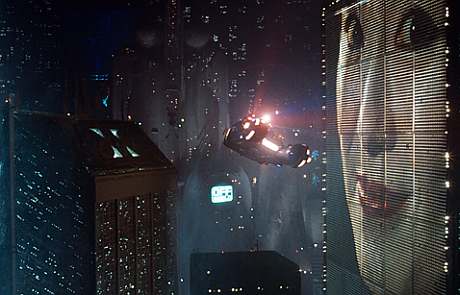
Twenty-five years ago, Los Angeles magazine envisioned what the world would look like in the current decade. And unlike Blade Runner, they avoided the cool but standard science fiction allegories – like massive billboards, flying cars and sentient robots – and went straight for the things that seemed entirely possible by contemporary standards.
The cover story of the magazine’s April 3, 1988 edition showed a futuristic downtown L.A. crisscrossed with electrically charged, multi-tiered freeways permeated by self-driving cars. The article itself then imagined a day in the life of the fictional Morrow family of the L.A. suburb Granada Hills, as “profiled” by the magazine in 2013 by science fiction writer Nicole Yorkin.
Ironically, the magazine did not envision that it would one day go out of business, or that print media would one day be lurching towards extinction. Nevertheless, the fictional article and the world it detailed were interesting reading. Little wonder then why, earlier this month, the LA Times along with an engineering class at USC, revisited the archives to assess what it predicted correctly versus incorrectly.
Together, professor Jerry Lockenour and his class made a list of the hits and misses, and what they found paints a very interesting picture of how we predict the future and how its realization so often differs from what we expect. Of the major predictions to be found in LA of the 2013, as well as in the lives of the Morrow family (get it?), here is what they got right:
Smart-Houses: In the article, the Morrows are said to begin every morning when their “Smart House” automatically turns on. This consists of all the appliances activating and preparing them breakfast, and no doubt turning on all the environmental controls and opening the shades to get the temperature and ambient lighting just right.
While this isn’t the norm for the American family yet, the past few years have proved a turning point for home devices hooking up with the Internet, to become more programmable and serve our daily needs. And plans are well under way to find a means of networking them all together so they function as one “smart” unit.
Self-Driving Cars: The writers of the article predicted that by 2013, cars would come standard with computers that control most of the settings, along with GPS systems for navigation. They also predict self-driving cars, which Google and Chevy are busy working on. In addition to using clean, alternative energy sources, these cars are expected to be able t0 self-drive, much in the same way a pilot puts their plane on auto-pilot. Drivers will also be able to summon the cars to their location, connect wirelessly to the internet, and download apps and updates to keep their software current.
But of course, they got a few things wrong as well. Here they are, the blots on their predictive record:
Homeprinted newspapers: The article also predicts that each morning the Morrows would begin their day with a freshly printed newspaper, as rendered by their laser-jet printer. These would be tailor-made, automatically selecting the latest news feeds that would be of most interest to them. What this failed to anticipate was the rise in e-media and the decline of printed media, though hardly anyone would fault them for this. While news has certainly gotten more personal, the use of tablets, ereaders and smartphones is the way the majority of people now read their selected news.
Robot servants and pets: In what must have seemed like a realistic prediction, but which now comes across as a sci-fi cliche, the Morrows’ home was also supposed to come equipped with a robotic servant that had a southern accent. The family’s son was also greeted every morning by a robot dog that would come to play with him. While we are certainly not there yet, the concept of anthropomorphic robot assistants is becoming more real every day. Consider, for example, the Kenshiro robot (pictured at right), the 3D printed android, or the proposed Roboy, the Swiss-made robotic child. With all of these in the works, a robotic servant or pet doesn’t seem so far-fetched does it?
Summary:
Between these four major predictions and which came to be true, we can see that the future is not such an easy thing to predict. In addition to always being in motion, and subject to acceleration, slowing and sudden changes, the size and shape of it can be very difficult to pin down. No one can say for sure what will be realized and when, or if any of the things we currently take for granted will even be here tomorrow.
For instance, during the 1960’s and 70’s, it was common practice for futurists and scientists to anticipate that the space race, which had culminated with humans setting foot on the moon in 1969, would continue into the future, and that humanity would be seeing manned outposts on the moon by and commercial space flight by 1999. No one at the time could foresee that a more restrictive budget environment, plus numerous disasters and a thawing of the Cold War, would slow things down in that respect.
In addition, most predictions that took place before the 1980’s completely failed to predict the massive revolution caused by miniaturization and the explosion in digital technology. Many futurist outlooks at the time predicted the rise in AI, but took it for granted that computers would still be the size of a desk and require entire rooms dedicated to their processors. The idea of a computer that could fit on top of a desk, let alone on your lap or in the palm of your hand, must have seemed farfetched.
What’s more, few could predict the rise of the internet before the late 1980’s, or what the realization of “cyberspace” would even look like. Whereas writer’s like William Gibson not only predicted but coined the term, he and others seemed to think that interfacing with it would be a matter of cool neon-graphics and avatars, not the clean, page and site sort of interface which it came to be.
And even he failed to predict the rise of such things as email, online shopping, social media and the million other ways the internet is tailored to suit the average person and their daily needs. When it comes right down to it, it is not a dangerous domain permeated by freelance hacker “jockeys” and mega-corporations with their hostile counter-intrusion viruses (aka. Black ICE). Nor is it the social utopia promoting open dialogue and learning that men like Bill Gates and Al Gore predicted it would be in the 1990’s. If anything, it is an libertarian economic and social forum that is more democratic and anarchistic than anyone could have ever predicted.
But of course, that’s just one of many predictions that came about that altered how we see things to come. As a whole, the entire thing has come to be known for being full of shocks and surprises, as well as some familiar faces. In short, the future is an open sea, and there’s no telling which way the winds will blow, or what ships will make it to port ahead of others. All we can do is wait and see, and hopefully trust in our abilities to make good decisions along the way. And of course, the occasional retrospective and issue congratulations for the things we managed to get right doesn’t hurt either!
You can tell a studio is serious about a movie when the trailer releases are many and not too far between. That seemed to be the case with Prometheus, the movie that couldn’t stop dropping hints before it even aired. And it’s definitely the case with the latest installment in the Abrams relaunch of Star Trek, entitled Star Trek: Into Darkness. And so for my third MTM, I’ve decided to post the third trailer for this upcoming movie.
This time around, there’s plenty of action to behold, plus some genuine hints as to what the bad guy is doing and what his deal truly is. Thanks to the previous two trailers, we already knew that Benedict Cumberbatch would be playing the lead villain and that this movie follows the rule of Act II being the darker story. We also knew that this time around, Kirk’s mettle will be tested as he’s forced to go beyond his usual combination of daring and bravado.
And with this latest teaser, some hints are given as to what exactly is motivating the villain and how Kirk and crew will be forced to deal with him. Apparently, it involves a massive terror attack against the Federation which cripples it by taking out its leadership. And what’s more, I believe that Cumberbatch, who’s character is rumored to be named Khan and who sound a lot like the original, will be stepping into the role once occupied by Ricardo Montelban. Fingers crossed at any rate, because that would be cool!
And of course, it’s an exciting watch. So enjoy it and join me in waiting eagerly for the May 17th theatrical release!
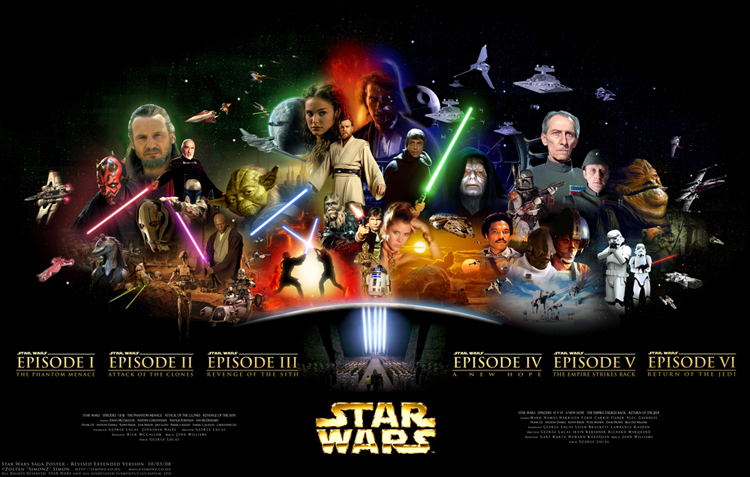
Don’t worry, that’s not the tagline for (yet) another Gangnam Style parody. It’s actually a concept for a March Madness style betting game involving Star Wars characters. Known as “This Is Madness!”, named after a favorite quote by C3P0, and designed to look like a bracket-style tournament between all of Lucasfilm’s classic characters… and the ones from the prequels too.
The tournament kicked off this past Monday, March 19th, and will continue until a winner is picked. The point of it all? To determine who is the biggest, baddest and most beloved fan favorite Star Wars character of all time! Daily matchups will take place, for which fans will get to vote by simply going to Starwars.com.
Each bracket will be for a different class of character (Jedis, Sith, Bounty Hunters, etc) until a final matchup between the light side and the dark. The winner will be announced on April 9th, and will presumably have bragging rights until Star Wars is no longer relevant… whenever that will be!
And of course, there’s a promotional video with the Dark Lord of the Sith explaining the rules of the tournament and encouraging us to vote Vader! Personally, I don’t much care who wins, so long as it isn’t that annoyingly racist caricature who’s name means container. Get it? That bloody bastard better not win anything, or I’m moving to Argentina!
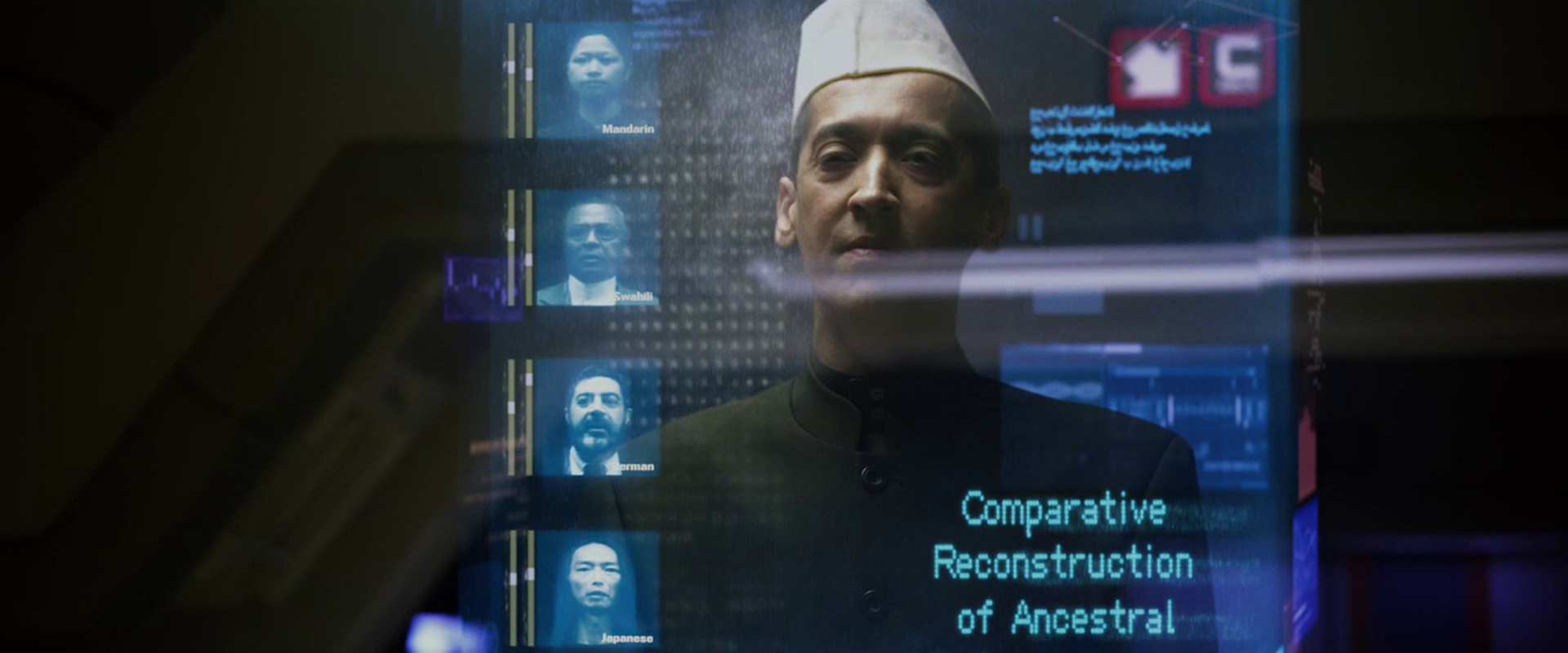
Remember that scene in Prometheus when David, the ship’s AI, was studying ancient languages in the hopes of being able to speak to the Engineers? The logic here was that since the Engineers were believed to have visited Earth many millennia ago to tamper with human evolution, that they were also responsible for our earliest known languages. In David’s case, this meant reconstructing the ancient tongue known as Proto-Indo-European.
Given the fact that my wife is linguistics major, and that I love all things ancient and historical, I found the concept pretty intriguing – even if it was a little Ancient Astronauts-y. To think that we could trace words and meaning back through endless iterations to determine what the earliest language recognized by linguists sounded like. Given how many tongues it has “parented”, it would be cool to meet the common ancestor.
And now there is a piece of software that can do just that. Thanks to a group of linguists and computer scientists in the US and Canada, this program has shown the ability to analyze enormous groups of languages to reconstruct the earliest human languages, long before there was writing. By using this program and others like it, linguists may one day know how people sounded when they talked 20,000 years ago.
Alexandre Bouchard-Côté, a University of British Columbia statistician, began working on the program when he was a graduate student at UC Berkeley. By using algorithms to compare sounds and cognates across hundreds of different modern languages, he found he could predict which language groups were most related to each other. Basically, a sound that remained the same across distantly-related languages most likely existed early in our linguistic evolutionary tree.
Modern linguists speculate that the earliest languages that led to today’s tongues include Proto-Indo-European, Proto-Afroasiatic and Proto-Austronesian. These are the ancestral language families that gave rise to languages like Celtic, Germanic, Italic and Slavic; Arabic, Hebrew, Cushite and Somali; and Samoan, Tahitian, and Maori. Though by no means the only language family trees (they do not account of Sub-Saharan Africa or the pre-Columbian Americas, for example), they do encompass the majority of spoken languages today.
For their purposes, Bouchard-Côté and his colleagues focused on Proto-Austronesia, the family which led to today’s Polynesian languages as well as languages in Southeast Asia and parts of continental Asia. Using the software they developed, they were able to reconstruct over 600 ancient Proto-Austronesian languages and published their findings in the December issue of Proceedings of the National Academy of Sciences.
In their paper, Bouchard-Côté and his researchers said this of their new program:
“The analysis of the properties of hundreds of ancient languages performed by this system goes far beyond the capabilities of any previous automated system and would require significant amounts of manual effort by linguists.”
Ultimately, this program could allow linguists to hear languages that haven’t been spoken in millennia, reconstructing a lost world where those languages spread across the world, evolving as they went. In addition, it could be used for linguistic futurism, anticipating how languages may evolve over time and surmising what people will speak and sound like hundreds or even thousands of years from now.
Personally, I think the ability to look back and know what our ancestors sounded like is the real prize, but I’d be a poor sci-fi nerd if I didn’t at least fantasize about what our language patterns will sound like down the road. Lord knows its been speculated about plenty of times thus far, with thoughts ranging from Galego (a Slavic-English hybrid from Dune), the Chinese-English smattering used in Firefly, and City Speak from Blade Runner.
Hey, remember this little gem? Bonus points to anyone who can translate it for me (without consulting Google Translate!):
Monsieur, azonnal kövessen engem, bitte! Lófaszt! Nehogy már! Te vagy a Blade, Blade Runner! Captain Bryant toka. Meni-o mae-yo.
Morning folks, and welcome to my second installment for Movie Trailer Monday. Today, it’s not so much a trailer as it is a fan-made teaser for the upcoming Star Wars VII. Given that Disney is still in contract talks with cast members and they haven’t even begun to shoot, no trailer could be feasible at this point. But that won’t stop fandom from making special videos presentations of what they hope to see.
And this one contains quite the eclectic bit of source material, splicing video game scenes from Knights of the Republic and Force Unleashed II, with some footage from Serenity and other movies. And in what I can only assume was a nod to Abram’s other works, there were also some scenes from Star Trek and the voice-over from the upcoming sequel, Into Darkness.
It seems that fan-made videos are begging better all the time, which just goes to show you how far software and computing have come. Soon, we may not even need Disney, Lucasarts, or any of the major studios at all! But until such time, I guess we’ll have to be content to rely on them to shoot all the cool footage so we can steal it and make our own shorts. Enjoy the show!
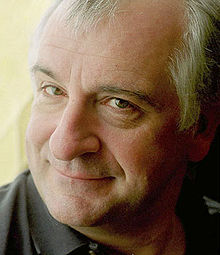
Yesterday was the birthday of the late, great science fiction writer and luminary known as Douglas Adams. Had he not passed away in 2001, at the age of forty-one, he would have been celebrating his sixty-first birthday. Best remembered for his series The Hitchhikers Guide to the Galaxy, Adams greatest accomplishment was arguably his ability to weave comedy and science fiction into one!
And that’s not the easiest thing to do in a genre like science fiction, which is noted for being often bleak, dystopian, or highly technical. Sure, there was plenty that was unintentionally funny, especially in Douglas’ time, but Adams demonstrated that science fiction writing could be both high-minded – incorporating real science and galactic exploration – and irreverent.
So I hope people will join me in wishing the man a belated happy birthday! Though I learned about it too late to acknowledge it on time, I’m sure he wouldn’t mind. The man did have a rich sense of humor, after all!
Biography: Born in Cambridge, England in 1952, Adams parents moved to London when he was still a toddler. They divorced five years later, and Adams spent his formative years with his mother in Brentwood, east of London. Receiving his education from the privately run Brentwood School, he was noted for being unusually tall, he also stood out because of his exceptional ability at creative writing.
Some of his earliest writing was published at the school, in the town publication The Brentwoodian, or the school magazine Broadsheet. He also designed the cover of one issue of the latter, and had a letter and short story published nationally in The Eagle, the boys’ comic, in 1965. On the strength of a bravura essay on religious poetry that discussed the Beatles and William Blake, he was awarded a place at St John’s College, Cambridge to read English in 1971 and graduated two years later.
While there, he also attempted to ply his comedic skills and applied to join the Footlights, an invitation-only student comedy club. While he waited to join, he began writing and performing in revues with Will Adams (no relation) and Martin Smith, forming a group called “Adams-Smith-Adams”. By 1973, he managed to become a member of the Footlights until he graduated and moved back to London.
At this point of his life, he was determined to break into television and radio as a writer. This resulted in a brief collaboration between him and Monty Python’s Graham Chapman, and a series of appearances by Adam’s on Flying Circus. At the time though, his writing style did not seem suited to radio or TV comedy, and he was forced to work odd jobs to make ends meet. However, Adams never stopped writing and continued to work towards his masterpiece.
The Hitchhikers Guide to the Galaxy: Hitchhiker began in 1977 as a pitch to the BBC radio as a concept for a science-fiction comedy radio series. According to Adams, the idea for the title occurred to him while he lay drunk in a field in Innsbruck, Austria, gazing at the stars. He was carrying a copy of The Hitchhiker’s Guide to Europe, and it occurred to him that “somebody ought to write a Hitchhiker’s Guide to the Galaxy“.
At the same time, Douglas worked on novelizations of his concept, which made producing the series all the more difficult. Not a prodigious writer, Adams was apparently the kind of man who had to be forced to meet deadlines and complete what he started. Despite the difficulties he had, Adams wrote five novels in the series, published in 1979, 1980, 1982, 1984, and 1992.
For the rest of his life, Adams made several attempts to get Hitchhiker adapted into a movie. He did not succeed in his lifetime, but in 1981, the radio series became the basis for a BBC television mini-series and Disney bought the rights in 1998. It was not until 2005, four years after his death, that the screenplay finally got a posthumous re-write by Karey Kirkpatrick, and the resulting movie was released.
Other Works: Despite Hitchhikers immense popularity, it was by no means Adam’s only literary creation. During the 1980’s, Adams and Mark Carwardine, a noted zoologist, collaborated on a series of BBC broadcasts known as Last Chance to See where they would travel to foreign countries and speak of endangered species.
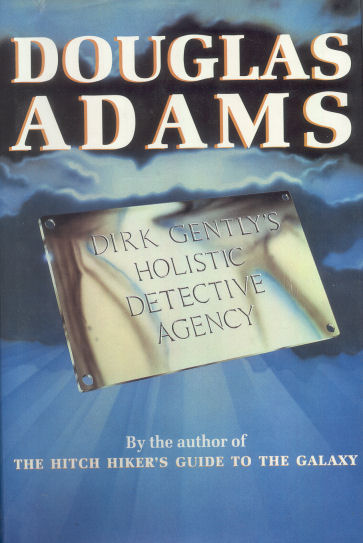
In between all this, he wrote the novel Dirk Gently’s Holistic Detective Agency, a humorous detective story which was relesead in 1987. Adams himself described the book as “a kind of ghost-horror-detective-time-travel-romantic-comedy-epic, mainly concerned with mud, music and quantum mechanics.” A sequel, entitled The Long Dark Tea-Time of the Soul, was published a year later. These were entirely original works, Adams’s first since So Long, and Thanks for All the Fish.
In between all of this, Adams also worked with the BBC as a writer on Doctor Who. Altogether, he wrote three Doctor Who serials starring Tom Baker as the Doctor. These included the episodes “The Pirate Planet” (Season 16), “City of Death” (with producer Graham Williams, from an original storyline by writer David Fisher), and Shada (only partially filmed and never filmed).
Legacy: Adams died in 2001 as a result of a degenerative heart condition and was buried in Highgate Cemetery, North London. After eighteen years of writing, publishing, and broadcasting, he left an indelible mark on science fiction and popular culture. The holiday known as Towel Day – in honor of the sage advice contained in the Guide – takes place every May 25th.
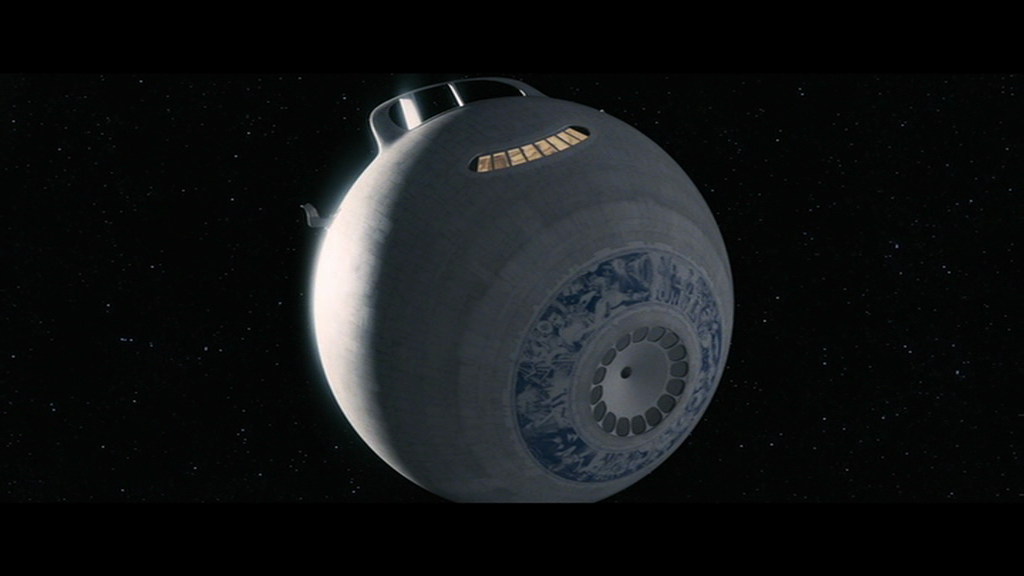
And despite his irreverence and characteristic wit, Adams is also remembered for exploring scientifically plausible ideas. For example, the Heart of Gold – the ship featured in Hitchhiker – is powered by the “Infinite Improbability Drive”. This is an FTL drive system which is based in a particular aspect of quantum theory. Chaos theory also plays an important role in Dirk Gently’s Holistic Detective Agency, where everything, even elements which seem superfluous, turn out to be interconnected with the plot.
The words “Don’t Panic”, also advice contained within the Guide, and the significance thereof are known by any self-respecting geek. Concepts like the “Babel Fish”, the living translation device one inserts in their ear, are also commemorated with programs like Yahoo’s translation program of the same name. Also, in 2011, over 3000 people took part in a public vote to choose the subjects of People’s Plaques in Islington. Adams received 489 votes, and a plaque is due to be erected in his honour.
And just yesterday, to mark his 61st birthday, Google celebrated with an interactive “Google Doodle” which featured a stylized version of the Heart of Gold’s computer console. In addition, the BBC has the text-based Hitchhiker’s Guide to the Galaxy game available to play on their website here. So if you’ve got time and feel like doing something fun to commemorate Adams, just click on the links provided and enjoy!
RIP Douglas Adams. You were a rich soul and a witty, funny, and brilliant man. Like so many before you, you were snatched up too soon and didn’t live long enough to get your proper due!
Hey guys, thought I’d get into a new habit around here and start posting previews for new movies on a regular basis. Might prove difficult to find a new preview every week, but the way I see it, people like a routine they get in on. And what’s nicer on a Monday than catching a trailer that makes you excited for an upcoming flick. Tell me that doesn’t beat the Monday blahs!
And here is the latest trailer from JJ Abram’s upcoming Star Trek sequel. Unlike the first which was resoundingly dark (had to be with a name like Into Darkness!) and focused on Benedict Cumberbatch – who plays bad guy Khan – this one is more centered on Kirk. And what’s also nice is the mention of a future city other than San Fransisco. And of course, plenty of action too!
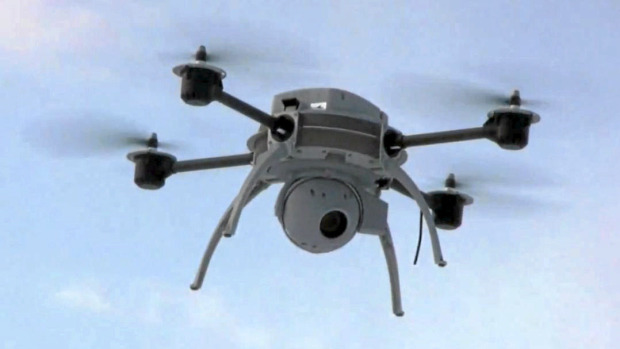
In a decision which has been decried by countless community activists and civil rights leaders, the Alameda County Sheriff’s Department announced plans last month to deploy up to two small, lightweight drones to assist in police surveillance. Despite resistance from the community, the town seems poised to join many other cities in using UAV’s for domestic security, effectively steam-rolling over concerns over privacy and “Big Brother” government.
As it stands, several police agencies across the US are currently using drones, including the Miami-Dade Police Department and the Texas Department of Public Safety. Until recently, the Seattle Police Department also employed a two-drone fleet, but grounded them amidst growing concerns over privacy and a recent government report, which warned that drone use could become even more commonplace.
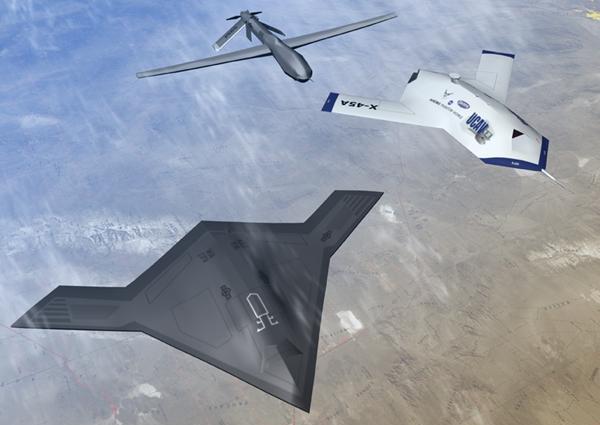
Before anyone gets too worried, rest assured that the drones in question are a far cry from the UAV’s currently conducting armed missions overseas. Unlike the Predator and Reaper drones that carry multiple Hellfire missiles and can level entire villages, these drones are relatively benign, weighing only a few pounds and relying on a series of propellers to keep them aloft. But of course, the potential for harm resides in their ability to monitor, not to kill…
Concerns over domestic drone surveillance reached a sort of climax last February after federal lawmakers signed the Modernization and Reform Act of 2012 into law. Among other things, the act required the Federal Aviation Administration (FAA) to accelerate drone flights in U.S. airspace. In response, the Government Accountability Office (GAO) warned that the act would allow drone use to become commonplace in the US.
In accordance with that law, drones, known in the report as “unmanned aerial systems,” are currently limited in the United States to law enforcement activities, search and rescue, forensic photography, monitoring or fighting forest fires, border security, weather research, scientific data collection and even hobbies. However, the law calls for expansion so drones can be used for commercial, utility and public uses.
Naturally, the FAA feels that the new law doesn’t take into account several key problems – notably concerns surrounding privacy, security and even GPS jamming and spoofing. In short, they pointed out that despite drone’s on-board navigation and detection system that allow them to avoid crashes, said systems could cause complications if and when drones share airspace with private aircraft.
Among other things, the FAA recommended that drone GPS systems undergo encryption so they would be resistant to jamming and hacking, which is apparently a danger in non-military unencrypted drones. They also advised that the government set up secure operation centers for unmanned drones, and recommended that the government formulate privacy protections to head off potential “abuses”.
Obviously, the FAA’s report and public concern struck a note. Just last month, federal lawmakers introduced legislation regulating state and federal government use of unmanned drones in the United States. This legislation prohibits drones from being armed, and would demand that agencies register drones and adopt privacy polices. What’s more, the proposal would allow drones to be used only in criminal matters, in which warrants would be required.
Once again, it appears that the Obama administration is willing to step in where public concerns over developing technology are concerned. Recall the instruction signed by Defense Secretary Ashton Carter back in December of last year designed to limit the development of autonomous aerial drones? Well here too, instructions have been given, but the general sense of worry is far from alleviated.
It puts me in mind of a prediction Arthur C. Clarke made shortly before he died in 2008. He predicted that despite concerns over “Big Brother”-type monitoring, that digital surveillance would be adopted by every city within the civilized world, until such time that crime was virtually eliminated. Much like many predictions he made, this one proved a little optimistic and futurist for some of his fans (including this one!).
As it stands, the use of remote machines to monitor our world is an ongoing and growing concern, and the debate will hardly be decided so easily. In the end, we all just have to ask if we really want to live in a post-privacy state, what the costs of living in that kind of world will be, and whether or not it will truly mean the emergence of dystopian scenarios, as envisioned by George Orwell and others.
Not exactly a wide range of choices is it? But that pretty much tells you what I think about this game doesn’t it? Freespace came along at a time when I was pretty much losing interest in flight simulators. Civilization II was growing stale, Unreal had yet to come out, and the Star Wars franchise was still busy producing Rebellion.
What’s more, Descent: Freespace and its sequel were two of the most awesomely conceived, inspired and original flight simulators I ever played. It presented some truly classic and hard science fiction, combined with just enough commercial appeal, and some genuinely fun fight and flight sequences to keep me entertained for months!
And it’s sequel was equally awesome, adding to the mix with more missions, more story, more ships, and more storyline. Like most gamers, my only disappointment came in the form of their not being a third and final chapter. Because of this, fans have taken it upon themselves of maintaining and enhancing the game engine until a third game does come out. But more on that later…
First up, Descent: Freespace, the game that started it all!
Descent: Freespace – The Great War: The game takes place in the distant future, where humanity has spread into the cosmos thanks to the discovery of subspace travel and formed the Galactic Terran Alliance (GTA). As the game opens, we learn that the GTA is at war with an alien species known as the Vasudans. The war is in its fourteenth year and you, a green pilot, have just joined the Galactic Terran Defense Forces (GTDF) and been assigned to the GTD (Galactic Terran Destroyer) Galatea.
The game also begins with an intro movie which prologues the story. In it, a Terran installation is destroyed by an unidentified alien force that jump into the Ross 128 system and obliterates everything in sight. Before your first mission, the subject of this “phantom attack” is addressed and dismissed, with Command claiming that the Vasudans were responsible.
What follows is a series of missions against the Vasudan armada. However, this ends when a new type of ship arrives and begins attacking you and the Vasudans indiscriminately. After a series of such attacks, Command names this new threat the “Shivans” (after Shiva, the Hindu God of Destruction) and arranges a ceasefire with the Vasudan government. Henceforth, all efforts are dedicated to finding out what this new species is and where they come from.
The next few missions involve extensive intelligence gathering, as it is clear that the Shivans are immensely superior in terms of weaponry and technology. Not only are their ships shielded and virtually impervious to your weapons, their systems make them incredibly difficult to track. But after a series of recon and capture missions, Terran and Vasudan scientists begin to incorporate their technology into our own.
Matters are also complicated somewhat when a new death cult emerges known as the Hammer of Light. Made up of Vasudans who believe that the Shivans are a race of holy destroyers foretold in prophecy, this group begins assisting the Shivans by attacking anyone who resists them. Henceforth, they too must be fended off while you and your Vasudan allies continue in your efforts to study the enemy. The next step in undertaking is the capture of the Shivan Destroyer Taranis.
After you and your squad disable it, the ship is towed back to Terran space, where a landing team goes in and gets first hand look at the Shivan species. They appear to be a race of large, quadruped creatures with a claw-like appendage that have weaponry embedded in their faces. However, no one can be sure if this is the actual species, some form of robotic avatar, or cybernetic war machines. In any case, the landing crew is killed very quickly.
Shortly thereafter, a new ship appears, dubbed the Lucifer, which destroys the Taranis and the Terran station nearby. The ship begins to make appearances all along the front, destroying ships with its two giant beam emitters, and eventually destroys the Galatea. In time, the Lucifer makes its way to the Vasudan homeworld, lays waste to it, and appears to be headed for Earth next. All attempts to stop it fail, as the ship appears protected by impenetrable shields.
Throughout the game, monologues are told which begin to provide some deep back story to the game. After several cut scenes, it becomes clear that the narrator is a member of an extinct species known as the Ancients, which were wiped out by the Shivans millenia ago. This informs the player that the Shivans are very ancient themselves, foreshadows the destruction they will bring, and also hints at what the Shivans weakness is.
The Vasudans stumble upon all this information when a group of refugees land on a world once inhabited by the Ancients. Within a vast alien archive, they discover the records which are shown in the cut scenes and discover that the Shivan’s shields do not work in subspace. After being reassigned to the GTD Bastion, a plan is mounted to track the Shivan vessel as it makes the jump for Earth and disable its jump engines while it is in transit.
A pitch battle takes place after you and your squad race to intercept the ship as it jumps, which is almost thwarted by the last-minute arrival of a Hammer of Light destroyer. You and yours barely make it into the node, pursue the Lucifer into subspace, and engage it and its fighter squads until you can take out its jump engines. The jump node then collapses and the Shivan vessel is destroyed.
The game then ends with a monologue by the main character, who explains that Earth is now cut off from the rest of space and safe for the time being. He also says that the Shivans, in being destroyers were actually preservers, in that they destroyed the Ancients who would otherwise have been too poweful to beat once humanity and the Vasudans encountered them. It is also said that the Shivans will be returning, though not within the narrators lifetime, a bit of knowledge which he describes as “bliss”.
Summary: In case it wasn’t already obvious, I loved this game. In fact, I even consider it to be one of my biggest inspirations when it comes to writing science fiction. The gameplay was fun, realistic, and structured in such a way as to make it all engrossing and suspenseful. Add to that a sense of genuine realism, and you can see why this franchise became so popular. It was the kind of science fiction game that was made by hard sci-fi fans for hard sci-fi fans.
Starting with the gameplay, the fighters and spacecraft are very much realistic, not looking at all like airplanes or ships. None of this aerodynamic crap or old-world paradigm stuff; all vessels looked like they were designed for space only. And the weapons and combat sequences are nothing short of cool! Not only do you shoot things up, you are required to take out ship’s subsystems using EMP’s, scan things using your close-range sensors, and even resupply and repair yourself with support ships. And the display is a very realistic looking HUD that is very well laid out and practical.
You also have a cool command interface with your ships, being able to order them in and out of the fight, to attack various targets, and/or cover you when you’re under fire. Ah, and those explosions… when you light up an enemy capitol ship, it not only blows up. It goes nova! Check it out below. Though it might seem a bit tried by modern standards, it was certainly groundbreaking for its time!
The aliens were also created with some genuine attention to detail, and avoided all the Star Trek-like mistakes which are so common to science fiction. For one, the aliens don’t speak English or have crazy names that are just strings of consonants. The language they speak is gibberish as far as we are concerned and requires a translation matrix. And with the exception of the name Vasudan, the aliens are given designations or equivalencies in English which approximate their meaning in alien languages.
For example, since the Vasudans live on a predominantly desert planet, they are all given names from ancient Egyptian culture. The Vasudans approve of this, as they are a culture that respects longevity, spiritualism, and ancient wisdom. The Shivans, consistently, are all named in accordance with mythological references to destroyers and hostile forces – i.e. Shivans, Lucifer, Sathanas, Cain, etc. They do not speak to us, since we have no basis for cultural exchange, or use their real names.
And another realistic feature: even by game’s end, virtually nothing is known about the Shivans aside from that which is gleamed from their captured technology. And though hints are dropped as to their nature and history, no clear answers are even given. For example, its clear the Shivans have advanced subspace technologies and seem solely concerned with controlling nodes and destroying other sentients. At the same time, subspace is where they are most vulnerable. From this, we are led to believe that perhaps they are from another dimension, and are left wanting more…
Oh yes, and another aspect of this game which I attracted me to it was the similarities it had with Babylon 5, my favorite show at the time and one of the best sci-fi series ever! One of the aspects of the back story to B5 was the war which takes place between humanity and the race known as the Mimbari. The war went very badly for humanity, due to the fact that the Mimbari were more advanced and Earth’s ships couldn’t lock on to them due to some kind of stealth technology.
All of these elements seemed to inform the concept of the Shivans. Not only are their weapons more powerful than yours – at least initially – their ships also possess shields are impossible to track until you gather the intel on how they work. So for the first few missions you see them, they appear as squiggling dots on your radar, are virtually immune to your gunfire, and cannot be tracked by missiles. Much like in the B5, you are told early on that a victory, any victory, is needed against the enemy to bolster morale.
Ultimately, people other than myself were left demanding more and got it almost right away. Not only was there an expansion that followed on the heels of this game, it was also followed by a much-anticipated and muchly awesome sequel (more on that later). On top of that, the game also featured a series of campaign missions that were user-designed and contributed, making Freespace one of the most fan-friendly simulators of all time.
That tradition has continued well into the franchise quasi-retirement, thanks to the creation of the Freespace 2 Source Code Project – a group of programmers currently maintaining and enhancing the game engine since 2002. This engine has been used for games based on Babylon 5 and the relaunched Battlestar Galactica franchise. So in addition to keeping this fan-favorite game alive, the F2SCP also helps other cult favorites come to life in space simulator form.
Stay tuned for more on the Descent: Freespace front, continuing with the aforementioned sequel!

 You’re not going to believe this. But just 15 minutes ago, on his Facebook feed, George Takei announced that he will be starring in the upcoming Star Wars remake. Not only that, but he had a few newsworthy items to share about the upcoming sequel that the studio has not been sharing just yet. These include the name of the new film and when filming will begin.




















 Stories by Williams