Favorite Cult Classics (Part the Second)

Welcome back! As promised, the second half of my nostalgic, cult classic favorites for you to peruse! Let me know what you think, and feel to add some contenders of your own. Cult hits are nothing if not personal, and what constitutes a classic is open to interpretation. Okay, six to ten, here goes:

2001: A Space Odyssey:
Yes, this movie deserves top billing for being a classic! And yet, the movie really doesn’t seem to garner much appreciation from audiences, not unless they are self-professed film buffs or hard sci-fi fans. Not sure I qualify for either, but I loved this movie for the simple reason that it was packed full of mind-blowing themes. Much like Akira, it was chock-full of things that got my young mind thinking and completely shaped my outlook on science fiction.

Sure, there are those who complain that this movie is boring and esoteric, but I found all that a fitting price for the kick-ass subject matter, not to mention the mind-blowing climax. You got a mystery, speculations about human evolution, ancient aliens, space exploration, and existential singularities! All the while, the weight of the philosophical implications are weighing at your mind…

And let’s not forget how inspiration this movie proved to be. Today, the concept of ancient astronauts, aliens who came to Earth millions of years ago and tampered with human evolution, has become all the rage. From Star Trek to Stargate, Battlestar Galactica to Prometheus, the concept of ancient astronauts has played out. And frankly, 2001 has them all beat! Between Kubrick and Clarke, their concept of the aliens and how they altered the course of evolution on Earth was the most realistic I have ever seen.

But I think what I liked best about was the fact that the movie was the subtle nature of the whole thing. At once speculative, philosophical, and visually stunning, this movie was characteristic of Kubrick, who preferred to convey things visually rather than coming out and telling people what was going on. You never really quite knew what happened during that eye-popping final scene, but those who love sci-fi and imaginative filmaking were sure to have ideas!

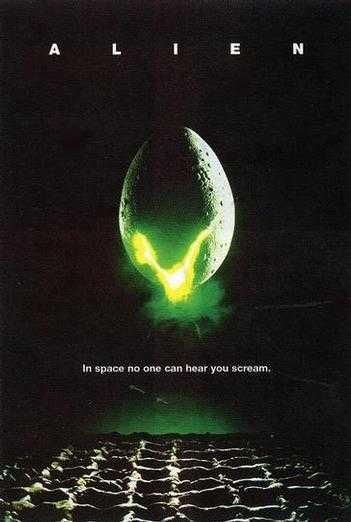
Alien:
Granted, this movie wasn’t exactly under-appreciated, but compared to the lavish attention the rest of the franchise has garnered- even though it was all downhill after Aliens – this first installment truly was the diamond in the rough. Not only did it have a cool concept, awesome set designs and a kick-ass back story, the direction and cinematography captures the story’s sense of dread and claustrophobia perfectly.

Little wonder then why this movie spawned an entire franchise, because it really did have everything. You had your blue-collar peeps working for the major interstellar company (Weyland-Yutani), a frightening discovery made on an uncharted planet, a mysterious derelict belonging to an unknown race, and a terrifying creature awakened from its slumber. And not just any kind of creature, but a complex symbiote that was designed for and possessed of a single purpose.

Or as Ash put it: “Perfect organism. Its structural perfection is matched only by its hostility.” He had a point didn’t he? In fact, all structures in this movie were pure genius, whether it was the Nostromo, the Derelict, or the Facehugger and Chestbuster combo. As with everything Scott does, attention to detail and the careful construction of a universe was paramount. Every set was richly detailed, well shot, and clearly made to elicit the right feel and impressions on the audience.

Much of the credit for this goes to H.R. Giger as well, the surrealist artist who brought Lovecraftian horror to the alien concept and set of the alien ship. Years later, I still find myself tuning in just to get a glimpse of that Gothic reconstruction, or to see the Space Jockey sitting in its chair, the tell-tale hole punching through its chest. Few movies have managed to capture that same sense of awe and wonder for me, with the possible exceptions of 2001 and Akira

Johnny Mnemonic:
Some people might think I’m crazy for listing this movie as a personal classic, but it can’t be helped! And my reasons are pretty simple. On the one hand, this movie kind of has that “so bad, it’s good” thing going on, but at the same time, I also felt it possessed some real signs of quality. Sure, the acting was pretty wooden, the fight choreography total crap, and the low-budget nature apparent throughout. But it was still a pretty faithful adaptation of Gibson’s work and introduced to that world at a still-young age. Hence why I come back to it every few years just to see it again.

Filmed in the mid-90’s, this movie is an adaptation of the short story by William Gibson and previewed a lot of what he wrote in Neuromancer. For example, you’ve got the big bad corporations, the cyberspace jockeys, freelance assassins, Yakuza, and the character Molly Millions. Things are also set in “The Sprawl”, the megapolis that stretches from Boston to Atlanta and is contained in geodesic domes, and the look and feel is definitely of the cyberpunk variety.

Into all this, Gibson introduced the revolutionary concept of mnemonic couriers, people who have “wetwire” implants in their brains that allow them to carry vast quantities of data from point A to point B. Basically, these couriers are the answer of what to do in a world where information is the most precious commodity, and all databases are vulnerable to hacking and protected by “Black ICE” – hostile Intrusion Countermeasure Electronics (aka. viruses)

And, in keeping with Gibson’s style, the story involves a titanic corporation that is fighting to maintain its monopolistic grip, while freelancers, smugglers and assorted little people are fighting to undermine them and distribute the information freely. Naturally, the main character of Johnny is an unlikely hero who is forced to take a break from looking out for number one and help others for a change. Might sound cheesy, and a little cliche, but it works and delivers on Gibson’s style. At the very least, it’s a guilty pleasure flick for me.

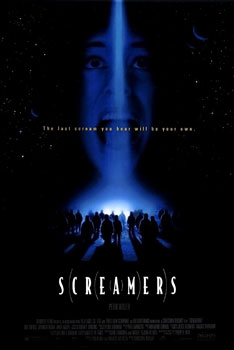
Screamers:
Now here’s a movie that’s high on the pleasure, low on the guilt. While a low-budget sci-fi flick that was (like Johnny Mnemonic) produced and filmed entirely in Canada, it had many signs of quality that immediately made it a cult hit. There’s the post-apocalyptic setting, the frightening tone, and the Cold War feel of the thing, updated for the 90’s. All the while, there is the knowledge that this is an adaptation of Philip K. Dick’s Second Variety, which sort of makes it a must-see of PKD fans.

Much like in the original story, the plot of the film involves a race of self-producing, self-upgrading machines that are designed to infiltrate enemy territory and eliminate all combatants. But of course, things begin to go awry when the people who produced them realize that they have upgraded to the point where they can impersonate human beings. And whereas the original story was set on Earth and took place between the US and Russia, the updated story takes place on Sirius 6b, a pining planet that became the front line between a the political-economic entity known as the NEB  and those who chose to resist its rule.

Personally, I felt the updated version works. Not only does the conflict seem more relevant, being between a mega-corporate entity and a coalition of workers and dissenters, but the off-world setting also feels more realistic. Perhaps it was the fact that in the post-Cold War world, nuclear war between two superpowers didn’t seem a likelihood anymore. Or it could just be that the whole NEB angle was reminiscent of Weyland-Yutani and Alien. All I know is, I liked it!

What’s more, a good deal of attention went into creating the setting and modelling the Screamers – aka. the automated machines that kill people. Designed to be the perfect terror weapons, they emit a high-pitched “scream” before making their attack, and can toy with their targets for some time before moving. This concept, combined with some good shooting, really created a sense of tension which is felt throughout. And of course, the paranoia which is engendered by the appearance of human-like machines was a very nice touch! A good movie, and a fitting adaptation which managed to capture PKD’s cautionary tale about the dangers of runaway progress.

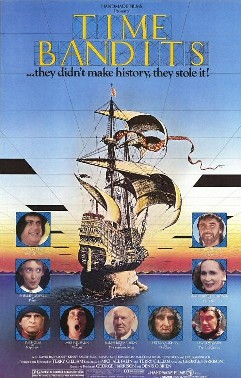
Time Bandits:
And last, here is the classic time traveling tale that I first saw in my childhood. Recently, my wife was told by a coworker that she should ought to see it, and my memory was jogged! Yes, this is indeed a cult classic, and one which is deserving of plenty of kudos and praise. Well cast, well written, witty and poignant, it’s one of those quintessential 70’s movies which has been rediscovered by several generations of film buffs and sci-fi fans.

The story opens with an imaginative and historically-minded child who lives in an overly-bourgeois neighborhood with his materially-possessed family. But upon realizing that there is a time-portal in his wall and that people from the past and future can come through it, his world is turned upside down. Quickly, he become the unwitting companion in a group of dwarves who are traveling through time, stealing precious artifacts, and being pursued by both the “Supreme Being” and an evil sorcerer.

Immediately, one can see the layered and inspired plot taking shape here. On the one hand, you have some decidedly Judea-Christian elements, plus a tale of childhood imagination and escapism. The dichotomy of the Supreme Being who possesses the power of time travel and the sorcerer who wants it for himself are representative of God and Lucifer, after a fashion. The dwarves who stole this power for themselves are a sort of Icaran allegory, or possibly Adam and Eve once they ate from the tree of knowledge. And ultimately, the way they are saved in the end from evil represents their redemption.

All the while we are left wondering if the boy is merely dreaming, or if what he is experiencing is real, which is an element that is intrinsic to all tales of childhood fantasies. On the one hand, the protagonists flights of fancy are seen as a weakness and immaturity to those around them, whereas we tend to see as it a rare gift to see past the surface. Should it all be a fantasy, then the story is left without a formal sense of resolution; but if it is real, then the hero has been vindicated and proven right. Appropriately, the movie plays with the two possibilities, going back and forth, but then giving strong hints at the end that it was in fact real. So really, you have a story that is inspired, imaginative, and also suspenseful!

___

Well, that’s my top ten list for the best cult classic movies of all time. What’s yours? I know I have a few in common with some people ’round these parts, and I also know that a few were previously unheard of. Hence why I want to here from others. I have a feeling there are some which I need to see and would very much enjoy. Already, I’m poised to watch Sunshine, A Boy and His Dog, and a few others which I’ve heard good things about. And I hope that in the course of swapping lists, I might be able to find a few more I’d like to see. Take care, and enjoy the rest of the long-weekend, those of who are reading this in Canada. As for the Yanks in the audience, and the rest of the world for that matter, enjoy the work week 😉

Favorite Cult Classics (Part The First)

It might be that I’m feeling nostalgic, or it might be that since my wife and I sprung for Netflix, I’ve been finding my way back to several of my favorite old movies. Hard to say exactly. All I know for sure is, I want to talk about the cult classic movies that I like best. You know what I’m talking about! Those rare gems, those diamonds in the rough, the movies that few seem to know about, but those who do always seem to love.

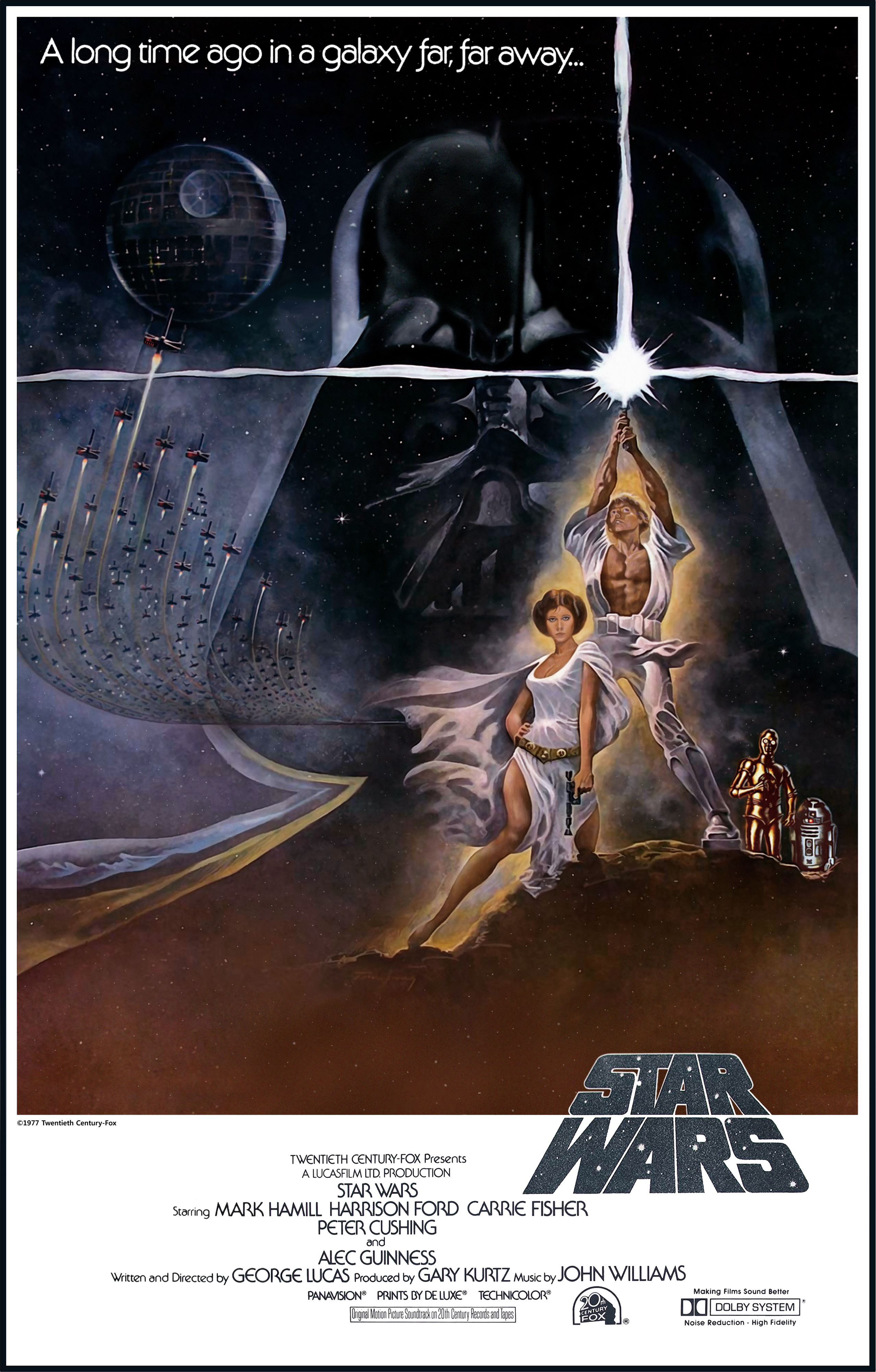
Yes, THOSE movies! Sure, we’ve all seen plenty of big hits, but these movies are the ones that occupy a special place in our hearts. Perhaps it’s because they are not so widely known, like the Star Wars’ and and Indiana Jones‘ of our time. Perhaps it’s because they didn’t get the recognition or the money they deserved, at least in their own time. Or it could be that they were simply the kind of things that got better with time.

In any case, I’ve compiled a list of my top 10 favorite cult classics, movies which I saw during my childhood, teen years and even in my twenties, and keep coming back too. Some were adventurous, some were funny, some were downright cheesy. But all have two things in common: One, none of them are known beyond a select group of appreciators, at least in this country. And two, those who like them, like them a lot! Check out the list below and see if you agree, and feel free to tell me your own favorites as well. I know we all got em!

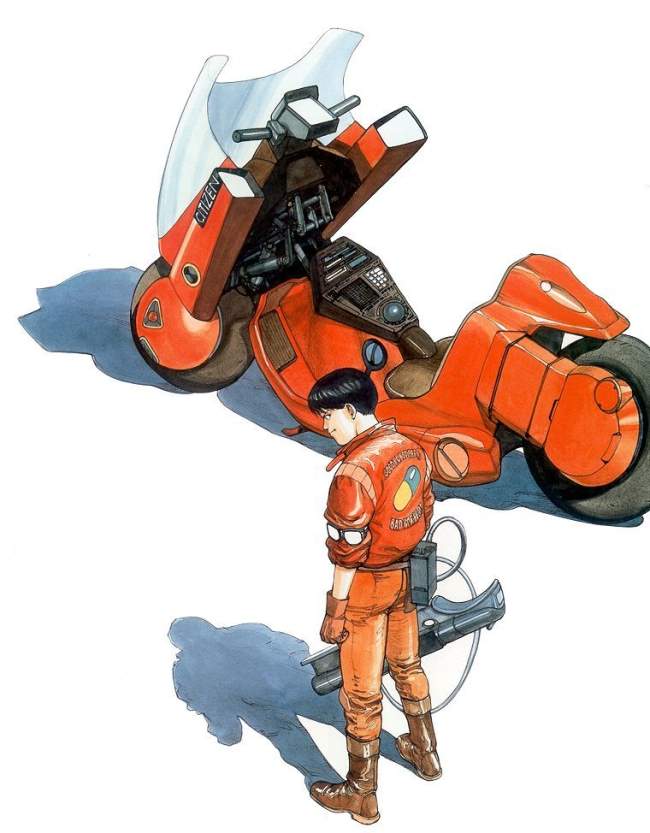
Akira:
One of the greatest animes I have ever seen, and with a very poignant and intriguing story to boot, Akira starts this list off right! The movie adapted several volumes of manga to screen, and did so in such a way that didn’t skimp on either story or detail. Even shortened, the plot still manages to convey the sense of awe and dread of atomic war, revolution, and evolutionary cataclysm. And the fact that the bulk of it is told from the point of view of disillusioned orphans who are all part of a bier gang only heightens the sense on confusion and angst of little people being thrown into situations far greater than they can handle.

And then there was the quality of the movie itself. Having seen this movie several times now and different versions thereof, I can tell you that no matter what the format, every single frame was animated in such a way as to be saturated. And not with digital effects, mind you, but with hand-drawn animations that really manage to capture the post apocalyptic and cyberpunk feel of Katsuhiro Otomo’s original graphic novel.

All in all, I consider this movie to be compatible in many respects to 2001: A Space Odyssey in that they both deal with grandiose of questions of existence, biological evolution, and both managed to blow my mind! And having first been exposed to both of them in my teen years, they are partly responsible for kindling my love of science fiction.

Army of Darkness:
Here’s a movie I kept being told to see, but did not get around to seeing until I was in university. And truth be told, it took me two viewings to really get the appeal of it. After that, it grew on me until I finally found myself thinking it hilarious, and quoting from it whenever I could. “Come get some!” “Groovy!” “This be my BOOMSTICK!” and “Good? Bad? I’m the one with the gun!” All classic lines!

Yeah, this movie is definitely filed in the guilty pleasure section, the space reserved for movies that are deliberately cheesy, over the top, and have a robust sense of humor about themselves. It’s also one of the many that gave Sam Raimi (director of the Spiderman trilogy) his start, and established Bruce Campbell (who appeared in all three) as a gifted ham actor.

Taking the position that decapitations and flesh-eating demons can be funny, this movie tells the story of a blue-collar, rough and tumble, one-liner spouting man named Ash who’s been sent back in time to fight an army of the undead. Automatically, hijinks ensue as he tries to convince people he’s not a demon himself, but instead chooses to establish who’s boss by demonstrating the power of his chainsaw and “boomstick” (aka. his sawed-off double-barrel shotgun).

But predictably, this anti-hero rises to the challenge and becomes a real hero, and does so with as little grace as possible! And of course, there’s a love story as well, which is similarly graceless thanks to Ash’s lowbrow romantic sensibilities. Nothing is left untouched by the ham and cheese! And all throughout, the gun fights, duels, and confrontations with creepy, evil forces are hilarious, made possible by Campbell’s hammy acting, facial expressions, one-liners and some wonderfully bad cinematography. Think Xena: Warrior Princess, but with guns and foul language!

Blade Runner:
Another personal favorite, and one which I wish I had come to know sooner. But lucky for me I was still a teen when I saw this movie, hence I can say that I saw it while still in my formative years. And today, years later, I still find myself appreciating it and loving it as one can only love a cult hit. It’s just that kind of movie which you can enjoy over and over again, finding new things to notice and appreciate each time.

And once again, my appreciation for this movie is due to two undeniable aspects. On the one hand, Ridley Scott created a very rich and detailed setting, a Los Angeles of the 21st century dominated by megastructures, urban sprawl, pollution and polarized wealth. It was the picture perfect setting of cyberpunk, combining high-tech and low-life.

On the other hand, there was the story. Loosely adapted from PKD’s Do Androids Dream of Electric Sheep?, this version of a future differed greatly in that the artificial humans, the antagonists of the original story, were about the only sympathetic characters in the story. The result was not a cautionary tale on the dangers of creating life in our own image as much as a commentary about the line between the artificial and the real.

The question it asked was: if you overcome all boundaries, if machines possess memory, feelings and a fear of death, is there anything at all to separate them from the rest of us? Will their lives be worth any less than ours, and what will it even mean to be alive?

Conan The Barbarian:
Here’s a movie which has appeared in some friends “guilty pleasure” list, usually next to Predator, Commando and other Anrie classics. But I am here today to tell you it really doesn’t belong. Unlike many 80’s Arnie movies that were so bad, they were good, this movie had some genuine quality and depth to it.

Examples? Well, for starters, this movie was a faithful adaptation of Robert E. Howard’s original concept, Conan the Cimmerian, which was first published in 1932. This franchise, which went through countless adaptations over the ensuing decades, wove real history and myth together with fantasy to create a tale of a bronze age adventurer who traveled across the ancient world, seeking fortune and glory.

One can see this in the movie as well. To create the setting and the various people that make up the universe, imagery, mythology and even names were borrowed from various real sources. For example, the Cimmerians (Conan’s people) were inspired by Celtic and Norse sources. The followers of Thulsa Doom, black-clad warriors from the East, were meant to resemble the Huns, the Goths, and other Eastern invaders. There are also several scenes showing a warlike people meant to resemble the Mongol Hoards, and much of the setting was made to resemble ancient cities of lore – Babylon, Jerusalem, Antioch, et al.

Add to all this some pretty damn good writing and good storytelling, and you can see why this movie has remained enduringly popular with many people over the years. Arnie excelled as the stone-faced barbarian of few words, but who made them count when he chose to spoke. James Earl Jones was exceptional as the amoral, Nietzschean warlord Thulsa Doom, and the production value was surprisingly good for a low-budget flick.

Serenity:
Yeah, I get the feeling everybody knows what I’m talking about with this one! After losing the wonderful show in the midst of its first season, every fan of Firefly was pleased to know that Joss Whedon would be making a full length movie. And personally, I th0ught he did a pretty good job with it too!

Picking up where the show left off, we are reunited with our favorite characters as they continue to work freelance jobs and try to stay one step ahead of the law and the expanding Alliance. From the outset, it is clear that things are getting desperate, as the jobs are proving more risky, and the Reavers are moving in from the Outer Rim. At the same time, a new threat has been thrown in in the form of an Alliance agent known only as the “Operative”, who has made it his business to bring River in at any cost.

And I personally loved how all these threads came together in a singular way, showing how the Reavers, River’s condition, and the Alliance’s ultimate agenda were all connected. Not only was it a tight and entertaining plot that captured the same sense of loss and desperation as the show, it also gave a sense of closure to the series, which ended before its time.

Yes, for myself and many fans, this movie is a way of commemorating a truly great show and idea that faltered because of insensitive boobs couldn’t see the value in it. But that seemed thematically consistent with the series itself, which was all about rebels in a hopeless fight against an evil empire. Take a lesson from this Fox Network, sooner or late,r the bad guys lose!

___

For brevity’s sake and the fact that I’m a busy man, I’ve decided to divide this list in half. Stay tuned for entries six through ten, coming up tomorrow! Happy Thanksgiving y’all!

New Anthology Sample: The Torch (Redux)!

Morning all! Welcome back for another Anthology sample, this time, a revised second installment from the short story “The Torch”. Last time, the story involved a tired and forelorn main character – Magid Muktari, environmental engineer and exoplanet enthusiast – coming home and meeting with his wife. My group seemed to agree that it was well written and faithful to Khaalidah’s original characters, unfortunately it contained details which did not fit with the story’s timeline. In essence, Muktari was not supposed to be married at this point in time.

After gritting my teeth and cursing my jumping of the gun, I erased the whole section and began writing it anew. The resulting section is the result, a homestead in which an overworked, forlorn visionary comes home to a slew of bad news and burdensome responsibilities. In the midst of it all, he contemplates his future and the future of his word. Take a look and let me know what you think:

The lights were already on when he came home. The nighttime creatures were about, singing their evening songs and tending to their nocturnal rituals. He felt the reassuring calm spread over him as soon as the wheels stopped in his driveway, the engine quieting down from its long run. The door raised itself for him and he put his tired feet to the ground, letting out a deep sigh.

“Home again, home again…” It took some effort to get him the rest of the way out. The steps were even harder to manage. It confounded him, how travelling could still be such a draining experience when machines generated all the motion. Perhaps their minds had not kept pace, still interpreting distance in terms of physical expenditure.

He paused on the front stoop and waited for Empathy to scan him. A quick flash hit his eye, discerning his retinal pattern, then projecting a kind greeting in his visual field.

Iyi geceler, Magid! it said. He waved at the sensor, and the door opened.

He made his way to the living room and tossed his jacket and satchel on the couch. His rear end met the cushions a moment later, and he felt himself begin to melt. He was halfway into a blissful fugue state when Empathy activated her living room interface and woke him up.

“Good evening, Magid. I have a number of messages for you.”

Muktari groaned and leaned up. He brushed the fatigue from his eyes and looked at the holographics that were forming in the center of his room. Green, blue and yellow, small dancing alpha-numerics. The words 13 Messages (2 Urgent) hanging in the middle.

“Give me the urgent ones,” he ordered. Empathy blinked and the display changed. He rubbed his head to dispel the headache and missed the appearance of his friends face in the center. It didn’t matter though, since the voice was one he would recognize anywhere.

“Magid, we got a problem over here,” said the face of Serge. “Word is the Memphis City Council is thinking of pulling the plug on the whole MFC concept. They’re claiming budgets, but the higher ups got it in their heads that this is a negotiation tactic. Me? I’m thinking the negotiation team tried to fleece them on land usage rights or something. In any case, someone needs to go out there and allay their concerns. They figure a senior engineer and manager ought to be just the person to do this.”

Muktari groaned again. He had just exhausted himself, skipping over time zones, heading from west to east. Going back west was the last thing he wanted right now. But at least Serge hadn’t given a date on when this was to expected. And he could certainly get away with not calling until the morning. Perhaps this would be the perfect opportunity to send someone else in his stead, or maybe Serge himself could be trusted with the task. No one knew the Memphis Floating Concept better than he, and he was sure to be able to put a positive spin on anything the negotiation team was asking for. At worst, he could tell them they were full of shit and to drop the demands, otherwise they would lose the contract.

The second message came up. This one he was ready and watching when the bronzed complexion of Aurelia came on. The summer sun was agreeing with her apparently, though the desert wind must have been a bother.

“Magid,” she said pleasantly. “Sorry to disturb you, but I thought you might like to know. A special presentation is being held in St. Petersburg this Tuesday, hosted by the Arctic Recovery foundation. The board has asked that we send a senior representative to present on behalf of the company and specifically asked for you. It’s not until Tuesday, so you’d have time to prepare.” She rolled her eyes and sighed. “I know, last minute, but I just heard myself. I hope this doesn’t interfere with your plans. I know you must be exhausted.”

“You don’t know the half,” he said to the image.

“Anyway, please contact me at your earliest convenience. We’re making progress on the Kebili array. Would love your input. Bye!”

The image disappeared. Empathy’s voice returned. “Shall I show the other messages?”

“Summarize,” he said curtly. A short list appeared in the display reticule. There were several messages regarding his choice of homeowner insurance, sat coverage, and offers for cheap aerofare to Mumbai, Atlantic City, Cancun and Topside. Only two were from names he recognized, and only one of immediate interest. Bill, to tell him when he’d be in town next and when they could meet up. And Myrana, no doubt to let him know what she had in mind for their next soiree together.

“Select Myrana, please” he said with some enthusiasm. The message moved to the center of the screen and enlarged. “Play.”

The image of Myrana’s face resolved in front of him, and his heart immediately sank. He knew that look, the look of disquiet, guilt and the burden of coming clean. He leaned back in his seat and waited for it.

“Magid, I’m sorry to do this over the link, but you’re a hard man to get to. I thought it better that I do it here than bother you on your mobile too. Basically…” she took a deep breath, “I think we need a break. I know we both said we were looking for different things when we started this… whatever this is, but I’m at the point where I think I need someone who can make themselves available. I’m sorry, but I can’t be waiting around for someone to decide they’re finally ready for a relationship, not at my age. Feel free to call me when you get this, but if you don’t, I understand. It was lovely, Magid, it really was but… these things can’t last. Bye.”

She kissed her fingers and put them to the monitor. The image disappeared a second later. Empathy’s cluelessly cheery voice came on a second later. “Would you like to review any of the other messages?”

“No.” he said flatly. “Delete all.”

He didn’t need to hear Bill’s message. He was sure his impending trip to St. Petersburg would conflict with it anyway. And in any case, they weren’t that close. Alone, he let out a particularly long sigh and reflected on the timeless truth of the matter. There was situation so bad that you couldn’t make it worse with a dose of personal disappointment. He was learning that for the umpteenth time now.

But at least he had a good’s night sleep to look forward to. He knew Serge and the others wouldn’t fault him for arriving late tomorrow morning. Perhaps some food and a nip of whiskey while he was at it. Pushing himself to his feet, he made his way to the kitchen and began producing the particulars for his impromptu meal.

Rome is burning, he thought as he fetched small tubs of chicken, Cacik sauce and greens from the cooler. Yes, that seemed to be the shape of things. The world was spinning, faster and faster, and no one seemed to be too worried about it. It was like riding a wild beast that just kept getting angrier the longer the rider held on. On the one hand, they were afraid to let go; on the other, they knew they had to at some point.

And yet, here he was, enjoying a meal and a drink and trying to forget about all that. Was that the natural order of things? Was it the case that the Senators of old, he wondered. After looking out upon the decadence that had befallen their once great city, and espying the barbarians who weren’t far from their gates, did they all simply go home, break their bread and drink their wine, and tell themselves that they had done all they could? He had to imagine they did, because when it came right down to it, there wasn’t much else to do. The fight could only happen during business hours, the rest of the time was earmarked for rest and creature comforts.

Yes, the doors must have been crashing down before they realized they were doomed. He was sure it was the same way with the people of Uxmal and Chichen Itza. It wasn’t until all the heads had stopped rolling and the crops had failed that they knew it was time to flee for the wilderness and hope for the best.

He looked down into the tub of Cacik he held and spooned some into his mouth. He had been gone for days and he couldn’t even remember when he had bought this latest bin of sauce. And yet, it still tasted fresh and clean. He checked the chicken and noted the same.

Yes, the gates are coming down and the city is ablaze, he thought. But at least the food is still good. One had to be thankful for small mercies.

Source, Now Available for Free until Nov.1st!

Good news everybody! At least, that’s how Professor Farnsworth would put it. My first novel, entitled Source, is now available for free through Smashwords until November 1st. As my first work of fictioni, it deals with a concept very near and dear to my heart: apocalyptic sci-fi!

In fact, the entire novel was inspired by a short story project I did with my old writer’s group – The Herscher Project – back in 2005. The theme was dark futures, and I used the opportunity to experiment with an idea that was kind of big news for the time.

If interested, go by Smashwords.com and download Source for your Kindle or ereader. Be sure to enter the coupon code: KY62K in the appropriate box, and get your copy for free! Note the old school cover, I’ve since updated that of course.

Relaunching an Idea: Red Sky At Night

Many months ago, I was struck by an idea. It is one which has been percolating in my mind for some time, but never really occurred to me as a reason to write. But then, I began to get into the whole “Alternate History” sub-genre of science fiction, examining such works as The Man In The High Castle, Fatherland, The Guns Of The South, and A Rebel In Time. It made me think that there was a good precedent for this kind of idea, and room for expansion.

But first, let me explain what I was thinking. Ever since University I’ve been fascinated by Russian history, particularly the interwar years. It was at this time that the most auspicious achievements and crimes took place in the former Soviet Union, after the death of Lenin and the ascent to power of Joseph Stalin, one of history’s greatest monsters.

Shortly thereafter, Russia became involved in World War II, during which time another monster – Adolf Hitler – committed unspeakable crimes against the Russian people. Over twenty six million people died on the Eastern Front, most of them civilians who had already witnessed such terrible suffering at the hands of their own dictator. In addition, many were victims of Soviet wartime oppression, killed by Stalin for the crime of not fighting hard enough or attempting to find liberation from their Nazi invaders.

From the point of view of Soviet propaganda, the years between 41 and 45 were portrayed as a the “Great Patriotic War”, a heroic struggle for the defense of the Motherland. In some respects this was true, but mainly it was a war between two nations being led by very petty and cynical men, with countless good and innocent souls caught in between. Those Germans who died in the East did so because of a fool’s dream of Lebensraum and racial purity, whereas the Russians who died did so in the defense of their families from both the invaders and the reprisals of NKVD officers.

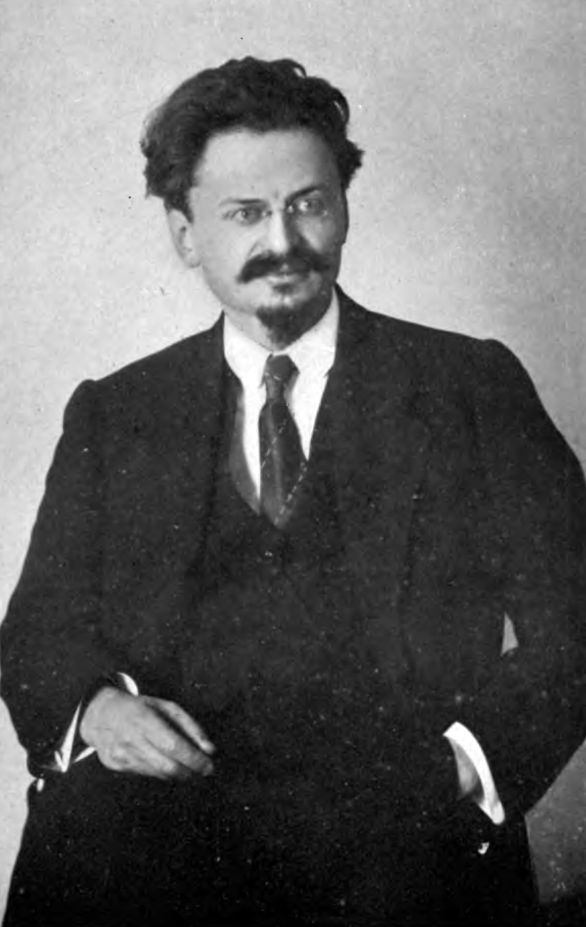
Reading of all this, I often wondered, what if Leon Trotsky, Lenin’s intended successor, had led Russia during the interwar years? What if he had won the leadership race, instead of the scheming Stalin, and became the man to lead Russia against the Nazi invaders? Would things have worked out differently? Would Russia have still stood and ground up the Nazis, but in a way that didn’t lead to the death of so many millions of innocent Russians. The question is not a new one. In fact, historians have been pondering it for some time, and the entire question hinges on a single event.

This is where the concept of my own alternate history came in. In my story, a single event happens differently, thus giving rise to an alternate history. At the 13th Party Congress in Russia 1924, Trotsky had an historic opportunity. Lenin, before his death, had published his “Last Will And Testament” where, amongst other things, he singled out Stalin as a rude and ruthless character who should never be allowed to come to power. During the years following Lenin’s death, Trotsky was seen as the natural successor, which made him the natural rival of Stalin and his followers.

During the 12th Party Congress, Stalin’s allies helped suppress news of the Testament, but by the 13th, Trotsky was in possession of it and could released it, causing irreparable harm to Stalin’s reputation. Why he did not, and instead chose to make a conciliatory speech calling for unity, is something which historians have debated ever since. In so doing, he essentially guaranteed Stalin’s rise to power and his own exile, which culminated in his murder in Mexico some years later.

Red Sky At Night:
This is the basis of my idea. Instead of asking for reconciliation, Trotsky released Lenin’s Testament to the Party and asked for Stalin’s removal. He was successful, which guaranteed that it was he who would become the new leader of Soviet Russia and its chief planner during the interwar years. As a result, Stalin’s crash industrialization programs (aka. the Five Year Plans) were never launched.

Instead, he maintained Lenin’s New Economic Policy (NEP) and even appointed Bukharin (whom Stalin murdered) to oversee reform and expansion of state-owned industry. This led to a degree of slow recovery for the Soviet economy and improved the lot of its farmers and small private enterprises. And when the Great Depression hit in 1929, Russia would still spared the worst ravages of it while similarly showing signs of growth.

What’s more, Trotsky maintained close ties to foreign communist movements, rather than focusing so heavily on matters at home. As a result, in 1933 when the Nazis demanded a non-confidence vote against the Social Democratic Party, Trotsky ordered the KDP (Communist Party of Germany) to stand shoulder to shoulder with the Social Democrats, a move which did not alter the Nazi seizure of power, but which ensured that they were aligned with the anti-Nazi movement from early on.

In China, rather than advising Mao to go along with the Nationalist government (which turned on them) Trotsky advised that Mao and his cadres remain committed to resisting Japanese invasion and not trusting in Chiang Kai Shek. This prevented the massacre of Chinese Communists, which came in handy when the Sino-Japanese war began in 1937.

When the Spanish Civil War began, Trotsky and the Comintern became the most vocal and committed supporters of the Loyalists, sending them weapons, advisers, volunteers and funds. Much as in our own timeline, this had the effect of making the Soviets look like the chief supporters of anti-fascism, but since the effort didn’t suffer from Stalin’s paranoia and cynicism, the efforts were much more effective and popular. And thanks to Trotsky’s focus on foreign affairs, Commissar Maxim Litvinov, the champion of Collective Security, received the support he needed when he made his pitches to the League of Nations.

But most importantly of all, no purges or Great Terror took place during the late 30’s, which had the effect of undermining Russia’s efforts abroad, embarrassing Russia politically, decimating the Soviet officer corps, and devastating Russia’s agriculture. Russia therefore was in a much better position to coordinate alliances with the Czechs, the French, and rally public opinion towards ensuring that the Nazis were contained rather than appeased.

However, things really came down to the 1938 Sudetenland Crisis. For years, the Russians had been railing against coming to an accommodation with Hitler, largely for their own purposes. However, when Hitler demanded that Prime Minister Benes of Czechoslovakia cede the Sudetenland under threat of war, things finally came together for them. Facing harsh public opinion, Prime Minister Neville Chamberlain found that he had little support for his policy of appeasement. French, Czech and League opinion were similarly opposed to any deal with Hitler, having been empowered by Russia’s example. As a result, instead of demanding that Benes give Hitler what he wanted, England and France instead demanded that Poland and Romania agree to allow Russian troops to pass their territory to mobilize against Germany, should the need arise.

These efforts did not materialize, but the appearance of unity on behalf of the League gave Hitler pause. His Generals advised that he back down, facing the likely prospect of war on all fronts, and Hitler was forced to concede. Afterward, Germany suffered from renewed economic problems, and Hitler lost virtually all support. The Nazis fell from power, World War II did not happen, the Holocaust never occurred, and the post-war division of the world between two superpowers not happen.

In the East, Japan found itself trapped as the League closed in to issue economic sanctions and demand that it withdraw from China. Soon, the Japanese Imperial government fell as well, and the threat of war was neutralized. In Italy and Spain, Mussolini and Franco remained in power, but were sure to behave themselves and even rejoined the League of Nations. And of course, Mao and his cadres did not seize power in the immediate post-war years, but instead came to an accommodation with the Nationalists, forming a powerful bloc within the government.

However, there was a downside to all of this as well. For starters, the economic boom caused by the war did not happen. Instead, the global economy recovered slowly throughout the 1940’s and 50’s. What’s more, the accommodation that took place between Russia and mainland Europe after the war, which saw the election of Social Democratic parties in every country and the de-radicalizing of Soviet power at home, caused a rift to form between the Anglo-American world and Eurasia. By 1950, fearing socialist revolution at home, England and America withdrew from the League and formed their own bloc, the Anglo-American Alliance.

Towards the end of the 1950’s, relations began to worsen, as the Alliance condemned what they saw as attempts at subversion in their own sphere while the League condemned the persecution of dissidents and revolutionaries. Both sides became retrenched and a new arms race began, the League and the Alliance scrambling to recruit the best and brightest minds to help them create new and better weapons. By the end of the 1950’s, scientists on both sides of the Atlantic were close to creating the first atomic weapons.

This is where the story opens. It’s 1963, twenty-five years since the Sudetenland Crisis took place, and the world is putting aside its difference to mark the occasion. East and West are coming together in a series of festivals, diplomatic summits, and tourist expos. However, behind the happy veneer of entente, the usual preparations for war continue. And in time, a series of events will trigger a crisis that could very well lead to another war. Much like in 1914, the world is sitting on a powder keg, and all that’s needed for another Great War to take place is for someone to provide the spark.

This idea got back-benched with my coming to join Writer’s Worth and all our anthology work, but I want to pick it back up. Much like Fascio Ardens (that’s its new title), I’m in the mood to write some genuine alternate history. It requires some staggering research to make these kinds of speculative works seem authentic and plausible, but I want to make it work. Call me crazy, especially since I’ve got it in my head to tackle two separate ideas. But as my grandpa used to say, “Lord hates a coward!”

New Look!

Hey all and good morning. Do you like what I’ve done with the place? Yes, after months of wanting to spruce up my blog’s appearance, I finally got around to some house cleaning, tidied things up a bit, and finally put my awards up where you could see them. Good thing too, I was getting worried people would come by and think that the only one who appreciated all my rambles was me. That seem right to you?

Also, I’m thinking of a new theme. Months back, I picked the one you see, Chapters, from a lineup because I thought it was conducive to displaying samples of my writing. However, given the fact that you can only pick from the last 20 posts, I find it a bit frustrating now. As anyone who knows me is undoubtedly aware, I go through a lot of posts on this site, and I mean A LOT! For that reason, I insist on being able to scroll back a ways, and I’d like my viewers to be able to do the same.

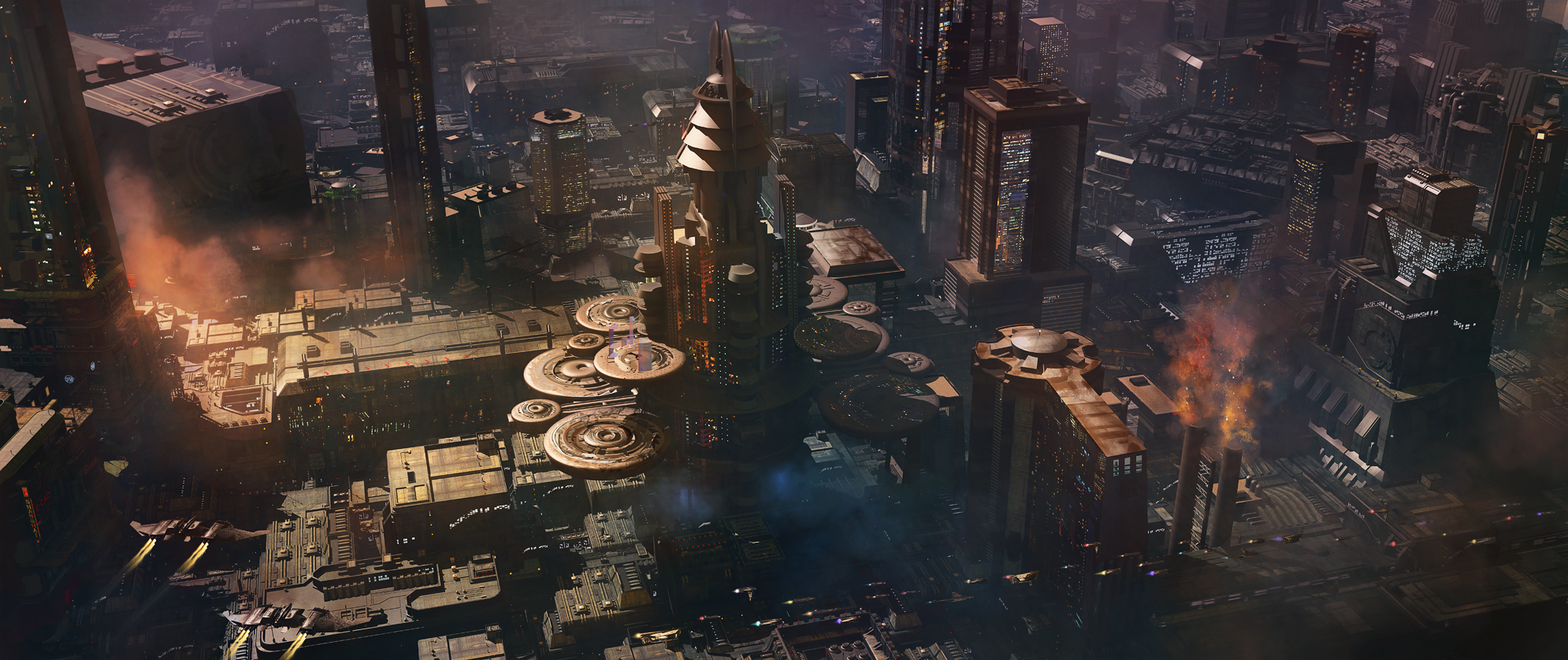
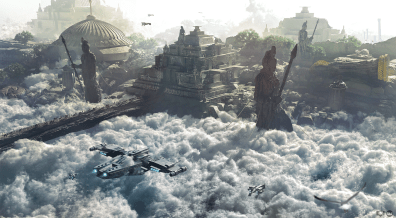
Anybody know about a theme that is good for that, not to mention putting up images of a sci-fi nature? I’ve been dying to use some images, like the one featured at the top here – “Aurora Rising”, a Blade Runner inspired image by fmacmanus at deviantART. Lovely isn’t it? Click on it to get a full-screen view. Trust me, it’s awesome!

Now if you’ll excuse me, I got some more chapters to write and some article to pen. Big news in the world of exploration, sci-fi and other such things. Williams away!

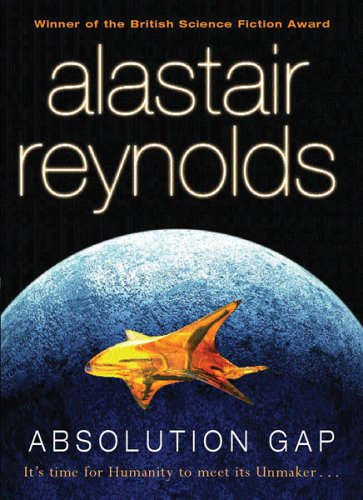
Absolution Gap

Good afternoon all – or morning or evening, as the case may be – and welcome to the final installment in my Revelation Space review. Today, I shall be covering the third and final installment in the trilogy, otherwise known as Absolution Gap. As the conclusion to the series, it brought together the apocalyptic trends established by the first two and wrapped them up pretty nicely, while also introducing some ideas and threads of its own.

These included the threat of the Inhibitors, the attempts by Neville Clavain and his rogue group of Conjoiners, Hyperpigs and refugees to stop them, and the growing awareness of those within the universe at large of their approaching doom. And, true to form, Reynold’s also tells the story through multiple threads which seem unrelated at the beginning, but ultimately come together to reveal a single plot arc that brings everyone and everything together.

And last, but not least, this book also brought the series full circle in terms of the quasi-religious motifs that play an important role in the story. As I mentioned in a previous post, concerning sci-fi and religion, Alastair Reynolds was not one to shy away from the subject of spirituality and religion. One look at the titles in this series (Revelation Space, Redemption Ark, Absolution Gap) are proof enough of that. However, Reynolds went a step beyond, weaving a narrative which begins with knowledge, proceeds to contrition, and then culminates in a sort of forgiveness for all humanity. In the end, the acts of the few who would risk all to save others provides the whole with a sort of reprieve, a second chance for them to contemplate their ambiguous future.

I also should mention that, much like in Redemption Ark, Reynolds chose to include characters and/or elements from his short stories and prequels into this book. In Redemption‘s case, this involved bringing Sky Haussmann back in the form of H, the man who helped Clavain and his friends find their way to Resurgam in time to witness the Inhibitors at work and help save the population. Here, we see hints of how the Revelation Space universe will end, which comes to us from the short story “Galactic North” which is to be found in the collection of the same name. But more on that later! In the meantime, let’s get into this book from the beginning…

Plot Synopsis:
The story opens in 2615, with aboard a lighthugger known as the Gnostic Ascension, a freelance treasure-hunter which is run by a sado-masochist named Jasmina. After waking her crewman Quaiche from reefersleep, she informs him that his attempts to lead them to valuable artifacts have failed for the last time. In order to ensure his success during their next stop, a planet in orbit of 107 Piscium, she places his lover Morwenna (an Ultra and fellow crewmember) in a scrimshaw suit on the outside of his exploratory ship until he returns with some goods.

While surveying a moon in orbit of the gas giant Haldora, he discovers what appears to be an alien bridge in a chasm, but is then attacked by automated defense systems. He then crashes on the planet and sends out a distress signal, knowing that since his ship is on the other side of Haldora, it will not be notified in time to save him. He begins to succumb to an indoctrination virus which he has been carrying for some time, and then notices a miracle has occurred. His shuttle has arrived in time to save him, tough the acceleration has killed Morwenna. During recovery, he realizes it was because Haldora disappeared for a fraction of a second, allowing his radio signal to reach his ship directly…

In the second thread, events take place on Ararat in 2675, twenty three since the crew of the Nostalgia for Infinity landed on the planet. After receiving a capsule from space, Scorpio seeks out Clavain, who has withdrawn from society and left him in charge. This was apparently due to the death of his daughter Felka, who wandered into the sea to contact the Pattern Jugglers and never returned. They discover that the capsule is from Ana Khouri, whom they have not seen since events around Resurgam took place.

Ana informs them that they are fighting the Inhibitors using advanced tech that they have retrieved with the help of Ana’s daughter, Aura. Having come into contact with the Hades Matrix, the alien moon which was an actual data storage device, she now has visions and is able to convey alien technology to their forces which they have begun to incorporate. Unfortunately, Skade has returned from where they had left her last time and kidnapped Auna from Ana’s womb, and is now holding her hostage. After being attacked by Inhibitors, her ship crashed on Ararat.

Making their way to the ship, Skade demands that they kill Clavain in exchange for Auna. Clavain agrees and asks Scorpio to do it for him, since he trusts him as a comrade as arms. He also asks that his body be thrown into the ocean so it might join with Felka and Galiana, his daughter and wife. After killing Clavain and rescuing Auna, the ship is attacked by Inhibitors, but they are saved by the Conjoiner Remontoire who defends them from orbit.

Back at the colony, the leaders decide that its time to load up the Nostalgia and leave the planet and confer with Captain Brannigan (now part of his ship) who reveals that he has been preparing to do so for some time. Apparently, he has been aware of what’s been going on in space, the mounting fight between Inhibitors and their allies, and knew the day would come when he had to lift them off Ararat. Bringing what colonists they can with them, they break for orbit and are met by Remontoire who helps outfit them with their new weapons.

After debating their ultimate destination, they decide to go to Yellowstone to help evacuate the people there before the Inhibitors lay it to waste. Aura tells them to go to a moon called Hela, though they don’t understand why and choose to ignore her advice. When they arrive at Yellowstone, they find the planet overrun and few, if any, ship attempting to depart the system are uninfested by Inhibitor machinery. As a result, Scorpio’s leadership is challenged and a new council is formed, which elects to go to Hela as Aura suggested.

In the third and final thread, the place is Hela and the year is 2727. On this world, a young 17 year old named Rahsmika Els runs away from home to find her long lost brother Harbin, who joined the “Cathedrals” long ago. This is basically a mobile city made up of religious institutions that travel the planet, keeping its eyes on the sky so they may witness what their leader – Quaiche – witnessed many years ago. The disappearance of Haldora, which is the basis of their faith, is something they are waiting on, and all initiates are injected with Quaichist blood to receive the same virus that converted him.

When Quaiche becomes aware of her, he becomes very interested. Els apparently has the ability to discern lies from truth. What’s more, her principle interest lies in xenoarchaelogy, and her theories on the extinct insectoids which were indigenous to the planet (the Scuttlers) are quite fascinating. Apparently, this race was also wiped out by the Inhibitors, and their whereabouts are another subject of fascination for the cult that has grown up around Quaiche. Because of all this, he lures her to his Cathedral and takes her on as an apprentice, never revealing that her brother is in fact dead.

Meanwhile, Els becomes plagued by nightmares about a race known as the “Shadows”, a people that live in a brane (dimension or universe) parallel to our own. In the course of speaking to them through her dreams, she learns that their universe was consumed by a rogue terraforming agent and they are trying to pass through into our own. Eons back, they had showed the Scuttlers how to build a machine that could bring them across, which was apparently hidden inside Haldora. Hence, the gas giant is not a natural planet, but a giant cloaking field which sometimes malfunctions. Hence its disappearance from time to time.

Shortly thereafter, the Nostalgia shows up and begins entering into negotiations with Quaiche to protect the planet. While this is happening, he attempts to seize the ship, but Scorpio and his people defeat them. He then takes Khouri and Els hostage, who we now learn is actually Aura (now 17 years old). Her identity was a cover to infiltrate the planet and learn all she could about their society, and her gifts the result of her enhanced mind. Quaiche then reveals that he wants the Nostalgia to anchor itself to Hela and stop it from rotating, so that he may watch Haldora permanently. Brannigan agrees and lands the ship, but also deploys a Cache Weapon which fires on Haldora, destroying its cloaking field and revealing the machine within.

A fight ensues, in which Quaiche is killed and Nostalgia/Brannigan is destroyed. Aura and Khouri are rescued and reunited with the crew. However, the question remains of what to do about the Shadows. When a digital envoy enters into a scrimshaw suit and begins to speak to them, it claims the offer to destroy the Inhibitors is still open. However, Scorpio claims that their is a better way. He claims that materials found on Ararat match ones found on Hela, which they originally took to be massive seashell deposits, but which turned out to be advanced building materials.

He now knows that these were left behind by a race known as the Nestbuilders, an ancient species which move unseen throughout our galaxy to elude the Inhibitors. He suggests appealing to them for help against the Inhibitors, rather than trusting in these Shadows. He advised Remontoire to tell Aura and Khouri of this, and they escape the Cathedrals before it is destroyed. Scorpio, injured and having gone through cryogenics too many times, dies out on the planet surface…

In the epilogue, the year is 3125 and the place is a Pattern Juggler planet. This brings the story full circle, back to the beginning where this same woman was standing on the world right before it was to be evacuated. She reflect on everything that has happened and realizes Scorpio was right. After finding the Nestbuilders, which had been hiding between stars, they used their weaponry and eventually pushed the Inhibitor menace back. The war is still not over, but victory seems assured. However, in doing so, they created a greater problem: the so called “Greenfly” machines. These are a self-replicating race of terraformers that programmed to destroy every object in a solar system and reorganize them into trillions of vegetation-filled habitats.

Apparently, the Inhibitors had kept them in check, but without the Inhibitors, the Greenfly are now out of control. This is very similar to what the Shadows described as having destroyed their own universe, which leads Aura to conclude that they were not from a parallel brane, but from the future. As such, humanity is evacuating towards the Pleiades, but before they leave, Aura decides that she will swim with the Pattern Jugglers one last time. In so doing, she hopes to warn and warn the people they have assimilated about what is coming, and enters the water just as the story ends…

Summary:
I should start this last section by stating that this was my least favorite book of the three. This does not mean I didn’t enjoy it, but as usual, there were the elements I had come to know and expect from Reynolds which detracted from the overall story. These include his use of convoluted plots, multiple twists, and some rather weird and out there concepts.

For starters, Clavain and Skade are both killed off pretty quickly in the beginning in a way that suggests that they were simply being done away with. In reality, Skade’s involvement in the story pretty much ended in book II when her ship blew up. Bringing her back and having her take Clavain with her just seemed like a way to write Clavain out, which I really didn’t see the need for (aside from making him a Jesus-like figure). Also, the concept of Ana’s daughter, which is the source of their ideas for fighting the Inhibitors, also seemed a bit weird. I mean a psychic, talking baby?

The Hades Matrix being a source of valuable information I could see, but why not just have it that they went back there to get as much information as they could in the intervening 23 years? And if they were going for a messiah-type figure in her daughter, why not let her grow up before she becomes this impressive psychic figure. It would go a long way to furthering the Judea-Christian elements that are prevalent in the story.

Which brings me to the next issue, that of the many plot twists. For starters, why was it necessary to blank out Aura’s mind so she could pretend to be a 17 year old native to Hela? Why not just send her in as is, posing as a religious convert who had come from off world? All kinds of people came to Hela everyday for this exact reason, so why not simply slip her in with them? Or, why didn’t they simply contact Quaiche directly when they got there instead of going through all this cloak and dagger? Things really didn’t materialize until they did anyway, so why go through all that? Granted, it tied the threads together quite succinctly, but by the time it is revealed, I began to feel that the story was trying to do too much.

And finally, there is the matter of the twist ending. At the time of reading, I felt like it came out of nowhere. Who were these Nestbuilders? Why hadn’t we heard of them until now? And why the last minute introduction of them? Naturally, I would later learn that the Nestbuilders did not so much come out of nowhere, but were instead an adaptation of something from an earlier work. Essentially, they are a species who make an appearance in “Galactic North” and who are related to the “Slugs” from Chasm City – i.e. the species that had taken to hiding between star systems to avoid the Inhibitors. This made sense and wrapped things up nicely by tying it back to his previous work. But much like with the character of H in the Redemption, I felt that things had not been explained fully.

What’s more, this does not explain how Scorpio was able to discern their existence and learn all he needed to know – like the fact that they could trust them or they would be able to help them beat the Inhibitors – from one tiny shard of shell they left behind. Perhaps if he revealed that Felka told them as much after meeting with the Pattern Jugglers one last time, or that Galiana had conveyed some hints in one of her visions before dying. But as I recall, no explanations were made and we’re simply handed this solution shortly before the book ends. Again, not well explained, and kind of comes off as a third act twist that feels contrived.

And now for the things I liked! As usual, Reynold’s characteristic knack for combining cool technology, hard science, a gritty take on the universe, and some interesting conceptualizations of alien civilizations proved very interesting. On top of all that, there was a rather intriguing commentary on organized religion and apocalypticism which ran through the entire story, which achieved a truly artistic climax in the way he envisioned the “Cathedrals”. I am forced to wonder if he adapted that from somewhere, or it was a Reynold’s original. Either way, very cool!

And in hindsight, I actually appreciate the way he managed to weave elements from Chasm City and Galactic North into this story. The way it ended on a note of uncertainty, due to the fact that their universe was beginning to resemble the very one the Shadows had told them about, really brought the story home and gave the impression of a tightly knit universe. Lastly, the way Reynolds took this opportunity (again) to get into some hard scientific concepts, most notably membrane theory (aka. M-theory), was quite welcome. Much like how he incorporating Galactic Collisions in volume two, it was not only educational but enjoyable to see real scientific theories being adapted into fiction.

All in all, I consider the Revelation Space trilogy to be one of the most influential and poignant series I have ever read. While it might not rank up there with Dune or LOTR, it remains a source of inspiration and ideas for me. Hell, Reynolds practically taught me all I know about nanotechnology, not to mention time dilation and relativistic space travel. Without his hard scientific  influence, I would still be believing in a universe where FTL had to happen in order for good sci-fi to occur!

Note: Alas, I have yet to read the Prefect, the fifth and final novel in the Revelation Space universe. And in point of fact, several short stories make up the universe as well, some of which I believe I have yet to read. So really, I cannot say in all honesty that I’ve read the entire series or have commented on it fully. However, the novels of Revelation Space, Redemption Ark, and Absolution Gap are the only ones in the series that have a common plot and characters, hence why I refer to them as a “trilogy” and treat them as a contained set. And in that respect, I have finished with the Revelation Space Universe and my review thereof. Anything else at this point would just be gravy… 😉

Anthology Sample: The Torch (part II)

Hello again from the world of writing! As some people may recall, I published a section of my other contribution to my group’s anthology a few days back. Entitled “The Torch”, it introduces a near-future scenario where an ecological engineer named Magid Muktari proposes launching an exoplanet colonization program. As the prologue to the anthology, it’s kind of important, in that it sets up the entire story and gets the ball rolling on the whole plot.

Hence why I wanted to do it myself. As the editor, you kind of have to put your money where your mouth is, otherwise you’re just a big fat delegator! And what good are those? In any case, the first section presented the introduction of the idea. In this second part, I wanted to get into the early like of Muktari, presenting his estranged wife from later in the book, but at a time when they were still partners and lovers.

Since she too was the creation of fellow anthologist Khaalidah, I thought she deserved a mention and a thorough treatment of all she accomplished in her lifetime. I hope I did her justice, and in the meantime captures some shred of what it will be like for a couple in the mid 21st century who are trying to make ends meet, and save the world at the same time! Hope y’all enjoy and remember that feedback is most welcome

*                    *                    *

The lights were already on when he came home. The nighttime creatures were about, singing their evening songs and tending to their nocturnal rituals. He felt the reassuring calm spread over him as soon as the wheels stopped in his driveway, the engine quieting down from its long run. The door raised itself for him and he put his tired feet to the ground, letting out a deep sigh.

“Home again, home again…” It took some effort to get him the rest of the way out. The steps were even harder to manage. It confounded him, how travelling could still be such a draining experience when machines generated all the motion. Perhaps their minds had not kept pace, still interpreting distance in terms of physical expenditure.

He paused on the front stoop and waited for Empathy to scan him. A quick flash hit his eye, discerning his retinal pattern, then projecting a kind greeting in his visual field.

Hujambo, Magid! it said. He laughed. Firdaws had toyed with the settings again. Of all the languages he had picked up in the course of his training, Swahili was the one that still alluded him. It was the one thing he she maintained over him for all these years; he suspected she relished it too.

“Hujambo, my dear!” he said as soon as he stepped into through the front door. No footsteps came to greet him. On a hunch, he wandered through the living annex and found her in her office. He paused at the entrance and sighed at her.

“Dining on ashes, dearest?”

She raised her finger to him. He spotted the jewel in her ear and the distant look in her eyes. Apparently, she had brought her work home with her again. Always the solemn and grave sort, her. Never shying and never blinking in the face of interminable change. He waited as patiently as he could while she finished her discussion with the person on the other end, and tried not to pass out against the wall.

“That’s not an offer, Tikhon, it’s an insult… No, don’t recommend this as a compromise, if we do, we’ll be doing nothing but until the project is realized. If they want the rights to drill, they need to meet the local’s demands and the EA’s demands… Alright, thank you. I’ll talk to you in the morning.”

She leaned back and sighed. She looked at him for the first time since his appearance on her step. She also removed the jewel and the contacts from her eyes, signaling the end of her day.

“How was your trip, dear?”

“Long and exhausting,” he replied. “And how goes the good fight?”

“The same,” she said, rising from her seat and proceeding to give him a kiss. “I trust your stopover was worth the extra travel time?”

“Ah, not exactly, no.”

She took his face in her hands. They felt lovely and cool against his skin. “Well, you can only do so much. I did say that it was an unlikely possibility as it was.”

He grumbled. She had indeed, and meant it as an indictment on the wisdom of his superiors rather than his plan. But it did him little good right now. In his current state, any tough love only seemed to drive the failure home.

“Shall I make us some dinner?”

He frowned and checked it his chrono. “You haven’t eaten yet?”

She shook her head and looked at the pile of display sheets that lay on her desk. No explanations were necessary. There was no time or schedules amongst workaholics.

“Sure, why not? Anything will do.”

“Good, because we’re having kofte. I was kind enough to pick some up on the way back from work, even though I knew there was a good chance you might not make it in before I went to sleep.”

“How considerate,” he said, bowing his head to offer thanks.

Punching him in the shoulder, she took off past him and headed for the kitchen. Taking a seat at the island stove, he watched while she prepared pieces of spiced meat and yoghurt from the cooler, intermixed with select greens from their crisper. She grabbed a tub of prepared rice from the bottom shelf and began spooning some into two bowls.

“Nothing like fresh,” he said, taking in the aroma. Firdaws insisted on doing things Halal, he knew. And the local authorities were yet to sign of on the compiled version. Luckily, their professions afforded them such luxuries, religious exception being a somewhat expensive pleasure these days.

“Are you going to ask about my day?” she asked finally.

“I thought I did.”

She laughed. “There are details, if you care to hear.”

“Of course,” he said with a sigh. Though he knew he wouldn’t be able to follow, and would incur her wrath if she turned around too soon.

“Well, it was hard enough getting the firm and the Emir to sit down together. He was unwilling to negotiate any lease on the land unless they agreed to a long-term commitment. The company asked what he meant by this, and he replies that fifty years would suffice. That nearly torpedoed everything. But once we got past that issue, the company started making its own demands. After surveying the land in the region, they announced they wanted to expand their lease to include an entire hillside range. They want resource exploitation rights, the whole lot…”

Muktari hummed thoughtfully, even though he wasn’t entirely sure the path she was taking with this. He heard a loud clink inside the cooler.

“So the Emir starts accusing them of sending in covert surveyors, which he claimed was in bad faith. That nearly caused the company to walk out again. However, they did say that they will resume negotiations if and when the Emir agrees to sign over the resource rights in the area to them.”

“I see…” though he didn’t.

“Now we’ve got to make a recommendation. Our boss wants to dangle the offer in front of the Emirs nose in the hopes that it might move things along, but as usual, he’s being an idiot.”

“Won’t be long before you are running things, dear.”

She chuckled. “In any case, I told him we should recommend a joint survey, find out exactly what the company found in those hills, and then conduct a separate negotiation. No sense in letting them exploit something until the locals have been notified of their rights and the government knows exactly what they are giving up.”

“Hmmm, and all this for a few hundred kilometers of sand.”

She turned suddenly. “That sand will hold one of the largest solar arrays to date. Every country in the region is already looking to buy up rights to the power it generates.”

“You’d think the Emir would want to conclude things.

Firdaws stroked a lock of black hair from her face. “His mistrust is… less than rational, but its working in his favor. Astral will make a meal out of his country if he lets them. The energy business is still the same, no matter what technology they employ.”

“And so the dance continues,” Muktari said with a chuckle. He was surprised that he had managed to get through it. His semi-delirious mind had somehow managed to take it all in and still managed to stay interested. Not all of it registered, but at least he grasped the salient points.

A loud clink signaled the presence of his bowl in front of him. He breathed in the warm steam of a lovely meal, felt his stomach ache with sudden anticipation. As usual, he hadn’t realized the extent of his own hunger until the food was in front of him.

“So…” she said. “What now?”

He looked up at her with a frown.

“You’re plan? Are you going to drop it, or take it to a more receptive audience?”

Muktari chewed slowly and considered the question. He had pondered that very question himself during the trip home, but to no avail. Short of going behind Zimmerman’s back and risking his entire career, he wasn’t sure how he could possibly move ahead with it anymore.

“Unclear,” he replied. “I might need to keep it close to my chest for now.”

“And let it die a natural death?”

Muktari cleared his throat. How like her to challenge him so. “I won’t let that happen. Sooner or later, I’ll find a receptive audience.”

Firdaws nodded and turned to close cooler unit. “It’s up to you, koca. But after the time and energy you’ve dedicated to this, I’d hate to see you lose faith just because your current boss said no.”

Current boss, he thought. Was she anticipating something, or making a possible suggestion? It was always so hard to tell with her!

Religion in Sci-Fi

Since its inception as a literary genre, religion has played an important role in science fiction. Whether it took the form of informing the author’s own beliefs, or was delivered as part of their particular brand of social commentary, no work of sci-fi has ever been bereft of spirituality.Even self-professed atheists and materialists had something to say about religion, the soul and the concept of the divine, even if it was merely to deny its existence.

And so, I thought it might make for an interesting conceptual post to see exactly what some of history’s greats believed and how they worked it into their body of literature. As always, I can’t include everybody, but I sure as hell can include anyone who’s books I’ve read and beliefs I’ve come to know. And where ignorance presides, I shall attempt to illuminate myself on the subject. Okay, here goes!

Alastair Reynolds:
Despite being a relative newby to the field of sci-fi authors, Reynolds has established a reputation for hard science and grand ideas with his novels. And while not much information exists on his overall beliefs, be they religious or secular, many indications found their way into his books that would suggest he carries a rather ambiguous view of spirituality.

Within the Revelation Space universe, where most of his writing takes place, there are many mentions of a biotechnological weapon known as the “Indoctrination Virus”. This is an invasive program which essentially converts an individual to any number of sectarian ideologies by permeating their consciousness with visions of God, the Cross, or other religious iconography.

In Chasm City, these viruses are shown to be quite common on the world of Sky’s Edge, where religious sects use them to convert people to the official faith of the planet that claims Sky Haussmann was a prophet who was unfairly crucified for his actions. In Absolution Gap, they also form the basis of a society that populates an alien world known as Hela. Here, a theocratic state was built around a man named Quaiche, who while near death watched the moon’s gas giant disappear for a fraction of a second.

Unsure if this was the result of a strain he carries, he created a mobile community that travels the surface of the planet and watches the gas giant at all times using mirrors and reclining beds, so that they are looking heavenward at all times. Over the years, this community grew and expanded and became a mobile city, with each “believer” taking on transfusions of his blood so they could contract the the strain that converted him and allowed him to witness all that he did.

While this would indicate that Reynolds holds a somewhat dim view of religion, he leaves plenty of room for the opposite take. All throughout his works, the idea of preserving one’s humanity in a universe permeated by post-mortal, post-human, cybernetic beings remains a constant. In addition, as things get increasingly dark and the destruction of our race seems imminent, individual gestures of humanity are seem as capable of redeeming and even saving humanity as a species.

In fact, the names of the original trilogy allude to this: Revelation Space, Redemption Ark, Absolution Gap. Like with everything else in his books, Reynold’s seems to prefer to take a sort of middling approach, showing humanity as an ambiguous species rather than an inherently noble one or foul one. Religion, since it is a decidedly human practice, can only be seen as ambiguous as well.

Arthur C. Clarke:
At once a great futurist and technologist, Clarke was nevertheless a man who claimed to be endlessly fascinated with the concept of God and transcendence. When interviews on the subjects of his beliefs, he claimed that he was “fascinated by the concept of God.” During another interview, he claimed that he believed that “Any path to knowledge is a path to God—or Reality, whichever word one prefers to use.”

However, these views came to change over time, leading many to wonder what the beliefs of this famed author really were. At once disenchanted with organized religion, he often found himself subscribing to various alternative beliefs systems. At other times, he insisting he was an atheist, and nearing the end of his life, even went so far as to say that he did not want religious ceremonies of any kind at his funeral.

Nowhere were these paradoxical views made more clear than in his work. For example, in 2001: A Space Odyssey, the theme of transcendence, of growing to the point of becoming god-like, is central. Early hominid’s evolution into humanity is seen as the direct result of tampering by higher forces, aliens which are so ancient and evolved that they are virtually indistinguishable from gods. Throughout the series, human beings get a taste of this as they merge with the alien intelligence, becoming masters of their own universe and godlike themselves.

In the last book of the series – 3001: Final Odyssey, which Clarke wrote shortly before his death – Clarke describes a future where the Church goes the way of Soviet Communism. Theorizing that in the 21st century a reformist Pope would emerge who would choose to follow a similar policy as Gorbachev (“Glasnost”) and open the Vatican archives, Clarke felt that Christianity would die a natural death and have to be replaced by something else altogether. Thereafter, a sort of universal faith built around an open concept of God (called Deus) was created. By 3001, when the story is taking place, people look back at Christianity as a primitive necessity, but one which became useless by the modern age.

So, in a way, Clarke was like many Futurists and thoroughgoing empiricists, in that he deplored religion for its excesses and abuses, but seemed open to the idea of a cosmic creator at times in his life. And, when pressed, he would say that his personal pursuit for truth and ultimate reality was identical to the search for a search God, even if it went by a different name.

Frank Herbert:
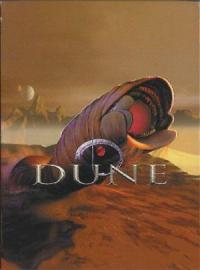
Frank Herbert is known for being the man who taught people how to take science fiction seriously all over again. One of the reasons he was so successful in this regard was because of the way he worked the central role played by religion on human culture and consciousness into every book he ever wrote. Whether it was the Lazarus Effect, the Jesus Incident, or the seminal Dune, which addresses the danger of prophecies and messiahs, Frank clearly believed that the divine was something humanity was not destined to outgrow.

And nowhere was this made more clear than in the Dune saga. In the very first novel, it is established that humanity lives in a galaxy-spanning empire, and that the codes governing technological progress are the result of a “jihad” which took place thousands of years ago. This war was waged against thinking machines and all other forms of machinery that threatened to usurp humanity’s sense of identity and creativity, resulting in the religious proscription “Thou shalt not make a machine in the likeness of a human mind.”

Several millennium later, the Bene Gesserit Sisterhood, a quasi-religious matriarchal society, are conspiring to create a messianic figure in the form of the Kwisatz Haderach. The name itself derives from the Hebrew term “Kefitzat Haderech” (literally: “The Way’s Jump”), a Kabbalic term related to teleportation. However, in this case, the name refers to the individual’s absolute prescience, the ability to jump through time in their mind’s eye. In preparation for the arrival of this being, they have been using their missionaries to spread messiah legends all over the known universe, hoping that people will respond to the arrival of their superbeing as if he were a messianic figure.

When the main character, Paul Atreides – the product of Bene Gesserit’s breeding program – arrives on the planet Arrakis, where his family is betrayed and killed, he and his mother become refugees amongst the native Fremen. They are one such people who have been prepped for his arrival, and wonder if he is in fact the one who will set them free. In order to survive, Paul takes on this role and begins to lead the Fremen as a religious leader. All along, he contends with the fear that in so doing, he will be unleashing forces he cannot control, a price which seems too high just to ensure that he and his mother survive and avenge themselves on their betrayers.

However, in the end, he comes to see that this is necessary. His prescience and inner awareness reveal to him that his concepts of morality are short-sighted, failing to take into account the need for renewal through conflict and war. And in the end, this is exactly what happens.By assuming the role of the Kwisatz Haderach, and the Fremen’s Mahdi, he defeats the Emperor and the Harkonnens and becomes the Emperor of the known universe. A series of crusades followers as his followers go out into the universe to subdue all rebellion to his rule and spread their new faith. Arrakis not only becomes the seat of power, but the spiritual capital of the universe, with people coming far and wide to see their new ruler and prophet.

As the series continues, Paul chooses to sacrifice himself in order to put an end to the cult of worship that has come of his actions. He wanders off into the desert, leaving his sister Alia to rule as Regent. As his children come of age, his son, Leto II, realizes the follies of his father and must make a similar choice as he did. Granted, assuming the role of a God is fraught with peril, but in order to truly awaken humanity from its sleep and prepare it for the future, he must go all the way and become a living God. Thus, he merges with the Sandworm, achieving a sort of quasi-immortality and invincibility.

After 3500 of absolute rule, he conspires in a plot to destroy himself and dies, leaving a huge, terrible, but ultimately noble legacy that people spend the next 1500 years combing through. When they come to the point of realizing what Leto II was preparing them for, they come to see the wisdom in his three and half millennia of tyranny. By becoming a living God, by manipulating the universe through his absolute prescience, he was preparing humanity for the day when they would be able to live without Gods. Like the Bene Gesserit, who became his chosen after the fact, he was conspiring to create “mature humanity”, a race of people who could work out their fates moment by moment and not be slaved to prophecies or messiahs.

As you can see, the commentary ran very deep. At once, Herbert seemed to be saying that humanity would never outlive the need for religion, but at the same time, that our survival might someday require us to break our dependency on it. Much like his critique on rational thought, democracy and all other forms of ideology, he seemed to be suggesting that the path to true wisdom and independence lay in cultivating a holistic awareness, one which viewed the universe not through a single lens, but as a multifaceted whole, and which was really nothing more than a projection of ourselves.

For those seeking clarity, that’s about as clear as it gets. As Herbert made very clear through the collection of his works, religion was something that he was very fascinated with, especially the more esoteric and mystical sects – such as Kaballah, Sufism, Zen Buddhism and the like. This was appropriate since he was never a man who gave answers easily, preferring to reflect on the mystery rather than trying to contain it with imperfect thoughts. Leto II said something very similar to this towards the end of God Emperor of Dune; as he lay dying he cautions Duncan and Siona against attempts to dispel the mystery, since all he ever tried to do was increase it. I interpreted this to be a testament of Frank’s own beliefs, which still inspire me to this day!

Gene Roddenberry:
For years, I often found myself wondering what Roddenberry’s take on organized religion, spirituality, and the divine were. Like most things pertaining to Star Trek, he seemed to prefer taking the open and inclusive approach, ruling nothing out, but not endorsing anything too strongly either. Whenever religion entered into the storyline, it seemed to take the form of an alien race who’s social structure was meant to resemble something out of Earth’s past. As always, their was a point to be made, namely how bad things used to be!

Behind the scenes, however, Roddenberry was a little more open about his stance. According to various pieces of biographical info, he considered himself a humanist and agnostic, and wanted to create a show where none of his characters had any religious beliefs. If anything, the people of the future were pure rationalists who viewed religion as something more primitive, even if they didn’t openly say so.

However, this did not prevent the subject of religion from coming up throughout the series. In the original, the crew discovers planets where religious practices are done that resemble something out of Earth’s past. In the episode “Bread and Circuses”, they arrive on a planet that resembles ancient Rome, complete with gladiatorial fights, Pro-Consuls, and a growing religion which worships the “Son”, aka. a Jesus-like figure. This last element is apparently on the rise, and is advocating peace and an end to the cultures violent ways. In “Who Mourns Adonais”, the crew are taken captive by a powerful alien that claims to be Apollo, and who was in fact the true inspiration for the Greek god. After neutralizing him and escaping from the planet, Apollo laments that the universe has outgrown the need for gods.

In the newer series, several similar stories are told. In the season one episode entitled “Justice”, they come Edenic world where the people live a seemingly free and happy existence. However, it is soon revealed that their penal code involves death for the most minor of infractions, one which was handed down by “God”. This being is essentially an alien presence that lives in orbit and watches over the people. When the Enterprise tries to rescue Wesley, who is condemned to die, the being interferes. Picard gains its acquiescence by stating “there can be no justice in absolutes”, and they leave. In a third season episode entitled “Who Watches the Watchers”, Picard becomes a deity to the people of a primitive world when the crew saves one of their inhabitants from death. In an effort to avoid tampering with their culture, he lands and convinces him of his mortality, and explains that progress, not divine power, is the basis of their advanced nature.

These are but a few examples, but they do indicate a general trend. Whereas Roddenberry assiduously avoided proselytizing his own beliefs in the series, he was sure to indicate the ill effects religion can have on culture. In just about every instance, it is seen as the source of intolerance, injustice, irrationality, and crimes against humanity and nature. But of course, the various crews of the Enterprise and Starfleet do not interfere where they can help it, for this is seen as something that all species must pass through on the road to realizing their true potential.

George Lucas:
Whereas many singers of space opera and science fiction provided various commentaries on religion in their works, Lucas was somewhat unique in that he worked his directly into the plot. Much like everything else in his stories, no direct lines are established with the world of today, or its institutions. Instead, he chose to create a universe that was entirely fictional and fantastic, with its own beliefs, conflicts, institutions and political entities. But of course, the commentary on today was still evident, after a fashion.

In the Star Wars universe,religion (if it could be called that) revolves around “The Force”. As Obi-Wan described it in the original movie “It is an energy field created by all living things. It surrounds us and penetrates us. It binds the galaxy together.” In Empire, Yoda goes a step farther when he says “Life creates it, makes it grow. Its energy surrounds us and binds us. Luminous beings are we, not this crude matter.”Sounds rather pantheistic, doesn’t it? The idea that all life emits an essence, and that the fate of all living things is bound together in a sort of interdependency.

What’s more, the way the Force was governed by a Light Side and a Dark Side; here Lucas appeared to be relying on some decidely Judea-Christian elements. Luke’s father, for example, is a picture perfect representation of The Fall, a Faustian man who sold his soul for power and avarice. The way he and the Emperor continually try to turn Luke by dangling its benefits under his nose is further evidence of this. And in the end, the way Darth Vader is redeemed, and how he is willing to sacrifice himself to save his son, calls to mind the crucifixion.

In the prequels, things got even more blatant. Whereas Anakin was seen as a sort of Lucifer in the originals, here he became the prodigal son. Conceived by the “Will of the Force”, i.e. an immaculate conception, he was seen by Qui Gonn as “The Chosen One” who’s arrival was foretold in prophecy. The Jedi Council feared him, which is not dissimilar to how the Pharisees and Sanhedrin reacted to the presence of Jesus (according to Scripture). And of course, the way Anakin’s potential and powers became a source of temptation for him, this too was a call-back to the Lucifer angle from the first films.

All of this was in keeping with Lucas’ fascination with cultural mythos and legends. Many times over, Lucas was rather deliberate in the way he worked cultural references – either visually or allegorically – into his stories. The lightsaber fights and Jedi ethos were derived from medieval Europe and Japan, the architecture and many of the costumes called to mind ancient Greece, Rome and Byzantium, the setting and gun fights were regularly taken from Old Westerns, and the Imperial getup and rise to power of the Emperor were made to resemble Nazi Germany.

However, Lucas also dispelled much of the mystery and pseudo-religious and spiritual quality of his work by introducing the concept of the “midi-chlorians”. This is something I cannot skip, since it produced a hell of a lot of angst from the fan community and confounded much of what he said in the original films. Whereas the Force was seen as a mystic and ethereal thing in the originals, in the prequels, Lucas sought to explain the nature of it by ascribing it to microscopic bacteria which are present in all living things.

Perhaps he thought it would be cool to explain just how this semi-spiritual power worked, in empirical terms. In that, he failed miserably! Not only did this deprive his franchise of something truly mysterious and mystical, it also did not advance the “science” of the Force one inch. Within this explanation, the Force is still a power which resides in all living things, its just these microscopic bacteria which seem to allow people to interact with it. Like most fans, I see this as something superfluous which we were all better off without!

H.G. Wells:
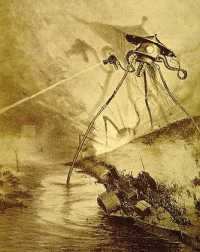
Prior to men like Herbert and the “Big Three” (Asimov, Clarke, and Robert A. Heinlein), Wells was the master of science fiction. Since his time, during which he published a staggering amount of novels, short-stories and essays, his influence and commentaries have had immense influence. And when it came to matters of faith and the divine, Well’s was similarly influential, being one of the first sci-fi writers to espouse a sort of “elemental Christian” belief, or a sort of non-denominational acceptance for religion.

These beliefs he outlined in his non-fiction work entitled God the Invisible King, where he professed a belief in a personal and intimate God that did not draw on any particular belief system. He defined this in more specific terms later in the work,  aligning himself with a “renascent or modern religion … neither atheist nor Buddhist nor Mohammedan nor Christian … [that] he has found growing up in himself”.

When it came to traditional religions, however, Wells was clearly of the belief that they had served their purpose, but were not meant to endure. In The Shape of Things to Come, he envisioned the creation of a global state (similar to Zamyatin’s “One State” and Huxley’s “World State”), where scientific progress was emphasized and all religions suppressed. This he saw as intrinsic to mankind’s progress towards a modern utopia, based on reason and enlightenment and the end of war.

In War of the Worlds, a similar interpretation is made. In this apocalyptic novel, one of the main characters is a clergyman who interprets the invasion of the Martians as divine retribution. However, this only seems to illustrate his mentally instability, and his rantings about “the end of the world” are ultimately what lead to his death at the hands of the aliens. Seen in this light, the clergyman could be interpreted as a symbol of mankind’s primitive past, something which is necessarily culled in the wake of the invasion my a far more advanced force. And, as some are quick to point out, the Martians are ultimately defeated by biology (i.e. microscopic germs) rather than any form of intervention from on high.

Isaac Asimov:
Much like his “Big Three” colleague Clarke, Asimov was a committed rationalist, atheist and humanist. Though he was born to Jewish parents who observed the faith, he did not practice Judaism and did not espouse a particular belief in God. Nevertheless, he continued to identify himself as a Jew throughout his life. In addition, as he would demonstrate throughout his writings, he was not averse to religious convictions in others, and was even willing to write on the subject of religion for the sake of philosophical and historical education.

His writings were indicative of this, particularly in the Foundation and I, Robot series. In the former, Asimov shows how the Foundation scientists use religion in order to achieve a degree of influential amongst the less-advanced kingdoms that border their world, in effect becoming a sort of technological priesthood. This works to their advantage when the regent of Anacreon attempts to invade Terminus and ends up with a full-scale coup on his hands.

In the Robot series, Asimov includes a very interesting chapter entitled “Reason”, in which a robot comes to invent its own religion. Named QT1 (aka. “Cutie”) this robot possesses high-reasoning capabilities and runs a space station that provides power to Earth. It concludes that the stars, space, and the planets don’t really exist, and that the power source of the ship is in fact God and the source of its creation.

Naturally, the humans who arrive on the station attempt to reason with Cutie, but to no avail. It has managed to convert the other robots, and maintains the place in good order as a sort of temple. However, the human engineers conclude that since its beliefs do not conflict with the smooth running of the facility, that they should not attempt to counterman it’s belief system.

What’s more, in a later story entitled “Escape!” Asimov presents readers with a view of the afterlife. After developing a spaceship that incorporates an FTL engine (known as the hyperspatial drive), a crew of humans take it into space and perform a successful jump. For a few seconds, they experience odd and disturbing visions before returning safely home. They realize that the jump causes people to cease exist, effectively dying, which is a violation of the Three Laws, hence why previous AI’s were incapable of completing the drive.

Taken together, these sources would seem to illustrate that Asimov was a man who saw the uses of religion, and was even fascinated by it at times, but did not have much of a use for it. But as long as it was not abused or impinged upon the rights or beliefs of others, he was willing to let sleeping dogs lie.

Philip K. Dick:
Naturally, every crowd of great artists has its oddball, and that’s where PKD comes in! In addition to being a heavy user of drugs and a fan of altered mental states, he also had some rather weird ideas when it came to religion. These were in part the result of a series of religious experiences he underwent which began for him in 1974 while recovering from dental surgery. They were also an expresion of his gnostic beliefs, which held that God is a higher intelligence which the human mind can make contact with, given the right circumstances.

Of Dick’s hallucinations, the first incident apparently occurred when a beautiful Christian woman made a delivery to his door and he was mesmerized by the light reflecting off of her fish pendant, which he claimed imparted wisdom and clairvoyance. Thereafter, Dick began to experience numerous hallucinations, and began to rule out medication as a cause. Initially, they took the form of geometric patterns, but began to include visions of Jesus and ancient Rome as well. Dick documented and discussed these experiences and how they shaped his views on faith in a private journal, which was later published as The Exegesis of Philip K. Dick.

As he stated in his journal, he began to feel that his hallucinations were the result of a greater mind making contact with his own, which he referred to as the “transcendentally rational mind”, “Zebra”, “God” and “VALIS” (vast active living intelligence system). Much of these experiences would provide the inspiration for his VALIS Trilogy, a series that deals with the concept of visions, our notions of God and transcendent beings.

In addition, many of Dick’s hallucinations took on a decidedly Judea-Christian character. For instance, at one point he became convinced that he was living two parallel lives; one as himself, and another as “Thomas” – a Christian persecuted by Romans in the 1st century AD. At another point, Dick felt that he had been taken over by the spirit of the prophet Elijah. These experiences would lead him to adapt certain Biblical elements into his work, a prime example being a chapter in Flow My Tears, the Policeman Said, which bore a striking resemblance to the a story from the Biblical Book of Acts, which Dick claimed to never have read.

All of this is a testament to the rather profound (and possibly nuts!) mind of PKD and his fascination with all things divine and spiritual. Though not a man of faith in the traditional sense, he was very much a part of the counter-culture in his day and experimented with drugs and alternative religious beliefs quite freely. And while most of his ideas were dismissed as outlandish and the result of drug abuse, there were many (Robert A Heinlein included) who saw past that to the creative and rather gifted artistic soul within. It is therefore considered a tragedy that PKD died in relative obscurity, having never witnessed how much of an impact and influence he would have on science fiction and modern literature.

Ray Bradbury:
Next up, we have the late great Ray Bradbury, a science fiction writer for whom all literature was of immense import. This included the Bible, the Tanakh, the Koran, and just about any other religious text ever written by man. What’s more, many of his works contain passages which would seem to indicate that Bradbury held religion in high esteem, and even believed it to be compatible (or at least not mutually exclusive) with science.

For example, in his seminal novel Fahrenheit 451, one of the most precious volumes being protected by the character of Faber, a former English professor, is the Bible itself. When Montag confronts him and begins ripping the pages out of it, Faber tells him that it is one of the last remaining copies in the world that actually contains God’s words, instead of the newer versions which contain product placements.

As the story progresses and World War III finally comes, Montag joins Faber and a community of exiles, all of whom are responsible for “becoming a book” by memorizing it. In this way, they hope to preserve whatever literature they can until such a time as civilization and the art of writing re-emerges. Montag is charged with memorizing the Book of Ecclesiastes, and joins the exiles on their journey.

In the Martian Chronicles, Bradbury is even more clear on his stance vis a vis religion. In the short story “-And the Moon Be Still as Bright”, the Fourth Expedition arrives on Mars to find that the majority of the Martians have died from chickenpox. A disillusioned character named Jeff Spender then spends much time in the alien ruins and comes to praise the Martians for how their culture combined religion and science.

Humanity’s big mistake, according to Spender, was in praising science at the expense of religion, which he seemed to suggest was responsible for modern man’s sense of displacement. Or has Spender put it: “That’s the mistake we made when Darwin showed up. We embraced him and Huxley and Freud, all smiles. And then we discovered that Darwin and our religions didn’t mix. Or at least we didn’t think they did. We were fools. We tried to budge Darwin and Huxley and Freud. They wouldn’t move very well. So, like idiots, we tried knocking down religion.”

In short, Bradbury saw humanity as lost, largely because of it deification of reason at the expense of faith. However, he did not appear to be advocating any particular religion, or even religion over science. When it came right down to it, he seemed to be of the opinion that faith was important to life, an outlet for creativity and inspiration, and needed to be preserved, along with everything else.

Robert A. Heinlein:
As yet another member of the “Big Three”, Heinlein’s own religious view bear a striking resemblance to those of his contemporaries. Much like Clarke and Asimov, he was a committed rationalist and humanist, and varied from outright atheism to merely rejecting the current state of human religion. According to various sources, this began when he first encountered Darwin’s Origin of the Species at the age of 13, which convinced him to eschew his Baptist roots.

These can be summed up in a statement made by Maureen, one of his characters in To Sail Beyond the Sunset, when she said that the purpose of metaphysics was to ask the question why, but not to answer. When one passed beyond the realm of questions and got into answer, they were firmly in religious territory. Naturally, the character of Maureen preferred the former, as the latter led to intolerance, chauvinism, and persecution.

In Stranger In A Strange Land, one of the most famous science fiction novels of all time, plenty of time is dedicated to the main character’s (the Martian Smith) experiences with religion. After becoming disillusioned with humanity’s existing institutions, he decides to create a new faith known as the “Church of All Worlds”. This new faith was based on universal acceptance and blended elements of paganism, revivalism, and psychic training. In short, it was an attempt to predate major religions by reintroducing ancient rites, nature worship, and the recognition of the divine in all things.

What’s more, Stranger’s challenge to just about every contemporary more, which included monogamy, fear of death, money, and conventional morality could only be seen by religious authorities as an indictment of traditional values. In that respect, they were right. Heinlein plotted out the entire novel in the early fifties, but did begin writing it for a full decade. He would later of say of this, “I had been in no hurry to finish it, as that story could not be published commercially until the public mores changed. I could see them changing and it turned out that I had timed it right.”

But just in case his work did not suffice, Heinlein expressed his opinions quite clearly in the book entitled Notebooks of Lazarus Long (named after one of his recurring characters): “History does not record anywhere at any time a religion that has any rational basis. Religion is a crutch for people not strong enough to stand up to the unknown without help. But, like dandruff, most people do have a religion and spend time and money on it and seem to derive considerable pleasure from fiddling with it.” These and other quotes illustrated his issues with religion, which included their irreconcilable nature with reason, their inherent contradictions, and the ludicrous things done in their names.

Summary:
And that’s what the masters had to say on the subject, at least those that I chose to include. As you can plainly see, their opinions ran the gambit from outright condemnation of religion (but not necessarily of faith) to believing that religion had it’s place alongside science as an equally worthy form of expression. And of course, there were those who fell somewhere in the middle, either seeing religion as an ambiguous thing or something that humanity would not outgrow – at least not for the foreseeable future. Strangely, none of them seemed to think that religion trumped science… I wonder why 😉

What To Do For Halloween?

Talking about sexy Star Wars costumes got me thinking… Sure, all those ladies costumes were downright sexy, but they don’t ME a lot of good (not beyond staring at them for hours on end, anyway!) So I began to ask myself, what should I go as for Halloween this year? That past two years I’ve been doing this Wolverine costume, which was pretty boss the first year I unveiled it! I had a leather jacket, blue jeans and did some wood claws that I would hold between my fingers. The real challenge, however, was in sculpting my hair to look like Wolverine’s horned crown. Check it out:

This is me snarling and bearing my claws at the bar. And below is me threatening our friend Jerry as my sister-in-laws dog Dogie tries to intervene (such a good dog!)

However, the costume has gotten a little tired after two years in a row. So I was wondering… what to do this year? There are a couple possibilities, some tried and some entirely new. For instance, given my total non-shortage of tank tops and outdoor gear, I was thinking I could go as Riddick this year. Not a difficult costume to pull off; already got a set of goggles, and would just need to shave my head.

And speaking of shaving my head, that calls to mind another possible costume! Ever since TDKR came out, I’ve been dying to do a rendition of Bane. The Joker was a little labor intensive and really didn’t seem doable back when TDK came out. But this year, I think I just might be able to find everything I need to pull of this latest, brawny villain! I already got a line on where I could get a mask just like his, and for cheap too! The rest of the costume is pretty simple and can be slapped together from a vest, a tank and some work pants easily enough.

Of course, I know what people are thinking. “Matt, you couldn’t possibly pull of these guys, you don’t have the upper body musculature!” …You’ve got some attitude buster! Besides, it’s Halloween, and if girls can go out as totally sexualized versions of droids, nurses, vampires and werewolves, I can pull off Bane or Riddick. You just watch me!

Also, if anyone’s got any ideas for themselves, feel free to let me know what they are. I’m thinking I might like to do a post about some of the best themed costumes that people have ever pulled off. I’m mainly interested in outfits from fantasy and sci-fi, mainly because they are the most fun and hilarious! At least, that’s what Comic Con and the Big Bang Theory have taught me.