Google CEO Wants Land Set Aside for Experimentation

future-city-1Back in May, Google co-founder and CEO Larry Page hosted a rare Q&A session with the attendees of the Google I/O keynote speech. During this time, he gave some rather unfiltered and unabashed answers to some serious questions, one of which was how he and others should focus on reducing negativity and focusing on changing the world.

Page responded by saying that “the pace of change is increasing” and that “we haven’t adapted systems to deal with that.” He was also sure to point out that “not all change is good” and said that we need to build “mechanisms to allow experimentation.” Towards that end, he claimed that an area of the world should be set aside for unregulated scientific experimentation. His exact words were:

There are many exciting things you could do that are illegal or not allowed by regulation. And that’s good, we don’t want to change the world. But maybe we can set aside a part of the world… some safe places where we can try things and not have to deploy to the entire world.

So basically he’s looking for a large chunk of real-estate to conduct beta tests in it. What could possibly go wrong?

detroit_experimentOne rather creative suggestion comes from Roy Klabin of PolicyMic, who suggest that an aging and dilapidated Detroit might be just the locale Page and his associates are looking for. This past week, the city declared bankruptcy, and began offering to sell city assets and eradicate retirement funds to meet its $18 billion debt obligations.

What’s more, he suggests that SpaceX founder Elon Musk, who’s always after innovation, should team up with Google. Between the two giants, there’s more than enough investment capital to pull Detroit out of debt and work to rehabilitate the city’s economy. Hell, with a little work, the city could be transformed back into the industrial hub it once was.

And due to a mass exodus of industry and working people from the city, there is no shortage of space. Already the city is considering converting segments of former urban sprawl into farming and agricultural land. But looking farther afield, Klabin sees no reason why these space couldn’t be made available for advanced construction projects involving arcologies and other sustainable-living structures.

dragonfly-vertical-farm-for-a-future-new-york-1Not a bad idea, really. With cities like Boston, New York, Las Vegas, New Orleans, Moscow, Chendu, Tokyo and Masdar City all proposing or even working towards the creation of arcologies, there’s no reason why the former Industrial Heartland – now known as the “Rust Belt” – shouldn’t be getting in on the action.

Naturally, there are some who would express fear over the idea, not to mention Page’s blunt choice of words. But Page did stress the need for positive change, not aimless experimentation. And future generations will need housing and food, and to be able to provide these things in a way that doesn’t burden their environment the way urban sprawl does. Might as well get a jump on things!

And thanks to what some are calling the “New Industrial Revolution” – a trend that embraces nanofabrication, self-assembling DNA structures, cybernetics, and 3D printing – opportunities exist to rebuild our global economy in a way that is cleaner, more efficient and more sustainable. Anyone with space to offer and an open mind can get in on the ground floor. The only question is, what are they willing to give up?

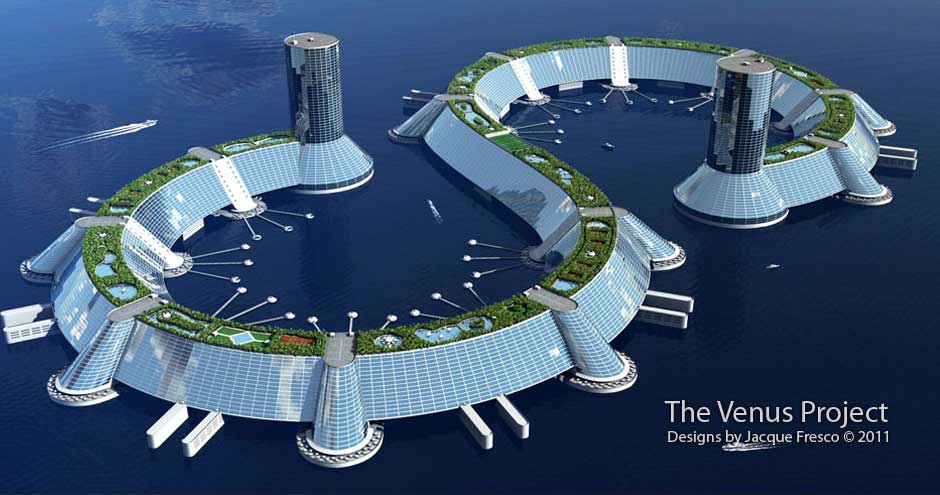
venus_projectThere’s also a precedent here for what is being proposed. The famous American architect and designer Jacque Fresco has been advocating something similar for decades. Believing that society needs to reshape the way it lives, works, and produces, he created the Venus Project – a series of designs for a future living space that would incorporate new technologies, smarter materials and building methods, and alternative forms of energy.

And then there’s the kind of work being proposed by designer Mitchell Joachim and Terreform ONE (Open Network Ecology). And amongst their many proposed design concepts is one where cities use vertical towers filled with energy-creating algae (pictured below) to generate power. But even more ambitious is their plan to “urbaneer” Brooklyn’s Navy Yard by turning natural ecological tissues into viable buildings.

future-city2This concept also calls to mind Arconsanti, the brainchild of architect Paolo Solari, who invented the concept of arcology. His proposed future city began construction back in the 1970 in central Arizona, but remains incomplete. Designed to incorporate such things as 3D architecture, vertical farming, and clean, renewable energy, this unfinished city still stands as the blueprint for Solari’s vision of a future where architecture and ecology could be combined.

What’s more, this kind of innovation and development will come in mighty handy when it comes to time to build colonies on the Moon and Mars. Already, numerous Earth cities and settlements are being considered as possible blueprints for extra-Terran settlement – places like Las Vegas, Dubai, Arviat, Black Rock City and the Pueblos and pre-Columbian New Mexico.

Black Rock City - home to "Burning Man" - shown in a Martian crater
Black Rock City – home to “Burning Man” – shown in a Martian crater

These are all prime examples of cities built to withstand dry, inhospitable environments. As such, sustainability and resource management play a major role in each of their designs. But given the pace at which technology is advancing and the opportunities it presents for high-tech living that is also environmentally friendly, some test models will need to be made.

And building them would also provide an opportunity to test out some of the latest proposed construction methods, one that do away with the brutally inefficient building process and replace it with things like drones, constructive bacteria, additive manufacturing, and advanced computer modelling. At some point, a large-scale project to see how these methods work together will be in order.

Let’s just hope Page’s ideas for a beta-testing settlement doesn’t turn into a modern day Laputa!

And be sure to check out this video from the Venus Project, where Jacque Fresco explains his inspirations and ideas for a future settlement:


Sources:
1.
Elon Musk and Google Should Purchase and Transform a Bankrupt Detroit (http://www.policymic.com/)
2. Larry Page wants to ‘set aside a part of the world’ for unregulated experimentation (theverge.com)

3. Six Earth Cities That Will Provide Blueprints for Martian Settlements (io9.com)
4. The Venus Project (thevenusproject.org)
5. Arcosanti Website (arcosanti.org)
6. Terreform ONE website (terreform.org)

News from Mars: Evidence of Falling Snow

Mars-snow-header-640x353Ever since astronomers first looked up at Mars, they discerned features that few could accurately identify. For many years, speculations about irrigation, canals, and a Martian civilization abounded, firing people’s imaginations and fiction. It was not until more recently, with the deployment of the Viking probe, that Mars’ surface features have come to be seen for what they are.

Thanks several more probes, and the tireless work of rover such as Opptorunity and Curiosity, scientists have been able to amass evidence and get a first hand look at the surface. Nevertheless, they are still hard-pressed to explain everything that they’ve seen. And while much evidence exists that rivers and lakes once dotted the landscape, other geological features exist which don’t fit that model.

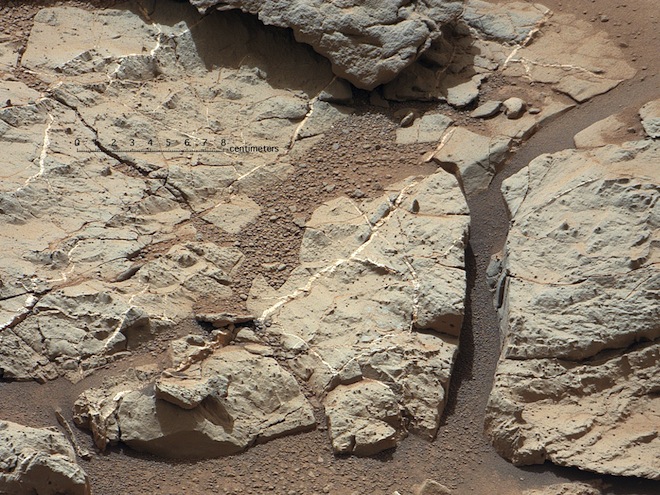
curiosity_rocksHowever, a recent report from Brown University has presented evidence that snowfall may be one answer. It has long been known that ice exists at the polar caps, but actual snowfall is a very specific meteorological feature, one that has serious implications for early Martian conditions. This is just another indication that Mars hosted an environment that was very much like Earths.

And this is not the first time that snow on Mars has been suggested. In 2008, NASA announced having detected snow falling from Martian clouds, but it was entirely vaporized before reaching the ground. The Brown researchers claim that snowfall in the past, and buildup on the surface leading to melting and runoff, could have created many of the tributary networks observed near tall mountain-ranges.

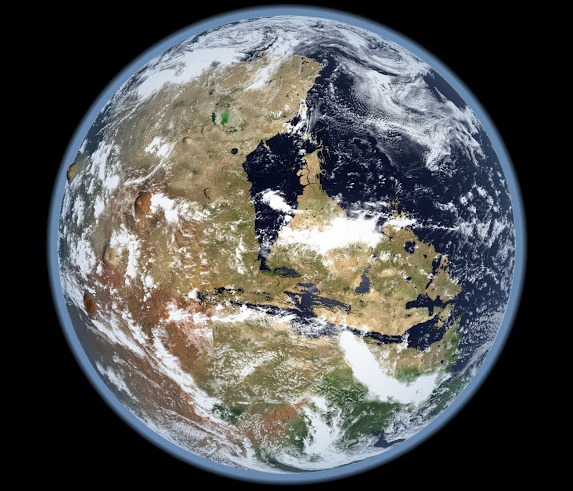
mars_atmoTo back this claim up, the team used a computer simulation from the Laboratoire de Météorologie Dynamique called the Mars global circulation model (GCM). This model compiles evidence about the early composition of the red planet’s atmosphere to predict global circulation patterns. And since other models predict that Mars was quite cold, the program indicated the highest probability of snowfall over the densest valley systems.

Lead researcher Kat Scanlon also relied on her background in orographic studies (science for “studying mountains”) in Hawaii to arrive at this hypothesis. This includes how tall mountains lead to divergent weather patterns on either side, with warm, wet conditions one and cold, dry ones on the other. NASA’s Curiosity rover also was intrinsic, thanks to recent information that might explain why Mars no longer displays this kind of behavior.

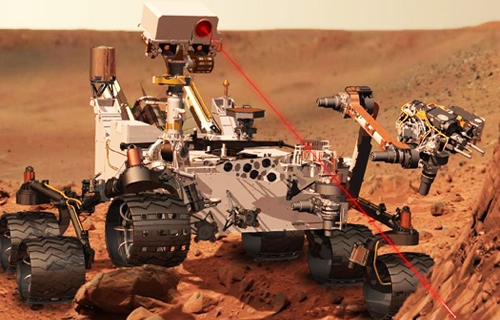
Curiosity-Laser-BeamIn short, Curiosity determined that the planet is losing its atmosphere. It has taken detailed assays of the current atmosphere, which is almost entirely carbon dioxide and about 0.6% the pressure of Earth’s at sea-level. More notably, it has used its ability to laser-blast solid samples and analyze the resulting vapor to determine that Mars has an unusually high ratio of heavy to light isotopes — most importantly of deuterium to hydrogen.

The main explanation for this is atmospheric loss, since light isotopes will escape slightly more quickly than heavy. Over billions of years, this can lead to non-standard isotope levels the show a loss of atmosphere. One major theory that might explain this loss say that about 4.2 million years ago Mars collided with an object about the size of Pluto. An impact from this body would have caused a huge expulsion of atmosphere, followed by a slow, continued loss from then on.

All of this plays into the larger question of life on Mars. Is there, or was there, ever life? Most likely, there was, as all the elements – water, atmosphere, clay minerals – appear to have been there at one time. And while scientists might still stumble upon a Lake Vostok-like reserve of microbial life under the surface, it seems most likely that Mars most fertile days is behind it.

However, that doesn’t mean that it can’t once again host life-sustaining conditions. And with some tweaking, of the ecological engineering – aka. terraforming – variety, it could once again.

Living-Mars.2Source: extremetech.com

Alan Turing Pardoned… Finally!

Alan TuringWhen it comes to the history of computing, cryptography and and mathematics, few people have earned more renown and respect than Alan Turing. In addition to helping the Allied forces of World War II break the Enigma Code, a feat which was the difference between victory and defeat in Europe, he also played an important role in the development of computers with his “Turing Machine” and designed the Turning Test – a basic intelligence requirement for future AIs.

Despite these accomplishments, Alan Turing became the target of government persecution when it was revealed in 1952 that he was gay. At the time, homosexuality was illegal in the United Kingdom, and Alan Turing was charged with “gross indecency” and given the choice between prison and chemical castration. He chose the latter, and after two years of enduring the effects of the drug, he ate an apple laced with cyanide and died.

turing-science-museum-2Officially ruled as a suicide, though some suggested that foul play may have been involved, Turing died at the tender age of 41. Despite his lifelong accomplishments and the fact that he helped to save Britain from a Nazi invasion, he was destroyed by his own government for the simple crime of being gay.

But in a recent landmark decision, the British government made a historic ruling by indicating that they would support a backbench bill that would clear his name posthumously of all charges. This ruling is not the first time that the subject of Turing’s sentencing has been visited by the British Parliament. Though for years they have been resistant to offering an official pardon, Prime Minister Gordon Brown did offer an apology for the “appalling” treatent Turing received.

Sackville_Park_Turing_plaqueHowever, it was not until now that it sought to wipe the slate clean and begin to redress the issue, starting with the ruling that ruined the man’s life. The government ruling came on Friday, and Lord Ahmad of Wimbledon, a government whip, told peers that the government would table the third reading of the Alan Turin bill at the end of October if no amendments are made.

Every year since 1966, the Turing Award – the computing worlds highest honor and equivalent of the Nobel Prize- has been given by the Association for Computing Machinery for technical or theoretical contributions to the computing community. In addition, on 23 June 1998 – what would have been Turing’s 86th birthday – an English Heritage blue plague was unveiled at his birthplace in and childhood home in Warrington Crescent, London.

Alan_Turing_Memorial_CloserIn addition, in 1994, a stretch of the A6010 road – the Manchester city intermediate ring road – was named “Alan Turing Way”, and a bridge connected to the road was named “Alan Turing Bridge”. A statue of Turing was also unveiled in Manchester in 2001 in Sackville Park, between the University of Manchester building on Whitworth Street and the Canal Street gay village.

This memorial statue depicts the “father of Computer Science” sitting on a bench at a central position in the park holding an apple. The cast bronze bench carries in relief the text ‘Alan Mathison Turing 1912–1954’, and the motto ‘Founder of Computer Science’ as it would appear if encoded by an Enigma machine: ‘IEKYF ROMSI ADXUO KVKZC GUBJ’.

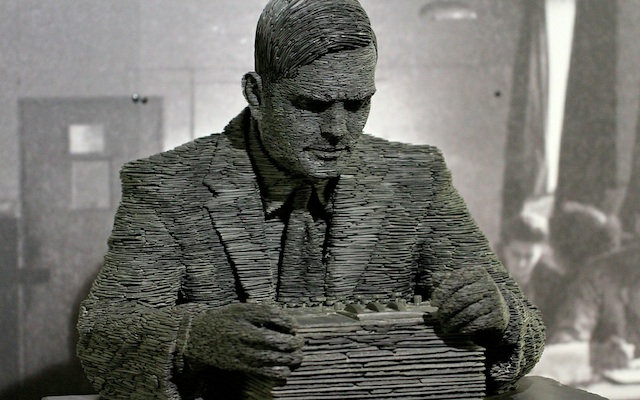
turing-statueBut perhaps the greatest and most creative tribute to Turning comes in the form of the statue of him that adorns Bletchley Park, the site of the UK’s main decryption department during World War II. The 1.5-ton, life-size statue of Turing was unveiled on June 19th, 2007. Built from approximately half a million pieces of Welsh slate, it was sculpted by Stephen Kettle and commissioned by the late American billionaire Sidney Frank.

Last year, Turing was even commemorated with a Google doodle last year in honor of what would have been his 100th birthday. In a fitting tribute to Turing’s code-breaking work, this doodle designed to spell out the name Google in binary. Unlike previous tributes produced by Google, this one was remarkably complicated. Those who attempted to figure it out apparently had to consult the online source Mashable just to realize what the purpose of it was.

google_doodle_turing

For many, this news is seen as a development that has been too long in coming. Much like Canada’s own admission to wrongdoing in the case of Residential Schools, or the Church’s persecution of Galileo, it seems that some institutions are very slow to acknowledge that mistakes were made and injustices committed. No doubt, anyone in a position of power and authority is afraid to admit to wrongdoing for fear that it will open the floodgates.

But as with all things having to do with history and criminal acts, people cannot be expected to move forward until accounts are settled. And for those who would say “get over it already!”, or similar statements which would place responsibility for moving forward on the victims, I would say “just admit you were wrong already!”

Rest in peace, Alan Turing, and may continued homophobes who refuse to admit they’re wrong find the wisdom and self-respect to learn and grow from their mistakes. Orson Scott Card, I’m looking in your direction!

Sources: news.cnet.com, guardian.co.uk

Robert Kirkman’s “The Walking Dead”

the-walking-dead_comicYou know how it is, when you find yourself loving a particular TV show or movie and someone tells you “you should really check out the original”? Well, that has happened to me three times now; first with The Lord of Rings, then with Game of Thrones, and then shortly thereafter with The Walking Dead.

From these three experiences, I’ve come to learn that I have a sort of rule of threes. Basically, if three friends tell me I need to read the original source material, then I definitely do! And in all cases, I came to identify with the self-professed franchise geeks who acted they had some prized inside knowledge and were insufferably critical about the adaptations.

And now that I’ve read the entire series, all 112 issues that have been published so far, I feel I am in a position to do a comparative analysis to the show. But for the sake of avoiding spoilers, I figured I would only cover the material that has been adapted into the miniseries thus far. So if it hasn’t happened beyond season three of the show, you won’t have to worry about it being mentioned here.

Robert Kirkman’s The Walking Dead:
*Note: For simplicity’s sake, I will be breaking down the plot of the comic book series by trade paperback volume. So far, Kirkland has released 112 issues, the first 108 of which are available in 18 volumes, each one containing six issues grouped by common theme. The show has so far adapted material from the first 8 volumes or 48 issues.

Volume 1 – Days Gone Bye:
WD_Volume_1-Days_Gone_ByeThe story begins in Georgia with the story’s protagonist – Rick Grimes, a sheriff – being wounded in the line of duty. He awakens sometime later to find the hospital apparently deserted and comes to a set of barred doors. Inside are a mess of zombies that try to bite him, and he is forced to flee. Once outside, he realizes the chaos has effected the entire town, and finds more examples of reanimated corpses as he heads for home.

Once he gets there, Rick can find no trace of his family and it appears as though every house is deserted. He is then nearly killed by a young boy who hits him in the head with a shovel but is saved when the boy’s father sees that he isn’t a zombie and takes him in. This good Samaritan – Morgan – tells Rick that he and son son Duane have been held up since the trouble began and explain to him what they know.

Rick learns from them that the zombies are basically reanimated corpses that are the result of some new type of virus, a virus which spreads through bites and scratches from the afflicted. He also learns that the government, before all TV and radio broadcasts went dark, urged citizens to converge on major cities where the armed forces would be doling out services and providing protection.

the-walking-dead-002-days-gone-bye-v1-12-page-11After going to his old police station and dividing up the weapons that remain, Rick decides to head out in search of his family, who he assumes will have gone to Atlanta. After quickly running out of gas and finding the local stations tapped out, Rick procures a horse and rides to the city limits. He quickly realizes the city has been overrun and is beset by hordes of zombies which kill his horse and try to eat him.

Rick attempts to flee and is once again saved when a young man named Glenn pulls him into an alley. After escaping, Glenn explains to him that the cities have all been overrun, and he only ever goes in to do supply runs for his camp. He proceeds to lead Rick to it on the outskirts of the city, where he is shocked and relieved to see Lori and Carl – his wife and son.
walking-dead-headHis best friend and ex-partner Shane is there with them too. After the disaster struck, they feared the worse and assumed he was dead and came to Atlanta. But having found the city in a state of crisis, they formed a camp with some others. This includes Dale, a retired man who owns an RV and who has been keeping company with two sisters, Andrea and Amy; Allen and Donna, a married couple and their twin boys, Ben and Billy; Jim, a distant man from Atlanta who lost his wife; Carol, a woman who lost her husband, and her daughter, Sophia.

Rick is greeted by everyone but is warned by Dale that Shane is not as happy to see him as he would like to think. As the days come and go, Rick and Shane hunt while the women do laundry, and everyone tries to maintain some degree of normalcy. It isn’t long before the camp is attacked by a single Walker and Dale manages to take its head off. But this fails to kill it and they quickly realize that taking out the brain is the only way to kill them.

the-walking-dead-004-days-gone-bye-v1-12-page-13Rick begins to accompany Glenn on supply runs into the city, hoping to find guns and ammo to outfit the camp. This proves difficult as the city is choked by Walkers and the two have to get creative to survive – which includes smearing themselves in the gore of dead Walkers. Back at camp, Lori and Shane discuss Rick’s arrival and the subject of a romantic liaison between them comes up. Lori tells him it was a mistake, and Shane is heartbroken.

Having made it back with guns and ammo aplenty, Rick and Shane begin to teach the camp how to shoot. That night, as they sit around the camp fire, they are attacked by Walkers that bite Amy and wound Jim. Andrea shoots her dying sister in the head to keep her from turning, and Jim is asked to be left on the outskirts of the city to await his fate.

Back at camp, Shane and Rick get into a confrontation and Shane begins to lose it. He almost shoots Rick, but Carl fires a shot through Shane’s neck, killing him instantly.

Volume 2- Miles Behind Us:
WD_volume_2-miles-behind-us
The second volume opens Lori having flashbacks to the night she and Shane slept together. Apparently, it happened on the night that they came to the outskirts of Atlanta, and between thinking Rick was dead and fearing for their safety, she took comfort in his arms. She also remembers that he told he’s always had feelings for her. Coming back to the present, we see them having a service for Shane, where she curses him and spits on his grave.

Afterward, they pack up Dale’s RV and decide its time to move on. With winter now upon them and no signs of help coming, they seek out in search of more permanent shelter. While on the road, they run into another group of people – Tyreese, his daughter Julie and her boyfriend Chris. They ask to join Rick’s crew, as they are also in desperate need of food and a place to stay.

They quickly integrate with Rick’s camp, as Tyreese proves adept at killing Walkers with his hammer, and he and Carol begin to hit it off as well. After clearing a field of Walkers, they sit around a fire and enjoy some supplies Glenn picked up. Things seem to be going well, but Lori tells Rick in private that she’s pregnant. Worse yet is the fact that it may not be his.

the-walking-dead-wiltshireAfter days on the road, killing Walkers hand-to-hand fashion, siphoning gas, and grabbing whatever they can from abandoned vehicles, they come upon a suburban development called Wilshire Estates. The gated community appears to be deserted except for a few Walkers. After clearing them out, they settle in. It also become clear at this time that Andrea and Dale have started a relationship. Tyreese and Carol appear to be getting closer too.

Things appear to be looking up, until Rick notices a sign at the front gate that says “All Dead, Do Not Enter”, which had previously been obscured by snow. Rick runs back to alert people, but is too late to stop them from being attacked by Walkers who begin emerging from one of the houses. Donna is killed and her husband Allen fires off his gun, which alerts more Walkers.

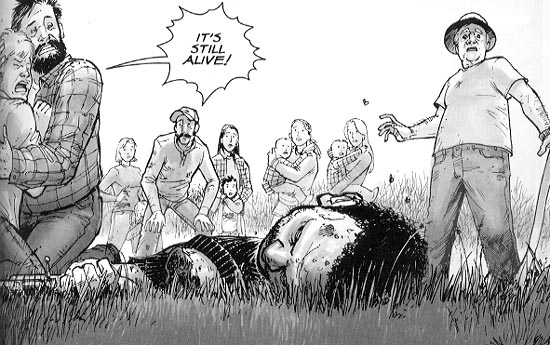
the-walking-dead-carl_shotThey throw everything and everyone back into the RV and head for the road, stopping many times along the way to try and pick up food. Finding most places picked clean, they decide to pull in near a wooded area and mount a hunting party. However, while in the woods, Carl is shot by a hunter who mistakes him for a Walker. Rick nearly kills the man, but stops when Tyreese tells him Carl is still alive.

The man tells him his name is Otis, and that he lives on a nearby farm owned by a veterinarian who has some experience dealing with bullet wounds. He and Rick begin carrying Carl to the farm while Tyreese doubles back to let the others know what’s happened. They meet up at the farm where Herschel, the farm’s owner, goes to work and is able to save Carl. With everyone together, introductions follow…

Herschel introduces his six children – his oldest daughter Lacey, son Arnold, Maggie, youngest son Billy, Rachel and Susie. Otis and his girlfriend Patricia are their neighbors who moved in when the trouble began and have lived with them ever since. Rick’s crew begin to settle in, Andrea attempts to speak to Allen, who is despondent after Donna’s death, and Carl soon wakes up.

the-walking-dead_herschelsfarmIn the days that follow, the two groups begin to bond. Glenn finds a willing partner with Maggie, who is about his age and also feeling lonely after being surrounded by nothing but relatives for so long. Meanwhile, Rick begins to talk to Herschel about his farm and learns that they have a special barn where they keep their dead… their living dead!

He’s naturally appalled by this, but Herschel is similarly appalled that Rick and his crew have been killing the them at every encounter. After a heated fight, Herschel storms off, but in the morning, they talk it out and Rick agrees to respect his rules while they stay on his farm. However, this proves difficult, as Rick’s crew begin doing practice shooting again which draws a Walker.

Herschel attempts to stick it in the barn rather than let Rick shoot it, but this allows several Walkers to break out. Pandemonium ensues as Arnold tries to save his father and is bit, forcing Herschel to shoot all the Walkers and Arnold himself. He tries to shoot himself next, but Rick stops him. They bury Arnold and Herschel tells Rick he was right. Everyone is given their own gun to carry from this point onward, and Julie and Chris agree to a suicide pact.

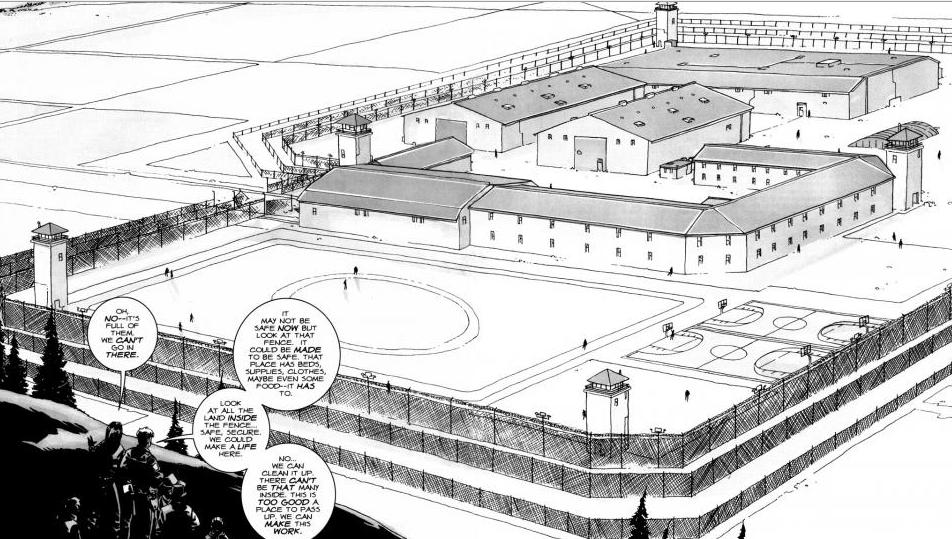
walking_dead-prisonIn the aftermath, Rick appeals to Herschel to let them stay on, but Herschel is determined to see them go the moment Carl is healed. Lori confronts him and things become very heated, and Rick agrees that they’ll leave to prevent violence from breaking out. They hit the road shortly thereafter and drive for days. They then spot a prison not far from the road and Rick tells them to stop. He tells them they’ve arrived home.

Difference to AMC’s The Walking Dead:
Even at this early juncture, the difference between the comic book and miniseries are very noticeable. For the first few episodes, things seemed largely consistent with the source material. But by the end of the first season, there were some wide divergences that could not fail to go unnoticed. In some cases, the reasons for obvious, having to do with the vagaries of television.
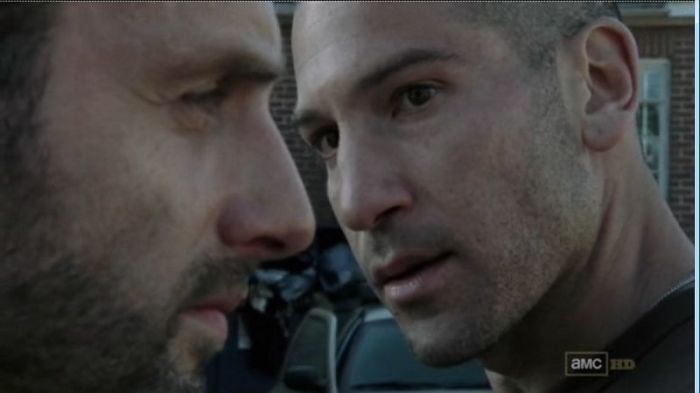
Shane-and-RickFor starters, Shane and Rick’s confrontation was something was resolved relatively quickly in the comic book series. And while his eventual break was certainly hinted at in the show, it took a very long time for it to manifest itself in his decision to kill Rick. This was something I found annoying frankly. It was like, how many more episodes do we have to endure where they argue, fight, and he sneaks off to talk to Lori before they finally try to kill each other?

Shane being around for what was essentially volume two material also meant that the story in the second season changed drastically. Not only was the conflict between him and Rick prolonged, he was also a source of conflict between their camp and Herschel and the reason the barn was opened in the first place.

On top of that, he was responsible for killing Otis, a character who survived far beyond the farm thread in the comic and later returned. The fact that they had to go out to find penicillin and other medical supplies was due to Carl’s wounds being made life-threatening, which they weren’t in the comic. They also killed off Dale and Sophia in this season, which seemed rather odd since both lived on in the comic and played a rather important roles.
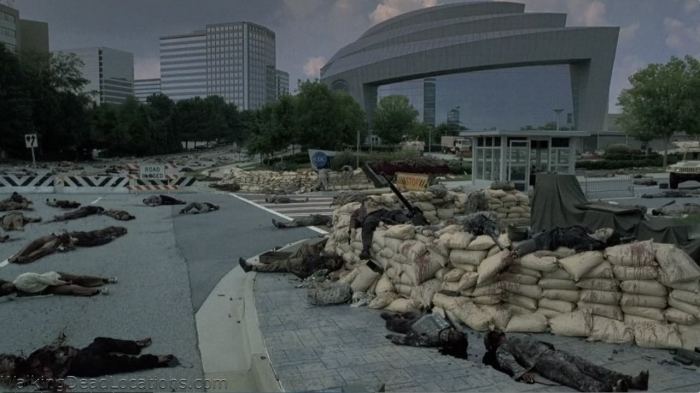
the-walking-dead-cdc1Second, there was the final episode in season one where the camp travels into Atlanta to go to the Center for Disease Control. Personally, I liked this episode best of the first season, so I was a little disappointed to not see it in the comic. But of course, it was easy to see how this episode was expositional. Since the CDC is in Atlanta, the show writers no doubt saw an opportunity to address the disease itself and lend it some mystery and background.

Third, and perhaps most importantly, their was the shuffle they did with characters. In addition to not introducing Tyreese until much later in the series, they also added characters who were not in the original. Daryl and Merle I could understand; these two were colorful, dynamic characters that added to the story. But Tyreese was central to the original story and its dynamic, so dropping him seemed inexplicable.

walking_dead_merle_darylThen there was also the addition of such people as Carol’s husband Ed, who was an abusive butthole, Morales and his wife Miranda, their two kids, Jacqui, and of course T-Dog. With the exception of T-Dog, all of these people died within the few episodes, Jacqui having committed suicide by the end of season one and the latter who lived well into season two but never seemed to get a back story. As a friend of mine said, “he was the highest paid extra in television”.

Between all of these characters, I have to wonder what the point was of including them. Was it just to pad the story? If so, why kill them off so casually? Why not simply incorporate Tyreese, Julie and Chris? Oh yes, and having Daryl and Merle meant there was more time spent in Atlanta, which led to the introduction of the small community of apparent gunmen who were in fact good Samaritans that were protecting a group of senior citizens. Again, a departure, but not a bad one.

Last, but certainly not least, the farm thread was also extended considerably and – in my opinion – unnecessarily. After the showdown at the barn, there was no reason to expect Herschel would allow Rick and his group to stay. But instead, the season went on, introducing a group of roamers that wanted access to Hershel’s farm the moment they learned about it, Rick and Shane’s showdown, and a massive Walker attack that divided the group in two and sent them running.

None of this happened in the original. Rick and his crew packed up and left as one group because Herschel could not bring himself to trust them. What’s more, he and his family did NOT travel with them to the prison. Glenn, however, did stay behind to be with Maggie.

Summary:
And that brings us to the end of part I of this comparative review of Robert Kirkman’s The Walking Dead. Stay tuned for the next installment which will cover volume 3 and 4 of the comic book series and the first half of season three of the show. I was hoping to wrap this up in a two installments – but hey, I’ve got to be realistic!

The 3D Printing Revolution

3D-printing1From the way people have been going on about 3D printing in the past few months, you’d think it was some kind of fad or something! But of course, there’s a reason for that. Far from being a simple prescriptive technology that requires us all to update our software or buy the latest version in order to “stay current”, 3D printing is ushering in a revolution that will literally change the world.

From design models and manufactured products, the range of possibilities is now venturing into printed food and even artificial organs. The potential for growth is undeniable, and the pace at which progress is happening is astounding. And on one of my usual jaunts through the tech journals and video-sharing websites, I found a few more examples of the latest applications.

ord_bot_2_2_display_mediumFirst up is this story from Mashable, a social media news source, that discusses NYU student Marko Manriquez’s new invention: the BurritoBot. Essentially a 3D food printer that uses tortillas, salsa, guacamole and other quintessential ingredients, Manriquez’s built this machine for his master’s thesis using open-source hardware – including the ORD bot, a 3D printing mechanical platform (pictured above).

The result is a food printer that an tailor-make Burritos and other Mexican delights, giving users the ability to specify which ingredients they want, in which proportion, and all through an app on their smartphone. No demos available online as of yet, but Mashable provides a pretty good breakdown on how it works, as well as Manrquez’s inspiration and intent behind its creation:


Next up, there’s Cornell University’s food printer that allows users to created desserts. In this CNN video, Chef David Arnold at the French Culinary Institute shows off the printer by creating a chocolate cake, layer by layer, dough and icing. A grad student from Cornell’s Computational Synthesis Lab was on hand to explain that their design is also open-source, with the blueprints and technical design made available online so anyone can build their own.

As Chef Arnold explained, his kitchen has been using the printer to work with ingredients ranging from cookie dough, to icing to masa – the corn meal tortillas are made from. It also allows for a degree of accuracy that many may not possess, while still offering plenty of opportunities to be creative. “The only real limitation now is that the product has to be able to go through a syringe,” he said. “Other than that, skies the limit.”


But even more exciting for some are the opportunities that are now being explored using metals. Using metal powder and an electron beam to form manufactured components, this type of “additive manufacturing” is capable of turning out parts that are amazingly complex, far more so than anything created through the machining-process.

In this next video, the crew from CNNMoney travel to the Oakridge National Lab in Tenessee to speak to the Automation, Manufacturing and Robotics Group. This government-funded lab specializes in making parts that are basically “structures within structures”, the kind of things that are used in advanced prosthetic limbs, machinery, and robots. As they claim, this sort of manufacturing is made possible thanks to the new generation of 3D ABS and metal printers.

Oakridge_natlabWhat’s more, this new process is far more efficient. Compared to old fashioned forms of machining, it consumes less energy and generates far less waste in terms of materials used. And the range of applications is extensive, embracing fields as divergent as robotics and construction to biomedical and aerospace. At present, the only real prohibition is the cost of the equipment itself, but that is expected to come down as 3D printing and additive manufacturers receive more market penetration.


But of course, all of this pales in comparison to the prospect of 3D printed buildings. As Behrokh Khoshnevis – a professor of Industrial & Systems Engineering at USC – explains in this last video from TEDxTalks, conventional construction methods are not only inefficient, labor intensive and dangerous, they may very well be hampering development efforts in the poorer parts of the world.

As anyone with a rudimentary knowledge of poverty and underdevelopment knows, slums and shanty-towns suffer disproportionately from the problems of crime, disease, illiteracy, and infant mortality. Unfortunately, government efforts to create housing in regions where these types of communities are common are restrained by budgets and resource shortages. With one billion people living in shanties and slum-like shelters, a new means of creating shelter needs to be found for the 21st century.

contour-craftingThe solution, according to Khoshnevis, lies in Contour Crafting and Automated Construction –  a process which can create a custom house in just 20 hours! As a proponent of Computer-Assisted Design and Computer-Assisted Manufacturing (CAD/CAM), he sees automated construction as a cost-effective and less labor resource-intensive means of creating homes for these and other people who are likely to live in unsafe, unsanitary conditions.

The technology is already in place, so any claims of that is of a “theoretical nature” are moot. What’s more, such processes are already being designed to construct settlements on the moon, incorporating robotics and 3D printing with advanced computer-assisted simulations. As such, Khoshnevis is hardly alone in advocating similar usages here on planet Earth.

The benefits, as he outlines them, are dignity, safety, and far more sanitary conditions for the inhabitants, as well as the social benefits of breaking the pathological cycle of underdevelopment. Be sure to check out his video below. It’s a bit long, but very enlightening!


Once in awhile, its good to take stock of the future and see that it’s not all creepy robots and questionable inventions. Much of the time, technological progress really does promise to make life better, and not just “more convenient”. It’s also especially good to see how it can be made to improve the lives of all people, rather than perpetuating the gap between the haves and the have nots.

Until next time, keep your heads high and your eyes to the horizon!


News From Space: First Blue Exoplanet Discovered!

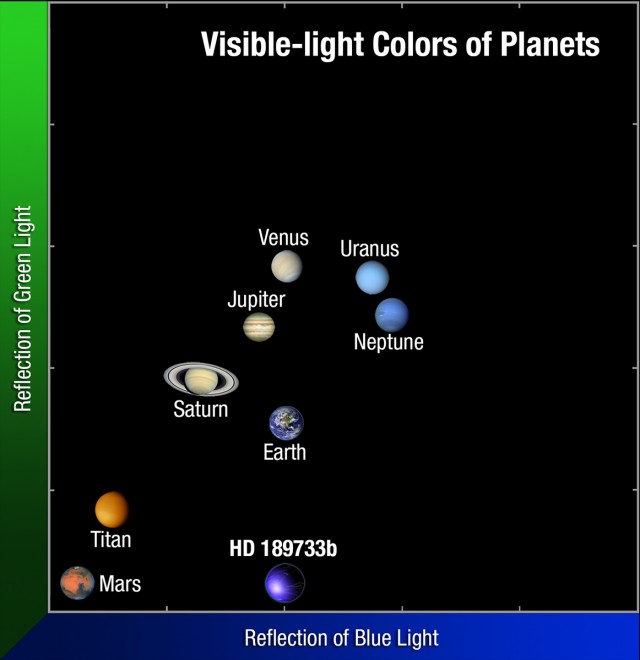
HD_189733_b_deep_blue_dotEver since our astronomers have gained the ability to see into deep space and discern what lies in distant solar systems, a total of 910 extra-solar planets have been discovered. Of those, only a handful have been confirmed as potentially habitable by Earth scientists. Despite these discovered, it was not until recently that a “blue planet” outside of the Solar System, thanks to NASAs Hubble telescope.

But here’s the kicker: as it turns out, the planet is not blue due to the presence of liquid water. The blue color likely comes from clouds in the atmosphere made of molten glass. The planet is known as HD 189733 b, located roughly 63 light years away from Earth in the constellation of Vulpecula (aka. the Fox). Initially discovered in 2005 by French astronomers who observed it passing in front of its star, HD 189733 b is one of the best-studied exoplanets.

Hd189733b_blue_planet_artPrior to this new finding, it was already known that the planet was a hot Jupiter — a massive gas giant that orbits very close to its parent star — and that, using polarimetry, it was most likely blue. Since that time, the blue color has been confirmed by a spectrograph aboard Hubble which scanned the planet during an eclipse. As it passed behind its parent star and out of our vision, Hubble recorded less blue light coming from the star, while the other colors remained the same.

This strongly indicates that the light reflected by HD 189733 b’s atmosphere is blue and thus, if we were close enough to directly observe the planet, it would appear blue. This is an apparent first for astrophysicists and astronomers, who wouldn’t normally be able to observe such a fluctuation from 63 light years away. But the size of the planet, plus the amount of light reflecting off it from its very-close-by star, mean that Hubble can do its thing.

blue_planet_image2-640x660As for the cause of the color itself, the current theory is that the planets atmosphere is full of clouds that contain tiny silicate particles, which absorb some light frequencies but reflect and scatter blue light. In the words of NASA, because the surface of the planet is around  815 Celsius (1,500 Fahrenheit), these particles are likely in a molten, liquid state that periodically turn into rain. Yes, you read that right, the planet experiences periods of molten glass rain!

In addition to that, it is also known that its orbital period (length of a year) is only 2.2 days. The planet is also tidally locked, meaning that one side is always facing towards the sun while the other experiences perpetual night. So basically, outside of its blue color, HD 189733 b is about as uninhabitable as it gets.

Ah well, the search for a truly Earth-like exoplanet continues I guess! And in the meantime, enjoy this short video from Hubble ESA – a computer graphic representation of the universe’s other “blue planet”:

Source: Extremetech.com

News from Space: Opportunity’s 10th Birthday!

opportunity_bdayNASA’s Opportunity Rover is a special kind of vehicle. Not only did it set the record for longest distance driven on another world and discover the most compelling evidence for life on Mars thus far, it also surpassed its 90 day mission by a grand total of 3560 days, as of this past July 7th. In other words, the Opportunity Rover just celebrated its tenth anniversary, and people all over the world are marking the occasion by acknowledging the rover’s many contributions.

These include discovering the first meteorite found outside of Earth, a temperature profile of the Martian atmosphere, and uncovering a series tiny, iron-rich spheres known as “blueberries” that hinted at a time when Mars had water. In fact, Opportunity’s most important discovery may have come just last month.

Blueberries_eagleThis consisted of a rock that proves that Martian water was once drinkable, which in turn suggests strongly that life could once have thrived there. On top of that, it captured some amazing photos, long before Curiosity was sending back its hefty batch of panoramas. But of course, Opportunity had its share of trials and tribulations as well.

Foremost amongst these was the two months back in 2005 that it spent spent in a sand dune before its operators were able to wriggle it free centimeter by centimeter. And on the rover’s second day on Mars, it also experienced some shoulder joint problems, which proved to be the first of many, many mechanical problems.

Burns_cliffAnd yet, all of that seems worth it now. After being eclipsed by its larger, more recent arrival – the Curiosity Rover – Opportunity has battled back with its incredible longevity. Who’s to say how much longer the little rover that could will remain in operation? And who’s to say what it will uncover. At this rate, its doesn’t seem unlikely that it will beat its cousin to the punch of finding the Holy Grail – organic particles on Mars!

And be sure to enjoy this video look-back at Opportunity produced by Space.com:


Sources:
gizmodo.com, space.com

News from Mars: Oxygen-Rich Atmosphere

marsEver since the Opportunity and Curiosity Rovers began their research stint on the red planet, evidence has been pouring in that indicates that the planet once supported life. And now, by examining the compositions of Martian meteorites found on Earth and data provided by the Mars rovers, Scientists from the Department of Earth Sciences at the University of Oxford have determined that the planet once boasted an oxygen-rich atmosphere.

The key determinant was the fact that the Martian surface rocks were five times richer in nickel than the meteorites found on Earth, a find which cast doubt on whether the meteorites were typical volcanic products. Whilst it is possible that the geological composition of Mars varies immensely from region to region, the team believes that it is more likely that the differences arise through a process known as subduction – in which material is recycled into the interior.

mars_oxygenThe scientists suggest that the Martian surface was oxidized very early in the history of the planet and that, through subduction, this oxygen-rich material was drawn into the shallow interior and recycled back to the surface during eruptions 4 billion years ago. The meteorites, by contrast, are much younger volcanic rocks that emerged from deeper within the planet and so were less influenced by this process.

As Professor Bernard Wood, the senior author of a study that appeared in Nature magazine, put it:

What we have shown is that both meteorites and surface volcanic rocks are consistent with similar origins in the deep interior of Mars but that the surface rocks come from a more oxygen-rich environment, probably caused by recycling of oxygen-rich materials into the interior. This result is surprising because while the meteorites are geologically young, around 180 million to 1.4 billion years old, the Spirit rover was analyzing a very old part of Mars, more than 3.7 billion years old.

In addition to evidence that Mars once had a sizable amount of surface water, in the form of rivers and lakes, this latest study demonstrates that Mars was once very much like Earth. In all likelihood, it would have been home to countless forms of bacteria, single-celled organisms, and possibly larger creatures as well. But being at the edge of our Sun’s habitable zone, it was unable to maintain the conditions for life to thrive.

terraforming-hswmarsSad news, but encouraging when it comes to the prospect of making Mars able to sustain life again. And in the coming years and decades, that’s precisely what a number of space agencies, private companies and citizens want to do. And if these plans are to succeed long term, the planet will have to be converted into something that can independently support life.

In short, the colonization of Mars requires that the planet become something akin to its old self.

Source: sci-news.com

Latest in 3D Printing: Invisibility Cloaks and Mind-Controlled Printers

anti-grav3d3-D printing continues to grow by leaps and bounds, being used to generate anything from components and models to complex machines and living tissues. And as the technology improves, the applications continue to grow and coalesce with developments made in other fields of scientific research. And in the last month alone, there have been a number of announcements that have both scared and impressed.

The first came from Duke University, where engineers have made yet another breakthrough. Seven years ago, they demonstrated their first “invisibility cloak” in a laboratory. Now, thanks to 3D printing, the fabrication process is a lot more accessible. And while invisibility might be a bit of a misnomer, that’s precisely what this object does as far as microwave radiation is concerned.

3dprinted_invisibilityThe object, which resembles a frisbee, has a large hole in the center, with seemingly random holes in the disc. The size, shape, and placement of these holes have actually been determined to disguise any object placed in the center hole from microwave beams, making it appear as though the object isn’t there. At present, the invention is limited in terms of practical use, but the design team believes this object has great potential.
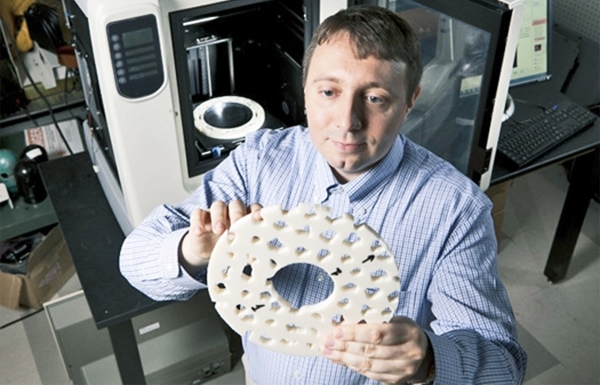
According to Yaroslav Urzhumov, an assistant research professor in electrical and computer engineering at Duke, the technology could be used to create a polymer-based cloaking layer just 1 inch thick, wrapped around a much larger object. From this, they hope to eventually be able to create a material that will operate in higher wavelengths, including the visible light spectrum.

INVISIBILITY-CLOAKMeanwhile, the team’s creation of the disc using a 3-D printer means the technology is now much more accessible. Urzhumov went as far to say the he believes that anyone with access to a 3D printer will have the ability to create something similar at home. In time, this could mean anyone would have the ability to create a full-spectrum invisibility cloak at home too. Good news for anyone looking to hide from surveillance drones or cameras!

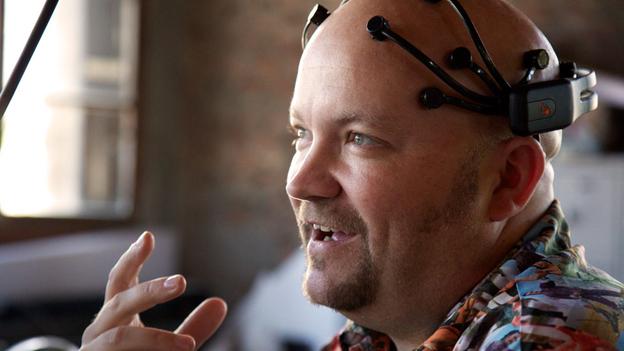
The second bit of news is even more impressive, and potentially frightening. It comes to us from Santiago Makerspace, a technology and design studio located in the heart of the Chilean capital where a designer created a 3D printed object using only their thoughts. The designer in question was George Laskowsky, Chief Technical Officer of Thinker Thing, a Chilean start-up that is developing a mind-controlled 3D printing system.

3dprinted_thought1The purpose behind Laskowsky’s work is simplification: while 3D printing has been growing and making design and fabrication easier and more accessible. However, mastering the design software is still a difficult challenge, especially for young children. That’s where Tinker Thing comes in, which seeks to develop the means to help children unleash their inner creativity.

Bryan Salt, CEO of Thinker Thing, expands on this, stating that there has not been enough work done on adapting the software for popular use. His company is looking to make it open and accessible so that it can be used to create items for one the largest markets for consumer products – children’s toys:

What is the point of these printers if my son cannot design his own toy? I realised that while there were a lot of people talking about the hardware of the printer no-one really seemed to be talking about how to actually use it.

3dprinted_toys1The software that makes this possible – Emotional Evolutionary Design (EED) – works by interpreting its users’ thoughts to make fantastical designs for toys and other objects. As part of the Monster Dreamer Project, Chilean children will get the first opportunity to try it out during tour of schools in the country at the end of this month.

Combined with Emotiv EPOCH (an EEG headset), a computer and a 3D printer, the children running Monster Dreamer will be presented with a series of different body shapes in bubbles. These will mutate randomly, with built-in rules preventing them from becoming too abstract. As different brain states such as excitement or boredom generate specific patterns of brain activity, the computer can identify the shapes associated with positive emotional responses.

3dprinted_toysThe favored shapes will grow bigger on the screen, while the others shrink. The biggest shapes are combined to generate a body part, and the process is repeated for different body parts until the monster is complete. The final result should be a unique 3D model that is ready for printing as a solid object. In essence, a child will create a tailor-made toy based solely on their emotional reactions to what they see.

Amazing the direction things are taking, isn’t it? One of the greatest appeals of 3D printing is the way which it is making technology and industry far more accessible and open to people.What began with items that would only interest engineers and design firms is now expanding to include just about any type of consumer product we can imagine, and comes with the ability to tailor make them at home, giving the average consumer immense control over the process.

future-city3Though an individual printer may still cost more than the average person is willing to spend, in time, they will likely come down in price and become like any other computer accessory – i.e. printers, faxes, modems, wireless routers. What’s more, we are likely to see a situation where communal labs, such as those found in a university or internet cafe, come equipped with one in the next few years.

In a way, it would not be a fevered dream to imagine that this could very well be the curtain raiser for a new age, an age when the means of production is literally in the hands of every person. If we are capable of printing food and buildings as well as toys and components, we would also be looking at an age when scarcity is a thing of the past and society is truly democratic and open. And all without the need for violence and forcible redistribution…

I can’t tell you how preferable it is to think about this stuff and not the current pace and effects of Climate Change. Sometimes, the only way to have hope for the future is to keep things positive and contemplate the happier possibilities. Here’s hoping smarter heads and brighter prospects prevail!

Sources: cnet.news.com, bbc.com

News 2050: Towers, Hypersonic Jets, Digital Eyes

BrightFuture Came across these in a recent research stint. It’s from BBC Future’s “What if?” section and is segment that deals with the coming decades, entitled News 2050. In a series of mock newscasts, they address likely scenarios from the future, looking at everything from emerging technology to environmental, social and political issues.

Here’s a sampling of what they’ve covered so far:

The world’s first 10,000 meter tower:

Hypersonic flights take-off:

Digital Eye Unveiled:


Pretty cool huh? And fun and educational. I’ll be looking for more of these segments from now on…