Jupiter May Have Saved Us… Again!

According to astronomers, one of key ingredients for a planet to create life is for it to have a gas giant orbiting in the outer reaches of its system. This big fella essentially provides blocking action for your life-giving world, absorbing asteroids with its massive gravitational pull and intimidating size! Apparently, Jupiter has been doing this for Earth for much of our Solar Systems history. Sure, once in awhile a  rock gets through, as the dinosaurs and witnesses to other major Extinction Level Events (ELE) will attest. But for the most part, Earth has enjoyed continuous habitability thanks to the presence of this giant at its doorstep.

And it appears that she is still taking asteroids for us, the latest occurring just two days ago. According to amateur astronomer Dan Petersen, the impact took place on Monday morning, at 11:35:30 UT. It was at this time that, while observing Jupiter, he had a brief glimpse of a blazing flash of light in the upper reaches of the planet’s cloudy atmosphere. Based on past observations, this is a strong indication that an impact event took place on her surface. If this is true, then Jupiter saved our butts yet again.

Naturally, the prospect that another asteroid could strike Earth and cause another ELE has been considered many times in the past. In fact, within the field of science-fiction, several novels and movies have been made detailing what scenarios our governments and space agencies to try and prevent it. That sounds like a good thematic post! I’ll get on it right now!

Astronaut Frank Culbertson On 9/11

The following is a letter composed by Captain Frank Culbertson (retired), the Expedition Three Commander who was aboard the ISS on 9/11 and saw the carnage from a unique vantage point – from space! Having bared witness to one of the most auspicious and terrible events in the history of his country, he composed a latter describing what it was like on the day of and during the days that followed. He was unable to get back home in the wake of the attack, and therefore had to continue to watch from orbit as he and his crew – much like the people of Earth – carried on as best they could.

The full transcript appears below, and thanks to Dr. Sci-Fi for turning me on to it. I especially enjoyed your 9/11 post. It was good to hear from someone else as they described what they were doing on that fateful day.

September 12, 2001; 19:34 hours

I haven’t written very much about specifics of this mission during the month I’ve been here, mainly for two reasons: the first being that there has been very little time to do that kind of writing, and secondly because I’m not sure how comfortable I am sharing thoughts I share with family and friends with the rest of the world.

Well, obviously the world changed today. What I say or do is very minor compared to the significance of what happened to our country today when it was attacked by …. by whom? Terrorists is all we know, I guess. Hard to know at whom to direct our anger and fear…

I had just finished a number of tasks this morning, the most time-consuming being the physical exams of all crew members. In a private conversation following that, the flight surgeon told me they were having a very bad day on the ground. I had no idea…

He described the situation to me as best he knew it at ~0900 CDT. I was flabbergasted, then horrified. My first thought was that this wasn’t a real conversation, that I was still listening to one of my Tom Clancy tapes. It just didn’t seem possible on this scale in our country. I couldn’t even imagine the particulars, even before the news of further destruction began coming in.

Vladimir came over pretty quickly, sensing that something very serious was being discussed. I waved Michael into the module as well. They were also amazed and stunned. After we signed off, I tried to explain to Vladimir and Michael as best I could the potential magnitude of this act of terror in downtown Manhattan and at the Pentagon. They clearly understood and were very sympathetic.

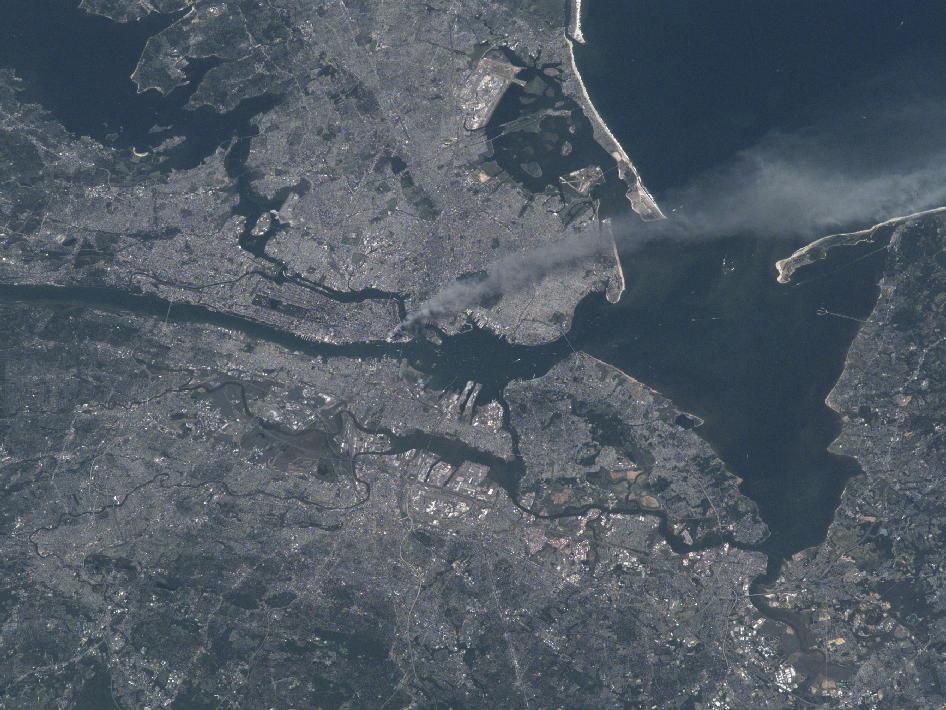
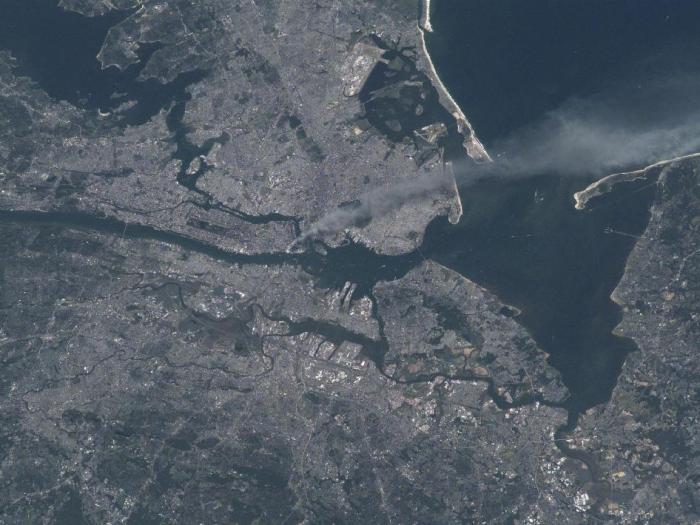
I glanced at the World Map on the computer to see where over the world we were and noticed that we were coming southeast out of Canada and would be passing over New England in a few minutes. I zipped around the station until I found a window that would give me a view of NYC and grabbed the nearest camera. It happened to be a video camera, and I was looking south from the window of Michael’s cabin.

The smoke seemed to have an odd bloom to it at the base of the column that was streaming south of the city. After reading one of the news articles we just received, I believe we were looking at NY around the time of, or shortly after, the collapse of the second tower. How horrible…

I panned the camera all along the East Coast to the south to see if I could see any other smoke around Washington, or anywhere else, but nothing was visible.

It was pretty difficult to think about work after that, though we had some to do, but on the next orbit we crossed the US further south. All three of us were working one or two cameras to try to get views of New York or Washington. There was haze over Washington, but no specific source could be seen. It all looked incredible from two to three hundred miles away. I can’t imagine the tragic scenes on the ground.

Other than the emotional impact of our country being attacked and thousands of our citizens and maybe some friends being killed, the most overwhelming feeling being where I am is one of isolation.

Next day….

I guess the fatigue and emotional strain got the best of me. I couldn’t stay awake and continue to write. Today was still difficult, but we started getting more information, plus we had the honor of talking directly with the Center Director, Roy Estess, who assured us that the ground teams would continue to work and ensure our safety, as well as the safe operation of the Station. We also heard from our Administrator, Mr. Goldin, who added that the partners in the Program are all totally committed to continuing safe operations and support. These were never questions for me. I know all these people! The ground teams have been incredibly supportive, very understanding of the impact of the news, and have tried to be as helpful as possible. They have all been very professional and focused though I can’t imagine the distraction of this type of news coming in and the thought that government buildings might be at risk. They never skipped a beat, even when relocating control centers. And a group of senior personnel and friends gave us a pretty thorough briefing on what was known and what was being done in the government and at NASA on Tuesday afternoon, which was very helpful and kind of them to do in the midst of all the turmoil. The Russian TsUP has also been supportive and helpful, trying to uplink news articles when our own assets were inoperable, and saying kind words…

My crewmates have been great, too. They know it’s been a tough day for me and the folks on the ground, and they’ve tried to be as even keeled and helpful as possible. Michael even fixed me my favorite Borscht soup for dinner. And they give me plenty of room to think when I needed it. They are very sympathetic and of course outraged at whoever would do this.

I know so many people in Washington, so many people who travel to DC and NYC, so many who are pilots, that I felt sure I would receive at least a few pieces of bad news over the next few days. I got the first one today when I learned that the Captain of the American Airlines jet that hit the Pentagon was Chic Burlingame, a classmate of mine. I met Chic during plebe summer when we were in the D&B together, and we had lots of classes together. I can’t imagine what he must of gone through, and now I hear that he may have risen further than we can even think of by possibly preventing his plane from being the one to attack the White House. What a terrible loss, but I’m sure Chic was fighting bravely to the end. And tears don’t flow the same in space…

It’s difficult to describe how it feels to be the only American completely off the planet at a time such as this. The feeling that I should be there with all of you, dealing with this, helping in some way, is overwhelming. I know that we are on the threshold (or beyond) of a terrible shift in the history of the world. Many things will never be the same again after September 11, 2001. Not just for the thousands and thousands of people directly affected by these horrendous acts of terrorism, but probably for all of us. We will find ourselves feeling differently about dozens of things, including probably space exploration, unfortunately.

It’s horrible to see smoke pouring from wounds in your own country from such a fantastic vantage point. The dichotomy of being on a spacecraft dedicated to improving life on the earth and watching life being destroyed by such willful, terrible acts is jolting to the psyche, no matter who you are. And the knowledge that everything will be different than when we launched by the time we land is a little disconcerting. I have confidence in our country and in our leadership that we will do everything possible to better defend her and our families, and to bring justice for what has been done. I have confidence that the good people at NASA will do everything necessary to continue our mission safely and return us safely at the right time. And I miss all of you very much. I can’t be there with you in person, and we have a long way to go to complete our mission, but be certain that my heart is with you, and know you are in my prayers.

Humbly,
Frank

September 14, 2001; 22:49

An update to the last letter… Fortunately, it’s been a busy week up here. And to prove that, like our country, we are continuing on our intended path with business as usual (as much as possible). Tonight the latest addition to the station, the Russian Docking Compartment will be launched from Baikonur, Kazakhstan. On Saturday night (US time), it will dock with us, at a port never used before on the nadir side of the Service Module. This new module will give us another place to dock a Progress or Soyuz and will provide a large airlock with two useable hatches for conducting EVA’s in Russian Orlan suits, which we will do a few of before we come home.

The problem before in dealing with this week was too little news. The problem now is too much. It came all at once when email was restored, and there’s not enough time to read it all! Plus it’s too hard to deal with all of it at once. But I appreciate getting it, and I really appreciate the great letters of support and friendship I am receiving.

We are doing well on board, getting our work done, and talking about things. Last night we had a long discussion over dinner about the significance of these events, the possible actions to follow, and what should be done. After dinner, Michael made a point of telling me that every email he received from friends in Russia said specifically to tell me how sorry they were that this happened, extending their condolences, and asking how I was doing. Vladimir taught me the Russian word for “condolences” after talking to the previous CDR, Yuri Usachev, on the phone in Star City. (Both the Russian and the English words are much too long to pronounce easily.) Very kind people.

For the last two days, the Russian MCC has been good enough to transmit live broadcasts of radio news about the event and associated stories, to make sure I was well informed. Every specialist who has come on the line to discuss a procedure or a problem has at some point extended greetings to me with kind words. Tonight the Russian capcom told us that because of the special day of remembrance in the US, all day people had been bringing flowers and lining all the walls of the US embassy in Moscow, and this evening they were lighting candles in the street outside the embassy. How the world has changed.

People everywhere seem to recognize the senselessness and horror in this attack. And the tremendous loss. Moscow has dealt with these kind of problems in the last few years with apartment and subway bombings, so they are as anxious to get rid of this threat as we are. But the bottom line is that there are good people everywhere who want to live in peace. I read that a child asked, “America is so good to other countries, we always help everyone, how can they hate us so much?”

I hope the example of cooperation and trust that this spacecraft and all the people in the program demonstrate daily will someday inspire the rest of the world to work the same way. They must!

Unfortunately, we won’t be flying over the US during the time people are lighting candles. Don’t know if we could see that anyway. We did, however, see a very unusual and beautiful sight a few minutes ago: the launch of our Docking Compartment on a Soyuz booster. We were overtaking it and it came into view about three minutes after its launch from Baikonur as the sun hit our station, so it was still in the dark. It looked like a large comet with a straight, wide tail silhouetted against the dark planet beneath. Despite some bad lighting for a while as the sun hit our window at a low angle, I managed some video of it as first we passed the rocket, and then watched it begin to catch up as it gained altitude and speed. I filmed until main engine cutoff and booster separation occurred just as we approached sunrise on the Himalayas. An unforgettable sight in an unforgettable week…

Life goes on, even in space. We’re here to stay…
Frank

How To Get To Mars…

A new video has been making the rounds recently. In this full-length compilation video, we get a glimpse of what the flight and deployment of Spirit/Opportunity Rover to Mars looked like, using CGI animation of course. In between, real footage from NASA is spliced in to provide real-time background to the simulated events. We see the navigators eagerly awaiting the landing and recovery of the rover’s signal, and the first photographs sent back by that rover. The arrival of this footage is very timely of course, coming soon after the arrival of Curiosity. Enjoy!

Neil Armstrong and the Moon Landing, the Conspiracy Continues…

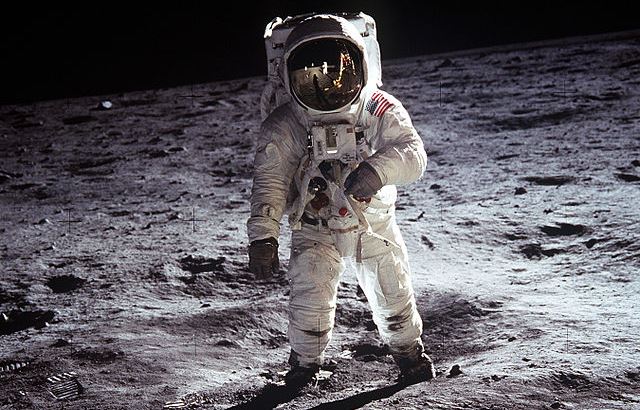
Earlier this week, the world came together to mourn the loss of one of the greatest figures of the 20th century. Neil Armstrong, the first man to land on the Moon, died at the age of 82 and left a brilliant legacy. For the majority of people who don’t believe the government is microwaving their testicles and hiding little green men with anal probes in some facility in the Nevada desert, this was a time to remember Apollo 11, the Space Race, and all that men like Neil Armstrong had accomplished.

But for other individuals, it was a time to reassert their theories with even greater dedication. For these people – the same people who believe the Moon Landing was faked as a distraction of propaganda exercise – now claim a number of new conspiracies are at work. And I’m sure you’ll agree, they are pretty freaking interesting*.

Apollo11_Aldrin1Some say that Neil Armstrong was part of a Masonic plot, that he was a “lying piece of Mason shit” as it were. Others claim that it was an Illuminati plot, or (I’m guessing) that the Knights Templar were somehow behind it. Yet others seem to think their is a connection between his death and Lance Armstrong’s fall from grace. But the one I like best is the “rumor” that Neil was murdered because he was about to blow the whistle on the whole Moon Landing conspiracy.

Ever since he set foot on the Moon, Armstrong had chosen to weigh in on the conspiracy theories, taking them in stride and never once denouncing the people who spoke them. In fact, during an interview earlier this year with an Australian TV station, he said “”People love conspiracy theories, they’re very attractive. But they were never a concern to me.” Yep, sounds like he’s hiding something to me!

apollo_11_bootprint-e1405838911229After considering all this, I find I can do little except shake my head and wonder if eugenics is such a bad idea after all. Sure, it got a terrible wrap in the hands of the Nazis and other fascist morons, but what if we refocused it to ensure that people who believe in these kinds of conspiracies are kept from making babies Would that be evil, or to the benefit of the human race? Yeah, doesn’t seem very just, but it’s nice to pretend, isn’t it?

But just in case you’re interested what some of the conspiracy theorists are saying, here is a link to the Godlike Productions website where many of said people seem to be hanging out. It seems the only prerequisite to participating in this board is a child-like imagination and the belief that they really are out to get you.

In the meantime, remember: just because you’re paranoid doesn’t mean they aren’t all out to get you. Just because you don’t know who they are doesn’t mean they aren’t out there. The absence of evidence is not the evidence of absence! Good night and, given the proliferation of stupid theories and the people who believe in them, good luck!

*Note: by interesting, I mean the kind of brain-dead, bat-shit crazy garbage that can only come out of the worst recesses of a mouth-breathers stunted and paranoid imagination!

Source: Gawker

Time-Lapse Footage of Curiosity Rover Landing

Amongst the awesome footage which is coming back from Mars, courtesy of the Curiosity Rover, is this lovely compilation. Using the many photos snapped by the rover as it made it’s decent, the enterprising folks over at Spaceflight 101 have created a time-lapse video of what the landing looked like.

Taken by the the Mars Descent Imager (MARDI), the images capture the separation of the heat shield from the rover and then its powered descent. Well worth watching, and stay tuned for more updates from Curiosity as it continues its journey across the Martian Landscape.

Top Five Exoplanets In The Known Universe

Hello again! Boy, I tell ya, it’s good to be back in the swing of things. You know what they say about absence making the heart grow fonder? Well, they also say a few things about being addicted to your devices! But either way, I’m happy to be back in civilization and able to communicate with my friends and colleagues who are, unfortunately, only reachable electronically.

And I’m even happier that people have had a creative outburst while I was away. I miss being able to take part in brainstorming sessions and coming up with new ideas with people. So I was pretty pleased when I came home and found my inbox so crammed full of emails and comments from my writer friends. And, like a plant that’s been deprived of water, their thoughts set my mind aflame with new ideas!

For one, I realized I had yet to discuss NASA’s top 5 Exploplanets in any real detail. Not long ago, it was announced that the planet Gliese 581 g, which is roughly 20 light years from our Solar System, is the most Earth-like planet in this region of the Galaxy, and hence, the most likely candidate for settlement someday. However, this news came as part of a larger story about all the planets, Earth-like or otherwise, that NASA has been confirming the existence of in recent years. Guess I was too busy focusing on how this effecting my writer’s group to expand on how cool these discoveries really are 😉

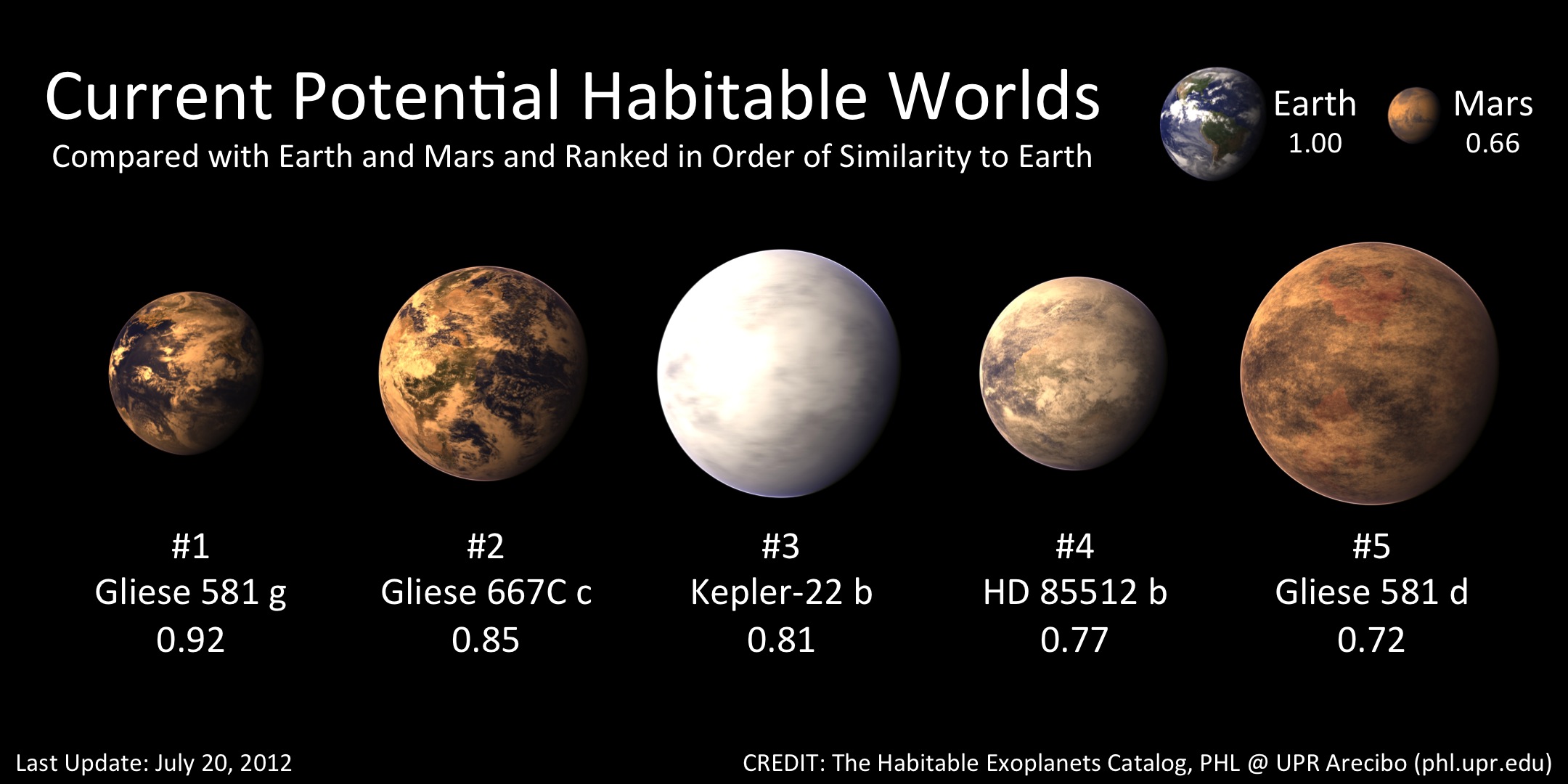
The table above shows the top five contenders, grouped according to how similar they are to Earth in terms of gravity, atmosphere, distance from their star, and ability to support life. Gliese 581 g, the fourth planet from the Gliese 581 star, ranks as number one with a 92 percent comparison match. Being roughly the same size as Earth, though boasting significantly more mass, it is also thought to have roughly the same gravitational pull. In addition, the astronomer who was intrinsic in it’s discovery, Steven Vogt, indicated that it is a prime candidate for extra-terrestrial life.

The second candidate, at 85%, is Gliese 667C c, a planet which orbits a red dwarf roughly 22 light-years away. It is so named because it’s parent star is part of a triple star system, or a trinary. Since c is estimated to be at least 4.5 times as massive as Earth, it has the honor of being designated a “Super-Earth”, and no doubt would have enough gravity to make even a world-class athlete feel overwrought from the simple task of walking.

Third is Kepler-22 b, an exoplanet which was spotted by NASA’s planet-hunting Kepler space telescope in 2009. An 81% match to Earth, this world is another “Super-Earth” which is speculated to have an atmosphere and climate which could be hospitable to Earth creatures. Unfortunately, this bad boy is over 600 light years away, making it a pretty poor candidate for settlement anytime soon.

Fourth up is HD 85512b, another super-Earth which orbits the orange dwarf Gliese 370, which is roughly 35 light-years away. At a relatively reasonable distance, and a 77% match to Earth, this planet could be a suitable candidate for colonization one day. NASA already estimates that its average surface temperature and presence within the star’s “Habitable Zone” would be within tolerable limits. Hopefully the gravity is the same!

And coming in at fifth place is the second planet to come to us from the Gliese 581 system, the fifth planet known as Gliese 581 d. As the above table shows, g and d are both within the systems Habitable Zone and could be made to support human populations, provided certain requirements (i.e. the existence of water, suitable temperatures and gravity) were met. When it was first discovered in 2007, it was dismissed as being “too cold” to support life. However, subsequent atmospheric modelling studies suggest that it could be habitable provided its atmosphere is capable of generating a Greenhouse Effect, as Earth’s is.

Many question how and why the discovery of exoplanets will benefit humanity. As one of my friends (hi Rami!) asked me recently, what good is it to colonize worlds do us if our problems remain? I argued that it would ensure our survival, but quickly realized that I’d need to make a better case if I was going to prove that point. As a curve-ball, I asked him to consider the possibility that maybe Earth itself, as we’ve made her in the past 15,000 years, could be the problem…

Naturally, that statement requires clarification. But that’s something for another time. Right now, all I am hoping for is that the discovery of habitable planets within humanity’s reach will mean either the possibility of extra-terrestrial life, or the option of planting the seed of humanity in a distant solar system. The implications of either would be mind-blowing, and I for one feel privileged to live in a time when such possibilities might be coming true!

The News From Saturn

Saturn has certainly been seen in the news a lot as of late. And you have the Cassini space probe, which was deployed from Earth back in 1997, to thank for all of that. Having completed the first leg of its mission back in 2008, its mission was extended to 2010, when most of the new photos and startling discoveries that are now being announced were made. Now, the healthy spacecraft is seeking to make exciting new discoveries in a second extended mission called the Cassini Solstice Mission.

But alas, the news! First, there was the announcement back in February that Saturn’s two largest moons – Titan and Rhea – were captured together in the same photo by the Cassini space probe. Considering that Saturn has 66 moons and Cassini was flying past at the time, this was no small accomplishment! What’s more, Titan’s atmosphere, which is fully developed (the only Saturnine moon to have this) was captured perfectly the shot.

But the news didn’t stop there. Shortly thereafter, in March to be specific, a report published in the Geophysical Research Letters announced that a thin layer of oxygen was discovered around Saturn’s moon of Dione. Once again, this discovery was made by the Cassini space probe as it passed by this other satellite of Saturn’s two years ago. This finding is proving to be quite the exciting one within the astronomical community.

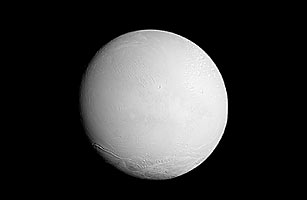
Shortly after that, NASA announced that the moon of Enceladus did indeed have its own ocean. Named the Enceladan Ocean, this natural body of water has been known about for some time, but what is now known is the water contains carbon dioxide, carbon monoxide, potassium salts and other organic materials. On top of that, it is now understood that it is situated above some volcanic jets, which means the water is most likely warm. Warm water, combined with organic minerals, makes the Enceladan Ocean a good candidate for life!

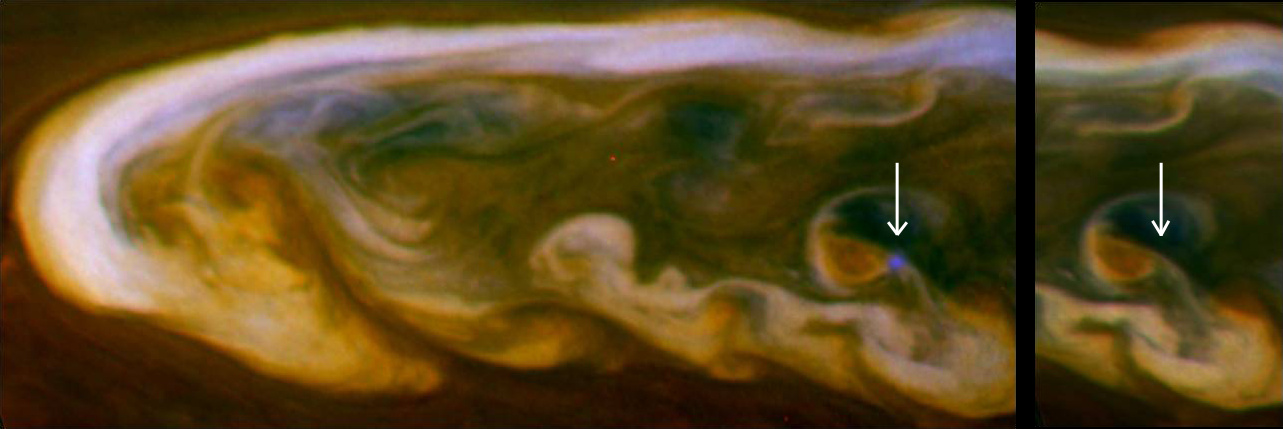
And then, in late July, images released by NASA showed that Cassini also caught a glimpse of a thunderstorm happening on Saturn’s surface. As all residents of Earth will surely agree, a thunderstorm is an impressive sight to behold. Especially when it’s seen happening on another planet! Apparently, what made this sighting most impressive was that it was visible on Saturn’s day side – aka. in broad daylight – from a range of 4.5 million km (2 million miles). That’s one humungous light show!

And less than a week ago, more information emerged as a result of the Cassini space probe, this time in relation to Saturn’s moon of Iapetus. After getting a good glimpse of the moon, scientists at NASA have determined that it is home to the largest ice avalanches in the Solar System, and is rivaled only by Mars. Take that Mount Everest! You too Olympus Mons!

Already, scientists had Iapetus pegged as the most intriguing moon in the Solar System. For starters, it has a Ying-Yang color pattern, looks like an inverted Death Star (check that image, no Photoshopping!), and has a long ridge running almost perfectly along Iapetus’ equator, a feature which earned it the nickname “the walnut moon”. I guess it wasn’t happy with just that, it also wanted to be the most dangerous place to downhill ski!

And you thought Jupiter did some badass things. Well, it does. But judging from all these findings, Saturn is going to be a pretty happening place someday. I can envision settlements on Titan, skiing on Iapetus, and terraforming on Dione. And for those who like to sight-see, there will be shuttle services that take you to the dark side of Saturn to witness the light show from space. Ooooh, I got goose bumps!

Via: BBC, IO9, Nature Geoscience, CICOPS, Time Science, and NASA