Scientists have come up with the best computer model to date of the universe, one which maps the evolution of the cosmos in unprecedented detail. Known as Illustris, this virtual cosmos – which was created by U.S., English and German researchers using a network of supercomputers – includes details never before achieved in a simulation. All told, the numerical-based model covers the 13-billion-year evolution of the universe, beginning just 12 million years after the Big Bang took place.
While cosmologists have been developing and employing computer models of the universe for several decades, the outcome is usually a rough approximation of the universe that scientists observe in reality. Illustris, however, has produced a universe that looks uncannily like the real on. Among other things, it models how the universe expands, how galaxies are formed, their composition and distribution, and the mechanics of how stars and black holes are formed.
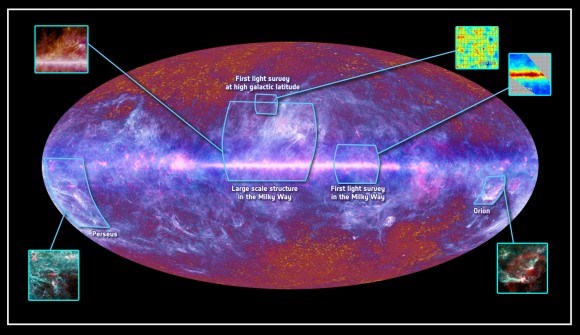
Given all the recent breakthroughs in physics and cosmology, this ultra-detailed virtual model should come as no surprise. For example, this past April, scientists made not only made the first-ever observation of gravitational waves, they also processed data that is believed to be the first real indication of the existence of Dark Matter. In addition, the ESA’s Planck mission released the most detailed thermal imaging map of the universe last year that placed an accurate date on the universe’s age and confirmed the validity of the Big Bang Theory.
The Illustris creators say it represents “a significant step forward in modelling galaxy formation”, and provides a good visual representation of our ever-expanding (no pun!) understanding of the universe. A recent article that appeared last Wednesday in the journal Nature describes Illustris, and several videos (like those below) have been released that show the simulation in action. Check them out below:
The nation of Japan has long been regarded as being at the forefront of emerging technology. And when it comes to solar energy, they are nothing if not far-sighted and innovative. Whereas most nations are looking at building ground-based solar farms in the next few years, the Japanese are looking at the construction of vast Lunar and space-based solar projects that would take place over the course of the next few decades.
The latest proposal comes from the Japan Aerospace Exploration Agency (JAXA), which recently unveiled a series of pilot projects which, if successful, should culminate in a 1-gigawatt space-based solar power generator within just 25 years. Relying on two massive orbital mirrors that are articulated to dynamically bounce sunlight onto a solar panel-studded satellite, the energy harvested would then be beamed wirelessly to Earth using microwaves, collected Earth-side by rectifying antennas at sea, and then passed on to land.
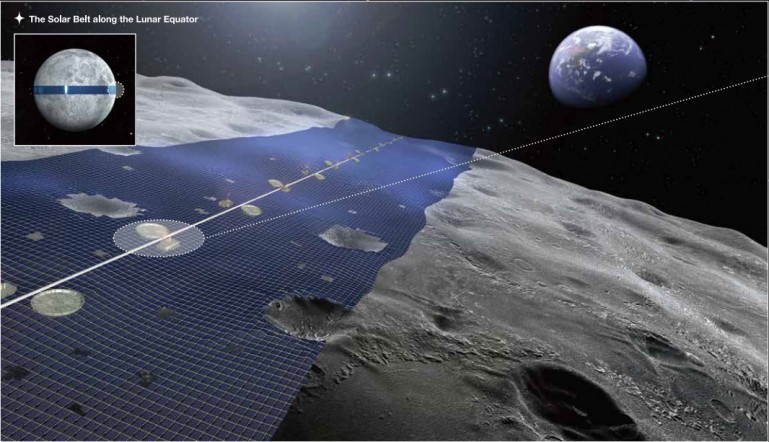
JAXA has long been the world’s biggest booster of space-based solar power technology, making significant investments in research and rallying international support for early test projects. And in this respect, they are joined by private industries such as the Shimizu Corporation, a Japanese construction firm that recently proposed building a massive array of solar cells on the moon – aka. the “Lunar Ring” – that could beam up to 13,000 terawatts (roughly two-thirds of global power consumption) to Earth around the clock.
Considering that Japan has over 120 million residents packed onto an island that is roughly the size of Montana, this far-sighted tendency should not come as a surprise. And even before the Fukushima disaster took place, Japan knew it needed to look to alternative sources of electricity if it was going to meet future demands. And considering the possibilities offered by space-based solar power, it should also come as no surprise that Japan – which has very few natural resources – would look skyward for the answer.
Beyond Japan, solar power is considered the of front runner of alternative energy, at least until s fusion power comes of age. But Until such time as a fusion reaction can be triggered that produces substantially more energy than is required to initiate it, solar will remain the only green technology that could even theoretically provide for our global power demands. And in this respect, going into space is seen as the only way of circumventing the problems associated with it.
Despite solar power being in incredible abundance – the Earth’s deserts absorb more energy in a day than the human race uses in an entire year – the issue of harnessing that power and getting it to where it is needed remain as stumbling blocks. Setting up vast arrays in the Earth’s deserts would certainly deal with the former, but transmitting it to the urban centers of the world (which are far removed from it’s deserts) would be both expensive and impractical.
Luckily, putting arrays into orbit solves both of these issues. Above the Earth’s atmosphere, they would avoid most forms of wear, the ground-based day/night cycle, and all occluding weather formations. And assuming the mirrors themselves are able to reorient to be perpetually aimed at the sun (or have mirrors to reflect the light onto them), the more optimistic estimates say that a well-designed space array could bring in more than 40 times the energy of a conventional one.
The only remaining issue lies in beaming all that energy back to Earth. Though space-based arrays can easily collect more power above the atmosphere than below it, that fact becomes meaningless if the gain is immediately lost to inefficiency during transmission. For some time, lasers were assumed to be the best solution, but more recent studies point to microwaves as the most viable solution. While lasers can be effectively aimed, they quickly lose focus when traveling through atmosphere.
However, this and other plans involving space-based solar arrays (and a Space Elevator, for that matter) assume that certain advances over the next 20 years or so – ranging from light-weight materials to increased solar efficiency. By far the biggest challenge though, or the one that looks to be giving the least ground to researchers, is power transmission. With an estimated final mass of 10,000 tonnes, a gigawatt space solar array will require significant work from other scientists to improve things like the cost-per-kilogram of launch to orbit.
It currently costs around $20,000 to place a kilogram (2.2lbs) into geostationary orbit (GSO), and about half that for low-Earth orbit (LEO). Luckily, a number of recent developments have been encouraging, such as SpaceX’s most recent tests of their Falcon 9R reusable rocket system or NASA’s proposed Reusable Launch Vehicle (RLV). These and similar proposals are due to bring the costs of sending materials into orbit down significantly – Elon Musk hopes to bring it down to $1100 per kilogram.
So while much still needs to happen to make SBSP and other major undertakings a reality, the trends are encouraging, and few of their estimates for research timelines seem all that pie-eyed or optimistic anymore.
April was a busy month for the very photo-talented (and photogenic) Curiosity Rover. In addition to another panoramic shot of the Martian landscape – which included Curiosity looking back at itself, making it a “selfie” – the rover also managed to capture a night-sky image that captured two minor planets and the Martian moon of Deimos in the same picture. At a time when Curiosity and Opportunity are both busy on long-haul missions to find evidence of life, these latest pictures remind us that day-to-day operations on Mars are still relevant.
The first shot took place on April 20th (Sol 606), when rover scientists used the Mast Camera to capture the minor planets of Ceres and Vesta, as well as the moon of Deimos, in the same frame. Ceres is a minor planet with a diameter of about 950 km, and is the largest object in the main asteroid belt. With a diameter of about 563 km, Vesta is the third-largest object in the asteroid belt. Deimos, meanwhile, is the smaller of Mars’ two moons, with a mean radius of 6 km.
In the main portion of the new image (seen above), Vesta, Ceres and three stars appear as short streaks due to the duration of a 12-second exposure. In other camera pointings the same night, the Curiosity’s camera also imaged Phobos and the planets Jupiter and Saturn, which are shown as insets on the left. Dr Mark Lemmon from Texas A&M University, a Curiosity team member, explained:
this imaging was part of an experiment checking the opacity of the atmosphere at night in Curiosity’s location on Mars, where water-ice clouds and hazes develop during this season… The two Martian moons were the main targets that night, but we chose a time when one of the moons was near Ceres and Vesta in the sky.
Deimos was much brighter than the visible stars, Vesta and Ceres in the same part of the sky, in the main image. The circular inset covers a patch of sky the size that Earth’s full moon appears to observers on Earth. At the center of that circular inset, Deimos appears at its correct location in the sky, in a 0.25 second exposure.
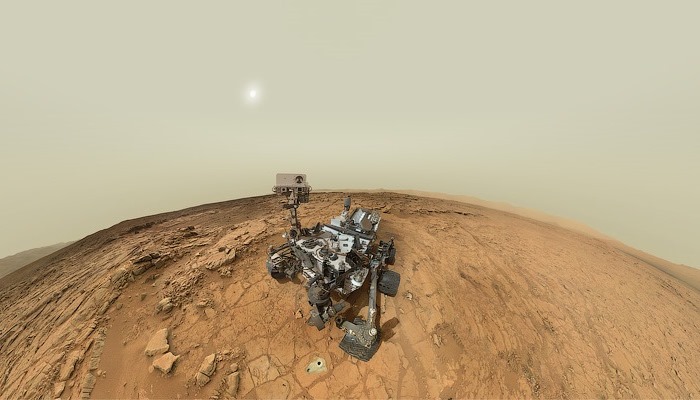
As for the latest in Curiosity’s long-line of panoramic self-portraits, this one comes to us courtesy of Jason Major. As a graphic designer and amateur space explorer, Major assembled the picture from about the dozen or so images acquired with the rover’s Mars Hand Lens Imager (MAHLI) instrument on April 27-28, 2014 (Sol 613). In the background, one can see the 5.5-km-high (3.4 miles) Mount Sharp (Aeolis Mons) that sits in the center of the Gale Crater.
One thing that Major noted about the picture he assembled is the way the cylindrical RUHF antenna and the bit of the RTG that is visible in the lower center seem to form a “toothy (if slightly dusty) grin”. But, as he stated:
…with almost 21 Earth-months on Mars and lots of discoveries already under her robot belt, Curiosity (and her team) certainly have plenty to smile about!
And the best is likely to still be coming. As we speak, Curiosity is making its way towards Mount Sharp and is expected to arrive there sometime in August. As the primary goal in its mission, Curiosity set off for this destination back in June after spending months studying Glenelg area. She is expected to arrive at the foot of the mountain in August, where she will begin drilling in an effort to study the mountain’s vast caches of minerals – which could potentially support a habitable environment.
If Curiosity does find evidence of organic molecules in this cache, it will be one of the greatest scientific finds ever made, comparable only to the discovery of hominid remains in the Olduvai Gorge, or the first recorded discovery of dinosaur remains. For not only will we have definitive proof that life once existed on Mars, we will know with some certainly that it may again someday…
Stay tuned for more news from the Red Planet. And in the meantime, keep on trucking Curiosity!
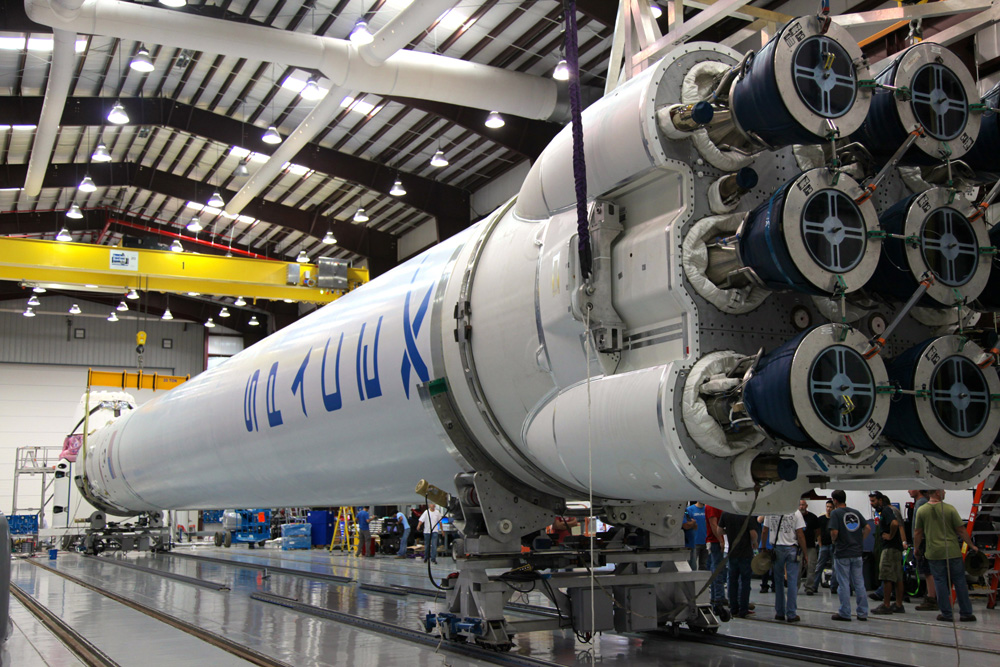
In yet another impressive feat from Elon Musk’s private space company, the Falcon 9 Reusable Rocket completed it’s second test on Friday April 2nd, 2014. In this latest test of the reusable rocket system, the Falcon 9 effectively quadrupled its height from its last test. Having reached 250 meters during its last test flight, the rocket now reached a full kilometer and then descended safely back to Earth and achieving a soft landing.
This comes just two weeks after SpaceX launched one of its Falcon 9’s on a supply mission to the ISS, which included the soft landing of its stage one rocket. Unfortunately, high sea waves prevented a boat from meeting the rocket on its ocean-based pad. And so, the rocket landed in the ocean, hovering for a few seconds before toppling into the sea. Still, the fact that the rocket was able to make it back to just above sea level was good news, and confirms that SpaceX is that much closer to the dream of reusability.
In the coming months, SpaceX plans to conduct more tests. In addition to reaching higher altitudes, they will also be testing the rocket’s retractable landing legs, and working more with unpowered guidance. According to the description that came with the recently-released video of the 1000m test:
F9R test flights in New Mexico will allow us to test at higher altitudes than we are permitted for at our test site in Texas, to do more with unpowered guidance and to prove out landing cases that are more-flight like.
This is also good news for NASA, which officially announced the cessation of cooperation with the Russian Federal Space Agency in early April. While their inability to rely on Russian Soyuz rockets to send astronauts into orbit (and bring them home) has allowed NASA to apply greater pressure on the federal government to fund its Reusable Launch Vehicle (RLV) system. However, Russian Deputy Prime Minister Dmitry Rogozin had a more mocking suggestion.
After initially joking that American astronauts would be left stranded on the ISS, he also recommended that NASA try using a trampoline to reach orbit. The joke was naturally irrelevant, since day-to-day operations involving the ISS are not going to be affected by these sanctions. Still, the inability to rely on Russian Soyuz’s in the near future will mean that US satellites – which are used for everything from GPS to spying – will be undeployable for the time being.
It also means that orbit conducted in Low-Earth Orbit will be complicated. As such, a reusable rocket system, be it NASA’s own or an external contractor’s (in this case, SpaceX) will give the US sanctions against Russia additional weight. It will also ensure that the dream of cost-effective space travel, which is intrinsic to everything from colonizing the Moon and Mars to establishing a Space Elevator and asteroid mining, will be become a reality in the not-too-distant future.
The sky is no longer the limit, people! And be sure to enjoy this video of the F9R 1000 meter test flight.
With over 1800 extra-solar planets discovered in the past 30 years, the search for life beyond our Solar System has begun anew. Astronomers believe that every star in the galaxy has a planet, and that one fifth of these might harbor life. The greatest challenge, though, is in being able to spot these “Earth-like” exoplanets. Due to the fact that they emit very little light compared to their parent stars (usually less than one-millionth the level of radiance), direct imaging is extremely rare and difficult.
As such, astronomers rely predominantly on is what is known as Transit Detection – spotting the planet’s as they cross in front of the star’s disc. This too presents difficulties, because the transit method requires that part of the planet’s orbit intersect a line-of-sight between the host star and Earth. The probability that an exoplanet will be in a randomly oriented orbit that can allow for it be observed in front of its star is therefore somewhat small.
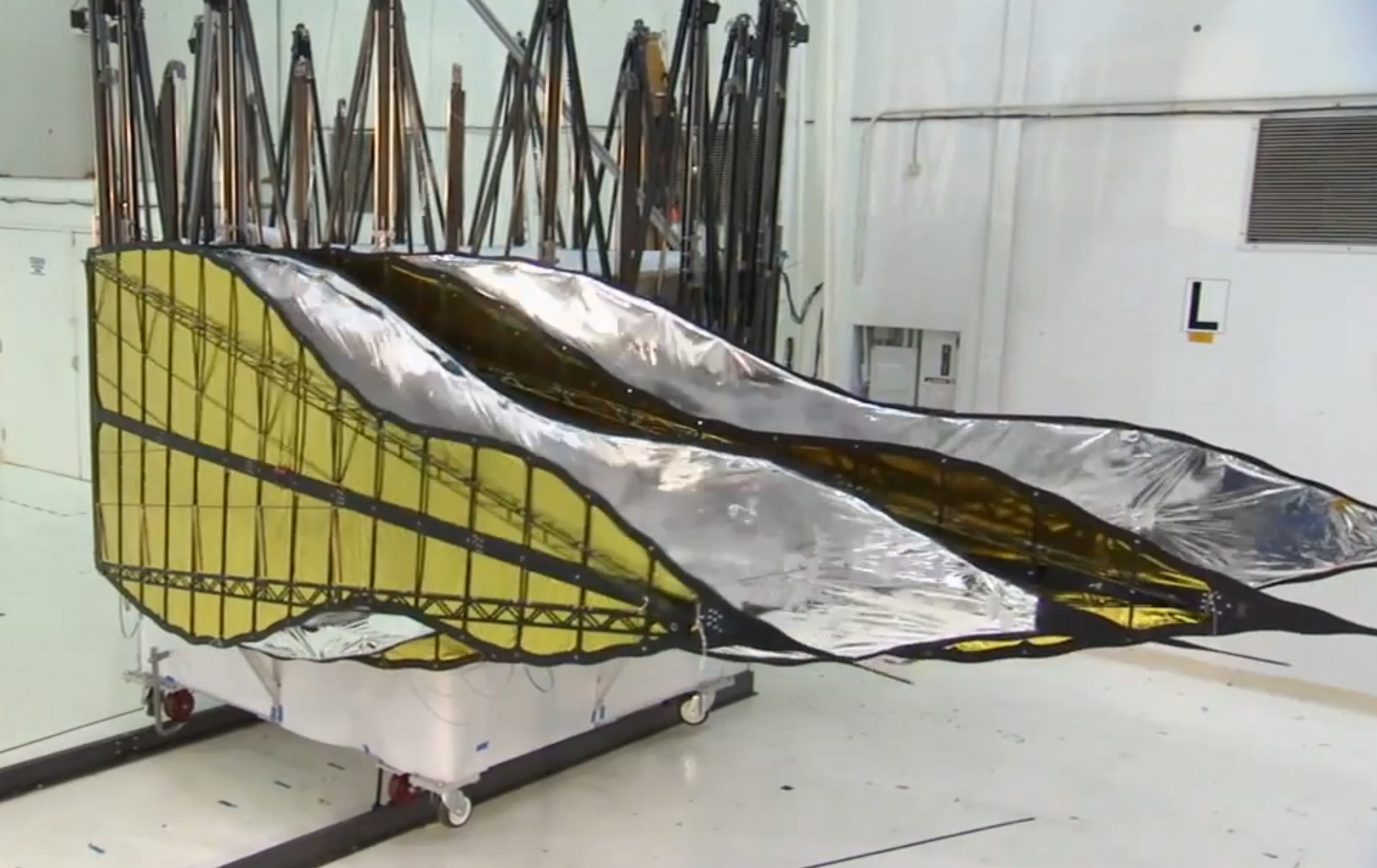
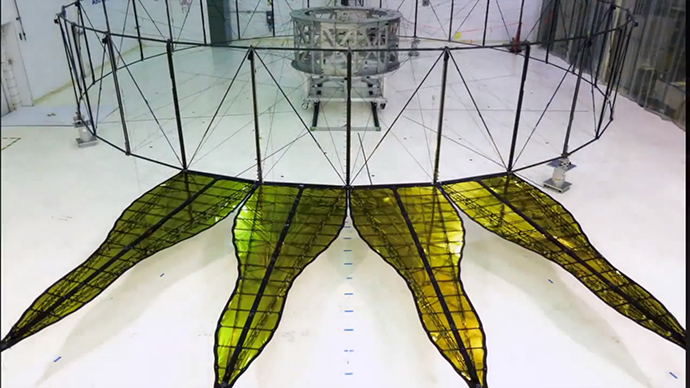
Luckily, engineers and astronomers at NASA and other federal space agencies are considering the possibility of evening these odds with new technology and equipment. Once such effort comes from Princeton’s High Contrast Imaging Laboratory, where Jeremy Kasdin and his team are working on a revolutionary space-based observatory known as a “starshade” – a flower petal-shaped device that allows a telescope to photograph planets from 50,000 kilometers away.
Essentially, the starshade blocks light from distant stars that ordinarily outshine their dim planets, making a clear view impossible. When paired with a space telescope, the starshade adds a new and powerful instrument to NASA’s cosmic detection toolkit. The flower-shaped petals are part of what makes the starshade so effective. The starshade is also unique in that, unlike most space-based instruments, it’s one part of a two-spacecraft observation system.
As Dr. Stuasrt Shaklan, NASA Jet Propulsion Labratory’s lead engineer on the starshade project, explaned:
The shape of the petals, when seen from far away, creates a softer edge that causes less bending of light waves. Less light bending means that the starshade shadow is very dark, so the telescope can take images of the planets without being overwhelmed by starlight… We can use a pre-existing space telescope to take the pictures. The starshade has thrusters that will allow it to move around in order to block the light from different stars.
This process presents a number of engineering challenges that Shaklan and his team are working hard to unravel, from positioning the starshade precisely in space, to ensuring that it can be deployed accurately. To address these, his research group will create a smaller scale starshade at Princeton to verify that the design blocks the light as predicted by the computer simulations. Concurrently, the JPL team will test the deployment of a near-full scale starshade system in the lab to measure its accuracy.
Despite these challenges, the starshade approach could offer planet-hunters many advantages, thanks in no small part to its simplicity. Light from the star never reaches the telescope because it’s blocked by the starshade, which allows the telescope system to be simpler. Another advantage of the starshade approach is that it can be used with a multi-purpose space telescope designed to make observations that could be useful to astronomers working in fields other than exoplanets.
As part of NASA’s New World’s Mission, the starshade engineers are optimistic that refining their technology could be the key to major exoplanet discoveries in the near future. And given that over 800 planets have been detected so far in 2014 – that’s almost half of the 1800 that have been detected in total – anything that can assist in their detection process at this point is likely to lead to an explosion in planetary discoveries.
And with one-fifth of these planets being a possible candidate for life… well, you don’t have to do the math to know that the outcome will be might exciting! In the meantime, enjoy this video from TED Talks, where Professor Jeremy Kasdin speaks about the starshade project:
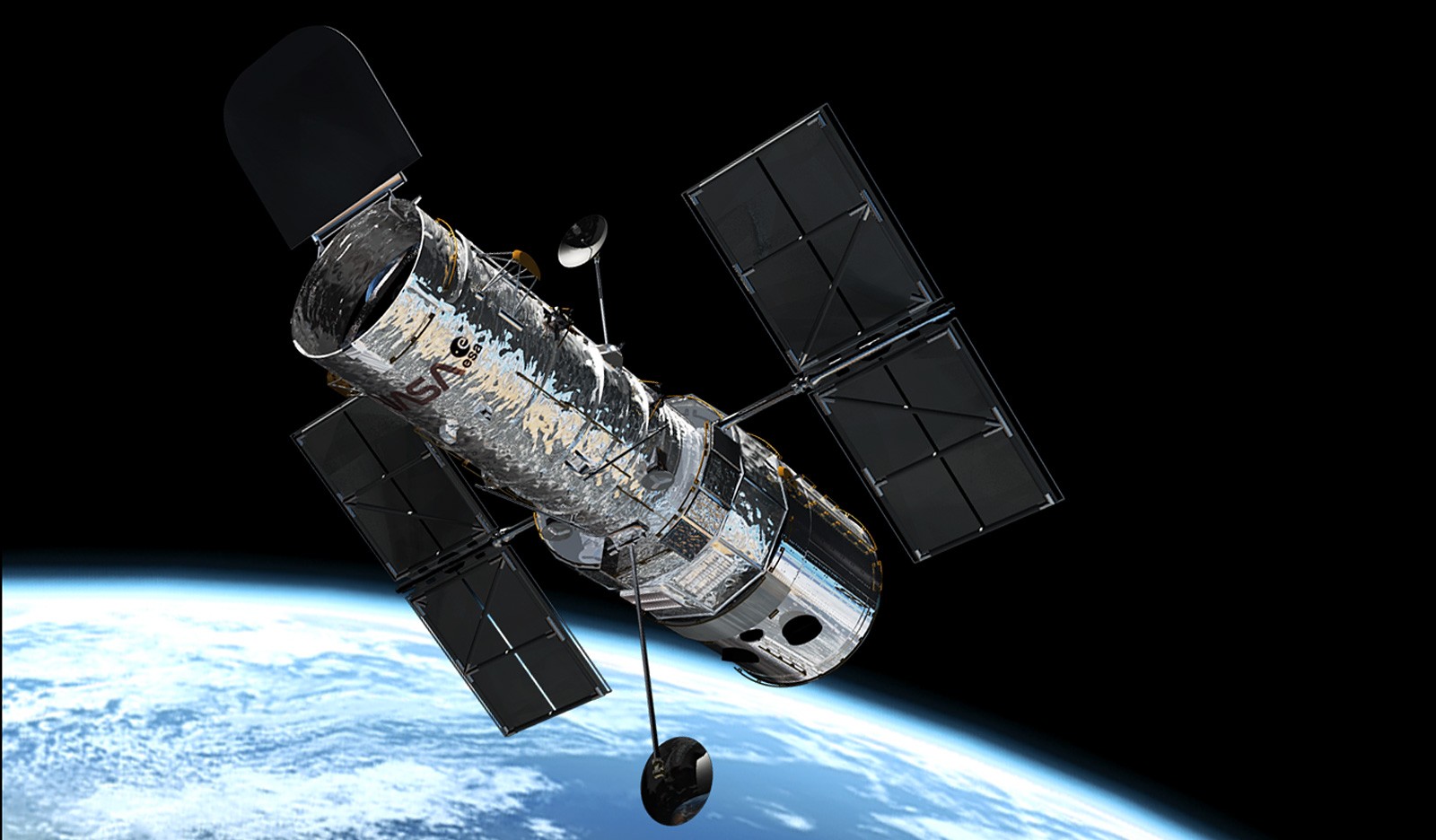
Last month, the Hubble Space Telescope celebrated its 24th birthday. And in honor of this occasion, NASA has released a video entitled “Evaporating Peaks – Pillars in the Monkey Head Nebula”. This video, which showcases visible and infrared light views of a collection of pillars along one edge of the Monkey Head Nebula (also known as NGC 2174) is just the latest in series of simulations that attempt to recreate what it would be like to step into a major stellar body.
Like all nebulas, NGC 2174 is a star-forming region in which bright, newborn stars near the center of the nebula illuminate the surrounding gas, creating the brilliant images we see in the video. The radiation from these stars, combined with strong stellar winds, also erode areas of lower density gases, which in turn causes pockets of higher density gas to turn into visible formations. This is what leads to the creation of the pillars and peaks of gas that run along the inner edge of this roughly circular cloud.
The sequence begins with a view of the night sky near the constellation of Gemini and Orion and then zooms through observations from the Digitized Sky Survey 2 to reveal a Hubble Space Telescope visible light view of the top of this region of pillars.
For over two years now, Elon Musk and his private space company (SpaceX) have been working towards the creation of a reusable rocket system. Known as the Falcon 9 Reusable Development Vehicle (F9R Dev) – or “Grasshopper” – this system may prove to be the greatest development in space travel since the invention of the multistage rocket. After multiple tests that reached greater and greater altitudes, the latest attempt at a takeoff and soft landing took place this past month.
Timed to coincide with SpaceX’s launch to the International Space Station (which took place on Friday April, 18th) the landing was apparently a success. Several days after the launch, Elon Musk tweeted that the “[d]ata upload from tracking plane shows landing in Atlantic was good!” This update came on April 22nd, and as of yet, no definitive data of whether the first stage landed correctly, or whether it was still in one piece by the time the recovery boats got to it.
Presumably SpaceX will provide another update in due course. In the meantime, they took the opportunity to release a rather awesome video of what the Falcon 9 Reusable should look like when successfully performing a vertical takeoff and vertical landing (VTVL). The video has accumulated an astonishing 3,598,143 views in the last two weeks, which is indicative of the level of interest this project and its impications have garnered over the past few years.
Meanwhile, the resupply mission went off without a hitch. Officially designated as CRS-3, this mission was even more significant due to the fact that its Falcon 9 launch vehicle featured the same retractable landing legs and the ability to soft land as the Grasshopper test rocket. However, in the case of the ISS mission, it was the first time where a Falcon 9 was tested in a real-world scenario where the rocket would return to Earth after reaching Low Earth Orbit (LEO).
Though the rocket was successfully picked up by the ISS, the jury is still out on whether or not the soft landing was a success or not. To minimize any risk, the first stage of the Falcon 9 attempted to “soft land” in the Atlantic. Unfortunately, according to Elon Musk, due to “13- to 20-foot waves… It’s unlikely that the rocket was able to splash down successfully.” Using telemetry data gathered from a SpaceX spotter plane, it appears that everything else went to plan, though.
Because of the rough seas, though, the retrieval boats couldn’t make it to the landing site, and thus the rocket is unlikely to be recovered. In the meantime, SpaceX will spend the following days and weeks analyzing more detailed data from the launch, and then update the Falcon 9 design and launch protocol accordingly. However, it is clear at this point that these latest tests are not being considered a failure, or reason to cease in their efforts.
As Musk himself explained in a series of public statements and interviews after the launch:
I would consider it a success in the sense that we were able to control the boost stage to a zero roll rate, which is previously what has destroyed the stage — an uncontrolled roll…I think we’re really starting to connect the dots of what’s needed [to bring the rocket back to the launch site]. I think that we’ve got a decent chance of bringing a stage back this year, which would be wonderful.
Considering the benefits of cheap, reusable rockets, and all the things they will make possible – space-based solar power, the construction of a Moon settlement, missions to Mars, the construction of a Space Elevator – there’s simply no way that a single unsuccessful rocket recovery will deter them. In the meantime, be sure to check out this video of what a successful Falcon 9 VTVL test looks like. Hopefully, we’ll be seeing a real-world example of this happening soon:
Hello again! In another attempt to cover events that built up while I was away, here are some stories that took place back in March and early April of this year, and which may prove to be some of the greatest scientific finds of the year. In fact, they may prove to be some of the greatest scientific finds in recent history, as they may help to answer the most fundamental questions of all – namely, what is the universe made of, and how did it come to exist?
First up, in a development that can only be described as cosmic in nature (pun intended), back in March, astrophysicists at the Harvard-Smithsonian Center announced the first-ever observation of gravitational waves. This discovery, which is the first direct evidence of the Big Bang, is comparable to significance to CERN’s confirmation of the Higgs boson in 2012. And there is already talk about a Nobel Prize for the Harvard crew because of their discovery.
This theory, which states that the entire universe sprung into existence from a tiny spot in the universe some 13.8 billion years ago, has remained the scientific consensus for almost a century. But until now, scientists have had little beyond theory and observations to back it up. As the name would suggest, gravitational waves are basically ripples in spacetime that have been propagating outward from the center of the universe ever since the Big Bang took place.
Originally predicted as part of Einstein’s General Theory of Relativity in 1916, these waves are believed to have existed since a trillionth of a trillionth of a trillionth of a second after the Big Bang took place, and have been propagating outward for roughly 14 billion years. The theory also predicts that, if we can detect some gravitational waves, it’s proof of the initial expansion during the Big Bang and the continued inflation that has been taking place ever since.
Between 2010 and 2012, the BICEP2 – a radio telescope situated at the Amundsen–Scott South Pole Station (pictured above) – the research team listened to the Cosmic Microwave Background (CMB). They were looking for hints of B-mode polarization, a twist in the CMB that could only have been caused by the ripples of gravitational waves. Following a lot of data analysis, the leaders announced that they found that B-mode polarization.
The work will now be scrutinized by the rest of the scientific community, of course, but the general consensus seems confident that it will stand up. In terms of scientific significance, the confirmation of gravitational waves would be the first direct evidence that the universe started out as nothing, erupted into existence 13.8 billion years ago, and has continued to expand ever since. This would confirm that cosmic inflation really exists and that the entire structure of the universe was decided in the beginning by the tiniest flux of gravitational waves.
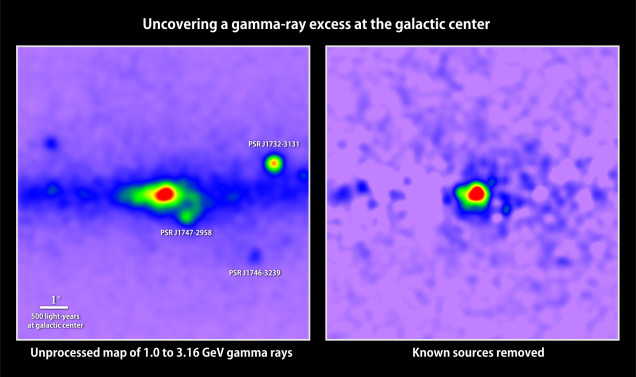
And that’s not only discovery of cosmic significance that was made in recent months. In this case, the news comes from NASA’s Fermi Gamma-ray Space Telescope, which has been analyzing high-energy gamma rays emanating from the galaxy’s center since 2008. After pouring over the results, an independent group of scientists claimed that they had found an unexplained source of emissions that they say is “consistent with some forms of dark matter.”
These scientists found that by removing all known sources of gamma rays, they were left with gamma-ray emissions that so far they cannot explain. And while they were cautious that more observations will be needed to characterize these emissions, this is the first time that potential evidence has been found that may confirm that this mysterious, invisible mass that accounts for roughly 26.8% of the universe actually exists.
To be fair, scientists aren’t even sure what dark matter is made of. In fact, it’s very existence is inferred from gravitational effects on visible matter and gravitational lensing of background radiation. Originally, it was hypothesized to account for the discrepancies that were observed between the calculations of the mass of galaxies, clusters and entire universe made through dynamical and general relativistic means, and the mass of the visible “luminous” matter.
The most widely accepted explanation for these phenomena is that dark matter exists and that it is most probably composed of Weakly Interacting Massive Particles (WIMPs) that interact only through gravity and the weak force. If this is true, then dark matter could produce gamma rays in ranges that Fermi could detect. Also, the location of the radiation at the galaxy’s center is an interesting spot, since scientists believe that’s where dark matter would lurk since the insofar invisible substance would be the base of normal structures like galaxies.
The galactic center teems with gamma-ray sources, from interacting binary systems and isolated pulsars to supernova remnants and particles colliding with interstellar gas. It’s also where astronomers expect to find the galaxy’s highest density of dark matter, which only affects normal matter and radiation through its gravity. Large amounts of dark matter attract normal matter, forming a foundation upon which visible structures, like galaxies, are built.
Dan Hooper, an astrophysicist at Fermilab and lead author of the study, had this to say on the subject:
The new maps allow us to analyze the excess and test whether more conventional explanations, such as the presence of undiscovered pulsars or cosmic-ray collisions on gas clouds, can account for it.The signal we find cannot be explained by currently proposed alternatives and is in close agreement with the predictions of very simple dark matter models.
Hooper and his colleagues suggest that if WIMPs were destroying each other, this would be “a remarkable fit” for a dark matter signal. They again caution, though, that there could be other explanations for the phenomenon. Writing in a paper submitted to the journal Physical Review D, the researchers say that these features are difficult to reconcile with other explanations proposed so far, although they note that plausible alternatives not requiring dark matter may yet materialize.
And while a great deal more work is required before Dark Matter can be safely said to exist, much of that work can be done right here on Earth using CERN’s own equipment. Tracy Slatyer, a theoretical physicist at the Massachusetts Institute of Technology and co-author of the report, explains:
Dark matter in this mass range can be probed by direct detection and by the Large Hadron Collider (LHC), so if this is dark matter, we’re already learning about its interactions from the lack of detection so far.This is a very exciting signal, and while the case is not yet closed, in the future we might well look back and say this was where we saw dark matter annihilation for the first time.
Still, they caution that it will take multiple sightings – in other astronomical objects, the LHC, or direct-detection experiments being conducted around the world – to validate their dark matter interpretation. Even so, this is the first time that scientists have had anything, even tentative, to base the existence of Dark Matter’s on. Much like until very recently with the Big Bang Theory, it has remained a process of elimination – getting rid of explanations that do not work rather than proving one that does.
So for those hoping that 2014 will be the year that the existence of Dark Matter is finally proven – similar to how 2012 was the year the Higgs Boson was discovered or 2013 was the year the Amplituhedron was found – there are plenty of reasons to hope. And in the meantime, check out this video of a gamma-ray map of the galactic center, courtesy of NASA’s Goddard Space Center.
It’s no secret that the human race is poised on a new generation of space exploration and travel. With future missions based on towing asteroids to Earth, building settlements on the Moon, and walking on Mars, NASA and other space agencies are eying their aging hardware and looking for design modifications. From shuttles, to rockets, to capsules, everything is getting an overhaul. And now, NASA is looking to create the next generation of space suits, and is looking to the public’s for help.
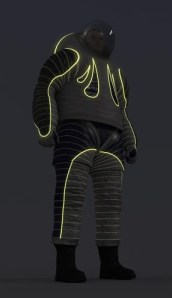
They are called the Z-series, a revolutionary new suit that is designed for walking on Mars as well as floating around in space and performing spacewalks. This new series is expected to replace the current aging design, which has been in continuous use on both space flights and aboard the International Space Station since 1982. In addition to updated technology and functionality, the new spacesuit also has an updated look.
The first design was unveiled back in December of 2012 with the Z-1, which bore a striking resemblance to Buzz Lightyear’s own spacesuit. The new version (the Z-2 series), which has different joint designs and a more durable torso, also comes with a trio of “flashy” cover designs that were made in collaboration with fashion students at Philadelphia University, and were inspired by biomimicry, the evolution of technology, and even – supposedly – street fashion.
And unlike the current microgravity suits, the Z-series is designed for walking in extra-terrestrial environments where gravity is the norm (i.e. the Moon and Mars). Intrinsic to the new design is flexibility: it makes it much easier to walk, bend, and pick things up off the surface of a planet or moon. It also goes on quite differently. Whereas the old suit is pulled on like a pair of pants and a shirt, the new version has a handy door built into the back so someone can climb inside.
As Bobby Jones, an engineer for ILC, the company that worked on the new design explained:
There are a lot of fundamental design differences between developing a microgravity suit versus a planetary walking suit. A lot of that has to do with how much mobility is built into the lower torso. With microgravity you’re using your arms to move around and your feet just hang out there. You can dock the suit up to your habitat or vehicle and leave it outside, so you don’t drag dust and other things into your cabin,” Jones explains.
As previously noted, anyone can help decide among the three cover designs by casting a vote on NASA’s website. One option, inspired by underwater creatures (and known as the “Biomimicry” suit), employs glowing wires to help the suit stay visible at night. A second version – known as the “Technology” suit – pays homage to past spacesuits and uses light-emitting patches along with wire. The third option, inspired by “Trends in Society”, uses electroluminescent wire and a bright color scheme to mimic the appearance of sportswear and the emerging world of wearable technologies.
NASA says the final design is “reflective of what everyday clothes may look like in the not too distant future,” pulling in elements of sportswear and wearable tech. NASA will move forward with the most popular cover in the public vote, and plans to have the suit ready for testing by the end of the year. And they are hardly alone in looking to create suits that can handle the challenges of future exploration. For example, it’s also worth checking out this MIT professor Dava Newman sleek Mars spacesuit, aka. the “Spiderman Spacesuit”, that is currently in development.
In the meantime, check out this video from Ted Talks where Newman showcases her Spiderman suit. And be sure to head over to the Johnson Space Center’s website and cast your vote for what NASA’s next-generation spacesuit will look like.
Yesterday, NASA officially announced that it intends to cease most work with the Russian Federal Space Agency amid growing tensions concerning the Ukrainian crisis. The statement came from Bob Jacobs, NASA’s deputy associate administrator of communications, who formalized the space agency’s position with a message sent to Universe Today, a copy of which was then posted on it’s Google+ message board on Wednesday, April 2nd.
In the statement, they indicate that while the International Space Station will still see work to “maintain safe and continuous operation”, most work with Roscosmos (Russia’s federal space agency) will cease. In addition, they were sure to include a reminder to Congress, saying that they now face a choice between fully funding human U.S. launches again in 2017, or facing years more of sending money to the Russians for Soyuz launches from Kazakhstan.
The full text of the statement appears as follows:
Given Russia’s ongoing violation of Ukraine’s sovereignty and territorial integrity, NASA is suspending the majority of its ongoing engagements with the Russian Federation. NASA and Roscosmos will, however, continue to work together to maintain safe and continuous operation of the International Space Station.
NASA is laser focused on a plan to return human spaceflight launches to American soil, and end our reliance on Russia to get into space. This has been a top priority of the Obama Administration’s for the past five years, and had our plan been fully funded, we would have returned American human spaceflight launches – and the jobs they support – back to the United States next year.
With the reduced level of funding approved by Congress, we’re now looking at launching from U.S. soil in 2017. The choice here is between fully funding the plan to bring space launches back to America or continuing to send millions of dollars to the Russians. It’s that simple. The Obama Administration chooses to invest in America – and we are hopeful that Congress will do the same.
So far, it’s not exactly clear what activities would constitute “safe and continuous operation” of the station. So, for example, whether or not NASA will continue to send photographers to cover launches and landing in Russia, or to what extent NASA TV broadcasts of Russian spacewalks would be affected, remains to be seen. And in the meantime, missions already scheduled for launch – such as Expedition 40, which will launch aboard a Soyuz spacecraft in May – are still expected to go ahead.
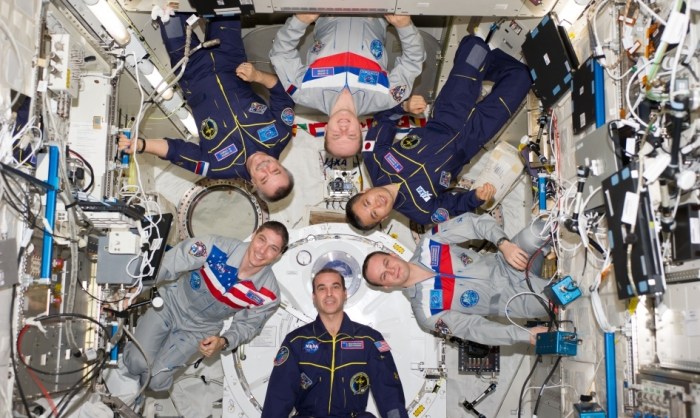
Since the Space Shuttle Program was retired in 2011, NASA and other space agencies such as the European Space Agency have relied on Russian Soyuz spacecraft to bring astronauts to the International Space Station. Crews are generally made up of large proportions of Russian cosmonauts and American astronauts, as well as a few astronauts from other agencies. The current Expedition 39 crew has has three Russians, two Americans and a Japanese commander, Koichi Wakata.
The relationship between NASA and Russia stretches back to the 1970s when Russia was still the Soviet Union, with their first joint mission (the Apollo-Soyuz Test Project) taking place in 1975. The relationship expanded when several NASA shuttles visited the Russian space station Mir in the 1990s, laying the groundwork for the International Space Station agreement today. And 2011, that relationship expanded considerably, with Russian rockets not only transporting ISS crews, but also US and European satellites into orbit.
NASA is working on a commercial crew program that right now is slated to bring U.S. astronauts back into space from American soil by 2017. There are several proposals being considered: a human-rated version of SpaceX’s Dragon, Blue Origin’s New Shepard, Sierra Nevada’s Dream Chaser and the Boeing CST-100. However, these depend upon continued funding and it is currently unclear how much money the CCP program will receive in the upcoming fiscal 2015 budget request before Congress.
Historically, NASA has repeatedly received less funding than what it has requested, which has resulted in missions being delayed – sometimes by years. But the new tensions with Russia may alter that situation somewhat, and judging from their statement, NASA is counting on this very thing. In the meantime, International Space Station operations were extended to at least 2024, and NASA officials have pointed out that it and similar agreements have weathered other world crises.

 Scientists have come up with the best computer model to date of the universe, one which maps the evolution of the cosmos in unprecedented detail. Known as Illustris, this virtual cosmos – which was created by U.S., English and German researchers using a network of supercomputers – includes details never before achieved in a simulation. All told, the numerical-based model covers the 13-billion-year evolution of the universe, beginning just 12 million years after the Big Bang took place.
 Given all the recent breakthroughs in physics and cosmology, this ultra-detailed virtual model should come as no surprise. For example, this past April, scientists made not only made the first-ever observation of gravitational waves, they also processed data that is believed to be the first real indication of the existence of Dark Matter. In addition, the ESA’s Planck mission released the most detailed thermal imaging map of the universe last year that placed an accurate date on the universe’s age and confirmed the validity of the Big Bang Theory.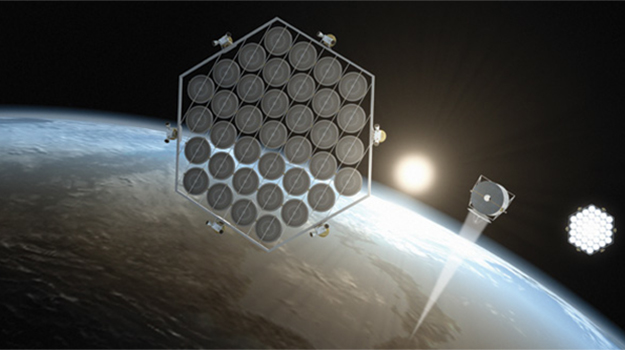
 Beyond Japan, solar power is considered the of front runner of alternative energy, at least until s fusion power comes of age. But Until such time as a fusion reaction can be triggered that produces substantially more energy than is required to initiate it, solar will remain the only
  Luckily, putting arrays into orbit solves both of these issues. Above the

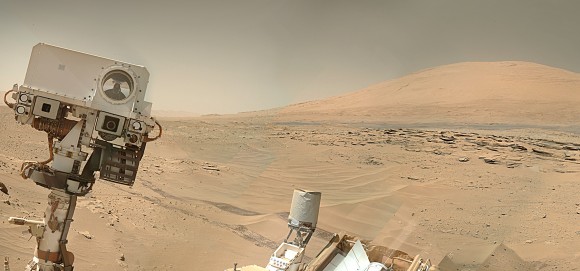 As for the latest in Curiosity’s long-line of panoramic self-portraits, this one comes to us courtesy of Jason Major. As a graphic designer and amateur space explorer, Major assembled the picture from about the dozen or so images acquired with the rover’s Mars Hand Lens Imager (MAHLI) instrument on April 27-28, 2014 (Sol 613). In the background, one can see the 5.5-km-high (3.4 miles) Mount Sharp (Aeolis Mons) that sits in the center of the Gale Crater.

 After initially joking that American astronauts would be left stranded on the ISS, he also recommended that NASA try using a trampoline to reach orbit. The joke was naturally irrelevant, since day-to-day operations involving the ISS are not going to be affected by these sanctions. Still, the inability to rely on Russian Soyuz’s in the near future will mean that US satellites – which are used for everything from GPS to spying – will be undeployable for the time being.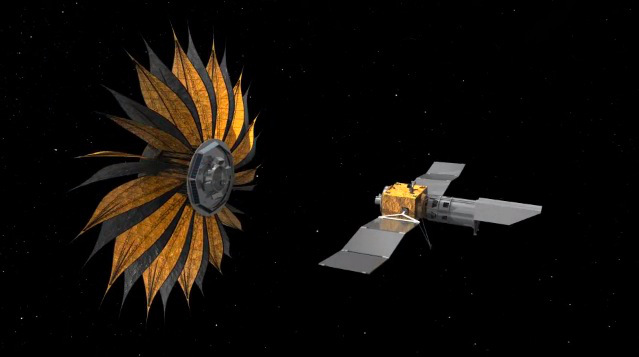


 Presumably SpaceX will provide another update in due course. In the meantime, they took the opportunity to release a rather awesome video of
 As Musk himself explained in a series of public statements and interviews after the launch: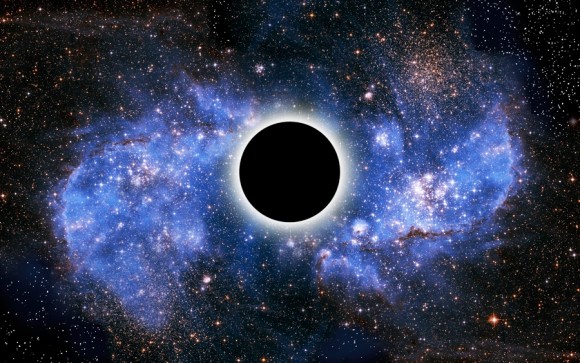


 And that’s not only discovery of cosmic significance that was made in recent months. In this case, the news comes from NASA’s Fermi Gamma-ray Space Telescope, which has been analyzing high-energy gamma rays emanating from the galaxy’s center since 2008. After pouring over the results, an independent group of scientists claimed that they had found an unexplained source of emissions that they say is “consistent with some forms of dark matter.”
 The galactic center teems with gamma-ray sources, from interacting binary systems and isolated pulsars to supernova remnants and particles colliding with interstellar gas. It’s also where astronomers expect to find the galaxy’s highest density of dark matter, which only affects normal matter and radiation through its gravity. Large amounts of dark matter attract normal matter, forming a foundation upon which visible structures, like galaxies, are built.


 And unlike the current microgravity suits, the Z-series is designed for walking in extra-terrestrial environments where gravity is the norm (i.e. the Moon and Mars). Intrinsic to the new design is flexibility: it makes it much easier to walk, bend, and pick things up off the surface of a planet or moon. It also goes on quite differently. Whereas the old suit is pulled on like a pair of pants and a shirt, the new version has a handy door built into the back so someone can climb inside.
 Yesterday, NASA officially announced that it intends to cease most work with the Russian Federal Space Agency amid growing tensions concerning the Ukrainian crisis. The statement came from Bob Jacobs, NASA’s deputy associate administrator of communications, who formalized the space agency’s position with a message sent to Universe Today, a copy of which was then posted on it’s Google+ message board on Wednesday, April 2nd.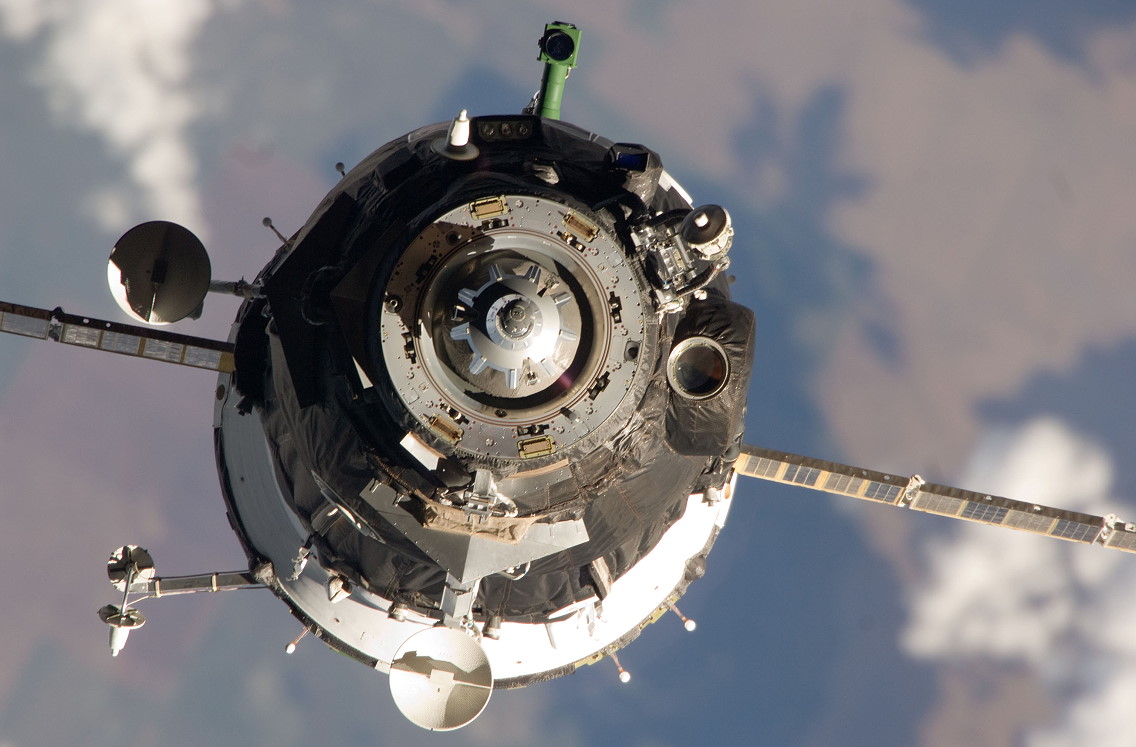
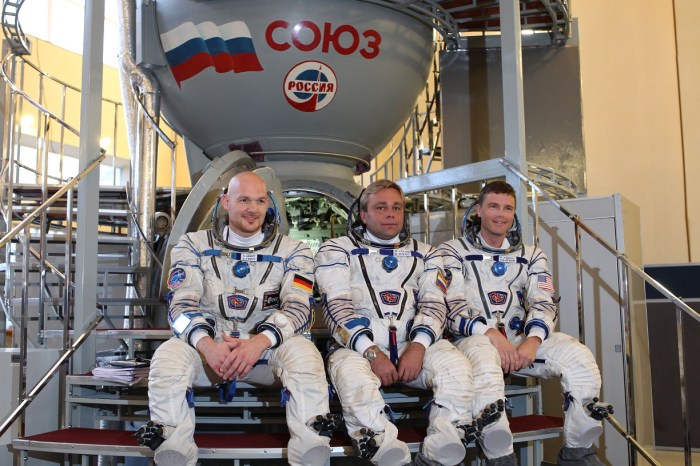 Since the Space Shuttle Program was retired in 2011, NASA and other space agencies such as the European Space Agency have relied on Russian Soyuz spacecraft to bring astronauts to the International Space Station. Crews are generally made up of large proportions of Russian cosmonauts and American astronauts, as well as a few astronauts from other agencies. The current Expedition 39 crew has has three Russians, two Americans and a Japanese commander, Koichi Wakata.
 NASA is working on a commercial crew program that right now is slated to bring U.S. astronauts back into space from American soil by 2017. There are several proposals being considered: a human-rated version of SpaceX’s Dragon, Blue Origin’s New Shepard, Sierra Nevada’s Dream Chaser and the Boeing CST-100. However, these depend upon continued funding and it is currently unclear how much money the CCP program will receive in the upcoming fiscal 2015 budget request before Congress.
 Stories by Williams