The Future is Here: The “Attention Powered” Car

attention_powered_CarDriver inattention, tunnel vision, and distraction are all major causes of road accidents. And while the law has certainly attempted to remedy this situation by imposing penalties against driving while on the phone, or driving and texting, the problem remains a statistically relevant one. Luckily, Emotiv and the Royal Automobile Club of Western Australia have joined forces to come up with a brilliant – albeit slightly unusual – solution.

It’s known as the “Attention Powered Car”, an automobile that features a neuroheadset made by Emotiv, creator of a range of electroencephalography-based monitoring gear. Basically, the driver straps on the headset while driving and  then interfaces with custom software to read the driver’s brainwaves. Any lapses in concentration are read by the headset and cause the vehicle to slow down to about 14 km/h (9 mph) as a way of alerting the driver.

emotiv_epocIn fact, the car – a Hyundai i40 – will only run at full capacity when it senses that drivers are giving their full attention to the task at hand. According to Pat Walker, RAC executive general manager:

The impact of inattention is now comparable to the number of deaths and serious injuries caused by speed and drink driving, which are all contributors to Western Australia consistently having the worst fatality rate of any Australian state. Nationally, it is estimated inattention was a factor in 46 percent of fatal crashes.

The prototype design is largely meant to bring attention to the issue of driver distraction, and also serve as a tool for investigating the problem further. Researchers have been using the car (on a track) to test how various tasks, such as switching radio stations or sending a text message, impact a driver’s attention. Factors measured include blink rate and duration, eye movement, and head tilts.

googlecarAnd while novel and pure science fiction gold, the concept is also quite due. Given the improvements made in EEG headsets in recent years, as well as computerized vehicles, it was really just a matter of time before someone realized the potential for combining the technologies to create a safer drive that still relied on a human operator.

While robot cars may be just around the corner, I imagine most people would prefer to still be in control of their vehicle. Allowing for a neuroband-operated vehicle may be just the thing to marry increased safety while avoiding the specter of a future dystopian cliche where robots handle our every need.

RAC WA has also produced a number of videos about the Attention Powered Car, including the one below. To check out others, simply click on this link and prepare to be impressed.


Sources: news.cnet.com, staging.forthebetter.com.au

The Future is Here: “Ironman” Spec-Ops Suit


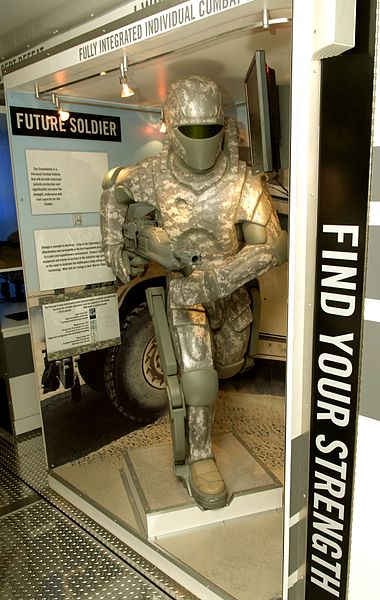
ironman3Army researchers have been working for years to incorporate powered armor, exoskeletons, and high-tech weaponry into the arsenal of next-generation soldiers. And this latest development from DARPA – the Defense Advanced Research Projects Agency, the research wing of the US Army – is being hailed as the closest thing there is to a real-life “Iron Man” suit to date.

Its known as the Tactical Assault Light Operator Suit (TALOS) and is designed to deliver “superhuman strength with greater ballistic protection”. Named in honor of the Greek automaton made of bronze that Zeus assigned to protect his lover Europa, this suit incorporates a powered exoskeleton, liquid armor, built-in computers and night vision, and the ability to monitor vital signs and apply wound-sealing foam.

DARPA-Warrior-Web-660x495Put together, the capabilities would make the already elite Special Operation Forces nearly invincible in the field, according to the Army. As Lt. Col. Karl Borjes, a U.S. Army Research, Development and Engineering Command (RDECOM) science adviser, said in a statement:

[The] requirement is a comprehensive family of systems in a combat armor suit where we bring together an exoskeleton with innovative armor, displays for power monitoring, health monitoring, and integrating a weapon into that — a whole bunch of stuff that RDECOM is playing heavily in.

For the sake of the suit’s design and high-tech features, DARPA reached out to engineers from MIT, who are currently working to produce the liquid body armor that is perhaps the most advanced feature of the suit. Composed of magnetorheological fluids, this armor will “transform from liquid to solid in milliseconds when a magnetic field or electrical current is applied.”

TALOS_Future_Army_Soldier_WideThe suit is expected to make a first-generation appearance some time next year. Because of the high number of highly integrated technical challenges with advanced specifications, the Army is also drawing on a broad range of collaborators from multiple fields to complete the design in time. And as Jim Geurts, USSOCOM acquisition executive, in a statement:

USSOCOM is interested in receiving white papers from a wide variety of sources, not just traditional military industry but also from academia, entrepreneurs, and laboratories capable of providing the design, construction, and testing of TALOS related technologies. The intent is to accelerate the delivery of innovative TALOS capabilities to the SOF operator.

US_Army_powered_armorFor some time now, the concept of advanced powered suits of armor has been a feature of science fiction. Examples abound from literary references, such as E.E. Smith’s Lensman series and Heinlein’s Starship Troopers, to RPGs like BattleTech and Warhammer 40k, and to the gaming world with the HALO and Fallout series’. And much like lightsabers, there has scarcely been a geek alive who didn’t want one!

Now it seems that something very close might be realizable within a year’s time. I don’t know about you, but I feel both inspired and more than a little jealous. Damn SOCOM, always getting the coolest gear first! And of course, there’s a video:


Sources:
wired.com, dailytech.com
,

The Future is Here: The Factory in a Box

factory_box3-D Printing has proven itself quite useful when it comes to creating components, toys, and models. But when it comes to assembling complicated parts, or full-on products, other machines are often necessary. That’s where the Microfactory comes in, a veritable “multi-tool” machine that merges the best of 3-D printing and machining.

Being touted as “a machine shop in a box”, the creators of the device (the Mebotics company) were inspired to create this multi-tool kit after collaborating at the Boston-area Artisans Asylum. Artisans Asylum is a non-profit organization dedicated to promoting hobbyists, artisans, fabricators and entrepreneurs through a series of open maker space presentations.

factory_box2In addition, the team was also inspired by the fact that most manufacturing systems suffer from two major downfalls: noise and mess. By “closing the system”, as they put it, they eliminated both hassles while still ensuring that their device is capable of both producing tailor-made objects and altering them to order.

The Microfactory dramatically expands the range of products a person with no other equipment could make. It is basically able to 3-D print in four colors, out of multiple materials, and also etch, and mill the final products. This process, which combines machining and printing, is what the makers refer to as “hybrid manufacturing.”

3D-printing-in-spaceAs Co-founder of Mebotics, Jeremy Fryer-Biggs, explains:

I wanted to have a machine that was capable of making parts for all the crazy stuff people people would ask me [to make]. I wanted a tool that would allow me to do a whole wide range of things.

As Fryer-Biggs and the team envision it, the Microfactory could also offer users the ability to create devices and components where they are needed, regardless of the location. With a fully-functional computer incorporated to provide the blueprints, they foresee some extreme scenarios where objects could be created and finished where no stores are available:

You’re at base camp in the Himalayas, you’re in the middle of Afghanistan and you wanna make a part. So you connect this thing to a Wi-Fi hotspot–if you have a Wi-Fi card in the machine that you put in. You can then download from the server whatever the replacement part is you need, and in the middle of nowhere, get your replacement.

3d_ISSThis vision is in keeping with what many scientific organizations – such as NASA, the ESA, and other space agencies – are foreseeing. Already, such devices are being considered for use on the International Space Station and on future space missions, where astronauts will always be in need of specialized tools and may not have the ability to have them shipped out to them.

The team currently has several working prototypes but is planning to bring the project to market by raising $1 million through Kickstarter. MicroFactory units are being pre-sold for between $4,000 and $10,000 in several models. Though the team admits that the price is high, the science fiction appeal alone is well worth it! As Marie Staver, a project manager on the team, put it: “The science fiction future is officially here.”

Couldn’t agree more. And in the meantime, check out this video of the Microfactory in action:

Sources: fastcoexist.com, mebotics.com, artisansasylum.com

3-D Printed Prosthetics: The Open Hand Project

Open_Hand3-D Printing has been a boon for a number of industries, offering a cheaper method of production and sending those savings onto the consumer. One such industry is prosthetics, which is taking advantage of the new technology to cheaply generate all the components needed to create robotic replacement limbs. And with the proliferation of models, amputees and accident victims have a range of options that was previously unimaginable.

The latest comes to us from Bristol in the UK, where the robotics company known as The Open Hand Project has developed a robot limb that is cheaply produced and can be purchased for under £650 (or roughly $1000 US). At this price, their prosthetic device – known as the Dextrus robot hand = is significantly cheaper than existing robotics technology.

Open_hand3Inventor Joel Gibbard first came up with the idea for the Dextrus robotic hand while studying Robotics at the University of Plymouth in 2011. He developed a prototype for his final-year project before leaving to work for National Instruments. After two years in the workplace, he left his job in March 2013 to launch the Open Hand Project, an open-source venture that aims to make robotic prosthetic hands accessible for people in the developing world.

Gibbard’s hand relies entirely on off-the-shelf DC motors with a spool on the end that connects to a steel “tendon” that can be tightened and loosened when the user wants to move their fingers. The outer casing is composed of 3D-printed plastic parts that act like bones while a rubber coating acts as the skin. The user can control the fingers using electomyographical signals picked up from the muscle in their arm using stick-on electrodes.

open_hand2As Gibbard explained in an interview with Wired magazine:

Each finger is individually actuated so you can grasp funny shaped objects. It’s not all that complicated. I’ve put a little tensioner in between each one so you have a bit of mechanical compliance. Even if an amputee has lost their hand, all of the muscles are still in the forearm and they can still flex them, so you can use that signal.

Already, the prosthesis was tested out by a chef named Liam Corbett, who lost his hand to meningitis two years ago and contacted Gibbard via Facebook when he heard about the Open Hand Project. According to Corbett, he was very impressed with the device and said that:

I think it’s certainly going to enable me to do the finer things in life which I certainly haven’t been able to do with a hook… I would be proud to wear this, it would make me feel more confident.

open_hand1Gibbard hopes to refine the design to cut down on the electrical noise it produces, and to develop specialized software to configure the electrodes to simplify the calibration process. Back in September, he opened up a crowdfunding campaign with Indiegogo to raise the necessary money. As of writing this article, he has surpassed his goal of £39,000 and raised a total of £41,065.

However, there is still four days left before the campaign closes. So if you want to donate, thus enabling GIbbard and his colleagues to refine the design further, simply click here and follow the prompts. And be sure to check out the Indiegogo video to see how the hand works:


Sources: wired.co.uk, indiegogo.com

The Future is Here: Carbon Nanotube Computers

carbon-nanotubeSilicon Valley is undergoing a major shift, one which may require it to rethink its name. This is thanks in no small part to the efforts of a team based at Stanford that is seeking to create the first basic computer built around carbon nanotubes rather than silicon chips. In addition to changing how computers are built, this is likely to extend the efficiency and performance.

What’s more, this change may deal a serious blow to the law of computing known as Moore’s Law. For decades now, the exponential acceleration of technology – which has taken us from room-size computers run by punched paper cards to handheld devices with far more computing power – has depended the ability to place more and more transistors onto an individual chip.

PPTMooresLawaiThe result of this ongoing trend in miniaturization has been devices that are becoming smaller, more powerful, and cheaper. The law used to describe this – though “basic rule” would be a more apt description – states that the number of transistors on a chip has been doubling every 18 months or so since the dawn of the information age. This is what is known as “Moore’s Law.”

However, this trend could be coming to an end, mainly because its becoming increasingly difficult, expensive and inefficient to keep jamming more tiny transistors on a chip. In addition, there are the inevitable physical limitations involved, as miniaturization can only go on for so long before its becomes unfeasible.

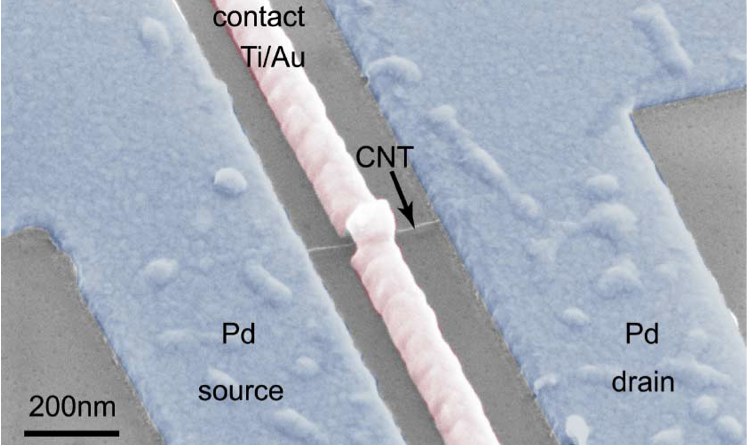
carbon_nanotubecomputerCarbon nanotubes, which are long chains of carbon atoms thousands of times thinner than a human hair, have the potential to be more energy-efficient and outperform computers made with silicon components. Using a technique that involved “burning” off and weeding out imperfections with an algorithm from the nanotube matrix, the team built a very basic computer with 178 transistors that can do tasks like counting and number sorting.

In a recent release from the university, Stanford professor Subhasish Mitra said:

People have been talking about a new era of carbon nanotube electronics moving beyond silicon. But there have been few demonstrations of complete digital systems using this exciting technology. Here is the proof.

Naturally, this computer is more of a proof of concept than a working prototype. There are still a number of problems with the idea, such as the fact that nanotubes don’t always grow in straight lines and cannot always “switch off” like a regular transistor. The Stanford team’s computer’s also has limited power due to the limited facilities they had to work with, which did not have access to industrial fabrication tools.

carbon_nanotube2All told, their computer is only about as powerful as an Intel 4004, the first single-chip silicon microprocessor that was released in 1971. But given time, we can expect more sophisticated designs to emerge, especially if design teams have access to top of the line facilities to build prototypes.

And this research team is hardly alone in this regard. Last year, Silicon Valley giant IBM managed to create their own transistors using carbon nanotubes and also found that they outperformed the transistors made of silicon. What’s more, these transistors measured less than ten nanometers across, and were able to operated using very low voltage.

carbon_nanotube_transistorSimilarly, a research team from Northwestern University in Evanston, Illinois managed to create something very similar. In their case, this consisted of a logic gate – the fundamental circuit that all integrated circuits are based on – using carbon nanotubes to create transistors that operate in a CMOS-like architecture. And much like IBM and the Standford team’s transistors, it functioned at very low power levels.

What this demonstrated is that carbon nanotube transistors and other computer components are not only feasible, but are able to outperform transistors many times their size while using a fraction of the power. Hence, it is probably only a matter of time before a fully-functional computer is built – using carbon nanotube components – that will supersede silicon systems and throw Moore’s Law out the window.

Sources: news.cnet.com, (2), fastcolabs.com

The Future of Medicine: Anti-Bleeding Clamps

itclamp2For centuries, medics have been forced to deal with cuts and lacerations by simply binding up wounds with bandages and wraps. Time has led to refinements in this process, replacing cloth with sterile bandages. But the basic process has remained the same. But now, severe cuts and bleeding have a new enemy, thanks to a new breed of clamping devices.

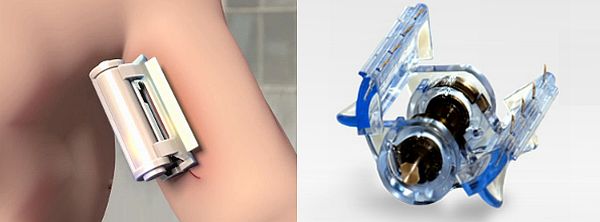
One such device is the iTClamp Hemmorage Control System, which won an award for top innovation in 2012 and was recently approved by the FDA. Basically, this clamp is placed over an open wound and then controls bleeding by sealing the edges shut to temporarily create a pool of blood under pressure and thereby form a clot that helps reduce more blood loss until surgery.

itclampThis past summer, the clamp got its first field test on a man who fell prey to a chainsaw wound on his upper arm just outside of Olive Branch, Mississippi. The hospital air crew who arrived on scene quickly determined that a tourniquet would not work, but were able to stop the bleeding and stabilize the patient within minutes, at which point they transported him to the Regional Medical Center of Memphis.

The clamp was invented by Dennis Filips, who served three tours in Afghanistan as a trauma surgeon for the Canadian Navy. With the saving of a life in the US, he has watched what began as an idea turn into a dream come true:

To have our first human use in the US turn out so well is thrilling, and we look forward to getting the iTClamp into the hands of first responders across the country and around the world.

ITClamp3The clamp is currently being sold for around $100 via various distributors across the US, and it’s available in Canada and Europe as well. At that price it could very well end up being adopted not only by first responders, but climbers and other adventurers looking to beef up their first-aid kits — and maybe the cautious chainsaw wielders among us as well.

And be sure to check out this video simulation of the iTClamp in action:


Sources: news.cnet.com, theepochtimes.com

News From Space: XS-1 Reusable Spacecraft

sx-1_spaceplaneWhen it comes to the future of space exploration, the ongoing challenge has been to find a way to bring down the costs associated with getting things into orbit. In recent years, a number of solutions have been presented, many of which have been proposed by private companies like SpaceX and Reaction Engines. Not to be outdone, the US government has its own proposal, known as the XS-1.

Developed by DARPA, the XS-1 is the latest in a string of designs for a reusable spacecraft that would be capable of taking off and landing from an airfield. But unlike its predecessors, this craft would be a two-stage craft that has no pilot and is controlled much like a drone. By combining these two innovations, DARPA foresees an age where a “one day turnaround,” or daily launches into space, would be possible.

skylon-orbit-reaction-enginesBasically, the XS-1 will work as a two-stage flyer, beginning as a regular high-altitude drone meant to fly as high as possible and reach hypersonic speed. Once this has been achieved, the payload will separate along with an expendable launch system with a small tank of rocket fuel which will then be automatically delivered to its final destination. The plane, meanwhile, will automatically return to base and begin prep for the next day’s mission.

In addition to being cheaper than rockets and space shuttles, an XS-1 space plane would also be much faster than NASA’s now-retired STS shuttles. Much like Reaction Engines Skylon concept, the ship is designed for hypersonic speeds, in this case up to Mach 10. While this might sound incredibly ambitious, NASA has already managed to achieve a top speed of Mach 9.8 with their X-43A experimental craft back in 2004 (albeit only for ten seconds).

x-43a The XS-1′s payload capacity should be around 2300 kilograms (5000 pounds) per mission, and DARPA estimates that a single launch would cost under $5 million. Currently, it costs about $20,000 to place a single kilo (2.2lbs) into geostationary orbit (GSO), and about half that for low-Earth orbit (LEO). So while DARPA’s requirements are certainly stringent, they would cut costs by a factor of ten and is within the realm of possibility.

As it stands, all ideas being forth are centered around reinventing the rocket to make launches cheaper. When it comes to long-term solutions, grander concepts like the space elevator, the slingatron, or space penetrators may become the norm. Regardless, many of the world’s greatest intellectual collectives have set their sights on finding a more affordable path into space. These advanced launch jets are just the first step of many.

Sources: extremetech.com, news.cnet.com

News From Space: 3-D Printed Spacecraft

3D_spaceprinting13D-Printing has led to many breakthroughs in the manufacturing industry in recent years. From its humble beginnings assembling models out of ABS plastic, the technology has been growing by leaps and bounds, with everything from construction and food printing to bioprinting becoming available. And as it happens, another major application is being developed by a private company that wants to bring the technology into orbit.

It’s called SpiderFab, a system of technologies that incorporates 3-D printing and robotic assembly to create  “on-orbit” structures and spaceship components (such as apertures, solar arrays, and shrouds). Developed by tech firm Tethers Unlimited, Inc. (TUI), the project is now in its second phase and recently landed a $500,000 development contract from NASA.

spiderfabOne of the greatest challenges of space exploration is the fact that all the technology must first be manufactured on Earth and then shuttled into orbit aboard a rocket or a shroud. The heavier the cargo, the larger the rocket needs to be. Hence, any major undertaking is likely to have a massive price tag attached to it. But by relocating the manufacturing process to a place on-site, aka. in orbit, the entire process will be much cheaper.

Towards this end, the SpiderFab, incorporates two major innovations in terms of transportation and manufacture. The first makes it possible to pack and launch raw materials, like spools of printable polymer, in a cost-effective way using smaller rockets. The second uses patented robotic fabrication systems that will process that material and aggregate it into structural arrangements.

3D_spaceprintingDr. Rob Hoyt, CEO of TUI, had this to say of his company’s brainchild in a recent interview with Co.Design:

SpiderFab is certainly an unconventional approach to creating space systems, and it will enable significant improvements for a wide range of missions.

The unorthodox system is also a solution to the problem that Hoyt began working on two decades ago when he first began working with NASA. While there, he experimented with on-orbit fabrication as a concept, but was limited due to the fact that there were no means available to make it reality. However, once 3-D printing became mainstream, he seized the opportunity presented. As he explains:

I didn’t strike on anything dramatically better than [previous investigations] until about six years ago, when additive manufacturing was really starting to take off. I realized that those techniques could be evolved to enable some dramatic improvements in what we can build in space.

spiderfab3At present, TUI is working on several different models of what the SpiderFab will eventually look like. The first of these is known as the Trusselator, one of many building blocks that will form the factory responsible for producing spacecraft components. The Trusselator is designed to print high-performance truss elements, while another, the Spinneret, will use 3-D printing-like techniques to connect and fuse together clusters of trusses.

Hoyt says that the TUI team will be further testing these processes in the next couple of months, first in the lab and then in a thermal-vacuum chamber. He hopes, however, that they will be able to conduct an on-orbit demonstration of SpiderFab a few years down the line. And with any luck, and more funding, NASA and other agencies may just convert their production process over to orbital 3-D printing facilities.

Alongside concepts like the SpaceX Grasshopper reusable rocket and reusable space craft, 3-D space printing is yet another revolutionary idea that is likely to bring the astronomical (no pun!) costs of space exploration down considerably. With affordability will come growth; and with growth, greater exploration will follow…

Star-Trek-universe

Sources: fastcodesign.com, tethers.com

Powered by the Sun: New Film Increases Solar Efficiency

sun_magneticfieldWith every passing year, solar power is getting cheaper and more efficient. And with every development that brings costs down and increases electrical yields, the day that it comes to replace fossil fuels and coal as the primary means of meeting our power needs gets that much closer. And with this latest development, this changeover may be coming sooner than expected.

It comes from North Carolina State University where researchers have developed a new system for strengthening the connections between stacked solar cells which could allow cells to operate at concentrations of up to 70,000 suns while minimizing wasted energy. This is especially good news seeing as how stacked cells are already an improvement over conventional solar cells.solar_panelStacked solar cells are made up of several cells that are placed one on top of the other, an arrangement that allows up to 45 percent of the absorbed solar energy to be converted into electricity. This is a significant improvement over single-junction solar cells which have a theoretical maximum conversion rate of 33.7 percent, and is made possible by the fact a stack formation prevents heat from being lost between panels.

The team at NCSU discovered that by inserting a very thin film layer of gallium arsenide into the connecting junction of stacked cells, they can eliminate energy loss ever further. The idea was inspired by the fact that cells typically start to break down at the connection junctions once they reach concentrations of 700 suns. With the addition of gallium arsenide in these spots, the connections become stronger, and all without sacrificing absorption.

solar_cell1Dr. Salah Bedair, a professor of electrical engineering at NCSU and senior author of the paper on this research:

Now we have created a connecting junction that loses almost no voltage, even when the stacked solar cell is exposed to 70,000 suns of solar energy. And that is more than sufficient for practical purposes, since concentrating lenses are unlikely to create more than 4,000 or 5,000 suns worth of energy.

At the moment, this technology is geared towards large scale solar power operations. Stacked cells are usually used in conjunction with optical concentration devices, such as Fresnel lenses, and mounted on a dual-axis solar trackers that keep the cell facing the Sun’s rays during daylight. So basically, we’re not likely to be seeing this technology available for local use. But it would be surprising if domestic consumers weren’t likely to benefit from it all the same.

solar_cell_galliumAs Dr. Bedair explained, the adoption of the technology will mean lower costs for the energy industry, and smaller arrays which will mean less land that needs to be set aside for use:

This [system] should reduce overall costs for the energy industry because, rather than creating large, expensive solar cells, you can use much smaller cells that produce just as much electricity by absorbing intensified solar energy from concentrating lenses. And concentrating lenses are relatively inexpensive.

What’s more, gallium arsenide is not exactly cheap to produce at the time. However, with constant refinements being made in industrial production processes, we can expect the cost of these to come down as well. As with everything else with solar power and renewable energy, its only a matter of time…

Source: gizmag.com

The Future is Here: Self-Healing Polymer

t1000I’ve heard of biomimetics – machinery and synthetics that can imitate organic materials – but this really takes the cake! In an effort to pioneer components and devices that would posses the regenerative powers of skin, a Spanish researcher Ibon Odriozola – who works for the CIDETEC Centre for Electrochemical Technologies in Spain – has created a polymer that could lead to a future where repairing machinery is as easy as suturing an open wound.

Comprised of a poly (urea-urethane) elastomeric matrix, the material is basically a network of complex molecular interactions that will spontaneously cross-link to “heal” most any break. In this context, the word “spontaneous” means that the material needs no outside intervention to begin its healing process, no catalyst or extra reactant.

healing-polymer-headerTo experiment with the material, Odriozola cut a sample in half with a razor blade at room temperature. And in just two hours, the cut healed itself with 97% efficiency. The reaction, called a metathesis reaction, has led Odriozola to dub the material his “Terminator” polymer, in reference to you-know-who (pictured above). Though the transition process takes a little longer, and involves polymers instead of metal, the basic principle is the same.

Unlike other self-healing materials, this one requires no catalyst and no layering. In addition to being very impressive to behold, this technology can extend the life spans of plastics that are under regular stress.  The group’s main goal now is to make a harder version, perhaps one that could be formed into such parts itself. As it exists today, the polymer is squishy and somewhat soft.

???????????In addition, a good self-healing material like this is a boon for ongoing efforts to find a viable material for artificial skin. Self-healing technology could also open the door to growth materials, as new units of the matrix could be incorporated as the material stretches and tears on the microscopic level. This would be especially useful when it comes to artificial skin, since it could grow over time and remove the need for replacement.

And if the healing mechanism proves strong enough, it could even be used as an adhesive or a sealant in other materials and even electronics. Just think of it! Everything from windows, to personal devices, to joints that are in need of padding. A simple injection of this type of material, and the breaks and aches go away. And given the progress being made with androids and life-like robots, its use as a source for artificial skin could go a long way to making them anthropomorphic.

And as usual, there’s a cool demonstration video. Enjoy!


Source: extremetech.com