Real-life Robocop?

Imagine if you will, a machine that gives disabled police officers a chance to continue working with the force, but from the comfort and safety of an office. Rather than walking the beat and putting themselves in harm’s way, they could telepresence themselves to the streets through a robot body, one which does the job of getting around and locating offenders, while they issue the arrests and infractions. This is the concept that lies behind a new breed of patrol robot that is being developed by Lieutenant Commander Jeremy Robins and Florida International University’s Discovery Lab.

Initially, Robins began this program as a way of bringing some of the thousands of disabled police officers and soldiers in the U.S. back to the workforce. Ultimately, this would call for the creation of a “telebot” that is not only equipped with the latest in wireless technology, but also one that can get around and take some serious punishment. In many ways, this is an elaboration on the concept of Robocop, the hybrid man-machine that stole our hearts back in the 80’s with his signature lines: “You’re move creep!” and “Dead or alive, you are coming with me!” And let’s not forget that sweet gun trick!

But of course, these new robots would be asked to do less adventurous things than the gun-toting cyborg who saved Old Detroit. In addition to working as patrol officers, they would responsible for handling all the regular tasks of police officers. These would include responding to 911 calls, writing traffic tickets, patrolling specific routes, and staying vigilant for law breakers. In addition, they could also be charged with safe guarding government and high-value facilities from terrorists or other criminals, doing both surveillance and acting as an on-site security force.

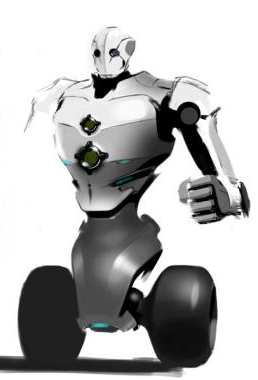
Early sketches of the robot give some indication of what it would look like. Essentially, it would have to be mobile, which would call for a wheeled chassis. It would have to be ambulatory, which would require arms. And it ought to have some semblance of a person, since it would be expected to carry the officer’s voice and interact with people. In essence, even little children need to be able to approach this robot and ask it if it can help them find their mothers.

An early rendition, shown here, has been appropriately named “Tough Guy”. Like all other design ideas, the end result calls for a robot that has a two-wheeled chassis, a mobile upper body, and a head that carries a two-way audio and video device so that the officer commanding it can both view and interact with the robots and environment and other people.

Already, the Discovery Lab has announced that the end product will be military grade and usable by the army under the 2 million dollar initiative that DARPA’s (Defense Advanced Research Projects Agency) set up years ago. Robins is also trying to get NASA to sign on with its Robonaut tech – a program to develop a robotic astronaut. So while the end product will be used primarily by police, plans are already in place to expand it to other areas – such as military operations and unmanned space exploration – as well.

Poalo Solari and the Birth of Arcology

Arcology: noun (plural arcologies) an ideal integrated city contained within a massive vertical structure, allowing maximum conservation of the surrounding environment. Origin: 1969: blend of architecture and ecology.

The question of what to do about Earth’s growing population – 7 billion and counting – and the environmental impact it is having has been on the minds of city planners, environmentalists, and global leaders for qu9ite some time. Far from it being a simple matter of determining how we are going to feed new every mouth we create, there’s also the question of how to provide for their other basic needs.

In the 20th century alone, humanity grew by multiplication factor of six. Cities expanded, suburban developments went up, and inner cities were “rezoned” and redeveloped in order to make room for them. When horizontal space became an issue, vertical structure were adapted, incorporating sky scrapers and massive high-rises. In addition, cities, counties and entire nations needed to find more sources of fresh water to address their health and sanitation needs, more landfills to accommodate waste, and more green spaces to grow food. In time, it soon became clear that this increased output of human beings and their various wastes was causing irreparable harm to the planet.

By the turn of the century, the projections only became worse, thanks in large part to the ongoing industrialization of developing nations. In these parts of the world, where a full third of the human race resides, the impact of so many new power plants, urban developments, superhighways, and fossil-fuel burning cars could not be underestimated. The problem of providing space for our people and seeing to their needs in a way that is sustainable in the long term has only become more pressing as a result.

As it turns out, the answer may lie in a concept developed in the 1960’s by a man named Paolo Soleri. An architect of Italian descent who studied at the feet of architect Frank Lloyd Wright, he is credited with coining the term “arcology”, a new form of architecture that plotted the creation of three-dimensional hyperstructures that would be self-sufficient, and in some cases, self-contained. Primarily proposed as a means to combat two-dimensional urban sprawl, arcologies were also meant to economize on transportation, energy use, commerce and agriculture. All needs, which included the need to reduce waste and impact on the environment, were incorporated in his new designs. And on top of that, they would be beautiful as well as very, very big.

One of his first designs was for a city-structure named Babel (or IID as it’s officially designated). This design called for a flared cylinder of apartments sitting in a saucer-shaped base, complete with commercial, civil spaces, and public areas. The estimated population for this monster design was 550,000 people – the population of a major city – but placed in an edifice 1900 meters high and 3000 meters at its widest point.

Close-ups of the design show the immense attention to detail that Soleri’s featured in his drawings. From housing, to production centers to water treatment and waste disposal, nothing was overlooked. And just in case you’re having problems imagining the scale, he features a picture of the Empire State building for a size comparison.

And then there was Hexadredon, an incredible geometric mountain resting on three immense supports. Accommodating over 170,000 people, it measured a mere 800 meters by 800 meters (640 square km). On top of all that, it looks immensely artistic, incorporating such design features as massive pyramids, support columns, and rotundas. In reality, it looks more like an ancient temple than a three-dimensional city.

His many other concepts involved cities adrift on water, built into canyons, or on the side of cliffs. As far as Soleri was concerned, nothing was off limits. Any and all geographic features and landscapes, including the ocean itself, could be built into human habitats. Though it remained somewhat speculative for its time, Soleri’s ideas formed the basis for a great deal of speculative writing and urban planning.

For instance, in Japan, urban planners have proposed a future city development to deal with urban sprawl in Tokyo – known as the Shimizu Mega-City Pyramid. As it stands, much of Tokyo Harbor is artificial, composed of fill in order to accommodate Japan’s growing population and industrial centers. This further expansion calls for the creation of a massive pyramid measuring 730 meters high, 8 square kilometers at the base, and capable of housing 750,000 people. All told, it would be roughly 14 times the size of the pyramid of Giza.

In addition, there is the proposed building project in Moscow known as “Crystal Island”. Measuring in at a whopping 2500 square kilometers at its base and 450 meters high, it will be the single largest structure on Earth, if and when it is completed. Shaped like a massive tent, the superstructure of the proposed design acts as a sort of second skin to the main building, creating a thermal buffer and shielding the interior from Moscow’s harsh weather.

In addition, this second skin will adjust with the seasons and sealed in winter to minimise heat loss, while opened again in summer to naturally cool the interior. Power would also be provided by built-in wind turbines and solar panel, as well as a series of renewable energy solutions. On top of all that, the design incorporates an existing park, which provides a range of activities, including cross-country skiing and skating. Construction was officially postponed in 2009 due to the economic crisis, but is expected to resume in the coming years.

Last, but not least, there is the planned community of Masdar City, which I wrote about in a previous article. Though not technically an arcology in the sense of a three-dimensional colossal environment, the design nevertheless incorporates all other aspects of Soleri’s concept. These include renewable energy sources, sustainable resource management, mass-transit, recycled water, and a range of other green technologies.

Today, the planned city of Arcosanti, which Soleri himself began construction on in 1970, remains an unfinished testament to his work and his genius. Located in central Arizona, just 110 km north of Phoenix, this work-in-progress incorporates Soleri’s unusual design features and, though uncompleted, remains a testament to his vision.

Check out this video from Arcosanti website, which featured Solari’s design for the mega-city Nudging Space:

Robot Cars in Five Years?

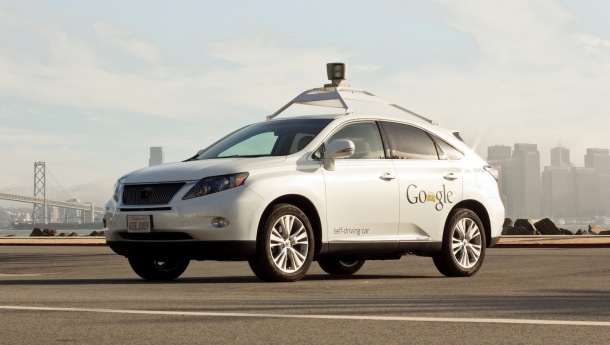
Could it be, that after decades of failed predictions, especially where flying cars were concerned, that science is finally making good on its promise of robot cars? Well, according to Google co-founder Sergey Brin, that’s what’s going to happen. Just two days ago, Brin was on hand for the signing of a bill in the California legislature which establishes safety and performance standards for cars operated by computers on California roads and highways. As the third state to pass this law – Nevada and Florida have already signed similar provisions – California will now allow licensed drivers to use automated vehicles, once they become commonplace.

Apparently, Google has been testing the concept quite extensively. Several prototypes have been developed, and over 300,000 miles worth of driving have been conducted for the sake of testing the software. Brin admits that their are bugs that still need to be worked out, such as improving the sensors and hardware failure supports for the technology. In addition, there are the big challenges of adapting the vehicles to “tricky situations”, such as weather conditions, temporary construction, and emergency vehicles. In any and all of these cases, the robots need to be able to interpret the situation and respond accordingly.

However, Sergey and Larry are confident, stating that “Our vehicles, of which about a dozen are on the road at any given time, have now completed more than 300,000 miles of testing. They’ve covered a wide range of traffic conditions, and there hasn’t been a single accident under computer control.” And, unless science fiction and futursist have been lying to me all this time, the robot cars are likely to come with manual control as well, just in case the driver feels the need to take the wheel and do a little hands-on driving! After all, the purpose of this technology is ensure our safety and comfort right? And what’s more comfortable than turning on the autopilot?

Source: CNET News

The Future Of Education

Hi all, and welcome to the third and final installment in the “Envisioning Technology” series. Today, it’s the “Future of Education Technology” that’s up for all to see. Much like their speculative work on Future Tech and the Future of Medicine, they present us here with an infographic that shows the interrelated fields of educational technology and how growth in one will inevitable lead to change in others.

On the one hand, we see a gradual transition from the Classroom (i.e. traditional educational environment) to the Studio environment, where a peer and group dynamic becomes the focus, rather than classic teacher-student transmission. In the final environment, learning becomes Virtual, divorced from any specific geographical context – i.e. it happens wherever you are, not just in a classroom or academic institution.

Also, through an incorporation of various education and education-related technologies, six steps are discerned within this process. As usual the entire process is traced from the present day to 2040, with many of the necessary technologies already in existence or in the process of development.

As a teacher, I was rather fascinated to see this, as it illustrates much of what was being espoused when I was still in teacher’s college. Back then, the concept of the post-modernist classroom was all the rage, even though there were many who insisted that this movement had passed.

Intrinsic to the concept was the deconstructing the traditional learning paradigm and even the classroom environment. Openness was the new rule, individuation the new philosophy and building on a student’s existing knowledge and experience, rather than simply handing them the curriculum and evaluated their assimilation thereof.

Naturally, many of us felt the same about all the concepts and ideas that were being thrown at us, in that they seemed highly idiosyncratic and theoretical. Missing from just about all the articles, studies and lectures we heard on the subject was mention of how this was to be done. Lectures on applied technology and new methods, on the other hand, seemed much more effective. Whereas the theory seemed to be commenting on trends that were happening, or still needed to happen, these lectures seemed to be showing us how.

Kind of makes you think… and in a way, I’m reminded of what men like George Orwell said. In 1984 (Goldstein’s Manifesto, to be specific), he claimed that the advent of modern industry and education had removed the basis of class distinction and elitism. By the 20th century, when totalitarian philosophies emerged, humanity was closer to the state of true equality that Marx predicted than ever before. Granted, that road has been fraught with bumps and attempts at subversion, but the general trend seems pretty clear.

Perhaps we’re seeing something of the same thing here with the emergence of IT and what people like Foucault, Derrida and Habermas predicted. The breakdown of singular standards, the opening of discourse, the plurality of perspective and opinions. Perhaps they weren’t just speaking off the cuff or stuck in an esoteric bubble. Maybe they were just picking up on trends which were yet to come to true fruition.

Makes me think, at any rate. But then again, that’s the point isn’t it?

Envisioning The Future of Health Technology

My thanks, yet again, to Futurist Foresight for providing the link to this fascinating infographic, which is the work of the good people at Envisioning Technology. People may remember this website from their work on “Envisioning Emerging Technology”, an infographic from a previous article which addressed the likelihood of interrelated technological developments in the coming decades. As a trend forecasting studio, compiling information and predictions into reports and tables in pretty much what these guys do. What a cool job!

In any case, here we have a table representing the future of health technology, as predicted by ET. Diving their findings into the fields of Augmentation, Biogerontology, Diagnostics, Telemedicine, Treatments, and Regeneration respectively, they attempt to show how small advancement in the near future will branch outwards to more radical ones in the not-too-distant future. The rough dates correspond to their previous graphic, starting with modern day research and culminating in 2040.

And of course, the infographic also shows how developments in all these fields over time will be interrelated, corresponding to different sub fields and becoming part of the ever-expanding field of advanced medicine. These sub fields include:

  • 3D Printing
  • Big Data
  • Cryonics
  • Life Extension
  • mHealth (health services supported by mobile devices)
  • Remote Virtual Presence
  • Neuroprosthetics
  • Sensors
  • Sensory Augmentation
  • Synthetic and Artificial Organs

Some inventions that are predicted include the Tricorder, 3D printed organs, artificial limbs, artificial eyes, cryogenic freezing, gene therapy, AI therapists, robotic nurses, robot surgery, implanted sensors, and exoskeletons. Wow, tricorders, really? In truth, I am often alarmed at what will be possible in the near future, but knowing that advancements are around the corner that could make life a lot healthier and happier for so many people gives me hope. Until next time!

How to Hack a Drone

What is the best way to test your security systems when you work in computers and/or software? Simple, ask the experts to hack it for you! That’s what IT firms have been doing for years now, and recently, the Department of Homeland Security decided to adopt the same tactic. Using a team from the University of Texas at Austin, the DHS asked them to test security on one of their infamous drones.

The team, led by professor Todd Humphreys, was offered $1,000 if they could successfully hack into a drone and order it to fly off course. Using this money, they invested in some simple off-the-shelf electronics and got to work. In the end, they were successful and were able to “spoof” the GPS on the Drone and send it into a dive, forcing it to level out shortly before crashing.

Naturally, this raised some obvious concerns. If a few specialists with $1,000 worth of equipment could hack the navigation system of a security drone, then foreign armies could do the same to military drones could likely do it with ease. What’s more, earlier this year, Congress ordered the FAA to draft laws and regulations for the commercial and government use of the drones in American airspace.

Airmail is another option, where companies like FedEx would use drones to deliver parcels all across the country. And of course, domestic surveillance drones are something that are being widely adapted for use. With this mind, Humphreys and the DHS are wondering how hard it might be to turn a domestic UAV into a terrorist weapon, much as US planes were on 9/11.

Scary stuff! But then again, this is why these exercises are conducted. By paying others to find the holes, its that much easier to patch them and ensure no one else ever can. As such, I think we all sleep a little safer knowing that drones are just spying on us, and not trying to kill us… yet!

Hello Hyperbike!

Thanks to Popular Mechanics for turning me onto this recent invention! Back in 2007, an inventive engineer named Curtis DeForest created a contraptio nas a safe and effective alternative to the traditional bike. He called it the Hyperbike, and one look at the contraption will tell you why! Featuring three wheels, the vehicle is a full-body machine that utilizes hand and foot motions to generate speed. Since it does not require forward momentum to stand up, a rider is incapable of falling off, and can reach speeds of up to 50 mph.

DeForest also designed the prototype so that the rider’s center of gravity is below the spinning axis of the wheels – as opposed to above it, like in most bikes. This difference, along with its additional front wheel, increases stability, and also caught the attention of NASA. Impressed with its design and its possibility for use in low-gravity environments, the space agency invested in a new prototype. However, no updates have been made available on the progress of this development, and rumor has it NASA has moved on.

Too bad too! Tell me something like this wouldn’t be useful in a number of different environments. And I’m sure there’s plenty of military applications for something like this. Maybe add a gasoline engine, 800 hp, some missiles and some jump jets. Make a lovely Hyperbike, that would!


“How Nanotech Could Reengineer Us.”

My personal thanks to kwolph, the unidentified fellow who was nice enough to stop by and forward me the link to this rather interesting infographic. Courtesy of the Keithley Center, which designs electronic systems for measurement and analysis, this infographic shows how advances in nanotechnology might aid us in reinventing and augmenting the human body.

These include augmenting our brain chemistry by either delivering drugs directly to our receptors (which can include anti-depressants, stimulants, or pain killers), or the more audacious approach of enhancing our thought pattens and memory by actively building and repairing neural tissue. As such, things like mental illness, brain injuries and trauma could be overcome at last.

In addition, there’s plenty of enhancing our hearts, lungs, reinforcing our bones, repairing muscle tissue, enhancing our eyes, reflexes, strength, endurance. And, as they point out, by virtue of the female model, the scourge of breast cancer, which effects one in eight women, could be be wiped out. No mother’s or young women dying before their time anymore!

And of course, other entirely too common ailments, heart disease, prostate cancer, ovarian cancer, lung cancer, and every form of degenerative disease, could be nipped in the bud either through regular maintenance of the bodily tissues, or by correcting the fault at the genetic level.

There’s really no limit to what programmable nanomachines could do, once the technology was realizable of course. And above all, proven to be safe and effective. And since it would mean that human beings no longer would be subject to disease or degenerative conditions (a la aging), lives could be extended indefinitely, which is part and parcel of the whole “transhuman”, “posthuman” and “postmortal” concept.

Naturally, they used the image of a very pretty young woman for the display. Had it been a man I’m guessing they would have gone with a six foot tall dude with washer board abs and only 1 percent body fat. Why can’t they ever use a porked out old dude with man boobs? That’s what I’d like to know? Well, for one, such regular individuals don’t exactly inspire confidence in the consumer market, do they?

Transhumanism… The Shape of Things to Come?

“Your mind is software. Program it. Your body is a shell. Change it. Death is a disease. Cure it. Extinction is approaching. Fight it.”

-Eclipse Phrase

A lot of terms are thrown around these days that allude to the possible shape of our future. Words like Technological Singularity, extropianism, postmortal, posthuman, and Transhuman. What do these words mean? What kind of future do they point to? Though they remain part of a school of thought that is still very much theoretical and speculative, this future appears to be becoming more likely every day.

Ultimately, the concept is pretty simple, in a complex, mind-bending sort of way. The theory has it that at some point in this or the next century, humanity will overcome death, scarcity, and all other limitations imposed on us by nature. The means vary, but it is believed that progress in any one or more of the following areas will make such a leap inevitable:

Artificial Intelligence:
The gradual evolution of computers, from punch cards to integrated circuits to networking, shows an exponential trend upwards. With the concordant growth of memory capacity and processing speed, it is believed that it is only a matter of time before computers are capable of independent reasoning. Progress is already being made in this domain, with the Google X Labs Neural Net that has a connectome of a billion connections.

As such, it is seen as inevitable that a machine will one day exist that is capable of surpassing a human being. This sort of machinery could even be merged with a human’s own mind, enhancing their natural thought patterns, memory, and augmenting their intelligence to the point where their intelligence is immeasurable by modern standards.

Just think of the things we could think up once that’s possible. Well… you can’t exactly, but we can certainly postulate. For starters, such things as the Grand Unifying Theory, the nature of time and space, quantum mechanics, and other mind-bendingly complex fields could suddenly make sense to us. What’s more, this would make further technological leaps that much easier.

Biology:
Here we have an area of development which can fall into one of three categories. On the one hand, advancements in medical science could very well lead to the elimination of disease and the creation of mind-altering pharmaceuticals. On the other, there’s the eventual development of things like biotechnology, machinery that is grown rather than built, composed of DNA strands or other “programmable” material.

Lastly, there is the potential for cybernetics, a man-machine interface where organic is merged with the artificial, either in the form of implants, prosthetic limbs, and artificial organs. All of these, alone or in combination, would enhance a human beings strength, mental capacity, and prolong their life.

This is the meaning behind the word postmortal. If human beings could live to the point where life could be considered indefinite (at least by current standards), the amount we could accomplish in a single lifetime could very well be immeasurable.

Nanotechnology:
The concept of machines so small that anything will be accessible, even the smallest components of matter, has been around for over half a century. However, it was not until the development of microcircuits and miniaturization that the concept graduated from pure speculation and became a scientific possibility.

Here again, the concept is simple, assuming you can wrap your head around the staggering technical aspects and implications. For starters, we are talking about machines that are measurable only on the nanoscale, meaning one to one-hundred billionths of a meter (1 x 10⁻⁹ m). At this size, these machines would be capable of manipulating matter at the cellular or even atomic level. This is where the staggering implications come in, when you realize that this kinds of machinery could make just about anything possible.

For starters, all forms of disease would be conquerable, precious metals could be synthesized, seamless, self-regenerating structures could be made, and any and all consumer products could be created out of base matter. We’d be living in a world in which scarcity would be a thing of the past, our current system of values and exchange would become meaningless, buildings could build themselves, and out of raw matter (like dirt and pure scrap) no less, societies would become garbage free, pollution could be eliminated, and manufactured goods could be made of materials that are both extra-light and near-indestructible.

Summary:
All of this progress, either alone or in combination, will add to a future that we can’t even begin to fathom. This is where the concept of the Technological Singularity comes in. If human beings were truly postmortal (evolved beyond death), society was postscarce (meaning food, water, fuel and other necessities would never be in short supply), and machines would be capable of handling all our basic needs.

For Futurists and self-professed Singularitarians, this trend is as desirable as it is inevitable. Citing such things as Moore’s Law (which measures the rate of computing progress) or Kurzweil’s Law of Accelerating Returns – which postulates that the rate of progress increases exponentially with each development – these voices claim that it is humanity’s destiny to conquer death and its inherent limitations. If one looks at the full range of human history – from the Neolithic Revolution to the Digital – the trend seems clear and obvious.

For others, this prospect is both frightening and something to be avoided. When it comes right down to it, transhumanity means leaving behind all the things that make us human. And whereas some people think the Singularity will solve all human problems, others see it as merely an extension of a trend whereby our lives become increasingly complicated and dependent on machinery. And supposing that we do cross some kind of existential barrier, will we ever be able to turn back?

And of course, the more dystopian predictions warn against the cataclysmic possibilities of entrusting so much of our lives to automata, or worse, intelligent machines. Virtually every apocalyptic and dystopian scenario devised in the last sixty years has predicted that doom will result from the development of AI, cybernetics and other advanced technology. The most technophobic claim that the machinery will turn on humanity, while the more moderate warn against increased dependency, since we will be all the more vulnerable if and when the technology fails.

Naturally, there are many who fall somewhere in between and question both outlooks. In recent decades, scientists and speculative fiction writers have emerged who challenge the idea that technological progress will automatically lead to the rise of dystopia. Citing the undeniable trend towards greater and greater levels of material prosperity caused by the industrial revolution and the post-war era – something which is often ignored by people who choose to emphasize the down sides – these voices believe that the future will be neither utopian or dystopian. It will simply be…

Where do you fall?

The Future Is Here: The EyeTap

There has been some rather interesting and revolutionary technology being released lately, and a good deal of it involves the human eye. First, there was the Google Glasses, then there were the VR contact lenses, and now the new EyeTap! This new technology, which is consistent with the whole 6th sense computing trend, uses the human eye as an actual display and camera… after a fashion.

Used in conjunction with a portable computer, the EyeTap combines the latest in display technology and Augmented Reality which allows for computer mediated interaction with their environment. This consists of the device taking in images of the surrounding area, and with the assistance of the computer, augment, diminish, or otherwise alter a user’s visual perception of what they see.

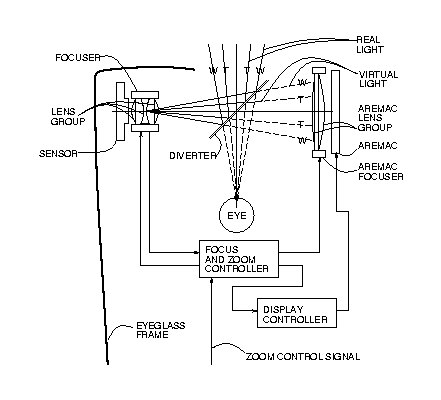
In addition, plans for the EyeTap include computer-generated displays so the user can also interface with the computer and do work while their AFK (Away From Keyboard, according to The Big Bang Theory). The figure below depicts the basic structure of the device and how it works.

Ambient light is taken in by the device just as a normal eye is, but are then reflected by the Diverter. These rays are then collected by a sensor (typically a CCD camera) while the computer processes the data. At this point, the Aremac display device (“camera” spelt backwards) redisplays the image as rays of light. These rays reflect again off the diverter, and are then collinear with the rays of light from the scene. The light which the viewer perceives is what is referred to as “Virtual Light”, which can either be altered or show the same image as before.

While the technology is still very much under development, it represents a major step forward in terms of personal computing, augmented reality, and virtual interfacing. And if this sort of technology can be permanently implanted to the human eye, it will also be a major leap for cybernetics.

Once again, Gibson must be getting royalties! His fourth novel, the first of the Bridge Trilogy, was named Virtual Light and featured a type of display glasses that relied on this very technology in order to project display images in the user’s visual field. Damn that man always seems to be on top of things!

And just for fun, here’s a clip from the recent Futurama episode featuring the new eyePhone. Hilarious, if I do so myself!