News From Mars: Mysterious “Thigh Bone” Revealed!

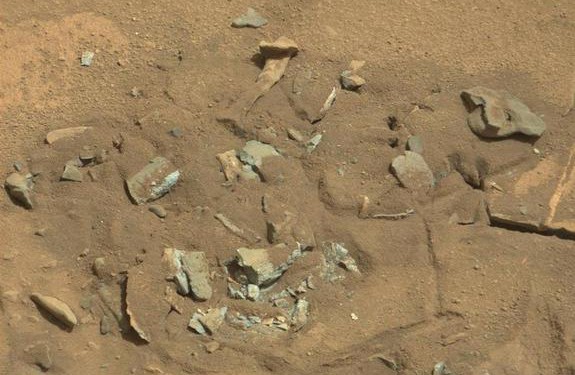
mars-thigh-bone-illusion-curiosity-photoTwo weeks ago, the Curiosity rover spotted an object on the surface of Mars that bore a striking resemblance to a femur (aka. athigh bone). This sighting caused a bit of a media stir and fueled speculation – mainly by conspiracy and UFO theorists – that proof of life on Mars had finally been found. This claim was quickly picked up by media outlets and began to spread like a bad strain of flu.

Alas, NASA has since announced that the finding, much like the Martian “donut” and “rat”, was just another piece of oddly-shaped rock. Mission scientists believe that here too, the rock was sculpted into its unusual shape by wind or water erosion. NASA announced all this when they released Curiosity’s “thigh bone” photo with a science explanation on Thursday (Aug. 21). In the caption, they said that:

No bones about it! Seen by Mars rover Curiosity using its MastCam, this Mars rock may look like a femur thigh bone. Mission science team members think its shape is likely sculpted by erosion, either wind or water.

If life ever existed on Mars, scientists expect that it would be small simple life forms called microbes. Mars likely never had enough oxygen in its atmosphere and elsewhere to support more complex organisms. Thus, large fossils are not likely.

MARS-COMET-surfaceIn short, the long-sought after signs of life that NASA is searching for have yet to be found. The Curiosity rover has found evidence that Mars was once a habitable place in the ancient past, mainly by determining with certainty that it once held water and a viable atmosphere. However, to date, there is no evidence that creatures large enough to leave a bone behind ever existed on the planet.

There is a long tradition of seeing shapes in Mars rocks that don’t reflect reality. The phenomenon in which the human brain perceives faces, animals or other shapes that aren’t really there is known as pareidolia; and when it comes to Mars, there is a long and fertile history of this taking place. In fact, in 1877 when astronomer Giovanni Schiaparelli looked up at Mars when it was in opposition, he spotted a network of lines that ran along the planet.

martian_canalsLater astronomers confirmed these sightings and erroneously thought them to be canals, an observation which was quickly seized upon by the popular imagination and spawned an entire mythos of there being a civilization on Mars. This civilization, made up of little green men known as Martians, is the entire basis of alien mythology which would go on to inspire 20th century works as The War of the Worlds and The Martian Chronicles.

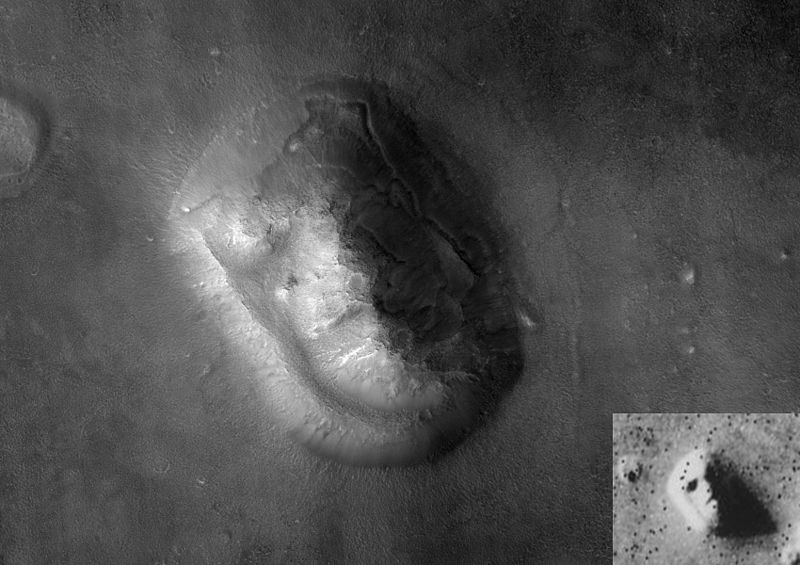
And for those old enough to recall, the “Martian face”, which was captured by the Viking Orbiter in 1976, is a more modern example. As you can see from the picture below (lower right hand), the low-resolution photos of the Cydonian mesa led many people to see a human face in it. This led to much speculation and more than a few crackpot theories about a civilization on Mars.

mars_faceHowever, high-res photos taken in 2001 by the Mars Global Surveyor probe (center) put these claims largely to rest by showing that the “face” was just an optical illusion. However, many of these same theorists moved on to claim that pyramid-like formations in that same region (Cydonia) so closely resembled those of Giza that there had to be a common explanation – i.e. aliens built the pyramids.

And in all cases, the golden rule seems to apply: never let little a thing like the facts or plausibility get in the way of a good story! As the rover continues on its long mission to find evidence of life on Mars, I am sure there will be plenty more pictures being seized upon by oddball theorists who are looking to peddle their oddball theories. Some of them are sure to be entertaining, so stay tuned!

Sources: cbc.ca, space.com

Powered by the Sun: Breakthrough Solar Cells

solar1In addition to becoming cheaper, and increasing in efficiency and yields, solar cell technology is also growing in terms of innovative design. By going beyond the conventional design of silicon panels and electrical cables, researchers are ensuring that solar technology can go farther. And the latest advances in design are especially far-sighted, aiming to merge solar technology with just about any surface, and even sending it into space.

In the former case, researchers at Michigan State University have created a fully transparent solar concentrator, which could turn any window or sheet of glass – from highrise buildings to the screens on smartphones and tablets – into a photovoltaic solar cell. And whereas other “transparent” solar panels have been designed in the past, this one is the first that truly lives up to the word.

transparent-solar-cellScientifically, a transparent solar panel is something of an oxymoron. Solar cells, specifically the photovoltaic kind, make energy by absorbing photons and converting them into electrons. If a material is transparent, by definition it means that all of the light passes through the medium. This is why previous transparent solar cells have actually only been partially transparent, and usually cast a colorful shadow.

To get around this limitation, the Michigan State researchers use a slightly different technique for gathering sunlight. Instead of trying to create a transparent photovoltaic cell, they used a transparent luminescent solar concentrator (TLSC), which consists of organic salts that absorb specific non-visible wavelengths of ultraviolet and infrared light, which they then luminesce (glow) as another wavelength of infrared light (also non-visible).

https://i0.wp.com/www.extremetech.com/wp-content/uploads/2014/08/transparent-luminescent-solar-concentrator-colorful.jpgThis emitted infrared light is guided to the edge of plastic, where thin strips of conventional photovoltaic solar cell convert it into electricity. Currently, the Michigan TLSC has an efficiency of around 1%, but they think 5% should be possible. On their own, these aren’t huge figures, but on a larger scale — every window in a house or office block — the numbers quickly add up to a significant electrical yield.

Moreover, the researchers are confident that the technology can be scaled all the way from large industrial and commercial applications, down to consumer devices, while remaining “affordable.” So far, one of the larger barriers to large-scale adoption of solar power is the intrusive and ugly nature of solar panels. But if large amounts of solar power can be produced from sheets of glass and plastic, it would go a long way to making the scaling process feasible.

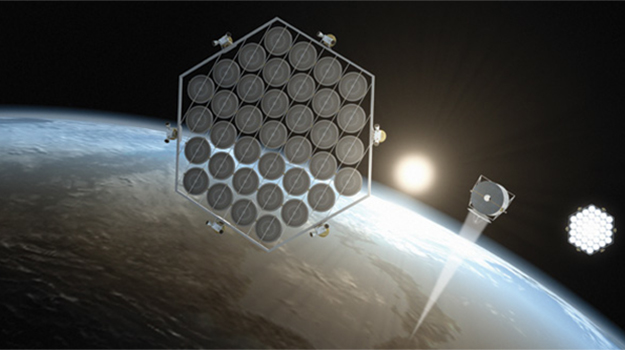
solar_panel_origamiAnother major innovation comes from Brigham Young University, where researchers have been working with NASA’s Jet Propulsion Laboratory to address the challenge of Space-Based Solar Power. For some time, scientists have understood that a solar array in orbit of Earth would be ideally suited for solar power collection, since it would be immune to weather, cloud cover or diurnal cycles (aka. nighttime).

Unfortunately, getting solar cells into space is a bit of a problem. In order to be effective, solar panels need to be thin have a large surface area to soak up more rays. This makes it difficult to transport them into orbit, and requires that they be broken down,and flown up piece by piece, and then assembled once in orbit. Given the cost of mounting a sending a single rocket into orbit, this prospect becomes very costly very fast.

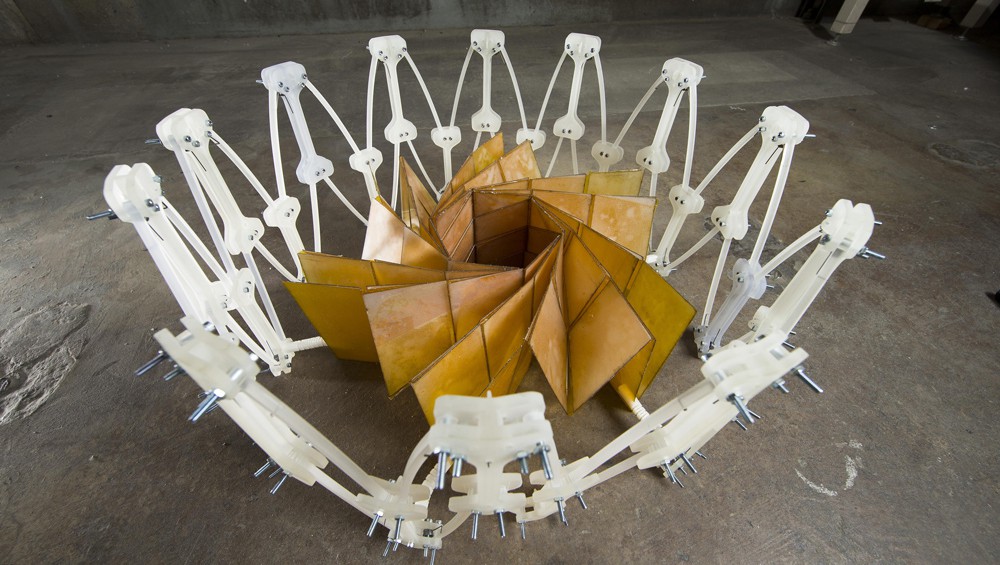
solar_panel_origami1However, the Brigham team came up with a simple and elegant solution to this problem, and found it in the form of origami. By working with complex origami folds, they were able to design a solar array that can shrink down to one-tenth of its original size. Folded up, the device is 2.7 meters (8.9 feet) across and can easily wrap around a spacecraft. Once it reaches space, the array would then unfold to become as wide as 25 meters (82 feet).

Given that solar panels deal with large, flat, thin structures, the origami concept seems like a natural fit. And this is not the first time that it has been used in space equipment design – in the 1990’s, Japanese astrophysicist Koryo Miura created a prototype for another folding solar panel. However, that project was abandoned for various reasons, not the least of which was lack of funding.

space-solar-headTo make the concept work and renew interest in the application, he Brigham team worked with Robert Lang, a world-renowned origami expert who also happens to be a mathematician and engineer and once worked at JPL himself. As Brian Trease, a mechanical engineer at the Jet Propulsion Laboratory, said:

He was trained as a physicist, used to work at JPL, and then got tired of the formal bureaucracy and left to start folding paper. Now he’s a world expert… We see value in going directly to any artist, even if they don’t have his credentials, because they have the thousands of hours or folding and tinkering to realize what can and can’t be done. Anytime you can bring in other disciplines, they just visualize things differently and bring in different solutions to your problems.

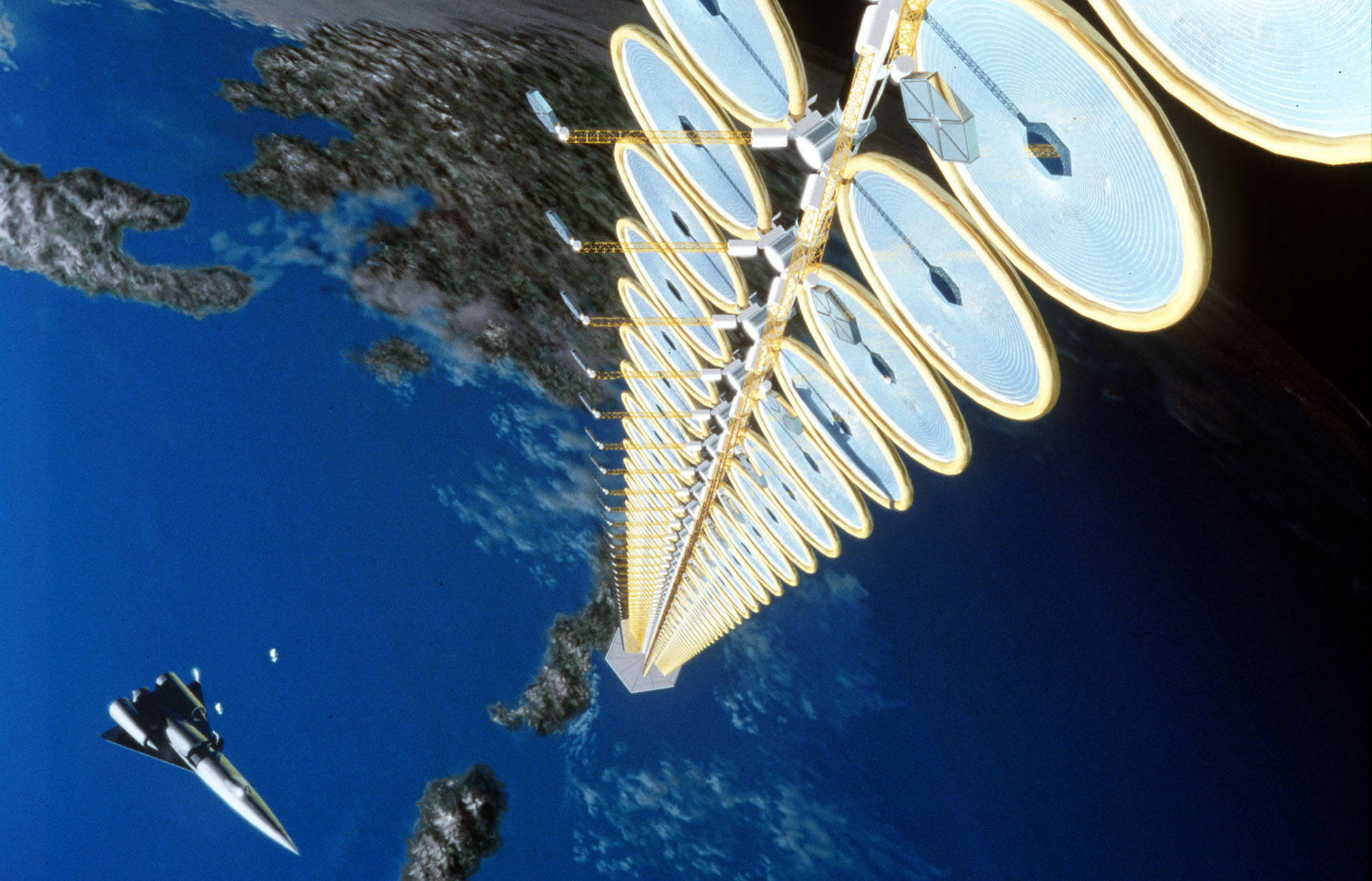
The new solar panels could be used to power spacecraft and potentially also on orbiting power stations that could wirelessly send energy to Earth via microwaves. A similar design could also be used on Earth to provide new options for portable solar power in remote locations. The same type of design might also be used in architecture or product design because of its unusual looks and function.

NASA_suntowerAccording to Trease, the Department of Defense has already been in touch with them regarding applications for soldiers in the field:

Soldiers right now might carry around 100 pounds, 15 of those pounds are batteries and fuel. If you can eliminate that, you’ve dramatically reduced their load… It’s different from opening an umbrella, because it can accommodate rigid material. You could do something like a deployable glass chandelier or a table. When it’s deployed, it looks like a flower blooming–it’s got a nice aesthetic to it.

In the next few weeks, Trease will also meet with other experts to consider different potential applications for space equipment, like antennas and reflectors, that could also deploy using origami. And given the rapidly-dropping prices associated with placing objects into orbit, this could prove to be the basis for the dream of Space-Based Solar Power – where all our energy needs are met by solar arrays in orbit that then beam them to Earth.


Source: extremetech.com, fastcoexist.com

Universe Today: Are Intelligent Civilizations Doomed?

Gaia_galaxyMy friend over at Universe Today, Fraser Cain, has been busy of late! In his latest podcast, he asks an all-important question that addresses the worrisome questions arising out of the Fermi Paradox. For those unfamiliar with this, the paradox states that given the age of the universe, the sheer number of stars and planets, and the statistical likelihood of some of the supporting life, how has humanity failed to find any indications of intelligent life elsewhere?

It’s a good question, and raised some frightening possibilities. First off, humanity may be alone in the universe, which is frightening enough prospect given its sheer size. Nothing worse than being on a massive playground and knowing you only have but yourself to play with. A second possibility is that extra-terrestrial life does exist, but has taken great pains to avoid being contacting us. An insulting, if understandable, proposition.

alien-worldThird, it could be that humanity alone has achieved the level of technical development necessary to send out and receive radio transmissions or construct satellites. That too is troubling, since it would means that despite the age of the universe, it took this long for an technologically advanced species to emerge, and that there are no species out there that we can learn from or look up to.

The fourth, and arguably most frightening possibility, is the Great Filter theory – that all intelligent life is doomed to destroy itself, and we haven’t heard from any others because they are all dead. This concept has been explored by numerous science fiction authors – such as Stephen Baxter (Manifold: Space), Alastair Reynolds (the Revelation Space universe) and Charles Stross (Accelerand0) – all of whom employ a different variation and answer.

kardashev_scaleAs explored by these and other authors, the biggest suggestions are that either civilizations will eventually create weapons or some kind of programmed matter which will destroy – such as nuclear weapons, planet busters, killer robots, or nanotech that goes haywire (aka. “grey goo”). A second possibility is that all species eventually undergo a technological/existential singularity where they shed their bodies and live out their lives in a simulated existence.

A third is that intelligent civilizations fell into a “success trap”, outgrowing their resources and their capacity to support their numbers, or simply ruined their planetary environment before they could get out into the universe. As usual, Fraser gives a great rundown on all of this, explaining the Fermi Paradox is, the statistical likelihood of life existing elsewhere, and what likely scenarios could explain why humanity has yet to find any proof of other civilizations.

Are Intelligent Civilizations Doomed:


And be sure to check out the podcast that deals strictly with the Fermi Paradox, from roughly a year ago:

The Fermi Paradox Explained:

News from Space: Dream Chaser Airframe Unveiled

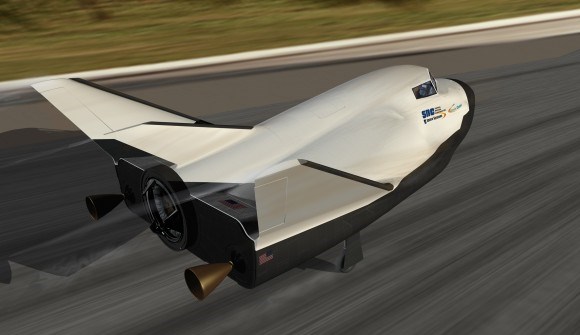
dream-chaser-dockedWith the cancellation of the Space Shuttle program, and the termination of NASA’s operations with the Russian Federal Space Agency (Roscosmos), NASA has been pushing ahead with several programs designed to restore their access to low Earth orbit and the International Space Station (ISS). One such program is the Dream Chaser, a joint venture between the Sierra Nevada Corporation and Lockheed Martin that aims to create a winged mini-shuttle.

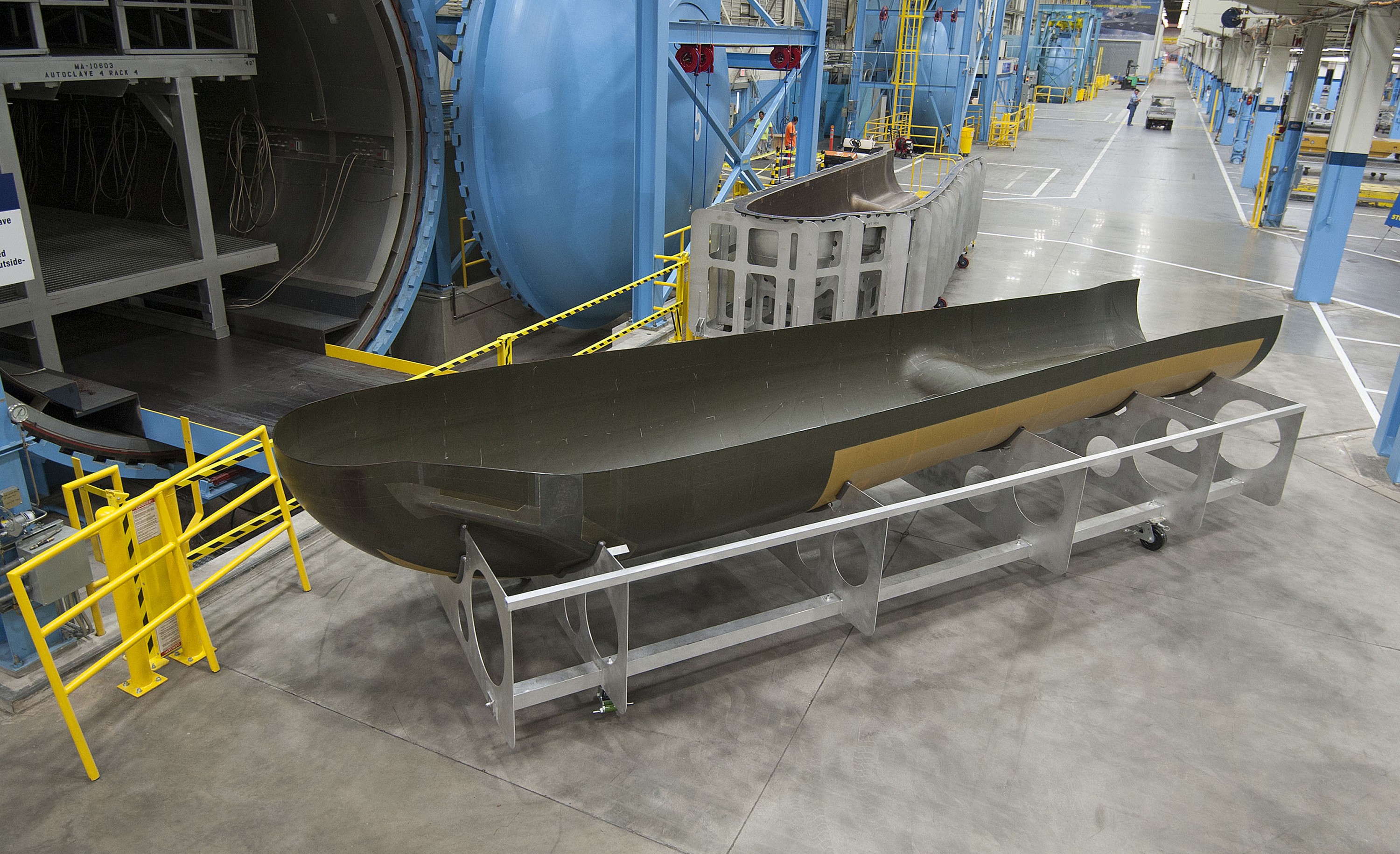
Earlier this month, the program reached an important milestone when the composite airframe structure was unveiled at a joint press conference by Sierra Nevada Corporation and Lockheed Martin at the Fort Worth facility. The assembly of the airframe took place at NASA’s Michoud Assembly Facility (MAF) in New Orleans, where Lockheed Martin is busy fabricating the structural components for the composite structure.

Dream Chaser at autoclave FP141497 07_31_14From here, the completed components are shipped to Lockheed Martin’s Aeronautics facility in Fort Worth, Texas for integration into the airframe and assembly. Designed to be launched into orbit atop a United Launch Alliance (ULA) Atlas V rocket and then fly back and land on its power, the Dream Chaser will carry a mix of cargo and up to a seven crewmembers to the ISS before landing on commercial runways anywhere in the world.

According to Mark N. Sirangelo, corporate vice president of Sierra Nevada’s Space Systems, the company chose to partner with Lockheed Martin because of its long history in the development of commercial aerospace technology:

As a valued strategic partner on SNC’s Dream Chaser Dream Team, Lockheed Martin is under contract to manufacture Dream Chaser orbital structure airframes… We competitively chose Lockheed Martin because they are a world leader in composite manufacturing, have the infrastructure, resources and quality control needed to support the needs of an orbital vehicle and have a proven track record of leading our nation’s top aviation and aerospace programs. Lockheed Martin’s diverse heritage coupled with their current work on the Orion program adds an extra element of depth and expertise to our program. SNC and Lockheed Martin continue to expand and develop a strong multi-faceted relationship.

dream-chaser-test1Dream Chaser measures about 9 meters (29 feet) long with a 7 meter (23 foot) wide wing span, and is about one third the size of the Space Shuttle Endeavor and all other NASA orbiters – which were retired beginning in 2011. Upon completion of the airframe manufacturing at Ft Worth, it will be transported to SNC’s Louisville, Colorado, facility for final integration and assembly.

SNC announced in July that they successfully completed and passed a series of risk reduction milestone tests on key flight hardware systems that brought the private reusable spacecraft closer to its critical design review (CDR) and first flight. The Sierra Nevada Corporation is now moving ahead with plans for the Dream Chaser’s first launch and unmanned orbital test flight in November of 2016, which will take place atop an Atlas V rocket from Cape Canaveral, Florida.

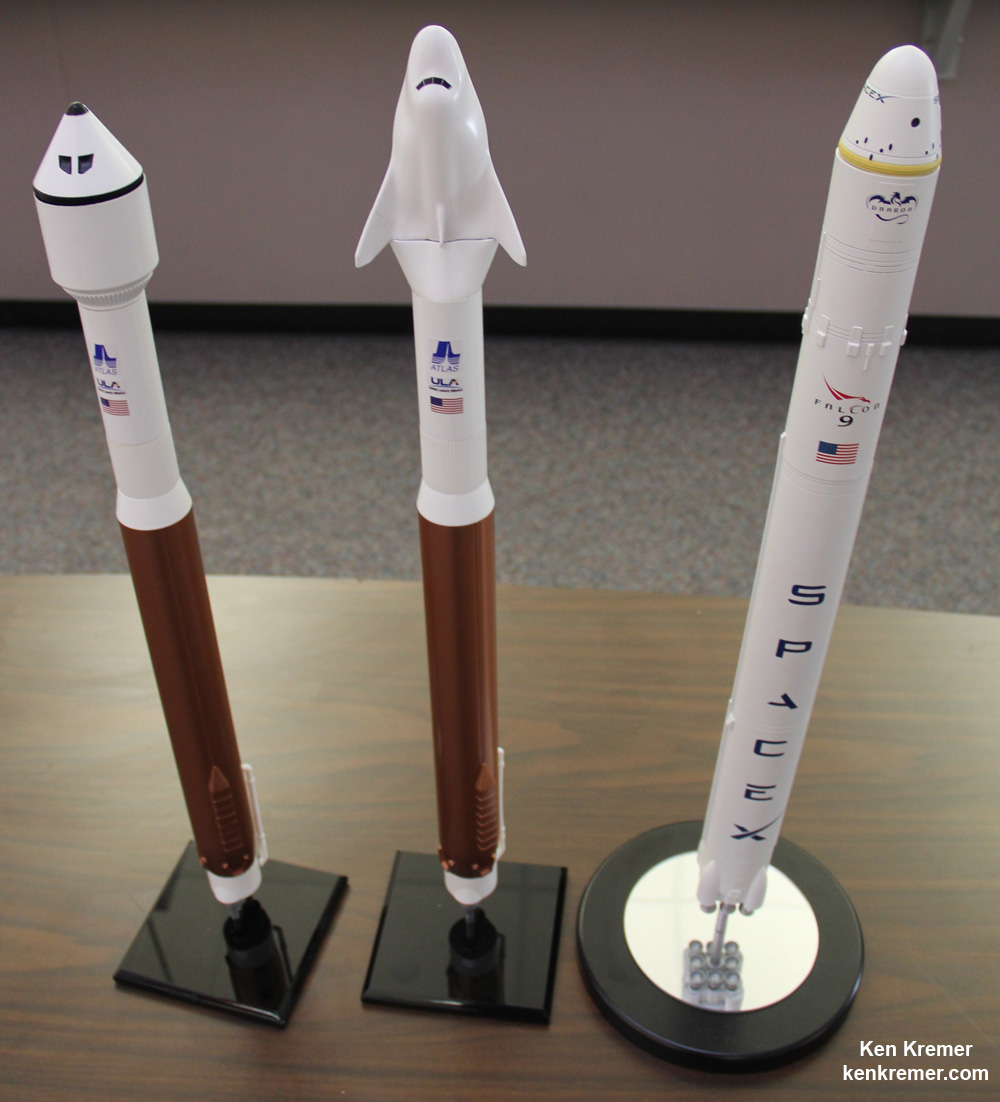
dream_chaserDream Chaser is among a trio of US private sector manned spaceships being developed with seed money from NASA’s Commercial Crew Program in a public/private partnership to develop a next-generation crew transportation vehicle to ferry astronauts to and from the International Space Station by 2017 – a capability totally lost following the space shuttle’s forced retirement in 2011.

These include the SpaceX Dragon and Boeing CST-100 ‘space taxis’, which are also vying for funding in the next round of contracts to be awarded by NASA around September 2014. Between a reusable mini-shuttle, a reusable space capsule, and reusable rockets, NASA not only hopes to restore indigenous space capability, but to drastically cut costs on future space missions.

Commercial-Crew-vehicles_Ken-Kremer-

Source: universetoday.com

The Future of Flight: VR Fighter Pilot Training

f-35sThe latest breeds of military aircraft are naturally smarter, faster, and more stealthy than their predecessors. Known as Fifth Generation craft, they are designed to incorporate numerous technological advances – like Low Probability of Intercept Radar (LPIR), supersonically launched guided missiles, a wealth of sensors, highly-integrated computer systems that provide full situational awareness, and automated targeting.

The problem is, these planes are too powerful to be trusted to the untrained. This creates a paradoxical situation where  recruits have to learn how to fly them before they can be allowed to fly them. This is especially so during Red Flag training, where pilots take part in advanced aerial combat exercises intended to prepare roughly 27,000 pilots and engineers for warfare every year.

Sen. Daniel K. Inouye memorial service in HawaiiThe solution, according to General Mike Hostage, is to train pilots in virtual reality in every facet of fifth generation fighter jet technology. It’s what is known as “Live Virtual Constructive” (LVC) training, which the military is increasingly turning to because it is a major cost saver.  Every branch is feeling the financial squeeze, and simulated training is a popular idea since it cuts down on the time it takes to get a pilot airborne and the cost of launching a jet.

As Hostage explained during an Air Force Association speech back in July:

The fifth generation brought us capabilities and lethalities that are straining my abilities at Red Flag to produce that same realistic combat environment. I can’t turn on every bell and whistle on my new fifth-generation platforms because a) they’re too destructive, and b) I don’t want the bad guys to know what I’m able to do… I will still do Red Flags, I will still do live training in live platform. But the place where I will be able to take the gloves off, the place where I can turn on all the bells and whistles and get full capability is going to be in the virtual constructive arena.

AFAMSIn addition to the cost-saving benefits, the US Air Force has embraces the technology thanks in no small part to the new head of the Air Force Agency for Modeling and Simulation (AFAMS), where much of the research into virtual reality training is being done. Colonel Franz Plescha, who was instituted as the agency’s new commander back in July, is a committed futurist who believes there is great potential in warfighting simulation technology.

A graduate of the United States Air Force Academy in 1987, Plescha’s most recent assignment (from July 2010 to June 2013) was as the Commander of the Warrior Preparation Center of the Einsiedlerhof Air Station in Germany. Here, he became intimately familiar with the kind of software and simulations that are designed to help commanders simulate the conduct of combat operations without ever having to put lives in danger.

F-22A_Raptor_-03-4058As he made clear, upon taking the helm at AFAMS, he refuses to waste any time on making the integration happen:

I personally believe the differences between live and simulation will continue to blur. Live or simulation? What’s the difference? What we call simulation today will become so real, it may actually influence our enemies in the future. Just imagine how that could change combat in the future.

But of course, one has to wonder if this vision is not already here, since digitally-assisted situational awareness, unmanned drones and cyber warfare are already present in militaries the world over. And as all other aspects of combat training become increasingly digitized, the distinction between simulation and warfare are themselves likely to become increasingly blurred.

Sources: motherboard.vice.com, afams.af.mil, teamorlando.org

Oscar Mike – Chapter Three

STEN

“In the long history of humankind (and animal kind, too) those who learned to collaborate and improvise most effectively have prevailed.”

-Charles Darwin

The room was flush with the aroma of metal filings and machine grease. And the acrid smell of burnt metal was also there, the telltale signs of forgers at work. The few open windows in the factory shop had managed to keep the air quality bearable, but it did nothing to remedy the heat situation. Whether it was the result of an unseasonably hot summer, or of melting down steel and nickel to make castings, the entire floor was predestined to feel like the eight ring of hell.

Braun’s obsessive face wiping could attest to that. His wet, clingy shirt and the way his khakis were sticking to his legs were another indication. He couldn’t imagine how anyone on the floor could stand the aprons, gloves and protective goggles they were forced to wear. Were it not for the hot metal components they were required to handle, he was sure they would all have stripped down to their skivvies a long time ago.

As they walked between stations on the assembly line, the foreman – the venerable Art Mitchell – showed him the fruits of their operation. Between wiping his face, Braun made entries in his notebook, noting the numbers and models produced.

“Our total haul for this past week was one-hundred and eighteen SMGs, eighty-nine service pistols, and two-hundred bayonets. Our intakes accounted for roughly two tons of recycled slag, a mix of steel, iron, nickel, tin and copper. And we managed to get just enough zinc from you people to fashion the firing pins.”

Braun nodded, making a note of it. He knew an appeal when he heard one, and would have to run that by the higher ups. Ever since they had set up shop, Mitchell and his workers had become the sole source of weapons and munitions for the town militias. His designs were seen on just about every city block now, the proliferation of weapons models that were well-dated, but ideally suited to modern needs.

But as always, expanded production meant that more resources would need to be obtained. The slag heaps and waste materials generated by the war could expect to keep producing plenty of iron and steel for the time being, but rare minerals and chemicals like zinc and chromium were quickly running out. Which meant resource extraction, in the old fashioned sense, would once again need to resume.

There were departmental rumors that some Smithsonite mines was being contemplated south of the capitol. Apparently, it was part a larger scheme to rebuild Socorro now that it too had been repopulated. But he could not say with any confidence that it was true, or assure Mitchell and his people that these proposed mines would become a ready source of zinc compounds, or even that they had a group of chemical engineers on hand that could extract it for him.

Such was the nature of things in his new role. He had learned to become a cog in an apparatus that was simply trying to get things done and see to a rising tide of production and manufacturing needs. At the center of it all was the rapidly expanding population of the region, people who had been fleeing the undead hordes and looking for a safe place to set down. Beyond simple shelter, food and water, all anyone had wanted back then was to know they could go to sleep at night and not spend their days in constant fear.

But now, with the cities of Santa Fe and Albuquerque resettled and rezoned, and dozens of townships besides, the more intricate matter of how to meet the less basic needs of their inhabitants was always on everyone’s mind. Beyond food, shelter and water, people were once again in need of basic comforts, and had to be organized to produce and distribute them. Braun heard much from each and every group he was tasked with listening to – the Agro Co-Op, Utilities, Weapons, and Materials – and knew much about their problems. But proposing solutions was beyond his pay grade. Gathering relevant information and making recommendations to those who actually had the power to do things, that was what he was he was tasked with. And according to those he reported to, it was a very important task.

Which reminded him – another thing in his job description was to investigate complaints made by other groups and see if he couldn’t find out what the source of the problem was. In this case, it was the people who kept track of weapons distribution that had asked him to inquire.

“I understand you experienced a drop in production back in early April.”

“Ah, yes,” said Mitchell, suddenly sounding grave.

“Okay. Any reason why that would be?”

“It’s simple, really. Our smelters and production lines run on electricity. And when the electrical grid is intermittent, our equipment stops working.”

“Right…”

Mitchell continued, still sounding and looking very much irate. “You may have heard about the brownouts we periodically deal with in town here? I know it’s not as common up north where you were from, but down here, it’s a way of life.”

“I’m sorry, sir. I’ll make a note of – ” he stopped short as his mind backtracked to the one nugget that stuck out in that last complaint. “How’d you know I was from up north?”

“Are you kidding?” Mitchell ran his hand up and down the length of Braun’s profile. “The buzz cut hair, the khaki pants, the way you walk… everything about you screams infantry, son. And people do talk.”

Braun frowned. “People have been talking about me?”

“Yeah. A lot of my workers were happy as hell to know that they were reporting to a former grunt now. They figured having someone who actually understood the nature their work, instead of some pencil-pushing bureaucrat, would make life easier.” The way Mitchell punctuated this with a grunt told him exactly what he thought of the end result.

“Well, as I said, I am new to this.”

“We all are, son. I guess we just do the best we can.”

Braun didn’t reply. Putting his pen to the pad again, he made the note, as promised. If he was going to avoid any such mistakes in the future, he needed to let his superiors know that they needed to do a better job of communicating with other departmental superiors. Otherwise, guys like him were going to wind up looking stupid in front of guys like Mitchell. He was sure to spell it in all uppercase letters and underline it twice.

BETTER INTERDEPARTMENTAL COMMUNICATION.

“Anyway,” Mitchell said, sounding suddenly uncertain. “What happened to get you stuck with us down here?”

“Long story,” Braun said hesitantly.

Mitchell chuckled. “Piss off the wrong person, huh?”

Again, Braun didn’t reply. Eventually, Mitchell nodded and let it drop.

“Shall I show you some of the fruits of our labor?”

Braun shook his head and tapped his pen against the notebook. “No, I think I got all the information I need right here.”

“I meant, would you like to see the firing range. We set one up so we could test fire every weapon that rolled off the line.”
Braun felt suddenly piqued. He hadn’t been expecting a hands-on demonstration. “That would be… lovely.”

A few minutes later, and Braun found himself in a large storage room on the buildings ground floor. The air was much cooler, and the smell immensely improved. Instead of the tangy odor of grease, filings and molten metal, there was the familiar smell of cordite.

They stood together, Mitchell and he, looking down range from a series targets – which in this case consisted of standing two by fours that held up sheets of foam insulation cut into the profile of men. Directly in front of them was a long counter covered with guns and open cases of ammunition. Braun recognized the three models: a short stock semi-auto rifle, a submachine gun that resembled an old STEN, and a Colt automatic.

The sum total of everything Mitchell and his crew had been working on since they first set up shop. Mitchell motioned to the nearest weapon, which happened to be a copy of their standard submachine gun. Braun stepped forward and took hold of the weapon. He noticed an inscription carved on the side.

Freak Killer 2.0

He raised the weapon to his shoulder, tested the sights and the weight.

“You recognize what that is, don’t you?” said Mitchell.

Braun nodded, lowered the weapon to get a better look at the assembly. In essence, the weapon was just a single, long tube of metal, a wiry metal stock, and a magazine sticking at right angles to it. The front end was especially long, thanks to the addition of the built-in suppressor.

“A venerable old design. How did you know how to recreate it so exactly?”

Mitchell crossed his arms. His tone became that of a proud father. “I had a set of the old blueprints at home. Metal working has always been my vocation, and old firearms my passion.”

“No wonder the Council saw fit to put you to work here.”

Mitchell laughed. “Well, the way they saw it, someone needed to be making sure we had a supply or replacement bullets. And no offense to your friends there, but most of our guns didn’t take five-five-six or nine millimeter ammo. Once they formed a militia, it just made more sense to create a standardized set of weapons and ammunition.”

“Hence the Freak Killer?”

Mitchell began speaking in proud tones again. “I was hard-pressed to come up with a model that was both easy enough to produce but reliable in the field, and simple enough to strip down and reassemble that someone could do it with a bare minimum of training. STENs were the perfect concept – designed with simplicity and a minimal number of components in mind.”

“Not to mention minimal expenditure of materials,” said Braun.

“Well observed. Perfectly suited to our purposes, wouldn’t you say?”

Braun raised the weapon again and chambered a round. He aimed at the nearest target, and squeezed. The weapon let off a metallic clack, and a small thunk sounded in the target down range. He took in, and let out, a small breath as he lowered the weapon, an old habit.

“Not bad,” he said. “And quiet too.”

“Stealth is another thing we non-military types take seriously. Loud gunshots have a way of drawing the infected to towards you. Don’t imagine you grunts ever worried about that, huh?”

Braun shrugged. “No. Drawing them in was kind of what we wanted to do. Easier to kill that way.”

Mitchell shook his head. “Well… you’re in our world now. Try to adapt.”

Oscar Mike – Prologue

zombie_forest_fire

The king who is situated anywhere immediately on the circumference of the conqueror’s territory is termed the enemy. The king who is likewise situated close to the enemy, but separated from the conqueror only by the enemy, is termed the friend.

-Kautilya, Arthasastra: Book IV

The sound was like a gentle beating in his ears. An intermittent thrum that kept reverberating in the dark. His eyes went in and out of focus, watching as the hard, graceful wings looped endlessly in an unending dance. He blinked many times, his mind moving in and out of the darkness. And all the while, a strange sensation was building in the back of him, like a burning light that was slowly became brighter.

The thrum was getting stronger too, and it was soon interrupted by a high-pitched whine and a loud voice…

“On your feet!”

A deafening roar sounded and he has hit by something hard. His skin prickled at the feel of terrible heat, and he realized he was awash in it. His mind went dark again for a moment, then came back to the light as he felt a sharp sting against his face. When his eyes opened, they saw the face of a familiar-looking man, and heard the same voice calling to him again.

“Get up! Get up!”

He drew in breath and felt another sharp sting. His body had been shocked into wakefulness again, and all at once, the landscape became a very noisy, very ugly place.

“Get up! We gotta move, sir!”

The face pulled away and a hand descended onto his chest, pulling at his uniform. The next thing he knew, he was on his feet and being shoved from behind. Close by, he saw the burning wreck of what had once been the beating wings, the body of their evac chopper. He could barely stand, barely move his body. And yet somehow, he knew to turn his back to it and run.

“C’mon! We got to get to the treeline before another -”

Another high-pitched whine and another roar followed, bringing with it another burst of heat and another powerful wave. This one sent him low; and above, the sound of several more terrible whines were coming in. He closed his eyes and just kept running. Surely, these ones would miss him if he could just block them out. Or, one might find him, and turn the world black forever…

“Sir! Sir! Look at me!”

The voice was coming from beside him this time. Bellard looked to it and instantly recognized who it was. He quickly sat up, but several deep breaths were needed before he could speak.

“Marcel,” he said, wiping his face. He noted the generous amount of sweat there, despite how cold he felt. “What happened?”

“You were having a nightmare, sir,” said Marcel, offering him his canteen. “And you instructed me to wake you when we found the path again.”

Bellard drank deeply from the canteen, his mouth accepting the cool water gratefully. He noted the brackish taste, and the unmistakable tang of iodine tablets. When he was finished, he processed what the Corporal was telling him and quickly remembered.

“Ah, yes. How far is it?”

“About a klick or so up ahead. Tree cover’s good. And no sign of ghouls.”

“Good.” Bellard wiped his face again. He immediately became aware of the thick stubble on his face, his sweat-soaked hair and the state of his clothes. For some reason, this made him think of the rest of the crew, who were still sleeping behind him. Lying in the recesses of some tree roots, each of them had made a pillow from their backpacks and a blanket from their uniform tops. He lamented the idea of waking them again after what felt like such a restless sleep, but they had to keep moving.

Raising himself up on one knee and then planting his boot solidly on the ground, he got a sharp spasm of pain that went from his back to his toes. He tried to talk over the pain to avoid moaning too loudly.

“Gather the others. We need to get moving before nightfall.”

“Yes, sir.” Marcel hurried past and began rallying the rest. The sounds of groaning and muttering from them followed, a familiar sound after days of forced marching.

Getting up the rest of the way proved difficult for Bellard, as his legs proving to be weaker than he had given them credit for. His head was also noticeably heavy, and the ground seemed to spin a little when he tried to straighten up.
And then the pain in his back returned, firing in his lower back and running the length of his leg. It was much worse this time, and he almost fell over from the shock of it. Luckily, he caught himself on one knee; and when up again, he saw Marcel standing beside him. One hand was resting on his shoulder, the other firmly grasping at his weapon.

“Can you walk, sir?”

“Yes…” he uttered. “Pinched nerve. I’ll be okay.”

“You sure? Don’t want you losing the use of your legs there.”

Bellard sensed the gentle mockery in his tone. At another time, he might have laughed. But at the moment, he prayed It wouldn’t come to that.

“I’m fine,” he said with false confidence. He looked back at the others and promptly changed the subject. “How are they doing?”

Marcel’s smile faded. “They said they wanted to talk to you first.”

Bellard knew instantly what to expect, but nodded just the same. For days now, his colleagues had been griping about the same thing: what was the plan? What were they to do for supplies? And what did they hope to do about the morass they were in? He had become rather well practiced at addressing their concerns by now.

“Assemble your squad. We move together in five mikes.”

Marcel issued a salute and took off. Habits of the grunts, they saluted the rank and not the man. Even now, when Bellard and the others were little more than dead weight, they still trusted in the silver bars he carried on his shoulders to see them through to safety. He suspected they might feel differently if they had a chance to sit in on one of his conversations with his associates…

He hobbled over and sidled up to Penn. Taggart and Drake took a knee nearby and moaned unhappily. He noted the shaking in their hands and the pallor in their faces. It was worse than usual. Between fatigue and water discipline, they were beginning to fade. He anticipated a had conversation.

“Alright, what’s the problem now, specialists?”

Penn was the first to speak, and it was quite the effort for him to get all the words out without becoming winded. “What are we even doing here, Ted? What’s our end game?”

“We’ve been over this, George,” he replied. “We’re going to get to the high ground. We’re going to keep moving until we are above the tree line, and away from the ghouls and all the fighting.”

“Yeah, and then what?”

It was Drake asking this. Bellard paused for a second as he considered that question. In the past few days, no one had asked what they planned to do once they reached their destination.

“What do you mean?”

“What he means is,” Taggart interjected, “what are we supposed to do when we get up into the hills? It’s not like anyone’s waiting for us up there. We’re running out of food and water, and there’s no guarantee anyone’s going to be able to rescue us.”

“I know, Beth. But what choice do we have?” He motioned to the east. It only took a few seconds before the noise of the carnage that was still going on down there reached them. The sounds of small arms fire and the occasional din of something heavier exploding. He summarized it for them as best he could. “People in uniform are still killing each other, and the ghouls are likely to overrun all of them eventually. We can’t stay in the valley. We have to get higher.”

“But what’s waiting for us up there?” asked Penn. “Sun, exposure, and whole lot of fucking rocks?”
Bellard grumbled. “I repeat… what choice do we have? At least up there there’s the possibility of safety. The rest… we can deal with that once we get there.”

Taggart and Penn grumbled right back at him. Only Drake seemed to be able to maintain a modicum of tact at the moment.

“It just sounds like we’re trading one shot at certain death for another. And we haven’t even addressed the larger issue of what’s on its way.”

Bellard looked over his shoulder to see if Marcel or any other of the grunts were nearby. He spotted PFC Rickard, one of the riflemen from the 29th that had made it out with them. The rest were moving up ahead, stepping through the wall of foliage the lined their clearing and fanning out to watch for ghouls. Only Rickard was within earshot, and he was concerned that any mention of what they knew would elicit suspicion.

They had agreed some time ago that no mention was to be made of the “larger issue”. They were having a hard enough time maintaining their own morale. They did not need their escort falling to pieces and questioning the nature of what they were doing too. And without their equipment handy, there really was no way of telling how far off it really was.

He raised his hands to them for quiet. “Look, if what we learned before is true, then it is all the more important to get to somewhere secure. The high ground in this region is our best bet of that. There’s simply no other place we can go. Not unless we can find ourselves a chopper and fly the hell out of here.”

“In that case…” said Taggart. “We might want to discuss what will happen if we get spotted up there.”

“You mean… if an enemy spotter goes flying by?”

She nodded. Drake once again had his tactful two cents to offer. “If we’re talking about survival at all costs here, and the enemy actually prevails down there, then it might be best to raise the white flag if they see us.”

Bellard sighed and looked at his feet. All this talk was beginning to take its toll and he could feel his back beginning to cramp up again. And the thought of allowing for their capture by the enemy; somehow, that seemed to make him feel worse. But they were right. It was obvious to anyone who had been there that General Montag and his task force had been beaten. Their grip on the valley had been tenuous during that last day, and the counter-attack had left no doubt as to who was going to win.

That’s when the ghouls came, like a terrible wall of wild animals from the northern mountains. There was no telling how the Rebels would fare against that, but if they came through, they would be the only ones left in the region that could give Marcell and his colleagues food, shelter and aid. Besides, they had a right to know as well. Rebels or not, they didn’t deserve to be overrun.

“Yes… that might be the best course of action,” he conceded. “I just hope our escort there prove to be as understanding.”
The others emitted some chortled sounds that almost sounded like laughter. They all knew it wouldn’t be as easy as that. As hardened grunts, they would not simply lay down there arms because a bunch of specialists told them to. Whatever respect they held for Bellard’s rank would most likely disappear at that point. But that was another die and another crisis. And there was no telling Marcel and his friends would even make it that far. And if their ranks were thinned, perhaps they would need less in the way of convincing…

“Alright. We’ll deal with that when the time comes. In the meantime, let’s get moving. We need to get out this valley as soon as possible. Otherwise, we might find ourselves -”

A yell came from the other direction. Every head in their group spun around to look for the source. All they saw was Rickard crouching low with his weapon raised. Slowly, he moved forward, trying to catch sight of his companions in the thick brush.

“Corporal?” he whispered loudly. “Manning? Paige? Sound off!”

Bellard and the others were crouched low too. In spite of the shooting pains that were going through his knees and back, he sat low, breathing quietly and straining to hear.

“Corporal? Marcel? What happened?” Rickard said louder. Weapon raised, he took a more few steps and pierced the foliage wall. His last step coincided with the tip of an arrowhead sticking out through the back of his neck, the metallic point slick with blood. He emitted a short, choking noise, and then fell.

Taggart yelled out. “Private!”

Penn quickly wrapped his hand around her mouth and dove to the ground. “Down, everyone!”
Bellard and Drake followed. All together, they lay in the dirt now, hugging the moist earth and waiting for something to happen. It was several seconds before they heard anything; and surprisingly, it wasn’t the sound of an arrow zipping overhead.

It was rustling, and it was coming from the bushes. Worst yet, it was coming from all around them, and getting closer. Then, it was the sound of boots coming to rest in the dirt, and someone clearing their throat…

“On your feet,” said a male voice. Slowly, Bellard raised his hands and painfully got on his knees. He hoped his position would be seen as a sign of cooperation, because at the moment it was the best he could do.

“Rest of you too,” the man said. Around him, the others began to oblige and got up with their hands raised.

Bellard slowly looked over and caught sight of the man’s face. The head was largely obscured by a hood, and the eyes covered by a set of goggles. But he did notice the thick stubble and the black paint rubbed across his cheeks.

He looked to the man’s companions next, all of whom carried hunting bows or machetes. Each wore what looked like a piece of green canvas that had been altered to carry a hood. Whoever they were, they weren’t part of the 200th.

“You armed?” the man asked.

Bellard looked at the others and then replied. As ranking officer, it seemed to fall on him to negotiate their surrender. Or whatever this was.

“No. We left our weapons behind. We’re completely unarmed.”

“Good.” The man nodded, and his companions began to close around them. One by one, the canvas-wearing hunters pulled them to their feet and began pushing them forward.

“What are you doing? What do you want with us?” Bellard said as he was himself was pulled up.

“You’re our prisoners,” the man said, his mouth forming a crooked smile beneath the goggles. “I thought that part was obvious.”

The Future is Here: Morphable Skins

https://i0.wp.com/www.m25audi.co.uk/images/audi/technology/aerodynamics.jpgTomorrow’s cars could have a feature that will reduce wind drag and allow them to go faster: smart, morphing skins that form dimples or go smooth on command. It is all part of a growing field of mechanics that seeks to make surfaces “smart”, and it is being considered for everything from increasing aerodynamics to reducing the damage caused by hurricanes and high winds.

The research comes from MIT, where engineers have developed a smart curved surface that can morph at will to reduce drag. Known as a “smorph” (short for smart morphable surface), they were able to get their creation to wrinkle into a dimpled pattern similar to a golf ball’s, with similar aerodynamic properties. In short, when the smorph wrinkles, it is able to travel faster than if it were smooth.

smorphScientists and golfers alike have long known that the dimples on the surface of a golf ball allow it to drastically reduce drag and travel much farther than would otherwise be possible. This happens because the small dents hold the airflow near the surface of ball for a longer time. This reduces the size of the wake, or zone of turbulence, as the ball takes off. However, the mechanics employed here are a bit more complex.


In recent years, in-depth aerodynamic studies have shown that the dimples reduce drag only at lower speeds. As you move toward faster speeds, the advantage of irregularities disappears and a smooth surface becomes the best way to minimize the wake. Now, researchers at MIT have married the best of both worlds by developing a surface that can it’s smoothness on the fly to maximize aerodynamic efficiency at all speeds.

Smorph_0The smorph manages to change its shape by changing the balance between its materials. Basically, an empty core is surrounded by two different polymers. One is thick and squishy, while the outermost layer is stiff skin. As the volume of  a the inner layer is reduced by sucking air out of its hollow core, the core shrinks. The squishy layer is soft enough to contract smoothly, but the skin is forced to wrinkle. The trick is controlling exactly how a smorph wrinkles.

Because the dimples look so much like those on a golf ball’s surface, the researchers were inspired to test their creation in a wind tunnel. Sure enough, when the researchers tested the smorph in a wind tunnel, they found that it was about twice as aerodynamically efficient when dimpled. But the sheath of vortices only form at relatively low speeds, and then convert back to a smooth surface at higher speeds in order to maintain aerodynamic velocity.

smorph_1This is where smorphs could offer a huge advantage. By being able to morph to control drag, they could be especially useful in building structures that won’t collapse or incur significant damage when facing very high winds – one example being the so-called radomes, the spherical, weatherproof domes that enclose radar antennas. The researchers also say that the materials could also be used to minimize drag in cars in order to maximize fuel efficiency.

Earlier this year, Reis won an NSF grant to keep developing smorphs, which he hopes to someday scale up to use on cars, aircraft, and even buildings. There are some issues to overcome before this happens though, such as the fact that hexagonal dimples are unstable on flat surfaces. So far smorphs have only been used on a round, ball shape, but Reis and his co-authors believe they can figure out how to reproduce the pattern on slightly curved surfaces.

Alongside such concepts as morphing wings and self-adjusting and reconfigurable robots, the creation of surfaces that can change shape in order to better accommodate airflow, or be optimal for different tasks, is part of the manufacturing revolution that seeks to replace rigid structures and products with something that can adapt, flow and transform depending on what is being asked of it.

And be sure to check out this video from MIT of the smorph in action:


Sources:
wired.com, gizmag.com

News from Mars: Laser-Blasting and Soil Sampling

mars_lifeAs the exploration of Mars goes on, the small army of robotic rovers, satellites and orbiters continue to provide us with information, photographs and discoveries that remind us of how great a mystery the Red Planet truly is. For instance, in the past month, two major stories have been announced concerning the nature of Martian soil, its ancient history, and some of the more exciting moments in it’s exploration.

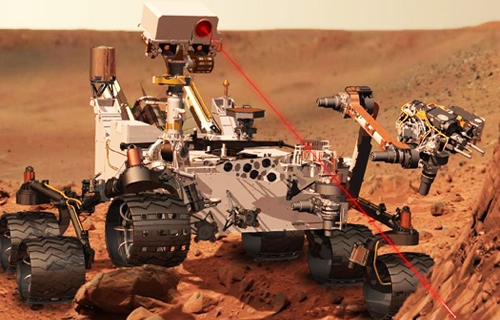
For example, Curiosity made news as its high resolution camera caught an image of sparks being generated as it zapped a Martian rock. In it’s lifetime, the rover has used its million watt Chemistry and Camera (ChemCam) laser to zap over 600 rock or soil targets as part of its mission. However, this was the first time that the rover team was able to get the arm-mounted Mars Hand Lens Imager (MAHLI) to capture the action as it occurred.

Curiosity-Laser-BeamThe ChemCam laser is used to determine the composition of Martian rocks and soils at a distance of up to 8 meters (25 feet). By hitting targets with several high-energy pulses, it is able to yield preliminary data for the scientists and engineers back at Earth to help them decide if a target warrants a closer investigation and, in rare cases, sampling and drilling activities.

ChemCam works through a process called laser-induced breakdown spectroscopy. The laser hits a target with pulses to generate sparks, whose spectra provide information about which chemical elements are in the target. Successive laser shots are fired in sequence to gradually blast away thin layers of material. Each shot exposes a slightly deeper layer for examination by the ChemCam spectrometer.

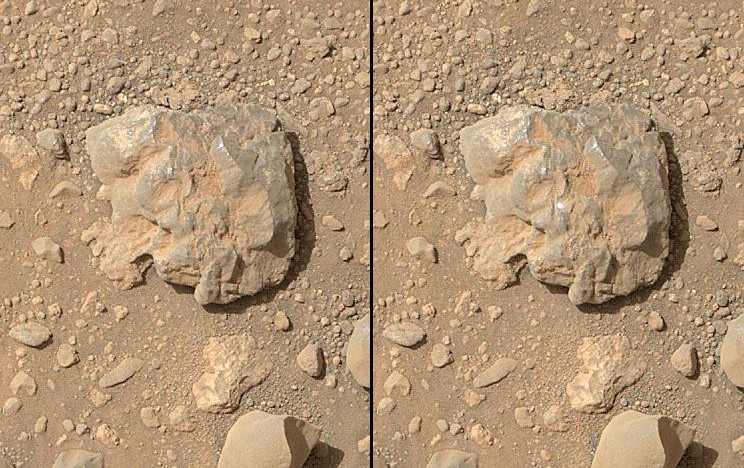
Mars_novarockAs Curiosity fired deeper into the target rock – named “Nova” – it showed an increasing concentration of aluminum as the sequential laser blasts penetrated through the uninteresting dust on the rock’s surface. Silicon and sodium were also detected. As Sylvestre Maurice, ChemCam’s Deputy Principal Investigator at the Research Institute in Astrophysics and Planetology, said in a statement:

This is so exciting! The ChemCam laser has fired more than 150,000 times on Mars, but this is the first time we see the plasma plume that is created… Each time the laser hits a target, the plasma light is caught and analyzed by ChemCam’s spectrometers. What the new images add is confirmation that the size and shape of the spark are what we anticipated under Martian conditions.

During it’s first year on Mars, Curiosity has already accomplished its primary objective of discovering a habitable zone on Mars that contains the minerals necessary to support microbial life billions of years ago when Mars was wetter and warmer. Currently, the rover is driving swiftly to the base of Mount Sharp at the center of Gale Crater, where it hopes to find more.

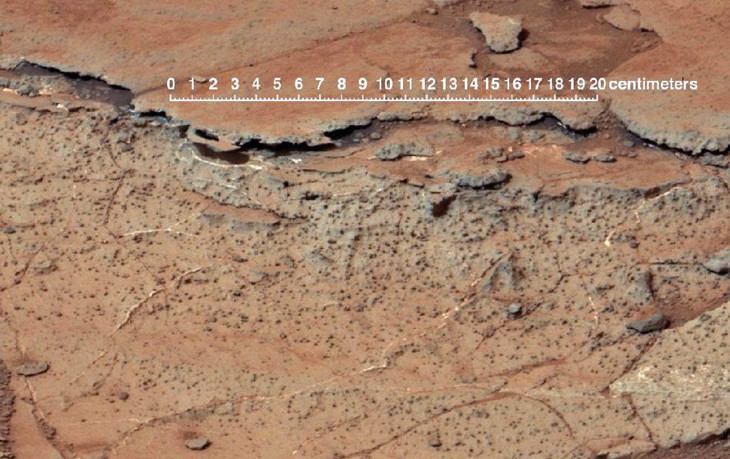
Mars_soilIn that same vein, according to new geological information obtained by Curiosty’s images and soil examinations, samples that were pulled out of a crater that is estimated to be some 3.7 billion years old contain more evidence that Mars was once much warmer and wetter. These findings were announced in a recent paper published in the online edition of Geology by University of Oregon geologist Gregory Retallack.

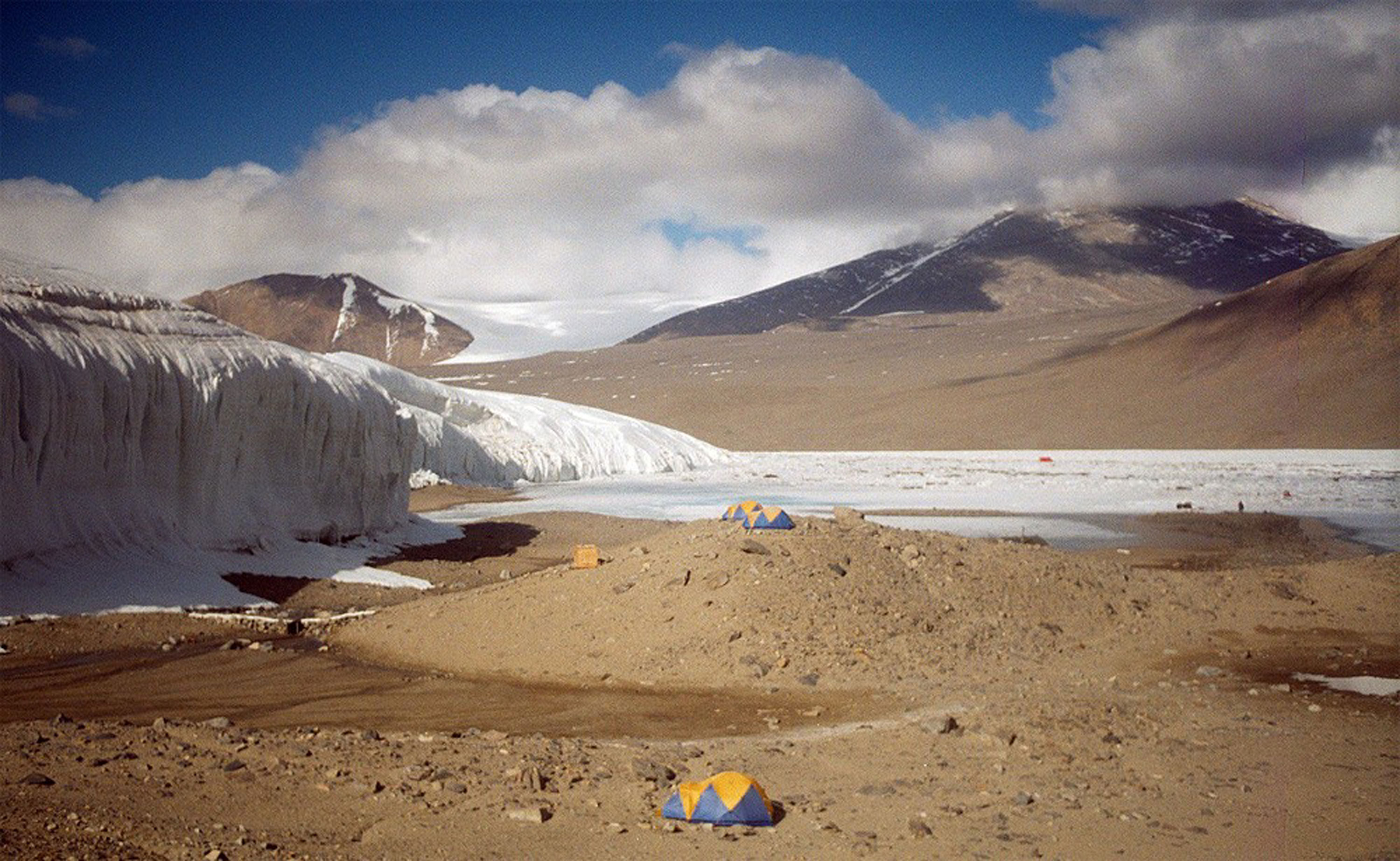
Unlike Earth, the Martian landscape is littered with loose rocks from impacts or layered by catastrophic floods. However, recent images from Curiosity from the Gale Crater reveal Earth-like soil profiles with cracked surfaces lined with sulfate, ellipsoidal hollows and concentrations of sulfate comparable with soils in Antarctica’s McMurdo Dry Valleys and Chile’s Atacama Desert.

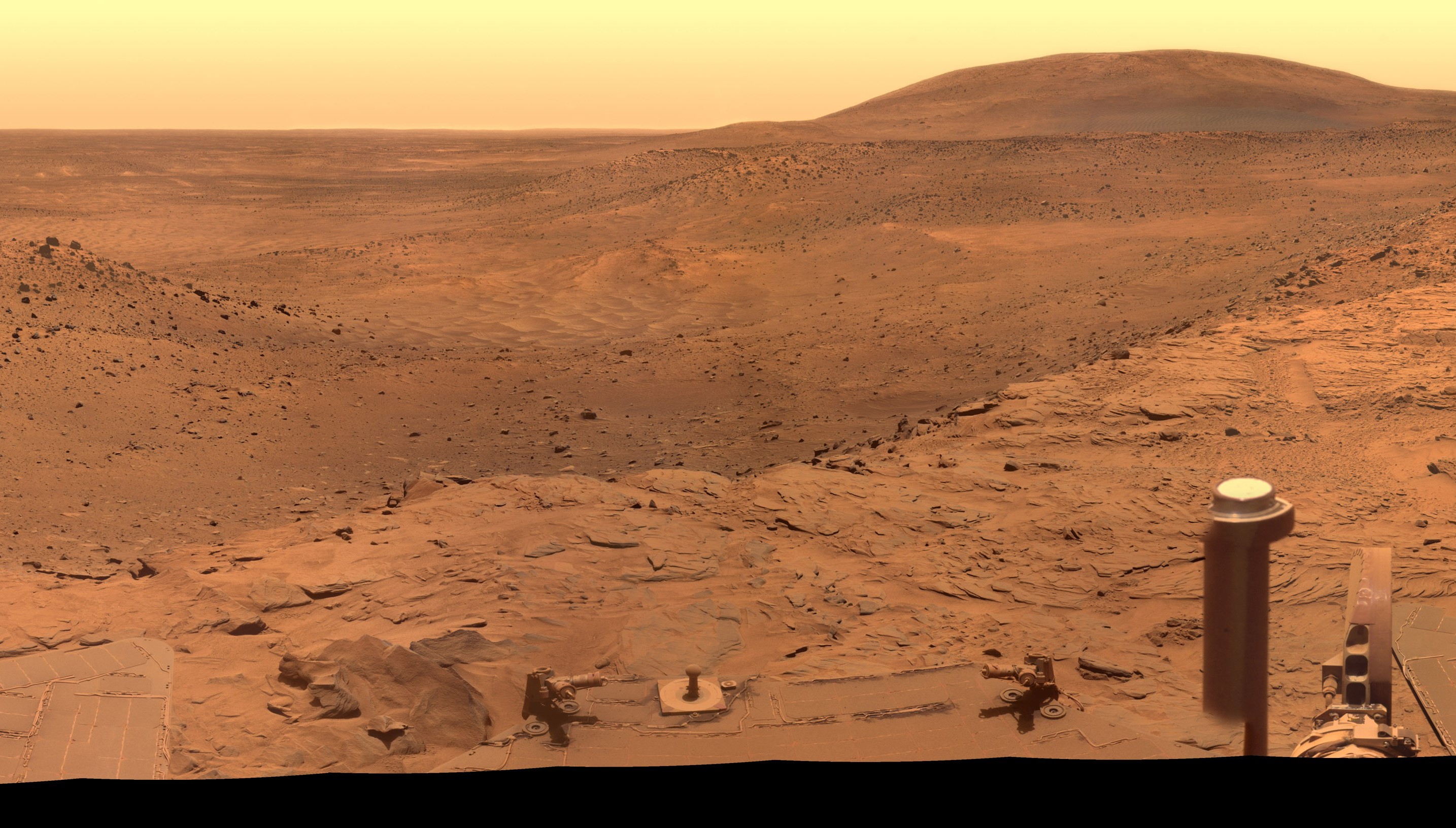
mars-180-degrees-panorama_croppedRetallack, the paper’s lone author, studied mineral and chemical data published by researchers closely tied with the Curiosity mission. As a professor of geological sciences and co-director of paleontology research at the UO Museum of Natural and Cultural History, he internationally known as an expert on the recognition of paleosols – ancient fossilized soils contained in rocks.

As he explains in the paper:

The pictures were the first clue, but then all the data really nailed it. The key to this discovery has been the superb chemical and mineral analytical capability of the Curiosity Rover, which is an order of magnitude improvement over earlier generations of rovers. The new data show clear chemical weathering trends, and clay accumulation at the expense of the mineral olivine, as expected in soils on Earth. Phosphorus depletion within the profiles is especially tantalizing, because it attributed to microbial activity on Earth.

dryvalleysThe ancient soils do not prove that Mars once contained life, but they do add to growing evidence that an early, wetter and warmer Mars was more habitable than the planet has been in the past 3 billion years. Surface cracks in the deeply buried soils suggest typical soil clods. Vesicular hollows, or rounded holes, and sulfate concentrations, he said, are both features of desert soils on Earth.

Since Curiosity is currently on its way to Mount Sharp, future missions will be needed to fully explore these features. But as Retallack explained, the parallels with Earth are quite exciting:

None of these features is seen in younger surface soils of Mars. The exploration of Mars, like that of other planetary bodies, commonly turns up unexpected discoveries, but it is equally unexpected to discover such familiar ground.

The newly discovered soils indicate that more benign and habitable soil condition existed on Mars than previously expected. What’s more, their dating to 3.7 billion years ago places them within a transition period when the planet went from an early, benign water cycle to the acidic and arid Mars of today. This is especially important since major changes were taking place on Earth at around the same time.

Living-Mars.2Roughly 3.5 billion years ago, life on Earth is believed to have emerged and began diversifying. But some scientists have theorized that potential evidence that might indicate that life existed on Earth earlier may have been destroyed by tectonic activity, which did not occur on Mars. Basically, it may offer some credence to the theory that while flourished on Earth, it originated on Mars.

One person who supports this theory is Steven Benner of the Westheimer Institute of Science and Technology in Florida.  In the past, he has speculated that life is more likely to have originated on a soil planet like Mars than a water planet like Earth. In an email interview with Science Daily, Benner wrote that Retallack’s paper:

[S]hows not only soils that might be direct products of an early Martian life, but also the wet-dry cycles that many models require for the emergence of life.

So in addition to shedding light on the mysteries of Mars, Curiosity has also been pivotal in addressing some major questions which only increase the mystery of our own existence. Did life as we know it originate on Mars but flourish on Earth? Are there still some remnants of this microbial “Eden” being preserved deep within the soil and rocks? And could life exist there again some day?

All good questions that will no doubt keep robotic rovers, orbiters, landers, and even manned missions busy for many decades to come! In the meantime, check out the video from NASA’s Jet Propulsion Laboratory of Curiosity’s spark-generating laser blast being caught on tape:


Sources:
universetoday.com, sciencedaily.com