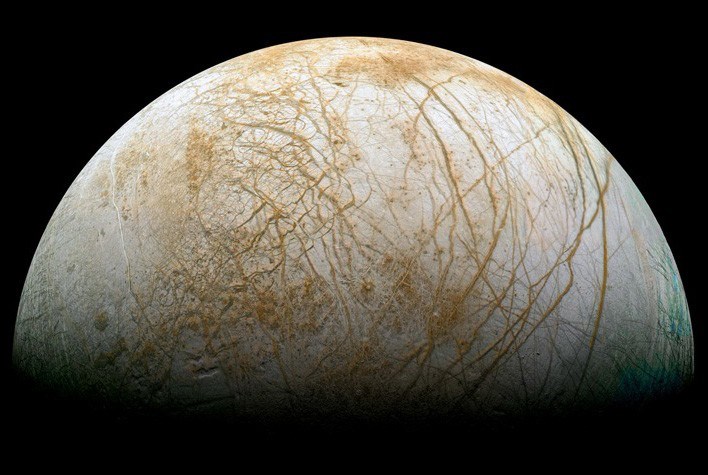
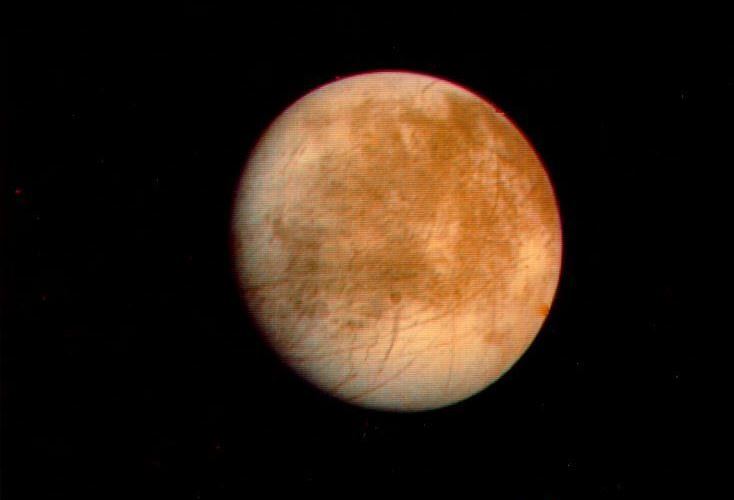
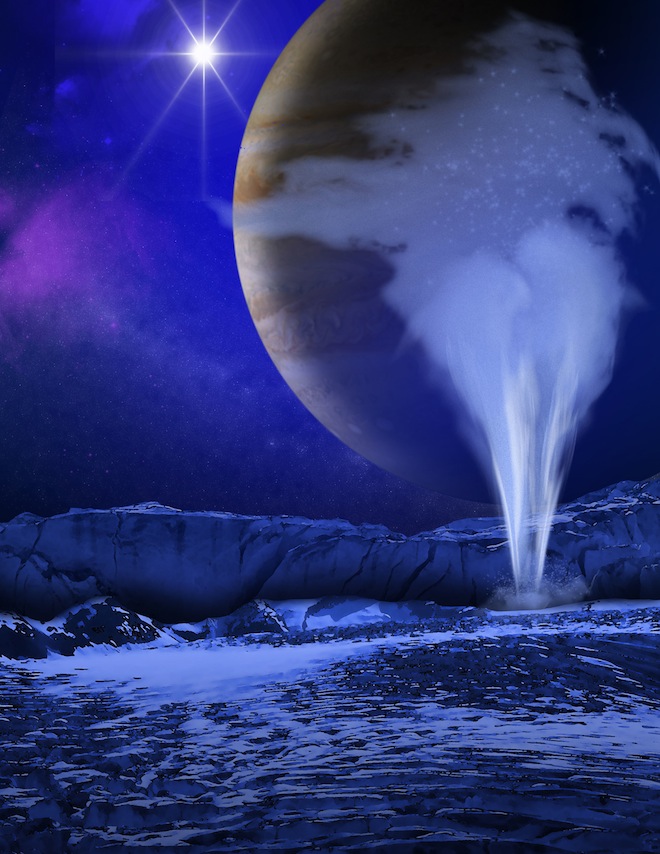
As the prime candidate for extra-terrestrial life, the Jovian moon of Europa has been the subject of much speculation and interest over years. And while our understanding of the surface has improved – thanks to observations made by several space probes and the Hubble space telescope – what lies beneath remains a mystery. Luckily, Europa may yet provide Earth scientists with a chance to look at its interior.
Earlier this month, data collected from the Hubble space telescope suggested that enormous jets of water more than 200 kilometers tall may be spurting intermittently from the moon’s surface. The findings, presented last week to the American Geophysical Union, await independent confirmation. But if the jets are real, the frozen world would join the tiny number of others known to have active jets, including Saturn’s moon Enceladus and Neptune’s moon Triton.
 What’s more, should these newly observed water plumes be tapping into some Europan sea, they could be bringing material to the surface that would otherwise stay hidden. Follow-up observations from Earth or with probes around Europa could sample the fountains, hunting for organic material and perhaps finding the evidence need to prove that living organisms exist beyond Earth.
Scientists spotted the plumes thanks to ultraviolet images taken by Hubble in December 2012. The research team, which hails from the Southwest Research Institute in Texas, then published their research in Science magazine. In the paper, astronomer and co-author Lorenz Roth explained their findings:
We found that there’s one blob of emission at Europa’s south pole. It was always there over the 7 hours we observed and always at the same location.
Previous observations from NASA’s Galileo mission, which visited the Jupiter system in the 1990s and early 2000s, suggest that Europa’s south pole is full of ridges and cracks quite similar to features called tiger stripes on Enceladus that spew water.
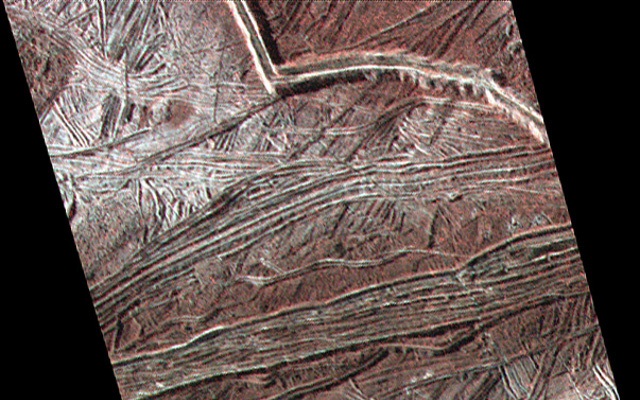 Lorenz and his team looked back through previous Hubble data to see if the plumes could have been spotted earlier but saw nothing, suggesting that they are likely transient. At the time, Europa was at its farthest from Jupiter, which could explain why the jets appeared only then. Researchers recently determined that Enceladus’ plumes are weakest when the moon is closest to Saturn, likely because the ringed planet’s gravity squeezes the tiger stripes shut.
Astronomer Kurt Retherford, also of SwRI and another co-author, claimed that the case of Enceladus helped them to make a connection with what they were observing:
We actually saw this press release on Enceladus. And we thought, ‘Oh my god! This is the explanation’” for why Europa’s plumes might only appear when it’s far from Jupiter.
In the past, scientists have looked for evidence of jets coming from Europa’s surface. When the Voyager probes flew by in the 70s, one image showed a fuzzy spot that some thought to be a plume, though most considered it an artifact of imaging. Galileo also saw a row of dark spots on a ridge of Europa which looked similar to spots seen on planet Earth before an eruption begins.
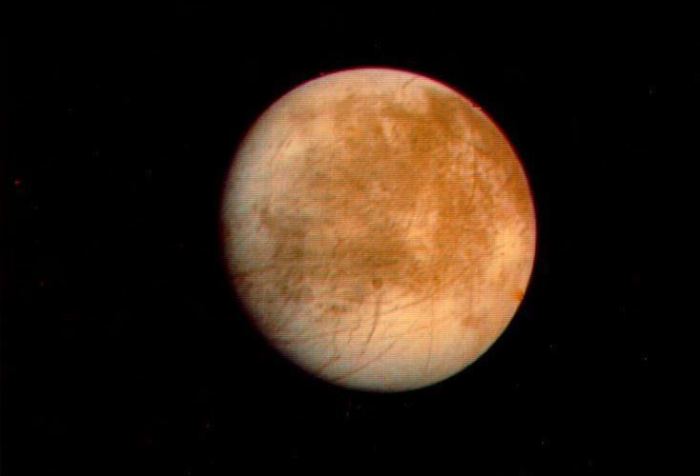 Because of these previous false positives though, scientists are likely to be cautious when interpreting these newest results. But even with these reservations, Robert Pappalardo – who leads the planning team for the Europa Clipper Pre-Project (a proposed mission to Europa) – said that he’s already discussing with other scientists how these new results should affect their study priorities.
For instance, some future orbiter headed to Europa could carry detectors specifically designed to search for heavy organic molecules that could be indicative of life in the subsurface. When it passed over the geyser’s spray, it would be bathed in material from the moon’s interior, giving scientists a window into Europa’s ocean. Pappalardo also hopes that the finding will help push Europa to a place of high priority in NASA’s exploration agenda.
Due to budget constraints, a manned mission is not yet feasible, but NASA has indicated that it would be willing to send a robot lander there in the near future. In addition, recent computer models provided from the University of Texas showed that the ice is likely to be thinnest at the equator. Between the possibility that the oceans might be most accessible in this region, and the likelihood that some of that water escapes into space, unlocking the mysteries of the Jovian satellite might be easier than previously thought.
 Sources: wired.com, science.jpl.nasa.gov


 A Martian year is 687 Earth days long. Accordingly, NASA’s Curiosity Rover reaches its one-year Martian Anniversary on June 24, 2014 (Earth Calendar), 687 days after its mission began.