Arcology: noun (plural arcologies) an ideal integrated city contained within a massive vertical structure, allowing maximum conservation of the surrounding environment. Origin: 1969: blend of architecture and ecology.
The question of what to do about Earth’s growing population – 7 billion and counting – and the environmental impact it is having has been on the minds of city planners, environmentalists, and global leaders for qu9ite some time. Far from it being a simple matter of determining how we are going to feed new every mouth we create, there’s also the question of how to provide for their other basic needs.
In the 20th century alone, humanity grew by multiplication factor of six. Cities expanded, suburban developments went up, and inner cities were “rezoned” and redeveloped in order to make room for them. When horizontal space became an issue, vertical structure were adapted, incorporating sky scrapers and massive high-rises. In addition, cities, counties and entire nations needed to find more sources of fresh water to address their health and sanitation needs, more landfills to accommodate waste, and more green spaces to grow food. In time, it soon became clear that this increased output of human beings and their various wastes was causing irreparable harm to the planet.
By the turn of the century, the projections only became worse, thanks in large part to the ongoing industrialization of developing nations. In these parts of the world, where a full third of the human race resides, the impact of so many new power plants, urban developments, superhighways, and fossil-fuel burning cars could not be underestimated. The problem of providing space for our people and seeing to their needs in a way that is sustainable in the long term has only become more pressing as a result.
As it turns out, the answer may lie in a concept developed in the 1960’s by a man named Paolo Soleri. An architect of Italian descent who studied at the feet of architect Frank Lloyd Wright, he is credited with coining the term “arcology”, a new form of architecture that plotted the creation of three-dimensional hyperstructures that would be self-sufficient, and in some cases, self-contained. Primarily proposed as a means to combat two-dimensional urban sprawl, arcologies were also meant to economize on transportation, energy use, commerce and agriculture. All needs, which included the need to reduce waste and impact on the environment, were incorporated in his new designs. And on top of that, they would be beautiful as well as very, very big.
One of his first designs was for a city-structure named Babel(or IID as it’s officially designated). This design called for a flared cylinder of apartments sitting in a saucer-shaped base, complete with commercial, civil spaces, and public areas. The estimated population for this monster design was 550,000 people – the population of a major city – but placed in an edifice 1900 meters high and 3000 meters at its widest point.
Close-ups of the design show the immense attention to detail that Soleri’s featured in his drawings. From housing, to production centers to water treatment and waste disposal, nothing was overlooked. And just in case you’re having problems imagining the scale, he features a picture of the Empire State building for a size comparison.
And then there was Hexadredon, an incredible geometric mountain resting on three immense supports. Accommodating over 170,000 people, it measured a mere 800 meters by 800 meters (640 square km). On top of all that, it looks immensely artistic, incorporating such design features as massive pyramids, support columns, and rotundas. In reality, it looks more like an ancient temple than a three-dimensional city.
His many other concepts involved cities adrift on water, built into canyons, or on the side of cliffs. As far as Soleri was concerned, nothing was off limits. Any and all geographic features and landscapes, including the ocean itself, could be built into human habitats. Though it remained somewhat speculative for its time, Soleri’s ideas formed the basis for a great deal of speculative writing and urban planning.
For instance, in Japan, urban planners have proposed a future city development to deal with urban sprawl in Tokyo – known as the Shimizu Mega-City Pyramid. As it stands, much of Tokyo Harbor is artificial, composed of fill in order to accommodate Japan’s growing population and industrial centers. This further expansion calls for the creation of a massive pyramid measuring 730 meters high, 8 square kilometers at the base, and capable of housing 750,000 people. All told, it would be roughly 14 times the size of the pyramid of Giza.
In addition, there is the proposed building project in Moscow known as “Crystal Island”. Measuring in at a whopping 2500 square kilometers at its base and 450 meters high, it will be the single largest structure on Earth, if and when it is completed. Shaped like a massive tent, the superstructure of the proposed design acts as a sort of second skin to the main building, creating a thermal buffer and shielding the interior from Moscow’s harsh weather.
In addition, this second skin will adjust with the seasons and sealed in winter to minimise heat loss, while opened again in summer to naturally cool the interior. Power would also be provided by built-in wind turbines and solar panel, as well as a series of renewable energy solutions. On top of all that, the design incorporates an existing park, which provides a range of activities, including cross-country skiing and skating. Construction was officially postponed in 2009 due to the economic crisis, but is expected to resume in the coming years.
Last, but not least, there is the planned community of Masdar City, which I wrote about in a previous article. Though not technically an arcology in the sense of a three-dimensional colossal environment, the design nevertheless incorporates all other aspects of Soleri’s concept. These include renewable energy sources, sustainable resource management, mass-transit, recycled water, and a range of other green technologies.
Today, the planned city of Arcosanti, which Soleri himself began construction on in 1970, remains an unfinished testament to his work and his genius. Located in central Arizona, just 110 km north of Phoenix, this work-in-progress incorporates Soleri’s unusual design features and, though uncompleted, remains a testament to his vision.
Check out this video from Arcosanti website, which featured Solari’s design for the mega-city Nudging Space:
Hey all. It seems my bud, David Lim, over at Ellipsis Media has come out with a review for the new Judge Dredd movie. Overall, he was pretty impressed with the result, likening it to the Batman franchise in that this new look has updated the look and feel and made it a hell of a lot darker and grittier than the original. Ah, listen to me prattle on! Click the video below for his full review.
Today, I thought I’d totally nerd out and share some additional cool stuff from one of my favorite games of all time: Sid Meier’s Alpha Centauri! As you may have noticed, I already did a review of the game itself. But returning to this game to boast about it some more was something I just couldn’t resist! After over a decade, I’m still not bored with this turn-based strategy game. It’s just that good.
Anyhoo, today I thought I’d share something which I glossed over in my review. And that would be the games best one-liners. During every turn, whenever you build a special project, experience a research breakthrough, build a new type of facility, or develop a new type of unit, you get a line accompanied by some music and in the case of projects, even a little movie. Most are original creations, spoken by the faction leaders themselves, and give added depth to an already immersive gaming experience.
Here is the list of the ones I like best, broken down by faction. I also included some of the movies at the bottom. Enjoy!
Gaia’s Stepdaughters: The Gaian’s are the natural ecologists and environmentalists of the game. As such, the majority of Lady Dierdre’s quotes (their leader) espouse cultivating an understanding of the planet’s ecology and the super-sentience that governs it. In many cases, these involve conversations between her and the planetary sentience itself, which are collected in the fictional tome named “Conversations with Planet”.
“Observe the Razorbeak as it tends so carefully to the fungal blooms; just the right bit from the yellow, then a swatch from the pink. Follow the Glow Mites as they gather and organize the fallen spores. What higher order guides their work? Mark my words: someone or something is managing the ecology of this planet.”
“Planet’s atmosphere, though a gasping death to humans and most animals, is paradise for Earth plants. The high nitrate content of the soil and the rich yellow sunlight bring an abundant harvest wherever adjustments can be made for the unusual soil conditions.”
“You are the children of a dead planet, earthdeirdre, and this death we do not comprehend. We shall take you in, but may we ask this question–will we too catch the planetdeath disease?” -taken from “Conversations with Planet”, Dierdre’s dialogue with the planetary sentience
“No longer mere earthbeings and planetbeings are we, but bright children of the stars! And together we shall dance in and out of ten billion years, celebrating the gift of consciousness until the stars themselves grow cold and weary, and our thoughts turn again to the beginning.” -“Conversation with Planet”, after you develop the “Ascent to Transcendance” where your faction merges with the planetary sentience
“Eternity lies ahead of us, and behind. Have you drunk your fill?”
-“Conversations with Planet”, during the game’s epilogue
Human Hive: Led by Chairman Yang, the Hive is a totalitarian faction that is clearly inspired by Maoist China and the North Korea. The majority of his quotes have to do with the nature of his political beliefs, which occasionally digress into the spiritual, a combination of Taoism and ascetisim.
“Einstein would turn in his grave. Not only does God play dice, the dice are loaded.”
“If our society seems more nihilistic than that of previous eras, perhaps this is simply a sign of our maturity as a sentient species. As our collective consciousness expands beyond a crucial point, we are at last ready to accept life’s fundamental truth: that life’s only purpose is life itself.”
“What do I care for your suffering? Pain, even agony, is no more than information before the senses, data fed to the computer of the mind. The lesson is simple: you have received the information, now act on it. Take control of the input and you shall become master of the output.”
“It is every citizen’s final duty to go into the tanks and become one with all the people.” -upon building Recycling Tanks
“My gift to industry is the genetically engineered worker, or Genejack. Specially designed for labor, the Genejack’s muscles and nerves are ideal for his task, and the cerebral cortex has been atrophied so that he can desire nothing except to perform his duties. Tyranny, you say? How can you tyrannize someone who cannot feel pain?” -upon building a Genejack Factory
Lords Believers: The undisputed fundamentalist faction of the planet, led by Sister Miriam. As expected, the majority of what she has to say has to do with defending her traditional beliefs, calling into question the nature of technological progress, and condemning the majority of developments that take place late in the game.
“Some would ask, how could a perfect God create a universe filled with so much that is evil. They have missed a greater conundrum: why would a perfect God create a universe at all?”
“The righteous need not cower before the drumbeat of human progress. Though the song of yesterday fades into the challenge of tomorrow, God still watches and judges us. Evil lurks in the datalinks as it lurked in the streets of yesteryear. But it was never the streets that were evil.”
“Beware, you who seek first and final principles, for you are trampling the garden of an angry God and he awaits you just beyond the last theorem.”
“Men in their arrogance claim to understand the nature of creation, and devise elaborate theories to describe its behavior. But always they discover in the end that God was quite a bit more clever than they thought.”
“Will we next create false gods to rule over us? How proud we have become, and how blind.” -after finishing the project The Self-Aware Colony
“And what of the immortal soul in such transactions? Can this machine transmit and reattach it as well? Or is it lost forever, leaving a soulless body to wander the world in despair?”
-after creating the Bulk Matter Transmitter
“Already we have turned all of our critical industries, all of our material resources, over to these…things…these lumps of silver and paste we call nanorobots. And now we propose to teach them intelligence? What, pray tell, will we do when these little homunculi awaken one day announce that they have no further need for us?”
Morgan Industries: CEO Morgan, leader of the Morganites, is an unquestioning believer in the art of laissez-faire economics and unadulterated capitalism. He has plenty to say on the subject of research and development, not to mention the continuance of monopolistic practices on the new planet. The environment and moderation be damned! Most of these are contained within his tomes “The Centauri Monopoly” and “The Ethics of Greed”.
“Human behavior is economic behavior. The particulars may vary but competition for limited resources remains a constant. Need as well as greed has followed us to the stars and the rewards of wealth still await those wise enough to recognize this deep thrumming of our common pulse.”
“Richard Baxton piloted his Recon Rover into a fungal vortex and held off four waves of mind worms, saving an entire colony. We immediately purchased his identity manifests and repackaged him into the Recon Rover Rick character with a multi-tiered media campaign: televids, touchbooks, holos, psi-tours– the works. People need heroes. They don’t need to know how he died clawing his eyes out, screaming for mercy. The real story would just hurt sales, and dampen the spirits of our customers.”
‘Abort, Retry, Fail?’ was the phrase some wormdog scrawled next to the door of the Edit Universe project room. And when the new dataspinners started working, fabricating their worlds on the huge organic comp systems, we’d remind them: if you see this message, always choose ‘Retry.’
-quote from one of Morgan’s software developers
“Resources exist to be consumed. And consumed they will be, if not by this generation then by some future. By what right does this forgotten future seek to deny us our birthright? None I say! Let us take what is ours, chew and eat our fill.”
“Fossils fuels in the last century reached their extreme prices because of their inherent utility: they pack a great deal of potential energy into an extremely efficient package. If we can but sidestep the 100 million year production process, we can corner this market once again.”
“Look at any photograph or work of art. If you could duplicate exactly the first tiny dot of color, and then the next and the next, you would end with a perfect copy of the whole, indistinguishable from the original in every way, including the so-called “moral value” of the art itself. Nothing can transcend its smallest elements.”
Peacekeeping Forces: Led by Brother Lal, the Peacekeepers are perhaps the most balanced faction in this game. Dedicated to human rights, scientific research, democracy, freedom of information, and peace, they are quite to make enemies with many of the more extreme factions. And of course, the majority of quotes from this faction deal with inalienable rights of human beings, the importance of freedom, and the consequences of certain technologies.
“As the Americans learned so painfully in Earth’s final century, free flow of information is the only safeguard against tyranny. The once-chained people whose leaders at last lose their grip on information flow will soon burst with freedom and vitality, but the free nation gradually constricting its grip on public discourse has begun its rapid slide into despotism. Beware of he who would deny you access to information, for in his heart he dreams himself your master.”
“The Mind Worms are the natural defenses of the living Planet–the white blood cells, if you will. In a world in which unassimilated thought represents danger, the Mind Worm seeks out concentrations of sentient mental energy and destroys them, ruthlessly and efficiently.”
“The entire character of a base and its inhabitants can be absorbed in a quick trip to the Rec Commons. The sweaty arenas of Fort Legion, the glittering gambling halls of Morgan Bank, the sunny lovers’ trysts in Gaia’s High Garden, or the somber reading rooms of U.N. Headquarters. Even the feeding bay at the Hive gives stark insight into the sleeping demons of Yang’s communal utopia.”
“The Warrior’s bland acronym, MMI, obscures the true horror of this monstrosity. Its inventors promise a new era of genius, but meanwhile unscrupulous power brokers use its forcible installation to violate the sanctity of unwilling human minds. They are creating their own private army of demons.”
Spartan Federation: The Spartans are aptly named, and represent the faction that believes that the right to bear arms in both inalienable and unquestionable. Led by Colonel Santiago, a total badass in her own right, the majority of what comes from them consists of philosophical tidbits taken from Sun Tzu’s Art of War, updated for the modern age, and some random bits of marching songs and barracks scuttlebutt.
“Information, the first principle of warfare, must form the foundation of all your efforts. Know, of course, thine enemy. But in knowing him do not forget above all to know thyself. The commander who embraces this totality of battle shall win even with inferior force.”
“I don’t know but I’ve been told, Deirdre’s got a Network Node. Likes to press the on-off switch, Dig that crazy Gaian witch!”
-Spartan marching song
“Industrial Grade Nano-Paste, one of Planet’s most valuable commodities, can also be one of its most dangerous. Simply pour out several canisters, slide in a programming transponder, and step well away while the stuff cooks. In under an hour the nano will use available materials to assemble a small factory, a hovertank, or enough rifles to equip a regiment.”
–describing industrial nanomachines
“We shall take only the greatest minds, the finest soldiers, the most faithful servants. We shall multiply them a thousandfold and release them to usher in a new era of glory.” -upon developing the Cloning Vats
The University: Led by Academician Prokhor Zakharov, the University is Planet’s great espouser of technological progress and scientific research, unhampered by such things as spirituality and political controls. On the one hand, they call to mind the stereotype of the mad scientist. On the other, they are picture perfect representations of the empirical method and true believers in freedom. As such, they make good allies, but can turn into enemies rather easily as well. Consistent with their outlook, the majority of what their leader has to say concerns scientific ideas and a defense of their methods from what they see as small-mindedness or old world dogma.
“Man’s unfailing capacity to believe what he prefers to be true rather than what the evidence shows to be likely and possible has always astounded me. We long for a caring Universe which will save us from our childish mistakes, and in the face of mountains of evidence to the contrary we will pin all our hopes on the slimmest of doubts. God has not been proven not to exist, therefore he must exist.”
“A brave little theory, and actually quite coherent for a system of five or seven dimensions — if only we lived in one.”
-after researching String Theory
“What actually transpires beneath the veil of an event horizon… decent people shouldn’t think too much about that!”
“The first living thing to go through the device was a small white rat. I still have him, in fact. As you can see, the damage was not so great as they say.” -after developing the technology for teleportation gates
“The popular stereotype of the researcher is that of a skeptic and a pessimist. Nothing could be further from the truth! Scientists must be optimists at heart, in order to block out the incessant chorus of those who say ‘It cannot be done.’
“We have reached an informational threshold which can only be crossed by harnessing the speed of light directly. The quickest computations require the fasted possible particles moving along the shortest paths. Since the capability now exists to take our information directly from photons traveling molecular paths, the final act of the information revolution will soon be upon us.”
-upon developing Optical Computers
Time travel in the classic sense has no place in rational theory, but temporal distortion does exist on the quantum level, and more importantly it can be controlled.
Other: “A handsome young cyborg named Ace,
wooed women at every base. But once ladies glanced at His special enhancement They vanished with narry a trace!”
-Spartan Barracks Graffiti
“Mary had a little lamb, Little lamb little lamb, Mary had a little lamb, whose fleece was white as snow.” -Assassins’ Redoubt Final Transmission, after you build the “Dream Twister”, a psionic weapon that drives people mad
“Please don’t go. The drones need you. They look up to you!”
I think that last one is my favorites. I queues up from time to time when you try to quit the game suddenly. Oh, and as promised, some movies from the gameplay. With the exception of the Intro segment, all play after you complete a Secret Project.
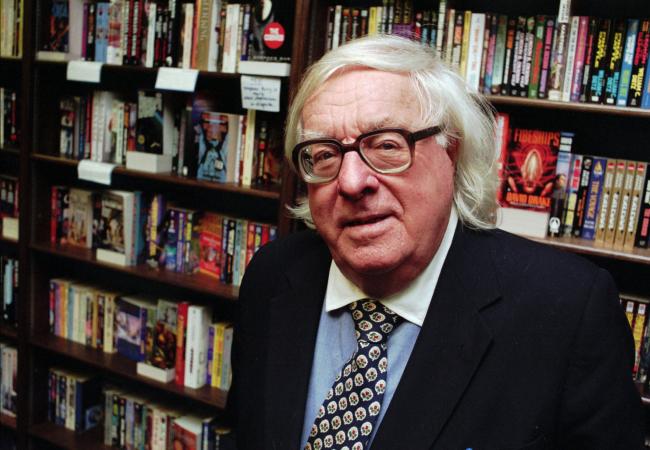
August 22, 2012 would have been Ray Bradbury’s 92 birthday. In 2000, he spoke at the down town Minneapolis Library. In honor of his birthday, Minnesota Public Radio rebroadcast his talk, which you can listen to here. The late Ray Bradbury’s Pen Pals lecture about his life and work
The photo comes from the MPR page. (STEVE CASTILLO/ASSOCIATED PRESS)
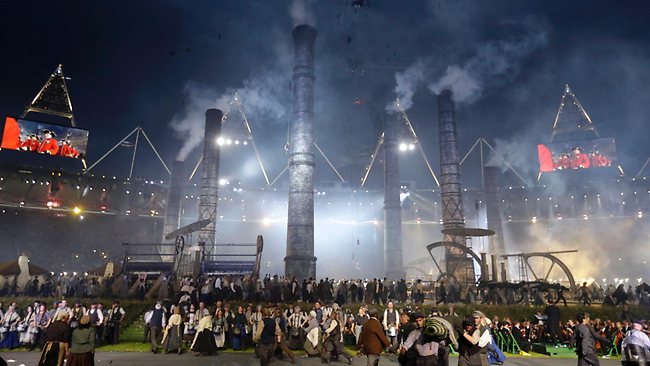
I trust just about everyone caught the Opening Ceremonies on TV today. And even if you didn’t see it live, I imagine it’s only a matter of time before you catch the highlights on replay or Youtube. And I for one was seriously impressed!
Between the amazingly-choreographed reenactment of the industrial revolution (under the watchful eye of veteran actor Kenneth Branagh), the Parade of Nations, the psychedelic display to the tune of “Come Together”, and the torch lighting display, followed by Paul McCartney playing “Hey Jude”, and the final volleys of fireworks from the perfectly designed stadium, the whole thing was a visual and auditory delight!
Seriously, it was like a watching a Steampunk writer’s wet dream crossed with an acid trip and topped off by a hit of ecstasy (drugs are wrong)! But what I, and I imagine most people liked most, was the display put on by Daniel Craig (aka. James Bond) and Queen Elizabeth II herself. I won’t indulge in the details since there are those who may not have seen it yet, but suffice it to say, it was the perfect combination of funny and awesome! And that Queen Elizabeth II is a damn good sport, apparently. The director said he never had to tell her anything twice.
I would be happy to include the video here, but unforunately, the Olympic Committee is block usage of their media. But one thing they don’t own the rights to is the new Skyfall trailer that premiered during the ceremonies. Click on the window below to check it out!
A few weeks back, a friend of mine, Nicola Higgins, directed me to an article about Google’s new neural net. Not only did she provide me with a damn interesting read, she also challenged me to write an article about the different types of robot brains. Well, Nicola, as Barny Stintson would say “Challenge Accepted!”And I got to say, it was a fun topic to get into.
After much research and plugging away at the lovely thing known as the internet (which was predicted by Vannevar Bush with his proposed Memor-Index system (aka. Memex) 50 years ago, btw) I managed to compile a list of the most historically relevant examples of mechanical minds, culminating in the development of Google’s Neural Net. Here we go..
Earliest Examples:
Even in ancient times, the concept of automata and arithmetic machinery can be found in certain cultures. In the Near East, the Arab World, and as far East as China, historians have found examples of primitive machinery that was designed to perform one task or another. And even though few specimens survive, there are even examples of machines that could perform complex mathematical calculations…
Antikythera mechanism: Invented in ancient Greece, and recovered in 1901 on the ship that bears the same name, the Antikythera is the world’s oldest known analog calculator, invented to calculate the positions of the heavens for ancient astronomers. However, it was not until a century later that its true complexity and significance would be fully understood. Having been built in the 1st century BCE, it would not be until the 14th century CE that machines of its complexity would be built again.
Although it is widely theorized that this “clock of the heavens” must have had several predecessors during the Hellenistic Period, it remains the oldest surviving analog computer in existence. After collecting all the surviving pieces, scientists were able to reconstruct the design (pictured at right), which essentially amounted to a large box of interconnecting gears.
Pascaline: Otherwise known as the Arithmetic Machine and Pascale Calculator, this device was invented by French mathematician Blaise Pascal in 1642 and is the first known example of a mechanized mathematical calculator. Apparently, Pascale invented this device to help his father reorganize the tax revenues of the French province of Haute-Normandie, and went on to create 50 prototypes before he was satisfied.
Of those 50, nine survive and are currently on display in various European museums. In addition to giving his father a helping hand, its introduction launched the development of mechanical calculators all over Europe and then the world. It’s invention is also directly linked to the development of the microprocessing circuit roughly three centuries later, which in turn is what led to the development of PC’s and embedded systems.
The Industrial Revolution:
With the rise of machine production, computational technology would see a number of developments. Key to all of this was the emergence of the concept of automation and the rationalization of society. Between the 18th and late 19th centuries, as every aspect of western society came to be organized and regimented based on the idea of regular production, machines needed to be developed that could handle this task of crunching numbers and storing the results.
Jacquard Loom: Invented by Joseph Marie Jacquard, a French weaver and merchant, in 1801, the Loom that bears his name is the first programmable machine in history, which relied on punch cards to input orders and turn out textiles of various patterns. Thought it was based on earlier inventions by Basile Bouchon (1725), Jean Baptiste Falcon (1728) and Jacques Vaucanson (1740), it remains the most well-known example of a programmable loom and the earliest machine that was controlled through punch cards.
Though the Loom was did not perform computations, the design was nevertheless an important step in the development of computer hardware. Charles Babbage would use many of its features to design his Analytical Engine (see next example) and the use of punch cards would remain a stable in the computing industry well into the 20th century until the development of the microprocessor.
Analytical Engine: Also known as the “Difference Engine”, this concept was originally proposed by English Mathematician Charles Babbage. Beginning in 1822 Babbage began contemplating designs for a machine that would be capable of automating the process of creating error free tables, which arose out of difficulties encountered by teams of mathematicians who were attempting to do it by hand.
Though he was never able to complete construction of a finished product, due to apparent difficulties with the chief engineer and funding shortages, his proposed engine incorporated an arithmetical unit, control flow in the form of conditional branching and loops, and integrated memory, making it the first Turing-complete design for a general-purpose computer. His various trial models (like that featured at left) are currently on display in the Science Museum in London, England.
The Birth of Modern Computing:
The early 20th century saw the rise of several new developments, many of which would play a key role in the development of modern computers. The use of electricity for industrial applications was foremost, with all computers from this point forward being powered by Alternating and/or Direct Current and even using it to store information. At the same time, older ideas would be remain in use but become refined, most notably the use of punch cards and tape to read instructions and store results.
Tabulating Machine: The next development in computation came roughly 70 years later when Herman Hollerith, an American statistician, developed a “tabulator” to help him process information from the 1890 US Census. In addition to being the first electronic computational device designed to assist in summarizing information (and later, accounting), it also went on to spawn the entire data processing industry.
Six years after the 1890 Census, Hollerith formed his own company known as the Tabulating Machine Company that was responsible for creating machines that could tabulate info based on punch cards. In 1924, after several mergers and consolidations, Hollerith’c company was renamed International Business Machines (IBM), which would go on to build the first “supercomputer” for Columbia University in 1931.
Atanasoff–Berry Computer: Next, we have the ABC, the first electronic digital computing device in the world. Conceived in 1937, the ABC shares several characteristics with its predecessors, not the least of which is the fact that it is electrically powered and relied on punch cards to store data. However, unlike its predecessors, it was the first machine to use digital symbols to compute and was the first computer to use vacuum tube technology
These additions allowed the ABC to acheive computational speeds that were previously thought impossible for a mechanical computer. However, the machine was limited in that it could only solve systems of linear equations, and its punch card system of storage was deemed unreliable. Work on the machine also stopped when it’s inventor John Vincent Atanasoff was called off to assist in World War II cryptographic assignments. Nevertheless, the machine remains an important milestone in the development of modern computers.
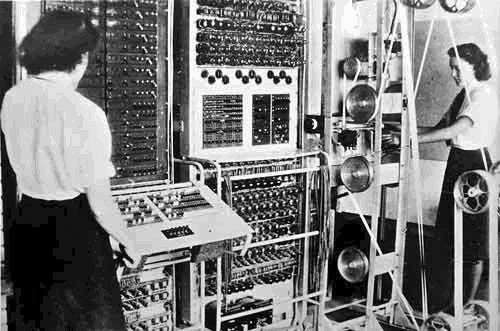
Colossus: There’s something to be said about war being the engine of innovation. The Colossus is certainly no stranger to this rule, the machine used to break German codes in the Second World War. Due to the secrecy surrounding it, it would not have much of an influence on computing and would not be rediscovered until the 1990’s. Still, it represents a step in the development of computing, as it relied on vacuum tube technology and punch tape in order to perform calculations, and proved most adept at solving complex mathematical computations.
Originally conceived by Max Newman, the British mathematician who was chiefly responsible fore breaking German codes in Bletchley Park during the war, the machine was a proposed means of combatting the German Lorenz machine, which the Nazis used to encode all of their wireless transmissions. With the first model built in 1943, ten variants of the machine for the Allies before war’s end and were intrinsic in bringing down the Nazi war machine.
Harvard Mark I: Also known as the “IBM Automatic Sequence Controlled Calculator (ASCC)”, the Mark I was an electro-mechanical computer that was devised by Howard H. Aiken, built by IBM, and officially presented to Harvard University in 1944. Due to its success at performing long, complex calculations, it inspired several successors, most of which were used by the US Navy and Air Force for the purpose of running computations.
According to IBM’s own archives, the Mark I was the first computer that could execute long computations automatically. Built within a steel frame 51 feet (16 m) long and eight feet high, and using 500 miles (800 km) of wire with three million connections, it was the industry’s largest electromechanical calculator and the largest computer of its day.
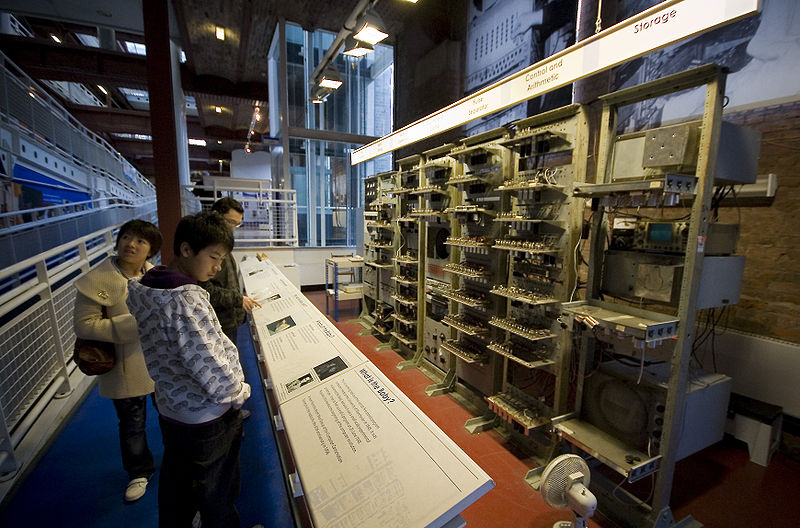
Manchester SSEM: Nicknamed “Baby”, the Manchester Small-Scale Experimental Machine (SSEM) was developed in 1948 and was the world’s first computer to incorporate stored-program architecture.Whereas previous computers relied on punch tape or cards to store calculations and results, “Baby” was able to do this electronically.
Although its abilities were still modest – with a 32-bit word length, a memory of 32 words, and only capable of performing subtraction and negation without additional software – it was still revolutionary for its time. In addition, the SSEM also had the distinction of being the result of Alan Turing’s own work – another British crytographer who’s theories on the “Turing Machine” and development of the algorithm would form the basis of modern computer technology.
The Nuclear Age to the Digital Age:
With the end of World War II and the birth of the Nuclear Age, technology once again took several explosive leaps forward. This could be seen in the realm of computer technology as well, where wartime developments and commercial applications grew by leaps and bounds. In addition to processor speeds and stored memory multiplying expontentially every few years, the overall size of computers got smaller and smaller. This, some theorized would lead to the development of computers that were perfectly portable and smart enough to pass the “Turing Test”. Imagine!
IBM 7090: The 7090 model which was released in 1959, is often referred to as a third generation computer because, unlike its predecessors which were either electormechanical or used vacuum tubes, this machine relied transistors to conduct its computations. In addition, it was an improvement on earlier models in that it used a 36-bit word length and could store up to 32K (32,768) words, a modest increase in processing over the SSEM, but a ten thousand-fold increase in terms of storage capacity.
And of course, these improvements were mirrored in the fact the 7090 series were also significantly smaller than previous versions, being about the size of a desk rather than an entire room. They were also cheaper and were quite popular with NASA, Caltech and MIT.
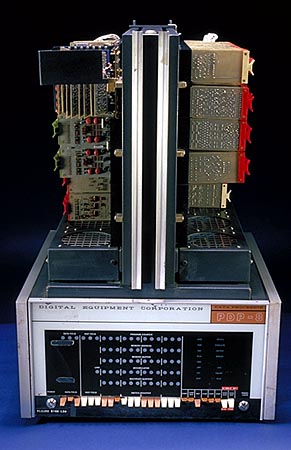
PDP-8: In keeping with the trend towards miniaturization, 1965 saw the development of the first commercial minicomputer by the Digital Equipment Corporation (DEC). Though large by modern standards (about the size of a minibar) the PDP-8, also known as the “Straight-8”, was a major improvement over previous models, and therefore a commercial success.
In addition, later models also incorporated advanced concepts like the Real-Time Operating System and preemptive multitasking. Unfortunately, early models still relied on paper tape in order to process information. It was not until later that the computer was upgraded to take advantage of controlling language such as FORTRAN, BASIC, and DIBOL.
Intel 4004: Founded in California in 1968, the Intel Corporation quickly moved to the forefront of computational hardware development with the creation of the 4004, the worlds first Central Processing Unit, in 1971. Continuing the trend towards smaller computers, the development of this internal processor paved the way for personal computers, desktops, and laptops.
Incorporating the then-new silicon gate technology, Intel was able to create a processor that allowed for a higher number of transistors and therefore a faster processing speed than ever possible before. On top of all that, they were able to pack in into a much smaller frame, which ensured that computers built with the new CPU would be smaller, cheaper and more ergonomic. Thereafter, Intel would be a leading designer of integrated circuits and processors, supplanting even giants like IBM.
Apple I: The 60’s and 70’s seemed to be a time for the birthing of future giants. Less than a decade after the first CPU was created, another upstart came along with an equally significant development. Named Apple and started by three men in 1976 – Steve Jobs, Steve Wozniak, and Ronald Wayne – the first product to be marketed was a “personal computer” (PC) which Wozniak built himself.
One of the most distinctive features of the Apple I was the fact that it had a built-in keyboard. Competing models of the day, such as the Altair 8800, required a hardware extension to allow connection to a computer terminal or a teletypewriter machine. The company quickly took off and began introducing an upgraded version (the Apple II) just a year later. As a result, Apple I’s remain a scarce commodity and very valuable collector’s item.
The Future:
The last two decades of the 20th century also saw far more than its fair of developments. From the CPU and the PC came desktop computers, laptop computers, PDA’s, tablet PC’s, and networked computers. This last creation, aka. the Internet, was the greatest leap by far, allowing computers from all over the world to be networked together and share information. And with the exponential increase in information sharing that occurred as a result, many believe that it’s only a matter of time before wearable computers, fully portable computers, and artificial intelligences are possible. Ah, which brings me to the last entry in this list…
The Google Neural Network: From mechanical dials to vacuum tubes, from CPU’s to PC’s and laptops, computer’s have come a hell of a long way since the days of Ancient Greece. Hell, even within the last century, the growth in this one area of technology has been explosive, leading some to conclude that it was just a matter of time before we created a machine that was capable of thinking all on its own.
Well, my friends, that day appears to have dawned. Already, Nicola and myself blogged about this development, so I shan’t waste time going over it again. Suffice it to say, this new program, which thus far has been able to identify pictures of cats at random, contains the necessary neural capacity to acheive 1/1000th of what the human brain is capable of. Sounds small, but given the exponential growth in computing, it won’t be long before that gap is narrowed substantially.
Who knows what else the future will hold? Optical computers that use not electrons but photons to move information about? Quantum computers, capable of connecting machines not only across space, but also time? Biocomputers that can be encoded directly into our bodies through our mitochondrial DNA? Oh, the possibilities…
Creating machines in the likeness of the human mind. Oh Brave New World that hath such machinery in it. Cool… yet scary!
Hey all. A few days ago, I read an interesting article from Io9that spoke of historic examples of what might be termed exoskeletons. Naturally, it got me thinking about the emerging technology of powered exoskeletons. I’ve been beating around that bush for months now and figured it was high time I just jumped into it. But an interesting thing happened. In the course of researching fictionalized examples of this technology, like Iron Man and so forth, I found that there were real historical precedents. Not just the whole “Future Soldier” concept as we know it, but ones that go back at least a century and a half.
Though they are not quite what you’d expect – for example, most have no power systems or moving parts – they are nevertheless examples of armored exoskeletons that were designed with a modern application in mind… i.e. stopping bullets. Yes, unlike your more conventional suits of armor, these concepts were designed to keep a man alive in a shootout long enough to kill his enemies, reach his objectives, or bust criminals. Here’s the list that I have compiled, in chronological order of when they were debuted:
Ned Kelly’s Armor: Our first example comes to us from Australia of the 1870’s, in the form of the body armor worn by notorious outlaw and (to some) folk hero Ned Kelly. Like all members of his gang, Kelly decked himself out with this head to groin suit in order to protect himself from gun fire during the commission of their many robberies. Always, the suit war worn under a dust jacket to hide it’s true nature.
The armor was made of iron a quarter of an inch thick, and consisted of a long breast-plate, shoulder-plates, back-guard, and helmet and. Kelly’s suit also had apron on the back and padding was applied inside to provide comfort underneath the armor’s heavy weight of 100 pounds. The suits’ separate parts were strapped together on the body while the helmet was separate and sat on the shoulders, allowing it to be removed easily.
Initially, police dismissed rumors of this armored suit as nonsense, but in the course of a firefight,they began to wonder if Ned Kelly was even human. It was not until he fell and his dust jacket came open that they realized he was wearing the suit, and not some kind of immortal demon!
Dr. Brewster’s Armor: In the early 1900s, a man from Dover, New Jersey named Dr. Guy Otis Brewster was famous for his experiments with unusual body armors. Perhaps his most famous suit was the bulletproof suit shown at right, which bestowed the wearer with the mien of a warrior polygon. As was to be expected, his tests of this unusual costume garnered him some rather interesting press coverage.
During WWI, his popularity led the US military to take notice. Due to the sheer number of deaths overseas to machine gun fire, and America’s impending involvement in the war. Experiments were conducted at the Picatinny Arsenal in April, 1917, when Dr. Brewster stood in front of a Lewis machine gun and was shot several times. After receiving several hits, he indicated that he suffered no trauma or serious pain from the experience. In fact, he claimed declared that it was “only about one tenth the shock which he experienced when struck by a sledge-hammer.”
However, his designs were not picked up for use in the war, though it was part of a larger effort to equip soldiers with body armor to defend against the hail of bullets they were forced to walk into.
WWI Trench Armor: The Great War was the most brutal war history had seen at date. And as such, some rather interesting – and in some cases, medieval – equipment was developed as a result. This included many designs of trench armor, which could be something as simple as a faceplate and helmet to a full metal body-suit. The purpose in each case was to provide the wearer with all the necessary protection to ensure that they would be resistant to snipers, machine guns and all other forms of enemy fire.
Naturally, these designs were never picked up en masse, mainly because the weight of the equipment made soldiers cumbersome. In addition, they did not protect against one other all-important killer in trench warfare, that being poisonous gas! Yes, it seemed that if a soldier had any kind of expectation of life in the trenches, their only hope was to cover themselves in sheets of metal, a helmet and a gas mask. In the end, engineers found it much easier to just develop tanks 😉
Police Wheeled Shield: It seems that the concept for Robocop began long before 8 Man and cyborgs were ever conceived. At least, that appears to be the reasoning behind the Police Wheeled Shield. Developed in 1956 for use by Detroit policemen against rioters and gunmen, this bit of body armor came in both the wheeled and carried variety.
The shield itself is made of an impregnable layer of steel, whereas the man (or men) behind it fire through its portholes. The viewing panel is inlaid with bullet-proof glass, and the flattop carried version also comes with a head-mounted light. Those using the carried version were also equipped with bullet-proof leggings, to ensure the bad guys didn’t get wise and try to trip them up with a leg shot.
Though innovative and virtually indestructible, the wheeled shield never saw widespread use for a number of reasons. For one, it was too large and cumbersome and was eventually rendered obsolete thanks to the invention of lightweight riot shields and Kevlar vests. Still, the idea of an armored cop did play well in the movies. Go Robocop!
Future G.I.: Developed in the late 50’s, this concept reminds us that during the Cold War, armies took the possibility of having to fight in radioactive environments very seriously. This particular bodysuit, known as the Future G.I., was developed in 1959, but was abandoned shortly thereafter in favor of more conventional concepts. Maybe they thought it was a little to dystopian or something…
In addition to a nylon armored vest that was resistant to radiation, the wearer also sported a transistor radio helmet, and a heat resistant mask. Naturally, the purpose here was to outfit soldiers so that they could defend territory that had been struck by nukes. Clearly, some people in the Pentagon thought that even after the bombs fell, soldiers would still need to fight and die for irradiated stretches of land.
All of the equipment featured in this design was state-of-the-art for the time, and you may notice the soldier posing for the photo is carrying carbine prototype which would eventually become the M16. Oddly, this is the only piece of the suit that would survive, going on to see service in Vietnam and every US conflict ever since.
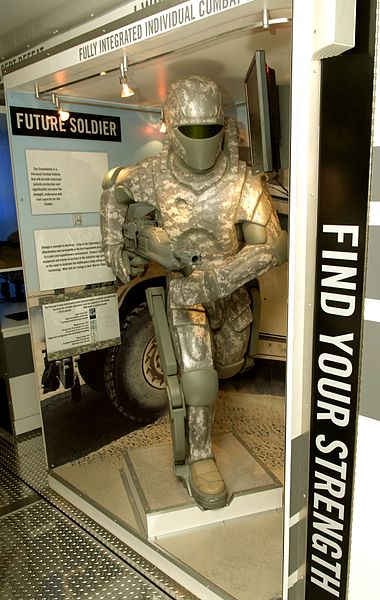
“Future Soldier”: Last, we have by far the most comprehensive and in-depth program to date for the development of an exoskeleton. Falling under the general banner of “Future Soldier”, the US and other national armies are hard at work with contractors to try and come up with a workable powered suit for armed forces use. These consist mainly of powered limbs that attach to the soldiers own arms and legs and assisting in basic motions, such as walking, lifting, and carrying heavy loads.
Each variant of the powered exoskeleton is built around the same concept, consisting primarily of an exoskeleton-like framework worn by a person and a power supply that supplies at least part of the activation-energy for limb movement. These will enable soldiers and engineers to be able to bear more weight and survive in hostile environments. Some day, they might even be able to increase a wearer’s running speed and allow them to jump higher and farther as well.
So far, civilian and military concepts for powered suits include the Ekso Bionics/Lockheed Martin HULC (Human Universal Load Carrier), the Sarcos/Raytheon XOS, the Cyderdine (no joke) HAL (Hybrid Assistive Limb) and the Argo Medical Technologies ReWalk module for paraplegics.Each of these suits give the wearer the ability to lift several times their own weight and/or assist them in the use of their limbs, especially in those who are paralyzed or do not have full range of motion or use.
Because of their obvious merits, their exists a massive commercial market for these designs as well, mainly in the field of medicine for spine-injury or terminally ill patients. In fact, it would be no exaggeration to say that military development and civilian development are feeding off each other, with research and development on the one side providing impetus and advancement to the other. So in addition to powered construction suits and Iron Man-type units, we might also be seeing walking suits replacing wheelchairs real soon!
Thank you all for reading and feel free to stay tuned for my next installment in this lineup, featuring the concept of exoskeletons and powered suits in fiction. Really folks, Iron Man is just a drop in the bucket of this fertile concept, so stick around!
Nina winces and imagines just how far down the hall people could hear that one. Griswold has been on the phone with Cyber Division for a few minutes now, and from the sounds of it, things are not going too well. She waits until the thumping and muffled shouts are finished before breathing easy again. She also steps closer to the door and puts her hand on the knob, anticipating what’s to come when the phone is slammed down on its cradle.
“Righetti! Get the fuck in here!”
Griswold is surprised when the door pops open less than half a second later. He makes a noise in the back of his throat then motions at her to sit.
“I just got off the phone with Walters over at CCRS, he’s given me a heads-up on what they’ve learned, and it’s not much. They say they’ve found the entry point the hacker used. They used some kind of ‘breaker’ to get past our firewalls and some kind of program to cover their ISP address, whatever the hell that means! No doubt about it, we have got a serious clusterfuck on our hands here!”
Nina nods without smiling. The familiarity of the words on his tongue is patently evident. He doesn’t even bother to hide it. And the direness of the news would be a lot more convincing for her if he weren’t being so loud and profane about it. By now, she’s come to understand that the good ole CF is very popular in their line of work. Everyone in the intelligence services appears to use it; it’s kind of like their version of SNAFU or FUBAR. Funny how people in the military and intelligence community need standardized terms for fucked-up situations, she thinks. One would think they dealt with them all the time.
“I’m sending you over to DC, care of Cyber Division. You’re to pack up and head over immediately, call me direct to let me know if you need anything. Otherwise, you’ll be reporting to DD Domovitch, head of Cyber. Understood?”
“You want me there, sir?” Nina asks.
“Yes,” Griswold replies with a fair degree of annoyance, “I want your eyes and ears there, and I also want you to make sure we remind those dickheads exactly whose shit pile this is! Now who did you say brought this to your attention?”
“Johnson, sir. He was the one who got the call from the Post and gave me the file numbers on all those pics.”
“Fine, take him with you! Just get yer ass over to the capitol and make sure those fuck ups don’t screw this up any more than they already have!”
“Are we to drive ourselves, sir?” she asks semi-sarcastically.
Griswold sighs. “We still have a budget, sweetheart. I got a helicopter waiting for you outside. Now move unless you want to lose your job!”
Nina nods and turns to leave in great haste. There’s only so much of Griswold’s profanity she can stand, then she feels dirty somehow. Someday, if she were the litigious type, she might consider folding all of his curse words and offhand sexual references into one big harassment lawsuit. But right now, she’s got more important things to think about. For one, this whole hack job. It’s all a little confusing to her, naturally. She’s pretty sure Cyber crimes is not her business and that her involvement in this case ended when she handed her boss the photographic evidence of the hack. But Griswold’s paranoia is understandable. Their business has been violated and he wants someone from their department to oversee the attempts at redress.
One thing is for sure: they need to find out who did this and how. Then, they need to bring them in for some serious “questioning”. And Nina knows what will happen next, as per the Bureau’s policy. If they don’t kill them first, they’ll probably offer them a job. That’s how the whole industry works, really. If you can’t beat em, hire em!
Getting back to her desk, he picks up her phone and dials Mark’s extension. He is there, surprisingly. No voice mail and no call backs within fifteen seconds, which is his usual ritual. His voice is plain and professional too.
“Johnson.”
She is straight to the point. “Mark? Nina. You remember where my desk is?”
There is a moment of hesitation. “Yes, of course. What’s the problem?”
“No problem,” she says unequivocally. “We’ve just been reassigned to DC. Get your kit together and meet me downstairs. We’re to leave immediately, by chopper.”
She hangs up and begins dialling her next number before he can answer enthusiastically. A chopper ride is a rare privilege and she knows Mark is far more excited than she is to be getting out from behind their desks for a change. Her next call is to old unfaithful, just to let him know that she’ll be gone. That and his car privileges have been extended, among other things. She gets the answering machine at their shared apartment and leaves a message.
“Garret, this is Nina. I’ll be away for a few days. Car is yours and you’ve got the run of the place. Don’t do anything stupid while I’m gone and if anything’s broken when I get back – anything of mine, that is, you can start looking for a new best friend. Bye!”
Her tone is playful but Garret knows her well enough to know she’s serious. She omitted Garret’s title of “dumb shit”, and “with benefits” from her description of their relationship, for obvious reasons. She’s at work, after all. Some modicum of decorum must be maintained, especially since their boss has the market on smut talk cornered. Who wants to hear about a visiting friend she obviously doesn’t trust fully, who also happens to share her bed? Righetti is a saintly name, and she’s determined to keep it that way.
Reaching into her desk drawer, she grabs her FBI ID and her sidearm, putting both in her carrying bag and heading for the elevator to meet Mark below.
I’m surprised I waited this long. I loooove making covers! And after the release of the first six chapters over at Story Time, I decided I should finally treat Crashland like a true writing project and give it a cover. Eventually, it’s going to be complete, and I would like to make it available to the public once it is.
To give it a quick recap, Crashland takes place in the not too distant future in the megacity of BosWash. The technological singularity – the point where advances in nanotech, biotech, artificial intelligence, quantum computing will forever change things – is fast approaching. In the midst of this, a group of unknown cyber terrorists have released a virus designed to cripple the world’s information networks.
Way I see it, in this near-future scenario, all things are networked and wireless like never before. People are able to access the future internet (known as the infobahn) remotely or through various interfaces. Just about all commerce, entertainment, social interaction and politics are conducted virtually, and all electronic systems are networked, so once the virus hits, it quickly spreads and brings it all down.
The main character, William Holden, a technological mogul, finds himself lost in the streets after the Crash takes place. Desperate to find his family, he begins combing his way through the dark and is attacked and almost killed. It’s a desperate struggle for him just to go on, but in time he finds help from some unlikely sources. Since they were in a position to witness the Crash directly, they know how and why it happened, secrets they reveal to Holden in time.
And that’s the extent of the story so far. In the coming chapters, I will reveal exactly who these strangers are, how they know what they know, and how they plan to reign in the people who are responsible. Holden, since he helped design the infobahn, is in a unique position to help. However, his intentions haven’t changed since the Crash occurred. Somewhere out there, his family still resides, and he’s determined to find them. Perhaps a trade off can be made…
Who knows? You’ll have to tune in to find out. And did I mention that since it’s a serial novel, you get to vote on what happens next? Yep, so the ending and outcome of all this will depend on what you want to see happen. And of course, there are plenty of other stories to vote on. Check er out!

 Arcology: noun (plural arcologies) an ideal integrated city contained within a massive vertical structure, allowing maximum conservation of the surrounding environment. Origin: 1969: blend of architecture and ecology.
 By the turn of the century, the projections only became worse, thanks in large part to the ongoing industrialization of developing nations. In these parts of the world, where a full third of the human race resides, the impact of so many new power plants, urban developments, superhighways, and fossil-fuel burning cars could not be underestimated. The problem of providing space for our people and seeing to their needs in a way that is sustainable in the long term has only become more pressing as a result.
 One of his first designs was for a city-structure named Babel (or IID as it’s officially designated). This design called for a flared cylinder of apartments sitting in a saucer-shaped base, complete with commercial, civil spaces, and public areas. The estimated population for this monster design was 550,000 people – the population of a major city – but placed in an edifice 1900 meters high and 3000 meters at its widest point.
 His many other concepts involved cities adrift on water, built into canyons, or on the side of cliffs. As far as Soleri was concerned, nothing was off limits. Any and all geographic features and landscapes, including the ocean itself, could be built into human habitats. Though it remained somewhat speculative for its time, Soleri’s ideas formed the basis for a great deal of speculative writing and urban planning.
 In addition, there is the proposed building project in Moscow known as “Crystal Island”. Measuring in at a whopping 2500 square kilometers at its base and 450 meters high, it will be the single largest structure on Earth, if and when it is completed. Shaped like a massive tent, the superstructure of the proposed design acts as a sort of second skin to the main building, creating a thermal buffer and shielding the interior from Moscow’s harsh weather.
 Last, but not least, there is the planned community of Masdar City, which I wrote about in a previous article. Though not technically an arcology in the sense of a three-dimensional colossal environment, the design nevertheless incorporates all other aspects of Soleri’s concept. These include renewable energy sources, sustainable resource management, mass-transit, recycled water, and a range of other green technologies.
 Today, the planned city of Arcosanti, which Soleri himself began construction on in 1970, remains an unfinished testament to his work and his genius. Located in central Arizona, just 110 km north of Phoenix, this work-in-progress incorporates Soleri’s unusual design features and, though uncompleted, remains a testament to his vision.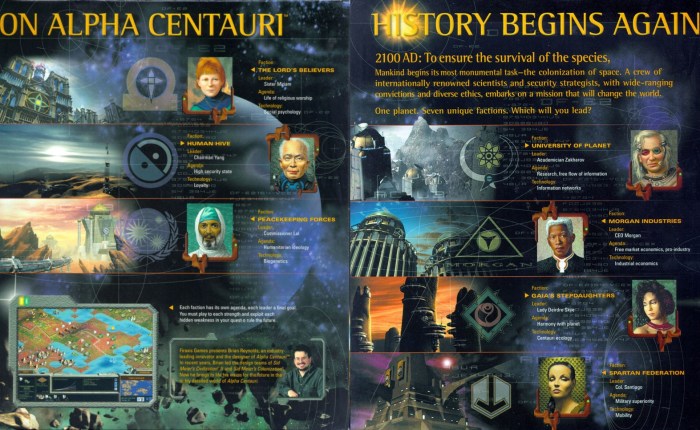









 From mechanical dials to vacuum tubes, from CPU’s to PC’s and laptops, computer’s have come a hell of a long way since the days of Ancient Greece. Hell, even within the last century, the growth in this one area of technology has been explosive, leading some to conclude that it was just a matter of time before we created a machine that was capable of thinking all on its own.





 Stories by Williams