Thanks to Popular Mechanics for turning me onto this recent invention! Back in 2007, an inventive engineer named Curtis DeForest created a contraptio nas a safe and effective alternative to the traditional bike. He called it the Hyperbike, and one look at the contraption will tell you why! Featuring three wheels, the vehicle is a full-body machine that utilizes hand and foot motions to generate speed. Since it does not require forward momentum to stand up, a rider is incapable of falling off, and can reach speeds of up to 50 mph.
DeForest also designed the prototype so that the rider’s center of gravity is below the spinning axis of the wheels – as opposed to above it, like in most bikes. This difference, along with its additional front wheel, increases stability, and also caught the attention of NASA. Impressed with its design and its possibility for use in low-gravity environments, the space agency invested in a new prototype. However, no updates have been made available on the progress of this development, and rumor has it NASA has moved on.
Too bad too! Tell me something like this wouldn’t be useful in a number of different environments. And I’m sure there’s plenty of military applications for something like this. Maybe add a gasoline engine, 800 hp, some missiles and some jump jets. Make a lovely Hyperbike, that would!
Just came across this recently. I know, it’s kind of old news at this point, but any fan of Game Of Thrones, or anyone who remembers using a computer with a floppy drive, cannot afford to miss out on this!
Wow. I’d like to thank my family, my wife, my cat Jasper, all my lovely friends, and of course, all the people who’ve helped to make this possible. Those would be the people who have chosen to follow my blog and even just come by to read what I’ve had to say over the past few years. Lord knows you’ve had plenty of choices in how to spend your internet time – which as we all know, costs way too much – and I’m pleased that you’ve chosen to spend some of it on me.
Over the next few weeks, I hope you stick around to see what else I’ve got on store. There’s plenty more Whiskey Delta on the way, plus a series of posts dealing with advances in technology – not to many though, I feel like I’ve been on a real nanotech and singularity bender lately! – and some (hopefully) big news regarding a certain novel named Data Miners. Possibly some anthology news too…
Thanks again, y’all. As far as milestones go, this is the biggest one I’ve experienced yet. Couldn’t have done it without you, so please feel free to stick around as I continue to unwind my pedigree. And if you yourself are an aspiring writer or are just fascinated with expressing your thoughts, let me know where I can share with them with you. Take care and see you real soon!
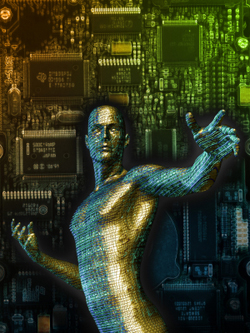
My personal thanks to kwolph, the unidentified fellow who was nice enough to stop by and forward me the link to this rather interesting infographic. Courtesy of the Keithley Center, which designs electronic systems for measurement and analysis, this infographic shows how advances in nanotechnology might aid us in reinventing and augmenting the human body.
These include augmenting our brain chemistry by either delivering drugs directly to our receptors (which can include anti-depressants, stimulants, or pain killers), or the more audacious approach of enhancing our thought pattens and memory by actively building and repairing neural tissue. As such, things like mental illness, brain injuries and trauma could be overcome at last.
In addition, there’s plenty of enhancing our hearts, lungs, reinforcing our bones, repairing muscle tissue, enhancing our eyes, reflexes, strength, endurance. And, as they point out, by virtue of the female model, the scourge of breast cancer, which effects one in eight women, could be be wiped out. No mother’s or young women dying before their time anymore!
And of course, other entirely too common ailments, heart disease, prostate cancer, ovarian cancer, lung cancer, and every form of degenerative disease, could be nipped in the bud either through regular maintenance of the bodily tissues, or by correcting the fault at the genetic level.
There’s really no limit to what programmable nanomachines could do, once the technology was realizable of course. And above all, proven to be safe and effective. And since it would mean that human beings no longer would be subject to disease or degenerative conditions (a la aging), lives could be extended indefinitely, which is part and parcel of the whole “transhuman”, “posthuman” and “postmortal” concept.
Naturally, they used the image of a very pretty young woman for the display. Had it been a man I’m guessing they would have gone with a six foot tall dude with washer board abs and only 1 percent body fat. Why can’t they ever use a porked out old dude with man boobs? That’s what I’d like to know? Well, for one, such regular individuals don’t exactly inspire confidence in the consumer market, do they?
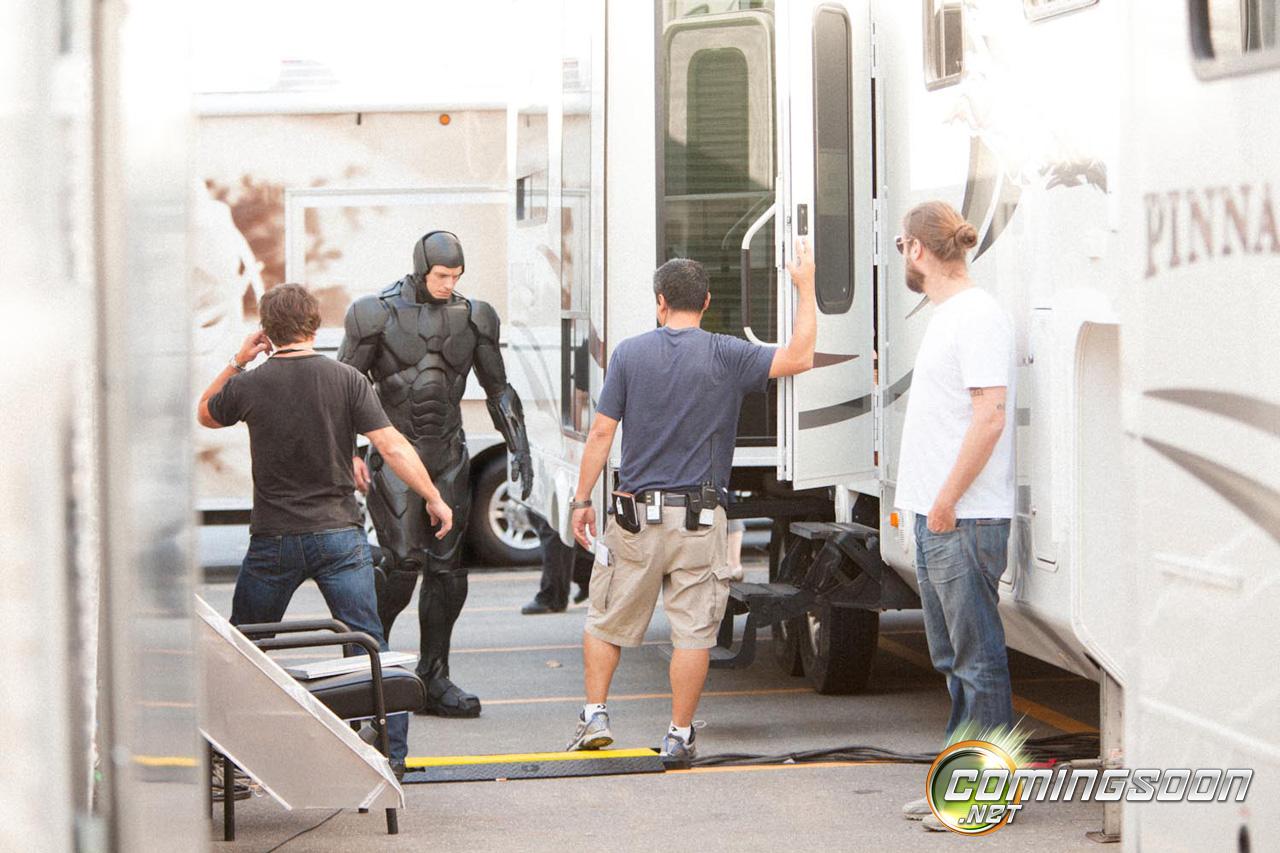
It seems the paparazzi are finally pulling their weight for us sci-fi geeks! This week, prospective audiences got their first glimpse at the new Robocop movie, which recently began filming on location in Toronto. Lead actor Joel Kinnaman, who plays Alex Murphy, was photographed wearing the new Robocop suit, and the new look has fans atwitter!
Yes, ever since the photos went public, countless fans took to Twitter to deplore Robocop’s admittedly Batman-esque outfit. Yes, it does look significantly different from the original. And upon closer examination, it seems that the new writers are diverging from the old script as well. For example, in the first photo you can clearly see that Alex Murphy has a human hand. In the other, his visor is up, which would seem to indicate that Murphy also has a fully-intact face.
This is starkly different from the original movie, where Murphy underwent a “full body prosthetic” after being shot to death. This, combined with the movie’s synopsis – which says that Alex Murphy was seriously wounded in the line of duty and not brutally murdered – suggests this reboot is also going to be less violent. Yes, Verhoeven had a weird fascination with over the top violence, but his movies made an impression and watering down an original does seem kinda wrong.
But take a look anyway and judge for yourself. Here he is the first photo, with Kinnaman wearing the suit for the first time:
And here he can be seen walking to his trailer, with the suit’s visor in the “up” position. Could just be for convenience, but it could also be a part of the new suit.
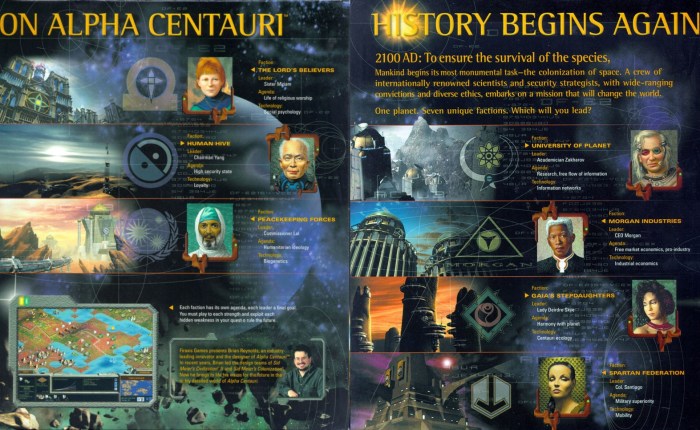
Today, I thought I’d totally nerd out and share some additional cool stuff from one of my favorite games of all time: Sid Meier’s Alpha Centauri! As you may have noticed, I already did a review of the game itself. But returning to this game to boast about it some more was something I just couldn’t resist! After over a decade, I’m still not bored with this turn-based strategy game. It’s just that good.
Anyhoo, today I thought I’d share something which I glossed over in my review. And that would be the games best one-liners. During every turn, whenever you build a special project, experience a research breakthrough, build a new type of facility, or develop a new type of unit, you get a line accompanied by some music and in the case of projects, even a little movie. Most are original creations, spoken by the faction leaders themselves, and give added depth to an already immersive gaming experience.
Here is the list of the ones I like best, broken down by faction. I also included some of the movies at the bottom. Enjoy!
Gaia’s Stepdaughters: The Gaian’s are the natural ecologists and environmentalists of the game. As such, the majority of Lady Dierdre’s quotes (their leader) espouse cultivating an understanding of the planet’s ecology and the super-sentience that governs it. In many cases, these involve conversations between her and the planetary sentience itself, which are collected in the fictional tome named “Conversations with Planet”.
“Observe the Razorbeak as it tends so carefully to the fungal blooms; just the right bit from the yellow, then a swatch from the pink. Follow the Glow Mites as they gather and organize the fallen spores. What higher order guides their work? Mark my words: someone or something is managing the ecology of this planet.”
“Planet’s atmosphere, though a gasping death to humans and most animals, is paradise for Earth plants. The high nitrate content of the soil and the rich yellow sunlight bring an abundant harvest wherever adjustments can be made for the unusual soil conditions.”
“You are the children of a dead planet, earthdeirdre, and this death we do not comprehend. We shall take you in, but may we ask this question–will we too catch the planetdeath disease?” -taken from “Conversations with Planet”, Dierdre’s dialogue with the planetary sentience
“No longer mere earthbeings and planetbeings are we, but bright children of the stars! And together we shall dance in and out of ten billion years, celebrating the gift of consciousness until the stars themselves grow cold and weary, and our thoughts turn again to the beginning.” -“Conversation with Planet”, after you develop the “Ascent to Transcendance” where your faction merges with the planetary sentience
“Eternity lies ahead of us, and behind. Have you drunk your fill?”
-“Conversations with Planet”, during the game’s epilogue
Human Hive: Led by Chairman Yang, the Hive is a totalitarian faction that is clearly inspired by Maoist China and the North Korea. The majority of his quotes have to do with the nature of his political beliefs, which occasionally digress into the spiritual, a combination of Taoism and ascetisim.
“Einstein would turn in his grave. Not only does God play dice, the dice are loaded.”
“If our society seems more nihilistic than that of previous eras, perhaps this is simply a sign of our maturity as a sentient species. As our collective consciousness expands beyond a crucial point, we are at last ready to accept life’s fundamental truth: that life’s only purpose is life itself.”
“What do I care for your suffering? Pain, even agony, is no more than information before the senses, data fed to the computer of the mind. The lesson is simple: you have received the information, now act on it. Take control of the input and you shall become master of the output.”
“It is every citizen’s final duty to go into the tanks and become one with all the people.” -upon building Recycling Tanks
“My gift to industry is the genetically engineered worker, or Genejack. Specially designed for labor, the Genejack’s muscles and nerves are ideal for his task, and the cerebral cortex has been atrophied so that he can desire nothing except to perform his duties. Tyranny, you say? How can you tyrannize someone who cannot feel pain?” -upon building a Genejack Factory
Lords Believers: The undisputed fundamentalist faction of the planet, led by Sister Miriam. As expected, the majority of what she has to say has to do with defending her traditional beliefs, calling into question the nature of technological progress, and condemning the majority of developments that take place late in the game.
“Some would ask, how could a perfect God create a universe filled with so much that is evil. They have missed a greater conundrum: why would a perfect God create a universe at all?”
“The righteous need not cower before the drumbeat of human progress. Though the song of yesterday fades into the challenge of tomorrow, God still watches and judges us. Evil lurks in the datalinks as it lurked in the streets of yesteryear. But it was never the streets that were evil.”
“Beware, you who seek first and final principles, for you are trampling the garden of an angry God and he awaits you just beyond the last theorem.”
“Men in their arrogance claim to understand the nature of creation, and devise elaborate theories to describe its behavior. But always they discover in the end that God was quite a bit more clever than they thought.”
“Will we next create false gods to rule over us? How proud we have become, and how blind.” -after finishing the project The Self-Aware Colony
“And what of the immortal soul in such transactions? Can this machine transmit and reattach it as well? Or is it lost forever, leaving a soulless body to wander the world in despair?”
-after creating the Bulk Matter Transmitter
“Already we have turned all of our critical industries, all of our material resources, over to these…things…these lumps of silver and paste we call nanorobots. And now we propose to teach them intelligence? What, pray tell, will we do when these little homunculi awaken one day announce that they have no further need for us?”
Morgan Industries: CEO Morgan, leader of the Morganites, is an unquestioning believer in the art of laissez-faire economics and unadulterated capitalism. He has plenty to say on the subject of research and development, not to mention the continuance of monopolistic practices on the new planet. The environment and moderation be damned! Most of these are contained within his tomes “The Centauri Monopoly” and “The Ethics of Greed”.
“Human behavior is economic behavior. The particulars may vary but competition for limited resources remains a constant. Need as well as greed has followed us to the stars and the rewards of wealth still await those wise enough to recognize this deep thrumming of our common pulse.”
“Richard Baxton piloted his Recon Rover into a fungal vortex and held off four waves of mind worms, saving an entire colony. We immediately purchased his identity manifests and repackaged him into the Recon Rover Rick character with a multi-tiered media campaign: televids, touchbooks, holos, psi-tours– the works. People need heroes. They don’t need to know how he died clawing his eyes out, screaming for mercy. The real story would just hurt sales, and dampen the spirits of our customers.”
‘Abort, Retry, Fail?’ was the phrase some wormdog scrawled next to the door of the Edit Universe project room. And when the new dataspinners started working, fabricating their worlds on the huge organic comp systems, we’d remind them: if you see this message, always choose ‘Retry.’
-quote from one of Morgan’s software developers
“Resources exist to be consumed. And consumed they will be, if not by this generation then by some future. By what right does this forgotten future seek to deny us our birthright? None I say! Let us take what is ours, chew and eat our fill.”
“Fossils fuels in the last century reached their extreme prices because of their inherent utility: they pack a great deal of potential energy into an extremely efficient package. If we can but sidestep the 100 million year production process, we can corner this market once again.”
“Look at any photograph or work of art. If you could duplicate exactly the first tiny dot of color, and then the next and the next, you would end with a perfect copy of the whole, indistinguishable from the original in every way, including the so-called “moral value” of the art itself. Nothing can transcend its smallest elements.”
Peacekeeping Forces: Led by Brother Lal, the Peacekeepers are perhaps the most balanced faction in this game. Dedicated to human rights, scientific research, democracy, freedom of information, and peace, they are quite to make enemies with many of the more extreme factions. And of course, the majority of quotes from this faction deal with inalienable rights of human beings, the importance of freedom, and the consequences of certain technologies.
“As the Americans learned so painfully in Earth’s final century, free flow of information is the only safeguard against tyranny. The once-chained people whose leaders at last lose their grip on information flow will soon burst with freedom and vitality, but the free nation gradually constricting its grip on public discourse has begun its rapid slide into despotism. Beware of he who would deny you access to information, for in his heart he dreams himself your master.”
“The Mind Worms are the natural defenses of the living Planet–the white blood cells, if you will. In a world in which unassimilated thought represents danger, the Mind Worm seeks out concentrations of sentient mental energy and destroys them, ruthlessly and efficiently.”
“The entire character of a base and its inhabitants can be absorbed in a quick trip to the Rec Commons. The sweaty arenas of Fort Legion, the glittering gambling halls of Morgan Bank, the sunny lovers’ trysts in Gaia’s High Garden, or the somber reading rooms of U.N. Headquarters. Even the feeding bay at the Hive gives stark insight into the sleeping demons of Yang’s communal utopia.”
“The Warrior’s bland acronym, MMI, obscures the true horror of this monstrosity. Its inventors promise a new era of genius, but meanwhile unscrupulous power brokers use its forcible installation to violate the sanctity of unwilling human minds. They are creating their own private army of demons.”
Spartan Federation: The Spartans are aptly named, and represent the faction that believes that the right to bear arms in both inalienable and unquestionable. Led by Colonel Santiago, a total badass in her own right, the majority of what comes from them consists of philosophical tidbits taken from Sun Tzu’s Art of War, updated for the modern age, and some random bits of marching songs and barracks scuttlebutt.
“Information, the first principle of warfare, must form the foundation of all your efforts. Know, of course, thine enemy. But in knowing him do not forget above all to know thyself. The commander who embraces this totality of battle shall win even with inferior force.”
“I don’t know but I’ve been told, Deirdre’s got a Network Node. Likes to press the on-off switch, Dig that crazy Gaian witch!”
-Spartan marching song
“Industrial Grade Nano-Paste, one of Planet’s most valuable commodities, can also be one of its most dangerous. Simply pour out several canisters, slide in a programming transponder, and step well away while the stuff cooks. In under an hour the nano will use available materials to assemble a small factory, a hovertank, or enough rifles to equip a regiment.”
–describing industrial nanomachines
“We shall take only the greatest minds, the finest soldiers, the most faithful servants. We shall multiply them a thousandfold and release them to usher in a new era of glory.” -upon developing the Cloning Vats
The University: Led by Academician Prokhor Zakharov, the University is Planet’s great espouser of technological progress and scientific research, unhampered by such things as spirituality and political controls. On the one hand, they call to mind the stereotype of the mad scientist. On the other, they are picture perfect representations of the empirical method and true believers in freedom. As such, they make good allies, but can turn into enemies rather easily as well. Consistent with their outlook, the majority of what their leader has to say concerns scientific ideas and a defense of their methods from what they see as small-mindedness or old world dogma.
“Man’s unfailing capacity to believe what he prefers to be true rather than what the evidence shows to be likely and possible has always astounded me. We long for a caring Universe which will save us from our childish mistakes, and in the face of mountains of evidence to the contrary we will pin all our hopes on the slimmest of doubts. God has not been proven not to exist, therefore he must exist.”
“A brave little theory, and actually quite coherent for a system of five or seven dimensions — if only we lived in one.”
-after researching String Theory
“What actually transpires beneath the veil of an event horizon… decent people shouldn’t think too much about that!”
“The first living thing to go through the device was a small white rat. I still have him, in fact. As you can see, the damage was not so great as they say.” -after developing the technology for teleportation gates
“The popular stereotype of the researcher is that of a skeptic and a pessimist. Nothing could be further from the truth! Scientists must be optimists at heart, in order to block out the incessant chorus of those who say ‘It cannot be done.’
“We have reached an informational threshold which can only be crossed by harnessing the speed of light directly. The quickest computations require the fasted possible particles moving along the shortest paths. Since the capability now exists to take our information directly from photons traveling molecular paths, the final act of the information revolution will soon be upon us.”
-upon developing Optical Computers
Time travel in the classic sense has no place in rational theory, but temporal distortion does exist on the quantum level, and more importantly it can be controlled.
Other: “A handsome young cyborg named Ace,
wooed women at every base. But once ladies glanced at His special enhancement They vanished with narry a trace!”
-Spartan Barracks Graffiti
“Mary had a little lamb, Little lamb little lamb, Mary had a little lamb, whose fleece was white as snow.” -Assassins’ Redoubt Final Transmission, after you build the “Dream Twister”, a psionic weapon that drives people mad
“Please don’t go. The drones need you. They look up to you!”
I think that last one is my favorites. I queues up from time to time when you try to quit the game suddenly. Oh, and as promised, some movies from the gameplay. With the exception of the Intro segment, all play after you complete a Secret Project.
Inspiration is a funny, fickle thing! As I’m sure anyone who’s ever attempted to write knows, ideas seem to come when you least expect them. On the one hand, a person can go months without coming up with an original idea. And then, just like that, inspiration can strike suddenly and without warning. You find yourself not only coming up with an idea, but the concept for a full-length novel!
That’s what happened to me this weekend. Myself and my wife were preparing to head up island to see her family. I was contemplating books that deal with the concept of alternate history, and how ones that deal with alternate outcomes to World War II and the Civil War seem to be especially popular. In the former case, you have The Man In the High Castle by Philip K Dick and Fatherland by Robert Harris, two seminal novels that address what would have happened had Germany won the war.
In the latter case, you have stories like A Rebel In Time by Harry Harrison and The Guns of the South by Harry Turtledove, which merge time travel and alternate history to examine what would have happened if The South had won the Civil War.
In both novels, the plot revolves around a single or group of White Supremacists who use a time machine to bring modern guns to the Confederate Army. This allows the South to prevail, which they hope will prevent the rise of the Civil Rights movement, the end of Apartheid, and other equality movements.
That’s when it hit me! Why the heck hasn’t anyone done an alternate history story where White Supremacists go back in time to make sure Germany won the Second World War? Sounds like something that ought to have been done by now; but to my knowledge, no one’s tackled it yet. I got to thinking long and hard about it, about the plot, characters and potential twists. Eventually, I had what I felt was the bare bones of an idea. It varies slightly from the premise I just mentioned, but in ways I think work! I plan to call it…
Fascio For those familiar with the Fascist movement of the 20th century, the concept of the Fascio is probably a familiar one. This was basically just a bundle of sticks with an axe tied on that was set afire at public gatherings. The ritual dates back to Ancient Rome, where the burning of these ceremonial bundles was meant to symbolize lighting the way to the future. Italian Fascists, under Mussolini, especially loved this ancient ritual, which they used to draw a connection to the past as much as to point to the future. Like all Fascist rituals, it was an inherent contradiction, more regressive than progressive in nature. But hey, the Fascists didn’t do logic…
Plot:
The story opens in 2050, where the world is reeling from the worst ravages of climate change and Fascist parties are once again taking hold of Europe and North America in response to numerous humanitarian crises. Two young history enthusiasts, believing that the worst is coming, decide to take advantage of an experimental new technology: Time Travel!
Using a machine they gain access to, the duo plan to travel back in time to Germany in 1920, where they plan to find a despondent young military officer named Hitler. Using futuristic technology, they plan to kill him without leaving a trace, and return to the future where things are surely to be much better.
Unfortunately, the time machine sends them to 1941 by accident. Unsure that they will be able to use the machine again in the future, they resolve to kill Hitler during the height of World War II, before he can enact the Final Solution and invade Russia. Relying on their knowledge of history and advanced technology, they manage to kill Hitler at his headquarters weeks before the Battle of Britain was to end and Operation Barbarossa (the invasion of Russia) began. After making a hasty retreat, they jump in the return module and set course of the future.
However, once again the machine drops them off in the wrong year. Rather than traveling 109 years into the future, they arrive in 1962, at roughly the same time as the Cuban Missile Crisis from their own timeline, and find a world starkly different than the one they read about in history books. Rather than finding a world dominated by the two superpowers of the United States and the Soviet Union, two different but equally menacing empires are in place. On the one side, there’s the Pan-American Alliance, led by the US, and on the other, the Axis Forces.
After combing through some records at the local library, they learn the terrible truth: assassinated Hitler in 1941, rather than ending the Second Word War, led Germany to victory. Without Hitler’s questionable and erratic leadership, Germany avoided making several mistakes which were directly attributable to him. For one, Germany did not give up the Battle of Britain a few weeks shy of victory. By choosing to maintain their operations against the RAF and its coastal airfields, they eventually overcame Britain’s air defenses. This allowed them to come to a cease fire agreement which took Britain out of the war.
Then, in 1942, they invaded Russia and were successful in capturing Moscow, Leningrad and Stalingrad, all within the space of a year. This led to the creation of Germania, an Empire which reached from Northern France to the Ural Mountains. In the Mediterranean, Italy became the dominant power, with possessions in the Balkans and all across North Africa. The US still went to war with Japan in the Pacific, where they were victorious, but in Europe, the Nazis and their Fascist allies were never defeated.
Thus the world was divided into two major power blocs. The US, Canada, Mexico and all of South America joined together and maintained alliances with India, Japan, China and Australia to safeguard against expansion into Asia and the Pacific. Germany, Italy, and their subservient allies came together to dominant Eurasia and set their eyes on the Middle East, Africa, and further East. Both sides developed nuclear weapons, and by 1960, tensions had reached an all-time breaking point.
Hence, the two historians bear witness to a different “Missile Crisis”, which still takes place in 1962, but was between the Axis and Allies, and actually took place. When the bombs begin to fall, they die, since the future they left is now erased from existence. In their last few moments, they realize the folly of tampering with timelines. Such things are just too complicated for people to handle!
And I was thinking about a possible epilogue chapter where the two main characters meet each other in the alternate future they have now created. The world they live in is a post-apocalyptic landscape, roughly ninety years since World War III, where life is hard and people live by a new form or “Iron Rule” – the rule of survival at all costs. Not sure, we’ll see…
So that’s my latest idea, a time traveling alternate future addressing World War II and the rise of neo-fascism in today’s world. I humbly submit to my followers for their approval. So tell me, what do you think?
“Your mind is software. Program it. Your body is a shell. Change it. Death is a disease. Cure it. Extinction is approaching. Fight it.”
-Eclipse Phrase
A lot of terms are thrown around these days that allude to the possible shape of our future. Words like Technological Singularity, extropianism, postmortal, posthuman, and Transhuman. What do these words mean? What kind of future do they point to? Though they remain part of a school of thought that is still very much theoretical and speculative, this future appears to be becoming more likely every day.
Ultimately, the concept is pretty simple, in a complex, mind-bending sort of way. The theory has it that at some point in this or the next century, humanity will overcome death, scarcity, and all other limitations imposed on us by nature. The means vary, but it is believed that progress in any one or more of the following areas will make such a leap inevitable:
Artificial Intelligence: The gradual evolution of computers, from punch cards to integrated circuits to networking, shows an exponential trend upwards. With the concordant growth of memory capacity and processing speed, it is believed that it is only a matter of time before computers are capable of independent reasoning. Progress is already being made in this domain, with the Google X Labs Neural Net that has a connectome of a billion connections.
As such, it is seen as inevitable that a machine will one day exist that is capable of surpassing a human being. This sort of machinery could even be merged with a human’s own mind, enhancing their natural thought patterns, memory, and augmenting their intelligence to the point where their intelligence is immeasurable by modern standards.
Just think of the things we could think up once that’s possible. Well… you can’t exactly, but we can certainly postulate. For starters, such things as the Grand Unifying Theory, the nature of time and space, quantum mechanics, and other mind-bendingly complex fields could suddenly make sense to us. What’s more, this would make further technological leaps that much easier.
Biology: Here we have an area of development which can fall into one of three categories. On the one hand, advancements in medical science could very well lead to the elimination of disease and the creation of mind-altering pharmaceuticals. On the other, there’s the eventual development of things like biotechnology, machinery that is grown rather than built, composed of DNA strands or other “programmable” material.
Lastly, there is the potential for cybernetics, a man-machine interface where organic is merged with the artificial, either in the form of implants, prosthetic limbs, and artificial organs. All of these, alone or in combination, would enhance a human beings strength, mental capacity, and prolong their life.
This is the meaning behind the word postmortal. If human beings could live to the point where life could be considered indefinite (at least by current standards), the amount we could accomplish in a single lifetime could very well be immeasurable.
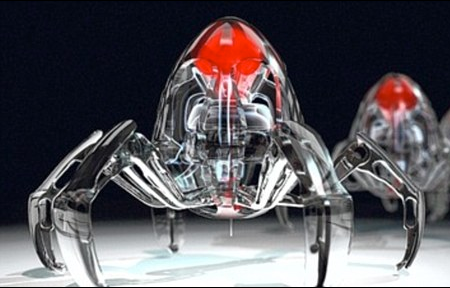
Nanotechnology: The concept of machines so small that anything will be accessible, even the smallest components of matter, has been around for over half a century. However, it was not until the development of microcircuits and miniaturization that the concept graduated from pure speculation and became a scientific possibility.
Here again, the concept is simple, assuming you can wrap your head around the staggering technical aspects and implications. For starters, we are talking about machines that are measurable only on the nanoscale, meaning one to one-hundred billionths of a meter (1 x 10⁻⁹ m). At this size, these machines would be capable of manipulating matter at the cellular or even atomic level. This is where the staggering implications come in, when you realize that this kinds of machinery could make just about anything possible.
For starters, all forms of disease would be conquerable, precious metals could be synthesized, seamless, self-regenerating structures could be made, and any and all consumer products could be created out of base matter. We’d be living in a world in which scarcity would be a thing of the past, our current system of values and exchange would become meaningless, buildings could build themselves, and out of raw matter (like dirt and pure scrap) no less, societies would become garbage free, pollution could be eliminated, and manufactured goods could be made of materials that are both extra-light and near-indestructible.
Summary: All of this progress, either alone or in combination, will add to a future that we can’t even begin to fathom. This is where the concept of the Technological Singularity comes in. If human beings were truly postmortal (evolved beyond death), society was postscarce (meaning food, water, fuel and other necessities would never be in short supply), and machines would be capable of handling all our basic needs.
For Futurists and self-professed Singularitarians, this trend is as desirable as it is inevitable. Citing such things as Moore’s Law (which measures the rate of computing progress) or Kurzweil’s Law of Accelerating Returns – which postulates that the rate of progress increases exponentially with each development – these voices claim that it is humanity’s destiny to conquer death and its inherent limitations. If one looks at the full range of human history – from the Neolithic Revolution to the Digital – the trend seems clear and obvious.
For others, this prospect is both frightening and something to be avoided. When it comes right down to it, transhumanity means leaving behind all the things that make us human. And whereas some people think the Singularity will solve all human problems, others see it as merely an extension of a trend whereby our lives become increasingly complicated and dependent on machinery. And supposing that we do cross some kind of existential barrier, will we ever be able to turn back?
And of course, the more dystopian predictions warn against the cataclysmic possibilities of entrusting so much of our lives to automata, or worse, intelligent machines. Virtually every apocalyptic and dystopian scenario devised in the last sixty years has predicted that doom will result from the development of AI, cybernetics and other advanced technology. The most technophobic claim that the machinery will turn on humanity, while the more moderate warn against increased dependency, since we will be all the more vulnerable if and when the technology fails.
Naturally, there are many who fall somewhere in between and question both outlooks. In recent decades, scientists and speculative fiction writers have emerged who challenge the idea that technological progress will automatically lead to the rise of dystopia. Citing the undeniable trend towards greater and greater levels of material prosperity caused by the industrial revolution and the post-war era – something which is often ignored by people who choose to emphasize the down sides – these voices believe that the future will be neither utopian or dystopian. It will simply be…
Man I love this show! Before it came around, scientific theories and geeking out weren’t considered mainstream at all. And for those who enjoy the show, the season 5 ender was quite the cliffhanger. The gang got together to give Howard and Bernadette a wedding before his big mission, Howard was seconds away from being launched into space, and everyone, including Sheldon and Amy, joined hands to wish him well. Touching, and also pretty hilarious!
Check out the promo for the Season 6 opener which promises to have more hijinks. Naturally, they open with a sci-fi reference, this one to Alien – “In Space No One Can Hear You Scream…” Just two weeks to go… man, they sure are taking their time on this one!
There has been some rather interesting and revolutionary technology being released lately, and a good deal of it involves the human eye. First, there was the Google Glasses, then there were the VR contact lenses, and now the new EyeTap! This new technology, which is consistent with the whole 6th sense computing trend, uses the human eye as an actual display and camera… after a fashion.
Used in conjunction with a portable computer, the EyeTap combines the latest in display technology and Augmented Reality which allows for computer mediated interaction with their environment. This consists of the device taking in images of the surrounding area, and with the assistance of the computer, augment, diminish, or otherwise alter a user’s visual perception of what they see.
In addition, plans for the EyeTap include computer-generated displays so the user can also interface with the computer and do work while their AFK (Away From Keyboard, according to The Big Bang Theory). The figure below depicts the basic structure of the device and how it works.
Ambient light is taken in by the device just as a normal eye is, but are then reflected by the Diverter. These rays are then collected by a sensor (typically a CCD camera) while the computer processes the data. At this point, the Aremac display device (“camera” spelt backwards) redisplays the image as rays of light. These rays reflect again off the diverter, and are then collinear with the rays of light from the scene. The light which the viewer perceives is what is referred to as “Virtual Light”, which can either be altered or show the same image as before.
While the technology is still very much under development, it represents a major step forward in terms of personal computing, augmented reality, and virtual interfacing. And if this sort of technology can be permanently implanted to the human eye, it will also be a major leap for cybernetics.
Once again, Gibson must be getting royalties! His fourth novel, the first of the Bridge Trilogy, was named Virtual Light and featured a type of display glasses that relied on this very technology in order to project display images in the user’s visual field. Damn that man always seems to be on top of things!
And just for fun, here’s a clip from the recent Futurama episode featuring the new eyePhone. Hilarious, if I do so myself!










 Stories by Williams