First Article Published at Universe Today!

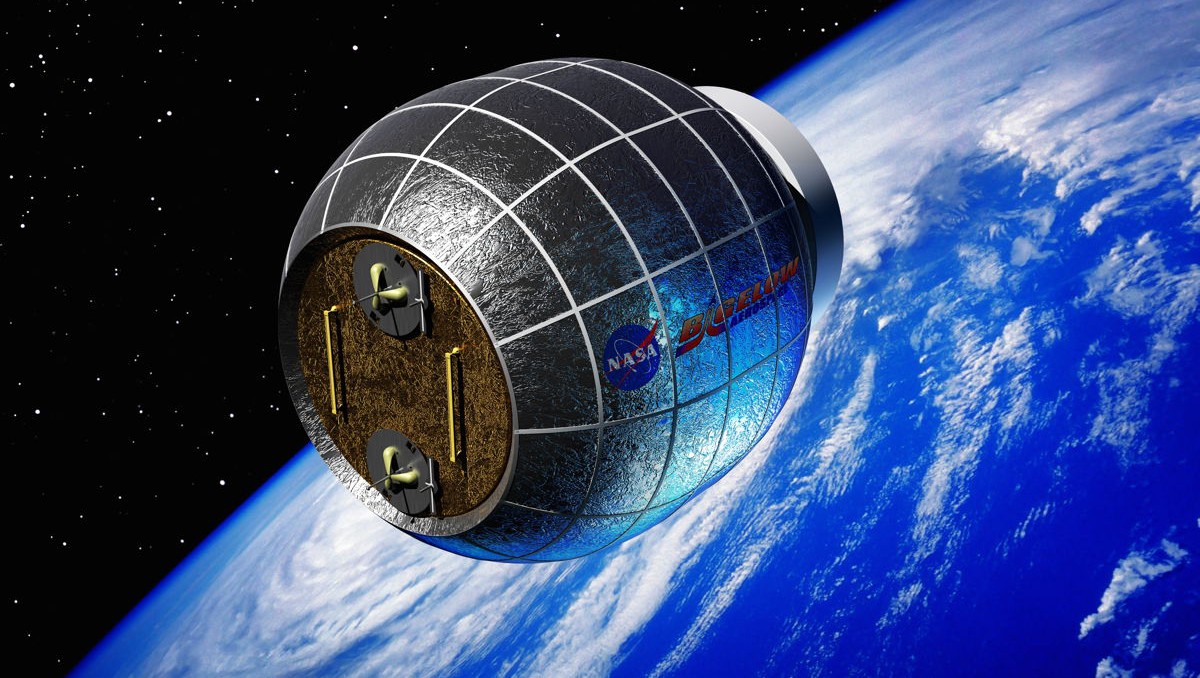
bigelow-expandable-activity-moduleHey all! Just wanted to let people know, my first article for Universe Today just went public. The subject of the article was the Bigelow Expandable Activity Module, a new type of space habitat that is being shipped to the ISS next year. Researching and writing the article itself was not unusual for me. It’s pretty much what I do here every single day. However, the real fun came in speaking to NASA and Bigelow Aerospace themselves via phone and email.

Interviewing the people behind big ideas and technological innovation is something a humble blogger like myself doesn’t get to do!  While I’ve really enjoyed talking to luminaries like Andraka and Makosinski in the past, this was a first for me. Looking forward to doing more of it in the near future!

In any case, follow the link below to check it out and don’t forget to comment and Like us on Facebook… no pressure 😉

www.universetoday.com

News from Space: “Life” Molecules Detected in Space!

SagitariusB2The secret to the creation to life in our universe appears to be seeding – the proper elements in the right mix in the right places to form the right kind of molecules. Only then can these molecules evolve chemically into more and more complex structures, thus following a general pathway toward biology. The pathway for life as we know it starts with carbon, but one which is specific organized and structured.

Recently, a team of astronomers  at the ALMA Observatory reported the discovery of this very element while probing distant galaxies. What they found was not just interstellar carbon, but a form of carbon with a branched structure. The discovery was made in the gaseous-star forming region known as Sagittarius B2 – a giant molecular cloud of gas and dust that is located about 390 light years from the center of the Milky Way.

radio-wave-dishesSimple carbon chains aren’t particularly unusual in the cosmos, but complex carbon is a different matter. It is what the researchers, based at Cornell University and the Max Planck Institute, describe as finding a molecular needle in a cosmic haystack. The actual molecule in question is isopropyl cyanide, and it was discerned thanks to the miracle known as radio astronomy.

Within clouds of interstellar dust and gas, elements find themselves shielded from the harsh radiation of open space and are, thus, free to form into more complex arrangements. These molecules don’t just sit there, but instead move around within their cloud-homes and bump into each other. The result of this activity are radio signals which can be detected light-years away – in this case, by radio telescopes here on Earth.

MaxPlanckIns_radiowavepulseEvery molecule has a different radio signal, so it’s possible to pick apart the contents of interstellar junk by examining a cloud’s frequency spectra. NASA, via the Ames Research Center, even maintains a radio-emission frequency database to aid in the tracking of polycyclic aromatic hydrocarbons, a form of molecule thought to contain much of the universe’s carbon stockpiles.

The branching carbon structure of isopropyle cyanide is of particular interest because it’s thought that this arrangement is a step on the way to the production of amino acids, the building blocks of proteins, and hence organic life. The discovery gives weight to the increasingly popular notion that life, or at least many of the key steps leading toward life, actually occurs off-planet.

alien-worldLife on Earth may have been well on its way while the planet was still just space dust waiting to come together into our rock-home. What’s more, the molecules discovered by the ALMA team probably aren’t alone.  As the authors, led by astronomer Arnaud Belloche, wrote:

[Isopropyle cyanide’s] detection therefore bodes well for the presence in the [interstellar medium] (ISM) of amino acids, for which such side-chain structure is a key characteristic… This detection suggests that branched carbon-chain molecules may be generally abundant in the [interstellar medium].

The discovery follows a general progression in recent years adding more and more life-ingredients to our picture of the ISM. A 2011 study revealed that complex organic matter should be created in large volumes from stars, while a 2012 report study found that conditions within the ISM are uniquely suited to the creation of increasingly complex molecules, “step[s] along the path toward amino acids and nucleotides, the raw materials of proteins and DNA, respectively.”

sugar-in-space-molecules_58724_990x742Also in 2012, astronomers working for ALMA found basic sugar molecules hanging out in the gas cloud around IRAS 16293-2422 – a young star located some 400 light-years from Earth. The particular form, glycoaldehyde, is thought to be a key component of the reaction behind the creation of DNA. Indeed, more and more, the universe is looking less and less like a harsh environment in which life must struggle to emerge, to a life factory.

Source: motherboard.vice.com

The Future of Medicine: Improved Malaria Vaccine

flu_vaccineOf the many advances made by medical science in the past century, vaccinations are arguably the greatest. With the ability to inoculate people against infection, diseases like yellow fever, measles, rubella, mumps, typhoid, tetanus, polio, tuberculosis, and even the common flu have become controllable – if not eliminated. Nevertheless, medical researchers agree that there are still some things that can be improved upon when it comes to vaccinations.

Beyond the controversies surrounding a supposed link between vaccinations and autism, there is the simple fact that the current method of inoculating people is rather invasive. Basically, it requires people to sit through the rather uncomfortable process of being stuck with a needle, oftentimes in an uncomfortable place (like the shoulder). Luckily, many researchers are working on a way to immunize people using gentler methods.

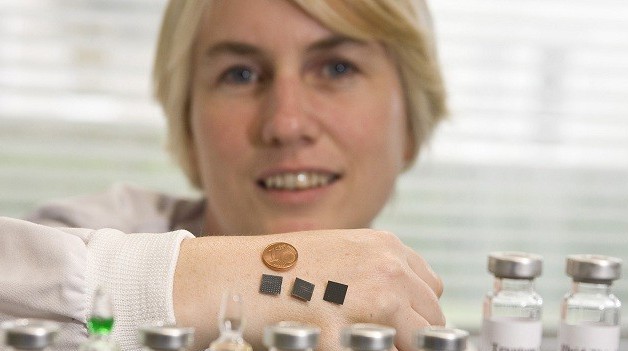
malaria_vaccineAt the University College Cork in Ireland, for example, scientists have just finished pre-clinical testing on an experimental malaria vaccine that is delivered through the skin. To deliver the vaccine into the body, the researchers used a skin patch with arrays of tiny silicon microneedles that painlessly create temporary pores. These pores provide an entry point for the vaccine to flow into the skin, as the patch dissolves and releases the drug.

To make the vaccine, the team used a live adenovirus similar to the virus that causes the common cold, but which they engineered to be safer and produce the same protein as the parasite that causes malaria. Adenoviruses are one of the most powerful vaccine platforms scientists have tested, and the one they used produced strong immunity responses to the malaria antigen with lower doses of the vaccine.

TB_microneedlesThe research showed that the administration of the vaccine with the microneedle patch solves a shortcoming related to this type of vaccine, which is inducing immunity to the viral vector – that is, to the vaccine itself. By overcoming this obstacle, the logistics and costs of vaccination could be simpler and cheaper as it would not require boosters to be made with different strains. Besides, with no needles or pain involved, there’s bigger potential to reach more people requiring inoculation.

This is similar to the array used by researchers at King’s College in London, who are also developing a patch for possible HIV vaccine delivery. Researchers at University of Washington used a similar method last year to deliver the tuberculosis vaccine. The method is an improvement on this type of vaccine delivery since it is painless and non-invasive. It’s use is also being researched in relation to other infections, including Ebola and HIV.

The details of the research appeared in the journal Nature. Lead researcher, Dr. Anne Moore, is set to negotiate with Silicon Valley investors and technology companies to commercialize the vaccine.

Sources: gizmag.com, (2), ucc.ie, nature.com

News from Mars: Mysterious Martian Ball Found!

Mars_ballThe rocky surface of Mars has turned up some rather interestingly-shaped objects in the past. First there was the Martian rat, followed shortly thereafter by the Martian donut; and very recently, the Martian thighbone. And in this latest case, the Curiosity rover has spotted what appears to be a perfectly-round ball. Even more interesting is the fact that this sphere may be yet another indication of Mars’ watery past.

The rock ball was photographed on Sept. 11 – on Sol 746 of the rover’s mission on Mars – while Curiosity was exploring the Gale Crater. One of Curiosity’s cameras captured several images of the centimeter-wide ball as part of the stream of photographs was taking. The scientists working at the Mars Science Laboratory based at NASA’s Jet Propulsion Laboratory (JPL), immediately began to examine it for indications of what it could be.

mars-selfie-01-140501As Ian O’Neill of Discovery News, who spoke with NASA after the discovery, wrote:

According to MSL scientists based at NASA’s Jet Propulsion Laboratory (JPL) in Pasadena, Calif., the ball isn’t as big as it looks — it’s approximately one centimeter wide. Their explanation is that it is most likely something known as a “concretion”… and they were created during sedimentary rock formation when Mars was abundant in liquid water many millions of years ago.

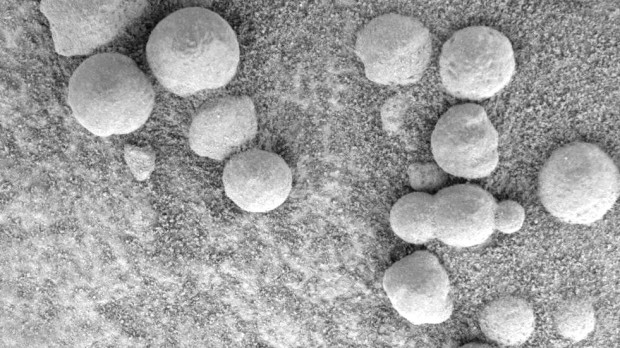
Curiosity has already found evidence of water at a dig site in Yellowknife Bay, which took place shortly after it landed in the Gale Crater two years ago. In addition, this is not the first time a Mars rover has found rocky spheres while examining the surface. In 2004, NASA’s Opportunity rover photographed a group of tiny balls made of a ferrous mineral called hematite. Opportunity photographed still more spheres, of a different composition, eight years later.

mars-blueberriesThe spheres likely formed through a process called “concretion”, where minerals precipitate within sedimentary rock, often into oval or spherical shapes. When the rock erodes due to wind or water, it leaves the balls of minerals behind and exposed. If in fact concretion caused the Mars spheres, then they would be evidence there was once water on the planet. However, some scientists believe the rock balls might be leftover from meteorites that broke up in the Martian atmosphere.

Curiosity is now at the base of Mount Sharp (Aeolis Mons) – The 5.6 km-high (3.5 mile) mountain in the center of Gale Crater – scientists are excited to commence the rover’s main science goal. This will consists of more drilling into layered rock and examining the powder so scientist can gain an idea about how habitable the Red Planet was throughout its ancient history, and whether or not it may have been able to support microbial life.

MarsCuriosityTrek_20140911_AMission managers will need to be careful as the rover has battered wheels from rougher terrain than expected. Because of this, the rover will slowly climb the slope of Mount Sharp driving backwards, so as to minimize the chance of any further damage. The Mars Reconnaissance Orbiter (MRO) will also be on hand to help, photographing the route from above to find the smoothest routes.

Despite the wear and tear that the little rover has experienced in its two years on the Martian surface, it has discovered some amazing things and NASA scientists anticipate that it will accomplish much more in the course of its operational history. And as it carried on with its mission to decode the secrets of Mars, we can expect it will find lots more interesting rocks – spherical, rat-shaped, ringed, femur-like, or otherwise.


Sources: cbc.ca, universetoday.com, news.discovery.com

Writing for HeroX and Universe Today!

good_news_farnsworthGood news, everyone! My services as a freelance writer were recently enlisted by the good folks who run HeroX and Universe Today. Thanks to my old friend and mentor, Fraser Cain (who consequently got me started in the indie publishing bizz), I’m going to be bringing the experience I’ve garnered writing my own blog to a more professional format – writing about space exploration, innovation and technological development.

As you can imagine, this means I’ll be doing less in the way of writing for this here website. But I promise I’ll still be around! After all, I’ve got lost more work to do on my stories, and there are always articles and headlines that need to be written about that I won’t get a chance to cover at those other sites. So rest assured, storiesbywilliams will be in operation for a long time to come.

XPRIZE_GooglePlus_Cover_2120x1192For those unfamiliar, HeroX is a spinoff of the XPRIZE Foundation, the non-profit organization that runs public competitions intended to encourage technological development and innovation. It’s directors includes such luminaries as Google’s Elon Musk and Larry Page, director James Cameron, author and columnist Arianna Huffington, and businessman/ philanthropist Ratan Tata, and more. In short, they are kind of a big deal!

Fraser Cain, founder of Universe Today, began HeroX as a way of combining the best of the XPRIZE with a crowdfunding platform similar to Kickstarter. Basically, the site brings together people with ideas for new inventions, finds the people with the talent and resources to make them happen, and funnels contributions and donations to them to bankroll their research and development.

big_bangUniverse Today, on the other hand, is kind of an old stomping ground for me. Years back, I did articles for them that dealt with a range of topics, including geology, natural science, physics, environmentalism, and astronomy. In both cases, I’ll be doing write ups on news items that involve technological development and innovation, and doing interviews with some of the people in the business.

If possible, I’ll try to link articles done for these sources to this page so people can check them out. And stay tuned for more updates on the upcoming release of Flash Forward, Oscar Mike, and my various other projects. Peace out!

The Future of Space: A Space Elevator by 2050?

space_elevatorIn the ongoing effort to ensure humanity has a future offworld, it seems that another major company has thrown its hat into the ring. This time, its the Japanese construction giant Obayashi that’s declared its interest in building a Space Elevator, a feat which it plans to have it up and running by the year 2050. If successful, it would make space travel easier and more accessible, and revolutionize the world economy.

This is just the latest proposal to build an elevator in the coming decades, using both existing and emerging technology. Obayashi’s plan calls for a tether that will reach 96,000 kilometers into space, with robotic cars powered by magnetic linear motors that will carry people and cargo to a newly-built space station. The estimated travel time will take 7 days, and will cost a fraction of what it currently takes to bring people to the ISS using rockets.

space_elevator_liftThe company said the fantasy can now become a reality because of the development of carbon nanotechnology. As Yoji Ishikawa, a research and development manager at Obayashi, explained:

The tensile strength is almost a hundred times stronger than steel cable so it’s possible. Right now we can’t make the cable long enough. We can only make 3-centimetre-long nanotubes but we need much more… we think by 2030 we’ll be able to do it.

Once considered the realm of science fiction, the concept is fast becoming a possibility. A major international study in 2012 concluded the space elevator was feasible, but best achieved with international co-operation. Since that time, Universities all over Japan have been working on the engineering problems, and every year they hold competitions to share their suggestions and learn from each other.

space_elevator3Experts have claimed the space elevator could signal the end of Earth-based rockets which are hugely expensive and dangerous. Compared to space shuttles, which cost about $22,000 per kilogram to take cargo into space, the Space Elevator can do it for around $200. It’s also believed that having one operational could help solve the world’s power problems by delivering huge amounts of solar power. It would also be a boon for space tourism.

Constructing the Space Elevator would allow small rockets to be housed and launched from stations in space without the need for massive amounts of fuel required to break the Earth’s gravitational pull. Obayashi is working on cars that will carry 30 people up the elevator, so it may not be too long before the Moon is the next must-see tourist destination. They are joined by a team at Kanagawa University that have been working on robotic cars or climbers.

graphene_ribbonsAnd one of the greatest issues – the development of a tether that can withstand the weight and tension of stresses of reaching into orbit – may be closer to being solved than previously thought. While the development of carbon nanotubes has certainly been a shot in the arm for those contemplating the space elevator’s tether, this material is not quite strong enough to do the job itself.

Luckily, a team working out of Penn State University have created something that just might. Led by chemistry professor John Badding, the team has created a “diamond nanothread” – a thread composed of carbon atoms that measures one-twenty-thousands the diameter of a single strand of human hair, and which may prove to be the strongest man-made material in the universe.

diamond_nanothreadAt the heart of the thread is a never-before-seen structure resembling the hexagonal rings of bonded carbon atoms that make up diamonds, the hardest known mineral in existence. That makes these nanothreads potentially stronger and more resilient than the most advanced carbon nanotubes, which are similar super-durable and super-light structures composed of rolled up, one atom-thick sheets of carbon called graphene.

Graphene and carbon nanotubes are already ushering in stunning advancements in the fields of electronics, energy storage and even medicine. This new discovery of diamond nanothreads, if they prove to be stronger than existing materials, could accelerate this process even further and revolutionize the development of electronics vehicles, batteries, touchscreens, solar cells, and nanocomposities.

space_elevator2But by far the most ambitious possibility offered is that of a durable cable that could send humans to space without the need of rockets. As John Badding said in a statement:

One of our wildest dreams for the nanomaterials we are developing is that they could be used to make the super-strong, lightweight cables that would make possible the construction of a ‘space elevator’ which so far has existed only as a science-fiction idea,

At this juncture, and given the immense cost and international commitment required to built it, 2050 seems like a reasonable estimate for creating a Space Elevator. However, other groups hope to see this goal become a reality sooner. The  International Academy of Astronautics (IAA) for example, thinks one could be built by 2035 using existing technology. And several assessments indicate that a Lunar Elevator would be far more feasible in the meantime.

Come what may, it is clear that the future of space exploration will require us to think bigger and bolder if we’re going to secure our future as a “space-faring” race. And be sure to check out these videos from Penn State and the Obayashi Corp:

John Badding and the Nanodiamond Thread:


Obayashi and the 2050 Space Elevator:


Sources:
cnet.com
, abc.net.au, science.psu.edu

Restoring Ability: Project NEUWalk

neuwalkIn the past few years, medical science has produced some pretty impressive breakthroughs for those suffering from partial paralysis, but comparatively little for those who are fully paralyzed. However, in recent years, nerve-stimulation that bypasses damaged or severed nerves has been proposed as a potential solution. This is the concept behind the NEUWalk, a project pioneered by the École Polytechnique Fédérale de Lausanne (EPFL) in Switzerland.

Here, researchers have figured out a way to reactivate the severed spinal cords of fully paralyzed rats, allowing them to walk again via remote control. And, the researchers say, their system is just about ready for human trials. The project operates on the notion that the human body requires electricity to function. The brain moves the body by sending electrical signals down the spinal cord and into the nervous system.

spinal-cord 2When the spinal cord is severed, the signals can no longer reach that part of the spine, paralysing that part of the body. The higher the cut, the greater the paralysis. But an electrical signal sent directly through the spinal cord below a cut via electrodes can take the place of the brain signal, as the team at EPFL, led by neuroscientist Grégoire Courtine, has discovered.

Previous studies have had some success in using epidural electrical stimulation (EES) to improve motor control where spinal cord injuries are concerned. However, electrically stimulating neurons to allow for natural walking is no easy task, and it requires extremely quick and precise stimulation. And until recently, the process of controlling the pulse width, amplitude and frequency in EES treatment was done manually.

brainwavesThis simply isn’t practical, and for two reasons: For starters, it is very difficult for a person to manually adjust the level of electrostimulation they require to move their legs as they are trying to walk. Second, the brain does not send electrical signals in an indiscriminate stream to the nerves. Rather, the frequency of the electrical stimulation varies based on the desired movement and neurological command.

To get around this, the team carefully studied all aspects of how electrical stimulation affects a rat’s leg movements – such as its gait – and was therefore able to figure out how to stimulate the rat’s spine for a smooth, even movement, and even take into account obstacles such as stairs. To do this, the researchers put paralyzed rats onto a treadmill and supported them with a robotic harness.

NEUWalk_ratsAfter several weeks of testing, the researchers had mapped out how to stimulate the rats’ nervous systems precisely enough to get them to put one paw in front of the other. They then developed a robust algorithm that could monitor a host of factors like muscle action and ground reaction force in real-time. By feeding this information into the algorithm, EES impulses could be precisely controlled, extremely quickly.

The next step involved severing the spinal cords of several rats in the middle-back, completely paralyzing the rats’ lower limbs, and implanted flexible electrodes into the spinal cord at the point where the spine was severed to allow them to send electrical signals down to the severed portion of the spine. Combined with the precise stimulation governed by their algorithm, the researcher team created a closed-loop system that can make paralyzed subjects mobile.

walkingrat.gifAs Grégoire Courtine said of the experiment:

We have complete control of the rat’s hind legs. The rat has no voluntary control of its limbs, but the severed spinal cord can be reactivated and stimulated to perform natural walking. We can control in real-time how the rat moves forward and how high it lifts its legs.

Clinical trials on humans may start as early as June 2015. The team plans to start testing on patients with incomplete spinal cord injuries using a research laboratory called the Gait Platform, housed in the EPFL. It consists of a custom treadmill and overground support system, as well as 14 infrared cameras that read reflective markers on the patient’s body and two video cameras for recording the patient’s movement.

WorldCup_610x343Silvestro Micera, a neuroengineer and co-author of the study, expressed hope that this study will help lead the way towards a day when paralysis is no longer permanent. As he put it:

Simple scientific discoveries about how the nervous system works can be exploited to develop more effective neuroprosthetic technologies. We believe that this technology could one day significantly improve the quality of life of people confronted with neurological disorders.

Without a doubt, restoring ambulatory ability to people who have lost limbs or suffered from spinal cord injuries is one of the many amazing possibilities being offered by cutting-edge medical research. Combined with bionic prosthetics, gene therapies, stem cell research and life-extension therapies, we could be looking at an age where no injury is permanent, and life expectancy is far greater.

And in the meantime, be sure to watch this video from the EPFL showing the NEUWalk technology in action:


Sources:
cnet.com, motherboard.com
, actu.epfl.ch

Cyberwars: “Bigger than Heartbleed”

Shellshock-bash-header-664x374Just months after the Heartbleed bug made waves across the internet, a new security flaw has emerged which threatens to compromise everything from major servers to connected cameras. It is known as the Bash or Shellshock bug, a quarter-century old vulnerability that could put everything from major internet companies and small-scale web hosts to wi-fi connected devices at risk.

This  flaw allows malicious code execution within the bash shell – commonly accessed through Command Prompt on PC or Mac’s Terminal application – to take over an operating system and access confidential information. According to the open-source software company Red Hat, bash shells are run in the background of many programs, and the bug is triggered when extra code is added within the lines of Bash code.

heartbleed-iconBecause the bug interacts with a large percentage of software currently in use, and does in ways that are unexpected, Robert Graham – an internet security expert – claims that the Bash bug is bigger than Heartbleed. As he explained it:

We’ll never be able to catalogue all the software out there that is vulnerable to the Bash bug. While the known systems (like your Web server) are patched, unknown systems remain unpatched. We see that with the Heartbleed bug: six months later, hundreds of thousands of systems remain vulnerable.

According to a report filed by Ars Technica, the vulnerability could affect Unix and Linux devices, as well as hardware running Max OS X – particularly Mac OS X Mavericks (version 10.9.4). Graham warned that the Bash bug was also particularly dangerous for connected devices because their software is built using Bash scripts, which are less likely to be patched and more likely to expose the vulnerability to the outside world.

shellshock_bashAnd since the bug has existed for some two and a half decades, a great number of older devices will be vulnerable and need to be patched because of it. By contrast, The Heartbleed bug was introduced into OpenSSL more than two years ago, allowing random bits of memory to be retrieved from impacted servers. And according to security researcher Bruce Schneier, roughly half a million websites could be vulnerable.

For the time being, the administrative solution is to apply patches to your operating system. Tod Beardsley, an engineering manager at security firm Rapid7, claims that even though the vulnerability’s complexity is low, the level of danger it poses is severe. In addition, the wide range of devices affected by the bug make it essential that system administrators apply patches immediately.

cyber_virusAs Beardsley explained during an interview with CNET:

This vulnerability is potentially a very big deal. It’s rated a 10 for severity, meaning it has maximum impact, and ‘low’ for complexity of exploitation — meaning it’s pretty easy for attackers to use it… The affected software, Bash, is widely used so attackers can use this vulnerability to remotely execute a huge variety of devices and Web servers. Using this vulnerability, attackers can potentially take over the operating system, access confidential information, make changes etc. Anybody with systems using bash needs to deploy the patch immediately.

Attackers can potentially take over the operating system, access confidential information, and make changes. After conducting a scan of the internet to test for the vulnerability, Graham reported that the bug “can easily worm past firewalls and infect lots of systems” which he says would be “‘game over’ for large networks”. Similar to Beardsley, Graham said the problem needed immediate attention.

cyber-hackIn the meantime, Graham advised people to do the following:

Scan your network for things like Telnet, FTP, and old versions of Apache (masscan is extremely useful for this). Anything that responds is probably an old device needing a Bash patch. And, since most of them can’t be patched, you are likely screwed.

How lovely! But then again, these sorts of exploitable vulnerabilities are likely to continue to pop up until we rethink how the internet is run. As the Heartbleed bug demonstrated, the problem at the heart (no pun!) of it all is that vast swaths of the internet run on open-source software that is created by only a handful of people who are paid very little (and sometimes, not at all) for performing this lucrative job.

In addition, there is a terrible lack of oversight and protection when it comes to the internet’s infrastructure. Rather than problems being addressed in an open-source manner after they emerge, there needs to be a responsible body of committed and qualified individuals who have the ability to predict problems in advance, propose possible solutions, and come up with a set of minimum standards and regulations.

cryptographyEnsuring that it is international body would also be advisable. For as the Snowden leaks demonstrated, so much of the internet is controlled the United States. And as always, people need to maintain a degree of vigilance, and seek out information – which is being updated on a regular basis – on how they might address any possible vulnerabilities in their own software.

I can remember reading not long ago that the growing amount of cyber-attacks would soon cause people to suffer from “alert fatigue”. Well, those words are ringing in my ears, as it seems that a growing awareness of our internet’s flaws is likely to lead to “bug fatique” as well. Hopefully, it will also urge people to action and lead to some significant reforms in how the internet is structured and administered.

Source: cnet.com, arstechnica.com, blog.erratasec.com, securityblog.redhat.com

The Future of Space: Smart, Stretchy, Skintight Spacesuits

biosuitSpacesuits have come a long way from their humble origins in the 1960s. But despite decades worth of innovation, the basic design remains the same – large, bulky, and limiting to the wearer’s range of movement. Hence why a number of researchers and scientists are looking to create suits that are snugger, more flexible, and more ergonomic. One such group hails from MIT, with a skin-tight design that’s sure to revolutionize the concept of spacesuits.

The team is led by Dava Newman, a professor of aeronautics and astronautics and engineering systems at MIT who previewed her Biosuit – playfully described by some as a “spidersuit” – at the TEDWomen event, held in San Fransisco in December of 2013. Referred to as a “second skin” suit, the design incorporates flexible, lightweight material that is lined with “tiny, muscle-like coils.”

mit-shrink-wrap-spacesuitSpeaking of the challenges of spacesuit design, and her team’s new concept for one, Dava Newman had the following to say in an interview with MIT news:

With conventional spacesuits, you’re essentially in a balloon of gas that’s providing you with the necessary one-third of an atmosphere [of pressure,] to keep you alive in the vacuum of space. We want to achieve that same pressurization, but through mechanical counterpressure — applying the pressure directly to the skin, thus avoiding the gas pressure altogether. We combine passive elastics with active materials.

Granted, Newman’s design is the first form-fitting spacesuit concept to see the light of day. Back in the 1960’s, NASA began experimenting with a suit that was modeled on human skin, the result of which was the Space Activity Suit (SAS). Instead of an air-filled envelope, the SAS used a skin-tight rubber leotard that clung to astronaut like spandex, pressing in to protect the wearer from the vacuum of space by means of counter pressure.

SAS_spacesuitFor breathing, the suit had an inflatable bladder on the chest and the astronaut wore a simple helmet with an airtight ring seal to keep in pressure. This setup made for a much lighter, more flexible suit that was mechanically far simpler because the breathing system and a porous skin that removed the need for complex cooling systems. The snag with the SAS was that materials in the days of Apollo were much too primitive to make the design practical.

Little progress was made until Dava Newman and her team from MIT combined modern fabrics, computer modelling, and engineering techniques to produce the Biosuit. Though a far more practical counter-pressure suit than its predecessor, it was still plagued by one major drawback – the skintight apparatus was very difficult to put on. Solutions were proposed, such as a machine that would weave a new suit about the wearer when needed, but these were deemed impractical.

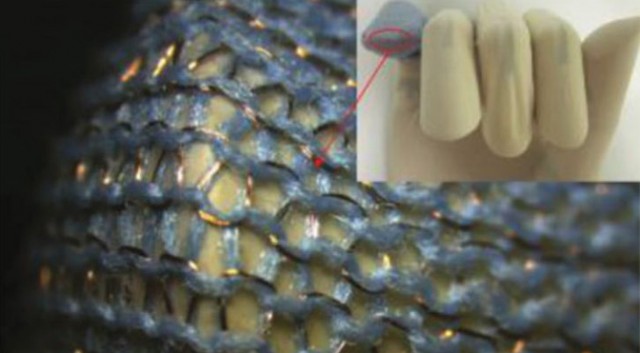
mit-shrink-wrap-spacesuit-0The new approach incorporates coils formed out of tightly packed, small-diameter springs made of a shape-memory alloy (SMA) into the suit fabric. Memory alloys are metals that can be bent or deformed, but when heated, return to their original shape. In this case, the nickel-titanium coils are formed into a tourniquet-like cuff that incorporates a length of heating wire. When a current is applied, the coil cinches up to provide the proper counter pressure needed for the Biosuit to work.

Bradley Holschuh, a post-doctorate in Newman’s lab, originally came up with the idea of a coil design. In the past, the big hurdle to second-skin spacesuits was how to get astronauts to squeeze in and out of the pressured, skintight suit. Holschuh’s breakthrough was to deploy shape-memory alloy as a technological end-around. To train the alloy, Holschuh wound raw SMA fiber into extremely tight coils and heated them to 450º C (842º F) to fashion an original or “trained” shape.

mit-shrink-wrap-spacesuit-3 When the coil cooled to room temperature, it could be stretched out, but when heated to 60º C (140º F), it shrank back into its original shape in what the MIT team compared to a self-closing buckle. As spokespersons from MIT explained:

The researchers rigged an array of coils to an elastic cuff, attaching each coil to a small thread linked to the cuff. They then attached leads to the coils’ opposite ends and applied a voltage, generating heat. Between 60 and 160 C, the coils contracted, pulling the attached threads, and tightening the cuff.

In order to maintain it without continually heating the coils, however, the team needs to come up with some sort of a catch that will lock the coils in place rather than relying on a continuous supply of electricity and needlessly heating up the suit – yet it will still have to be easy to unfasten. Once Newman and her team find a solution to this problem, their suit could find other applications here on Earth.

Image converted using ifftoanyAs Holschuh explained, the applications for this technology go beyond the spacesuit, with applications ranging from the militarized to the medical. But for the moment, the intended purpose is keeping astronauts safe and comfortable:

You could [also] use this as a tourniquet system if someone is bleeding out on the battlefield. If your suit happens to have sensors, it could tourniquet you in the event of injury without you even having to think about it… An integrated suit is exciting to think about to enhance human performance. We’re trying to keep our astronauts alive, safe, and mobile, but these designs are not just for use in space.

Considering the ambitious plans NASA and other government and private space agencies have for the near-future – exploring Mars, mining asteroids, building a settlement on the Moon, etc. – a next-generation spacesuit would certainly come in handy. With new launch systems and space capsules being introduced for just this purpose, it only makes sense that the most basic pieces of equipment get a refit as well.

And be sure to check out this video of Dava Newman showing her Biosuit at the TEDWomen conference last year:


Sources:
gizmag.com, motherboard.vice.com
, newsoffice.mit.edu

The Future of Space: Building A Space Elevator!

space_elevator2Regularly scheduled trips to the Moon are one of many things science fiction promised us by the 21st century that did not immediately materialize. However, ideas are on the drawing board for making it happen in the coming decades. They include regular rocket trips, like those suggested by Golden Spike, but others have more ambitious plans. For example, there’s LiftPort – a company that hopes to build a space elevator straight to the Moon.

When he was working with NASA’s Institute for Advanced Concepts in the early 2000s, LiftPort President Michael Laine began exploring the idea of a mechanism that could get people and cargo to space while remaining tethered to Earth. And he is certainly not alone in exploring the potential, considering the potential cost-cutting measures it offers. The concept is pretty straightforward and well-explored within the realm of science fiction, at least in theory.

space_elevatorThe space elevator concept is similar to swinging a ball on a string, except it involves a tether anchored to the Earth that’s about 500 km long. The other end is in anchored in orbit, attached to a space station that keeps the tether taut. Anything that needs to be launched into space can simply be fired up the tether by a series of rocket-powered cars, which then dock with the station and then launched aboard a space-faring vessel.

Compared to using rockets to send everything into space, the cost using the elevator is far less (minus the one-time astronomical construction fee). And while the materials do not yet exist to construct 0ne, suggestions have been floated for a Lunar Elevator. Taking advantage of the Moon’s lower gravity, and using the Earth’s gravity well to stabilize the orbital anchor, this type of elevator could be built using existing materials.

space_elevator_lunar1One such person is Laine, who believes the capability exists to build an elevator that would reach from to the Moon to a distance of 238,000 km towards the Earth. Hence why, started two and a half years ago, he struck out to try and bring this idea to reality. The concept behind the Moon Elevator is still consistent with the ball on the string analogy, but it is a little more complicated because of the Moon’s slow orbit around the Earth.

The solution lies in Lagrangian points, which are places of gravitational equilibrium between two bodies. It’s here that the gravitational pull of both bodies are equal, and so they cancel each other out. Lagrangian point L1 is about 55,000 kilometers from the Moon, and that’s the one Laine hopes to take advantage of. After anchoring one end of the “string” on the Moon’s surface, it will extend to L1, then from L1 towards Earth.

lunar_space_elevatorAt the end of the string will be a counterweight made up of all the spent pieces of rocket that launched the initial mission to get the spike into the Moon. The counterweight will be in the right place for the Earth to pull on it gravitationally, but it will be anchored, through the Lagrange point, to the Moon. The force on both halves of the “string” will keep it taut. And that taut string will be a space elevator to the Moon.

What’s more, Laine claims that the Moon elevator can be built off-the-shelf, with readily available technology. A prototype could be built and deployed within a decade for as little as $800 million, he claims. It would be a small version exerting just a few pounds of force on the anchor on the Moon, but it would lay the groundwork for larger follow-up systems that could transport more cargo and eventually astronauts.

liftportTo demonstrate their concept, LiftPort is working on a proof-of-concept demonstration that will see a robot climb the tallest free­standing human structure in existence. This will consist of three large helium balloons held together on a tripod and a giant spool of Vectran fiber that is just an eighth of an inch think, but will be able to support 635 kilograms (1,400 pounds) and withstand strong winds.

Vectran is the same material was used by NASA to create the airbags that allowed the Spirit and Opportunity’s rovers to land on Mars. Since it gets stronger as it gets colder, it is ideal for this high altitude test, which will be LiftPort’s 15th experiment and the 20th robot to attempt an ascent. Laine doesn’t have a prospective date for when this test will happen, but insists it will take place once the company is ready.

LiftPort1Regardless, when the test is conducted, it will be the subject of a new documentary by Ben Harrison. Having learned about Liftport back in 2012 when he stumbled across their Kickstarter campaign, Harrison donated to the project and did a brief film segment about it for Engadget. Since that time, he has been filming Liftport’s ongoing story as part of a proposed documentary.

Much like Laine, Harrison and his team are looking for public support via Kickstarter so they can finish the documentary, which is entitled “Shoot the Moon”. Check out their Kickstarter page if feel like contributing. As of the time of writing, they have managed to raise a total of $14,343 of their $37,000 goal. And be sure to check out the promotional videos for the Liftport Group and Harrison’s documentary below:

Lunar Space Elevator Infrastructure Overview:


Shoot the Moon – Teaser Trailer:


Sources:
 motherboard.vice.com
, lunarelevator.com