Woohoo! It feels like forever since I reached a milestone and felt the need to celebrate. But that’s to be expected after a few years. At first, they come fast and often due to the fact that everything’s new and exciting. After awhile, they naturally become fewer and further between. But it’s always important to mark these occasions and take the time to give thanks.
So my thanks to the many people who have chosen to come by over the years. Especially those 2038 of you who have chosen to stick around by subscribing and/or following. And thanks be to the people who have offered constructive criticism, comments, and ongoing support. I would name names, but I don’t want to leave anybody out. Besides, you know who you are!
And of course, a big shout out to people who’ve offered beta reading, editing and constructive criticism to my own works, and have allowed me to do the same for their own. This coming March will mark storiesbywilliams third anniversary, and I hope to have a number of things done by then. So stay tuned, and expect me to come by and camp out in your blogs as well!
Google has always been famous for investing in speculative ventures and future trends. Between their robot cars, Google Glass, the development of AI (the Google Brain), high-speed travel (the Hyperloop), and alternative energy, their seems to be no limit to what Musk and Page’s company will take on. And now, with Calico, Google has made the burgeoning industry of life-extension its business.
The newly formed company has set itself to “focus on health and well-being, in particular the challenge of aging and associated diseases.” Those were the words of Google co-founder Larry Page, who issued a two-part press release back in September. From this, it is known that Calico will focus on life extension and improvement. But in what way and with what business model, the company has yet to explain.
What does seem clear at this point is that Art Levinson, the chairman of Apple and former CEO of Genentech (a pioneer in biotech) will be the one to head up this new venture. His history working his way from a research scientist on up to CEO of Genentech makes him the natural choice, since he will bring medical connections and credibility to a company that’s currently low on both.
Google Health, the company’s last foray into the health industry, was a failure for the company. This site, which began in 2008 and shut down in 2011, was a personal health information centralization service that allowed Google users to volunteer their health records. Once entered, the site would provide them with a merged health record, information on conditions, and possible interactions between drugs, conditions, and allergies.
In addition, the reasons for the company’s venture into the realm of health and aging may have something to do with Larry Page’s own recent health concerns. For years, Page has struggled with vocal nerve strain, which led him to make a significant donation to research into the problem. But clearly, Calico aims to go beyond simple health problems and cures for known diseases.
In a comment to Time Magazine, Page stated that a cure for cancer would only extent the average human lifespan by 3 years. They want to think bigger than that, which could mean addressing the actual causes of aging, the molecular processes that break down cells. Given that Google Ventures included life extension technology as part of their recent bid to attract engineering students, Google’s top brass might have a slightly different idea.
And while this might all sound a bit farfetched, the concept of life-extension and even clinical immortality have been serious pursuits for some time. We tend to think of aging as a fact of life, something that is as inevitable as it is irreversible. However, a number of plausible scenarios have already been discussed that could slow or even end this process, ranging from genetic manipulation, nanotechnology, implant technology, and cellular therapy.
Whether or not Calico will get into any of these fields remains to be seen. But keeping in mind that this is the company that has proposed setting aside land for no-hold barred experimentation and even talked about building a Space Elevator with a straight face. I wouldn’t be surprised if they started building cryogentic tanks and jars for preserving disembodies brains before long!
Drone warfare is one of the most controversial issues facing the world today. In addition to ongoing concerns about lack of transparency and who’s making the life-and-death decisions, there has also been serious and ongoing concerns about the cost in civilian lives, and the efforts of both the Pentagon and the US government to keep this information from the public.
This past October, the testimonial of a Pakistani family to Congress helped to put a human face on the issue. Rafiq ur Rehman, a Pakistani primary school teacher, described how his mother, Momina Bibi, had been killed by a drone strike. His two children – Zubair and Nabila, aged 13 and 9 – were also injured in the attack that took place on October 24th of this year.
This testimony occurred shortly after the publication of an Amnesty International report, which listed Bibi among 900 other civilians they say have been killed by drone strikes since 2001. Not only is this number far higher than previously reported, the report claims that the US may have committed war crimes and should stand trial for its actions.
Already, efforts have been mounted to put limitations on drone use and development within the US. Last year, Human Rights Watch and Harvard University released a joint report calling for the preemptive ban of “killer robots”. Shortly thereafter, Deputy Defense Secretary Ashton Carter signed a series of instructions to “minimize the probability and consequences of failures that could lead to unintended engagements.”
However, these efforts officially became international in scope when, on Monday October 21st, a growing number of humans rights activists, ethicists, and technologists converged on the United Nations Headquarters in New York City to call for an international agreement that would ban the development and use of fully autonomous weapons technology.
Known as the “Campaign To Stop Killer Robots,” an international coalition formed this past April, this group has demanded that autonomous killing machines should be treated like other tactics and tools of war that have been banned under the Geneva Convention – such as chemical weapons or anti-personnel landmines.
As Jody Williams. a Nobel Peace Prize winner and, a founding member of the group said:
If these weapons move forward, it will transform the face of war forever. At some point in time, today’s drones may be like the ‘Model T’ of autonomous weaponry.
According to Noel Sharkey, an Irish computer scientist who is chair of the International Committee for Robot Arms Control, the list of challenges in developing autonomous robots is enormous. They range from the purely technological, such as the ability to properly identify a target using grainy computer vision, to ones that involve fundamental ethical, legal, and humanitarian questions.
As the current drone campaign has shown repeatedly, a teenage insurgent is often hard to distinguish from a child playing with a toy. What’s more, in all engagements in war, there is what is called the “proportionality test” – whether the civilian risks outweigh the military advantage of an attack. At present, no machine exists that would be capable of making these distinctions and judgement calls.
Despite these challenges, militaries around the world – including China, Israel, Russia, and especially the U.S. – are enthusiastic about developing and adopting technologies that will take humans entirely out of the equation, often citing the potential to save soldiers’ lives as a justification. According to Williams, without preventative action, the writing is on the wall.
Consider the U.S. military’s X-47 aircraft, which can take off, land, and refuel on its own and has weapons bays, as evidence of the trend towards greater levels of autonomy in weapons systems. Similarly, the U.K. military is collaborating with B.A.E. Systems to develop a drone called the Taranis, or “God of Thunder,” which can fly faster than the speed of sound and select its own targets.
The Campaign to Stop Killer Robots, a coalition of international and national NGOs, may have only launched recently, but individual groups have been to raise awareness for the last few years. Earlier this month, 272 engineers, computer scientists and roboticists signed onto the coalition’s letter calling for a ban. In addition, the U.N. is already expressed concern about the issue.
For example, the U.N. Special Rapporteur issued a report to the General Assembly back in April that recommended states establish national moratorium on the development of such weapons. The coalition is hoping to follow up on this by asking that other nations will join those already seeking to start early talks on the issue at the U.N. General Assembly First Committee on Disarmament and International Security meeting in New York later this month.
On the plus side, there is a precedent for a “preventative ban”: blinding lasers were never used in war, because they were preemptively included in a treaty. On the downside, autonomous weapons technology is not an easily-defined system, which makes it more difficult to legislate. If a ban is to be applied, knowing where it begins and ends, and what loopholes exist, is something that will have to be ironed out in advance.
What’s more, there are alternatives to a ban, such as regulation and limitations. By allowing states to develop machinery that is capable of handling itself in non-combat situations, but which require a human operator to green light the use of weapons, is something the US military has already claimed it is committed to. As far as international law is concerned, this represents a viable alternative to putting a stop to all research.
Overall, it is estimated that we are at least a decade away from a truly autonomous machine of war, so there is time for the law to evolve and prepare a proper response. In the meantime, there is also plenty of time to address the current use of drones and all its consequences. I’m sure I speak for more than myself when I say that I hope its get better before it gets worse.
And in the meantime, be sure to enjoy this video produced by Human Rights Watch:
At long last, and months after I was hoping to have it done, I’ve finally managed to give Papa Zulu a full first-round edit. Now, I just need to make all the corrections, maybe get an edited proof, and let my beta readers look over it for additional mistakes. Alas, after all that reading and correcting, this is only the first of many read-throughs.
See, this is why I hate editing! It’s slow, tedious, repetitive, and I hate having to read my own writing because it’s like listening to your own voice droning on and on and on. But lucky for me, I’ve got people lined up to handle things from here. Good thing I decided not to do NaNoWriMo and instead dedicate myself to this. Otherwise it would be 2014 before anyone saw this sequel! Not to toot my own horn, but those who liked Whiskey Delta did ask for a sequel. People don’t like to be kept waiting…
Oh, and when it is finished, this is what the cover will look like. I chose to split the difference and incorporate the best of both covers, which gave me this. Look for it on Amazon and Kindle in the coming weeks. Onto round two!
Recall that hilarious episode of The Big Bang Theory where Sheldon designed the friendship algorithm? Well, like much of what they do, the hilarity comes with its share of educational value. In fact, half of what makes the show so funny is the way they weave scientific fact into the story and nerd out on it! For those who actually get it, it’s doubly entertaining.
In this case, Sheldon’s characteristic appraisal of his situation reflected something very real and relatable about algorithms. Essentially, they are step-by-step procedures designed to solve problems. While they pertain to calculation, data processing, and automated reasoning, the concept is something we are already intimately familiar with.
Literally everyone uses algorithms in everyday decision making, thinking things out in advance and taking things into consideration to come up with alternate plans and reach the desired outcome. Treating it like a computer program, as Sheldon does below, is just an excessively nerdy way of going about it! Enjoy the video recap:
No one likes the idea of having to clean their homes or living spaces. Its time consuming, repetitive, and never seems to end. But thanks to some new concepts, which were featured this year at the Electrolux Design Labs competition, a day may be coming when all such maintenance can be handled by machines, and not the large, bulky kinds that are often featured in sci-fi shows and novels.
Instead, the new concept for household cleaning robots focuses on the growing field of swarm robotics. That was the concept behind Mab, a series to tiny robots that fly around the house and determine what needs cleaning. Designed by Adrian Perez Zapata, a 23-year old student from Bolivia, the Mab concept utilizes swarm programming to allow all 908 of its insect-like robots to carry out group functions.
Each of the tiny robots lives within a spherical core (picture above), and once they are released, they venture out and depositing tiny amounts of water and cleaning solution onto surfaces that have been identified as dirty. Then, having sucked up the dirty liquid, the swarm returns to their core where they unload and await further instructions or the next schedules cleaning cycle.
The robots fly around by means of several tiny, spinning propellers, and their energy comes from built-in solar panels and a battery unit that is recharged whenever they are in the core unit. Zapata claimed that he derived much of his inspiration for the design from the “robo-bee” research being conducted at Harvard, but initially got the idea from watching actual insects at work one day:
I was in my university gardens when I observed the controlled flight of bees pollinating a flower, and how magical it is to see swarms of bees working together. My concept Mab only requires a short initial configuration to function autonomously, so you could arrive home and see a swarm of mini-robots roaming around cleaning independently. This means you could sit back and relax, as you observe with great astonishment the little Mab fairies working their magic.
Zapata’s design won first place in the 2013 Electrolux Design Labs competition, an annual contest created to encourage designer students from all over the world to come up with ideas and solutions for future living. This year’s theme was Inspired Urban Living, featuring three focus areas to choose from: Social Cooking, Natural Air and Effortless Cleaning, and drew some rather impressive ideas!
For example, second place went to Luiza Silva of Brazil for her design concept known as Atomium, a home 3-D printer for food that uses molecular ingredients to construct food layer by layer. You simply draw the shape of the food you would like to eat and show it to the Atomium, which then scans the image and prints the specified food in the desired shape.
Third place went to Jeabyun Yeon from South Korea for the Breathing Wall, an “air cleaning concept which pulsates and changes shape as it cleans the air.” Inspired by fish gills, It can also be customized to suit individual needs as it scents the air you breathe and changes color according to your choice.
After that, the finalists included: Nutrima, a device for instantly assessing food’s nutritional value and possible toxicity; Kitchen Hub, an app to keep track of food in the fridge, encourage healthy eating, and reduce waste; OZ-1, an air purifier worn as a necklace; 3F, a shape-shifting autonomous vacuum cleaner; and Global Chef, a hologramatic device for bringing virtual guests to the dinner-table.
Taken together, these small bits of innovation are indicative of a much larger trend, where touchscreens, 3-D printing, scanners, swarm robots, and smart environments address our needs in ways that are intuitive, automated, efficient, and very user friendly. The only downside… they are likely to make us ever lazier than we already are!
In the meantime, check out these videos of the Mab, Atomium, Breathing Wall, and other cool inventions that were featured at the 2013 Electrolux Design Labs competition:
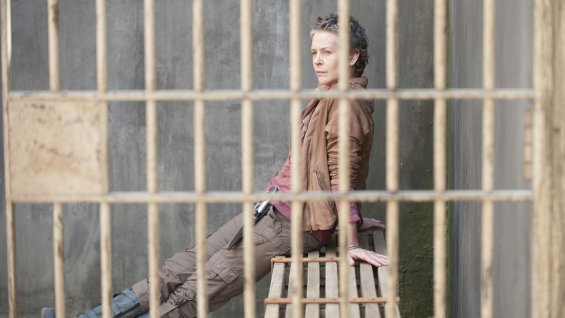
Welcome back for more of AMC’s The Walking Dead. Last time around, due to a combination of inexcusable procrastination and excusable travel plans, I had to review all three episodes of the season in one go. Henceforth, I hope to be more studios and cover episodes as they come. And with that mind, I was sure to watch this week’s episode just as soon as I could.
Indifference: Picking up where things left off, this episode opens with Rick still looking into what Carol did to Karen and David – aka. the people she killed and immolated to protect the others. After talking to Lizzy, Rick takes Carol on a supply run, in part because they lost supplies after the initial outbreak of the flu, but also because Daryl and the others have yet to return.
A third reason Rick has chosen to bring Carol along is to keep an eye on her, as he clearly doesn’t trust her anymore. They come to a small town and begin combing houses, and find two young people – Sam and Anna – held up in one. They learn they are survivors from a refugee center who have been on the move ever since. The couple ask to come with them and help them search the neighborhood, and Rick reluctantly agrees.
While searching the nearby houses, Rick and Carol get a chance to talk about what she did, and she remains unrepentant. When they return outside, they see Anna’s remains being devoured by several Walkers. Carol dismisses it and suggests they go back to wait for Sam, but when he doesn’t show, she recommends they leave.
After loading up their car with everything they’ve found, Rick tells Carol that she needs to move on. In addition to Tyreese wanting blood, he knows the others in the prison won’t accept her once they know the truth, and that she’s now strong enough to survive on her own. After securing a car for her, Carol gives Rick the watch Ed gave to her on her their anniversary and drives off.
Meanwhile, Daryl and company have managed to find their way to autoshop that’s been overgrown by vines. After clearing it, during which time Tyreese nearly dies again, Daryl and Bob begin searching the store for supplies while Michonne and Tyreese clear a minivan they discover within the vines. She chides him for his anger, telling him that while understandable, it will get him killed.
With minivan working, they drive the rest of the way to the veterinary college and find all the medicine and supplies they need. On the way out, they are spotted by a group of Walkers that also died from the flu strain and begin running. After taking cover in a storage room, they find that the door to the exit stairwell is chained and there are many more Walkers on the other side.
Reasoning that the Walkers in the stairwell might not have died from the flu, they break open the doors and start fighting their way out. However, all exits up above are cut off as well, and they are forced to break a window and climb out. Bob nearly loses his bag to a herd of Walkers but manages to pull it up, and Daryl sees that it had a bottle of liquor inside. Daryl tells Bob that he if takes one sip before they get back, he’ll kill him himself.
They load up their minivan and leave, and Michonne tells Daryl that she’s decided to let the Governor go and move on. They and Rick both head back for the prison.
Summary: Clearly, this episode was all about moving on. In addition to Michonne telling Tyreese that he needed to let go of his anger, and her taking her own advice and letting the Governor go, Rick sends Carol on her way as a means of resolving their moral dilemma. But of course, there was also the aspect of the episode from which it derives its name.
Rick’s moral dilemma arises from the fact that Carol appears to have become indifferent to death and the suffering of others. And then there was the issue of Bob’s alcoholism, how he was willing to risk everything for a bottle of booze while the others were fighting to make sure they got out with the medicine they needed to save their people’s lives.
Taken together, these threads once again stress the larger theme of the story. On the one hand, people are forced to do what they have to to survive. But in the end, there is only so much which can be sacrificed before staying alive becomes meaningless. This episode managed to capture that quite well.
However, there were also a lot of things which were kind of annoying. For one, the way they’ve now written Carol out seems kind of weak, especially when one considers how she really died. In the comic, Carol tried to commit suicide after losing Tyreese, her lover, to Michonne. After that, she became somewhat erratic and dependent, and felt increasingly isolated as a result. She then let a Walker bite her and died tragically.
And let’s not forget that they’ve done this once before, let us think Carol was gone when in fact she wasn’t. But if this is indeed the end of her thread, I would have to say that it’s not too surprising. Given what they’ve done with her in the last two seasons, minimizing her role and then turning her into a sociopath, I’d say the decision to drop her makes sense.
However, there is another point of interest that fans of the original could not fail to notice. In this episode, Tyreese and Michonne began chatting and seemed to find they had something in common. Given their relationship in the original comic, one can’t help but wonder if this will evolve into something more. But of course, this could be simple projection, since she also appeared to be flirting with Daryl at one point. Not sure where their going with that…
But above all, I mainly got a bad feeling from this episode due to the fact that it kind of felt like filler and portends of how this season is likely to drag on like the others. I foresee next episode being a race to try and save all the infected, with lots of talking and introspection! And when all that’s done, I’m thinking the Woodbury people – save one or two new additions to the cast – will be dead and the core will finally decide to leave the prison behind.
Maybe then, they’ll finally get back on script! Sigh… Oh well, at least Issue 116 will be out in a few days!
The basic law of computer evolution, known as Moore’s Law, teaches that within every two years, the number of transistors on a computer chip will double. What this means is that every couple of years, computer speeds will double, effectively making the previous technology obsolete. Recently, analysts have refined this period to about 18 months or less, as the rate of increase itself seems to be increasing.
This explosion in computing power is due to ongoing improvements in the field of miniaturization. As the component pieces get smaller and smaller, engineers are able to cram more and more of them onto chips of the same size. However, it does make one wonder just how far it will all go. Certainly there is a limit to how small things can get before they cease working.
According to the International Technology Roadmap for Semiconductors (ITRS), a standard which has been established by the industry’s top experts, that limit will be reached in 2015. By then, engineers will have reached the threshold of 22 nanometers, the limit of thickness before the copper wiring that currently connect the billions of transistors in a modern CPU or GPU will be made unworkable due to resistance and other mechanical issues.
However, recent revelations about the material known as graphene show that it is not hampered by the same mechanical restrictions. As such, it could theoretically be scaled down to the point where it is just a few nanometers, allowing for the creation of computer chips that are orders of magnitude more dense and powerful, while consuming less energy.
Back in 2011, IBM built what it called the first graphene integrated circuit, but in truth, only some of the transistors and inductors were made of graphene while other standard components (like copper wiring) was still employed. But now, a team at the University of California Santa Barbara (UCSB) have proposed the first all-graphene chip, where the transistors and interconnects are monolithically patterned on a single sheet of graphene.
In their research paper, “Proposal for all-graphene monolithic logic circuits,” the UCSB researchers say that:
[D]evices and interconnects can be built using the ‘same starting material’ — graphene… all-graphene circuits can surpass the static performances of the 22nm complementary metal-oxide-semiconductor devices.
To build an all-graphene IC (pictured here), the researchers propose using one of graphene’s interesting qualities, that depending on its thickness it behaves in different ways. Narrow ribbons of graphene are semiconducting, ideal for making transistors while wider ribbons are metallic, ideal for gates and interconnects.
For now, the UCSB team’s design is simply a computer model that should technically work, but which hasn’t been built yet. In theory, though, with the worldwide efforts to improve high-quality graphene production and patterning, it should only be a few years before an all-graphene integrated circuit is built. As for full-scale commercial production, that is likely to take a decade or so.
When that happens though, another explosive period of growth in computing speed, coupled with lower power consumption is to be expected. From there, subsequent leaps are likely to involve carbon nanotubes components, true quantum computing, and perhaps even biotechnological circuits. Oh the places it will all go!
Reducing our “carbon footprint” as a society – i.e. finding ways to consume less energy and generate less pollution – is at an all time high in the industrialized world. But for researchers and scientists hoping to avert the worst effects of Climate Change, the real challenge is finding ways to meet human needs that will either be carbon-neutral, or that consume more than they create.
This is the logic behind process like Carbon Capture, the “Smog Vacuum” and now, carbon negative building materials such as the “Carbon Buster”. Basically, it’s a brick that’s partially composed of wood from old doors and windows (35% to be exact). In addition, it contains nasty pollutants that used to go into the air. But most important of all, more CO2 is locked inside than was emitted during the brick’s production and transport.
The block is manufactured by a company in the east of England known as Lignacite, a company that has been making products from wood for 65 years. Lignacite recently partnered with another company named Carbon 8, another Suffolk-based company that converts noxious fumes from waste incinerators and combined with CO2, cement and sand to create aggregate.
To create the bricks, this aggregate is mixed with wood shavings from Lignacite’s plant, and Carbon Busters are born. Each one is composed of 50% recycled material and locks in about 14 kg (31 pounds) of carbon dioxide, which includes the CO2 the original trees took in during photosynthesis, and the CO2 captured in the aggregate-making process.
Granted, the bricks aren’t exactly aesthetically appealing. But they are relatively lightweight, suitable for even the biggest construction projects, and more fire-resistant than blocks made from stone, which crack and crumble at high temperatures. Since the wood inside these bricks is not exposed to oxygen, they will not burn, but simply calcify and blacken when exposed to fire.
Giles de Lotbiniere, Lignacite’s chairman, claims that so far, roughly 600 homes have been built in the Suffolk area near where the Lignacite plant is situated. He also indicated that they sell at a 5% premium compared to conventional bricks. And while there is currently resistance to using aggregate and wood-based materials on an international scale, de Lothbiniere believes the market will expand in coming years:
Over the years, we’ve wondered if we want to continue making blocks out of wood. Each time we’ve found another reason to do it. Now, with climate change, we’ve found another one.
But of course, the market for carbon negative materials is already becoming an interesting and diversified place. Just two years ago, Material ConneXion unveiled its own carbon-negative product – a carbon-negative cement composed of magnesium silicate that not only requires less heating, but it is also able to absorb CO2 from the environment as it hardens.
And then there’s Hemcrete, a bio-composite, thermal walling material made from hemp, lime and water that represents an alternative to fiberglass as an insulating material. Much like these other carbon-negative materials, more CO2 is locked-up in the process of growing and harvesting the hemp than is released in the production, and the product is 100% recyclable.
Taken together, materials like these are likely to revolution the construction industry in the coming years, an industry which currently accounts for roughly 38% of the CO2 emissions in the industrialized world.
It seems like weeks since the Red Planet has been featured in the news. But that’s to be expected when the two biggest news makers – the Opportunity and Curiosity rovers – are either performing a long drive or climbing a tall mountain. Not much in the way of updates are expected, unless something goes wrong. Luckily, these rovers always find ways to surprise us.
After over a year on Mars, Curiosity has accomplished a long list of firsts. This latest occurred last week, when NASA announced that Curiosity picked up the pace of its long trek to Mount Sharp by completing its first two-day autonomous drive, in which the rover did one leg of an autonomous drive on Sunday, then completed it on Monday.
Previously, Curiosity’s autonomous drives were only executed after finishing a drive planned by mission control on Earth using images supplied by Curiosity. These images would then be uploaded its on board computer, and the rover would compare them with images taken by its navigation camera to plot a safe path. The drive completed Monday is the first where the rover ended an autonomous drive on one day, then continued it the next day by itself.
This is all thanks to the incorporation of the new autonomous navigation (or autonav) software, which NASA finished incorporating and debuted at the end of August. According to NASA, this new system not only allows the rover to drive itself for longer stretches of time, it also allows mission control to plan activities for several days, which could be implemented on Fridays and before holidays so the rover can continue to work while the staff are away.
According to NASA, on Sunday, the new software allowed Curiosity to drive about 55 m (180 ft) along a path planned by mission control, then switched to autonomous mode and traveled another 38m (125 ft) with the rover selecting waypoints and the safest path. It then stored navigation variables in its non-volatile memory, then reloaded them on Monday to drive another 32 m (105 ft).
In all, Curiosity covered about 125 meters (410 ft) in total. This brought it within about 80 m (262 ft) from “Cooperstown,” a rocky outcrop where the rover will be conducting another series of scientific examinations. These will be the first time that Curiosity has had the opportunity to use its arm-mounted instruments since September 22.
According to Kevin Lewis of Princeton University, who spoke about the upcoming studies in “Cooperstown”:
What interests us about this site is an intriguing outcrop of layered material visible in the orbital images. We want to see how the local layered outcrop at Cooperstown may help us relate the geology of Yellowknife Bay [on Mars] to the geology of Mount Sharp.
This stop will be only brief, as the rover team are anxious to get Curiosity back on its way to Mount Sharp. Once there, it will begin digging, drilling and generally seeking out the vast caches of minerals that the mountain is expected to have, ones which could potentially support a habitable environment. Exciting times ahead!

 Woohoo! It feels like forever since I reached a milestone and felt the need to celebrate. But that’s to be expected after a few years. At first, they come fast and often due to the fact that everything’s new and exciting. After awhile, they naturally become fewer and further between. But it’s always important to mark these occasions and take the time to give thanks.































 Stories by Williams