The Ultimate Spaceship Size Chart

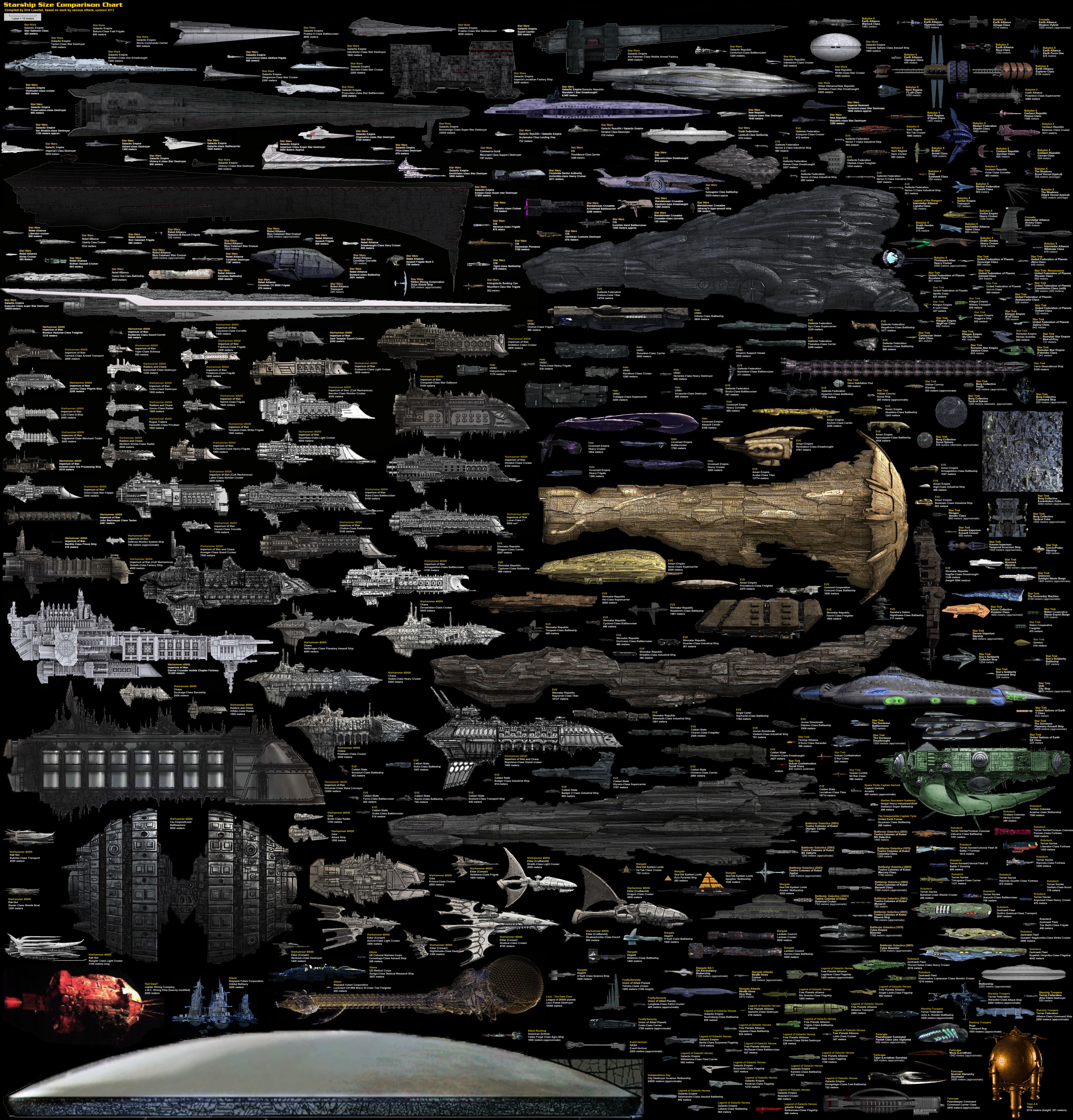
Star_Trek_Spacedock My thanks to my friend, fellow indie writer and collaborater Goran Zidar, who let me know about this chart. As fans of science fiction and space opera are sure to know, these spaceship size charts have been around for some years. They take familiar vessels from different franchises and group them according to scale. They’re cool, they’re fun; and assuming they’re accurate, it’s kind of amazing anyone took the time to actually compile the specs for comparison.

Well as it happens, this latest one claims to take every single ship from every sci-fi franchise and combine them in one infographic. Quite the claim, I know. But one look and you have to admit, its pretty jam-packed and more than a little thorough. But if you can think of something they missed, I’d be interested to hear about it. Lord knows there are plenty of geeks out there who don’t like seeing their favorite franchise get overlooked. I should know, I’m one of them!

Just click on the image below to enlarge and see if you can spot your favorite space-faring vessel:

spaceship_sizechartSource: img.gawkerassets.com


The Future is Here: “Ironman” Spec-Ops Suit


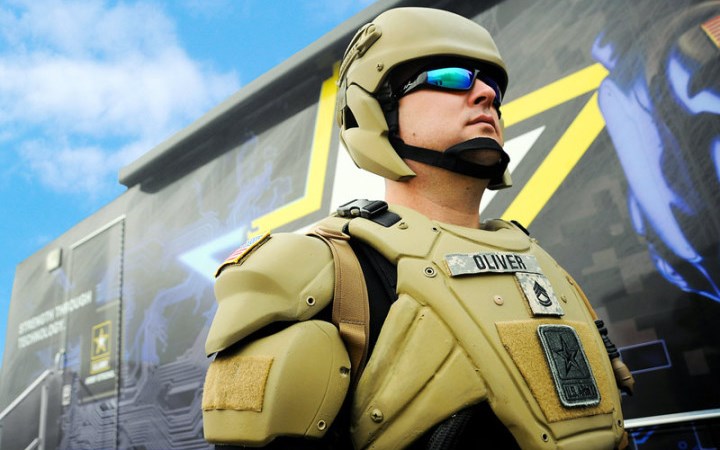
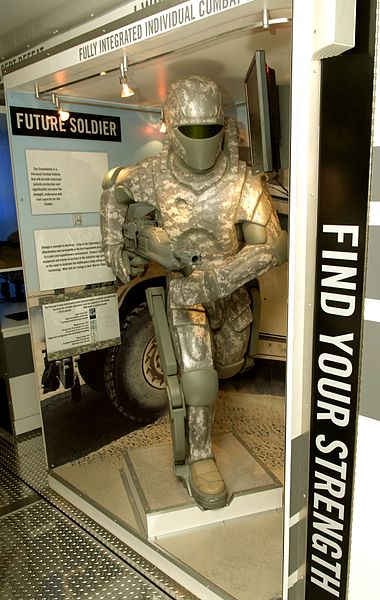
ironman3Army researchers have been working for years to incorporate powered armor, exoskeletons, and high-tech weaponry into the arsenal of next-generation soldiers. And this latest development from DARPA – the Defense Advanced Research Projects Agency, the research wing of the US Army – is being hailed as the closest thing there is to a real-life “Iron Man” suit to date.

Its known as the Tactical Assault Light Operator Suit (TALOS) and is designed to deliver “superhuman strength with greater ballistic protection”. Named in honor of the Greek automaton made of bronze that Zeus assigned to protect his lover Europa, this suit incorporates a powered exoskeleton, liquid armor, built-in computers and night vision, and the ability to monitor vital signs and apply wound-sealing foam.

DARPA-Warrior-Web-660x495Put together, the capabilities would make the already elite Special Operation Forces nearly invincible in the field, according to the Army. As Lt. Col. Karl Borjes, a U.S. Army Research, Development and Engineering Command (RDECOM) science adviser, said in a statement:

[The] requirement is a comprehensive family of systems in a combat armor suit where we bring together an exoskeleton with innovative armor, displays for power monitoring, health monitoring, and integrating a weapon into that — a whole bunch of stuff that RDECOM is playing heavily in.

For the sake of the suit’s design and high-tech features, DARPA reached out to engineers from MIT, who are currently working to produce the liquid body armor that is perhaps the most advanced feature of the suit. Composed of magnetorheological fluids, this armor will “transform from liquid to solid in milliseconds when a magnetic field or electrical current is applied.”

TALOS_Future_Army_Soldier_WideThe suit is expected to make a first-generation appearance some time next year. Because of the high number of highly integrated technical challenges with advanced specifications, the Army is also drawing on a broad range of collaborators from multiple fields to complete the design in time. And as Jim Geurts, USSOCOM acquisition executive, in a statement:

USSOCOM is interested in receiving white papers from a wide variety of sources, not just traditional military industry but also from academia, entrepreneurs, and laboratories capable of providing the design, construction, and testing of TALOS related technologies. The intent is to accelerate the delivery of innovative TALOS capabilities to the SOF operator.

US_Army_powered_armorFor some time now, the concept of advanced powered suits of armor has been a feature of science fiction. Examples abound from literary references, such as E.E. Smith’s Lensman series and Heinlein’s Starship Troopers, to RPGs like BattleTech and Warhammer 40k, and to the gaming world with the HALO and Fallout series’. And much like lightsabers, there has scarcely been a geek alive who didn’t want one!

Now it seems that something very close might be realizable within a year’s time. I don’t know about you, but I feel both inspired and more than a little jealous. Damn SOCOM, always getting the coolest gear first! And of course, there’s a video:


Sources:
wired.com, dailytech.com
,

New Trailer: Captain America The Winter Soldier

Marvel's CAPTAIN AMERICA: THE WINTER SOLIDER - Teaser PosterJust yesterday, the first trailer for the upcoming Captain America sequel was released. Entitled Captain America: The Winter Soldier, this movie appears to pick up where the Avengers left off. And from the look of things, they chose to go with a “the enemy within” story arc, where Shield is forced to contend with a threat that comes from within the US government itself.

The cast includes Chris Evans, Scarlett Johansson and Samuel L. Jackson – reprising their roles as Steve Rogers (Capt. America), Natasha Romanoff (Black Widow) and Nick Fury – and also includes Anthony Mackie as “The Falcon”, Sebastian Stan as “The Winter Soldier” and Robert Redford as Alexander Pierce. The movie is set to be released on April 4th, 2014.

November 2013 Eclipse

Bloomberg Photos Best Of The Year 2012On this coming November 3rd, the people of the Africa will be treated once again (if that’s the right word) to a solar eclipse. And the good folks at Astronomers Without Borders – an independent outreach program with global reach – will be doing all they can to make sure that students and sky watchers can safety watch it take place. And they are looking for help…

Basically, they are looking for donations so they can send tens of thousands of eclipse glasses to schools in Africa just in time for the eclipse. In addition to allowing for students to safely observe a major astronomical event, it is also a rare opportunity to expose students to science in a region where science resources are often non-existent.

SOLAR-ECLIPSE-2013-pathAs Mike Simmons, who leads AWB, told Universe Today in an email interview:

We’re working with the IAU’s Office of Astronomy for Development who has contacts working with schools and able to distribute the glasses to them. The opportunity for this came up late so we’re working very hard to make it happen in the short time we have left.

According to the AWB website, schools have been identified and vetted by partner organizations in each country in Africa, and distribution networks have been verified. Every donated pair of eclipse glasses WILL reach a student for use for the eclipse, and will be given by the AWB free of charge.

SOLAR-ECLIPSE-2013-kidsThe International Astronomical Union’s Office of Astronomy for Development, which is based in Cape Town, South Africa, is providing invaluable support and assistance through their many contacts across Africa. But alas, the program depends entirely on private donations.  However, as Simmons explained, they are confident they can raise the money in time:

There’s no question we can get all the donations that are needed as long as we get the word out in time. We do probably a half-million dollars in programs each year based on the hard work of passionate amateur astronomers and educators around the world,” Simmons said, “all on way less than $25,000 a year.

If you’re interested in pledging a donation, simply go to AWB’s website by clicking here. Each pair goes for $1 to $4, depending on how many you want to buy. As for those of us who don’t live in Africa, I guess we’ll just to wait until Monday, August 21, 2017, when the next Solar Eclipse that will be visible from North America will take place.

Source: universetoday.com, astronomerswithoutborders.com

The Future is Here: The Factory in a Box

factory_box3-D Printing has proven itself quite useful when it comes to creating components, toys, and models. But when it comes to assembling complicated parts, or full-on products, other machines are often necessary. That’s where the Microfactory comes in, a veritable “multi-tool” machine that merges the best of 3-D printing and machining.

Being touted as “a machine shop in a box”, the creators of the device (the Mebotics company) were inspired to create this multi-tool kit after collaborating at the Boston-area Artisans Asylum. Artisans Asylum is a non-profit organization dedicated to promoting hobbyists, artisans, fabricators and entrepreneurs through a series of open maker space presentations.

factory_box2In addition, the team was also inspired by the fact that most manufacturing systems suffer from two major downfalls: noise and mess. By “closing the system”, as they put it, they eliminated both hassles while still ensuring that their device is capable of both producing tailor-made objects and altering them to order.

The Microfactory dramatically expands the range of products a person with no other equipment could make. It is basically able to 3-D print in four colors, out of multiple materials, and also etch, and mill the final products. This process, which combines machining and printing, is what the makers refer to as “hybrid manufacturing.”

3D-printing-in-spaceAs Co-founder of Mebotics, Jeremy Fryer-Biggs, explains:

I wanted to have a machine that was capable of making parts for all the crazy stuff people people would ask me [to make]. I wanted a tool that would allow me to do a whole wide range of things.

As Fryer-Biggs and the team envision it, the Microfactory could also offer users the ability to create devices and components where they are needed, regardless of the location. With a fully-functional computer incorporated to provide the blueprints, they foresee some extreme scenarios where objects could be created and finished where no stores are available:

You’re at base camp in the Himalayas, you’re in the middle of Afghanistan and you wanna make a part. So you connect this thing to a Wi-Fi hotspot–if you have a Wi-Fi card in the machine that you put in. You can then download from the server whatever the replacement part is you need, and in the middle of nowhere, get your replacement.

3d_ISSThis vision is in keeping with what many scientific organizations – such as NASA, the ESA, and other space agencies – are foreseeing. Already, such devices are being considered for use on the International Space Station and on future space missions, where astronauts will always be in need of specialized tools and may not have the ability to have them shipped out to them.

The team currently has several working prototypes but is planning to bring the project to market by raising $1 million through Kickstarter. MicroFactory units are being pre-sold for between $4,000 and $10,000 in several models. Though the team admits that the price is high, the science fiction appeal alone is well worth it! As Marie Staver, a project manager on the team, put it: “The science fiction future is officially here.”

Couldn’t agree more. And in the meantime, check out this video of the Microfactory in action:

Sources: fastcoexist.com, mebotics.com, artisansasylum.com

Back From Vacation!

ottawa-panoramaHey all! I just got in last night from Ottawa and let me tell you, it was quite the trip. We managed to do many things while we were there, including visiting my childhood home, my old neighborhood, my favorite watering holes and restaurants, and visited with many of my old friends! But at the same time, it’s good to be home. Visiting your old hometown and friends can be wonderful, but so can being back in the place you love with your wife and cat.

And I can tell, I have a lot of catching up to do. Seriously, if I thought I was behind before I left, I’m way behind now! Luckily, I have a revised to do list that covers what I hope to do in the coming weeks. While I was away, I actually managed to get some serious reading and editing done, and decided it was time to get back to a few ongoing projects that also begging for completion.

  • Catch up on sleep
  • Cut back on beer (sampled too many this time around!)
  • Watch the season premier and episode 2 of The Walking Dead
  • Review of the Akira graphic novel
  • Review of the Batman graphic novels – Arkham Asylum, The Killing Joke, The Man Who Laughs
  • Review of Rami Ungar’s The Quiet Game (overdue)
  • Catch up on Yuva stories
  • Catch up on other people’s posts

Sound like a plan? Good, then let’s get this party started! Good to be home…

Going to Ottawa!

Skating-on-the-Rideau-Canal-500x400Hi Folks. Just wanted to let people know that I will be away for the next week as the wife and I do our biannual trip to my old hometown of Ottawa. This means regular post by me will cease for that time. I know my output has been sluggish lately, but it will be less so as the darling bride and I visit with my old friends and take in the sites and sounds.

We don’t get much in the way of Autumn out here on the West Coast. Sure, its get cold and rainy, but fall colors don’t happen much since most of our trees are evergreens. So it will be a treat to be surrounded by that this year! And we’re certainly looking forward to visiting plenty of the old haunts with plenty of my old crew! I love living here in BC, but I would very much like to have better access to these people.

When I get back, be prepared to hear all about the following topics:

  • Papa Zulu done editing and ready for beta testing!
  • a review of the season four opener of The Walking Dead and The Oath webepisodes
  • the latest from the Revengers
  • more chapters of Oscar Mike
  • more updates on the Yuva anthology
  • more updates on tech developments that are both awe inspiring and scary!

Take care you all and hope to catch up again soon!

The Future is Here: Self-Healing Metal

self-healing_metalYou’ve heard of self-healing concrete, you’ve heard of self-healing polymers. And now, it seems that researchers at MIT have found a way to make metals heal themselves after tiny cracks form. As the latest in a series of materials that is capable of maintaining itself, this discovery could very well help pioneer the revolution in manufacturing everyone has been waiting for.

Led by graduate student Guoqiang Xu and professor Michael Demkowicz, the process of getting metals to heal themselves was made almost entirely by accident. The discovery first came when they were modelling a sheet of nickle and tiny microscopic cracks were applied. Once tension was applied, the cracks became smaller and then disappeared as the edges fused together.

crystallineApparently, the key has to do with the fact that most metals are composed of microscopic crystalline grains, the size and orientation of which affect the overall strength and characteristics of the material. Nickel has always been of interest because of its use in so many superalloys, many of which are used in harsh environments – jet turbines, deep sea oil rigs, heavy industry joints.

It turns out that the grains making these materials so strong are not as static as scientists thought. As the metal is pulled outward, the edge of the crystalline grains begins to migrate and can eventually fill in the crack completely. The migration of this crystalline boundary is what heals the gaps in the material. And while it is not exactly polymorphic alloy (see pic below), its certainly big news.

metal_fatigueAnd while researchers have only been able to reproduce this healing behavior with cracks at the microstructural level (known as disclination), these micro-defects are the source of much larger and sometimes catastrophic cracks and metal fatigue. The geometry of disclinations can actually reverse an applied force locally, which is how the tension leads to the metal pulling itself back together.

The team believes this newfound knowledge can be used to prevent superalloys from accumulating structural cracks that could lead to real damage with time. Materials could also be designed to direct damage into disclination-type structures, areas that could absorb damage and then heal themselves. Given time, it could even lead to metals that don’t weaken with age.

t1000Still, you shouldn’t be expecting something like this guy anytime soon! And be sure to enjoy this brief but poignant video of the self-healing effect in action:


Source:
extremetech.com

The Future of Fusion: Milestone Hit Amidst Funding Fears

fusion_reactorThe National Ignition Facility (NIF) in Livermoore, California has made quite a bit of headlines lately. But when you’re goal is to harness fusion power – a clean, unlimited and cheap source of energy – that is abound to happen. For decades, the challenge of harnessing fusion has been to create a process that produces more energy than it consumes; a goal which has remained elusive.

However, a recent breakthrough at NIF has brought us all one step closer to viability. Apparently, the breakthrough happened in late September, where the amount of energy released through the latest controlled fusion reaction exceeded the amount of energy being absorbed by the fuel. This was the first time this had been achieved at any fusion facility anywhere in the world.

fusion_energyNIF, based at Livermore in California, uses 192 beams from the world’s most powerful laser to heat and compress a small pellet of hydrogen fuel to the point where nuclear fusion reactions take place. Viability, in this case, meant producing more energy from a fusion reaction than was consumed by the lasers themselves and any inefficiencies that cost power along the way.

As already noted, this breakthrough has been decades in the making. After nearly 50 years of experimentation and failure, the NIF announced in 2009 that its aim was to demonstrate nuclear fusion producing net energy by 30 September 2012. But unexpected technical problems ensured the deadline came and went; the fusion output was less than had originally been predicted by mathematical models.

NIF Livermore July 2008Soon after, the $3.5 billion facility shifted focus, cutting the amount of time spent on fusion versus nuclear weapons research – which was part of the lab’s original mission. However, the latest experiments showed that net energy  output is possible, which in turn will provide a welcome boost to ignition research at NIF as well as encouraging fusion research in general.

Despite this breakthrough, there are worries that the research will not be able to continue. Thanks to the government shutdown, federal funding for major research labs like the NIF is threatened. A suspension in funding can be just as harmful as it being cut off altogether, as delays at a crucial juncture can mean all progress will be lost.

NASA_coldfusionLuckily, the NIF is just one of several projects around the world aimed at harnessing fusion. They include the multi-billion-euro ITER facility, currently under construction in Cadarache, France. However, ITER will take a different approach to the laser-driven fusion, using magnetic fields to contain the hot fusion fuel – a concept known as magnetic confinement.

What’s more, NASA’s own research into cold fusion that relies on weak nuclear forces – as opposed to strong ones – is likely to continue, regardless of whether it meets the requirements for emergency exemption. And given that the prize of this research is a future where all our energy needs are provider for using a cheap, abundant, clean alternative, there is no way we’re stopping now!

Sources: bbc.co.uk, IO9.com

Crypto Wars: The Tech World vs. the NSA

cyber_securitySix years ago, something interesting took place at Microsoft’s Windows annual Crypto conference in Santa Barbara. In the course of the presentations, two members of the company’s security group (Dan Shumow and Niels Ferguson) gave a talk that dealt with internet security and the possibility that major systems could be hacked.

They called their presentation “On the Possibility of a Back Door in the NIST SP800-90 Dual Ec Prng”. That’s a name few people outside of the techy community would recognize, as it refers to a pseudorandom number generating program that is used extensively in cryptography. And thought the presentation was only nine slides and a few minutes long, they managed to capture the attention of the crowd with some rather stark observations.

cyber_security1Basically, they laid out a case showing that the new encryption standard, given a stamp of approval by the U.S. government, possessed a glaring weakness that made one of the program’s algorithms susceptible to cracking. But the weakness they described wasn’t just an average vulnerability, it had the kind of properties one would want if one were intentionally inserting a backdoor to make the algorithm susceptible to cracking by design.

At the time, no one thought much of it. But today, that’s all changed, thanks to Edward Snowden. Apparently, cryptographers and journalists are seeing a connection between the talk given by Shumow and Ferguson and the classified NSA documents Snowden leaked. Apparently, some of that information confirms that the weakness in the Dual_EC_DRBG algorithm might be indeed a backdoor.

nsa_aerialEarlier this month, an article appeared in the New York Times that implied that the backdoor was intentionally put there by the NSA as part of a $250-million, decade-long covert operation by the agency to weaken and undermine the integrity of a number of encryption systems used by millions of people around the world.

Naturally, these allegations not only stoked the fires over the NSA’s long history of spying on databases, both domestic and foreign, it has also raised questions over the integrity of the rather byzantine process that produces security standards in the first place. The National Institute of Standards and Technology (NIST) approved Dual_EC_DRBG and the standard, is now facing criticism alongside the NSA.

nist_aerialbigAnd while NIST has since been forced to re-open the program to examination and public discussion, security and crypto firms around the world are scrambling to unravel just how deeply the suspect algorithm infiltrated their code, if at all. Some even went so far as to publicly denounce it, such as corporate giant RSA Security.

But of course, a number of crypto experts have noted that the Times hasn’t released the memos that purport to prove the existence of a backdoor. What’s more, the paper’s direct quotes from the classified documents don’t mention a backdoor or efforts by the NSA to weaken it or the standard, only the efforts of the agency to push the standard through NIST’s committees for approval.

nsasecurity_primary-100041064-largeOne such person is Jon Callas, the CTO of Silent Circle – a company that offers encrypted phone communication. Having attended the Crypto conference in 2007 and heard the presentation by Shumow, he believes that the real problem may lie in the fact that the algorithm was poorly made:

If [the NSA] spent $250 million weakening the standard and this is the best that they could do, then we have nothing to fear from them. Because this was really ham-fisted. When you put on your conspiratorial hat about what the NSA would be doing, you would expect something more devious, Machiavellian … and this thing is just laughably bad. This is Boris and Natasha sort of stuff.

Sources at Microsoft agree. In addition to the presenters – who never mention the NSA in their presentation and went out of their way to avoid accusing NIST of any wrongdoing – a manager who spoke with WIRED on condition of anonymity believes the reporters at the Times saw the classified documents dealing with the program, read about the 2007 talk, and assumed their was a connection.

cryptographyBut Paul Kocher, president and chief scientist of Cryptography Research, says that regardless of the lack of evidence in the Times story, he discounts the “bad cryptography” explanation for the weakness, in favor of the backdoor one:

Bad cryptography happens through laziness and ignorance. But in this case, a great deal of effort went into creating this and choosing a structure that happens to be amenable to attack.

Personally, I find it interesting that the NSA would be so committed to making sure a program passed inspection. Especially one that had a fatal flaw that, when exploited properly, could be used to give someone who knew about it access to encrypted information. But of course, it’s not like the NSA has been known to invade people’s privacy, right? RIGHT?

Clearly, all there is at this point is speculation. One thing is certain though. In the coming weeks and months, the NSA is going to be the recipient of even more flak over its monitoring and cryptographic activities. Whether this effects any change in policy remains to be seen, but I doubt anyone will be holding their breaths.

Sources: wired.com, nytimes.com