Crashland – Chapter 13!

After about a week and a half on hiatus, I’ve finally returned to Story Time to pick up my serial novel of Crashland. Last time, things ended on a cliffhanger as the tube station Holden and his compatriots were hiding out in began to collapse. Still recovering from his injuries, Holden was forced to find his way down a dark tunnel while the others carried the cybernetic Simon out on a stretcher.

Unfortunately, Holden fell behind and got lost in the dark. His only hope was to either retreat back the way he came, try to navigate based on the glow tubes strewn about the tunnel, or just sit and wait for the trouble to pass. And of course, audiences voted and the choice was clear! Holden would try to navigate his way out the only way he could.

And now, chapter 13 is ready! Come on by and see what happens, then stick around to vote on the next chapter. I have to say that it is one of the most consequential chapters I’ve written yet! Yes, the ending is not only a cliffhanger, but a matter of life and death. When it’s done, one of the story’s characters will be killed off. Tune in to decide which one!

Crashland – Chapter 12 Now Appearing at Story Time!

The votes are in and chapter 12 of Crashland is now available at Story Time. Last time around, the protagonist William Holden was being introduced to the final member of the crew. This, he discovered, was a cybernetic being known as Simon, a breed of human being designed to monitor cyberspace at all times. He also deduced what Jacobs plan was… unfortunately he didn’t tell the rest of us what it was. Yeah, I know, but I aint telling neither!

In any case, their discussion was interrupted when one of Jacobs men came to announce that they had a problem. When he learned what it was, he conveyed to Holden that they did indeed have a problem! The only question was, what was the nature of it? I asked audiences to decide. Was it: a. a rival gang attacking their hideout, b. an unruly mob that was threatening their friends who are camped out near the entrance, or c. the tube collapsing?

Well, the votes are in and audiences have once again decided. It’s C! The tube is collapsing, and now Holden, Jacobs, and his little band of agents will have to evacuate quickly! Come and by and see what happens, then stick around to vote on the next chapter! It’s all happening over at Story Time.

Crashland – Chapter 8, coming soon!

Things are once again picking up for the people of Crashland! The votes have once again come in and the readers have spoken. And as a result, Chapter 8 is on the way! Which means that the mysteries which have building since the beginning will soon be revealed.

But first, allow me to recap. Last time, the stories protagonist, William Holden, awoke to find himself in an abandoned subway with a group of strange men. His wounds were treated, and they wanted to know who he was. With the city degenerating into chaos, they were understandably reluctant to let just anyone in their camp and give them food, medicine and their trust. Holden knew that depending on what he told them, he might just be allowed to stay, or shot!

After telling them that he was a fictitious employee working for his own company (a lie), the one named Jacobs informed him that the city above them had descended into hell. Whatever hopes Holden had of finging aid and comfort, not to mention his family, were in vain. Holden didn’t take the news too well and began to experience a breakdown. This left Jacobs and his companions with a tough choice to make.

Jacobs boss, a man named Kurzweil, revealed that they knew who Holden really was and needed his help. The chapter ended before their identities could be revealed, but two things were clear: whatever they’ve got planned, it sounds big. And whoever they are, they mean business! In the next chapter, more will be revealed. How the world went to hell, who caused the infopocalypse, and how some plan to rebuild it.

So please, come on by and check it out. And, as usual, stay around to vote on what you want to see happen! It’s all happening over at Story Time!

Crashland – Chapter 7, Now appearing at Story Time!

Well, it was a hard slog, but Chapter 6 has finally concluded with a clear vote from audiences. After finding himself alive and patched up in an abandoned subway station, Holden realized he was in the custody of some rather strange agents. They wanted to know who he was, and intimated that depending on his answers, he might just live to see another day.

He lied and told them he was a simple engineer working for his company. He recounted events as best he could, but ended up realizing they knew more about him than he thought. After a terse conversation, he revealed that he was trying to find his way to the city center to find help and located his wife and family. The man speaking to him, named Jacobs, had bad news…

Yes, it seems audiences have decided that they want to see the story take a dark turn. After some time trying to make his way towards the only lights left on in the city, Holden was told that all he was looking at were some raging fires that were set by the mob. Facing a hopeless situation, Holden must now decide what to do, and its clear that his hosts are more than they appear to be…

Come on by and see what happens. Then, stick around to vote on what happens next! There’s more action, more danger, and more post-apocalyptic adventure to be had over at Story Time! And while you’re there, check out the new cover art for Goran’s Zidar’s serial novels, the YA mystery TJ Thirteen and the paranormal thriller Hunter.

New Cover for Crashlands!

I’m surprised I waited this long. I loooove making covers! And after the release of the first six chapters over at Story Time, I decided I should finally treat Crashland like a true writing project and give it a cover. Eventually, it’s going to be complete, and I would like to make it available to the public once it is.

To give it a quick recap, Crashland takes place in the not too distant future in the megacity of BosWash. The technological singularity – the point where advances in nanotech, biotech, artificial intelligence, quantum computing will forever change things – is fast approaching. In the midst of this, a group of unknown cyber terrorists have released a virus designed to cripple the world’s information networks.

Way I see it, in this near-future scenario, all things are networked and wireless like never before. People are able to access the future internet (known as the infobahn) remotely or through various interfaces. Just about all commerce, entertainment, social interaction and politics are conducted virtually, and all electronic systems are networked, so once the virus hits, it quickly spreads and brings it all down.

The main character, William Holden, a technological mogul, finds himself lost in the streets after the Crash takes place. Desperate to find his family, he begins combing his way through the dark and is attacked and almost killed. It’s a desperate struggle for him just to go on, but in time he finds help from some unlikely sources. Since they were in a position to witness the Crash directly, they know how and why it happened, secrets they reveal to Holden in time.

And that’s the extent of the story so far. In the coming chapters, I will reveal exactly who these strangers are, how they know what they know, and how they plan to reign in the people who are responsible. Holden, since he helped design the infobahn, is in a unique position to help. However, his intentions haven’t changed since the Crash occurred. Somewhere out there, his family still resides, and he’s determined to find them. Perhaps a trade off can be made…

Who knows? You’ll have to tune in to find out. And did I mention that since it’s a serial novel, you get to vote on what happens next? Yep, so the ending and outcome of all this will depend on what you want to see happen. And of course, there are plenty of other stories to vote on. Check er out!

Rabbletown: Life in these United Christian States of Holy America, by Randy Attwood

Rabbletown: Life in these United Christian States of Holy America, by Randy Attwood

Hello and welcome to the first literary review I have had the honor of doing for a fellow author! On the docket for today, a sci-fi, near future dystopian work known as Rabbletown: Life in these United Christian States of Holy America, by Randy Attwood. Awhile back, this author and his work came to my attention by way of my writers group. Like many of us, Randy has been writing for many years, had an idea and manuscript that was just awaiting completion, and which he recently finished and made available as an ebook and paperback (see links below for info on where to find it).

Author Bio: Randy is a retired journalist, but also worked as the director of university relations for Kentucky University medical center and as the media relations officer for the Nelson-Atkins Museum of Art in Kansas City. He retired in 2010 and now dedicates himself to his writing. He has several titles to date, and Rabbletown is (far as I can tell) the flagship of his fleet.

Plot Synopsis: The story takes place in a dystopian future, circa 2084, where the US has become a fundamentalist state (as the name clearly implies). The how and why of this are explained in the preamble, where ongoing tension between the US and Middle East eventually turn nuclear and result in the full scale devastation of both. Whereas the United States bombs Iran and environs into oblivion using its ICBM’s, the various nation-states and terrorist organizations strike back using backpack nukes and dirty bombs until most US major cities are ruined.

What emerges is, predictably, a renewed Dark Ages where civil authorities are replaced by religious ones, the Evangelical movement becomes the dominant political force in America, and Jews, Muslims and Catholics are either suppressed or eradicated. The president of the US is known as the Pastor President, and all offices (governor, mayor, etc) are also required to take on the title of pastor before their rank. Each president is named in honor of famous Evangelists; the current president is Jerry Falwell V, his VP is Pat Robertson.

In addition to demonstrating their lineage from these current media figures, this is also a clear and delicious stab at the Christian Right and its political machinations! Other names of note include Cheney – a former member of the regime who is languishing in jail after an attempted coup – thus ensuring that the political right are also included in this indictment. What’s more, the civil authorities are known as Inquisitors, who are naturally the enforcers of religious law, extract confessions through torture and regularly stone those who sin.

Foreign policy is similarly medieval in this day and age. Whereas the US has become a Christian Republic, there is talk of the “Caliphate”, presumably a united Arab world, where Christian and Muslim soldiers fight for control of Jerusalem once again. It is hinted in the story that this “Crusade” is not real, merely a political tool that the Pastor Presidents use from time to time to drum up support. Still, the purpose of having it is clear. Whereas politics in the US are now dominated by religion, so to is their view of the world.

In any case, what follows is a story of how one town – Rabbletown, Kansas (a borough of Topeka) – is working to create the country’s greatest Cathedral in preparation for a visit from the Pastor President. The main characters, the Mason Bob Crowley, his wife Cheryl, Pastor Governor Jerry Johnson IV, Healer Elmer, Father Superior Robert, Friar Francis and Pastor Teacher Harold, give us a inside view of life in this future Kansas town, presenting it from various angles and providing exposition of how society works. Their particular POV’s are also important when a seminal development takes place, the appearance of a boy who has a knack for quoting Bible verses and seems somehow… “touched” by the Lord. This boy is none other than Bobby Crowley, the son of Mason Bob.

(Spoiler Alert!): The story begins to truly come together after a series of holy events takes place involving Bobby and a routine stoning. Everyone, from the President to the boy’s father, becomes swept up in a frenzy after news of it spreads, the authorities condemning it as the work of Satan while others proclaim the boy to be Christ reborn. Repression and division follow, with the so-called holy authorities becoming very much the enemy of those who appear chosen and righteous. Needless to say, the allegory is clear. In time, the division between the authorities and believers reaches (ahem!) Biblical proportions, in a scene that very much resembles that of Jerusalem during the time of Jesus.

Weaknesses: It is this last part which fell short for me. Given the background and nature of the story, one would get the impression that religion is being cast in a negative light, or at least that it is being mocked for its current excesses and abuses. However, the story also seems to be making the point that religion will be the source of salvation. While this would seem like a keen observation about the duality of faith – the line between salvation and condemnation being so fine – it also makes for an unbelievable ending. Whereas the question of Bobby’s holiness would have seemed best if left vague and metaphorical, there is no doubt about it in the story. Bobby is literally divine, his nature and purpose a force of righteous redemption.

There are some other weaknesses, such as the relevant facts being presented in a matter-of-fact way that leaves the reader feeling spoon fed. The dialogue also comes off as expository and forced at times, something you wouldn’t expect to hear from real people no matter how politically conscious they are. And the intro gives us a full dose of the background which leaves the reader feeling less inclined to read and discover for themselves what’s already happened, what has led the characters to their current situation. And the ending, well its a little predictable given all the Biblical allusions. However, these are hardly fatal and don’t really take away from the overall plot. Really, its just the ending that felt like it misfired.

Strengths: Overall, the story has all the elements of good satire: corruption, decay, selfishness and power mongering; with small, shining lights of redemption amidst it all. The bit about people’s daily lives and how they turn to their PPC’s (Personal Pastor Counselor) is also quite ingenious, predicting the emergence of an internet-based personal religious counseling. The mock history, particularly the part about the Catholic Accommodation was also a stroke a fine art (I shan’t describe, read it yourself!).

And above all, the mockery of the Evangelical movement and its political ambitions feels quite apt. For what can be said about people who seem to think that its a good idea to combine religion and politics, and have little to no qualms about condemning their “liberal” adversaries and all the “undesirables” of society? If they got their wish, would it really resemble anything other than Taliban-style medievalism?

Hence, I recommend Rabbtletown for those people looking for a dystopian read with a religious twist. It’s clever, fun, and a short read which will inspire thought. And, given some tweaking and a little expansion, it could even be a bestseller someday! Hey, you gotta have faith (ba pa ra pum pum!).

28 Days Later…

Hello all! In honor of Halloween, I thought I’d jump ahead on my review list again and cover a zombie flick! And not just any zombie flick, a good, scary and even poignant thriller known as 28 Days Later! Not only is this movie a cult favorite, its also a films that got in on the ground floor of this new zombie craze.

Yes, for some reason, zombie movies have been pretty popular in the new millennium. Maybe it’s a retro thing, but it seems that within the last ten years, there have been a plethora of writers/directors who have breathed new life into this old movie genre. After 28 Days was released in 2002, it was followed by the Resident Evil movie, House of the Dead in 2003 (another video game adaptation), the remake of Dawn of the Dead (2004), Shaun of the Dead, Doom (2005), Slither (2006), The Zombie Diaries, I Am Omega (2007), I Am Legend, Day of the Dead (2008, another remake), followed by Quarantine, Zombieland in 2009, and the list goes on. In fact, I’m not even taking the time to mention all the sequels and lesser known titles that came between these ones!

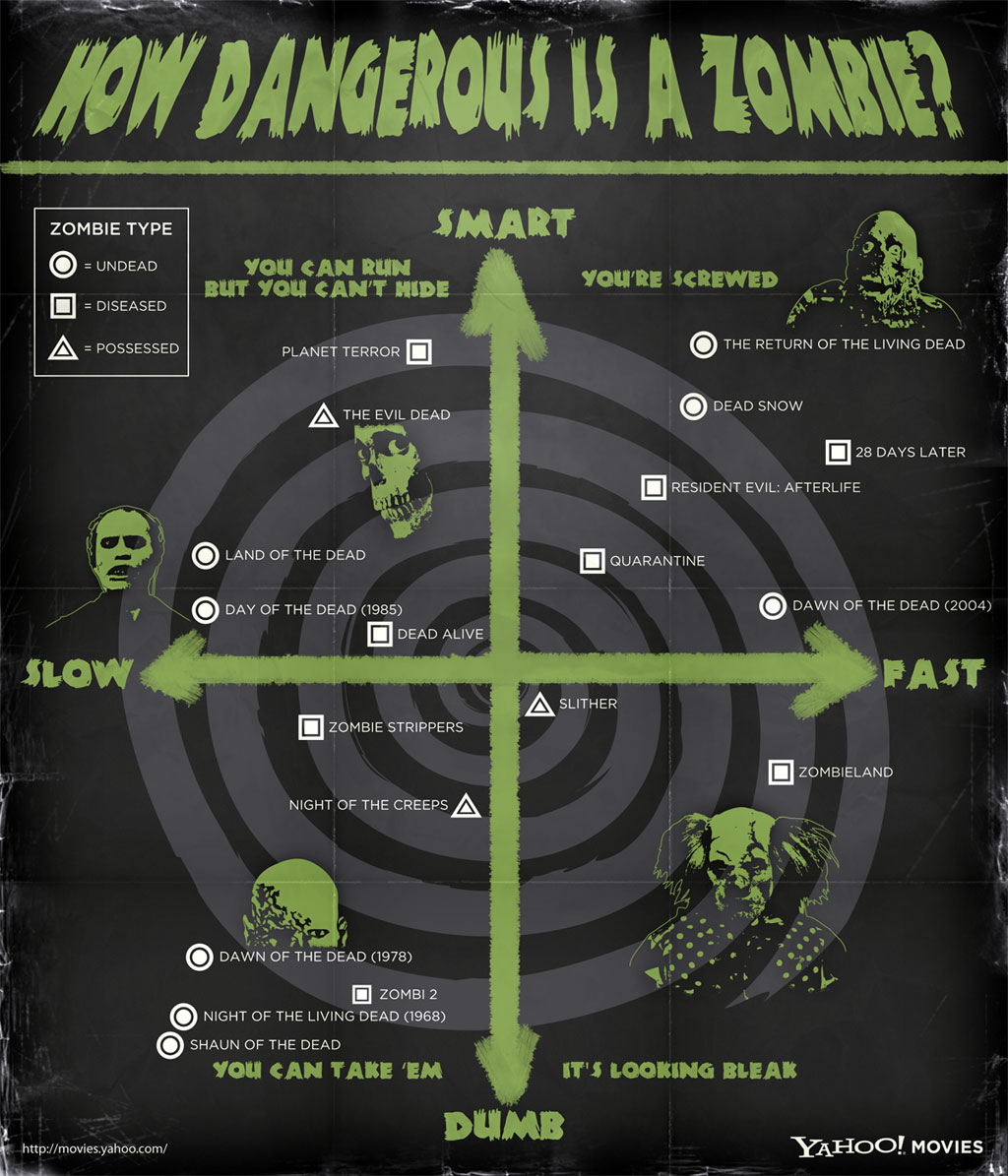
The point is, whereas in previous decades, people could expect a low-budget zombie movie at least once a year, since 2000, there have been multiple entries every year, sometimes as many as a dozen! And with this explosion in titles, there’s been some variety to how zombies were presented as well. Whereas in the old zombie classics, zombies were slow witted and slow moving – literally the walking dead – in new movies and re-imaginings, zombies were fast moving and sometimes highly intelligent. In fact, there’s even a neat table over at Yahoo movies that places zombie films within the context of these two criteria:

How Dangerous Is A Zombie?

If one were to use that table to discuss this movie, the zombies would be placed on the high end of both speed and intelligence, making them VERY dangerous. And, as I will mention soon enough, their take on the creatures was also quite realistic, at least when compared to other franchises. Okay, get comfortable and be ready to get scared, its horror movie time!

(Background—>):
Compared to most horror films, 28 Days had a relatively fair budget of about 5 million pounds or 7 million US$ (based on the 2002 rate of exchange). It’s overall gross, however, was over 82.7 million dollars, and it even spawned a graphic novel and a sequel (haven’t seen or read them yet, but working on it ;)). In addition, the movie was the result of collaboration between writer Alex Garland and esteemed British director Daniel Boyle, whose film credits include Shallow Grave, Trainspotting, Sunshine,Slumdog Millionaire and The Beach (which Garland also wrote).

The film was also well received by audiences and critics, earning itself several awards for direction, cinematography and acting in both Europe and the US in the process. It was even placed on two top 100 and one top 20 list as one of the best horror movies of all time. In addition to its direction and acting, critics praised it for its story, allegory and humanistic elements. In short, the movie went in with a modest budget and limited fanfare, but came out a cult hit and a commercial success. Little wonder why its seen as one of the best movies of the genre, people love underdogs as much as they do hidden gems!

(Content—>):
28 Days Later essentially begins with an act of activism, where some well-meaning animal rights people storm into an animal testing facility and try to free some chimpanzees who are undergoing weird tests. In the course of the break-in, one of the doctors tries to stop them, saying that the chimps are infected with “rage”. This opening kind of seemed hokey to me at first, but afterward I came to see how effective it was. We get a brief prologue that tells us how things began, but which doesn’t weight us down with long-winded or unlikely explanations.

This is always a challenge in zombie movies, explaining how and why the dead are up and walking. In this case, they chose to go with a virus that was like super-rabies, making the infected extremely violent and spreading through the exchange of bodily fluids. Kind of brilliant if you think about it, explains all the zombie-like behavior while still being somewhat plausible. Of course, they are basically saying that animal rights activists will be responsible for the apocalypse, but who cares? It’s fiction!

We then cut to a hospital where the main character – a bike courier named Jim (Cillian Murphy*) – wakes up from a coma and realizes he’s all alone (for some reason, we get a full-frontal shot of his junk here too!) He then gets up and begins to look for answers and food, finding only abandoned buildings and empty streets. After making his way out into central London, he quickly realizes something terrible must have happened. All the missing signs and news pinups about the “End of Days” seem to attest to that. Naturally, he travels to a church where he finds pews filled with corpses, and one survivor, who for some reason seems to want to bite him…

*People may remember Murphy as The Scare Crow in Batman Begins and The Dark Knight.

But of course, he is narrowly saved by two healthy people – a woman named Selena (Naomi Harris) and her friend – who explain to him what’s been going on. Here too, the exposition was kept mercifully brief, the two basically telling him that a virus has devastated the country and that its spread through blood, bites, etc. He agrees to team up with them, but only if they can swing by his house, as he needs to know if his parents are still alive. Naturally, they are not, and infected people soon attack them. Selena’s friend is bitten in the process, and she is forced to kill him. Jim is upset by this, but Selena explains that this is how it is now. Needless sentiment lead to hesitation, which in turn leads to death. Now Selena and Jim are alone to wander the streets looking for other survivors.

Their search brings them to an apartment building where a father and daughter are holed up, and using Christmas lights to attract other survivors. A desperate chase follows as they are forced to run up the stairs as the infected chase them. But eventually they get to the landing where the father, Frank (Brendon Gleeson), is waiting for them in full riot gear! After beating down the infected, he lets them in and they meet his daughter, Hanna (Megan Burns), and begin swapping plans. It seems Frank has a radio and from their high elevation, they’ve been able to picking up a military radio transmission coming from Manchester that tells of a cure, food and shelter. The four of them make plans to go there straightaway.

Getting there is an adventure to be sure, the four having to flee from infected as they get out of the city and there being a few pacing scenes along the way. But eventually, they arrive to find the town of Manchester on fire, and that the transmission is coming from a military base nearby. However, the base appears to be deserted, the only inhabitants being infected crows and bodies. What follows is a heart wrenching scene where Frank gets a drop of blood in his eye and begins to change. He has just enough time to tell his daughter that he loves her before they realize he’s been infected and he goes bat-shit crazy! That’s when the army men reveal themselves and open fire on Frank!

They are then taken to the base’s main compound where the CO, Major Henry West (Christopher Eccleston), welcomes them. Jim and Selena are cautiously optimistic now that they have some protection and a roof over their head, but Hannah is understandably bitter. Her father is dead, after all, and these men were responsible. In the course of the next few days, the Major shows Jim their set up and explains what they’re doing. Seems they’ve been luring the infected to the compound and then killing them with bullets and landmines. They’ve also been keeping a live one for study so they can see how long they survive without the ability to feed. This one they call Mailer, since he was once one of them…

However, things go awry when a few things become clear. For one, the boys seem to like Selena, and are quite pushy on that fact. When Jim tries to intervene to keep them off her, the Major explains that his mens’ sanity has been hanging by a thread and he’s had to make promises to keep their morale from collapsing and them from offing themselves. In short, he promised them women… Suddenly, the signal, the one that lured them in with promises of safety, food and a cure makes perfect sense. The Major and his men, who think the world has gone to hell, are looking to create their own little society here, and need breeding stock! Jim resists, as does one of the soldiers, and the Major orders that they be shot.

While Selena and Hannah are forced to don dresses and prepare for an evening of rape, Jim manages to give the soldiers the slip and runs off. Before the other soldier is shot, he gives Jim some words of encouragement. The Major and the others insist the world is dying, he says, but he’s seen planes going overhead and thinks that’s a pretty strong indication that the carnage must be reserved to Britain. Jim takes some hope from this too, and begins to hatch a plan. He returns to the abandoned outpost where they first met the Major’s men and sets off the siren. This lures the Major and some of his troops, as they know that the siren will draw unwanted attention. When they show up, Jim manages to kill some of them, with the help of some infected, of course.

Back at the base, Selena sets Hanna free and is cornered by one of the soldiers who is about to rape her. However, Jim has returned to the base at this point and unleashes Mailer on them. While he creates all kinds of carnage, Jim manages to break in and kill the soldier who was going to rape Selena with his bare hands. Selena thinks he’s been infected too and is prepared to kill him, but hesitates just long enough to realize he’s clean. We quickly realize that she’s in love with Jim now, as she showed no hesitation when killing her old companion. The two kiss and reunite with Hannah, and all three commandeer a vehicle outside and prepare to drive off.

However, Major West is waiting for them and shoots Jim in the stomach. But Mailer shows up in time to grab West before he can shoot anyone else, and Hannah drives while Selena tends to Jim’s wound. The three then drive to a hospital where Selena tends to his wounds in a frantic montage of quick cut-scenes. Then, after being in a coma for another 28 days, Jim wakes up and finds that he’s recovering in bed, this time in some remote cottage. The three of them are now in the countryside where Hannah and Selena have prepared a massive cloth banner that spells out HELLO. Jim is now awake just in time to help them deploy it and to see a Finnish fighter jet fly overhead. The movie ends with Selena asking sarcastically, “Do you think he saw us this time?”

(Synopsis—>):
Apparently, Boyle and Garland also came up with a number of alternate endings as well, two of which were filmed and a third which never made it past storyboard. In the first, which was meant to be the original ending, Jim dies in the hospital, leaving Selena and Hannah to carry on. However, this ending was rejected after some test screening audiences said it was “too bleak”. Though the scene was meant to convey that the two ladies survived, audiences believed they were marching off to certain death. The second alternate ending included the rescue banner at the very end, but without Jim being present, so as to show that the ladies made it without him.

A third, which never made it past storyboard, was a radical departure. In this one, Jim, Selena, Hannah and Frank converge on a medical facility rather than a military base, the same one where the infected apes escaped from at the beginning. Frank is still infected, but it turns out that there is a cure available here. Unfortunately, the doctor at the base informs them that the cure consists of a full blood transfusion, and only Jim is a blood match. He therefore sacrifices himself to save Frank, and the movie ends. This ending was rejected by Boyle and Garland though, since they realized it was unrealistic. In essence, if an infection can spread through even a drop of blood, no amount of transfusing would work!

While they didn’t go with the ending they wanted, the movie still conveyed the same message all around. In it, we are given a pretty realistic take on zombies, one which ties in with the dangers of epidemics and how modern, industrial societies are vulnerable to infectious diseases. In addition, we get a story that’s chock full of allegory about the human condition. Whereas some people survive by becoming selfish and doing whatever they have to to go on – in Selena’s case, cutting all ties, in the Major’s case, promising his men women – ultimately, people are redeemed through acts of self-sacrifice and empathy.

Frank shows this through his abundant sense of generosity and how he’ll do anything to make sure his daughter survives. Selena demonstrates this by saving Jim and Hannah, allowing herself to care for them even though she’s presumably become hardened and only cares about staying alive. And of course, Jim demonstrates this by putting himself in danger to save Selena and Hannah, even though it nearly costs him his life. And of course, the three make it in the end only by mutual dependency and love. There’s even the bit about the rogue soldier who would rather die than give in to hopelessness and take part in a gang rape.

And that’s the movie. Simple, scary, effective and entertaining! It’s rare that a movie will come along that can cover all these bases, but this one managed to do it quite well. Its also a reminder that within the realm of low-budget cinema, there are some genuine gems waiting to be found. Hell, one could even make the case that low budgets are essential to the success of some movies. It ensures that there aren’t any over-the-top special effects to make it look fake, or a sense of mass appeal to water down the plot. And it just goes to show you what can happen when good acting, writing and direction come together!

28 Days Later
Entertainment Value: 8.5/10
Plot: 9/10
Direction: 9/10
Total: 9/10

Strange Days

Here’s a cult classic you don’t hear about often. But that’s the way of cult classics, isn’t it? You never hear about them until you stray into the fan community and they insist that you have to see it. You finally do and then maybe, just maybe, you yourself become an accolade. Once that happens, you might eventually become aware of the community of fans that’s out there – most likely they have an internet fansite going – they spread the word and make sure the movie is listed as a “sleeper hit” or a “hidden gem”.

Yeah, that’s about how I came to see the movie Strange Days. I can remember when it came out back in 95, how little fanfare and attention it got and how briefly it was in theaters. In fact, I didn’t even hear about it again until recently when it turned up on somebody’s top ten lists of the best sci-fi movies. Upon further investigation, I found that this movie made it onto a lot of people’s lists, even a few professional ones. And since I committed to covering sci-fi cult-classics awhile back, I thought I’d check this one out. And, I am pleased to say, I was pretty impressed.

(Background—>):
In spite of being well-received by critics, this movie did quite poorly at the box office. Surprising, considering the all-star cast and the fact that James Cameron co-wrote and produced the thing. And when I stay all-star, I mean all-star! Ray Fiennes, Angela Basset, Juliet Lewis, Tom Sizemore, Vincent D’Onofrio, and Michael Winscott all had main roles in this movie (this last guy you may remember as the creepy villain from The Crow, and every other movie he’s ever done for that matter!)

However, as is often the case, the movie went on to attract a cult following who enjoyed the movies cyberpunk elements, its millennial theme and dark, paranoid feel. And with few exceptions, the acting and delivery was quite good. Ray Fiennes excels at being the sleazy but redeemable huckster, Basset as his concerned and beleaguered friend, and Winscott as the creepy, paranoid control-freak. Juliet Lewis came off as a little labored, but then again, her dialogue was kind of the cheesy, looks good on paper stuff. Still, she manages to pull off the abused, damaged damsel quite convincingly (draw whatever inference you will from that ;)).

In addition, the movie did a good job of capturing that pervasive sense of millennial madness that was beginning to manifest around the early-mid nineties. While things like the Y2K virus quickly became a cliche, especially after they proved baseless, the years leading up to the millennium were not without their share of fears, concerns and a general sense of imminence. Many people, both religious and secular, predicted doom, thinking the world would end. Others predicted a sort of social cataclysm, that mobs and rioters would take to the streets and begin looting, especially if all the grids went down. But most, I think, were just worried that the madness and hysteria would be self-fulfilling, that some riots and crackdowns might happen before everyone realized that the world wasn’t ending.

Also, the technological aspects of this movie were quite interesting. Mainly, they centers on a form of virtual entertainment known as the SQUID (Superconducting Quantum Interference Device), a device which can record and playback events directly from the wearers cerebral cortex. This predicted the internet phenomena in many ways, the concept of “viral videos” and snuff films being the main plot device in the story. And one of the major events in the movie, the murder of an outspoken hip-hop artist and the controversy surrounding it, predicted the death of Tupac Shakur, which took place around a year later.

(Content—>):
The movie opens on the last days of December, 1999. Violent crime and gang warfare are getting out of control, and in the midst of all this, a major recording artist and activist named Jeriko One (Glenn Plummer) is killed. Meanwhile, a woman is being chased by two policemen, played by Vicent D’Onofrio and William Fichtner, who clearly want to kill her. Seems she saw something and was wearing a SQUID at the time, and when she gets away, the policemen retrieve the device and realize she got it all on tape (disc, whatever!).

Meanwhile, we meet Lenny Nero (Ray Fiennes), a former LAPD officer who has since turned to the world of contraband and sleaze, selling SQUID tapes to anyone looking for a break from reality or themselves. However, Nero has a rule that he never sells “blackjacks” (i.e. snuff films), because he considers himself a purveyor of experiences, not a peddler of smut! His friends, Lornette ‘Mace’ Mason (Angela Basset) and Max Peltier (Tom Sizemore) are also former LAPD officers who have since retired. Mason now does private security while Justin is a private eye. They don’t approve of what Nero does, but stick by him because of their friendship, and in Mason’s case, feelings of unrequited love.

Things begin to unfold when the woman who was being chased, named Iris (Brigette Bako), finds Nero at a bar. She claims someone is trying to kill her and has to flee, but that she recorded the entire thing on a disc and dropped it in his car. However, his car is soon towed and he’s unable to figure out what she was talking about. Shortly thereafter, a “blackjack” is dropped off at his house that shows someone killing her. Nero is freaked, especially since when he last saw her, Iris also told him that their mutual friend and Nero’s former lover, Faith Justin (Juliette Lewis), is in danger as well. This presents Nero with an opportunity to see her, only to be told by her and her manager that he’s not wanted. In between telling him that they are through, Justin is sure to relate that she’s also afraid because her manager, Philo Gant (Michael Winscott), is becoming increasingly paranoid and controlling. Spurned, Nero shows Mason and Peltier the blackjack and they are similarly shocked.

Shortly thereafter, Nero and Mason go to pick up his car so they can see what Iris dropped off and run into the same two officers who were chasing Iris earlier. They narrowly escape them and then view the tape, where it shows these same officers murdering Jeriko in cold blood. Shortly thereafter, Nero finds his supplier, Tick (Richard Edson), dead from an overdose of the SQUID. It looks like an accident, but Peltier suspects foul play since what appears to be an isolated case of murder might have something to do with a larger conspiracy he’s been hearing about. According to Peltier, there is a militant movement coming from City Hall and the LAPD who are determined to bring the city under control, even if it involves death squads! Because Jeriko was a major activist who was bringing the gangs of LA together to reign in the LAPD and the cities politicians, these squads would have been targeting him.

They then go to pick up Faith who is at a New Years party being hosted Philo. She reveals to them that she knows what going on, that Philo has become a total “wirehead” (i.e. SQUID-addict), who’s in the habit of having his artists followed because of his increasing paranoia. Iris was his mole and was tailing Jeriko, and was therefore with him when he was murdered. When she showed the tape to Philo, he feared for his business, beat her up, burnt the tape and told her killer where to find her. However, she made a copy in advance which she then put in Nero’s car. They now understand why Faith was afraid and trying to keep Nero away. Clearly, she feared for her life as well and didn’t want him getting involved. They all agree they should release the tape, but both Peltier and Nero worry about the impact it will have – i.e. a full-scale war between the gangs and the LAPD.

However, their rescue attempt is thwarted as Philo and his thugs intervene. Faith is then taken to his suite where she expects to die. After arguing and regrouping, Nero and Mason decide to attempt to rescue her again. Meanwhile, the streets are filled with people celebrating, rioting, and signs boasting “2K”. In the midst of the rowdy chaos, Mason and Nero manage to sneak into Philo’s party, Nero attempts to rescue Faith while Mason confronts the police commissioner and slips him the disk. Mason gets into Philo’s suite but finds him dead, and that Peltier, his friend, is the one who killed him. Seems he and Faith have been having an affair, and that HE was the one who murdered Iris and sent the tapes to Nero. He also confesses that the whole conspiracy theory was just his way of keeping Nero away from the authorities. In the end, it was all just a “traffic stop gone wrong”.

While this might seem like a letdown, I actually preferred it to the alternative. Rather than there being some big conspiracy that goes all the way to the top, the real motivating factor in all this was just random violence. And it is for this reason that Peltier did what he did. In a world as messed up as theirs, he believes what matters most is getting what you can before you’re murdered senselessly. In any case, Faith comes in and distracts him long enough for Nero to get the upper hand and they fight. Nero gets a knife in his back (symbolic since his friend betrayed him) but manages to toss Peltier from the balcony in the end.

Down below, Mason has been forced to flee the party when the two crooked officers spot her and begin chasing her through a crowd. She subdues them, but then is set upon by several riot cops. She is cornered and beaten, and it looks like its all over until a number of people in the crowd decide to help her out. A big fight, symbolic of the war they were anticipating, begins, but is broken up when the commissioner arrives and reveals he’s seen what’s on the disc. The two officers are arrested, one eats his gun while the other – D’Onofrio, in true psychotic form – tries to shoot Basset and is gunned down!

The movie ends with the New Year being rung in. Yes, in spite of the shooting, several deaths and a near riot, the countdown happens as planned and people cheer. Ah whatever, it’s New Year’s right? No sense letting a few fatalities ruin the biggest party of the millennium. Everyone is merry, people kiss (even some riot troops and civilians), and of course, Nero and Mason hook up! Seems he’s finally taken the hint and broken it off with Faith who, let’s face it, is more trouble than she’s worth. War is averted, the New Year arrives without the apocalypse, and there’s resolution all around!

(Synopsis—>):
Overall, I can see why this movie was a cult hit and why it didn’t do so well in theaters. For one, it wasn’t the usual big-budget splashy action flick Cameron is famous for, and it didn’t have a faithful marketing effort behind it. And that’s to be expected from a noire, cyberpunk thriller such as this, studios just don’t seem to know how to peddle and pigeon hole it. However, given its obvious depth and signs of quality, I think it was inevitable that audiences would take notice of it, adding it to their lists of favorites alongside movies like Blade Runner and Akira.

For one, the movie managed to capture, years in advance, the feeling of paranoia that surrounded the actual millennium. Ultimately, these fears proved to be baseless (just like in the movie!), which was one of the things I found subtly brilliant here. Long before the myth of Y2K began to circulate, it was easy to see how people would treat the millennium with a certain degree of paranoia. The religiously minded would fear that the apocalypse was at hand, the paranoid would expect riots, and others believed the world’s infrastructure to all go down! But of course, the clock struck twelve… and nothing happened. And, the plot where a hip-hop artist/activist is murdered in many ways predicted the feelings of loss and suspicion that followed Tupac’s death. Many of his die-hard fans continue to say he was assassinated, some even that he’s still alive!

In addition, the concept of VR technology and human experience was explored in depth and I found this very effective as well. On the one hand, the SQUID technology is just like a drug, something people do to escape their daily lives. On the other, there’s a lot of time dedicated to showing how something like this would have a negative impact on people’s memories and experiences by depriving them of authenticity. On several occasions, Nero is criticized for not being able to let go of the past, mainly because he keeps reliving it with his SQUID. The character of Mason says at one point that memories are meant to fade. Ergo, reliving his old experiences is depriving him of the ability to move on.

But what was best was the twist at the end. Ultimately, the threat came from close to home rather than from death squads or in the form of some big, shadowy conspiracy. All along, the characters are moving about thinking that they are witnesses to an assassination and that they can’t trust the authorities. But in the end, it turns out that the “assassination” was just a random act of violence – albeit with disastrous consequences if it went public – and that it’s their best friend they can’t trust. All of this is in keeping with the central theme and setting of the movie, which again, is millennial madness and an impending set of doom, all of which proves baseless in the end.

Movies like this one remind me that Cameron had a keen mind and some pretty cool ideas way back when. So… what happened? How did he go from Aliens, T2 and Strange Days to “I’m king of the world” and “Unobtainium”? Was it the money? Must be the money. Screws up everything!

Strange Days:
Entertainment Value: 7/10 (admittedly, not the funnest movie around)
Plot: 9/10
Direction: 8/10
Total: 8/10

AKIRA!

I’ll admit it, I don’t watch a lot of Anime. I know, that probably makes me a bad geek. But what can I say? You gotta be into that kind of thing and apparently, I’m not. But over the years, I’ve managed to find a few titles that I did like. Ninja Scroll, Vampire Hunter D, and – best of all – Akira! Yes, not only was this the best piece of Anime I’ve ever seen, it managed to tell a story that still intrigues me years later. Not long ago, I watched it for what felt like the umpteenth time and found that it I still get wrapped up by its stunning visual effects, existential ideas, and its post-apocalyptic, cyberpunk theme. I tell ya, the animators spared no expense when it came to visuals, and the story-writing and direction was reminiscent of Kubrick in a lot of ways. Much of what is happening is shown, not told, and those watching it might therefore feel the need to see it more than once. But enough gushing, time to get to the review!

(Background—>)
The movie Akira was actually based on the Manga series of the same name by Katsuhiro Otomo, who was also brought in to direct the movie. The movie condensed the storyline of the six original Manga novels, but kept all of the major themes and plot elements. Much like the comic, the movie is set in Neo-Tokyo, a post-apocalyptic, dystopian future city where biker gangs rule the streets and an authoritarian government is hiding secrets about human experiments. It was well received by critics when it was first released in 1988 and has gone to become one of the top-rated animated movies of all time, and of course it attracted a cult following in the process. However, there were also some critics who panned it, claiming that it did a poor job of condensing six volumes of Manga into one two hour movie and cut corners in the process (fans of the Dune series can no doubt relate!) These critics tended to be in the minority though, with fans and critics alike hailing the end product for its visual style, its imaginings of a dark future, and its attention to detail. I, if it hasn’t been made clear already, am one of them!

(Content—>)
The movie opens on a silent, birds-eye view of Tokyo in 1988, right before it is vaporized by what looks like a nuclear attack. The entire city is engulfed in light and things white out. The scene then changes to an orbital view, where the white light fades and we see what look like thermal images of Tokyo harbor. The white turns to red, which turns to blue, and the outline of a new city, build on the ashes of the old, appears. And then, a close up on the massive crater that was Tokyo and the name in big red letters… AKIRA! What is awesome about this scene is that there is virtually no sound at the beginning. You hear what sounds like a strong wind, but that’s all until the title rolls and a caption tells us that the setting is Neo-Tokyo, 31 years after WWIII. When the sound rolls, its just a series of loud, metallic pangs that chill you to your bones! An effective opening, conveying a sense of apocalypticism and dread, punctuating the visuals and making it clear that more horror and fright are on the way!

We then move to the streets of Neo-Tokyo where we meet the main characters of Shotoro Kaneda, the leader of a Bosozoku biker gang, and his buds. They’re up to their usual thing, battling the Clowns (a rival gang) and making a big mess of the streets in the process. Meanwhile, student and civilian protests are taking place not far away and the riot police are out in full force trying to contain them, shooting them with tear gas canisters and beating them with truncheons. In between all this, a man who is clearly a member of some underground cell is running through the streets and trying to stay ahead of the police. With him is a small boy who he appears to be rescuing, and we can tell he’s no ordinary child because his skin is blue! The resistance man is then shot when they run into the riot police’s barricade, and the boy gives us a preview of some freaky powers when he screams and shatters all the windows in the area, sending everybody running. In the crowd, a young girl and an older man are watching, themselves members of this same underground, and become perplexed when they see the blue boy disappear.

We go back to Kaneda and his biker gang, who appear to have routed the Clowns and are now chasing them down. Tetsuo, the obvious runt of the litter, gets seperated as he tries to chase down too Clowns, and ends up running into the blue-skinned boy. A mere second before impact, the boy freaks out again and Tetsuo’s bike explodes, sending him into the pavement. Kaneda and the others show up just in time to see him wounded but not killed, and the blue boy as well who’s appearance shocks them. Military choppers and shadowy figures show up seconds later, with some big mustached Colonel and an older, blue-skinned person leading them. The boy is taken away, the elder one scolding him for trying to get into the outside world where they don’t belong. Tetsuo is taken as well, with Kaneda and the rest unable to help because they are at gunpoint and face down on the asphalt.

This sets off the three intertwining plot elements that make up the movie. One the one hand, we have Kaneda and his friends trying to find Tetsuo, all the while trying to survive in the hostile environment that is Neo-Tokyo. We have the resistance looking to get back into some government facility so they can free these blue-skinned kids – known as the Espers, clearly the subject of experiments and covert activities. And we have the Colonel, who’s running said facility, overseeing the experiments on these individuals, and trying to figure out what to do with Tetsuo. It becomes clear after just a few scenes that his exposure to this small child is changing him, in the psionic sense, and now they must figure out what to do about it. While he presents an interesting phenomena, a normal person changed through accidental exposure, there are hints that this chance encounter could bring disaster.

In between all this, we get numerous snapshots of what life is like in the post-apocalyptic city, and all of it is interesting and awesome. The police are overworked trying to control a population that is beginning to become unruly after the shock and horror of a nuclear holocaust and the push to rebuild. The public school system is clogged with orphans who’s parents died in the war and who have to turn to biker gangs and deviant behavior to express themselves. And behind it all, there is the shadowy government project being run by the Colonel, who is haunted by the visions the blue kids are showing him and a name which might be a person, a phenomena, or both… Akira! At one point, in a scene that is both expository and foreshadowing, we are shown an underground facility where a massive cryogenic unit sits and waits. As they inspect it, the Colonel is reminded of conversations he had with the resident scientist about the children could be the next phase in evolution, how it is frightening, and how he fears for the city. In any case, we see a name on the big cryogenic unit… AKIRA! Whoever or whatever this is, its clear that the blue kids are related, and that the war itself might have had something to do with it.

At about this time, Tetsuo manages to escape from the military facility. He finds his girlfriend, Kaori, steals Kaneda’s bike, and makes plans with her to get out of the city. Unfortunately, some Clowns find them and begin beating the crap out of them. Luckily, Kaneda and his buds were on their tale and manage to intervene, but clearly something’s wrong. In the course of taking his revenge on one of the Clowns, Tetsuo begins to lose it. When they try to stop him, he starts to lose it and says that someday he’ll show all of them (case of foreshadowing here). To make matters worse, he starts experiencing intense migraines and has apocalyptic visions. He sees the city crumbling, his body falling apart, and hears the name Akira ringing like a shrill bell in his mind. And, wouldn’t you know it, the military shows up again and hauls him away! It seems that whatever is happening to Tetsuo is beyond his control, and naturally, his friends are even more determined now to find him and figure out what’s going on.

Paralleling this, we get a scene where one of the government bureaucrats is meeting with the leader of the resistance. The two watch a public protest where a religious cult begins burning TV’s and other “decadent” possessions, calling forth the name of Akira as some sort of messianic prophet and saying that the time for atonement has come. The bureaucrat explains how this is a sign, how the city is saturated and begiinning to rot like “an overripe fruit”, and how Akira is the seed that will soon fall and grow into a new order (clever metaphor). We are still not sure who or what Akira is at this point, but its clear that whoever or whatever it is, everyone is looking to it for deliverance. The resistance and their bureaucratic ally want it to pave the way to the future, the government wants to keep it under wraps, and the people on the streets see it as the name of the messiah. Real cool! From all of this, we see that at all levels of society, the name Akira is a secretive, powerful, and dangerous thing.

Along the way, Kaneda finds out about the resistance and begins making common cause with them. This begins when he notices that a particular young woman named Kei, whom he is obviously infatuated with, has a way of showing up repeatedly wherever and whenever shit is going down. At first, he was just trying to nail her; but in time, he comes to realize that she is part of an underground cell that is looking to expose a government secret, the same one that Tetsuo is now part of. They agree that they can help each other, mainly because she and her friends can get inside the facility and she is sympathetic with Kaneda’s desire to save his friend. Eventually, they succeed, but their attempt at a rescue coincides with another, scarier development.

In the facility, Tetsuo is still changing, and the process is getting beyond all control. His psionic abilities are reaching dangerous proportions, and he wants answers! He has come to see that there are others like him (the Espers), which happens after a psychedelic episode where the children enter his room in the guises of childhood toys and transform them into nightmarish creatures that try to devour him. It’s not quite clear why they do this, perhaps they grew scared of him and wanted to put him in his place. It is clear to them from their visions of a catastrophic future that Tetsuo is a threat, so perhaps this was their way of telling him to behave. In any case, this scene is nothing short of art! At once nightmarish, hallucinogenic and psychedlic, it manages to intrigue, creep out and terrify, in that order. And, ironically but fittingly, it ends when Tetsuo accidentally cuts himself and the children are terrified by the site blood and flee. However, Tetsuo is now angry and abundantly aware that he is not alone. He sees in his mind’s eye where the Esper’s nursery is, and sets out to find it, them, and the answers he seeks.

In the process, a number of attendees and guards try to stop him, but he makes short work of them all. Yes, Tetsuo has come to understand that whatever is changing him has given him some freaky powers, including the power to kill with a simple thought. As he walks along the hallway, he kills numerous people in sick and ugly ways, a clear indication of his descent into madness and a preview of what’s to come. Once he reaches the blue kids’ nursery, they begin fighting it out with their crazy mind powers, and the effects used to illustrate this are not just cool, they’re crazy! One really gets the sense of the psychic and psychotic; music, effects and dialogue all coming together to intrigue and scare the viewer! In the course of all this, Tetsuo gleams a name from their minds. Seems their is another like them, someone who is even more powerful than the Espers and Tetsuo combined. Tetsuo wants to find this person, this… Akira! He even manages to get the location from their minds before they are interrupted.

That interruption comes in the form of Kaneda and Kei who have successfully broken in amidst the chaos. They have a brief rendezvous, but Kaneda’s attempts to get Tetsuo to leave with them fail. Seems Tetsuo thinks he’s beyond Kaneda’s help now, and that he’s in charge and ready to show him what’s what, as promised earlier. The Colonel and more men enter and attempt to stop Tetsuo, but he kills even more people, destroys the nursery, and flies from the facility (much to his own surprise). Seems his body is now flying him on autopilot and taking him out into the city to find the last known location of the fabled Akira. The Colonel and his troops are then forced to declare martial law, in part because of Tetsuo’s escape, but also because the government has decided that he is not fit to run the program anymore and try to arrest him. After a brief scene where some bureaucrats show up and a minor gunfight ensues, the Colonel orders his troops to arrest all members of the government and get their asses to where Tetsuo is heading! He means business now!

Meanwhile, Kaneda and Kei have been arrested and stuck in a cell. Here,Kei begins to explain exactly what they think Akira represents. In a word: evolution! Essentially, Kei says that the power that has driven single cell organisms and reptiles to evolve into spaceship-making, atom-splitting humans is still at work. Harnessed in the human genome is a ton of energy that is just waiting to manifest itself in the form of freaky powers, the kind that Tetsuo and the Espers now demonstrate. Kei begins to become distant as it is made clear that one of the Espers, the young girl, is speaking through her. She explains that in the past, this process went horribly wrong, but someday soon, it would become a reality and their kind would exist freely. Kaneda is totally lost, but that doesn’t matter for long. Kei snaps out of her dream-like puppet state and reveals that the door to their cell is now open. Seems the Espers are pulling strings to make sure the two of them get out.

With the help of voiceover, they even say that they plan on using the girl to stop Testuo. And they don’t make it far before they put that plan into action. After meeting up with Kai, another member of the biker gang, Kaneda is told that a rampaging Tetsuo killed one of other members. He’s pissed, but is made even more pissed when the Espers show up and make Kei come with her. She walks away (on water, no less), and leaves Kaneda fuming angrily over how helpless he feels. Caught between a friend who’s gone rogue and some freaky kids who are using his would-be girlfriend for their own purposes, all the while caught up in plot he can’t begin to understand, he decides to set out on his own to find Tetsuo and end him!

Speaking of which, we meet up with Tetsuo next and see that he’s been stalking the streets and killing anyone who gets in his way, all the while seeking the other secret facility where, as we saw earlier, Akira is housed. This is without a doubt one of the best parts of the movie, as the street people, seeing some psionic boy in a red cape (yep, he fashions himself a cape!) become convinced that Tetsuo is Akira and start following him like a messiah. They all die, naturally, as Tetsuo’s is forced to fight his way through soldiers and his powers cause untold amounts of collateral damage. When he finally reaches the facility, just outside the uncompleted Olympic Stadium (bit of a side story to that one), he runs into Kei again and they fight. Not so much “they”, more like the Espers fight Tetsuo through her, but of course he beats them/her and breaks into the facility anyway. As soon as he cracks open the cryogenic seals that hold Akira, the Colonel arrived outside the stadium and begins to fill him in via a megaphone.

We then get the big moment of truth: turns out the facility was holding the remains of a boy, a boy named Akira. He is what caused Tokyo’s annihilation in 1988, as he was an evolutionary curiosity that evolved beyond anyone’s control. After the explosion, which started WWIII since everyone thought Tokyo was under nuclear attack, his remains were sealed away for future study. That’s it, that’s all! No mind-blowing conspiracy, no earth-shattering answers, just a bunch of test tubes and tissue samples in formaldehyde. And as for the conspiracy, that was just the government trying to keep the truth of Akira under wraps so they could study it in the hopes of preventing the same thing from happening again. Hence why they’ve been holding the Espers in a sealed location, seems they were Akira’s fellow potentates who survived the obliteration.

Tetsuo is obviously phased and disappointed, but he’s quickly snapped out of it with the arrival of Kaneda. The two get into it as Kaneda tries to talk him down, but a fight quickly ensues with Kaneda employing a captured laser gun and Tetsuo using his freaky powers. The government jumps in and tries to kill Tetsuo with their orbital laser satellite, but this only manages to critically injure Tetsuo by blowing off his arm. The kid proves beyond their control again, and flies into orbit where he takes over the satellite and then crashes it. This, however, gives Kaneda, Kei, and Kai a chance to escape.

A lull follows as the Colonel and his forces lick their wounds, Tetsuo fashions a new arm out of random machine parts, and Kaneda, Kei, and Kai recharge the laser gun and keep each other company. Some time later, they all meet up inside the stadium, where Tetsuo has placed the remains of Akira on a sort of shrine and is sitting in the chair he has fashioned into a sort of throne. Symbolism! The Colonel urges Tetsuo to come home, but he refuses. He is once again losing control and its beginning to show in his body, which is sprouting amorphous blob-like appendages! He is also losing his mind, at once amused and in terrible pain over what’s happening all around him. The Espers show up and begin praying to the remains of Akira, hoping to get some kind of instruction or deliverance. Seems they too revere him since he was the first to undergo what they are experiencing now.

Tetsuo’s girlfriend Kaori is also drawn to the stadium, but she soon dies as Tetsuo’s loses all control over his body and it consumes her. Kaneda returns, shooting his laser and trying to bring Tetsuo down, but the attempts appear to be in vain. Even Tetsuo is being killed by his own abilities now and there doesn’t appear to be any way to stop it. And the scientists watching it all are stunned when the queer instruments they have that measure psionic abilities go off the charts and begin to show the “Akira pattern”. And then, in a blinding burst of revelation (destructive, apocalyptic, revelation!) Akira appears to the Espers! His white light, much as it did at the beginning, starts consuming the stadium and Tetsuo’s amorphous body. Kaneda is willing to risk his own life to pull Tetsuo from the expanding ball of light, but the Espers decide they will take Tetsuo with them and save Kaneda by sacrificing themselves. Essentially, they are going into the light, which means either death, transcendence, or a little of both. Kaneda, Kei, and everyone else, will be sent back in the process so they can live on.

However, Kaneda is still inside the light for a moment and experiences what can only be described as a taste of transcendence, or possibly the afterlife. It is a totally mind-blowing scene, biggest one of the movie, as he watches entire city blocks get mangled in the light, catches glimpses from their and Tetsuo’s life, and hears the Espers speaking to him about the meaning of it all. He gets a chance to say good-bye to his friend, who appears before him as a blinding ball of light, and sees moments of their lives together. He then wakes up next to Kei, safe and sound. Might sound cheesy, but trust me, its sad, meaningful, and above all, awesome to behold. All the more so because you’re not being told what’s happening, you gotta figure it out on your own. The vivid imagery and passing bits of explanation paint a picture, but you’re left pondering what it means.

Meanwhile, the city is once again in ruins, even though Kei, Kai and Kaneda survived. The Colonel has also survived, having found shelter in a nearby tunnel when the apocalyptic light show began. Clearly, they are the survivors of this new apocalypse, and it is to them that the responsibility to rebuild once more falls. The Espers end things by reiterating their final message, how things are changing, and though the world may not be ready, someday what they have will become a reality. “It has already begun…” they say at the end. By it, of course, they mean the next leap in human evolution, where we will evolve beyond flesh and blood bodies and become unrestrained forces of pure consciousness, with all kinds of freaky psionic abilities! Yes, the day will come when we shall all be… Akira!

(Synopsis—>)
Okay, I’m feeling mind-blown just recounting all this. Like I said before, this movie did things right, relying on a sort of show-don’t-tell philosophy, psychedelic and existential themes, and an attention to detail that is unsurpassed. From a technical standpoint, there was also the stunning visual effects and a great combination of music, sound and visuals to punctuate the plot and dialogue. But the thing I liked most was the depth and development shown by the plot and thematic elements of the story. For example, the clear religious themes: First off, there was the coming of the messiah and the End of Days. There was also the Garden of Eden or Deluge Myth that was present at the end. Lastly, there is the Fall. All of these were present at one time or another, the first being a recurring theme while the others became clear closer to the end. The fascinating and gritty use of them all was awesome, terrifying and hugely intriguing.

Then, of course, there was the plot. You’d think that with the archetypal and religious tones that were at work, you’d get some cliches or cardboard cut-out characters. But, interestingly enough, the characters were pretty damn realistic throughout. They are at once cynical, greedy, scared, brutal, and sympathetic, no one a crystal-clear good guy or bad guy. Whether it was the overwrought bureaucrats, the cautious and troubled Colonel, the street toughs who see each other as a family, the fallen Tetsuo or the romantic scientists, every character felt genuine and justifiable. Just like real people, everyone is motivated by their own combination of things, no one is perfect, and everyone just wants to do what they think is right. That, plus the fact that the story doesn’t end happily, but with some hope, was also very realistic. In the event that human beings actually began manifesting psionic powers, we can expect that the results would be frightening and probably disastrous. And in all likelihood, it would take a few disasters before humanity found a way to control it or live with it.

That being said, the movie could also be a bit daunting at times. Towards the end, the action sequences and dialogue did get a little drawn out and could even feel emotionally taxing. Like with a lot of movies of its kind, there were moments where I was just like “enough death and destruction! Get on with it, already!” But for the most part, this is effective in that it conveys the right feel and attitude. After all, death, destruction and the apocalypse are not neat and tidy things. They are painful, demoralizing and downright brutal! One would expect scenes or total destruction and terrible strife to be sad and terrible, so I can only say that Katsohiro’s direction was realistic in that respect and in keeping with the overall tone of the movie. Speaking of which, the movie also showed some very obvious insight into the mentality of destruction and holocaust. All throughout the movie, there is a sense of shock and horror at work, and it comes out in full force at the end. But unlike your average disaster movie, the destruction in Akira wasn’t some cheap attempt at action-porn, it was the real deal!

And you really get the sense that this speaks directly to a sense of cultural experience, Japan being a nation that has not only experienced earthquakes, tsunamis and volcanoes regularly in the course of its history, but is also the only country on the planet that has experienced the horrors of a nuclear attack. When one sees the blast at the beginning, the flashing, cooling orbital view, and then the big, black crater, one immediately thinks of Hiroshima, and not just the physical impact but the terrible psychological toll it took as well. All the scenes involving the orphaned kids, the apocalyptic dreams, the post-war reconstruction; you really feel like Katsohiro was relying on the real-life experiences of those who had been there.

Oh, and one final note: I’ve since seen two versions of the movie, the original VHS release that was available back in the 90’s, and a more recent version which was clearly dubbed in Japan. The Japanese dubbed one is actually more faithful to the original dialogue, but my advice would be to get the version that was dubbed by Hollywood studios. The translation was better, and the dialogue and voices more effective and less cheesy. Don’t know what it is about Japanese voice actors, but the men sound too gruff and the ladies too high-pitched! Also, in what I am assuming was the original Japanese script, the dialogue was also remarkably less subtle. If you can see both versions and compare for yourselves, you’ll see what I mean.

But other than that, this movie is an enduring classic for me. Its appeal is cultish, its style awesome, and its effects stunning even though they are over twenty years old by now. I look forward to the live-action American remake of this movie, starring Leonardo DiCaprio and set for release sometime in the next year, or possibly 2013. One has to wonder how they will spin things and if they plan on sticking to the grit and realism of the original. I sincerely hope so, otherwise I might have to give it a scathing review!

AKIRA
Entertainment Value: 8/10
Plot: 9/10
Direction: 10/10 (Yo!)

Total: 9/10