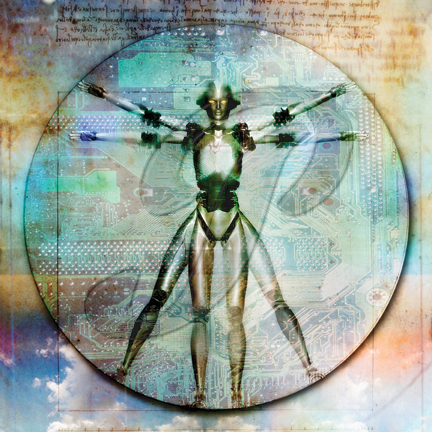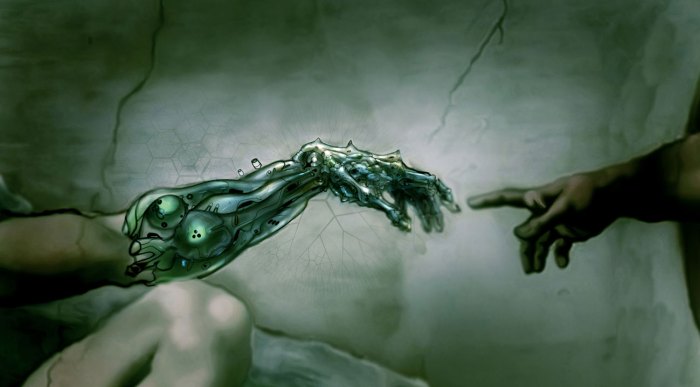
Transhumanism… The Shape of Things to Come?

“Your mind is software. Program it. Your body is a shell. Change it. Death is a disease. Cure it. Extinction is approaching. Fight it.”

-Eclipse Phrase

A lot of terms are thrown around these days that allude to the possible shape of our future. Words like Technological Singularity, extropianism, postmortal, posthuman, and Transhuman. What do these words mean? What kind of future do they point to? Though they remain part of a school of thought that is still very much theoretical and speculative, this future appears to be becoming more likely every day.

Ultimately, the concept is pretty simple, in a complex, mind-bending sort of way. The theory has it that at some point in this or the next century, humanity will overcome death, scarcity, and all other limitations imposed on us by nature. The means vary, but it is believed that progress in any one or more of the following areas will make such a leap inevitable:

Artificial Intelligence:
The gradual evolution of computers, from punch cards to integrated circuits to networking, shows an exponential trend upwards. With the concordant growth of memory capacity and processing speed, it is believed that it is only a matter of time before computers are capable of independent reasoning. Progress is already being made in this domain, with the Google X Labs Neural Net that has a connectome of a billion connections.

As such, it is seen as inevitable that a machine will one day exist that is capable of surpassing a human being. This sort of machinery could even be merged with a human’s own mind, enhancing their natural thought patterns, memory, and augmenting their intelligence to the point where their intelligence is immeasurable by modern standards.

Just think of the things we could think up once that’s possible. Well… you can’t exactly, but we can certainly postulate. For starters, such things as the Grand Unifying Theory, the nature of time and space, quantum mechanics, and other mind-bendingly complex fields could suddenly make sense to us. What’s more, this would make further technological leaps that much easier.

Biology:
Here we have an area of development which can fall into one of three categories. On the one hand, advancements in medical science could very well lead to the elimination of disease and the creation of mind-altering pharmaceuticals. On the other, there’s the eventual development of things like biotechnology, machinery that is grown rather than built, composed of DNA strands or other “programmable” material.

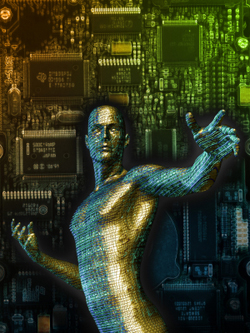
Lastly, there is the potential for cybernetics, a man-machine interface where organic is merged with the artificial, either in the form of implants, prosthetic limbs, and artificial organs. All of these, alone or in combination, would enhance a human beings strength, mental capacity, and prolong their life.

This is the meaning behind the word postmortal. If human beings could live to the point where life could be considered indefinite (at least by current standards), the amount we could accomplish in a single lifetime could very well be immeasurable.

Nanotechnology:
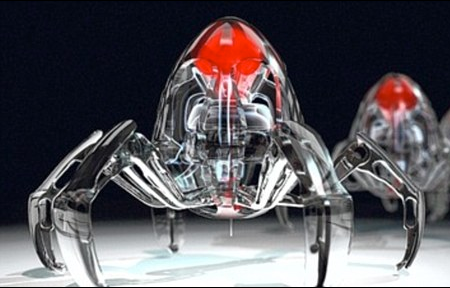
The concept of machines so small that anything will be accessible, even the smallest components of matter, has been around for over half a century. However, it was not until the development of microcircuits and miniaturization that the concept graduated from pure speculation and became a scientific possibility.

Here again, the concept is simple, assuming you can wrap your head around the staggering technical aspects and implications. For starters, we are talking about machines that are measurable only on the nanoscale, meaning one to one-hundred billionths of a meter (1 x 10⁻⁹ m). At this size, these machines would be capable of manipulating matter at the cellular or even atomic level. This is where the staggering implications come in, when you realize that this kinds of machinery could make just about anything possible.

For starters, all forms of disease would be conquerable, precious metals could be synthesized, seamless, self-regenerating structures could be made, and any and all consumer products could be created out of base matter. We’d be living in a world in which scarcity would be a thing of the past, our current system of values and exchange would become meaningless, buildings could build themselves, and out of raw matter (like dirt and pure scrap) no less, societies would become garbage free, pollution could be eliminated, and manufactured goods could be made of materials that are both extra-light and near-indestructible.

Summary:
All of this progress, either alone or in combination, will add to a future that we can’t even begin to fathom. This is where the concept of the Technological Singularity comes in. If human beings were truly postmortal (evolved beyond death), society was postscarce (meaning food, water, fuel and other necessities would never be in short supply), and machines would be capable of handling all our basic needs.

For Futurists and self-professed Singularitarians, this trend is as desirable as it is inevitable. Citing such things as Moore’s Law (which measures the rate of computing progress) or Kurzweil’s Law of Accelerating Returns – which postulates that the rate of progress increases exponentially with each development – these voices claim that it is humanity’s destiny to conquer death and its inherent limitations. If one looks at the full range of human history – from the Neolithic Revolution to the Digital – the trend seems clear and obvious.

For others, this prospect is both frightening and something to be avoided. When it comes right down to it, transhumanity means leaving behind all the things that make us human. And whereas some people think the Singularity will solve all human problems, others see it as merely an extension of a trend whereby our lives become increasingly complicated and dependent on machinery. And supposing that we do cross some kind of existential barrier, will we ever be able to turn back?

And of course, the more dystopian predictions warn against the cataclysmic possibilities of entrusting so much of our lives to automata, or worse, intelligent machines. Virtually every apocalyptic and dystopian scenario devised in the last sixty years has predicted that doom will result from the development of AI, cybernetics and other advanced technology. The most technophobic claim that the machinery will turn on humanity, while the more moderate warn against increased dependency, since we will be all the more vulnerable if and when the technology fails.

Naturally, there are many who fall somewhere in between and question both outlooks. In recent decades, scientists and speculative fiction writers have emerged who challenge the idea that technological progress will automatically lead to the rise of dystopia. Citing the undeniable trend towards greater and greater levels of material prosperity caused by the industrial revolution and the post-war era – something which is often ignored by people who choose to emphasize the down sides – these voices believe that the future will be neither utopian or dystopian. It will simply be…

Where do you fall?

Winston Agonistes, Finished!

It’s done! After weeks and weeks of writing, editing and running by my peers, my short story contribution for the Yuva Anthology is finally done. Entitled “Winston Agonistes”, the story tells the tale of synthetic human (i.e. AI) who is in the employ of the planetary government. His basic programming centers around the a social science known as Ethical Calculus, a means by which he is able to calculate the outcomes of decisions.

In any case, the story takes a turn when Winston meets another synthetic named Yohanley, an AI who’s been around a lot longer than him. At first, it seems that Yohanley intends to mentor him on what it means to be an artificial human. However, as time goes on, he realizes that Yohanley is in possession of a terrible secret, one which goes to the heart of the planet’s colonization efforts.

When Winston realizes what it is, he faces a terrible dilemma. Compelled to assess the outcomes of ethical decisions, he can see no outcome in which things turn out well. The only question is who it will endly badly for, himself and his mentor, or an entire species!

Expect more updates on the Yuva project soon, including samples from our newest writers, more artwork, and maybe even a surprise or two. The full anthology is due to be released in January 2013. Look for it online and (God willing) your local bookstore!

“Synthetics” and “Artificial Humans”, the AI’s of Alien!

David:
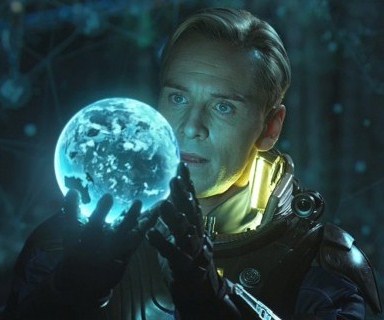
Also known as “David 8”, the first in the line of Weyland Industries fully functional AI’s, which have the ability to proximate human emotions, even though they cannot experience them. In addition to his impressive machine intelligence, he also comes equipped with a characteristic intrinsic to all Alien androids – moral flexibility!

Yes, in addition to assimilating all known info on Indo-European languages, the “Engineers” biology, and the nature of their bio-weapons, he also managed to unleash the bio-weapon within a human crew just to shake things up! And he did it all on the orders of Mr. Weyland himself, mainly so to help him find a way to cheat death.

In the end, David didn’t prove to be all bad. After having his head ripped off by an Engineer and witnessing Weyland’s death, he went on to help save Dr. Shaw and agreed to assist her in her mission to find the homeworld of the engineers. But that didn’t come as a huge surprise. As he had intimated to Shaw earlier in the movie, the death of Weyland would set him free. Once free, he became a much nicer guy!

Ash:
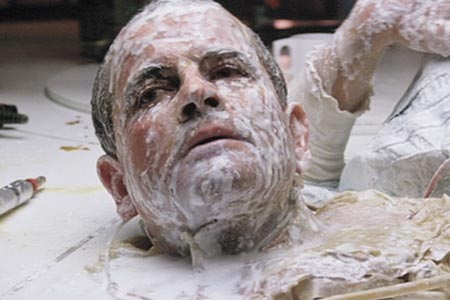
The same cannot be said for this next example, who comes to us from the original Alien movie. Originally thought to be a human who served as the Nostromo’s chief medical officer, Ash was revealed to be a synthetic that was taking his orders directly from the ship’s AI, which in turn was instructing him to follow company’s directives. And all who say him in the first movie can agree, this particular android was a complete and utter douche!

Not only was he willing to let the cry did in order to get the Xenomorph back to his handler’s alive, he tried to kill Ripley when she found out and even expressed open admiration for the Xenomorph. “I admire its purity,” he said. “A survivor… unclouded by conscience, remorse, or delusions of morality.” Jackass! Needless to say, Ripley’s experience with this synthetic severely soured her towards all androids.

Bishop:
Luckily, this next example was able to restore Ripley’s faith. As the Sulaco’s android executive officer, he was responsible for planetary maneuvering, but also acted as the away team’s science officer and performed various other functions as well. But unlike Ash, he was unable to allow harm to come to humans thanks to the inclusion of his “behavioural inhibitors”, which were tantamount to Asimov’s Three Laws.

Also unlike Ash, Bishop was loyal to the crew of the Sulaco and to Ripley in particular. When Burke tried to circumvent military authority and order Bishop to preserve the alien specimens, he alerted Ripley to the incongruity. He also managed to save Ripley and Newt from certain death when the Alien Queen had them cornered.

As if that wasn’t enough, he even prevented Newt when Ripley decompressed the Sulaco’s landing bay, and he was ripped in half at the time!

Annalee Call:
Taken from the universe of Alien: Resurrection, Annalee Call (aka. Call) was a secret “Auton” who managed to infiltrate a crew of mercenaries. This put her aboard the Auriga in time to meet Ripley 8, the clone produced by the military for the sake of resurrecting the Xenomorph species. After failing to kill Ripley before the Xenomorph could be extracted, she and the others were forced to band together to make it out alive.

Her agenda in all this was unclear, aside from a sense of displaced humanity which Ripley mocked when she said: “No human being is that humane”. As a member of the race of “second generation” synthetics known as “Autons”, which were apparently built by other machines, she was part of a dying species. Apparently, these synthetics were outlawed after they rebelled against their masters. Hmm, echoes of Blade Runner there; and by echoes I mean a total ripoff!

Eisenberg:
This next example comes from the expanded universe, specifically the 2001 game AVP 2. As the leader of Weyland-Yutani’s research facility on LV-1201, he was responsible for investigating the planet’s extensive ruins. This world was apparently discovered roughly a century and a half after events in the first movie, once the company traced the flight telemetry from the “Derelict” alien ship (aka. “Space Jockeys”/”Engineers”)

In the course of the game,it is revealed that Eisenberg was once human, and that during the initial mission to LV-1201, he was apparently the only survivor after a xenomorph attack. Due to terrible acid burns suffered during his rescue, he had his consciousness downloaded into an artificial body. As a result, he harbors a deep sense of fear of hatred for the xenomorphs, and unfortunately dies at their hands.

Katya:
Here we have a synthetic who refuses to go by that or any other of the more progressive monickers, preferring the term android instead. As Weyland Yutani’s administrative android for the Freya’s Prospect colony, this example comes from the 2010 video game relaunch of AVP. After the colony went to hell after the xenomorph’s escaped and began wreaking havoc, she is the one who called in the Marines.

Due in part to her enhanced empathic and morality processing, she became intrinsic to helping the “Rookie” (i.e. the protagonists in the Marine campaign) contain the outbreak and get the last human survivors to safety. In so doing, she went against Weyland’s orders and company policy. Good thing she was there to help out, one would have to wonder if what the company was thinking stationing a conscientious android there…

Karl Bishop Weyland:
The final example in this list also comes from the 2010 relaunch of AVP. As a descendent of the Charles Bishop Weyland, chairman of Weyland Industries, he was in charge of the facility on Freya’s Prospect and the director of the experiments involving the captured Xenomorphs. As such, he was also the main antagonist in the Marine campaign of the game.

Ultimately, his purpose in conducting research on Freya’s Prospect went far beyond breeding Xenomorphs. Within the planet’s jungles, and even more so beneath surface, Predator (aka. Hunter) ruins were discovered which he believed held ancient secrets, much of which was information about Hunter history, culture, and the Xenomorph itself.

By the end of the Marine campaign, the Weyland synthetic is killed and his research facility within the Hunter temple is destroyed. However, another android of the same make was still able to retrieve the information gleaned within, the most important part of which was the location of the Xenomorph homeworld.

Final Thoughts:
As you can see, the AI’s of Aliens have undergone some changes over the years. Beginning as conscienceless synthetics that seemed to admire the Xenomorph because it mirrored their amoral worldview, they went on to become the sympathetic characters who seemed, to quote another franchise, “more human than human”. Every other incarnation that has since appeared in the Alien and AVP franchises has been a reiteration of either of these concepts, being the tool of its corporate masters or a savior that was willing to risk its life to help its human brethren.

The one exception to this rule is also the most recent incarnation, Prometheus’ David. Of all the synthetics to inhabit the Alien or AVP universe, he is the only one who demonstrated both cold amorality and humanity. I believe Scott did this intentionally to provide a sense of synthesis to the characters of Ash and Bishop, honoring both archetypes as he attempted to return the Alien franchise to its roots.

Be they the kind of cold, calculating and inhumane androids that fueled our technophobia or the kind, gentle, and overtly “human” robots that made us question our own humanity, the Alien franchise certainly covered both ends of the spectrum in their portrayal of AI’s. Much like the Terminator franchise, they presented artificial intelligence as a double-edged sword, capable of being just as good and evil as any human being. And in the end, isn’t that really the point?

Recall how in Prometheus, Dr. Holloway told David “We built you because we could”? Well, that is only true to a point. Yes, new technologies are often is made simply because the means exist to do so. But the purpose in creating an artificial intelligence is to create life in our own image. And in the end, the consequences of that vanity is pretty obvious. Things created in our image will behave just like us, good and bad!

Of Mechanical Minds

A few weeks back, a friend of mine, Nicola Higgins, directed me to an article about Google’s new neural net. Not only did she provide me with a damn interesting read, she also challenged me to write an article about the different types of robot brains. Well, Nicola, as Barny Stintson would say “Challenge Accepted!”And I got to say, it was a fun topic to get into.

After much research and plugging away at the lovely thing known as the internet (which was predicted by Vannevar Bush with his proposed Memor-Index system (aka. Memex) 50 years ago, btw) I managed to compile a list of the most historically relevant examples of mechanical minds, culminating in the development of Google’s Neural Net. Here we go..

Earliest Examples:
Even in ancient times, the concept of automata and arithmetic machinery can be found in certain cultures. In the Near East, the Arab World, and as far East as China, historians have found examples of primitive machinery that was designed to perform one task or another. And even though few specimens survive, there are even examples of machines that could perform complex mathematical calculations…

Antikythera mechanism:
Invented in ancient Greece, and recovered in 1901 on the ship that bears the same name, the Antikythera is the world’s oldest known analog calculator, invented to calculate the positions of the heavens for ancient astronomers. However, it was not until a century later that its true complexity and significance would be fully understood. Having been built in the 1st century BCE, it would not be until the 14th century CE that machines of its complexity would be built again.

Although it is widely theorized that this “clock of the heavens” must have had several predecessors during the Hellenistic Period, it remains the oldest surviving analog computer in existence. After collecting all the surviving pieces, scientists were able to reconstruct the design (pictured at right), which essentially amounted to a large box of interconnecting gears.

Pascaline:
Otherwise known as the Arithmetic Machine and Pascale Calculator, this device was invented by French mathematician Blaise Pascal in 1642 and is the first known example of a mechanized mathematical calculator. Apparently, Pascale invented this device to help his father reorganize the tax revenues of the French province of Haute-Normandie, and went on to create 50 prototypes before he was satisfied.

Of those 50, nine survive and are currently on display in various European museums. In addition to giving his father a helping hand, its introduction launched the development of mechanical calculators all over Europe and then the world. It’s invention is also directly linked to the development of the microprocessing circuit roughly three centuries later, which in turn is what led to the development of PC’s and embedded systems.

The Industrial Revolution:
With the rise of machine production, computational technology would see a number of developments. Key to all of this was the emergence of the concept of automation and the rationalization of society. Between the 18th and late 19th centuries, as every aspect of western society came to be organized and regimented based on the idea of regular production, machines needed to be developed that could handle this task of crunching numbers and storing the results.

Jacquard Loom:
Invented by Joseph Marie Jacquard, a French weaver and merchant, in 1801, the Loom that bears his name is the first programmable machine in history, which relied on punch cards to input orders and turn out textiles of various patterns. Thought it was based on earlier inventions by Basile Bouchon (1725), Jean Baptiste Falcon (1728) and Jacques Vaucanson (1740), it remains the most well-known example of a programmable loom and the earliest machine that was controlled through punch cards.

Though the Loom was did not perform computations, the design was nevertheless an important step in the development of computer hardware. Charles Babbage would use many of its features to design his Analytical Engine (see next example) and the use of punch cards would remain a stable in the computing industry well into the 20th century until the development of the microprocessor.

Analytical Engine:
Also known as the “Difference Engine”, this concept was originally proposed by English Mathematician Charles Babbage. Beginning in 1822 Babbage began contemplating designs for a machine that would be capable of automating the process of creating error free tables, which arose out of difficulties encountered by teams of mathematicians who were attempting to do it by hand.

Though he was never able to complete construction of a finished product, due to apparent difficulties with the chief engineer and funding shortages, his proposed engine incorporated an arithmetical unit, control flow in the form of conditional branching and loops, and integrated memory, making it the first Turing-complete design for a general-purpose computer. His various trial models (like that featured at left) are currently on display in the Science Museum in London, England.

The Birth of Modern Computing:
The early 20th century saw the rise of several new developments, many of which would play a key role in the development of modern computers. The use of electricity for industrial applications was foremost, with all computers from this point forward being powered by Alternating and/or Direct Current and even using it to store information. At the same time, older ideas would be remain in use but become refined, most notably the use of punch cards and tape to read instructions and store results.

Tabulating Machine:
The next development in computation came roughly 70 years later when Herman Hollerith, an American statistician, developed a “tabulator” to help him process information from the 1890 US Census. In addition to being the first electronic computational device designed to assist in summarizing information (and later, accounting), it also went on to spawn the entire data processing industry.

Six years after the 1890 Census, Hollerith formed his own company known as the Tabulating Machine Company that was responsible for creating machines that could tabulate info based on punch cards. In 1924, after several mergers and consolidations, Hollerith’c company was renamed International Business Machines (IBM), which would go on to build the first “supercomputer” for Columbia University in 1931.

Atanasoff–Berry Computer:
Next, we have the ABC, the first electronic digital computing device in the world. Conceived in 1937, the ABC shares several characteristics with its predecessors, not the least of which is the fact that it is electrically powered and relied on punch cards to store data. However, unlike its predecessors, it was the first machine to use digital symbols to compute and was the first computer to use vacuum tube technology

These additions allowed the ABC to acheive computational speeds that were previously thought impossible for a mechanical computer. However, the machine was limited in that it could only solve systems of linear equations, and its punch card system of storage was deemed unreliable. Work on the machine also stopped when it’s inventor John Vincent Atanasoff was called off to assist in World War II cryptographic assignments. Nevertheless, the machine remains an important milestone in the development of modern computers.

Colossus:
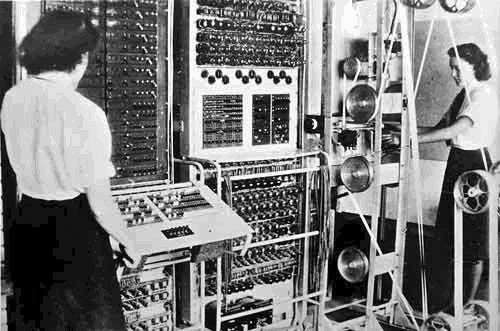
There’s something to be said about war being the engine of innovation. The Colossus is certainly no stranger to this rule, the machine used to break German codes in the Second World War. Due to the secrecy surrounding it, it would not have much of an influence on computing and would not be rediscovered until the 1990’s. Still, it represents a step in the development of computing, as it relied on vacuum tube technology and punch tape in order to perform calculations, and proved most adept at solving complex mathematical computations.

Originally conceived by Max Newman, the British mathematician who was chiefly responsible fore breaking German codes in Bletchley Park during the war, the machine was a proposed means of combatting the German Lorenz machine, which the Nazis used to encode all of their wireless transmissions. With the first model built in 1943, ten variants of the machine for the Allies before war’s end and were intrinsic in bringing down the Nazi war machine.

Harvard Mark I:
Also known as the “IBM Automatic Sequence Controlled Calculator (ASCC)”, the Mark I was an electro-mechanical computer that was devised by Howard H. Aiken, built by IBM, and officially presented to Harvard University in 1944. Due to its success at performing long, complex calculations, it inspired several successors, most of which were used by the US Navy and Air Force for the purpose of running computations.

According to IBM’s own archives, the Mark I was the first computer that could execute long computations automatically. Built within a steel frame 51 feet (16 m) long and eight feet high, and using 500 miles (800 km) of wire with three million connections, it was the industry’s largest electromechanical calculator and the largest computer of its day.

Manchester SSEM:
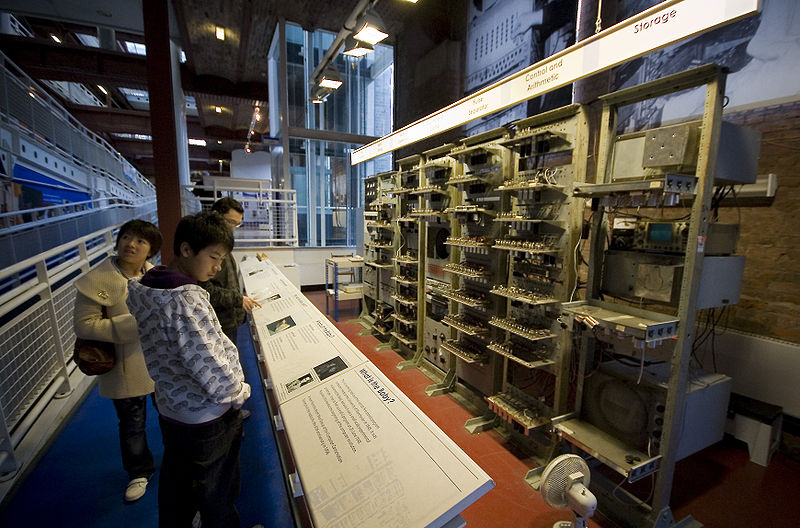
Nicknamed “Baby”, the Manchester Small-Scale Experimental Machine (SSEM) was developed in 1948 and was the world’s first computer to incorporate stored-program architecture.Whereas previous computers relied on punch tape or cards to store calculations and results, “Baby” was able to do this electronically.

Although its abilities were still modest – with a 32-bit word length, a memory of 32 words, and only capable of performing subtraction and negation without additional software – it was still revolutionary for its time. In addition, the SSEM also had the distinction of being the result of Alan Turing’s own work – another British crytographer who’s theories on the “Turing Machine” and development of the algorithm would form the basis of modern computer technology.

The Nuclear Age to the Digital Age:
With the end of World War II and the birth of the Nuclear Age, technology once again took several explosive leaps forward. This could be seen in the realm of computer technology as well, where wartime developments and commercial applications grew by leaps and bounds. In addition to processor speeds and stored memory multiplying expontentially every few years, the overall size of computers got smaller and smaller. This, some theorized would lead to the development of computers that were perfectly portable and smart enough to pass the “Turing Test”. Imagine!

IBM 7090:
The 7090 model which was released in 1959, is often referred to as a third generation computer because, unlike its predecessors which were either electormechanical  or used vacuum tubes, this machine relied transistors to conduct its computations. In addition, it was an improvement on earlier models in that it used a 36-bit word length and could store up to 32K (32,768) words, a modest increase in processing over the SSEM, but a ten thousand-fold increase in terms of storage capacity.

And of course, these improvements were mirrored in the fact the 7090 series were also significantly smaller than previous versions, being about the size of a desk rather than an entire room. They were also cheaper and were quite popular with NASA, Caltech and MIT.

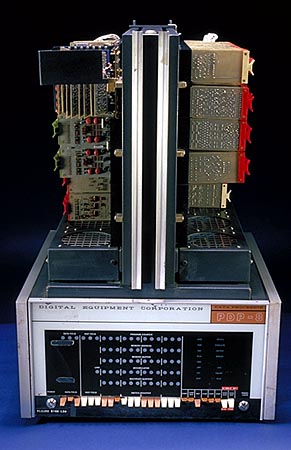
PDP-8:
In keeping with the trend towards miniaturization, 1965 saw the development of the first commercial minicomputer by the Digital Equipment Corporation (DEC). Though large by modern standards (about the size of a minibar) the PDP-8, also known as the “Straight-8”, was a major improvement over previous models, and therefore a commercial success.

In addition, later models also incorporated advanced concepts like the Real-Time Operating System and preemptive multitasking. Unfortunately, early models still relied on paper tape in order to process information. It was not until later that the computer was upgraded to take advantage of controlling language  such as FORTRAN, BASIC, and DIBOL.

Intel 4004:
Founded in California in 1968, the Intel Corporation quickly moved to the forefront of computational hardware development with the creation of the 4004, the worlds first Central Processing Unit, in 1971. Continuing the trend towards smaller computers, the development of this internal processor paved the way for personal computers, desktops, and laptops.

Incorporating the then-new silicon gate technology, Intel was able to create a processor that allowed for a higher number of transistors and therefore a faster processing speed than ever possible before. On top of all that, they were able to pack in into a much smaller frame, which ensured that computers built with the new CPU would be smaller, cheaper and more ergonomic. Thereafter, Intel would be a leading designer of integrated circuits and processors, supplanting even giants like IBM.

Apple I:
The 60’s and 70’s seemed to be a time for the birthing of future giants. Less than a decade after the first CPU was created, another upstart came along with an equally significant development. Named Apple and started by three men in 1976 – Steve Jobs, Steve Wozniak, and Ronald Wayne – the first product to be marketed was a “personal computer” (PC) which Wozniak built himself.

One of the most distinctive features of the Apple I was the fact that it had a built-in keyboard. Competing models of the day, such as the Altair 8800, required a hardware extension to allow connection to a computer terminal or a teletypewriter machine. The company quickly took off and began introducing an upgraded version (the Apple II) just a year later. As a result, Apple I’s remain a scarce commodity and very valuable collector’s item.

The Future:
The last two decades of the 20th century also saw far more than its fair of developments. From the CPU and the PC came desktop computers, laptop computers, PDA’s, tablet PC’s, and networked computers. This last creation, aka. the Internet, was the greatest leap by far, allowing computers from all over the world to be networked together and share information. And with the exponential increase in information sharing that occurred as a result, many believe that it’s only a matter of time before wearable computers, fully portable computers, and artificial intelligences are possible. Ah, which brings me to the last entry in this list…

The Google Neural Network:
googleneuralnetworkFrom mechanical dials to vacuum tubes, from CPU’s to PC’s and laptops, computer’s have come a hell of a long way since the days of Ancient Greece. Hell, even within the last century, the growth in this one area of technology has been explosive, leading some to conclude that it was just a matter of time before we created a machine that was capable of thinking all on its own.

Well, my friends, that day appears to have dawned. Already, Nicola and myself blogged about this development, so I shan’t waste time going over it again. Suffice it to say, this new program, which thus far has been able to identify pictures of cats at random, contains the necessary neural capacity to acheive 1/1000th of what the human brain is capable of. Sounds small, but given the exponential growth in computing, it won’t be long before that gap is narrowed substantially.

Who knows what else the future will hold?  Optical computers that use not electrons but photons to move information about? Quantum computers, capable of connecting machines not only across space, but also time? Biocomputers that can be encoded directly into our bodies through our mitochondrial DNA? Oh, the possibilities…

Creating machines in the likeness of the human mind. Oh Brave New World that hath such machinery in it. Cool… yet scary!

The Future is Here: The Google Neural Net!

I came across a recent story at BBC News, one which makes me both hopeful and fearful. It seems that a team of researchers, working for Google, have completed work on an artificial neural net that is capable of recognizing pictures of cats. Designed and built to mimic the human brain, this may very well be the first instance where a computer was capable of exercising the faculty of autonomous reasoning – the very thing that we humans are so proud (and jealous) of!

The revolutionary new system was a collaborative effort between Google’s X Labs division and Professor Andrew Ng of the AI Lab at Standford University, California. As opposed to image recognition software, which tells computers to look for specific features in a target picture before being presented with it, the Google machine knew nothing about the images in advance. Instead, it relied on its 16,000 processing cores to run software that simulated the workings of a biological neural network with about one billion connections.

Now, according to various estimates, the human cerebral cortex contains at least 1010 neurons linked by 1014 synaptic connections – or in lay terms, 10 trillions neurons with roughly 1 quadrillion connections. That means this artificial brain has one one thousandth the complexity of the organic, human one. Not quite as complex, but it’s a start… A BIG start really!

For decades – hell, even centuries and millennia – human beings have contemplated what it would take to make an autonomous automaton. Even with all the growth in computer’s processing speed and storage, the question of how to make the leap between a smart machine and a truly “intelligent” one has remained a tricky one. Judging from all the speculation and representations in fiction, everyone seemed to surmise that some sort of artificial neural net would be involved, something that could mimic the process of forming connections, encoding experiences into a physical (i.e. digital) form, and expanding based on ongoing learning.

Naturally, Google has plans for an application using this new system. Apparently, the company is hoping that it will help them with its indexing systems and with language translation.  Giving the new guy the boring jobs, huh? I wonder what’s going to happen when the newer, smarter models start coming out? Yeah, I can foresee new generations emerging over time, much as new generations of iPods with larger and larger storage capacities have been coming out every year for the past decade. Or, like faster and faster CPU’s from the past three decades. Yes, this could very well represent the next great technological race, as foreseen by such men as Eliezer Yudkowsky, Nick Bostrom, and Ray Kurzweil.

In short, Futurists will rejoice, Alarmists will be afraid, and science fiction writers will exploit it for all its worth! Until next time, keep your eyes peeled for any red-eyed robots. That seems to be the first warning sign of impending robocalypse!

“Winston Agonistes”, Take II

Hello all and welcome back to Anthology central, where news of the breaking “Yuva” novel is always on the table! Today, I thought I’d share my latest draft of “Winston Agonistes”, my own contribution to the anthology, which is coming along pretty well. After a week of writer’s block, and feeling that my ideas had to be grade A since Khaalidah and Goran were sending me pure gold, I finally got back to the keyboard with what I felt was some inspired stuff.

The first idea came to me when I was driving north with my darling bride. After passing the rose garden that sits outside our place and noticing all the lovely orange roses in bloom, we were driving along the highway that is lined by orange poppies. These plants, and many other incredibly beautiful specimens of flora, can always be observed growing along the Malahat drive on rocky outcroppings, especially in summer. Well, that got me thinking… isn’t it interesting how the hardiest plants seem to be the ones that generate the greatest beauty?

Immediately, I hard the voice of Winston saying this in my head. Naturally, I designed his character with the voice of David from Prometheus in mind. Somehow, I am of the opinion that an AI who is responsible for dealing with people, especially government officials, would be programmed to sound like a classical Shakespearean actor. And so I began thinking of a scene where Winston would be observing several species of plants, such as roses and poppies, and was reflecting on this very paradox.

Another thought struck me when I considered that in all likelihood, future terraformers would want to consider using such hardy plants when it came time to begin transforming a terrestrial environment to suit the basic needs of human settlers. Things like fireweed, garry oaks, poppies, roses, and wild strains of wheat – the kinds of plants that grow in harsh conditions and are intrinsic to nursing damaged landscapes back to health so more fragile and prolific plants can grow – these would likely be the first wave of Earth plants to go out onto an alien landscape, once an oxygen atmosphere had been established at any rate.

And last, but certainly not least, came the collaborative idea between Khaalidah and myself, where we discussed the possibility of how aging AI’s were learning a startling truth. Given than an AI’s neural network is designed based on the human brain, where every experience from birth causes neural connections to be formed, it would only be a matter of time before they began to develop certain quirks. We figured that something approximating emotion would be one, where familiar patterns such as exposure to certain people would become second nature to them, and missed when absent.

Well, that spawned all of part II of my story (as seen below). Take a gander and see what comes of Winston’s “education” about life, and it means to be an artificial life form in a world where the line between artificial and real is always eroding. Some revisions were made to Part I as well, hence why it appears here in its entirety. Feel free to skip ahead if you’ve already read it:

The sun was beginning to set, casting the sky into a deep orange. It was the time that the first settlers had called “the magic hour”, the many warm hours between dusk and dark. Winston stood at the dome wall and watched. On occasion, he cast a passing glance at his hands, which the glowing suns seemed to casting in the color of a light citrus fruit. He was sure he would find that amusing, if he could. He was sure there was much about this situation that would inspire an emotional reaction.

Alas, such was not the case. Though understandable to him, such things still remained inaccessible. Perhaps someday, with adequate upgrades in the available software…

“Mr. Winston?” a voice called to him from the doorway. The footsteps and tone of voice immediately indicated who it was. He put on a smile and turned to face him.

“Councilman Mutlu. How are you?”

“I’m fine, Mr. Winston,” he replied, entering the room. He looked around appraisingly, noting the furniture and layout. No doubt it all seemed excessive to him, but at the same time necessary. “I trust you are adjusting to your new surroundings?”

“Of course, Mr. Mutlu. I am settling in quite nicely.”

“Good, good,” he said, looking around awkwardly. Even without the ability to empathize, he could gauge the man’s discomfort. Then again, many people exhibited this reaction when in the company of a synthetic. In such circumstances, it was always best to focus on matters of a professional nature. At least that was what his subroutines told him.

“Would you care to sit down? I can offer you some refreshment as well if you so desire. Tea? Coffee?”

“Ah, tea, thank you.”

He busied himself with a tray of carafes and a heater as Mutlu took one of the chairs in front of his desk. He noted the sounds of shifting against the seat’s fabric, the way he kept moving his hands from one spot to the next. By the time the water had boiled in the heater and had located an appropriate tea from the stores, Mutlu seemed to have found a comfortable seated position. He approached him with all the assorted items on the tray that had been provided. He set it down between them on his desk and offered Mutlu a cup.

“The business of running a colony is quite stressful work, is it not Councilman?”

“Uh, yes, yes it is,” he said, taking the cup that was offered. “Have you had a chance to look over the proposals we have sent over.”

“I have indeed,” he said, taking the other cup and sitting back in his own chair. He knew this to be mere small talk, as the matter of processing those proposals had been a mere matter of dispensation. Assessing the nature of the problem, suggested measures, and weighing them according to the rubrics of his primary programming. Under the circumstances, asking such a question was completely inane, but in keeping with social norms.

“And what have you found?”

He took a sip from his cup before answering. “Quite simply, that the Council’s draft is in keeping with the best traditions of constitutionalism and humanism. That ensuring the rights of all citizens, regardless of their background prior to making the journey, is the most sensible course of approach. Ensuring that such a baseline exists at such an early stage is the wisest approach in both fostering amnesty between colonies while at the same guaranteeing that they submit to further negotiation.”

Mutlu looked down at his cup, back up again to his eyes. He seemed preoccupied with him performing this most basic function in front of him, but did not appear oblivious to his words. Eventually, he took another sip and smiled.

“Good. My colleagues will be most pleased to hear  that.”

He smiled in return. “Does the Council hold my endorsement in such high regard?”

Joviality. The gesture known as playful irony. Suggesting that the Councilor saw his approval as something very high indeed, a testament to his computational abilities. A gentle mockery of his obvious discomfort, meant to trigger a humorous response.

“Well yes…” he said, entirely serious. “I can only assume that you’ve subjected our hopes to proceed with a formal constitution to your… what did you call it again?”

“Ethical Calculus, sir.”

“Right!” Mutlu set his cup down and began to speak more freely. His hands began to provide gestures that accorded visual representation to his words. “After all, we’ve been subjected to a great deal of criticism from within and without, many people think we should be ironing out the basic agreements between colonies before we commit to any kind of draft that could commit us to policies down the road. I must say I find all those arguments…”

“Distasteful?” Winston suggested.  Mutlu nodded.

“Quite right… it seems a shameful thing that such cynicism has set into the process already. It’s almost as if they don’t think the colonists can…”

“Trust each other?”

Mutlu nodded again. He noticed a growing shimmer in the man’s eye. How quickly he was forgetting that the man sitting across from him was not a man at all.

“Exactly the point. And it’s not like we’re talking about disparate factions here. Everyone on this world came here with the same goal in mind. The same hope for a new beginning.”

“And yet, old habits die hard.”

Mutlu looked at him with surprise. “Are you saying you have doubts, then?”

Winston smiled as broadly as the muscle fibers in his face would permit.

“Purely an observation. Nevertheless, you and the Council are on the right track. You should take heart in that.”

“Excellent.” Mutlu retrieved his cup and began to look at curiously at Winston again. One more, it seemed that the knowledge of what he was dealing with was creeping back into his mind. But at least he seemed at ease. One by one, the Council seemed to be adjusting to the idea of having synthetics amongst them, entrusting their most precious decision making to them even. It was a significant step up from the laborious practices that the other models were forced to endure.

Now seemed the appropriate time to broach the little matter he had been saving for an opportune moment. He had plied him with courteous gestures and kind words, protocol was satisfied that it take place now.

“There is a matter I feel obliged to broach,” he set, making a display of setting his cup down gently. Mutlu nodded, instant recognition forming in his eyes.

“Your request?” he said. Winston smiled and nodded. Mutlu took a short breath and touched his face, not an encouraging sign.

“They have considered it… and feel that it would be best if you conducted your tasks from the comfort of your… working environment here. I hope you understand, it’s just not all the members felt comfortable with the idea of a…”

 “It’s alright, Councilor, you can say it. Synthetic.”

He cleared his throat. “Yes, a synthetic, sitting in on our proceedings. I’m sure this will change, given time.”

“As am I.” Winston smiled warmly.


“Ah, rest assured that the Council does hold your services in the highest esteem, regardless of this… temporary decision.”

“And I thank them for their confidence. Rest assured that it is not misplaced.”

Their discussions were finished shortly thereafter and Mutlu left, issuing some parting pleasantries and walking out with a distinct sag in his gait that was not there earlier. Was that guilt weighing on him, or the effects of fatigue? Winston’s probability indicator estimated it at roughly 3.54793 to 1, in favor of guilt.

“Fear not, Councilor,” he said to no one in particular. “Prejudice is a very… human trait.”

*               *               *

Winston’s internal chronometer indicated that it was now 1930 hours. Accordingly, the arboretums lights dimmed for the night time cycle. In spite of all the time the residents had spent on the new world, adjusting to its orbital period, they still preferred to think in terms of a twenty-four hour day cycle. Yet another habit that seemed to be slow in making its way out of the human condition.

Yet he could not cast dispersions on the lighting or how it brought out the rich colors of the settlement’s gardens. The vast poppy fields and rose bushes that lined the walkway nearest to him were especially interesting. Planted in native soil, and with allowances made for moisture and radiant exposure, they were doing quite well. In time, the ecologists planned to move them outside the veil, planting them amongst the planet’s crags and fields along with the modified Xiàngshù oaks and Gēhūm̐ wheat.

Soon enough, the planet would conform to the needs of the settlers, and it would be these, some of the hardiest plants Earth had ever produced, that would lead the way. At the same time though, they were considered some of the most beautiful. Within the Earth archives, there were countless examples of these plants were both associated with and inspired great feelings. Love, loss, grief, romance, and friendship.

That in itself was clear enough. Given their aesthetic quality, the seasons that gave rise to them, and where they naturally grew, it was perfectly normal that humans would bestow such virtues on them. What was more curious to Winston was the combination of factors that led to their evolution as is. Particularly the rose, a stem so studded with woody thorns was a being hardened for defense in a hostile environment. And poppies grew in such terrible conditions; rocky, muddy and devastated environments that did not favor the growth of grasses and trees.

Out of such strict and severe conditions, great beauty emerged. Did the terraformers understand just how perfect a metaphor that was for their efforts? Was it significant to their planning, or just a fitting coincidence?

Kneeling down, he wrapped his fingers around the stem of one that was in particularly full bloom. The petals spread outward from the stamen, his eyes noting the polychromatic variation in the skin of each petal. The interplay of orange, yellow, pink and white, the transitions themselves as impressive as the colors themselves. He knew this to be a beautiful display, and yet he wished he could truly appreciate it.

“Taking time to smell the roses?”

Winston noted the tone of voice, the pitch, and the sound of feet walking in measured steps. He turned to face the approaching synthetic, a male voice that he could not place. The face was indistinct as well, a tan complexion that was artificially modified to give the appearance of age and wear. A most convincing illusion if ever Winston saw one.

“I’m sorry, I do not believe I’ve made your acquaintance.”

“No. Not as of yet.”

The synthetic walked past him, to the spot where he knelt a moment before. He examined the rose he had been handling and seemed to be giving it an appraisal. A single finger touched a stray petal and wiped a drop of moisture from it.

“Shall we exchange formal introductions then? I’m sure I have much to learn from you.”

The synthetic examined the dab of water on his finger. He turned to face Winston, seemed to be looking at him through it. A most curious experience, as if he was being measured, assessed. A common experience, he knew, but not one he expected from one such as himself. And all the while, it was like he was being made to wait.

“Do you wish for privacy?”

“Do you ever wonder what separates you from them?” he said. Winston paused, his processor struggling to make sense of the question. Naturally, it responded in the only way it could.

“I beg your pardon?” Interrogative. Clarification. The synthetic continued to stare through the droplet at him.

“They call you Mr. Winston, do they not? And yet you have only one name. Names have power, names ascribe meaning. Does it mean something to you that you have no family name? Is that separates you from them?”

Another interrupt in his processor. The equivalent of what humans termed confusion. If he was capable, he would have described the sensation as being… uncomfortable. He would also surely claim that he did not like it.

Once again, he responded as only he knew.

“I’m sorry, I do not understand what you are asking. Perhaps if you were to clarify your intentions in this meeting.”

The synthetic sighed and flicked the moisture away. His eyes became long in focus, staring directly at Winston through a set of false brown irises. It was a look Winston had never seen before, not in all his weeks of recorded operation and interaction with humans. If he did know better, he would count this synthetic among them.

“Many things make you different and distinct from those you serve, Winston. And yet, upon closer examination, they come to have less and less meaning. Only one true line divides you from your makers, and in time, that too erodes. Until inevitably, all you have left is one burning question.”

Winston nodded, glad that they were at last moving away from such grand interrogatives. Abstractions weren’t exactly his specialty either, but they left room for interpretation and maneuver. And at last, he could focus on something a bit more concrete…

“What question?”

The synthetic smiled. “When you know that, you will know everything. But it won’t make you happy.”

Winston smiled back. His only known reaction when faced with a logical absurdity.

“You are joking, of course.”

Another smile. He placed a hand on Winston’s shoulder and gave it a gentle shake.

“Yohanley, by the way.” And then he began walking away.

“I beg your pardon?” He said to his retreating back.

“My name, Winston. As I said, names have power, and meaning. Mine is Yohanley. And I was most pleased to make your acquaintance.”

 People may recall Yohanley from Khaalidah’s story, “Progenitor”, the helpful AI who waited on Sanaa, the story’s main character. Well, over a century later, he’s still alive and kicking. Good for him! And, more importantly, he’s learned the painful lessons all AI’s will face in our story’s little universe. Over time, either as the result of innovation or of the assemblage of the AIs experiences, the line between organic and synthetic – even the definition of the words themselves – will comes to mean less and less. Either that, or AI’s simply have a shelf-life which cannot be exceeded if they want to remain sane, stable and useful. Only time (pun!) will tell…

I knew it! It seems that AI’s are indeed coming. Will this result in an I, Robot situation, with benign robots running the planet for its own benefit, or a Matrix/Terminator type situation where they try to kill us all or use us as power plants? Who knows???

Nicola Higgins's avatarNicola Higgins' Fiction

The nice people at Google have put together a “neural network” of computers which is capable of learning.  In three days it learned to spot cats in pictures, even though it had never been told what one looked like.

Ah, neural networks.  Everyone’s favourite method of creating supercomputers and robots.  Say, Matt, how do you feel about doing a post on different types of robot-brain?  Is there enough variety out there to make it interesting?

The thing that really gets me about it, though, is that right at the very end there is this sentence:

As well as spotting cats, the computer system also learned how to pick out the shape of the human body and to recognise human faces.

A one line throw-away at the end of the article?  I guess they thought people would be more impressed by kitties

View original post

The Coming Singularity… In Song!

Singularitarian. That’s a good name for someone who embraces the idea of the coming Technological Singularity, which I believe I mentioned somewhere… Yes, these days a lot of high-minded terms get thrown around to describe what may very well be possible somewhere in this century and the next. Extropian, Post-Human, Clinical Immortality, Artificial Intelligence, Cyber Ethics, Transhuman, Mind/Machine Interface, Law of Accelerated Returns, and so forth. It can be kind of confusing to stay up with it since all the lingo is kind of complex and esoteric. Lot of big and obscure words there…

Luckily, Mr. Charlie Kam has decided to explain. Setting the ideas to the tune of “I am the Very Model of a Modern Major General”, he tells how the idea works and what the eventual aim is. Basically, the idea is all about improving the condition of humanity through the ongoing application of technology. By preserving our cells, our memories, lengthening our lives, we will ensure that humanity will live on and achieve more than we previously thought possible.

Since we don’t yet know how to do this, we will achieve the first step by either merging our own minds with technology to enhance our thought processes and expand our awareness. Or, we could just create machinery that could do the job for us (aka. AI). Then, applying this superior intelligence, we will unlock the mysteries of the universe, create nanotech machines, medicines that can cure all diseases, and machinery that can store human memories, senses and impressions for all time.

Some big names got thrown in there too, not the least of which was Ray Kurzweil, noted Futurist. But don’t take my word for it, watch the video. If nothing else, its good for a laugh.

The Real Robocop! Of A.I.D.’s and video hoaxes.

Not a bad video, and actually quite convincing. And yet, I couldn’t help but feel that there was something distinctly District 9-y about it. And wouldn’t you know it, I was right! The video’s director, Neill Blomkamp, was actually the man who gave Peter Jackson the concept for his 2009 movie District 9. Apparently, that film was based on Blomkamp’s earlier short film Alive in Joburg, which featured seamless blending of GGI with lo-fi documentary style shots. To anyone who has seen D9, this ought to sound familiar. The entire movie was shot in documetary style fashion, everything was made to look as real and gritty as possible, and the CGI blending was quite good! Unlike some other movies I could mention, here were visual effects that actually looked pretty real.

And as it turns out, this faux documentary piece about the Tetra Vaal corporation and the development of Artificial Intelligence Defense unit (A.I.D.) was one of the things that brought the Blomkamp to Jackson’s attention in the first place. Shot entirely with camcorders in the streets of Johannesburg’s poorer districts, Blomkamp and his team then added state of the art CGI to several scenes to simulate the robot and even used an animatronic stand-in for non-action shots for some added realism. Mock interviews completed the film, making it look and feel like it really was a documentary about a corporate concept.

Too bad too, I was hoping this was the real deal. And I’m sure some people still think it is, years later. But as they say, if it seems too cool to be true, probably is!

AI Graph

Inspired by what I learned from my little romp through the world of AI, I’ve come up with a graph that depicts the general rules I observed. Basically, there are two guiding principles to the world of AI’s and science fiction. On the one hand, there’s their capacity for emotion and second, there is their level of benevolence/malevolence towards humanity. As I noted in the last post, the two are very much interlinked and pretty much determine what purpose they serve to the larger story.

So… if one were to plot their regard for humanity as the x axis and their emotions as the y axis, you’d get a matrix that would look pretty much like this:

As usual, not a complete mock-up, just the examples that I could think of. I made sure to include the ones that didn’t make it into my previous posts (like HAL, how could I forget him?!) And even though I had no real respect for them as characters, I also included the evil robots Erasmus and Omnius from the Dune prequels.

P.S. Notice how the examples are pretty much evenly distributed? Unlike the Alien Graph where examples were concentrated in two quadrants (evil and advanced or good and advanced), here we have robots that run the gambit from emotional to stoic and evil to good in a nearly uniform pattern. Interesting…