Envisioning The Future of Health Technology

My thanks, yet again, to Futurist Foresight for providing the link to this fascinating infographic, which is the work of the good people at Envisioning Technology. People may remember this website from their work on “Envisioning Emerging Technology”, an infographic from a previous article which addressed the likelihood of interrelated technological developments in the coming decades. As a trend forecasting studio, compiling information and predictions into reports and tables in pretty much what these guys do. What a cool job!

In any case, here we have a table representing the future of health technology, as predicted by ET. Diving their findings into the fields of Augmentation, Biogerontology, Diagnostics, Telemedicine, Treatments, and Regeneration respectively, they attempt to show how small advancement in the near future will branch outwards to more radical ones in the not-too-distant future. The rough dates correspond to their previous graphic, starting with modern day research and culminating in 2040.

And of course, the infographic also shows how developments in all these fields over time will be interrelated, corresponding to different sub fields and becoming part of the ever-expanding field of advanced medicine. These sub fields include:

  • 3D Printing
  • Big Data
  • Cryonics
  • Life Extension
  • mHealth (health services supported by mobile devices)
  • Remote Virtual Presence
  • Neuroprosthetics
  • Sensors
  • Sensory Augmentation
  • Synthetic and Artificial Organs

Some inventions that are predicted include the Tricorder, 3D printed organs, artificial limbs, artificial eyes, cryogenic freezing, gene therapy, AI therapists, robotic nurses, robot surgery, implanted sensors, and exoskeletons. Wow, tricorders, really? In truth, I am often alarmed at what will be possible in the near future, but knowing that advancements are around the corner that could make life a lot healthier and happier for so many people gives me hope. Until next time!

The Future…

A recent article from The Futurist concerning trends in the coming decade got me thinking… If we can expect major shifts in the technological and economic landscape, but at the same time be experiencing worries about climate change and resource shortages, what will the future look like? Two competing forces are warring for possession of our future; which one will win?

To hear Singularitarians and Futurists tell it, in the not-too-distant future we will be capable of downloading our consciousness and merging our brains with machine technology. At about the same time, we’re likely to perfect nanobots that will be capable of altering matter at the atomic level. We will be living in a post-mortal, post-scarcity future where just about anything is possible and we will be able to colonize the Solar System and beyond.

But to hear environmentalists and crisis planners tell it, we will be looking at a worldwide shortage of basic commodities and food due to climate change. The world’s breadbaskets, like the American Midwest, Canada’s Prairiers, and the Russian Steppe, will suffer from repeated droughts, putting a strain on food production and food prices. Places that are already hard pressed to feed their growing populations, like China and India, will be even harder pressed. Many countries in the mid-latitudes that are already suffering from instability due to lack of irrigation and hunger – Pakistan, North Africa, the Middle East, Saharan Africa – will become even more unstable.

Polar ice regions will continue to melt, wreaking havoc with the Gulf Stream and forcing Europe to experience freezing winters and their own crop failures. And to top if off, tropical regions will suffer from increased tropical storm activity and flooding. This will be create a massive refugee crisis, where up to 25% of the world’s population will try to shift north and south to occupy the cooler climes and more developed parts of the world. And this, of course, will lead to all kinds of political upheaval and incidents as armed forces are called out to keep them away.

Makes you wonder…

To hear the future characterized in such dystopian and utopian terms is nothing new. But at this juncture, it now seems like both of these visions are closer to coming true than ever before. With the unprecedented growth in computing, information technology, and biology, we could very well be making DNA based computers and AI’s in a few decades. But the climate crisis is already happening, with record heat, terrible wildfires, tropical storms and food shortages already gripping the world. Two tidal waves are rising and heading on a collision course, both threatening to sweep humanity up in their wake. Which will prove successful, or will one come first, rendering the other completely ineffective?

Hard to say, in the meantime, check out the article. It proves to be an interesting read!

The Futurist – Seven Themes For the Coming Decade

20,000 Hits!

Morning! Some good news, netter news, and bad on this rainy day here in Victoria BC. Good news first, I’m finally over my flu… well mostly. For days it’s been dogging me and keeping me grounded. Luckily, I turned this  time towards more articling and have topped 250! Good for me. As for the better news, I just learned that my hit ticker, the thing that monitors my overall traffic, has just passed 20,000. YAAAAAAY!

Okay, now for the bad news… I lied, there is no bad news! At least none that I can see right now, but I’m heavily biased by this good news. Perhaps I’m tempting fate… Who cares?! Point is, I’ve finally reached this milestone and there are plenty of people to thank!

For starters, I want to thank Worpdress.com for the FP back in March of this year. Were it not for them posting my article Dystopian Science Fiction, on their home page, I never would have made it this far. I know, the moderators give FP’s to like a dozen people a day, but thanks to that sliver of recognition, I got over 7000 hits in the space of 24 hours. That’s almost twice what I managed to get in the 12 months leading up to it. In the space of a day, my overall traffic went from just over 4000 to 11,000, just in the space of a day!

Wow. But more importantly, that day allowed me to pick up roughly 100 new followers. 100 new colleagues, peers, friends, and collaborators to spin ideas with, bounce my thoughts off of and help with ideas of their own. This meant that every day thereafter, whenever I published something, I had 100 people to share it with, rather than just speaking my thoughts to the void. That kind of interaction is invaluable and matters far more than overall traffic, let me tell you 😉

And things only got better from there. As March rolled in April and April to May, more and more people came by to comment on what I had to say and began following my blog. In those eight weeks, my total followers went from just over 100 to 200, on WordPress that is (think I got like 600 from twitter, but they rarely stop by!) So naturally, my endless gratitude goes to all the people who came by, liked what they saw, and decided to stay. Without you, this would really be impossible!

And of course there’s my family, my darling bride, the good folks at Grim5Next, and Story Time to thank. You’re encouragement, invitations to join in writer’s projects, proofreading and editing and helpful comments have always been a source of help and inspiration. I dream of someday writing professionally, which in addition to committing all my time to it means that I’ll also get paid. Hopefully, that dream isn’t too far from realization. I can’t tell you how annoying I’ll be when that happens, at least to those who sign my checks… Freaking PAY ME!

So once again, thank you all and I hope you’ll keep coming by in the future. I have plenty more to share, new ideas to formulate, and about a million more articles concerning science fiction, pop culture and the changing world we live in. And rest assured, if I EVER get famous, I’ll be taking all of you with me! Good luck and good day!

The Coming Singularity… In Song!

Singularitarian. That’s a good name for someone who embraces the idea of the coming Technological Singularity, which I believe I mentioned somewhere… Yes, these days a lot of high-minded terms get thrown around to describe what may very well be possible somewhere in this century and the next. Extropian, Post-Human, Clinical Immortality, Artificial Intelligence, Cyber Ethics, Transhuman, Mind/Machine Interface, Law of Accelerated Returns, and so forth. It can be kind of confusing to stay up with it since all the lingo is kind of complex and esoteric. Lot of big and obscure words there…

Luckily, Mr. Charlie Kam has decided to explain. Setting the ideas to the tune of “I am the Very Model of a Modern Major General”, he tells how the idea works and what the eventual aim is. Basically, the idea is all about improving the condition of humanity through the ongoing application of technology. By preserving our cells, our memories, lengthening our lives, we will ensure that humanity will live on and achieve more than we previously thought possible.

Since we don’t yet know how to do this, we will achieve the first step by either merging our own minds with technology to enhance our thought processes and expand our awareness. Or, we could just create machinery that could do the job for us (aka. AI). Then, applying this superior intelligence, we will unlock the mysteries of the universe, create nanotech machines, medicines that can cure all diseases, and machinery that can store human memories, senses and impressions for all time.

Some big names got thrown in there too, not the least of which was Ray Kurzweil, noted Futurist. But don’t take my word for it, watch the video. If nothing else, its good for a laugh.

A Review of Repo Men, the movie

The following are the core concepts of the novel The Repossession Mambo, by Eric Garcia (the same guy who brought us Matchstick Men and the Anonymous Rex series). It’s 2025. Thanks to a company known as “The Union”, society has been flooded with artificial organs and just about everyone has one. They have saved and prolonged many a life, and cost a mint! And if you fall behind on your payments, a Repossession agent will come to your house, slit you from your navel to your neck, and retrieve it.

In short, its a dystopian future where a single company an unrealistic amount of power – the power to save live, the power to take it away. Most people are struggling just to make ends meet and as a result, the debt-ridden masses struggle to make their payments and stay alive. Right out of the annals of classic sci-fi. And with all the other cyberpunk concepts that have been done, I’m surprised someone didn’t tackle the issue of artificial organs sooner.

And, let’s face it, the premise is very much in tune with our day in age, released at a time when homeowners and families are struggling to avoid foreclosure on their houses thanks to a series of bad mortgages (and re-mortgages) that they were sweet talked and pressured in taking them in first place. Yes, for people coming through the worst economic crisis since the Great Depression, and who are used to dealing with punitive cost of privatized health care, this movie was sure to resonate. A wonder then why it did so poorly at the box office!

Plot Synopsis:
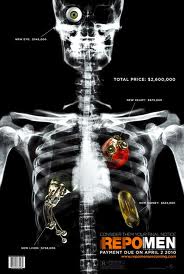
As already noted, the story opens on the US in the near future. Artificial organs, joints, and even a neurological matrix, have revolutionized life by ensuring that the terminally ill, crippled and people near brain death can live on happily, assuming they can pay of course!

Small hints are given as to what is going on in the world at large, all of it quite familiar and relateable to today. On the one hand, there is loose talk of an ongoing debt crisis and a crippled economy. There’s also the passing mention of US soldiers gearing up to go into Nigeria in what has been deemed “Operation: Hope Springs Eternal” (a parody on “Operation: Restore Hope” or “Operation: Iraqi Freedom” perhaps?)

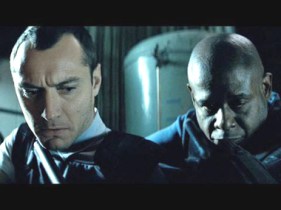
Into all this, we get Remy (Jude Law) who appears to be writing a manifesto of sorts. He opens it with a reference to Schrodinger’s Cat, which any fan of Big Bang Theory will instantly recognize. He wonders how anything could be considered both alive and dead in the same instant, clearly alleging that his story illustrates just that. The movie then opens in a flashback sequence, all things building towards his session in a slum with an antiquated typewriter.

Basically, Remy was a Repo Man who, alongside his age-old friend and army buddy Jake Freivald (Forest Whitaker), is considered the best in the business. However, Remy’s wife would prefer it if he transferred to sales and stopped doing the grisly work of harvesting people’s organs for money. He agrees, but also tells Jake he will do one last job. He is nearly killed when his equipment (a defibrillator) shorts out and nearly kills him. He wakes up in the hospital and is told that he will need an artificial heart now. His angry, panicked reaction tells us all we need to know about his feelings on that 😉 After years of watching others get screwed over by The Union, he now is facing that very thing himself.

Naturally, he tries to go back to Repo’ing since his wife has already left him and he needs the money. But somehow, he just can’t bring himself to do it anymore. What’s more, time is running out on him making his payments. During a final attempt, he goes into a “Nest” – a slum area where people go to flee The Union’s repo men – where he is attacked and knocked unconscious.

He awakens to find a woman named Beth (Alice Braga) – a lounge singer that he’s seen playing clubs before – living in one of the abandoned buildings and decides to help her. After standing watch as she goes through withdrawal, he agrees to help her since they are in the same boat. Seems she has mucho enhancements, including artificial joints, organs, eyes, and ears.

He breaks into the company storeroom and begins filing the bar codes off of all the spare parts they currently have. No bar codes, no scans will be able to detect that they have organs with are past due. However, Remy is caught by his friend and told to get out while he can. Back at their slum lair, Beth has set him up with an old typewriter she found. He sets to work banging out a “cautionary tale” about what he did and what he’s learned, until at last a repo man finds them and they are forced to kill him. Naturally, Remy outsmarts the man and he dies, but Beth is injured in the course of things. They are then forced to find a black market dealer who will fix her up, which takes them to another “Nest”.

Unfortunately, Jake finds them there and reveals to Remy that he is responsible for shorting out his defibrillator. By forcing him to meet the payments of an artificial organ, he figured his friend would never leave the business. The two fight, and in the course of it, Remy is knocked unconscious. What follows is a total mind-f*** which is comparable only to Inception! I shall break it down succinctly.

Basically, Remy wakes up to find that Beth incapacitated Jake. They then flee together and decide the only way they can resolve this is to break into corporate HQ, find the “Pink Door” where repo personnel make their returns, and physically scan their organs. After an over-the-top scene where Remy fights everyone between him and the “Pink Door” (which is ridiculously labeled as such), they break in and begin performing field surgery on themselves so they can scan the bar-codes.

Jake and their boss walk in a moment later, and Jake decides to switch sides and kills their boss. They blow up the repossession machine together and escape to the tropics, where Remy has apparently published his manuscript under the name The Repossession Mambo. However, this idyllic scene is interrupted when things begin to get fuzzy and some hiccups appear, as if it were all a recording…

Oh wait, it is! You see, in real life, Remy was rendered near brain-dead from the blow Jake gave him. The medics who arrived shortly thereafter hooked him up to one of the new neurological matrix’s in order to keep up his brain function. Hence, all this stuff about beating the company and escaping to the tropics was all a lie. Jake also tells them to leave Beth (unconscious but not dead) alone for him to deal with later. He then picks up Remy’s manuscript and notices the title, the same one featured in his little reverie.

I seriously wasn’t expecting that, but respected the movie more for the little dystopian twist at the end. It was in keeping with the whole tradition of cyberpunk tales, making sure that things like happy endings only happen in the movies… or not!

Final Thoughts:
I’ll be honest, this movie didn’t suck. It was very hard to take Jude Law seriously as a cynical, bad-guy, but for the most part, it was ably acted. It was also hard to believe that a former jarhead turned repo man, a man who for all intents and purposes seemed to like killing and didn’t care about the pain he caused, could maintain a marriage and a family. Somehow, these two sides of his personality didn’t fit. And lastly, the gore level, especially in that scene behind the “Pink Door” seemed gratuitous. It’s like, if they can invent scanners that can read a bar code through flesh and clothing, why do they need to slice opens their own bodies to scan the bar-codes for the big machine? I might have mentioned that the fight scene which brought them there was also pretty stupid, but of course, that was all in a dream! Technically, it doesn’t count 😉

But other than that, I actually liked this movie. It had plenty of thematic elements which landed for me. For one, there was the issue of a company pressuring people to sign-up for a product no one seemed to be able to afford. The scenes where we see the salespeople do their thing, or the boss’s BS about “you owe it to your family to do this” and “we can come up with a plan that fits your financial standing” were just too perfect. Tell me that wasn’t a parody of the banking industry, pressuring people into taking sub-prime mortgages when they could barely afford their current payments!

What’s more, the high costs of the new organs, which people had to turn to payment plans, credit, and whatever else to afford were clearly a reference to the health care crisis in America. People need life-saving procedures, have no choice but to sign up for them unless they want to die and leave their families behind. But in the end, its more than they can afford, and all the smarmy reassurances of the salespeople can’t change that very fact.

Yeah, it kind of bombed at the box office, but I’m thinking that rentals, DVD sales and Netflix might help it recoup its losses. And I strongly recommend people, at least those who aren’t turned off by blood and gore, take the time to watch it. If you’re a fan of dystopian sci-fi, you might just like it. And if you’re a writer of dystopian sci-fi (for example, me!) then you might just find it inspiring.

Repo Men:
Entertainment Value: 7/10 (not really a nail-biter, but definitely not boring)
Plot: 8/10
Direction: 7/10 (nothing special, but ably shot)
Overall: 7.5/10

Blade Runner!

Third on the queue, the sci-fi and cult classic Blade Runner! Thank God too, since my first two reviews were both about movies I really didn’t like. While it’s fun to bash bad movies, it can leave a bad taste in your mouth. Good movies are like Listerine that way, they cleanse the critical palette, renew your faith in the visual medium. And as promised when I first decided to do reviews, movies based on books would receive special mention, especially movies that differed greatly from the books that inspired them. Truth be told, I had Blade Runner in mind when I made that statement, and a number of other Philip K Dick stories that went on to become films. In fact, the movies Minority Report, Paycheck, Impostor, The Adjustment Bureau, and Screamers were all movies based on Dick’s stories (which I plan to review soon enough!). And in every case, the films were quite different from the original works. You might even say it’s the Philip K Dick curse: to see your novels and short stories inspire film adaptations, but only after you’ve died and always with big changes! And without a doubt, Blade Runner was the most extreme case of this curse at work. In terms of plot, story, and especially tone and setting, the movie was vastly different from the novel. I’d say shame on the people who made this movie, but the truth is, it kind of worked in their favor…

(Background—>)
A few years back, I finally got around to reading Do Androids Dream of Electric Sheep? which was the original title of the novel that would be the basis for the Blade Runner movie. Having already seen the movie, I found the novel quite surprising, and at times, downright odd. But it’s message and style eventually won me over, as did the comical and satirical aspects that Dick made use of. Whereas the movie was set in a Los Angeles of the future – a noire, dystopian crowded cityscape marked by flying cars and massive video advertisements on the sides of skyscrapers – the novel takes place in a relatively depopulated post-apocalyptic LA where the only people who remain are those who are either too poor or don’t have the requisite IQ levels to get a pass off-world. These colonies get a passing mention in the movie in the form of ads being broadcast from flying zeppelins, but the focus is overwhelmingly on life in the city. Another major difference is the lack of satirical consumer goods that were in the original novel: emotional dialers that people use to set their moods and empathy boxes that are basically TV’s that provide an interactive emotional experience. Both were touches of genius, hilarious but also very interesting in how they help to advance the story.

But by far, the greatest difference between the novel and the movie was in terms of theme. Whereas the novel was very much concerned with the fine line between artifice and authenticity (the robots representing the former), the movie depicted the Replicants (the AI’s) as tragic figures who are given the gift of life, only to have it taken away in the form of slavery, four-year lifespans, and “retirement” (i.e. execution) if they break the rules. So really, the book was a touch more simple in how it perceived machines: as cold and heartless, characterized by false animals, false humans, and nuclear arms. The movie depicted this in more complicated terms, blurring the lines between artificial and authentic, human and machine. Whereas in the book we don’t much care about the Replicants, in the movie, they are about the only characters we sympathize with.

(Content—>)
The movie opens on the city of Los Angeles in the future, circa 2019, where a Blade Runner detective has gone to the Tyrell Corp (the maker of Replicants for off-world use) to issue a Voight-Kampff test to one of the employees. This test, we soon learn, measures emotional responses and is the only way to tell the difference between a Replicant and a human. This is because the latest models (known as Nexus 6’s) have surpassed humans in all aspects, but still have a hard time mimicking human emotions. The Tyrell Corporations motto is “more human than human” for a reason, you see. And for reasons of legality that are mentioned in the movie’s preamble, no Replicants are allowed on Earth, so anyone suspected of being one is required to take the test and then “retired” if they fail. Upon realizing why he’s being tested, the employee shoots the Blade Runner and escapes. Guess he failed!

We then move to the character of Rick Deckard (played by Harrison Ford), who is enjoying a bowl of noodles at a street vendor when a bunch of LA police men approach him and demand he come with them. In this scene, we are given a ground level view of the noire city, as well as a taste of cityspeak. This lingo is the language of the street in the Blade Runner universe, a mishmash of various tongues which is illustrated beautifully by the character of Gaff (played by Edward James Olmos). Deckard goes with them and is told by his old chief that he’s needed again, and despite his reluctance, he takes the job. As his boss says, “you’re not cop, you’re little people!”, meaning he really has no choice in the matter. What follows is an admittedly expository scene, but a totally justified one, where we learn who the “bad guys” are as well as some other pertinent facts. For example, we learn that in addition to their difficulty approximating human emotions, Nexus 6’s also have a four year lifespan that ensures that they will never be able to overcome this flaw. Too much time, too many memories, and they might become totally indistinguishable from the rest of us. Spine tingly!

Afterward, Deckard goes to the Tyrell corp to meet the CEO and learn what he can from them. Sidenote: I could be wrong but I think the set designers got an award for the design of this one building. Part sky scraper, part Ziggurat, totally awesome! Here, we meet not only Tyrell himself, but a Replicant named Rachael (played by Sean Young). She represents a new breed of machine specially created by Tyrell to test out a new idea: giving Replicants memories so they’ll have an easier time dealing with emotions. After running the Voight-Kampff test on her, Deckard is both intrigued and frightened by her, a feeling that haunts him for the rest of the movie, and that I believe is meant to represent the love-hate relationship humanity has with technology. What is also interesting is that she doesn’t yet know that she’s a machine, but once the test is done, she overhears Deckard talking to Tyrell and is shattered by the news.

The movie then splits between the Replicant party, led by a unit named Batty (Rutger Hauer) who is trying to find the men most directly responsible for their creation, and Deckard who is trying to find the Replicants and determine why they came to Earth in the first place. In between, there are the scenes that catalog the budding romance between Deckard and Rachael, who herself seems to be torn between her attraction to Deckard on the one hand, and disgust over what he does. This part of the story, more than anything, helps to illustrate the blurred line that exists between artificial and real. While a relationship between the two of them would certainly be considered taboo, neither of them can resist the allure of the other. Over time, Rachael appears to make peace with the fact that she is a machine, and Deckard seems to get over it as well (wink wink!)

Ultimately, Batty and what is left of his companions (because Deckard keeps killing them), make their way to Tyrell himself. Their whole purpose, we learn, was to find a way to extend their lives. What follows is, in my opinion, one of the best scenes in cinematic history. In the course of a very civilized conversation, Batty is told that there is no way to extend his life, and never was. His hopes, and everything they did in order to get to Earth and find Tyrell, were therefore in vain. Tyrell tries to comfort him by telling him that “the candle that burns half as long burns twice as bright.” He further tells him to let go of whatever guilt he harbors for all the things he did to get to Earth and see him, that he should “revel in his time”. But, overcome by anger and grief, Batty kills Tyrell and escapes from the building. One of the things that makes this scene so good is the fact that you genuinely get the feeling that a sort of father-son dynamic (or that of a man meeting his God) is taking place between them. In addition, you can feel the pain being exuded by Hauer as he kills Tyrell. Obviously it pains him to murder his “father”, but he’s got nothing to lose and just needs someone to blame for the fact that he’s going to die and is helpless to do anything about it.

Shortly thereafter, a confrontation ensues between Deckard and Batty at the Replicant’s hideout. And in spite of the fact that Deckard has now killed all his companions and he is poised to deliver the death blow, Batty chooses instead to save his life. His final scene, as he sits half-naked in the rain holding a dove, are yet another example of cinematic genius. “I’ve seen things you people wouldn’t believe…” he says, the rain dripping from his face. “Attack ships on fire off the shoulder of Orion. I watched C-beams glitter in the dark near the Tannhauser gate. All those moments will be lost in time… like tears in rain… Time to die.” So sad, even Harris Ford shed tears, and he’s fricking Han Solo and Indiana Jones! The police then show up, Gaff let’s him know that his girlfriend’s secret is out, but that he left her alone. As he says, “It’s a shame she won’t live. But then again, who does?” Whether or not he’s referring to the fact that she will eventually be hunted down, or to her four year lifespan, is still a bit of a mystery to me. But in either case, by the end, Deckard is finished with being a Blade Runner and runs off with Rachael, finding a measure of redemption through his relationship with her.

(Synopsis—>)
Blade Runner was panned by some critics who didn’t like the pacing of it, and my own wife remarked the first time she saw it that she felt a little let down. But of course she, and I imagine many of those critics, were expected an action movie and not the cinematic tour de force that it was. With a name like Blade Runner, you kinda sorta think it’s going to be an action flick. But upon seeing it for a second time, her feelings changed and she saw the depth it undeniably has. And despite doing poorly at the box office, time has been very good to this movie, elevating it to the status of a cult classic and an example of cinematic gold. In fact, over the years it has appeared on numerous top 100 lists, not only as one of the best sci-fi movies of all time, but also one of the best movies period. Who am to argue? And hell, why would I even want to? I love this movie!

Blade Runner:
Entertainment value: 7/10 (admittedly, bit slow in places)
Plot: 8/10
Direction: 10/10 baby!
Overall: 8.5/10

Of Great Sci-Fi (and other non-affliated) Quotes:

alien-worldRecently, I’ve taken to posting quotes by the great science fiction authors on twitter. Most are from the authors I draw the most inspiration from, others are just from people I admire and who offered some wisdom along the way. Like a true nerd, I keep these things in a file on my computer, adding to it every time I find a new one or think up one myself. Might sound odd but I find it useful, it offers fresh inspiration and perspective whenever I’ve hit a wall or am not sure how a piece of writing is turning out. Today, I thought I’d share a few of the gems that have really inspired me over the years. To be fair, some of them are not science-fiction related, or even by authors; they’re just moments of brilliance captured in an utterance. Here are a few:

“We sit atop a sort of anthill of technologies. At the bottom there’s fire, and growing cereal grains, and learning to store cereal – all those things that people have to store edible energy and start building cities. Not that we’re the crown of creation; we are at the crown of technological creation at any given moment.”
-William Gibson during an interview after writing “Pattern Recognition”

“It’s impossible to move, to live, to operate at any level without leaving traces, bits, seemingly meaningless fragments of personal information.”

“The future has already arrived. It’s just not evenly distributed yet.”

“Cyberspace. A consensual hallucination experienced daily by billions of legitimate operators, in every nation, by children being taught mathematical concepts…”

“When I began to write fiction that I knew would be published as science fiction, [and] part of what I brought to it was the critical knowledge that science fiction was always about the period in which it was written.”

“. . . the street finds its own uses for things.”
-Other tidbits from Gibson, who’s nothing if not prolific in his observations!

“The difference between stupid and intelligent people—and this is true whether or not they are well-educated—is that intelligent people can handle subtlety. They are not baffled by ambiguous or even contradictory situations—in fact, they expect them and are apt to become suspicious when things seem overly straightforward.”
-Neal Stephenson, “The Diamond Age”

“Ronald Reagan has a stack of three-by-five cards in his lap. He skids up a new one: “What advice do you, as the youngest American fighting man ever to win both the Navy Cross and the Silver Star, have for any young marines on their way to Guadalcanal?”
Shaftoe doesn’t have to think very long. The memories are still as fresh as last night’s eleventh nightmare: ten plucky Nips in Suicide Charge!
“Just kill the one with the sword first.”
“Ah,” Reagan says, raising his waxed and penciled eyebrows, and cocking his pompadour in Shaftoe’s direction. “Smarrrt–you target them because they’re the officers, right?”
“No, fuckhead!” Shaftoe yells. “You kill ’em because they’ve got fucking swords! You ever had anyone running at you waving a fucking sword?”
-Stephenson, “Cryptonomicon”. One of the funniest written passages I’ve ever read, and fitting because it puts Reagan in his proper, historically accurate place!

“I just think talk of suffering should be left to those who’ve actually suffered.”
-Jack (a First Nations former student I knew. As soon as he said it, I knew that I had just heard one of the smartest things ever said by anybody, anywhere, ever!)